EP0155193A2 - Testverfahren - Google Patents
Testverfahren Download PDFInfo
- Publication number
- EP0155193A2 EP0155193A2 EP85301836A EP85301836A EP0155193A2 EP 0155193 A2 EP0155193 A2 EP 0155193A2 EP 85301836 A EP85301836 A EP 85301836A EP 85301836 A EP85301836 A EP 85301836A EP 0155193 A2 EP0155193 A2 EP 0155193A2
- Authority
- EP
- European Patent Office
- Prior art keywords
- ligand
- specific binding
- binding partner
- gate electrode
- characteristic
- Prior art date
- Legal status (The legal status is an assumption and is not a legal conclusion. Google has not performed a legal analysis and makes no representation as to the accuracy of the status listed.)
- Granted
Links
Images


Classifications
-
- G—PHYSICS
- G01—MEASURING; TESTING
- G01N—INVESTIGATING OR ANALYSING MATERIALS BY DETERMINING THEIR CHEMICAL OR PHYSICAL PROPERTIES
- G01N33/00—Investigating or analysing materials by specific methods not covered by groups G01N1/00 - G01N31/00
- G01N33/48—Biological material, e.g. blood, urine; Haemocytometers
- G01N33/50—Chemical analysis of biological material, e.g. blood, urine; Testing involving biospecific ligand binding methods; Immunological testing
- G01N33/53—Immunoassay; Biospecific binding assay; Materials therefor
- G01N33/543—Immunoassay; Biospecific binding assay; Materials therefor with an insoluble carrier for immobilising immunochemicals
- G01N33/54366—Apparatus specially adapted for solid-phase testing
- G01N33/54373—Apparatus specially adapted for solid-phase testing involving physiochemical end-point determination, e.g. wave-guides, FETS, gratings
- G01N33/5438—Electrodes
-
- Y—GENERAL TAGGING OF NEW TECHNOLOGICAL DEVELOPMENTS; GENERAL TAGGING OF CROSS-SECTIONAL TECHNOLOGIES SPANNING OVER SEVERAL SECTIONS OF THE IPC; TECHNICAL SUBJECTS COVERED BY FORMER USPC CROSS-REFERENCE ART COLLECTIONS [XRACs] AND DIGESTS
- Y10—TECHNICAL SUBJECTS COVERED BY FORMER USPC
- Y10S—TECHNICAL SUBJECTS COVERED BY FORMER USPC CROSS-REFERENCE ART COLLECTIONS [XRACs] AND DIGESTS
- Y10S435/00—Chemistry: molecular biology and microbiology
- Y10S435/817—Enzyme or microbe electrode
-
- Y—GENERAL TAGGING OF NEW TECHNOLOGICAL DEVELOPMENTS; GENERAL TAGGING OF CROSS-SECTIONAL TECHNOLOGIES SPANNING OVER SEVERAL SECTIONS OF THE IPC; TECHNICAL SUBJECTS COVERED BY FORMER USPC CROSS-REFERENCE ART COLLECTIONS [XRACs] AND DIGESTS
- Y10—TECHNICAL SUBJECTS COVERED BY FORMER USPC
- Y10S—TECHNICAL SUBJECTS COVERED BY FORMER USPC CROSS-REFERENCE ART COLLECTIONS [XRACs] AND DIGESTS
- Y10S436/00—Chemistry: analytical and immunological testing
- Y10S436/806—Electrical property or magnetic property
-
- Y—GENERAL TAGGING OF NEW TECHNOLOGICAL DEVELOPMENTS; GENERAL TAGGING OF CROSS-SECTIONAL TECHNOLOGIES SPANNING OVER SEVERAL SECTIONS OF THE IPC; TECHNICAL SUBJECTS COVERED BY FORMER USPC CROSS-REFERENCE ART COLLECTIONS [XRACs] AND DIGESTS
- Y10—TECHNICAL SUBJECTS COVERED BY FORMER USPC
- Y10S—TECHNICAL SUBJECTS COVERED BY FORMER USPC CROSS-REFERENCE ART COLLECTIONS [XRACs] AND DIGESTS
- Y10S436/00—Chemistry: analytical and immunological testing
- Y10S436/807—Apparatus included in process claim, e.g. physical support structures
Definitions
- the present invention relates to methods of assaying one of a pair of specific binding partners, and to apparatus for carrying out these methods.
- the assay of ligand is determined by monitoring the extent of complex formation, for example by use of chemical or biochemical labels.
- labelling employing radioisotopic, fluorescent or bioluminescent species, spin-labelling or enzyme labelling.
- radioisotopic labels has become particularly widespread, due to the high degree of sensitivity and specificity obtainable.
- an enzyme label which has been employed is an enzyme label.
- the enzyme label is monitored for example by measuring the removal of substrate or the appearance of the product of the enzyme-catalysed substrate reaction by spectrophotometry, nephelometry, fluorimetry or by radiometry.
- Such monitoring techniques may lack the high degree of sensitivity and specificity required for modern assay work. This may be due to the fact that neither the primary nor the secondary reaction is 100% quantitative or there may be inaccuracy in end-point assessment.
- the use of radioactive labels presents the usual problems of safety and short shelf-life of the reagents.
- the chromogens used in spectrophotometric techniques are often carcinogenic.
- the apparatus used with known assay methods of the types mentioned above is not suitable for miniaturisation.
- the methods thus require relatively large amounts of inconvenient or even dangerous reagents and the apparatus tends to be bulky and expensive.
- FET field effect transistors
- the invention provides a method of assaying a ligand in a sample, which comprises contacting the sample with a predetermined quantity of a specific binding partner to the ligand, said specific binding partner being immobilised on the effective gate electrode of a field effect transistor, and determining whether (and, if desired, the extent to which) an appropriate transistor characteristic is changed as a result of complex formation between the ligand and the specific binding partner.
- the assay can be completed from the determined change in the transistor characteristic with reference to calibration data.
- the method of the present invention is applicable both to qualitative and to quantitative assays.
- effective gate electrode refers to an electrode functioning as the gate electrode of the FET. It will be appreciated that the construction of an effective gate electrode may differ considerably from that of conventional gate electrodes. The construction of effective gate electrodes is described below.
- a predetermined quantity of a specific binding partner is immobilised on the effective gate electrode.
- the specific binding partner may be present in a quantity greater than, equivalent to or less than the quantity of ligand present in the sample.
- the change in the transistor characteristic may be determined as an absolute change observed after the complexing reaction has been allowed to proceed for a controlled period of time, or a rate of change of that characteristic with respect to time.
- the initial rate of change may conveniently be measured. The method used will always, however, be consistent with the method employed in the calibration experiments.
- the specific binding partner In the "absolute” mode, the specific binding partner will typically be present in a quantity greater than or equivalent to the quantity of ligand present in the sample.
- the specific binding partner may be present in a quantity greater than, equivalent to or less than the quantity of ligand present in the sample.
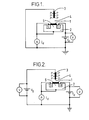
- a gate insulator 1 (preferably ion-insensitive) of insulating material [e.g. silicon dioxide, silicon nitride (which may for example have been treated with sodium hydroxide to reduce pH sensitivity) or paralene (which may for example have been deposited under vacuum thereby giving an ion-insensitive FET)] approximately 1000 A in thickness covers the surface of a p-type silicon substrate 2 between two diffusions of n-type silicon (the 'source' area S and 'drain' area D).
- An effective gate electrode 3 on which is immobilised a predetermined quantity of the specific binding partner P lies over the gate insulator and an electrolyte 4 is present in contact with the electrode and the insulator.
- V T threshold potential
- the threshold potential VT of the FET will vary with individual devices. It can have a value of zero or can have a positive or negative non- zero value. As mentioned above, a suitable FET for use in the present invention may have a V T of approximately -0.5 V so that the device may be "on" without the immobilised specific binding partner being subjected to a large local electric field.
- any change in the other characteristic will be due directly to complex formation between the specific binding partner and the ligand under assay. If in addition, the parameters of V d , pH, ionic strength and temperature are maintained constant and/or variations therein compensated for, such a change will be due solely to complex formation.
- the pH may, for example, be controlled by the use of buffers.
- a method of assay as herein described wherein the change in one transistor characteristic selected from the drain current characteristic and the gate electrode potential characteristic as a result of complex formation is determined, the other characteristic and optionally also the drain potential V d , the pH and ionic strength of the assay medium and the temperature of the system being maintained constant or variations therein compensated for.
- the nature of the effective gate electrode may be varied to suit the assay conditions.
- Particularly suitable for the assays of the present invention is a titanium dioxide gate electrode which may be chemically activated to permit coupling with the specific binding partner.
- a conventional glass-bodied calomel electrode, a Ag/AgCl electrode, or any other suitable gate electrode may be used. Techniques for immobilising specific binding partners to glass and metal oxide surfaces are well-known in the art.
- a reference electrode may act as a secondary gate electrode or may be used with a second FET, the outputs of the two transistors being monitored differentially. If appropriate, such an electrode may be chemically activated in an analagous way to the primary gate electrode, although not carrying specific binding partner. Furthermore, non-specific effects may be reduced by the covering the electrode bearing the immobilised specific binding partner with a membrane which is either permeable to, or perm-selective for, the ligand under assay. The reference system may also be protected by such a membrane.
- apparatus for carrying out the assay methods as herein described, which apparatus includes a field effect transistor, the effective gate electrode of which has the specific binding partner immobilised thereon, and optionally a reference electrode.
- An aqueous assay medium may be present, comprising a suitable pH buffer, which may advantageously act as an electrolyte. Means may be provided for incubating the assay mixture at any desired temperature.
- the aqueous assay medium and the sample to be assayed may conveniently be introduced in any desired order through an entry port provided in the apparatus.
- the apparatus will generally further comprise a suitable electrical circuit.
- the apparatus may be pre-calibrated and provided with a scale whereby the change in the appropriate transistor characteristic may be read off directly as an amount of ligand in the sample.
- the invention will be particularly described hereinafter with reference to an antibody or an antigen as a ligand.
- the invention is not to be taken as being limited to assays of antibodies or antigens. Examples of ligands which may be assayed by the method of the invention are given in Table I below, together with an indication of a suitable specific binding partner in each instance.
- the method of the invention is particularly suitable for assaying the following ligands: Hormones, including peptide hormones (e.g. thyroid stimulating hormone (TSH), lutenising hormone (LH), follicle stimulating hormone (FSH), insulin and prolactin) and non-peptide hormones (such as thyroxine and tri-iodothyronine), proteins, including human chorionic gonadotrophin (HCG), carcinoembryonic antigen (CEA ⁇ and alphafetoprotein (AFP), drugs (e.g. digoxin), sugars, toxins and vitamins.
- TSH thyroid stimulating hormone
- LH lutenising hormone
- FSH follicle stimulating hormone
- insulin and prolactin insulin and prolactin
- non-peptide hormones such as thyroxine and tri-iodothyronine
- proteins including human chorionic gonadotrophin (HCG), carcinoembryonic antigen (CEA ⁇ and alphafeto
- antigen as used herein will be understood to include both permanently antigenic species (for example, proteins, bacteria, bacteria fragments, cells, cell fragments and viruses) and haptens which may be rendered antigenic under suitable conditions.
- Immobilisation of an antibody or antigen molecule onto a gate electrode may be effected by various methods.
- the attachment of the antibody or antigen to the electrode can be via any portion of the molecular structure so long as specific immunological activity is retained at the antibody or antigen binding site.
- the electrode and/or the antibody or antigen may be chemically modified to permit successful attachment.
- a titanium dioxide electrode carrying immobilised antibody may be prepared by heating a titanium wire at about 1000°C to form a thin oxide layer on its surface, contacting it firstly with a basic solution of cyanogen bromide and then with a basic solution of the antibody, and finally deactivating with urea the remaining active sites which have not taken up antibody.
- a titanium dioxide electrode carrying immobilised protein e.g.
- an enzyme such as glucose oxidase may be prepared by heating a titanium wire at about 900 - 1000 6 C and allowing it to cool to form a thin titanium dioxide layer on its surface, silanising it (for example by contacting with a solution of X-aminopropyltriethoxysilane in an appropriate solvent, e.g. acetone and subsequently evaporating the solvent) and then contacting it with firstly a solution of glutaraldehyde and secondly with a solution of the protein, and finally washing and deactivating the remaining active sites with urea.
- a reference electrode may be prepared in analogous ways but omitting the stage of contacting the wire with the solution of the antibody or protein.
- Electrode-immobilisation of an antibody or antigen reagent may also for example be achieved by bonding interactions between functional groups on the antibody or antigen molecule and the electrode, or by cross-linking or adsorption onto the surface of the electrode. Binding of reagents to the electrode may generally be accomplished by methods analogous to known methods of binding such reagents to solid supports (e.g. particles and beads), for example those described in European Patent Application No. 83305834.0.
- the magnitude of the change in transistor characteristic due to complexing between an antibody and antigen will typically be of the order of millivolts or milliamperes.
- the magnitude may vary due, inter alia, to the particular electrode used, the pH of the medium, the purity of the reagent used on the electrode and the ionic strength of the medium, and such parameters must therefore be consistent between the calibration experiments and the assay methods.
- Titanium rods (2 cm long x 0.2 cm diameter) were heated for 12 hours at +900°C and then allowed - to cool overnight, thus growing a thin layer of titanium dioxide on the surface.
- Silanisation of the rods was achieved by adding them to a 1% (v/v) solution of ⁇ -aminopropyltriethoxysilane in acetone and evaporating to dryness. The rods were then baked at 80°C for 22 hours.
- the rods were soaked in a 2.5% (v/v) solution of- glutaraldehyde in phosphate buffer (50 mM, pH 7.4) for 22 hours at 25°C. After thorough washing with deionised water, the rods were contacted with a solution of glucose oxidase (0.33 mg/ml in phosphate buffer, 50 mM, pH 7.4)'overnight at 4°C. After thorough washing with deionised water and soaking with 6M urea to remove any adsorbed enzyme the rods were assayed for glucose oxidate activity.
- a control rod was produced by following the above procedure but not contacting the rod with glucose oxidase.
Landscapes
- Health & Medical Sciences (AREA)
- Immunology (AREA)
- Life Sciences & Earth Sciences (AREA)
- Engineering & Computer Science (AREA)
- Molecular Biology (AREA)
- Biomedical Technology (AREA)
- Chemical & Material Sciences (AREA)
- Hematology (AREA)
- Urology & Nephrology (AREA)
- Biotechnology (AREA)
- Microbiology (AREA)
- Cell Biology (AREA)
- Food Science & Technology (AREA)
- Medicinal Chemistry (AREA)
- Physics & Mathematics (AREA)
- Analytical Chemistry (AREA)
- Biochemistry (AREA)
- General Health & Medical Sciences (AREA)
- General Physics & Mathematics (AREA)
- Pathology (AREA)
- Measuring Or Testing Involving Enzymes Or Micro-Organisms (AREA)
- Investigating Or Analysing Biological Materials (AREA)
Applications Claiming Priority (2)
| Application Number | Priority Date | Filing Date | Title |
|---|---|---|---|
| GB8406955 | 1984-03-16 | ||
| GB848406955A GB8406955D0 (en) | 1984-03-16 | 1984-03-16 | Assay |
Publications (3)
| Publication Number | Publication Date |
|---|---|
| EP0155193A2 true EP0155193A2 (de) | 1985-09-18 |
| EP0155193A3 EP0155193A3 (en) | 1989-01-25 |
| EP0155193B1 EP0155193B1 (de) | 1992-06-24 |
Family
ID=10558221
Family Applications (1)
| Application Number | Title | Priority Date | Filing Date |
|---|---|---|---|
| EP85301836A Expired - Lifetime EP0155193B1 (de) | 1984-03-16 | 1985-03-15 | Testverfahren |
Country Status (8)
| Country | Link |
|---|---|
| US (1) | US4778769A (de) |
| EP (1) | EP0155193B1 (de) |
| AU (1) | AU578075B2 (de) |
| CA (1) | CA1241695A (de) |
| DE (1) | DE3586254T2 (de) |
| GB (1) | GB8406955D0 (de) |
| IL (1) | IL74570A (de) |
| ZA (1) | ZA851971B (de) |
Cited By (8)
| Publication number | Priority date | Publication date | Assignee | Title |
|---|---|---|---|---|
| FR2599844A1 (fr) * | 1986-06-09 | 1987-12-11 | Centre Nat Rech Scient | Phase solide conductrice pour dosage immunoenzymatique, son procede de preparation et son utilisation dans des procedes de dosage immunoenzymatique |
| WO1988008875A1 (en) * | 1987-05-05 | 1988-11-17 | The Washington Technology Center | Cycling biochip sensor |
| EP0245477A4 (de) * | 1985-11-19 | 1989-08-09 | Univ Johns Hopkins | Kapazitiver sensor für chemische analyse und messung. |
| US4927502A (en) * | 1989-01-31 | 1990-05-22 | Board Of Regents, The University Of Texas | Methods and apparatus using galvanic immunoelectrodes |
| EP0328380A3 (en) * | 1988-02-10 | 1990-06-27 | Nec Corporation | Electrochemical sensors in immunological measurement |
| EP0395137A3 (de) * | 1989-04-21 | 1991-06-12 | ENIRICERCHE S.p.A. | Sensor mit einem Antigen, das chemisch an eine Halbleitervorrichtung gebunden ist |
| US5074977A (en) * | 1987-05-05 | 1991-12-24 | The Washington Technology Center | Digital biosensors and method of using same |
| WO2013008062A1 (en) * | 2011-07-12 | 2013-01-17 | Centre National De La Recherche Scientifique (Cnrs) | Non covalent molecular structure, comprising a pyrene based glycoconjugate, device comprising the same and its use for detection of lectin |
Families Citing this family (27)
| Publication number | Priority date | Publication date | Assignee | Title |
|---|---|---|---|---|
| EP0315788B1 (de) * | 1987-10-13 | 1992-12-09 | Taiyo Yuden Co., Ltd. | Ionensensor |
| US4973910A (en) * | 1988-01-14 | 1990-11-27 | Wilson Mahlon S | Surface potential analyzer |
| US5057430A (en) * | 1988-09-15 | 1991-10-15 | Biotronic Systems Corporation | Biochemical sensor responsive to bubbles |
| US6306594B1 (en) | 1988-11-14 | 2001-10-23 | I-Stat Corporation | Methods for microdispensing patterened layers |
| US5200051A (en) * | 1988-11-14 | 1993-04-06 | I-Stat Corporation | Wholly microfabricated biosensors and process for the manufacture and use thereof |
| AU9113991A (en) * | 1990-11-19 | 1992-06-11 | Biotechnology Research And Development Corporation | Mutant orientable proteins and coated substrates |
| US5494831A (en) * | 1993-08-30 | 1996-02-27 | Hughes Aircraft Company | Electrochemical immunosensor system and methods |
| AU1061997A (en) | 1995-11-30 | 1997-06-19 | Wlodek Mandecki | Screening of drugs from chemical combinatorial libraries employing transponders |
| US6051377A (en) * | 1995-11-30 | 2000-04-18 | Pharmaseq, Inc. | Multiplex assay for nucleic acids employing transponders |
| US6001571A (en) * | 1995-11-30 | 1999-12-14 | Mandecki; Wlodek | Multiplex assay for nucleic acids employing transponders |
| US5641634A (en) * | 1995-11-30 | 1997-06-24 | Mandecki; Wlodek | Electronically-indexed solid-phase assay for biomolecules |
| US5736332A (en) * | 1995-11-30 | 1998-04-07 | Mandecki; Wlodek | Method of determining the sequence of nucleic acids employing solid-phase particles carrying transponders |
| US5981166A (en) * | 1997-04-23 | 1999-11-09 | Pharmaseq, Inc. | Screening of soluble chemical compounds for their pharmacological properties utilizing transponders |
| JP3612675B2 (ja) * | 1997-06-05 | 2005-01-19 | 日本光電工業株式会社 | pH変化誘因性物質または生物体の測定装置及び測定方法 |
| US5940212A (en) * | 1997-10-30 | 1999-08-17 | 3M Innovative Properties Company | Cube corner article with altered inactive areas and method of making same |
| EP1030912A4 (de) | 1997-11-14 | 2007-01-10 | California Inst Of Techn | Vorrichtung für die zellyse |
| AU2002311951A1 (en) * | 2001-05-18 | 2002-12-03 | Regents Of The University Of Minnesota | Metal/metal oxide electrode as ph-sensor and methods of production |
| US6653653B2 (en) | 2001-07-13 | 2003-11-25 | Quantum Logic Devices, Inc. | Single-electron transistors and fabrication methods in which a projecting feature defines spacing between electrodes |
| US6483125B1 (en) | 2001-07-13 | 2002-11-19 | North Carolina State University | Single electron transistors in which the thickness of an insulating layer defines spacing between electrodes |
| DE10163557B4 (de) * | 2001-12-21 | 2007-12-06 | Forschungszentrum Jülich GmbH | Transistorbasierter Sensor mit besonders ausgestalteter Gateelektrode zur hochempfindlichen Detektion von Analyten |
| US6673717B1 (en) | 2002-06-26 | 2004-01-06 | Quantum Logic Devices, Inc. | Methods for fabricating nanopores for single-electron devices |
| GB0322010D0 (en) * | 2003-09-19 | 2003-10-22 | Univ Cambridge Tech | Detection of molecular interactions using field effect transistors |
| JP3874772B2 (ja) * | 2004-07-21 | 2007-01-31 | 株式会社日立製作所 | 生体関連物質測定装置及び測定方法 |
| JP4081477B2 (ja) * | 2005-03-29 | 2008-04-23 | 株式会社日立製作所 | 生体分子検出装置及びそれを用いた生体分子検出方法 |
| US8653839B2 (en) * | 2009-07-17 | 2014-02-18 | Caterpillar Inc. | Zinc oxide sulfur sensors and method of using said sensors |
| US8373206B2 (en) | 2010-07-20 | 2013-02-12 | Nth Tech Corporation | Biosensor apparatuses and methods thereof |
| US10378044B1 (en) * | 2013-10-01 | 2019-08-13 | FemtoDx | Methods for increasing the molecular specificity of a nanosensor |
Family Cites Families (11)
| Publication number | Priority date | Publication date | Assignee | Title |
|---|---|---|---|---|
| ZA704115B (en) * | 1969-06-23 | 1971-03-31 | Miles Lab | Apparatus and method for the determination of substances in test reaction systems |
| US4020830A (en) * | 1975-03-12 | 1977-05-03 | The University Of Utah | Selective chemical sensitive FET transducers |
| SE407115B (sv) * | 1975-10-06 | 1979-03-12 | Kabi Ab | Forfarande och metelektroder for studium av enzymatiska och andra biokemiska reaktioner |
| US4238757A (en) * | 1976-03-19 | 1980-12-09 | General Electric Company | Field effect transistor for detection of biological reactions |
| US4273636A (en) * | 1977-05-26 | 1981-06-16 | Kiyoo Shimada | Selective chemical sensitive field effect transistor transducers |
| JPS5539042A (en) * | 1978-09-14 | 1980-03-18 | Tokyo Daigaku | Ion selecting field-effect sensor |
| GB2096824A (en) * | 1981-04-09 | 1982-10-20 | Sibbald Alastair | Chemically sensitive field effect transistor |
| US4411741A (en) * | 1982-01-12 | 1983-10-25 | University Of Utah | Apparatus and method for measuring the concentration of components in fluids |
| SE8200442L (sv) * | 1982-01-27 | 1983-07-28 | Forsvarets Forsknings | Forfarande vid detektion av organiska molekyler, sasom biomolekyler |
| GB8314523D0 (en) * | 1983-05-25 | 1983-06-29 | Lowe C R | Diagnostic device |
| EP0170446B1 (de) * | 1984-07-10 | 1991-03-06 | Serono Diagnostics Limited | Testverfahren |
-
1984
- 1984-03-16 GB GB848406955A patent/GB8406955D0/en active Pending
-
1985
- 1985-03-12 IL IL74570A patent/IL74570A/xx not_active IP Right Cessation
- 1985-03-15 ZA ZA851971A patent/ZA851971B/xx unknown
- 1985-03-15 DE DE8585301836T patent/DE3586254T2/de not_active Expired - Lifetime
- 1985-03-15 US US06/712,193 patent/US4778769A/en not_active Expired - Lifetime
- 1985-03-15 CA CA000476608A patent/CA1241695A/en not_active Expired
- 1985-03-15 EP EP85301836A patent/EP0155193B1/de not_active Expired - Lifetime
- 1985-03-15 AU AU40002/85A patent/AU578075B2/en not_active Expired
Cited By (10)
| Publication number | Priority date | Publication date | Assignee | Title |
|---|---|---|---|---|
| EP0245477A4 (de) * | 1985-11-19 | 1989-08-09 | Univ Johns Hopkins | Kapazitiver sensor für chemische analyse und messung. |
| FR2599844A1 (fr) * | 1986-06-09 | 1987-12-11 | Centre Nat Rech Scient | Phase solide conductrice pour dosage immunoenzymatique, son procede de preparation et son utilisation dans des procedes de dosage immunoenzymatique |
| WO1987007725A1 (fr) * | 1986-06-09 | 1987-12-17 | Centre National De La Recherche Scientifique (Cnrs | Procede cyclique de dosage immunoenzymatique d'un ligand |
| WO1988008875A1 (en) * | 1987-05-05 | 1988-11-17 | The Washington Technology Center | Cycling biochip sensor |
| US5074977A (en) * | 1987-05-05 | 1991-12-24 | The Washington Technology Center | Digital biosensors and method of using same |
| EP0328380A3 (en) * | 1988-02-10 | 1990-06-27 | Nec Corporation | Electrochemical sensors in immunological measurement |
| US4927502A (en) * | 1989-01-31 | 1990-05-22 | Board Of Regents, The University Of Texas | Methods and apparatus using galvanic immunoelectrodes |
| EP0395137A3 (de) * | 1989-04-21 | 1991-06-12 | ENIRICERCHE S.p.A. | Sensor mit einem Antigen, das chemisch an eine Halbleitervorrichtung gebunden ist |
| US5160597A (en) * | 1989-04-21 | 1992-11-03 | Eniricerche S.P.A. | Sensor with antigen chemically bonded to a semiconductor device |
| WO2013008062A1 (en) * | 2011-07-12 | 2013-01-17 | Centre National De La Recherche Scientifique (Cnrs) | Non covalent molecular structure, comprising a pyrene based glycoconjugate, device comprising the same and its use for detection of lectin |
Also Published As
| Publication number | Publication date |
|---|---|
| CA1241695A (en) | 1988-09-06 |
| EP0155193B1 (de) | 1992-06-24 |
| DE3586254T2 (de) | 1993-02-11 |
| AU578075B2 (en) | 1988-10-13 |
| IL74570A0 (en) | 1985-06-30 |
| IL74570A (en) | 1990-02-09 |
| EP0155193A3 (en) | 1989-01-25 |
| AU4000285A (en) | 1985-09-19 |
| GB8406955D0 (en) | 1984-04-18 |
| DE3586254D1 (de) | 1992-07-30 |
| US4778769A (en) | 1988-10-18 |
| ZA851971B (en) | 1986-05-28 |
Similar Documents
| Publication | Publication Date | Title |
|---|---|---|
| US4778769A (en) | Methods of electrochemical assay employing a field effect transistor | |
| EP0163312A2 (de) | Immunotest | |
| Meyerhoff et al. | Novel nonseparation sandwich-type electrochemical enzyme immunoassay system for detecting marker proteins in undiluted blood | |
| EP0207152B1 (de) | Festphasendiffusionstextverfahren | |
| JPH0239747B2 (de) | ||
| US4670383A (en) | Immune-chemical measurement process for haptens and proteins | |
| EP0149602A1 (de) | Immunometrische bestimmung in der polyklonale und monoklonale antikörper verwendet werden und ein testsatz dafür | |
| HK1000970B (en) | Solid phase diffusion assay | |
| Robinson et al. | Bioelectrochemical immunoassay for human chorionic gonadotrophin in serum using an electrode-immobilised capture antibody | |
| US5236849A (en) | Method of high sensitivity immunoassay | |
| KR100231628B1 (ko) | 당단백질의 분리 및 측정 방법 | |
| Robinson et al. | Bioelectrochemical enzyme immunoassay of human choriogonadotropin with magnetic electrodes. | |
| EP0303229B1 (de) | Hoch empfindlicher Immunoassay | |
| JPH081438B2 (ja) | 酵素免疫測定法 | |
| Boitieux et al. | Oxygen electrode-based enzyme immunoassay for the amperometric determination of hepatitis B surface antigen | |
| IE850007L (en) | Process and reagent for the determination of a polyvalent¹antigen | |
| JPH0285755A (ja) | 免疫センサ | |
| EP0328380A2 (de) | Elektrochemische Sensoren für immunologische Testverfahren | |
| EP0155135B1 (de) | Testverfahren | |
| EP0125368B1 (de) | Verfahren zur immunologischen Bestimmung durch Reaktionsgeschwindigkeits-Potentiometrie unter Verwendung von fluoridionenselektiver Elektrode | |
| EP0488195B1 (de) | Chemilumineszierender Immunotest | |
| Anderson et al. | Internally referenced ImmunoConcentration assays. | |
| JP2000180446A (ja) | 干渉作用を回避する方法及び試薬 | |
| Karube et al. | A catalytic immuno-reactor for the amperometric determination of human serum albumin | |
| JPH052940B2 (de) |
Legal Events
| Date | Code | Title | Description |
|---|---|---|---|
| PUAI | Public reference made under article 153(3) epc to a published international application that has entered the european phase |
Free format text: ORIGINAL CODE: 0009012 |
|
| AK | Designated contracting states |
Designated state(s): BE CH DE FR GB IT LI NL SE |
|
| PUAL | Search report despatched |
Free format text: ORIGINAL CODE: 0009013 |
|
| AK | Designated contracting states |
Kind code of ref document: A3 Designated state(s): BE CH DE FR GB IT LI NL SE |
|
| 17P | Request for examination filed |
Effective date: 19890717 |
|
| 17Q | First examination report despatched |
Effective date: 19901123 |
|
| GRAA | (expected) grant |
Free format text: ORIGINAL CODE: 0009210 |
|
| AK | Designated contracting states |
Kind code of ref document: B1 Designated state(s): BE CH DE FR GB IT LI NL SE |
|
| ITF | It: translation for a ep patent filed | ||
| REF | Corresponds to: |
Ref document number: 3586254 Country of ref document: DE Date of ref document: 19920730 |
|
| ET | Fr: translation filed | ||
| PLBE | No opposition filed within time limit |
Free format text: ORIGINAL CODE: 0009261 |
|
| STAA | Information on the status of an ep patent application or granted ep patent |
Free format text: STATUS: NO OPPOSITION FILED WITHIN TIME LIMIT |
|
| 26N | No opposition filed | ||
| ITTA | It: last paid annual fee | ||
| EAL | Se: european patent in force in sweden |
Ref document number: 85301836.4 |
|
| REG | Reference to a national code |
Ref country code: GB Ref legal event code: 732E |
|
| REG | Reference to a national code |
Ref country code: CH Ref legal event code: PUE Owner name: SERONO DIAGNOSTICS LIMITED TRANSFER- SERONO DIAGNO |
|
| NLS | Nl: assignments of ep-patents |
Owner name: LABORATOIRES SERONO S.A.;SERONO DIAGNOSTIC S.A. |
|
| REG | Reference to a national code |
Ref country code: FR Ref legal event code: TP Ref country code: FR Ref legal event code: CD |
|
| BECA | Be: change of holder's address |
Free format text: 960508 S.A. LABORATOIRES *SERONO:ZONE INDUSTRIELLE DE L'OURIETTAZ, 1170 AUBONNE |
|
| BECH | Be: change of holder |
Free format text: 960508 S.A. LABORATOIRES *SERONO |
|
| REG | Reference to a national code |
Ref country code: GB Ref legal event code: IF02 |
|
| PGFP | Annual fee paid to national office [announced via postgrant information from national office to epo] |
Ref country code: SE Payment date: 20040304 Year of fee payment: 20 |
|
| PGFP | Annual fee paid to national office [announced via postgrant information from national office to epo] |
Ref country code: FR Payment date: 20040309 Year of fee payment: 20 |
|
| PGFP | Annual fee paid to national office [announced via postgrant information from national office to epo] |
Ref country code: NL Payment date: 20040310 Year of fee payment: 20 Ref country code: GB Payment date: 20040310 Year of fee payment: 20 |
|
| PGFP | Annual fee paid to national office [announced via postgrant information from national office to epo] |
Ref country code: CH Payment date: 20040317 Year of fee payment: 20 |
|
| PGFP | Annual fee paid to national office [announced via postgrant information from national office to epo] |
Ref country code: DE Payment date: 20040325 Year of fee payment: 20 |
|
| PGFP | Annual fee paid to national office [announced via postgrant information from national office to epo] |
Ref country code: BE Payment date: 20040518 Year of fee payment: 20 |
|
| PG25 | Lapsed in a contracting state [announced via postgrant information from national office to epo] |
Ref country code: LI Free format text: LAPSE BECAUSE OF EXPIRATION OF PROTECTION Effective date: 20050314 Ref country code: GB Free format text: LAPSE BECAUSE OF EXPIRATION OF PROTECTION Effective date: 20050314 Ref country code: CH Free format text: LAPSE BECAUSE OF EXPIRATION OF PROTECTION Effective date: 20050314 |
|
| PG25 | Lapsed in a contracting state [announced via postgrant information from national office to epo] |
Ref country code: NL Free format text: LAPSE BECAUSE OF EXPIRATION OF PROTECTION Effective date: 20050315 |
|
| BE20 | Be: patent expired |
Owner name: S.A. LABORATOIRES *SERONO Effective date: 20050315 |
|
| REG | Reference to a national code |
Ref country code: GB Ref legal event code: PE20 |
|
| REG | Reference to a national code |
Ref country code: CH Ref legal event code: PL |
|
| NLV7 | Nl: ceased due to reaching the maximum lifetime of a patent |
Effective date: 20050315 |
|
| EUG | Se: european patent has lapsed | ||
| BE20 | Be: patent expired |
Owner name: S.A. LABORATOIRES *SERONO Effective date: 20050315 |