EP0155568A2 - Verfahren zur Reinigung verengter Bereiche auf der Sekundärseite eines Dampferzeugers - Google Patents
Verfahren zur Reinigung verengter Bereiche auf der Sekundärseite eines Dampferzeugers Download PDFInfo
- Publication number
- EP0155568A2 EP0155568A2 EP85102296A EP85102296A EP0155568A2 EP 0155568 A2 EP0155568 A2 EP 0155568A2 EP 85102296 A EP85102296 A EP 85102296A EP 85102296 A EP85102296 A EP 85102296A EP 0155568 A2 EP0155568 A2 EP 0155568A2
- Authority
- EP
- European Patent Office
- Prior art keywords
- secondary side
- steam generator
- cleaning agent
- solution
- deposits
- Prior art date
- Legal status (The legal status is an assumption and is not a legal conclusion. Google has not performed a legal analysis and makes no representation as to the accuracy of the status listed.)
- Granted
Links
Images
Classifications
-
- F—MECHANICAL ENGINEERING; LIGHTING; HEATING; WEAPONS; BLASTING
- F28—HEAT EXCHANGE IN GENERAL
- F28G—CLEANING OF INTERNAL OR EXTERNAL SURFACES OF HEAT-EXCHANGE OR HEAT-TRANSFER CONDUITS, e.g. WATER TUBES OR BOILERS
- F28G13/00—Appliances or processes not covered by groups F28G1/00 - F28G11/00; Combinations of appliances or processes covered by groups F28G1/00 - F28G11/00
-
- F—MECHANICAL ENGINEERING; LIGHTING; HEATING; WEAPONS; BLASTING
- F22—STEAM GENERATION
- F22B—METHODS OF STEAM GENERATION; STEAM BOILERS
- F22B37/00—Component parts or details of steam boilers
- F22B37/02—Component parts or details of steam boilers applicable to more than one kind or type of steam boiler
- F22B37/48—Devices or arrangements for removing water, minerals or sludge from boilers ; Arrangement of cleaning apparatus in boilers; Combinations thereof with boilers
- F22B37/483—Devices or arrangements for removing water, minerals or sludge from boilers ; Arrangement of cleaning apparatus in boilers; Combinations thereof with boilers specially adapted for nuclear steam generators
Definitions
- the present invention generally relates to a process for cleaning of certain inaccessible flow-restricted areas in the secondary side of a nuclear steam generator, and more specifically a nuclear steam generator to remove corrosion products or sludge, such as those which collect on the tubesheet, or in the tubesheet and tube support crevices.
- a pressurized fluid is passed through the reactor core and, after being heated in the core, is passed through heat transfer tubes that are positioned in a secondary side of a steam generator.
- the heat transfer tubes transfer heat to a secondary fluid to produce steam that is then used to operate a turbine for production of electrical power.
- flushing operations have been proposed to periodically remove as much of the impurities from the flow restricted areas as possible.
- a flashing operation may be effected, for example, by introducing a quantity of water into the secondary side of the steam generator while the pressurized water reactor system is at cold shutdown, applying a nitrogen overpressure, heating the steam generator to about 140°C using the reactor coolant pumps, and then depressurizing the generator by opening of power-operated relief valves. The valves are subsequently closed and the cycle is repeated.
- Such a procedure somewhat helps to remove sludge from the tubesheet and from crevices found in the secondary side.
- the invention in its broad form comprises a process for cleaning flow-restricted areas of a steam generator to remove undesirable deposits on its secondary side, through which areas heat-transfer tubes of the steam generator primary side pass, the cleaning being done with an aqueous solution of an organic cleaning agent which will solubilize said deposits collected in said secondary side, comprising the process steps of: a) heating the interior of the secondary side of the steam generator, raising an aqueous organic cleaning agent solution to an elevated temperature by passage of heated fluid through the primary side of the steam generator and through heat transfer tubes passing through said secondary side, while maintaining said secondary side at an initial pressure which will prevent boiling of the aqueous organic cleaning agent solution at said elevated temperature; b) reducing the pressure in the secondary side of the steam generator, while maintaining said heating, so as to cause localized flashing and boiling of the aqueous organic cleaning agent solution therein, such that the concentration of said aqueous organic cleaning agent is increased in the region of said restricted areas; c) maintaining said reduced pressure in the secondary side of the steam generator, while maintaining said heating
- the deposits collected in the secondary side of a steam generator of a nuclear power plant system are solubilized in an aqueous organic cleaning agent by localized flashing and boiling of the cleaning agent solution in those restricted areas with resultant concentration of the cleaning agent solution in the restricted areas.
- a supply of aqueous organic cleaning agent solution is charged to the secondary side and the solution heated, by passage of heated fluid through the heat transfer tubes passing through the secondary side, while an initial pressure is maintained in the secondary side to prevent boiling of the solution.
- the pressure in the secondary side is then reduced, while heating is maintained, such that localized flashing and boiling of the aqueous organic cleaning agent solution is effected in the restricted areas with a resultant increase in the concentration of the solution in the restricted areas.
- the pressure is returned to at least the initial pressure, solubilization of the deposits effected, and the aqueous cleaning agent solution containing solubilized deposits is withdrawn from the secondary side of the steam generator.
- the heating, pressurization, depressurization and repressurization may be repeated more than once prior to the withdrawing of the solution, or a series of the pressurization, depressurization, repressurization and withdrawing steps may be effected using fresh supplies of cleaning agent solution.
- an elevated temperature of about 120-135°C is used along with an initial pressure of about 2-3 atmospheres, while in removing copper-containing deposits, hydrogen peroxide or other oxidant is added to the aqueous organic cleaning agent solution and an elevated temperature of about 30-40°C used along with an initial pressure of no higher than 0.15 atmosphere.
- the sludge and deposits that tend to collect in the restricted areas of a steam generator secondary side are removed therefrom by an aqueous cleaning solution, containing organic cleaning agent, with the concentration of the cleaning solution increased in the region of said restricted areas.
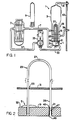
- a nuclear steam supply system 1 containing a steam generator 3.
- a pressurized fluid is passed through the reactor 5, then after being heated, through line 7, which contains a pressurizer 9, (on one loop only) to the steam generator 3.
- the heated fluid enters the primary side 11 of the steam generator 3 which is divided in half by a vertical divider plate 13 into an inlet section 15 and outlet section 17.
- a tubesheet 19 divides the steam generator 3 into the primary side 11 and a secondary side 29.
- the tubesheet 19 is provided with an array of holes 21 through which several thousand U-shaped heat transfer tubes 23 are inserted.
- the U-shaped tubes 23 each have leg portions- 25 and a U-bend portion 27.
- leg portions 25 are inserted into corresponding holes 21 on opposite sides of the tubesheet 19 so that one end communicates with the inlet section 15 and the other end communicates with the outlet section 17.
- the leg portions 25 of the U-shaped tubes 23 are supported and stabilized on the secondary side 29 of the generator 3 by a series of separator plates 31 which are stabilized axially by tie rods.
- the heated pressurized fluid entering the inlet section 15 of the primary side 11 circulates through the U-shaped tubes 23 and exits the outlet section 17 of the primary side 11 to a line 33 which passes the fluid to a coolant pump 35 and then through line 37 back to the reactor 5 in a continuous closed loop.
- Secondary water is introduced into the secondary side 29 of the steam generator 3 through secondary water inlet 39, and circulates around the U-shaped tubes 23 where it is .converted into steam by heat released by the primary coolant passing through tubes 23.
- the steam produced in the secondary side 29 rises into a steam drum (not shown), where water droplets are removed by demisters, and passes out of the steam generator 3 through a secondary outlet 41 for use in driving of turbines to produce energy, condenses in a condenser, outside a containment 43, and returns to the secondary inlet 39 of the steam generator 3 in a continuous loop.
- the loop also contains conventional relief valves, and steam dump valves (not shown).
- the time required for the complete cleaning of a sludge pile or packed crevice may be unacceptably long from an operational standpoint and be too risky for the generator components.
- the chief concern with on-line, or power operation mode, cleaning agent applications is that the cleaning agent is likely to disassociate at operating temperatures and local corrosion rates may be unpredictable.
- the disassociation products may produce turbine corrosion concerns which have not yet been evaluated.
- chemical cleaning has not yet been applied to any large nuclear steam generator after the unit has commenced operation.
- the present process differs from existing cleaning processes in that the organic cleaning agent is transported into the flow restricted areas of the steam generator by convection rather than by diffusion and is concentrated in the flow restricted areas by boiling processes. As a consequence, the rate of ingress of the cleaning agent into the flow restricted areas is increased compared to diffusion controlled processes and the bulk concentration of the organic cleaning agent required for the cleaning of the flow restricted area can be substantially reduced.
- the convective and concentration mode of cleaning of the present invention is produced by depressurizing the secondary side of the steam generator, containing an aqueous organic cleaning agent solution, at temperatures of between about 120-135°C, maintaining the secondary side of the steam generator in a depressurized state for a period of time, and then repressurizing the generator, and repeating these steps to solubilize deposits therein.
- Depressurizing the generator produces flashing and boiling of the aqueous organic cleaning agent solution within the generator.
- the boiling processes should continue as long as the generator is depressurized. These boiling processes are analogous to the boiling processes which occur during power operation, so that the cleaning agent solution should be concentrated in the flow restricted areas at which cor- rodants can be concentrated during power operation.
- the corrosion products within the flow restricted areas are solubilized by the concentrated cleaning agent solution.
- Application of a nitrogen gas overpressure will accelerate the penetration of the concentrated solution into the restricted areas following the repressurization so that vapor within the flow restricted areas is collapsed.
- concentration process may result in the local precipitation of the organic cleaning agent, the precipitate should then return to solution as the dissolution process dilutes the cleaning agent concentration.
- the amount of organic acid such as ethylenediaminetetraacetic acid (EDTA) or citric acid was in the range of 7.5-20 percent by weight.
- EDTA ethylenediaminetetraacetic acid
- citric acid citric acid
- an aqueous solution of an organic cleaning agent is charged to the secondary side of the steam generator while the plant is at cold shutdown.
- the organic cleaning agents are selected from conventional cleaning agents useful in solubilizing deposits formed in a steam generator, and will vary depending upon the particular deposits that are to be removed from the generator and upon the constituents occupying the pores of the deposit.
- a useful solution would comprise ethylenediaminetetraacetic acid (EDTA), hydrazine, a corrosion inhibitor, ammonium hydroxide and a dispersant, in water.
- EDTA ethylenediaminetetraacetic acid
- hydrazine hydrazine
- ammonium hydroxide a corrosion inhibitor
- dispersant a dispersant
- a useful solution would comprise EDTA, a corrosion inhibitor, a surfactant, and triethanolamine in water.
- a useful solution would comprise EDTA, citric acid, ascorbic acid, hydrazine, a hydroxy substituted amine such as tetrakis (2-hydroxypropyl ethylenediamine), a surfactant, a corrosion inhibitor, and triethanolamine, in water.
- the interior of the secondary side is heated to a temperature of between 120-135°C by passage of heated fluid through the primary side of the steam generator and through the heat transfer tubes, which fluid can be heated by operating the coolant pump in the primary system.
- This heating will increase the pressure to about 3 atmospheres.
- a nitrogen overpressure of about 0.5-1 atmosphere is maintained over the secondary side of the steam generator containing the cleaning solution. The nitrogen overpressure aids in controlling the concentration of cleaning agent achieved in the generator and prevents boiling from occurring except when desired.
- the pressure in the secondary side is reduced by opening of existing valves, with nitrogen gas and steam bled off from the generator, while maintaining the heating through the heat transfer tubes.
- the reduction in pressure causes localized flashing and boiling of the aqueous organic cleaning agent solution in the secondary side of the steam generator, while increasing the concentration of the cleaning agent solution in the flow restricted areas.
- the reduction in pressure, with continued heating, is maintained for a period of time to concentrate the solution in the restricted areas.
- the time will very depending upon the type of deposit and the amount of the deposits present.
- the steam generator is repressurized to the initial elevated pressure.
- the solution, with concentration achieved in the restricted areas, is maintained in the secondary side for a period of time sufficient to substantially fully solubilize the deposits.
- the cleaning agent solution containing the solubilized deposits is then drained from the generator.
- the pressurization and depressurization may be repeated after addition of a fresh supply of the aqueous organic cleaning agent solution.
- the initial supply of cleaning agent solution may be subjected to additional pressurization and depressurization steps, while maintained at the elevated temperature, prior to draining of the same from the generator.
- the initial supply of cleaning agent will be drained from the steam generator after a single depressurization step, while subsequent supplies of cleaning agent solution will be subjected to more than one pressurization and depressurization step prior to being drained from the generator. The steps are repeated until the deposits have been removed from the generator.
- copper-bearing deposits can be removed from the secondary side of the steam generator by the use of a lower temperature and pressure, and addition of an oxidant such as hydrogen peroxide, to the organic cleaning solution.
- an oxidant such as hydrogen peroxide
- the aforedescribed process steps are carried out except that the temperature to which the cleaning agent solution is heated in the secondary side of the steam generator should be in the range of between about 30-40°C, and the pressure would be a subatmospheric pressure, no higher than 0.15 atmosphere, throughout the secondary coolant system including the secondary side of the steam generator.
- the particular temperature and pressure would depend upon the conditions to be used. For example, using a temperature of about 38°C, the pressure would be about 0.065 atmosphere, so as to prevent boiling and flashing of the cleaning agent solution until desired.
- Cleaning agent solutions for copper deposit removal would, for example, contain EDTA, hydrogen peroxide, ammonium hydroxide, ethylenediamine and a dispersant.
- the present process provides an accelerated chemical cleaning of the restricted areas of a steam generator by concentration of the cleaning agent solution in the restricted areas of the secondary side.
- concentration of the cleaning agent solution in the restricted areas of the secondary side is usable while effecting efficient cleaning of the restricted areas.
Landscapes
- Engineering & Computer Science (AREA)
- Physics & Mathematics (AREA)
- Mechanical Engineering (AREA)
- General Engineering & Computer Science (AREA)
- High Energy & Nuclear Physics (AREA)
- Thermal Sciences (AREA)
- Chemical & Material Sciences (AREA)
- Combustion & Propulsion (AREA)
- Cleaning By Liquid Or Steam (AREA)
- Devices For Medical Bathing And Washing (AREA)
- Cleaning And De-Greasing Of Metallic Materials By Chemical Methods (AREA)
Applications Claiming Priority (2)
| Application Number | Priority Date | Filing Date | Title |
|---|---|---|---|
| US591638 | 1984-03-20 | ||
| US06/591,638 US4632705A (en) | 1984-03-20 | 1984-03-20 | Process for the accelerated cleaning of the restricted areas of the secondary side of a steam generator |
Publications (3)
| Publication Number | Publication Date |
|---|---|
| EP0155568A2 true EP0155568A2 (de) | 1985-09-25 |
| EP0155568A3 EP0155568A3 (en) | 1986-06-04 |
| EP0155568B1 EP0155568B1 (de) | 1989-05-31 |
Family
ID=24367260
Family Applications (1)
| Application Number | Title | Priority Date | Filing Date |
|---|---|---|---|
| EP85102296A Expired EP0155568B1 (de) | 1984-03-20 | 1985-03-01 | Verfahren zur Reinigung verengter Bereiche auf der Sekundärseite eines Dampferzeugers |
Country Status (7)
| Country | Link |
|---|---|
| US (1) | US4632705A (de) |
| EP (1) | EP0155568B1 (de) |
| JP (1) | JPS60213896A (de) |
| KR (1) | KR940000359B1 (de) |
| CA (1) | CA1240574A (de) |
| DE (1) | DE3570736D1 (de) |
| ES (1) | ES8701352A1 (de) |
Cited By (4)
| Publication number | Priority date | Publication date | Assignee | Title |
|---|---|---|---|---|
| EP0265549A1 (de) * | 1986-10-30 | 1988-05-04 | Anco Engineers Inc. | Druckpulsierendes Reinigungsverfahren für einen Rohrbündelwärmetauscher |
| EP0458533A1 (de) * | 1990-05-18 | 1991-11-27 | Westinghouse Electric Corporation | Druckpulsierendes chemisches Reinigungsverfahren von Dampferzeugern |
| EP0484042A1 (de) * | 1990-10-29 | 1992-05-06 | Westinghouse Electric Corporation | Methode zum Beseitigen von Schlamm und Ablagerungen aus dem Inneren eines Wärmetauscherbehälters |
| DE19544225A1 (de) * | 1995-11-28 | 1997-06-05 | Asea Brown Boveri | Reinigung des Wasser-Dampfkreislaufs in einem Zwangsdurchlauferzeuger |
Families Citing this family (22)
| Publication number | Priority date | Publication date | Assignee | Title |
|---|---|---|---|---|
| US4769085A (en) * | 1983-08-26 | 1988-09-06 | Innus Industrial Nuclear Services S.A. | Method for cleaning a steam generator |
| DE3533886A1 (de) * | 1985-04-16 | 1987-03-26 | Kraftwerk Union Ag | Reinigungsverfahren |
| US5225087A (en) * | 1991-05-10 | 1993-07-06 | Westinghouse Electric Corp. | Recovery of EDTA from steam generator cleaning solutions |
| US5257296A (en) * | 1991-10-25 | 1993-10-26 | Buford Iii Albert C | Steam generator chemical solvent mixing system and method |
| US5276965A (en) * | 1992-02-13 | 1994-01-11 | The Atlantic Group, Inc. | Method for dismantling potentially contaminated tubes from a tube bundle |
| DE4216383A1 (de) * | 1992-05-18 | 1993-11-25 | Siemens Ag | Verfahren zum Reinigen eines geschlossenen Behälters |
| US5413168A (en) * | 1993-08-13 | 1995-05-09 | Westinghouse Electric Corporation | Cleaning method for heat exchangers |
| DE69506605T2 (de) * | 1994-03-17 | 1999-07-08 | Calgon Corp., Pittsburgh, Pa. | Verfahren zur Kontrolle und zum Entfernen von einer Feststoffablagerung auf einer Oberfläche eines Dampferzeugungsanlagebestandteils |
| US5587025A (en) * | 1995-03-22 | 1996-12-24 | Framatome Technologies, Inc. | Nuclear steam generator chemical cleaning passivation solution |
| US5841826A (en) * | 1995-08-29 | 1998-11-24 | Westinghouse Electric Corporation | Method of using a chemical solution to dislodge and dislocate scale, sludge and other deposits from nuclear steam generators |
| FR2764364B1 (fr) * | 1997-06-05 | 1999-09-03 | Framatome Sa | Procede de nettoyage d'un generateur de vapeur d'un reacteur nucleaire refroidi par de l'eau sous pression |
| FR2765720B1 (fr) * | 1997-07-01 | 1999-10-01 | Framatome Sa | Procede de nettoyage de la partie secondaire d'un generateur de vapeur d'un reacteur nucleaire refroidi par de l'eau sous pression |
| US6740168B2 (en) * | 2001-06-20 | 2004-05-25 | Dominion Engineering Inc. | Scale conditioning agents |
| DE10238730A1 (de) * | 2002-08-23 | 2004-03-04 | Framatome Anp Gmbh | Verfahren zur Reinigung des Dampferzeugers eines Druckwasserreaktors |
| US20100199929A1 (en) * | 2004-03-25 | 2010-08-12 | Remark John F | Steam generator thermal venting |
| US7857911B2 (en) * | 2004-04-01 | 2010-12-28 | Asml Netherlands B.V. | Scale conditioning agents and treatment method |
| US7302917B2 (en) * | 2004-09-29 | 2007-12-04 | Framatome Anp, Inc. | Chemical cleaning of a steam generator during mode 5 generator shut down |
| CN103155047B (zh) * | 2010-07-21 | 2016-08-03 | 加拿大原子能有限公司 | 反应堆去污方法和试剂 |
| KR101181584B1 (ko) * | 2010-09-28 | 2012-09-10 | 순천향대학교 산학협력단 | 침적 슬러지의 물리화학적 세정방법 |
| JP6104580B2 (ja) * | 2012-12-03 | 2017-03-29 | 三菱重工業株式会社 | 狭隘部の腐食生成物や塩分の除去方法及び狭隘部の洗浄装置 |
| EP3051247B1 (de) | 2013-09-24 | 2017-11-15 | GD Energy Services S.a.r.l. | Verfahren zur chemischen reinigung eines wärmetauschers |
| US9751114B2 (en) | 2015-07-23 | 2017-09-05 | Renmatix, Inc. | Method and apparatus for removing a fouling substance from a pressured vessel |
Family Cites Families (7)
| Publication number | Priority date | Publication date | Assignee | Title |
|---|---|---|---|---|
| US2123434A (en) * | 1934-12-13 | 1938-07-12 | Du Pont | Process of cleaning |
| US3329528A (en) * | 1963-04-19 | 1967-07-04 | Midland Ross Corp | Treating narrow passages with a fluid |
| NL149551B (nl) * | 1964-08-04 | 1976-05-17 | Dow Chemical Co | Werkwijze voor het reinigen en passiveren van ijzerhoudende metaaloppervlakken, waarop metallisch koper is afgezet. |
| US3854996A (en) * | 1972-04-27 | 1974-12-17 | Halliburton Co | Method for removing magnetite scale |
| JPS54120449A (en) * | 1978-03-10 | 1979-09-19 | Mitsubishi Heavy Ind Ltd | Method and apparatus for cleansing minute gaps |
| US4238244A (en) * | 1978-10-10 | 1980-12-09 | Halliburton Company | Method of removing deposits from surfaces with a gas agitated cleaning liquid |
| US4320528A (en) * | 1980-01-23 | 1982-03-16 | Anco Engineers, Inc. | Ultrasonic cleaner |
-
1984
- 1984-03-20 US US06/591,638 patent/US4632705A/en not_active Expired - Lifetime
-
1985
- 1985-02-27 CA CA000475277A patent/CA1240574A/en not_active Expired
- 1985-03-01 DE DE8585102296T patent/DE3570736D1/de not_active Expired
- 1985-03-01 EP EP85102296A patent/EP0155568B1/de not_active Expired
- 1985-03-15 ES ES541332A patent/ES8701352A1/es not_active Expired
- 1985-03-20 KR KR1019850001827A patent/KR940000359B1/ko not_active Expired - Lifetime
- 1985-03-20 JP JP60054729A patent/JPS60213896A/ja active Granted
Cited By (5)
| Publication number | Priority date | Publication date | Assignee | Title |
|---|---|---|---|---|
| EP0265549A1 (de) * | 1986-10-30 | 1988-05-04 | Anco Engineers Inc. | Druckpulsierendes Reinigungsverfahren für einen Rohrbündelwärmetauscher |
| EP0458533A1 (de) * | 1990-05-18 | 1991-11-27 | Westinghouse Electric Corporation | Druckpulsierendes chemisches Reinigungsverfahren von Dampferzeugern |
| EP0484042A1 (de) * | 1990-10-29 | 1992-05-06 | Westinghouse Electric Corporation | Methode zum Beseitigen von Schlamm und Ablagerungen aus dem Inneren eines Wärmetauscherbehälters |
| DE19544225A1 (de) * | 1995-11-28 | 1997-06-05 | Asea Brown Boveri | Reinigung des Wasser-Dampfkreislaufs in einem Zwangsdurchlauferzeuger |
| US5840130A (en) * | 1995-11-28 | 1998-11-24 | Asea Brown Boveri Ag | Cleaning of the water/steam circuit in a once-through forced-flow steam generator |
Also Published As
| Publication number | Publication date |
|---|---|
| US4632705A (en) | 1986-12-30 |
| CA1240574A (en) | 1988-08-16 |
| JPH039439B2 (de) | 1991-02-08 |
| ES541332A0 (es) | 1986-11-16 |
| JPS60213896A (ja) | 1985-10-26 |
| KR940000359B1 (ko) | 1994-01-17 |
| DE3570736D1 (en) | 1989-07-06 |
| KR850007697A (ko) | 1985-12-07 |
| EP0155568B1 (de) | 1989-05-31 |
| EP0155568A3 (en) | 1986-06-04 |
| ES8701352A1 (es) | 1986-11-16 |
Similar Documents
| Publication | Publication Date | Title |
|---|---|---|
| EP0155568B1 (de) | Verfahren zur Reinigung verengter Bereiche auf der Sekundärseite eines Dampferzeugers | |
| DE69302590T2 (de) | Verfahren zur Entfernung von Kohlendioxid aus Verbrennungsabgasen | |
| EP0914482B1 (de) | Verfahren und vorrichtung zur rückextraktion von metallchelaten | |
| KR100189168B1 (ko) | 원자로의 피동 격납용기 냉각장치 | |
| US5601657A (en) | Two-step chemical cleaning process | |
| US5841826A (en) | Method of using a chemical solution to dislodge and dislocate scale, sludge and other deposits from nuclear steam generators | |
| EP0150981B1 (de) | Verfahren zur Vakuumentgasung und Anfüllung eines Reaktorkühlsystems | |
| US4820473A (en) | Method of reducing radioactivity in nuclear plant | |
| DE3018450A1 (de) | Verfahren zur bereitstellung von prozesswaerme fuer hochtemperaturprozesse unter verwendung einer waermepumpe | |
| US4686067A (en) | Process for eliminating deposits formed in a steam generator of a pressurized water nuclear reactor | |
| DE2427539C2 (de) | Gasgekühlter Kernreaktor | |
| Tas et al. | Liquid breeder materials | |
| EP2729936A1 (de) | Einrichtung zur notkühlung einer anlage für exotherme prozesse | |
| EP0679728A1 (de) | Verfahren und Vorrichtung zur Behandlung von metallichem Material | |
| US5517539A (en) | Method of decontaminating a PWR primary loop | |
| US4257819A (en) | Method for flushing out a narrow gap | |
| DE2758866C2 (de) | Toroidaler Reaktor zur Erzeugung von Wärmeenergie aus Fusionsreaktionen | |
| US12198825B2 (en) | Chemical decontamination method | |
| US5742654A (en) | Method and apparatus for enhancing removal of corrosion products from a nuclear reactor piping system | |
| DE2844608A1 (de) | Verfahren zum lagern fluessiger, radioaktiver abfallstoffe | |
| JPS6113198A (ja) | 廃液蒸発装置の除染方法 | |
| EP1101226A2 (de) | Verfahren und vorrichtung zum abtrennen eines neutronenabsorbierenden absorbers von einem kühlmittel | |
| RU2203461C1 (ru) | Способ отмывки парогенератора | |
| Schneidmiller et al. | Development of the Pacific Nuclear High Temperature Steam Generator Cleaning Process | |
| McDonald et al. | Technical considerations relative to removal of sodium from LMFBR components |
Legal Events
| Date | Code | Title | Description |
|---|---|---|---|
| PUAI | Public reference made under article 153(3) epc to a published international application that has entered the european phase |
Free format text: ORIGINAL CODE: 0009012 |
|
| AK | Designated contracting states |
Designated state(s): BE CH DE FR GB IT LI SE |
|
| PUAL | Search report despatched |
Free format text: ORIGINAL CODE: 0009013 |
|
| AK | Designated contracting states |
Kind code of ref document: A3 Designated state(s): BE CH DE FR GB IT LI SE |
|
| 17P | Request for examination filed |
Effective date: 19861117 |
|
| 17Q | First examination report despatched |
Effective date: 19871208 |
|
| ITF | It: translation for a ep patent filed | ||
| GRAA | (expected) grant |
Free format text: ORIGINAL CODE: 0009210 |
|
| AK | Designated contracting states |
Kind code of ref document: B1 Designated state(s): BE CH DE FR GB IT LI SE |
|
| REF | Corresponds to: |
Ref document number: 3570736 Country of ref document: DE Date of ref document: 19890706 |
|
| ET | Fr: translation filed | ||
| PLBE | No opposition filed within time limit |
Free format text: ORIGINAL CODE: 0009261 |
|
| STAA | Information on the status of an ep patent application or granted ep patent |
Free format text: STATUS: NO OPPOSITION FILED WITHIN TIME LIMIT |
|
| 26N | No opposition filed | ||
| PGFP | Annual fee paid to national office [announced via postgrant information from national office to epo] |
Ref country code: FR Payment date: 19901218 Year of fee payment: 7 |
|
| PGFP | Annual fee paid to national office [announced via postgrant information from national office to epo] |
Ref country code: GB Payment date: 19901220 Year of fee payment: 7 |
|
| PGFP | Annual fee paid to national office [announced via postgrant information from national office to epo] |
Ref country code: SE Payment date: 19901227 Year of fee payment: 7 |
|
| PGFP | Annual fee paid to national office [announced via postgrant information from national office to epo] |
Ref country code: BE Payment date: 19910114 Year of fee payment: 7 |
|
| PGFP | Annual fee paid to national office [announced via postgrant information from national office to epo] |
Ref country code: CH Payment date: 19910328 Year of fee payment: 7 |
|
| PGFP | Annual fee paid to national office [announced via postgrant information from national office to epo] |
Ref country code: DE Payment date: 19910330 Year of fee payment: 7 |
|
| ITTA | It: last paid annual fee | ||
| PG25 | Lapsed in a contracting state [announced via postgrant information from national office to epo] |
Ref country code: GB Effective date: 19920301 |
|
| PG25 | Lapsed in a contracting state [announced via postgrant information from national office to epo] |
Ref country code: SE Effective date: 19920302 |
|
| PG25 | Lapsed in a contracting state [announced via postgrant information from national office to epo] |
Ref country code: LI Effective date: 19920331 Ref country code: CH Effective date: 19920331 Ref country code: BE Effective date: 19920331 |
|
| BERE | Be: lapsed |
Owner name: WESTINGHOUSE ELECTRIC CORP. Effective date: 19920331 |
|
| GBPC | Gb: european patent ceased through non-payment of renewal fee | ||
| PG25 | Lapsed in a contracting state [announced via postgrant information from national office to epo] |
Ref country code: FR Effective date: 19921130 |
|
| REG | Reference to a national code |
Ref country code: CH Ref legal event code: PL |
|
| PG25 | Lapsed in a contracting state [announced via postgrant information from national office to epo] |
Ref country code: DE Effective date: 19921201 |
|
| REG | Reference to a national code |
Ref country code: FR Ref legal event code: ST |
|
| EUG | Se: european patent has lapsed |
Ref document number: 85102296.2 Effective date: 19921005 |