EP0155606A2 - Thermoplastisch verarbeitbare polyvinylalkohol-Kompositionnen, Verfahren zu ihrer Herstellung und daraus hergestellte Folien und Formteile - Google Patents
Thermoplastisch verarbeitbare polyvinylalkohol-Kompositionnen, Verfahren zu ihrer Herstellung und daraus hergestellte Folien und Formteile Download PDFInfo
- Publication number
- EP0155606A2 EP0155606A2 EP85102682A EP85102682A EP0155606A2 EP 0155606 A2 EP0155606 A2 EP 0155606A2 EP 85102682 A EP85102682 A EP 85102682A EP 85102682 A EP85102682 A EP 85102682A EP 0155606 A2 EP0155606 A2 EP 0155606A2
- Authority
- EP
- European Patent Office
- Prior art keywords
- polyvinyl alcohol
- weight
- parts
- water
- soluble
- Prior art date
- Legal status (The legal status is an assumption and is not a legal conclusion. Google has not performed a legal analysis and makes no representation as to the accuracy of the status listed.)
- Granted
Links
Classifications
-
- C—CHEMISTRY; METALLURGY
- C08—ORGANIC MACROMOLECULAR COMPOUNDS; THEIR PREPARATION OR CHEMICAL WORKING-UP; COMPOSITIONS BASED THEREON
- C08K—Use of inorganic or non-macromolecular organic substances as compounding ingredients
- C08K5/00—Use of organic ingredients
- C08K5/04—Oxygen-containing compounds
- C08K5/05—Alcohols; Metal alcoholates
- C08K5/053—Polyhydroxylic alcohols
-
- C—CHEMISTRY; METALLURGY
- C08—ORGANIC MACROMOLECULAR COMPOUNDS; THEIR PREPARATION OR CHEMICAL WORKING-UP; COMPOSITIONS BASED THEREON
- C08L—COMPOSITIONS OF MACROMOLECULAR COMPOUNDS
- C08L29/00—Compositions of homopolymers or copolymers of compounds having one or more unsaturated aliphatic radicals, each having only one carbon-to-carbon double bond, and at least one being terminated by an alcohol, ether, aldehydo, ketonic, acetal or ketal radical; Compositions of hydrolysed polymers of esters of unsaturated alcohols with saturated carboxylic acids; Compositions of derivatives of such polymers
- C08L29/02—Homopolymers or copolymers of unsaturated alcohols
- C08L29/04—Polyvinyl alcohol; Partially hydrolysed homopolymers or copolymers of esters of unsaturated alcohols with saturated carboxylic acids
-
- C—CHEMISTRY; METALLURGY
- C08—ORGANIC MACROMOLECULAR COMPOUNDS; THEIR PREPARATION OR CHEMICAL WORKING-UP; COMPOSITIONS BASED THEREON
- C08L—COMPOSITIONS OF MACROMOLECULAR COMPOUNDS
- C08L33/00—Compositions of homopolymers or copolymers of compounds having one or more unsaturated aliphatic radicals, each having only one carbon-to-carbon double bond, and only one being terminated by only one carboxyl radical, or of salts, anhydrides, esters, amides, imides or nitriles thereof; Compositions of derivatives of such polymers
- C08L33/24—Homopolymers or copolymers of amides or imides
-
- C—CHEMISTRY; METALLURGY
- C08—ORGANIC MACROMOLECULAR COMPOUNDS; THEIR PREPARATION OR CHEMICAL WORKING-UP; COMPOSITIONS BASED THEREON
- C08L—COMPOSITIONS OF MACROMOLECULAR COMPOUNDS
- C08L39/00—Compositions of homopolymers or copolymers of compounds having one or more unsaturated aliphatic radicals, each having only one carbon-to-carbon double bond, and at least one being terminated by a single or double bond to nitrogen or by a heterocyclic ring containing nitrogen; Compositions of derivatives of such polymers
- C08L39/04—Homopolymers or copolymers of monomers containing heterocyclic rings having nitrogen as ring member
- C08L39/06—Homopolymers or copolymers of N-vinyl-pyrrolidones
Definitions
- the invention relates to thermoplastically processable compositions of polyvinyl alcohol, a plasticizer, water and an inhibitor, a process for the production of these compositions and films and molded parts produced from these compositions, in particular blown films, which, even after prolonged storage at high temperature and under the action of an aggressive The atmosphere remains soluble in cold water.
- Cold water-soluble films made of polyvinyl alcohol are used as packaging for aggressive and toxic substances that are used in solution or dispersed in water.
- the packaging in the cold-water-soluble film makes the handling of such substances, for example crop protection agents or cleaners, easier and safer, because direct contact with the substances is avoided when producing solutions or dispersions.
- Polyvinyl alcohols that are soluble in water of at most 40 ° C are considered to be soluble in cold water.
- a disadvantage of the previously known packaging films made of polyvinyl alcohol is that they are changed under the influence of aggressive media, in particular hydrogen chloride, bleaching agents such as sodium chlorite or cleaners which contain amidosulfonic acid, during prolonged storage at high temperatures so that they do not change in cold water are more soluble.
- aggressive media in particular hydrogen chloride, bleaching agents such as sodium chlorite or cleaners which contain amidosulfonic acid, during prolonged storage at high temperatures so that they do not change in cold water are more soluble.
- the shelf life of such packs is therefore limited.
- thermoplastically processable polyvinyl alcohol compositions by adding amines failed, since such compositions already undergo severe yellowing during thermoplastic processing be changed so that the cold water solubility is lost.
- polyacrylamide means that the melt viscosity of the polyvinyl alcohol compositions increases so much that thermoplastic processing, in particular into blown films, is no longer possible.
- thermoplastically processable polyvinyl alcohol compositions do not have the disadvantages described if they contain 0.5 to 10 parts by weight, preferably 1 to 4 parts by weight, of a water-soluble polymer or copolymer per 100 parts by weight of polyvinyl alcohol contain, which consists of at least 70 wt .-% of monomer units which are at least monosubstituted carboxamides on the amido nitrogen.
- additives examples include homopolymers or copolymers of N-vinylpyrrolidone, 2-acrylamido-2-methyl-propanesulfonic acid in the form of the alkali metal or ammonium salt and N-vinyl-N-methyl-acetamide.
- Suitable grades of polyvinyl alcohol are basically all types that are soluble in cold water.
- plasticizers known per se are added.
- Preferred plasticizers are polyfunctional aliphatic alcohols with a boiling point of more than 250 ° C. in combination with water. Examples of such alcohols are trimethylolpropane, diglycol (2,2'-dihydroxy-diethyl ether) and glycerin.
- the amount depends on the degree of polymerization and the residual acetyl content of the polyvinyl alcohol. The lower the residual acetyl content and the degree of polymerization of the polyvinyl alcohol, the higher it is. As a rule, an addition of 2 to 15 parts by weight of the polyfunctional alcohol to 100 parts by weight of polyvinyl alcohol is sufficient.
- the required addition of water is usually 1 to 5 parts by weight per 100 parts by weight of polyvinyl alcohol.
- the procedure is expediently such that the polyvinyl alcohol, the grain size of which should advantageously be at least 70% in the range from 0.4 to 4.0 mm, with the carboxamide-containing polymer, which is preferably powdery, and whose particle size should not be more than 300 microns, mixed and then the water and alcohol are added and mixed with temperature increase to about 60 to 120 ° C, preferably 60 to 80 ° C until the mixture after Going through a gelling phase becomes grainy again.
- the polyvinyl alcohol the grain size of which should advantageously be at least 70% in the range from 0.4 to 4.0 mm
- the carboxamide-containing polymer which is preferably powdery, and whose particle size should not be more than 300 microns
- the temperature of the mixture rises to 70 ° C. within 15 minutes; then the stirrer speed is reduced to 600 min- 1 and the mixer wall is cooled with cold water.
- the result is a free-flowing polyvinyl alcohol composition as non-dusting and non-adhesive granules.
- the polyvinyl alcohol composition obtained according to Example 1 was subjected to a throughput with the aid of a commercially available single-screw extruder with a length of 25 D and a screw speed of 50 min -1 in a temperature range between 200 to 170 ° C. (blow head), a melt pressure at the blow head of 250 bar of 75 g. min-1 and a take-off speed of 6 m - min -1 processed into a blown film in which the inflation ratio between the die head diameter and the bladder was 1: 7.
- the result was a transparent, non-blocking extrusion blown film with a thickness of 30 ⁇ m, which quickly dissolves in water at 15 ° C.
- Bags made of the polyvinyl alcohol film were sealed on a film sealing apparatus, each with 10 g of a dry mixture of a finely divided silica were filled with 1% concentrated hydrochloric acid and sealed. To avoid air access and humidity, these bags were packed airtight in polyethylene and aluminum foil and stored in a drying cabinet for 4 weeks at a temperature of 50 ° C.
- the stirrer is stirred at 1200 min-1 with the highest number of revolutions.
- the temperature of the mixture rises to 60 ° C. within 15 minutes; then the stirrer speed is reduced to 600 min- 1 and the mixer wall is cooled with cold water.
- Example la the polyvinyl alcohol composition obtained in Example 2 is processed in a single-screw extruder to give a perfect, fish-eye-free and non-blocking blown film of 30 ⁇ m.
- bags are also welded with this film and filled with 10 g of the finely divided silica containing hydrogen chloride, and packed airtight in polyethylene and aluminum film to avoid air access and air humidity.
- bags were filled with the chemically inert sorbitol according to Example 1. After 4 weeks of storage of the bags at 50 ° C. in a drying cabinet, the bags were then attempted to dissolve in water at 15 ° C. Both the bags filled with sorbitol and those with the finely divided silica containing hydrogen chloride dissolved without residue within 5 minutes with stirring.
- the batch is drained from the kettle at 55 ° C.
- the result was a free-flowing, non-dusting and non-blocking granular polyvinyl alcohol composition.
- Example 3 The composition obtained according to Example 3 is processed to the blown extrusion film as in Examples la) and 2a). This creates a non-blocking, clear polyvinyl alcohol film of 30 ⁇ m.
- this template is mixed within 1 min with a solution of 195 g of trimethylolpropane, dissolved in 125 g of water.
- the temperature of the mixture rises to 70 ° C. within 15 minutes due to the heat of friction; the stirrer speed is then reduced to 60 min -1 and the mixer wall is cooled with cold water.
- the mixture is then mixed with 36 g of a finely divided, siliconized silica at a temperature of 65 ° C.
- the batch is drained from the kettle at 60 ° C.
- the result was a free-flowing, non-dusting and non-sticky, granular polyvinyl alcohol composition.
- the blend prepared above is also processed into a blown extrusion film of 30 ⁇ m.
Landscapes
- Chemical & Material Sciences (AREA)
- Health & Medical Sciences (AREA)
- Chemical Kinetics & Catalysis (AREA)
- Medicinal Chemistry (AREA)
- Polymers & Plastics (AREA)
- Organic Chemistry (AREA)
- Compositions Of Macromolecular Compounds (AREA)
- Manufacture Of Macromolecular Shaped Articles (AREA)
- Laminated Bodies (AREA)
- Addition Polymer Or Copolymer, Post-Treatments, Or Chemical Modifications (AREA)
- Processes Of Treating Macromolecular Substances (AREA)
Abstract
Description
- Gegenstand der Erfindung sind thermoplastisch verarbeitbare Kompositionen aus Polyvinylalkohol, einem Weichmacher, Wasser und einem Inhibitor, ein Verfahren zur Herstellung dieser Kompositionen und aus diesen Kompositionen hergestellte Folien und Formteile, insbesondere Blasfolien, die auch nach längerer Lagerung bei hoher Temperatur und unter der Einwirkung einer aggressiven Atmosphäre kaltwasserlöslich bleiben.
- Kaltwasserlösliche Folien aus Polyvinylalkohol werden als Verpackung für aggressive und giftige Substanzen verwendet, die in Wasser gelöst oder dispergiert zur Anwendung kommen. Durch die Verpackung in der kaltwasserlöslichen Folie wird die Handhabung solcher Substanzen, beispielsweise von Pflanzenschutzmitteln oder Reinigern, erleichtert und sicherer gemacht, weil bei der Herstellung von Lösungen oder Dispersionen der unmittelbare Kontakt mit den Substanzen vermieden wird. Als kaltwasserlöslich gelten Polyvinylalkohole, die in Wasser von höchstens 40°C löslich sind.
- Ein Nachteil der bisher bekannten Verpackungsfolien aus Polyvinylalkohol besteht darin, daß sie unter der Einwirkung aggressiver Medien, insbesondere von Chlorwasserstoff, von Bleichmitteln wie Natriumchlorit oder Reinigern, die Amidosulfonsäure enthalten, bei längerer Lagerung bei hohen Temperaturen so verändert werden, daß sie in kaltem Wasser nicht mehr löslich sind. Die Lagerfähigkeit solcher Packungen ist daher beschränkt.
- Versuche, thermoplastisch verarbeitbare Polyvinylalkohol- Kompositionen durch Zusatz von Aminen zu stabilisieren schlugen fehl, da solche Kompositionen bereits bei der thermoplastischen Verarbeitung unter starker Vergilbung so verändert werden, daß die Kaltwasserlöslichkeit verloren geht.
- Ein Zusatz von Polyacrylamid führt dazu, daß die Schmelzviskosität der Polyvinylalkohol-Kompositionen so stark ansteigt, daß eine thermoplastische Verarbeitung, insbesondere zu Blasfolien, nicht mehr möglich ist.
- Es wurde nun gefunden, daß thermoplastisch verarbeitbare Polyvinylalkohol-Kompositionen die geschilderten Nachteile nicht haben, wenn sie auf 100 Gew.-Teile Polyvinylalkohol 0,5 bis 10 Gew.-Teile, vorzugsweise 1 bis 4 Gew.-Teile, eines wasserlöslichen Polymeren oder Copolymeren enthalten, das zu mindestens 70 Gew.-% aus Monomereinheiten besteht, die am Amidostickstoff mindestens einfach substituierte Carbonsäureamide sind.
- Beispiele für den erfindungsgemäßen Zusatz sind Homo-oder Copolymere von N-Vinylpyrrolidon, 2-Acrylamido-2-methyl-propansulfonsäure in Form des Alkali- oder Ammoniumsalzes und N-Vinyl-N-methyl-acetamid.
- Geeignete Polyvinylalkohol-Qualitäten sind grundsätzlich alle Typen die in kaltem Wasser löslich sind. Um sie thermoplastisch verarbeitbar zu machen, setzt man ihnen an sich bekannte Weichmacher zu. Bevorzugte Weichmacher sind mehrfunktionelle aliphatische Alkohole mit einem Siedepunkt von mehr als 250°C in Kombination mit Wasser. Beispiele solcher Alkohole sind Trimethylolpropan, Diglycol (2,2'-Dihydroxy-diethylether) und Glycerin. Die Menge richtet sich nach dem Polymerisationsgrad und dem Restacetylgehalt des Polyvinylalkohols. Sie ist um so höher, je niedriger der Restacetylgehalt und der Polymerisationsgrad des Polyvinylalkohols ist. In der Regel ist ein Zusatz von 2 bis 15 Gew.-Teilen des mehrfunktionellen Alkohols auf 100 Gew.-Teile Polyvinylalkohol ausreichend.
- Der erforderliche Zusatz an Wasser beträgt in der Regel 1 bis 5 Gew.-Teile auf 100 Gew.-Teile Polyvinylalkohol.
- Höhere Zusatzmengen an mehrfunktionellen aliphatischen Alkoholen bis zu 50 Gew.-Teile auf 100 Gew.-Teile Polyvinylalkohol sind möglich.
- Zur Herstellung eines erfindungsgemäß modifizierten und gut handhabbaren Granulats für die thermoplastische Verarbeitung verfährt man zweckmäßig so, daß man zunächst den Polyvinylalkohol, dessen Korngröße zweckmäßig zu mindestens 70 % im Bereich von 0,4 bis 4,0 mm liegen soll, mit dem carbonsäureamidhaltigen Polymeren, das vorzugsweise pulverförmig ist, und dessen Partikelgröße nicht mehr als 300 µm sein soll, vermischt und darauf das Wasser und den Alkohol zusetzt und unter Temperaturerhöhung auf etwa 60 bis 120°C, vorzugsweise 60 bis 80°C solange intensiv durchmischt, bis die Mischung nach Durchlaufen einer Gelierphase wieder körnig wird.
- Die folgenden Beispiele zeigen Ausführungsformen der Erfindung.
- In einem Zwangsmischer werden vorgelegt:

- Zu dieser Feststoff-Mischung werden im Laufe von 1 Minute hinzugegeben eine Lösung von
- 192 g Trimethylolpropan, gelöst in
- 120 g Wasser. Dabei wird mit der höchsten Tourenzahl des Rührers von 1200 min-1 gerührt.
- Innerhalb von 15 min steigt die Temperatur der Mischung auf 70°C; danach wird die Rührerumdrehungszahl auf 600 min-1 reduziert und die Mischerwand mit Kaltwasser gekühlt.
- Der Mischung werden dann bei einer Innentemperatur von 65°C 36 g einer feinteiligen silikonisierten Kieselsäure hinzugefügt. Bei 60°C wird der Ansatz aus dem Kessel abgelassen.
- Es resultiert eine gut rieselfähige PolyvinylalkoholKomposition als nichtstaubendes und nichtklebendes Granulat.
- Die nach Beispiel 1 erhaltene Polyvinylalkohol-Komposition wurde mit Hilfe eines handelsüblichen Einschneckenextruders einer Länge von 25 D bei einer Schneckenumdrehungszahl von 50 min-1 in einem Temperaturbereich zwischen 200 bis 170°C (Blaskopf), einem Massedruck am Blaskopf von 250 bar, einem Durchsatz von 75 g . min-1 und einer Abzugsgeschwindigkeit von 6 m - min-1 zu einer Blasfolie verarbeitet, bei der das Aufblasverhältnis zwischen Blaskopfdurchmesser und Schlauchblase 1 : 7 betrug. Es resultierte eine durchsichtige, nichtblockende, sehr schnell in Wasser von 15°C sich lösende Extrusionsblasfolie mit einer Dicke von 30 µm.
- Auf einer Folienverschweißapparatur wurden Beutel aus der Polyvinylalkohol-Folie geschweißt, welche mit je 10 g einer trockenen Mischung einer feinteiligen Kieselsäure mit 1 % konzentrierter Salzsäure gefüllt und zugeschweißt wurden. Zur Vermeidung von Luftzutritt und Luftfeuchte wurden diese Beutel in Polyethylen und Aluminiumfolie luftdicht verpackt und 4 Wochen bei einer Temperatur von 50°C im Trockenschrank gelagert.
- Nach dieser Lagerzeit wurden mit den Folienbeuteln Lösegeschwindigkeiten in Wasser von 15°C durchgeführt. Hierbei zeigte sich zwischen einem Blindversuch (entsprechender Beutel, gefüllt mit Sorbit, entsprechend gelagert) und dem Beutel, gefüllt mit dem chlorwasserstoffhaltigen Material, kein Unterschied. Beide Beutel waren in 5 min unter Rühren vollständig aufgelöst.
- In der oben beschriebenen Mischapparatur werden vorgelegt:
- 6 kg eines granulatförmigen Polyvinylalkohols mit folgenden Kenndaten:
- Viskosität der 4 %igen wäßrigen Lösung 8 mPa·s (gemessen bei 20°C), Esterzahl 140 mgKOH/g, Korngrößenverteilung:
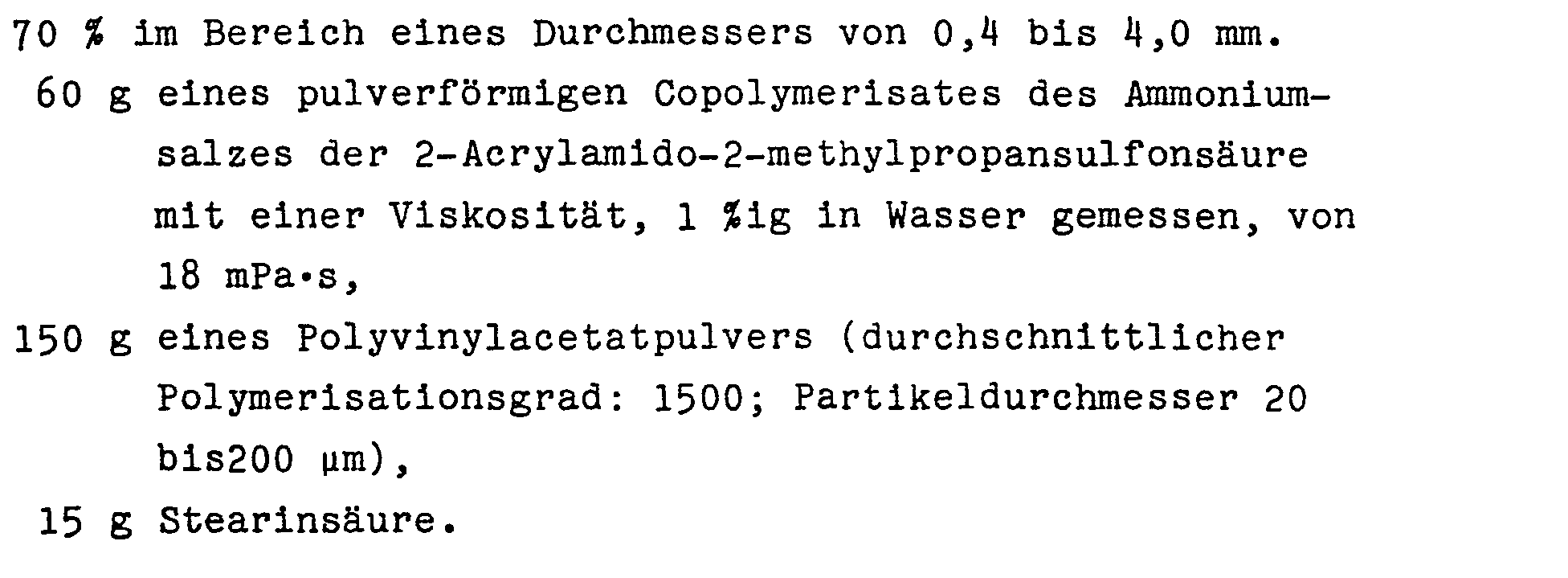
- Zu dieser Feststoffmischung werden im Laufe von 1 min hinzugegeben eine Lösung von

- Dabei wird mit der höchsten Tourenzahl des Rührers mit 1200 min-1 gerührt. Innerhalb von 15 min steigt die Temperatur der Mischung auf 60°C; danach wird die Rührerumdrehungszahl auf 600 min-1 reduziert und die Mischerwand mit Kaltwasser gekühlt.
- Der Mischung werden dann bei einer Innentemperatur von 55°C 36 g einer feinteiligen silikonisierten Kieselsäure zugefügt. Danach wird der Ansatz aus dem Kessel abgelassen. Es resultiert eine gut rieselfähige, nichtstaubende und nichtklebende granulatförmige Polyvinylalkohol-Komposition. Die Mischerwandungen weisen keinen Belag auf.
- Gemäß Beispiel la) wird die in Beispiel 2 erhaltene Polyvinylalkohol-Komposition im Einschneckenextruder zu einer einwandfreien, fischaugenfreien und nichtblockenden Blasfolie von 30 µm verarbeitet.
- Analog zu Beispiel la) werden auch mit dieser Folie Beutel geschweißt und mit je 10 g der Chlorwasserstoff enthaltenden feinteiligen Kieselsäure gefüllt, sowie zur Vermeidung von Luftzutritt und Luftfeuchte in Polyethylen-und Aluminiumfolie luftdicht verpackt. Vergleichsweise wurden entsprechend Beispiel 1 Beutel mit dem chemisch inerten Sorbit gefüllt. Nach 4-wöchiger Lagerung der Beutel bei 50°C im Trockenschrank erfolgten dann die Lösegeschwindigkeitsversuche der Beutel in Wasser von 15°C. Sowohl die mit Sorbit gefüllten Beutel als auch diejenigen mit der chlorwasserstoffhaltigen feinteiligen Kieselsäure lösten sich innerhalb von 5 min unter Rühren rückstandslos auf.
- Im oben beschriebenen Zwangsmischer werden vorgelegt:

- Zu dieser Mischung werden unter Rühren bei 1200 min-1 hinzugegeben eine Lösung von
- 192 g Trimethylolpropan in
- 120 g Wasser.
- Innerhalb von 10 min steigt die Temperatur der Mischung durch Friktionswärme auf 65°C; danach wird die Rührerumdrehungszahl auf 600 min-1 reduziert und die Mischerwand mit Kaltwasser gekühlt.
- Der Mischung werden dann bei einer Temperatur von 60°C 36 g einer feinteiligen silikonisierten Kieselsäure hinzugefügt.
- Bei 55°C wird der Ansatz aus dem Kessel abgelassen. Es resultierte eine gut rieselfähige, nichtstaubende und nichtblockende granulatförmige Polyvinylalkohol-Komposition.
- Die nach Beispiel 3 erhaltene Komposition wird wie in Beispiel la) und 2a) zur Blasextrusionsfolie verarbeitet. Hierbei entsteht eine nichtblockende, klare Polyvinylalkoholfolie von 30 um.
- Nach Durchführung des in Beispiel la) und 2a) beschriebenen Lagertestes der Folie, einmal mit chlorwasserstoffhaltiger feinteiliger Kieselsäure, zum anderen mit inertem Sorbit stellte sich folgendes heraus: die mit Sorbit gefüllten Beutel lösten sich in Wasser von 15°C innerhalb von 5 min vollständig auf. Die mit chlorwasserstoffhaltiger feiner Kieselsäure gefüllten Beutel zeigten nach dieser Zeit einen Löserückstand von 10 Gew.-%.
- Im oben beschriebenen Zwangsmischer werden vorgelegt:

- Bei einer Rührerumdrehungszahl von 1200 min-1 wird diese Vorlage innerhalb von 1 min vermischt mit einer Lösung von 195 g Trimethylolpropan, gelöst in 125 g Wasser.
- Durch Friktionswärme steigt die Temperatur der Mischung innerhalb von 15 min auf 70°C an; danach wird die Rührerumdrehungszahl auf 60 min-1 reduziert und die Mischerwand mit Kaltwasser gekühlt.
- Die Mischung wird dann bei einer Temperatur von 65°C mit 36 g einer feinteiligen, silikonisierten Kieselsäure versetzt.
- Bei 60°C wird der Ansatz aus dem Kessel abgelassen. Es resultierte eine gut rieselfähige, nichtstaubende und nichtklebende, granulatförmige Polyvinylalkohol-Komposition.
- Wie in den vorhergehenden Beispielen beschrieben, wird auch der vorstehend hergestellte Blend verarbeitet zu einer Blasextrusionsfolie von 30 um.
- In den Lagertests wurden außer Sorbit als inertes pulverförmiges Material noch folgende pulverförmigen Substanzen in Beutel eingeschweißt und entsprechend gelagert: das mit 1 % konz. Salzsäure beaufschlagte feinteilige Kieselsäurepulver, Amidosulfonsäure, Natriumchlorit.
- Nach der Lagerzeit von 4 Wochen bei 50°C stellten sich folgende Löseergebnisse der Folie in Wasser von 15°C innerhalb von 5 min heraus:
- die mit Chlorwasserstoff versetzte feinteilige Kieselsäure: vollständig
- Amidosulfonsäure: vollständig
- Natriumchlorit: Rückstand von 8 % der Folie.
Claims (8)
Priority Applications (1)
| Application Number | Priority Date | Filing Date | Title |
|---|---|---|---|
| AT85102682T ATE50587T1 (de) | 1984-03-21 | 1985-03-08 | Thermoplastisch verarbeitbare polyvinylalkoholkompositionnen, verfahren zu ihrer herstellung und daraus hergestellte folien und formteile. |
Applications Claiming Priority (2)
| Application Number | Priority Date | Filing Date | Title |
|---|---|---|---|
| DE19843410241 DE3410241A1 (de) | 1984-03-21 | 1984-03-21 | Thermoplastisch verarbeitbare polyvinylalkohol-kompositionen, verfahren zu ihrer herstellung und daraus hergestellte folien und formteile |
| DE3410241 | 1984-03-21 |
Publications (3)
| Publication Number | Publication Date |
|---|---|
| EP0155606A2 true EP0155606A2 (de) | 1985-09-25 |
| EP0155606A3 EP0155606A3 (en) | 1987-04-29 |
| EP0155606B1 EP0155606B1 (de) | 1990-02-28 |
Family
ID=6231098
Family Applications (1)
| Application Number | Title | Priority Date | Filing Date |
|---|---|---|---|
| EP85102682A Expired - Lifetime EP0155606B1 (de) | 1984-03-21 | 1985-03-08 | Thermoplastisch verarbeitbare polyvinylalkohol-Kompositionnen, Verfahren zu ihrer Herstellung und daraus hergestellte Folien und Formteile |
Country Status (5)
| Country | Link |
|---|---|
| US (1) | US4656216A (de) |
| EP (1) | EP0155606B1 (de) |
| JP (1) | JPS60228551A (de) |
| AT (1) | ATE50587T1 (de) |
| DE (2) | DE3410241A1 (de) |
Cited By (5)
| Publication number | Priority date | Publication date | Assignee | Title |
|---|---|---|---|---|
| EP0490562A3 (en) * | 1990-12-07 | 1992-09-30 | Rohm And Haas Company | Polymeric blends |
| EP0556781A1 (de) * | 1992-02-17 | 1993-08-25 | Showa Denko Kabushiki Kaisha | Wasserlöslicher thermoplastischer Film und seine Verwendung |
| WO1997009379A1 (en) * | 1995-09-08 | 1997-03-13 | Solplax Limited | Biodegradable plastic material and a method for its manufacture |
| GB2367828A (en) * | 2000-08-25 | 2002-04-17 | Reckitt & Colmann Prod Ltd | Water-soluble containers containing aqueous compositions |
| WO2002060980A3 (en) * | 2001-01-31 | 2002-12-19 | Procter & Gamble | Water dissolvable polymer film forming compositions and articles made therefrom |
Families Citing this family (33)
| Publication number | Priority date | Publication date | Assignee | Title |
|---|---|---|---|---|
| US5002526A (en) * | 1989-12-22 | 1991-03-26 | Kimberly-Clark Corporation | Tampon applicator |
| US5362801A (en) * | 1990-12-07 | 1994-11-08 | Rohm And Haas Company | Hot melt adhesives made from the blend of polyvinyl alcohol copolymers and copolymers from unsaturated monomers |
| US5362803A (en) * | 1990-12-07 | 1994-11-08 | Rohm And Haas Company | Polymeric blends of polyvinyl alcohol copolymers with copolymers of unsaturated monomers |
| WO1993000210A1 (en) * | 1991-06-24 | 1993-01-07 | Minnesota Mining And Manufacturing Company | Repulpable securing devices |
| US5389068A (en) * | 1992-09-01 | 1995-02-14 | Kimberly-Clark Corporation | Tampon applicator |
| US5954683A (en) * | 1996-04-15 | 1999-09-21 | Playtex Products, Inc. | Composition and coating for a disposable tampon applicator and method of increasing applicator flexibility |
| US5843060A (en) | 1997-01-02 | 1998-12-01 | Xomed Surgical Products, Inc. | Non-adherent nasal, sinus and otic packing and method for processing sponge materials in fabrication of packings |
| US5804653A (en) * | 1997-03-07 | 1998-09-08 | Playtex Products, Inc. | Polyvinyl alcohol compound |
| AU8417501A (en) * | 2000-08-25 | 2002-03-04 | Reckitt Benckiser Uk Ltd | Water-soluble thermoformed containers comprising aqueous compositions |
| US7217385B2 (en) * | 2002-11-15 | 2007-05-15 | Polyval Plc | Polyvinyl alcohol composition and film |
| GB0226763D0 (en) * | 2002-11-15 | 2002-12-24 | Polyval Plc | Polyvinyl alcohol composition and film |
| US9206414B2 (en) * | 2003-08-13 | 2015-12-08 | Axcelon Biopolymers Corporation | Anisotropic nanocomposite hydrogel |
| US7235592B2 (en) * | 2004-10-12 | 2007-06-26 | Zimmer Gmbh | PVA hydrogel |
| US20060214050A1 (en) * | 2004-11-17 | 2006-09-28 | Naeckel Arno T | Disposable variable depth anchor cable pack |
| US8017139B2 (en) * | 2005-02-23 | 2011-09-13 | Zimmer Technology, Inc. | Blend hydrogels and methods of making |
| US8465771B2 (en) * | 2005-03-30 | 2013-06-18 | The University Of Western Ontario | Anisotropic hydrogels |
| US7571295B2 (en) * | 2005-08-04 | 2009-08-04 | Intel Corporation | Memory manager for heterogeneous memory control |
| US20070098799A1 (en) * | 2005-10-28 | 2007-05-03 | Zimmer, Inc. | Mineralized Hydrogels and Methods of Making and Using Hydrogels |
| US8262730B2 (en) * | 2005-12-07 | 2012-09-11 | Zimmer, Inc. | Methods of bonding or modifying hydrogels using irradiation |
| US20070141108A1 (en) * | 2005-12-20 | 2007-06-21 | Zimmer, Inc. | Fiber-reinforced water-swellable articles |
| US8017107B2 (en) * | 2005-12-22 | 2011-09-13 | Zimmer, Inc. | Perfluorocyclobutane crosslinked hydrogels |
| US8110242B2 (en) * | 2006-03-24 | 2012-02-07 | Zimmer, Inc. | Methods of preparing hydrogel coatings |
| US7731988B2 (en) * | 2007-08-03 | 2010-06-08 | Zimmer, Inc. | Multi-polymer hydrogels |
| US20090043398A1 (en) * | 2007-08-09 | 2009-02-12 | Zimmer, Inc. | Method of producing gradient articles by centrifugation molding or casting |
| US8062739B2 (en) * | 2007-08-31 | 2011-11-22 | Zimmer, Inc. | Hydrogels with gradient |
| US7947784B2 (en) * | 2007-11-16 | 2011-05-24 | Zimmer, Inc. | Reactive compounding of hydrogels |
| US8034362B2 (en) | 2008-01-04 | 2011-10-11 | Zimmer, Inc. | Chemical composition of hydrogels for use as articulating surfaces |
| CN102321933A (zh) * | 2011-08-09 | 2012-01-18 | 马海燕 | 大直径熔纺pva共混单丝及其生产方法 |
| JP5952763B2 (ja) * | 2013-03-19 | 2016-07-13 | 積水化成品工業株式会社 | ハイドロゲル |
| US11098236B2 (en) | 2018-08-28 | 2021-08-24 | Kuraray Co., Ltd. | Particulate polyvinyl alcohol compositions having reduced dust content |
| WO2021067482A1 (en) * | 2019-09-30 | 2021-04-08 | Monosol, Llc | Water soluble unit dose film for packaging harsh chemicals |
| CN115572447B (zh) * | 2022-09-27 | 2023-07-28 | 安徽瑞鸿新材料科技有限公司 | 一种通过共混改性制备pva复合材料的方法 |
| WO2024145031A1 (en) * | 2022-12-29 | 2024-07-04 | Avient Corporation | Liquid plastisol compositions and water soluble plasticized articles prepared therefrom |
Family Cites Families (18)
| Publication number | Priority date | Publication date | Assignee | Title |
|---|---|---|---|---|
| CA707477A (en) * | 1965-04-13 | Otto Wheeley B. | Self-adhering decorative surface tiles | |
| FR1228668A (fr) * | 1959-06-09 | 1960-08-31 | Kurashiki Rayon Co | Fibres orientées d'alcool polyvinylique |
| NL279781A (de) * | 1961-06-15 | |||
| JPS474587Y1 (de) * | 1968-07-24 | 1972-02-17 | ||
| US3695989A (en) * | 1970-08-12 | 1972-10-03 | Robert E Albert | Cold water soluble foam plastic package |
| US3892905A (en) * | 1970-08-12 | 1975-07-01 | Du Pont | Cold water soluble plastic films |
| CS170001B1 (de) * | 1973-07-31 | 1976-08-27 | ||
| JPS5844699B2 (ja) * | 1974-11-12 | 1983-10-05 | 株式会社クラレ | スグレタセイノウ オユウスル ヒドロゲルヨウキザイ |
| US4156047A (en) * | 1976-08-18 | 1979-05-22 | E. I. Du Pont De Nemours And Company | Water-soluble films from polyvinyl alcohol compositions |
| US4155971A (en) * | 1976-08-18 | 1979-05-22 | E. I. Du Pont De Nemours And Company | Method of making water-soluble films from polyvinyl alcohol compositions |
| US4119604A (en) * | 1976-08-18 | 1978-10-10 | E. I. Du Pont De Nemours And Company | Polyvinyl alcohol compositions for use in the preparation of water-soluble films |
| DE2812684A1 (de) * | 1978-03-23 | 1979-10-04 | Hoechst Ag | Weichmacherhaltiges polyvinylalkohol-granulat |
| DE2964688D1 (en) * | 1978-03-23 | 1983-03-17 | Hoechst Ag | Polyvinyl alcohol pellets containing a plasticizer, and method for their preparation |
| JPS5714522A (en) * | 1980-06-09 | 1982-01-25 | Key Pharma | Polymer diffused matrix |
| JPS5734148A (en) * | 1980-08-08 | 1982-02-24 | Kuraray Co Ltd | Ethylene-vinyl alcohol copolymer resin composition |
| US4481326A (en) * | 1980-12-15 | 1984-11-06 | Colgate Palmolive Company | Water soluble films of polyvinyl alcohol polyvinyl pyrrolidone |
| ZA833926B (en) * | 1982-06-17 | 1984-02-29 | Kimberly Clark Co | Creping adhesives containing polyvinyl pyrrolidone |
| US4544693A (en) * | 1984-01-03 | 1985-10-01 | Monsanto Company | Water-soluble film |
-
1984
- 1984-03-21 DE DE19843410241 patent/DE3410241A1/de active Granted
-
1985
- 1985-03-08 AT AT85102682T patent/ATE50587T1/de active
- 1985-03-08 EP EP85102682A patent/EP0155606B1/de not_active Expired - Lifetime
- 1985-03-08 DE DE8585102682T patent/DE3576167D1/de not_active Expired - Lifetime
- 1985-03-19 US US06/714,045 patent/US4656216A/en not_active Expired - Fee Related
- 1985-03-20 JP JP60054711A patent/JPS60228551A/ja active Pending
Cited By (7)
| Publication number | Priority date | Publication date | Assignee | Title |
|---|---|---|---|---|
| EP0490562A3 (en) * | 1990-12-07 | 1992-09-30 | Rohm And Haas Company | Polymeric blends |
| EP0556781A1 (de) * | 1992-02-17 | 1993-08-25 | Showa Denko Kabushiki Kaisha | Wasserlöslicher thermoplastischer Film und seine Verwendung |
| WO1997009379A1 (en) * | 1995-09-08 | 1997-03-13 | Solplax Limited | Biodegradable plastic material and a method for its manufacture |
| US5948848A (en) * | 1995-09-08 | 1999-09-07 | Solplax Limited | Biodegradable plastic material and a method for its manufacture |
| GB2367828A (en) * | 2000-08-25 | 2002-04-17 | Reckitt & Colmann Prod Ltd | Water-soluble containers containing aqueous compositions |
| GB2367828B (en) * | 2000-08-25 | 2002-10-09 | Reckitt & Colmann Prod Ltd | Water-soluble containers containing aqueous compositions |
| WO2002060980A3 (en) * | 2001-01-31 | 2002-12-19 | Procter & Gamble | Water dissolvable polymer film forming compositions and articles made therefrom |
Also Published As
| Publication number | Publication date |
|---|---|
| US4656216A (en) | 1987-04-07 |
| EP0155606A3 (en) | 1987-04-29 |
| EP0155606B1 (de) | 1990-02-28 |
| JPS60228551A (ja) | 1985-11-13 |
| ATE50587T1 (de) | 1990-03-15 |
| DE3576167D1 (de) | 1990-04-05 |
| DE3410241C2 (de) | 1987-08-20 |
| DE3410241A1 (de) | 1985-10-03 |
Similar Documents
| Publication | Publication Date | Title |
|---|---|---|
| EP0155606B1 (de) | Thermoplastisch verarbeitbare polyvinylalkohol-Kompositionnen, Verfahren zu ihrer Herstellung und daraus hergestellte Folien und Formteile | |
| DE1795126C3 (de) | Verfahren zur Gewinnung von wasserlöslichen Acrylamidpolymerisaten | |
| EP1505108B1 (de) | Polyamid-Laser-Sinter-Pulver mit einem Metallsalz und einem Fettsäurederivat, Verfahren zur Herstellung und daraus hergestellte Formkörper | |
| EP0704207B1 (de) | Thermoplastischer Kunststoff für darmsaftlösliche Arznei-Umhüllungen | |
| CH656624A5 (de) | Verfahren zur herstellung einer bis zu hohen temperaturen stabilen und homogenen polymerlegierung sowie verwendung derselben. | |
| DE69323320T2 (de) | Mischungen aus stärkeestern und linearen polyestern | |
| EP0446473A2 (de) | Hydrogelschäume und Verfahren zu deren Herstellung | |
| DE19846412A1 (de) | Hydrophile hochquellfähige Hydrogele sowie Verfahren zu ihrer Herstellung und Verwendung | |
| WO2000022017A1 (de) | Verfahren zur herstellung von wasserquellbaren hydrophilen polymeren, die polymere sowie deren verwendung | |
| EP0039854B1 (de) | Polyvinylalkohol-Komposition, Verfahren zu ihrer Herstellung und ihre Verwendung | |
| DE69332395T2 (de) | Biologisch abbaubare Kunststoffmaterialien, Verfahren zu ihrer Herstellung, sowie ihre Verwendung | |
| DE2643204B2 (de) | Verfahren zum Stabilisieren von Polyamiden | |
| DE2236456C3 (de) | Verfahren zum Herstellen eines gemischten Polymerisats | |
| DE4127522A1 (de) | Neue masse mit einem hydrophilen polymer und einem davon verschiedenen hydrophilen material | |
| DE60036845T2 (de) | Aliphatische polyesterzusammensetzung für eine grundmischung und verfahren zur herstellung einer aliphatischen polyesterfolie unter verwendung der zusammensetzung | |
| EP0000565B1 (de) | Wässrige Copolymerisatlösungen, Verfahren zu deren Herstellung und deren Verwendung als Hüllenbildner für die Herstellung von Microkapseln durch Komplexkoazervation | |
| DE2359012A1 (de) | Herstellung von polyesterharzen mit verbesserten presseigenschaften | |
| DE2447679A1 (de) | Verfahren zur herstellung von thermoplastischen kunststoffen aus chemisch modifiziertem eiweiss sowie kunststofformmassen aus chemisch modifiziertem eiweiss und chemischem weichmachungsmittel | |
| DE69700677T2 (de) | Thermostabilisierte Zusammensetzungen von Vinylidenfluorid-Polymeren | |
| DE69812129T2 (de) | Gelmaterialien | |
| US3190864A (en) | Moulding compositions of tetrafluoroethylene with stabilizers to prevent black specks | |
| DE2252340C3 (de) | Verfahren zur Herstellung von Vinylchloridpolymerisaten und deren Verwendung zur Herstellung harter Formteile | |
| DE3637770A1 (de) | Staubfreie farbpigmentzusammensetzung fuer kunststoffe und verfahren zu deren herstellung | |
| DE3000750C2 (de) | Verfahren zur Herstellung von Polyvinylalkohol | |
| DE2944533A1 (de) | Wasserloeslicher modellwerkstoff fuer feingussmodelle |
Legal Events
| Date | Code | Title | Description |
|---|---|---|---|
| PUAI | Public reference made under article 153(3) epc to a published international application that has entered the european phase |
Free format text: ORIGINAL CODE: 0009012 |
|
| AK | Designated contracting states |
Designated state(s): AT BE CH DE FR GB IT LI LU NL SE |
|
| PUAL | Search report despatched |
Free format text: ORIGINAL CODE: 0009013 |
|
| AK | Designated contracting states |
Kind code of ref document: A3 Designated state(s): AT BE CH DE FR GB IT LI LU NL SE |
|
| 17P | Request for examination filed |
Effective date: 19870723 |
|
| 17Q | First examination report despatched |
Effective date: 19880704 |
|
| GRAA | (expected) grant |
Free format text: ORIGINAL CODE: 0009210 |
|
| AK | Designated contracting states |
Kind code of ref document: B1 Designated state(s): AT BE CH DE FR GB IT LI LU NL SE |
|
| REF | Corresponds to: |
Ref document number: 50587 Country of ref document: AT Date of ref document: 19900315 Kind code of ref document: T |
|
| REF | Corresponds to: |
Ref document number: 3576167 Country of ref document: DE Date of ref document: 19900405 |
|
| ITF | It: translation for a ep patent filed | ||
| ET | Fr: translation filed | ||
| GBT | Gb: translation of ep patent filed (gb section 77(6)(a)/1977) | ||
| PLBE | No opposition filed within time limit |
Free format text: ORIGINAL CODE: 0009261 |
|
| STAA | Information on the status of an ep patent application or granted ep patent |
Free format text: STATUS: NO OPPOSITION FILED WITHIN TIME LIMIT |
|
| 26N | No opposition filed | ||
| ITTA | It: last paid annual fee | ||
| PGFP | Annual fee paid to national office [announced via postgrant information from national office to epo] |
Ref country code: FR Payment date: 19940211 Year of fee payment: 10 |
|
| PGFP | Annual fee paid to national office [announced via postgrant information from national office to epo] |
Ref country code: CH Payment date: 19940214 Year of fee payment: 10 |
|
| PGFP | Annual fee paid to national office [announced via postgrant information from national office to epo] |
Ref country code: SE Payment date: 19940221 Year of fee payment: 10 Ref country code: GB Payment date: 19940221 Year of fee payment: 10 |
|
| PGFP | Annual fee paid to national office [announced via postgrant information from national office to epo] |
Ref country code: AT Payment date: 19940224 Year of fee payment: 10 |
|
| PGFP | Annual fee paid to national office [announced via postgrant information from national office to epo] |
Ref country code: BE Payment date: 19940309 Year of fee payment: 10 |
|
| PGFP | Annual fee paid to national office [announced via postgrant information from national office to epo] |
Ref country code: NL Payment date: 19940331 Year of fee payment: 10 Ref country code: LU Payment date: 19940331 Year of fee payment: 10 |
|
| EPTA | Lu: last paid annual fee | ||
| PGFP | Annual fee paid to national office [announced via postgrant information from national office to epo] |
Ref country code: DE Payment date: 19940518 Year of fee payment: 10 |
|
| EAL | Se: european patent in force in sweden |
Ref document number: 85102682.3 |
|
| PG25 | Lapsed in a contracting state [announced via postgrant information from national office to epo] |
Ref country code: LU Free format text: LAPSE BECAUSE OF NON-PAYMENT OF DUE FEES Effective date: 19950308 Ref country code: GB Effective date: 19950308 Ref country code: AT Effective date: 19950308 |
|
| PG25 | Lapsed in a contracting state [announced via postgrant information from national office to epo] |
Ref country code: SE Effective date: 19950309 |
|
| PG25 | Lapsed in a contracting state [announced via postgrant information from national office to epo] |
Ref country code: LI Effective date: 19950331 Ref country code: CH Effective date: 19950331 Ref country code: BE Effective date: 19950331 |
|
| BERE | Be: lapsed |
Owner name: HOECHST A.G. Effective date: 19950331 Owner name: SCHERING A.G. BERLIN UND BERGKAMEN Effective date: 19950331 |
|
| PG25 | Lapsed in a contracting state [announced via postgrant information from national office to epo] |
Ref country code: NL Effective date: 19951001 |
|
| GBPC | Gb: european patent ceased through non-payment of renewal fee |
Effective date: 19950308 |
|
| PG25 | Lapsed in a contracting state [announced via postgrant information from national office to epo] |
Ref country code: FR Free format text: LAPSE BECAUSE OF NON-PAYMENT OF DUE FEES Effective date: 19951130 |
|
| REG | Reference to a national code |
Ref country code: CH Ref legal event code: PL |
|
| NLV4 | Nl: lapsed or anulled due to non-payment of the annual fee |
Effective date: 19951001 |
|
| PG25 | Lapsed in a contracting state [announced via postgrant information from national office to epo] |
Ref country code: DE Effective date: 19951201 |
|
| EUG | Se: european patent has lapsed |
Ref document number: 85102682.3 |
|
| REG | Reference to a national code |
Ref country code: FR Ref legal event code: ST |