EP0156231A2 - Dispositif pour traiter des pièces d'oeuvre par faisceau d'énergie à puissance volumique très élevée, notamment un faisceau laser de laser à CO2 - Google Patents
Dispositif pour traiter des pièces d'oeuvre par faisceau d'énergie à puissance volumique très élevée, notamment un faisceau laser de laser à CO2 Download PDFInfo
- Publication number
- EP0156231A2 EP0156231A2 EP85102778A EP85102778A EP0156231A2 EP 0156231 A2 EP0156231 A2 EP 0156231A2 EP 85102778 A EP85102778 A EP 85102778A EP 85102778 A EP85102778 A EP 85102778A EP 0156231 A2 EP0156231 A2 EP 0156231A2
- Authority
- EP
- European Patent Office
- Prior art keywords
- housing
- processing
- cover
- laser
- optics
- Prior art date
- Legal status (The legal status is an assumption and is not a legal conclusion. Google has not performed a legal analysis and makes no representation as to the accuracy of the status listed.)
- Granted
Links
Images


Classifications
-
- B—PERFORMING OPERATIONS; TRANSPORTING
- B23—MACHINE TOOLS; METAL-WORKING NOT OTHERWISE PROVIDED FOR
- B23K—SOLDERING OR UNSOLDERING; WELDING; CLADDING OR PLATING BY SOLDERING OR WELDING; CUTTING BY APPLYING HEAT LOCALLY, e.g. FLAME CUTTING; WORKING BY LASER BEAM
- B23K26/00—Working by laser beam, e.g. welding, cutting or boring
- B23K26/02—Positioning or observing the workpiece, e.g. with respect to the point of impact; Aligning, aiming or focusing the laser beam
-
- B—PERFORMING OPERATIONS; TRANSPORTING
- B23—MACHINE TOOLS; METAL-WORKING NOT OTHERWISE PROVIDED FOR
- B23K—SOLDERING OR UNSOLDERING; WELDING; CLADDING OR PLATING BY SOLDERING OR WELDING; CUTTING BY APPLYING HEAT LOCALLY, e.g. FLAME CUTTING; WORKING BY LASER BEAM
- B23K26/00—Working by laser beam, e.g. welding, cutting or boring
- B23K26/02—Positioning or observing the workpiece, e.g. with respect to the point of impact; Aligning, aiming or focusing the laser beam
- B23K26/035—Aligning the laser beam
-
- B—PERFORMING OPERATIONS; TRANSPORTING
- B23—MACHINE TOOLS; METAL-WORKING NOT OTHERWISE PROVIDED FOR
- B23K—SOLDERING OR UNSOLDERING; WELDING; CLADDING OR PLATING BY SOLDERING OR WELDING; CUTTING BY APPLYING HEAT LOCALLY, e.g. FLAME CUTTING; WORKING BY LASER BEAM
- B23K26/00—Working by laser beam, e.g. welding, cutting or boring
- B23K26/70—Auxiliary operations or equipment
- B23K26/702—Auxiliary equipment
Definitions
- the invention relates to a device for machining workpieces by means of an energy beam of high power density, in particular a laser beam from a C0 2 laser, according to the preamble of claim 1.
- the laser processing device mentioned here is a relatively high-quality machine. It is therefore endeavored to use the same basic unit for several different types of processing. For this purpose, a processing attachment corresponding to the processing to be carried out becomes the laser processing direction assigned. This allows z. B. with a basic machine either welding, cutting or surface finishing work.
- the laser processing device should be adaptable to different workpieces or workpiece positions, i. H. Can work with, for example, horizontal or vertical laser beams.
- the optics influencing the laser beam, in particular the processing optics must be adaptable to the given working conditions.
- the object of the invention is a device, in particular a bear processing optics that can be used universally in an economical manner and are easy to maintain.
- the invention has the characterizing features of claim 1. This solution ensures that different units, such as cutting attachments, welding attachments or alignment aids, but also the mirrors required for steel deflection or beam focusing, can be quickly and precisely attached in the housing of the processing optics because their universal connections make them easy to disassemble and assemble .
- the universal connections on the processing optics expediently have approximately the same dimensions at those openings in the housing to which optionally differently designed attachments (processing attachments etc.) are to be connected.
- such openings in the housing of the processing optics to which welding heads, cutting heads, etc. should not be connectable for technical reasons, are equipped with differently dimensioned universal connections. In this way, it is ensured on the one hand that the attachments on the processing optics used for different processing operations can be easily replaced, but on the other hand cannot be connected to incorrect openings in the housing in order to avoid malfunctions of the laser processing device.
- the universal connections consist of two parts, namely a closure part arranged on the outside of the housing of the processing optics and a second, correspondingly designed connecting part in the end region of the connecting elements or attachments to be connected to the processing optics.
- the latter connector of the universal connection consists in the simplest way of a circumferential annular groove which is arranged at a distance from an end face of the units facing the housing.
- the remaining part of the universal closure is formed on the housing, namely as a set of at least two clamping claws. These are detachably evenly distributed on the edge of the openings in the housing, and can be screwed on from the outside.
- the clamping claws are L-shaped with a nose protruding towards the center of the opening, which is dimensioned corresponding to the ring groove or the groove sections in the assemblies.
- the universal connections allow the processing optics to be easily coupled to the corresponding supply elements or attachments, in that the latter are simply pushed between the clamping claws loosely loosened relative to the housing.
- the clamping claws only need to be loosened and tightened again after another unit has been assigned to the respective opening in the housing. The units are thus held only by frictional or non-positive engagement on the housing.
- the unoccupied openings in the housing to protect the interior of the housing and the mirrors arranged therein are each covered by a removable blind flange.
- the latter can be fastened to the housing with a universal closure used to fasten the attachments or supply elements.
- the invention proposes, in a housing, whose open end faces are closed by a cover, on each of which a mirror is arranged, the lid is also releasably connected to the housing by a universal connection.
- this universal connection can have the same structure as the universal connections used to attach the attachments or the like to the housing, but with dimensions adapted to the cover.
- an anti-rotation device is provided according to the invention.
- This preferably consists of two opposing (resilient) ball thrust pieces.
- the latter are arranged in one of the parts to be centered with respect to one another, for example a cover, and work together with a bore or the like assigned to them in the other part, for example in the housing, in which the ball of the ball thrust piece engages resiliently.
- Such ball thrust pieces facilitate the assembly of the mirrors removed from the processing optics for inspection and cleaning purposes, in that the mirror, once aligned, can be reassembled in the correct position with respect to its longitudinal axis using the thrust pieces.
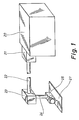
- a high-power laser namely a C0 2 laser 20
- C0 2 laser 20 serves as the energy source.
- a telescope 21 At the beam output of the C0 2 laser 20 there is a telescope 21.
- the latter is connected via a (horizontal) protective tube 22 to a deflecting mirror 23. This deflects the laser beam arriving through the protective tube 22 from the horizontal into a vertical beam direction. From the deflecting mirror 23, the laser beam finally passes through a further (vertical) protective tube 24 to a processing lens 25.
- the processing lens 25 is designed such that the laser beam is deflected twice in it, namely from a vertical to a horizontal beam direction and from this in turn in a direction at right angles to the exit of the laser beam from the processing optics 25.
- the laser beam in this exemplary embodiment leaves the processing optics 25 in the vertical beam direction, specifically as a focused laser beam 26.
- a focused laser beam 26 both cutting and welding work on a workpiece 27 (FIG. 1 ) to execute.
- the processing attachment 28 arranged at the output end below the processing optics 25 and only partially shown in FIG. 2 must be designed, namely either as a welding attachment or as a cutting attachment.
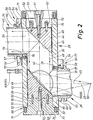
- the structure of the processing optics 25 is shown in detail in FIG. 2. Accordingly, this has an elongated, horizontal housing 29 with a square cross section. A longitudinal, circular through-bore 30 is arranged in the center of the housing 29. The opposite end faces 31 and 32 of the housing 29 are each closed by a flange-like cover 33 or 34.
- the housing 29 has a total of four openings in its walls.
- the remaining three openings, namely the outlet openings 37, 38 and 39, are located in the opposite end region of the housing 29.
- the outlet opening 37 is arranged in a lower wall 40 of the housing 29
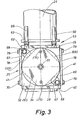
- the two remaining outlet openings 38 and 39 are in two opposite side walls 41 of the housing 29 arranged. All three outlet openings 37, 38 and 39 lie in a common plane running transversely to a longitudinal axis 42 of the processing optics 25, in which a longitudinal central axis 43 of the focused laser beam 26 also lies.
- the mirrors required to deflect the laser beam are arranged in the housing 29 of the processing optics 25.
- the deflecting mirror 44 is assigned to the inlet opening 36th It has a flat reflection surface 46 inclined by 450 to the longitudinal axis 42 of the processing optics 25. In this way, the deflecting mirror 45 steers the cylindrical one that enters the housing 29 vertically through the inlet opening 36 Laser beam 47 into a laser beam 48 running vertically in the housing 29 in the direction of the longitudinal axis 42 thereof.
- the horizontally extending laser beam 48 has approximately the same shape as the laser beam 47 entering the processing optics 25. From the deflecting mirror 44, the laser beam 48 arrives at the opposite focusing mirror 45, which can alternatively be assigned to one of the outlet openings 37, 38 or 39.
- the focusing mirror 45 has a parabolic, ie concave, reflection surface 49.
- the parabolic reflection surface 49 is also inclined to the longitudinal axis 42 of the processing optics 25 in such a way that the focusing mirror 45 causes a beam deflection of 90 °.
- the horizontal, cylindrical laser beam 48 is again deflected into a vertical position, but at the same time is focused to the laser beam 26 by the concave curvature of the reflecting surface 49 of the focusing mirror 45
- the processing optics 25 of the laser beam 26 focused by the focusing mirror 45 lie outside the housing 29, namely in the region of the processing attachment 28.
- the mirrors are each attached to one of the end covers 33 and 34 of the housing 29.
- the deflecting mirror 44 is connected to the inside end face of the cover 33 and the focusing mirror 45 is connected to the inside end face of the cover 34, each with a screw 51 lying in the longitudinal axis 42 of the processing optics 25 from the outer end faces of the housing 29.
- two cylindrical pins 52 each serve for the exact positioning and anti-rotation of the deflecting mirror 44 and the focusing mirror 45 relative to the covers 33 and 34 respectively assigned to them.
- the deflecting mirror 44 and the focusing mirror 45 are dimensioned slightly smaller in diameter than the cylindrical through bore 30 in the housing 29. This prevents the mirrors from jamming in the housing 29 when they expand as a result of thermal heating.
- the inlet opening 36 of the housing 29 is assigned a lower end of the protective tube 24 and the outlet opening 37 located in the lower wall 40 of the processing attachment 28.
- the protective tube 24 and the processing attachment 28 are each attached to the processing optics 25 by a universal connection 53.
- Processing attachments or supply connections can also be attached to the processing head 25 at the lateral outlet openings 38 and 39 in the housing 29 with a universal connection 53.
- the same type of universal connections 53 can be attached, which in the present exemplary embodiment can also have the same dimensions, because the diameters of the inlet opening 36 and the outlet openings 37, 38 and 39 are about the same size.
- a universal connection 53 The structure of a universal connection 53 is shown in detail in FIGS. 5 and 6. Accordingly, the universal connection 53 has two clamping claws 54 screwed onto the upper wall 35 of the housing 29 by a screw 55 in each case. As shown in FIG. 6, the two clamping claws 54 are located diagonally with respect to the upper wall 35. Each clamping claw 54 has an L-shaped cross section with a nose 56 protruding towards the center of the inlet opening 36. The latter is slightly offset from the upper wall 35 of the housing 29, forms that is, a free space 57 between its underside and the upper wall 35.
- the lower end of the protective tube 24 directed towards the housing 29 has a circumferential annular groove 58.
- This is arranged at a slight distance from an end wall 59 of the protective tube 24 abutting the upper wall 35 of the housing 29, and is screwed in.
- the dimensions of the annular groove 58 and their distance from the end wall 59 are selected such that, on the one hand, the lugs 56 of the clamping claws 54 engage in the annular groove 58 and, on the other hand, the ring 60 remaining between the annular groove 58 and the end wall 59 of the protective tube 24 has the clearance 57 between them fills the lugs 56 and the top wall 35.
- the clamping claws 54 screwed onto the housing 29 then clamp the ring 60 of the protective tube 24 with respect to the housing 29 with their lugs 56.
- annular groove 61 on the protective tube 24 or on the processing attachment 28 can also be formed by two collars 62 and 63 arranged at a distance from one another, as shown in FIG. 2, for example.
- a centering projection 64 on the end wall 59 of the protective tube 24 can also be seen from FIG. 5. This has a diameter set back compared to the outer dimensions of the protective tube 24.
- the centering projection 64 engages in a recess 65 that is designed to fit in the upper wall 35 of the housing 29, namely the inlet opening 36.
- the centering projection 64 and the recess 65 enable the protective tube 24 to be radially centered relative to the housing 29 of the processing optics 25.
- connection is released by first removing the two Screws 55 of the clamping claws 54 are loosened to such an extent that the centering projection 64 of the protective tube 24, which is as short as possible, can be lifted out of the recess 65 to such an extent that the protective tube 24 and the processing optics 25 can be moved laterally to one another until the lugs 56 of the clamping claws 54 disengage from the annular groove 58.
- the assembly is carried out in the reverse order in that the protective tube 24 to be assembled is first pushed between the clamping claws 54, the lugs 56 of the clamping claws 54 coming into engagement with the annular groove 58.
- a radial alignment of the protective tube 24 with respect to the housing 29 then takes place in that the centering projection 64 is pushed into the recess 65. Thereafter, the screws 55 of the clamping claws 54 can be tightened so far that the lugs 56 clamp the protective tube 24 against the housing 29 via the ring 60.
- Such universal connections 53 are also assigned to the outlet openings 37, 38 and 39 for fastening a processing attachment 28 to the processing optics 25. All universal connections 53 at the inlet opening 36 and the outlet openings 37, 38 and 39 expediently have approximately the same dimensions.
- the covers 33 and 34 are also connected to the housing 29 via a universal connection 66.
- the latter corresponds in principle to the structure of the universal connections 53 for the protective tube 24 and the processing attachments 28.
- Two clamping claws 67 are also screwed here by one screw 68 each to one of the end faces 31 and 32 of the housing 29, the clamping claws 67 being in one Diagonals of the end face 31 and 32 are opposite.
- the covers 33 and 34 have four groove sections 69. The groove sections 69 are straight milled into the outer surface of the circular cover 33 and 34 respectively.
- the arrangement of the groove sections 69 is such that two groove sections 69 lie opposite each other in pairs, the two pairs of the opposite groove sections 69 being offset by 90 ° to one another.
- the covers 33 and 34 can thereby be screwed to the processing optics 25 in a relative position with respect to the longitudinal axis 42 which is offset relative to one another in each case.
- the focusing mirror 45 can alternatively be assigned to the (lower) outlet opening 37 or one of the two (side) outlet openings 38 or 39 depending on the processing to be carried out.
- the universal connections 66 of the covers 33 and 34 also each have a radial centering with a cylinder extension 70 arranged on the inside end face of the covers 33 and 34, which projects through the end faces 31 and 32 into the through bore 30 of the housing 29 for radial centering of the deflecting mirror 44 and the focusing mirror 45 in the processing optics 25.
- the cylinder lugs 70 have suitable dimensions for the through hole 30.
- the universal connections 66 are assigned an anti-rotation device.
- the covers 33, 34 are arranged opposite each other in front of the end faces 31, 32 of the housing 29 in each cover 33, 34 in order to prevent them from rotating.
- the latter are located in the edge regions of the covers 33 and 34, specifically, as further shown in FIG. 3, in those regions which are recessed by the groove sections 69.
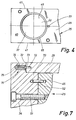
- FIG. 7 shows the construction of a ball thrust piece 71 or an anti-rotation device on an enlarged scale. So that's it Ball thrust piece 71 inserted into a blind hole 72 arranged in the cover 33. On the side facing the end face 32 of the housing 29, the ball thrust piece 71 has a ball 73 which is pressed against the end face 32 by a compression spring 74. The ball thrust piece 71 is pushed so far into the blind bore 72 that the ball 73 partially protrudes from the surface of the cover 34 which abuts the end face 32 of the housing 29. The protruding part of the ball 73 of the ball thrust piece 71 is in engagement with a blind hole 75 arranged in the end face 32.
- a total of four (small) blind bores 75 arranged in the housing 29 are assigned to the two ball thrust pieces 71 in the cover 34.
- the four blind bores 75 are evenly distributed on the end face 32, that is to say they each have an offset of 90 ° to one another.
- Two opposing blind bores 75 are each associated with the ball thrust pieces 71 in the cover 34.
- the other two blind bores 75 are used for centering of the cover 34 when this is rotated through 90 0, together with the focusing mirror 45 about the longitudinal axis 42 of the housing 29th This enables an exact assignment of the focusing mirror 45 to one of the three exit openings 37, 38 or 39 in the processing optics 25, which are offset by 90 ° to each other, by alternately in each of the 90 0 rotations the two ball thrust pieces 71 in two of the (small) blind holes 75 intervene.
- Two (small) blind holes 75 may be arranged, since the deflecting mirror 44 can only be secured against rotation in a single, defined position.
- the protective tube 24 and the processing attachments 28 can be secured against rotation with respect to the processing optics 25, namely likewise by means of ball thrust pieces 76 which are assigned to the universal connections 53.
- the universal connections 43 - in contrast to the covers 33, 34 - each have only one ball thrust piece 76, as shown in FIG. 4.
- the ball thrust piece 76 is arranged in the housing 29, while a (small) blind bore 77 cooperating with the ball thrust piece 76 is arranged in the collar 62 directed towards the lower wall 40 of the housing 29.
- the universal connection 53 is assigned only one (small) blind hole 77 to each ball thrust piece 76 here. A change of a processing attachment 28 which has been initially adjusted can thus be carried out without having to readjust the same.
- the protective tube 24 can be secured against rotation with the processing optics 25 using a ball thrust piece 76.
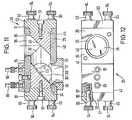
- FIGS. 11 and 12 Another (alternative) fastening of the covers 91, 92 to the housing 29 of the processing optics 25 is shown in FIGS. 11 and 12. Accordingly, the covers 91, 92 are screwed to the housing 29 with two diagonally opposite knurled screws 93. A knob-like knurled head 94 enables the covers 91, 92 to be attached and detached by hand, that is to say without tools. A central, cylindrical centering part 95 on the knurled fitting screws 93, which enters a corresponding through bore 96 in the covers 91, 92, and a centering projection 97 in the housing 29 are used for adjusting the Cover 91, 92 relative to the housing 29 of the processing optics 25. This ensures that the mirrors (deflecting mirror 44; focusing mirror 45) always assume approximately the same position after each removal of the covers 91, 92.
- each cover 91, 92 has four symmetrically arranged, equally large through bores 96. These allow mounting of the cover 91, 92 in four different steps of 90 0 offset relative positions on the housing 29th
- this exemplary embodiment has an internal thread 98 in the lower outlet opening 37 of the housing 29 for fastening a machining attachment 99.
- the latter can thus be screwed onto the housing 29 simply by hand, that is to say without a tool, without the clamping claws 54 of a universal connection 53.
- the free outlet openings for example the lateral outlet openings 38 and 39 in FIG. 3, are closed by a blind flange 78.
- the latter are not connected to the housing 29 with a universal connection 53, but are screwed to the housing 29 by means of two opposite screws 79.
- the hole pattern for the screws in the blind flange 78 is selected such that the threaded holes used to fasten the clamping claws 54 to the housing 29 can be used after the clamping claws 54 have been unscrewed beforehand.
- FIG. 9 A further exemplary embodiment for the arrangement of an endoscope in the processing optics 25 is shown in FIG. 9.
- the receiving bore 86 opens out as a blind bore shortly before the reflection surface 49 of the focusing mirror s 45.
- a smaller, vertical observation bore 87 branches off from it, specifically lying on the longitudinal central axis 43 of the focused laser beam 26.
- the diameter of the observation bore 87 is dimensioned to be relatively small, for example 2 mm, so that it only insignificantly reduces the area of the reflection surface 49 and thus does not lead to any appreciable loss of power in the laser beam.
- an optical observation instrument arranged in this way, for example when the laser is switched off, a first positioning of a processing attachment 28 relative to the housing 29 is possible.
- the machining attachment 28 can also be positioned at a specific point on the workpiece 27 in this way.
- FIG. 8 shows a further exemplary embodiment of the invention, in which a suction port 88 is fastened to the housing 29 by a universal connection 53 at the two unoccupied (lateral) outlet openings 38 and 39.
- the suction nozzles 88 are connected to a gas supply and are used to extract dust, smoke or the like from the inside of the processing optics 25 during processing through the processing attachment 28 to protect the reflection surfaces 46 and 49 of the mirrors.
- protective gas or a cooling gas can also be blown into the interior of the processing optics 25 through the suction ports.
- the opposite suction nozzle 88 as a gas inlet and gas outlet, as a result of which a horizontally directed gas flow is created in the processing optics 25, which forms a “gas barrier” against dust, smoke, etc. entering the processing optics 25.
- the deflecting mirror 44 and the focusing mirror 45 are made of copper in the devices of the exemplary embodiments described. As a result, the mirrors practically do not change their shape due to thermal stress during processing, so that no readjustments are necessary.
- the reflection surfaces 46 and 49 of the copper mirrors are either (high-gloss) polished or vapor-coated, in particular sputtered.
- FIGS. 2 and 3 also show two connections on the upper wall 35 of the housing 29, namely a coolant inlet 89 and a coolant outlet 90.
- a coolant circuit is formed from bores arranged in the walls of the housing 29 supply and disposal.
- the cooling bores in the processing optics 25 can also extend over one or more of the covers 33 or 34. The end faces between the housing 29 on the one hand and the covers 33 and 34 on the other hand are then to be provided with suitable seals.
Landscapes
- Physics & Mathematics (AREA)
- Optics & Photonics (AREA)
- Engineering & Computer Science (AREA)
- Plasma & Fusion (AREA)
- Mechanical Engineering (AREA)
- Laser Beam Processing (AREA)
- Endoscopes (AREA)
Priority Applications (1)
| Application Number | Priority Date | Filing Date | Title |
|---|---|---|---|
| AT85102778T ATE48778T1 (de) | 1984-03-26 | 1985-03-12 | Vorrichtung zur bearbeitung von werkstuecken durch einen energiestrahl hoher leistungsdichte, insbesondere einen laserstrahl eines co2-lasers. |
Applications Claiming Priority (2)
| Application Number | Priority Date | Filing Date | Title |
|---|---|---|---|
| DE19843411126 DE3411126A1 (de) | 1984-03-26 | 1984-03-26 | Vorrichtung zur bearbeitung von werkstuecken durch einen energiestrahl hoher leistungsdichte, insbesondere einem laserstrahl eines co(pfeil abwaerts)2(pfeil abwaerts)-lasers |
| DE3411126 | 1984-03-26 |
Publications (3)
| Publication Number | Publication Date |
|---|---|
| EP0156231A2 true EP0156231A2 (fr) | 1985-10-02 |
| EP0156231A3 EP0156231A3 (en) | 1986-02-12 |
| EP0156231B1 EP0156231B1 (fr) | 1989-12-20 |
Family
ID=6231663
Family Applications (1)
| Application Number | Title | Priority Date | Filing Date |
|---|---|---|---|
| EP85102778A Expired EP0156231B1 (fr) | 1984-03-26 | 1985-03-12 | Dispositif pour traiter des pièces d'oeuvre par faisceau d'énergie à puissance volumique très élevée, notamment un faisceau laser de laser à CO2 |
Country Status (5)
| Country | Link |
|---|---|
| US (1) | US4667080A (fr) |
| EP (1) | EP0156231B1 (fr) |
| JP (1) | JPS60231586A (fr) |
| AT (1) | ATE48778T1 (fr) |
| DE (2) | DE3411126A1 (fr) |
Cited By (2)
| Publication number | Priority date | Publication date | Assignee | Title |
|---|---|---|---|---|
| EP0252268A3 (en) * | 1986-07-11 | 1989-02-01 | Bias Forschungs- Und Entwicklungslabor Fur Angewandte Strahltechnik | Process for monitoring the machining energy source, particularly with a laser, and machining optics for its implementation |
| EP0464213B1 (fr) * | 1990-01-19 | 1995-07-19 | Fanuc Ltd. | Procede de decoupage au laser |
Families Citing this family (20)
| Publication number | Priority date | Publication date | Assignee | Title |
|---|---|---|---|---|
| IT206702Z2 (it) * | 1985-11-26 | 1987-10-01 | Comau Spa | Robot industriale per saldatura e taglio mediante fascio laser |
| JPS62238091A (ja) * | 1986-04-08 | 1987-10-19 | Mitsubishi Electric Corp | レ−ザ加工装置の加工ヘツド |
| JPH0435027Y2 (fr) * | 1986-12-05 | 1992-08-19 | ||
| JPH0763862B2 (ja) * | 1987-09-16 | 1995-07-12 | ファナック株式会社 | レーザ加工用ビームベンダ |
| JPS6475193A (en) * | 1987-09-16 | 1989-03-20 | Fanuc Ltd | Beam bender for laser beam machining |
| DE3814074A1 (de) * | 1988-04-26 | 1989-11-09 | Baasel Carl Lasertech | Laserduesenkopf |
| DE8806584U1 (de) * | 1988-05-19 | 1989-09-14 | Kuka Schweissanlagen + Roboter Gmbh, 8900 Augsburg | Strahlführungsvorrichtung für Roboter |
| DE4404141A1 (de) * | 1994-02-09 | 1995-08-10 | Fraunhofer Ges Forschung | Vorrichtung und Verfahren zur Laserstrahlformung, insbesondere bei der Laserstrahl-Oberflächenbearbeitung |
| DE4408115B4 (de) * | 1994-03-10 | 2005-02-24 | Maschinenfabrik Karl H. Arnold Gmbh & Co Kg | Umlenkspiegelgehäuse für Lasermaterialbearbeitungssysteme |
| US5603853A (en) * | 1995-02-28 | 1997-02-18 | The Twentyfirst Century Corporation | Method of high energy density radiation beam lap welding |
| US5595670A (en) * | 1995-04-17 | 1997-01-21 | The Twentyfirst Century Corporation | Method of high speed high power welding |
| DE19631535C2 (de) * | 1996-07-25 | 2002-05-08 | Mannesmann Ag | Verfahren und Vorrichtung zum spanlosen Zerteilen eines rotationssymmetrischen Werkstückes aus metallischem Werkstoff in einzelne Abschnitte oder Ringe |
| WO2001038036A1 (fr) * | 1999-11-29 | 2001-05-31 | Siemens Production And Logistics Systems Ag | Procede et dispositif de traitement de substrats au moyen de rayons lasers |
| US8253062B2 (en) * | 2005-06-10 | 2012-08-28 | Chrysler Group Llc | System and methodology for zero-gap welding |
| US8803029B2 (en) * | 2006-08-03 | 2014-08-12 | Chrysler Group Llc | Dual beam laser welding head |
| US8198565B2 (en) * | 2007-04-11 | 2012-06-12 | Chrysler Group Llc | Laser-welding apparatus and method |
| US8847114B1 (en) * | 2007-05-07 | 2014-09-30 | Purdue Research Foundation | Laser-assisted micromachining system and method |
| JP6302376B2 (ja) * | 2014-08-12 | 2018-03-28 | 株式会社マキタ | オイルポンプ |
| US9364931B2 (en) * | 2014-10-09 | 2016-06-14 | Metal Industries Research And Development Centre | Laser-assisted machining device |
| DE102021110446B4 (de) | 2021-04-23 | 2022-12-29 | Evekinger Rohr- Und Profilwerke Gmbh | Vorrichtung zur Bearbeitung eines Substrats mittels eines Laserbearbeitungskopfs |
Family Cites Families (12)
| Publication number | Priority date | Publication date | Assignee | Title |
|---|---|---|---|---|
| DE749939C (de) * | 1941-04-01 | 1944-12-08 | Zentrierbare Verbindung an optischen Geraeten | |
| US3463594A (en) * | 1965-11-01 | 1969-08-26 | Hughes Aircraft Co | Laser tool apparatus |
| DE2052512A1 (de) * | 1970-10-26 | 1972-04-27 | Siemens Ag | Materialbearbeitungslaser |
| IL40602A (en) * | 1972-10-17 | 1975-07-28 | Panengeneering Ltd | Laser device particularly useful as surgical scalpel |
| US4000391A (en) * | 1973-05-14 | 1976-12-28 | Westinghouse Electric Corporation | Nuclear reactor fuel element splitter |
| DE2346197A1 (de) * | 1973-09-13 | 1975-07-24 | Siemens Ag | Vorrichtung zum verbinden von zwei teilen |
| US3906953A (en) * | 1974-05-23 | 1975-09-23 | American Optical Corp | Endoscopic surgical laser system |
| US4141362A (en) * | 1977-05-23 | 1979-02-27 | Richard Wolf Gmbh | Laser endoscope |
| US4228341A (en) * | 1978-12-12 | 1980-10-14 | Laser Industries Ltd. | Mechanical control system particularly useful for directing a laser beam |
| JPS5760787U (fr) * | 1980-09-22 | 1982-04-10 | ||
| JPS57128145A (en) * | 1981-02-02 | 1982-08-09 | Olympus Optical Co | Laser knife |
| IT1144346B (it) * | 1981-05-08 | 1986-10-29 | Fiat Ricerche | Dispositivo per modificare e uniformare la distribuzione d intensita di un fascio laser di potenza |
-
1984
- 1984-03-26 DE DE19843411126 patent/DE3411126A1/de not_active Withdrawn
-
1985
- 1985-03-12 DE DE8585102778T patent/DE3574837D1/de not_active Expired - Lifetime
- 1985-03-12 EP EP85102778A patent/EP0156231B1/fr not_active Expired
- 1985-03-12 US US06/710,807 patent/US4667080A/en not_active Expired - Fee Related
- 1985-03-12 AT AT85102778T patent/ATE48778T1/de not_active IP Right Cessation
- 1985-03-22 JP JP60057636A patent/JPS60231586A/ja active Granted
Cited By (2)
| Publication number | Priority date | Publication date | Assignee | Title |
|---|---|---|---|---|
| EP0252268A3 (en) * | 1986-07-11 | 1989-02-01 | Bias Forschungs- Und Entwicklungslabor Fur Angewandte Strahltechnik | Process for monitoring the machining energy source, particularly with a laser, and machining optics for its implementation |
| EP0464213B1 (fr) * | 1990-01-19 | 1995-07-19 | Fanuc Ltd. | Procede de decoupage au laser |
Also Published As
| Publication number | Publication date |
|---|---|
| JPH0318994B2 (fr) | 1991-03-13 |
| JPS60231586A (ja) | 1985-11-18 |
| EP0156231A3 (en) | 1986-02-12 |
| EP0156231B1 (fr) | 1989-12-20 |
| DE3574837D1 (de) | 1990-01-25 |
| US4667080A (en) | 1987-05-19 |
| ATE48778T1 (de) | 1990-01-15 |
| DE3411126A1 (de) | 1985-10-03 |
Similar Documents
| Publication | Publication Date | Title |
|---|---|---|
| EP0156231B1 (fr) | Dispositif pour traiter des pièces d'oeuvre par faisceau d'énergie à puissance volumique très élevée, notamment un faisceau laser de laser à CO2 | |
| DE3036427C2 (de) | Laserstrahl-Reflexionsvorrichtung | |
| DE4306800C2 (de) | Beschichtungsvorrichtung mit einem Rotationszerstäuber | |
| EP1240963B1 (fr) | Elément de raccord | |
| WO2002040211A1 (fr) | Dispositif destine a un procede de soudure hybride | |
| DE102011003686A1 (de) | Laserbearbeitungsvorrichtung | |
| EP1580521B1 (fr) | Appareil de mesure de coordonnées à lentilles interchangeables | |
| DE3621717C2 (de) | Industrieroboter | |
| DE29507189U1 (de) | Anschlußkopf zur Bearbeitung eines Werkstücks mittels eines Laserstrahls | |
| DE19824692A1 (de) | Ausrichteinrichtung | |
| DE3630127C2 (fr) | ||
| DE4242057C2 (de) | Laser-Bearbeitungsanlage | |
| DE4005453A1 (de) | Einrichtung zur abstandsmessung bei der laser-materialbearbeitung | |
| EP0285704A2 (fr) | Système de serrage composé de plusieurs parties en particulier pour outils tournant rond | |
| EP0004312B1 (fr) | Tête de rabotage à lames réversibles et interchangeables | |
| DE3503401A1 (de) | Fuehrungsvorrichtung fuer einen laserstrahl, vorzugsweise zur dreidimensionalen werkstueckbearbeitung | |
| DE68906240T2 (de) | Vorrichtung zum durchtrennen von pfaehlen. | |
| DE8337305U1 (de) | Vorrichtung zum Schneiden von Werkstücken durch einen Laserstrahl | |
| DE3630402A1 (de) | Aufbohrwerkzeug | |
| DE102019111843A1 (de) | Zerspanungswerkzeug | |
| DE29904489U1 (de) | Arbeitskopf zur Bearbeitung eines Werkstücks mittels eines Laserstrahls | |
| DE4426458C2 (de) | Düsenkopf für die Bearbeitung eines Werkstücks mittels eines Laserstrahls | |
| DE3432942C2 (fr) | ||
| DD232015A1 (de) | Befestigungsvorrichtung fuer schleifscheiben an der schleifspindel einer schleifmaschine mit automatischem schleifscheibenwechsler | |
| DE10157787A1 (de) | Werkzeug für die spanabhebende Bearbeitung |
Legal Events
| Date | Code | Title | Description |
|---|---|---|---|
| PUAI | Public reference made under article 153(3) epc to a published international application that has entered the european phase |
Free format text: ORIGINAL CODE: 0009012 |
|
| AK | Designated contracting states |
Designated state(s): AT BE CH DE FR GB IT LI NL SE |
|
| PUAL | Search report despatched |
Free format text: ORIGINAL CODE: 0009013 |
|
| AK | Designated contracting states |
Kind code of ref document: A3 Designated state(s): AT BE CH DE FR GB IT LI NL SE |
|
| 17P | Request for examination filed |
Effective date: 19860214 |
|
| 17Q | First examination report despatched |
Effective date: 19861203 |
|
| GRAA | (expected) grant |
Free format text: ORIGINAL CODE: 0009210 |
|
| AK | Designated contracting states |
Kind code of ref document: B1 Designated state(s): AT BE CH DE FR GB IT LI NL SE |
|
| PG25 | Lapsed in a contracting state [announced via postgrant information from national office to epo] |
Ref country code: SE Effective date: 19891220 Ref country code: NL Effective date: 19891220 Ref country code: IT Free format text: LAPSE BECAUSE OF FAILURE TO SUBMIT A TRANSLATION OF THE DESCRIPTION OR TO PAY THE FEE WITHIN THE PRESCRIBED TIME-LIMIT;WARNING: LAPSES OF ITALIAN PATENTS WITH EFFECTIVE DATE BEFORE 2007 MAY HAVE OCCURRED AT ANY TIME BEFORE 2007. THE CORRECT EFFECTIVE DATE MAY BE DIFFERENT FROM THE ONE RECORDED. Effective date: 19891220 Ref country code: BE Effective date: 19891220 |
|
| REF | Corresponds to: |
Ref document number: 48778 Country of ref document: AT Date of ref document: 19900115 Kind code of ref document: T |
|
| GBT | Gb: translation of ep patent filed (gb section 77(6)(a)/1977) | ||
| REF | Corresponds to: |
Ref document number: 3574837 Country of ref document: DE Date of ref document: 19900125 |
|
| PG25 | Lapsed in a contracting state [announced via postgrant information from national office to epo] |
Ref country code: AT Effective date: 19900312 |
|
| PG25 | Lapsed in a contracting state [announced via postgrant information from national office to epo] |
Ref country code: LI Effective date: 19900331 Ref country code: CH Effective date: 19900331 |
|
| ET | Fr: translation filed | ||
| NLV1 | Nl: lapsed or annulled due to failure to fulfill the requirements of art. 29p and 29m of the patents act | ||
| PLBE | No opposition filed within time limit |
Free format text: ORIGINAL CODE: 0009261 |
|
| STAA | Information on the status of an ep patent application or granted ep patent |
Free format text: STATUS: NO OPPOSITION FILED WITHIN TIME LIMIT |
|
| REG | Reference to a national code |
Ref country code: CH Ref legal event code: PL |
|
| 26N | No opposition filed | ||
| PGFP | Annual fee paid to national office [announced via postgrant information from national office to epo] |
Ref country code: GB Payment date: 19950302 Year of fee payment: 11 |
|
| PGFP | Annual fee paid to national office [announced via postgrant information from national office to epo] |
Ref country code: FR Payment date: 19950309 Year of fee payment: 11 |
|
| PG25 | Lapsed in a contracting state [announced via postgrant information from national office to epo] |
Ref country code: GB Effective date: 19960312 |
|
| PGFP | Annual fee paid to national office [announced via postgrant information from national office to epo] |
Ref country code: DE Payment date: 19960328 Year of fee payment: 12 |
|
| GBPC | Gb: european patent ceased through non-payment of renewal fee |
Effective date: 19960312 |
|
| PG25 | Lapsed in a contracting state [announced via postgrant information from national office to epo] |
Ref country code: FR Effective date: 19961129 |
|
| REG | Reference to a national code |
Ref country code: FR Ref legal event code: ST |
|
| PG25 | Lapsed in a contracting state [announced via postgrant information from national office to epo] |
Ref country code: DE Effective date: 19971202 |