EP0156535B1 - Spektralsensibilisiertes Aufzeichnungsmaterial - Google Patents
Spektralsensibilisiertes Aufzeichnungsmaterial Download PDFInfo
- Publication number
- EP0156535B1 EP0156535B1 EP85301437A EP85301437A EP0156535B1 EP 0156535 B1 EP0156535 B1 EP 0156535B1 EP 85301437 A EP85301437 A EP 85301437A EP 85301437 A EP85301437 A EP 85301437A EP 0156535 B1 EP0156535 B1 EP 0156535B1
- Authority
- EP
- European Patent Office
- Prior art keywords
- layer
- frangible
- photosensitive
- surfactant
- photosensitive layer
- Prior art date
- Legal status (The legal status is an assumption and is not a legal conclusion. Google has not performed a legal analysis and makes no representation as to the accuracy of the status listed.)
- Expired
Links
- 238000003384 imaging method Methods 0.000 title description 16
- 239000004094 surface-active agent Substances 0.000 claims description 79
- 150000001875 compounds Chemical class 0.000 claims description 39
- 230000005855 radiation Effects 0.000 claims description 31
- 239000000463 material Substances 0.000 claims description 25
- 230000000873 masking effect Effects 0.000 claims description 23
- 230000003595 spectral effect Effects 0.000 claims description 23
- 239000000758 substrate Substances 0.000 claims description 23
- 238000000034 method Methods 0.000 claims description 21
- 239000000203 mixture Substances 0.000 claims description 21
- -1 aromatic polycyclic hydrocarbons Chemical class 0.000 claims description 20
- 230000001235 sensitizing effect Effects 0.000 claims description 20
- 230000035945 sensitivity Effects 0.000 claims description 19
- 229910052751 metal Inorganic materials 0.000 claims description 18
- 239000002184 metal Substances 0.000 claims description 18
- 230000001464 adherent effect Effects 0.000 claims description 16
- 230000008569 process Effects 0.000 claims description 12
- 125000004432 carbon atom Chemical group C* 0.000 claims description 11
- 125000000217 alkyl group Chemical group 0.000 claims description 9
- 125000003342 alkenyl group Chemical group 0.000 claims description 8
- 239000000975 dye Substances 0.000 claims description 8
- 125000005037 alkyl phenyl group Chemical group 0.000 claims description 6
- 125000000304 alkynyl group Chemical group 0.000 claims description 6
- 125000005010 perfluoroalkyl group Chemical group 0.000 claims description 6
- 230000009467 reduction Effects 0.000 claims description 6
- 125000001997 phenyl group Chemical group [H]C1=C([H])C([H])=C(*)C([H])=C1[H] 0.000 claims description 5
- 229940075397 calomel Drugs 0.000 claims description 4
- ZOMNIUBKTOKEHS-UHFFFAOYSA-L dimercury dichloride Chemical compound Cl[Hg][Hg]Cl ZOMNIUBKTOKEHS-UHFFFAOYSA-L 0.000 claims description 4
- 125000001165 hydrophobic group Chemical group 0.000 claims description 4
- 125000005504 styryl group Chemical group 0.000 claims description 4
- 229910044991 metal oxide Inorganic materials 0.000 claims description 3
- 150000004706 metal oxides Chemical class 0.000 claims description 3
- 150000003839 salts Chemical class 0.000 claims description 3
- XSQUKJJJFZCRTK-UHFFFAOYSA-N Urea Chemical class NC(N)=O XSQUKJJJFZCRTK-UHFFFAOYSA-N 0.000 claims description 2
- 229930195733 hydrocarbon Natural products 0.000 claims description 2
- 239000000693 micelle Substances 0.000 claims description 2
- 150000003732 xanthenes Chemical class 0.000 claims description 2
- 230000001419 dependent effect Effects 0.000 claims 2
- 230000000903 blocking effect Effects 0.000 claims 1
- 239000010410 layer Substances 0.000 description 145
- ZWEHNKRNPOVVGH-UHFFFAOYSA-N 2-Butanone Chemical compound CCC(C)=O ZWEHNKRNPOVVGH-UHFFFAOYSA-N 0.000 description 33
- 229910052782 aluminium Inorganic materials 0.000 description 29
- XAGFODPZIPBFFR-UHFFFAOYSA-N aluminium Chemical compound [Al] XAGFODPZIPBFFR-UHFFFAOYSA-N 0.000 description 29
- 238000011161 development Methods 0.000 description 27
- 230000018109 developmental process Effects 0.000 description 27
- 229920000728 polyester Polymers 0.000 description 26
- 239000010408 film Substances 0.000 description 24
- 239000011248 coating agent Substances 0.000 description 23
- 238000000576 coating method Methods 0.000 description 23
- 239000000243 solution Substances 0.000 description 23
- 239000007787 solid Substances 0.000 description 15
- 239000002585 base Substances 0.000 description 11
- 238000010438 heat treatment Methods 0.000 description 11
- 206010070834 Sensitisation Diseases 0.000 description 10
- 230000008313 sensitization Effects 0.000 description 10
- CIWBSHSKHKDKBQ-JLAZNSOCSA-N Ascorbic acid Chemical compound OC[C@H](O)[C@H]1OC(=O)C(O)=C1O CIWBSHSKHKDKBQ-JLAZNSOCSA-N 0.000 description 9
- 239000011230 binding agent Substances 0.000 description 9
- 239000004014 plasticizer Substances 0.000 description 9
- 229910052709 silver Inorganic materials 0.000 description 9
- 239000004332 silver Substances 0.000 description 9
- 0 CC[C@@]1*C[C@](C)CC1 Chemical compound CC[C@@]1*C[C@](C)CC1 0.000 description 8
- LQNUZADURLCDLV-UHFFFAOYSA-N nitrobenzene Chemical compound [O-][N+](=O)C1=CC=CC=C1 LQNUZADURLCDLV-UHFFFAOYSA-N 0.000 description 8
- BQCADISMDOOEFD-UHFFFAOYSA-N Silver Chemical compound [Ag] BQCADISMDOOEFD-UHFFFAOYSA-N 0.000 description 7
- YQGOJNYOYNNSMM-UHFFFAOYSA-N eosin Chemical compound [Na+].OC(=O)C1=CC=CC=C1C1=C2C=C(Br)C(=O)C(Br)=C2OC2=C(Br)C(O)=C(Br)C=C21 YQGOJNYOYNNSMM-UHFFFAOYSA-N 0.000 description 7
- 229920000642 polymer Polymers 0.000 description 7
- 239000004820 Pressure-sensitive adhesive Substances 0.000 description 6
- GWEVSGVZZGPLCZ-UHFFFAOYSA-N Titan oxide Chemical compound O=[Ti]=O GWEVSGVZZGPLCZ-UHFFFAOYSA-N 0.000 description 6
- 229920001577 copolymer Polymers 0.000 description 6
- 229920001225 polyester resin Polymers 0.000 description 6
- 239000004645 polyester resin Substances 0.000 description 6
- 206010034972 Photosensitivity reaction Diseases 0.000 description 5
- 238000010521 absorption reaction Methods 0.000 description 5
- 125000001797 benzyl group Chemical group [H]C1=C([H])C([H])=C(C([H])=C1[H])C([H])([H])* 0.000 description 5
- 125000001424 substituent group Chemical group 0.000 description 5
- WFKWXMTUELFFGS-UHFFFAOYSA-N tungsten Chemical compound [W] WFKWXMTUELFFGS-UHFFFAOYSA-N 0.000 description 5
- 229910052721 tungsten Inorganic materials 0.000 description 5
- 239000010937 tungsten Substances 0.000 description 5
- VVBLNCFGVYUYGU-UHFFFAOYSA-N 4,4'-Bis(dimethylamino)benzophenone Chemical compound C1=CC(N(C)C)=CC=C1C(=O)C1=CC=C(N(C)C)C=C1 VVBLNCFGVYUYGU-UHFFFAOYSA-N 0.000 description 4
- GJNKQJAJXSUJBO-UHFFFAOYSA-N 9,10-diethoxyanthracene Chemical compound C1=CC=C2C(OCC)=C(C=CC=C3)C3=C(OCC)C2=C1 GJNKQJAJXSUJBO-UHFFFAOYSA-N 0.000 description 4
- XEEYBQQBJWHFJM-UHFFFAOYSA-N Iron Chemical compound [Fe] XEEYBQQBJWHFJM-UHFFFAOYSA-N 0.000 description 4
- 229920004890 Triton X-100 Polymers 0.000 description 4
- 239000013504 Triton X-100 Substances 0.000 description 4
- 239000012790 adhesive layer Substances 0.000 description 4
- 230000036211 photosensitivity Effects 0.000 description 4
- 239000013047 polymeric layer Substances 0.000 description 4
- 239000002904 solvent Substances 0.000 description 4
- 238000012360 testing method Methods 0.000 description 4
- SURWYRGVICLUBJ-UHFFFAOYSA-N 2-ethyl-9,10-dimethoxyanthracene Chemical compound C1=CC=CC2=C(OC)C3=CC(CC)=CC=C3C(OC)=C21 SURWYRGVICLUBJ-UHFFFAOYSA-N 0.000 description 3
- CSCPPACGZOOCGX-UHFFFAOYSA-N Acetone Chemical compound CC(C)=O CSCPPACGZOOCGX-UHFFFAOYSA-N 0.000 description 3
- WEVYAHXRMPXWCK-UHFFFAOYSA-N Acetonitrile Chemical compound CC#N WEVYAHXRMPXWCK-UHFFFAOYSA-N 0.000 description 3
- UHOVQNZJYSORNB-UHFFFAOYSA-N Benzene Chemical compound C1=CC=CC=C1 UHOVQNZJYSORNB-UHFFFAOYSA-N 0.000 description 3
- MQIUGAXCHLFZKX-UHFFFAOYSA-N Di-n-octyl phthalate Natural products CCCCCCCCOC(=O)C1=CC=CC=C1C(=O)OCCCCCCCC MQIUGAXCHLFZKX-UHFFFAOYSA-N 0.000 description 3
- YMWUJEATGCHHMB-UHFFFAOYSA-N Dichloromethane Chemical compound ClCCl YMWUJEATGCHHMB-UHFFFAOYSA-N 0.000 description 3
- RTZKZFJDLAIYFH-UHFFFAOYSA-N Diethyl ether Chemical compound CCOCC RTZKZFJDLAIYFH-UHFFFAOYSA-N 0.000 description 3
- XEKOWRVHYACXOJ-UHFFFAOYSA-N Ethyl acetate Chemical compound CCOC(C)=O XEKOWRVHYACXOJ-UHFFFAOYSA-N 0.000 description 3
- 206010073306 Exposure to radiation Diseases 0.000 description 3
- OKKJLVBELUTLKV-UHFFFAOYSA-N Methanol Chemical compound OC OKKJLVBELUTLKV-UHFFFAOYSA-N 0.000 description 3
- YXFVVABEGXRONW-UHFFFAOYSA-N Toluene Chemical compound CC1=CC=CC=C1 YXFVVABEGXRONW-UHFFFAOYSA-N 0.000 description 3
- XTXRWKRVRITETP-UHFFFAOYSA-N Vinyl acetate Chemical compound CC(=O)OC=C XTXRWKRVRITETP-UHFFFAOYSA-N 0.000 description 3
- BJQHLKABXJIVAM-UHFFFAOYSA-N bis(2-ethylhexyl) phthalate Chemical compound CCCCC(CC)COC(=O)C1=CC=CC=C1C(=O)OCC(CC)CCCC BJQHLKABXJIVAM-UHFFFAOYSA-N 0.000 description 3
- 150000007942 carboxylates Chemical class 0.000 description 3
- 230000008859 change Effects 0.000 description 3
- 238000010276 construction Methods 0.000 description 3
- UJKWLAZYSLJTKA-UHFFFAOYSA-N edma Chemical compound O1CCOC2=CC(CC(C)NC)=CC=C21 UJKWLAZYSLJTKA-UHFFFAOYSA-N 0.000 description 3
- 230000000694 effects Effects 0.000 description 3
- 150000002739 metals Chemical class 0.000 description 3
- 239000000178 monomer Substances 0.000 description 3
- 239000000049 pigment Substances 0.000 description 3
- 239000000843 powder Substances 0.000 description 3
- 230000015227 regulation of liquid surface tension Effects 0.000 description 3
- 229920005989 resin Polymers 0.000 description 3
- 230000027756 respiratory electron transport chain Effects 0.000 description 3
- RWSOTUBLDIXVET-UHFFFAOYSA-O sulfonium Chemical compound [SH3+] RWSOTUBLDIXVET-UHFFFAOYSA-O 0.000 description 3
- 239000004408 titanium dioxide Substances 0.000 description 3
- ZCDADJXRUCOCJE-UHFFFAOYSA-N 2-chlorothioxanthen-9-one Chemical compound C1=CC=C2C(=O)C3=CC(Cl)=CC=C3SC2=C1 ZCDADJXRUCOCJE-UHFFFAOYSA-N 0.000 description 2
- LETDRANQSOEVCX-UHFFFAOYSA-N 2-methyl-4,6-bis(trichloromethyl)-1,3,5-triazine Chemical compound CC1=NC(C(Cl)(Cl)Cl)=NC(C(Cl)(Cl)Cl)=N1 LETDRANQSOEVCX-UHFFFAOYSA-N 0.000 description 2
- XKRFYHLGVUSROY-UHFFFAOYSA-N Argon Chemical compound [Ar] XKRFYHLGVUSROY-UHFFFAOYSA-N 0.000 description 2
- HEDRZPFGACZZDS-UHFFFAOYSA-N Chloroform Chemical compound ClC(Cl)Cl HEDRZPFGACZZDS-UHFFFAOYSA-N 0.000 description 2
- VYZAMTAEIAYCRO-UHFFFAOYSA-N Chromium Chemical compound [Cr] VYZAMTAEIAYCRO-UHFFFAOYSA-N 0.000 description 2
- PEDCQBHIVMGVHV-UHFFFAOYSA-N Glycerine Chemical compound OCC(O)CO PEDCQBHIVMGVHV-UHFFFAOYSA-N 0.000 description 2
- 229920002292 Nylon 6 Polymers 0.000 description 2
- 229920002302 Nylon 6,6 Polymers 0.000 description 2
- 229920003171 Poly (ethylene oxide) Polymers 0.000 description 2
- 239000004952 Polyamide Substances 0.000 description 2
- WYURNTSHIVDZCO-UHFFFAOYSA-N Tetrahydrofuran Chemical compound C1CCOC1 WYURNTSHIVDZCO-UHFFFAOYSA-N 0.000 description 2
- ATJFFYVFTNAWJD-UHFFFAOYSA-N Tin Chemical compound [Sn] ATJFFYVFTNAWJD-UHFFFAOYSA-N 0.000 description 2
- HCHKCACWOHOZIP-UHFFFAOYSA-N Zinc Chemical compound [Zn] HCHKCACWOHOZIP-UHFFFAOYSA-N 0.000 description 2
- 239000006096 absorbing agent Substances 0.000 description 2
- NIXOWILDQLNWCW-UHFFFAOYSA-N acrylic acid group Chemical group C(C=C)(=O)O NIXOWILDQLNWCW-UHFFFAOYSA-N 0.000 description 2
- 230000009471 action Effects 0.000 description 2
- 239000000654 additive Substances 0.000 description 2
- 230000032683 aging Effects 0.000 description 2
- 230000000712 assembly Effects 0.000 description 2
- 238000000429 assembly Methods 0.000 description 2
- 230000006399 behavior Effects 0.000 description 2
- 230000015572 biosynthetic process Effects 0.000 description 2
- 125000003178 carboxy group Chemical group [H]OC(*)=O 0.000 description 2
- 239000011651 chromium Substances 0.000 description 2
- 229910052804 chromium Inorganic materials 0.000 description 2
- 239000008199 coating composition Substances 0.000 description 2
- 239000002131 composite material Substances 0.000 description 2
- 238000005336 cracking Methods 0.000 description 2
- 230000003247 decreasing effect Effects 0.000 description 2
- JEIPFZHSYJVQDO-UHFFFAOYSA-N ferric oxide Chemical compound O=[Fe]O[Fe]=O JEIPFZHSYJVQDO-UHFFFAOYSA-N 0.000 description 2
- 239000011521 glass Substances 0.000 description 2
- XMBWDFGMSWQBCA-UHFFFAOYSA-N hydrogen iodide Chemical class I XMBWDFGMSWQBCA-UHFFFAOYSA-N 0.000 description 2
- 238000005286 illumination Methods 0.000 description 2
- 150000002484 inorganic compounds Chemical class 0.000 description 2
- 229910010272 inorganic material Inorganic materials 0.000 description 2
- 229910052742 iron Inorganic materials 0.000 description 2
- 238000010030 laminating Methods 0.000 description 2
- QSHDDOUJBYECFT-UHFFFAOYSA-N mercury Chemical compound [Hg] QSHDDOUJBYECFT-UHFFFAOYSA-N 0.000 description 2
- 125000000449 nitro group Chemical group [O-][N+](*)=O 0.000 description 2
- 230000003287 optical effect Effects 0.000 description 2
- 150000002896 organic halogen compounds Chemical class 0.000 description 2
- 239000000123 paper Substances 0.000 description 2
- 239000011236 particulate material Substances 0.000 description 2
- 239000003504 photosensitizing agent Substances 0.000 description 2
- 229920003229 poly(methyl methacrylate) Polymers 0.000 description 2
- 229920002037 poly(vinyl butyral) polymer Polymers 0.000 description 2
- 229920000058 polyacrylate Polymers 0.000 description 2
- 229920002647 polyamide Polymers 0.000 description 2
- 229920000515 polycarbonate Polymers 0.000 description 2
- 239000004417 polycarbonate Substances 0.000 description 2
- 229920006267 polyester film Polymers 0.000 description 2
- 239000004926 polymethyl methacrylate Substances 0.000 description 2
- 229920000915 polyvinyl chloride Polymers 0.000 description 2
- 125000006239 protecting group Chemical group 0.000 description 2
- 239000011347 resin Substances 0.000 description 2
- 238000001228 spectrum Methods 0.000 description 2
- 238000006467 substitution reaction Methods 0.000 description 2
- 238000003786 synthesis reaction Methods 0.000 description 2
- 229920001169 thermoplastic Polymers 0.000 description 2
- 239000004416 thermosoftening plastic Substances 0.000 description 2
- 239000011135 tin Substances 0.000 description 2
- 229910052718 tin Inorganic materials 0.000 description 2
- 238000012546 transfer Methods 0.000 description 2
- 238000001429 visible spectrum Methods 0.000 description 2
- 229910052725 zinc Inorganic materials 0.000 description 2
- 239000011701 zinc Substances 0.000 description 2
- RYHBNJHYFVUHQT-UHFFFAOYSA-N 1,4-Dioxane Chemical compound C1COCCO1 RYHBNJHYFVUHQT-UHFFFAOYSA-N 0.000 description 1
- WUYMUVBIVVABRN-UHFFFAOYSA-N 1-[[4-[4-amino-5-(3-methoxyphenyl)pyrrolo[2,3-d]pyrimidin-7-yl]phenyl]methyl]piperidin-4-ol Chemical compound COC1=CC=CC(C=2C3=C(N)N=CN=C3N(C=3C=CC(CN4CCC(O)CC4)=CC=3)C=2)=C1 WUYMUVBIVVABRN-UHFFFAOYSA-N 0.000 description 1
- SMZOUWXMTYCWNB-UHFFFAOYSA-N 2-(2-methoxy-5-methylphenyl)ethanamine Chemical compound COC1=CC=C(C)C=C1CCN SMZOUWXMTYCWNB-UHFFFAOYSA-N 0.000 description 1
- JMWGZSWSTCGVLX-UHFFFAOYSA-N 2-ethyl-2-(hydroxymethyl)propane-1,3-diol;2-methylprop-2-enoic acid Chemical compound CC(=C)C(O)=O.CC(=C)C(O)=O.CC(=C)C(O)=O.CCC(CO)(CO)CO JMWGZSWSTCGVLX-UHFFFAOYSA-N 0.000 description 1
- PYSRRFNXTXNWCD-UHFFFAOYSA-N 3-(2-phenylethenyl)furan-2,5-dione Chemical compound O=C1OC(=O)C(C=CC=2C=CC=CC=2)=C1 PYSRRFNXTXNWCD-UHFFFAOYSA-N 0.000 description 1
- WUPHOULIZUERAE-UHFFFAOYSA-N 3-(oxolan-2-yl)propanoic acid Chemical compound OC(=O)CCC1CCCO1 WUPHOULIZUERAE-UHFFFAOYSA-N 0.000 description 1
- SMORZVDIHUZUQK-UHFFFAOYSA-N 5,10-diethoxy-16,17-dimethoxy-violanthrene Chemical compound C12=C3C4=C(OC)C=C2C2=CC=CC=C2C(OCC)C1=CC=C3C1=CC=C2C(OCC)C3=CC=CC=C3C3=CC(OC)=C4C1=C32 SMORZVDIHUZUQK-UHFFFAOYSA-N 0.000 description 1
- DXPPIEDUBFUSEZ-UHFFFAOYSA-N 6-methylheptyl prop-2-enoate Chemical compound CC(C)CCCCCOC(=O)C=C DXPPIEDUBFUSEZ-UHFFFAOYSA-N 0.000 description 1
- HRPVXLWXLXDGHG-UHFFFAOYSA-N Acrylamide Chemical compound NC(=O)C=C HRPVXLWXLXDGHG-UHFFFAOYSA-N 0.000 description 1
- FERIUCNNQQJTOY-UHFFFAOYSA-M Butyrate Chemical compound CCCC([O-])=O FERIUCNNQQJTOY-UHFFFAOYSA-M 0.000 description 1
- FERIUCNNQQJTOY-UHFFFAOYSA-N Butyric acid Natural products CCCC(O)=O FERIUCNNQQJTOY-UHFFFAOYSA-N 0.000 description 1
- OKTJSMMVPCPJKN-UHFFFAOYSA-N Carbon Chemical compound [C] OKTJSMMVPCPJKN-UHFFFAOYSA-N 0.000 description 1
- 229920001634 Copolyester Polymers 0.000 description 1
- RYGMFSIKBFXOCR-UHFFFAOYSA-N Copper Chemical compound [Cu] RYGMFSIKBFXOCR-UHFFFAOYSA-N 0.000 description 1
- VGGSQFUCUMXWEO-UHFFFAOYSA-N Ethene Chemical compound C=C VGGSQFUCUMXWEO-UHFFFAOYSA-N 0.000 description 1
- 239000005977 Ethylene Substances 0.000 description 1
- 229920006385 Geon Polymers 0.000 description 1
- FYYHWMGAXLPEAU-UHFFFAOYSA-N Magnesium Chemical compound [Mg] FYYHWMGAXLPEAU-UHFFFAOYSA-N 0.000 description 1
- CERQOIWHTDAKMF-UHFFFAOYSA-M Methacrylate Chemical compound CC(=C)C([O-])=O CERQOIWHTDAKMF-UHFFFAOYSA-M 0.000 description 1
- NTIZESTWPVYFNL-UHFFFAOYSA-N Methyl isobutyl ketone Chemical compound CC(C)CC(C)=O NTIZESTWPVYFNL-UHFFFAOYSA-N 0.000 description 1
- UIHCLUNTQKBZGK-UHFFFAOYSA-N Methyl isobutyl ketone Natural products CCC(C)C(C)=O UIHCLUNTQKBZGK-UHFFFAOYSA-N 0.000 description 1
- 229920001410 Microfiber Polymers 0.000 description 1
- 239000002033 PVDF binder Substances 0.000 description 1
- 206010034960 Photophobia Diseases 0.000 description 1
- LGRFSURHDFAFJT-UHFFFAOYSA-N Phthalic anhydride Natural products C1=CC=C2C(=O)OC(=O)C2=C1 LGRFSURHDFAFJT-UHFFFAOYSA-N 0.000 description 1
- 239000004698 Polyethylene Substances 0.000 description 1
- 239000004743 Polypropylene Substances 0.000 description 1
- 239000004793 Polystyrene Substances 0.000 description 1
- 229920001328 Polyvinylidene chloride Polymers 0.000 description 1
- OFOBLEOULBTSOW-UHFFFAOYSA-N Propanedioic acid Natural products OC(=O)CC(O)=O OFOBLEOULBTSOW-UHFFFAOYSA-N 0.000 description 1
- 229920000147 Styrene maleic anhydride Polymers 0.000 description 1
- XSTXAVWGXDQKEL-UHFFFAOYSA-N Trichloroethylene Chemical group ClC=C(Cl)Cl XSTXAVWGXDQKEL-UHFFFAOYSA-N 0.000 description 1
- OKKRPWIIYQTPQF-UHFFFAOYSA-N Trimethylolpropane trimethacrylate Chemical compound CC(=C)C(=O)OCC(CC)(COC(=O)C(C)=C)COC(=O)C(C)=C OKKRPWIIYQTPQF-UHFFFAOYSA-N 0.000 description 1
- 239000005083 Zinc sulfide Substances 0.000 description 1
- 150000001241 acetals Chemical class 0.000 description 1
- 150000001242 acetic acid derivatives Chemical class 0.000 description 1
- 125000005396 acrylic acid ester group Chemical group 0.000 description 1
- 230000004913 activation Effects 0.000 description 1
- 239000000853 adhesive Substances 0.000 description 1
- 230000001070 adhesive effect Effects 0.000 description 1
- 239000002390 adhesive tape Substances 0.000 description 1
- 239000003513 alkali Substances 0.000 description 1
- 125000003545 alkoxy group Chemical group 0.000 description 1
- 229920000180 alkyd Polymers 0.000 description 1
- 229910045601 alloy Inorganic materials 0.000 description 1
- 239000000956 alloy Substances 0.000 description 1
- 230000004075 alteration Effects 0.000 description 1
- PNEYBMLMFCGWSK-UHFFFAOYSA-N aluminium oxide Inorganic materials [O-2].[O-2].[O-2].[Al+3].[Al+3] PNEYBMLMFCGWSK-UHFFFAOYSA-N 0.000 description 1
- 150000001408 amides Chemical class 0.000 description 1
- 150000001412 amines Chemical class 0.000 description 1
- 150000001454 anthracenes Chemical class 0.000 description 1
- 150000004056 anthraquinones Chemical class 0.000 description 1
- RJGDLRCDCYRQOQ-UHFFFAOYSA-N anthrone Chemical compound C1=CC=C2C(=O)C3=CC=CC=C3CC2=C1 RJGDLRCDCYRQOQ-UHFFFAOYSA-N 0.000 description 1
- 229910052786 argon Inorganic materials 0.000 description 1
- 238000000149 argon plasma sintering Methods 0.000 description 1
- 150000004945 aromatic hydrocarbons Chemical class 0.000 description 1
- 230000008901 benefit Effects 0.000 description 1
- ZYGHJZDHTFUPRJ-UHFFFAOYSA-N benzo-alpha-pyrone Natural products C1=CC=C2OC(=O)C=CC2=C1 ZYGHJZDHTFUPRJ-UHFFFAOYSA-N 0.000 description 1
- RWCCWEUUXYIKHB-UHFFFAOYSA-N benzophenone Chemical compound C=1C=CC=CC=1C(=O)C1=CC=CC=C1 RWCCWEUUXYIKHB-UHFFFAOYSA-N 0.000 description 1
- 239000012965 benzophenone Substances 0.000 description 1
- RFVHVYKVRGKLNK-UHFFFAOYSA-N bis(4-methoxyphenyl)methanone Chemical compound C1=CC(OC)=CC=C1C(=O)C1=CC=C(OC)C=C1 RFVHVYKVRGKLNK-UHFFFAOYSA-N 0.000 description 1
- 229910052797 bismuth Inorganic materials 0.000 description 1
- JCXGWMGPZLAOME-UHFFFAOYSA-N bismuth atom Chemical compound [Bi] JCXGWMGPZLAOME-UHFFFAOYSA-N 0.000 description 1
- 244000309464 bull Species 0.000 description 1
- JHIWVOJDXOSYLW-UHFFFAOYSA-N butyl 2,2-difluorocyclopropane-1-carboxylate Chemical compound CCCCOC(=O)C1CC1(F)F JHIWVOJDXOSYLW-UHFFFAOYSA-N 0.000 description 1
- 125000000484 butyl group Chemical group [H]C([*])([H])C([H])([H])C([H])([H])C([H])([H])[H] 0.000 description 1
- 229910052980 cadmium sulfide Inorganic materials 0.000 description 1
- 229910052799 carbon Inorganic materials 0.000 description 1
- 239000006229 carbon black Substances 0.000 description 1
- 229920002678 cellulose Polymers 0.000 description 1
- 229920002301 cellulose acetate Polymers 0.000 description 1
- 229920001727 cellulose butyrate Polymers 0.000 description 1
- 239000000919 ceramic Substances 0.000 description 1
- 238000003776 cleavage reaction Methods 0.000 description 1
- 230000000295 complement effect Effects 0.000 description 1
- 229910052802 copper Inorganic materials 0.000 description 1
- 239000010949 copper Substances 0.000 description 1
- 235000001671 coumarin Nutrition 0.000 description 1
- 150000004775 coumarins Chemical class 0.000 description 1
- 239000013039 cover film Substances 0.000 description 1
- QSAWQNUELGIYBC-UHFFFAOYSA-N cyclohexane-1,2-dicarboxylic acid Chemical class OC(=O)C1CCCCC1C(O)=O QSAWQNUELGIYBC-UHFFFAOYSA-N 0.000 description 1
- 125000000664 diazo group Chemical group [N-]=[N+]=[*] 0.000 description 1
- MNQDKWZEUULFPX-UHFFFAOYSA-M dithiazanine iodide Chemical compound [I-].S1C2=CC=CC=C2[N+](CC)=C1C=CC=CC=C1N(CC)C2=CC=CC=C2S1 MNQDKWZEUULFPX-UHFFFAOYSA-M 0.000 description 1
- 229920001971 elastomer Polymers 0.000 description 1
- 238000007772 electroless plating Methods 0.000 description 1
- 238000009713 electroplating Methods 0.000 description 1
- 150000002148 esters Chemical class 0.000 description 1
- 150000002170 ethers Chemical class 0.000 description 1
- 125000001495 ethyl group Chemical group [H]C([H])([H])C([H])([H])* 0.000 description 1
- 229920001038 ethylene copolymer Polymers 0.000 description 1
- 230000001747 exhibiting effect Effects 0.000 description 1
- 239000000945 filler Substances 0.000 description 1
- 230000004907 flux Effects 0.000 description 1
- 235000011187 glycerol Nutrition 0.000 description 1
- PCHJSUWPFVWCPO-UHFFFAOYSA-N gold Chemical compound [Au] PCHJSUWPFVWCPO-UHFFFAOYSA-N 0.000 description 1
- 229910052737 gold Inorganic materials 0.000 description 1
- 239000010931 gold Substances 0.000 description 1
- 150000008282 halocarbons Chemical class 0.000 description 1
- 125000001475 halogen functional group Chemical group 0.000 description 1
- 125000002887 hydroxy group Chemical group [H]O* 0.000 description 1
- 229910052740 iodine Inorganic materials 0.000 description 1
- 239000011630 iodine Substances 0.000 description 1
- YOBAEOGBNPPUQV-UHFFFAOYSA-N iron;trihydrate Chemical compound O.O.O.[Fe].[Fe] YOBAEOGBNPPUQV-UHFFFAOYSA-N 0.000 description 1
- 150000002576 ketones Chemical class 0.000 description 1
- 208000013469 light sensitivity Diseases 0.000 description 1
- 239000007788 liquid Substances 0.000 description 1
- 229910052749 magnesium Inorganic materials 0.000 description 1
- 239000011777 magnesium Substances 0.000 description 1
- 239000011976 maleic acid Substances 0.000 description 1
- 229910052753 mercury Inorganic materials 0.000 description 1
- 150000002736 metal compounds Chemical class 0.000 description 1
- 229910001507 metal halide Inorganic materials 0.000 description 1
- 150000005309 metal halides Chemical class 0.000 description 1
- 125000000956 methoxy group Chemical group [H]C([H])([H])O* 0.000 description 1
- 229940043265 methyl isobutyl ketone Drugs 0.000 description 1
- 239000003658 microfiber Substances 0.000 description 1
- 239000004005 microsphere Substances 0.000 description 1
- 238000002156 mixing Methods 0.000 description 1
- 230000004048 modification Effects 0.000 description 1
- 238000012986 modification Methods 0.000 description 1
- CXMXRPHRNRROMY-UHFFFAOYSA-N n-Decanedioic acid Natural products OC(=O)CCCCCCCCC(O)=O CXMXRPHRNRROMY-UHFFFAOYSA-N 0.000 description 1
- 230000007935 neutral effect Effects 0.000 description 1
- 125000002560 nitrile group Chemical group 0.000 description 1
- 125000006502 nitrobenzyl group Chemical group 0.000 description 1
- MCSAJNNLRCFZED-UHFFFAOYSA-N nitroethane Chemical compound CC[N+]([O-])=O MCSAJNNLRCFZED-UHFFFAOYSA-N 0.000 description 1
- LYGJENNIWJXYER-UHFFFAOYSA-N nitromethane Chemical compound C[N+]([O-])=O LYGJENNIWJXYER-UHFFFAOYSA-N 0.000 description 1
- XNGIFLGASWRNHJ-UHFFFAOYSA-N o-dicarboxybenzene Natural products OC(=O)C1=CC=CC=C1C(O)=O XNGIFLGASWRNHJ-UHFFFAOYSA-N 0.000 description 1
- UYDLBVPAAFVANX-UHFFFAOYSA-N octylphenoxy polyethoxyethanol Chemical compound CC(C)(C)CC(C)(C)C1=CC=C(OCCOCCOCCOCCO)C=C1 UYDLBVPAAFVANX-UHFFFAOYSA-N 0.000 description 1
- 229920000620 organic polymer Polymers 0.000 description 1
- 150000002902 organometallic compounds Chemical class 0.000 description 1
- CELWCAITJAEQNL-UHFFFAOYSA-N oxan-2-ol Chemical class OC1CCCCO1 CELWCAITJAEQNL-UHFFFAOYSA-N 0.000 description 1
- 125000006503 p-nitrobenzyl group Chemical group [H]C1=C([H])C(=C([H])C([H])=C1[N+]([O-])=O)C([H])([H])* 0.000 description 1
- 239000003973 paint Substances 0.000 description 1
- 150000002979 perylenes Chemical class 0.000 description 1
- 229920000412 polyarylene Polymers 0.000 description 1
- 150000004291 polyenes Chemical class 0.000 description 1
- 229920000573 polyethylene Polymers 0.000 description 1
- 229920000139 polyethylene terephthalate Polymers 0.000 description 1
- 239000005020 polyethylene terephthalate Substances 0.000 description 1
- 229920000193 polymethacrylate Polymers 0.000 description 1
- 229920000098 polyolefin Polymers 0.000 description 1
- 229920001155 polypropylene Polymers 0.000 description 1
- 229920002223 polystyrene Polymers 0.000 description 1
- 229920002635 polyurethane Polymers 0.000 description 1
- 239000004814 polyurethane Substances 0.000 description 1
- 239000004800 polyvinyl chloride Substances 0.000 description 1
- 239000005033 polyvinylidene chloride Substances 0.000 description 1
- 229920002981 polyvinylidene fluoride Polymers 0.000 description 1
- 230000037452 priming Effects 0.000 description 1
- HUAZGNHGCJGYNP-UHFFFAOYSA-N propyl butyrate Chemical compound CCCOC(=O)CCC HUAZGNHGCJGYNP-UHFFFAOYSA-N 0.000 description 1
- QQONPFPTGQHPMA-UHFFFAOYSA-N propylene Natural products CC=C QQONPFPTGQHPMA-UHFFFAOYSA-N 0.000 description 1
- 125000004805 propylene group Chemical group [H]C([H])([H])C([H])([*:1])C([H])([H])[*:2] 0.000 description 1
- 150000003220 pyrenes Chemical class 0.000 description 1
- 230000004044 response Effects 0.000 description 1
- 230000007017 scission Effects 0.000 description 1
- 239000011343 solid material Substances 0.000 description 1
- 239000007921 spray Substances 0.000 description 1
- 238000004544 sputter deposition Methods 0.000 description 1
- 230000000087 stabilizing effect Effects 0.000 description 1
- BDHFUVZGWQCTTF-UHFFFAOYSA-M sulfonate Chemical compound [O-]S(=O)=O BDHFUVZGWQCTTF-UHFFFAOYSA-M 0.000 description 1
- 239000012085 test solution Substances 0.000 description 1
- YLQBMQCUIZJEEH-UHFFFAOYSA-N tetrahydrofuran Natural products C=1C=COC=1 YLQBMQCUIZJEEH-UHFFFAOYSA-N 0.000 description 1
- 125000004149 thio group Chemical group *S* 0.000 description 1
- AFNRRBXCCXDRPS-UHFFFAOYSA-N tin(ii) sulfide Chemical compound [Sn]=S AFNRRBXCCXDRPS-UHFFFAOYSA-N 0.000 description 1
- VZCYOOQTPOCHFL-UHFFFAOYSA-N trans-butenedioic acid Natural products OC(=O)C=CC(O)=O VZCYOOQTPOCHFL-UHFFFAOYSA-N 0.000 description 1
- UBOXGVDOUJQMTN-UHFFFAOYSA-N trichloroethylene Natural products ClCC(Cl)Cl UBOXGVDOUJQMTN-UHFFFAOYSA-N 0.000 description 1
- ZIBGPFATKBEMQZ-UHFFFAOYSA-N triethylene glycol Chemical compound OCCOCCOCCO ZIBGPFATKBEMQZ-UHFFFAOYSA-N 0.000 description 1
- 238000007738 vacuum evaporation Methods 0.000 description 1
- 239000002966 varnish Substances 0.000 description 1
- 229920002554 vinyl polymer Polymers 0.000 description 1
- 230000000007 visual effect Effects 0.000 description 1
- 239000000080 wetting agent Substances 0.000 description 1
- 229910052724 xenon Inorganic materials 0.000 description 1
- FHNFHKCVQCLJFQ-UHFFFAOYSA-N xenon atom Chemical compound [Xe] FHNFHKCVQCLJFQ-UHFFFAOYSA-N 0.000 description 1
- 229910052984 zinc sulfide Inorganic materials 0.000 description 1
- DRDVZXDWVBGGMH-UHFFFAOYSA-N zinc;sulfide Chemical compound [S-2].[Zn+2] DRDVZXDWVBGGMH-UHFFFAOYSA-N 0.000 description 1
Images


Classifications
-
- G—PHYSICS
- G03—PHOTOGRAPHY; CINEMATOGRAPHY; ANALOGOUS TECHNIQUES USING WAVES OTHER THAN OPTICAL WAVES; ELECTROGRAPHY; HOLOGRAPHY
- G03F—PHOTOMECHANICAL PRODUCTION OF TEXTURED OR PATTERNED SURFACES, e.g. FOR PRINTING, FOR PROCESSING OF SEMICONDUCTOR DEVICES; MATERIALS THEREFOR; ORIGINALS THEREFOR; APPARATUS SPECIALLY ADAPTED THEREFOR
- G03F1/00—Originals for photomechanical production of textured or patterned surfaces, e.g., masks, photo-masks, reticles; Mask blanks or pellicles therefor; Containers specially adapted therefor; Preparation thereof
- G03F1/54—Absorbers, e.g. of opaque materials
- G03F1/56—Organic absorbers, e.g. of photo-resists
-
- G—PHYSICS
- G03—PHOTOGRAPHY; CINEMATOGRAPHY; ANALOGOUS TECHNIQUES USING WAVES OTHER THAN OPTICAL WAVES; ELECTROGRAPHY; HOLOGRAPHY
- G03C—PHOTOSENSITIVE MATERIALS FOR PHOTOGRAPHIC PURPOSES; PHOTOGRAPHIC PROCESSES, e.g. CINE, X-RAY, COLOUR, STEREO-PHOTOGRAPHIC PROCESSES; AUXILIARY PROCESSES IN PHOTOGRAPHY
- G03C1/00—Photosensitive materials
- G03C1/72—Photosensitive compositions not covered by the groups G03C1/005 - G03C1/705
- G03C1/73—Photosensitive compositions not covered by the groups G03C1/005 - G03C1/705 containing organic compounds
-
- G—PHYSICS
- G03—PHOTOGRAPHY; CINEMATOGRAPHY; ANALOGOUS TECHNIQUES USING WAVES OTHER THAN OPTICAL WAVES; ELECTROGRAPHY; HOLOGRAPHY
- G03F—PHOTOMECHANICAL PRODUCTION OF TEXTURED OR PATTERNED SURFACES, e.g. FOR PRINTING, FOR PROCESSING OF SEMICONDUCTOR DEVICES; MATERIALS THEREFOR; ORIGINALS THEREFOR; APPARATUS SPECIALLY ADAPTED THEREFOR
- G03F7/00—Photomechanical, e.g. photolithographic, production of textured or patterned surfaces, e.g. printing surfaces; Materials therefor, e.g. comprising photoresists; Apparatus specially adapted therefor
- G03F7/004—Photosensitive materials
- G03F7/0045—Photosensitive materials with organic non-macromolecular light-sensitive compounds not otherwise provided for, e.g. dissolution inhibitors
Definitions
- the present invention relates to imaging materials and a process for their use, the materials comprising photolabile-blocked surfactants which have photosensitivity in the near ultraviolet, visible region, and the near infrared region of the spectrum.
- a photosensitive layer and article are provided which are useful in printing plates, projection transparencies, and high resolution recording films.
- a peel-apart imaging article is provided for use in any application such as line image masters or printed circuits where high contrast, high density, and high resolution are required.
- Photosensitive elements suitable for use in printing plates and information recording films are well known and are the subject of a great many publications and patents. Due to the increasing cost of silver, efforts have been made to displace silver halide as the photosensitive material in photosensitive elements with more or less success. Many of these non-silver containing photosensitive elements have utilized compositions containing moieties which polymerize on exposure to suitable radiation to yield a polymer in exposed areas of the element.
- photosensitive elements using photolabile-blocked surfactants have been developed.
- Such surfactants are compounds characterized by a hydrophobic group and at least one polar hydrophilic group, the polar group(s) being masked by a covalently bonded labile masking group. Because of the photolabile mask, the masked surfactant has substantially reduced surfactant activity as compared to the same surfactant in the unmasked state and, on exposure to suitable radiation, the mask is removed, substantially restoring the surfactant to its original surface activity.
- U.S. Patent No. 4,369,244 discloses photosensitive imaging materials and a peel-apart imaging system based upon surfactant compounds whose surfactant activity is blocked by masking groups which are photolabile. On response to suitable radiation the surfactant is released and causes a change in adhesion of the layer in which it is situated relative to an adjacent layer (normally an opaque frangible layer). Peel-apart development can give a visible image.
- the radiation which may be used is determined by the absorption of the masking group and this may be modified to some extent by substituents on those groups. Thus the o-nitrobenzyl group absorbs at about 250 nm whereas the dimethoxy benzyl group absorbs at about 350 nm.
- Spectral sensitization of silver-containing photographic materials may be accomplished by incorporating certain organic dyes (sensitizer compounds) in the photosensitive layer.
- organic dyes sensitizer compounds
- U.S. Patent Nos. 3,729,313; 3,741,769; 3,808,006; 4,069,054; and 4,250,053 disclose photopolymerized or photoinitiated systems which are sensitized to radiation of longer wavelength than near UV by the addition of sensitizer compounds.
- U.S. Patent No. 4,343,893 discloses masked photographic developer compounds where the developer moiety is released by electron transfer from an alkali to the masking moiety without the absorption of radiation.
- Spectral sensitization the process of expanding the wavelength sensitivity of silver-containing photosensitive material, is known in the art.
- the intrinsic absorption and, therefore, the intrinsic photographic sensitivity of non-silver systems is, in many cases, restricted to wavelengths of less than 420 nm.
- typical photosensitive groups and their upper wavelength sensitivity are as follows: diazo (450 nm), sulfonium (350 nm), iodinium (300 nm), and o-nitrobenzyl (400 nm).
- diazo 450 nm
- sulfonium 350 nm
- iodinium 300 nm
- o-nitrobenzyl 400 nm
- Extension of photosensitivity into the regions of the visible spectrum beyond 420 nm is necessary for optimum effective light sensitivity. If non-silver photographic materials can be sensitized to absorb throughout the visible spectrum and beyond, a wide range of commercially available light sources, including incandescent light, can be utilized.
- EP 0,046,028A (which is equivalent to US 4,369,244) discloses a photosensitive layer comprising a blend of a light-transmissive film-forming polymeric material, and at least one covalently-bonded, electron- accepting photolabile-blocked surfactant when in said blend being capable upon exposure to radiation of releasing a detectable amount of surfactant in the exposed areas.
- the invention provides such a photosensitive layer characterised by at east one spectral sensitizing compound capable of conferring sensitivity to said surfactant to radiation within the wavelength range 300 to 900 nm by donating an electron thereto and in that said surfactant has a photolabile masking group whose half-wave reduction potential relative to a standard calomel electrode is equal to or more positive than minus 1.5V.
- a photosensitive article is also provided by the invention, the article comprising a support bearing on at least one surface the above-described photosensitive layer.
- a peel-apart imaging article and process therefor having photosensitivity within the wavelength region covering the near UV, visible, and near IR, yet having good stability of the unexposed material.
- a particularly desirable photosensitive element comprises at least one frangible, light-opaque layer adhered to one surface of a photosensitive organic polymeric layer.
- the polymeric layer changes its surface activity characteristics by the removal of a photolabile mask from a masked surfactant in the polymeric layer.
- the photosensitive organic polymeric layer comprises an organic film-forming polymer, a photolabile-blocked surfactant, and at least one spectral sensitizing compound.
- An article with both a frangible layer and a photosensitive layer may have a support layer for the photosensitive layer and/or the frangible layer. It also may be combined with a strippably adherent layer which adheres to the frangible layer or to the photosensitive layer. If the strippably adherent layer is adjacent the frangible layer it has a degree of adherence intermediate between the degree of adherence of the frangible layer to the exposed and to the unexposed photosensitive layer. If the strippably adherent layer is adjacent to the photosensitive layer it has a degree of adherence greater than the degree of adherence of the frangible layer to the exposed and to the unexposed photosensitive layer.
- the dry peel-apart articles of the invention are based upon laminate structures containing at least two layers, one of which is a photosensitive layer.
- the photosensitive layer comprises a film-forming polymer, a photolabile-blocked surfactant, and a spectral sensitizing compound which is effective with the photolabile-blocked surfactant. Exposure of the photosensitive layer to radiation changes the surface active properties of the surfactant compound and thereby alters the adhesion of the photosensitive layer to an adjacent layer or the substrate. This change in adhesion may be developed to an image by applying an adhesive layer to the top surface and peeling apart.
- Visible images may be provided by an article comprising a photosensitive layer on a support and frangible layer which is light-opaque or light-scattering or to which a toner or dye may be applied subsequently.
- the shear strength is sufficiently small and the ductility sufficiently low such that edges between exposed and unexposed areas may be sharp and smooth.
- the present invention provides a photosensitive, imageable article selected from Articles I and II:
- the degree of difference in peel strengths between a) the frangible layer and the photosensitive layer and b) the frangible layer and the strippably-adhered substrate is at least 10 percent both in the unexposed article and the photoactivated article.
- This range of 10 percent difference has been established in detailed studies by Eiichi Inoue disclosed in Nippon Shashin Gakkai-Shi 41, (4), 245-252 (1978).
- the present invention also provides an imaging process selected from Processes I and II:
- contrast is high, the system being of the "on-off" type.
- the density of the imaged article is determined by the composition of the frangible layer.
- the D mln is normally very low.
- Optical density of the imaged article between 3 and 4 are common and densities in excess of 4 are easily attained.
- FIG. 1 A preferred embodiment of the invention is shown in FIG. 1 and comprises a transparent support 2 bearing a layer of unexposed opaque frangible material 4a and photosensitive layer 6 composed of a film-forming polymer, a photolabile-blocked surfactant, and a spectral sensitizer.
- exposure to light is capable of decreasing the interfacial adhesion between the exposed frangible layer 4b and photosensitive layer 6; selective exposure of some areas and not others results in equivalent areas of reduced and unreduced adhesion; applied adhesive layer 8 and substrate 10 which together provide PSA tape 32 can be used for the purpose of peel development of the film from the support.
- the adhesion between adhesive layer 8 and substrate 10 is greater than the adhesion between any of the other interfaces in the article. This may be used to provide a negative image of frangible material on the support and a complementary positive image of frangible material on the peel development layer as in FIG. 2, or the opposite mode as in FIG. 3.
- photosensitive layer 6 of article 40 is coated onto support 2 and frangible layer 4a is coated onto photosensitive layer 6.
- PSA tape 32 is applied to frangible layer 4a so that on peel development in exposed areas frangible layer 4b is released from photosensitive layer 6 whereas in unexposed areas frangible layer 4a remains attached to photosensitive layer 6.
- the adhesion between adhesive layer 8 and substrate 10 is greater than the adhesion between any of the other interfaces in the article. Additional embodiments and detailed drawing thereof are shown in U.S. Patent No. 4,369,244.
- the photolabile-blocked surfactants useful in the present invention are surfactants (i.e., compounds characterized by having a hydrophobic group and at least one polar hydrophilic group) in which the polar group(s) is masked by a covalently bonded photolabile masking group. Because of the photolabile mask, the masked surfactant has substantially reduced surfactant activity as compared with the same surfactant in the unmasked state, and, on exposure to suitable radiation, the mask is removed, substantially restoring the surfactant to its original surface activity.
- the photolabile-blocked surfactant compounds useful in the present invention which by means of certain sensitizing compounds are sensitized to radiation in the wavelength range 300 to 900 nm, have the general formula (P-X)aRb, wherein (-X) a R b is the hydrogen-eliminated residue of a surfactant having the formula (H-X) a R b including the polar divalent radical X;
- P is a covalently bonded photolabile masking group which prior to exposure to actinic radiation masks the polar properties of X and upon exposure to actinic radiation will unmask the polar properties of X
- R is a hydrophobic group which provides in the surfactant (H-X) $ R b a critical micelle concentration (CMC), represented by log (CMC) values equal to or less than -2, wherein a is a number 1 or 2 to satisfy the valence of R and b equals 1 or 2 to satisfy the valence of X.
- CMC critical mic
- a candidate film-forming binder and surfactant mixture is coated onto a frangible, metallized (e.g., aluminized) surface.
- a firmly adherent metal coating must be used in this procedure.
- the peel force necessary to strip the dried coating from the metallized surface pulling at a 180° angle at a rate of 5 cm/sec. is determined.
- An adhesive tape (such as 3M Scotch° Brand Transparent Tape) may be used to grasp the film.
- the criticality of these peel force values can be readily seen if the dynamics of the process are analyzed.
- the metal layer on the substrate must be strippable from the substrate at a peel force between 0.8 and 40 g/ cm in order to provide a useful imaging base.
- a lower degree of adhesion allows the entire metal layer or portions thereof to be too readily removed and a higher degree of adhesion is too difficult to remove.
- the process of forming an image requires a change in the peel force value so that it becomes less than the adhesion value for the metal layer to the support 2 or to the strippably adhered layer 8 respectively where it initially was equal to those respective values.
- the peel force value of frangible layer to support or frangible layer to adhered layer must be between 0.8 and 40 g/cm
- the range of the peel force values between non-exposed and exposed binder/blocked surfactant compositions must include a portion of that 0.8 to 40 g/cm range if it is to be capable of overlapping and extending both above and below the adhesion value of the frangible layer to support or the frangible layer to the substrate.
- photosensitive blocked surfactants are those surfactants which, when present in an organic polymeric binder, provide the binder/blocked surfactant composition with a range between its unexposed and exposed values which overlays at least a part of 0.8 to 40 g/cm.
- masking groups P which are substituted in such a way as to make them sensitive to far blue or near UV light are not very stable in the unexposed condition, that is, the surfactant tends to be gradually released in the absence of any exposing radiation.
- Stable masking groups P have photosensitivity at shorter wavelengths for example 250-300 nm.
- the present disclosure shows that certain of the known masking groups P may be spectrally-sensitized by the addition of suitable dyes or pigments to the composition.
- Certain known masking groups with substituents to give sensitivity in the 300-400 nm wavelength region are found not to be capable of spectral sensitization.
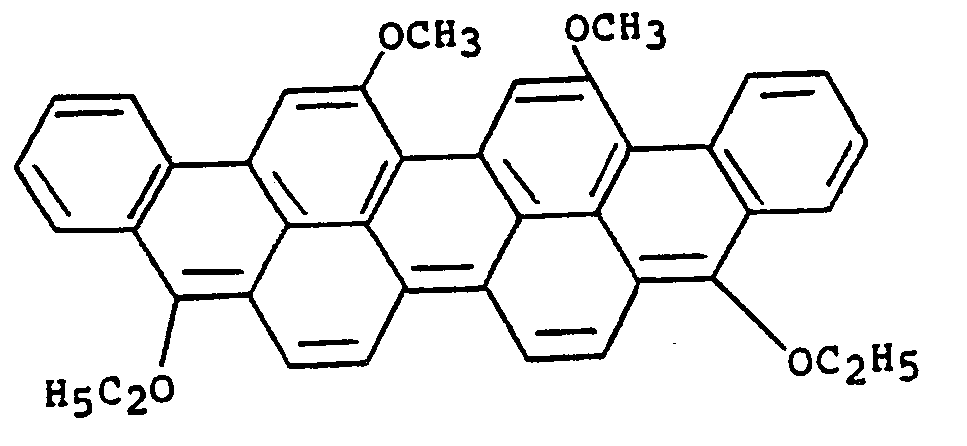
- the masking groups P suitable for such spectral sensitization are those exhibiting electron accepting properties and that spectral sensitizers such as 2-chlorothioxanthone, Michler's ketone, and polyaromatics such as EDMA (2-ethyl-9,10-dimethoxyanthracene), DEA (9,10-diethoxyanthracene), and 5,10-diethoxy-16,17-dimethoxy violanthrene give dramatic increases in speed even though several of these compounds have triplet energies well below that of nitrobenzene. An explanation for this behavior is that the latter group of compounds sensitize via photo-induced electron transfer rather than energy transfer.
- Suitable photolabile masking groups P are those which have half-wave reduction potentials (versus standard calomel electrode potentials) of -1.5 volts or more positive.
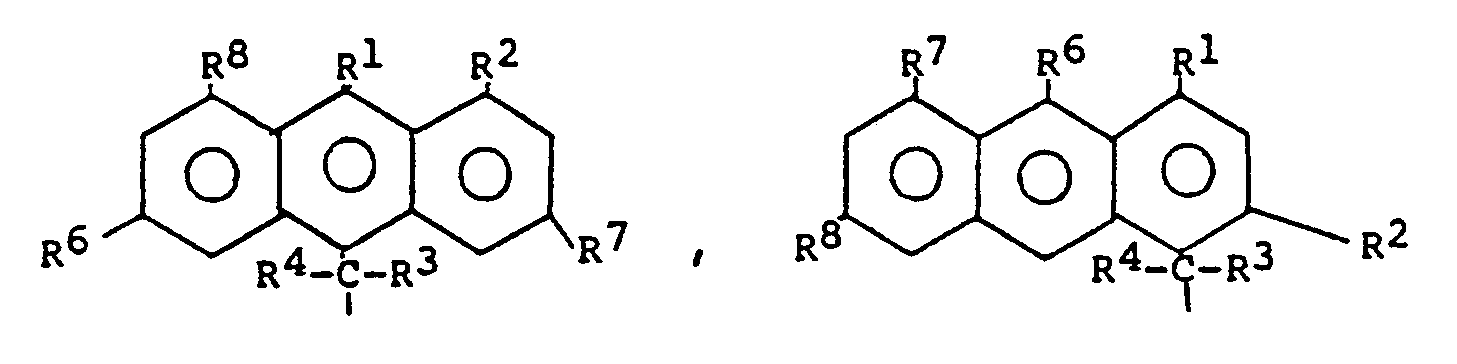
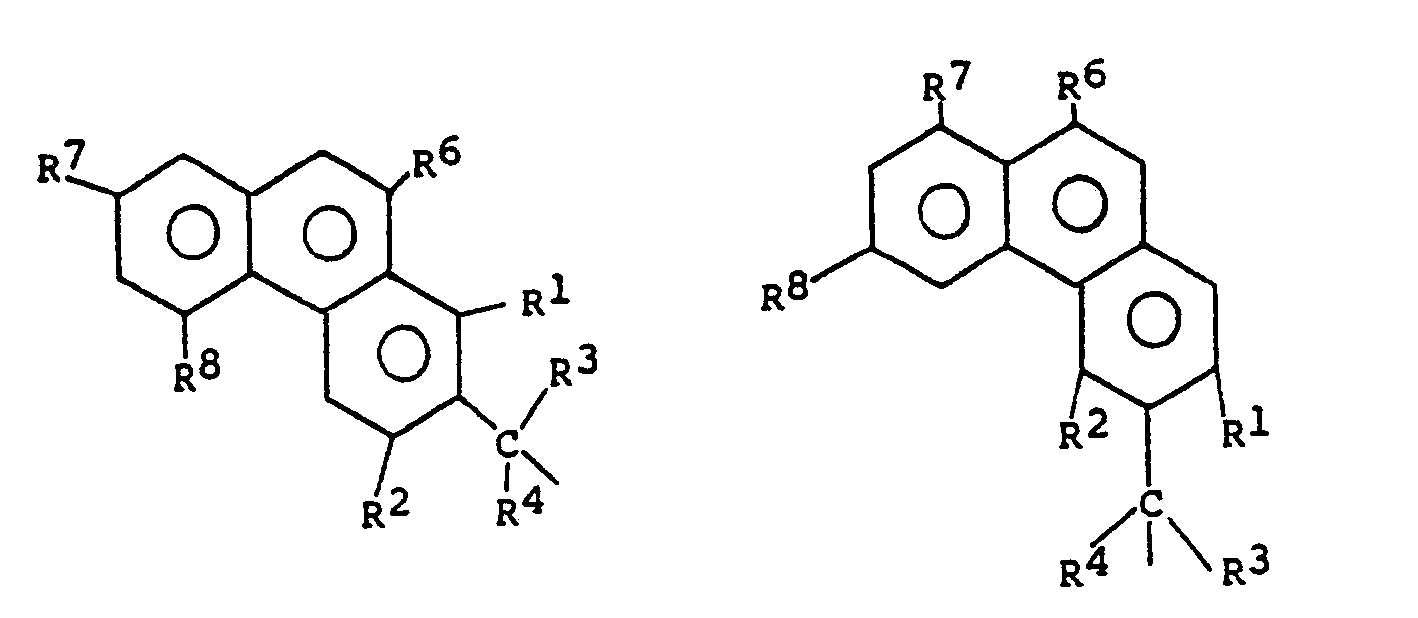
- suitable masking groups P are halo-substituted ethyl groups, benzyl groups substituted with nitro and/or nitrile groups and related condensed ring groups, e.g., in which
- Spectral sensitizing compounds suitable for this invention include those disclosed in the art as being suitable for the spectral sensitization of photolyzable organic halogen compounds, and sulfonium and iodonium salts. It has been found that compounds such as can be photochemically-sensitized to release surfactant. This widens the choice of labile masking groups with thermal stability, thereby vastly extending the shelf-life of imageable articles.
- Triplet energy sensitization of compounds of formula II would require an energy higher than the triplet energy of nitrobenzene of about 60 kcal/mole.
- benzophenone, 4,4'-dimethoxybenzophenone, and anthrone give a very small increase in speed even though they have triplet energies above that of nitrobenzene.
- 2-chloro-thioxanthone, Michler's ketone, and polyaromatics such as EDMA (2-ethyl-9,10-dimethoxyanthracene), DEA (9,10)-diethoxyanthracene) and 5,10-di- ethoxy-16,17-dimethoxy violanthrene give dramatic increases in speed even though several of these compounds have triplet energies well below that of nitrobenzene.
- An explanation for this behavior can be that the latter group of compounds sensitize via photoinduced electron transfer (equations 1-5) rather than energy transfer, but this explanation is not to be limiting upon the invention in any way.
- the classes of spectral sensitizing compounds useful in this invention are those with at least one absorption peak in the wavelength range 300-900 nm and which act as electron donors on activation rather than triplet sensitizers.
- Suitable classes of sensitizers, members of which satisfy these requirements, are as follows:
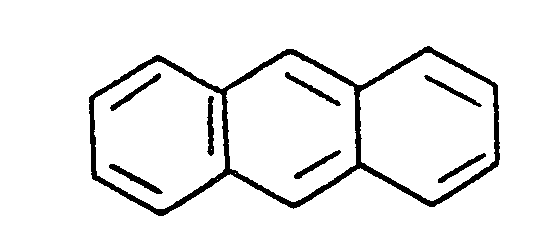
- Aromatic polycyclic hydrocarbons such as anthracenes, anthraquinones, pyrenes, perylenes, viol- anthrenes, etc. especially those containing electron donating substituents,
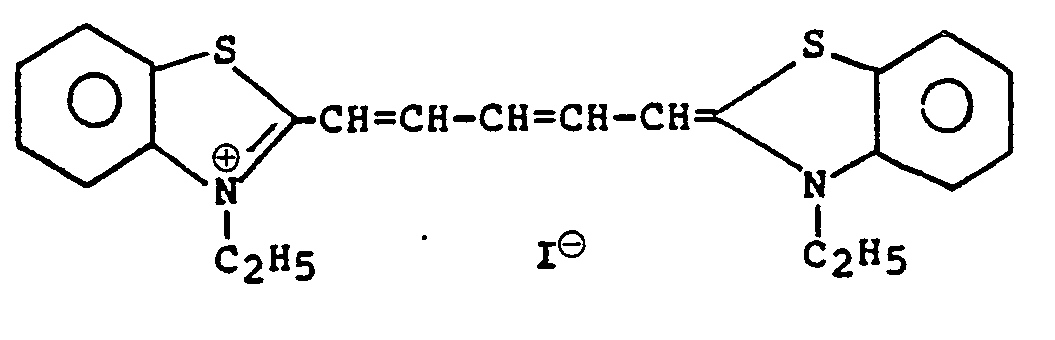
- Polymethine dyes which are effective as silver halide sensitizers as described for instance in "The Theory of the Photographic Process", by C. E. K. Mees and T. H. James, Macmillan Company, NY, Third Edition and in “Photographic Chemistry” by P. Glafkides, Vol. II, Fountain Press, London (1960), including cyanines, merocyanines, oxanols, hemicyanines, and azacyanines,
- a standard test solution is prepared with the following composition:
- Exposure is made through a stencil so as to provide exposed and unexposed areas in the construction.
- the cover film is removed, and the coating is treated with a finely divided colored powder, such as a color toner powder of the type conventionally used in xerography.
- a finely divided colored powder such as a color toner powder of the type conventionally used in xerography.
- the tested material is a sensitizer
- the trimethylol propane trimethacrylate monomer in the light exposed areas will be polymerized by the light generated free radicals from the photolyzable organic halogen compound, i.e., 2-methyl-4,6- bis(trichloromethyl)-s-triazine. Since the polymerized areas are essentially tack free, the colored powder will selectively adhere only to the tacky, unexposed areas of the coating, providing a visual image corresponding to that in the stencil.
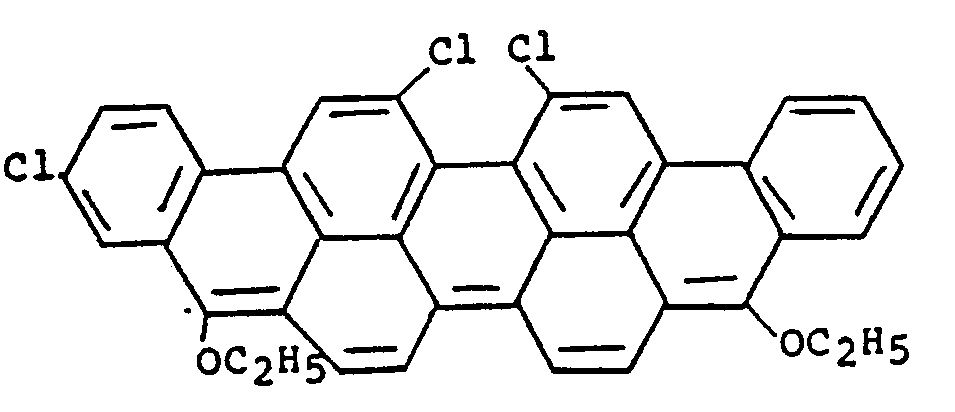
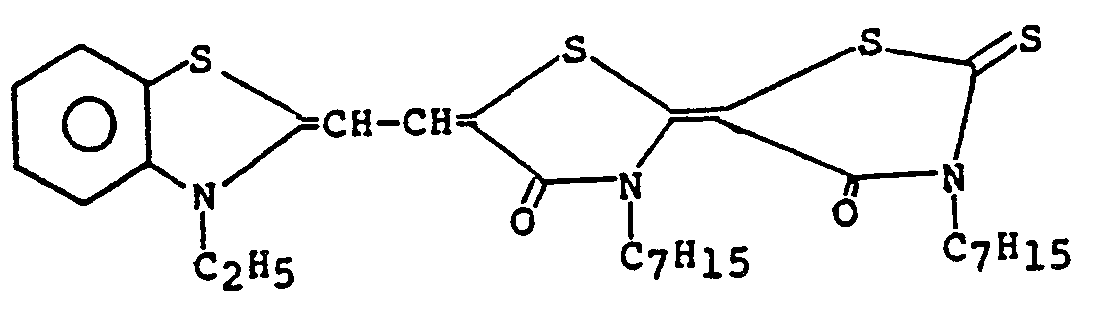
- Table I shows some explicit structures of sensitizers included in the above classes which have been found valuable in this invention.
- Spectral sensitizing compounds are present in an amount 0.1 to 5.0 times compared to the weight of the blocked surfactant, preferably 0.25 to 1.5 times such weight.
- the film-forming binder components of the radiation-activatable composition of the invention are thermoplastic organic polymers preferably having a molecular weight of at least 10,000.
- Suitable polymers include: (a) copolyesters based on terephthalic, isophthalic, sebacic, adipic, and hexahydrophthalic acids; such polyesters are sold under the trade designation Vitel" by the Goodyear Tire and Rubber Company, (b) alkyd resins based on phthalic anhydride and glycerine available from Enterprise Paint Company under the trade designation EPICTM Varnish, (c) polyamides such as poly(hexamethyleneadipamide) and poly caprolactam, (d) vinyl acetate polymers such as that available under the trade designation VINACTM ASB516 from Air Products Company and vinyl chloride copolymers such as the copolymer with vinyl acetate, e.g., those sold under the trade designation VMCHTM, VAGHTM or VYHHTM by the Union Carbide
- Estane 5715TM (k) the polycarbonates, and (I) styrenemaleic anhydride or maleic acid copolymers such as SMA-1000ATM (Arco Chemical Co., Philadelphia, PA).
- Plasticizers which have been found useful, for example, are the phthalic acid diesters such as dioctylphthalate, sebacic acid diesters such as MonoplexTM DOS from Rohm and Haas Co., and liquid polyoxyethylene containing compounds such as TritonTM X-100 from Rohm and Haas Co., TergitolTM TMN-10 from Union Carbide Corp.
- Plasticizers can be added to the photosensitive layer in an amount in the range of 0.1 to 10 weight percent of the coating solution.
- Particulate material such as pigments, e.g., carbon black, clays, titanium dioxide, umber ochre and the like, microfibers, glass microspheres, alumina, may also be added; however, only small amounts, i.e., less than about 5 weight percent, can be tolerated since the surfactant liberated on irradiation will tend to orient about particulate material and be lost at the substrate surface.
- pigments e.g., carbon black, clays, titanium dioxide, umber ochre and the like
- microfibers, glass microspheres, alumina may also be added; however, only small amounts, i.e., less than about 5 weight percent, can be tolerated since the surfactant liberated on irradiation will tend to orient about particulate material and be lost at the substrate surface.
- the support for bearing the photosensitive and frangible image-forming layers may be made substantially of any solid material including glass, metal, ceramic, paper and film-forming thermoplastic polymeric material capable of accepting a thin layer of metal or inorganic compound thereon.
- Particularly suitable polymers include polyesters, acetates, polyolefins, polyamides, polyvinyl resins, polycarbonates, polyacrylates, and polymethacrylates such as polyethylene terephthalate, polyethylene, polypropylene, polyvinylchloride, polystyrene, polymethylmethacrylate, polyhexamethylene adipamide (nylon 6), polyvinylidene fluoride and polyvinylidene chloride.
- the support surface may be primed with or without subsequent subbing to reproducibly control the adhesion of the frangible layer to the support.
- titanium dioxide dispersed in a coating solvent may be coated as a thin priming layer on polyester and aluminum then vacuum coated on top of it.
- Variation of the thickness of the titanium dioxide layer gives controlled variation of the peel-strength adhesion of the aluminum to the support. This in turn can give more latitude in the choice of surfactant system and the resultant adhesion values between the frangible layer and the photosensitive layer both before and after exposure, as described above.
- the thickness of the support is sufficient to permit peel-apart action when this feature is desired.
- a support having a thickness of at leat 50 micrometers (2 mils) is useful for peel-apart imaging assemblies.
- the support material may contain therein various additives such as pigment, dyestuff, and/or filler to give write-on properties, opacity, and coloration as is well known in the art.
- the support can be coated with the photosensitive composition by any of the conventional means, including spray, brush, dip pad, rollcoating, wire-wound bar, curtain and knife techniques, and may, if desired, be dried under ambient or oven conditions to provide coating films on the support.
- the coating material is applied in such an amount that the dried photosensitive layer is from about 1 to 100 um, preferably 10 to 40 pm, thick.
- the strippably adhered substrate in peel-apart imaging assemblies of the invention may be of any of the above-mentioned materials providing they are flexible enough to be bent through an angle of at least 120° without cracking.
- substrates having a thickness in the range of 5 to 100 micrometers (0.2 to 4 mils) are useful.
- the thin, frangible, preferably light-opaque layer may be a metal or metal compound layer on the surface of the support or the photosensitive layer and may be deposited by a variety of methods, such as vacuum evaporation, cathodic sputtering, electroless plating, and electrolytic plating. Substantially all metals may be included such as aluminum, zinc, tin, copper, gold, silver, bismuth, magnesium, chromium, iron and alloys of these metals.
- Inorganic compounds suitable for the thin layer include metal oxides such as the oxides of aluminum, zinc, tin, chromium and iron, and metal salts such as tin sulfide, zinc sulfide, cadmium sulfide which may be used above or in combination with the previously mentioned metals.
- the thickness of the metal-containing layer depends on the particular application desired. For example, a thinner layer may not possess sufficient light reflecting, absorbing or scattering properties to sufficiently attenuate a light beam for certain applications and a thick layer may give cracking and uneven cleavage along edges and consequent resolution reduction. Metal layers of 5 or 10 to 500 nm preferably may be employed while a thickness of 40-200 nm is more preferred.
- the photosensitized coating compositions of the invention may be prepared by using any convenient method of mixing the film-forming binder, the photolabile surfactant, and the sensitizing compound in a suitable solvent. Generally, from about one to about ten parts, preferably about two to five parts by weight each of photolabile masked surfactant and sensitizing compound are used per 100 parts by weight of film-forming binder. Solutions are prepared to contain about 10 to 50 weight percent concentration of solids, the concentration used being that which provides a solution having a viscosity most suitable to the method by which the composition is to be applied to the substrate.
- Solvents for use in the photosensitive coating composition are chosen on the basis of the film-forming binder. Suitable solvents include ketones such as acetone, methylethylketone, and methylisobutylketone; aromatic hydrocarbons such as benzene and toluene; halocarbons such as chloroform, methylene chloride, and trichloroethylene; esters such as ethyl acetate and propyl butyrate; ethers such as diethyl ether, dioxane, and tetrahydrofuran; nitromethane; nitroethane; and acetonitrile.
- ketones such as acetone, methylethylketone, and methylisobutylketone
- aromatic hydrocarbons such as benzene and toluene
- halocarbons such as chloroform, methylene chloride, and trichloroethylene
- esters such as ethyl acetate
- the image producing element according to this invention is exposed to light through a desired pattern and subjected to a dry heat development. Peel development is used to produce a metal image corresponding to the original pattern on the substrate.
- Suitable radiation sources include carbon arcs, mercury arc lamps, fluorescent lamps with ultraviolet or visible radiation emitting phosphors, argon and xenon glow lamps, tungsten lamps, metal halide arc lamps or electronic flash units.
- the period for which the image producing element is exposed to light varies depending upon the type of photosensitive layer, the wavelength emitted from the light source and the illumination level.
- Mercury vapor arcs and tungsten lamps customarily used in the graphic arts and printing industries are used at a distance of 2.5 to 51 cm (1 to 20 inches) or more from the photosensitive layer to bring about release. Total radiation fluxes of 10 to 10,000 pw2/cm 2 are generally suitable for use.
- Dry heat development of the imaged films of this invention may be accomplished by a variety of methods including heated rollers, heated plates, heated air, and infrared heat sources.
- the period for which the imaged film is subjected to heat varies depending on the type of photosensitive layer, the exposure time and the temperature of the heat sources. Exposure and heat development of the film of this invention may be done sequentially or simultaneously.
- an adhesive-bearing tape which may be a pressure-sensitive adhesive tape (e.g., ScotchTM Magic Mending Tape (3M, St. Paul, MN)) or a heat activatable laminating film, such tape or laminating film being applied to the surface of the photosensitive layer either prior to exposure and heat development, after exposure but before heat development or after exposure and heat development.
- the peeling action may be done either manually or mechanically.
- the articles of the invention may provide dryographic and lithographic type printing plates, projection transparencies, and high resolution recording films.
- a peel-apart imaging article is provided which is useful in any application where high contrast, high density, and high resolution are required, for example, line image masters and printed circuits.
- the first four compounds have triplet energies greater than 65 kcal/mole but are not efficient sensitizers whereas the remaining compounds have triplet energies up to about 65 kcal/mole yet act as good sensitizers and appear to be electron donors. This illustrates the higher efficiency of electron donors because it is well known in the art that a sensitizer that has a triplet energy less than the triplet energy of an acceptor cannot act as an efficient triplet sensitizer.
- Sensitization also depends on the stability of the radical formed by photorelease of the masking group, e.g., 1-phenyl-p-nitrocinnamyl radical (blocked surfactant XI) is more stable than the p-nitrobenzyl radical (blocked surfactant VII) and allows more efficient photorelease of surfactant as in the case of non-fluorinated carboxylate.
- the radical formed by photorelease of the masking group e.g., 1-phenyl-p-nitrocinnamyl radical (blocked surfactant XI) is more stable than the p-nitrobenzyl radical (blocked surfactant VII) and allows more efficient photorelease of surfactant as in the case of non-fluorinated carboxylate.
- a solution composed of 15 percent Goodyear Vitel PE 222 polyester resin, 0.9 percent of blocked surfactant III and 0.9 percent 9,10-diethoxyanthracene (DEA) in methyl ethyl ketone was hand coated with a No. 26 coating rod (about 60 pm wet thickness) onto about 50 nm thick vapor coated aluminum layer on polyester base and air dried to a tack free surface.
- Imagewise exposure (Berkey Ascor wedge exposure for 60 seconds) followed by heating at 60°C for 90 seconds and peel development gave a solid 5 steps in aluminum on the polyester base (negative image).
- the composite was subjected to accelerated aging for 7 days at 120°F or 7 days at 105°F, 95 percent relative humidity. There was no evidence for film failure after 7 days but the imaging speed had decreased, i.e., 2 minute exposure and heating at 90°C for 1 minute gave a solid 1 step in aluminum.
- Example 1 A solution identical to that used in Example 1 but containing 0.45 percent sensitizer 5 of Table I, above ( ⁇ m ax 528 nm) was similarly coated. Exposure for 30 seconds with a 3M Model 70 visible light source followed by heating at 60°C for 90 seconds and peel development gave a solid 3 steps in aluminum. 3M Model 70 exposure for 80 seconds through a typed white paper (typing face down) followed by 90 seconds at 60°C and tape peel gave a good negative line copy image of high contrast and optical density (density 2.5) that could be used as an overhead transparency.
- Example 1 A solution containing 15 percent Vitel PE 222, one percent blocked surfactant III, 0.58 percent eosin and 2.6 percent dioctylphthalate by weight in methyl ethyl ketone was coated as in Example 1. The film was wedge exposed for 2 minutes with a 3M Model 70 exposure unit and heated 30 seconds at 95°C. Peel development left no aluminum on the polyester. This result indicates eosin does not efficiently sensitize 4-nitrobenzyl derivatives under these conditions.
- Example 2 Two imageable articles were prepared using the procedure of Example 1.
- the coating solution contained 15 percent Vitel PE 222, 0.9 percent blocked surfactant VIII and 0.9 percent eosin in methylethylketone and the second sample contained a similar solution but without eosin.
- Both samples were Berkey Ascor wedge exposed for 5 minutes, heated at 60°C for 90 seconds and peel developed. Both samples gave slight negative image formation but the sample without eosin showed more image than the sample with eosin.
- This result contradicts patents (U.S. Patent Nos. 3,849,137 and 4,131,465) which state eosin sensitizes the photochemistry of o-nitrobenzyl derivatives.
- Example 8 was repeated except that 2 percent by weight -of a plasticizer, octylphenoxypolyethoxyethanol (Triton X-100 0 , Rohm and Haas Co.), was added to the coating solution. Exposure for 30 seconds followed by heating 1 minute at 80°C and peel development gave 4 solid steps in aluminum left on the polyester, thus illustrating improved sensitivity with Triton X-100 present.
- Triton X-100 0 octylphenoxypolyethoxyethanol
- Example 8 was repeated except that 0.4 percent by weight 3,3'-diethylthiadicarbocyanine iodide (sensitizer 8 Table I, ⁇ max 653 nm) was used in place of sensitizer 9. Exposure for 60 seconds followed by heating 60 seconds at 80°C and peel development gave no solid steps in aluminum on the polyester indicating little sensitivity.
- Example 10 was repeated except that 1.7 weight percent of a plasticizer, Triton X-100, was added to the coating solution. Exposure for 30 seconds followed by heating 1 minute at 80°C and peel development gave 6 steps in aluminum left on the polyester showing good sensitivity with the plasticizer added.
- a plasticizer Triton X-100
- Example 12 was repeated except that 2.3 percent by weight of a plasticizer, dioctylphthalate, was added to the coating solution. The film was wedge exposed for one minute, heated 45 seconds at 95°C and peel developed to give 9 solid steps in aluminum left on the polyester.
- a plasticizer dioctylphthalate
- Example 12 was repeated except that 1.6 percent by weight of a plasticizer, Triton X ⁇ 100®, was added to the coating solution. The film was wedge exposed for 20 seconds, heated one minute at 95°C and peel developed to give 3 solid steps in aluminum left on the polyester.
- a plasticizer Triton X ⁇ 100®
- a solution containing 15 weight percent Vitel PE 222 @ and 0.9 weight percent blocked surfactant, having in formula in methyl ethyl ketone was coated using the procedure of Example 1. Exposure in a Berkey Ascor wedge for 10 minutes followed by heating for 1 min at 80°C and then peel apart development left no aluminum on the polyester. This indicated little or no sensitivity.
- Example 12 was repeated except that 0.9 weight percent of 9,10-diethoxyanthracene was added to the coating solution. Berkey Ascor wedge exposure for 30 sec was followed by heating for 1 min at 80°C. After peel apart development, three solid steps in aluminum were left on the polyester base.
- Example 3 A solution composed of 15 weight percent Goodyear Vital PE 222 polyester resin and 0.9 percent of blocked surfactant I in methyl ethyl ketone was coated as in Example 3. Imagewise exposure (Berkey Ascor wedge exposure for 60 seconds) followed by heating at 60°C for 90 seconds and peel development gave 5 solid steps in aluminum on the polyester base. The composite was subjected to accelerated aging for 7 days at 49°C (120°F) or 7 dans at 41°C (105°F), 95 percent relative humidity. The film failed after 7 days, i.e., on peel development all the aluminum remained on the polyester base even in unexposed areas.
Landscapes
- Physics & Mathematics (AREA)
- General Physics & Mathematics (AREA)
- Chemical & Material Sciences (AREA)
- Engineering & Computer Science (AREA)
- Materials Engineering (AREA)
- Spectroscopy & Molecular Physics (AREA)
- Photosensitive Polymer And Photoresist Processing (AREA)
- Laminated Bodies (AREA)
- Non-Silver Salt Photosensitive Materials And Non-Silver Salt Photography (AREA)
- Plural Heterocyclic Compounds (AREA)
- Indole Compounds (AREA)
Claims (16)







Applications Claiming Priority (2)
| Application Number | Priority Date | Filing Date | Title |
|---|---|---|---|
| US06/591,419 US4554238A (en) | 1984-03-20 | 1984-03-20 | Spectrally-sensitized imaging system |
| US591419 | 1984-03-20 |
Publications (3)
| Publication Number | Publication Date |
|---|---|
| EP0156535A2 EP0156535A2 (de) | 1985-10-02 |
| EP0156535A3 EP0156535A3 (en) | 1986-06-04 |
| EP0156535B1 true EP0156535B1 (de) | 1989-06-14 |
Family
ID=24366411
Family Applications (1)
| Application Number | Title | Priority Date | Filing Date |
|---|---|---|---|
| EP85301437A Expired EP0156535B1 (de) | 1984-03-20 | 1985-03-01 | Spektralsensibilisiertes Aufzeichnungsmaterial |
Country Status (4)
| Country | Link |
|---|---|
| US (1) | US4554238A (de) |
| EP (1) | EP0156535B1 (de) |
| JP (1) | JPS60243653A (de) |
| DE (1) | DE3571088D1 (de) |
Families Citing this family (39)
| Publication number | Priority date | Publication date | Assignee | Title |
|---|---|---|---|---|
| US4740600A (en) * | 1984-05-10 | 1988-04-26 | Minnesota Mining And Manufacturing Company | Photolabile blocked surfactants and compositions containing the same |
| JPH02189548A (ja) * | 1989-01-19 | 1990-07-25 | Mitsubishi Kasei Corp | 光重合性組成物 |
| CA2023423A1 (en) * | 1989-09-05 | 1991-03-06 | Christopher E. Osuch | Transparent dissolution rate modifiers for photoresists |
| CA2033821A1 (en) * | 1990-01-12 | 1991-07-13 | Evan D. Laganis | Photopolymerizable compositions sensitive to longer wavelength visible actinic radiation |
| CA2033403A1 (en) * | 1990-01-26 | 1991-07-27 | Michael J. Mcfarland | Photoresist containing aliphatic di- and tri-esters of aliphatic and aromatic di-and tri-acids and alcohols |
| DE69218785T2 (de) * | 1991-10-11 | 1997-10-09 | Minnesota Mining & Mfg | Dünne bildübertragungsschicht |
| US5164280A (en) * | 1991-12-06 | 1992-11-17 | Eastman Kodak Company | Mechanicochemical layer stripping in image separation systems |
| EP0568993B1 (de) * | 1992-05-06 | 1998-08-12 | Kyowa Hakko Kogyo Co., Ltd. | Chemisch amplifizierte Resistzusammensetzung |
| US5262272A (en) * | 1992-10-08 | 1993-11-16 | Minnesota Mining And Manufacturing Company | Dye permeable polymer interlayers |
| EP0701173B1 (de) * | 1994-09-08 | 1997-11-12 | Agfa-Gevaert N.V. | Verfahren zur Herstellung lithographischer Druckplatten mittels Bildelementen, einen lichtempfindlichen Säurespender enthaltend |
| JPH0954437A (ja) | 1995-06-05 | 1997-02-25 | Fuji Photo Film Co Ltd | 化学増幅型ポジレジスト組成物 |
| US5763134A (en) * | 1996-05-13 | 1998-06-09 | Imation Corp | Composition comprising photochemical acid progenitor and specific squarylium dye |
| US7144700B1 (en) * | 1999-07-23 | 2006-12-05 | Affymetrix, Inc. | Photolithographic solid-phase polymer synthesis |
| WO2001079158A2 (en) * | 2000-04-13 | 2001-10-25 | Hsc Research And Development Limited Partnership | Compounds for modulating cell proliferation |
| US6632872B1 (en) | 2000-09-19 | 2003-10-14 | 3M Innovative Properties Company | Adhesive compositions including self-assembling molecules, adhesives, articles, and methods |
| US20020155589A1 (en) * | 2001-03-30 | 2002-10-24 | Fuji Photo Film Co., Ltd. | Biochemical analysis unit and biochemical analyzing method using the same |
| US7521168B2 (en) | 2002-02-13 | 2009-04-21 | Fujifilm Corporation | Resist composition for electron beam, EUV or X-ray |
| KR100955454B1 (ko) | 2002-05-31 | 2010-04-29 | 후지필름 가부시키가이샤 | 포지티브 레지스트 조성물 |
| CA2407755A1 (en) * | 2002-10-11 | 2004-04-11 | The Hospital For Sick Children | Inhibition of vegf secretion |
| US7771915B2 (en) | 2003-06-27 | 2010-08-10 | Fujifilm Corporation | Two-photon absorbing optical recording material and two-photon absorbing optical recording and reproducing method |
| US20070197660A1 (en) * | 2003-07-30 | 2007-08-23 | The Hospital For Sick Children | Compounds for modulating cell proliferation |
| WO2005092904A1 (en) * | 2004-03-26 | 2005-10-06 | Hsc Research And Development Limited Partnership | Novel compounds for modulating cell proliferation |
| DE602005007427D1 (de) | 2004-07-20 | 2008-07-24 | Fujifilm Corp | Bilderzeugendes Material |
| JP4439409B2 (ja) | 2005-02-02 | 2010-03-24 | 富士フイルム株式会社 | レジスト組成物及びそれを用いたパターン形成方法 |
| US20060204732A1 (en) | 2005-03-08 | 2006-09-14 | Fuji Photo Film Co., Ltd. | Ink composition, inkjet recording method, printed material, method of producing planographic printing plate, and planographic printing plate |
| US9709700B2 (en) * | 2005-04-06 | 2017-07-18 | 3M Innovative Properties Company | Optical bodies including rough strippable boundary layers |
| ATE410460T1 (de) | 2005-08-23 | 2008-10-15 | Fujifilm Corp | Härtbare tinte enthaltend modifiziertes oxetan |
| JP4757574B2 (ja) | 2005-09-07 | 2011-08-24 | 富士フイルム株式会社 | インク組成物、インクジェット記録方法、印刷物、平版印刷版の製造方法、及び、平版印刷版 |
| EP2103639A1 (de) | 2005-11-04 | 2009-09-23 | Fujifilm Corporation | Härtbare polyzyklische Epoxidzusammensetzung, Tinte und Tintenstrahldruckverfahren damit |
| DE602007012161D1 (de) | 2006-03-03 | 2011-03-10 | Fujifilm Corp | Härtbare Zusammensetzung, Tintenzusammensetzung, Tintenstrahlaufzeichnungsverfahren und Flachdruckplatte |
| JP2008189776A (ja) | 2007-02-02 | 2008-08-21 | Fujifilm Corp | 活性放射線硬化型重合性組成物、インク組成物、インクジェット記録方法、印刷物、平版印刷版の作製方法、及び平版印刷版 |
| JP2008208266A (ja) | 2007-02-27 | 2008-09-11 | Fujifilm Corp | インク組成物、インクジェット記録方法、印刷物、平版印刷版の製造方法、および平版印刷版 |
| JP5159141B2 (ja) | 2007-03-30 | 2013-03-06 | 富士フイルム株式会社 | インク組成物、インクジェット記録方法、印刷物、平版印刷版の作製方法及び平版印刷版 |
| JP5111039B2 (ja) | 2007-09-27 | 2012-12-26 | 富士フイルム株式会社 | 重合性化合物、重合開始剤、および染料を含有する光硬化性組成物 |
| US8240838B2 (en) | 2007-11-29 | 2012-08-14 | Fujifilm Corporation | Ink composition for inkjet recording, inkjet recording method, and printed material |
| JP5383133B2 (ja) | 2008-09-19 | 2014-01-08 | 富士フイルム株式会社 | インク組成物、インクジェット記録方法及び印刷物成形体の製造方法 |
| EP2169018B1 (de) | 2008-09-26 | 2012-01-18 | Fujifilm Corporation | Tintenzusammensetzung und Tintenaufzeichnungsverfahren |
| JP5461809B2 (ja) | 2008-09-29 | 2014-04-02 | 富士フイルム株式会社 | インク組成物、及び、インクジェット記録方法 |
| US8513445B2 (en) | 2010-09-29 | 2013-08-20 | Polyera Corporation | Polycyclic aromatic molecular semiconductors and related compositions and devices |
Family Cites Families (11)
| Publication number | Priority date | Publication date | Assignee | Title |
|---|---|---|---|---|
| US3808006A (en) * | 1971-12-06 | 1974-04-30 | Minnesota Mining & Mfg | Photosensitive material containing a diaryliodium compound, a sensitizer and a color former |
| US3729313A (en) * | 1971-12-06 | 1973-04-24 | Minnesota Mining & Mfg | Novel photosensitive systems comprising diaryliodonium compounds and their use |
| US3741769A (en) * | 1972-10-24 | 1973-06-26 | Minnesota Mining & Mfg | Novel photosensitive polymerizable systems and their use |
| CA1051705A (en) * | 1974-04-15 | 1979-04-03 | Thap Dominh | High gain transition metal complex imaging |
| US4069054A (en) * | 1975-09-02 | 1978-01-17 | Minnesota Mining And Manufacturing Company | Photopolymerizable composition containing a sensitized aromatic sulfonium compound and a cationacally polymerizable monomer |
| US4086210A (en) * | 1976-05-10 | 1978-04-25 | Eastman Kodak Company | Radiation sensitive polymeric o-nitrophenyl acetals |
| US4075175A (en) * | 1977-01-21 | 1978-02-21 | E. I. Du Pont De Nemours And Company | Preparation of photosensitive polyaldehydes |
| US4291114A (en) * | 1978-10-18 | 1981-09-22 | Minnesota Mining And Manufacturing Co. | Imageable, composite-dry transfer sheet and process of using same |
| US4250053A (en) * | 1979-05-21 | 1981-02-10 | Minnesota Mining And Manufacturing Company | Sensitized aromatic iodonium or aromatic sulfonium salt photoinitiator systems |
| US4343893A (en) * | 1980-07-25 | 1982-08-10 | E. I. Du Pont De Nemours And Company | Masked development/image modifier compounds of silver photographic systems |
| US4369244A (en) * | 1980-08-11 | 1983-01-18 | Minnesota Mining And Manufacturing Company | Imaging process and article employing photolabile, blocked surfactant |
-
1984
- 1984-03-20 US US06/591,419 patent/US4554238A/en not_active Expired - Fee Related
-
1985
- 1985-03-01 DE DE8585301437T patent/DE3571088D1/de not_active Expired
- 1985-03-01 EP EP85301437A patent/EP0156535B1/de not_active Expired
- 1985-03-11 JP JP60046721A patent/JPS60243653A/ja active Pending
Also Published As
| Publication number | Publication date |
|---|---|
| US4554238A (en) | 1985-11-19 |
| EP0156535A2 (de) | 1985-10-02 |
| DE3571088D1 (en) | 1989-07-20 |
| EP0156535A3 (en) | 1986-06-04 |
| JPS60243653A (ja) | 1985-12-03 |
Similar Documents
| Publication | Publication Date | Title |
|---|---|---|
| EP0156535B1 (de) | Spektralsensibilisiertes Aufzeichnungsmaterial | |
| US3729313A (en) | Novel photosensitive systems comprising diaryliodonium compounds and their use | |
| EP0115446B1 (de) | Metallfilm-Bildstruktur | |
| US3741769A (en) | Novel photosensitive polymerizable systems and their use | |
| US3808006A (en) | Photosensitive material containing a diaryliodium compound, a sensitizer and a color former | |
| US4205989A (en) | Dry system image producing element | |
| US3536489A (en) | Heterocyclic iminoaromatic-halogen containing photoinitiator light sensitive compositions | |
| JPS6020735B2 (ja) | 剥離現像可能な感光材料を用いる画像形成方法 | |
| US5364740A (en) | Bleaching of dyes in photosensitive systems | |
| JPS6130253B2 (de) | ||
| US4396700A (en) | Process for forming an image | |
| US4369244A (en) | Imaging process and article employing photolabile, blocked surfactant | |
| US3102811A (en) | Process for producing images, using light sensitive aromatic 1,2-dialdehydes and elements therefor | |
| CA1094377A (en) | Dry system image producing element having a photosensitive layer on a metal layer | |
| US4467022A (en) | Imaging process and article employing photolabile, blocked surfactant | |
| US3336596A (en) | Medium for electron beam recording | |
| US5851724A (en) | Method for producing lithographic plates with imaging elements comprising a photosensitive acid precursor | |
| EP0042632A1 (de) | Aufzeichnungsmaterial und Verfahren zur Herstellung von Metallbildern | |
| JPH10181219A (ja) | 位置合わせ用紫外線発色シート | |
| US3219444A (en) | Photographic processes | |
| CA2168773A1 (en) | Monochromatic and polychromatic proofs of high resolution masters and process and means for their preparation | |
| KR800001692B1 (ko) | 건식 화상(畵像) 형성 재료 | |
| JP3066869B2 (ja) | 遮光性マスキングフィルム | |
| EP0543881B1 (de) | Einschicht-trockene lichtempfindliche zusammensetzung für behandlung und anstrichverfahren | |
| JPH08160607A (ja) | 画像記録材料及び画像記録方法 |
Legal Events
| Date | Code | Title | Description |
|---|---|---|---|
| PUAI | Public reference made under article 153(3) epc to a published international application that has entered the european phase |
Free format text: ORIGINAL CODE: 0009012 |
|
| AK | Designated contracting states |
Designated state(s): DE FR GB IT |
|
| PUAL | Search report despatched |
Free format text: ORIGINAL CODE: 0009013 |
|
| AK | Designated contracting states |
Kind code of ref document: A3 Designated state(s): DE FR GB IT |
|
| 17P | Request for examination filed |
Effective date: 19860930 |
|
| 17Q | First examination report despatched |
Effective date: 19870612 |
|
| ITF | It: translation for a ep patent filed | ||
| GRAA | (expected) grant |
Free format text: ORIGINAL CODE: 0009210 |
|
| AK | Designated contracting states |
Kind code of ref document: B1 Designated state(s): DE FR GB IT |
|
| REF | Corresponds to: |
Ref document number: 3571088 Country of ref document: DE Date of ref document: 19890720 |
|
| ET | Fr: translation filed | ||
| PLBE | No opposition filed within time limit |
Free format text: ORIGINAL CODE: 0009261 |
|
| STAA | Information on the status of an ep patent application or granted ep patent |
Free format text: STATUS: NO OPPOSITION FILED WITHIN TIME LIMIT |
|
| 26N | No opposition filed | ||
| ITTA | It: last paid annual fee | ||
| PGFP | Annual fee paid to national office [announced via postgrant information from national office to epo] |
Ref country code: FR Payment date: 19940210 Year of fee payment: 10 |
|
| PGFP | Annual fee paid to national office [announced via postgrant information from national office to epo] |
Ref country code: DE Payment date: 19940224 Year of fee payment: 10 |
|
| PGFP | Annual fee paid to national office [announced via postgrant information from national office to epo] |
Ref country code: GB Payment date: 19940225 Year of fee payment: 10 |
|
| PG25 | Lapsed in a contracting state [announced via postgrant information from national office to epo] |
Ref country code: GB Effective date: 19950301 |
|
| GBPC | Gb: european patent ceased through non-payment of renewal fee |
Effective date: 19950301 |
|
| PG25 | Lapsed in a contracting state [announced via postgrant information from national office to epo] |
Ref country code: FR Free format text: LAPSE BECAUSE OF NON-PAYMENT OF DUE FEES Effective date: 19951130 |
|
| PG25 | Lapsed in a contracting state [announced via postgrant information from national office to epo] |
Ref country code: DE Effective date: 19951201 |
|
| REG | Reference to a national code |
Ref country code: FR Ref legal event code: ST |