EP0158619A2 - Instrument chirurgical - Google Patents
Instrument chirurgical Download PDFInfo
- Publication number
- EP0158619A2 EP0158619A2 EP85870018A EP85870018A EP0158619A2 EP 0158619 A2 EP0158619 A2 EP 0158619A2 EP 85870018 A EP85870018 A EP 85870018A EP 85870018 A EP85870018 A EP 85870018A EP 0158619 A2 EP0158619 A2 EP 0158619A2
- Authority
- EP
- European Patent Office
- Prior art keywords
- finger
- glove
- surgical instrument
- vagina
- rupture
- Prior art date
- Legal status (The legal status is an assumption and is not a legal conclusion. Google has not performed a legal analysis and makes no representation as to the accuracy of the status listed.)
- Withdrawn
Links
Classifications
-
- A—HUMAN NECESSITIES
- A41—WEARING APPAREL
- A41D—OUTERWEAR; PROTECTIVE GARMENTS; ACCESSORIES
- A41D19/00—Gloves
- A41D19/015—Protective gloves
- A41D19/01594—Protective gloves with accessories, e.g. tools, receptacles
-
- A—HUMAN NECESSITIES
- A61—MEDICAL OR VETERINARY SCIENCE; HYGIENE
- A61B—DIAGNOSIS; SURGERY; IDENTIFICATION
- A61B17/00—Surgical instruments, devices or methods
- A61B17/42—Gynaecological or obstetrical instruments or methods
- A61B17/4208—Instruments for rupturing the amniotic membrane
Definitions
- the present invention relates to a surgical instrument intended, in particular, to be introduced through the vagina to rupture, during childbirth, the membrane or amniotic sac.
- the contraction of the uterine muscle is reflected in the bag, contained in the uterine cavity, enclosing the fetus and amniotic fluid and exerts on this bag a force directed from top to bottom.
- the bag having an irreducible volume due to the presence of amniotic fluid, it exerts pressure on the lower segment of the uterus where the tissues are more malleable and where there is the cervical canal capable of yielding, expanding, under the effect of the aforementioned force.
- the cervix shortens until it disappears completely and the dilation continues gradually until reaching a diameter of 8 to 9 cm.
- the rupture of the amniotic sac does not occur naturally, and it is then necessary, for the delivery can continue normally, to manually cause the rupture of the amniotic sac by acting through the vagina.
- a rigid, metallic or plastic instrument having a substantially rectilinear portion ending in a curved end which is introduced into the vagina, guiding it as best it can with the aid of a finger also inserted into the vagina, until contact with the amniotic sac into which we then penetrate the curved end of the instrument to cause rupture.
- the object of the invention is to remedy this drawback and to provide an extremely simple instrument, the introduction of which into the vagina up to the amniotic sac can be controlled extremely precisely using a single finger, just like its handling, when in contact with the bag, to break the latter, which avoids the aforementioned injuries.
- the low cost of the instrument according to the invention allows it to be discarded after use, which offers the advantage, compared with known metal instruments, of avoiding sterilization operations.
- the instrument is constituted either by a finger finger, or by a glove made of flexible material, of the type used in surgery and for manipulations, and by a curved element, in the shape of a claw or hook. and made of rigid material, which is associated with the end of the finger or one of the fingers of the glove.
- the surgical instrument 1 is intended, in particular, to be introduced through the vagina, to cause, when it does not occur naturally, rupture of the membrane or amniotic sac in order to allow the flow of amniotic fluid through the vagina to facilitate the expulsion of the fetus from the uterine cavity.
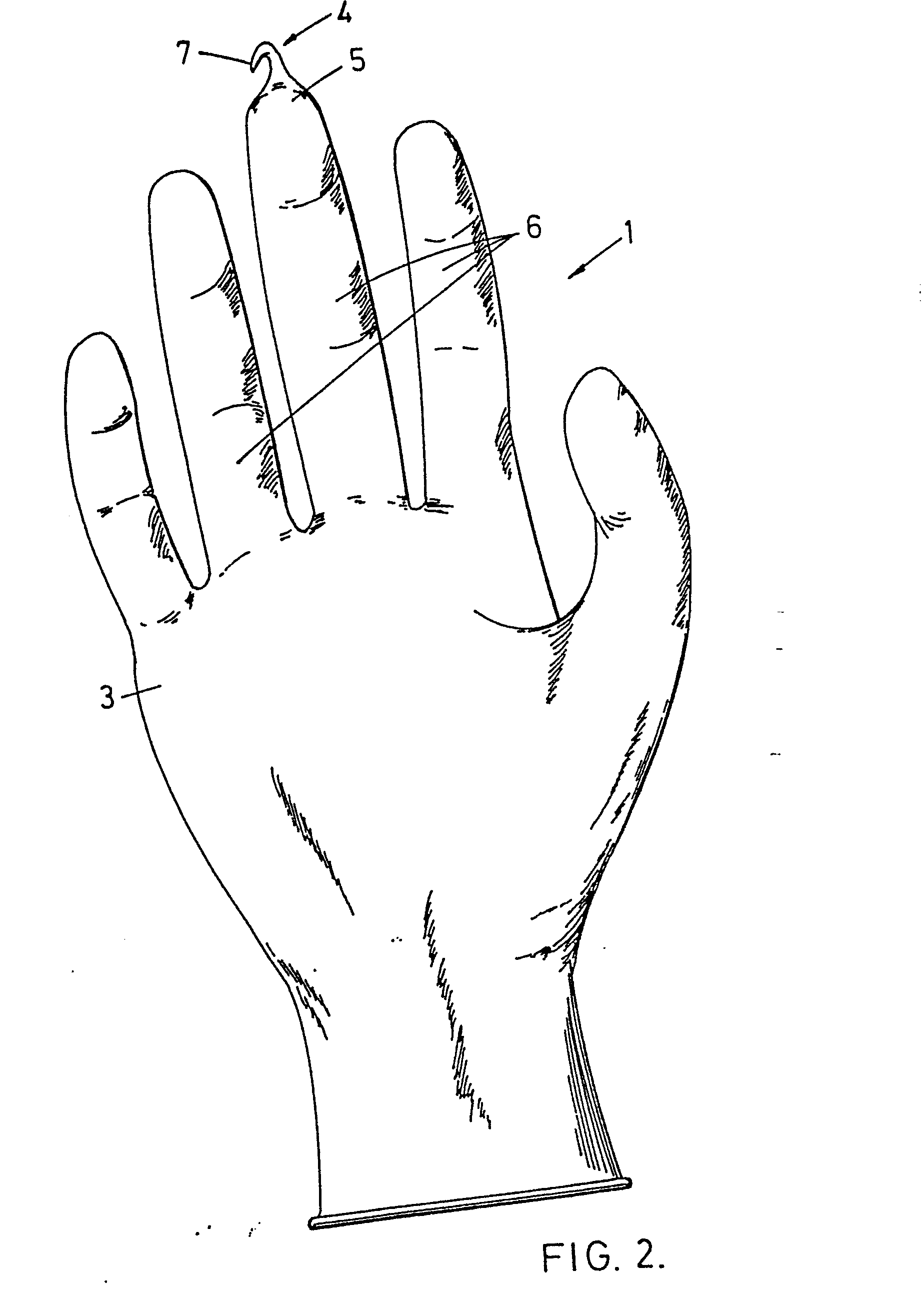
- This instrument 1 is constituted either by a finger-pocket 2, as shown in FIG. 1, or by a glove 3, as shown in FIG. 1, in flexible material, of the type used for manipulations and in surgery, and by a curved element 4, in the shape of a claw or hook, this element 4 being made of rigid material, such as a plastic material, which is associated with the end 5 of the finger pocket 2 or of one of the fingers 6 of the glove 3.
- the element 4 is associated with the finger-pocket or with the glove, so that its free tapered end 7 is turned towards the side of the palm of the hand so that by more or less bending the finger at the end of which the element, it can be penetrated into the vagina with extreme precision to the amniotic sac - and this, by orienting it so that the tip of the element cannot come into direct contact with the walls of the vagina .
- the element 4 When the element 4 is in contact with the amniotic sac, it suffices with a simple flexion of the finger which can also be carried out with extreme precision, to make its tapered end penetrate into the wall of the bag and cause, during the withdrawal of said element, tearing of the amniotic sac.
- the curved element 4 When associated with a glove, the curved element 4 is advantageously located in the extension of the finger of the glove corresponding to the middle finger.
- the element 4 can be constituted by an insert made of rigid plastic material, which is chosen to authorize the assembly, by welding or gluing, of said element on the finger pocket or the finger of the glove.
- the element 4 can also be incorporated into the glove or the fingerprint during their manufacture, so that they form only one piece.
Landscapes
- Health & Medical Sciences (AREA)
- Surgery (AREA)
- Engineering & Computer Science (AREA)
- Life Sciences & Earth Sciences (AREA)
- Medical Informatics (AREA)
- General Health & Medical Sciences (AREA)
- Reproductive Health (AREA)
- Pregnancy & Childbirth (AREA)
- Biomedical Technology (AREA)
- Heart & Thoracic Surgery (AREA)
- Gynecology & Obstetrics (AREA)
- Molecular Biology (AREA)
- Animal Behavior & Ethology (AREA)
- Nuclear Medicine, Radiotherapy & Molecular Imaging (AREA)
- Public Health (AREA)
- Veterinary Medicine (AREA)
- Textile Engineering (AREA)
- Prostheses (AREA)
- Ultra Sonic Daignosis Equipment (AREA)
- Switches With Compound Operations (AREA)
- Eye Examination Apparatus (AREA)
- Materials For Medical Uses (AREA)
Abstract
Instrument chirurgical 1 destiné, en particulier, à être introduit à travers le vagin pour rompre, en cours d'accouchement, la membrane ou sac amniotique, cet instrument 1 étant constitué par un gant 3 en matière souple et par un élément recourbé 4, en forme de griffe ou de crochet, réalisé en matière rigide et associé à l'extrémité 5 d'un des doigts 6 du gant 3.
La figure à considérer est la figure 2.
Description
- La présente invention a pour objet un instrument chirurgical destiné, en particulier, à être introduit à travers le vagin pour rompre, en cours d'accouchement, la membrane ou sac amniotique.
- En cours d'accouchement, la contraction du muscle utérin se répercute sur le sac, contenu dans la cavité utérine, renfermant le foetus et le liquide amniotique et exerce sur ce sac une force dirigée de haut en bas. Le sac ayant un volume irréductible du fait de la présence du liquide amniotique, il exerce une pression sur le segment inférieur de l'utérus où les tissus sont plus malléables et où il existe le canal cervical capable de céder, en se dilatant, sous l'effet de la force précitée. Quand les contractions progressent, le col se raccourcit jusqu'à sa totale disparition et la dilatation se poursuit graduellement jusqu'à atteindre un diamètre de 8 à 9 cm. C'est alors que se produit normalement la rupture des membranes ovulaires et une partie du liquide amniotique se déverse dans le vagin, les contractions du muscle utérin se répercutent alors, non plus sur le sac à volume irréductible, mais directement sur le foetus pour l'expulser de la cavité utérine vers le vagin et vers l'extérieur.
- Dans certains cas, la rupture du sac amniotique ne s'effectue pas naturellement, et on est alors obligé, pour que l'accouchement puisse se poursuivre normalement, de provoquer manuellement la rupture du sac amniotique en agissant à travers le vagin.
- Pour procéder à cette intervention, on utilise un instrument rigide, métallique ou en matière plastique, présentant une portion sensiblement rectiligne terminée par une extrémité recourbée que l'on introduit dans le vagin, en le guidant tant bien que mal à l'aide d'un doigt également introduit dans le vagin, jusqu'au contact du sac amniotique dans lequel on fait alors pénétrer l'extrémité recourbée de l'instrument pour provoquer sa rupture.
- L'utilisation d'un tel instrument présente notamment l'inconvénient de nécessiter un très grand doigté, d'une part, pour manipuler l'instrument et, d'autre part, pour assurer son guidage précis si l'on veut éviter d'occasionner des lésions plus ou moins graves à 1a mère ou au foetus.
- L'invention a pour but de remédier à cet inconvénient et de procurer un instrument extrêmement simple dont l'introduction dans le vagin jusqu'au sac amniotique peut être contrôlée de manière extrêmement précise à l'aide d'un seul doigt, tout comme son maniement, lorsqu'il est au contact du sac, pour rompre ce dernier, ce qui permet d'éviter les lésions précitées. De plus, le faible coût de l'instrument suivant l'invention permet de le jeter après usage, ce qui offre l'avantage, par rapport aux instruments métalliques connus, d'éviter les opérations de stérilisation.
- A cet effet, suivant l'invention, l'instrument est constitué soit par un doigtier, soit par un gant en matière souple, du type utilisé en chirurgie et pour les manipulations, et par un élément recourbé, en forme de griffe ou de crochet et réalisé en matière rigide, qui est associé à l'extrémité du doigtier ou d'un des doigts du gant.
- D'autres détails et particularités de l'invention ressortiront de la description des dessins annexés au présent mémoire et qui représentent, à titre d'exemples non limitatifs, deux formes de réalisation particulières de l'instrument chirurgical suivant l'invention.
- La figure 1 est une vue en perspective de l'instrument chirurgical suivant l'invention.
- La figure 2 est une vue en perspective d'une variante de l'instrument illustré à la figure 1.
- Dans les différentes figures, les mêmes notations de référence désignent des éléments identiques ou analogues.
- L'instrument chirurgical 1 suivant l'invention et représenté aux dessins est destiné, en particulier, à être introduit à travers le vagin, pour provoquer, lorsque celle -ci ne se produit pas naturellement, la rupture de la membrane ou sac amniotique afin de permettre l'écoulement du liquide amniotique par le vagin pour faciliter l'expulsion du foetus de la cavité utérine. Cet instrument 1 est constitué soit par un doigtier 2, comme montré à la figure 1 , soit par un gant 3, comme montré à la figure 1, en matière souple, du type que l'on utilise pour les manipulations et en chirurgie, et par un élément recourbé 4, en forme de griffe ou de crochet, cet élément 4 étant réalisé en matière rigide, telle qu'une matière plastique, qui est associé à l'extrémité 5 du doigtier 2 ou d'un des doigts 6 du gant 3. L'élément 4 est associé au doigtier ou au gant, pour que son extrémité effilée libre 7 soit tournée du côté de la paume de la main de sorte qu'en recourbant plus ou moins le doigt à l'extrémité duquel est situé l'élément , on peut faire pénétrer ce dernier dans le vagin avec une extrême précision jusqu'au sac amniotique-et ce, en l'orientant de telle sorte que la pointe de l'élément ne puisse entrer directement en contact avec les parois du vagin. Lorsque l'élément 4 est au contact du sac amniotique, il suffit d'une simple flexion du doigt pouvant également être réalisée avec une extrême précision, pour faire pénétrer son extrémité effilée dans la paroi du sac et provoquer, lors du retrait dudit élément, la déchirure du sac amniotique.
- Lorsqu'il est associé à un gant, l'élément recourbé 4 est avantageusement situé dans le prolongement du doigt du gant correspondant au médius.
- L'élément 4 peut être constitué par une pièce rapportée en matière plastique rigide, qui est choisie pour autoriser l'assemblage, par soudure ou collage , dudit élément sur le doigtier ou le doigt du gant. L'élément 4 peut également être incorporé au gant ou au doigtier lors de leur fabrication, de sorte qu'ils ne forment qu'une seule pièce.
- Il doit être entendu que l'invention n'est nullement limitée aux formes de réalisation décrites et que bien des modifications peuvent être apportées à ces dernières sans sortir du cadre du présent brevet.
Claims (5)
1) Instrument chirurgical (1) destiné, en particulier,à être introduit à travers le vagin pour rompre, en cours d'accouchement, la membrane ou sac amniotique, ledit instrument étant caractérisé en ce qu'il est constitué soit par un doigtier (2) , soit par un gant (3) en matière souple, du type utilisé en chirurgie et pour les manipulations, et par un élément recourbé (4) , en forme de griffe ou de crochet et réalisé en matière rigide, qui est associé à l'extrémité (5) du doigtier (2) ou d'un des doigts (6) du gant (3).
2) Instrument chirurgical suivant la revendication 1, caractérisé en ce que l'élément recourbé (4) susdit est associé au doigtier (2) ou au doigt (6) du gant (31 pour que son extrémité libre (7) soit orientée du côté de la paume de la main, de manière à ce que par une simple flexion du doigt, recouvert du doigtier ou du doigt du gant portant ledit élément et introduit dans le vagin,on puisse faire pénétrer l'extrémité libre (7) de cet élément (4) dans le sac amniotique et rompre ce dernier lorsque l'on en dégage ledit élément.
3) Instrument chirurgical suivant l'une ou l'autre des revendications 1 et 2, caractérisé en ce que ledit élément recourbé (4) est associé au doigt (6) du gant (3) correspondant au médius.
4) Instrument chirurgical suivant l'une quelconque des revendications 1 à 3 , caractérisé en ce que l'élément recourbé (4) est une pièce rapportée,par soudure ou par collage, sur le doigtier (2) ou le doigt (6) du gant (3) précité.
5) Instrument chirurgical suivant l'une quelconque des revendications 1 à 3, caractérisé en ce que le doigtier (2) ou le gant (3) et l'élément recourbé (4) sont réalisés en une seule pièce.
Applications Claiming Priority (2)
| Application Number | Priority Date | Filing Date | Title |
|---|---|---|---|
| BE0/212358A BE898868A (fr) | 1984-02-09 | 1984-02-09 | Instrument chirurgical |
| BE212358 | 1984-02-09 |
Publications (2)
| Publication Number | Publication Date |
|---|---|
| EP0158619A2 true EP0158619A2 (fr) | 1985-10-16 |
| EP0158619A3 EP0158619A3 (fr) | 1986-01-15 |
Family
ID=3843721
Family Applications (1)
| Application Number | Title | Priority Date | Filing Date |
|---|---|---|---|
| EP85870018A Withdrawn EP0158619A3 (fr) | 1984-02-09 | 1985-02-05 | Instrument chirurgical |
Country Status (3)
| Country | Link |
|---|---|
| EP (1) | EP0158619A3 (fr) |
| JP (1) | JPS60210249A (fr) |
| BE (1) | BE898868A (fr) |
Cited By (1)
| Publication number | Priority date | Publication date | Assignee | Title |
|---|---|---|---|---|
| CN111728681A (zh) * | 2020-06-19 | 2020-10-02 | 河北省中医院 | 人工破水针 |
Families Citing this family (3)
| Publication number | Priority date | Publication date | Assignee | Title |
|---|---|---|---|---|
| GB8416712D0 (en) * | 1984-06-30 | 1984-08-01 | Oneil Alexander G B | Medical instrument |
| JPH02134901U (fr) * | 1989-04-17 | 1990-11-08 | ||
| RU2565832C2 (ru) * | 2013-01-11 | 2015-10-20 | Сергей Геннадьевич Измайлов | Инструмент для обработки раневой полости |
Family Cites Families (3)
| Publication number | Priority date | Publication date | Assignee | Title |
|---|---|---|---|---|
| US3126890A (en) * | 1964-03-31 | Surgical instrument | ||
| US3687139A (en) * | 1971-01-28 | 1972-08-29 | Jean R Poirier | Digital amniotome |
| US3749099A (en) * | 1971-11-18 | 1973-07-31 | Medspec Inc | Digital amniotome |
-
1984
- 1984-02-09 BE BE0/212358A patent/BE898868A/fr not_active IP Right Cessation
-
1985
- 1985-02-05 EP EP85870018A patent/EP0158619A3/fr not_active Withdrawn
- 1985-02-08 JP JP60022077A patent/JPS60210249A/ja active Pending
Cited By (1)
| Publication number | Priority date | Publication date | Assignee | Title |
|---|---|---|---|---|
| CN111728681A (zh) * | 2020-06-19 | 2020-10-02 | 河北省中医院 | 人工破水针 |
Also Published As
| Publication number | Publication date |
|---|---|
| JPS60210249A (ja) | 1985-10-22 |
| EP0158619A3 (fr) | 1986-01-15 |
| BE898868A (fr) | 1984-05-30 |
Similar Documents
| Publication | Publication Date | Title |
|---|---|---|
| EP1027091B1 (fr) | Catheter universel | |
| EP0605351B1 (fr) | Instrument, destiné à l'extraction des tronçons veineux | |
| EP0490714B1 (fr) | Instrument chirurgical endoscopique pour le déplacement de tissus ou organes | |
| EP1237501B1 (fr) | Prothese destinee a controler le sens d'ecoulement dans un conduit d'un organisme vivant | |
| EP0340698B1 (fr) | Instrument ophtalmologique | |
| FR2874166A1 (fr) | Agrafe chirurgicale | |
| FR2499404A1 (fr) | Instrument facilitant le logement d'un dispositif intrauterin dans un tube de mise en place | |
| JP4267728B2 (ja) | デンタルフロスホルダ | |
| EP0091895A1 (fr) | Dispositif de drainage suprapubique de la vessie, introduit par l'urètre | |
| FR2646769A1 (fr) | Vis a usages chirurgicaux orthopediques, pouvant etre reunie a un appareil de fixation externe | |
| EP1336398A1 (fr) | Applicateur pour tampon hygiénique | |
| EP0621007A1 (fr) | Système pour ligature et/ou suture pour chirurgie endoscopique | |
| FR2521014A1 (fr) | Instrument chirurgical tubulaire, notamment catheter de thrombectomie | |
| FR2481103A1 (fr) | Bistouri medical pour recueillir une goutte de sang et son procede de fabrication | |
| FR2537001A1 (fr) | Sonde ureterale en helice | |
| FR2834198A1 (fr) | Dispositif medical d'explantation | |
| WO2001080747A1 (fr) | Applicateur pour la mise en place d'une aiguille chirurgicale | |
| WO2017064437A1 (fr) | Ballonnet gonflable à usage médical | |
| DE50109992D1 (de) | Verwendung einer Spritze für medizinische Zwecke in Verbindung mit einer Transportvorrichtung | |
| FR2561525A1 (fr) | Canule nasale a air a fonctions multiples | |
| FR2698778A1 (fr) | Spéculum. | |
| EP0192610B1 (fr) | Brucelles à serrage et à desserrage automatiques | |
| JPH07275256A (ja) | 身体挿入用棒状体の固定具 | |
| EP0974375B1 (fr) | Dispositif à ballonnet à diamètre nominal ajustable | |
| FR2565828A1 (fr) | Ballonnet a valve detachable d'un catheter destine a sa mise en place |
Legal Events
| Date | Code | Title | Description |
|---|---|---|---|
| PUAI | Public reference made under article 153(3) epc to a published international application that has entered the european phase |
Free format text: ORIGINAL CODE: 0009012 |
|
| AK | Designated contracting states |
Designated state(s): AT CH DE FR GB IT LI LU NL SE |
|
| PUAL | Search report despatched |
Free format text: ORIGINAL CODE: 0009013 |
|
| AK | Designated contracting states |
Designated state(s): AT CH DE FR GB IT LI LU NL SE |
|
| STAA | Information on the status of an ep patent application or granted ep patent |
Free format text: STATUS: THE APPLICATION IS DEEMED TO BE WITHDRAWN |
|
| 18D | Application deemed to be withdrawn |
Effective date: 19860916 |