EP0159027B1 - Magnetischer dünner Film - Google Patents
Magnetischer dünner Film Download PDFInfo
- Publication number
- EP0159027B1 EP0159027B1 EP85104636A EP85104636A EP0159027B1 EP 0159027 B1 EP0159027 B1 EP 0159027B1 EP 85104636 A EP85104636 A EP 85104636A EP 85104636 A EP85104636 A EP 85104636A EP 0159027 B1 EP0159027 B1 EP 0159027B1
- Authority
- EP
- European Patent Office
- Prior art keywords
- thin film
- magnetic
- magnetic thin
- film according
- elements
- Prior art date
- Legal status (The legal status is an assumption and is not a legal conclusion. Google has not performed a legal analysis and makes no representation as to the accuracy of the status listed.)
- Expired - Lifetime
Links
Images


Classifications
-
- G—PHYSICS
- G11—INFORMATION STORAGE
- G11B—INFORMATION STORAGE BASED ON RELATIVE MOVEMENT BETWEEN RECORD CARRIER AND TRANSDUCER
- G11B5/00—Recording by magnetisation or demagnetisation of a record carrier; Reproducing by magnetic means; Record carriers therefor
- G11B5/127—Structure or manufacture of heads, e.g. inductive
- G11B5/31—Structure or manufacture of heads, e.g. inductive using thin films
-
- H—ELECTRICITY
- H01—ELECTRIC ELEMENTS
- H01F—MAGNETS; INDUCTANCES; TRANSFORMERS; SELECTION OF MATERIALS FOR THEIR MAGNETIC PROPERTIES
- H01F10/00—Thin magnetic films, e.g. of one-domain structure
- H01F10/08—Thin magnetic films, e.g. of one-domain structure characterised by magnetic layers
- H01F10/10—Thin magnetic films, e.g. of one-domain structure characterised by magnetic layers characterised by the composition
- H01F10/12—Thin magnetic films, e.g. of one-domain structure characterised by magnetic layers characterised by the composition being metals or alloys
- H01F10/14—Thin magnetic films, e.g. of one-domain structure characterised by magnetic layers characterised by the composition being metals or alloys containing iron or nickel
- H01F10/147—Thin magnetic films, e.g. of one-domain structure characterised by magnetic layers characterised by the composition being metals or alloys containing iron or nickel with lattice under strain, e.g. expanded by interstitial nitrogen
-
- G—PHYSICS
- G11—INFORMATION STORAGE
- G11B—INFORMATION STORAGE BASED ON RELATIVE MOVEMENT BETWEEN RECORD CARRIER AND TRANSDUCER
- G11B5/00—Recording by magnetisation or demagnetisation of a record carrier; Reproducing by magnetic means; Record carriers therefor
- G11B5/127—Structure or manufacture of heads, e.g. inductive
- G11B5/147—Structure or manufacture of heads, e.g. inductive with cores being composed of metal sheets, i.e. laminated cores with cores composed of isolated magnetic layers, e.g. sheets
-
- H—ELECTRICITY
- H01—ELECTRIC ELEMENTS
- H01F—MAGNETS; INDUCTANCES; TRANSFORMERS; SELECTION OF MATERIALS FOR THEIR MAGNETIC PROPERTIES
- H01F41/00—Apparatus or processes specially adapted for manufacturing or assembling magnets, inductances or transformers; Apparatus or processes specially adapted for manufacturing materials characterised by their magnetic properties
- H01F41/14—Apparatus or processes specially adapted for manufacturing or assembling magnets, inductances or transformers; Apparatus or processes specially adapted for manufacturing materials characterised by their magnetic properties for applying magnetic films to substrates
- H01F41/20—Apparatus or processes specially adapted for manufacturing or assembling magnets, inductances or transformers; Apparatus or processes specially adapted for manufacturing materials characterised by their magnetic properties for applying magnetic films to substrates by evaporation
-
- G—PHYSICS
- G11—INFORMATION STORAGE
- G11B—INFORMATION STORAGE BASED ON RELATIVE MOVEMENT BETWEEN RECORD CARRIER AND TRANSDUCER
- G11B5/00—Recording by magnetisation or demagnetisation of a record carrier; Reproducing by magnetic means; Record carriers therefor
- G11B5/127—Structure or manufacture of heads, e.g. inductive
- G11B5/31—Structure or manufacture of heads, e.g. inductive using thin films
- G11B5/3109—Details
-
- Y—GENERAL TAGGING OF NEW TECHNOLOGICAL DEVELOPMENTS; GENERAL TAGGING OF CROSS-SECTIONAL TECHNOLOGIES SPANNING OVER SEVERAL SECTIONS OF THE IPC; TECHNICAL SUBJECTS COVERED BY FORMER USPC CROSS-REFERENCE ART COLLECTIONS [XRACs] AND DIGESTS
- Y10—TECHNICAL SUBJECTS COVERED BY FORMER USPC
- Y10T—TECHNICAL SUBJECTS COVERED BY FORMER US CLASSIFICATION
- Y10T428/00—Stock material or miscellaneous articles
- Y10T428/12—All metal or with adjacent metals
- Y10T428/12431—Foil or filament smaller than 6 mils
Definitions
- This invention relates to a magnetic thin film and more particularly, to a magnetic thin film consisting essentially of Fe, Al and Si and also containing nitrogen.
- the Sendust® alloy thin film can be applied to the magnetic recording head which can record the signals on the magnetic recording medium having high coercive force, such as the aforementioned metal powder tape.
- the Sendust® alloy thin film is inferior e.g. to ferrite in abrasion resistance and, being a metal material, it is relatively easy to rust.
- saturation magnetic flux density Bs of the Sendust® alloy thin film may cause saturation magnetic flux density Bs of the Sendust® alloy thin film to be lowered.
- the saturation magnetic flux density of the Sendust® alloy thin film free of the aforementioned additives amounts to ca. 1,1T (11000 Gauss)
- the saturation magnetic flux density of the Sendust® alloy thin film containing these additives amounts to ca. 0.9T (9000 Gauss).
- Such reduction in the saturation magnetic flux density Bs is unfavorable with the magnetic recording medium having the high coercive force Hc such as metal powder tape.
- Non-crystalline magnetic alloys that are high in saturation magnetic flux density Bs and are not affected in magnetic permeability in the high frequency region.
- these non-crystalline magnetic alloys are unstable at high temperatures and are deteriorated markedly in the magnetic permeability due to prolonged heating or heat cycles with a resultingly lowered reproducing efficiency.
- the materials can not be subjected to a temperature higher than 500°C for prolonged time, because the materials can be crystallized under these conditions.
- amorphous magnetic alloys for the preparation of magnetic heads which may involve the processing step at a temperature higher than 500°C, such as glass bonding.
- Patent Abstracts of Japan, Vol.8,No.33,(P254)(1470),14.02.84 & JP-A-58 188 318 discloses a magnetic head with enhanced reliability and durability being made of a Fe-Si-Al alloy (mainly a Sendust® alloy) into the surface of which ions of Cr,Ti,Zr,Nb,Ru,Rh,Pd,Os,In,,Pt,O or N are implanted, which metallic ions convert the alloy into a wear resistant alloy and O and N enhance the wear resistance by forming oxides and nitrides, respectively.
- a Fe-Si-Al alloy mainly a Sendust® alloy
- US-A-3965 463 describes an amorphous magnetic composition comprising a single magnetic element or a multi component system such as binary and ternary alloys and compounds comprising rare earth elements and transition metal elements which may contain Fe,In,N,Ga,Y,Gd,Ag,Cu,Co or Ni.
- the present inventors have conducted perseverant researches, and found that, by adding nitrogen to the magnetic thin film consisting essentially of Fe,Al and Si,the hardness and magnetic permeability can be drastically improved without lowering the saturation magnetic flux density.
- the present invention which has been completed on the basis of the above findings comprises a magnetic thin film having a composition represented by the following formula:
- Fig.1 is a characteristic diagram showing the relation between the N contents in the Fe-Al-Si alloy thin film and the Vickers hardness.
- Fig.2 is a characteristic diagram showing the relation between the N contents in the Fe-Al-Si alloy thin film and the specific resistivity with the resistivity of the N-free Fe-Al-Si alloy thin film being one.
- Fig.3 is a characteristic diagram showing the relation between N contents in the Fe-Al.-Si alloy thin film and magnetic permeability at 1 MHz.
- Fig.4 is a characteristic diagram showing frequency characteristics of magnetic permeability of the N-containing Fe-Al-Si alloy thin film.
- Fig.5 is a characteristic diagram showing the relation between the contents of N in the Fe-Al-Si alloy thin film and the saturation magnetic flux densitiy.
- the magnetic thin film of the present invention consists essentially of Fe,Al and Si and, more importantly, it also contains nitrogen(N).
- Additive such as the elements of the IIIa or IVa groups and the elements of the platinum group may be used in combination.
- the magnetic thin film composition is expressed as
- part of Fe can be replaced by Co for elevating the saturation magnetic flux density Bs.
- a maximum value of the saturation magnetic flux density Bs may be obtained with a composition in which 40 weight percent of Fe is replaced by Co. It is preferred that the ratio of substitution by Co be in the range of 0 to 60 weight percent related to Fe.
- part of Fe may be replaced by Ni for maintaining a higher value of magnetic permeability without decreasing the saturation magntic flux density. It is preferred that the ratio of substitution by Ni be in the range of 0 to 40 weight percent related to Fe.
- the film thickness of the magnetic thin film having the above composition is preferably more than 1nm (10 ⁇ ) and less than 1mm and more preferably more than 1nm (10 ⁇ ) and less than 100 ⁇ m.
- high magnetic permeability and high hardness may be achieved with the magnetic thin film of the present invention by reason of the content of nitrogen (N) without deterioration in the magnetic properties such as saturation magnetic flux density or coercive force.
- the contents of nitrogen (N) give rise to an increased specific resistivity and a lowered eddy current loss in the high frequency region so that the frequency characteristics of the magnetic permeability are improved with the result that the film may be effectively used with the magnetic heads used in a frequency region higher than 10 MHz.
- the magnetic thin film with contents of nitrogen (N) as described above is also superior in durability. For example, no rust formation was observed on the film immersed in city water for three days.
- the drastically increased film hardness is possibly ascribable to the Fe nitration or the generation of the high hardness particles, such as aluminium nitride or silicon nitride particles.
- the magnetic thin film is preferably prepared by, for example, physical vapor deposition or ion implantation.
- the methods of physical vapour deposition may include flash vacuum evaporation, reactive vacuum evaporation, ion plating, sputtering or a cluster ion beaming. Deposition and ion implantation may also be carried out simultaneously.
- nitrogen N may be used.
- the aforementioned physical vapor deposition for example, may be effected in an atmosphere containing a nitrogen gas and the contents of the nitrogen N in the resulting magnetic thin film are controlled by checking the concentration of the nitrogen gas.
- a compound of nitrogen and at least one element of the aforementioned composition and an alloy of the remaining components are used as a deposition source so that nitrogen may be introduced into the resulting magnetic thin film.
- the following methods may be employed.
- Tee respective components are previously smelted in e.g. an induction furnace for forming an alloy ingot which may be used as an deposition source.
- the deposition sources for the respective elements are prepared and the composition is controlled by activating the selected number of the deposition sources.
- the alloy is used as the deposition source and other elements are implanted during deposition.
- the target composition was Fe82 Al7 Si11.
- films were deposited in accordance with the planar magnetron type sputtering method by using the above target.
- a sputtering operation was carried out with the addition of nitrogen (N2) into an Ar as the inert gas.
- N2 nitrogen
- the ratio of N2 in the inert gas was changed by controlling the partial pressure of the N2 gas which is an index of the N2 ratio in the inert gas.
- the Fe-Al-Si alloy thin film was formed on the crystallized glass substrate. After heat-treating the resulting Fe-Al-Si alloy thin film at 550°C for one hour, the hardness, specific resistivity, magnetic permeability and saturation magnetic flux density were measured.
- Fig.1 In the characteristic diagram of Fig.1, there is shown the relation between the hardness and the ratio of N contained in the Fe-Al-Si alloy thin film.
- the hardness was measured herein in terms of the Vickers hardness and with a weight of 50g applied for 15 seconds for weighting.
- the hardness of the Fe-Al-Si alloy thin film is appreciably increased.
- the hardness Hv of the Fe-Al-Si alloy film completely free of N amounts to 630
- the hardness Hv of the Fe-Al-Si alloy thin film with contents of 2 weight percen of N amounts to 1120.
- Fig. 2 In the characteristic diagram shown in Fig. 2, there is shown the relation between the electrical resistance (specific resistivity) and the ratio of N in the Fe-Al-Si alloy thin film. It should be noted that the electrical resistance was measured by the four-terminal method and as the specific resistivity with the electrical resistance of the N-free Fe-Al-Si alloy thin film as 1.0.
- This specific resistivity is a critical factor for estimating magnetic permeability of the Fe-Al-Si alloy thin film in the high frequency region.
- a coaxial like induction current eddy current
- eddy current flows in the magnetic body by the temporally changing magnetic flus, such eddy current causing a power consumption known as eddy current loss.
- This eddy current loss is markedly related with the frequency and the resistivity of the magnetc material and gives rise to decreased permeability especially in the high frequency region. It is known for example that magnetic permeability of the ordinary Sendust® alloy material tends to be lowered in the high frequency region, since the resistivity of the material is 85 ⁇ cm which is much lower than that of the amorphous alloy material which is 150 ⁇ cm.
- the larger resistivity of the resulting Fe-Al-Si alloy thin film is preferred. It is seen from Fig.2 that, with the increase in the N ratio, the specific resistivity of the Fe-Al-Si alloy thin film is linearly increased. It is therefore presumed that N-containing the Fe-Al-Si alloy film is also excellent in magnetic permeability in the high frequency region.
- Fig. 3 In the characteristic diagram shown in Fig. 3, there is shown the relation between the N ratio in the Fe-Al-Si alloy film and magnetic permeability at 1 MHz. Measurement of magnetic permeability was made with the aid of a permeance meter. It is seen from Fig.3 that magnetic permeability of the Fe-Al-Si alloy thin film is notably increased with increase in the N ratio. For instance,with the N ratio of 2 weight percent, magnetic permeability is improved by a factor of about 2.5.
- Fig.4 shows frequency characteristics of magnetic permeability of the N-containing Fe-Al-Si alloy thin film.
- the curve a represents the frequency characteristics for N contents of 0 weight percent
- the curve b those for N contents of 1.1 weight percent
- the curve c those for N contents of 2.0 weight percent
- the curve d those for N contents of 3.3 weight percent.
- the Fe-Al-Si alloy thin film with N contents exhibits a higher magnetic permeability in any frequency than that without N contents. Above all, it may be appreciated that decrease in magnetic permeability in the higher frequency tends to be reduced with increase in the N contents.
- the alloy thin film with N contents of 3.3 weight percent may be sufficiently employed in the frequency range of 20 to 30 MHz, although it exhibits a low magnetic permeability in the frequency region less than 10 MHz.
- the saturation magnetic flux density of the Fe-Al-Si alloy thin film is increased by the addition of N into the film. This may be highly meritorious in consideration that the saturation magnetic flux density is generally lowered by using additives aimed to improve hardness or temperature characteristics of the magnetic permeability. In the present Example, not only the reduction in the saturation magnetic flux density is prevented, but the saturation magnetic flux density is improved.
- the Fe-Al-Si alloy thin film with 1.1 weight percent of N was immersed in city water for 85 hours to check for the state of rusting. It has been shown that the film has retained its metal mirror surface and rust occurrence is substantially nil.
- the Fe-Al-Si alloy thin film is not only superior in hardness, rust-proofness or durability but also superior in magnetic characteristics such as permeability or saturation magnetic flux density and hence may be advantageously used e.g. in conjunction with magnetic heads.
- the resulting Fe-Al-Si alloy thin film was heat-treated at 350° C to 800° C for 1-5 hours. Then, magnetic permeability of the film was measured with the aid of a permeance meter and the Vickers hardness was also measured with weighting of 50g.
- the composition of the resulting Fe-Al-Si alloy thin film was analyzed as to Fe, Al and Si contents with the aid of an X-ray micro-analyzer. The nitrogen contens were measured by the gas analysis of the magnetic thin film formed on the Ni substrate. The results are shown in Table 1.
- a composite target consisting of a pure iron target on which Al, Si and Co or Ni were mounted was used as target and the sputtering operation was carried out in a N2-containing Ar gas and in a N2-free Ar gas for the preparation of the Fe-Al-Si alloy thin film.
- Silicion (Si) with the purity of 99.9999 percent, aluminum (Al) with the purity of 99.99 percent and iron (Fe) with the purity of 99.99 percent were used as the starting materials. These starting materials were separately prepared in such weight amounts as to give a predetermined relative composition. The resulting batch was smelted in vacuum by using a high frequency smelting oven. The resulting molten product was poured into a mold for the preparation of the alloy target.
- the saturation magnetic flux density and the coercive force were also measured in the above Examples and comparative Examples and were found to be substantially unchanged no matter whether or not nitrogen was contained in the film samples.
- the saturation magnetic flux density and the coercive force of the comparative sample 13 amount to 1,1T(11000 Gauss) and 23,8 A m (0.3 Oerstead) respectively
- the saturation magnetic flux density of the sample 13 amounts to 1,1T (11000 Gauss)and the coercive force of the same sample amounts to 23,8 A m (0.3 Oersted).
- the present invention allows to provide a magnetic thin film high in hardness and superior in magnetic properties.
Landscapes
- Engineering & Computer Science (AREA)
- Power Engineering (AREA)
- Manufacturing & Machinery (AREA)
- Thin Magnetic Films (AREA)
- Soft Magnetic Materials (AREA)
- Physical Vapour Deposition (AREA)
Claims (14)
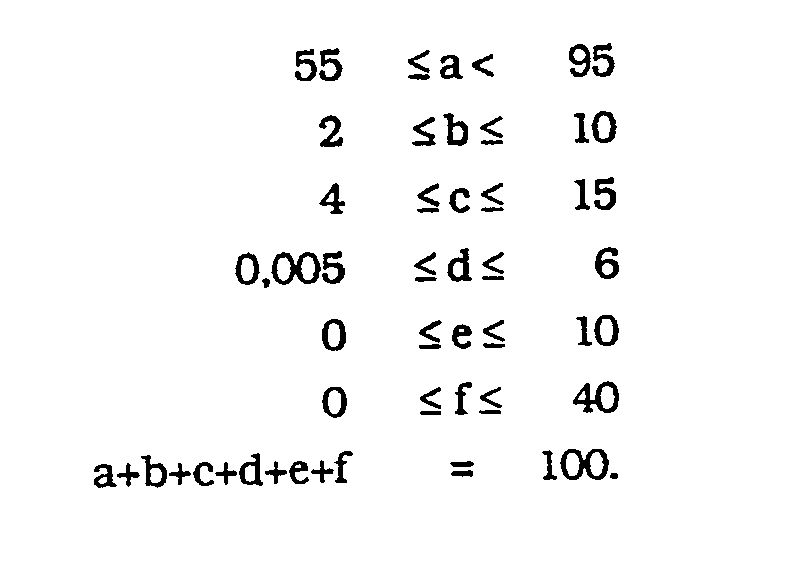
- Magnetischer Dünnfilm mit einer Zusammensetzung der folgenden Formel:worin T mindestens ein Element, ausgewählt aus Elementen der Gruppe IIIa,IVa, Va,VIa,VIIa und Ib, Ga, In, Ge, Sn und Sb und P und mindestens ein Element der Platingruppe und a,b,c,d,e und f jeweils die Gewichtsprozente der jeweiligen Elemente bedeuten, welche folgende Beziehungen erfüllt:
FeaAlbSicNdTePf
- Magnetischer Dünnfilm nach Anspruch 1, worin das Element der Gruppe IIIa Sc,Y,La,Ce,Nd oder Gd bedeutet.
- Magnetischer Dünnfilm nach Anspruch 1, worin das Element der Gruppe IVa Ti,Zr oder Hf bedeutet.
- Magnetischer Dünnfilm nach Anspruch 1, worin das Element der Gruppe Va V,Nb oder Ta bedeutet.
- Magnetischer Dünnfilm nach Anspruch 1, worin das Element der Gruppe VIa Cr,Mo oder W bedeutet.
- Magnetischer Dünnfilm nach Anspruch 1, worin das Element der Gruppe VIIa Mn,Tc oder Re bedeutet.
- Magnetischer Dünnfilm nach Anspruch 1, worin das Element der Gruppe Ib Cu,Ag oder Au bedeutet.
- Magnetischer Dünnfilm nach Anspruch 1, worin das Element der Platin gruppe Ru,Rh,Pd,Os,Ir oder Pt bedeutet.
- Magnetischer Dünnfilm nach Anspruch 1, worin e und f die Beziehung e + f ≦αµρ¨ 20 erfüllen, wenn Ru,Rh oder Pd als Element der Platingruppe eingesetzt ist.
- Magnetischer Dünnfilm nach Anspruch 1, worin e und f die Beziehung e + f ≦αµρ¨ 40 erfüllen, wenn Os,Ir oder Pt Element der Platingruppe eingesetzt ist.
- Magnetischer Dünnfilm nach einem der Ansprüche 1 bis 10, worin ein Teil des Fe durch Co oder Ni ersetzt ist.
- Magnetischer Dünnfilm nach Anspruch 11, worin das Substitutionsverhältnis durch Co im Bereich von 0 bis 60 Gew.-%, bezogen auf Fe, liegt.
- Magnetischer Dünnfilm nach Anspruch 11, worin das Substitutionsverhältnis durch Ni im Bereich von 0 bis 40 Gew.-%, bezogen auf Fe, liegt`
- Magnetischer Dünnfilm nach einem der Ansprüche 1 bis 13, worin a die Beziehung 70 ≦αµρ¨ a < 95.
vorzugsweise 65 ≦αµρ¨ a < 95
erfüllt.
Applications Claiming Priority (2)
| Application Number | Priority Date | Filing Date | Title |
|---|---|---|---|
| JP76434/84 | 1984-04-18 | ||
| JP59076434A JPS60220913A (ja) | 1984-04-18 | 1984-04-18 | 磁性薄膜 |
Publications (3)
| Publication Number | Publication Date |
|---|---|
| EP0159027A2 EP0159027A2 (de) | 1985-10-23 |
| EP0159027A3 EP0159027A3 (en) | 1986-12-10 |
| EP0159027B1 true EP0159027B1 (de) | 1991-03-06 |
Family
ID=13605044
Family Applications (1)
| Application Number | Title | Priority Date | Filing Date |
|---|---|---|---|
| EP85104636A Expired - Lifetime EP0159027B1 (de) | 1984-04-18 | 1985-04-17 | Magnetischer dünner Film |
Country Status (6)
| Country | Link |
|---|---|
| US (1) | US4683012A (de) |
| EP (1) | EP0159027B1 (de) |
| JP (1) | JPS60220913A (de) |
| KR (1) | KR930002395B1 (de) |
| CA (1) | CA1272591A (de) |
| DE (1) | DE3581950D1 (de) |
Families Citing this family (20)
| Publication number | Priority date | Publication date | Assignee | Title |
|---|---|---|---|---|
| KR940004986B1 (ko) * | 1984-08-27 | 1994-06-09 | 가부시기가이샤 히다찌세이사꾸쇼 | 자성막의 제조방법 및 그것을 사용한 자기헤드 |
| US4735865A (en) * | 1985-06-10 | 1988-04-05 | Sharp Kabushiki Kaisha | Magnetic head core |
| JPS62188206A (ja) * | 1985-10-07 | 1987-08-17 | Nippon Mining Co Ltd | Fe−Si−Al合金磁性膜及びその製造方法並びに薄膜積層磁気ヘツド |
| JPS62158306A (ja) * | 1986-01-07 | 1987-07-14 | Hitachi Ltd | 高密度鉄系磁性体膜およびその製造方法 |
| JPS62210607A (ja) * | 1986-03-12 | 1987-09-16 | Matsushita Electric Ind Co Ltd | 軟磁性合金膜及びその形成法 |
| JPS6364313A (ja) * | 1986-09-04 | 1988-03-22 | Sony Corp | 軟磁性薄膜 |
| US5038242A (en) * | 1988-05-13 | 1991-08-06 | Citizen Watch Co., Ltd. | Magnetic head containing a barrier layer |
| US5225006A (en) * | 1988-05-17 | 1993-07-06 | Kabushiki Kaisha Toshiba | Fe-based soft magnetic alloy |
| JP2698813B2 (ja) * | 1989-04-03 | 1998-01-19 | 富士写真フイルム株式会社 | 軟磁性薄膜 |
| JPH03111528A (ja) * | 1989-09-26 | 1991-05-13 | Toshiba Corp | 磁性合金 |
| US5154983A (en) * | 1989-10-18 | 1992-10-13 | Victor Company Of Japan, Ltd. | Magnetic alloy |
| US5262915A (en) * | 1990-08-23 | 1993-11-16 | Tdk Corporation | Magnetic head comprising a soft magnetic thin film of FeNiZrN having enhanced (100) orientation |
| EP0531514B1 (de) * | 1991-03-25 | 1996-08-28 | Eastman Kodak Company | Magnetkopf zur Aufzeichnung mit hoher Frequenz und hoher Dichte |
| US5230818A (en) | 1991-12-20 | 1993-07-27 | Eastman Kodak Company | Coating compositions for master media for anhysteretic recording |
| SG46191A1 (en) * | 1993-01-15 | 1998-02-20 | Ibm | Layered magnetic structure for use in a magnetic head |
| JPH06259729A (ja) * | 1993-03-03 | 1994-09-16 | Tdk Corp | 磁気ヘッド |
| US5411813A (en) * | 1993-04-08 | 1995-05-02 | Eastman Kodak Company | Ferhgasi soft magnetic materials for inductive magnetic heads |
| JPH07210856A (ja) * | 1994-01-19 | 1995-08-11 | Tdk Corp | 磁気記録媒体 |
| JP2778494B2 (ja) * | 1994-12-26 | 1998-07-23 | 日本電気株式会社 | 電極薄膜およびその電極薄膜を用いた磁気抵抗効果型ヘッド |
| US5515221A (en) * | 1994-12-30 | 1996-05-07 | International Business Machines Corporation | Magnetically stable shields for MR head |
Family Cites Families (12)
| Publication number | Priority date | Publication date | Assignee | Title |
|---|---|---|---|---|
| US3089795A (en) * | 1959-11-18 | 1963-05-14 | Westinghouse Electric Corp | Method for producing fiber texture and cube-texture sheets of iron-base alloys |
| US3965463A (en) * | 1972-08-29 | 1976-06-22 | International Business Machines Corporation | Apparatus using amorphous magnetic compositions |
| US4065330A (en) * | 1974-09-26 | 1977-12-27 | The Foundation: The Research Institute Of Electric And Magnetic Alloys | Wear-resistant high-permeability alloy |
| US4177089A (en) * | 1976-04-27 | 1979-12-04 | The Arnold Engineering Company | Magnetic particles and compacts thereof |
| JPS53119723A (en) * | 1977-03-30 | 1978-10-19 | Hitachi Metals Ltd | Method of making abrassionnresistant high permeability alloy |
| US4231816A (en) * | 1977-12-30 | 1980-11-04 | International Business Machines Corporation | Amorphous metallic and nitrogen containing alloy films |
| JPS5562145A (en) * | 1978-10-31 | 1980-05-10 | Hitachi Metals Ltd | Corrosion resistant, high permeability alloy |
| JPS5585656A (en) * | 1978-12-22 | 1980-06-27 | Hitachi Denshi Ltd | Wear-resistant high-permeability alloy, heat treating method therefor and magnetic head using said alloy |
| JPS55125258A (en) * | 1979-03-22 | 1980-09-26 | Kobe Steel Ltd | High permeability alloy with superior workability |
| JPS55152155A (en) * | 1979-05-16 | 1980-11-27 | Sumitomo Special Metals Co Ltd | Fine crystalline strip material for high permeability magnetic material, preparation and product thereof |
| JPS597334B2 (ja) * | 1979-09-03 | 1984-02-17 | 株式会社神戸製鋼所 | 耐食性にすぐれたセンダスト系合金の製造法 |
| JPS5644755A (en) * | 1979-09-20 | 1981-04-24 | Hitachi Metals Ltd | Alloy of high magnetic permeability |
-
1984
- 1984-04-18 JP JP59076434A patent/JPS60220913A/ja not_active Expired - Lifetime
-
1985
- 1985-04-03 CA CA000478277A patent/CA1272591A/en not_active Expired - Lifetime
- 1985-04-05 US US06/720,342 patent/US4683012A/en not_active Expired - Lifetime
- 1985-04-17 DE DE8585104636T patent/DE3581950D1/de not_active Expired - Lifetime
- 1985-04-17 KR KR1019850002584A patent/KR930002395B1/ko not_active Expired - Fee Related
- 1985-04-17 EP EP85104636A patent/EP0159027B1/de not_active Expired - Lifetime
Also Published As
| Publication number | Publication date |
|---|---|
| DE3581950D1 (de) | 1991-04-11 |
| JPS60220913A (ja) | 1985-11-05 |
| EP0159027A2 (de) | 1985-10-23 |
| EP0159027A3 (en) | 1986-12-10 |
| KR930002395B1 (ko) | 1993-03-30 |
| CA1272591A (en) | 1990-08-14 |
| KR850007509A (ko) | 1985-12-04 |
| US4683012A (en) | 1987-07-28 |
Similar Documents
| Publication | Publication Date | Title |
|---|---|---|
| EP0159027B1 (de) | Magnetischer dünner Film | |
| EP0159028B1 (de) | Magnetischer dünner Film | |
| US4748000A (en) | Soft magnetic thin film | |
| US4969962A (en) | Magnetic alloys for magnetic head | |
| EP0178634B1 (de) | Amorpher weichmagnetischer dünner Film | |
| JP2508462B2 (ja) | 軟磁性薄膜 | |
| JPH0744107B2 (ja) | 軟磁性薄膜 | |
| JP2675178B2 (ja) | 軟磁性合金膜 | |
| JP2522284B2 (ja) | 軟磁性薄膜 | |
| JPH0746654B2 (ja) | 軟磁性薄膜 | |
| JPH0789525B2 (ja) | 磁気ヘッド用軟磁性薄膜 | |
| JPH0758647B2 (ja) | 結晶質軟磁性薄膜 | |
| JPH0789527B2 (ja) | 結晶質軟磁性薄膜 | |
| JPH0746656B2 (ja) | 結晶質軟磁性薄膜 | |
| JP3019400B2 (ja) | 非晶質軟磁性材料 | |
| JPH0789526B2 (ja) | 結晶質軟磁性薄膜 | |
| JPH0746653B2 (ja) | 結晶質軟磁性薄膜 | |
| JPH0746652B2 (ja) | 結晶質軟磁性薄膜 | |
| JPH0789524B2 (ja) | 磁気ヘッド用軟磁性薄膜 | |
| JPH0744109B2 (ja) | 軟磁性薄膜 | |
| JPH0789523B2 (ja) | 磁気ヘッド用軟磁性薄膜 | |
| JPH07111926B2 (ja) | 軟磁性薄膜 | |
| JPH0744106B2 (ja) | 軟磁性薄膜 | |
| JPH0612650A (ja) | 磁気記録媒体およびその製造方法 | |
| JPH04288805A (ja) | 軟磁性薄膜およびそれを用いた薄膜磁気ヘッド |
Legal Events
| Date | Code | Title | Description |
|---|---|---|---|
| PUAI | Public reference made under article 153(3) epc to a published international application that has entered the european phase |
Free format text: ORIGINAL CODE: 0009012 |
|
| AK | Designated contracting states |
Designated state(s): DE FR GB NL |
|
| PUAL | Search report despatched |
Free format text: ORIGINAL CODE: 0009013 |
|
| AK | Designated contracting states |
Kind code of ref document: A3 Designated state(s): DE FR GB NL |
|
| 17P | Request for examination filed |
Effective date: 19870604 |
|
| 17Q | First examination report despatched |
Effective date: 19881222 |
|
| GRAA | (expected) grant |
Free format text: ORIGINAL CODE: 0009210 |
|
| AK | Designated contracting states |
Kind code of ref document: B1 Designated state(s): DE FR GB NL |
|
| ET | Fr: translation filed | ||
| REF | Corresponds to: |
Ref document number: 3581950 Country of ref document: DE Date of ref document: 19910411 |
|
| PLBE | No opposition filed within time limit |
Free format text: ORIGINAL CODE: 0009261 |
|
| STAA | Information on the status of an ep patent application or granted ep patent |
Free format text: STATUS: NO OPPOSITION FILED WITHIN TIME LIMIT |
|
| 26N | No opposition filed | ||
| PGFP | Annual fee paid to national office [announced via postgrant information from national office to epo] |
Ref country code: FR Payment date: 20010409 Year of fee payment: 17 Ref country code: DE Payment date: 20010409 Year of fee payment: 17 |
|
| PGFP | Annual fee paid to national office [announced via postgrant information from national office to epo] |
Ref country code: GB Payment date: 20010411 Year of fee payment: 17 |
|
| PGFP | Annual fee paid to national office [announced via postgrant information from national office to epo] |
Ref country code: NL Payment date: 20010430 Year of fee payment: 17 |
|
| REG | Reference to a national code |
Ref country code: GB Ref legal event code: IF02 |
|
| PG25 | Lapsed in a contracting state [announced via postgrant information from national office to epo] |
Ref country code: GB Free format text: LAPSE BECAUSE OF NON-PAYMENT OF DUE FEES Effective date: 20020417 |
|
| PG25 | Lapsed in a contracting state [announced via postgrant information from national office to epo] |
Ref country code: NL Free format text: LAPSE BECAUSE OF NON-PAYMENT OF DUE FEES Effective date: 20021101 Ref country code: DE Free format text: LAPSE BECAUSE OF NON-PAYMENT OF DUE FEES Effective date: 20021101 |
|
| GBPC | Gb: european patent ceased through non-payment of renewal fee |
Effective date: 20020417 |
|
| PG25 | Lapsed in a contracting state [announced via postgrant information from national office to epo] |
Ref country code: FR Free format text: LAPSE BECAUSE OF NON-PAYMENT OF DUE FEES Effective date: 20021231 |
|
| NLV4 | Nl: lapsed or anulled due to non-payment of the annual fee |
Effective date: 20021101 |
|
| REG | Reference to a national code |
Ref country code: FR Ref legal event code: ST |