EP0159670A2 - Funkverbindungseinrichtung und Verfahren zum Regeln der Senderausgangsleistung - Google Patents
Funkverbindungseinrichtung und Verfahren zum Regeln der Senderausgangsleistung Download PDFInfo
- Publication number
- EP0159670A2 EP0159670A2 EP85104714A EP85104714A EP0159670A2 EP 0159670 A2 EP0159670 A2 EP 0159670A2 EP 85104714 A EP85104714 A EP 85104714A EP 85104714 A EP85104714 A EP 85104714A EP 0159670 A2 EP0159670 A2 EP 0159670A2
- Authority
- EP
- European Patent Office
- Prior art keywords
- communication device
- radio communication
- circuit
- power amplifier
- power
- Prior art date
- Legal status (The legal status is an assumption and is not a legal conclusion. Google has not performed a legal analysis and makes no representation as to the accuracy of the status listed.)
- Granted
Links
- 238000004891 communication Methods 0.000 title claims abstract description 94
- 238000000034 method Methods 0.000 title claims description 7
- 230000008878 coupling Effects 0.000 claims abstract description 9
- 238000010168 coupling process Methods 0.000 claims abstract description 9
- 238000005859 coupling reaction Methods 0.000 claims abstract description 9
- 230000020169 heat generation Effects 0.000 abstract description 4
- 238000010586 diagram Methods 0.000 description 7
- 230000017525 heat dissipation Effects 0.000 description 6
- 238000010295 mobile communication Methods 0.000 description 3
- 230000008054 signal transmission Effects 0.000 description 1
- 238000009423 ventilation Methods 0.000 description 1
Images



Classifications
-
- H—ELECTRICITY
- H03—ELECTRONIC CIRCUITRY
- H03G—CONTROL OF AMPLIFICATION
- H03G3/00—Gain control in amplifiers or frequency changers
- H03G3/20—Automatic control
- H03G3/30—Automatic control in amplifiers having semiconductor devices
- H03G3/3036—Automatic control in amplifiers having semiconductor devices in high-frequency amplifiers or in frequency-changers
- H03G3/3042—Automatic control in amplifiers having semiconductor devices in high-frequency amplifiers or in frequency-changers in modulators, frequency-changers, transmitters or power amplifiers
-
- H—ELECTRICITY
- H04—ELECTRIC COMMUNICATION TECHNIQUE
- H04B—TRANSMISSION
- H04B1/00—Details of transmission systems, not covered by a single one of groups H04B3/00 - H04B13/00; Details of transmission systems not characterised by the medium used for transmission
- H04B1/38—Transceivers, i.e. devices in which transmitter and receiver form a structural unit and in which at least one part is used for functions of transmitting and receiving
- H04B1/3827—Portable transceivers
- H04B1/3877—Arrangements for enabling portable transceivers to be used in a fixed position, e.g. cradles or boosters
Definitions
- the present invention relates to a radio communication system, and more particularly to a radio communication device comprising a portable communication device and a power amplifier device connectable to the portable communication device to amplify a transmitter output therefrom.
- the present invention is concerned with a method of effecting a control such that transmitter output power level of the portable communication device is kept at a minimum level required for the power amplifier device.
- portable or handy type radio communication devices have restrictions in respect to a battery capacity and a heat dissipation structure. Accordingly, their transmitter output is limited to about several of hundreds of mW (milliwatt) to about several watts. Such a transmitter output is of a small value as compared to that of a radio communication device carried on a vehicle or a fixed radio communication device. In other words, in case where a larger transmitter output is needed, it is necessary to provide an amplifier device connectable to the portable communication device for amplifying its transmitter output.
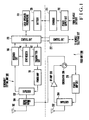
- Fig. 1 is a block diagram illustrating a mobile communication device comprising a removably fitting unit 100 serving as a portable communication device and a fixed unit 200 serving as a power amplifier device into which the portable communication device 100 is removably fitted.
- the configuration of these units 100 and 200 will be briefly described as follows.
- the removably fitting 100 is provided with an antenna 102, an antenna switch 104 coupled to the antenna 102, a duplexer 106 coupled to the antenna switch 104 to switch a signal path, a receiver circuit 108 coupled to the duplexer 106, a control circuit 110 coupled to the receiver circuit 108, a transmitter circuit 112 coupled to the control circuit 110, a synthesizer 114 to control the receiver circuit 108 and the transmitter circuit 112 in accordance with a control signal from the control circuit 110, a power amplifier circuit 116 coupled between the transmitter circuit 112 and the duplexer 106, and a telephone loudspeaker/ microphone 118.
- Reference numeral 120 denotes a battery.
- the fixed unit 200 is provided with an antenna 202, a duplexer 204 coupled to the antenna 202, an RF (radio frequency) amplifier 206 coupled to the duplexer 204, a circulator 208 coupled to the RF amplifier 206 and connectable to the above-mentioned antenna switch 104, and a power amplifier circuit 210 coupled between the circulator 208 and the duplexer 204.
- RF radio frequency
- the fixed unit 200 is further provided with a control circuit 212 capable of effecting a mutual communication with the control circuit 110 provided in the removably fitting unit 100, and an electric charger 214 coupled to a power supply circuit 216 to charge the battery 120 provided in the removably fitting unit 100, when the removably fitting unit 100 is fitted into the fixed unit 200 in order to establish an electrical coupling therebetween.
- Signal flows are indicated by arrow.
- a power supply in the removably fitting unit 100 is switched from the battery 120 to a battery embarked in a vehicle.
- the battery 120 is charged by the charger 214.
- the antenna switch 104 becomes operartive, a signal is received by the vehicle antenna 202 instead of the antenna 102.
- signal transmission is mutually effected between the control circuits 110 and 212.
- Fig. 2 shows a cirucit configuration of the conventional radio communication device Cl, obtained by extracting the parts relevant to the invention from the entire system configuration shown in Fig. 1 for the purpose of facilitating the description.
- the portable communication device 100 comprises an input terminal 1, an amplifier 3 for amplifying an input signal, a power detector circuit 5 connected to the output of the amplifier 3, a differential amplifier 7 responsive to the difference between an output from the power detector circuit 5 and a reference voltage supplied from an input terminal 11 to produce an output signal, and a signal converter circuit 9 responsive to the output signal from the differential circuit 7 to produce a control signal for a control of the amplifier 3.
- the power detector 5 may comprise a directional coupler and a diode.
- Reference numeral 13a denotes an output terminal.
- the power detector circuit 5, the differential amplifier 7 and the signal converter circuit 9 constitutes an automatic output power control circuit.
- the power amplifier device 200 has a circuit configuration similar to that of the portable communication device 100.
- Reference numerals 4, 6, 12, 8 and 10 denote an amplifier, a power detector circuit, a reference voltage input terminal, a differential amplifier and a signal converter circuit, respectively, and reference numerals 13b and 14 denote an input terminal and an output terminal, respectively.
- the power detector circuit 6, the differential amplifier 8 and the signal converter circuit 10 constitutes an automatic output power control circuit.
- Fig. 3 is a perspective view showing the radio communication device C1 comprising the portable communication device 100 and the power amplifier device 200 provided with the circuit connectable with the communication device 100 for amplifying a transmitter output.
- various methods of connecting the portable communication device 100 with the power amplifier device 200 Taking into consideration appearance, convenience in using, volume and shock-proof characteristic etc, it is preferable to connect the device 100 with the device 200 in a manner that most part or the entirety of the communication device 100 is accommodated into the amplifier device 200 as shown in Fig. 3. Accordingly, such a system is ordinarily employed.
- the portable communication device 100 is so designed as to be used in an atomospheric environment. Further, the device 100 requires appearance and weight which impose restrictions on the design of heat dissipation structure. Accordingly, when the accommodating system as shown in Fig. 3 is adopted, ventilation around the portable communication device 100 is liable to be degraded with consequent elevation in temperature, thus considerably impairing heat dissipation effect.
- the device 100 is designed so as to produce the output amounting to several of hundreds of mW to several W, thus producing the same amount of heat in both the usages. For this reason, in the case of using the portable communication device 100 and the power amplifier device 200 connected to each other, the temperature elevation in the portable communication device 100 is far beyond a setting value in the case of sole use of the portable communication device. This results in not only a bad influence on various kinds of circuit characteristics but also likelihood to degrade reliability, thus producing a serious problem in the radio communication device.
- An object of the present invention is to provide a radio communication device which can solve a problem of excessive heat generation in the communication device when a portable communication device is accommodated into a power amplifier device in a manner stated above.
- a radio communication device comprising; first device means provided with a radio transmitter and receiver circuit; second device means adapted to be electrically coupled to the first device means and for amplifying a transmitter output power level therefrom; and detector means for detecting that an electrical coupling between the first and second device means is established, thereby effecting a control such that the transmitter output power level is suppressed to a minimum input level required for the second device means.
- the detector means may comprise a detector circuit operative to produce information indicative of the establishment of the electrical coupling between the first and second device means.
- the first device means may be configured as a radio communication circuit comprising a power amplifier, and an automatic output power control circuit coupled to the power amplifier to control the power amplifier depending upon an output level of the power amplifier, the detector circuit being coupled to the automatic output power control circuit, whereby the automatic output power control circuit becomes operative to vary the output level of the power amplifier in accordance with the information from the detector circuit.
- the automatic output power control circuit may comprise an output power detector coupled to the power amplifier, a differential amplifier responsive to a difference between the output level of the power detector and a reference voltage, and a control signal converter for converting an output from the differential amplifier into a control signal for controlling the power amplifier.
- the automatic output power control circuit further comprises a reference voltage producing circuit for producing the reference voltage.
- the detector circuit may be configured as a circuit for voltage-dividing the reference voltage from the reference voltage producing circuit.
- the first device means may be adapted to be removably fitted into the second device means.
- the detector means may include a variable resistor and a switch responsive to the establishment of an electrical connection between the portable communication means and the amplifier means.
- the detector means may be provided, at the first device means, with a switch element, a contact provided at the switch element, a movable pin, and a first connector, and at the second device means with a projection and a second connector, whereby when the first device means is fitted into the second device means, the projection pushes the pin to turn on the switch element.
- the first and second device means are provided with control circuit which can be mutually communicated with each other, whereby when the control unit is operative to deliver a power-down signal to the reference voltage producing circuit in response to information indicative of establishment of the electrical connection between the first and second device means to turn on a switch element, a control is effected such that an output level of the power amplifier is suppressed to a minimum input level required for the power amplifier means.
- a method of controlling a transmitter output power level of a radio communication device comprising portable radio communication means provided with a radio transmitter and receiver circuit and power amplifier means adapted to be electrically coupled to the radio communication means and for amplifying a transmitter output therefrom, characterized in that the method comprises the steps of detecting that an electrical coupling between the portable communication means and the power amplifier means is established, and effecting a control such that the transmitter output level is kept at a minimum level required for the power amplifier means.
- Fig. 4 is a circuit diagram illustrating the embodiment of the invention.
- the portable communication device 100 and the amplifier device 200 are provided with the power amplifier and the automatic output power control circuit, in an independent manner, respectively. For this reason, in the case of using the portable communication device 100 with it being connected to the power amplifier device 200, the power amplifier 3 provided in the portable communication device 100 dissipates the same amount of power as that when solely the portable communication device 100 is used. This brings about a problem in heat dissipation as previously mentioned.
- the portable communication device 100 is further provided with a circuit for adjusting a reference voltage comprising a circuit 15 operative to produce a controllable reference voltage V f and a detector circuit 16 for detecting that an electrical connection or coupling between the communication device 100 and the amplifier device 200 is established.
- the detector circuit 16 becomes operative to convert information K indicating that the power amplifier device 200 is connected to the communication device 100 into an electric signal S which in turn is delivered to the controllable reference voltage producing circuit 15.
- the circuit 15 becomes operative to produce a reference voltage V f in response to the electric signal S.
- the power amplifier 3 is controlled so that its output power is lowered in accordance with an output from the differential amplifier 7 which amplifies the difference between the modified reference voltage V f and a dc signal S1 from the output power detector circuit 5.
- an output power level P of the portable communication device 100 when the power amplifier 4 has a sufficiently large gain, it is possible to use a relatively small value as power level applied to the input terminal 13b, i.e., an output power level P of the portable communication device 100.
- the power amplifier 4 has a gain of 30 dB and the power amplifier device 200 is required to produce an output power level of 10 W from the output terminal 14, it is required to input a power level of 10 mW to the input terminal 13.
- the power amplifier 3 provided in the portable communication device 100 has ability to produce an output of several of hundreds of mW to several W to ensure that the portable communication device 100 can be used alone. For this reason, a measure for lowering an output power level P of the portable communication device 100 is required.
- the overall gain of the radio communication device C2 of the invention is equal to that of the conventional radio communication device Cl shown in Fig. 2.
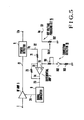
- Fig. 5 is a detailed circuit diagram illustrating an embodiment according to the present invention wherein circuit components identical to those shown in Fig. 4 are designated by the same reference numerals, respectively.
- An input signal to the input terminal 1 is amplified by the power amplifier 3.
- the signal thus amplified is delivered to the power detector circuit 5 through a line 21.
- the signal passed through the power detector circuit 5 is outputted from the output terminal 13a.
- the output signal Vp detected by the detector circuit 5 is applied to a resistor 71 through a line 22 and then is inputted to an inverting input terminal 72 of the differential amplifier 7.
- a feedback resistor 73 is connected between an output terminal 74 and the inverting input terminal 72 to form a feedfack loop.
- the differenctial amplifier 7 provided with the feedback resistor may be constituted by a comparison circuit.
- a power supply voltage Vs is applied to a power supply voltage terminal 151.
- a variable resistor 152 to which the power supply voltage Vs is applied constitutes the circuit 15 which is operative to produce a desired reference voltage by adjusting the value of the variable resistor 152.
- the reference voltage VR EF thus produced is inputted to a non-inverting input terminal 75 of the differential amplifier 7.
- the differential amplifier 7 becomes operative to compare the output signal inputted to the inverting input terminal 72 with the reference voltage V REF inputted to the non-inverting input terminal 75 to amplify the difference therebetween, thus producing a control signal on the output terminal 74.
- the control signal is inputted to the control signal converter circuit 9 through a line 23.
- the control signal converter circuit 9 becomes operative to convert the control signal into a voltage suitable for control of the power amplifier 3.
- the voltage thus obtained is applied to the power amplifier 3 through a line 24.
- This control voltage is proportional to the difference between the reference voltage V REF and the output signal. Accordingly, the output power of the communication device varies inversely proportional to the control voltage. This provides an effect for allowing the output power to return to its initial value. Namely, the output power is kept constant by varying the control voltage so that the output voltage and the reference voltage V REF are equal to each other.
- the detector circuit 16 comprises a variable resistor 161, a switch 162 and a resistor 163 which are connected in series between the non-inverting input terminal 75 of the differential amplifier 7 and ground.
- the switch 162 is cut off. Accordingly, the resistors 161 and 163 do not serve as a voltage divider.
- the switch 162 turns on. As a result, the non-inverting input terminal 75 of the differential amplifier 7 is also connected to ground through the resistors 161 and 163.
- the setting of the reference voltage V REF can be effected not only by the variable resistor 152 but also by the variable resistor 161 and the resistor 163. It is now assumed that the resistance value of the variable resistor 152 between its slider and one end close to ground is R 152 ' and its maximum resistance value is R 152 and the resistance values of the resistors 161 and 163 are R 161 ' and R 163' respectively.
- the reference voltage is expressed as follows.
- the switch 162 when the switch 162 is turned on, the reference voltage V REF ' becomes smaller than that when the switch 162 is cut off. As a result, the output power of the removably fitting unit is reduced.
- Fig. 6 is a cross sectional view illustrating the connection detector switch 162.
- the switch 162 is provided on the side of the removably fitting unit 100 with a casing 121, a switch element 122, an electrical contact 123, a lever 124, a pin 125, and a connector 126 and on the side of the fixed unit 200, casing 221, a projection 222 and a connector 223.
- the pin 125 is moved upwards by the projection 222 to bring the lever 124 into contact with the contact 123 to thereby turn on the switch element 122.
- the switch operation is mechanically determined depending upon whether the removably fitting unit 100 and the fixed unit 200 are connected with each other or not.
- the embodiment shown in Fig. 6 can be modified as follows.
- the control circuits 110 and 212 (Fig. 1) via the connectors 126 and 223 (Fig. 6).
- the switch 162 (Fig. 5) is turned on, thus effecting a control such that an output power level of the unit 100 is suitably suppressed.
- the present invention can provide a system of varying a reference voltage from the reference voltage producing circuit 15 in accordance with an output from the detector circuit 16 for detecting that the connection of the portable communication device 100 and the power amplifier device 200 is established, thus controlling transmitter power from the power amplifier 3 provided in the portable communication device 100.
- This system makes it possible to suppress an excessive heat generation in the communication device which is problematic when the portable communication device is used by being accommodated into the power amplifier device.
- a control is effected in a manner to vary a reference voltage V f of the automatic output power control circuit provided in the communication device to a minimum input required for the power amplifier device 200, thus suppressing heat generation in the communication device.
Landscapes
- Engineering & Computer Science (AREA)
- Computer Networks & Wireless Communication (AREA)
- Signal Processing (AREA)
- Transmitters (AREA)
- Transceivers (AREA)
Applications Claiming Priority (2)
| Application Number | Priority Date | Filing Date | Title |
|---|---|---|---|
| JP78967/84 | 1984-04-19 | ||
| JP59078967A JPS60223231A (ja) | 1984-04-19 | 1984-04-19 | 無線通信機 |
Publications (3)
| Publication Number | Publication Date |
|---|---|
| EP0159670A2 true EP0159670A2 (de) | 1985-10-30 |
| EP0159670A3 EP0159670A3 (en) | 1986-10-08 |
| EP0159670B1 EP0159670B1 (de) | 1989-04-12 |
Family
ID=13676670
Family Applications (1)
| Application Number | Title | Priority Date | Filing Date |
|---|---|---|---|
| EP85104714A Expired EP0159670B1 (de) | 1984-04-19 | 1985-04-18 | Funkverbindungseinrichtung und Verfahren zum Regeln der Senderausgangsleistung |
Country Status (5)
| Country | Link |
|---|---|
| US (1) | US4654882A (de) |
| EP (1) | EP0159670B1 (de) |
| JP (1) | JPS60223231A (de) |
| CA (1) | CA1230926A (de) |
| DE (1) | DE3569443D1 (de) |
Cited By (11)
| Publication number | Priority date | Publication date | Assignee | Title |
|---|---|---|---|---|
| EP0248033A4 (de) * | 1985-11-01 | 1987-11-02 | Motorola Inc | Mehrpegelleistungsverstärkerschaltung für tragbare rundfunkempfänger. |
| EP0336375A1 (de) * | 1988-04-08 | 1989-10-11 | Siemens Aktiengesellschaft | Funkgerät |
| AU610999B2 (en) * | 1988-06-15 | 1991-05-30 | Mitsubishi Denki Kabushiki Kaisha | Transmission power control circuit and method |
| AU612920B2 (en) * | 1989-04-10 | 1991-07-18 | Mitsubishi Denki Kabushiki Kaisha | Radio transceiver apparatus with booster |
| EP0331435A3 (de) * | 1988-02-29 | 1991-07-31 | Kabushiki Kaisha Toshiba | Funkfernsprechgerät |
| EP0413355A3 (en) * | 1989-08-18 | 1992-11-25 | Nec Corporation | Vehicular power booster circuitry for multi-level portable transceiver |
| AU631421B2 (en) * | 1989-04-24 | 1992-11-26 | Telenokia Oy | High-frequency amplifier of a radio transmitter |
| EP0452011A3 (en) * | 1990-03-29 | 1993-02-24 | Nokia Mobile Phones Ltd. | Hand-held transceiver as a modular unit |
| US5203020A (en) * | 1988-06-14 | 1993-04-13 | Kabushiki Kaisha Toshiba | Method and apparatus for reducing power consumption in a radio telecommunication apparatus |
| EP0654898A3 (de) * | 1993-11-19 | 1996-01-24 | Matsushita Communication Ind | Übertragungsschaltung. |
| GB2313263A (en) * | 1996-05-16 | 1997-11-19 | Motorola Inc | Circuit for adjusting transmit power in a radiotelephone |
Families Citing this family (46)
| Publication number | Priority date | Publication date | Assignee | Title |
|---|---|---|---|---|
| JPH0644716B2 (ja) * | 1984-08-14 | 1994-06-08 | 日本電気株式会社 | 無線通信装置 |
| JPS63226124A (ja) * | 1986-10-29 | 1988-09-20 | Oki Electric Ind Co Ltd | 無線装置用レベル制御回路 |
| JPH0432860Y2 (de) * | 1987-07-20 | 1992-08-06 | ||
| JPH0432859Y2 (de) * | 1987-07-20 | 1992-08-06 | ||
| JPS6452322U (de) * | 1987-09-26 | 1989-03-31 | ||
| US4825193A (en) * | 1988-01-07 | 1989-04-25 | Motorola, Inc. | Acknowledge back pager with adaptive variable transmitter output power |
| US4875038A (en) * | 1988-01-07 | 1989-10-17 | Motorola, Inc. | Frequency division multiplexed acknowledge back paging system |
| US4891637A (en) * | 1988-01-07 | 1990-01-02 | Motorola, Inc. | Acknowledge back pager with apparatus for controlling transmit frequency |
| US4882579A (en) * | 1988-01-07 | 1989-11-21 | Motorola, Inc. | Code division multiplexed acknowledge back paging system |
| US4823123A (en) * | 1988-01-07 | 1989-04-18 | Motorola, Inc. | Knowledge back pager with frequency control apparatus |
| JPH0278331A (ja) * | 1988-09-14 | 1990-03-19 | Nec Corp | 移動通信用送受信装置 |
| JPH02246531A (ja) * | 1989-03-20 | 1990-10-02 | Fujitsu Ltd | 送信電力可変形送信機の送信断検出回路 |
| US4989260A (en) * | 1989-05-17 | 1991-01-29 | The Quaker Oats Company | Transmitter with power reduction to compensate for varying radiated electric field strength when switching between batteries and AC power |
| US5142279A (en) * | 1989-06-05 | 1992-08-25 | Motorola, Inc. | Acknowledge back paging system having the capability of matching variable length data messages to pager addresses |
| JP2746685B2 (ja) * | 1989-09-06 | 1998-05-06 | 富士通株式会社 | 送信出力制御回路 |
| SE466722B (sv) * | 1990-07-31 | 1992-03-23 | Ericsson Telefon Ab L M | Drivenhet foer en mobiltelefon |
| JP2568779B2 (ja) | 1991-12-10 | 1997-01-08 | 松下電器産業株式会社 | 携帯電話装置 |
| US5457814A (en) * | 1993-10-02 | 1995-10-10 | Nokia Mobile Phones Ltd. | Power boost system for cellular telephone |
| AU667140B2 (en) * | 1992-11-26 | 1996-03-07 | Nec Corporation | Booster for use in combination with radio apparatus |
| KR950007973B1 (ko) * | 1992-11-27 | 1995-07-21 | 삼성전자주식회사 | 휴대용 무선송수신기의 고주파 출력레벨 보상회로 |
| JPH06265430A (ja) * | 1993-03-11 | 1994-09-22 | Nissan Motor Co Ltd | 筒内圧センサ |
| JPH06276146A (ja) * | 1993-03-19 | 1994-09-30 | Fujitsu Ltd | 移動電話装置 |
| CA2136749C (en) * | 1993-03-26 | 1998-11-03 | Richard K. Kornfeld | Power amplifier bias control circuit and method |
| DE4316526B4 (de) * | 1993-05-18 | 2005-11-10 | Philips Intellectual Property & Standards Gmbh | Sender mit einem steuerbaren Leistungsverstärker |
| JPH06334541A (ja) * | 1993-05-25 | 1994-12-02 | Sony Corp | 無線送信機 |
| US5339046A (en) * | 1993-06-03 | 1994-08-16 | Alps Electric Co., Ltd. | Temperature compensated variable gain amplifier |
| US5732335A (en) * | 1995-04-28 | 1998-03-24 | Telefonaktiebolaget Lm Ericsson | Externally controlled output power by means of antenna keying |
| US5974041A (en) * | 1995-12-27 | 1999-10-26 | Qualcomm Incorporated | Efficient parallel-stage power amplifier |
| US5872481A (en) * | 1995-12-27 | 1999-02-16 | Qualcomm Incorporated | Efficient parallel-stage power amplifier |
| US6230031B1 (en) * | 1997-03-31 | 2001-05-08 | Oki Telecom, Inc. | Power amplifying circuitry for wireless radio transceivers |
| US6069525A (en) * | 1997-04-17 | 2000-05-30 | Qualcomm Incorporated | Dual-mode amplifier with high efficiency and high linearity |
| US6038457A (en) * | 1997-12-05 | 2000-03-14 | Motorola, Inc. | Apparatus and method for detecting and powering an accessory |
| USD419160S (en) * | 1998-05-14 | 2000-01-18 | Northrop Grumman Corporation | Personal communications unit docking station |
| US6041243A (en) * | 1998-05-15 | 2000-03-21 | Northrop Grumman Corporation | Personal communications unit |
| US6304559B1 (en) | 1998-05-15 | 2001-10-16 | Northrop Grumman Corporation | Wireless communications protocol |
| US6243573B1 (en) | 1998-05-15 | 2001-06-05 | Northrop Grumman Corporation | Personal communications system |
| US6223062B1 (en) | 1998-05-15 | 2001-04-24 | Northrop Grumann Corporation | Communications interface adapter |
| USD421002S (en) * | 1998-05-15 | 2000-02-22 | Northrop Grumman Corporation | Personal communications unit handset |
| US6169730B1 (en) | 1998-05-15 | 2001-01-02 | Northrop Grumman Corporation | Wireless communications protocol |
| US6141426A (en) * | 1998-05-15 | 2000-10-31 | Northrop Grumman Corporation | Voice operated switch for use in high noise environments |
| US6069526A (en) * | 1998-08-04 | 2000-05-30 | Qualcomm Incorporated | Partial or complete amplifier bypass |
| JP2003133972A (ja) * | 2001-10-29 | 2003-05-09 | Fujitsu Ltd | 無線送信機を有する電子装置 |
| DE10218828A1 (de) * | 2002-04-26 | 2003-11-06 | Siemens Ag | Mobilfunkgerät mit Sendeleistungsbeschränkung |
| US8536950B2 (en) * | 2009-08-03 | 2013-09-17 | Qualcomm Incorporated | Multi-stage impedance matching |
| US8102205B2 (en) | 2009-08-04 | 2012-01-24 | Qualcomm, Incorporated | Amplifier module with multiple operating modes |
| JP2015050548A (ja) * | 2013-08-30 | 2015-03-16 | 株式会社タムラ製作所 | 送信機及びこれを用いた無線通信システム |
Family Cites Families (6)
| Publication number | Priority date | Publication date | Assignee | Title |
|---|---|---|---|---|
| US4095184A (en) * | 1976-11-01 | 1978-06-13 | Hochstein Peter A | Radio transceiver power booster |
| US4189676A (en) * | 1978-04-13 | 1980-02-19 | Motorola, Inc. | Switching system utilizing flexible circuit with transmission line for matched impedance connections |
| JPS5694848A (en) * | 1979-12-28 | 1981-07-31 | Nec Corp | Control system of transmitter |
| JPS6110327Y2 (de) * | 1980-01-10 | 1986-04-03 | ||
| US4353037A (en) * | 1980-08-11 | 1982-10-05 | Motorola, Inc. | Amplifier protection circuit |
| JPS6041821A (ja) * | 1983-08-18 | 1985-03-05 | Nec Corp | 送信出力電力制御装置 |
-
1984
- 1984-04-19 JP JP59078967A patent/JPS60223231A/ja active Granted
-
1985
- 1985-04-15 US US06/723,633 patent/US4654882A/en not_active Expired - Lifetime
- 1985-04-16 CA CA000479261A patent/CA1230926A/en not_active Expired
- 1985-04-18 EP EP85104714A patent/EP0159670B1/de not_active Expired
- 1985-04-18 DE DE8585104714T patent/DE3569443D1/de not_active Expired
Cited By (14)
| Publication number | Priority date | Publication date | Assignee | Title |
|---|---|---|---|---|
| EP0248033A4 (de) * | 1985-11-01 | 1987-11-02 | Motorola Inc | Mehrpegelleistungsverstärkerschaltung für tragbare rundfunkempfänger. |
| EP0331435A3 (de) * | 1988-02-29 | 1991-07-31 | Kabushiki Kaisha Toshiba | Funkfernsprechgerät |
| EP0336375A1 (de) * | 1988-04-08 | 1989-10-11 | Siemens Aktiengesellschaft | Funkgerät |
| US5203020A (en) * | 1988-06-14 | 1993-04-13 | Kabushiki Kaisha Toshiba | Method and apparatus for reducing power consumption in a radio telecommunication apparatus |
| AU610999B2 (en) * | 1988-06-15 | 1991-05-30 | Mitsubishi Denki Kabushiki Kaisha | Transmission power control circuit and method |
| AU612920B2 (en) * | 1989-04-10 | 1991-07-18 | Mitsubishi Denki Kabushiki Kaisha | Radio transceiver apparatus with booster |
| EP0392132A3 (de) * | 1989-04-10 | 1992-05-06 | Mitsubishi Denki Kabushiki Kaisha | Funksendeempfangsgerät mit Booster-Verstärker |
| AU631421B2 (en) * | 1989-04-24 | 1992-11-26 | Telenokia Oy | High-frequency amplifier of a radio transmitter |
| EP0413355A3 (en) * | 1989-08-18 | 1992-11-25 | Nec Corporation | Vehicular power booster circuitry for multi-level portable transceiver |
| EP0452011A3 (en) * | 1990-03-29 | 1993-02-24 | Nokia Mobile Phones Ltd. | Hand-held transceiver as a modular unit |
| EP0654898A3 (de) * | 1993-11-19 | 1996-01-24 | Matsushita Communication Ind | Übertragungsschaltung. |
| US5659893A (en) * | 1993-11-19 | 1997-08-19 | Matsushita Communication Industrial Co., Ltd. | Transmission circuit with improved gain control loop |
| GB2313263A (en) * | 1996-05-16 | 1997-11-19 | Motorola Inc | Circuit for adjusting transmit power in a radiotelephone |
| GB2313263B (en) * | 1996-05-16 | 2000-07-12 | Motorola Inc | Circuit for adjusting transmit power |
Also Published As
| Publication number | Publication date |
|---|---|
| EP0159670B1 (de) | 1989-04-12 |
| EP0159670A3 (en) | 1986-10-08 |
| JPS60223231A (ja) | 1985-11-07 |
| US4654882A (en) | 1987-03-31 |
| CA1230926A (en) | 1987-12-29 |
| DE3569443D1 (en) | 1989-05-18 |
| JPH0320167B2 (de) | 1991-03-18 |
Similar Documents
| Publication | Publication Date | Title |
|---|---|---|
| EP0159670B1 (de) | Funkverbindungseinrichtung und Verfahren zum Regeln der Senderausgangsleistung | |
| US4636741A (en) | Multi-level power amplifying circuitry for portable radio transceivers | |
| US4709403A (en) | Apparatus for controlling output power of transmitter | |
| EP0639890B1 (de) | Richtkoppler-Detektor zur Leistungspegelsteuerung | |
| US5095541A (en) | Radio telephone apparatus | |
| US5126686A (en) | RF amplifier system having multiple selectable power output levels | |
| CA1245307A (en) | Battery-powered radio communication apparatus capable of prolonging the communicable state thereof | |
| US6151509A (en) | Dual band cellular phone with two power amplifiers and a current detector for monitoring the consumed power | |
| EP0241265B1 (de) | Funkgerät und Antennenumschaltvorrichtung, um die Empfangsempfindlichkeit zu verändern | |
| US6301486B1 (en) | Radio telephone apparatus | |
| US5754943A (en) | Cable loss equalization system used in wireless communication equipment | |
| US5438248A (en) | Method and apparatus for recognizing different types of batteries | |
| JPH0215754A (ja) | ポケット電話機 | |
| KR100665590B1 (ko) | 전력 증폭기 회로와 안정화기 회로를 구비하는 무선 주파수 장치와, 이러한 장치를 구비하는 이동 트랜시버 단말기 | |
| GB2313263A (en) | Circuit for adjusting transmit power in a radiotelephone | |
| JPH0918358A (ja) | 無線送信機 | |
| US6668162B1 (en) | Method and an arrangement for compensating the temperature drift of a detector and a control signal in periodic control | |
| JPS6243608B2 (de) | ||
| EP0590888B1 (de) | Leistungsverstärker für ein tragbares Funktelefon | |
| JP3180429B2 (ja) | 移動電話装置 | |
| JPH0879154A (ja) | パワーコントロール回路 | |
| JPS639233A (ja) | 送信電力の制御検出回路 | |
| JPS6159917A (ja) | 送信出力切替装置 | |
| JPS627211A (ja) | Agc増幅器 | |
| JPH03933B2 (de) |
Legal Events
| Date | Code | Title | Description |
|---|---|---|---|
| PUAI | Public reference made under article 153(3) epc to a published international application that has entered the european phase |
Free format text: ORIGINAL CODE: 0009012 |
|
| 17P | Request for examination filed |
Effective date: 19850418 |
|
| AK | Designated contracting states |
Designated state(s): DE FR GB |
|
| PUAL | Search report despatched |
Free format text: ORIGINAL CODE: 0009013 |
|
| AK | Designated contracting states |
Kind code of ref document: A3 Designated state(s): DE FR GB |
|
| 17Q | First examination report despatched |
Effective date: 19880727 |
|
| GRAA | (expected) grant |
Free format text: ORIGINAL CODE: 0009210 |
|
| AK | Designated contracting states |
Kind code of ref document: B1 Designated state(s): DE FR GB |
|
| REF | Corresponds to: |
Ref document number: 3569443 Country of ref document: DE Date of ref document: 19890518 |
|
| ET | Fr: translation filed | ||
| PLBE | No opposition filed within time limit |
Free format text: ORIGINAL CODE: 0009261 |
|
| STAA | Information on the status of an ep patent application or granted ep patent |
Free format text: STATUS: NO OPPOSITION FILED WITHIN TIME LIMIT |
|
| 26N | No opposition filed | ||
| PGFP | Annual fee paid to national office [announced via postgrant information from national office to epo] |
Ref country code: FR Payment date: 20000411 Year of fee payment: 16 |
|
| PGFP | Annual fee paid to national office [announced via postgrant information from national office to epo] |
Ref country code: GB Payment date: 20000412 Year of fee payment: 16 |
|
| PGFP | Annual fee paid to national office [announced via postgrant information from national office to epo] |
Ref country code: DE Payment date: 20000417 Year of fee payment: 16 |
|
| PG25 | Lapsed in a contracting state [announced via postgrant information from national office to epo] |
Ref country code: GB Free format text: LAPSE BECAUSE OF NON-PAYMENT OF DUE FEES Effective date: 20010418 |
|
| PG25 | Lapsed in a contracting state [announced via postgrant information from national office to epo] |
Ref country code: FR Free format text: THE PATENT HAS BEEN ANNULLED BY A DECISION OF A NATIONAL AUTHORITY Effective date: 20010430 |
|
| GBPC | Gb: european patent ceased through non-payment of renewal fee |
Effective date: 20010418 |
|
| PG25 | Lapsed in a contracting state [announced via postgrant information from national office to epo] |
Ref country code: DE Free format text: LAPSE BECAUSE OF NON-PAYMENT OF DUE FEES Effective date: 20020201 |
|
| REG | Reference to a national code |
Ref country code: FR Ref legal event code: ST |