EP0159848A1 - Procédé pour la fabrication d'hydrocarbures lubrifiants à partir d'oléfines inférieures - Google Patents
Procédé pour la fabrication d'hydrocarbures lubrifiants à partir d'oléfines inférieures Download PDFInfo
- Publication number
- EP0159848A1 EP0159848A1 EP85302428A EP85302428A EP0159848A1 EP 0159848 A1 EP0159848 A1 EP 0159848A1 EP 85302428 A EP85302428 A EP 85302428A EP 85302428 A EP85302428 A EP 85302428A EP 0159848 A1 EP0159848 A1 EP 0159848A1
- Authority
- EP
- European Patent Office
- Prior art keywords
- catalyst
- stage
- zeolite
- feed
- contacting
- Prior art date
- Legal status (The legal status is an assumption and is not a legal conclusion. Google has not performed a legal analysis and makes no representation as to the accuracy of the status listed.)
- Granted
Links
- 150000001336 alkenes Chemical class 0.000 title claims abstract description 41
- 229930195733 hydrocarbon Natural products 0.000 title claims abstract description 31
- 150000002430 hydrocarbons Chemical class 0.000 title claims abstract description 31
- 239000000314 lubricant Substances 0.000 title claims description 16
- 238000004519 manufacturing process Methods 0.000 title description 2
- 239000003054 catalyst Substances 0.000 claims abstract description 49
- 238000000034 method Methods 0.000 claims abstract description 43
- 230000008569 process Effects 0.000 claims abstract description 36
- 239000010457 zeolite Substances 0.000 claims abstract description 35
- HNPSIPDUKPIQMN-UHFFFAOYSA-N dioxosilane;oxo(oxoalumanyloxy)alumane Chemical compound O=[Si]=O.O=[Al]O[Al]=O HNPSIPDUKPIQMN-UHFFFAOYSA-N 0.000 claims abstract description 28
- 229910021536 Zeolite Inorganic materials 0.000 claims abstract description 24
- 239000011148 porous material Substances 0.000 claims abstract description 22
- 230000002378 acidificating effect Effects 0.000 claims abstract description 13
- 150000007530 organic bases Chemical class 0.000 claims abstract description 4
- 239000006152 selective media Substances 0.000 claims abstract description 4
- 230000000415 inactivating effect Effects 0.000 claims abstract 4
- 238000006243 chemical reaction Methods 0.000 claims description 29
- 239000002253 acid Substances 0.000 claims description 18
- JRZJOMJEPLMPRA-UHFFFAOYSA-N olefin Natural products CCCCCCCC=C JRZJOMJEPLMPRA-UHFFFAOYSA-N 0.000 claims description 15
- 238000006384 oligomerization reaction Methods 0.000 claims description 12
- 230000000694 effects Effects 0.000 claims description 11
- 239000002609 medium Substances 0.000 claims description 9
- 239000003377 acid catalyst Substances 0.000 claims description 8
- 238000005336 cracking Methods 0.000 claims description 8
- 239000004215 Carbon black (E152) Substances 0.000 claims description 7
- 239000003795 chemical substances by application Substances 0.000 claims description 7
- VYPSYNLAJGMNEJ-UHFFFAOYSA-N Silicium dioxide Chemical compound O=[Si]=O VYPSYNLAJGMNEJ-UHFFFAOYSA-N 0.000 claims description 6
- UWKQJZCTQGMHKD-UHFFFAOYSA-N 2,6-di-tert-butylpyridine Chemical compound CC(C)(C)C1=CC=CC(C(C)(C)C)=N1 UWKQJZCTQGMHKD-UHFFFAOYSA-N 0.000 claims description 5
- 125000001931 aliphatic group Chemical group 0.000 claims description 5
- PNEYBMLMFCGWSK-UHFFFAOYSA-N aluminium oxide Inorganic materials [O-2].[O-2].[O-2].[Al+3].[Al+3] PNEYBMLMFCGWSK-UHFFFAOYSA-N 0.000 claims description 5
- 229910000323 aluminium silicate Inorganic materials 0.000 claims description 5
- 230000009849 deactivation Effects 0.000 claims description 5
- 150000001412 amines Chemical class 0.000 claims description 4
- 238000009835 boiling Methods 0.000 claims description 4
- 230000003606 oligomerizing effect Effects 0.000 claims description 4
- 150000005673 monoalkenes Chemical class 0.000 claims description 3
- QJGQUHMNIGDVPM-UHFFFAOYSA-N nitrogen group Chemical group [N] QJGQUHMNIGDVPM-UHFFFAOYSA-N 0.000 claims description 3
- 239000000377 silicon dioxide Substances 0.000 claims description 3
- 239000003463 adsorbent Substances 0.000 claims description 2
- 238000010924 continuous production Methods 0.000 claims description 2
- 239000002245 particle Substances 0.000 claims description 2
- JUJWROOIHBZHMG-UHFFFAOYSA-N pyridine Substances C1=CC=NC=C1 JUJWROOIHBZHMG-UHFFFAOYSA-N 0.000 claims description 2
- 150000003222 pyridines Chemical class 0.000 claims description 2
- UMJSCPRVCHMLSP-UHFFFAOYSA-N pyridine Natural products COC1=CC=CN=C1 UMJSCPRVCHMLSP-UHFFFAOYSA-N 0.000 claims 1
- 239000000047 product Substances 0.000 description 26
- QQONPFPTGQHPMA-UHFFFAOYSA-N propylene Natural products CC=C QQONPFPTGQHPMA-UHFFFAOYSA-N 0.000 description 11
- 239000013078 crystal Substances 0.000 description 10
- 239000000463 material Substances 0.000 description 9
- 125000004805 propylene group Chemical group [H]C([H])([H])C([H])([*:1])C([H])([H])[*:2] 0.000 description 9
- 239000000203 mixture Substances 0.000 description 8
- 230000003197 catalytic effect Effects 0.000 description 6
- -1 ZSM-5 type catalyst Chemical compound 0.000 description 5
- OKTJSMMVPCPJKN-UHFFFAOYSA-N Carbon Chemical compound [C] OKTJSMMVPCPJKN-UHFFFAOYSA-N 0.000 description 4
- 239000007788 liquid Substances 0.000 description 4
- 150000001338 aliphatic hydrocarbons Chemical class 0.000 description 3
- 125000000217 alkyl group Chemical group 0.000 description 3
- 239000012298 atmosphere Substances 0.000 description 3
- 230000015572 biosynthetic process Effects 0.000 description 3
- IAQRGUVFOMOMEM-UHFFFAOYSA-N but-2-ene Chemical compound CC=CC IAQRGUVFOMOMEM-UHFFFAOYSA-N 0.000 description 3
- 229910052799 carbon Inorganic materials 0.000 description 3
- 239000000975 dye Substances 0.000 description 3
- VLKZOEOYAKHREP-UHFFFAOYSA-N n-Hexane Chemical compound CCCCCC VLKZOEOYAKHREP-UHFFFAOYSA-N 0.000 description 3
- 238000006116 polymerization reaction Methods 0.000 description 3
- 239000011541 reaction mixture Substances 0.000 description 3
- QGZKDVFQNNGYKY-UHFFFAOYSA-N Ammonia Chemical compound N QGZKDVFQNNGYKY-UHFFFAOYSA-N 0.000 description 2
- IJGRMHOSHXDMSA-UHFFFAOYSA-N Atomic nitrogen Chemical compound N#N IJGRMHOSHXDMSA-UHFFFAOYSA-N 0.000 description 2
- VGGSQFUCUMXWEO-UHFFFAOYSA-N Ethene Chemical compound C=C VGGSQFUCUMXWEO-UHFFFAOYSA-N 0.000 description 2
- 239000005977 Ethylene Substances 0.000 description 2
- ATUOYWHBWRKTHZ-UHFFFAOYSA-N Propane Chemical compound CCC ATUOYWHBWRKTHZ-UHFFFAOYSA-N 0.000 description 2
- VSCWAEJMTAWNJL-UHFFFAOYSA-K aluminium trichloride Chemical compound Cl[Al](Cl)Cl VSCWAEJMTAWNJL-UHFFFAOYSA-K 0.000 description 2
- 150000007514 bases Chemical class 0.000 description 2
- HCAUQPZEWLULFJ-UHFFFAOYSA-N benzo[f]quinoline Chemical compound C1=CC=C2C3=CC=CC=C3C=CC2=N1 HCAUQPZEWLULFJ-UHFFFAOYSA-N 0.000 description 2
- 125000002091 cationic group Chemical group 0.000 description 2
- 150000001875 compounds Chemical class 0.000 description 2
- 238000001816 cooling Methods 0.000 description 2
- 230000007423 decrease Effects 0.000 description 2
- 238000004821 distillation Methods 0.000 description 2
- 239000007789 gas Substances 0.000 description 2
- 150000002736 metal compounds Chemical class 0.000 description 2
- 125000002496 methyl group Chemical group [H]C([H])([H])* 0.000 description 2
- 238000002156 mixing Methods 0.000 description 2
- 239000003921 oil Substances 0.000 description 2
- 238000005191 phase separation Methods 0.000 description 2
- YNPNZTXNASCQKK-UHFFFAOYSA-N phenanthrene Chemical compound C1=CC=C2C3=CC=CC=C3C=CC2=C1 YNPNZTXNASCQKK-UHFFFAOYSA-N 0.000 description 2
- 150000002989 phenols Chemical class 0.000 description 2
- 150000003003 phosphines Chemical class 0.000 description 2
- BBEAQIROQSPTKN-UHFFFAOYSA-N pyrene Chemical compound C1=CC=C2C=CC3=CC=CC4=CC=C1C2=C43 BBEAQIROQSPTKN-UHFFFAOYSA-N 0.000 description 2
- 239000000243 solution Substances 0.000 description 2
- 238000003756 stirring Methods 0.000 description 2
- RIOQSEWOXXDEQQ-UHFFFAOYSA-N triphenylphosphine Chemical compound C1=CC=CC=C1P(C=1C=CC=CC=1)C1=CC=CC=C1 RIOQSEWOXXDEQQ-UHFFFAOYSA-N 0.000 description 2
- QFMZQPDHXULLKC-UHFFFAOYSA-N 1,2-bis(diphenylphosphino)ethane Chemical compound C=1C=CC=CC=1P(C=1C=CC=CC=1)CCP(C=1C=CC=CC=1)C1=CC=CC=C1 QFMZQPDHXULLKC-UHFFFAOYSA-N 0.000 description 1
- VXNZUUAINFGPBY-UHFFFAOYSA-N 1-Butene Chemical compound CCC=C VXNZUUAINFGPBY-UHFFFAOYSA-N 0.000 description 1
- DRGAZIDRYFYHIJ-UHFFFAOYSA-N 2,2':6',2''-terpyridine Chemical compound N1=CC=CC=C1C1=CC=CC(C=2N=CC=CC=2)=N1 DRGAZIDRYFYHIJ-UHFFFAOYSA-N 0.000 description 1
- SKDGWNHUETZZCS-UHFFFAOYSA-N 2,3-ditert-butylphenol Chemical compound CC(C)(C)C1=CC=CC(O)=C1C(C)(C)C SKDGWNHUETZZCS-UHFFFAOYSA-N 0.000 description 1
- BPRYUXCVCCNUFE-UHFFFAOYSA-N 2,4,6-trimethylphenol Chemical compound CC1=CC(C)=C(O)C(C)=C1 BPRYUXCVCCNUFE-UHFFFAOYSA-N 0.000 description 1
- KMVWNDHKTPHDMT-UHFFFAOYSA-N 2,4,6-tripyridin-2-yl-1,3,5-triazine Chemical compound N1=CC=CC=C1C1=NC(C=2N=CC=CC=2)=NC(C=2N=CC=CC=2)=N1 KMVWNDHKTPHDMT-UHFFFAOYSA-N 0.000 description 1
- NPAXPTHCUCUHPT-UHFFFAOYSA-N 3,4,7,8-tetramethyl-1,10-phenanthroline Chemical compound CC1=CN=C2C3=NC=C(C)C(C)=C3C=CC2=C1C NPAXPTHCUCUHPT-UHFFFAOYSA-N 0.000 description 1
- RBTBFTRPCNLSDE-UHFFFAOYSA-N 3,7-bis(dimethylamino)phenothiazin-5-ium Chemical compound C1=CC(N(C)C)=CC2=[S+]C3=CC(N(C)C)=CC=C3N=C21 RBTBFTRPCNLSDE-UHFFFAOYSA-N 0.000 description 1
- DHDHJYNTEFLIHY-UHFFFAOYSA-N 4,7-diphenyl-1,10-phenanthroline Chemical compound C1=CC=CC=C1C1=CC=NC2=C1C=CC1=C(C=3C=CC=CC=3)C=CN=C21 DHDHJYNTEFLIHY-UHFFFAOYSA-N 0.000 description 1
- KEOGXNQAWCDJJN-UHFFFAOYSA-N 5,6,7,8,9,10,11,12,13,14-decahydrocyclododeca[b]pyridine Chemical compound C1CCCCCCCCCC2=NC=CC=C21 KEOGXNQAWCDJJN-UHFFFAOYSA-N 0.000 description 1
- VEXZGXHMUGYJMC-UHFFFAOYSA-M Chloride anion Chemical compound [Cl-] VEXZGXHMUGYJMC-UHFFFAOYSA-M 0.000 description 1
- HMOLMTVNACKYSY-UHFFFAOYSA-K Cl[Fe](Cl)Cl.N1C(C=C2N=C(C=C3NC(=C4)C=C3)C=C2)=CC=C1C=C1C=CC4=N1 Chemical compound Cl[Fe](Cl)Cl.N1C(C=C2N=C(C=C3NC(=C4)C=C3)C=C2)=CC=C1C=C1C=CC4=N1 HMOLMTVNACKYSY-UHFFFAOYSA-K 0.000 description 1
- PIICEJLVQHRZGT-UHFFFAOYSA-N Ethylenediamine Chemical compound NCCN PIICEJLVQHRZGT-UHFFFAOYSA-N 0.000 description 1
- VQTUBCCKSQIDNK-UHFFFAOYSA-N Isobutene Chemical group CC(C)=C VQTUBCCKSQIDNK-UHFFFAOYSA-N 0.000 description 1
- 239000002841 Lewis acid Substances 0.000 description 1
- BLRPTPMANUNPDV-UHFFFAOYSA-N Silane Chemical compound [SiH4] BLRPTPMANUNPDV-UHFFFAOYSA-N 0.000 description 1
- DGEZNRSVGBDHLK-UHFFFAOYSA-N [1,10]phenanthroline Chemical compound C1=CN=C2C3=NC=CC=C3C=CC2=C1 DGEZNRSVGBDHLK-UHFFFAOYSA-N 0.000 description 1
- 150000001298 alcohols Chemical class 0.000 description 1
- 229910021529 ammonia Inorganic materials 0.000 description 1
- 239000011959 amorphous silica alumina Substances 0.000 description 1
- 229940111121 antirheumatic drug quinolines Drugs 0.000 description 1
- 125000003118 aryl group Chemical group 0.000 description 1
- 125000004429 atom Chemical group 0.000 description 1
- 230000008901 benefit Effects 0.000 description 1
- 239000011230 binding agent Substances 0.000 description 1
- 239000001273 butane Substances 0.000 description 1
- 125000004432 carbon atom Chemical group C* 0.000 description 1
- 239000003575 carbonaceous material Substances 0.000 description 1
- 150000001735 carboxylic acids Chemical class 0.000 description 1
- 239000003729 cation exchange resin Substances 0.000 description 1
- 229940023913 cation exchange resins Drugs 0.000 description 1
- 150000001768 cations Chemical class 0.000 description 1
- 230000008859 change Effects 0.000 description 1
- 239000003426 co-catalyst Substances 0.000 description 1
- 239000000571 coke Substances 0.000 description 1
- 239000000470 constituent Substances 0.000 description 1
- 238000011437 continuous method Methods 0.000 description 1
- MKNXBRLZBFVUPV-UHFFFAOYSA-L cyclopenta-1,3-diene;dichlorotitanium Chemical compound Cl[Ti]Cl.C=1C=C[CH-]C=1.C=1C=C[CH-]C=1 MKNXBRLZBFVUPV-UHFFFAOYSA-L 0.000 description 1
- YMNCCEXICREQQV-UHFFFAOYSA-L cyclopenta-1,3-diene;titanium(4+);dichloride Chemical compound [Cl-].[Cl-].[Ti+4].C=1C=C[CH-]C=1.C=1C=C[CH-]C=1 YMNCCEXICREQQV-UHFFFAOYSA-L 0.000 description 1
- 230000003247 decreasing effect Effects 0.000 description 1
- 230000008021 deposition Effects 0.000 description 1
- 150000004985 diamines Chemical class 0.000 description 1
- XNMQEEKYCVKGBD-UHFFFAOYSA-N dimethylacetylene Natural products CC#CC XNMQEEKYCVKGBD-UHFFFAOYSA-N 0.000 description 1
- 238000001035 drying Methods 0.000 description 1
- 239000012013 faujasite Substances 0.000 description 1
- 239000012467 final product Substances 0.000 description 1
- GVEPBJHOBDJJJI-UHFFFAOYSA-N fluoranthrene Natural products C1=CC(C2=CC=CC=C22)=C3C2=CC=CC3=C1 GVEPBJHOBDJJJI-UHFFFAOYSA-N 0.000 description 1
- 238000011010 flushing procedure Methods 0.000 description 1
- 238000005194 fractionation Methods 0.000 description 1
- 238000004817 gas chromatography Methods 0.000 description 1
- BTIJJDXEELBZFS-QDUVMHSLSA-K hemin Chemical compound CC1=C(CCC(O)=O)C(C=C2C(CCC(O)=O)=C(C)\C(N2[Fe](Cl)N23)=C\4)=N\C1=C/C2=C(C)C(C=C)=C3\C=C/1C(C)=C(C=C)C/4=N\1 BTIJJDXEELBZFS-QDUVMHSLSA-K 0.000 description 1
- 229940025294 hemin Drugs 0.000 description 1
- 239000001257 hydrogen Substances 0.000 description 1
- 229910052739 hydrogen Inorganic materials 0.000 description 1
- 238000005984 hydrogenation reaction Methods 0.000 description 1
- 238000002347 injection Methods 0.000 description 1
- 239000007924 injection Substances 0.000 description 1
- 238000006317 isomerization reaction Methods 0.000 description 1
- 150000002605 large molecules Chemical class 0.000 description 1
- 150000007517 lewis acids Chemical class 0.000 description 1
- 239000010687 lubricating oil Substances 0.000 description 1
- 229920002521 macromolecule Polymers 0.000 description 1
- UEGPKNKPLBYCNK-UHFFFAOYSA-L magnesium acetate Chemical compound [Mg+2].CC([O-])=O.CC([O-])=O UEGPKNKPLBYCNK-UHFFFAOYSA-L 0.000 description 1
- 229940069446 magnesium acetate Drugs 0.000 description 1
- 235000011285 magnesium acetate Nutrition 0.000 description 1
- 239000011654 magnesium acetate Substances 0.000 description 1
- FDZZZRQASAIRJF-UHFFFAOYSA-M malachite green Chemical compound [Cl-].C1=CC(N(C)C)=CC=C1C(C=1C=CC=CC=1)=C1C=CC(=[N+](C)C)C=C1 FDZZZRQASAIRJF-UHFFFAOYSA-M 0.000 description 1
- 229940107698 malachite green Drugs 0.000 description 1
- MMIPFLVOWGHZQD-UHFFFAOYSA-N manganese(3+) Chemical compound [Mn+3] MMIPFLVOWGHZQD-UHFFFAOYSA-N 0.000 description 1
- 229960000907 methylthioninium chloride Drugs 0.000 description 1
- 230000004048 modification Effects 0.000 description 1
- 238000012986 modification Methods 0.000 description 1
- 229910052680 mordenite Inorganic materials 0.000 description 1
- IJDNQMDRQITEOD-UHFFFAOYSA-N n-butane Chemical compound CCCC IJDNQMDRQITEOD-UHFFFAOYSA-N 0.000 description 1
- OFBQJSOFQDEBGM-UHFFFAOYSA-N n-pentane Natural products CCCCC OFBQJSOFQDEBGM-UHFFFAOYSA-N 0.000 description 1
- 150000004780 naphthols Chemical class 0.000 description 1
- 229910052759 nickel Inorganic materials 0.000 description 1
- 229910052757 nitrogen Inorganic materials 0.000 description 1
- 239000012299 nitrogen atmosphere Substances 0.000 description 1
- 229910000510 noble metal Inorganic materials 0.000 description 1
- 150000002892 organic cations Chemical group 0.000 description 1
- YWAKXRMUMFPDSH-UHFFFAOYSA-N pentene Chemical compound CCCC=C YWAKXRMUMFPDSH-UHFFFAOYSA-N 0.000 description 1
- 229920001467 poly(styrenesulfonates) Polymers 0.000 description 1
- 239000002685 polymerization catalyst Substances 0.000 description 1
- 230000000379 polymerizing effect Effects 0.000 description 1
- 239000001294 propane Substances 0.000 description 1
- 150000003248 quinolines Chemical class 0.000 description 1
- 239000000376 reactant Substances 0.000 description 1
- 230000035484 reaction time Effects 0.000 description 1
- 238000011084 recovery Methods 0.000 description 1
- 239000011347 resin Substances 0.000 description 1
- 229920005989 resin Polymers 0.000 description 1
- 229920006395 saturated elastomer Polymers 0.000 description 1
- 238000010517 secondary reaction Methods 0.000 description 1
- 238000000926 separation method Methods 0.000 description 1
- 229910000077 silane Inorganic materials 0.000 description 1
- 150000003377 silicon compounds Chemical class 0.000 description 1
- 239000007787 solid Substances 0.000 description 1
- 239000002904 solvent Substances 0.000 description 1
- 239000007858 starting material Substances 0.000 description 1
- 239000000126 substance Substances 0.000 description 1
- 125000001424 substituent group Chemical group 0.000 description 1
- YNHJECZULSZAQK-UHFFFAOYSA-N tetraphenylporphyrin Chemical compound C1=CC(C(=C2C=CC(N2)=C(C=2C=CC=CC=2)C=2C=CC(N=2)=C(C=2C=CC=CC=2)C2=CC=C3N2)C=2C=CC=CC=2)=NC1=C3C1=CC=CC=C1 YNHJECZULSZAQK-UHFFFAOYSA-N 0.000 description 1
- ANRHNWWPFJCPAZ-UHFFFAOYSA-M thionine Chemical compound [Cl-].C1=CC(N)=CC2=[S+]C3=CC(N)=CC=C3N=C21 ANRHNWWPFJCPAZ-UHFFFAOYSA-M 0.000 description 1
- AAAQKTZKLRYKHR-UHFFFAOYSA-N triphenylmethane Chemical compound C1=CC=CC=C1C(C=1C=CC=CC=1)C1=CC=CC=C1 AAAQKTZKLRYKHR-UHFFFAOYSA-N 0.000 description 1
- 238000010977 unit operation Methods 0.000 description 1
- 230000008016 vaporization Effects 0.000 description 1
- 238000005406 washing Methods 0.000 description 1
- XLYOFNOQVPJJNP-UHFFFAOYSA-N water Substances O XLYOFNOQVPJJNP-UHFFFAOYSA-N 0.000 description 1
Images
Classifications
-
- C—CHEMISTRY; METALLURGY
- C10—PETROLEUM, GAS OR COKE INDUSTRIES; TECHNICAL GASES CONTAINING CARBON MONOXIDE; FUELS; LUBRICANTS; PEAT
- C10G—CRACKING HYDROCARBON OILS; PRODUCTION OF LIQUID HYDROCARBON MIXTURES, e.g. BY DESTRUCTIVE HYDROGENATION, OLIGOMERISATION, POLYMERISATION; RECOVERY OF HYDROCARBON OILS FROM OIL-SHALE, OIL-SAND, OR GASES; REFINING MIXTURES MAINLY CONSISTING OF HYDROCARBONS; REFORMING OF NAPHTHA; MINERAL WAXES
- C10G50/00—Production of liquid hydrocarbon mixtures from lower carbon number hydrocarbons, e.g. by oligomerisation
- C10G50/02—Production of liquid hydrocarbon mixtures from lower carbon number hydrocarbons, e.g. by oligomerisation of hydrocarbon oils for lubricating purposes
-
- B—PERFORMING OPERATIONS; TRANSPORTING
- B01—PHYSICAL OR CHEMICAL PROCESSES OR APPARATUS IN GENERAL
- B01J—CHEMICAL OR PHYSICAL PROCESSES, e.g. CATALYSIS OR COLLOID CHEMISTRY; THEIR RELEVANT APPARATUS
- B01J29/00—Catalysts comprising molecular sieves
- B01J29/04—Catalysts comprising molecular sieves having base-exchange properties, e.g. crystalline zeolites
- B01J29/06—Crystalline aluminosilicate zeolites; Isomorphous compounds thereof
- B01J29/40—Crystalline aluminosilicate zeolites; Isomorphous compounds thereof of the pentasil type, e.g. types ZSM-5, ZSM-8 or ZSM-11, as exemplified by patent documents US3702886, GB1334243 and US3709979, respectively
-
- B—PERFORMING OPERATIONS; TRANSPORTING
- B01—PHYSICAL OR CHEMICAL PROCESSES OR APPARATUS IN GENERAL
- B01J—CHEMICAL OR PHYSICAL PROCESSES, e.g. CATALYSIS OR COLLOID CHEMISTRY; THEIR RELEVANT APPARATUS
- B01J29/00—Catalysts comprising molecular sieves
- B01J29/04—Catalysts comprising molecular sieves having base-exchange properties, e.g. crystalline zeolites
- B01J29/06—Crystalline aluminosilicate zeolites; Isomorphous compounds thereof
- B01J29/70—Crystalline aluminosilicate zeolites; Isomorphous compounds thereof of types characterised by their specific structure not provided for in groups B01J29/08 - B01J29/65
- B01J29/7007—Zeolite Beta
-
- C—CHEMISTRY; METALLURGY
- C10—PETROLEUM, GAS OR COKE INDUSTRIES; TECHNICAL GASES CONTAINING CARBON MONOXIDE; FUELS; LUBRICANTS; PEAT
- C10G—CRACKING HYDROCARBON OILS; PRODUCTION OF LIQUID HYDROCARBON MIXTURES, e.g. BY DESTRUCTIVE HYDROGENATION, OLIGOMERISATION, POLYMERISATION; RECOVERY OF HYDROCARBON OILS FROM OIL-SHALE, OIL-SAND, OR GASES; REFINING MIXTURES MAINLY CONSISTING OF HYDROCARBONS; REFORMING OF NAPHTHA; MINERAL WAXES
- C10G50/00—Production of liquid hydrocarbon mixtures from lower carbon number hydrocarbons, e.g. by oligomerisation
-
- B—PERFORMING OPERATIONS; TRANSPORTING
- B01—PHYSICAL OR CHEMICAL PROCESSES OR APPARATUS IN GENERAL
- B01J—CHEMICAL OR PHYSICAL PROCESSES, e.g. CATALYSIS OR COLLOID CHEMISTRY; THEIR RELEVANT APPARATUS
- B01J29/00—Catalysts comprising molecular sieves
- B01J29/04—Catalysts comprising molecular sieves having base-exchange properties, e.g. crystalline zeolites
- B01J29/06—Crystalline aluminosilicate zeolites; Isomorphous compounds thereof
- B01J29/65—Crystalline aluminosilicate zeolites; Isomorphous compounds thereof of the ferrierite type, e.g. types ZSM-21, ZSM-35 or ZSM-38, as exemplified by patent documents US4046859, US4016245 and US4046859, respectively
-
- B—PERFORMING OPERATIONS; TRANSPORTING
- B01—PHYSICAL OR CHEMICAL PROCESSES OR APPARATUS IN GENERAL
- B01J—CHEMICAL OR PHYSICAL PROCESSES, e.g. CATALYSIS OR COLLOID CHEMISTRY; THEIR RELEVANT APPARATUS
- B01J29/00—Catalysts comprising molecular sieves
- B01J29/04—Catalysts comprising molecular sieves having base-exchange properties, e.g. crystalline zeolites
- B01J29/06—Crystalline aluminosilicate zeolites; Isomorphous compounds thereof
- B01J29/70—Crystalline aluminosilicate zeolites; Isomorphous compounds thereof of types characterised by their specific structure not provided for in groups B01J29/08 - B01J29/65
Definitions
- This invention relates to the manufacture of high viscosity index lubricant range hydrocarbons.
- it provides a multi-stage process in which an oligomerization catalyst, such as shape selective medium pore crystalline zeolite of the ZSM-5 type, is employed for upgrading olefinic feedstocks containing C 3 + alkenes at elevated temperature and pressure.
- an oligomerization catalyst such as shape selective medium pore crystalline zeolite of the ZSM-5 type
- Patents 4,150,062, 4,211,640 and 4,227,992 there are described the operating conditions for the Mobil Olefin to Gasoline/Distillate (MOGD) process for selective conversion of C 3 + olefins to mainly aliphatic hydrocarbons.
- MOGD Mobil Olefin to Gasoline/Distillate
- process conditions can be varied to favor the formation of hydrocarbons of varying molecular weight. At moderate temperature and relatively high pressure, the conversion conditions favor C + 10 aliphatic product. Lower olefinic feedstocks containing C2-C8 alkenes may be converted; however, the distillate mode conditions do not convert a major fraction of ethylene.
- a typical reactive feedstock consists essentially of C 3 -C 6 mono-olefins, with varying amounts of nonreactive paraffins and the like being acceptable components.
- the present invention seeks to provide an improved process for upgrading olefins to valuable lubricant quality product.
- Significantly improved linearity can be achieved by employing a primary stage catalyst comprising a medium pore shape selective siliceous zeolite with a substantially inactive surface.
- a multi-stage process has now been devised for converting a feedstock comprising lower olefins to form higher hydrocarbons, particularly lubricants.
- a multi-stage process for producing hydrocarbons by oligomerizing lower olefin feed at moderate temperature and elevated pressure which comprises contacting the lower olefin in a primary reactor stage under oligomerization conditions with a medium pore siliceous zeolite catalyst having acid cracking activity, and a constraint index of about 1 to 12; wherein the zeolite has acidic pore activity and wherein the zeolite surface is substantially inactive for acidic reactions.
- the process is completed by contacting the heavy fraction in a secondary reactor stage with an acidic catalyst to upgrade the heavy fraction to a high viscosity index lubricant range hydrocarbon.
- This technique is advantageous for producing C + 20 heavy hydrocarbons comprising lubricant or heavy distillate range compounds having a substantially linear molecular conformation from lower olefins, such as C 3 to C 6 mono-olefins.
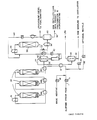
- the drawing is a schematic representation of a fixed bed reactor system and product separation system, according to the invention, showing process flow streams and unit operations.
- the shape-selective oligomerization/polymerization catalysts preferred for use herein include the crystalline aluminosilicate zeolites having a silica to alumina molar ratio of at least 12, a constraint index of about 1 to 12 and acid cracking activity of about 50-300.
- Representative of the ZSM-5 type zeolites are ZSM-5, ZSM-11, ZSM-12, ZSM-23, ZSM-35 and ZSM-38.
- ZSM-5 is described in U.S. Patent 3,702,886 and U.S. Patent Re. 29,948;
- ZSM-11 is described in U.S. Patent 3,709,979.
- U.S. Patent 3,832,449 describes ZSM-12; U.S.
- Patent 4,076,842 describes ZSM-23; U.S. Patent 4,016,245 describes ZSM-35 and U.S. Patent 4,046,839 describes ZSM-38.
- a suitable shape selective medium pore catalyst for fixed bed operations is a small crystal H-ZSM-5 zeolite (silica:alumina ratio approximately 70:1) with alumina binder in the form of cylindrical extrudates of about 1-5mm.
- the catalyst preferably comprises ZSM-5 which has a crystallite size of about 0.02 to 0.05 micron.
- pentasil catalysts which may be used in one or more reactor stages include a variety of medium pore ( ⁇ 5 to 0 9A) siliceous materials such as borosilicates, ferrosilicates, and/or aluminosilicates disclosed in U.S. Patents 4,414,423 and 4,417,088.
- medium pore siliceous materials such as borosilicates, ferrosilicates, and/or aluminosilicates disclosed in U.S. Patents 4,414,423 and 4,417,088.
- the acid catalysts may be deactivated by pretreatment with a surface-neutralizing base, to obtain catalysts suitable for the primary stage of the process.
- Secondary stage catalyst may comprise acid zeolites; however, other acid materials may be employed which catalyze ethylenic unsaturation reactions.
- Other desirable materials for the secondary reaction include HZSM-12, as described in U.S. Patent 4,254,295 or the large-pore zeolites of U.S. Patent 4,430,516.
- Advantage may be obtained by selecting the same type of unmodified catalyst for both stages. Since the final stage is usually conducted at lower temperature than the initial reaction, higher activity may be maintained in the secondary reactor.
- the second stage catalyst can be any acid catalyst useful for polymerizing olefins. Particularly suitable are unmodified medium pore ZSM-5 type zeolites with a Constraint Index of 1-12, preferably of small crystal size (less than 1 micron).
- small pore zeolites for example ZSM-34; large pore zeolites, for example mordenite and ZSM-4; synthetic faujasite; crystalline silica-aluminophosphates; amorphous silica-alumina; acid clays; organic cation exchange resins, such as cross linked sulfonated polystyrene; and Lewis acids, such as BF 3 or AlCl 3 containing suitable co-catalysts such as water, alcohols, carboxylic acids; or hydrogen halides.
- Shape-selective oligomerization as it applies to the conversion of C 2 -C 10 olefins over ZSM-5, is known to produce higher olefins up to C 30 and higher.
- reaction conditions favoring higher molecular weight product are low temperature (200-260°C), elevated pressure (about 2000 kPa or greater), and long contact time (less than 1 WHSV).
- the reaction under these conditions proceeds through the acid-catalyzed steps of (1) oligomerization, (2) isomerization-cracking to a mixture of intermediate carbon number olefins, and (3) interpolymerization to give a continuous boiling product containing all carbon numbers.
- the channel systems of ZSM-5 type catalysts impose shape-selective constraints on the configuration of the large molecules, accounting for the differences with other catalysts.
- the desired oligomerization-polymerization products include C + 10 substantially linear aliphatic hydrocarbons.
- the ZSM-5 catalytic path for propylene feed provides a long chain with approximately one lower alkyl (e.g., methyl) substituent per 8 or more carbon atoms in the straight chain.
- the lubricant range final product can be depicted as a typical linear molecule having a sparingly-substituted long carbon chain, as follows:
- the final molecular conformation is influenced by the pore structure of the catalyst.
- the structure is primarily a methyl-branched straight olefinic chain, with the maximum cross section of the chain limited by the 5.4 x 5.6 Angstrom dimension of the largest ZSM-5 pore.
- other lower olefins such as 2-butene or isobutylene, are readily employed as starting materials due to rapid isomerization over the acidic zeolite catalyst.
- C + heavy distillate and lubricant range products
- the raw aliphatic product is essentially mono-olefinic.
- Overall branching is not extensive, with most branches being methyl at about one branch per eight or more atoms.
- the viscosity index of a hydrocarbon lube oil is related to its molecular conformation. Extensive branching in a molecule usually results in a low viscosity index. It is believed that two modes of oligomerization/polymerization of olefins can take place over acidic zeolites such as HZSM-5. One reaction sequence takes place at Brönsted acid sites inside the channels or pores, producing essentially linear materials. The other reaction sequence occurs on the outer surface, producing highly branched material. By decreasing the surface acid activity (surface ⁇ -value) of such zeolites, fewer highly branched products with low VI are obtained.
- Catalysts of low surface activity can be obtained by using medium pore zeolites of small crystal size that have been deactivated by basic compounds, examples of which are amines, phosphines, phenols, polynuclear hydrocarbons, cationic dyes and others. These compounds all must have a minimum cross section diameter of 5 A or greater.
- Suitable amines include monoamines, diamines, triamines, aliphatic and aromatic cyclic amines and heterocyclic amines, porphines, phthalocyanines, 1,10-phenanthroline, 4,7-diphenyl-1, 10-phenanthroline, 3,4,7,8-tetramethyl-1, 10-phenanthroline, 5,6-benzoquinoline, 2,2':6',2"-terpyridine, 2,4,6-tri(2-pyridyl)-S-triazine and 2,3-cyclododecenopyridine.
- phosphines include triphenylphosphine and 1,2-bis(diphenylphosphine)ethane.
- Suitable phenols are, for example, di-t-butylphenol, alkylated naphthol and 2,4,6-trimethylphenol.
- Polynuclear hydrocarbons include substances such as pyrene and phenanthrene.
- Cationic dyes include thionine, methylene blue and triphenylmethane dyes, such as malachite green and crystal violet. Another surface modification technique is deactivation by treating with metal compounds.
- metal-porphines such as a hemin or iron (III) porphine chloride, cobalticinium chloride (C5H5)2CoCl, and titanocene dichloride (biscyclopentadienyl titanium dichloride), large complex cations such as [Co(NH 2 R) 6 ] 2+ ,
- the catalysts may be treated with organic silicon compounds, as described in U.S. Patents 4,100,215 and 4,002,697 to impart the desired degree of surface deactivation while being essentially free of carbonaceous deposits.
- Such treatment involves contacting the catalyst with a silane surface modifying agent capable of deactivating catalytic (acidic) sites located on the external surface of the zeolite by chemisorption.
- a silane surface modifying agent capable of deactivating catalytic (acidic) sites located on the external surface of the zeolite by chemisorption.
- Those amines with an effective cross section larger than about 5 Angstroms are suitable especially substituted quinolines, heterocyclic amines and alkyl-substituted pyridines such as 2,4 or 2,6-di-alkyl pyridines.
- Preferred are bulky, sterically-hindered di-ortho-alkyl pyridines, such as 2,6-di-tertiary-butylpyridine
- the lower molecular weight C 6 -C 20 intermediate materials formed over the modified catalyst are relatively linear olefins. These olefins can be effectively converted to lube range materials by additional polymerization. Accordingly, lube range materials can be obtained in accordance with the present invention in a two-stage process.
- the first stage involves oligomerization of an inexpensive lower olefin of, e.g., propylene at about 200°C over a surface poisoned HZSM-5.
- the second stage involves further oligomerization/interpolymerization of the product (or a fraction of the product) from the first stage over a second and/or different acid catalyst, which may be modified or unmodified as disclosed herein, at about 100-260°C.
- the temperature of the second stage is usually lower than that of the first stage, i.e., about 25-75°C lower and preferably the catalyst is an unmodified ZSM-5 type catalyst. Both high yields and high VI are achieved by this two-stage process
- temperatures, pressures and equipment may be used in the novel process disclosed herein.
- Preferred temperatures may vary from about 100 to about 350°C, preferably 150° to 250°C pressures from about atmospheric to 20,000 kPa and WHSV from about 0.01 to about 2.0, preferably 0.2 to 1.0 are employed.
- the attached drawing shows the process relationships of the multi-stage process, depicting the conversion of a C 3 -C 6 rich olefinic, inter-stage phase separation and recycle. Heavy hydrocarbons are recovered by fractionation and may be sent to a conventional hydrotreating unit for product finishing.
- the olefinic feedstock supply 1 is brought to process pressure by means of pump 5.
- the primary stage I is operated continuously in a series of fixed bed downflow reactors by adding a sterically-hindered nitrogenous base to lower olefin feed at a rate sufficient to maintain surface inactivity in the catalyst.
- 2,6-di-(t-butyl)-pyridine is injected into the feed at a concentration of about 5 to 1000 ppm by pump 10.
- the mixture is a hydrocarbon solution of preheated by passing sequentially through a series of heat exchange means 12 and reactant effluent exchangers 14C, 148, 14A and furnace 16 prior to entering the primary stage catalytic reactor system 20.
- a typical distillate mode first stage reactor system 20 is shown.
- a multi-reactor system is employed with inter-zone cooling, whereby the reaction exotherm can be carefully controlled to prevent excessive temperature above the normal moderate range of about 200° to 290°C, especially in the final reaction zone. While process pressure may be maintained over a wide range, usually from about 2000 to over 20,000 kPa, the preferred pressure is about 7000 to 15,000 kPa.
- the feedstock is heated to reaction temperature and carried sequentially through a series of zeolite beds 20A, B, C wherein at least a portion of the olefin content is converted to heavier distillate constituents.
- the maximum temperature differential across only one reactor is about 30°C and the space velocity (WHSV based on olefin feed) is about 0.1 to 2.
- the heat exchangers 14A and 14B provide inter-reactor cooling.
- the effluent mixture from stage I enters a high temperature separator (HTS) 26, wherein high boiling product is recovered as a liquid rich in C + 10 hydrocarbons; while vaporizing volatile components of the effluent stream, including light gas and lower hydrocarbons, such as C 1 to C 9 aliphatics.
- HTS high temperature separator
- the major portion (e.g. 50% to more than 90 wt %) of C 10 hydrocarbon components are contained in the high boiling liquid fraction.
- Overhead vapor is withdrawn through conduit 27, cooled indirectly by incoming feedstock in exchanger 12 to condense a major amount of C 5 -C 9 gasoline range hydrocarbons for recovery in the second low temperature phase separation unit (LTS) 30.
- LTS low temperature phase separation unit
- This condensed stream is withdrawn through conduit 32 to provide essentially all of the liquid olefinic recycle stream and pressurized by pump means 34 prior to combining with feedstock.
- the major portion of C 5 to C 9 hydrocarbon components are contained in this liquified recycle stream; however, an optional recycle stream 36 may be obtained from distilled raw gasoline.
- an optional recycle stream 36 may be obtained from distilled raw gasoline.
- both stages contain HZSM-5 catalyst and are operated continuously and/or batchwise.
- the secondary stage usually is maintained at an average temperature less than about 260°C at elevated pressure greater than about 2000 kPa and weight hourly space velocity less than 1 hr -1 .
- An olefinic intermediate stream from units 26, 40 is pressurized by pump 42, and heated by effluent heat exchanger 42 and furnace 44 prior to entering the Stage II reactor 50 for further oligomerization conversion to produce lubricant, raw olefinic gasoline, distillate, etc., the Stage II effluent may be cooled in exchanger 42 or by-passed via line 54 and furnace 56 prior to flashing in phase separator 60.
- Overhead containing gasoline C 4 light gas and light distillate may be recovered as product and/or recycled via line 64 to the reactor stage(s).
- the secondary effluent liquid stream is fractionated to provide a major raw product stream consisting essentially of 2900C+ aliphatic hydrocarbons comprising a major amount of C 10 -C 20 distillate and C 20 -C 60 aliphatic hydrocarbons.
- This raw olefinic product may then be hydrotreated in a separate process step (not shown) to provide a paraffinic lubricant and/or heavy distillate product. Details of a mild hydrogenation treatment may be obtained from U.S. Patent 4,211,640, typically using Co or Ni with W/Mo and/or noble metals.
- the hydrotreated stream may be further fractionated to yield refined high grade lubricants of outstanding quality.
- HZSM-5 Primary stage catalyst
- HZSM-5 Primary stage catalyst
- An olefinic feedstock consisting of 27 weight percent propene, 36.1 wt% butene, 10.7 wt% propane and 26.1 wt% butane is cofed with gasoline recycle in a down flow fixed bed reactor system, as depicted, at 7000 kPa about 0.4 WHSV and average reactor temperature of 205°C.
- the deactivating agent is injected with the olefinic feed at a concentration of about 50 weight parts per million, based on fresh feed. The results of the continuous run are shown below.
- the secondary reactor is charged with unmodified HZSM-5 catalyst having an acid cracking activity ( ⁇ -value) of about 250.
- An enclosed stirred reactor is maintained at an average temperature of about 175°C under autogenous pressure.
- the secondary feed is the 165-345°C distillate cut from the primary effluent (Table I), which is contacted with catalyst at a 10:1 ratio based on active catalysts at a space velocity of about 0.1 to 0.4 WHSV.
- Table I The results of this run are tabulated below:
- the oligomer mixture is saturated with BF 3 .
- To this BF3-olefin mixture is added 10 ml of BF 3 C 4 H 9 0H complex, keeping the temperature of the reaction mixture between 0-5°C.
- Samples are withdrawn periodically and their product compositions determined by gas chromatography. The results are tabulated below: After 5 hours, the reaction mixture is neutralized with ammonia to form a white solid which is filtered off.
- the lube is obtained by distillation.
- the 345°C + lube has kinematic viscosities of 32.82 cs at 40°C, 5.00 cs at 100°C and a VI of 63.
- Example C The procedure of Example C is followed, except that the reaction is carried out for 0.5 hours.
- the 345°C + lube ( ⁇ 12%) has kinematic viscosities of 12.6 at 40°C, 3.2 cs at 100°C and a VI of 127.
- Examples C and D illustrate that lubes of high viscosities and of high viscosity index can be obtained when adequate reaction conditions are employed, such as by varying the total reaction time.
Landscapes
- Chemical & Material Sciences (AREA)
- Engineering & Computer Science (AREA)
- Chemical Kinetics & Catalysis (AREA)
- Oil, Petroleum & Natural Gas (AREA)
- Organic Chemistry (AREA)
- General Chemical & Material Sciences (AREA)
- Crystallography & Structural Chemistry (AREA)
- Materials Engineering (AREA)
- Production Of Liquid Hydrocarbon Mixture For Refining Petroleum (AREA)
- Catalysts (AREA)
- Organic Low-Molecular-Weight Compounds And Preparation Thereof (AREA)
- Low-Molecular Organic Synthesis Reactions Using Catalysts (AREA)
Applications Claiming Priority (2)
| Application Number | Priority Date | Filing Date | Title |
|---|---|---|---|
| US598139 | 1984-04-09 | ||
| US06/598,139 US4520221A (en) | 1984-04-09 | 1984-04-09 | Process of making high VI lubes |
Publications (2)
| Publication Number | Publication Date |
|---|---|
| EP0159848A1 true EP0159848A1 (fr) | 1985-10-30 |
| EP0159848B1 EP0159848B1 (fr) | 1990-10-17 |
Family
ID=24394403
Family Applications (1)
| Application Number | Title | Priority Date | Filing Date |
|---|---|---|---|
| EP85302428A Expired - Lifetime EP0159848B1 (fr) | 1984-04-09 | 1985-04-04 | Procédé pour la fabrication d'hydrocarbures lubrifiants à partir d'oléfines inférieures |
Country Status (11)
| Country | Link |
|---|---|
| US (1) | US4520221A (fr) |
| EP (1) | EP0159848B1 (fr) |
| JP (1) | JPH0692587B2 (fr) |
| AU (1) | AU580988B2 (fr) |
| BR (1) | BR8501671A (fr) |
| CA (1) | CA1257613A (fr) |
| DE (1) | DE3580118D1 (fr) |
| ES (1) | ES8706589A1 (fr) |
| IN (1) | IN164496B (fr) |
| NZ (1) | NZ211627A (fr) |
| ZA (1) | ZA852626B (fr) |
Cited By (4)
| Publication number | Priority date | Publication date | Assignee | Title |
|---|---|---|---|---|
| EP0256707A1 (fr) * | 1986-08-05 | 1988-02-24 | Mobil Oil Corporation | Procédé catalytique pour l'oligomérisation de l'éthène |
| EP0299671A3 (fr) * | 1987-07-13 | 1989-05-24 | Mobil Oil Corporation | Production d'huiles de graissage à haut indice de viscosité à partir de faibles oléfines et de faibles quantités d'eau |
| EP0377306A1 (fr) * | 1989-01-03 | 1990-07-11 | Mobil Oil Corporation | Procédé de préparation de cooligomères hydrogénés |
| EP1856009A4 (fr) * | 2005-02-28 | 2012-01-04 | Exxonmobil Res & Eng Co | Production d'essence par polymerisation d'olefine |
Families Citing this family (56)
| Publication number | Priority date | Publication date | Assignee | Title |
|---|---|---|---|---|
| US5243112A (en) * | 1982-04-30 | 1993-09-07 | Mobil Oil Corp. | Lubricant range hydrocarbons from light olefins |
| US4547612A (en) * | 1984-09-25 | 1985-10-15 | Mobil Oil Corporation | Production of lubricant and/or heavy distillate range hydrocarbons by light olefin upgrading |
| US4618737A (en) * | 1985-12-13 | 1986-10-21 | Mobil Oil Corporation | Peroxide-induced polymerization of MOGD liquids to high viscosity lubes |
| US4855527A (en) * | 1987-10-07 | 1989-08-08 | Mobil Oil Corporation | Olefin oligomerization with surface modified zeolite |
| AU613954B2 (en) * | 1987-10-07 | 1991-08-15 | Mobil Oil Corporation | Olefin oligomerization |
| US5026933A (en) * | 1987-10-07 | 1991-06-25 | Mobil Oil Corporation | Olefin oligomerization with surface modified zeolite catalyst |
| US4870038A (en) * | 1987-10-07 | 1989-09-26 | Mobil Oil Corporation | Olefin oligomerization with surface modified zeolite catalyst |
| US4788375A (en) * | 1987-11-27 | 1988-11-29 | Mobil Oil Corporation | Olefin conversion to lubricant range hydrocarbons |
| US4990711A (en) * | 1988-06-23 | 1991-02-05 | Mobil Oil Corporation | Synthetic polyolefin lubricant blends having high viscosity indices |
| US4918255A (en) * | 1988-07-15 | 1990-04-17 | Mobil Oil Corp. | Heterogeneous isoparaffin/olefin alkylation with isomerization |
| US4935577A (en) * | 1988-07-15 | 1990-06-19 | Mobil Oil Corp. | Hydrocarbon processes comprised of catalytic distillation using Lewis acid promoted inorganic oxide catalyst systems |
| US4922047A (en) * | 1988-12-22 | 1990-05-01 | Mobil Oil Corporation | Process for production of traction fluids from bicyclic and monocyclic terpenes with zeolite catalyst |
| US5015361A (en) * | 1989-01-23 | 1991-05-14 | Mobil Oil Corp. | Catalytic dewaxing process employing surface acidity deactivated zeolite catalysts |
| US5000840A (en) * | 1989-01-23 | 1991-03-19 | Mobil Oil Corporation | Catalytic dewaxing lubricating oil stock derived from oligomerized olefin |
| US5068048A (en) * | 1990-02-07 | 1991-11-26 | Mobil Oil Corporation | Lubricants and lube additives from epoxidation of lower olefin oligomers |
| US5035818A (en) * | 1990-02-07 | 1991-07-30 | Mobil Oil Corporation | Amide and sulfonic acid derivation of lower olefin oligomers |
| US5021178A (en) * | 1990-02-07 | 1991-06-04 | Mobil Oil Corporation | Acylation of lower olefin oligomers |
| US4992189A (en) * | 1990-02-07 | 1991-02-12 | Mobil Oil Corporation | Lubricants and lube additives from hydroxylation and esterification of lower alkene oligomers |
| US5095165A (en) * | 1990-03-21 | 1992-03-10 | Mobil Oil Corporation | Hydrocarbon lubricants containing polar groups |
| US5053568A (en) * | 1990-11-15 | 1991-10-01 | Mobil Oil Corp. | Lubricant compositions comprising copolymers of 1-vinyladamantane and 1-alkenes and methods of preparing the same |
| US5120899A (en) * | 1991-03-04 | 1992-06-09 | Mobil Oil Corporation | Diamondoid recovery from natural gas fields |
| US5308471A (en) * | 1991-08-15 | 1994-05-03 | Mobil Oil Corporation | Hydrocarbon upgrading process |
| US5210347A (en) * | 1991-09-23 | 1993-05-11 | Mobil Oil Corporation | Process for the production of high cetane value clean fuels |
| US5250484A (en) * | 1991-11-26 | 1993-10-05 | Mobil Oil Corporation | Surface modified porous acidic crystalline catalyst |
| US5234875A (en) * | 1991-12-11 | 1993-08-10 | Mobil Oil Corporation | Coke-selectivated porous acidic crystalline catalyst, its preparation, and use in olefin oligomerization |
| US5237120A (en) * | 1991-12-27 | 1993-08-17 | Mobil Oil Corporation | Double bond isomerization of olefin-containing feeds with minimal oligomertization using surface acidity deactivated zeolite catalysts |
| US5234872A (en) * | 1992-05-11 | 1993-08-10 | Mobil Oil Corp. | Method for producing zeolites with reduced surface acidity |
| US5242676A (en) * | 1992-05-11 | 1993-09-07 | Mobil Oil Corp. | Selective surface dealumination of zeolites using dicarboxylic acid |
| US5238677A (en) * | 1992-06-15 | 1993-08-24 | Mobil Oil Corp. | Process for the dealumination of mordenite |
| US5284989A (en) * | 1992-11-04 | 1994-02-08 | Mobil Oil Corporation | Olefin oligomerization with surface modified zeolite catalyst |
| US5304695A (en) * | 1993-02-22 | 1994-04-19 | Mobil Oil Corporation | Double bond isomerization of olefin-containing feeds with minimal oligomerization using permanently surface acidity deactivated zeolite catalysts |
| US5345020A (en) * | 1993-06-03 | 1994-09-06 | Mobil Oil Corporation | Method for making diamondoid lubricant base stock by alkylation with an olefin in the presence of a Lewis acid |
| US5367097A (en) * | 1993-06-03 | 1994-11-22 | Mobil Oil Corporation | Lubricant composition and method for increasing diamondoid incorporation in polyalphaolefin-containing lubricant |
| US5449849A (en) * | 1994-04-18 | 1995-09-12 | Mobil Oil Corporation | Selectivated ZSM-035 catalyst and process for selectively converting ethene to linear butenes therewith |
| US5475181A (en) * | 1994-04-18 | 1995-12-12 | Mobil Oil Corporation | Process for selectively converting ethene to isobutylene over selectivated ZSM-35 |
| JP2000344690A (ja) * | 1999-03-31 | 2000-12-12 | Fuji Oil Co Ltd | メタロシリケート触媒を用いたジメチルナフタレンおよびアルキルナフタレンの製造法 |
| US6649802B1 (en) | 2000-09-21 | 2003-11-18 | Uop Llc | Layered oligomerization catalyst system |
| US6403853B1 (en) | 2000-09-21 | 2002-06-11 | Uop Llc | Olefin oligomerization using surface modified molecular sieve catalyst |
| WO2003082788A1 (fr) * | 2002-03-29 | 2003-10-09 | Exxonmobil Chemical Patents Inc. | Procédé amélioré de vaporisation instantanée de cobalt |
| WO2003082789A2 (fr) * | 2002-03-29 | 2003-10-09 | Exxonmobil Chemical Patents Inc. | Synthese oxo |
| GB0412139D0 (en) * | 2004-06-01 | 2004-06-30 | Exxonmobil Chem Patents Inc | Olefin oligomerization process |
| GB0412151D0 (en) * | 2004-06-01 | 2004-06-30 | Exxonmobil Chem Patents Inc | Olefin oligomerization process |
| US7238332B2 (en) * | 2004-06-14 | 2007-07-03 | Feaver William B | Material and process for the filtration of nitric acid and NO2 from streams of air |
| US20100144513A1 (en) * | 2008-12-09 | 2010-06-10 | Nicholas Christopher P | Catalyst for Olefin Upgrading |
| US8178740B2 (en) * | 2008-12-09 | 2012-05-15 | Uop Llc | Olefin upgrading process |
| US20100144514A1 (en) * | 2008-12-09 | 2010-06-10 | Nicholas Christopher P | Process for Making Catalyst for Olefin Upgrading |
| EP2272939B1 (fr) | 2009-07-03 | 2012-09-12 | BP Corporation North America Inc. | Procédé d'oligomérisation d'alcènes |
| EP2269734A1 (fr) | 2009-07-03 | 2011-01-05 | BP Corporation North America Inc. | Catalyseur modifié à base de zéolite |
| EP2386354B1 (fr) | 2010-05-14 | 2019-07-24 | Bp Oil International Limited | Procédé d'oligomérisation d'alcènes |
| ES2443539B1 (es) | 2012-07-19 | 2014-12-04 | Consejo Superior De Investigaciones Científicas (Csic) | Proceso de oligomerización de alquenos utilizando la zeolita ITQ-39 |
| US9416071B2 (en) | 2014-05-06 | 2016-08-16 | Uop Llc | Hydrocarbon conversion processes using lactamium-based ionic liquids |
| WO2017011232A1 (fr) | 2015-07-10 | 2017-01-19 | Uop Llc | Synthèse de liquides ioniques à base de thioamide et d'amide non cycliques |
| WO2017011222A1 (fr) | 2015-07-10 | 2017-01-19 | Uop Llc | Procédés de conversion en hydrocarbure à l'aide de liquide à base de thioamide et d'amide non cyclique |
| US10815165B1 (en) * | 2016-05-23 | 2020-10-27 | Emerging Fuels Technology, Inc. | Production of basestocks from paraffinic hydrocarbons |
| JP7443684B2 (ja) | 2019-07-10 | 2024-03-06 | 東ソー株式会社 | 新規ゼオライト及びそれを含む芳香族炭化水素製造用触媒 |
| CN116064132B (zh) * | 2021-10-29 | 2024-05-07 | 中国石油化工股份有限公司 | 一种柴油催化分离方法 |
Citations (5)
| Publication number | Priority date | Publication date | Assignee | Title |
|---|---|---|---|---|
| DE2347235A1 (de) * | 1972-09-20 | 1974-04-11 | Sir Soc Italiana Resine Spa | Verfahren zur dimerisation oder codimerisation von linearen olefinen und katalysator zur durchfuehrung des verfahrens |
| US4100215A (en) * | 1974-09-25 | 1978-07-11 | Mobil Oil Corporation | Selective production of para-xylene |
| DE3229895A1 (de) * | 1981-09-25 | 1983-04-14 | Chevron Research Co., 94105 San Francisco, Calif. | Verfahren zur oligomerisation von alkenen |
| US4414423A (en) * | 1981-09-25 | 1983-11-08 | Chevron Research Company | Multistep oligomerization process |
| EP0099701A1 (fr) * | 1982-07-22 | 1984-02-01 | Mobil Oil Corporation | Procédé et appareil pour la conversion d'oléfines en essence et distillat |
Family Cites Families (5)
| Publication number | Priority date | Publication date | Assignee | Title |
|---|---|---|---|---|
| US4029719A (en) * | 1972-09-20 | 1977-06-14 | Societa' Italiana Resine S.I.R. S.P.A. | Process for the dimerization or co-dimerization of linear olefins and catalysts therefore |
| US4211640A (en) * | 1979-05-24 | 1980-07-08 | Mobil Oil Corporation | Process for the treatment of olefinic gasoline |
| US4453029A (en) * | 1979-12-19 | 1984-06-05 | Mobil Oil Corporation | Selective sorption by zeolites |
| US4417086A (en) * | 1982-04-30 | 1983-11-22 | Chevron Research Company | Efficient fluidized oligomerization |
| NZ209388A (en) * | 1983-09-19 | 1987-02-20 | Mobil Oil Corp | Two-stage process for converting olefinic components in feedstock to high viscosity index lubricating oils using zeolite catalyst |
-
1984
- 1984-04-09 US US06/598,139 patent/US4520221A/en not_active Expired - Lifetime
-
1985
- 1985-03-29 NZ NZ211627A patent/NZ211627A/en unknown
- 1985-03-30 IN IN248/MAS/85A patent/IN164496B/en unknown
- 1985-04-01 AU AU40585/85A patent/AU580988B2/en not_active Ceased
- 1985-04-04 EP EP85302428A patent/EP0159848B1/fr not_active Expired - Lifetime
- 1985-04-04 DE DE8585302428T patent/DE3580118D1/de not_active Expired - Lifetime
- 1985-04-04 CA CA000478428A patent/CA1257613A/fr not_active Expired
- 1985-04-08 ES ES542034A patent/ES8706589A1/es not_active Expired
- 1985-04-09 ZA ZA852626A patent/ZA852626B/xx unknown
- 1985-04-09 JP JP60073621A patent/JPH0692587B2/ja not_active Expired - Lifetime
- 1985-04-09 BR BR8501671A patent/BR8501671A/pt unknown
Patent Citations (5)
| Publication number | Priority date | Publication date | Assignee | Title |
|---|---|---|---|---|
| DE2347235A1 (de) * | 1972-09-20 | 1974-04-11 | Sir Soc Italiana Resine Spa | Verfahren zur dimerisation oder codimerisation von linearen olefinen und katalysator zur durchfuehrung des verfahrens |
| US4100215A (en) * | 1974-09-25 | 1978-07-11 | Mobil Oil Corporation | Selective production of para-xylene |
| DE3229895A1 (de) * | 1981-09-25 | 1983-04-14 | Chevron Research Co., 94105 San Francisco, Calif. | Verfahren zur oligomerisation von alkenen |
| US4414423A (en) * | 1981-09-25 | 1983-11-08 | Chevron Research Company | Multistep oligomerization process |
| EP0099701A1 (fr) * | 1982-07-22 | 1984-02-01 | Mobil Oil Corporation | Procédé et appareil pour la conversion d'oléfines en essence et distillat |
Non-Patent Citations (1)
| Title |
|---|
| CHEMICAL ABSTRACTS, vol. 99, no. 17, October 24, 1983, Columbus, Ohio, USA W.E. GARWOOD "Conversion of C2-C10 to higher olefins over synthetic zeolite ZSM-5" page 543, abstract-no. 139 251v * |
Cited By (4)
| Publication number | Priority date | Publication date | Assignee | Title |
|---|---|---|---|---|
| EP0256707A1 (fr) * | 1986-08-05 | 1988-02-24 | Mobil Oil Corporation | Procédé catalytique pour l'oligomérisation de l'éthène |
| EP0299671A3 (fr) * | 1987-07-13 | 1989-05-24 | Mobil Oil Corporation | Production d'huiles de graissage à haut indice de viscosité à partir de faibles oléfines et de faibles quantités d'eau |
| EP0377306A1 (fr) * | 1989-01-03 | 1990-07-11 | Mobil Oil Corporation | Procédé de préparation de cooligomères hydrogénés |
| EP1856009A4 (fr) * | 2005-02-28 | 2012-01-04 | Exxonmobil Res & Eng Co | Production d'essence par polymerisation d'olefine |
Also Published As
| Publication number | Publication date |
|---|---|
| US4520221A (en) | 1985-05-28 |
| BR8501671A (pt) | 1985-12-24 |
| JPS60229989A (ja) | 1985-11-15 |
| JPH0692587B2 (ja) | 1994-11-16 |
| AU580988B2 (en) | 1989-02-09 |
| CA1257613A (fr) | 1989-07-18 |
| ZA852626B (en) | 1986-11-26 |
| ES542034A0 (es) | 1987-07-01 |
| AU4058585A (en) | 1985-10-17 |
| IN164496B (fr) | 1989-03-25 |
| EP0159848B1 (fr) | 1990-10-17 |
| DE3580118D1 (de) | 1990-11-22 |
| NZ211627A (en) | 1987-11-27 |
| ES8706589A1 (es) | 1987-07-01 |
Similar Documents
| Publication | Publication Date | Title |
|---|---|---|
| CA1257613A (fr) | Obtention d'hydrocarbures dans la gamme des lubrifiants, a partir d'olefines legeres | |
| US4568786A (en) | Production of lubricant range hydrocarbons from light olefins | |
| CA1248477A (fr) | Production de lubrifiant et (ou) d'hydrocarbures distillant dans les fractions lourdes, par valorisation d'olefines legeres | |
| US4720600A (en) | Production of middle distillate range hydrocarbons by light olefin upgrading | |
| US4990711A (en) | Synthetic polyolefin lubricant blends having high viscosity indices | |
| US5105038A (en) | Synthetic polyolefin lubricant blends | |
| US5026933A (en) | Olefin oligomerization with surface modified zeolite catalyst | |
| US5004852A (en) | Two-stage process for conversion of olefins to high octane gasoline | |
| US4740645A (en) | Multistage conversion of lower olefins with interreactor quenching | |
| EP0215609B1 (fr) | Procédé en plusieurs étapes pour convertir des oléfines en hydrocarbures plus lourds | |
| EP0318132B1 (fr) | Procédé pour la préparation d'hydrocarbures à partir d'poléfines dans une séquence de réacteurs | |
| US4658079A (en) | Production of lubricant range hydrocarbons from light olefins | |
| US4855527A (en) | Olefin oligomerization with surface modified zeolite | |
| EP0323032A2 (fr) | Procédé pour la préparation d'hydrocarbures plus lourds à partir d'oléfines légères dans des réacteurs catalytiques à plusieurs étapes | |
| US20010004972A1 (en) | Process for making a lube base stock from a lower molecular weight feedstock using at least two oligomerization zones | |
| US4962249A (en) | High VI lubricants from lower alkene oligomers | |
| US4716135A (en) | Organophosphorus-modified zeolites and method of preparation | |
| AU671424B2 (en) | High cetane value cleans fuels and processes for their production | |
| CA1269402A (fr) | METHODE DE PREPARATION DES OLEFINES .alpha. A PARTIR D'OLEFINES LEGERES | |
| US5000840A (en) | Catalytic dewaxing lubricating oil stock derived from oligomerized olefin | |
| US4618737A (en) | Peroxide-induced polymerization of MOGD liquids to high viscosity lubes | |
| US4547609A (en) | Multi-stage process for the conversion of olefins into high viscosity lubricants | |
| US4849186A (en) | Production of middle distillate range hydrocarbons by light olefin upgrading | |
| US5073351A (en) | Production of middle distillate range hydrocarbons by light olefin upgrading | |
| CA1274203A (fr) | Methode de fabrication d'huile lubrifiante a partir d'olefines |
Legal Events
| Date | Code | Title | Description |
|---|---|---|---|
| PUAI | Public reference made under article 153(3) epc to a published international application that has entered the european phase |
Free format text: ORIGINAL CODE: 0009012 |
|
| AK | Designated contracting states |
Designated state(s): BE DE FR GB IT NL |
|
| 17P | Request for examination filed |
Effective date: 19860403 |
|
| 17Q | First examination report despatched |
Effective date: 19870409 |
|
| GRAA | (expected) grant |
Free format text: ORIGINAL CODE: 0009210 |
|
| AK | Designated contracting states |
Kind code of ref document: B1 Designated state(s): BE DE FR GB IT NL |
|
| REF | Corresponds to: |
Ref document number: 3580118 Country of ref document: DE Date of ref document: 19901122 |
|
| ET | Fr: translation filed | ||
| ITF | It: translation for a ep patent filed | ||
| ITTA | It: last paid annual fee | ||
| PLBE | No opposition filed within time limit |
Free format text: ORIGINAL CODE: 0009261 |
|
| STAA | Information on the status of an ep patent application or granted ep patent |
Free format text: STATUS: NO OPPOSITION FILED WITHIN TIME LIMIT |
|
| 26N | No opposition filed | ||
| PGFP | Annual fee paid to national office [announced via postgrant information from national office to epo] |
Ref country code: FR Payment date: 19980505 Year of fee payment: 14 |
|
| REG | Reference to a national code |
Ref country code: FR Ref legal event code: ST |
|
| PG25 | Lapsed in a contracting state [announced via postgrant information from national office to epo] |
Ref country code: FR Free format text: THE PATENT HAS BEEN ANNULLED BY A DECISION OF A NATIONAL AUTHORITY Effective date: 19990430 |
|
| REG | Reference to a national code |
Ref country code: GB Ref legal event code: IF02 |
|
| PGFP | Annual fee paid to national office [announced via postgrant information from national office to epo] |
Ref country code: GB Payment date: 20030313 Year of fee payment: 19 |
|
| PGFP | Annual fee paid to national office [announced via postgrant information from national office to epo] |
Ref country code: NL Payment date: 20030318 Year of fee payment: 19 |
|
| PGFP | Annual fee paid to national office [announced via postgrant information from national office to epo] |
Ref country code: DE Payment date: 20030430 Year of fee payment: 19 |
|
| PGFP | Annual fee paid to national office [announced via postgrant information from national office to epo] |
Ref country code: BE Payment date: 20030514 Year of fee payment: 19 |
|
| PG25 | Lapsed in a contracting state [announced via postgrant information from national office to epo] |
Ref country code: GB Free format text: LAPSE BECAUSE OF NON-PAYMENT OF DUE FEES Effective date: 20040404 |
|
| PG25 | Lapsed in a contracting state [announced via postgrant information from national office to epo] |
Ref country code: BE Free format text: LAPSE BECAUSE OF NON-PAYMENT OF DUE FEES Effective date: 20040430 |
|
| BERE | Be: lapsed |
Owner name: *MOBIL OIL CORP. Effective date: 20040430 |
|
| PG25 | Lapsed in a contracting state [announced via postgrant information from national office to epo] |
Ref country code: NL Free format text: LAPSE BECAUSE OF NON-PAYMENT OF DUE FEES Effective date: 20041101 |
|
| PG25 | Lapsed in a contracting state [announced via postgrant information from national office to epo] |
Ref country code: DE Free format text: LAPSE BECAUSE OF NON-PAYMENT OF DUE FEES Effective date: 20041103 |
|
| GBPC | Gb: european patent ceased through non-payment of renewal fee | ||
| NLV4 | Nl: lapsed or anulled due to non-payment of the annual fee |
Effective date: 20041101 |