EP0161759B1 - Polymere Liposome als stabile Gasträger - Google Patents
Polymere Liposome als stabile Gasträger Download PDFInfo
- Publication number
- EP0161759B1 EP0161759B1 EP85302048A EP85302048A EP0161759B1 EP 0161759 B1 EP0161759 B1 EP 0161759B1 EP 85302048 A EP85302048 A EP 85302048A EP 85302048 A EP85302048 A EP 85302048A EP 0161759 B1 EP0161759 B1 EP 0161759B1
- Authority
- EP
- European Patent Office
- Prior art keywords
- aqueous dispersion
- liposomes
- conjugated
- yne
- ligand
- Prior art date
- Legal status (The legal status is an assumption and is not a legal conclusion. Google has not performed a legal analysis and makes no representation as to the accuracy of the status listed.)
- Expired - Lifetime
Links
- 239000002502 liposome Substances 0.000 title claims abstract description 73
- 239000000969 carrier Substances 0.000 title description 4
- 239000006185 dispersion Substances 0.000 claims abstract description 40
- 150000003904 phospholipids Chemical class 0.000 claims abstract description 34
- 125000004432 carbon atom Chemical group C* 0.000 claims abstract description 27
- 239000003446 ligand Substances 0.000 claims abstract description 24
- 229920000642 polymer Polymers 0.000 claims abstract description 20
- 125000001931 aliphatic group Chemical group 0.000 claims abstract description 17
- CURLTUGMZLYLDI-UHFFFAOYSA-N Carbon dioxide Chemical compound O=C=O CURLTUGMZLYLDI-UHFFFAOYSA-N 0.000 claims abstract description 16
- 239000007789 gas Substances 0.000 claims abstract description 16
- IJGRMHOSHXDMSA-UHFFFAOYSA-N Atomic nitrogen Chemical compound N#N IJGRMHOSHXDMSA-UHFFFAOYSA-N 0.000 claims abstract description 15
- MYMOFIZGZYHOMD-UHFFFAOYSA-N Dioxygen Chemical compound O=O MYMOFIZGZYHOMD-UHFFFAOYSA-N 0.000 claims abstract description 10
- 229910001882 dioxygen Inorganic materials 0.000 claims abstract description 9
- UGFAIRIUMAVXCW-UHFFFAOYSA-N Carbon monoxide Chemical compound [O+]#[C-] UGFAIRIUMAVXCW-UHFFFAOYSA-N 0.000 claims abstract description 8
- 239000001569 carbon dioxide Substances 0.000 claims abstract description 8
- 229910002092 carbon dioxide Inorganic materials 0.000 claims abstract description 8
- 229910002091 carbon monoxide Inorganic materials 0.000 claims abstract description 8
- MWUXSHHQAYIFBG-UHFFFAOYSA-N nitrogen oxide Inorganic materials O=[N] MWUXSHHQAYIFBG-UHFFFAOYSA-N 0.000 claims abstract description 5
- 125000000217 alkyl group Chemical group 0.000 claims abstract description 4
- 229920006037 cross link polymer Polymers 0.000 claims abstract description 4
- 239000007787 solid Substances 0.000 claims abstract 4
- 238000000034 method Methods 0.000 claims description 30
- 239000000203 mixture Substances 0.000 claims description 13
- 150000001720 carbohydrates Chemical class 0.000 claims description 9
- 230000015572 biosynthetic process Effects 0.000 claims description 8
- HVYWMOMLDIMFJA-DPAQBDIFSA-N cholesterol Chemical compound C1C=C2C[C@@H](O)CC[C@]2(C)[C@@H]2[C@@H]1[C@@H]1CC[C@H]([C@H](C)CCCC(C)C)[C@@]1(C)CC2 HVYWMOMLDIMFJA-DPAQBDIFSA-N 0.000 claims description 8
- HDTRYLNUVZCQOY-UHFFFAOYSA-N α-D-glucopyranosyl-α-D-glucopyranoside Natural products OC1C(O)C(O)C(CO)OC1OC1C(O)C(O)C(O)C(CO)O1 HDTRYLNUVZCQOY-UHFFFAOYSA-N 0.000 claims description 4
- HDTRYLNUVZCQOY-WSWWMNSNSA-N Trehalose Natural products O[C@@H]1[C@@H](O)[C@@H](O)[C@@H](CO)O[C@@H]1O[C@@H]1[C@H](O)[C@@H](O)[C@@H](O)[C@@H](CO)O1 HDTRYLNUVZCQOY-WSWWMNSNSA-N 0.000 claims description 4
- 235000012000 cholesterol Nutrition 0.000 claims description 4
- 229910052757 nitrogen Inorganic materials 0.000 claims description 4
- QJGQUHMNIGDVPM-UHFFFAOYSA-N nitrogen(.) Chemical compound [N] QJGQUHMNIGDVPM-UHFFFAOYSA-N 0.000 claims description 4
- 230000005855 radiation Effects 0.000 claims description 4
- WQZGKKKJIJFFOK-GASJEMHNSA-N Glucose Natural products OC[C@H]1OC(O)[C@H](O)[C@@H](O)[C@@H]1O WQZGKKKJIJFFOK-GASJEMHNSA-N 0.000 claims description 3
- 229910019142 PO4 Inorganic materials 0.000 claims description 3
- WQZGKKKJIJFFOK-PHYPRBDBSA-N alpha-D-galactose Chemical compound OC[C@H]1O[C@H](O)[C@H](O)[C@@H](O)[C@H]1O WQZGKKKJIJFFOK-PHYPRBDBSA-N 0.000 claims description 3
- WQZGKKKJIJFFOK-VFUOTHLCSA-N beta-D-glucose Chemical compound OC[C@H]1O[C@@H](O)[C@H](O)[C@@H](O)[C@@H]1O WQZGKKKJIJFFOK-VFUOTHLCSA-N 0.000 claims description 3
- 238000007710 freezing Methods 0.000 claims description 3
- 230000008014 freezing Effects 0.000 claims description 3
- 229930182830 galactose Natural products 0.000 claims description 3
- 239000008103 glucose Substances 0.000 claims description 3
- NBIIXXVUZAFLBC-UHFFFAOYSA-K phosphate Chemical compound [O-]P([O-])([O-])=O NBIIXXVUZAFLBC-UHFFFAOYSA-K 0.000 claims description 3
- 239000010452 phosphate Substances 0.000 claims description 3
- 238000010257 thawing Methods 0.000 claims description 3
- GVJHHUAWPYXKBD-IEOSBIPESA-N α-tocopherol Chemical compound OC1=C(C)C(C)=C2O[C@@](CCC[C@H](C)CCC[C@H](C)CCCC(C)C)(C)CCC2=C1C GVJHHUAWPYXKBD-IEOSBIPESA-N 0.000 claims description 3
- NLZUEZXRPGMBCV-UHFFFAOYSA-N Butylhydroxytoluene Chemical compound CC1=CC(C(C)(C)C)=C(O)C(C(C)(C)C)=C1 NLZUEZXRPGMBCV-UHFFFAOYSA-N 0.000 claims description 2
- 229940087168 alpha tocopherol Drugs 0.000 claims description 2
- 229960000984 tocofersolan Drugs 0.000 claims description 2
- 239000002076 α-tocopherol Substances 0.000 claims description 2
- 235000004835 α-tocopherol Nutrition 0.000 claims description 2
- 125000000647 trehalose group Chemical group 0.000 claims 2
- XLYOFNOQVPJJNP-UHFFFAOYSA-N water Substances O XLYOFNOQVPJJNP-UHFFFAOYSA-N 0.000 claims 2
- 238000000527 sonication Methods 0.000 claims 1
- QVGXLLKOCUKJST-UHFFFAOYSA-N atomic oxygen Chemical compound [O] QVGXLLKOCUKJST-UHFFFAOYSA-N 0.000 abstract description 23
- 239000001301 oxygen Substances 0.000 abstract description 23
- 229910052760 oxygen Inorganic materials 0.000 abstract description 23
- 125000004429 atom Chemical group 0.000 abstract 1
- 150000002632 lipids Chemical class 0.000 description 28
- PEDCQBHIVMGVHV-UHFFFAOYSA-N glycerol group Chemical group OCC(O)CO PEDCQBHIVMGVHV-UHFFFAOYSA-N 0.000 description 20
- 239000000243 solution Substances 0.000 description 12
- 210000004369 blood Anatomy 0.000 description 11
- 239000008280 blood Substances 0.000 description 11
- 239000012528 membrane Substances 0.000 description 11
- 238000004132 cross linking Methods 0.000 description 10
- 238000007254 oxidation reaction Methods 0.000 description 10
- 230000003647 oxidation Effects 0.000 description 9
- 150000001875 compounds Chemical class 0.000 description 8
- 239000000725 suspension Substances 0.000 description 7
- OKTJSMMVPCPJKN-UHFFFAOYSA-N Carbon Chemical compound [C] OKTJSMMVPCPJKN-UHFFFAOYSA-N 0.000 description 6
- LFQSCWFLJHTTHZ-UHFFFAOYSA-N Ethanol Chemical compound CCO LFQSCWFLJHTTHZ-UHFFFAOYSA-N 0.000 description 6
- 210000003743 erythrocyte Anatomy 0.000 description 6
- RTZKZFJDLAIYFH-UHFFFAOYSA-N Diethyl ether Chemical compound CCOCC RTZKZFJDLAIYFH-UHFFFAOYSA-N 0.000 description 5
- 229910052799 carbon Inorganic materials 0.000 description 5
- 238000000338 in vitro Methods 0.000 description 5
- HEDRZPFGACZZDS-UHFFFAOYSA-N Chloroform Chemical compound ClC(Cl)Cl HEDRZPFGACZZDS-UHFFFAOYSA-N 0.000 description 4
- 235000014633 carbohydrates Nutrition 0.000 description 4
- 238000006243 chemical reaction Methods 0.000 description 4
- 230000018044 dehydration Effects 0.000 description 4
- 238000006297 dehydration reaction Methods 0.000 description 4
- 125000001183 hydrocarbyl group Chemical group 0.000 description 4
- 230000002209 hydrophobic effect Effects 0.000 description 4
- 238000001727 in vivo Methods 0.000 description 4
- 239000000463 material Substances 0.000 description 4
- 239000002808 molecular sieve Substances 0.000 description 4
- 239000000047 product Substances 0.000 description 4
- 230000000717 retained effect Effects 0.000 description 4
- URGAHOPLAPQHLN-UHFFFAOYSA-N sodium aluminosilicate Chemical compound [Na+].[Al+3].[O-][Si]([O-])=O.[O-][Si]([O-])=O URGAHOPLAPQHLN-UHFFFAOYSA-N 0.000 description 4
- 239000000592 Artificial Cell Substances 0.000 description 3
- 239000012736 aqueous medium Substances 0.000 description 3
- 150000001732 carboxylic acid derivatives Chemical class 0.000 description 3
- 230000001413 cellular effect Effects 0.000 description 3
- 238000004587 chromatography analysis Methods 0.000 description 3
- 230000035602 clotting Effects 0.000 description 3
- 230000003247 decreasing effect Effects 0.000 description 3
- 238000004519 manufacturing process Methods 0.000 description 3
- VLKZOEOYAKHREP-UHFFFAOYSA-N n-Hexane Chemical compound CCCCCC VLKZOEOYAKHREP-UHFFFAOYSA-N 0.000 description 3
- 239000008363 phosphate buffer Substances 0.000 description 3
- 150000008105 phosphatidylcholines Chemical class 0.000 description 3
- 230000008569 process Effects 0.000 description 3
- 230000007704 transition Effects 0.000 description 3
- 239000000232 Lipid Bilayer Substances 0.000 description 2
- OFBQJSOFQDEBGM-UHFFFAOYSA-N Pentane Chemical compound CCCCC OFBQJSOFQDEBGM-UHFFFAOYSA-N 0.000 description 2
- XYFCBTPGUUZFHI-UHFFFAOYSA-N Phosphine Chemical compound P XYFCBTPGUUZFHI-UHFFFAOYSA-N 0.000 description 2
- ABLZXFCXXLZCGV-UHFFFAOYSA-N Phosphorous acid Chemical compound OP(O)=O ABLZXFCXXLZCGV-UHFFFAOYSA-N 0.000 description 2
- 229920002684 Sepharose Polymers 0.000 description 2
- HDTRYLNUVZCQOY-LIZSDCNHSA-N alpha,alpha-trehalose Chemical compound O[C@@H]1[C@@H](O)[C@H](O)[C@@H](CO)O[C@@H]1O[C@@H]1[C@H](O)[C@@H](O)[C@H](O)[C@@H](CO)O1 HDTRYLNUVZCQOY-LIZSDCNHSA-N 0.000 description 2
- 150000008064 anhydrides Chemical class 0.000 description 2
- 239000003963 antioxidant agent Substances 0.000 description 2
- 235000006708 antioxidants Nutrition 0.000 description 2
- 239000012620 biological material Substances 0.000 description 2
- 210000000601 blood cell Anatomy 0.000 description 2
- 239000003633 blood substitute Substances 0.000 description 2
- 239000002775 capsule Substances 0.000 description 2
- 150000001733 carboxylic acid esters Chemical class 0.000 description 2
- 210000004027 cell Anatomy 0.000 description 2
- 238000005119 centrifugation Methods 0.000 description 2
- 230000008859 change Effects 0.000 description 2
- 230000001086 cytosolic effect Effects 0.000 description 2
- 230000007423 decrease Effects 0.000 description 2
- 238000013461 design Methods 0.000 description 2
- 238000011161 development Methods 0.000 description 2
- 125000001033 ether group Chemical group 0.000 description 2
- YAGKRVSRTSUGEY-UHFFFAOYSA-N ferricyanide Chemical compound [Fe+3].N#[C-].N#[C-].N#[C-].N#[C-].N#[C-].N#[C-] YAGKRVSRTSUGEY-UHFFFAOYSA-N 0.000 description 2
- 238000004108 freeze drying Methods 0.000 description 2
- RWSXRVCMGQZWBV-WDSKDSINSA-N glutathione Chemical compound OC(=O)[C@@H](N)CCC(=O)N[C@@H](CS)C(=O)NCC(O)=O RWSXRVCMGQZWBV-WDSKDSINSA-N 0.000 description 2
- 239000007788 liquid Substances 0.000 description 2
- 238000011068 loading method Methods 0.000 description 2
- 125000002496 methyl group Chemical group [H]C([H])([H])* 0.000 description 2
- 230000003278 mimic effect Effects 0.000 description 2
- 230000007935 neutral effect Effects 0.000 description 2
- 230000001453 nonthrombogenic effect Effects 0.000 description 2
- 230000035699 permeability Effects 0.000 description 2
- WTJKGGKOPKCXLL-RRHRGVEJSA-N phosphatidylcholine Chemical compound CCCCCCCCCCCCCCCC(=O)OC[C@H](COP([O-])(=O)OCC[N+](C)(C)C)OC(=O)CCCCCCCC=CCCCCCCCC WTJKGGKOPKCXLL-RRHRGVEJSA-N 0.000 description 2
- 229910052698 phosphorus Inorganic materials 0.000 description 2
- 239000011574 phosphorus Substances 0.000 description 2
- -1 phosphorus ester Chemical class 0.000 description 2
- 238000001556 precipitation Methods 0.000 description 2
- 102000004169 proteins and genes Human genes 0.000 description 2
- 108090000623 proteins and genes Proteins 0.000 description 2
- 230000002441 reversible effect Effects 0.000 description 2
- 238000004611 spectroscopical analysis Methods 0.000 description 2
- 238000003860 storage Methods 0.000 description 2
- 239000000126 substance Substances 0.000 description 2
- 239000006228 supernatant Substances 0.000 description 2
- 230000002885 thrombogenetic effect Effects 0.000 description 2
- CITHEXJVPOWHKC-UUWRZZSWSA-N 1,2-di-O-myristoyl-sn-glycero-3-phosphocholine Chemical compound CCCCCCCCCCCCCC(=O)OC[C@H](COP([O-])(=O)OCC[N+](C)(C)C)OC(=O)CCCCCCCCCCCCC CITHEXJVPOWHKC-UUWRZZSWSA-N 0.000 description 1
- PORPENFLTBBHSG-MGBGTMOVSA-N 1,2-dihexadecanoyl-sn-glycerol-3-phosphate Chemical compound CCCCCCCCCCCCCCCC(=O)OC[C@H](COP(O)(O)=O)OC(=O)CCCCCCCCCCCCCCC PORPENFLTBBHSG-MGBGTMOVSA-N 0.000 description 1
- TZCPCKNHXULUIY-RGULYWFUSA-N 1,2-distearoyl-sn-glycero-3-phosphoserine Chemical compound CCCCCCCCCCCCCCCCCC(=O)OC[C@H](COP(O)(=O)OC[C@H](N)C(O)=O)OC(=O)CCCCCCCCCCCCCCCCC TZCPCKNHXULUIY-RGULYWFUSA-N 0.000 description 1
- IIZPXYDJLKNOIY-JXPKJXOSSA-N 1-palmitoyl-2-arachidonoyl-sn-glycero-3-phosphocholine Chemical compound CCCCCCCCCCCCCCCC(=O)OC[C@H](COP([O-])(=O)OCC[N+](C)(C)C)OC(=O)CCC\C=C/C\C=C/C\C=C/C\C=C/CCCCC IIZPXYDJLKNOIY-JXPKJXOSSA-N 0.000 description 1
- XOHUEYCVLUUEJJ-UHFFFAOYSA-I 2,3-Diphosphoglycerate Chemical compound [O-]P(=O)([O-])OC(C(=O)[O-])COP([O-])([O-])=O XOHUEYCVLUUEJJ-UHFFFAOYSA-I 0.000 description 1
- NJNWCIAPVGRBHO-UHFFFAOYSA-N 2-hydroxyethyl-dimethyl-[(oxo-$l^{5}-phosphanylidyne)methyl]azanium Chemical group OCC[N+](C)(C)C#P=O NJNWCIAPVGRBHO-UHFFFAOYSA-N 0.000 description 1
- ZKHQWZAMYRWXGA-KQYNXXCUSA-J ATP(4-) Chemical compound C1=NC=2C(N)=NC=NC=2N1[C@@H]1O[C@H](COP([O-])(=O)OP([O-])(=O)OP([O-])([O-])=O)[C@@H](O)[C@H]1O ZKHQWZAMYRWXGA-KQYNXXCUSA-J 0.000 description 1
- ZKHQWZAMYRWXGA-UHFFFAOYSA-N Adenosine triphosphate Natural products C1=NC=2C(N)=NC=NC=2N1C1OC(COP(O)(=O)OP(O)(=O)OP(O)(O)=O)C(O)C1O ZKHQWZAMYRWXGA-UHFFFAOYSA-N 0.000 description 1
- 239000004322 Butylated hydroxytoluene Substances 0.000 description 1
- 208000001408 Carbon monoxide poisoning Diseases 0.000 description 1
- 241000288748 Chrysochloridae Species 0.000 description 1
- 206010053567 Coagulopathies Diseases 0.000 description 1
- QOSSAOTZNIDXMA-UHFFFAOYSA-N Dicylcohexylcarbodiimide Chemical compound C1CCCCC1N=C=NC1CCCCC1 QOSSAOTZNIDXMA-UHFFFAOYSA-N 0.000 description 1
- 206010015719 Exsanguination Diseases 0.000 description 1
- 108010024636 Glutathione Proteins 0.000 description 1
- JZNWSCPGTDBMEW-UHFFFAOYSA-N Glycerophosphorylethanolamin Natural products NCCOP(O)(=O)OCC(O)CO JZNWSCPGTDBMEW-UHFFFAOYSA-N 0.000 description 1
- ZWZWYGMENQVNFU-UHFFFAOYSA-N Glycerophosphorylserin Natural products OC(=O)C(N)COP(O)(=O)OCC(O)CO ZWZWYGMENQVNFU-UHFFFAOYSA-N 0.000 description 1
- 206010059484 Haemodilution Diseases 0.000 description 1
- 206010020772 Hypertension Diseases 0.000 description 1
- IMQLKJBTEOYOSI-GPIVLXJGSA-N Inositol-hexakisphosphate Chemical compound OP(O)(=O)O[C@H]1[C@H](OP(O)(O)=O)[C@@H](OP(O)(O)=O)[C@H](OP(O)(O)=O)[C@H](OP(O)(O)=O)[C@@H]1OP(O)(O)=O IMQLKJBTEOYOSI-GPIVLXJGSA-N 0.000 description 1
- 239000004677 Nylon Substances 0.000 description 1
- IMQLKJBTEOYOSI-UHFFFAOYSA-N Phytic acid Natural products OP(O)(=O)OC1C(OP(O)(O)=O)C(OP(O)(O)=O)C(OP(O)(O)=O)C(OP(O)(O)=O)C1OP(O)(O)=O IMQLKJBTEOYOSI-UHFFFAOYSA-N 0.000 description 1
- 206010070834 Sensitisation Diseases 0.000 description 1
- 208000036064 Surgical Blood Loss Diseases 0.000 description 1
- 208000007536 Thrombosis Diseases 0.000 description 1
- 208000003441 Transfusion reaction Diseases 0.000 description 1
- 229920004890 Triton X-100 Polymers 0.000 description 1
- 239000013504 Triton X-100 Substances 0.000 description 1
- XLLNINGEDIOQGQ-UHFFFAOYSA-N [acetyloxy(hydroxy)phosphoryl] acetate Chemical compound CC(=O)OP(O)(=O)OC(C)=O XLLNINGEDIOQGQ-UHFFFAOYSA-N 0.000 description 1
- 239000002253 acid Substances 0.000 description 1
- 230000002378 acidificating effect Effects 0.000 description 1
- 239000000654 additive Substances 0.000 description 1
- 230000002776 aggregation Effects 0.000 description 1
- 238000004220 aggregation Methods 0.000 description 1
- 150000001298 alcohols Chemical class 0.000 description 1
- 208000007502 anemia Diseases 0.000 description 1
- 150000001449 anionic compounds Chemical class 0.000 description 1
- 150000001450 anions Chemical class 0.000 description 1
- 230000000890 antigenic effect Effects 0.000 description 1
- 238000013459 approach Methods 0.000 description 1
- 239000012062 aqueous buffer Substances 0.000 description 1
- 239000007864 aqueous solution Substances 0.000 description 1
- 239000007900 aqueous suspension Substances 0.000 description 1
- 239000002473 artificial blood Substances 0.000 description 1
- 230000001580 bacterial effect Effects 0.000 description 1
- 230000004888 barrier function Effects 0.000 description 1
- 230000005540 biological transmission Effects 0.000 description 1
- 239000010836 blood and blood product Substances 0.000 description 1
- 230000036471 bradycardia Effects 0.000 description 1
- 208000006218 bradycardia Diseases 0.000 description 1
- 210000004556 brain Anatomy 0.000 description 1
- 230000005587 bubbling Effects 0.000 description 1
- 239000000872 buffer Substances 0.000 description 1
- 125000000484 butyl group Chemical group [H]C([*])([H])C([H])([H])C([H])([H])C([H])([H])[H] 0.000 description 1
- 235000010354 butylated hydroxytoluene Nutrition 0.000 description 1
- 229940095259 butylated hydroxytoluene Drugs 0.000 description 1
- 150000001721 carbon Chemical group 0.000 description 1
- 150000001735 carboxylic acids Chemical class 0.000 description 1
- 230000000747 cardiac effect Effects 0.000 description 1
- 230000003197 catalytic effect Effects 0.000 description 1
- 210000000170 cell membrane Anatomy 0.000 description 1
- 239000002738 chelating agent Substances 0.000 description 1
- 230000015271 coagulation Effects 0.000 description 1
- 238000005345 coagulation Methods 0.000 description 1
- 230000021615 conjugation Effects 0.000 description 1
- 239000000470 constituent Substances 0.000 description 1
- 238000011109 contamination Methods 0.000 description 1
- 238000001816 cooling Methods 0.000 description 1
- 230000002939 deleterious effect Effects 0.000 description 1
- 238000006392 deoxygenation reaction Methods 0.000 description 1
- 230000001419 dependent effect Effects 0.000 description 1
- 239000003599 detergent Substances 0.000 description 1
- 238000009792 diffusion process Methods 0.000 description 1
- 239000000539 dimer Substances 0.000 description 1
- 229960003724 dimyristoylphosphatidylcholine Drugs 0.000 description 1
- 238000010494 dissociation reaction Methods 0.000 description 1
- 230000005593 dissociations Effects 0.000 description 1
- 230000000694 effects Effects 0.000 description 1
- 238000010894 electron beam technology Methods 0.000 description 1
- 238000011067 equilibration Methods 0.000 description 1
- 125000004185 ester group Chemical group 0.000 description 1
- 230000032050 esterification Effects 0.000 description 1
- 238000005886 esterification reaction Methods 0.000 description 1
- 150000002148 esters Chemical class 0.000 description 1
- 238000006266 etherification reaction Methods 0.000 description 1
- 125000001495 ethyl group Chemical group [H]C([H])([H])C([H])([H])* 0.000 description 1
- 238000002474 experimental method Methods 0.000 description 1
- 238000000605 extraction Methods 0.000 description 1
- 238000000855 fermentation Methods 0.000 description 1
- 230000004151 fermentation Effects 0.000 description 1
- NBVXSUQYWXRMNV-UHFFFAOYSA-N fluoromethane Chemical compound FC NBVXSUQYWXRMNV-UHFFFAOYSA-N 0.000 description 1
- 238000009472 formulation Methods 0.000 description 1
- 230000004927 fusion Effects 0.000 description 1
- 229960003180 glutathione Drugs 0.000 description 1
- 229910052736 halogen Inorganic materials 0.000 description 1
- 150000002367 halogens Chemical class 0.000 description 1
- 238000005534 hematocrit Methods 0.000 description 1
- 208000006454 hepatitis Diseases 0.000 description 1
- 231100000283 hepatitis Toxicity 0.000 description 1
- 230000013632 homeostatic process Effects 0.000 description 1
- BHEPBYXIRTUNPN-UHFFFAOYSA-N hydridophosphorus(.) (triplet) Chemical compound [PH] BHEPBYXIRTUNPN-UHFFFAOYSA-N 0.000 description 1
- 239000001257 hydrogen Substances 0.000 description 1
- 229910052739 hydrogen Inorganic materials 0.000 description 1
- 125000004435 hydrogen atom Chemical group [H]* 0.000 description 1
- 208000026278 immune system disease Diseases 0.000 description 1
- 230000005847 immunogenicity Effects 0.000 description 1
- 230000001939 inductive effect Effects 0.000 description 1
- 238000001802 infusion Methods 0.000 description 1
- 238000013383 initial experiment Methods 0.000 description 1
- 229910001412 inorganic anion Inorganic materials 0.000 description 1
- 238000011835 investigation Methods 0.000 description 1
- 150000002500 ions Chemical class 0.000 description 1
- 239000000787 lecithin Substances 0.000 description 1
- 235000010445 lecithin Nutrition 0.000 description 1
- 229940067606 lecithin Drugs 0.000 description 1
- 230000014759 maintenance of location Effects 0.000 description 1
- 239000002609 medium Substances 0.000 description 1
- 230000004048 modification Effects 0.000 description 1
- 238000012986 modification Methods 0.000 description 1
- 238000012544 monitoring process Methods 0.000 description 1
- 239000000178 monomer Substances 0.000 description 1
- 229940042880 natural phospholipid Drugs 0.000 description 1
- JCXJVPUVTGWSNB-UHFFFAOYSA-N nitrogen dioxide Inorganic materials O=[N]=O JCXJVPUVTGWSNB-UHFFFAOYSA-N 0.000 description 1
- 229920001778 nylon Polymers 0.000 description 1
- 239000003921 oil Substances 0.000 description 1
- 150000007530 organic bases Chemical class 0.000 description 1
- 239000003960 organic solvent Substances 0.000 description 1
- 150000002926 oxygen Chemical class 0.000 description 1
- 238000006213 oxygenation reaction Methods 0.000 description 1
- 238000012856 packing Methods 0.000 description 1
- 239000002245 particle Substances 0.000 description 1
- 230000001717 pathogenic effect Effects 0.000 description 1
- UWEYRJFJVCLAGH-UHFFFAOYSA-N perfluorodecalin Chemical compound FC1(F)C(F)(F)C(F)(F)C(F)(F)C2(F)C(F)(F)C(F)(F)C(F)(F)C(F)(F)C21F UWEYRJFJVCLAGH-UHFFFAOYSA-N 0.000 description 1
- RVZRBWKZFJCCIB-UHFFFAOYSA-N perfluorotributylamine Chemical compound FC(F)(F)C(F)(F)C(F)(F)C(F)(F)N(C(F)(F)C(F)(F)C(F)(F)C(F)(F)F)C(F)(F)C(F)(F)C(F)(F)C(F)(F)F RVZRBWKZFJCCIB-UHFFFAOYSA-N 0.000 description 1
- 230000000144 pharmacologic effect Effects 0.000 description 1
- 150000008104 phosphatidylethanolamines Chemical class 0.000 description 1
- ACVYVLVWPXVTIT-UHFFFAOYSA-N phosphinic acid Chemical compound O[PH2]=O ACVYVLVWPXVTIT-UHFFFAOYSA-N 0.000 description 1
- 229910000073 phosphorus hydride Inorganic materials 0.000 description 1
- PYJNAPOPMIJKJZ-UHFFFAOYSA-N phosphorylcholine chloride Chemical group [Cl-].C[N+](C)(C)CCOP(O)(O)=O PYJNAPOPMIJKJZ-UHFFFAOYSA-N 0.000 description 1
- 230000004962 physiological condition Effects 0.000 description 1
- 229940068041 phytic acid Drugs 0.000 description 1
- 239000004417 polycarbonate Substances 0.000 description 1
- 229920000515 polycarbonate Polymers 0.000 description 1
- 150000004033 porphyrin derivatives Chemical class 0.000 description 1
- 238000002360 preparation method Methods 0.000 description 1
- 230000037452 priming Effects 0.000 description 1
- 239000003805 procoagulant Substances 0.000 description 1
- 125000001436 propyl group Chemical group [H]C([*])([H])C([H])([H])C([H])([H])[H] 0.000 description 1
- 230000029058 respiratory gaseous exchange Effects 0.000 description 1
- 239000012266 salt solution Substances 0.000 description 1
- 150000003839 salts Chemical class 0.000 description 1
- 229920006395 saturated elastomer Polymers 0.000 description 1
- 238000000926 separation method Methods 0.000 description 1
- 239000010865 sewage Substances 0.000 description 1
- 239000002904 solvent Substances 0.000 description 1
- 230000003595 spectral effect Effects 0.000 description 1
- 238000001228 spectrum Methods 0.000 description 1
- 125000001424 substituent group Chemical group 0.000 description 1
- 238000006467 substitution reaction Methods 0.000 description 1
- 238000001356 surgical procedure Methods 0.000 description 1
- 229920001059 synthetic polymer Polymers 0.000 description 1
- AOBORMOPSGHCAX-DGHZZKTQSA-N tocofersolan Chemical compound OCCOC(=O)CCC(=O)OC1=C(C)C(C)=C2O[C@](CCC[C@H](C)CCC[C@H](C)CCCC(C)C)(C)CCC2=C1C AOBORMOPSGHCAX-DGHZZKTQSA-N 0.000 description 1
- 230000001988 toxicity Effects 0.000 description 1
- 231100000419 toxicity Toxicity 0.000 description 1
- 239000006163 transport media Substances 0.000 description 1
- 238000000108 ultra-filtration Methods 0.000 description 1
- 238000005199 ultracentrifugation Methods 0.000 description 1
- 230000002227 vasoactive effect Effects 0.000 description 1
- 238000001429 visible spectrum Methods 0.000 description 1
- 229910052724 xenon Inorganic materials 0.000 description 1
- FHNFHKCVQCLJFQ-UHFFFAOYSA-N xenon atom Chemical compound [Xe] FHNFHKCVQCLJFQ-UHFFFAOYSA-N 0.000 description 1
Images

Classifications
-
- A—HUMAN NECESSITIES
- A61—MEDICAL OR VETERINARY SCIENCE; HYGIENE
- A61K—PREPARATIONS FOR MEDICAL, DENTAL OR TOILETRY PURPOSES
- A61K38/00—Medicinal preparations containing peptides
- A61K38/16—Peptides having more than 20 amino acids; Gastrins; Somatostatins; Melanotropins; Derivatives thereof
- A61K38/41—Porphyrin- or corrin-ring-containing peptides
- A61K38/42—Haemoglobins; Myoglobins
-
- A—HUMAN NECESSITIES
- A61—MEDICAL OR VETERINARY SCIENCE; HYGIENE
- A61K—PREPARATIONS FOR MEDICAL, DENTAL OR TOILETRY PURPOSES
- A61K9/00—Medicinal preparations characterised by special physical form
- A61K9/10—Dispersions; Emulsions
- A61K9/127—Synthetic bilayered vehicles, e.g. liposomes or liposomes with cholesterol as the only non-phosphatidyl surfactant
- A61K9/1271—Non-conventional liposomes, e.g. PEGylated liposomes or liposomes coated or grafted with polymers
- A61K9/1273—Polymersomes; Liposomes with polymerisable or polymerised bilayer-forming substances
Definitions
- This invention relates to gas transportation and more particularly to stable carriers for oxygen and other gases, for use both in vivo and in vitro, in which a gas ligand is protected by a stable, permeant and biocompatible barrier of polymeric phospholipid(s).
- red blood substitutes Efforts directed toward the development of oxygen carriers as replacements for red blood cells have extended over several decades.
- the need for blood substitutes stems from the numerous problems associated with homologous blood transfusions which include donor availability, requirement for cross- matching, transmission of hepatitis, transfusion reactions, poor storage stability and others.
- the required characteristics for red cell substitutes include chemical and physical stability, increased biological half-life, low immunogenicity, biological inertness (no pathogenic potential), thromboresistance and adequate oxygen affinity.
- Blood is a complex tissue, made up of a large number of components, which interact to sustain homeostasis.
- the most frequent indicator for transfusion or blood replacement is to restore or maintain oxygen-carrying ability.
- haemoglobin solutions oxygen-absorbant organic liquids and artificial cells.
- the initial difficulties associated with the infusion of free haemoglobin involved a toxicity which derived from contamination of the solution with stromal lipids. These problems have been lessened by better preparatory methods.
- persistant difficulties have restricted the use of haemoglobin solutions for transfusion.
- haemoglobin tetramers dissociate to dimers and are rapidly cleared from the circulation (half-life of several hours). Free haemoglobins are vasoactive, and present the risk of hypertension and bradycardia.
- haemoglobin in plasma lacks the acidic environment and phosphate content of red blood cells, resulting in a higher affinity for oxygen and a lower capacity to off-load oxygen to the tissues.
- the use of liquid fluorocarbons as substitutes for red cells has received much attention since the middle 1960's. Some patients have been infused successfully with these solutions, but the potential for widespread use is doubtful.
- the major restrictions in the use of fluorocarbons are its short half-life (approximately 11 hours), poor miscibility with blood and variable blood compatibility.
- the capacity to form "sealed" containers has focused much attention on the potential of liposomes as pharmacological capsules.
- This utility of liposomes has been hampered by their leakage rates and propensity toward aggregation/fusion/precipitation. These deleterious properties can be partially eliminated by the inclusion of negatively charged phospholipids; however, this modification precludes their use in vivo because of the catalytic effect of negative phospholipids on thrombosis.
- Liposomes encapsulating haemolgobin are described in GB-A-1578776 (cf. FR-A-2354095).
- EP-A-0032622 describes new phospholipid polymers with improved thromboresistance. These polymers reflect a new concept in biomaterials design, namely, the design of polymers which mimic the thromboresistant surfaces of blood cell membranes and are used in the liposomes of the present invention.
- the extracellular surfaces of the plasma membranes of red blood cells and quiescent platelets are thromboresistant; in contrast, their cytoplasmic surfaces are thrombogenic.
- the simplest common feature among the blood-compatible cellular and model membranes is the high content of the electrically neutral phospholipids which contain the phosphorylcholine head group.
- Polymeric phospholipids represent a new class of biomaterials with characteristics both of biomembranes (extreme thinness, polar surfaces, non-thrombogenic, low antigenic potential and low permeability) and of synthetic polymers (chemical and physical stability).
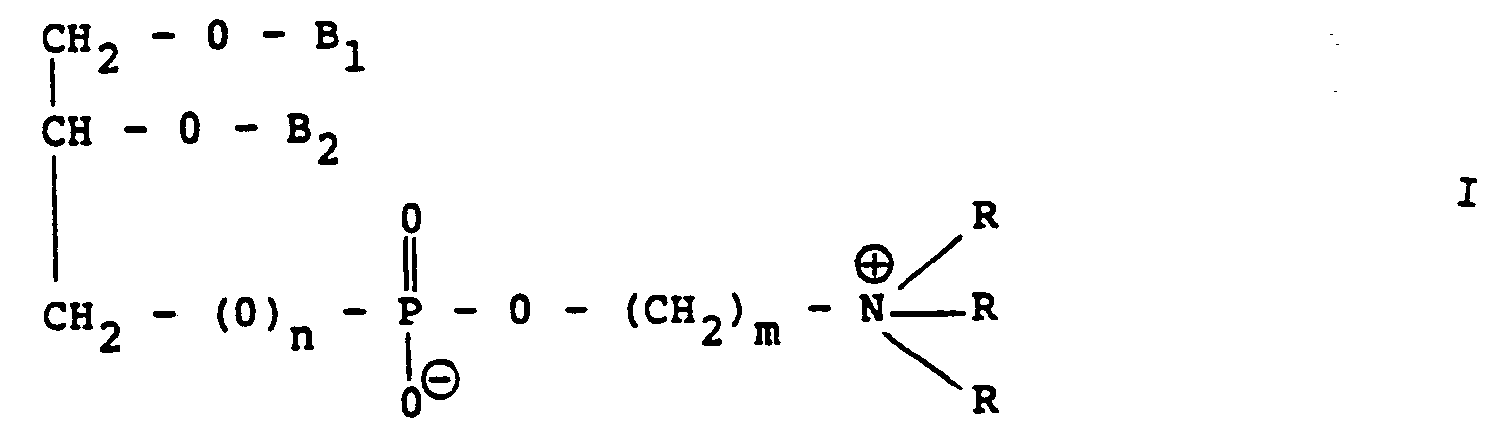
- the present invention provides an aqueous dispersion of liposomal phospholipid polymers wherein the liposome contains a ligand that will reversibly bind with molecular oxygen or with nitrogen or carbon monoxide or carbon dioxide and wherein the liposome is formed from an intermolecularly and/or intramolecularly cross-linked polymer of a conjugated di-yne of the general formula: wherein at least one of B 1 and B 2 is a group of the formula: wherein p is 0 or 1, X 1 is a divalent aliphatic or cycloaliphatic group, Y 1 is H or a monovalent aliphatic or cycloaliphatic group, the total number of carbon atoms in X 1 and Y 1 in each B 1 and/or B 2 being 8 to 26, and the other of B 1 and B 2 is either (a) the same or a different group of the formula: or (b) is an aliphatic or cycloaliphatic group containing at least 8 carbon atom
- diacetylenic phospholipid polymers will normally contain repeat units of the structure where two of Z 1' Z 2 , Z 3 and Z 4 represents Y 1' as defined above, the other two of Z 1' Z 2 , Z 3 and Z 4 each represent ⁇ X i ⁇ (CO)p ⁇ G where X 1 and p are as defined above and G represents where n, m and R are as defined above, the cross-linked chains being bonded to the same or different G residues.
- the conjugated di-ynes of formula I are preferably those in which the zwitterionic group is the phosphate-linked group of the natural phospholipid lecithin and sphingomyelin, namely the choline phosphate group: or the related phosphine-linked group:
- the preferred zwitterionic group is the analogue of the naturally occurring product in which m is 2 but m can also be 3 or 4 and, while it is preferred that each R group is methyl, as it is in the naturally occurring products, R may also be ethyl, propyl or butyl and the zwitterionic group can be unsymmetrically substituted at the quaternary nitrogen.
- both B 1 and B 2 each represent a group of the formula:
- symmetrical compounds are the easiest to synthesise, that is to say compounds in which, in B, and B 2 , p, X 1 and Y, are identical.
- Such symmetry is not essential, in accordance with the present invention and it is possible to utilise compounds in which in one of B, and B 2 p is zero and in the other of B 1 and B 2 p is 1 where each X, and Y 1 are identical or different.
- the position of the conjugated di-yne system in the B 1 and B 2 residue is not critical.
- X 1 can be a direct bond so that the conjugated di-yne is immediately adjacent to the carboxylic ester or ether and in such a case Y 1 would need to contain at least 8 carbon atoms.
- the conjugated di-yne system can be at that end of the hydrophobic chain remote from the carboxylic ester or ether function so that Y 1 is hydrogen and X 1 contains at least 8 carbon atoms.
- X 1 and Y 1 are each preferably an aliphatic or cycloaliphatic group.
- aliphatic or cycloaliphatic groups were unbranched hydrocarbon groups, in principle, there is no reason why the aliphatic or cycloaliphatic groups should not be branched-chain hydrocarbon groups or should contain substituents on the hydrocarbon chains, for example alkoxy substituents or halogen.
- the conjugated di-yne system represents the only carbon to carbon unsaturation in the hydrophobic chain but if additional cross-linking is desired, further carbon to carbon unsaturation could occur in the groups X 1 and Y 1 .
- each hydrophobic chain contains a total of 12 to 30 carbon atoms.
- the group B 1 and/or B 2 contains less than 12 carbon atoms, the resulting material is difficult to polymerise except at very low temperatures.
- we find that the most satisfactory results are obtained when there is between 16 and 26 carbon atoms in the groups B 1 and/or B 2 and particularly when the chain contains 22 or 24 carbon atoms.
- the exact structural configuration of the carbon atoms in X 1 and Y 1 is not critical to the present invention, their main functions being to impart the correct degree of hydrophobicity to the compounds and to permit polymerisation at a convenient temperature, it is not essential that the carbon atoms be in a straight chain or branched configuration but the groups X 1 and Y 1 can also include cycloaliphatic residues containing 3 to 8 or even more carbon atoms in a cycloaliphatic configuration.
- both B 1 and B 2 include the conjugated d-yne system so that the conjugated di-yne system can participate in both intramolecular and intermolecular polymerisation.
- a sufficient degree of cross-linking can be obtained simply by intermolecular polymerisation in which case it is only essential that one of the groups B 1 and B 2 contain the conjugated di-yne system.
- B 1 and B 2 When only one of B 1 and B 2 contains the conjugated di-yne system, the other of B 1 and B 2 may be a C 8 ⁇ C 30 aliphatic or cycloaliphatic residue, preferably hydrocarbon residue, which can be saturated or may contain olefinic or perhaps single acetylenic unsaturation which can be isolated or in conjugation with the conjugated di-yne system.
- Such groups are 'again bonded to the glycerol residue through an ester or ether group and should again preferably contain at least 12 carbon atoms.
- the conjugated di-ynes used in the invention may be prepared by procedures described in EP-A-0032622.
- the zwitterionic group can be introduced by subjecting the appropriate phosphonic or phosphinic acid or an esterifiable derivative thereof to reaction with glycerol or an esterifiable derivative thereof whereby the a-hydroxy group of glycerol reacts to form the necessary phosphorus ester group.
- the groups B, and B 2 can be introduced into the molecule by esterification or etherification using a carboxylic acid B 1 COOH or an alcohol B 1 0H or the corresponding B 2 COOH or BOH material, or an ester- or ether-forming derivative of one of these carboxylic acids or alcohols with glycerol or an ether-forming or ester- forming derivative thereof. These reactions can be carried out between the glycerol or derivative thereof on the one hand and the carboxylic acid or alcohol and the phosphorus ester on the other hand either simultaneously or subsequently in either order.
- ester groups can equally well be used. When it is desired to produce a compound in which p is 0, then corresponding conventional ether-forming processes can be used.
- the conjugated di-ynes can be polymerised by subjecting them to actinic radiation, normally ultraviolet radiation of wavelengths in the range ⁇ 300 nm. Such irradiation produces a cross-linking between the conjugated di-yne systems in adjacent chains. This gives rise to a polymer containing repeat units of the structure: wherein Z,, Z 2' Z 3 and Z 4 are as defined above.
- the conjugated di-yne system involved in the cross-linking is an unsymmetrically substituted di-yne.
- Cross-linking involves C 1 and C 4 of the 4 carbon atom chain of the conjugated di-yne but since C 1 and C 4 are not equivalent to each other, because of the unsymmetrical substitution, various cross-linking products can be produced depending upon whether cross-linking occurs between C 1 and C 1 in each chain or between C 1 and C 4 or between C 4 and C 4 . For example, if cross-linking occurs between C, and C 4 , the repeat unit will be
- both B 1 and 8 2 contain conjugated di-yne systems
- both 8 1 and B 2 contain the conjugated di-yne system and, in order to optimise the intramolecular cross-linking, it is preferred that the relative positions of the conjugated di-yne system in B 1 and 8 2 be approximately the same, in other words, that the carbon chains connecting the conjugated di-yne systems to the glycerol residue should not differ in length by more than 2 carbon atoms.
- polymerisation is normally best induced by exposure to actinic radiation normally that having a wavelength shorter than that of visible light but in principle, any method known to be capable of inducing polymerisation of conjugated di-yne systems can be used for the production of the polymers of this invention.
- X-irradiation X-irradiation
- gamma irradiation sensitisation
- irradiation with white light and particle e.g. electron-beam bombardment.
- the liposomes are prepared by dispersion of the conjugated di-yne in an aqueous medium, raising the temperature of the dispersion to one above the lipid or Chapman transition temperature which is the temperature at which liposome formation occurs and then cooling the dispersion back to ambient temperature.
- Liposome formation can be carried out by known techniques to produce multi-lamellar liposomes.
- Small diameter unilamellar liposomes can be generated by subjecting the multi-lamellar liposomes to ultrasonic vibration.
- Larger unilamellar liposomes can be generated by dissolving the conjugated di-yne in alcohol, pentane, hexane, diethyl ether or other solvent, and then injecting this solution e.g. through a syringe, into an aqueous medium.
- These unilamellar materials are sometimes known as microvesicles.
- the ligand is introduced into the aqueous medium before liposome formation so that the liposomes will contain the ligand which will be protected in the liposome but able to undertake gas exchange through the liposome wall.
- the diacetylenic phospholipid I may first be prepared in liposome form by any of the methods described above, and the ligand then introduced into the liposome dispersion which can then be subjected to two or more cycles of freezing and thawing whereupon it is found that the ligand becomes encapsulated in the liposomes, polymerisation may then be induced as above.
- Liposomes may be separated according to size before or after polymerisation. Passage of the dispersion through a chromatographic column of molecular sieve will separate large liposomes from small liposomes. Alternatively, the size of the liposomes may be altered by forcing the dispersion through an ultrafiltration membrane such as a polycarbonate or nucleopore membrane.
- an ultrafiltration membrane such as a polycarbonate or nucleopore membrane.
- Suitable ligands include haemoglobin or crosslinked haemoglobin solutions, other porphyrin derivatives, synthetic chelates (such as those based upon Fe (II) or Co (II); Baldwin, 1975), fluorocarbons or perfluorochemicals (such as perfluorotributylamine and perfluorodecaline; Sloviter (1975)).
- Aqueous dispersions of diacetylenic phospholipid monomers I form multilamellar, spherical vesicles ("liposomes") that maintain their shape after irradiation. Entrapment of soluble markers and the behaviour of the dispersions as osmometers confirmed that the monomeric lipids form sealed structures. Polymerisation of diacetylenic phospholipid vesicles dramatically enhanced their stability of precipitation. Moreover, their spherical morphology appeared unaltered in high salt or solutions of ethanol. In preliminary experiments in vitro, polymerised liposomes were stable in human plasma over the course of 1 week at 37°C.
- the lipid composition of the polymerised liposomes may be altered to include proportions of non- polymerisable lipids and/or lipophilic additives. Imperfections in the packing of the polymer chains, such as may occur for some mixed-chain diacetylenic phsopholipids in which the non-polymerising chain differs greatly in length from the polymerising chain, can affect the rate of leakage of the ligand from the inside to the outside of the liposomes. By including cholesterol within the bilayers formed from diacetylenic lipids, the leakage rates for liposomes composed of monomeric diacetylenic phospholipids may be decreased. Similarly, leakage from poorly packed polymeric phospholipids will also be decreased by cholesterol.
- the conjugated backbone of polymerised diacetylenic phospholipids may, under conditions of long storage or high oxygen concentration, be subject to gradual oxidation.
- lipophilic antioxidants such as alphatocopherol or butylated hydroxytoluene
- a negatively charged phospholipid such as phosphatidic acid, phosphatidylethanolamine, diacetylphosphate or phosphatidylserine results in an increase in the efficiency of entrapment by liposomes (e.g. moles of haemoglobin entrapped per mole of total lipid) and limits the capacity of monomeric liposomes to aggregate.
- Our invention deals with a specific and novel application of polymeric liposomes - the transport of oxygen and other gases by ligation with compounds entrapped in polymeric vesicles.
- This invention is a significant advance from early and recent notions of artificial cells (Chang, 1980) - due to the much- enhanced stablity and haemocompatibility of diacetylenic phospholipids - and is a hitherto unknown application for diacetylenic lipids.
- Suitable ligands include haemoglobin, synthetic chelates and derivatives and fluorocarbon oils as indicated above.
- the ligand becomes entrapped within a spontaneously formed liposome upon addition of an aqueous solution/suspension to a dried film of the monomeric phospholipid.
- Haemoglobin-haemosomes are best prepared with deoxy- haemoglobin since the presence of large quantities of oxygen can inhibit the polymerisation process. Polymerisation was verified qualitatively by the change in the colour of the suspension, and was later confirmed by extracting the lipid into chloroform solution. The concentration of entrapped ligand is adjusted by simply varying the aqueous concentration of the solution/suspension added to the dried lipid film.
- Polymerised haemosomes also hold promise for the production of a freeze-dried blood surrogate.
- Dehydration of biological membranes is usually accompanied by irrevocable loss of structural and functional integrity (Crowe et al, 1984), at least part of which is due to the formation by phospholipids of complex crystalline phases, some of which are non-bilayer structures.
- liposomes and reconstituted systems show evidence of morpholigical damage.
- carbohydrates most notably trehalose
- no evidence of phase transitions is seen during dehydration, and upon rehydration, vesicles are similar morphologically and functionally to freshly prepared ones.
- carbohydrates may be used to stabilise liposomes during freeze-drying.
- Polymerised liposomes may exhibit enhanced stability during dehydration/rehydration because of the crystalline lattice supported by covalent bonds between neighbouring phospholipids.
- haemoglobin is approximately 85 ⁇ 95% oxygenated at the ambient partial pressure of oxygen. Following dehydration/rehydration in the absence of carbohydrate, up to 90% of fresh haemoglobin was oxidised to methaemoglobin and was no longer capable of oxygen transport. In contrast, when haemoglobin was dried in the presence of trehalose, galactose or glucose, up to 80% of the protein retained its capacity to bind and transport oxygen.
- lipids la, Ib and Ic were formulated into haemosomes (liposomes containing a haemoglobin derivative) by each of Methods A, B and C below.
- Multilamellar haemosomes were prepared by addition of deoxy-haemoglobin (6 mM haeme) in phosphate buffer pH 7 to the dried monomeric lipid (final concentration of 5 mg/ml) under oxygen-free conditions. The suspension was gently heated above the temperature of the phase transition of the lipid, vortexed and then mildly sonicated. Haemosomes were separated from free haemoglobin by molecular sieve chromatography on Sepharose 4B (Pharmacia).
- Liposomes were also prepared as in Method A above but were extensively sonicated to produce small, unilamellar haemosomes.
- Liposomes were also prepared as in Method A above but in the absence of haemoglobin. Haemoglobin was then added to the suspension of liposomes in the phosphate buffer and encapsulated by several cycles of freezing and thawing using a mixture of haemoglobin (6 mM haeme, final) and liposomes (5 mgs/ml). Entrapment of haemoglobin was verified by molecular sieve chromatography on Sepharose 4B.
- Polymerisation of the haemosomes obtained using lipids la, Ib or Ic by Method A, B or C was accomplished by irradiation at 254 nanometers using a xenon lamp. The formation of the polymer was verified qualitatively by the change in colour of the suspension, and by extraction of the lipid into chloroform. Polymerisation could be accomplished either before or after separation of the haemosomes from unencapsulated haemoglobin. Polymerisation proceeded most rapidly in the absence of extrahaemosomal haeme.
- haemolysates instead of purified haemoglobin, and b) conversion of the haemoglobin to carbon monoxy haemoglobin before polymerisation.
- Haemolysates contain some of the natural antioxidants (such as glutathione) that are contained in erythrocytes but are absent in solutions of purified haemoglobin.
- Binding of carbon monoxide to haemoglobin effectively removes the trace haemoglobin that is responsible for haeme-oxidation during irradiation with ultraviolet light. Reconversion (after polymerisation) to oxyhaemoglobin was accomplished by irradiation with visible light under a stream of pure oxygen. The lower energy of visible light did not oxidise the haeme under these conditions.
- the haemosomes prepared by all methods using lipids la, Ib and Ic retained haemoglobin over 5 days at room temperature or at 4°C.
- Samples prepared from lipid Ib (the only lipid assayed under these conditions) retained their haemoglobin for over 3 months while at 4°C (with less than 2% of the haemoglobin leaking into the external medium). Retention of haemoglobin was verified by centrifugation; no haemoglobin could be detected in the supernatant.
- the concentration of entrapped haemoglobin may be adjusted by simply varying the aqueous concentration of the solution/suspension added to the dried lipid film.
- inositol hexaphosphate (2 mM) was entrapped in polymeric haemosomes and accelerated oxygen off-loading as measured by a stopped-flow fast-reaction spectroscopic method.
- the permeability of polymerised and monomeric haemosomes to inorganic anions was tested by the addition of smallcrystals of potassium ferricyanide to haemosome dispersions. If this high charged anion has access to haemoglobin, the haeme group is rapidly oxidised; this process may be observed by monitoring the spectrum in the Soret region. Addition of ferricyanide to monomeric haemosomes resulted in the rapid oxidation of the haeme. Polymerisation of the phospholipids markedly decreased the rate of oxidation. Polymerised haemosomes, composed of lipid Ic and cholesterol (mole fraction 0.5) were highly impermeant to ferricyanide; no oxidation of the haeme occurred even in detergent solutions (1-5% Triton X-100).
- Polymeric oxygen transporting liposomes have important potential applications both in vivo and in vitro.
- the gas binding and dissociation appear rapid enough for the liposomes to act as oxygen carriers in vivo, a notion which is strengthened by their apparent bio- and haemocompatibility.
- Such liposomes could be used during surgical haemodilution. In this procedure, exsanguination is carried out before surgery. Surgical blood loss may be compensated by oxygen transporting liposomes in buffer, autologous plasma, or plasma expanders. Finally the patient's own blood may be re-infused after removal of the liposomes.
- These liposomes may be used for patients who reject homologous blood transfusions on religious grounds, or in patients with rare blood groups or immune disorders.
- Oxygen-loaded liposomes may be used to treat carbon monoxide poisoning, to reverse the effects of sickle-cell crises or to increase the haematocrit in anaemia.
- In vitro applications include the priming of heart-lung machines, oxygen transport in remote (e.g. underwater) breathing devices or as a transport medium for other gases. Additional uses include oxygenation of bacterial cultures as in bulk fermentation and sewage treatment.
- the intravesicular contents of haemosomes may also be altered beyond the simple manipulation of ligand concentration or composition.
- the inclusion of 2,3-diphosphoglycerate or adenosine triphosphate lowers the affinity of haemoglobin for oxygen and can be used to increase oxygen-off-loading to tissues.
- Reductase systems can be entrapped to prevent haemoglobin oxidation.
- Other laboratories have attempted to eliminate oxidation problems by "burying" oxygen adducts within the bilayer itself (Tsuchida et al, 1983).
Landscapes
- Health & Medical Sciences (AREA)
- Life Sciences & Earth Sciences (AREA)
- Chemical & Material Sciences (AREA)
- Veterinary Medicine (AREA)
- Pharmacology & Pharmacy (AREA)
- Epidemiology (AREA)
- Medicinal Chemistry (AREA)
- Animal Behavior & Ethology (AREA)
- General Health & Medical Sciences (AREA)
- Public Health (AREA)
- Engineering & Computer Science (AREA)
- Gastroenterology & Hepatology (AREA)
- Dispersion Chemistry (AREA)
- Bioinformatics & Cheminformatics (AREA)
- Immunology (AREA)
- Proteomics, Peptides & Aminoacids (AREA)
- Medicinal Preparation (AREA)
- Medicines That Contain Protein Lipid Enzymes And Other Medicines (AREA)
- Manufacturing Of Micro-Capsules (AREA)
- Addition Polymer Or Copolymer, Post-Treatments, Or Chemical Modifications (AREA)
- Liquid Crystal Substances (AREA)
Claims (23)





Priority Applications (1)
| Application Number | Priority Date | Filing Date | Title |
|---|---|---|---|
| AT85302048T ATE56864T1 (de) | 1984-03-23 | 1985-03-25 | Polymere liposome als stabile gastraeger. |
Applications Claiming Priority (2)
| Application Number | Priority Date | Filing Date | Title |
|---|---|---|---|
| GB848407557A GB8407557D0 (en) | 1984-03-23 | 1984-03-23 | Polymeric lipsomes |
| GB8407557 | 1984-03-23 |
Publications (2)
| Publication Number | Publication Date |
|---|---|
| EP0161759A1 EP0161759A1 (de) | 1985-11-21 |
| EP0161759B1 true EP0161759B1 (de) | 1990-09-26 |
Family
ID=10558564
Family Applications (1)
| Application Number | Title | Priority Date | Filing Date |
|---|---|---|---|
| EP85302048A Expired - Lifetime EP0161759B1 (de) | 1984-03-23 | 1985-03-25 | Polymere Liposome als stabile Gasträger |
Country Status (7)
| Country | Link |
|---|---|
| US (1) | US4675310A (de) |
| EP (1) | EP0161759B1 (de) |
| JP (1) | JPS61501513A (de) |
| AT (1) | ATE56864T1 (de) |
| DE (1) | DE3579844D1 (de) |
| GB (1) | GB8407557D0 (de) |
| WO (1) | WO1985004326A1 (de) |
Families Citing this family (69)
| Publication number | Priority date | Publication date | Assignee | Title |
|---|---|---|---|---|
| US4900540A (en) * | 1983-06-20 | 1990-02-13 | Trustees Of The University Of Massachusetts | Lipisomes containing gas for ultrasound detection |
| EP0208764A4 (de) * | 1985-01-11 | 1987-10-08 | Univ California | Konservierungsverfahren für liposome. |
| DE3689769T2 (de) * | 1985-07-05 | 1994-07-21 | Liposome Co Inc | Multilamellare liposome mit verbesserter einschliessungswirkung. |
| ATE68524T1 (de) * | 1985-07-09 | 1991-11-15 | Quadrant Bioresources Ltd | Beschuetzung von proteinen und aehnlichem. |
| GB8619627D0 (en) * | 1986-08-12 | 1986-09-24 | Genetics Int Inc | Electrochemical assay |
| US4911929A (en) * | 1986-08-29 | 1990-03-27 | The United States Of America As Represented By The Secretary Of The Navy | Blood substitute comprising liposome-encapsulated hemoglobin |
| US4776991A (en) * | 1986-08-29 | 1988-10-11 | The United States Of America As Represented By The Secretary Of The Navy | Scaled-up production of liposome-encapsulated hemoglobin |
| US4833061A (en) * | 1987-04-06 | 1989-05-23 | Minnesota Mining And Manufacturing Company | Photosensitive phospholipid vesicles |
| WO1989008459A1 (en) * | 1988-03-11 | 1989-09-21 | Alpha Therapeutic Corporation | Perfluorochemical emulsion with stabilized vesicles |
| US5051353A (en) * | 1988-08-09 | 1991-09-24 | The United States Of America As Represented By The Secretary Of The Navy | Preservation and restoration of hemoglobin in blood substitutes |
| FR2641463B1 (fr) * | 1989-01-09 | 1991-03-08 | Sederma Sa | Preparations cosmetiques destinees a l'oxygenation de la peau |
| US5352435A (en) * | 1989-12-22 | 1994-10-04 | Unger Evan C | Ionophore containing liposomes for ultrasound imaging |
| US5705187A (en) * | 1989-12-22 | 1998-01-06 | Imarx Pharmaceutical Corp. | Compositions of lipids and stabilizing materials |
| US5585112A (en) * | 1989-12-22 | 1996-12-17 | Imarx Pharmaceutical Corp. | Method of preparing gas and gaseous precursor-filled microspheres |
| US6146657A (en) * | 1989-12-22 | 2000-11-14 | Imarx Pharmaceutical Corp. | Gas-filled lipid spheres for use in diagnostic and therapeutic applications |
| US5656211A (en) * | 1989-12-22 | 1997-08-12 | Imarx Pharmaceutical Corp. | Apparatus and method for making gas-filled vesicles of optimal size |
| US5580575A (en) * | 1989-12-22 | 1996-12-03 | Imarx Pharmaceutical Corp. | Therapeutic drug delivery systems |
| US5305757A (en) * | 1989-12-22 | 1994-04-26 | Unger Evan C | Gas filled liposomes and their use as ultrasonic contrast agents |
| US5088499A (en) * | 1989-12-22 | 1992-02-18 | Unger Evan C | Liposomes as contrast agents for ultrasonic imaging and methods for preparing the same |
| US5922304A (en) * | 1989-12-22 | 1999-07-13 | Imarx Pharmaceutical Corp. | Gaseous precursor filled microspheres as magnetic resonance imaging contrast agents |
| US5773024A (en) * | 1989-12-22 | 1998-06-30 | Imarx Pharmaceutical Corp. | Container with multi-phase composition for use in diagnostic and therapeutic applications |
| US5230882A (en) * | 1989-12-22 | 1993-07-27 | Unger Evan C | Liposomes as contrast agents for ultrasonic imaging and methods for preparing the same |
| US6551576B1 (en) | 1989-12-22 | 2003-04-22 | Bristol-Myers Squibb Medical Imaging, Inc. | Container with multi-phase composition for use in diagnostic and therapeutic applications |
| US5733572A (en) * | 1989-12-22 | 1998-03-31 | Imarx Pharmaceutical Corp. | Gas and gaseous precursor filled microspheres as topical and subcutaneous delivery vehicles |
| US20020150539A1 (en) | 1989-12-22 | 2002-10-17 | Unger Evan C. | Ultrasound imaging and treatment |
| US5123414A (en) * | 1989-12-22 | 1992-06-23 | Unger Evan C | Liposomes as contrast agents for ultrasonic imaging and methods for preparing the same |
| US6001335A (en) * | 1989-12-22 | 1999-12-14 | Imarx Pharmaceutical Corp. | Contrasting agents for ultrasonic imaging and methods for preparing the same |
| US5776429A (en) * | 1989-12-22 | 1998-07-07 | Imarx Pharmaceutical Corp. | Method of preparing gas-filled microspheres using a lyophilized lipids |
| US5334381A (en) * | 1989-12-22 | 1994-08-02 | Unger Evan C | Liposomes as contrast agents for ultrasonic imaging and methods for preparing the same |
| US5469854A (en) * | 1989-12-22 | 1995-11-28 | Imarx Pharmaceutical Corp. | Methods of preparing gas-filled liposomes |
| US6088613A (en) * | 1989-12-22 | 2000-07-11 | Imarx Pharmaceutical Corp. | Method of magnetic resonance focused surgical and therapeutic ultrasound |
| US5542935A (en) * | 1989-12-22 | 1996-08-06 | Imarx Pharmaceutical Corp. | Therapeutic delivery systems related applications |
| US5228446A (en) * | 1989-12-22 | 1993-07-20 | Unger Evan C | Gas filled liposomes and their use as ultrasonic contrast agents |
| US5874062A (en) * | 1991-04-05 | 1999-02-23 | Imarx Pharmaceutical Corp. | Methods of computed tomography using perfluorocarbon gaseous filled microspheres as contrast agents |
| US5205290A (en) | 1991-04-05 | 1993-04-27 | Unger Evan C | Low density microspheres and their use as contrast agents for computed tomography |
| WO1992022298A1 (en) * | 1991-06-18 | 1992-12-23 | Unger Evan C | Novel liposomal drug delivery systems |
| US5284663A (en) * | 1991-07-23 | 1994-02-08 | Temple University | Salt film encapsulated perfluorocarbons |
| US5325860A (en) * | 1991-11-08 | 1994-07-05 | Mayo Foundation For Medical Education And Research | Ultrasonic and interventional catheter and method |
| US5264220A (en) * | 1991-11-12 | 1993-11-23 | Long David M Jr | Method of extending the vascular dwell-time of particulate therapeutic and particulate diagnostic agents |
| GB9301702D0 (en) * | 1993-01-28 | 1993-03-17 | Biocompatibles Ltd | New materials |
| AU6523194A (en) * | 1993-03-26 | 1994-10-24 | Biorelease Technologies, Inc. | Compositions including heme-containing proteins and methods relating thereto |
| US7083572B2 (en) | 1993-11-30 | 2006-08-01 | Bristol-Myers Squibb Medical Imaging, Inc. | Therapeutic delivery systems |
| US5736121A (en) * | 1994-05-23 | 1998-04-07 | Imarx Pharmaceutical Corp. | Stabilized homogenous suspensions as computed tomography contrast agents |
| US6743779B1 (en) | 1994-11-29 | 2004-06-01 | Imarx Pharmaceutical Corp. | Methods for delivering compounds into a cell |
| US5786214A (en) * | 1994-12-15 | 1998-07-28 | Spinal Cord Society | pH-sensitive immunoliposomes and method of gene delivery to the mammalian central nervous system |
| US5830430A (en) * | 1995-02-21 | 1998-11-03 | Imarx Pharmaceutical Corp. | Cationic lipids and the use thereof |
| US5997898A (en) * | 1995-06-06 | 1999-12-07 | Imarx Pharmaceutical Corp. | Stabilized compositions of fluorinated amphiphiles for methods of therapeutic delivery |
| US6521211B1 (en) | 1995-06-07 | 2003-02-18 | Bristol-Myers Squibb Medical Imaging, Inc. | Methods of imaging and treatment with targeted compositions |
| US6231834B1 (en) | 1995-06-07 | 2001-05-15 | Imarx Pharmaceutical Corp. | Methods for ultrasound imaging involving the use of a contrast agent and multiple images and processing of same |
| US6139819A (en) * | 1995-06-07 | 2000-10-31 | Imarx Pharmaceutical Corp. | Targeted contrast agents for diagnostic and therapeutic use |
| US6033645A (en) * | 1996-06-19 | 2000-03-07 | Unger; Evan C. | Methods for diagnostic imaging by regulating the administration rate of a contrast agent |
| WO1997040679A1 (en) | 1996-05-01 | 1997-11-06 | Imarx Pharmaceutical Corp. | Methods for delivering compounds into a cell |
| US6414139B1 (en) | 1996-09-03 | 2002-07-02 | Imarx Therapeutics, Inc. | Silicon amphiphilic compounds and the use thereof |
| US5846517A (en) | 1996-09-11 | 1998-12-08 | Imarx Pharmaceutical Corp. | Methods for diagnostic imaging using a renal contrast agent and a vasodilator |
| WO1998010798A1 (en) * | 1996-09-11 | 1998-03-19 | Imarx Pharmaceutical Corp. | Improved methods for diagnostic imaging using a contrast agent and a vasodilator |
| US6143276A (en) * | 1997-03-21 | 2000-11-07 | Imarx Pharmaceutical Corp. | Methods for delivering bioactive agents to regions of elevated temperatures |
| US6090800A (en) * | 1997-05-06 | 2000-07-18 | Imarx Pharmaceutical Corp. | Lipid soluble steroid prodrugs |
| US6120751A (en) | 1997-03-21 | 2000-09-19 | Imarx Pharmaceutical Corp. | Charged lipids and uses for the same |
| US6537246B1 (en) | 1997-06-18 | 2003-03-25 | Imarx Therapeutics, Inc. | Oxygen delivery agents and uses for the same |
| US7452551B1 (en) | 2000-10-30 | 2008-11-18 | Imarx Therapeutics, Inc. | Targeted compositions for diagnostic and therapeutic use |
| US6416740B1 (en) | 1997-05-13 | 2002-07-09 | Bristol-Myers Squibb Medical Imaging, Inc. | Acoustically active drug delivery systems |
| US6548047B1 (en) | 1997-09-15 | 2003-04-15 | Bristol-Myers Squibb Medical Imaging, Inc. | Thermal preactivation of gaseous precursor filled compositions |
| US6123923A (en) * | 1997-12-18 | 2000-09-26 | Imarx Pharmaceutical Corp. | Optoacoustic contrast agents and methods for their use |
| US20010003580A1 (en) | 1998-01-14 | 2001-06-14 | Poh K. Hui | Preparation of a lipid blend and a phospholipid suspension containing the lipid blend |
| US7011854B2 (en) * | 2002-02-04 | 2006-03-14 | Alfama-Investigacao e Desenvolvimento de Produtos Farmaceuticos Lda | Method for treating a mammal by administration of a compound having the ability to release CO, compounds having the ability to release CO and pharmaceutical compositions thereof |
| GB0601394D0 (en) | 2006-01-24 | 2006-03-01 | Hemocorm Ltd | Therapeutic delivery of carbon monoxide |
| US7976743B2 (en) * | 2006-10-16 | 2011-07-12 | Northwestern University | Gas-containing liposomes |
| US9163044B2 (en) | 2011-04-19 | 2015-10-20 | Alfama, Inc. | Carbon monoxide releasing molecules and uses thereof |
| ES2628634T3 (es) | 2011-07-21 | 2017-08-03 | Alfama, Inc. | Moléculas liberadoras de monóxido de carbono-rutenio y usos de las mismas |
Family Cites Families (6)
| Publication number | Priority date | Publication date | Assignee | Title |
|---|---|---|---|---|
| GB1578776A (en) * | 1976-06-10 | 1980-11-12 | Univ Illinois | Hemoglobin liposome and method of making the same |
| DE3070993D1 (en) * | 1979-12-20 | 1985-09-19 | Dennis Chapman | Polymerisable phospholipids and polymers thereof, methods for their preparation, methods for their use in coating substrates and forming liposomes and the resulting coated substrates and liposome compositions |
| JPS56135492A (en) * | 1979-12-20 | 1981-10-22 | Chiyatsupuman Denisu | Biocompatible surfaces |
| US4532130A (en) * | 1981-07-06 | 1985-07-30 | Rush-Presbyterian-St. Luke's Medical Center | Preparation of synthetic frythrocytes |
| EP0082877A1 (de) * | 1981-07-06 | 1983-07-06 | Rush-Presbyterian-St.Luke's Medical Center | Herstellung synthetischer erythrocyten |
| US4397870A (en) * | 1982-07-27 | 1983-08-09 | The University Of Pennsylvania | Process for prolonging retention of emulsion particles in the bloodstream |
-
1984
- 1984-03-23 GB GB848407557A patent/GB8407557D0/en active Pending
-
1985
- 1985-03-25 EP EP85302048A patent/EP0161759B1/de not_active Expired - Lifetime
- 1985-03-25 AT AT85302048T patent/ATE56864T1/de not_active IP Right Cessation
- 1985-03-25 DE DE8585302048T patent/DE3579844D1/de not_active Expired - Fee Related
- 1985-03-25 US US06/803,404 patent/US4675310A/en not_active Expired - Fee Related
- 1985-03-25 WO PCT/GB1985/000114 patent/WO1985004326A1/en not_active Ceased
- 1985-03-25 JP JP60501581A patent/JPS61501513A/ja active Pending
Also Published As
| Publication number | Publication date |
|---|---|
| US4675310A (en) | 1987-06-23 |
| WO1985004326A1 (en) | 1985-10-10 |
| JPS61501513A (ja) | 1986-07-24 |
| EP0161759A1 (de) | 1985-11-21 |
| DE3579844D1 (de) | 1990-10-31 |
| GB8407557D0 (en) | 1984-05-02 |
| ATE56864T1 (de) | 1990-10-15 |
Similar Documents
| Publication | Publication Date | Title |
|---|---|---|
| EP0161759B1 (de) | Polymere Liposome als stabile Gasträger | |
| US5676971A (en) | Agents for inhibiting adsorption of proteins on the liposome surface | |
| US4133874A (en) | Lipid encapsulated hemoglobin cells | |
| EP1466649B1 (de) | Pharmazeutische Zusammensetzung enthaltend einen künstlichen Sauerstoffträger | |
| CA1197462A (en) | Functional oxygen transport system | |
| EP0320507B1 (de) | Vermehrte herstellung von mit liposomen eingekapseltem hämoglobin | |
| Farmer et al. | Liposome-encapsulated hemoglobin: a synthetic red cell | |
| JP5916743B2 (ja) | ヘモグロビン含有リポソーム及びその製法 | |
| JPS6137735A (ja) | ヘモグロビン含有リポソ−ムおよびその製造方法 | |
| CA2383977C (en) | Stably preserving oxygen infusion | |
| US5049391A (en) | Liposome encapsulated hemoglobin | |
| JP3037994B2 (ja) | リポソーム表面への蛋白質吸着抑制剤 | |
| US4612370A (en) | Lipid-saccharide reaction products | |
| JPH04300838A (ja) | 人工赤血球および人工赤血球懸濁液 | |
| JPS62178521A (ja) | ヘモグロビン含有リポソ−ム | |
| JP4926391B2 (ja) | ヘモグロビン含有リポソームの製造方法および包装体 | |
| JP3128630B2 (ja) | 粉末状脂質小胞体製剤の製造方法 | |
| JP4763265B2 (ja) | メト化防止剤を含有する人工酸素運搬体 | |
| AU640298B2 (en) | Agents for inhibiting adsorption of proteins on the liposome surface | |
| JP3572428B2 (ja) | 重合リポソームの製造方法 | |
| AU616040B2 (en) | Agents for inhibiting adsorption of proteins on the liposome surface | |
| JP2008120760A (ja) | ヘモグロビン及びアロステリック因子含有リポソーム懸濁液及びその製法 | |
| Burnette | Neohemocytes | |
| JP2007269646A (ja) | 表面修飾リポソームおよびその製造方法 | |
| JPH03291239A (ja) | ヘモグロビン含有リポソーム |
Legal Events
| Date | Code | Title | Description |
|---|---|---|---|
| PUAI | Public reference made under article 153(3) epc to a published international application that has entered the european phase |
Free format text: ORIGINAL CODE: 0009012 |
|
| AK | Designated contracting states |
Designated state(s): AT BE CH DE FR GB IT LI LU NL SE |
|
| 17P | Request for examination filed |
Effective date: 19860521 |
|
| 17Q | First examination report despatched |
Effective date: 19880811 |
|
| GRAA | (expected) grant |
Free format text: ORIGINAL CODE: 0009210 |
|
| AK | Designated contracting states |
Kind code of ref document: B1 Designated state(s): AT BE CH DE FR GB IT LI LU NL SE |
|
| REF | Corresponds to: |
Ref document number: 56864 Country of ref document: AT Date of ref document: 19901015 Kind code of ref document: T |
|
| ITF | It: translation for a ep patent filed | ||
| REF | Corresponds to: |
Ref document number: 3579844 Country of ref document: DE Date of ref document: 19901031 |
|
| ET | Fr: translation filed | ||
| ITTA | It: last paid annual fee | ||
| PLBE | No opposition filed within time limit |
Free format text: ORIGINAL CODE: 0009261 |
|
| STAA | Information on the status of an ep patent application or granted ep patent |
Free format text: STATUS: NO OPPOSITION FILED WITHIN TIME LIMIT |
|
| 26N | No opposition filed | ||
| PGFP | Annual fee paid to national office [announced via postgrant information from national office to epo] |
Ref country code: NL Payment date: 19920331 Year of fee payment: 8 |
|
| PGFP | Annual fee paid to national office [announced via postgrant information from national office to epo] |
Ref country code: GB Payment date: 19920519 Year of fee payment: 8 |
|
| PGFP | Annual fee paid to national office [announced via postgrant information from national office to epo] |
Ref country code: FR Payment date: 19920522 Year of fee payment: 8 |
|
| PGFP | Annual fee paid to national office [announced via postgrant information from national office to epo] |
Ref country code: CH Payment date: 19920525 Year of fee payment: 8 Ref country code: SE Payment date: 19920525 Year of fee payment: 8 |
|
| PGFP | Annual fee paid to national office [announced via postgrant information from national office to epo] |
Ref country code: AT Payment date: 19920529 Year of fee payment: 8 |
|
| PGFP | Annual fee paid to national office [announced via postgrant information from national office to epo] |
Ref country code: DE Payment date: 19920610 Year of fee payment: 8 |
|
| PGFP | Annual fee paid to national office [announced via postgrant information from national office to epo] |
Ref country code: BE Payment date: 19920616 Year of fee payment: 8 |
|
| PGFP | Annual fee paid to national office [announced via postgrant information from national office to epo] |
Ref country code: LU Payment date: 19920811 Year of fee payment: 8 |
|
| EPTA | Lu: last paid annual fee | ||
| PG25 | Lapsed in a contracting state [announced via postgrant information from national office to epo] |
Ref country code: GB Effective date: 19930325 Ref country code: LU Free format text: LAPSE BECAUSE OF NON-PAYMENT OF DUE FEES Effective date: 19930325 Ref country code: AT Effective date: 19930325 |
|
| PG25 | Lapsed in a contracting state [announced via postgrant information from national office to epo] |
Ref country code: SE Effective date: 19930326 |
|
| PG25 | Lapsed in a contracting state [announced via postgrant information from national office to epo] |
Ref country code: CH Effective date: 19930331 Ref country code: BE Effective date: 19930331 Ref country code: LI Effective date: 19930331 |
|
| BERE | Be: lapsed |
Owner name: BIOCOMPATIBLES LTD Effective date: 19930331 |
|
| PG25 | Lapsed in a contracting state [announced via postgrant information from national office to epo] |
Ref country code: NL Effective date: 19931001 |
|
| NLV4 | Nl: lapsed or anulled due to non-payment of the annual fee | ||
| GBPC | Gb: european patent ceased through non-payment of renewal fee |
Effective date: 19930325 |
|
| PG25 | Lapsed in a contracting state [announced via postgrant information from national office to epo] |
Ref country code: FR Effective date: 19931130 |
|
| REG | Reference to a national code |
Ref country code: CH Ref legal event code: PL |
|
| PG25 | Lapsed in a contracting state [announced via postgrant information from national office to epo] |
Ref country code: DE Effective date: 19931201 |
|
| REG | Reference to a national code |
Ref country code: FR Ref legal event code: ST |
|
| EUG | Se: european patent has lapsed |
Ref document number: 85302048.5 Effective date: 19931008 |