EP0161876A2 - Behälter für unter Druck gesetzte Produkte - Google Patents
Behälter für unter Druck gesetzte Produkte Download PDFInfo
- Publication number
- EP0161876A2 EP0161876A2 EP85303135A EP85303135A EP0161876A2 EP 0161876 A2 EP0161876 A2 EP 0161876A2 EP 85303135 A EP85303135 A EP 85303135A EP 85303135 A EP85303135 A EP 85303135A EP 0161876 A2 EP0161876 A2 EP 0161876A2
- Authority
- EP
- European Patent Office
- Prior art keywords
- margin
- metal
- plastics
- metal member
- opening
- Prior art date
- Legal status (The legal status is an assumption and is not a legal conclusion. Google has not performed a legal analysis and makes no representation as to the accuracy of the status listed.)
- Withdrawn
Links
- 229910052751 metal Inorganic materials 0.000 claims abstract description 87
- 239000002184 metal Substances 0.000 claims abstract description 87
- 239000004033 plastic Substances 0.000 claims abstract description 60
- 229920003023 plastic Polymers 0.000 claims abstract description 60
- 238000000034 method Methods 0.000 claims abstract description 22
- 238000002407 reforming Methods 0.000 claims abstract description 15
- 239000000463 material Substances 0.000 claims description 22
- 230000000694 effects Effects 0.000 claims description 2
- 239000011324 bead Substances 0.000 description 9
- 235000014171 carbonated beverage Nutrition 0.000 description 8
- 230000006835 compression Effects 0.000 description 8
- 238000007906 compression Methods 0.000 description 8
- 230000015572 biosynthetic process Effects 0.000 description 6
- 238000007789 sealing Methods 0.000 description 6
- 230000004048 modification Effects 0.000 description 4
- 238000012986 modification Methods 0.000 description 4
- 230000008901 benefit Effects 0.000 description 3
- 208000034809 Product contamination Diseases 0.000 description 2
- 230000009471 action Effects 0.000 description 2
- 238000005260 corrosion Methods 0.000 description 2
- 230000007797 corrosion Effects 0.000 description 2
- 230000002093 peripheral effect Effects 0.000 description 2
- 230000009467 reduction Effects 0.000 description 2
- 238000004826 seaming Methods 0.000 description 2
- 239000004411 aluminium Substances 0.000 description 1
- 229910052782 aluminium Inorganic materials 0.000 description 1
- XAGFODPZIPBFFR-UHFFFAOYSA-N aluminium Chemical compound [Al] XAGFODPZIPBFFR-UHFFFAOYSA-N 0.000 description 1
- 230000003190 augmentative effect Effects 0.000 description 1
- 235000013361 beverage Nutrition 0.000 description 1
- 230000008602 contraction Effects 0.000 description 1
- 210000003298 dental enamel Anatomy 0.000 description 1
- 230000000994 depressogenic effect Effects 0.000 description 1
- 229920001903 high density polyethylene Polymers 0.000 description 1
- 239000004700 high-density polyethylene Substances 0.000 description 1
- 238000005304 joining Methods 0.000 description 1
- 239000004922 lacquer Substances 0.000 description 1
- 238000004519 manufacturing process Methods 0.000 description 1
- 239000002991 molded plastic Substances 0.000 description 1
- 229920000642 polymer Polymers 0.000 description 1
- 230000008569 process Effects 0.000 description 1
- 239000011253 protective coating Substances 0.000 description 1
- 230000000717 retained effect Effects 0.000 description 1
- 238000005482 strain hardening Methods 0.000 description 1
- 229920001169 thermoplastic Polymers 0.000 description 1
- 239000004416 thermosoftening plastic Substances 0.000 description 1
Images


Classifications
-
- B—PERFORMING OPERATIONS; TRANSPORTING
- B21—MECHANICAL METAL-WORKING WITHOUT ESSENTIALLY REMOVING MATERIAL; PUNCHING METAL
- B21D—WORKING OR PROCESSING OF SHEET METAL OR METAL TUBES, RODS OR PROFILES WITHOUT ESSENTIALLY REMOVING MATERIAL; PUNCHING METAL
- B21D51/00—Making hollow objects
- B21D51/16—Making hollow objects characterised by the use of the objects
- B21D51/38—Making inlet or outlet arrangements of cans, tins, baths, bottles, or other vessels; Making can ends; Making closures
- B21D51/383—Making inlet or outlet arrangements of cans, tins, baths, bottles, or other vessels; Making can ends; Making closures scoring lines, tear strips or pulling tabs
Definitions
- This invention concerns containers for pressurised products.
- a primary application of the invention is to essentially metal cans for carbonated beverage products and having easy opening end closures for ready access to the contents by the consumer.
- the present invention seeks to overcome the problems previously experienced in obtaining a satisfactory seal between a plastics member and a metal member for a pressurised container, and seeks in particular to provide a method capable of reliably retaining and sealing a plastics easy opening device in a metal end for a carbonated beverage can.
- a method in accordance with the invention for mounting a plastics member in a metal member for a pressuried container comprises: forming the metal member to provide an inclined margin around an opening in the metal member, inserting the plastics member into the opening from the exterior side of the metal member, and reforming metal of the margin to embed the free edge of the margin in, and cause the same to seal around, the plastics member, after such reformation the margin being inclined at a substantial angle towards the interior side of the metal member.
- a particular advantage of an easy opening end having a plastics easy opening device mounted in a metal end by this method is that,by virtue of the substantial angle of inclination of the reformed margin, internal pressures within a can to which the end is fitted will tend to cause the margin to bite increasingly into and seal more firmly about the easy opening device, the greater the pressure the better being the seal which is formed. As a result, the seal may be able to withstand the considerable pressures associated with carbonated beverages.
- the effect of the reformation of the metal to embed the free edge of the metal in the plastics member is augmented by reformation of the plastics member radially outwardly along the margin on the interior side of the metal member.
- the reformation of the metal is achieved indirectly during the reformation of the plastics material, by tooling which makes no direct contact with the margin; scuffing of any protective coating or lacquer on the margin is thereby avoided.
- Reforming of the plastics material enables the free edge of the metal to be more deeply embedded in the plastics material than would be possible by reformation of the metal alone. In this way, the free edge of the metal can be more fully isolated from the product in a container of which the metal member forms part, and the danger of product contamination and metal corrosion is thereby minimised.
- the product For maximum protection of the free edge of the metal from attack by.the product it is further preferred to cut the free edge of the metal margin so that it is axially directed and therefore readily engageable over its whole area with the plastics material.
- a further advantageous feature is the offsetting of the root of the margin from the main plane of the metal member to form an annular shoulder or elbow in the metal.
- the shoulder acts as a hinge about which the margin may pivot during the metal reforming operation or subsequently in use. By forming such a hinge, distortion of the metal member which might otherwise occur may be eliminated.
- Another aspect of the invention concerns apparatus for carrying out the above method.
- apparatus for mounting a plastics member in a metal member for a pressurised container comprises first means for forming the metal member to provide an inclined margin around an opening in the metal member, second means for inserting the plastics member into the opening from the exterior side of the metal member, and third means for reforming metal of the margin to embed the free edge of the margin in, and cause the same to seal around, the plastics member, after such reformation the margin being inclined at a substantial angle towards the interior side of the metal member.
- the invention from a further aspect provides a component of or for a pressurised container, which comprises a plastics member mounted within an opening in a metal member, the metal member having a margin around the opening which is inclined at a substantial angle towards the interior side of the metal member and whose free edge is embedded in, and seals around, the plastics member.
- the invention is of particular benefit in, and is intended primarily for use in, the manufacture of easy opening ends for beverage containers, but may have application to the mounting of plastics members in metal members for pressurised containers generally.
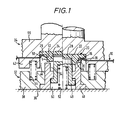
- a can end 10 made of aluminium of relatively light gauge (e.g.-0115 inches thick), and having a circular opening 12 defined by a free edge 14. From Figure 1, it will be seen that a region of the can end 10 around the opening 12 has been formed to create an annular shoulder or elbow 16, which is offset from the main plane of the can end 10 towards the upper and exterior side of the can end 10, and an inclined frustoconical margin 18, which tapers downwardly (as shown) and inwardly from the annular shoulder 16 towards the lower and interior side of the can end 10, and terminates at the free edge 14.
- the formation of the opening and of the inclined margin 18 is not shown or described in detail, because this may be achieved conventionally.
- the margin 18 and opening 12 are produced by forming the can end 10 to create the offset shoulder 16 and also a dimple or depression in the metal can end projecting inwardly from the shoulder 16, and by thereafter severing the crown of the dimple to form the opening 12.
- the flank of the dimple then provides the inclined margin 18, and moreover the free edge 14 produced by the severing action extends axially for the reason to become apparent later.
- Figure 1 also shows a moulded plastics easy opening device 20having a plug portion 22.
- This plug portion 22 is inserted into the opening 12 from the exterior side of the can end 10 following the formation of both the opening 12 and the margin 18.
- the plug portion 22 of the easy opening device 20 comprises a tubular plug body 24 having a cylindrical outer surface 9 which is dimensioned to be an interference fit in the opening 12, and a flange 26 which encircles the plug body 24 and is arranged to rest against the annular shoulder 16.
- a removable closure disk 28 closes the outer end of the plug body 24.
- the plug portion 22 is compressed between opposed tools, as illustrated in the right-hand side of Figure 1, with the direction of the applied pressure being at right angles to the general plane of the metal can end 10.
- the pressure exerted on the plug body 24 progressively reforms the plastics material of the easy opening device 20 radially outwardly along the inclined margin 18 to create a retaining bead 30 in intimate contact with the underside of the margin.
- the pressure transmitted to the margin though the plastics material under reformation causes a substantial and significant reformation of the margin itself, the angle of inclination of the margin (to the plane of the can end) thereby being typically reduced by an angle of 6°, from an initial angle of 30° to a final angle of 24°.
- the free edge 14 of the margin is deeply embedded in the plastics material so that subsequently, in use of the end as part of a can of a carbonated beverage, the easy opening device 20 is firmly retained in position and moreover there is substantially no danger of contact of the carbonated beverage with the free edge 14 of the margin.
- the can end therefore presents a high resistance to corrosion and product contamination.
- Additional features contributory to a permanently high enamel rating and leakage resistance for the can end are the axial orientation of the free end 14 (which ensures optimum contact of the free end with the plastics material of the plug body 24), and remanent tensile force which is created in the plug body by the resilience of the margin following the reformation of the latter. Such tensile force maintains the bead in tight sealing engagement with the interior side of the margin, assisted by the pressure of the carbonated beverage.
- the can end 10 and the easy opening device 20 are at ambient temperature, and the tooling employed is likewise unheated.
- the plastics material of the plug body 24 is therefore cold-formed to produce the bead 30.
- any "memory" of the plastics material is destroyed and there is little tendency for subsequent plastics creep to impair the metal- to-plastics seal.
- Such tooling basically comprises a fixed lower tool 32, and an upper tool 34 which is mounted above the lower tool 32 and is arranged for reciprocation vertically towards and away from the lower tool 32.
- the lower tool 32 is mounted on a bed plate 36 and comprises a lower block 38 which is bolted to the bed plate 36, and a cold-forming die 40 which is received in an opening in the lower block 38 and which is fixedly located thereby on the bed plate 36.
- An upper block 42 is mounted on the lower block 38 by means not shown, for limited vertical movement relative to the lower block. It is biased upwardly by means of compression springs 44 to the limiting position shown at the left hand side of Fig. 1. It is formed with an opening 46 into which the cold-forming die 40 projects with clearance.
- a locating spigot 48 is held captive in a cavity 50 centrally within the cold-forming die 40, and is biased upwardly by a compression spring 52 to the upper limiting position shown on the left hand side of Fig. 1; it then projects beyond the top surface of the cold-forming die 40.
- An annular space 54 is defined between the spigot 48 and the upper end of the cold forming die 40.
- the upper tool 34 comprises a compression head 56 mounted for vertical movement towards and away from the lower tool 32 and provided in its lower surface with a recess 58.
- the recess is dimensioned for receiving the easy opening device 20 as is now to be described, and corresponds in plan elevation to the opening 46 in the lower tool 32.
- the upper tool 34 is then progressively lowered so that the head 56 engages over the easy opening device 20 and receives it within its recess 58, making a small annular clearance around the flange 26. Outside the shoulder 26 it engages the top surface of the can end so as to pinch the end resiliently against the underlying upper block 42.
- the compression head 56 causes it to press the can end 10 and easy opening device 20 simultaneously downwardly until the lower end of the plug body 24 engages the upper surface of the cold-forming die 40, whereupon the plug portion 22 is compressed between the compression head 56 and the cold-forming die 40, and an outer peripheral portion of the plug body 24 is formed radially outwardly and upwardly as shown to create the bead 30.
- the plane area of the can end 10 surrounding the shoulder 16 is resiliently but firmly clamped between the upper block 42 and the compression head 56 to restrain the can end against gross movement or distortion outside the shoulder 16.
- the margin 18 is subject to substantial compressive forces transmitted through the plastics material of the plug portion 22, and as a result itself undergoes substantial reformation as previously mentioned. No direct contact of the margin by the tools 32,34 occurs to cause possible damage to the margin, e.g. by scuffing. The reforming forces on the margin are applied indirectly through the plastics material.
- the spigot 48 is depressed resiliently as the compression head 56 descends; in addition to providing lateral location for the easy opening device 20 as previously described, it also serves to prevent the plastics material from being deformed radially inwardly during the cold-forming operation and thereby encourages the outward movement of the plastics material necessary for the formation of the bead 30.
- the reforming operation is complete when the upper block 42 bottoms on the lower block 38.
- the compression head 56 is then lifted away from the completed can end so as to allow the upper block 42 and the spigot 48 to rise to their upward limiting positions under the action of the springs 44 and 52, the upper block acting as an ejector to release the can end from the spigot.
- Another can end assembly is then located on the spigot, and the operation is repeated as before.
- FIGS 2 to 4 show in detail the plastics easy opening device 20, the metal can end 10, and the easy opening end produced by joining the two together using the above method.
- the easy opening device 20 is integrally moulded from a suitable thermoplastics polymer, e.g. high density polyethylene, to include a first portion 60 and a second portion 62 together providing the plug portion 22 of Figure
- a suitable thermoplastics polymer e.g. high density polyethylene
- the first portion 60 has a body portion 64 forming the outer part of the plug body 24 and including the flange 26. Within the body portion 64 there is a central opening 66.
- the second portion 62 of the easy opening device 20 is joined to the first portion 60 at an integral hinge 70 and includes a stopper portion 72 forming the inner part of the plug body 24.
- the stopper portion 72 includes the closure disk 28, and a tubular skirt 74 which is a push fit into the body portion 64 of the first portion 60 to close and seal the opening 66.
- the second portion 62 also includes a pull-ring 76 joined to the stopper portion 72 at an integral hinge 78.
- the easy opening device 20 is moulded in an open state in which the stopper skirt 74 is free from the opening 66. It is prepared for attachment to the can end by folding the first and second portions 60,62 together so as to insert the stopper skirt 74 into the opening 66, and by heat sealing the portions together around the opening 66. Such heat sealing may form a continuous annular heat seal around the opening, or it may be effected at a number of spaced locations. In either case, the heat seal is rupturable to allow the device 20 to be opened for dispensing product from the can.
- the metal can end 10 has a peripheral seaming ring 80 at which it may be double seamed to a can body.
- the end has a generally planar closure panel 82 formed with the opening 12 and, around the opening 12, the annular shoulder 16 offset from the panel 82 and surrounding the margin 18.
- the pull-ring 76 of the easy opening device 20 lies flat just above the panel 82 of the can end 10. It can be lifted away from the panel 82 by the consumer, and then used to pull the stopper skirt 74 out of the opening 66.
- the opening 66 is then available as a dispensing orifice for the can to which the can end 10 is fitted. If desired, the skirt can be replaced in the opening as a re-closure.
- the plug body 24 is generally tubular and has a flat undersurface prior to the reforming operation.
- the plug body 24 is rebated to leave a lower projecting portion 90 which is completely reformed in the outward direction to produce the bead 30.
- the bottom surface of the plug body is then substantially plane after reforming. Again, a substantial reduction in the angle of inclination of the margin, typically 6°, occurs during the formation of the bead, leaving residual tension in the plug body to help to maintain the metal- to-plastics seal.
- the spigot 48 is modified to provide an upstanding boss 92 which fits snugly within the plug body 24, and a horizontal shoulder 94 which is capable of supporting the undersurface of the main part of the plug body 24 at the rebate, as shown.
- the bead-forming portion 90 of the plug body fits, with clearance, over the main body of the spigot 48. Otherwise, the method of securing the plastics easy opening device 20 in the metal can end 10, and the tooling employed, are as already described.
- the plastics easy opening device 20 employed in the method of Figure 6 is the same as that employed in the method of Figure 1.
- the metal can end 100 has been modified by the omission of the annular shoulder 16, although an inwardly inclined margin 18 is again provided, terminating in an axially extending free edge 14.
- the easy opening device 20 is inserted into the opening 12 in the can end 100 from the exterior side of the can end.
- the assembly of device 20 and can end 100 is then subjected to an operation in which the easy opening device 20 is pressed downwardly whilst a clinching die engaging the underside of the margin 18 reforms the metal of the margin upwardly to clinch the margin 18 onto, and cause it to bite into, the plug body 24.
- substantially no reforming of the plastics material takes place during this operation.
- the free edge 14 of the margin 18 becomes firmly embedded within the plastics material to create a secure hermetic seal between the plastics and metal members.
- the margin 18 remains inwardly inclined at a substantial angle, so that again the plastics-to-metal seal is enhanced by the carbonation pressure.
- the tooling shown in Figure 6 comprises a fixed lower tool 132, and an upper tool 34 corresponding to the upper tool 34 of Figure 1.
- the lower tool 132 is similar to the lower tool 32 of Figure 1 except that the cold-forming die 40 and spigot 48 are replaced by a single clinching die 140.
- the clinching die 140 has a cylindrical upper portion 142 surrounding a recess 144 which is closely dimensioned for receiving the plug body 24.
- the upper surface 146 of the cylindrical upper portion 142 is arranged to engage the margin 18 for clinching the margin onto the plug body 24.
- the metal can end 200 is initially formed with an inwardly offset annular shoulder 216 and an outwardly directed inclined margin 218 as shown in the left-hand side of Figure 7.
- the plastics easy opening device 220 is provided with a downwardly sloping shoulder 222 between its plug body 24 and flange 26.
- the plug body 24 is initially inserted into the opening 12 from the exterior side of the can end 200, and the easy opening device 220 and the can end 200 are then compressed between opposed tools, as illustrated in the right-hand side of Figure 7, to progressively reform the metal of the margin 218 downwardly towards and through the horizontal until the margin 218 is inclined at a substantial angle towards the interior side of the metal can end 200. Substantially no forming of the plastics material takes place during this operation. In the course of the operation the opening 12 is closed down onto the plug body 24 so that, as with the embodiment of Fig. 6, the metal of the margin 218 bites into and becomes firmly embedded in the plastics material of the plug body to provide a hermetic seal between the plastics and metal members.
- the tooling shown in Figure 7 comprises a vertically reciprocable upper tool 34 as before, and a lower tool 232 in the form of a single fixed block 238 bolted to the bed plate 36.
- the block 238 has an opening 240 sized to freely receive the plug body 24, and a contoured upper surface 242 shaped to fit closely about the annular shoulder 216 of the metal can end 200 and to provide an annular limiting surface 244 for limiting the downwards formation of the metal margin 218.
- the annular limiting surface 244 has a horizontal radially outer portion 244A and a downwardly inclined radially inner portion 244B, the outer portion 244A of which forms the horizontal outer part of the reformed margin.
- the inner portion 244B forms the inner part 300 of the margin, and is inclined appropriately.
- the margin 18 has an initial inclination of 30° and a final inclination of 24° to the plane of the can end.
- the initial inclination should lie within the range 25° to 45°
- the final inclination lying within the range 10° to 30°
- the reduction in the angle of inclination caused by the reformation process being within the range 5° to 20°.
- the preferred initial and final values of the angles of inclination of the metal margin for the Figure 5 embodiment are the same as those for the embodiment of Figure 1; For the Figure 6 embodiment they are 30° and 20° respectively.
Landscapes
- Engineering & Computer Science (AREA)
- Mechanical Engineering (AREA)
- Closures For Containers (AREA)
- Regulating Braking Force (AREA)
Applications Claiming Priority (2)
| Application Number | Priority Date | Filing Date | Title |
|---|---|---|---|
| GB8411641 | 1984-05-08 | ||
| GB08411641A GB2158383B (en) | 1984-05-08 | 1984-05-08 | Pressurised containers |
Publications (1)
| Publication Number | Publication Date |
|---|---|
| EP0161876A2 true EP0161876A2 (de) | 1985-11-21 |
Family
ID=10560591
Family Applications (1)
| Application Number | Title | Priority Date | Filing Date |
|---|---|---|---|
| EP85303135A Withdrawn EP0161876A2 (de) | 1984-05-08 | 1985-05-02 | Behälter für unter Druck gesetzte Produkte |
Country Status (5)
| Country | Link |
|---|---|
| EP (1) | EP0161876A2 (de) |
| JP (1) | JPS6118548A (de) |
| GB (1) | GB2158383B (de) |
| ZA (1) | ZA853409B (de) |
| ZW (1) | ZW8085A1 (de) |
Cited By (1)
| Publication number | Priority date | Publication date | Assignee | Title |
|---|---|---|---|---|
| AT389659B (de) * | 1986-11-18 | 1990-01-10 | Rasselstein Ag | Verfahren zum herstellen eines mit einem eindrueckbaren oeffnungslappen versehenen dosendeckels aus blech |
Families Citing this family (3)
| Publication number | Priority date | Publication date | Assignee | Title |
|---|---|---|---|---|
| GB8815486D0 (en) * | 1988-06-29 | 1988-08-03 | Grace W R & Co | Container closures & materials for use in these |
| US6371318B1 (en) | 1997-12-24 | 2002-04-16 | Owens-Illinois Closure Inc. | Plastic closure with compression molded sealing/barrier liner |
| US6399170B1 (en) | 1997-12-24 | 2002-06-04 | Owens-Illinois Closure Inc. | Plastic closure with compression molded barrier liner |
Family Cites Families (2)
| Publication number | Priority date | Publication date | Assignee | Title |
|---|---|---|---|---|
| GB1039991A (en) * | 1963-01-03 | 1966-08-24 | Thermo Engineers Ltd | Improvements relating to the securing of plates transversely on heat exchanger tubes |
| GB2097310B (en) * | 1981-04-23 | 1984-12-05 | Metal Box Co Ltd | Mounting plastics memebers in openings in sheet metal members |
-
1984
- 1984-05-08 GB GB08411641A patent/GB2158383B/en not_active Expired
-
1985
- 1985-05-02 EP EP85303135A patent/EP0161876A2/de not_active Withdrawn
- 1985-05-06 ZA ZA853409A patent/ZA853409B/xx unknown
- 1985-05-06 ZW ZW80/85A patent/ZW8085A1/xx unknown
- 1985-05-08 JP JP60096144A patent/JPS6118548A/ja active Pending
Cited By (1)
| Publication number | Priority date | Publication date | Assignee | Title |
|---|---|---|---|---|
| AT389659B (de) * | 1986-11-18 | 1990-01-10 | Rasselstein Ag | Verfahren zum herstellen eines mit einem eindrueckbaren oeffnungslappen versehenen dosendeckels aus blech |
Also Published As
| Publication number | Publication date |
|---|---|
| GB8411641D0 (en) | 1984-06-13 |
| ZW8085A1 (en) | 1985-07-01 |
| JPS6118548A (ja) | 1986-01-27 |
| GB2158383A (en) | 1985-11-13 |
| ZA853409B (en) | 1986-12-30 |
| GB2158383B (en) | 1988-04-13 |
Similar Documents
| Publication | Publication Date | Title |
|---|---|---|
| US4893725A (en) | Methods of making metal can ends with plastics closures | |
| US4434641A (en) | Buckle resistance for metal container closures | |
| US4685849A (en) | Method for making an easy opening container end closure | |
| US4648528A (en) | Easy opening container end closure | |
| US4580692A (en) | Container sealing cap | |
| US6877941B2 (en) | Can end and method for fixing the same to a can body | |
| US4577774A (en) | Buckle resistance for metal container closures | |
| US7174762B2 (en) | Can end | |
| US4667499A (en) | Apparatus for forming a container curl with a generally V-shaped crushed portion | |
| US4574975A (en) | Resealable container closure | |
| WO1982003612A1 (en) | Closure cap for beverage containers | |
| US4213538A (en) | Can end closure | |
| JPH05177285A (ja) | 耐圧性の板金製端末閉鎖部材 | |
| EP0390816B1 (de) | Kunststoffverschlüsse für behälter und dosen und verfahren zur herstellung | |
| USRE33217E (en) | Buckle resistance for metal container closures | |
| US6161717A (en) | End closure with reverse bead on opening panel | |
| US4149479A (en) | Method for forming opening means in panel | |
| WO2000009406A1 (en) | Safe opening can end and method of manufacturing | |
| USRE32927E (en) | Resealable container closure | |
| US4862722A (en) | Method for forming a shell for a can type container | |
| NZ210588A (en) | Shell used in manufacture of can ends: non-circular blank having rounded corners is cut from sheet metal | |
| US4494898A (en) | Mounting plastics members in openings in sheet metal members | |
| US4632271A (en) | Resealable container closure | |
| GB2158383A (en) | Pressurised containers | |
| US4274351A (en) | Can end closure |
Legal Events
| Date | Code | Title | Description |
|---|---|---|---|
| PUAI | Public reference made under article 153(3) epc to a published international application that has entered the european phase |
Free format text: ORIGINAL CODE: 0009012 |
|
| AK | Designated contracting states |
Designated state(s): AT BE CH DE FR GB IT LI LU NL SE |
|
| STAA | Information on the status of an ep patent application or granted ep patent |
Free format text: STATUS: THE APPLICATION IS DEEMED TO BE WITHDRAWN |
|
| 18D | Application deemed to be withdrawn |
Effective date: 19871202 |
|
| RIN1 | Information on inventor provided before grant (corrected) |
Inventor name: PAVELY, ANDREW PHILIP Inventor name: JUTY, ANDRZEJ JAN JOZEF |