EP0162949B1 - Méthode et appareil pour mesurer les conditions de scorification dans un convertisseur - Google Patents
Méthode et appareil pour mesurer les conditions de scorification dans un convertisseur Download PDFInfo
- Publication number
- EP0162949B1 EP0162949B1 EP84110571A EP84110571A EP0162949B1 EP 0162949 B1 EP0162949 B1 EP 0162949B1 EP 84110571 A EP84110571 A EP 84110571A EP 84110571 A EP84110571 A EP 84110571A EP 0162949 B1 EP0162949 B1 EP 0162949B1
- Authority
- EP
- European Patent Office
- Prior art keywords
- slag
- converter
- vessel
- light
- blowing
- Prior art date
- Legal status (The legal status is an assumption and is not a legal conclusion. Google has not performed a legal analysis and makes no representation as to the accuracy of the status listed.)
- Expired
Links
Images





Classifications
-
- C—CHEMISTRY; METALLURGY
- C21—METALLURGY OF IRON
- C21C—PROCESSING OF PIG-IRON, e.g. REFINING, MANUFACTURE OF WROUGHT-IRON OR STEEL; TREATMENT IN MOLTEN STATE OF FERROUS ALLOYS
- C21C5/00—Manufacture of carbon-steel, e.g. plain mild steel, medium carbon steel or cast steel or stainless steel
- C21C5/28—Manufacture of steel in the converter
- C21C5/42—Constructional features of converters
- C21C5/46—Details or accessories
- C21C5/4673—Measuring and sampling devices
-
- C—CHEMISTRY; METALLURGY
- C21—METALLURGY OF IRON
- C21C—PROCESSING OF PIG-IRON, e.g. REFINING, MANUFACTURE OF WROUGHT-IRON OR STEEL; TREATMENT IN MOLTEN STATE OF FERROUS ALLOYS
- C21C5/00—Manufacture of carbon-steel, e.g. plain mild steel, medium carbon steel or cast steel or stainless steel
- C21C5/28—Manufacture of steel in the converter
- C21C5/30—Regulating or controlling the blowing
Definitions
- the present invention relates to a method and apparatus for directly observing slag-forming conditions within a converter used for steel refining.
- Slag foaming occurs due to several slag conditions, such as the slag composition, viscosity, the total amount of oxygen in the slag, etc. Too extensive slag foaming causes the slag and even molten steel to overflow the converter mouth, which overflow is referred to as "slopping". Of course, the composition of the molten steel and the steel yield are greatly influenced by slopping. Also, various problems are caused, such as reduction in the operational efficiency and in the calorific content of the recovered gases, impairment of the operational environment, e.g., generation of brown smoke, and damage to the steelmaking devices. Slopping therefore must be suppressed as much as possible.
- Japanese Unexamined Patent Publication (Kokai) No. 52-101618 discloses a method for estimating the amount of slag by calculating the oxygen balance based on information on the waste gases during blowing and then estimating the amount of oxides formed in the converter, i.e., the molten slag. In this method, however, there is an unavoidable time delay due to the gas analysis and mathematical analysis. In addition, since slopping is not dependent upon just the amount of molten slag alone, the accuracy of prediction of slopping is not very high.
- acoustic measuring method changes in the frequency and magnitude of the acoustics generated in the converter are monitored to estimate the slag level and to predict slopping.
- a microwave is directly projected into the converter interior to directly measure the slag level based on the FM radar technique and to predict slopping.
- the energy emission from the upper and lower parts of the converter body is detected as temperature, and the occurrence and magnitude of slopping are predicted based on the temperature magnitude and peak values.
- the acoustic measuring method, vibration measuring method, method for measuring the inner pressure of a converter, and method for measuring the surface temperature of the converter body are all indirect measuring methods and suffer from low accuracies of prediction of slopping due to the inability to quantitatively measure the slag level or conditions.
- the method using a microwave gauge enables direct measurement of the slag level, but suffer from the fact that it is not easy to detect or estimate abnormalities by microwave measurement, since the melt, slag, gases, and the like effect considerably complicated movement in the converter during blowing. In addition, this method requires sophisticated signal processing, which increases the cost of the measuring device.
- the present inventors recognized, as a result of various studies concerning abnormal reactions in a converter, that the occurrence of such abnormal reactions is closely related to the slag-forming conditions, i.e., the foaming behavior of slag.
- the present inventors studied the foaming behavior of slag and discovered that the light intensity of the gaseous atmosphere and the wavelength characteristics of light emitted from the gaseous atmosphere considerably differ from those of the slag. The present inventors discovered that they could positively utilize such differences to detect the foaming behavior.
- the present invention provides a method and apparatus for directly observing slag-forming conditions, i.e., the slag-foaming conditions, in a converter during blowing, thereby allowing more precise and speedy observation than in the prior art and contributing to a highly accurate converter operation.
- the method according to the present invention is characterized in that at least one light-detecting device observing the vessel-interior light is disposed in at least one throughhole of the side wall of a converter so as to face the vessel interior and observe the slag-forming conditions.
- the apparatus comprises a light-detecting device including a receptor, which receptor is disposed in a throughhole of the side wall of a converter so as to face the vessel interior, and a device for detecting the intensity and/or wavelength of a light signal input from the light-detecting device.
- Fig. 1 is a cross-sectional view of a top-blowing converter, schematically showing an embodiment of mounting a light-detecting device observing the vessel-interior light in the converter;
- Figure 1 is a cross-sectional view of a top-blowing converter, schematically showing an embodiment of mounting a device for observing the vessel-interior light.
- a converter 1 is provided, on its side wall 2, with at least one throughhole 4 opening into the vessel interior 3.
- At least one light-detecting device 5 observing the vessel-interior light is disposed in the throughhole 4 to face the vessel interior 3 and observes the intensity or the wavelength of the light emitted from the slag and gaseous atmosphere within the converter 1.
- This light-detecting device 5 may be a photometer and is hereinafter referred to as the photometer 5.
- Fig. 1 only one throughhole and observation device are shown.
- Figures 2A to 2C show non-immersion portions 8 of the converter side wall 2, i.e., in the converter upright position, tilting position for tapping, and tilting position for charging the pig iron from the ladle, respectively.
- the portion of the converter wall 2 where a trunnion shaft 6 is rigidly secured and the region around that portion are not immersed within a melt 7.
- This portion and region, shown by the hatching are the non-immersion portion 8.
- the throughholes 4 can be formed through the non-immersion portion 8 to prevent the melt 7 from entering the throughholes 4.
- the photometers 5 can also be removably inserted into the tapping hole. When the molten steel is tapped through the tapping holes, the photometers 5 are removed therefrom.
- FIGs 3A through 3C, Fig. 4, and Fig. 5 illustrate the principle of the present invention, Figs. 3A through 3C showing the portions of mounting the devices for observing vessel-interior light and Figs. 4 and 5 showing time charts on the level of detected light signals.
- three photometers 5a, 5b, and 5c are arranged as seen in the vertical direction of the converter, so as to measure the vessel-interior light at the levels Xa, Xb, and Xc, respectively.
- the position of the throughholes 4, i.e., their distance from the bottom or mouth of the converter 1, must be empirically determined by the size and capacity of the converter 1. In the case of a single throughhole 4, the throughhole 4 must be located at the highest target slag level. In the case of plurality of throughholes 4, the highest and lowest throughholes 4 must be located straddling the highest target slag level.
- Figure 4 shows the light signal (ordinate) detected by any one of the photometers 5a, 5b, and 5c and then subjected to signal processing with the aid of an appropriate filter.
- the abscissa of Fig. 4 indicates the blowing time periods, the former period when the gaseous atmosphere is present beneath the level Xa, Xb, or Xc and the latter being when foaming slag is present beneath the levels Xa, Xb, or Xc.
- Figure 5 illustrates the results of continuous measurement of the vessel-interior light by the photometers 5a through 5c. Under the slag-foaming conditions shown in Fig. 3A, all of the photometers 5a through 5c face or are exposed to the gaseous atmosphere, which indicates that the slag-foaming level y is located beneath the level Xc.
- the photometers 5a and 5b face or are exposed to the gaseous atmosphere and the photometer 5c faces or is exposed to the foaming slag.
- the slag-foaming level y is therefore located beneath the level of the converter mouth 9 and between the levels Xb and Xc.
- the slag-foaming level y is therefore located between the level of the converter mouth 9 and the level Xa of the photometer 5a.
- the complicated foaming behavior of slag can therefore be accurately monitored by means of mounting a plurality of the photometers in the vertical direction and continuously measuring the vessel-interior light during the operation of the converter 1. If necessary, photometers may also be mounted along the width of the converter 1.
- the intensity of light of the gaseous atmosphere and the wavelength characteristics of light emitted from the gaseous atmosphere considerably differ from those of the slag. Therefore, by direct observation of the vessel-interior light, it is possible to distinguish, without signal processing of the light, the light upon facing or exposure to the slag from the light upon facing or exposure to the gaseous atmosphere. However, if the vessel-interior light is subjected to signal processing with regard to the intensity or wavelength of the light, a clearer image of the slag-forming conditions can be obtained. Also as is described in detail hereinbelow, the obtained signals can be advantageously utilized for controlling various blowing operations.
- slag-foaming behavior Using the slag-foaming behavior, one can preliminarily determine slag-forming criteria specifying the relationship between such behavior and slag-forming conditions. Therefore, according to an embodiment of the present invention, it is possible to compare the detected intensity and/or wavelength of the vessel-interior light with the slag-forming criteria determined for specific slag-forming conditions, such as formation of dephosphorizing and/or non-slopping slag.
- the slag-forming criteria are determined for each converter having a specified structure and vessel volume and for each blowing condition. the value detected by the photometers 5a through 5c (Figs. 3A through 3C) is compared with the slag-forming criteria, thereby achieving detection of slag-forming conditions.
- slag-forming criteria is as follows.
- the slag-forming level y arrives at the level Xa of the higest photmeter 5a, this means there is excessive slag formation and a high possibility of slopping.
- the level Xa can therefore be established as the slag-forming criterion indicating excessive formation of slag.
- the slag-forming criteria are determined for each type of slag formation. That is, dephosphorization requires formation of a dephosphorizing slag having an appropriate total amount of iron-oxide for a normal dephosphorization reaction and also having a sufficient volume.
- the formation of the dephosphorizing slag can be verified by monitoring the slag-forming level y, e.g., at the lowest level Xc of the photometer 5c. If the level of slag is beneath the lowest level Xc during the dephosphorizing period, abnormality in slag formation occurs.
- FIGS. 6 and 7 are partial cross-sectional views of a converter, showing different mounting structures of a photometer.
- a photometer 5 is mounted in the throughhole 4 via a protective tube 11 having an inner cylinder 110.
- a cooling-water circulating channel 111 is formed in the protective tube 11. Cooling water w is supplied into the cooling-water circulating channel 111 via one of conduits 112. The water w is withdrawn via the other conduit 112.
- the photometer 5 is installed within the inner cylinder 110 in such a manner that its active side faces the vessel interior.
- Purge gas such as N 2 , Ar, C0 2 , or another inert gas g, is supplied to and passed through the inner cylinder 110 and then ejected through the aperture 113 into the vessel. During its passage and ejection, the purge gas cools the photometer 5 and prevents gases including dust, slag, or the like from entering the inner cylinder 110.
- the signal detected by the photometer 5 is input via a cable 12 into a signal processing device 13, such as a transmission filter, a computing device 14, and a display device 15.
- a signal processing device 13 such as a transmission filter, a computing device 14, and a display device 15.
- the converter operation may be controlled either automatically or by a human operator.
- automatic control the signal detected by the photometer 5 is compared with the slag-forming criteria preliminarily input into the computing device 14 so as to automatically detect the slag-forming conditions.
- a warning signal or operating command is thereupon generated from the computing device 14 to various controlling devices (not shown).
- control by a human operator the operator watches detected values indicated on the display device 15 and compares them with predetermined slag-forming criteria, to control the converter operation.
- Figure 7 shows another examples of the photometer in Fig. 7, the same reference numerals and symbols as those of Fig. 6 indicate identical members.
- An optical conductor 51 i.e., a body capable of transmitting at a low loss the light emitted from a high temperature body, e.g., a quartz-based optical fiber, is located in the inner cylinder 110 of the protective tube 11.
- the optical conductor 51 is connected to the body 52 of the photometer 5, which is disposed at an appropriate position outside the converter.
- the structure shown in Fig. 7 is particularly advantageous, since the body 52 of photometer 5, which is expensive, can be located a safe distance from the high-temperature wall 2.
- the photometer 5 is not limited to any particular form provided that it can measure the intensity and/or wavelength of the vessel-interior light.
- the photometer 5 includes various assemblies a MOS or CCD device assembled with an optical filter, and a lens; a spectrometer and a photomultiplier; and an optical thermometer and a detector of the temperature profile.
- Figures 8, 9, and 10 show still another structure for mounting a photometer on a displacement mechanism disposed in the neighborhood of the converter and provided with means for retractably inserting the photometer into the throughhole.
- a support stand 21 located at the neighborhood of the converter 1 is equipped with a photometer 22.
- the photometer 22 includes an optical conductor and a receptor 23 at the front end thereof.
- the receptor 23 can be retractably advanced into the throughhole 4 by means of the displacement mechanism 24 which is secured to the supporting stand 21.
- the receptor 23 can therefore be timely inserted into the throughhole 4 when the vessel interior is to be observed and can be kept protected from such detrimental environments as thermal load and dusts during the operation period, e.g., the tapping period, in which the vessel interior is not to be observed.
- the tapping hole can therefore be utilized as the throughhole 4.
- the vessel-interior light received by the receptor 23 is transmitted via connector 25 into a photoelectric converter 26 for generating an electrical signal.
- the electric signal is input into an image processor 27 for detecting the intensity and/or wavelength of the vessel-interior light.
- the detected signal is shown on a display 28 of the vessel-interior conditions or a display 29 of the slag level.
- an inner brickwork lining 2a and steel mantle 2b have an aperture of, e.g., 500 mm diameter.
- a cylindrical body 4a has an inner refractory lining for defining the throughhole 4 and is welded to the steel mantle 2b.
- a flange 4c having an aperture is secured to the cylindrical body 4a.
- a seal cap 4d is attached to the flange 4c by bolts and has a conical-shaped seal surface spread toward the vessel exterior.
- a probe 22a provided with a photoconductor therein is equipped with a conical seal body 22b, the conical shape of which body allowing gas-tight contact with the seal cap 4d.
- the position of the receptor 23 being provided at the probe tip end is adjustable by an adjusting bar 22c and adjusting nut 22d, so that the probe tip end 23 can be positioned at an appropriate position to receive the vessel-interior light.
- Th ' e probe 22a is displaced toward and locked to the seal cap 4d by displacement mechanism 24 (Fig. 8).
- the spring 22e which is guided along the spring guide 22f, is not indispensable but is preferable to further displace or and thus compress the probe 22a against the seal cap 4d.
- a supporting platform 30 having wheels 30a and 30b is displaced along a pair of rails 21 a.
- the wheels 30a are attached to the supporting platform 30 so that they are engaged to the upper and lower surfaces of the rails 21 a, while the wheels 30b are attached to the supporting platform 30 so that they are engaged to the inner surfaces of the rails 21a.
- the probe 22a is provided, at its rear end as seen from the throughhole (not shown), metallic fittings 22g and is loosely connected to the displacing platform 30c via the metallic fittings 22g and a bolt 30e.
- the displacing platform 30c is provided with a probe-supporting base 30d on which the probe 22a is freely placed.
- the displacing platform 30 can be an automotive one directly equipped with a driving mechanism or one which is driven via a rod, gear, wire, or the like by means of an electric motor, pneumatic means, or hydraulic means installed separate from the displacing platform 30.
- the driven mechanism shown in Figs. 10A through 10C are hydraulic.
- the hydraulic cylinder 24a is connected via the rod 24b to the metallic fittings 22h, thereby transmitting the force of the hydraulic cylinder 24a to the probe 22a.
- the metallic fitting 22h the rod 24b are loosely connected with one another. Since the probe 22a is loosely connected to both the displacing platform 30 and the rod 24b as is described above and, further, since a clearance can be formed between the wheels 30b and one of the rails 21 a, the probe 22a is somewhat displaceable in any direction, thereby making it possible to realize a further highly gas-tight contact between the conical seal body 22b and the conical seal surface of the seal cap 4d.
- the probe 22a including the photo-conductor therein, is generally a dual tube. Therefore, the annular space between the inner and outer tubes can be used as the passage for an inert gas blown toward the end of the probe so as to cool it or clean the receptor located at its end.
- the photoelectrically conducted signal of the vessel-interior light is divided into a plurality of ranges of wavelength.
- the proportion of area of the light to the total image area of the receptor is computed with regard to each wavelength range, and the computed area proportion compared with predetermined slag-forming criteria.
- melt 7 is charged in the converter 1.
- a photometer 22 is displaced until it is inserted into the through-hole.
- Oxygen begins to be blown through a lance 16, and then refining is initiated.
- the flux materials are charged into the converter 1 and form molten slag.
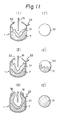
- the amount of slag 31 is still relatively small in Fig. 1 (I), and the circular field of the receptor 23 gives a white image of the high-temperature gaseous atmosphere 32 of converter, as shown in Fig. 11 (I').
- the surface of the slag 31 (Fig. 11 (11)) is vigorously stirred by the oxygen blown through the lance 16 and by the CO gas or the like formed due to the blowing reactions.
- the vessel-interior light can be subjected to wavelength separation by means of, for example, a blue-transmitting filter, so as to pass through the filter light having the wavelength range where the intensity of light emitted from the slag is dominant.
- the filtered light is subjected to a computing process so as to obtain the proportion of the filtered light to the entire area of the circular field of the receptor. The obtained surface-area proportion is plotted, as shown in Fig. 13, with time.
- A indicates the pseudo slag signal generated during the blowing start period, in which the temperature of the gaseous atmosphere is low, and B indicates an abrupt increase of the surface-area ratio and thus occurrence of slopping.
- B indicates an abrupt increase of the surface-area ratio and thus occurrence of slopping.
- the surface-area ratio Prior to the occurrence of slopping, the surface-area ratio intensely varies. The slopping can therefore be predicted on the basis of such intense change.
- a throughhole formed at the nonimmersing portion 8 (Figs. 2A, 2B, and 2C) cools due to non-contact with the molten steel and further cools if the inert purge gas is blown to it through the probe tip end.
- deposits on the throughhole can be melted due to the latent heat of the slag when the end of the throughhole is exposed to the foaming slag. In this case, the deposits can be blown out by inert purge gas, thus preventing accumulation of deposits.
- Oxygen-containing purge gas is preferred purge gas discovered after various investigations of the assignee of the present application.
- the coolant gas of the probe can be blown at an almost constant rate to attain the intended cooling
- the flow rate of the oxygen-containing purge gas for attaining the intended purge greatly varies depending upon the position of the throughhole, quality and quantity of the vessel's content, temperature, and vessel interior conditions. Control of the flow-rate for the purge is therefore difficult. It is more desirable and convenient to control and to vary the oxygen content of the purge gas.
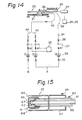
- inert gas is fed from a source A and is separately blown into conduit systems 34 and 40.
- the conduit system 34 includes a stop valve 35 and a reducing valve 36, a flow-rate adjusting device 37 with an orifice and flow-control valve, and a stop valve 38 successively arranged in the flow direction.
- the inert gas blown through the conduit system 34 flows via a flexible hose 39 into an inner cylinder 62 (Fig. 15) which is connected via an inlet port 63 (Fig. 15) to the flexible hose 39.
- the inert gas is further blown through a small aperture 42 of a front tip 41 screwed into a probe 61.
- the inner gas is then released from a tip aperture 43 into the vessel interior while preventing fogging or contamination of a front glass 67 of the probe 61.
- the inert gas flowing through the conduit system 40 is mixed with oxygen fed from a source B into the conduit system 44.
- the mixture gas flows via a flexible hose 45 and inlet port 65 into an outer cylinder 64 to cool the outer surface of the inner cylinder 62 and the front tip 41.
- the mixture gas is released into the vessel interior from the outer cylinder 64 through an opening 66.
- the flow rate ratio of oxygen to inert gas is adjusted by a flow-rate controller 33 connected to the conduit systems 40 and 44.
- the reverse Z 0 symbol indicates the check valves located upstream of the joining point of the conduit systems 40 and 44.
- the probe 61 includes a photo conductor therein.
- the symbol 26, 27, 28, and 29 indicate a photoelectric converter, image processor, display device of the vessel-interior condition, and slap level-display device, respectively.
- the amount of slag is controlled on the basis of the detected slag-forming conditions so as to maintain the amount of slag within an appropriate range at a high accuracy.
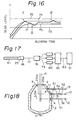
- This embodiment aims not only to predict the occurrence of slopping but also to enhance operational efficiency and improve the steel quality by means of observing the slag level at a high accuracy, monitoring the variation tendencies in the slag level, and suppressing detrimental tendencies. A typical example of this embodiment is described with reference to Fig. 16.
- the level of slag at which slopping is likely to occur is denoted by 72.
- Reference numeral 74 indicates the change of the slag level with time, allowing one to maintain the level of slag lower than the level 72 over the entire blowing period.
- the level of slag at with the slag formation is poor is denoted by 73.
- Reference numeral 75 indicates the change of the slag level with time, allowing one to ensure, at a certain initial preparatory blowing period, a slag level higher than 75.
- target slag-level control is effected to control the level of slag between the levels 74 and 75 during the entire blowing period.
- the symbols I, II, and III indicate the slag-level control actions.
- information is extracted from the signal obtained by the photometer so as to monitor the surface-area proportion of yellow base color to the entire color signal and variation in that proportion.
- the proportion and variation are compared with predetermined color criteria.
- Figure 17 is a block diagram for computing and outputting the proportion described above.
- the probe 61 more specifically the photo-conductor, is provided with a connector 25 and photoelectric converter 26.
- the light detected by the probe 61 is electrically converted to an image signal 77 which is transmitted to the wavelength-range divider 78.
- Analog signals 79 i.e., one (B-blue) having a wavelength range of from approximately 0.3 to 0.4 ⁇ m, another (G-green) having a wavelength range of from approximately 0.4 to 0.6 pm, and the other (R-red) havingh a wavelength range of from approximately 0.6 to 0.8 pm, are generated by the wavelength range-divider 78.
- the analog signals are converted at an appropriate threshold level to binary signals 80 which are input into an area-computing device 81.
- the binary R signal, the binary G signal, and the bindary B signal are multiplied by a count pulse of, for example, 0.134 useç (7 MHz) in a reset cycle of 16.7 msec, and the number of pulses of R-G on and B off is counted.
- the area proportion of yellow base color is counted for each 16.7 msec cycle and is generated as the output signal of yellow 82, which is observed with a area-proportion display device 91.
- control operations controlling the oxygen-blowing rate; controlling the lance height; charging the auxiliary raw materials, such as lime or iron ore; and controlling the bottom-flowing gas rate are carried out. This allows stabilization of the slag composition to drastically reduce the occurrence of slopping and to improve the slag quality.
- one or more of dolomite powder, quick lime powder, coal powder, and cokes powder is blown, into the vessel preferably through an additional throughhole of the side wall, upon the prediction of occurrence of slopping so as to stabilize the blowing.
- Figure 18 shows a 170 ton top- and bottom-blowing converter which has a top lance 16 for blowing 0 2 and a bottom nozzle 17 for blowing C0 2 .
- Throughholes 4 were formed at levels 1.5 m, 2.5 m, and 3.5 m beneath the converter mouth 9.
- Protective tubes 11 having an inner cylinder 110 (Fig 7) were inserted into the throughholes 4.
- An optical conductor 51 having a diameter of 12 mm, was stationarily located in each cylinder 110 and was connected to each body of photometers 52.
- the photometers 52 were ITV cameras equipped with short wavelength- transmitting filters. Signals from the ITV cameras were transmitted into signal processing units 13 including digital memories to store the signals in the digital memories. The digital information was subjected to signal processing for generating an image. The difference in the intensity of light between the gaseous atmosphere and the foaming slag was more distinct than by conventional photometers.
- the temperature of the foaming level of slag was intermittently measured by lowering the sublance equipped with a consumable thermometer at the tip end thereof.
- the present invention attains measurement of the slag level y at a high accuracy.
- the present invention attains, furthermore, continuous measurement, which makes it possible to successfully detect or predict the dynamic slag-forming behavior within the convertor.
- Table 1 shows the relationship between the total number of heats in which the foaming level of slag y arrived at the respective levels of the photometers and the occurrence of slopping, the relationship being determined by investigations of the assignee.
- the slag-forming criterion was defined as the time when the photometer 5a detected the foaming slag, i.e., the slag-forming criterion indicated abnormal or excessive formation of slag.
- the intensity of vessel-interior light was continuously measured during blowing by the photometers 5a, 5b, and 5c.
- the warning signal shown by Z in Fig. 19 was generated to warn of abnormal or excessive formation of slag.
- control actions such as reduction in the 0 2 -flow rate, through the top-blowing lance 16, and charging of unburnt dolomite into the converter 1, were carried out. Due to such control actions, the occurrence of slopping could be reduced to as low as 0.5% or less.
- a converter having an outer diameter of approximately 7 m and a height from the bottom to mouth of 8 m was pierced by a throughhole 150 mm in diameter through the side wall.
- a probe having an outer diameter of 80 mm and a photoconductor having an outer diameter of 40 mm were used.
- the purge gas blowing exerted no detrimental influence upon the blowing operation and quality of tapped steels.
- a 170 ton top- and bottom-blowing converter 8 m in height was charged with melt 1.5 m in depth.
- a throughhole was formed at the converter wall 2.5 m perpendicularly under the mouth.
- An optical fiber 12 mm in diameter was used as as photoconductor and inserted into a cooling protective tube.
- a CCD color-camera was used as a photoelectric converter.
- the slag level was detected by method as described with reference to Fig. 17 of computing the area ratio of yellow base color. The relationship between the area ratio of yellow base color and the position of the optical fiber was so established that the area ratio was 50% when the slag level coincided at the center of field of the optical fiber.
- the area ratio 100% and 0% corresponded to the slag levels above and below the throughhole, respectively.
- the threshold levels in the binary circuit were K 35%, G 35%, and B 25%.
- the area ratio signal of yellow base color 82 from a circuit 81 was divided and transmitted into two circuits. In one of the circuits, the area ratio signal was converted in the binary circuit 83 having appropriate threshold level (10%), into a binary signal 84. In the other circuit, the area-ratio signal of yellow base color 82 was passed through a high-pass filter 85 (cut frequency of 5Hz) and then converted to a positive value at a circuit 86. The positive signal was converted to a binary signal 88 in the binary circuit 87 having an appropriate threshold level (50%), which binary signal 88 indicated the changes in the area ratio. The two binary signals 84 and 88 were input into a decision circuit 89 which produces a final control signal 90. The possibility of occurrence of slopping was decided as shown in Table 3.
- Figs. 21 through 23 One or more of the operating objects were manipulated as described with reference to Figs. 21 through 23.
- Fig. 21 when the slag level varies during operation as shown by a curve 71 and exceeds the target slag level 76 at the points 92 and 93 and when there is no possibility of occurrence of slopping, an increase in the bottom-blowing flow rate (No. 1) is effective to atain the target slag level 76.
- a decrease in the bottom-blowing flow rate (No. 1) is first employed. If the slag level seemingly will not reach the target level 76 approximately 2 minutes after the decrease in bottom-blowing flow rate, the lance is lifted (No. 2) or the oxygen-flow rate is decreased (No. 3) to promote the foaming of slag.
- Blowing was carried out as in Example 3 except for the following:
- another throughhole was formed in a non-immersing portion of the side wall of the converter to charge the auxiliary raw materials therethrough.
- the additional throughhole was equipped with a nozzle for blowing auxiliary raw materials, purge gas and carrier gas.
- Purge gas consisting of 75% CO 2 and 25% 0 2 was blown without interruption at a rate of 120 Nm 3 /hr to prevent clogging of the additional aperture.
- the CO 2 gas was blown with flow rate by 500 Nm 3 /hr as carrier gas, and coke powder (5 mm or less) ws blown into the vessel interior.
- lump dolomite was charged.
- the coke-powder injection is more effective than the lump dolomite charging.
- Example 4 Blowing was carried out as in Example 4 except for the following: Instead of addition of another throughhole for injection of pulverized auxiliary raw materials using purge gas to the throughhole for observation of the vessel interior, and assembled probe was equipped, which had an observation device and injection mechanism.
- This kind of probe is a modified one shown in Fig. 15 in the following points.
- Inlet port 65 into an outer cylinder 64 is connected to the powder injection unit.
- the injected powder in carrier gas is released into the vessel interior from the outer cylinder 64.
- the probe 61 includes a photoconductor therein.
- the purge gas is released from an inlet port 63 and blown through a small aperture 42 of a front tip 41 screwed into a probe 61.
- the purge gas is mixed with oxygen concentration with 30 to 40% by volume.
Landscapes
- Engineering & Computer Science (AREA)
- Chemical & Material Sciences (AREA)
- Manufacturing & Machinery (AREA)
- Materials Engineering (AREA)
- Metallurgy (AREA)
- Organic Chemistry (AREA)
- Carbon Steel Or Casting Steel Manufacturing (AREA)
Claims (10)
Applications Claiming Priority (10)
| Application Number | Priority Date | Filing Date | Title |
|---|---|---|---|
| JP59084115A JPS60228930A (ja) | 1984-04-27 | 1984-04-27 | 転炉炉内観測方法 |
| JP84114/84 | 1984-04-27 | ||
| JP59084118A JPS60228928A (ja) | 1984-04-27 | 1984-04-27 | スロッピング検出方法 |
| JP84115/84 | 1984-04-27 | ||
| JP84116/84 | 1984-04-27 | ||
| JP84118/84 | 1984-04-27 | ||
| JP59084117A JPS60230929A (ja) | 1984-04-27 | 1984-04-27 | 転炉操業方法 |
| JP59084114A JPS60228929A (ja) | 1984-04-27 | 1984-04-27 | 転炉炉況観測装置 |
| JP84117/84 | 1984-04-27 | ||
| JP59084116A JPS60228931A (ja) | 1984-04-27 | 1984-04-27 | 転炉スロツピング検出装置 |
Publications (2)
| Publication Number | Publication Date |
|---|---|
| EP0162949A1 EP0162949A1 (fr) | 1985-12-04 |
| EP0162949B1 true EP0162949B1 (fr) | 1987-12-16 |
Family
ID=27525078
Family Applications (1)
| Application Number | Title | Priority Date | Filing Date |
|---|---|---|---|
| EP84110571A Expired EP0162949B1 (fr) | 1984-04-27 | 1984-09-05 | Méthode et appareil pour mesurer les conditions de scorification dans un convertisseur |
Country Status (5)
| Country | Link |
|---|---|
| EP (1) | EP0162949B1 (fr) |
| AU (1) | AU558925B2 (fr) |
| BR (1) | BR8404496A (fr) |
| CA (1) | CA1250356A (fr) |
| DE (1) | DE3468127D1 (fr) |
Cited By (2)
| Publication number | Priority date | Publication date | Assignee | Title |
|---|---|---|---|---|
| AT410031B (de) * | 2000-12-01 | 2003-01-27 | Voest Alpine Ind Anlagen | Einrichtung zur aufnahme und weiterleitung elektromagnetischer wellen, die von einer materialprobe ausgesendet werden |
| DE102012211714A1 (de) * | 2012-07-05 | 2014-05-22 | Siemens Vai Metals Technologies Gmbh | Verfahren und Vorrichtung zur Detektion des Schlackepegels in einem metallurgischen Gefäß |
Families Citing this family (10)
| Publication number | Priority date | Publication date | Assignee | Title |
|---|---|---|---|---|
| DE3934340C1 (fr) * | 1989-10-14 | 1991-03-07 | Voest-Alpine Industrieanlagenbau Ges.M.B.H., Linz, At | |
| DE4036216C1 (fr) * | 1990-11-14 | 1992-01-30 | Voest-Alpine Industrieanlagenbau Ges.M.B.H., Linz, At | |
| TW337553B (en) * | 1995-12-20 | 1998-08-01 | Voest Alpine Ind Anlagen | Method for determination of electromagnetic waves originating from a melt |
| US6175676B1 (en) * | 1999-02-23 | 2001-01-16 | Bethlehem Steel Corporation | Fiber optic sensor and method of use thereof to determine carbon content of molten steel contained in a basic oxygen furnace |
| CN101029848B (zh) * | 2007-01-29 | 2013-02-20 | 聚光科技(杭州)股份有限公司 | 一种应用于高温液体的连续测温方法 |
| DE102010035910A1 (de) * | 2010-06-09 | 2011-12-15 | Sms Siemag Ag | Einrichtung zur Temperaturmessung in einem Konverter |
| EP2910651A1 (fr) * | 2014-02-19 | 2015-08-26 | Siemens VAI Metals Technologies GmbH | Procédé de circulation d'un bain de métal et installation de four |
| DE102015200188A1 (de) * | 2015-01-09 | 2016-07-14 | Sms Group Gmbh | Verfahren und Vorrichtung zum Betreiben einer Blaslanze in einem Konverter |
| CN106996967B (zh) * | 2017-04-28 | 2023-08-22 | 成都哈工智传科技有限公司 | 磁性矿品位检测方法及检测设备 |
| CN112143853B (zh) * | 2020-10-13 | 2022-04-15 | 长春工业大学 | 一种aod炉冶炼过程的喷溅预报与喷溅压制方法及系统 |
Family Cites Families (4)
| Publication number | Priority date | Publication date | Assignee | Title |
|---|---|---|---|---|
| DE1408873B2 (de) * | 1961-10-13 | 1971-07-01 | Gesellschaft zur Forderung der Eisen huttentechmk mbH, 4000 Dusseldorf | Ausgangsmasse fuer den poroesen feuerfesten stopfen einer einrichtung zur kontinuierlichen temperatur messung von eisen und stahlschmelzen |
| GB1411790A (en) * | 1971-11-30 | 1975-10-29 | Monsanto Co | Microwave-excited emission detector |
| JPS53118161A (en) * | 1977-03-25 | 1978-10-16 | Sumitomo Metal Ind | Measuring method of slug forming by micro wave level meter |
| LU81859A1 (fr) * | 1979-11-07 | 1981-06-04 | Arbed | Procede de conditionnement de la scorie au cours de l'affinage d'un bain de metal |
-
1984
- 1984-08-30 AU AU32558/84A patent/AU558925B2/en not_active Ceased
- 1984-09-05 DE DE8484110571T patent/DE3468127D1/de not_active Expired
- 1984-09-05 EP EP84110571A patent/EP0162949B1/fr not_active Expired
- 1984-09-05 CA CA000462485A patent/CA1250356A/fr not_active Expired
- 1984-09-06 BR BR8404496A patent/BR8404496A/pt not_active IP Right Cessation
Non-Patent Citations (1)
| Title |
|---|
| PATENT ABSTRACTS OF JAPAN; UNEXAMINED APPLICATIONS, field C, vol. 7, no. 135, June 11, 1983, THE PATENT OFFICE JAPANESE GOVERNMENT, page 50 C 170 * |
Cited By (2)
| Publication number | Priority date | Publication date | Assignee | Title |
|---|---|---|---|---|
| AT410031B (de) * | 2000-12-01 | 2003-01-27 | Voest Alpine Ind Anlagen | Einrichtung zur aufnahme und weiterleitung elektromagnetischer wellen, die von einer materialprobe ausgesendet werden |
| DE102012211714A1 (de) * | 2012-07-05 | 2014-05-22 | Siemens Vai Metals Technologies Gmbh | Verfahren und Vorrichtung zur Detektion des Schlackepegels in einem metallurgischen Gefäß |
Also Published As
| Publication number | Publication date |
|---|---|
| BR8404496A (pt) | 1986-03-25 |
| AU558925B2 (en) | 1987-02-12 |
| CA1250356A (fr) | 1989-02-21 |
| AU3255884A (en) | 1985-10-31 |
| DE3468127D1 (en) | 1988-01-28 |
| EP0162949A1 (fr) | 1985-12-04 |
Similar Documents
| Publication | Publication Date | Title |
|---|---|---|
| US4651976A (en) | Method for operating a converter used for steel refining | |
| EP0162949B1 (fr) | Méthode et appareil pour mesurer les conditions de scorification dans un convertisseur | |
| EP3620542B1 (fr) | Procédé de surveillance de fonctionnement de convertisseur et procédé de fonctionnement de convertisseur | |
| EP1424543B1 (fr) | Instrument de mesure de la temperature d'un metal en fusion | |
| CA2241276A1 (fr) | Procede et dispositif pour detecter des ondes electromagnetiques partant d'une masse en fusion | |
| KR102521711B1 (ko) | 전로의 슬로핑 예지 방법, 전로의 조업 방법 및 전로의 슬로핑 예지 시스템 | |
| JP6954262B2 (ja) | 転炉の操業方法 | |
| JP7036142B2 (ja) | 転炉のスロッピング予知方法、転炉の操業方法及び転炉のスロッピング予知システム | |
| US4749171A (en) | Method and apparatus for measuring slag-foam conditions within a converter | |
| US5830407A (en) | Pressurized port for viewing and measuring properties of a molten metal bath | |
| JP3164976B2 (ja) | 転炉でのスロッピング予知方法及びその防止方法 | |
| JP3440267B2 (ja) | アーク溶解炉のスラグへのアーク埋没評価方法 | |
| US4149877A (en) | Controlling pig iron refining | |
| Vazquez | Tenova’s intelligent i BOF® technology, a modular package for BOF process improvement | |
| JPH113778A (ja) | アーク炉における溶解進捗状況の判定方法 | |
| JPS6224487B2 (fr) | ||
| JPS60228929A (ja) | 転炉炉況観測装置 | |
| Unwin | Improving slag detection | |
| JPS60228930A (ja) | 転炉炉内観測方法 | |
| JPS6224493B2 (fr) | ||
| JPS6144117A (ja) | 転炉側壁貫通孔の閉塞防止方法 | |
| JPS63227705A (ja) | 転炉の吹錬制御方法 | |
| JPH08232014A (ja) | 真空精錬炉及びその操業方法 | |
| JPS59166612A (ja) | 転炉異常反応検出方法 | |
| JPH056654B2 (fr) |
Legal Events
| Date | Code | Title | Description |
|---|---|---|---|
| PUAI | Public reference made under article 153(3) epc to a published international application that has entered the european phase |
Free format text: ORIGINAL CODE: 0009012 |
|
| AK | Designated contracting states |
Designated state(s): BE DE FR GB IT NL |
|
| 17P | Request for examination filed |
Effective date: 19860114 |
|
| 17Q | First examination report despatched |
Effective date: 19870109 |
|
| GRAA | (expected) grant |
Free format text: ORIGINAL CODE: 0009210 |
|
| AK | Designated contracting states |
Kind code of ref document: B1 Designated state(s): BE DE FR GB IT NL |
|
| ITF | It: translation for a ep patent filed | ||
| ET | Fr: translation filed | ||
| REF | Corresponds to: |
Ref document number: 3468127 Country of ref document: DE Date of ref document: 19880128 |
|
| PLBE | No opposition filed within time limit |
Free format text: ORIGINAL CODE: 0009261 |
|
| STAA | Information on the status of an ep patent application or granted ep patent |
Free format text: STATUS: NO OPPOSITION FILED WITHIN TIME LIMIT |
|
| 26N | No opposition filed | ||
| ITTA | It: last paid annual fee | ||
| PGFP | Annual fee paid to national office [announced via postgrant information from national office to epo] |
Ref country code: GB Payment date: 19970827 Year of fee payment: 14 |
|
| PGFP | Annual fee paid to national office [announced via postgrant information from national office to epo] |
Ref country code: FR Payment date: 19970909 Year of fee payment: 14 |
|
| PGFP | Annual fee paid to national office [announced via postgrant information from national office to epo] |
Ref country code: DE Payment date: 19970912 Year of fee payment: 14 |
|
| PGFP | Annual fee paid to national office [announced via postgrant information from national office to epo] |
Ref country code: NL Payment date: 19970929 Year of fee payment: 14 |
|
| PGFP | Annual fee paid to national office [announced via postgrant information from national office to epo] |
Ref country code: BE Payment date: 19971104 Year of fee payment: 14 |
|
| PG25 | Lapsed in a contracting state [announced via postgrant information from national office to epo] |
Ref country code: GB Free format text: LAPSE BECAUSE OF NON-PAYMENT OF DUE FEES Effective date: 19980905 |
|
| PG25 | Lapsed in a contracting state [announced via postgrant information from national office to epo] |
Ref country code: BE Free format text: LAPSE BECAUSE OF NON-PAYMENT OF DUE FEES Effective date: 19980930 |
|
| BERE | Be: lapsed |
Owner name: NIPPON STEEL CORP. Effective date: 19980930 |
|
| PG25 | Lapsed in a contracting state [announced via postgrant information from national office to epo] |
Ref country code: NL Free format text: LAPSE BECAUSE OF NON-PAYMENT OF DUE FEES Effective date: 19990401 |
|
| GBPC | Gb: european patent ceased through non-payment of renewal fee |
Effective date: 19980905 |
|
| PG25 | Lapsed in a contracting state [announced via postgrant information from national office to epo] |
Ref country code: FR Free format text: LAPSE BECAUSE OF NON-PAYMENT OF DUE FEES Effective date: 19990531 |
|
| NLV4 | Nl: lapsed or anulled due to non-payment of the annual fee |
Effective date: 19990401 |
|
| PG25 | Lapsed in a contracting state [announced via postgrant information from national office to epo] |
Ref country code: DE Free format text: LAPSE BECAUSE OF NON-PAYMENT OF DUE FEES Effective date: 19990701 |
|
| REG | Reference to a national code |
Ref country code: FR Ref legal event code: ST |