EP0163843A2 - Outil ayant une couche de protection contre l'usure - Google Patents
Outil ayant une couche de protection contre l'usure Download PDFInfo
- Publication number
- EP0163843A2 EP0163843A2 EP85104047A EP85104047A EP0163843A2 EP 0163843 A2 EP0163843 A2 EP 0163843A2 EP 85104047 A EP85104047 A EP 85104047A EP 85104047 A EP85104047 A EP 85104047A EP 0163843 A2 EP0163843 A2 EP 0163843A2
- Authority
- EP
- European Patent Office
- Prior art keywords
- protection layer
- tool
- wear
- wear protection
- tool according
- Prior art date
- Legal status (The legal status is an assumption and is not a legal conclusion. Google has not performed a legal analysis and makes no representation as to the accuracy of the status listed.)
- Withdrawn
Links
Images
Classifications
-
- B—PERFORMING OPERATIONS; TRANSPORTING
- B24—GRINDING; POLISHING
- B24D—TOOLS FOR GRINDING, BUFFING OR SHARPENING
- B24D5/00—Bonded abrasive wheels, or wheels with inserted abrasive blocks, designed for acting only by their periphery; Bushings or mountings therefor
- B24D5/12—Cut-off wheels
- B24D5/123—Cut-off wheels having different cutting segments
-
- B—PERFORMING OPERATIONS; TRANSPORTING
- B23—MACHINE TOOLS; METAL-WORKING NOT OTHERWISE PROVIDED FOR
- B23D—PLANING; SLOTTING; SHEARING; BROACHING; SAWING; FILING; SCRAPING; LIKE OPERATIONS FOR WORKING METAL BY REMOVING MATERIAL, NOT OTHERWISE PROVIDED FOR
- B23D61/00—Tools for sawing machines or sawing devices; Clamping devices for these tools
- B23D61/02—Circular saw blades
- B23D61/025—Details of saw blade body
- B23D61/026—Composite body, e.g. laminated
-
- B—PERFORMING OPERATIONS; TRANSPORTING
- B28—WORKING CEMENT, CLAY, OR STONE
- B28D—WORKING STONE OR STONE-LIKE MATERIALS
- B28D1/00—Working stone or stone-like materials, e.g. brick, concrete or glass, not provided for elsewhere; Machines, devices, tools therefor
- B28D1/02—Working stone or stone-like materials, e.g. brick, concrete or glass, not provided for elsewhere; Machines, devices, tools therefor by sawing
- B28D1/12—Saw-blades or saw-discs specially adapted for working stone
- B28D1/121—Circular saw blades
Definitions
- the invention relates to a tool for processing rock, in particular, having a tool base body which carries one or more processing elements which are provided with a wear protection layer.
- Machining tools in particular non-metallic materials such as stone, such as drills, cutting discs and saws, generally have a basic tool body that carries one or more machining elements that are made of hard metal or a metal alloy or composite materials and that generally show high wear resistance against fretting .
- Such base bodies also serve as a matrix for diamonds or grains of cubic crystalline boron nitride.
- the bond of, for example, diamond abrasive grains consists of a harder material, such as an iron alloy or a hard metal alloy such as tungsten carbide or a cobalt alloy.
- a number of these matrix-forming materials which show very good wear properties in the stone / matrix friction pairing, are very sensitive to erosion, cavitation and co-corrosion wear and to combinations of these wear phenomena, for example so-called fretting. Such signs of wear essentially lead to premature tool failure due to wear on the tool flanks and the end faces, although the active machining surfaces of the tool have in no way been used up. Such wear occurs in particular when, due to the tool geometry, the tool flanks are not in contact with the workpiece, but only cooling lubricants flow against them.
- Coolant additives that contribute to a considerable increase in the service life of the active friction surface lead to a further increase in wear on the flanks and forehead if they increase the settling times of the sludge, for example due to the emulsifiers contained in the agent, so that there is an increased particle concentration in the coolant.
- wear protection layers in the form of armor have hitherto become known, the essential property of which is that they are of considerable hardness.
- These known hard armor layers are applied by build-up welding or by spraying a layer onto the work-passive surfaces of the tool and are known as galvanic dispersion layers.
- the wear protection layer consists of a softer material than the composite material of the processing elements, for the purpose of reflection or absorption of the removal energy.
- a wear protection layer according to of the invention that is to say of a soft material, in that the energy of the particles causing the abrasion is absorbed by this wear protection layer with little destruction and thus rendered ineffective.
- this can be done by elastic reflection of the particles if a wear protection layer is provided which has elastic properties.
- the energy causing the removal can be rendered harmless for the tool in that the wear protection layer has plastic properties which lead to absorption of the removal energy.
- Elastic reflection preferably occurs when using a wear protection layer which is made of rubber or silicone rubber. Basically, therefore, rubber or viscoelastic materials are generally suitable.
- the wear protection layer in the sense of the invention.
- This can therefore also consist of a plastic, for example polyurethane or an epoxy resin.
- wear protection layers made of a metal are particularly suitable which have a low hardness and a low recrystallization temperature, which can also be a metal alloy.
- a recrystallization temperature is generally to be understood as the melting temperature. So the range of the sintering temperature of the bonding material for the diamonds in the processing elements is around 650 - 1,400 ° C. the recrystallization temperature of the wear protection layer should be lower.
- Wear protection layers that can be galvanically applied to the tool base body are therefore particularly suitable, such as, for example, ductile metals, in particular copper, which have a good adhesive property on the tool base body. It is also possible to apply such wear protection layers as solder to the tool body, in particular by soft soldering.
- the formation of the wear protection layer proposed here is possible with all tools that are used for processing metallic as well as non-metallic materials, in particular stone.
- This also includes tools that have diamond-tipped machining elements or machining elements with crystalline boron nitride. With these, too, the goal of making the service life dependent on the actual wear of its active machining surfaces is achieved.
- the arrangement according to the invention of a wear protection layer made of a softer material than the composite material of the machining elements does not exclude that the wear protection layer additionally has a grain of a hard material, in particular also of diamond or boron nitride. As a result, a positive effect of the protective layer can be exploited. So this is not armoring of the processing elements.
- the additional hard material in the wear layer which is soft per se, only contributes to the removal of the workpieces in the area of the active machining area.
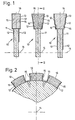
- the tool shown in FIGS. 1 and 2 is a saw blade which is rotatably mounted about an axis 14.
- the tool 10 carries a plurality of segment-like machining elements 13 which are spaced apart from one another on a disk-shaped tool base body 11 and which, according to FIG. 1, can have a different cross section.
- the processing elements 13 are coated on their passive sides 15 not involved in the actual machining process, i.e. their two outer sides and their front and rear sides with a wear protection layer 12 made of a relatively soft material, while the active outer side 16 of a processing element 13 is free of a wear protection layer or during the use of the tool is free, since the tool 10 can be completely covered with a protective layer due to the manufacturing process or also the load-bearing one Tool base body 11 can be provided with the protective layer as shown in Figure 1.
- the wear protection layer 12 is also suitable for preventing wear and tear on any tool holder, for example drill bits, drill rods, saw blade and the like, which can be equipped with both diamond-containing machining elements and non-diamond-containing machining elements 13.
- the embodiment shown in the drawing according to FIG. 2 involves machining elements 13 containing diamond grains and a protective layer which is likewise interspersed with diamond grains.
- the type of application of the wear protection layer 12 depends on its material.
- the point in time at which the wear protection layer 12 is applied essentially depends on the coating method chosen. Galvanic layers and solder layers are particularly suitable, since they can be applied both to loose tool segments or machining elements, which are then usually hard-soldered to the tool holder, and to ready-soldered or welded tool / holder units.
- the wear protection layers according to the invention can be added Apply several times if necessary and, if necessary, on site if appropriate wear should make this necessary.
- Both tampon electroplating and the use of solder pastes are basically suitable for forming the wear protection layer 12 according to the invention. Dipping into or brushing on CuSO 4 or AgNO 3 solutions is also suitable for applying a thin wear protection layer 12.
Landscapes
- Engineering & Computer Science (AREA)
- Mechanical Engineering (AREA)
- Mining & Mineral Resources (AREA)
- Polishing Bodies And Polishing Tools (AREA)
- Processing Of Stones Or Stones Resemblance Materials (AREA)
- Earth Drilling (AREA)
Applications Claiming Priority (4)
| Application Number | Priority Date | Filing Date | Title |
|---|---|---|---|
| DE19843418815 DE3418815A1 (de) | 1984-05-21 | 1984-05-21 | Werkzeug mit verschleissschutzschicht zur bearbeitung metallischer und nichtmetallischer werkstoffe |
| DE3418815 | 1984-05-21 | ||
| DE19843433729 DE3433729A1 (de) | 1984-09-14 | 1984-09-14 | Werkzeug zur bearbeitung metallischer und nichtmetallischer werkstoffe |
| DE3433729 | 1984-09-14 |
Publications (2)
| Publication Number | Publication Date |
|---|---|
| EP0163843A2 true EP0163843A2 (fr) | 1985-12-11 |
| EP0163843A3 EP0163843A3 (fr) | 1988-08-03 |
Family
ID=25821390
Family Applications (1)
| Application Number | Title | Priority Date | Filing Date |
|---|---|---|---|
| EP85104047A Withdrawn EP0163843A3 (fr) | 1984-05-21 | 1985-04-03 | Outil ayant une couche de protection contre l'usure |
Country Status (1)
| Country | Link |
|---|---|
| EP (1) | EP0163843A3 (fr) |
Cited By (10)
| Publication number | Priority date | Publication date | Assignee | Title |
|---|---|---|---|---|
| WO1991002626A1 (fr) * | 1989-08-25 | 1991-03-07 | Tyrolit Schleifmittelwerke Swarovski K.G. | Dressage des meules |
| FR2662963A1 (fr) * | 1990-06-11 | 1991-12-13 | Combustible Nucleaire | Element de coupe abrasif et procede de fabrication d'un tel element. |
| EP0433692A3 (en) * | 1989-11-23 | 1992-01-02 | Toyoda Koki Kabushiki Kaisha | Segmentee grinding wheel |
| WO1996007521A1 (fr) * | 1994-09-05 | 1996-03-14 | Ehwa Diamond Ind. Co., Ltd. | Plaquette de lame de scie brasee a l'argent |
| EP1022094A3 (fr) * | 1998-10-26 | 2002-11-20 | Kaiser, Michael, Dr. Ing. | Disque de dressage diamanté |
| EP1270126A1 (fr) * | 2001-06-29 | 2003-01-02 | Turbolite AG | Lame de scie circulaire avec des régions résistantes à l'usure |
| EP1808250A1 (fr) * | 2006-01-13 | 2007-07-18 | WIKUS-Sägenfabrik Wilhelm H. Kullmann GmbH & Co. KG. | Lame de scie avec base et denture munie d'une pointe avec couche de protection contre l'usure |
| EP2094424A4 (fr) * | 2006-11-16 | 2014-03-05 | Shinhan Diamond Ind Co Ltd | Outil diamant et procédé de fabrication de segment de celui-ci |
| DE102020128920A1 (de) | 2020-11-03 | 2022-05-05 | WIKUS-Sägenfabrik Wilhelm H. Kullmann GmbH & Co. KG | Superlegierungssägeblatt |
| US20230330815A1 (en) * | 2020-12-28 | 2023-10-19 | Hunan Institute Of Science And Technology | Block-type structured diamond grinding wheel with adaptive supply of instantaneous cooling |
Family Cites Families (3)
| Publication number | Priority date | Publication date | Assignee | Title |
|---|---|---|---|---|
| BE621587A (fr) * | ||||
| FR1568331A (fr) * | 1968-03-29 | 1969-05-23 | ||
| BE718758A (fr) * | 1968-07-30 | 1968-12-31 |
-
1985
- 1985-04-03 EP EP85104047A patent/EP0163843A3/fr not_active Withdrawn
Cited By (11)
| Publication number | Priority date | Publication date | Assignee | Title |
|---|---|---|---|---|
| WO1991002626A1 (fr) * | 1989-08-25 | 1991-03-07 | Tyrolit Schleifmittelwerke Swarovski K.G. | Dressage des meules |
| EP0433692A3 (en) * | 1989-11-23 | 1992-01-02 | Toyoda Koki Kabushiki Kaisha | Segmentee grinding wheel |
| FR2662963A1 (fr) * | 1990-06-11 | 1991-12-13 | Combustible Nucleaire | Element de coupe abrasif et procede de fabrication d'un tel element. |
| EP0461951A1 (fr) * | 1990-06-11 | 1991-12-18 | Supradiamant | Elément de coupe abrasif et procédé de fabrication d'un tel élément |
| WO1996007521A1 (fr) * | 1994-09-05 | 1996-03-14 | Ehwa Diamond Ind. Co., Ltd. | Plaquette de lame de scie brasee a l'argent |
| EP1022094A3 (fr) * | 1998-10-26 | 2002-11-20 | Kaiser, Michael, Dr. Ing. | Disque de dressage diamanté |
| EP1270126A1 (fr) * | 2001-06-29 | 2003-01-02 | Turbolite AG | Lame de scie circulaire avec des régions résistantes à l'usure |
| EP1808250A1 (fr) * | 2006-01-13 | 2007-07-18 | WIKUS-Sägenfabrik Wilhelm H. Kullmann GmbH & Co. KG. | Lame de scie avec base et denture munie d'une pointe avec couche de protection contre l'usure |
| EP2094424A4 (fr) * | 2006-11-16 | 2014-03-05 | Shinhan Diamond Ind Co Ltd | Outil diamant et procédé de fabrication de segment de celui-ci |
| DE102020128920A1 (de) | 2020-11-03 | 2022-05-05 | WIKUS-Sägenfabrik Wilhelm H. Kullmann GmbH & Co. KG | Superlegierungssägeblatt |
| US20230330815A1 (en) * | 2020-12-28 | 2023-10-19 | Hunan Institute Of Science And Technology | Block-type structured diamond grinding wheel with adaptive supply of instantaneous cooling |
Also Published As
| Publication number | Publication date |
|---|---|
| EP0163843A3 (fr) | 1988-08-03 |
Similar Documents
| Publication | Publication Date | Title |
|---|---|---|
| DE1477118B2 (de) | Schneidwerkzeug für spanabhebende Bearbeitung | |
| DE2434714C2 (de) | Sägedraht für eine Drahtsäge und Verfahren zur Herstellung | |
| DE102006001816B4 (de) | Sägeblatt mit einem Grundkörper und Zähnen mit einer Schneide mit einer Verschleißschutzschicht | |
| EP0163843A2 (fr) | Outil ayant une couche de protection contre l'usure | |
| DE1758823B2 (de) | Kernbohrer | |
| EP0508941B1 (fr) | Outil pour l'usinage de matériaux | |
| EP0540566B1 (fr) | Outil de coupe | |
| DE2306780A1 (de) | Verzahntes werkzeug zum feinbearbeiten von zahnraedern | |
| DD207171A5 (de) | Werkzeug zur herstellung von aussenprofilformen | |
| DE3433729A1 (de) | Werkzeug zur bearbeitung metallischer und nichtmetallischer werkstoffe | |
| DE102019117799B4 (de) | Zerspanungswerkzeug mit asymmetrischen Zähnen mit Schneidpartikeln | |
| DE3418815A1 (de) | Werkzeug mit verschleissschutzschicht zur bearbeitung metallischer und nichtmetallischer werkstoffe | |
| WO1999018260A1 (fr) | Outil de coupe et procede pour appliquer un revetement sur des outils de coupe | |
| DE3447124C1 (de) | Abrasives Werkzeug zum Feinbearbeiten der Zahnflanken von insbesondere gehaerteten Zahnraedern | |
| EP0857552B1 (fr) | Outil pour l'usinage de la pierre avec amélioration du comportement à l'attaque | |
| EP0761356B1 (fr) | Fil de sciage | |
| AT404915B (de) | Säge mit einem grundkörper und zähnen und verfahren zur herstellung einer säge | |
| EP0530528B1 (fr) | Outil de meulage | |
| DE1093692B (de) | Schneidwerkzeug, insbesondere zum Abrichten von Schleifscheiben | |
| DE202007011503U1 (de) | Schneidmesser | |
| DE20206159U1 (de) | Sägeblatt für eine Bearbeitungsmaschine | |
| EP1156905B1 (fr) | Outil de meulage ou de coupe | |
| DE1947295A1 (de) | Hartmetallbestueckte Kreissaege | |
| EP1673192B1 (fr) | Alesoir | |
| DE1966764A1 (de) | Schleifwerkzeug |
Legal Events
| Date | Code | Title | Description |
|---|---|---|---|
| PUAI | Public reference made under article 153(3) epc to a published international application that has entered the european phase |
Free format text: ORIGINAL CODE: 0009012 |
|
| AK | Designated contracting states |
Designated state(s): BE DE FR GB IT NL SE |
|
| PUAL | Search report despatched |
Free format text: ORIGINAL CODE: 0009013 |
|
| AK | Designated contracting states |
Kind code of ref document: A3 Designated state(s): BE DE FR GB IT NL SE |
|
| 17P | Request for examination filed |
Effective date: 19890203 |
|
| 17Q | First examination report despatched |
Effective date: 19900910 |
|
| STAA | Information on the status of an ep patent application or granted ep patent |
Free format text: STATUS: THE APPLICATION IS DEEMED TO BE WITHDRAWN |
|
| 18D | Application deemed to be withdrawn |
Effective date: 19910321 |
|
| RIN1 | Information on inventor provided before grant (corrected) |
Inventor name: DIETRICH, RAINER, DR. DIPL.-ING. Inventor name: HILSCH, GEORG, DIPL.-ING. Inventor name: SASSE, KARL-MICHAEL, DIPL.-ING. |