EP0164472B1 - Eingekapseltes Hypochlorit-Desaktivierungsmittel - Google Patents
Eingekapseltes Hypochlorit-Desaktivierungsmittel Download PDFInfo
- Publication number
- EP0164472B1 EP0164472B1 EP84308724A EP84308724A EP0164472B1 EP 0164472 B1 EP0164472 B1 EP 0164472B1 EP 84308724 A EP84308724 A EP 84308724A EP 84308724 A EP84308724 A EP 84308724A EP 0164472 B1 EP0164472 B1 EP 0164472B1
- Authority
- EP
- European Patent Office
- Prior art keywords
- composition
- hypochlorite
- deactivator
- weight
- coating
- Prior art date
- Legal status (The legal status is an assumption and is not a legal conclusion. Google has not performed a legal analysis and makes no representation as to the accuracy of the status listed.)
- Expired - Lifetime
Links
Images
Classifications
-
- A—HUMAN NECESSITIES
- A61—MEDICAL OR VETERINARY SCIENCE; HYGIENE
- A61K—PREPARATIONS FOR MEDICAL, DENTAL OR TOILETRY PURPOSES
- A61K8/00—Cosmetics or similar toiletry preparations
- A61K8/18—Cosmetics or similar toiletry preparations characterised by the composition
- A61K8/19—Cosmetics or similar toiletry preparations characterised by the composition containing inorganic ingredients
- A61K8/20—Halogens; Compounds thereof
-
- A—HUMAN NECESSITIES
- A61—MEDICAL OR VETERINARY SCIENCE; HYGIENE
- A61K—PREPARATIONS FOR MEDICAL, DENTAL OR TOILETRY PURPOSES
- A61K8/00—Cosmetics or similar toiletry preparations
- A61K8/02—Cosmetics or similar toiletry preparations characterised by special physical form
- A61K8/11—Encapsulated compositions
-
- A—HUMAN NECESSITIES
- A61—MEDICAL OR VETERINARY SCIENCE; HYGIENE
- A61Q—SPECIFIC USE OF COSMETICS OR SIMILAR TOILETRY PREPARATIONS
- A61Q11/00—Preparations for care of the teeth, of the oral cavity or of dentures; Dentifrices, e.g. toothpastes; Mouth rinses
- A61Q11/02—Preparations for deodorising, bleaching or disinfecting dentures
-
- A—HUMAN NECESSITIES
- A61—MEDICAL OR VETERINARY SCIENCE; HYGIENE
- A61K—PREPARATIONS FOR MEDICAL, DENTAL OR TOILETRY PURPOSES
- A61K2800/00—Properties of cosmetic compositions or active ingredients thereof or formulation aids used therein and process related aspects
- A61K2800/20—Chemical, physico-chemical or functional or structural properties of the composition as a whole
- A61K2800/22—Gas releasing
- A61K2800/222—Effervescent
-
- A—HUMAN NECESSITIES
- A61—MEDICAL OR VETERINARY SCIENCE; HYGIENE
- A61K—PREPARATIONS FOR MEDICAL, DENTAL OR TOILETRY PURPOSES
- A61K2800/00—Properties of cosmetic compositions or active ingredients thereof or formulation aids used therein and process related aspects
- A61K2800/40—Chemical, physico-chemical or functional or structural properties of particular ingredients
- A61K2800/41—Particular ingredients further characterized by their size
- A61K2800/412—Microsized, i.e. having sizes between 0.1 and 100 microns
Definitions
- This invention relates to a denture cleansing composition comprising a hypochlorite generating agent and a hypochlorite deactivator which is substantially free of chlorine odor. More particularly it relates to a hypochlorite type denture cleansing composition having incorporated therein a controlled release deactivator for the hypochlorite.
- Effervescent denture cleansers have been long known in the art. Most of those presently on the market derive their cleansing efficiency mainly from peroxy compounds which provide active oxygen. While the active oxygen provides a good bleaching action, it has relatively poor plaque removing properties. Various peroxygen type denture cleansers are described in U.S. Patent Nos. 2,498,343; 2,498,344; 2,931,776 and 3,243,377.
- U.S. Patent No. 3,113,111 derives its cleansing efficacy from an active chloride source and has good plaque removing properties.
- the product is not effervescent and must be stirred mechanically to dissolve.
- An effervescent denture cleansing composition which releases hypochlorite/chlorine on contact with water is disclosed in U.S. Patent No. 3,936,385.
- the product has good plaque removing properties and dissolves without stirring.
- it is not fully acceptable because of the chlorine odor associated with the product and its tendancy to corrode metals.
- Efforts to mask odor using fragrances have been unsuccessful because of the strong hypochlorite odor.
- U.S Patent No. 4,295,985 discloses a soap which removes chlorine odor from the skin and hair of bathers. The composition is said to neutralize chlorine (as hypochlorite).
- Compounds taught to be suitable neutralizing agents are sodium nitrite, sodium sulfite, sodium thiosulfate, urea, thiourea, ascorbic acid, hydrazine, hydroxylamine, pyrrole, sodium ferrocyanide, hydroquinone, formaldehyde, furfural, sodium hypophosphate and sodium hydrosulfite.
- the prior art approach has been to add the deodorizing agent to the denture cleansing composition. As such, it immediately begins to reduce the available hypochlorite. Hence, either reduced efficiency must be accepted or substantially larger amounts of cleansing agent, at increased costs, must be utilized to achieve the desired effect.
- U.S. Patent No. 3,952,107 discloses a two part tablet which preferentially releases an enzyme to attack the proteinaceous materials which are loosely bonded to plaque. Subsequently, an oxygen generating agent is released to complete the cleaning.
- the delay time between each activation step is disclosed to be about 60 to 120 seconds. The time release is accomplished by consideration of the relative thickness of the two layers, the proportion of the effervescent producing composition in each layer and the particle size of certain ingredients in each layer.
- U.S. Patent No. 4,256,999 discloses a two layer denture cleansing tablet, each of which disintegrate at controlled rates to give improved cleaning efficiency.
- Various techniques, including the use of silicic acid and polyvinyl pyrrolidone, to control the release rate are taught.
- FR-A-2256767 there is disclosed a two component capsule which is prepared by encapsulating sodium thiosulphate in a layer of hydroxyethyl methacrylate/ethylene glycol methacrylate copolymer, and by then forming an outer layer of lithium hypochlorite and KH2PO4-Na2HPO4.
- the sodium hypochlorite dissolves to form a solution suitable for sterilizing a hydrophilic contact lens.
- hypochlorite generating type denture cleansing composition can be rendered free of objectionable hypochlorite derived odour without loss of cleansing efficiency by incorporating into the composition a hypochlorite deactivator, the activation of which is controlled to minimize any deleterious effect on cleansing.
- Controlled release of the deactivator compound is accomplished either by incorporating it into a two part tablet (as in disclosed in our European Patent Application No. 891193399.7 (EP-A-0360299)) or by encapsulating the deactivator to form controlled released microcapsules (as is disclosed in the present application).
- a controlled release encapsulated hypochlorite deactivator composition comprising:
- the present invention also provides a denture cleansing composition comprising (i) a hypochlorite generating agent and (ii) a controlled release encapsulated hypochlorite deactivator composition of the invention.
- the present invention also provides a process for preparing a controlled release hypochlorite deactivator composition, which comprises: contacting hypochlorite deactivator beads or granules comprising alkali metal nitrite or alkali metal perborate and having a particle size of about 297 to about 841 micrometres (about 20 to about 50 U.S.
- the coating composition comprising (i) a water-insoluble pH-insensitive film-forming composition, said film-forming composition being permeable to water, nitrite ions and perborate ions at a pH of about 8.5 to about 11, and (iii) a plasticizer, wherein the coating composition is present in an amount of from 6% to 20% by weight based on the total weight of the encapsulated beads or granules, and wherein the plasticizer is present in an amount of from 18% to 40% by weight based on the solid weight of the film-forming composition; and curing the encapsulated deactivator beads or granules for 45 minutes to 75 minutes at a temperature of from 85°C to 100°C.
- the present invention also provides an effervescent denture cleansing composition which comprises: an effervescent first part having incorporated therein a cleansing agent comprising a hypochlorite generating agent; and an effervescent second part having incorporated therein a hypochlorite deactivator; wherein the hypochlorite deactivator is a controlled release encapsulated hypochlorite deactivator composition of the invention.
- the invention relates to a hypochlorite generating type of denture cleansing agent. More particularly it relates to an effervescent denture cleanser which utilizes a hypochlorite generating compound as a plaque removal agent. Specifically it relates to a method for rendering the hypochlorite cleansing composition free of objectional odor without loss of efficiency of the cleansing agent. This end is accomplished by incorporating into the denture cleansing composition a hypochlorite deactivator which is activated by controlled release over the cleansing cycle.
- the term "denture” means all those removable orthodontic appliances such as false teeth, dental plates and bridges.
- any alkali metal nitrite or perborate can be used as a hypochlorite deactivator, to react with a hypochlorite in solution to neutralize hypochlorite/chlorine odor.
- the preferred alkali metals are sodium and potassium.
- suitable hypochlorite deactivators are sodium nitrite, potassium nitrite and sodium perborate monohydrate.
- hypochlorite generating agent means any compound which upon contact with water generates or releases hypochlorite ion directly or by the interaction of two or more compounds.
- the hypochlorite generating agent of this invention are heterocyclic N-chloroimides such as a chloroisocyanurate, e.g., sodium dichloroisocyanurate, potassium dichloroisocyanurate, or trichlorocyanuric acid; complex salts of two or more compounds, e.g., [(mono-trichloro)-tetra-(monopotassiumdichloro)]penta-isocyanurate; other N-chloroimides, e.g., sodium p-toluene-sulfonochloramide, N,Ndichloro-p-toluenesulfonamide, sodium benzene-sulfonchloramide, N,
- Still other compounds which liberate hypochlorite/chlorine on contact with water are N-chloro malonimide, N-chloro phthalinide and N-chloro naphthalimide; the hydantoins such as 1,3-dichloro-5,5-dimethyl hydrantoin; N-monochloro-C,C-dimethylhydrantoin; methylene-bis-(N-chloro-C,C-dimethylhydantoin); 1,3-dichloro-5-ethylhydantoin and 1,3-dichloro-5,5-diisoethylhydantoin; dry solid inorganic compound such as lithium hypochlorite, calcium hypochlorite; mixtures of salts, such as sodium persulfate and sodium chloride; sodium perborate and chlorinated 5-triazine triones.
- the hydantoins such as 1,3-dichloro-5,5-dimethyl
- the hypochlorite deactivator In order to utilize the hypochlorite deactivator without adversely effecting the effectiveness of the hypochlorite as a cleansing agent it is necessary to delay the action of the deactivator until the cleansing action is complete. Otherwise, the deactivator will be destroying hypochlorite which is necessary for cleansing the denture.
- the cleansing action is complete in about 8 to about 20 minutes; and preferably about 10 to about 18 minutes.
- hypochlorite deactivator The action of the hypochlorite deactivator is controlled in that the hypochlorite deactivator is encapsulated into microcapsules which are formulated to control the release of the deactivator over the cleansing cycle.
- the hypochlorite deactivator is encapsulated in a film forming material which will control the rate of release at a rate which does not adversely affect the cleansing action of the hypochlorite.
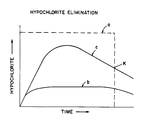
- curve "a” represents the idealized hypochlorite concentration curve over a denture cleansing cycle t.
- the hypochlorite instantaneously reaches its maximum value and is immediately eliminated at the end of the cleansing cycle by the subsequent release of deactivator.
- Prior art methods of including a hypochlorite deactivator in the denture cleansing composition result in a hypochlorite concentration curve represented by curve “b.”
- the hypochlorite is maintained at a low level throughout the cleansing cycle. Hence, cleansing efficiency is greatly reduced.
- Curve “c” represents the results achieved by the method of this invention where k is the available hypochlorite concentration at end of the cleaning cycle. Ideally, k is zero.
- time and economic constraints require that k be fixed at same acceptable level which will permit hypochlorite derived odor to be masked by an acceptable fragrance.
- hypochlorite derived odor means solution odor as well as odor resulting from the attack of hypochlorite on proteinaceous material.
- the value of "k" is not itself significant since the test of an acceptable odor is a subjective one which must be determined by correlating product parameters with the perceived results as evaluated by users of the product.
- the spray dried fragrances comprise a fragrance oil which has been deposited on a solid, such as maltodextrin, by a solution spray drying technique.
- Illustrative, non-limiting examples of spray dried fragrances which can be used in the practice of this invention are peppermint, wintergreen, lime, lemon, menthol, and so forth. While the amount of fragrance used is a matter of choice at least 0.1% (w/w) based on the total denture cleansing composition should be used in order to mask the hypochlorite-chlorine odor.
- the hypochlorite deactivator is encapsulated in a barrier film which controls the rate of dissolution of the hypochlorite deactivator in the denture cleaning solution. While the encapsulation technique used in the practice of this invention is well known in the art, there are certain parameters which are critical to the successful encapsulation of a hypochlorite deactivator which is effective for the purpose of this invention. These parameters include selection of the coating material, particle size of the hypochlorite deactivator, weight percent of coating material relative to deactivator weight, the method of application of coating material and the amount of plasticizer used in the encapsulating film.
- the hypochlorite deactivator is utilized in either bead or granule form, and has a particle size of less than 20 mesh to about 50 mesh (U.S. standard stainless steel mesh).
- the appropriate particle size may be selected by sieving the deactivator and rejecting material which is collected on a 20 mesh screen and which passes through a 60 mesh screen. Particles larger than about 20 mesh cannot be used since they create problems in the feeder and hopper of the tabletting machine, e.g., segregation. At a particle size substantially smaller than 50 mesh the particles have too large a surface area and encapsulation become uneconomical because of the large quantities of encapsulating material required.
- the encapsulating material must be used at about 6% to about 20% by weight based on the total weight of the encapsulated deactivator particle, preferably about 12% to about 20%, and more preferably about 14% to about 20%. At less than 6% by weight of coating of encapsulating material the deactivator dissolves too quickly in the hypochlorite denture cleanser solution resulting in insufficient hypochlorite being available for cleaning. At above about 20% by weight of the coating of encapsulating material the dissolution rate is too slow to be of any value from a practical cleaning cycle standpoint.
- the coating can be applied either from a solution or an emulsion.
- the solids content of the vehicle should be about 6 to about 30% (w/w) based on the total weight of vehicle plus coating. Below 6% solids inordinately long times are required to apply the coating. At high solids content, i.e. greater than 30% (w/w), the solution or emulsion was either too viscous or the coatings were not uniform.
- a plasticizer is required for the coating to ensure good film-forming characteristics. Excessive amounts of plasticizer results in stickiness and agglomeration of coated particles. Too low a level results in a discontinuous coating and as a consequence immediate dissolution of deactivator. Thus, about 18% to about 40% (w/w) based on the film former solids is used, preferably about 20% to about 30% (w/w). It should be noted that reference to coating weight includes film former, plasticizers and adjunctives which may be included in the coating formulation.
- plasticizer used will depend on the selection of film former. Specific plasticizers are normally recommended by the film former supplier and no advantage is seen in deviating from these recommendations. Where the film former is ethyl cellulose the recommended plasticizer is dibutyl sebacate. Triethyl citrate can also be used.
- the film former must not be water soluble. Since the pH of denture cleansing solutions is about 8.5 to 11.0, e.g. 9.0 to 10.0, the film former must not be solubilized by basic solutions. Hence, the enteric coatings normally used for drugs are ineffective.
- the film former must, therefore, be water insoluble. Furthermore, it must either be permeable with respect to H2O and nitrite ions, or adjunctives which are water soluble or hydrophilic must be included in the film.
- water soluble polymers such as polyvinyl alcohol can be incorporated into the coating at about 2% to about 10% by weight.
- the adjunctive can be a water insoluble material rendered soluble at high pH, e.g. polyvinyl acetate phthalate (PVAP) or butyrate (PVAB).
- PVAP polyvinyl acetate phthalate
- PVAB butyrate
- the film former is preferably swelled by water.
- PVAB and PVAP may be utilized as the film former at coating weights of about 25 to about 30% (w/w).
- the preferred film former is ethyl cellulose.
- Other film formers which may be utilized either directly or with the aid of adjunctives are styrene-maleic anhydride copolymers and sulfonated polystyrene wherein the sulfonation comprises less than 15 mole % of the polymer e.g. 5-10 mole %.
- Other sulfonated polymers such as sulfonated ethylene-propylene-terpolymers (EPDM), with the same caveat as to degree of sulfonatin, and polyvinyl acrylate may be used.
- the film former is preferably applied by spraying a solution or emulsion into the air inlet stream of a fluidized bed comprising the particles to be coated.
- the inlet air temperature should be about room temperature 23°C, to about 65°C.
- Air flow rate is required to fluidize the particles so that a "boiling bed” condition exists.
- the air flow rate will depend on the bed height (charge) and particle density. As those skilled in the fluidization art will recognize, the flow rate must be sufficient so that the pressure drop through the bed exceeds the bed weight per unit area. However, excessive flow rates are to be avoided to minimize attrition or fracture of particles.
- An air flow rate of about 30 to about 80 m3/hr has been found to be adequate, preferably the air flow rate is about 55 to about 75 m3/hr.
- coating medium means the film former, plasticizers and adjunctives in a solvent or as an emulsion.
- Particles of NaNO2 in the 20 to 50 mesh range were coated with a plasticized film of ethyl cellulose.
- the air inlet temperature was room temperature and the carrier air flow rate was 55/m3/hr.
- the coating medium was introduced to the unit at 5 ml/min.
- the product was dried in the column for about 15 min. at 65°C and subsequently cured at about 90-95°C for one hour.
- the coating weight was 8% (w/w) based on the NaNo2.
- the coating medium had the following formulation: Coating Solution w/w % Ethyl Cellulose 5.0 Dibutyl Sebacate 1.0 Stearyl dimethyl benzyl NH4Cl 0.25 Ethanol 93.75 Approximately 0.400 Kg of material was coated using about 0.65 Kg of solution.
- Example II The method of Example I was repeated using 0.200 Kg of NaNO2.
- the inlet air temperature was 60°C and the fluidizing air flow rate was 75 m3/hr.
- the coating was applied from an emulsion which included an ethyl cellulose latex emulsion (30% solids).
- the formulation of the coating medium was as follows: Component w/w % Ethyl Cellulose latex emulsion 50.00 Dibutyl Sebacate 3.00 Deionized Water 46.965 Talc 0.035
- the finished product comprised a coating of 15.25% (w/w) based on the NaNO2.
- the product was oven dried for 1 hour at 90°C.
- Example I was repeated using 0.400 Kg of sodium perborate, monohydrate.
- the fluidizing air flow rate was 32 m3/hr and the spray rate was 8 ml/min sustained for 65 minutes.
- the formulation of the coating medium was as follows: Component w/w% Ethyl Cellulose 5.0 Dibutyl Sebacate 1.0 Ethanol, Anhydrous 94.0
- Tablets were prepared using the compositions shown in the Table incorporating sodium dichloroisocyanate as the hypochlorite generating agent and the deactivators of Examples I, II and III.
- the amount of deactivator used is the stoichiometric amount with respect to the amount of dichloroisocyanurate.
- Example II was repeated and encapsulated NaNO2 having coating weights (% w/w) of 6, 8, 10, 12, 14, 16, and 20%. Tablets were prepared using the formulation of Run C of the Table of Example IV. The total weight of encapsulated deactivator was adjusted to compensate for coating weight thereby ensuring that a stoichiometric amount of deactivator was present.
- compositions were evaluated by testing the odor characteristics and cleansing efficacy of each. Tests subjects were asked to evaluate the objectionability of hypochlorite derived odor from the solution and on the skin. All of the compositions were acceptable from the standpoint of hypochlorite derived odor.
- Cleansing efficacy was found to be marginal below 12 weight percent of coating. Optimum results were achieved at a coating weight of 18%. At 20% there was no substantial improvement in cleaning over the 18% coating which would not justify the increased cost of coating.
Landscapes
- Health & Medical Sciences (AREA)
- Life Sciences & Earth Sciences (AREA)
- Veterinary Medicine (AREA)
- Animal Behavior & Ethology (AREA)
- General Health & Medical Sciences (AREA)
- Public Health (AREA)
- Birds (AREA)
- Epidemiology (AREA)
- Oral & Maxillofacial Surgery (AREA)
- Chemical & Material Sciences (AREA)
- Inorganic Chemistry (AREA)
- Cosmetics (AREA)
- Pharmaceuticals Containing Other Organic And Inorganic Compounds (AREA)
Claims (19)
- Ein Präparat für die gesteuerte Abgabe von gekapseltem Hypochlorit-Desaktivator, welches umfasst:(a) Hypochlorit-Desaktivator Perlen oder Körner welche Alkali-Metall-Nitrit oder Alkali-Metall-Perborat enthalten, die eine Partikelgrösse von 297 bis 841 Mikrometern (µm) aufweisen (entsprechend etwa 20 bis 50 U.S. Standard stainless steel mesh) und(b) einen Überzug, welcher die Desaktivator-Perlen oder -Körner vollständig umgibt, wobei der Überzug umfasst(i) eine nichtwasserlösliche, pH-unempfindliche, eine dünne, Schicht bildende Verbindung, wobei die dünne Schicht, bei einem PH von etwa 8.5 bis 11, für Wasser, Nitrit- und Perborat-Ionon durchlässig ist und,(ii) bezogen auf das Gewicht der schichtbildenden Verbindung, 18% bis 40% eines Weichmachers; wobei die schichtbildende Verbindung etwa 6% bis 20% (w/w) der eingekapselten Desaktivator-Verbindung enthält
- Ein Präparat nach Anspruch 1, in welchem die, eine dünne Schicht bildende Verbindung Ethyl-Cellulose und der Weichmacher Dibutyl-Talg ist.
- Ein Präparat nach Anspruch 1 oder 2, in welchem die schichtbildende Verbindung 14% bis 20%, vorzugsweise 16% bis 20% und noch besser etwa 18% des Gesamtgewichts des umkapselten Desaktivators ausmacht.
- Ein Präparat nach einem der Ansprüche 1 bis 3, in welchem das Alkalimetall Natrium ist.
- Ein Präparat nach Anspruch 4, in welchem der Desaktivator NaNO₂ ist.
- Ein Präparat zum Reinigen künstlicher Gebisse welches (i) einen Hypochlorit erzeugenden Bestandteil und (ii) ein Präparat für die gesteuerte Abgabe von gekapseltem Hypochlorit-Desaktivator nach einem der Ansprüche 1 bis 5 umfasst.
- Ein Präparat nach Anspruch 6, in welchem die Desaktivator-Verbindung, bezogen auf den Hypochlorit erzeugenden Bestandteil, in angenähert stöchiometrischer Menge vorhanden ist.
- Verfahren zum Herstellen eines Präparats für die gesteuerte Abgabe von gekapseltem Hypochlorit-Desaktivator, bei welchem:
Perlen oder Körner von Hypochlorid-Desaktivator, der Alkalimetall-Nitrit oder Alkalimetall-Perborat enthält, und die eine Partikelgrösse von etwa 297 bis 841 Mikrometern (µm) (entsprechend etwa 20 bis 50 U.S. Standard stainless steel mesh) aufweisen, mit einer Verbindung zum Überziehen der Perlen und Körnern in Kontakt bringt, wobei die Verbindung zum Überziehen(i) eine nichtwasserlösliche, pH-unempfindliche, dünne, Schicht bildende Verbindung enthält und die dünne Schicht, bei einem PH von etwa 8.5 bis 11, für Wasser, Nitrit- und Perborat-Ionon durchlässig ist und,(iii) einen Weichmacher, der, bezogen auf das Gewicht der umkapselten Perlen oder Körner, 6% bis 20% schichtbildende Verbindung enthält, wobei der Weichmacher, bezogen auf das Gewicht der schichtbildenden Verbindung, 18% bis 40% ausmacht und die umkapselten Desaktivator-Perlen oder Körner 45 bis 75 Minuten bei einer Temperatur von 85° bis 100° getrocknet werden. - Verfahren nach Anspruch 8, bei welchem 20% bis 30% Weichmacher, bezogen auf das Gewicht der schichtbildenden Verbindung, vorhanden ist.
- Verfahren nach Anspruch 8 oder 9, bei welchem die schichtbildende Verbindung mit einem Flüssigbett-Sprühschicht-Verfahren mit einer Lösung oder einer Emulsion der Überzug-Verbindung aufgebracht wird.
- Verfahren nach Anspruch 10, bei welchem die den Überzug bildende Verbindung 6% bis 30% des Gewichts der Lösung oder Emulsion, ausmacht.
- Verfahren nach Anspruch 11, bei welchem den Überzug bildende Verbindung besteht aus:
angenähert 50% Gewichtsanteil einer Ethylcellulose-Emulsion die einen Feststoffanteil von 30% bezogen auf Gewicht aufweist; und
Dibutyl-Talg in der Grössenordnung von angenähert 3 % bezogen auf das Gewicht der den Überzug bildenden Emulsion. - Ein Brausepräparat, zum Reinigen künstlicher Gebisse, welche zusammengesetzt ist aus:
einen ersten Brause-Anteil, der ein Reinigungsmittel umfasst, welches ein Hypochlorit erzeugendes Mittel enthält; und
einen zweiten Brause-Anteil, welcher einen Hypochlorit-Desaktivator enthält; worin der Hypochlorit-Desaktivator ein Mittel zur gesteuerten Abgabe von Hypochlorit-Desaktivator, nach einem der Ansprüche 1 bis 5 ist. - Präparat nach Anspruch 12, worin das Hypochlorit erzeugende Mittel Natrium-Dichlor-Isocyanurat ist.
- Präparat nach einem der Ansprüche 13 oder 14 worin der Hypochlorit-Desaktivator Natrium-Perborat oder Natrium-Nitrit, vorzugsweise Natrium-Nitrit ist.
- Präparat nach einem der Ansprüche 13 bis 15, worin der zweite Anteil sich in Wasser langsamer auflöst als der erste Anteil.
- Präparat nach Anspruch 16, worin der zweite Anteil eine gesteuerte Auflös-Rate aufweist, wobei die Auflös-Rate durch die Beigabe einer bestimmten Menge eines Brausemittels bestimmt wird.
- Präparat nach Anspruch 17, worin das Brausemittel eine Mischung aus einem Alkalimetall-Bikarbonat, vorzugsweise Natrium-Bikarbonat, und einer wasserlöslichen, organischen Säure, vorzugsweise Zitronensäure, ist, wobei die Mischung 20% bis 40%, bezogen auf das Gewicht des zweiten Anteils, oder bezogen auf das Gewicht des Gesamtgewichts der Tablette ausmacht.
- Präparat nach Anspruch 18, worin das Brausemittel aus 15% bis 20% Alkalimetall-Perborat-Monohydarat, bezogen auf das Gesamtgewicht des zweiten Anteils, oder bezogen auf das Gesamtgewicht der Tablette, besteht.
Priority Applications (1)
| Application Number | Priority Date | Filing Date | Title |
|---|---|---|---|
| EP19890119399 EP0360299A3 (de) | 1984-03-16 | 1984-12-14 | Sprudelndes Gebissreinigungsmittel |
Applications Claiming Priority (2)
| Application Number | Priority Date | Filing Date | Title |
|---|---|---|---|
| US590129 | 1984-03-16 | ||
| US06/590,129 US4552679A (en) | 1984-03-16 | 1984-03-16 | Method for deodorizing hypochlorite denture cleansing solutions and product containing a delayed release hypochlorite deactivator |
Related Child Applications (2)
| Application Number | Title | Priority Date | Filing Date |
|---|---|---|---|
| EP89119399.7 Division-Into | 1984-12-14 | ||
| EP19890119399 Division EP0360299A3 (de) | 1984-03-16 | 1984-12-14 | Sprudelndes Gebissreinigungsmittel |
Publications (3)
| Publication Number | Publication Date |
|---|---|
| EP0164472A2 EP0164472A2 (de) | 1985-12-18 |
| EP0164472A3 EP0164472A3 (en) | 1987-12-16 |
| EP0164472B1 true EP0164472B1 (de) | 1992-03-18 |
Family
ID=24360983
Family Applications (2)
| Application Number | Title | Priority Date | Filing Date |
|---|---|---|---|
| EP84308724A Expired - Lifetime EP0164472B1 (de) | 1984-03-16 | 1984-12-14 | Eingekapseltes Hypochlorit-Desaktivierungsmittel |
| EP19890119399 Withdrawn EP0360299A3 (de) | 1984-03-16 | 1984-12-14 | Sprudelndes Gebissreinigungsmittel |
Family Applications After (1)
| Application Number | Title | Priority Date | Filing Date |
|---|---|---|---|
| EP19890119399 Withdrawn EP0360299A3 (de) | 1984-03-16 | 1984-12-14 | Sprudelndes Gebissreinigungsmittel |
Country Status (5)
| Country | Link |
|---|---|
| US (1) | US4552679A (de) |
| EP (2) | EP0164472B1 (de) |
| CA (1) | CA1240619A (de) |
| DE (1) | DE3485600D1 (de) |
| ZA (1) | ZA849490B (de) |
Cited By (1)
| Publication number | Priority date | Publication date | Assignee | Title |
|---|---|---|---|---|
| US5944528A (en) * | 1996-07-29 | 1999-08-31 | Idex Dental Sciences, Inc. | Chlorine dioxide tooth whitening compositions |
Families Citing this family (37)
| Publication number | Priority date | Publication date | Assignee | Title |
|---|---|---|---|---|
| JPH0621905B2 (ja) * | 1986-08-15 | 1994-03-23 | ホ−ヤ株式会社 | コンタクトレンズ洗浄用組成物 |
| US4828746A (en) * | 1986-11-24 | 1989-05-09 | The Procter & Gamble Company | Detergent compatible, dryer released fabric softening/antistatic agents in a sealed pouch |
| US4867988A (en) * | 1987-04-08 | 1989-09-19 | Production Previews, Inc. | Dentifrice containing microencapsulated oxygen |
| US4965012A (en) * | 1987-04-17 | 1990-10-23 | Olson Keith E | Water insoluble encapsulated enzymes protected against deactivation by halogen bleaches |
| US5187011A (en) * | 1989-12-04 | 1993-02-16 | Exxon Research And Engineering Company | Composition comprising encapsulated substrate with thermoplastic polymer overcoating |
| US5192615A (en) * | 1989-12-06 | 1993-03-09 | Exxon Research & Engineering Company | Composition comprising encapsulated substrate and thermoplastic polymer overcoating |
| US5204183A (en) * | 1989-12-14 | 1993-04-20 | Exxon Research And Engineering Company | Composition comprising polymer encapsulant for sealing layer encapsulated substrate |
| NL9002561A (nl) * | 1990-11-23 | 1992-06-16 | Tekke Andelbeek | Werkwijze voor het reinigen van een tandprothese, verpakking van porties stoffen voor het uitvoeren van de werkwijze en tablet of capsule te gebruiken bij het uitvoeren van de werkwijze. |
| US5205961A (en) * | 1991-04-18 | 1993-04-27 | Ppg Industries, Inc. | Granular calcium hypochlorite treatment process |
| NL9101559A (nl) | 1991-09-16 | 1993-04-16 | Dentip Int Bv | Toepassing van organische zuren voor het reinigen van gebitsprotheses alsmede preparaten, die dergelijke zuren bevatten. |
| US5384062A (en) * | 1993-12-01 | 1995-01-24 | Warner-Lambert Company | Perborate persulfate: protease denture cleanser tablet composition |
| WO1995027472A1 (en) * | 1994-04-07 | 1995-10-19 | Richter Jon L | Oral rinse and method of treating halitosis |
| NL9500373A (nl) * | 1995-02-24 | 1996-10-01 | Diamond White Avv | Werkwijze voor het bereiden van een combinatiepreparaat voor het bleken van gebitselementen enerzijds en voor huid- en slijmvliesaandoeningen anderzijds alsmede toepassing daarvan. |
| US5866107A (en) * | 1995-08-30 | 1999-02-02 | Cosmair, Inc. | Dust free bleach |
| US6313086B1 (en) * | 1996-07-31 | 2001-11-06 | The Procter & Gamble Company | Detergent compositions containing and effervescent |
| US5911909A (en) * | 1996-11-12 | 1999-06-15 | S. C. Johnson & Son, Inc. | Acidic bleaching solution, method of preparation and a bleaching system for forming the same |
| ES2227660T5 (es) * | 1997-05-27 | 2009-09-14 | THE PROCTER & GAMBLE COMPANY | Pastillas y procedimiento para fabricar pastillas. |
| US5895781A (en) * | 1997-12-22 | 1999-04-20 | S. C. Johnson & Son, Inc. | Cleaning compositions for ceramic and porcelain surfaces and related methods |
| GB2337054A (en) * | 1998-05-08 | 1999-11-10 | Procter & Gamble | Effervescent particle |
| US6409993B1 (en) | 1999-11-04 | 2002-06-25 | Ultradent Products, Inc. | Dental bleaching compositions incorporating perborates |
| US6258343B1 (en) * | 2000-08-15 | 2001-07-10 | Colgate-Palmolive Company | Method for encapsulating reactive dental agents |
| US7153438B2 (en) * | 2003-02-21 | 2006-12-26 | Pur Water Purification Products, Inc. | Water treatment compositions with masking agent |
| US8044008B2 (en) * | 2007-08-09 | 2011-10-25 | Lynn Muzik | Dental appliance cleansing composition |
| US20100009009A1 (en) | 2008-07-10 | 2010-01-14 | Micropure, Inc. | Method and composition for prevention and treatment of oral fungal infections |
| US8287755B2 (en) * | 2008-12-09 | 2012-10-16 | The Clorox Company | Solid-layered bleach compositions |
| US8361945B2 (en) * | 2008-12-09 | 2013-01-29 | The Clorox Company | Solid-layered bleach compositions and methods of use |
| US8361942B2 (en) * | 2008-12-09 | 2013-01-29 | The Clorox Company | Hypochlorite denture compositions and methods of use |
| US8361944B2 (en) | 2008-12-09 | 2013-01-29 | The Clorox Company | Solid-layered bleach compositions and methods of use |
| US20100233101A1 (en) | 2009-02-13 | 2010-09-16 | Micropure, Inc. | Composition and method for the oxidative consumption of salivary biomolecules |
| CA2819357C (en) * | 2010-12-03 | 2014-03-11 | Fmc Corporation | Effervescent composition for improved carbon dioxide generation in insect monitor devices |
| US20130216631A1 (en) * | 2012-02-17 | 2013-08-22 | The Clorox Company | Targeted performance of hypohalite compositions thereof |
| US8937036B2 (en) | 2013-03-15 | 2015-01-20 | Lma Solutions Inc. | Cleaning, disinfecting, deodorizing, and bleaching composition for removable dental appliances |
| US9205161B2 (en) | 2014-03-14 | 2015-12-08 | LMA Solutions, Inc. | Disinfecting composition comprising a chloramine bleaching agent for removable dental appliances |
| CA3020197C (en) | 2017-09-01 | 2024-06-04 | Micropure, Inc. | Aliphatic anionic compounds and oxidative compounds with improved stability and efficacy for use in pharmaceutical compositions |
| MX2021001487A (es) * | 2018-08-10 | 2021-04-28 | Colgate Palmolive Co | Composiciones solidas para blanqueamiento dental y efectos antimicrobianos. |
| WO2021211174A1 (en) * | 2020-04-13 | 2021-10-21 | Chemtreat, Inc. | Methods and systems for controlling bacteria in biofilms |
| JP7770746B2 (ja) * | 2022-10-06 | 2025-11-17 | 四国化成工業株式会社 | 義歯洗浄剤及び義歯の洗浄方法 |
Citations (1)
| Publication number | Priority date | Publication date | Assignee | Title |
|---|---|---|---|---|
| GB2055579A (en) * | 1979-08-16 | 1981-03-11 | Contact Lens Mfg Ltd | Treating contact lenses |
Family Cites Families (19)
| Publication number | Priority date | Publication date | Assignee | Title |
|---|---|---|---|---|
| US3042621A (en) * | 1957-11-01 | 1962-07-03 | Colgate Palmolive Co | Detergent composition |
| LU66925A1 (de) * | 1973-01-29 | 1974-09-25 | ||
| US3755085A (en) * | 1970-09-30 | 1973-08-28 | Procter & Gamble | Prevention of enzyme deactivation by chlorine |
| US3821117A (en) * | 1971-07-23 | 1974-06-28 | Carter Wallace | Effervescent tablet |
| DE2318930A1 (de) * | 1972-04-17 | 1973-10-31 | Procter & Gamble | Enzym enthaltende detergenzgemische |
| US3723327A (en) * | 1972-06-05 | 1973-03-27 | Lever Brothers Ltd | Granular proteolytic enzyme composition |
| US3936385A (en) * | 1973-08-09 | 1976-02-03 | Colgate-Palmolive Company | Denture cleanser |
| IL46397A (en) * | 1974-01-07 | 1977-11-30 | Nat Patent Dev Corp | Process for sterilizing contact lenses |
| DE2413561A1 (de) * | 1974-03-21 | 1975-10-02 | Henkel & Cie Gmbh | Lagerbestaendiger, leichtloeslicher waschmittelzusatz und verfahren zu dessen herstellung |
| US3962107A (en) * | 1974-06-24 | 1976-06-08 | Johnson & Johnson | Enzyme-containing denture cleanser tablet |
| GB1534261A (en) * | 1974-11-08 | 1978-11-29 | Reckitt & Colmann Prod Ltd | Cleaning composition |
| US4327151A (en) * | 1976-08-25 | 1982-04-27 | Lever Brothers Company | Encapsulated bleaches and methods for their preparation |
| DE2647364C2 (de) * | 1976-10-20 | 1983-12-29 | Kukident Richardson GmbH & Co. KG, 6940 Weinheim | Reinigungstablette für Zahnprothesen |
| US4295985A (en) * | 1979-10-25 | 1981-10-20 | Petrow Henry G | Method of removal of chlorine retained by human skin and hair after exposure to chlorinated water, and soap and shampoo compositions adapted to effect said removal |
| AT371338B (de) * | 1979-10-30 | 1983-06-27 | Gergely Gerhard | Reinigungstablette fuer zahnprothesen |
| US4362639A (en) * | 1981-04-03 | 1982-12-07 | Warner-Lambert Company | Cleanser with improved afterodor and tarnish resistance |
| DE3128336A1 (de) * | 1981-07-17 | 1983-01-27 | Henkel KGaA, 4000 Düsseldorf | "verfahren zur herstellung umhuellter koerniger bleichaktivatoren" |
| ZA828968B (en) * | 1981-12-08 | 1983-11-30 | Warner Lambert Co | Denture cleanser |
| US4421664A (en) * | 1982-06-18 | 1983-12-20 | Economics Laboratory, Inc. | Compatible enzyme and oxidant bleaches containing cleaning composition |
-
1984
- 1984-03-16 US US06/590,129 patent/US4552679A/en not_active Expired - Fee Related
- 1984-12-04 CA CA000469316A patent/CA1240619A/en not_active Expired
- 1984-12-05 ZA ZA849490A patent/ZA849490B/xx unknown
- 1984-12-14 DE DE8484308724T patent/DE3485600D1/de not_active Expired - Fee Related
- 1984-12-14 EP EP84308724A patent/EP0164472B1/de not_active Expired - Lifetime
- 1984-12-14 EP EP19890119399 patent/EP0360299A3/de not_active Withdrawn
Patent Citations (1)
| Publication number | Priority date | Publication date | Assignee | Title |
|---|---|---|---|---|
| GB2055579A (en) * | 1979-08-16 | 1981-03-11 | Contact Lens Mfg Ltd | Treating contact lenses |
Non-Patent Citations (1)
| Title |
|---|
| Dr.M.W.RANNEY: "Microencapsulation Technology", 1969, pages 14, 15, 120; Noyes Dev. Corp., New Jersey, US * |
Cited By (1)
| Publication number | Priority date | Publication date | Assignee | Title |
|---|---|---|---|---|
| US5944528A (en) * | 1996-07-29 | 1999-08-31 | Idex Dental Sciences, Inc. | Chlorine dioxide tooth whitening compositions |
Also Published As
| Publication number | Publication date |
|---|---|
| CA1240619A (en) | 1988-08-16 |
| US4552679A (en) | 1985-11-12 |
| EP0360299A2 (de) | 1990-03-28 |
| DE3485600D1 (de) | 1992-04-23 |
| ZA849490B (en) | 1985-07-31 |
| EP0360299A3 (de) | 1991-12-04 |
| EP0164472A2 (de) | 1985-12-18 |
| EP0164472A3 (en) | 1987-12-16 |
Similar Documents
| Publication | Publication Date | Title |
|---|---|---|
| EP0164472B1 (de) | Eingekapseltes Hypochlorit-Desaktivierungsmittel | |
| US4671972A (en) | Controlled release encapsulated hypochlorite deactivator for use in denture cleansers | |
| US4568560A (en) | Encapsulated fragrances and flavors and process therefor | |
| US6893629B2 (en) | Delivery system for a tooth whitener | |
| US5945032A (en) | Polymer/hydrogen peroxide complexes | |
| US5360609A (en) | Chlorine dioxide generating polymer packaging films | |
| AU743730B2 (en) | Dentifrice composition containing encapsulated reactive ingredients | |
| JPS63199799A (ja) | 殺菌作用を有するコンタクトレンズ洗浄錠剤の製法 | |
| DK157729B (da) | Tandproteserensemiddel | |
| GR950300005T1 (en) | Pharmaceutical preparation in the form of an effervescent and/or disintegrating tablet or an instant granulate, and process for producing it. | |
| JP2003504324A5 (de) | ||
| JPH08208741A (ja) | 粉末状過酸化水素−ポリマー−複合体の製法 | |
| US5486304A (en) | Fragrant denture cleanser composition | |
| KR100471918B1 (ko) | 치아 미백 용 패취 | |
| JPH0517338A (ja) | 浴用剤組成物 | |
| JP2003246998A (ja) | 発泡性洗浄剤 | |
| US6258343B1 (en) | Method for encapsulating reactive dental agents | |
| US5466391A (en) | Granulated agent and catalyst used for oxygen generation | |
| US5230903A (en) | Chloroisocyanurate composition | |
| CN115590020A (zh) | 一种以泡沫为壳材的缓释二氧化氯微胶囊及其制备方法 | |
| CN114010569A (zh) | 一种无水美白膏体及其制作方法 | |
| KR20010080718A (ko) | 퀴나프릴 마그네슘을 포함하는 약제 합성물 | |
| CN112423724A (zh) | 用于牙齿增白和抗微生物效果的固体组合物 | |
| MXPA00011988A (en) | Dentifrice composition containing encapsulated reactive ingredients | |
| MXPA97007130A (en) | Polymer complexes / hidrog peroxide |
Legal Events
| Date | Code | Title | Description |
|---|---|---|---|
| PUAI | Public reference made under article 153(3) epc to a published international application that has entered the european phase |
Free format text: ORIGINAL CODE: 0009012 |
|
| AK | Designated contracting states |
Designated state(s): BE CH DE FR GB IT LI NL |
|
| PUAL | Search report despatched |
Free format text: ORIGINAL CODE: 0009013 |
|
| AK | Designated contracting states |
Kind code of ref document: A3 Designated state(s): BE CH DE FR GB IT LI NL |
|
| 17P | Request for examination filed |
Effective date: 19880601 |
|
| 17Q | First examination report despatched |
Effective date: 19890605 |
|
| GRAA | (expected) grant |
Free format text: ORIGINAL CODE: 0009210 |
|
| ITF | It: translation for a ep patent filed | ||
| AK | Designated contracting states |
Kind code of ref document: B1 Designated state(s): BE CH DE FR GB IT LI NL |
|
| PG25 | Lapsed in a contracting state [announced via postgrant information from national office to epo] |
Ref country code: NL Effective date: 19920318 Ref country code: LI Effective date: 19920318 Ref country code: FR Effective date: 19920318 Ref country code: CH Effective date: 19920318 Ref country code: BE Effective date: 19920318 |
|
| XX | Miscellaneous (additional remarks) |
Free format text: TEILANMELDUNG 89119399.7 EINGEREICHT AM 14/12/84. |
|
| REF | Corresponds to: |
Ref document number: 3485600 Country of ref document: DE Date of ref document: 19920423 |
|
| REG | Reference to a national code |
Ref country code: CH Ref legal event code: PL |
|
| EN | Fr: translation not filed | ||
| NLV1 | Nl: lapsed or annulled due to failure to fulfill the requirements of art. 29p and 29m of the patents act | ||
| PG25 | Lapsed in a contracting state [announced via postgrant information from national office to epo] |
Ref country code: GB Effective date: 19921214 |
|
| ITTA | It: last paid annual fee | ||
| PLBE | No opposition filed within time limit |
Free format text: ORIGINAL CODE: 0009261 |
|
| STAA | Information on the status of an ep patent application or granted ep patent |
Free format text: STATUS: NO OPPOSITION FILED WITHIN TIME LIMIT |
|
| 26N | No opposition filed | ||
| GBPC | Gb: european patent ceased through non-payment of renewal fee |
Effective date: 19921214 |
|
| PG25 | Lapsed in a contracting state [announced via postgrant information from national office to epo] |
Ref country code: DE Effective date: 19930901 |