EP0164728B1 - Aggloméré laminé amortissant les vibrations - Google Patents
Aggloméré laminé amortissant les vibrations Download PDFInfo
- Publication number
- EP0164728B1 EP0164728B1 EP19850107194 EP85107194A EP0164728B1 EP 0164728 B1 EP0164728 B1 EP 0164728B1 EP 19850107194 EP19850107194 EP 19850107194 EP 85107194 A EP85107194 A EP 85107194A EP 0164728 B1 EP0164728 B1 EP 0164728B1
- Authority
- EP
- European Patent Office
- Prior art keywords
- polymer
- metal plate
- composite metal
- thermoplastic polymer
- acrylate
- Prior art date
- Legal status (The legal status is an assumption and is not a legal conclusion. Google has not performed a legal analysis and makes no representation as to the accuracy of the status listed.)
- Expired - Lifetime
Links
Images

Classifications
-
- C—CHEMISTRY; METALLURGY
- C08—ORGANIC MACROMOLECULAR COMPOUNDS; THEIR PREPARATION OR CHEMICAL WORKING-UP; COMPOSITIONS BASED THEREON
- C08L—COMPOSITIONS OF MACROMOLECULAR COMPOUNDS
- C08L23/00—Compositions of homopolymers or copolymers of unsaturated aliphatic hydrocarbons having only one carbon-to-carbon double bond; Compositions of derivatives of such polymers
- C08L23/02—Compositions of homopolymers or copolymers of unsaturated aliphatic hydrocarbons having only one carbon-to-carbon double bond; Compositions of derivatives of such polymers not modified by chemical after-treatment
-
- C—CHEMISTRY; METALLURGY
- C08—ORGANIC MACROMOLECULAR COMPOUNDS; THEIR PREPARATION OR CHEMICAL WORKING-UP; COMPOSITIONS BASED THEREON
- C08L—COMPOSITIONS OF MACROMOLECULAR COMPOUNDS
- C08L25/00—Compositions of, homopolymers or copolymers of compounds having one or more unsaturated aliphatic radicals, each having only one carbon-to-carbon double bond, and at least one being terminated by an aromatic carbocyclic ring; Compositions of derivatives of such polymers
- C08L25/02—Homopolymers or copolymers of hydrocarbons
- C08L25/04—Homopolymers or copolymers of styrene
- C08L25/08—Copolymers of styrene
- C08L25/14—Copolymers of styrene with unsaturated esters
-
- Y—GENERAL TAGGING OF NEW TECHNOLOGICAL DEVELOPMENTS; GENERAL TAGGING OF CROSS-SECTIONAL TECHNOLOGIES SPANNING OVER SEVERAL SECTIONS OF THE IPC; TECHNICAL SUBJECTS COVERED BY FORMER USPC CROSS-REFERENCE ART COLLECTIONS [XRACs] AND DIGESTS
- Y10—TECHNICAL SUBJECTS COVERED BY FORMER USPC
- Y10S—TECHNICAL SUBJECTS COVERED BY FORMER USPC CROSS-REFERENCE ART COLLECTIONS [XRACs] AND DIGESTS
- Y10S525/00—Synthetic resins or natural rubbers -- part of the class 520 series
- Y10S525/931—Blend of stated incompatibility
-
- Y—GENERAL TAGGING OF NEW TECHNOLOGICAL DEVELOPMENTS; GENERAL TAGGING OF CROSS-SECTIONAL TECHNOLOGIES SPANNING OVER SEVERAL SECTIONS OF THE IPC; TECHNICAL SUBJECTS COVERED BY FORMER USPC CROSS-REFERENCE ART COLLECTIONS [XRACs] AND DIGESTS
- Y10—TECHNICAL SUBJECTS COVERED BY FORMER USPC
- Y10T—TECHNICAL SUBJECTS COVERED BY FORMER US CLASSIFICATION
- Y10T428/00—Stock material or miscellaneous articles
- Y10T428/31504—Composite [nonstructural laminate]
- Y10T428/31678—Of metal
- Y10T428/31681—Next to polyester, polyamide or polyimide [e.g., alkyd, glue, or nylon, etc.]
-
- Y—GENERAL TAGGING OF NEW TECHNOLOGICAL DEVELOPMENTS; GENERAL TAGGING OF CROSS-SECTIONAL TECHNOLOGIES SPANNING OVER SEVERAL SECTIONS OF THE IPC; TECHNICAL SUBJECTS COVERED BY FORMER USPC CROSS-REFERENCE ART COLLECTIONS [XRACs] AND DIGESTS
- Y10—TECHNICAL SUBJECTS COVERED BY FORMER USPC
- Y10T—TECHNICAL SUBJECTS COVERED BY FORMER US CLASSIFICATION
- Y10T428/00—Stock material or miscellaneous articles
- Y10T428/31504—Composite [nonstructural laminate]
- Y10T428/31678—Of metal
- Y10T428/31692—Next to addition polymer from unsaturated monomers
-
- Y—GENERAL TAGGING OF NEW TECHNOLOGICAL DEVELOPMENTS; GENERAL TAGGING OF CROSS-SECTIONAL TECHNOLOGIES SPANNING OVER SEVERAL SECTIONS OF THE IPC; TECHNICAL SUBJECTS COVERED BY FORMER USPC CROSS-REFERENCE ART COLLECTIONS [XRACs] AND DIGESTS
- Y10—TECHNICAL SUBJECTS COVERED BY FORMER USPC
- Y10T—TECHNICAL SUBJECTS COVERED BY FORMER US CLASSIFICATION
- Y10T428/00—Stock material or miscellaneous articles
- Y10T428/31504—Composite [nonstructural laminate]
- Y10T428/31678—Of metal
- Y10T428/31692—Next to addition polymer from unsaturated monomers
- Y10T428/31699—Ester, halide or nitrile of addition polymer
Definitions
- the present invention relates to a vibration-damping composite metal plate comprising two metal plates and a resin composition sandwiched between the metal plates, wherein the resin composition has an excellent vibration-damping property and forms a vibration-damping layer in the vibration-damping composite metal plate.
- a vibration-damping composite metal plate such as a vibration-damping composite steel plate
- the composite metal plate damps vibration by internal friction due to shear deformation of a viscoelastic material of an interlayer of the plate.
- the composite metal plate is used to surround a noise source. For this reason, the composite metal plate is used in a plate form, and is also formed into a desired shape by, e.g., bending or drawing.
- the material of the interlayer of the vibration-damping composite metal plate is conventionally selected from thermoplastic or thermosetting resins.
- thermoplastic resins include polymers such as a vinyl acetate resin or a vinyl chloride resin; copolymers such as a vinyl acetate-ethylene copolymer or an acrylonitrile-styrene copolymer; or compositions thereof with a plasticizer.
- thermosetting resins include an urethane resin or an epoxy resin.
- a resin composition comprising a blend of two or more resins has also been proposed as the material of the interlayer.
- Japanese Patent Publication No. 79-1354 discloses a composition obtained by adding a viscoelastic polymer such as polyurethane to an acidic copolymer such as an ethylene-acrylic acid copolymer or an ionomer thereof.
- Japanese Patent Laid-open No. 59-80454 discloses a composition obtained by adding an amorphous polymer to a crystalline polyolefin modified by an unsaturated carboxylic acid or an anhydride thereof.
- Japanese Patent Laid-open No. 57-167360 discloses the water dispersion of a composition comprising a styrene-acrylic ester copolymer and a scaly in organic powder.
- a viscoelastic material conventionally used for an interlayer of a vibration-damping composite metal plate has a mechanical loss tangent tan ⁇ which becomes maximum at a temperature higher than its glass transition temperature.
- the rigidity of the viscoelastic material used is abruptly decreased, and the loss factor ⁇ of the metal plate is not always good.
- the good vibration-damping property of a laminated structure such as a vibration-damping composite metal plate is closely associated with the good vibration- damping property of the viscoelastic material used for the interlayer and the relatively high rigidity thereof. At the region of the low rigidity of the viscoelastic material, its vibration-damping property can not be fully exhibited.
- this specific temperature is high, the vibration-damping property is abruptly decreased.
- the glass transition temperature of the composition is decreased, and satisfactory vibration-damping property cannot be obtained at high temperatures.
- vibration-damping composite metal plates using a vibration-damping resin composition have satisfied both the requirements of good vibration-damping property and processability such as bending or deep drawing property. For this reason, a vibration-damping resin composition for a vibration-damping layer of a vibration-damping composite metal plate and having excellent vibration-damping property, processability and mechanical strength has been desired.
- FR-A-2 120 302 compatible compositions are disclosed on the basis of polyolefines and arylvinyl polymers.
- the resin compositions described in this publication have good mechanical properties but the aspect of vibration damping is not considered.
- FR-A-2 120 302 it is explained that in blending polyolefin PO and polystyrene PS, which are mutually incompatible, a PO-PS block copolymer is used as a compatibilizing agent. In this manner, the desired compatible compositions can be obtained.
- the present inventors have found the following fact.
- a crystalline thermoplastic resin incompatible with a conventionally used viscoelastic material is added thereto for use as a vibration-damping interlayer, even though the mechanical loss tangent tan ⁇ of the composition decreases more than that of the viscoelastic material alone, excellent vibration-damping property of the vibration-damping composite metal plate is obtained within a high temperature range by adding the crystalline thermoplastic resin, and a high rigidity of the composition can be maintained at a specific temperature at which the mechanical loss tangent tan ⁇ of the viscoelastic material is maximum.
- a vibration-damping composite metal plate comprising two metal plates and a resin composition sandwiched between the metal plates
- the resin composition consisting essentially of 20 to 70 % by weight of an amorphous thermoplastic polymer (a), and 80 to 30 % by weight of a crystalline thermoplastic polymer (b) incompatible with the polymer (a), at least one of monomers constituting the amorphous polymer (a) being graft or block copolymerized with the crystalline polymer (b) in an amount not less than 0,5 % by weight based on a total amount of the polymer (a), the polymer (a) being at least one member selected from the group consisting of vinyl ester polymers, polymers of aromatic vinyl monomers and acrylic ester polymers, and having a glass transition temperature lower than that of the polymer (b) and having a maximum tan ⁇ not less than 0,5 with a temperature range of -50 °C to 150 °C and a frequency range of 0,1 to 20 000 Hz
- the resin composition used in the vibration-damping composite metal plate according to the invention has a particularly good mechanical strength, e.g. tensile elongation, and the vibration-damping composite metal plate using this resin composition has an excellent formability.
- the amorphous thermoplastic polymer (a) is a polymer selected from the group consisting of homopolymer of acrylic ester, homopolymer of aromatic vinyl monomer, and copolymer derived from an acrylic ester and an aromatic vinyl monomer
- the crystalline thermoplastic polymer (b) is a crystalline polyolefin (B).
- the amorphous thermoplastic polymer (a) is a copolymer derived from a styrene monomer and an acrylic monomer.
- the acrylic ester is a member selected from the group consisting of n-butyl acrylate, 2-ethylhexyl acrylate, linevol acrylate, iso-nonyl acrylate, 2-butoxyethyl acrylate, diethyleneglycol monobutylether acrylate, lauryl methacrylate, and tridecyl methacrylate.
- the aromatic vinyl monomer is one member selected from the group consisting of styrene, 4-methyl styrene, and ⁇ -methyl styrene.
- the acrylic ester is one member selected from the group consisting of n-butyl acrylate, 2-ethylhexyl acrylate, linevol acrylate, iso-nonyl acrylate, 2-butoxyethyl acrylate, diethyleneglycol monobutylether acrylate, lauryl methacrylate, and tridecyl methacrylate; and the aromatic vinyl monomer is one member selected from the group consisting of styrene, 4-methyl styrene and ⁇ -methyl styrene.
- the amorphous thermoplastic polymer (a) has a maximum tan ⁇ not less than 1,0 at the temperature of -50 °C to 150 °C and the frequency of 0,1 to 20 000 Hz.
- the crystalline thermoplastic polymer (b) is one member selected from the group consisting of high density polyethylene, polypropylene and higher ⁇ -olefin polymers higher than polypropylene.
- the crystalline polyolefin (B) is one member selected from the group consisting of high density polyethylene and propylene polymers.
- the crystalline polyolefin (B) is propylene polymers.
- the composite metal plate according to the invention comprises 30 to 60 % by weight of the amorphous thermoplastic polymer (a) and 70 to 40 % by weight of the crystalline thermoplastic polymer (b).
- the content of the acrylic ester in the polymer (a) derived from the acrylic ester and the aromatic vinyl monomer is 5 to 95 % by weight.
- At least one of the monomers constituting the amorphous thermoplastic polymer (a) is graft or block copolymerized with the crystalline thermoplastic polymer (b) in an amount not less than 1 % by weight based on the total amount of the polymer (a).
- At least one of the monomers constituting the amorphous thermoplastic polymer (a) is graft or block copolymerized with the crystalline thermoplastic polymer (b) in an amount not less than 3 % by weight based on the total amount of the polymer (a).
- the crystalline thermoplastic polymer (b) has a melting point at least 30 °C higher than the glass transition temperature of the amorphous thermoplastic polymer (a).
- the crystalline thermoplastic polymer (b) has a melting point at least 50 °C higher than the glass transition temperature of the amorphous thermoplastic polymer (a).
- the crystalline thermoplastic polymer (b) has a shear storage modulus not less than 5 x 10³ N/cm2 (5 ⁇ 108 dyne/cm2) at the temperature and frequency at which the polymer (a) exhibits the maximum tan ⁇ .
- the crystalline thermoplastic polymer (b) has a shear storage modulus not less than 6 x 10³ N/cm2 (6 ⁇ 108 dyne/cm2) at the temperature and frequency at which the polymer (a) exhibits the maximum tan ⁇ .
- the resin composition consists essentially of 20 to 70 % by weight of an amorphous thermoplastic polymer (a), and 80 to 30 % by weight of a crystalline thermoplastic polymer (b) incompatible with the polymer (a), at least one of monomers constituting the amorphous polymer (a) being graft or block copolymerized with the crystalline polymer (b) in an amount not less than 0,5 % by weight based on a total amount of the polymer (a), the polymer (a) being at least one member selected from the group consisting of vinyl ester polymers, polymers of aromatic vinyl monomers and acrylic ester polymers, and having a glass transition temperature lower than that of the polymer (b) and having a maximum tan ⁇ not less than 0,5, preferably not less than 1,0 with a temperature range of -50 °C to 150 °C and a frequency range of 0,1 to
- the amorphous thermoplastic polymer (a) is a copolymer derived from a styrene monomer and an acrylic monomer. Also, a mixture of such amorphous thermoplastic polymers can be used, wherein the compatibility of the selected polymers is not required as long as the required value of tan ⁇ is obtained.
- the polymer (b) should have a shear storage modulus not less than 1 x 10³ N/cm2 (1 ⁇ 108 dyne/cm2), preferably not less than 5 x 10³ N/cm2 (5 ⁇ 108 dyne/cm2) and most preferably not less than 6 x 10³ N/cm2 (6 ⁇ 108 dyne/cm2), at the temperature and frequency at which the polymer (a) exhibits the maximum tan ⁇ .
- Incompatibility means the state wherein when the dynamic viscoelasticity of the composition consisting of the polymers (a) and (b) is measured, the respective polymers (a) and (b) independently exhibit maximum tan ⁇ . If the polymers (a) and (b) are compatible, the composition exhibits a maximum tan ⁇ at a single temperature at which the rigidity of the composition is considerably decreased and the loss factor ⁇ of the vibration-damping composite metal plate may not be satisfactory.
- the crystalline polymer (b) having a high rigidity at such a temperature must be mixed with the polymer (a) in order to maintain a high rigidity of the composition.
- the polymer (b) must be incompatible with the polymer (a), and have a melting point higher than the glass transition temperature of the polymer (a).
- the melting point of the polymer (b) is near the glass transition temperature of the polymer (a)
- the polymer (b) in the composition is softened or melts at a temperature at which the loss factor ⁇ of the composite metal plate is exhibited by the tan ⁇ of the composition attributable to the polymer (a).
- the rigidity of the composition is significantly reduced, and the loss factor ⁇ of the vibration-damping composite metal plate may be rendered poor.
- the melting point of the polymer (b) must be higher than the glass transition temperature of the polymer (a) by preferably 30°C or more and more preferably by 50°C or more.
- One or more resins may be used as the polymer (b) herein.
- These crystalline polymers (b) are a crystalline ⁇ -olefin resin such as polyethylene or polypropylene, or a crystalline condensation polymer such as polyamide or polyester.
- Crystalline ⁇ -olefin resins are preferably high density polyethylene, polypropylene, and higher ⁇ -olefin polymers higher than high-density polyethylene and polypropylene are particularly preferable since such higher ⁇ -olefin polymers have a high melting point.
- a preferable composition of the amorphous thermoplastic polymer (a) and the crystalline thermoplastic polymer (b) is a vinyl ester, styrene or acrylic polymer or copolymer as the polymer (a) and an ethylene or propylene polymer as the polymer (b).
- the amount of the amorphous thermoplastic polymer (a) is 20 to 70 % by weight, preferably 30 to 60 % by weight.
- a vibration-damping composite metal plate using a resin composition according to the present invention for an inter-layer must have a loss factor ⁇ of 0,05 or more and preferably 0,1 or more. If the amount of the polymer (a) is less than the prescribed amount, the tan ⁇ of the composition attributable to the polymer (a) is decreased. As a result, the loss factor ⁇ of a composite metal plate using this composition is also decreased, and satisfactory vibration-damping performance may not be obtained. On the other hand, if the amount of the polymer (a) is more than the prescribed amount, satisfactory processability of a composite metal plate may not be obtained.
- the amount of the crystalline thermoplastic polymer (b) is 80 to 30 % by weight, preferably 70 to 40 % by weight, depending on the amount of the polymer (a) used. In the composition of either embodiment, if the amount of the polymer (b) is smaller than the lower limit, the rigidity of the composition is impaired, and the loss factor ⁇ and processability of a vibration-damping composite metal plate using this composition are also impaired.
- the amount of the polymer (b) exceeds the upper limit, in the composition of the embodiment, the maximum tan ⁇ of the composition attributable to the polymer (a) is lowered, and the loss factor ⁇ of a vibration-damping composite metal plate using this composition is impaired.
- At least one of the monomers constituting the amorphous thermoplastic polymer (a) is copolymerized by graft or block copolymerization with the crystalline thermoplastic polymer (b).
- the copolymerization amount is not less than 0,5 % by weight based on a total amount of the polymer (a), more preferably not less than 1 % by weight and even more preferably not less than 3 % by weight based on the total amount of the polymer (a).
- the copolymerization amount has this value, the mechanical strength of the composition, e.g., the tensile elongation is improved, and processability, e.g., bending and drawing performance of a vibration-damping composite metal plate using this composition is much improved.
- the composition of the present invention is obtained by melt kneading or solution blending an amorphous polymer (a) and a crystalline polymer (b).
- the composition is prepared as a block or graft copolymer.
- examples of such polymers may include an ehtylene-vinyl acetate block copolymer or polypropylene-vinyl acetate graft copolymer.
- a copolymerization method and a simple kneading method may be used in combination.
- the block or graft copolymerization method may be various block or graft copolymerization methods including a method disclosed in Japanese Patent Laid-open No. 59-27934 wherein an amorphous polymer (a) is copolymerized with a polymer (b) by using a polymer peroxide of the amorphous polymer (a), a method disclosed in Japanese Patent Laid-open No. 58-198529 wherein functional groups introduced in polymers (a) and (b) are reacted to prepared a copolymer, and a method disclosed in Japanese Patent Publication No. 83-53003 wherein a resin and a vinyl monomer are subjected to water suspension graft copolymerization.
- a composition comprising a polymer (A) derived from an acrylic ester and a aromatic vinyl monomer as the amorphous thermoplastic polymer (a) and a crystalline polyolefin (B) as the crystalline thermoplastic polymer (b) has an excellent loss factor and a particularly excellent processability and mechanical properties such as tensile elongation.
- the composition satisfies the requirement of good balance in loss factor, mechanical strength and processability and is particularly useful as a composition for a vibration-damping layer of a vibration-damping composite metal plate.
- the polymers (A) derived from the acrylic eaters and aromatic vinyl monomers include copolymers there-between and the acrylic eaters and aromatic vinyl monomers copolymerized with the above-mentioned polyolefin.
- the acrylic esters include alkyl eaters of acrylic acid or methacrylic acid such as alkyl esters having 1 to 18 carbon atoms of (metha)acrylic acid, 2-alkoxyethyl esters of (metha)acrylic acid, or diethyleneglycol monoalkylesters of (metha)acrylic acid, e.g., methyl acrylate, ethyl acrylate, n-propyl acrylate, iso-propyl acrylate, n-butyl acrylate, iso-butyl acrylate, pentyl acrylate, hexyl acrylate, heptyl acrylate, octyl acrylate, 2-ethylhexyl acrylate, nonyl acryl
- acrylic esters are n- or iso-alkyl esters having 1 to 4 carbon atoms of acrylic acid, alkyl esters having 5 to 18 carbon atoms of acrylic acid, 2-alkoxyethyl esters having 1 to 4 carbon atoms of acrylic acid, diethyleneglycol monoalkylether esters having 1 to 4 carbon atoms of acrylic acid, n-butyl methacrylate, and alkyl esters having 5 to 18 carbon atoms of methacrylic acid.
- acrylic esters include n-butyl acrylate, 2-ethylhexyl acrylate, linevol acrylate, iso-nonyl acrylate, 2-butoxyethyl acrylate, diethyleneglycol monobutylether acrylate, lauryl methacrylate, and tridecyl methacrylate.
- aromatic vinyl monomers examples include styrene; nucleus substituted styrenes such as methyl styrene, dimethyl styrene, ethyl styrene, isopropyl styrene, or chlorostyrene; or ⁇ -substituted styrenes such as ⁇ -methyl styrene or ⁇ -ethyl styrene.
- Preferred examples of the aromatic vinyl monomers include styrene, 4-methyl styrene and ⁇ -methyl styrene. Styrene is particularly preferable.
- An acrylic ester and an aromatic vinyl monomer are copolymerized herein so as to allow free adjustment of the glass transition temperature of the copolymer between the glass transition temperature of the acrylic ester homopolymer and that of the aromatic vinyl homopolymer by variously changing the composition, and thereby optimally setting a temperature range and a frequency range within which the loss factor of a vibration-damping composite metal plate is optimum.
- Acrylic ester homopolymers generally have glass transition temperatures lower than those of aromatic vinyl homopolymers.
- an acrylic ester homopolymers should preferably have glass transition temperatures as lower as possible than those of aromatic vinyl homopolymers.
- Copolymerization of an acrylic ester monomer and an aromatic vinyl monomer can be performed by conventional random polymerization such as solution polymerization, emulsion polymerization, and suspension polymerization. More than one type of copolymer obtained may be used in a resin composition according to the present invention.
- the amount of the acrylic ester in the derived polymer can be suitably selected in order to set the temperature for obtaining the maximum loss factor ⁇ at the operating temperature of a vibration-damping composite metal plate.
- the amount of the acrylic ester falls within a range of 5 to 95% by weight.
- the copolymer can be obtained by copolymerizing a comonomer containing a small amount of, e.g., 30% by weight or less of another monomer as a third component, as needed.
- a copolymer obtained by co-polymerizing a comonomer containing a monomer having a carboxyl group, an epoxy group, a hydroxyl group or the like is preferably used.
- Examples of the crystalline polyolefin (B) to be used herein with the polymer (A) may include polymers of ⁇ -olefins such as ethylene, propylene, butene-1, pentene-1, 3-methylbutene-1, hexene-1, or 4-methylpentene-1; copolymers of two or more thereof; or copolymers thereof with other monomers mainly consisting of such ⁇ -olefins.
- ⁇ -olefins such as ethylene, propylene, butene-1, pentene-1, 3-methylbutene-1, hexene-1, or 4-methylpentene-1
- copolymers of two or more thereof or copolymers thereof with other monomers mainly consisting of such ⁇ -olefins.
- polystyrene resins examples include low density polyethylene, high density polyethylene, isotactic polypropylene, an ethylene-propylene copolymer, an ethylene-butene-1 copolymer, an ethylene-octene-1 copolymer, a propylene-butene-1 copolymer, polybutene-1, poly 4-methylpentene-1 or the like.
- high density polyethylene and propylene polymers are preferable, and propylene polymers are particularly preferable.
- the polymer (A) derived from an acrylic ester and an aromatic vinyl monomer includes a copolymer component copolymerized with the crystalline polyolefin (B). More than one crystalline polyolefin (B) can be used. However, at least a portion of such polyolefins is copolymerized with one or both the acrylic ester and the aromatic vinyl monomer.
- the copolymerization amount is not less than 0,5% by weight preferably not less than 1% by weight, and more preferably not less than 3% by weight based on the total weight of the polymer (A).
- the copolymerization amount with the crystalline polyolefin (B) is the above-mentioned amount, the resultant composition has a particularly good mechanical strength, and a composite metal plate using this composition has a particularly good processability.
- a composition comprising the polymer (A) and the crystalline polyolefin (B) can be obtained by kneading these components by a conventional kneading method.
- a modified substance obtained by graft or block copolymerizing a crystalline polyolefin with predetermined amounts of an acrylic ester and an aromatic vinyl monomer in a suspension system, a solution system or a molten system, preferably, in a water suspension is particularly preferable.
- the composition of the present invention may further contain various additives, plasticizers, fillers, elastomers and the like in amounts such that the desired properties of the composition are not impaired.
- a plasticizer when added can shift the temperature at which the composition has a maximum tan ⁇ to the lower temperature side, adjust the vibration-damping temperature range of a vibration-damping composite metal plate, impart viscidity to the composition to improve adhesion with a metal plate, and soften the composition to eliminate brittleness thereof.
- a filler when added serves to maintain a high rigidity at the temperature at which the composition exhibits a maximum tan ⁇ and thus improve the loss factor ⁇ .
- a styrene-butadiene block copolymer, a hydrogenated substance thereof, an ethylene-propylene rubber or the like is preferably used as an elastomer.
- the composition of the present invention may contain an electroconductive filler such as carbon black or metal fiber.
- an electroconductive filler such as carbon black or metal fiber.
- various flame retardants such as antimony trioxide or aluminum hydroxide can be added.
- the composition of the present invention is modified by a carboxyl group, an epoxy group, a hydroxyl group or the like, or crosslinking.
- Such modification can be performed in any step of preparing the composition.
- a composition consisting of a polymer (A) and a crystalline polyolefin (B) methods can be adopted including a method wherein a crystalline polyolefin (B) modified by a carboxyl group, an epoxy group or a hydroxyl group or a polymer (A) modified by the same group and derived from an acrylic ester and an aromatic vinyl monomer is added as a resin component, a method wherein the above-mentioned polar group is added in the step of copolymerizing at least one of an acrylic ester and an aromatic vinyl monomer with a crystalline polyolefin, a method wherein the above-mentioned polar group is added after the composition of the present invention is prepared.
- the composition of the present invention preferably has a shear storage modulus as a composition of 1 ⁇ 103 N/cm2 (1 ⁇ 108 dyne/cm2) or more at a temperature at which the polymer (a) exhibits a maximum tan ⁇ .
- the obtained vibration-damping composite steel plate can maintain a good vibration-damping property to a higher temperature range than in the case wherein only the polymer (a) used in the present invention is used for an interlayer.
- the polymer (a) is used, even if the tan ⁇ is high, shear storage modulus G' is abruptly decreased at a temperature for maintaining maximum tan ⁇ , and a loss factor ⁇ acceptable as a composite steel plate is not obtainable.
- the composition used in the present invention undergoes only a small decrease in shear storage modulus G' at a temperature at which the composition exhibits a maximum tan ⁇ attributable to the polymer (a). Therefore, even if the tan ⁇ of the composition is decreased to the slightly lower level than the level of the tan ⁇ of the polymer (a), the loss factor ⁇ of the composite steel plate is kept optimal. In some cases, a loss factor ⁇ higher than that of a composite steel plate using a resin composition consisting of only the polymer (a) can be obtained. Since the resin (b) used herein is crystalline, a resin having a high melting point can be used. For this reason, a polymer (a) which exhibits a maximum tan ⁇ at a high temperature can be used to obtain a vibration-damping resin composition having an excellent loss factor within a high temperature range.
- the resin composition used according to the present invention has a high shear storage modulus within a temperature range in which a composite steel plate using the composition exhibits the vibration-damping property, and therefore an excellent strength is advantageous in the case of using the composition as a structural material. Furthermore, since the composition also has a high shear storage modulus at normal temperatures, a composite steel plate using this composition also has excellent processability such as bending and drawing performance. Since the molecules of the polymer (a) and the molecules of the polymer (b) are dispersed with the molecules of the copolymer among them, the plate also has an excellent mechanical strength.
- the composition used in the present invention achieves a good balance in a loss factor, adhesivity, and mechanical strength.
- a vibration-damping steel plate using the resin composition used in the present invention therefore has an excellent balance in a vibration-damping property, drawing property and bending property.
- a vibration-damping composite metal plate can be manufactured from the composition used in the present invention by various conventional methods. For example, a solution of the composition is prepared and is applied between metal plates, the assembly is dried and the plates are hot-pressed. Alternatively, the composition is formed into a film and is sandwiched between metal plates, and the plates are laminated by a press or a heating roll. Still alternatively, the composition in the molten form is extruded in a film form between metal plates, thereby laminating the plates.
- the process can be performed by means of a polyolefin modified by an unsaturated carboxylic acid or an anhydride thereof, or the film of the composition can be subjected to a surface treatment such as a corona discharge treatment or flame treatment before adhesion to metal plates with adhesives, or surfaces of the metal plates can be subjected to a surface treatment such as chemical conversion treatment before lamination.
- the composition used in the present invention in the molten state can be formed into a film form, and allows simplification of the process of preparing a vibration-damping composite metal plate as compared with conventional vibration-damping materials.
- a steel plate used in a vibration-damping composite steel plate preferably has a thickness of 0,2 to 3,2 mm, and the layer of the composition according to the present invention preferably has a thickness of 0,03 to 0,5 mm.
- the present invention will now be described by way of Examples. However, some of the specific terms used herein will first be defined.
- the mechanical loss tangent tan ⁇ and the rigidity (shear storage modulus) G' of the polymer or a composition thereof are obtained by measurement of the dynamic viscoelasticity of the polymer or composition, and values obtained are different in accordance with each measurement method adopted.
- the mechanical loss tangent tan ⁇ and the shear storage modulus G' used herein were measured by the forced torsional oscillation method at a frequency of 10 Hz.
- the temperature dependency of the mechanical loss tangent tan ⁇ was examined and the obtained value was defined as tan ⁇ max.
- a vibration-damping composite steel plate was obtained by forming a vibration-damping resin composition into a film, and sandwiching the film between 0,8-mm thick steel plates and laminating the assembly by compression.
- the vibration-damping layer had a thickness of 0,1 to 0,2 mm in each Example except for Example 2, and had a thickness of 0,5 mm in Example 2.
- the loss factor ⁇ of the vibration-damping composite steel plate is the loss factor ⁇ measured at 1 000 Hz by the resonance response method by mechanical impedance (the loss factor is calculated by the sharpness of the resonance curve in frequency responce function).
- the melting point of each crystalline resin used is a melt end temperature measured by a DSC (differential scanning calorimeter).
- the tensile strength of the composition was measured such that a 0,5-mm thick dumbbell of the composition was measured at a test speed of 50 mm/min in accordance with JIS (Japanese Industrial Standard)-K-6758.
- the content of the polymer (a) copolymerized with the polymer (b) was measured by a method wherein an obtained modified copolymer was extracted in boiling methyl ethyl ketone, and the unextracted component was vacuum dried and analyzed by infrared analysis (Examples 1 and 2).
- the content of the monomer copolymerized with the polyolefin (B) was measured by a method wherein an obtained modified propylene-ethylene copolymer was dissolved in boiling xylene and allowed to reprecipitate in acetone, and the precipitate was vacuum dried and sujected to infrared analysis to determine the contents of styrene and acrylic ester (Example 3).
- a polyvinyl acetate having a glass transition temperature of about 28°C (available from Wako Junyaku Kogyo. polymerization degree: 1 400 to 1 600. to be referred to as PVAc hereinafter) and a polypropylene having a melting point of 167°C ("Mitsubishi Noblen MH8", trademark, available from Mitsubishi Petrochemical Co., Ltd., referred to as PP hereinafter) were kneaded in various amounts, and each resultant composition was sandwiched between two steel plates having a thickness of 0,8 mm to provide a vibration-damping composite steel plate.
- the interlayer of the composite steel plate had a thickness of 0,1 to 0,2 mm.
- Table 1 below shows the maximum loss factor ⁇ max and the corresponding temperature T ⁇ max of each composite steel plate, the shear storage modulus G' of the composition at the temperature Ttan ⁇ max at which the composition exhibits the maximum mechanical loss tangent tan ⁇ , and the loss factor ⁇ at 1 000 Hz and 80°C of each composite steel plate.
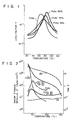
- Fig. 1 shows changes in loss factor ⁇ of vibration-damping steel plates of some of various compositions, as a function of temperature.
- Fig. 2 shows changes, as a function of temperature, in the shear storage modulus G' and the mechanical loss tangent tan ⁇ at a frequency of 10 Hz for a composition consisting of only PVAc, a composition consisting of only PP and a composition consisting of PVAc and PP in a mixing ratio of 60 : 40 (based on weight).
- the PVAc has a maximum tan ⁇ and a corresponding temperature of 2,6 and 54°C, respectively
- the PP has a shear storage modulus G' at 54°C of 2,5 ⁇ 104 N/cm2 (2,5 ⁇ 109 dyne/cm2). With the composition containing 60% by weight of PVAc, the maximum tan ⁇ is decreased to 0,5.
- the loss factor ⁇ of a vibration-damping steel plate using this composition is better in a high temperature region than that of the composition consisting of only PVAc, as can be seen from Fig. 1.
- Table 1 Composition (wt%) ⁇ max T ⁇ max (°C) G' of composition at Ttan ⁇ max N/cm2 (dyne/cm2) Actual loss factor ⁇ (1 000 Hz, 80°C) PVAc PP 100 - 0,30 70 5,6 ⁇ 102 (5,6 ⁇ 107) 0,18 75 25 0,31 80 4,5 ⁇ 103 (4,5 ⁇ 108) 0,31 60 40 0,42 84 1,3 ⁇ 104 (1,3 ⁇ 109) 0,40 45 55 0,19 75 2,4 ⁇ 104 (2,4 ⁇ 109) 0,18 30 70 0,06 70 3,0 ⁇ 104 (3,0 ⁇ 109) 0,05
- a composition was prepared by adding 55 parts by weight of low density polyethylene ("Yukalon ZC-30", trademark, available from Mitsubishi Petrochemical Co., Ltd., referred to as LDPE hereinafter) having a melting point of 109°C to 45 parts by weight of the PVAc used in Comparative Example 1.
- the mixture was kneaded and was formed into an interlayer having a thickness of 0,5 mm between two steel plates each having a thickness of 0,8 mm, thereby providing a composite steel plate.
- Fig. 3 shows changes in the loss factor ⁇ at 1 000 Hz of the prepared composite steel plate as a function of temperature.
- the plate had a maximum loss factor ⁇ max of 0,15 at 75°C, and a shear storage modulus G' of 6,8 ⁇ 103 N/cm2 (6,8 ⁇ 108 dyne/cm2) at a temperature at which the composition exhibited a maximum mechanical loss tangent tan ⁇ .
- the LDPE had a shear storage modulus G'of 3,9 ⁇ 103 N/cm2 (3,9 ⁇ 108 dyne/cm2) at 54°C at which the PVAc exhibited the maximum tan ⁇ .
- a composition was prepared by adding 50 parts by weight of an ethylene-vinyl acetate copolymer ("Yukalon-EVA X-700", trademark, available from Mitsubishi Petrochemical Co., Ltd., referred to as EVA hereinafter) having a melting point of 75°C to 50 parts by weight of the PVAc used in Comparative Example 1.
- EVA ethylene-vinyl acetate copolymer
- a composite steel plate having an interlayer of 0,5 mm thickness and similar to that in Comparative Example 2 was prepared using the obtained composition.
- Fig. 3 shows changes in the loss factor ⁇ at 1 000 Hz of the obtained composite steel plate as a function of temperature.
- the EVA had a shear storage modulus G' of 1,0 ⁇ 102 N/cm2 (1,0 ⁇ 107 dyne/cm2) at 54°C at which a PVAc exhibited the maximum tan ⁇ .
- G' shear storage modulus
- the shear storage modulus of the EVA is unsatisfactory.
- the loss factor ⁇ of the obtained composite steel plate is low within the overall temperature range and the peak of ⁇ due to addition of the PVAc is not clear, as shown in Fig. 3.
- Fig. 4 shows changes, as a function of temperature, in the loss factor ⁇ of a composite steel plate using a mixture consisting of equal amounts of a polystyrene ("Diarex HF 77", trademark, available from Mitsubishi Monsanto Co., Ltd., referred to as PS hereinafter) having a glass transition temperature of about 100°C and a polypropylene (“Noblen FX4", trademark, available from Mitsubishi Petrochemical Co., Ltd. ) having a melting point of 152°C.
- a polystyrene (“Diarex HF 77", trademark, available from Mitsubishi Monsanto Co., Ltd., referred to as PS hereinafter) having a glass transition temperature of about 100°C
- a polypropylene Noblen FX4", trademark, available from Mitsubishi Petrochemical Co., Ltd.
- the PS had a maximum tan ⁇ of 3,4 at 109°C
- the polypropylene had a shear storage modulus G' of 9,8 ⁇ 103 N/cm2 (9,8 ⁇ 108 dyne/cm2) at this temperature.
- the obtained composite steel plate had a maximum loss factor ⁇ of 0,14 at 120°C. and a shear storage modulus G' of 1,8 ⁇ 103 N/cm2 (1,8 ⁇ 108 dyne/cm2) at the temperature at which the composition had a maximum tan ⁇ .
- Fig. 4 also shows changes, as a function of temperature, in the loss factor ⁇ of a composite steel plate using a composition consisting of high density polyethylene ("Yukalon-HD, BZ50A", trademark, available from Mitsubishi Petrochemical Co., Ltd., referred to as HDPE hereinafter) having a melting point of 133°C in place of the polypropylene used in Comparative Example 4.
- high density polyethylene Yukalon-HD, BZ50A
- HDPE high density polyethylene
- the HDPE had a shear storage modulus G' of 5,1 ⁇ 103 N/cm2 (5,1 ⁇ 108 dyne/cm2) at a temperature of 109°C at which the PS had a maximum tan ⁇ .
- the composition had a shear storage modulus G' of 1,3 ⁇ 102 N/cm2 (1,3 ⁇ 107 dyne/cm2) at the temperature at which the composition had a maximum tan ⁇ .
- the composite steel plate had a maximum loss factor ⁇ of 0,11 at 120°C, as can be seen from Fig. 4.
- Vibration-damping composite steel plates were prepared following the same procedures as in Comparative Example 1 except that a styrene-acrylic ester copolymer having a glass transition temperature of about 20°C (50% by weight styrene content, 210 000 molecular weight, referred to as SAE hereinafter) was used in place of the PVAc used in Comparative Example 1.
- SAE styrene-acrylic ester copolymer having a glass transition temperature of about 20°C (50% by weight styrene content, 210 000 molecular weight, referred to as SAE hereinafter) was used in place of the PVAc used in Comparative Example 1.
- Table 2 shows the maximum loss factor ⁇ max and the corresponding temperature (T ⁇ max) of each composite steel plate, and the shear storage modulus G' of the composition at a temperature Ttan ⁇ max at which the composition has a maximum tan ⁇ .
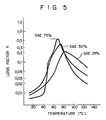
- Fig. 5 shows changes in the loss factor ⁇ of some of various vibration-damping steel plates as a function of temperature.
- the SAE had a maximum tan ⁇ and a corresponding temperature of 2,9 and 40°C, respectively, and the PP had a shear storage modulus G' of 3,2 ⁇ 104 N/cm2 (3,2 ⁇ 109/cm2) at 40°C.
- Table 2 Composition (wt%) ⁇ max T ⁇ max (°C) G' of composition at Ttan ⁇ max N/cm2 (dyne/cm2) SAE PP 75 25 0,53 67 2,0 ⁇ 103 (2,0 ⁇ 108) 60 40 0,40 70 4,9 ⁇ 103 (4,9 ⁇ 108) 50 50 0,37 74 1,6 ⁇ 104 (1,6 ⁇ 109) 40 60 0,30 84 2,7 ⁇ 104 (2,7 ⁇ 109) 25 75 0,18 85 3,4 ⁇ 104 (3,4 ⁇ 109)
- the suspension was heated to 80°C and was stirred at this temperature for 5 hours to perform polymerization.
- the suspension was thereafter heated to 90°C and was kept at this temperature for 5 hours to complete polymerization.
- the obtained, modified propylene-ethylene copolymer had a vinyl acetate content of 50% by weight.
- the grafted amount of the vinyl acetate was 15% by weight.
- the copolymer 1 had a tensile elongation of 360%, while a composition consisting of equal amounts of polyvinyl acetate and a maleic anhydride-modified propylene-ethylene copolymer had a tensile elongation of only 20%.
- Table 3 shows the maximum loss factor ⁇ max at 1 000 Hz, a corresponding temperature T ⁇ max, and the shear storage modulus G' of the composition at the temperature Ttan ⁇ max at which the composition has the maximum tan ⁇ , for each of the obtained composite steel plates.
- the PVAc had a maximum tan ⁇ at 10 Hz and a corresponding temperature Ttan ⁇ max of 2,6 and 55°C, respectively.
- the PP(1) had a shear storage modulus G' at 55°C of 1,9 ⁇ 104 N/cm2 (1,9 ⁇ 109 dyne/cm2).
- a styrene-modified propylene-ethylene copolymer (copolymer 2) was prepared following the same procedurs as in preparation of the copolymer 1 except that styrene was used in place of vinyl acetate.
- the obtained, modified propylene-ethylene copolymer had a styrene content of 50% by weight, and the grafted amount of styrene of 10% by weight.
- the copolymer 2 had a tensile elongation of 90%, while a composition consisting of equal amounts of polystyrene and a maleic anhydride-modified propylene-ethylene copolymer had a tensile elongation of 10%.
- a n-butyl methacrylate-modified propylene-ethylene copolymer (copolymer 3) was prepared following the same procedures as in preparation of the copolymer 1 except that n-butyl methacrylate was used in place of vinyl acetate.
- the obtained, modified propylene-ethylene copolymer had a n-butyl methacrylate content of 50% by weight, and the grafted amount of n-butyl methacrylate of 10% by weight.
- the copolymer 3 had a tensile elongation of 200%, while a composition consisting of equal amounts of poly-n-butyl methacrylate and a maleic anhydride-modified propylene-ethylene copolymer had a tensile elongation of 10%.
- Composite steel plates were prepared following the same procedures as in Example 1 using copolymers 2 and 3, separately.
- Table 4 shows the maximum loss factor ⁇ max at 1 000 Hz and the corresponding temperature T ⁇ max of each composite steel plate, and the shear storage modulus G' of the composition at the temperature Ttan ⁇ max at which the composition has the maximum tan ⁇ .
- the polystyrene had the maximum tan ⁇ of 3,4 at 110°C.
- the PP(1) had a shear storage modulus G' at this temperature of 1,8 ⁇ 103 N/cm2 (1,8 ⁇ 108 dyne/cm2), and the poly-n-butyl methacrylate had a maximum tan ⁇ at 50°C of 1,6.
- the PP(1) at this temperature had a shear storage modulus G' of 1,5 ⁇ 104 N/cm2 (1,5 ⁇ 109 dyne/cm2).
- Pure water and polyvinyl alcohol as a suspending agent were charged in amounts of 35 kg and 320 g into an autoclave having a volume of 50 l to prepare an aqueous medium.
- an aqueous medium After dissolving 180 g of benzoyl peroxide in 10,8 kg of styrene (SM) and 7,2 kg of isononyl acrylate (INA), the obtained mixture was added to the medium and the mixture was stirred to prepare a suspension.
- nitrogen was introduced into the autoclave in order to substitute its interior with nitrogen, the autoclave was heated to 60°C.
- the suspension was stirred at this temperature for 5 hours to perform prepolymerization.
- the autoclave was heated to 90°C while increasing the stirring speed.
- SAE styrene-isononyl acrylate copolymer
- Pure water, tribasic calcium phosphate as a suspending agent, and sodium dodecylbenzene sulfonate were charged in amounts of 20 kg, 0,6 kg and 0,06 kg, respectively, in an autoclave having a volume of 50 l to prepare an aqueous medium.
- Particles of a maleic anhydride-modified propylene-ethylene copolymer (MFR: 17 g/10 min.; 5,5% by weight ethylene content; 0,4% by weight maleic anhydride content; referred to as PP(2) hereinafter) having a particle size of 3 to 4 mm were suspended in the medium by stirring.
- BPO benzoyl peroxide
- SM styrene
- INA iso-nonyl acrylate
- Nitrogen was introduced into the autoclave in order to substitute its interior with nitrogen.
- the autoclave was heated to 60°C and the suspension was stirred at this temperature for 5 hours so as to impregnate the PP(2) particles with the styrene and iso-nonyl acrylate containing a polymerization initiator.
- modified PP styrene-iso-nonyl acrylate-modified propylene-ethylene copolymer
- PP SM INA BPO SM (grafted amount) INA grafted amount) 1 5 3,5 1,5 0,015 35 (6,7) 15 (2,9) 19,2 2 6 2,8 1,2 0,012 28 (5,0) 12 (2,2) 18,0 3 7 2,1 0,9 0,009 21 (3,2) 9 (1,4) 15,3 4 5 3 2 0,015 30 (6,3) 20 (4,2) 21,0 *
- the grafting ratio indicates the total grafted amount in % by weight of SM and INA based on the total weight of the SM and INA in the modified PP.
- Table 6 shows the maximum loss factor ⁇ max at 1 000 Hz, the corresponding temperature T ⁇ max of each composite steel plate, and a maximum tan ⁇ tan ⁇ max and a tensile elongation of each composition.
- Table 6 Modified PP No. ⁇ max T ⁇ max (°C) tan ⁇ max Tensile elongation (%) 1 0,21 90 0,53 550 2 0,20 90 0,38 650 3 0,13 90 0,26 880 4 0,20 70 0,49 640
- SAE styrene-iso-nonyl arcylate copolymer
- PP(3) maleic anhydride-modified polypropylene
- INA content modified propylene-ethylene copolymer having an SM content of 30% by weight and an INA content of 20% by weight
- Table 8 Mixing Ratio (wt%)
- Particles of a styrene-2-ethylhexyl acrylate-modified propylene-ethylene copolymer were prepared following the same procedures as in Example 3 except that, in the preparation of the graft copolymer (1), particles of a maleic anhydride-modified propylene-ethylene copolymer (MFR: 4 g/10 min.; 8% by weight ethylene content; and 0,4% by weight maleic anhydride content; referred to as PP (4) hereinafter) were used in place of the PP(2) and 2-ethylhexyl acrylate (2-EHA) was used in place of iso-nonyl acrylate.
- MFR maleic anhydride-modified propylene-ethylene copolymer
- 2-EHA 2-ethylhexyl acrylate
- Table 9 shows the styrene content, the 2-ethylhexyl acrylate content and graft copolymerization amount thereof in each modified PP obtained by variously changing the charging ratios of the raw materials.
- Composite steel plates were prepared following the same procedures as in Example 3 using a composition prepared by adding an antioxidant to particles of each modified PP indicated in Table 9.
- Table 10 shows the maximum loss factor ⁇ max at 1 000 Hz and the corresponding temperature T ⁇ max of each composite steel and the maximum tan ⁇ tan ⁇ max and the tensile elongation of each composition.
- Table 10 Modified PP No. ⁇ max T ⁇ max (°C) tan ⁇ max Tensile elongation (%) 5 0,35 81 0,72 360 6 0,41 83 0,92 190 7 0,50 85 1,5 130 8 0,18 16 0,42 160
Landscapes
- Chemical & Material Sciences (AREA)
- Health & Medical Sciences (AREA)
- Chemical Kinetics & Catalysis (AREA)
- Medicinal Chemistry (AREA)
- Polymers & Plastics (AREA)
- Organic Chemistry (AREA)
- Laminated Bodies (AREA)
- Compositions Of Macromolecular Compounds (AREA)
Claims (18)
- Plaque de composite métallique amortissant les vibrations comprenant deux plaques métalliques et une composition de résines intercalée entre les plaques métalliques, la composition de résines consistant essentiellement en 20 à 70% en poids d'un polymère thermoplastique amorphe (a) et 80 à 30% en poids d'un polymère thermoplastique cristallin (b) incompatible avec le polymère (a), l'un au moins des monomères constituant le polymère amorphe (a) étant copolymérisé par greffage ou par copolymérisation séquencée avec le polymère cristallin (b) en quantité de pas moins de 0,5% en poids par rapport à la quantité totale du polymère (a), le polymère (a) étant au moins un composé choisi parmi les polymères d'esters vinyliques, les polymères de monomères vinylaromatiques et les polymères d'esters acryliques et ayant une température de transition vitreuse inférieure à celle du polymère (b) et ayant une tg δ de pas moins de 0,5 dans une gamme de températures de -50 à 150°C et une gamme de fréquences de 0,1 à 20 000 Hz et le polymère (b) étant un composé choisi parmi les résines d'α-oléfines cristallines et les polymères de condensation cristallins et ayant un point de fusion supérieur à la température de transition vitreuse du polymère (a) et un module de conservation du cisaillement de pas moins de 1.10³ N/cm² (1.10⁸ dyne/cm²) à la température et à la fréquence auxquelles le polymère (a) présente la tangente δ maximale.
- Plaque de composite métallique selon la revendication 1, dans laquelle le polymère thermoplastique amorphe (a) est un polymère choisi parmi les homopolymères d'esters acryliques, les homopolymères de monomères vinylaromatiques et les copolymères dérivés d'un ester acrylique et d'un monomère vinylaromatique et le polymère thermoplastique cristallin (b) est une polyoléfine cristalline (B).
- Plaque de composite métallique selon la revendication 1 ou 2, dans laquelle le polymère thermoplastique amorphe (a) est un copolymère dérivé d'un monomère styrénique et d'un monomère acrylique.
- Plaque de composite métallique selon la revendication 2, dans laquelle l'ester acrylique est choisi parmi l'acrylate de n-butyle, l'acrylate de 2-butylhexyle, l'acrylate de linevol, l'acrylate d'isononyle, l'acrylate de 2-butoxyéthyle, l'acrylate d'éther monobutylique de diéthylèneglycol, le méthacrylate de lauryle et le méthacrylate de tridécyle.
- Plaque de composite métallique selon la revendication 2, dans laquelle le monomère vinylaromatique est choisi parmi le styrène, le 4-méthylstyrène et l'α-méthylstyrène.
- Plaque de composite métallique selon la revendication 2, dans laquelle l'ester acrylique est choisi parmi l'acrylate de n-butyle, l'acrylate de 2-butylhexyle, l'acrylate de linevol, l'acrylate d'isononyle, l'acrylate de 2-butoxyéthyle, l'acrylate d'éther monobutylique de diéthylèneglycol, le méthacrylate de lauryle et le méthacrylate de tridécyle ; et le monomère vinylaromatique est choisi parmi le styrène, le 4-méthylstyrène et l'α-méthylstyrène.
- Plaque de composite métallique selon l'une quelconque des revendications 1 à 6, dans laquelle le polymère thermoplastique amorphe (a) a une tg δ maximale de pas moins de 1,0 à une température de -50 à 150°C et à une fréquence de 0,1 à 20000 Hz.
- Plaque de composite métallique selon la revendication 1 ou 2, dans laquelle le polymère thermoplastique cristallin (b) est choisi parmi le polyéthylène haute densité, le polypropylène et les polymères d'α-oléfines supérieures au-dessus du polypropylène.
- Plaque de composite métallique selon la revendication 2, dans laquelle la polyoléfine cristalline (B) est choisie parmi le polyéthylène haute densité et les polymères de propylène.
- Plaque de composite métallique selon la revendication 2, dans laquelle la polyoléfine cristalline (B) est un polymère de propylène.
- Plaque de composite métallique selon l'une quelconque des revendications 1 à 10, comprenant 30 à 60% en poids du polymère thermoplastique amorphe (a) et 70 à 40% en poids du polymère thermoplastique cristallin (b).
- Plaque de composite métallique selon la revendication 2, dans laquelle la teneur en ester acrylique dans le polymère (a) dérivé de l'ester acrylique et du monomère vinylaromatique est de 5 à 95% en poids.
- Plaque de composite métallique selon l'une quelconque des revendications 1 à 12, dans laquelle l'un au moins des monomères constituant le polymère thermoplastique amorphe (a) est copolymérisé par greffage ou par copolymérisation séquencée avec le polymère thermoplastique cristallin (b) en quantité de pas moins de 1% en poids par rapport à la quantité totale du polymère (a).
- Plaque de composite métallique selon l'une quelconque des revendications 1 à 13, dans laquelle l'un au moins des monomères constituant le polymère thermoplastique amorphe (a) est copolymérisé par greffage ou par copolymérisation séquencée avec le polymère thermoplastique cristallin (b) en quantité de pas moins de 3% en poids par rapport à la quantité totale du polymère (a).
- Plaque de composite métallique selon l'une quelconque des revendications 1 à 14, dans laquelle le polymère thermoplastique cristallin (b) a un point de fusion supérieur d'au moins 30°C à la température de transition vitreuse du polymère thermoplastique amorphe (a).
- Plaque de composite métallique selon l'une quelconque des revendications 1 à 15, dans laquelle le polymère thermoplastique cristallin (b) a un point de fusion supérieur d'au moins 50°C à la température de transition vitreuse du polymère thermoplastique amorphe (a).
- Plaque de composite métallique selon l'une quelconque des revendications 1 à 16, dans laquelle le polymère thermoplastique cristallin (b) a un module de conservation du cisaillement de pas moins de 5.10³ N/cm² (5.10⁸ dyne/cm²) à la température et à la fréquence auxquelles le polymère (a) présente la tg δ maximale.
- Plaque de composite métallique selon l'une quelconque des revendications 1 à 17, dans laquelle le polymère thermoplastique cristallin (b) a un module de conservation du cisaillement de pas moins de 6.10³ N/cm² (6.10⁸ dyne/cm²) à la température et à la fréquence auxquelles le polymère (a) présente la tg δ maximale.
Applications Claiming Priority (6)
| Application Number | Priority Date | Filing Date | Title |
|---|---|---|---|
| JP11970284A JPS6128551A (ja) | 1984-06-11 | 1984-06-11 | 制振用樹脂組成物 |
| JP119702/84 | 1984-06-11 | ||
| JP18312184A JPH0672634B2 (ja) | 1984-09-01 | 1984-09-01 | 制振用樹脂組成物 |
| JP18312284A JPS6160759A (ja) | 1984-09-01 | 1984-09-01 | 制振用樹脂組成物 |
| JP183121/84 | 1984-09-01 | ||
| JP183122/84 | 1984-09-01 |
Publications (3)
| Publication Number | Publication Date |
|---|---|
| EP0164728A2 EP0164728A2 (fr) | 1985-12-18 |
| EP0164728A3 EP0164728A3 (en) | 1988-08-17 |
| EP0164728B1 true EP0164728B1 (fr) | 1993-09-01 |
Family
ID=27313888
Family Applications (1)
| Application Number | Title | Priority Date | Filing Date |
|---|---|---|---|
| EP19850107194 Expired - Lifetime EP0164728B1 (fr) | 1984-06-11 | 1985-06-11 | Aggloméré laminé amortissant les vibrations |
Country Status (5)
| Country | Link |
|---|---|
| US (1) | US4740427A (fr) |
| EP (1) | EP0164728B1 (fr) |
| AU (1) | AU563256B2 (fr) |
| CA (1) | CA1256787A (fr) |
| DE (1) | DE3587555T2 (fr) |
Cited By (1)
| Publication number | Priority date | Publication date | Assignee | Title |
|---|---|---|---|---|
| US5665822A (en) | 1991-10-07 | 1997-09-09 | Landec Corporation | Thermoplastic Elastomers |
Families Citing this family (21)
| Publication number | Priority date | Publication date | Assignee | Title |
|---|---|---|---|---|
| JPS6348321A (ja) * | 1986-08-15 | 1988-03-01 | Nippon Steel Corp | 制振材料用粘弾性樹脂の製法 |
| JPS63112675A (ja) * | 1986-10-30 | 1988-05-17 | Denki Kagaku Kogyo Kk | 接着剤 |
| JP2623316B2 (ja) * | 1987-10-20 | 1997-06-25 | 東洋紡績株式会社 | 複合型制振材料及び制振材料用粘弾性樹脂組成物 |
| US4822834A (en) * | 1988-04-19 | 1989-04-18 | The United States Of America As Represented By The Secretary Of The Air Force | Vibration damping composition suitable for outer space temperature variations |
| US5319016A (en) * | 1989-07-04 | 1994-06-07 | Chisso Corporation | Emulsion adhesive composition and process for production thereof |
| JPH0623383B2 (ja) * | 1989-10-13 | 1994-03-30 | ニチアス株式会社 | ラバーラミネートガスケット用素材 |
| US5087491A (en) * | 1990-02-09 | 1992-02-11 | The United States Of America As Represented By The Secretary Of The Navy | Vibration-damping structural member |
| US5227234A (en) * | 1990-08-10 | 1993-07-13 | Mitsui Petrochemical Industries, Ltd. | Thermal adhesive vibration damping sheets |
| JPH0542629A (ja) * | 1990-12-28 | 1993-02-23 | Kawasaki Steel Corp | 複合型制振材料およびその製造方法 |
| JP3256232B2 (ja) * | 1991-10-07 | 2002-02-12 | ランデック コーポレイション | 熱可塑性エラストマー |
| US5338599A (en) * | 1991-11-26 | 1994-08-16 | The United States Of America As Represented By The Secretary Of The Navy | Vibration-damping structural component |
| US5277971A (en) * | 1992-05-22 | 1994-01-11 | Tredegar Industries, Inc. | Tamper-evident pressure sensitive facestock labels |
| US5635562A (en) * | 1995-04-26 | 1997-06-03 | Lear Corporation | Expandable vibration damping materials |
| US6110985A (en) * | 1998-10-30 | 2000-08-29 | Soundwich, Inc. | Constrained layer damping compositions |
| US6521704B1 (en) * | 2000-06-13 | 2003-02-18 | General Electric Company | Vibration dampening compositions and methods thereof |
| WO2003054103A2 (fr) * | 2001-12-20 | 2003-07-03 | World Properties, Inc. | Resine adhesive aux proprietes antivibration elevees et procede de fabrication de cette resine |
| US7585559B2 (en) * | 2003-06-03 | 2009-09-08 | Intellectual Property Holdings, Llc | Foam barrier heat shield |
| US7748184B1 (en) | 2005-02-09 | 2010-07-06 | Intellectual Property Holdings, Llc | Body panel having improved stiffness and method of making |
| US7799840B2 (en) | 2006-09-12 | 2010-09-21 | Intellectual Property Holdings, Llc | Thermoplastic vibrational damper with constraining layer |
| US7834090B2 (en) * | 2007-08-03 | 2010-11-16 | The Gates Corporation | Rubber composition and vibration damper using the rubber composition |
| JP5258680B2 (ja) * | 2009-06-18 | 2013-08-07 | 日東電工株式会社 | 高温用制振シートおよびその使用方法、ならびに高温用制振基材の使用方法 |
Family Cites Families (23)
| Publication number | Priority date | Publication date | Assignee | Title |
|---|---|---|---|---|
| US3027346A (en) * | 1956-11-15 | 1962-03-27 | Union Carbide Corp | Process for preparing composition containing graft copolymer of polyethylene and an acrylate monomer |
| LU39140A1 (fr) * | 1959-09-11 | 1900-01-01 | ||
| BE601857A (fr) * | 1960-03-28 | |||
| GB1125382A (en) * | 1964-09-11 | 1968-08-28 | Goodyear Tire & Rubber | Clear impact resistant resin |
| DE1694087B2 (de) * | 1966-11-25 | 1975-10-30 | Hoechst Ag, 6000 Frankfurt | Schwingungsdämpfendes Verbundsystem |
| US3700754A (en) * | 1967-02-23 | 1972-10-24 | American Cyanamid Co | Compositions of polymers of methyl methacrylate and polymers of ethylene |
| US3524905A (en) * | 1967-11-30 | 1970-08-18 | Du Pont | Polypropylene-hydrolyzed ethylene/vinyl ester copolymer blends |
| US3553072A (en) * | 1967-12-05 | 1971-01-05 | Hoechst Ag | Vibration damped sandwich systems |
| US3562090A (en) * | 1967-12-05 | 1971-02-09 | Hoechst Ag | Vibration damped sandwich systems |
| US3632675A (en) * | 1969-05-28 | 1972-01-04 | Hercules Inc | Preparation of impact resistant styrene polymers |
| FR2120302A5 (fr) * | 1970-12-29 | 1972-08-18 | Aquitaine Total Organico | |
| US4064198A (en) * | 1973-08-17 | 1977-12-20 | Basf Aktiengesellschaft | Process for the manufacture of shaped articles by graft polymerization |
| JPS5342069A (en) * | 1976-09-29 | 1978-04-17 | Hitachi Ltd | Device for automatically measuring the distance between ratchet wheel and pawl |
| JPS541354A (en) * | 1977-06-06 | 1979-01-08 | Matsushita Electric Works Ltd | Flame-retardant compounds |
| US4391857A (en) * | 1979-08-16 | 1983-07-05 | Kuraray Company, Limited | Aqueous dispersion type coating compositions with an improved vibration-damping characteristic |
| JPS57167360A (en) * | 1981-04-08 | 1982-10-15 | Kuraray Co Ltd | Vibration-damping paint |
| JPS5853003A (ja) * | 1981-09-22 | 1983-03-29 | Fujitsu Ltd | 磁気リ−ド方式 |
| JPS58198529A (ja) * | 1982-05-17 | 1983-11-18 | Toa Nenryo Kogyo Kk | ポリオレフイン系共重合体の製造方法 |
| JPS5927934A (ja) * | 1982-08-06 | 1984-02-14 | Asahi Chem Ind Co Ltd | ポリオレフイングラフト組成物の製造方法 |
| EP0108710A2 (fr) * | 1982-10-08 | 1984-05-16 | Ciba-Geigy Ag | Laminés en plaques métalliques et en matière plastique |
| JPS5980454A (ja) * | 1982-10-28 | 1984-05-09 | Sumitomo Chem Co Ltd | 制振性複合体 |
| JPS59217742A (ja) * | 1983-05-25 | 1984-12-07 | Mitsubishi Petrochem Co Ltd | 熱可塑性樹脂組成物 |
| CA1241586A (fr) * | 1983-10-13 | 1988-09-06 | Nobuo Fukushima | Materiau antivibrations se pretant bien a la mise en forme |
-
1985
- 1985-06-04 AU AU43268/85A patent/AU563256B2/en not_active Ceased
- 1985-06-07 CA CA000483506A patent/CA1256787A/fr not_active Expired
- 1985-06-11 DE DE85107194T patent/DE3587555T2/de not_active Expired - Fee Related
- 1985-06-11 EP EP19850107194 patent/EP0164728B1/fr not_active Expired - Lifetime
-
1986
- 1986-05-15 US US06/867,416 patent/US4740427A/en not_active Expired - Fee Related
Cited By (2)
| Publication number | Priority date | Publication date | Assignee | Title |
|---|---|---|---|---|
| US5783302A (en) | 1990-12-07 | 1998-07-21 | Landec Corporation | Thermoplastic elastomers |
| US5665822A (en) | 1991-10-07 | 1997-09-09 | Landec Corporation | Thermoplastic Elastomers |
Also Published As
| Publication number | Publication date |
|---|---|
| DE3587555D1 (de) | 1993-10-07 |
| AU4326885A (en) | 1985-12-19 |
| EP0164728A3 (en) | 1988-08-17 |
| EP0164728A2 (fr) | 1985-12-18 |
| DE3587555T2 (de) | 1994-04-28 |
| AU563256B2 (en) | 1987-07-02 |
| US4740427A (en) | 1988-04-26 |
| CA1256787A (fr) | 1989-07-04 |
Similar Documents
| Publication | Publication Date | Title |
|---|---|---|
| US4740427A (en) | Vibration-damping composite metal plate | |
| EP0057967B1 (fr) | Composition à base de polyoléfine | |
| DE3486302T2 (de) | Modifizierte Polyolefin-Zusammensetzung. | |
| EP0270924B1 (fr) | Compositions d'un copolymère d'éthylène | |
| EP3017003B1 (fr) | Compositions de polypropylène contenant des charges de fibres de verre | |
| KR960005622B1 (ko) | 폴리(비닐 클로라이드), 염소화된 폴리올레핀, 폴리올레핀 및 폴리올레핀 그라프트 공중합체의 기계적 상용성 다상블렌드 및 이것의 경질 섬유 보강복합체 | |
| US6624099B1 (en) | Glass-reinforced multi-layer sheets from olefin polymer materials | |
| US4761451A (en) | Acoustic vibration sheet and polypropylene composition for the same | |
| EP0007639A1 (fr) | Laminés-métal-plastiques à base de compositions de polyoléfine ayant une grande résistance aux chocs et une résistance à l'écoulement à haute température | |
| US4681816A (en) | Composite laminates comprising a metallic substrate and vibration damper | |
| EP0502414B1 (fr) | Composition de résine ignifugée | |
| WO1995024444A2 (fr) | Compositions de polyolefines thermoplastiques polaires flexibles | |
| US5489648A (en) | Modified polyolefin and composition containing the same | |
| JP3398976B2 (ja) | 樹脂組成物 | |
| EP0849324A1 (fr) | Mélange polymère soudable par haute fréquence | |
| DE3751001T2 (de) | Amorphe Polyester-Zusammensetzungen und ihre Verwendungen. | |
| JP2846451B2 (ja) | 接着性樹脂組成物 | |
| KR900000972B1 (ko) | 제진성(制振性) 수지 조성물 | |
| DE60121536T2 (de) | Copolymer, dieses enthaltender Klebstoff und Laminat | |
| JPS62290537A (ja) | ポリプロピレン系樹脂の積層シ−ト | |
| EP0557124A1 (fr) | Compositions de polymères thermoplastiques | |
| JPS61268440A (ja) | 制振性複合鋼板 | |
| JPH0672634B2 (ja) | 制振用樹脂組成物 | |
| JPS63193831A (ja) | 複合型制振積層体 | |
| JPS6160759A (ja) | 制振用樹脂組成物 |
Legal Events
| Date | Code | Title | Description |
|---|---|---|---|
| PUAI | Public reference made under article 153(3) epc to a published international application that has entered the european phase |
Free format text: ORIGINAL CODE: 0009012 |
|
| 17P | Request for examination filed |
Effective date: 19850611 |
|
| AK | Designated contracting states |
Kind code of ref document: A2 Designated state(s): BE DE FR GB IT SE Designated state(s): BE DE FR GB IT SE |
|
| PUAL | Search report despatched |
Free format text: ORIGINAL CODE: 0009013 |
|
| AK | Designated contracting states |
Kind code of ref document: A3 Designated state(s): BE DE FR GB IT SE |
|
| 17Q | First examination report despatched |
Effective date: 19891110 |
|
| RTI1 | Title (correction) | ||
| GRAA | (expected) grant |
Free format text: ORIGINAL CODE: 0009210 |
|
| AK | Designated contracting states |
Kind code of ref document: B1 Designated state(s): BE DE FR GB IT SE |
|
| REF | Corresponds to: |
Ref document number: 3587555 Country of ref document: DE Date of ref document: 19931007 |
|
| ITF | It: translation for a ep patent filed | ||
| ET | Fr: translation filed | ||
| PGFP | Annual fee paid to national office [announced via postgrant information from national office to epo] |
Ref country code: FR Payment date: 19940511 Year of fee payment: 10 |
|
| PGFP | Annual fee paid to national office [announced via postgrant information from national office to epo] |
Ref country code: BE Payment date: 19940517 Year of fee payment: 10 |
|
| PGFP | Annual fee paid to national office [announced via postgrant information from national office to epo] |
Ref country code: GB Payment date: 19940601 Year of fee payment: 10 |
|
| PGFP | Annual fee paid to national office [announced via postgrant information from national office to epo] |
Ref country code: SE Payment date: 19940617 Year of fee payment: 10 |
|
| PLBE | No opposition filed within time limit |
Free format text: ORIGINAL CODE: 0009261 |
|
| STAA | Information on the status of an ep patent application or granted ep patent |
Free format text: STATUS: NO OPPOSITION FILED WITHIN TIME LIMIT |
|
| PGFP | Annual fee paid to national office [announced via postgrant information from national office to epo] |
Ref country code: DE Payment date: 19940727 Year of fee payment: 10 |
|
| 26N | No opposition filed | ||
| EAL | Se: european patent in force in sweden |
Ref document number: 85107194.4 |
|
| PG25 | Lapsed in a contracting state [announced via postgrant information from national office to epo] |
Ref country code: GB Effective date: 19950611 |
|
| PG25 | Lapsed in a contracting state [announced via postgrant information from national office to epo] |
Ref country code: SE Effective date: 19950612 |
|
| PG25 | Lapsed in a contracting state [announced via postgrant information from national office to epo] |
Ref country code: BE Effective date: 19950630 |
|
| BERE | Be: lapsed |
Owner name: MITSUBISHI PETROCHEMICAL CO. LTD Effective date: 19950630 Owner name: NIPPON KOKAN K.K. Effective date: 19950630 |
|
| GBPC | Gb: european patent ceased through non-payment of renewal fee |
Effective date: 19950611 |
|
| PG25 | Lapsed in a contracting state [announced via postgrant information from national office to epo] |
Ref country code: FR Effective date: 19960229 |
|
| PG25 | Lapsed in a contracting state [announced via postgrant information from national office to epo] |
Ref country code: DE Effective date: 19960301 |
|
| EUG | Se: european patent has lapsed |
Ref document number: 85107194.4 |
|
| REG | Reference to a national code |
Ref country code: FR Ref legal event code: ST |