EP0164974A2 - Polymere mit Isothianaphthen-Struktur und elektrochromische Anzeigevorrichtung - Google Patents
Polymere mit Isothianaphthen-Struktur und elektrochromische Anzeigevorrichtung Download PDFInfo
- Publication number
- EP0164974A2 EP0164974A2 EP85303864A EP85303864A EP0164974A2 EP 0164974 A2 EP0164974 A2 EP 0164974A2 EP 85303864 A EP85303864 A EP 85303864A EP 85303864 A EP85303864 A EP 85303864A EP 0164974 A2 EP0164974 A2 EP 0164974A2
- Authority
- EP
- European Patent Office
- Prior art keywords
- isothianaphthene
- polymer
- poly
- polymerization
- electrolyte
- Prior art date
- Legal status (The legal status is an assumption and is not a legal conclusion. Google has not performed a legal analysis and makes no representation as to the accuracy of the status listed.)
- Granted
Links
Images



Classifications
-
- C—CHEMISTRY; METALLURGY
- C08—ORGANIC MACROMOLECULAR COMPOUNDS; THEIR PREPARATION OR CHEMICAL WORKING-UP; COMPOSITIONS BASED THEREON
- C08G—MACROMOLECULAR COMPOUNDS OBTAINED OTHERWISE THAN BY REACTIONS ONLY INVOLVING UNSATURATED CARBON-TO-CARBON BONDS
- C08G61/00—Macromolecular compounds obtained by reactions forming a carbon-to-carbon link in the main chain of the macromolecule
- C08G61/12—Macromolecular compounds containing atoms other than carbon in the main chain of the macromolecule
- C08G61/122—Macromolecular compounds containing atoms other than carbon in the main chain of the macromolecule derived from five- or six-membered heterocyclic compounds, other than imides
- C08G61/123—Macromolecular compounds containing atoms other than carbon in the main chain of the macromolecule derived from five- or six-membered heterocyclic compounds, other than imides derived from five-membered heterocyclic compounds
-
- C—CHEMISTRY; METALLURGY
- C09—DYES; PAINTS; POLISHES; NATURAL RESINS; ADHESIVES; COMPOSITIONS NOT OTHERWISE PROVIDED FOR; APPLICATIONS OF MATERIALS NOT OTHERWISE PROVIDED FOR
- C09K—MATERIALS FOR MISCELLANEOUS APPLICATIONS, NOT PROVIDED FOR ELSEWHERE
- C09K9/00—Tenebrescent materials, i.e. materials for which the range of wavelengths for energy absorption is changed as a result of excitation by some form of energy
- C09K9/02—Organic tenebrescent materials
-
- G—PHYSICS
- G02—OPTICS
- G02F—OPTICAL DEVICES OR ARRANGEMENTS FOR THE CONTROL OF LIGHT BY MODIFICATION OF THE OPTICAL PROPERTIES OF THE MEDIA OF THE ELEMENTS INVOLVED THEREIN; NON-LINEAR OPTICS; FREQUENCY-CHANGING OF LIGHT; OPTICAL LOGIC ELEMENTS; OPTICAL ANALOGUE/DIGITAL CONVERTERS
- G02F1/00—Devices or arrangements for the control of the intensity, colour, phase, polarisation or direction of light arriving from an independent light source, e.g. switching, gating or modulating; Non-linear optics
- G02F1/01—Devices or arrangements for the control of the intensity, colour, phase, polarisation or direction of light arriving from an independent light source, e.g. switching, gating or modulating; Non-linear optics for the control of the intensity, phase, polarisation or colour
- G02F1/15—Devices or arrangements for the control of the intensity, colour, phase, polarisation or direction of light arriving from an independent light source, e.g. switching, gating or modulating; Non-linear optics for the control of the intensity, phase, polarisation or colour based on an electrochromic effect
- G02F1/1514—Devices or arrangements for the control of the intensity, colour, phase, polarisation or direction of light arriving from an independent light source, e.g. switching, gating or modulating; Non-linear optics for the control of the intensity, phase, polarisation or colour based on an electrochromic effect characterised by the electrochromic material, e.g. by the electrodeposited material
- G02F1/1516—Devices or arrangements for the control of the intensity, colour, phase, polarisation or direction of light arriving from an independent light source, e.g. switching, gating or modulating; Non-linear optics for the control of the intensity, phase, polarisation or colour based on an electrochromic effect characterised by the electrochromic material, e.g. by the electrodeposited material comprising organic material
- G02F1/15165—Polymers
-
- H—ELECTRICITY
- H01—ELECTRIC ELEMENTS
- H01B—CABLES; CONDUCTORS; INSULATORS; SELECTION OF MATERIALS FOR THEIR CONDUCTIVE, INSULATING OR DIELECTRIC PROPERTIES
- H01B1/00—Conductors or conductive bodies characterised by the conductive materials; Selection of materials as conductors
- H01B1/06—Conductors or conductive bodies characterised by the conductive materials; Selection of materials as conductors mainly consisting of other non-metallic substances
- H01B1/12—Conductors or conductive bodies characterised by the conductive materials; Selection of materials as conductors mainly consisting of other non-metallic substances organic substances
- H01B1/124—Intrinsically conductive polymers
- H01B1/127—Intrinsically conductive polymers comprising five-membered aromatic rings in the main chain, e.g. polypyrroles, polythiophenes
-
- H—ELECTRICITY
- H01—ELECTRIC ELEMENTS
- H01M—PROCESSES OR MEANS, e.g. BATTERIES, FOR THE DIRECT CONVERSION OF CHEMICAL ENERGY INTO ELECTRICAL ENERGY
- H01M4/00—Electrodes
- H01M4/02—Electrodes composed of, or comprising, active material
- H01M4/36—Selection of substances as active materials, active masses, active liquids
- H01M4/60—Selection of substances as active materials, active masses, active liquids of organic compounds
-
- Y—GENERAL TAGGING OF NEW TECHNOLOGICAL DEVELOPMENTS; GENERAL TAGGING OF CROSS-SECTIONAL TECHNOLOGIES SPANNING OVER SEVERAL SECTIONS OF THE IPC; TECHNICAL SUBJECTS COVERED BY FORMER USPC CROSS-REFERENCE ART COLLECTIONS [XRACs] AND DIGESTS
- Y02—TECHNOLOGIES OR APPLICATIONS FOR MITIGATION OR ADAPTATION AGAINST CLIMATE CHANGE
- Y02E—REDUCTION OF GREENHOUSE GAS [GHG] EMISSIONS, RELATED TO ENERGY GENERATION, TRANSMISSION OR DISTRIBUTION
- Y02E60/00—Enabling technologies; Technologies with a potential or indirect contribution to GHG emissions mitigation
- Y02E60/10—Energy storage using batteries
Definitions
- Various sulfur-containing heterocyclic polymers are known including polymers from thiophene, U.S. Patent No. 2,552,796 and U.S. Patent No. 2,658,902; polymers from dibenzothiophehe, U.S. Patent No. 3,585,163; polymers from vinyl bithiophehe, U.S. Patent No. 3,615,384; polymers from various substituted thiophenes, U.S. Patent No. 3,725,362; polymers from 2-bromc-8-hydroxy-5,5-dioxodibenzothiophene, U.S. Patent No. 3,775,368; and polymers from tetrathiapentalene, U.S. Patent No. 4,111,857.
- polyacetylenes are under investigation for their possible availability as electrode materials of secondary batteries since they show excellent conductivities as high as 10 2 to 10 3 s/cm by doping iodine or arsenic pentafluoride (cf. Synthetic Metals, Vol. 1, No. 2, 101 (1979/1980)), and excellent charge-discharge characteristics.
- use of polyacetylenes as materials for solar batteries is also under investigation because of their light absorption characteristics close to those of sun light.
- the polyacetylenes are disadvantageous in that they are per se susceptible to oxidation and doped polyacetylenes are extremely sensitive to humidity.
- Polythiophenes are studied not only as conductive materials or as battery electrode materials because of their specific electronic structure having a conjugated structure similar to that of cis-form polyacetylenes and containing a sulfur atom, but also as electrochromic materials making use of color changes in a doped state.
- A. M. Druy, et al reported that 2,2'-bithienyl is electrochemically polymerized to form a polymer having a color which reversibly varies from blue in an oxidized state to red in a reduced state and such a polymer is useful as an electrochromic material making use of the reversibility of the color change [cf. Journal de Physique, Vol. 44, No. 6, C3-595 (1983)].
- a polymer having an isothianaphthene structure is a very stable compound even in air and capable of reversibly varying its color in the course of oxidation or reduction in such a stable manner as sufficient to allow repeated use thereof and it is a novel polymer that can easily show conductivities higher than 10 s/cm upon doping general dopants and, thus accomplished the present invention.
- poly(isothianaphthene) a polymer of a "nonclassical" thiophene (M. P. Cava et al., Acc. Chem. Res., 1975, Vol. 8, 139). While not bound by any theory, we believe that poly(isothianaphthene) exhibits higher stability (and perhaps conductivity) than poly-(thiophene) because the resonance contributors lc and ld shown in Figure 1 are important in the stabilization of open shell species (lc) and delocalization along the backbone (ld) is responsible for high electrical conductivity.
- analogous resonance structure (particularly the analog of ld) would not be expected to be as important contributors to the electronic structure of poly(thiophene) as they are in the case of poly(isothianaphthene) because of the overwhelming gain in stability resulting from incorporation of the 3,4 bond of thiophene into a benzene ring.
- the anodic polymerization is the more desirable; it is simple and the product appears in the form of a relatively tough, blue-black film.
- the chemically coupled product is of more academic interest since it is crystalline and its number- average molecular weight is known but it is invariably produced in powder form.
- liquid crystal display devices have recently been developed as display devices requiring low energy and been widely used in various applications.
- liquid crystal devices have a problem of dependence on a visual angle and also are disadvantageous in that the display is poor in sharpness; no memory function is provided; display cannot be obtained over a large surface area; and the like.
- electrochromism in which light absorption characteristics vary due to application'of voltage or electric current.
- Electrochromic materials which can be used in the ECD devices are classified into inorganic materials and organic materials.
- the inorganic materials that are considered usable mainly include oxides of transition metals, a specific example is wolfram oxide, but they are limited in developable colors and also cause electrochemical elution of the membrane or deterioration of electrodes when protons are used as color-forming ions, although their response speeds are high.
- the organic materials include viologen dyes, phthalocyanine complexes, etc.
- the viologen dyes are disadvantageous in that repeated use thereof results in precipitation of insoluble substances, and the phthalocyanine complexes have a pending problem of adhesiveness between a vacuum-evaporated membrane and a base plate.
- electrochromic materials which have recently been proposed include polyanilines as disclosed in A.F. Diaz, et al., Journal of Electro-Analytical Chemistry, Vol. 111, 111 (1980) or Yoneyama, et al., ibid., Vol. 161, 419 (1984); polypyrroles as disclosed in A.F. Diaz, et al., ibid., Vol. 101 (1983) and polythiophenes as disclosed in M.A. Druy, et al., Journal de Physique, Vol. 44, June, page C3-595 (1983) or Kaneto et al., Japan Journal of Applied Physics, Vol. 23, No.
- electrochromic materials are required to exhibit rapid response, provide high contrast, consume low power, develop excellent color tones and the like.
- an electrochromic material capable of developing a colorless tone will greatly contribute to broadening the utility of the device.
- any of these hetero-conjugated type high molecular weight materials are colored in the course of conversion from an oxidized state into a reduced state. Methods for increasing contrast by, for example, employing a white background plate, have been attacked but still not reached completion.
- the present invention comprises a polymer having an isothianaphthene structure represented by the formula (Ia) and/or (Ib): wherein R 1 and R 2 each represents a hydrogen atom or a hydrocarbon residue having 1 to 5 carbon atoms such as methyl, methoxy and thiomethyl, with the proviso that R 1 and R 2 may link together to form, along with the benzene ring, a fused ring which is naphthalene; X is sulfur, selenium or tellurium; Y - represents an anion of an electrolyte; z represents a number from 0.01 to 1 showing a ratio of the anion per mol of a monomer; and n represents a number of from 5 to 500 showing a degree of polymerization.
- R 1 and R 2 each represents a hydrogen atom or a hydrocarbon residue having 1 to 5 carbon atoms such as methyl, methoxy and thiomethyl, with the proviso that R 1 and R 2 may link together to
- An electrochromic display wherein a high molecular weight conductive membrane formed on a conductive transparent base is used as a display base and an opposing electrode is arranged thereunder via a liquid electrolyte, which is characterized in that said high molecular weight conductive membrane is a polymer having an isothianaphthene structure and capable of being reversibly oxidized or reduced.
- the above-described polymer can be used in the electric and electronic fields as electrodes or electrochromic display elements, or for the production of solar batteries, electric splicing, fixing and conversion devices of electromagnetic wires, or as reversible oxidation-reduction systems.
- the polymers according to the present invention can easily be synthesized by various polymerization methods.
- Poly(isothianaphthene) and related polymers are prepared by several different approaches. Electrochemical polymerization of isothianaphthene is strongly electrolyte dependent. Nucleophilic anions (Br-, Cl-) allow formation of poly(isothianaphthene). The latter, either in a Bronsted acid (HSO 4 ⁇ nH 2 O) doped form or chloride doped form is a better conductor than polythiophene by ca. one order of magnitude.
- l,3-dihydroisothianaphthene-2- oxide or a derivative thereof represented by the formula (IIa): is reacted in a solvent having a dehydrating and oxidizing effect, such as concentrated sulfuric acid, to form the desired polymer.
- a solvent having a dehydrating and oxidizing effect such as concentrated sulfuric acid
- the desired polymer can also be obtained by subjecting isothianaphthene or a derivative thereof represented by the formula (IIb): which is obtainable, for example, by dehydration and sublimation of the compound represented by the formula (IIa) on alumina, to (i) electrochemical polymerization in an aprotic solvent in the presence of an electrolyte; (ii) cationic polymerization in the presence or absence of a solvent, followed by reacting the resulting dihydro type polymer with an oxidizing agent for dehydrogenation: (iii) oxidative polymerization; or a like method.
- isothianaphthene or a derivative thereof represented by the formula (IIb) which is obtainable, for example, by dehydration and sublimation of the compound represented by the formula (IIa) on alumina, to (i) electrochemical polymerization in an aprotic solvent in the presence of an electrolyte; (ii) cationic polymerization in the presence
- Solvents which can be used in the above-described polymerization of monomers are not particularly restricted and can properly be selected according to the method of polymerization.
- aprotic solvents such as acetonitrile, benzonitrile, propionitrile, dioxane, tetrahydrofuran, sulforan, propylene carbonate, etc., can be used.
- solvents usable include dichloromethane, chloroform, carbon tetrachloride, dichloroethane, tetrafluoroethane, nitromethane, nitroethane, nitrobenzene, carbon disulfide, etc.
- solvents such as concentrated sulfuric acid and polyphosphoric acid can be used.
- Polymerization temperatures which can be used in the above-described polymerization of monomers can be determined according to the respective polymerization methods and are not particularly critical, but it is generally desirable to carry out the polymerization at temperatures ranging from -80° to 200°C.
- the polymerization time can be determined depending on the method and temperature of polymerization, the structure of monomers, etc., but it is usually preferable to conduct polymerization for a period of from 0.25 hours to 200 hours.
- the above-described monomer compounds represented by the formulae (IIa) and (IIb) can be synthesized according to known processes, for example, the processes described in M.P. Cava, et al., Journal of American Chemical Society Vol. 81 4266 (1959) and M.P. Cava, et al., Journal of Organic Chemistry, Vol. 36, No. 25, 3932 (1971). Further, in order to increase yields of 1,3-dihydroisothianaphthene, a method of using solubilized lithium sulfide which can be obtained by reacting lithium triethyl borohydride with sulfur is proposed in J. A. Gradysz, et al., Tetrahedron Letters, Vol. 35, 2329 (1979).
- the invention also includes the preparation of this novel polymer.
- the thus obtained polymers according to the present invention have an entirely novel structure, and can not only exhibit markedly high conductivity through coping but also repeatedly perform electrochemical oxidation-reduction reaction while assuming inherent colors in the respective states.
- the polyisothianaphthene of this invention is a particularly interesting polymer, for its transparency is not lost even in a further oxidized state. Therefore, the polymers having an isothianaphthene structure according to the present invention are greatly useful in the electric and electronic industries, for example, as electrodes, electrochroric display elements, solar batteries, electric splicing, fixing and conversion devices of electromagnetic wires as well as reversible oxidation-reduction systems.
- nuclear magnetic resonance spectra ( l H-NMR) were measured by means of a spectrophotometer EM-360A manufactured by Varian/Analytical Div. using TMS as an internal standard, and infrared absorption (IR) spectra were measured by means of a spectrophotometer of Model 281 manufactured by The Perkin-Elmer Corp.
- This compound was very labile and changed from yellow to black even when preserved under light-screening and sealing.
- the resulting crystals were further recrystallized from ethyl acetate-cyclohexane to obtain crystals having a melting point of 90 to 91°C.
- the IR spectrum of the crystals showed strong absorption of sulfoxide at 1035 cm -1 in addition to the absorptions of isothianaphthene, and the absorption of sulfide at 740 cm -1 disappeared.
- the 1 H-NMR spectrum measured in CDCl 3 with TMS as an internal standard were as follows:
- the results of the elementary analysis were C: 67.26%; H: 3.12%; and S: 23.59% and in fairly agreement with calculated values (C: 67.19%; H: 3.32%; S: 23.54%) on the assumption that the repeating unit had the following structure:
- the electric conductivity (d RT ) of the polymer at room temperature was measured by the use of a 4-terminal network conductivity measuring cell and was found to be 2 x 10- 2 s/cm.
- the polymer had a molecular weight of 2000 as converted to polystyrene by gel-permeation chromatography (Varian 5000) of a tetrahydrofuran solution of the polymer.
- the electric conductivity (d RT ) of the polymer at room temperature as measured in the same manner as in Example 1 was 10 -8 s/cm or less.
- Isothianaphthene was synthesized in the same manner as described in Example 2(a). A mixture of 250 mg of isothianaphthene, 5 ml of anhydrous methylene chloride, 134 mg of anhydrous aluminum chloride and 134 mg of anhydrous cupric chloride was allowed to react at a temperature of 35 to 37°C for 1 hour to form a black precipitate.
- Electrochemical polymerization of isothianaphthene was carried out by using an electrolytic solution prepared by dissolving an electrolyte indicated in Table 1 below and isothianaphthene in a polar solvent at a prescribed concentration; a platinum plate as a sample electrode; an aluminum plate as a counter electrode; at room temperature at a constant voltage for a prescribed period of time. There was formed a polyisothianaphthene film on the platinum plate anode. The aforesaid electrolytic solution had been subjected in advance to disoxidation by bubbling dry argon gas therethrough for at least 30 minutes. The constant voltage during the polymerization was 1.5 V.
- Example 4-2 The same procedures as in Example 4-2 were repeated but using a conductive glass on which indium oxide had been vacuum evaporated as an anode in place of platinum plate used in Example 4-2, thereby to electrochemically precipitate a polymer on the conductive glass.
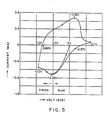
- the cyclic voltammetry was performed using the above obtained polymer-coated conductive glass as a working electrode; a platinum wire as a counter electrode and a standard calomel electrode as a reference electrode; by the use of a polarographic analyzer (174A model manufactured by EG & G Co.) in an acetonitrile solution containing 292 mmol/1 of tetrabutylammonium perchlorate at room temperature.
- the applied voltage sweep rate was 20 mV/sec, and the range of sweep was from +1.0 V to -0.7 V (vs. standard calomel electrode). The results obtained are shown in Figure 5.
- the polymer showed an oxidation peak and a reduction peak at +0.58 V and -0.15 V, respectively, and had a color varying from deep blue at a voltage range of from -0.7.V to +0.6 V to extremely transparent light green at a voltage range of from +0.6 V to +1.0 V.
- the polyisothianaphthene film obtained in Example 4-1 was cut into pieces of 1 cm wide and 3 cm long. One end of the sample piece was adhered to a platinum wire using a conductive adhesive, and this sample piece was arranged on each of both surfaces of a lithium foil of the same size via a 1 mm thick porous polypropylene partitioning membrane in such a manner that an electrolytic solution could sufficiently impregnated thereinto. The system was then dipped in a propylene carbonate solution containing 0.5 mol/l of lithium perchlorate to a depth of 2 cm.
- the monomer isothianaphthene was prepared by the procedure described in the literature (J. A. Gladysz et al., Tetrahedron, 1979, Vol. 35, 2239; M. P. Cava et al., J. Amer. Chem. Soc., 1959, Vol. 81, 4266; M. P. Cava et al., J. Org. Chem., 1971, Vol. 36, 3932), and used directly after preparation.
- the polymer poly(dihydroisothianaphthene) was obtained by electrochemical oxidation of this monomer in a two-electrode, separate compartment cell. Platinum sheet was used as the anode, and oxidized graphite was used as the cathode.
- the clear colorless solution used for the polymerization contained 0.23 M of isothianaphthene with 0.30 M electrolyte, B U4 NPF 6 , in acetonitrile.
- the acetonitrile (Mallinckrodt) was used directly without further purification.
- a series of 1.5 V batteries was used as the power supply.
- thiophene produces partially oxidized ("doped") polymer films under the above conditions while isothianaphthene, after deposition of an extremely thin blue film (presumably doped poly(isothianaphthene)), is transformed to poly(dihydroisothianaphthene).
- poly(isothianaphthene) acts as an initiator of cationic polymerization of isothianaphthene.
- H 2 S0 4 may convert dihydroisothianaphthene-S-oxide directly into poly(isothianaphthene).
- H 2 SO 4 x ⁇ (H 2 O) y .
- the addition of solid dihydroisothianaphthene-S-oxide to 98% H 2 SO 4 did in fact produce the desired partially doped poly(isothianaphthene) (cf Scheme I, below).
- 7,7,8,8-tetracyanoquinodimethane can be used as a catalyst for cationic polymerization.
- the product did not exhibit higher conductivity than any of the other doped poly(isothianaphthene) compounds, indicating that the acceptor is probably not involved in the conductivity of the solid. Two reasons could be advanced for that observation, the acceptor molecules are probably not stacked in small crystalline regions and/or there is complete charge transfer.
- LiBF 4 and Bu 4 NC10 4 can be used as the electrolyte for this reaction.
- the metastable isothianaphthene can be polymerized to well characterizable highly conducting polymers by at least three different procedures; one of these involves the electrochemical preparation of poly(dihydroisothianaphthene) by the polymerization of isothianaphthene in the presence of nucleophilic anions. It has also been found that poly(isothianaphthene) is a better conductor than polythiophene.
- the monomer isothianaphthene (396 mg, 2.96 m.mol) was dissolved in 10 ml methylene chloride which was previously dried over P 2 0 5 .
- methanesulfonic acid was added to this solution, there was an instantaneous change in the reaction mixture from colorless to red. This color became violet after 90 minutes.
- the residue was dissolved in tetrahydrofuran.
- the polymer poly(dihydroisothianaphthene) precipitated from the solution. This was separated by centrifugation, and dried under vacuum.
- the infrared spectrum was identical with that of polymer poly-(dihydroisothianaphthene) mentioned above.
- the polymerization procedure was essentially the same as that described above in Example VI for the polymer poly(dihydroisothianaphthene). The most important point was the electrolyte.
- a blue film of the doped polymer poly(isothianaphthene) was grown on the anode (conducting glass) instantly after connecting a 1.5 V battery.
- Bu 4 NBr and Ph 4 AsCl can also be used as the electrolyte for this reaction.
- the monomer isothianaphthene (238 mg. 1.77 m.mol) was dissolved in 5 ml methylene chloride. After a few mg of TCNQ were added to this solution, its color changed to red very slowly. After overnight stirring, this color became bluish-black. Next, more TCNQ which was double the molar quantity of the monomer isothianaphthene, was added to this solution. This was heated up to 110°C and this temperature was kept for 1 hour. When this reaction mixture was poured into methanol, greenish-black powder precipitated from this solution. This was washed with methanol and chloro-benzene using a Soxhlet extraction apparatus, followed by drying under vacuum.
- the present invention presents three alternative routes to poly(isothianaphthene):
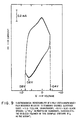
- Figure 9 shows the reversible electrochemical doping of poly(isothianaphthene).
- aluminum as one electrode (with a standard calomel reference electrode)
- the poly-(isothianaphthene) as the other electrode
- a propylene carbonate solution of lithium fluoroborate as the electrolvte
- the present inventors have conducted extensive investigations on electrochromic behaviors of a polymer having an isothianaphthene structure and, as a result, found that the above-described polymer is a novel electrochromic material which is rapid in response and provides a substantially colorless tone in an oxidized state, and thus accomplished the present invention. This finding is admittedly surprising because such an electrochromic material that assumes a substantially colorless tone is not hitherto known.
- the electrochromic display device comprises a conductive transparent base having provided thereon a high molecular weight conductive membrane and an opposing electrode arranged thereunder via a liquid electrolyte and is characterized in that said high molecular weight conductive membrane is a polymer having an isothianaphtene structure and capable of being reversibly oxidized or reduced.
- liquid electrolyte herein used means a dispersion or solution of a supporting electrolyte in a solvent.
- the high molecular weight conductive membrane which can be used as an electrochromic layer according to the present invention is a polymer capable of being reversibly oxidized or reduced and having an isothianaphthene structure represented by the formula (III): wherein R 1 and R 2 represent hydrogen or hydrocarbon having a carbon number of 1 - 5, X is sulfur, selenium or tellurium, Y- represents an anion, z is a value of 0-0.40 representing the ratio of anion per isothianaphthene structure unit, and n represents the degree of polymerization of 5 - 500, which is produced by electrochemically polymerizing isothianaphtene compound expressed by the following formula (IV): wherein R l , R 2 and X are as defined immediately above.
- isothianaphthene compound represented by the formula ( IV ) include 1,3-isothianaphthene, 5-methyl-1,3-isothianaphthene, 5,6-dimethylisothianaphthene, 5-ethyl-1,3-isothianaphthene, 5-methyl-6-ethyl-1,3-isothianaphthene, etc.
- Electrochemical polymerization of the above-described isothianaphthene compound can be carried out according to the methods generally employed for electrochemical polymerization of thiophene, pyrrole, etc. [e.g., the method described in Solid State Communication, Vol. 46, No. 5, 389 (1983)]. More specifically, both controlled potential electrolysis or controlled current electrolysis can be employed, and it is desirable to form a polymer membrane on a transparent base by using a conductive transparent base as a sample electrode.
- the conductive transparent base which can be used in the present invention include the ones comprising a transparent insulator such as glass, polyester film, etc. having vacuum evaporated thereon indium-tin oxide, tin oxide, platinum, etc. by sputtering or a like method, which are easily available as commercial products.
- the polymer membrance formed by electrochemical polymerization has a thickness of from 0.03 to 30 ⁇ m, preferably 0.05 to 22 ⁇ m, more preferably 0.1 to 10 ⁇ m.
- the membrane thickness can be controlled by the quantity of electricity applied in the electrochemical polymerization. When the membrane thickness is less than 0.03 ⁇ m, clear contrast cannot be attained, leading to substantial loss of commerical value as a display material. To the contrary, a thickness exceeding 30 ⁇ m provides clear contrast but is unfavorable in view of film strength or response speed.
- ECD devices can be produced by assembling the thus obtained polymer with an opposing electrode via a liquid electrolyte.
- the liquid electrolyte which can be used is a dispersion or solution of a supporting electrolyte in a solvent.
- the supporting electrolyte which can be used in the present invention includes combinations of (i) anions (i.e., Y - in the formula (III))such as halide anions of Va group elements, e.g., PF 6 - , SbF 6 - , AsF 6 - and SbCl 6 - ; halide anions of IIIa Group series element, e.g., BF 4 - ; halogen anions, e.g., I - (I 3 - ), Br - and Cl - ; perchloric acid anions, e.g., ClO 4 - ; and (ii) cations such as alkali metal ions, e.g., Li + ,
- the supporting electrolytes composed of the above-described combinations of anions (X) and cations are LiPF 6 , LiSbF 6 , LiAsF 6 , LiClO 4 , NaI, NaPF 6 , NaSbF 6 , NaAsF 6 , NaClO 4 , KI, KPF 6 , KSbF 6 , KAsF 6 , KClO 4 , [(n-Bu) 4 N] + ⁇ (AsF 6 ) - , [(n-Bu) 4 N] + ⁇ (PF 6 ) - , [(n-Bu) 4 N] + ⁇ ClO 4 - , LiAlCl 4 , LiBF 4 , (C 6 H 5 ) 4 P ⁇ BF 4 , (C 6 H 5 ) 4 P ⁇ AsF 6 and (C 6 H 5 ) 4 P ⁇ ClO 4 , but these examples are not limitative.
- These supporting electrolytes may be used individually or in combination of two
- HF 2 anion can also be used in addition to the above-enumerated anions.
- cations which can be used in addition to the above-enumerated ones include pyrylium or pyridinium cations represented by the following formula (V) and carbonium cations represented by the following formula (VI) or (VII): wherein Z represents an oxygen atom or a nitrogen atom; R' represents a hydrogen atom, an alkyl group having 1 to 15 carbon atoms or an aryl group having 6 to 15 carbon atoms; R" represents a halogen atom, an alkyl group having 1 to 10 carbon atoms or an aryl group having 6 to 15 carbon atoms; m is 0 when Z is an oxygen atom, or m is 1 when Z is a nitrogen atom; and p is 0 or an integer of from 1 to 5.
- R 3 , R 4 and R 5 each represents a hydrogen atom, an alkyl group having 1 to 15 carbon atoms, an allyl group, an aryl group having 6 to 15 carbon atoms or -OR 7 wherein R 7 represents an alkyl group having 1 to 10 carbon atoms or an aryl group having 6 to 15 carbon atoms, with proviso that R 3 , R 4 and R 5 are not hydrogen atoms at the same time; and R 6 represents a hydrogen atom, an alkyl group having 1 to 15 carbon atoms or an aryl group having 6 to 15 carbon atoms.
- the HF2 anion which can be used is usually obtained by dissolving a compound (hydrofluoride) represented by the formula (VIII), (IX) or (X): wherein R' and R" each represents a hydrogen atom, an alkyl group having 1 to'15 carbon atoms or an aryl group having 6 to 15 carbon atoms; R"' represents an alkyl group having 1 to 10 carbon atoms or an aryl group having 6 to 15 carbon atoms; Z represents an oxygen atom or a nitrogen atom; q represents 0 or a positive integer of 5 or less; and M represents an alkali metal, as a supporting electrolyte in an appropriate solvent.
- Specific examples of the compounds represented by the above formulae (VIII), (IX) and (X) include H 4 N ⁇ HF 2 , Bu 4 N ⁇ HF 2 , Na ⁇ HF 2 , K ⁇ HF 2 , Li ⁇ HF 2 and
- the pyrylium or pyridinium cations represented by the formula (III) can be obtained by dissolving a salt forced between a cation represented by the formula (V) and an anion (X), e.g., ClO 4 - , BF 4 - , AlCl 4 - , FeCl 4 - , SnCl 5 - , PF 6 - , PCl 6 - , SbF 6 - , AsF 6 - , CF 3 SO 3 - , HF 2 - , etc., as a supporting electrolyte in an appropriate solvent.
- X anion
- Specific examples of such a salt are:
- carbonium cations can be obtained by dissolving or dispersing a salt formed between such a cation and an anion (X) (i.e., carbonium salt) as a supporting electrolyte in an appropriate solvent.
- X anion
- the anion (X) usable typically includes BF 4 - , AlCl 4 - , AlBr 3 Cl - , FeCl 4 - , PF 6 -, PC1 6 -, SbCl 6 -, SbF 6 -, ClO 4 - , CF 3 SO 3 - , etc.
- the carbonium salt specifically includes, for example, (C 6 H 5 ) 3 C ⁇ BF 4 , (CH 3 ) 3 C ⁇ BF 4 , HCO ⁇ AlCl 4 , HCO ⁇ BF 4 , C 6 H 5 CO ⁇ SnCl 5 , etc.
- the solvents which can be used in the present invention may be either an aqueous solvent or a non-aqueous solvent, but a solution of the aforesaid supporting electrolyte in a non-aqueous organic solvent is preferred.
- the organic solvents herein used are aprotic and have high dielectric constants.
- ethers, ketones, nitriles, amines, amides, sulfur compounds, phosphoric ester compounds, phosphorous ester compounds, boric ester compounds, chlorinated hydrocarbons, esters, carbonates, nitro compounds and the like can be employed.
- ethers, ketones, nitriles, phosphoric ester compounds, phosphorous ester compounds, boric ester compounds, chlorinated hydrocarbons and carbonates are preferred.
- these solvents include tetrahydrofuran, 2-methyltetrahydrofuran, 1,4-dioxane, monoglyme, acetonitrile, propionitrile, 4-methyl-2-pentanone, butyronitrile, valeronitrile, benzonitrile, 1,2-dichloroethane, ⁇ -butyrolactone, valerolactone, dimethoxyethane, methylformate, propylene carbonate, ethylene carbonate, dimethylformamide, dimethyl sulfoxide, dimethyl thioformamide, ethyl phosphate, methyl phosphate, ethyl phospite, methyl phosphite, 3-methylsulforan, etc.
- nitriles and carbonates are preferred.
- organic solvents may be used alone or in combination of two or more of them.
- organic solvents having merely dispersed therein a supporting electrolyte, or an organic solid electrolyte having high ionic conductivity which is composed of polyethylene oxide and NaI, NaSCN, etc. can also be used in addition to the above-described electrolytes.
- Concentrations of the supporting electrolyte used in the ECD devices of this invention vary depending on the kind of organic solvents used, current and voltage values of applied electricity, operating temperatures, the kind of supporting electrolytes and the like and, therefore, cannot be generally fixed.
- the liquid electrolyte may be either homogeneous or heterogeneous, but usually employable concentrations range from 0.001 to 10 mol/l.
- the distance between the high molecular weight conductive membrane and an opposing electrode cannot be generally determined since it varies depending on the kind of supporting electrolytes, current and voltage values of applied electricity, the display surface area as an ECD device and the like, but it is preferably from 0.05 to 5 mm. Further, as an opposing electrode, a variety of materials can be employed according to the end use.
- the conductive transparent materials as described above are preferably used as opposing electrodes.
- opaque conductive materials such as a metal foil, e.g., nickel or platinum, and gauze.
- the ECD devices provide a substantially colorless tone, background plates having various color tones can be selected.
- the ECD devices obtained by the present invention can be used in a wide application owing to a wide selection of materials to be used.
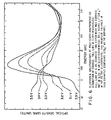
- the thus produced display base was immersed in a tetrahydrofuran solution containing 0.53 mol/l of LiCl0 4 , and electricity was imposed therethrough using Li as a counterelectrode to determine dependence on applied voltage.
- the results obtained are shown in Figure 6.
- the polymer had a blue color at 2.50 V (vs. Li electrode) but turned to transparent pale green at 3.50 V. It was also confirmed that this change was reversible.
- an ECD device as shown in Figure 8 was produced, and a propylene carbonate solution containing 0.53 mol/l of LiBF 4 was incorporated therein as a liquid electrolyte and then sealed.
- Square waves of +0.8 V to -0.4 V were applied to the ECD device at a frequency of 1 Hz to effect a durability test.
- no deterioration of the electrochromic material was observed even after 2 x 10 4 times of coloring and discoloring operations.
Landscapes
- Chemical & Material Sciences (AREA)
- Physics & Mathematics (AREA)
- Nonlinear Science (AREA)
- Organic Chemistry (AREA)
- Chemical Kinetics & Catalysis (AREA)
- General Physics & Mathematics (AREA)
- Polymers & Plastics (AREA)
- Medicinal Chemistry (AREA)
- Health & Medical Sciences (AREA)
- Optics & Photonics (AREA)
- Spectroscopy & Molecular Physics (AREA)
- Engineering & Computer Science (AREA)
- Materials Engineering (AREA)
- Electrochemistry (AREA)
- General Chemical & Material Sciences (AREA)
- Polyoxymethylene Polymers And Polymers With Carbon-To-Carbon Bonds (AREA)
Priority Applications (1)
| Application Number | Priority Date | Filing Date | Title |
|---|---|---|---|
| AT85303864T ATE53046T1 (de) | 1984-05-31 | 1985-05-31 | Polymere mit isothianaphthen-struktur und elektrochromische anzeigevorrichtung. |
Applications Claiming Priority (8)
| Application Number | Priority Date | Filing Date | Title |
|---|---|---|---|
| JP109329/84 | 1984-05-31 | ||
| JP10932984A JPS6117581A (ja) | 1984-05-31 | 1984-05-31 | イソチアナフテン構造を有する重合体 |
| JP121956/84 | 1984-06-15 | ||
| JP59121956A JPS6112784A (ja) | 1984-06-15 | 1984-06-15 | エレクトロクロミツク表示装置 |
| US63480584A | 1984-07-26 | 1984-07-26 | |
| US634805 | 1984-07-26 | ||
| US06/736,984 US4640748A (en) | 1984-05-31 | 1985-05-22 | Polyisothianaphtene, a new conducting polymer |
| US736984 | 1991-07-29 |
Publications (3)
| Publication Number | Publication Date |
|---|---|
| EP0164974A2 true EP0164974A2 (de) | 1985-12-18 |
| EP0164974A3 EP0164974A3 (en) | 1986-12-17 |
| EP0164974B1 EP0164974B1 (de) | 1990-05-23 |
Family
ID=27469708
Family Applications (1)
| Application Number | Title | Priority Date | Filing Date |
|---|---|---|---|
| EP85303864A Expired - Lifetime EP0164974B1 (de) | 1984-05-31 | 1985-05-31 | Polymere mit Isothianaphthen-Struktur und elektrochromische Anzeigevorrichtung |
Country Status (2)
| Country | Link |
|---|---|
| EP (1) | EP0164974B1 (de) |
| DE (1) | DE3577860D1 (de) |
Cited By (7)
| Publication number | Priority date | Publication date | Assignee | Title |
|---|---|---|---|---|
| US4795242A (en) * | 1985-05-22 | 1989-01-03 | University Of California | Conducting substituted polyisothianaphthenes |
| EP0545417A1 (de) * | 1991-12-04 | 1993-06-09 | Showa Denko Kabushiki Kaisha | Wasserlösliches leitfähiges Polymer und Verfahren zu seiner Herstellung |
| WO1994017120A1 (en) * | 1993-01-29 | 1994-08-04 | Dsm N.V. | Process for the preparation of a polymer from a heterocyclic monomer |
| WO1994028083A1 (en) * | 1993-05-28 | 1994-12-08 | Showa Denko Kabushiki Kaisha | Antistatic agent and method for suppressing electrification |
| US5648453A (en) * | 1991-12-04 | 1997-07-15 | Showa Denko K.K. | Electroconductive polymer and process for producing the polymer |
| US5688873A (en) * | 1991-12-04 | 1997-11-18 | Showa Denko K.K. | Electroconductive polymer and process for producing the polymer |
| EP3564290A4 (de) * | 2016-12-28 | 2020-09-09 | Showa Denko K.K. | Verfahren zur herstellung eines elektrisch leitfähigen polyisothianaphthenpolymers |
Family Cites Families (1)
| Publication number | Priority date | Publication date | Assignee | Title |
|---|---|---|---|---|
| US4487667A (en) * | 1983-05-16 | 1984-12-11 | The B. F. Goodrich Company | Polymethylene pyrroles and electrically conductive polymers thereof |
-
1985
- 1985-05-31 EP EP85303864A patent/EP0164974B1/de not_active Expired - Lifetime
- 1985-05-31 DE DE8585303864T patent/DE3577860D1/de not_active Expired - Lifetime
Cited By (12)
| Publication number | Priority date | Publication date | Assignee | Title |
|---|---|---|---|---|
| US4795242A (en) * | 1985-05-22 | 1989-01-03 | University Of California | Conducting substituted polyisothianaphthenes |
| EP0273643A3 (en) * | 1986-12-18 | 1990-03-07 | The Regents Of The University Of California | Conducting substituted polyisothianophthenes |
| EP0545417A1 (de) * | 1991-12-04 | 1993-06-09 | Showa Denko Kabushiki Kaisha | Wasserlösliches leitfähiges Polymer und Verfahren zu seiner Herstellung |
| US5648453A (en) * | 1991-12-04 | 1997-07-15 | Showa Denko K.K. | Electroconductive polymer and process for producing the polymer |
| US5688873A (en) * | 1991-12-04 | 1997-11-18 | Showa Denko K.K. | Electroconductive polymer and process for producing the polymer |
| WO1994017120A1 (en) * | 1993-01-29 | 1994-08-04 | Dsm N.V. | Process for the preparation of a polymer from a heterocyclic monomer |
| BE1006640A3 (nl) * | 1993-01-29 | 1994-11-03 | Dsm Nv | Werkwijze voor de bereiding van een polymeer. |
| US5532328A (en) * | 1993-01-29 | 1996-07-02 | Dsm N.V. | Process for the preparation of a polymer |
| WO1994028083A1 (en) * | 1993-05-28 | 1994-12-08 | Showa Denko Kabushiki Kaisha | Antistatic agent and method for suppressing electrification |
| US5783251A (en) * | 1993-05-28 | 1998-07-21 | Showa Denko K.K. | Method for suppressing electrification and for observing or inspecting an article |
| EP3564290A4 (de) * | 2016-12-28 | 2020-09-09 | Showa Denko K.K. | Verfahren zur herstellung eines elektrisch leitfähigen polyisothianaphthenpolymers |
| US11136432B2 (en) | 2016-12-28 | 2021-10-05 | Showa Denko K.K. | Method for producing polyisothianaphthene-based electroconductive polymer |
Also Published As
| Publication number | Publication date |
|---|---|
| EP0164974B1 (de) | 1990-05-23 |
| DE3577860D1 (de) | 1990-06-28 |
| EP0164974A3 (en) | 1986-12-17 |
Similar Documents
| Publication | Publication Date | Title |
|---|---|---|
| US4640748A (en) | Polyisothianaphtene, a new conducting polymer | |
| EP0273643B1 (de) | Elektrische leitfähige substituierte Polyisothianaphthene | |
| US5011751A (en) | Electrochemical device | |
| KR960009685B1 (ko) | 자기 도우프된 중합체의 제조방법 | |
| Su et al. | Polytriphenylamine derivative with high free radical density as the novel organic cathode for lithium ion batteries | |
| US4740436A (en) | Secondary battery | |
| EP0222906B1 (de) | Elektrisch leitfähige polymere | |
| US4889659A (en) | Nitrogenized electronic conductive polymers, their preparation processes, electrochromic display cell and electrochemical generator using these polymers | |
| KR101139079B1 (ko) | 리튬염 | |
| JP3234638B2 (ja) | フッ素化チオフェン、これらのチオフェンから誘導されたポリマー及びこれらのポリマーを含む導電性ポリマー | |
| US4772940A (en) | Polymer having isothianaphthene structure and electrochromic display | |
| US4769115A (en) | Process for preparing electrically conductive polymer | |
| US5037713A (en) | Secondary battery | |
| EP0167321B1 (de) | Ladbare elektrochemische Zelle mit konjugierten Polymeren als aktives Elektrodenmaterial | |
| EP0164974B1 (de) | Polymere mit Isothianaphthen-Struktur und elektrochromische Anzeigevorrichtung | |
| US4954590A (en) | Preparation of polymer having isoindole structures | |
| Jeon et al. | Electrochemical doping of poly (3-vinylperylene) and electrical properties of doped polymers | |
| JPS6411207B2 (de) | ||
| KR20170031600A (ko) | 전하 저장 재료, 전극 활물질 및 이차전지 | |
| JPH0211614B2 (de) | ||
| JPS6224034B2 (de) | ||
| CN1024067C (zh) | 导电的带取代基的聚异硫茚类的应用 | |
| JPS632251A (ja) | 二次電池 | |
| Iwasa et al. | In Situ Absorption Spectra and ESR Measurements of Poly (trans-(2, 2′-bithiophene-5-yl)-(2, 2′: 5′, 2 ″-terthiophene-5-yl) ethylene) During Electrochemical Doping | |
| JPS62143923A (ja) | 導電性高分子の電解重合法 |
Legal Events
| Date | Code | Title | Description |
|---|---|---|---|
| PUAI | Public reference made under article 153(3) epc to a published international application that has entered the european phase |
Free format text: ORIGINAL CODE: 0009012 |
|
| AK | Designated contracting states |
Designated state(s): AT BE CH DE FR GB IT LI LU NL SE |
|
| RIN1 | Information on inventor provided before grant (corrected) |
Inventor name: HEEGER, ALAN Inventor name: KOBAYASHI, MASAO Inventor name: WUDL, FRED |
|
| PUAL | Search report despatched |
Free format text: ORIGINAL CODE: 0009013 |
|
| AK | Designated contracting states |
Kind code of ref document: A3 Designated state(s): AT BE CH DE FR GB IT LI LU NL SE |
|
| 17P | Request for examination filed |
Effective date: 19870617 |
|
| 17Q | First examination report despatched |
Effective date: 19881031 |
|
| GRAA | (expected) grant |
Free format text: ORIGINAL CODE: 0009210 |
|
| RIN1 | Information on inventor provided before grant (corrected) |
Inventor name: HEEGER, ALAN Inventor name: KOBAYASHI, MASAO Inventor name: WUDL, FRED |
|
| AK | Designated contracting states |
Kind code of ref document: B1 Designated state(s): AT BE CH DE FR GB IT LI LU NL SE |
|
| REF | Corresponds to: |
Ref document number: 53046 Country of ref document: AT Date of ref document: 19900615 Kind code of ref document: T |
|
| ET | Fr: translation filed | ||
| REF | Corresponds to: |
Ref document number: 3577860 Country of ref document: DE Date of ref document: 19900628 |
|
| ITF | It: translation for a ep patent filed | ||
| PLBE | No opposition filed within time limit |
Free format text: ORIGINAL CODE: 0009261 |
|
| STAA | Information on the status of an ep patent application or granted ep patent |
Free format text: STATUS: NO OPPOSITION FILED WITHIN TIME LIMIT |
|
| 26N | No opposition filed | ||
| ITTA | It: last paid annual fee | ||
| EPTA | Lu: last paid annual fee | ||
| EAL | Se: european patent in force in sweden |
Ref document number: 85303864.4 |
|
| REG | Reference to a national code |
Ref country code: GB Ref legal event code: IF02 |
|
| PGFP | Annual fee paid to national office [announced via postgrant information from national office to epo] |
Ref country code: NL Payment date: 20040429 Year of fee payment: 20 |
|
| PGFP | Annual fee paid to national office [announced via postgrant information from national office to epo] |
Ref country code: AT Payment date: 20040504 Year of fee payment: 20 |
|
| PGFP | Annual fee paid to national office [announced via postgrant information from national office to epo] |
Ref country code: FR Payment date: 20040519 Year of fee payment: 20 |
|
| PGFP | Annual fee paid to national office [announced via postgrant information from national office to epo] |
Ref country code: SE Payment date: 20040521 Year of fee payment: 20 |
|
| PGFP | Annual fee paid to national office [announced via postgrant information from national office to epo] |
Ref country code: CH Payment date: 20040524 Year of fee payment: 20 |
|
| PGFP | Annual fee paid to national office [announced via postgrant information from national office to epo] |
Ref country code: GB Payment date: 20040526 Year of fee payment: 20 |
|
| PGFP | Annual fee paid to national office [announced via postgrant information from national office to epo] |
Ref country code: LU Payment date: 20040528 Year of fee payment: 20 |
|
| PGFP | Annual fee paid to national office [announced via postgrant information from national office to epo] |
Ref country code: BE Payment date: 20040622 Year of fee payment: 20 |
|
| PGFP | Annual fee paid to national office [announced via postgrant information from national office to epo] |
Ref country code: DE Payment date: 20040630 Year of fee payment: 20 |
|
| PG25 | Lapsed in a contracting state [announced via postgrant information from national office to epo] |
Ref country code: GB Free format text: LAPSE BECAUSE OF EXPIRATION OF PROTECTION Effective date: 20050530 |
|
| BE20 | Be: patent expired |
Owner name: THE *REGENTS OF THE UNIVERSITY OF CALIFORNIA Effective date: 20050531 |
|
| PG25 | Lapsed in a contracting state [announced via postgrant information from national office to epo] |
Ref country code: NL Free format text: LAPSE BECAUSE OF EXPIRATION OF PROTECTION Effective date: 20050531 |
|
| REG | Reference to a national code |
Ref country code: GB Ref legal event code: PE20 |
|
| REG | Reference to a national code |
Ref country code: CH Ref legal event code: PL |
|
| NLV7 | Nl: ceased due to reaching the maximum lifetime of a patent |
Effective date: 20050531 |
|
| EUG | Se: european patent has lapsed | ||
| BE20 | Be: patent expired |
Owner name: THE *REGENTS OF THE UNIVERSITY OF CALIFORNIA Effective date: 20050531 |