EP0222906B1 - Elektrisch leitfähige polymere - Google Patents
Elektrisch leitfähige polymere Download PDFInfo
- Publication number
- EP0222906B1 EP0222906B1 EP86904288A EP86904288A EP0222906B1 EP 0222906 B1 EP0222906 B1 EP 0222906B1 EP 86904288 A EP86904288 A EP 86904288A EP 86904288 A EP86904288 A EP 86904288A EP 0222906 B1 EP0222906 B1 EP 0222906B1
- Authority
- EP
- European Patent Office
- Prior art keywords
- electrically conducting
- formula
- optionally substituted
- process according
- conjugated
- Prior art date
- Legal status (The legal status is an assumption and is not a legal conclusion. Google has not performed a legal analysis and makes no representation as to the accuracy of the status listed.)
- Expired - Lifetime
Links
- 0 CC1=C(*)C(*)=C(C)*1 Chemical compound CC1=C(*)C(*)=C(C)*1 0.000 description 1
Images
Classifications
-
- H—ELECTRICITY
- H01—ELECTRIC ELEMENTS
- H01M—PROCESSES OR MEANS, e.g. BATTERIES, FOR THE DIRECT CONVERSION OF CHEMICAL ENERGY INTO ELECTRICAL ENERGY
- H01M4/00—Electrodes
- H01M4/02—Electrodes composed of, or comprising, active material
- H01M4/36—Selection of substances as active materials, active masses, active liquids
- H01M4/60—Selection of substances as active materials, active masses, active liquids of organic compounds
-
- C—CHEMISTRY; METALLURGY
- C08—ORGANIC MACROMOLECULAR COMPOUNDS; THEIR PREPARATION OR CHEMICAL WORKING-UP; COMPOSITIONS BASED THEREON
- C08G—MACROMOLECULAR COMPOUNDS OBTAINED OTHERWISE THAN BY REACTIONS ONLY INVOLVING UNSATURATED CARBON-TO-CARBON BONDS
- C08G61/00—Macromolecular compounds obtained by reactions forming a carbon-to-carbon link in the main chain of the macromolecule
- C08G61/12—Macromolecular compounds containing atoms other than carbon in the main chain of the macromolecule
- C08G61/122—Macromolecular compounds containing atoms other than carbon in the main chain of the macromolecule derived from five- or six-membered heterocyclic compounds, other than imides
- C08G61/123—Macromolecular compounds containing atoms other than carbon in the main chain of the macromolecule derived from five- or six-membered heterocyclic compounds, other than imides derived from five-membered heterocyclic compounds
-
- H—ELECTRICITY
- H01—ELECTRIC ELEMENTS
- H01B—CABLES; CONDUCTORS; INSULATORS; SELECTION OF MATERIALS FOR THEIR CONDUCTIVE, INSULATING OR DIELECTRIC PROPERTIES
- H01B1/00—Conductors or conductive bodies characterised by the conductive materials; Selection of materials as conductors
- H01B1/06—Conductors or conductive bodies characterised by the conductive materials; Selection of materials as conductors mainly consisting of other non-metallic substances
- H01B1/12—Conductors or conductive bodies characterised by the conductive materials; Selection of materials as conductors mainly consisting of other non-metallic substances organic substances
- H01B1/124—Intrinsically conductive polymers
- H01B1/127—Intrinsically conductive polymers comprising five-membered aromatic rings in the main chain, e.g. polypyrroles, polythiophenes
-
- Y—GENERAL TAGGING OF NEW TECHNOLOGICAL DEVELOPMENTS; GENERAL TAGGING OF CROSS-SECTIONAL TECHNOLOGIES SPANNING OVER SEVERAL SECTIONS OF THE IPC; TECHNICAL SUBJECTS COVERED BY FORMER USPC CROSS-REFERENCE ART COLLECTIONS [XRACs] AND DIGESTS
- Y02—TECHNOLOGIES OR APPLICATIONS FOR MITIGATION OR ADAPTATION AGAINST CLIMATE CHANGE
- Y02E—REDUCTION OF GREENHOUSE GAS [GHG] EMISSIONS, RELATED TO ENERGY GENERATION, TRANSMISSION OR DISTRIBUTION
- Y02E60/00—Enabling technologies; Technologies with a potential or indirect contribution to GHG emissions mitigation
- Y02E60/10—Energy storage using batteries
Definitions
- This invention relates to electrically conducting polymers, to films of these polymers on electrodes, and to processes for preparing these polymers.
- organic polymers containing a n-conjugated backbone structure have desirable electrical conductivities for a range of applications. These applications include coatings on electrodes for batteries, galvanic cells, and electrochromic display devices.
- polyacetylene especially trans-polyacetylene.
- These polymers may be doped with conductivity increasing amounts of an electron acceptor (p-type) dopant and/or a conductivity- decreasing amount of an electron donor (n-type) dopant to produce families of polymeric materials whose conductivities range from semiconductor behaviour to metallic behaviour.
- Methods of doping these polymers with n- and/p- type dopants are disclosed in US Patent Nos 4204216, 4222903, and 4321114.
- Polyphenylene is another conducting polymer disclosed in these patents.
- EP-A-0095973 discloses polymers of pyrrole, thiophene and furan that are substituted in the 3 and/or 4 ring positions with groups such as alkyl, cyano and halo. These polymers are disclosed as useful in batteries.
- an electrically conducting organic material which comprises a polymer optionally doped with an n- or p- type dopant, wherein the polymer contains along its backbone at least one n-conjugated linear unit of formula I where A is selected from groups of the formula 1a, 1b b or 1c. where R 1 and R 2 are independently selected from H, optionally substituted alkyl, alkoxyl or halide and X is selected from 0, S and NR 3 where R 3 is H or an optionally substituted alkyl group; B is selected from groups of the formula l'a, 1b' or 1c'. where R 1 ⁇ R 2 and X are defined above.
- Y is selected from groups of the formula (CR) 2x-1 where X is an integer Room 1 to 6 and R is H or an optionally substituted alkyl group and n is 1 or 2 provided that when A is 1a, B is 1 a', when A is 1b B is 1b' and when A is 1c, B is 1c' and further provided that when A is 1c, Y is not ⁇ CH ⁇ .
- the backbone comprises repeat units of formula II. where n is 1 or 2 and X, Y, R 1 and R are as defined above.
- the polymer is preferably doped with either n-type (electron doning) cationic dopant ions, or, more preferably, with p-type (electron withdrawing) anionic dopant ions.
- Suitable dopants ions and methods of incorporating these ions into the polymer are disclosed in US Patent No 4,321,114 (Heeger et a/).
- a wide variety of dopant species may suitably be employed, either individually or in combination, for effectively modifying the room temperature electrical conductivity of the conjugated polymer in accordance with the present invention.
- Suitable anionic dopant ions for effecting p-type doping include, for example, I-, Br-, Cl - , F - , ClO 4 - , AlCl 4 , PF 6 - , AsF 6 - , AsF 4 - , SO 3 CF 3 - , BF 4 - , BCl 4 , NO 3 - , POF 4 - , CN - , SiF 3 - , CH 3 C0 2 - (acetate), C 6 H 5 CO 2 - (benzoate), CH 3 C 6 H 4 S0 3 - (tosylate), SiF 6 -- , SO 4 -- , or the like.
- the cationic dopant ions suitable for effecting n-type doping are cations of a metal whose Pauling electronegativity value is no greater than 1.6. A complete list of such metals and their corresponding electronegativity values are provided in Table I below.
- the above list of metals includes all of the alkali metals, all of the alkaline earth metals, and certain of the metals from Group 3 (Y, Sc and Al) and Group 4 (Zr and Ti) of the Periodic Table.
- the preferred cationic dopant ions are alkali metal ions, particularly Li + ; and the preferred anionic dopant ions are halide ions, ClO 4 - , PF 6 -, AsF 6 - , AsF 4 - , SO 3 CHF 3 - , and BF 4 - .
- the molar ratio of cyclic groups in the polymer to dopant ions in the material preferably lies in the range 1:0.01 to 1:5.
- the present polymers containing units of formula II may be prepared by the oxidation of precursor polymers having repeat units where A and Y are as defined above, to generate the required sequence of double bonds.
- these particular polymers are prepared by chemical- or electro- oxidative polymerisation.
- n 1
- the polymer is prepared by the chemical oxidative co-polymerisation of monomeric precursors for example by condensation polymerisation followed by oxidation.
- n 2
- the polymers are preferably prepared by first preparing a precursor monomer of formula HA ⁇ (Y)H ⁇ AH (eg 2,2'-dipyrryl methane), and then electro-oxidatively polymerising the monomer.
- the polymeric product is conveniently filmed onto the anode of a cell from a solution of the monomer conveniently contain a salt to improve the ionic conductivity of the solution.
- the advantage of electro-oxidative polymerisation is that the product polymer is filmed onto an electrode ready for use in, for example, a battery.
- the salt in the solution will provide a source of dopant ions that will dope the polymer during its formation and so generally improve its conductivity.
- an electrode for use in a galvanic cell, a battery, an electochromic display device or an optical storage device which has thereon a film of an electrically conducting organic material according to the first aspect.
- the thickness of the film is preferably from 0.01 um to 2 mm, most preferably from 0.05 um to 100 pm, depending on the use to which the electrode is to be put.
- a process of depositing an electronically conducting organic material onto a substrate which comprises electrochemically oxidising, between an anode and a cathode, a monomer of general formula III dissolved within a solvent, wherein
- A is a divalent optionally-substituted conjugated organic cyclic group containing a n-conjugated sequence of single bonds and at least two double bonds, and is preferably a hetero-or homo-cyclic group containing less than 7 ring atoms,
- Y 1 is preferably CH, p is preferably 1, and q is preferably 1.
- A is preferably wherein X is a Group V1b atom or an optionally-substituted Group Vb atom, and R 1 and R 2 , when taken separately, are the same or different and each is selected from the group consisting of H, optionally-substituted alkyl, optionally-substituted alkoxyl, optionally-substituted aryl, optionally-substituted amino, halo and cyano or, when taken together, are optionally-substituted benzo.
- X is preferably NR, S or 0 where R is H, optionally-substituted aryl, or optionally-substituted alkyl.
- R, R ⁇ and R 2 consists of or contains an optionally-substituted alkyl group
- the alkyl group is preferably a C 1 ⁇ C 5 , especially an nC 1 ⁇ C 5 , alkyl group.
- X is NH or S and R 1 and R are both H.
- Preferred monomers of general Formula III are 2,2' dipyrrylmethane and 2,2' dithienylmethane.
- the material is usually deposited as a film.
- the solvent preferably contains an electrolyte compound that is ionisable in the solvent to provide anionic dopant ions that dope the depositing material as electrochemical oxidation proceeds.
- the presence of the compound speeds up film deposition and will generally improve the conductivity of the resultant polymeric material.
- Suitable anionic dopant ions include any one of those listed as suitable for inclusion in the material according to the first aspect of the present invention.
- One use of the materials according to the first aspect of the present invention, and, more especially, of the polymeric product of the process according to the third aspect of the present invention, is in batteries.
- Another variety of material for possible electrode application includes electrically conducting polymers having extended n-conjugation sequences, the most well known example being polyacetylene; they may be used either as anodes or cathodes if a suitable doping process is possible. Again full chemical reversibility over many charge - discharge cycles is desired, however results shows that for polyacetylene high coulombic efficiencies are obtained only if the material is not oxidized beyond a 6 mole % limit.
- the present polymeric material may be used in a galvanic cell, a photogalvanic cell, or a battery comprising an anode, a cathode and an electrolyte contained between the electrodes, wherein one or both of the active components of the electrodes comprises in part or in whole a material according to the first aspect of the present invention or, most preferably, the polymeric product of the process according to the third aspect of the present invention. It is important that the polymer film be adherent to the backing electrode and form good electrical contact. The thickness of the polymeric film formed would be controlled by the total amount of charge passed during the polymerisation. The desired thickness of film grown would be dependent on the required characteristics for the cell.
- a greater mass of polymer could be compatible with a cell of high capacity but would possibly give a lower current drain rate and power density under commensurate conditions as for a thinner-film electrode device.
- the electrode films be relatively thin, less than 50 pm and preferably less than 25 pm but thicker than 0.01 pm.
- procedures for forming a film of the electrode material include casting or spin-casting from a solution of the polymer in a suitable solvent.
- the polymer may be deposited as an insoluble film from the polymerisation reaction.
- All the cells or batteries described herein may be used in either a primary or secondary mode.
- the number of discharge - charge cycles, and amount of charge, as a fraction the total practicable capacity of the battery, in a typical cycle, which will be attainable will be dependent on the construction, materials and morphologies of said materials in the batteries made.
- this invention is not limited or constrained by this.
- the principal advantages of the polymeric materials described in this invention, over other electronically conducting polymers, are improved stability in a variety of environments and doping states, particularly high mole % doping levels. Stability to doping, most particularly p-doping of the polymers described in this invention, when in contact with aqueous electrolytes, is an advantage of the polymeric materials of this invention.
- the polymeric electrode chosen from the types given in this invention may be synthesized and fabricated by conventional techniques. It is preferred that the process may be combined into a single operation, for example the monomer may undergo an electrochemically driven or photoelectrochemically driven, by appropriate choice of a semiconductor electrode, an oxidative coupling reaction to given a film of the desired polymer or an intermediate or precursor polymer. Alternatively if the polymeric electrode material is soluble in a suitable solvent, then film formation may be achived by solvent evaporation. If the polymer is insoluble then the synthetic procedure would be designed such that the wanted polymer is formed as a thin film covering the region allotted for the electrode. The performance of the resulting electrode may be very dependent on the nature of the morphology created.
- Ways of controlling this aspect using the above electrochemical synthetic route include: variation of the monomer concentration, the current density, applied potential, the material and makeup of the electrode and the electrolyte solvent and salt. If the polymer is prepared by a conventional synthetic route or other route apart from electro-oxidation then it may be desirable to blend the electrically conducting polymer with the polymeric electrolyte if this is appropriate in order to improve mechanical and physical properties and ion transport within the body of the electrode material. Where the polymeric electrode is formed in situ in the presence of a polymeric electrolyte then this improvement of morphology and inter-phase contact may be expected to take place.
- the method of fabrication of the cell may be achieved by conventional techniques however a most important aspect of the use of the materials described here is their ability to form thin coherent films so that contact areas are very high and consequently the necessary current densities may be small.
- a further use of the materials according to the first aspect of the present invention and, more especially, of the polymeric product of the process according to the third aspect of the present invention, is in electrochromic display devices and in optical storage (memory) devices.
- An electro-chromic display is a device wherein the display effect is achived as a consequence of a redox reaction caused by the passage of charge between a display electrode and a counter electrode, both contacted by a suitable electrolyte.
- Examples of conventional displays include those given in GB-A-1,376,799 whereis a material undergoing the redox reaction is heptyl viologen dication. Upon passage of charge, there is reduction of the viologen and a purple fil m is deposited at the indicating or display electrode.
- the polymer property made use of is a change in the absorption spectrum of the polymer film in contact with a backing electrode and surrounded by an electrolyte when the content of doping or oxidation state of the polymer is changed. This is normally achieved by changing the potential of the backing electrode.
- the film may be switched between two or more levels of oxidation in order to change the nature of the display or the content of the memory.
- the oxidation state of the film is read optically by passage of a beam of light of appropriate wavelength, not necessarily corresponding to the visible region of the electromagnetic spectrum, over the film with a reflection arrangement or through the film with a transmission arrangement.
- the memory may be read electrically in which case the memory effect may be erased concurrently with the reading stage, though not necessarily so.
- a further method of writing the memory is to have the backing electrode as an appropriate semiconductor electrode, such that when illuminated by light (the writing step) of energy greater than the band gap between the valence and conduction bands of the semi-conductor then the polymeric film would be caused to change oxidation state.
- the backing electrode as an appropriate semiconductor electrode, such that when illuminated by light (the writing step) of energy greater than the band gap between the valence and conduction bands of the semi-conductor then the polymeric film would be caused to change oxidation state.
- contrast is defined here as the difference in absorption or absorbance, or reflection or reflectance, for a particular wavelength of light, of the polymeric film in the two oxidation states considered.
- the polymeric film may be doped with any of the n- or p- type dopants that are described above as suitable for doping the material according to the first aspect of the present invention.
- the thickness of the polymeric film covering the backing electrode is preferably from 0.01 to 5 um and is most preferably from 0.05 to 1 pm.
- the thickness of the polymeric film covering the backing electrode is preferably from 0.01 to 5 um and is most preferably from 0.05 to 1 pm.
- For the property of a high contrast between the designated oxidation states of the polymer it may be advantageous to have a relatively thick film, thus there is a compromise between the desired properties and an optimum film thickness for a particular example of polymer would be chosen.
- a Grignard reagent was prepared in diethyl ether by a standard method and distilled pyrrole was added to the resulting solution. After a 2 hour reflux the solution produced was added at room temperature to a solution of phosgene in toluene and reaction allowed to occur over a 16 hour period. Work-up of the reaction mixture gave the required product; the full method is described by A W Johnson and W R Overend, J C S Perkin I, 1972, 2681.
- the second stage of the synthesis was the reduction of (V) by sodium borohydride as described by R Chong, P S Clezy and A J Liepa, Austral. J Chem 1969,22, 229.
- the product was a solid (colourless needles) and had the required analytical properties. The material was stored in the dark under vacuum prior to use.
- Polymerisation was performed in a single major compartment, 3-electrode cell of total volume ca. 20 cm 3 , with the counter-electrode separated from the remaining solution by a glass sinter. An oxygen-free nitrogen atmosphere was maintained within the cell and whole arrangement was temperature controlled.
- the electrolyte employed was vacuum dried poly(ethylene glycol) of average molar mass 200 containing lithium trifluoromethanesulphonate (0.1 mol dm -3 ) and 0.1 mol dm- 3 2,2'-dipyrrylmethane, maintained at 52°C.
- the anode was either a platinum flag or a tin oxide transparent conducting glass with a counter electrode of aluminium and calomel reference electrode.
- Electrode deposited films had a metallic green-black appearance.
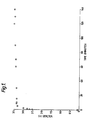
- the potential - polymerisation time characteristic is given in the graph illustrated in Figure 1.
- the thickness of the film after 240 minutes was about 1 mm. Thinner films were also produced using shorter reaction times. The films produced were ethanol washed and dried under vacuum.
- the films were found to be flexible and showed a conductivity, measured by a standard 4-point-probe method, of about 1 S cm -1 at room temperature.
- Elemental analysis (C, H, N) indicate that the polymer to salt ratio in the doped films was ca. 2.4:1 ie (C 9 H 7 N 2 ) 2.4 CF 3 SO 3 .
- the process used was an interfacial polymerisation where equal volumes of an aqueous 30% (w/v) iron (III) chloride solution and toluene containing 0.05 mol dm- 3 2,2'-dipyrrylmethane were allowed to react at room temperature. After 2 hours, a thin metallic green-black polymeric film was apparent at the interface between the organic and aqueous phases. After about 4 hours, the film was thick enough to be lifted intact from the reaction mixture. The retention of the film's colour indicated its stability in an aqueous environment.
- Poly(pyrrole methine) was prepared by the condensation reaction of pyrrole with formaldehyde. Pyrrole and a formalin solution (about 40% w/v formaldehyde) in a pyrrole: formaldehyde molar ratio of about 1:1 were reacted together at ambient temperature under an air atmosphere. The reaction time was varied between 30 minutes and 6 hours for several reaction batches, after which the volalite components of the reaction mixture were removed. Typically, the product was deeply coloured or black. The product varied from a low molar mass polymer (30 minutes reaction time) to a crosslinked brittle solid (6 hours reaction time). When the reaction was allowed to proceed to completion (6 hours reaction time), the infrared carbonyl absorption was no longer detectable in the product. The products were all found to be air and water stable.
- Example 1 The process of Example 1 was repeated using 2,2'-dithienylmethane in place of 2,2'-dipyrrylmethane.
- the temperature, time, and current densities employed during polymerisation were all the same as those used in Example 1.
- a coherent and deeply coloured film was observed to form on the anode.
- the monomer (VIII) was isolated by the method of Goldfarb et al (see preparation of 2,2'-dithienylmethane described above) and was electro-oxidatively polymerised using the method of Example 5.
- the combined reaction and doping step can be summarized by the following equation:
Landscapes
- Chemical & Material Sciences (AREA)
- Chemical Kinetics & Catalysis (AREA)
- Physics & Mathematics (AREA)
- Spectroscopy & Molecular Physics (AREA)
- Health & Medical Sciences (AREA)
- Medicinal Chemistry (AREA)
- Polymers & Plastics (AREA)
- Organic Chemistry (AREA)
- Electrochemistry (AREA)
- General Chemical & Material Sciences (AREA)
- Polyoxymethylene Polymers And Polymers With Carbon-To-Carbon Bonds (AREA)
- Battery Electrode And Active Subsutance (AREA)
Claims (20)


Applications Claiming Priority (2)
| Application Number | Priority Date | Filing Date | Title |
|---|---|---|---|
| GB8517622 | 1985-07-12 | ||
| GB858517622A GB8517622D0 (en) | 1985-07-12 | 1985-07-12 | Electrically conducting conjugated polymers |
Publications (2)
| Publication Number | Publication Date |
|---|---|
| EP0222906A1 EP0222906A1 (de) | 1987-05-27 |
| EP0222906B1 true EP0222906B1 (de) | 1990-04-04 |
Family
ID=10582183
Family Applications (1)
| Application Number | Title | Priority Date | Filing Date |
|---|---|---|---|
| EP86904288A Expired - Lifetime EP0222906B1 (de) | 1985-07-12 | 1986-07-11 | Elektrisch leitfähige polymere |
Country Status (7)
| Country | Link |
|---|---|
| US (1) | US4781443A (de) |
| EP (1) | EP0222906B1 (de) |
| JP (1) | JPH0730169B2 (de) |
| CA (1) | CA1336847C (de) |
| DE (1) | DE3670172D1 (de) |
| GB (1) | GB8517622D0 (de) |
| WO (1) | WO1987000678A1 (de) |
Families Citing this family (36)
| Publication number | Priority date | Publication date | Assignee | Title |
|---|---|---|---|---|
| DE3531600A1 (de) * | 1985-09-04 | 1987-03-05 | Wacker Chemie Gmbh | Polymere mit konjugierten doppelbindungen |
| US5342912A (en) * | 1987-12-14 | 1994-08-30 | Fred Wudl | Self-doped zwitterionic aniline polymers |
| US5863981A (en) * | 1986-03-24 | 1999-01-26 | The Regents Of The University Of California | Electrically conducting water-soluble self-doping polyaniline polymers and the aqueous solutions thereof |
| DE3710657A1 (de) * | 1987-03-31 | 1988-10-13 | Wacker Chemie Gmbh | Basische polypyrrylenmethine und deren salze |
| US5286414A (en) * | 1987-05-26 | 1994-02-15 | Hoechst Aktiengesellschaft | Electroconductive coating composition, a process for the production thereof and the use thereof |
| GB8714239D0 (en) * | 1987-06-17 | 1987-07-22 | Dowty Mining Machinery Ltd | Solid state batteries |
| DE3880120T2 (de) * | 1987-12-07 | 1993-10-14 | Solvay | Leitfähige Polymere von mit Äthergruppierung substituierten aromatischen heterocyclischen Verbindungen, Verfahren zu deren Herstellung, Vorrichtung enthaltend diese Polymere, und Monomere die ermöglichen solche Polymere zu gewinnen. |
| US5760169A (en) * | 1987-12-14 | 1998-06-02 | The Regents Of The University Of California | Self-doped polymers |
| US4880508A (en) * | 1988-02-12 | 1989-11-14 | The United States Of America As Represented By The United States Department Of Energy | Water-soluble conductive polymers |
| DE3804521A1 (de) * | 1988-02-13 | 1989-08-24 | Hoechst Ag | Elektrisch leitende beschichtungsmasse, verfahren zu ihrer herstellung und ihre verwendung |
| JP2907222B2 (ja) * | 1989-01-27 | 1999-06-21 | 富士通株式会社 | 有機非線形光学材料 |
| EP0385523A1 (de) * | 1989-02-20 | 1990-09-05 | SOLVAY (Société Anonyme) | Verfahren zur Herstellung von elektrisch leitenden Polymeren aus 3-Alkylthiophenen und elektrische Gegenstände |
| US5284723A (en) * | 1989-07-14 | 1994-02-08 | Solvay & Cie (Societe Anonyme) | Electrochemical energy storage devices comprising electricaly conductive polymer and their uses |
| FR2650833B1 (fr) * | 1989-08-14 | 1991-11-08 | Solvay | Compositions de polymeres conducteurs d'electricite derives de pyrrole substitue ou non et procede pour leur obtention |
| US5175221A (en) * | 1990-02-21 | 1992-12-29 | Exxon Research And Engineering Company | Quaternary salts of polymers having repeating quinoxaline moieties |
| DE4027253A1 (de) * | 1990-08-29 | 1992-03-05 | Wacker Chemie Gmbh | Neue arylmethylole, deren herstellung und verwendung |
| US5442478A (en) * | 1990-10-30 | 1995-08-15 | The Regents, University Of California | Electrochromic device using mercaptans and organothiolate compounds |
| US5142406A (en) * | 1990-10-30 | 1992-08-25 | The Regents Of The University Of California | Electrochromic optical switching device |
| JP2958576B2 (ja) * | 1991-01-24 | 1999-10-06 | 富士写真フイルム株式会社 | 電池用正極材料 |
| US5682043A (en) * | 1994-06-28 | 1997-10-28 | Uniax Corporation | Electrochemical light-emitting devices |
| US5514262A (en) * | 1995-05-05 | 1996-05-07 | Ford Motor Company | Electochemical deposition of trans-polyacetylene films |
| US6381169B1 (en) | 1999-07-01 | 2002-04-30 | The Regents Of The University Of California | High density non-volatile memory device |
| CA2377671C (en) * | 1999-07-01 | 2011-01-04 | David F. Bocian | High density non-volatile memory device |
| US6324091B1 (en) | 2000-01-14 | 2001-11-27 | The Regents Of The University Of California | Tightly coupled porphyrin macrocycles for molecular memory storage |
| DE60218814T2 (de) * | 2001-01-03 | 2007-12-06 | Santa Fe Science and Technology, Inc., Santa Fe | Stabile, konjugiertes polymer enthaltende elektrochrome vorrichtungen mit ionischen flüssigkeiten |
| WO2002077633A1 (en) | 2001-03-23 | 2002-10-03 | The Regents Of The University Of California | Open circuit potential amperometry and voltammetry |
| US6728129B2 (en) * | 2002-02-19 | 2004-04-27 | The Regents Of The University Of California | Multistate triple-decker dyads in three distinct architectures for information storage applications |
| US20060238696A1 (en) * | 2005-04-20 | 2006-10-26 | Chien-Hui Wen | Method of aligning negative dielectric anisotropic liquid crystals |
| BRPI1006600B1 (pt) * | 2009-04-17 | 2019-10-08 | 3M Innovative Properties Company | Revestimento de proteção contra descarga atmosférica |
| JP2013084919A (ja) * | 2011-09-30 | 2013-05-09 | Sumitomo Chemical Co Ltd | 光電変換素子 |
| JP5863479B2 (ja) * | 2012-01-27 | 2016-02-16 | 株式会社ダイセル | 有機半導体用有機ヘテロ高分子及びそれを用いた半導体デバイス |
| US9444096B2 (en) * | 2013-01-30 | 2016-09-13 | Battelle Memorial Institute | Organometallic-inorganic hybrid electrodes for lithium-ion batteries |
| JP2014172969A (ja) * | 2013-03-07 | 2014-09-22 | Tokyo Institute Of Technology | 有機ヘテロ高分子 |
| WO2020129854A1 (ja) * | 2018-12-19 | 2020-06-25 | 綜研化学株式会社 | 導電性高分子組成物 |
| CN115348995A (zh) * | 2020-03-31 | 2022-11-15 | 多佛欧洲公司 | 墨组合物 |
| CN113201244B (zh) * | 2021-04-30 | 2022-07-01 | 桂林理工大学 | 一种掺杂剂及其制备方法、应用、功能化乳胶漆 |
Family Cites Families (10)
| Publication number | Priority date | Publication date | Assignee | Title |
|---|---|---|---|---|
| US3335075A (en) * | 1964-08-10 | 1967-08-08 | Gen Electric | Electrolytic polymerization of phenol |
| US3615384A (en) * | 1970-06-29 | 1971-10-26 | Ibm | Electrophotographic process employing vinyl bithiophene polymeric photoconductors |
| US4090782A (en) * | 1977-05-31 | 1978-05-23 | International Business Machines Corporation | Electrochromic display devices comprising thienylidene pyrazoline compounds |
| US4501686A (en) * | 1982-04-26 | 1985-02-26 | Matsushita Electric Industrial Co., Ltd. | Anion-doped polymers of five-membered oxygen family heterocyclic compounds and method for producing same |
| EP0101808A3 (de) * | 1982-06-29 | 1985-05-29 | Bayer Ag | Dotierte Polymere |
| JPS60240721A (ja) * | 1984-05-15 | 1985-11-29 | Matsushita Electric Ind Co Ltd | 導電性重合体組成物の洗浄方法 |
| JPS60240720A (ja) * | 1984-05-15 | 1985-11-29 | Matsushita Electric Ind Co Ltd | 導電性重合体組成物の洗浄方法 |
| US4548696A (en) * | 1984-11-15 | 1985-10-22 | Olin Corporation | 3,4-Disubstituted polypyrroles and articles of manufacture coated therewith |
| DE3531600A1 (de) * | 1985-09-04 | 1987-03-05 | Wacker Chemie Gmbh | Polymere mit konjugierten doppelbindungen |
| US4694062A (en) * | 1986-09-08 | 1987-09-15 | Honeywell Inc. | Method of making electroactive heterocyclic aromatic polymers |
-
1985
- 1985-07-12 GB GB858517622A patent/GB8517622D0/en active Pending
-
1986
- 1986-07-11 DE DE8686904288T patent/DE3670172D1/de not_active Expired - Lifetime
- 1986-07-11 EP EP86904288A patent/EP0222906B1/de not_active Expired - Lifetime
- 1986-07-11 JP JP61503986A patent/JPH0730169B2/ja not_active Expired - Fee Related
- 1986-07-11 CA CA000513565A patent/CA1336847C/en not_active Expired - Fee Related
- 1986-07-11 US US07/026,696 patent/US4781443A/en not_active Expired - Lifetime
- 1986-07-11 WO PCT/GB1986/000403 patent/WO1987000678A1/en not_active Ceased
Also Published As
| Publication number | Publication date |
|---|---|
| WO1987000678A1 (en) | 1987-01-29 |
| CA1336847C (en) | 1995-08-29 |
| DE3670172D1 (de) | 1990-05-10 |
| JPS63500105A (ja) | 1988-01-14 |
| GB8517622D0 (en) | 1985-08-21 |
| JPH0730169B2 (ja) | 1995-04-05 |
| US4781443A (en) | 1988-11-01 |
| EP0222906A1 (de) | 1987-05-27 |
Similar Documents
| Publication | Publication Date | Title |
|---|---|---|
| US4781443A (en) | Electrically conducting polymers | |
| US4795242A (en) | Conducting substituted polyisothianaphthenes | |
| US5132049A (en) | Substituted thiophenes, conducting polymers derived from these thiophenes, process for obtaining them and devices containing these polymers | |
| US5268448A (en) | Conducting polymers derived from fluorinated thiophenes | |
| US4880508A (en) | Water-soluble conductive polymers | |
| US7125479B2 (en) | Polymeric compositions comprising thieno[3,4-b]thiophene, method of making, and use thereof | |
| US4640748A (en) | Polyisothianaphtene, a new conducting polymer | |
| KR101139079B1 (ko) | 리튬염 | |
| US5405937A (en) | Polymers derived from fluorinated thiophenes, and conductive polymers derived therefrom | |
| EP0947014A4 (de) | Elektrochemische speicherzelle mit mindestens einer elektrode auf basis von fluorophenyl thiophenpolymer | |
| EP0421546B1 (de) | Fester Polymerelektrolyt auf Basis von Polyepoxyden | |
| JP2892784B2 (ja) | フッ素化チオフエン、これらのチオフエンから誘導された導電性ポリマー、それらの製造方法及びこれらのポリマーを含む装置 | |
| Furukawa et al. | Lithium batteries with polymer electrodes | |
| Hu et al. | Free-standing oligo (oxyethylene)-functionalized polythiophene with the 3, 4-ethylenedioxythiophene building block: electrosynthesis, electrochromic and thermoelectric properties | |
| US4772940A (en) | Polymer having isothianaphthene structure and electrochromic display | |
| Honda et al. | Solid‐State Electrochromic Devices Composed of Prussian Blue, WO 3, and Poly (ethylene oxide)‐Polysiloxane Hybrid‐Type Ionic Conducting Membrane | |
| JPS62169820A (ja) | 複素五員環式化合物重合体 | |
| Reddinger et al. | Muticoloured electrochromic polymers derived from easily oxidized bis [2-(3, 4-ethylenedioxy) thienyl] carbazoles | |
| EP0231309B1 (de) | Herstellung von elektrisch leitendem polythiophen | |
| JP3080359B2 (ja) | 多分岐重合体およびその製造方法 | |
| KR0165310B1 (ko) | 가용성 전도성 고분자, 그 제조방법 및 이를 채용한 표시소자 | |
| EP0164974B1 (de) | Polymere mit Isothianaphthen-Struktur und elektrochromische Anzeigevorrichtung | |
| US5500474A (en) | Stable conducting polymer and processes for the preparation thereof | |
| EP0231394B1 (de) | Neue polymere aus3,4-substituierter pyrrolverbindung und herstellungsverfahren | |
| JPH08198871A (ja) | チオフェン化合物及び導電性高分子 |
Legal Events
| Date | Code | Title | Description |
|---|---|---|---|
| PUAI | Public reference made under article 153(3) epc to a published international application that has entered the european phase |
Free format text: ORIGINAL CODE: 0009012 |
|
| 17P | Request for examination filed |
Effective date: 19870224 |
|
| AK | Designated contracting states |
Kind code of ref document: A1 Designated state(s): DE FR GB SE |
|
| 17Q | First examination report despatched |
Effective date: 19880429 |
|
| GRAA | (expected) grant |
Free format text: ORIGINAL CODE: 0009210 |
|
| AK | Designated contracting states |
Kind code of ref document: B1 Designated state(s): DE FR GB SE |
|
| REF | Corresponds to: |
Ref document number: 3670172 Country of ref document: DE Date of ref document: 19900510 |
|
| ET | Fr: translation filed | ||
| PLBE | No opposition filed within time limit |
Free format text: ORIGINAL CODE: 0009261 |
|
| STAA | Information on the status of an ep patent application or granted ep patent |
Free format text: STATUS: NO OPPOSITION FILED WITHIN TIME LIMIT |
|
| 26N | No opposition filed | ||
| EAL | Se: european patent in force in sweden |
Ref document number: 86904288.7 |
|
| REG | Reference to a national code |
Ref country code: GB Ref legal event code: 732E |
|
| REG | Reference to a national code |
Ref country code: GB Ref legal event code: IF02 |
|
| REG | Reference to a national code |
Ref country code: FR Ref legal event code: TP |
|
| PGFP | Annual fee paid to national office [announced via postgrant information from national office to epo] |
Ref country code: FR Payment date: 20030609 Year of fee payment: 18 |
|
| PGFP | Annual fee paid to national office [announced via postgrant information from national office to epo] |
Ref country code: GB Payment date: 20030612 Year of fee payment: 18 |
|
| PGFP | Annual fee paid to national office [announced via postgrant information from national office to epo] |
Ref country code: SE Payment date: 20030623 Year of fee payment: 18 |
|
| PGFP | Annual fee paid to national office [announced via postgrant information from national office to epo] |
Ref country code: DE Payment date: 20030625 Year of fee payment: 18 |
|
| PG25 | Lapsed in a contracting state [announced via postgrant information from national office to epo] |
Ref country code: GB Free format text: LAPSE BECAUSE OF NON-PAYMENT OF DUE FEES Effective date: 20040711 |
|
| PG25 | Lapsed in a contracting state [announced via postgrant information from national office to epo] |
Ref country code: SE Free format text: LAPSE BECAUSE OF NON-PAYMENT OF DUE FEES Effective date: 20040712 |
|
| PG25 | Lapsed in a contracting state [announced via postgrant information from national office to epo] |
Ref country code: DE Free format text: LAPSE BECAUSE OF NON-PAYMENT OF DUE FEES Effective date: 20050201 |
|
| EUG | Se: european patent has lapsed | ||
| GBPC | Gb: european patent ceased through non-payment of renewal fee |
Effective date: 20040711 |
|
| PG25 | Lapsed in a contracting state [announced via postgrant information from national office to epo] |
Ref country code: FR Free format text: LAPSE BECAUSE OF NON-PAYMENT OF DUE FEES Effective date: 20050331 |
|
| REG | Reference to a national code |
Ref country code: FR Ref legal event code: ST |