EP0165456A2 - Procédé et appareil pour la fabrication de brames d'acier minces - Google Patents
Procédé et appareil pour la fabrication de brames d'acier minces Download PDFInfo
- Publication number
- EP0165456A2 EP0165456A2 EP85105852A EP85105852A EP0165456A2 EP 0165456 A2 EP0165456 A2 EP 0165456A2 EP 85105852 A EP85105852 A EP 85105852A EP 85105852 A EP85105852 A EP 85105852A EP 0165456 A2 EP0165456 A2 EP 0165456A2
- Authority
- EP
- European Patent Office
- Prior art keywords
- strand
- pool
- chilled
- heat
- embryo
- Prior art date
- Legal status (The legal status is an assumption and is not a legal conclusion. Google has not performed a legal analysis and makes no representation as to the accuracy of the status listed.)
- Granted
Links
Images
Classifications
-
- B—PERFORMING OPERATIONS; TRANSPORTING
- B22—CASTING; POWDER METALLURGY
- B22D—CASTING OF METALS; CASTING OF OTHER SUBSTANCES BY THE SAME PROCESSES OR DEVICES
- B22D11/00—Continuous casting of metals, i.e. casting in indefinite lengths
- B22D11/14—Plants for continuous casting
- B22D11/145—Plants for continuous casting for upward casting
Definitions
- the first, and historically the earliest group, may be referred to as the vertical group in which the molten metal to be cast is poured continuously into the open upper end of a substantially vertically disposed mold passage of a chilled mold in which a continuous strand consisting of a solidified shell surrounding a molten core is formed as heat is withdrawn through the chilled walls of the mold passage.
- the embryo cast strand so formed is withdrawn downwardly continuously from the open lower end of the mold passage where it enters a secondary cooling zone in which it is subjected to further cooling and solidification by direct application of cooling fluid to the solidified surface.
- the US patents Nos. 2,135,183 and 2,135, 184 of Junghans are representative of the earliest commercially successful continuous casting processes of this group.
- the second group may be referred to as the horizontal group because the mold passage through the chilled mold is substantially horizontally disposed.
- the theoretical advantages of the horizontally disposed mold passage have been outweighed by practical difficulties which have been encountered in their use, particularly in feeding the molten metal into the mold passage. Machines and processes of this group have found very little commercial use.
- the invention is especially adapted to the manufacture of relatively thin steel slabs of 12 to 25 mm (one-half to one inch) in thickness, and will be described more particularly hereinafter as applied thereto.
- I also propose to provide means resistant to heat transfer extending at least along the side edges of the submerged portion of the chilled surface and forming vertical walls projecting above said surface to restrict heat transfer from the strand except through said chilled surface.
- the first portion of said chilled surface i.e., the submerged portion thereof, be curved convexly, longitudinally to form a short arc of a circle, and that the lower end of the arc be located substantially perpendicularly to the horizontal surface of the molten metal pool so that the embryo cast strand will move along the submerged portion of the chilled surface in a substantially vertical direction while it is accumulating metal from the pool and until it emerges from the pool.
- the second portion of said chilled surface be curved convexly to form an arc of a circle of the same radius as that of the submergd arc so that as the embryo strand moves from the submerged portion onto and along the second portion it is not subjected to bending or other stresses as it proceeds along said surfaces and during the time when the crystal structure of the strand is being formed and solidified by withdrawal of heat through said chilled surfaces.
- I also propose to cause the solidified strand to move directly from the chilled surface to pass between forming rollers while it retains sufficient residual heat to be easily deformable without need to reheat the strand, thus making possible considerable saving in the cost of the product.
- the curved chilled mold surfaces may extend through a total circular arc of between 45° and 75° so that the strand may leave the second portion of the chilled surface moving toward withdrawal rolls and a work station such as a rolling mill, for example.
- the quantity of heat withdrawn from the strand is controlled to permit the strand to retain sufficient residual heat to be reshaped by rolling without reheating.
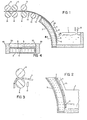
- the pool of molten metal to be cast may be stored in a suitable tundish or reservoir 1 of refractory material to which molten metal may be supplied in any suitable manner as through a spout 2.
- the flow of metal to the reservoir may be controlled in any suitable manner; i.e., either manually or automatically by known means responsive to the level of molten metal in the reservoir; i.e., to increase the flow of metal into the reservoir when the level tends to fall below a predetermined level, or to decrease the flow of metal when the level rises above the predetermined level.
- a water cooled mold 3 having a transversely flat thermally conductive wall 4, preferably of copper, forming a flat chilled mold surface having a lower portion 5 that extends to the bottom of said reservoir and submerged in the molten metal therein.
- the molten metal mold is exposed to the chilled surface 5 so that heat may be withdrawn through said surface to cause an embryo cast strand 6 to begin to be formed thereon.
- they are preferably made of materials which are resistant to heat transfer, such as refractory materials, for example. Since the surfaces of the submerged portions of the strips 26 are exposed to the molten metal in the pool and will be heated thereby, there will be little or no tendency for heat transfer through them from the strand, but if desired, electrical heating elements may be embedded in the strips, particularly those located above the surface of the pool.
- said strips may be made of metal, such as steel, for example, in which case the strips, even though submerged, may have heating elements embedded therein to maintain the strips at a temperature sufficient to prevent heat transfer laterally from the strand.
- the embryo casts strand will be completely formed when it reaches the level of the metal in the pool. That is, no metal will be added to the strand above the pool level, although previously adhered metal in liquid or partially solidified state will be solidified subsequently by additional heat transfer as it moves along the second portion of the chilled surface above the pool level.
- the strips 26 may be extended along the side edges of the mold wall as far as desired, although, since complete solidification of the strand may occur within a reasonably short distance beyond the pool level, the strips may not be needed along the entire length of the mold wall.
- the mold wall 4 although flat transversely, is curved longitudinally to form a circular arc of from 45° to 75°.
- the lower portion of the chilled surface designated by 5 forms only a short portion of the entire chilled surface of the mold and the lower end of the arc is located substantially perpendicularly to the bottom of the reservoir and to the surface of the molten metal pool. It extends only through an arc of 10° to 20° so that the embryo strand will move along the submerged chilled surface in substantially vertical direction while it is accumulating metal from the pool. Since the two convexly curved surfaces 5 and 7 are formed on the same radius, the embryo cast strand retains its contour as it moves along both portions and is not subjected to bending or other stresses as its crystal structure is being formed and solidified. Bending of the strand is required only as it reaches the withdrawal rolls 9, by which time solidification of the strand will have been completed.
- the surfaces of the mold wall 4 may be lubricated by methods known in the art.
- the mold 3 may be supported in any suitable manner.
- the portion of the strand 8 between the surface 7 and the withdrawal rolls 9 may be supported by one or more rollers such as roller 10.
- a plurality of chains 11 may be arranged to extend down along the chilled surfaces 7 and 5 to the bottom of the reservoir 1 to be imbedded in the first of the solidified metal which forms on the surface 5.
- the other ends of the chains 11 may be extended upwardly over the surface 7 to the withdrawal rolls 9.
- the level of the molten metal in the reservoir 1 is relatively low indicated in Fig. 2.
- the withdrawal rolls 9 may be activated to begin the withdrawal of the starter bar.
- the level of molten metal mold is allowed to rise as indicated in Fig. 1 and the embryo cast strand 6 continues to be formed by withdrawal of heat through the surface 5.
- the thickness of the cast strand may be determined by adjustment of either or both of two factors: (1) the depth of the molten metal in the pool and (2) the rate of withdrawal of the cast strand. The slower the rate of withdrawal, the greater the thickness of the cast strand. Likewise, the greater the depth of the molten metal in the pool, the greater the thickness of the cast strand. It will be understood that the molten metal will begin to solidify against the chilled surface 5 near the bottom thereof to form the embryo strand 6. The strand will be very thin at first but will thicken gradually as it is withdrawn upwardly along the chilled surface 5 until it reaches its maximum thickness as it emerges from the pool. Thereafter, the strand is cooled additionally as it moves along the continuation 7 of the chilled surface 5. If desired, it may be cooled still further by sprays from nozzles.
- the strand 8 may be moved directly between pairs of rolls 14 and 15 which reduce the thickness of the strand.
- the thickness of the strand could be reduced by rolls 14 and 15 to provide hot rolled sheet steel having a thickness of 6,4 mm (one quarter inch) or less.
- the forming rolls 14, 15 and the withdrawal rolls 9 may be mounted together as a unit in a supporting structure (not shown) forming part of the supporting structure for the mold.
Landscapes
- Engineering & Computer Science (AREA)
- Mechanical Engineering (AREA)
- Continuous Casting (AREA)
Applications Claiming Priority (4)
| Application Number | Priority Date | Filing Date | Title |
|---|---|---|---|
| US61204884A | 1984-05-18 | 1984-05-18 | |
| US612048 | 1984-05-18 | ||
| US71871985A | 1985-04-01 | 1985-04-01 | |
| US718719 | 1985-04-01 |
Publications (3)
| Publication Number | Publication Date |
|---|---|
| EP0165456A2 true EP0165456A2 (fr) | 1985-12-27 |
| EP0165456A3 EP0165456A3 (en) | 1987-02-04 |
| EP0165456B1 EP0165456B1 (fr) | 1988-12-07 |
Family
ID=27086659
Family Applications (1)
| Application Number | Title | Priority Date | Filing Date |
|---|---|---|---|
| EP19850105852 Expired EP0165456B1 (fr) | 1984-05-18 | 1985-05-13 | Procédé et appareil pour la fabrication de brames d'acier minces |
Country Status (4)
| Country | Link |
|---|---|
| EP (1) | EP0165456B1 (fr) |
| BR (1) | BR8502337A (fr) |
| CA (1) | CA1239520A (fr) |
| DE (1) | DE3566628D1 (fr) |
Cited By (3)
| Publication number | Priority date | Publication date | Assignee | Title |
|---|---|---|---|---|
| EP0387006A3 (fr) * | 1989-03-08 | 1991-08-14 | Stelco Inc. | Dispositif à deux parois convergentes pour machine de coulée de bandes |
| EP0875317A1 (fr) * | 1997-04-29 | 1998-11-04 | Outokumpu Oyj | Procédé et dispositif pour la coulée de fils, tubes et barres métalliques dans une direction ascendante |
| CN108067594A (zh) * | 2016-11-08 | 2018-05-25 | 丰田自动车株式会社 | 成型体制造方法和成型体制造装置 |
Family Cites Families (1)
| Publication number | Priority date | Publication date | Assignee | Title |
|---|---|---|---|---|
| FR2253587B1 (fr) * | 1974-12-23 | 1978-11-03 | Ural Krasnog |
-
1985
- 1985-05-13 EP EP19850105852 patent/EP0165456B1/fr not_active Expired
- 1985-05-13 DE DE8585105852T patent/DE3566628D1/de not_active Expired
- 1985-05-17 BR BR8502337A patent/BR8502337A/pt unknown
- 1985-05-17 CA CA000481768A patent/CA1239520A/fr not_active Expired
Cited By (5)
| Publication number | Priority date | Publication date | Assignee | Title |
|---|---|---|---|---|
| EP0387006A3 (fr) * | 1989-03-08 | 1991-08-14 | Stelco Inc. | Dispositif à deux parois convergentes pour machine de coulée de bandes |
| EP0875317A1 (fr) * | 1997-04-29 | 1998-11-04 | Outokumpu Oyj | Procédé et dispositif pour la coulée de fils, tubes et barres métalliques dans une direction ascendante |
| RU2203769C2 (ru) * | 1997-04-29 | 2003-05-10 | Оутокумпу Ойй | Способ отливки металлической проволоки, брусков и труб из цветных металлов с перемещением вверх и устройство для его осуществления |
| CN108067594A (zh) * | 2016-11-08 | 2018-05-25 | 丰田自动车株式会社 | 成型体制造方法和成型体制造装置 |
| CN108067594B (zh) * | 2016-11-08 | 2019-11-05 | 丰田自动车株式会社 | 成型体制造方法和成型体制造装置 |
Also Published As
| Publication number | Publication date |
|---|---|
| CA1239520A (fr) | 1988-07-26 |
| DE3566628D1 (en) | 1989-01-12 |
| EP0165456A3 (en) | 1987-02-04 |
| EP0165456B1 (fr) | 1988-12-07 |
| BR8502337A (pt) | 1986-01-21 |
Similar Documents
| Publication | Publication Date | Title |
|---|---|---|
| US5630467A (en) | Thin slab continuous casting machine and method | |
| US4715428A (en) | Method and apparatus for direct casting of crystalline strip by radiant cooling | |
| EP0165456B1 (fr) | Procédé et appareil pour la fabrication de brames d'acier minces | |
| US4787438A (en) | Method and apparatus for continuously casting metal | |
| US3433287A (en) | Dummy bar device for continuous casting machine | |
| US3638713A (en) | Continuous casting method including strand support adjustment | |
| ES2280727T3 (es) | Procedimiento para la laminacion continua de una barra metalica, en especial una barra de acero, medida en la seccion transversal como un desbaste delgado y producida a una velocidad de colada, y la maquina de colada continua correspondiente. | |
| US4709745A (en) | Process and apparatus for making thin steel slabs | |
| JPS58122107A (ja) | 連続薄板直接圧延設備 | |
| EP0909597A1 (fr) | Lingotière pour la coulée continue de brames minces | |
| US2496235A (en) | Method for the continuous casting of metal slabs | |
| US6536505B1 (en) | Method and apparatus for producing thin slabs in a continuous casting plant | |
| CA1054370A (fr) | Methode et appareil de fabrication du verre plat par coulee sur bain de metal en fusion | |
| US4678719A (en) | Method and apparatus for continuous casting of crystalline strip | |
| RU2126733C1 (ru) | Способ изготовления полуфабрикатов и устройство для его осуществления | |
| FI78250C (fi) | Foerfarande och anordning foer direktgjutning av smaelt metall. | |
| EP0174767B1 (fr) | Procédé et appareil pour la coulée directe de bande cristalline par refroidissement par radiation | |
| US3797555A (en) | Method for continuous casting of metal strips | |
| EP0174766B1 (fr) | Procédé et appareil pour la coulée directe de bande cristalline en atmosphère inoxydable | |
| US5927376A (en) | Method to shear slabs arriving from a continuous casting plant and relative device | |
| US3435879A (en) | Continuous casting method | |
| US3916985A (en) | Apparatus for continuous casting of metal strips | |
| JPH0333424B2 (fr) | ||
| US4022369A (en) | Curved roller track for continuously cast ingots | |
| JPH0616920B2 (ja) | ビ−ムブランク連続鋳造方法 |
Legal Events
| Date | Code | Title | Description |
|---|---|---|---|
| PUAI | Public reference made under article 153(3) epc to a published international application that has entered the european phase |
Free format text: ORIGINAL CODE: 0009012 |
|
| AK | Designated contracting states |
Designated state(s): CH DE FR GB IT LI |
|
| PUAL | Search report despatched |
Free format text: ORIGINAL CODE: 0009013 |
|
| AK | Designated contracting states |
Kind code of ref document: A3 Designated state(s): CH DE FR GB IT LI |
|
| 17P | Request for examination filed |
Effective date: 19870507 |
|
| 17Q | First examination report despatched |
Effective date: 19870911 |
|
| GRAA | (expected) grant |
Free format text: ORIGINAL CODE: 0009210 |
|
| AK | Designated contracting states |
Kind code of ref document: B1 Designated state(s): CH DE FR GB IT LI |
|
| PG25 | Lapsed in a contracting state [announced via postgrant information from national office to epo] |
Ref country code: LI Effective date: 19881207 Ref country code: IT Free format text: LAPSE BECAUSE OF FAILURE TO SUBMIT A TRANSLATION OF THE DESCRIPTION OR TO PAY THE FEE WITHIN THE PRESCRIBED TIME-LIMIT;WARNING: LAPSES OF ITALIAN PATENTS WITH EFFECTIVE DATE BEFORE 2007 MAY HAVE OCCURRED AT ANY TIME BEFORE 2007. THE CORRECT EFFECTIVE DATE MAY BE DIFFERENT FROM THE ONE RECORDED. Effective date: 19881207 Ref country code: FR Free format text: THE PATENT HAS BEEN ANNULLED BY A DECISION OF A NATIONAL AUTHORITY Effective date: 19881207 Ref country code: CH Effective date: 19881207 |
|
| REF | Corresponds to: |
Ref document number: 3566628 Country of ref document: DE Date of ref document: 19890112 |
|
| REG | Reference to a national code |
Ref country code: CH Ref legal event code: PL |
|
| EN | Fr: translation not filed | ||
| PG25 | Lapsed in a contracting state [announced via postgrant information from national office to epo] |
Ref country code: GB Effective date: 19890513 |
|
| PLBE | No opposition filed within time limit |
Free format text: ORIGINAL CODE: 0009261 |
|
| STAA | Information on the status of an ep patent application or granted ep patent |
Free format text: STATUS: NO OPPOSITION FILED WITHIN TIME LIMIT |
|
| 26N | No opposition filed | ||
| GBPC | Gb: european patent ceased through non-payment of renewal fee | ||
| PG25 | Lapsed in a contracting state [announced via postgrant information from national office to epo] |
Ref country code: DE Effective date: 19900201 |