EP0165577A2 - Zinkbacitracin enthaltender Futtermittelzusatz - Google Patents
Zinkbacitracin enthaltender Futtermittelzusatz Download PDFInfo
- Publication number
- EP0165577A2 EP0165577A2 EP85107418A EP85107418A EP0165577A2 EP 0165577 A2 EP0165577 A2 EP 0165577A2 EP 85107418 A EP85107418 A EP 85107418A EP 85107418 A EP85107418 A EP 85107418A EP 0165577 A2 EP0165577 A2 EP 0165577A2
- Authority
- EP
- European Patent Office
- Prior art keywords
- feed additive
- polymer
- zinc bacitracin
- feed
- coated
- Prior art date
- Legal status (The legal status is an assumption and is not a legal conclusion. Google has not performed a legal analysis and makes no representation as to the accuracy of the status listed.)
- Granted
Links
Classifications
-
- A—HUMAN NECESSITIES
- A23—FOODS OR FOODSTUFFS; TREATMENT THEREOF, NOT COVERED BY OTHER CLASSES
- A23K—FODDER
- A23K50/00—Feeding-stuffs specially adapted for particular animals
- A23K50/30—Feeding-stuffs specially adapted for particular animals for swines
-
- A—HUMAN NECESSITIES
- A23—FOODS OR FOODSTUFFS; TREATMENT THEREOF, NOT COVERED BY OTHER CLASSES
- A23K—FODDER
- A23K20/00—Accessory food factors for animal feeding-stuffs
- A23K20/10—Organic substances
- A23K20/195—Antibiotics
-
- A—HUMAN NECESSITIES
- A23—FOODS OR FOODSTUFFS; TREATMENT THEREOF, NOT COVERED BY OTHER CLASSES
- A23K—FODDER
- A23K40/00—Shaping or working-up of animal feeding-stuffs
- A23K40/30—Shaping or working-up of animal feeding-stuffs by encapsulating; by coating
Definitions
- the invention relates to a zinc bacitracin-containing feed additive, which is mixed with a feed, an improved stability against heat and - the effects of moisture and mechanical processing aufwei-st, so that the zinc bacitracin contained therein even after prolonged storage even under unfavorable conditions, only a small percentage loses its activity.
- Zinc Bacitracin is a performance enhancer that is added to the feed as a feed additive for better feed conversion and thus for greater daily weight gain in animals. Chemically speaking, zinc bacitracin is a cyclic polypeptide that is relatively stable in solid and dissolved form. Zinc bacitracin is much more unstable in feed mixtures, for which the effects of heat and moisture when pelleting the feed and the mechanical stress during the mixing process of the feed additive with the feed, on the other hand reactions with the heavy metals present in the feed, such as copper and iron, as well as with organic compounds , such as Ascorbic acid can be held responsible.
- DE-OS 27 45 035 describes a process in which zinc bacitracin precipitates from a culture broth, is mixed with calcium carbonate and is spray-dried.
- the improved stability of the zinc compound compared to bacitracin is used, on the other hand, the spray drying results in a very low water content of the product.
- Spray drying is based on the principle of removing water from a formulation.
- a disadvantage is the higher costs compared to other drying processes.
- dried products absorb the amount of water corresponding to the adsorption isotherm very quickly, so that all production and packaging steps following spray drying must be carried out under low-moisture conditions.
- Conventional devices and machines should be used for the preparation of the preparation and the disadvantages of the prior art described should be avoided.
- the feed additive should be obtained in the smallest possible particles in order to enable a homogeneous distribution in the feed.
- the object is achieved in that the feed additive containing zinc bacitracin is provided with a polymer coating.
- the substances forming the coating dissolve under physiological conditions (in the stomach, intestine, rumen of the corresponding animal species) or swell to such an extent that the active ingredient can be released.
- Coatings made from polyacrylates and polysaccharides have proven to be preferred, coatings from hydroxypropylmethyl cellulose, hydroxyethyl cellulose and methyl cellulose are particularly preferred.
- the proportion of the polymer is between 1 and 30% by weight, preferably 5-20% by weight, based on the starting material, a mixture of 5-40% by weight, preferably 15-25% by weight, zinc bacitracin and 60-95%, preferably 75-85% by weight of a carrier.
- the feed additive according to the invention is stabilized even at higher polymer concentrations, but it is within the scope of the invention to keep the amount of polymer as small as possible.
- the carrier material can consist of 20-80% by weight fermentation residue and 20-80% by weight calcium carbonate, preferably 75% by weight fermentation residue and 25% by weight calcium carbonate.
- Other carriers in particular those of the feed law regulations of May 83, published in the Federal Law Gazette of the FRG, can also be used.
- various processes are available for the production of the feed containing zinc bacitracin according to the invention.
- the simplest method for such a coating with the polymers is wet mixing.
- the substance to be protected is intensively mixed and granulated with a solution of the coating material. After the granules have dried, the resulting agglomerates are crushed again.
- Another method is e.g. spray solidification, whereby the substance to be protected is incorporated into molten materials.
- spray solidification When spraying, small, spherical particles form which solidify when they cool down.
- the substance to be protected is coated with polymers using the methods known from the literature. While dissolved or liquid substances are relatively easy to encapsulate, problems can occur with solids, depending on the particle shape, in that the shell is only applied incompletely.
- the feed additive containing zinc bacitracin is coated with polymers in a fluidized bed granulator.
- the feed additive consisting of a mixture of 5-40% by weight, preferably 15-25% by weight, zinc bacitracin and 60-95% by weight, preferably 75-85% by weight, of a carrier is replaced by a Air stream whirled up, then the polymer, preferably hydroxypropylmethyl cellulose, hydroxyethyl cellulose or methyl cellulose, is sprayed in a dissolved form through a nozzle.
- Organic and aqueous solvents or solvent mixtures can be used to prepare the polymer solution, provided that they dissolve the polymer. If appropriate, suspensions of the polymer in suitable solvents can also be used.
- Preferred solvents are water, methanol and dichloromethane or solvent mixtures, such as e.g. Methanol / dichloromethane in the ratio 1 + 1.
- the solvents it is important that they have a relatively low boiling point, so that no solvent residues remain in the feed mixture after processing.
- the smallest possible particle size of the feed additive containing zinc bacitracin is desirable in order to ensure a uniform distribution of the feed additive in the feed mixture.
- the agglomerate formation and thus the particle size can be controlled via the spraying speed, the agglomerate formation increasing with increasing spraying speed.
- the feed additive containing zinc bacitracin coated with a polymer by the process according to the invention is distinguished from the untreated commercial product in a mixture with feed even under unfavorable storage conditions at elevated temperatures by a substantially low decomposition of the zinc bacitracin, so that, in contrast to current practice, the content of zinc bacitracin in finished feed mixtures can be determined even after a long storage period and the tolerances prescribed by law can be checked.
- the feed additive which is provided with a polymer coating, offers additional advantages through a clearly perceptible reduction in odor compared to the untreated product and a significantly lower level of dust during processing.
- the feed additive according to the invention is suitable for improving feed utilization in animal fattening.
- the starting material is whirled up in a fluidized bed granulator by means of an air stream, after which the hydroxypropylmethyl cellulose is sprayed in solution via a nozzle.
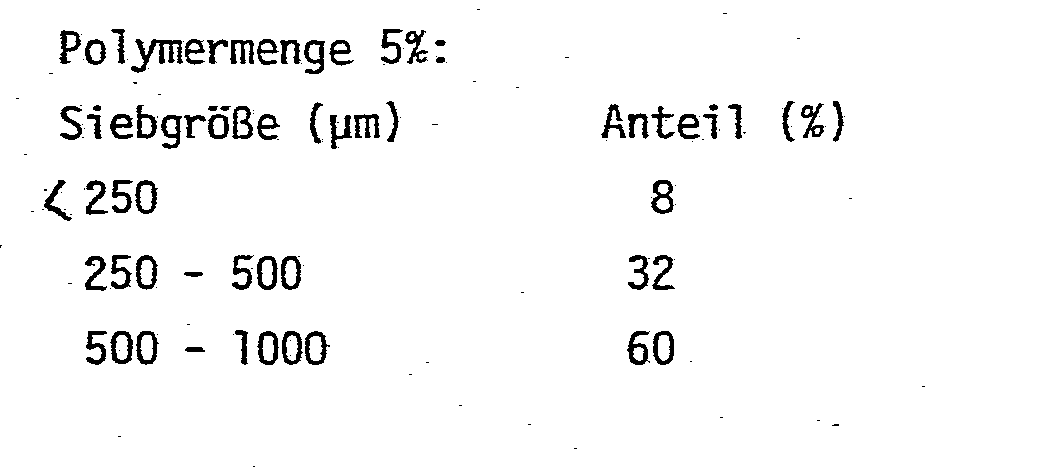
- the feed additive produced according to Example A had the following grain size distributions:
- composition of the feed mixtures examined is listed in Table I below.
- the coating in the formulations R 2 and R 3 was produced in accordance with the preferred embodiment of the process according to the invention, in the case of R 1 the starting material was not treated.
- the production of the feed mixtures was carried out using 2 premixes in a grater, the final mixing in a cube mixer.
- Piglet rearing feed II composition according to feed law regulations from May 1983 was used as feed because the feed contains particularly high levels of iron, copper, manganese and zinc.
- the long-term behavior of feeds according to the invention and commercial zinc zacitracin was also investigated.
- the polymer concentration is 20% based on a feed additive consisting of 20% zinc bacitracin, 20% calcium carbonate and 60% fermentation residues.
- Table III shows the residual zinc bacitracin content in a complete feed for broilers (type 7.7) with an initial concentration of zinbacitracin of 50 ppm after 1, 3 and 6 months' storage at different temperatures.
- untreated feed additive containing zinc bacitracin as well as hydroxypropylmethylcellulose (HPMC), methylcellulose (MC) and hydroxypropylcellulose (HPC) was stored at 60% atmospheric humidity for 4 weeks at 21 ° C in glass and polyethylene vessels (PE).
- HPMC hydroxypropylmethylcellulose
- MC methylcellulose
- HPC hydroxypropylcellulose
- HPC hydroxypropylmethylcellulose
- MC methylcellulose
- HPC hydroxypropylcellulose
- the four weekly values of a feed additive coated with a polyacrylate are summarized in Table VII.
- the polymer content was 30%.
- Spray conditions The filter was shaken for 5 seconds every 90 seconds.
- the feed additive is available as a fine, compact powder, which forms light, loose granules in the course of the spray phase.
- the formation of granules and the resulting large increase in volume must be taken into account in the batch size. Therefore, the spraying must also be started with a relatively small amount of air and increased during the spraying phase with increasing granulate formation.
- the granules are sieved in a sieve granulator from Frewitt with a sieve insert of 1.0 mm mesh size (rotating, medium speed) and then mixed for 100 minutes in a rotisserie mixer from Lermer.
Landscapes
- Life Sciences & Earth Sciences (AREA)
- Chemical & Material Sciences (AREA)
- Polymers & Plastics (AREA)
- Zoology (AREA)
- Engineering & Computer Science (AREA)
- Food Science & Technology (AREA)
- Animal Husbandry (AREA)
- Birds (AREA)
- Fodder In General (AREA)
- Pharmaceuticals Containing Other Organic And Inorganic Compounds (AREA)
- Coloring Foods And Improving Nutritive Qualities (AREA)
- Fertilizers (AREA)
- Apparatuses For Bulk Treatment Of Fruits And Vegetables And Apparatuses For Preparing Feeds (AREA)
- Feeding And Watering For Cattle Raising And Animal Husbandry (AREA)
- Feed For Specific Animals (AREA)
- Lubricants (AREA)
- Magnetic Heads (AREA)
- Acyclic And Carbocyclic Compounds In Medicinal Compositions (AREA)
Abstract
Description
- Die Erfindung betrifft einen Zinkbacitracin enthaltenden Futtermittelzusatz, der, vermischt mit einem Futtermittel, eine verbesserte Stabilität gegenüber Hitze- und-Feuchtigkeitseinwirkung und mechanischer Bearbeitung aufwei-st, so daß das darin enthaltene Zinkbacitracin auch nach einer längeren Lagerung selbst unter ungünstigen Bedingungen nur einen geringfügigen Anteil seiner Aktivität verliert.
- Zinkbacitracin ist ein Leistungsförderer, der als Futtermittelzusatz zur besseren Futterverwertung und damit zur größeren täglichen Gewichtszunahme bei Tieren dem Futter beigemischt wird. Chemisch gesehen ist Zinkbacitracin ein zyklisches Polypeptid, das in fester und gelöster Form relativ stabil ist. In Futtermischungen ist Zinkbacitracin wesentlich instabiler, wofür zum einen die Einwirkung von Hitze und Feuchtigkeit beim Pelletieren des Futters sowie die mechanische Beanspruchung beim Mischvorgang des Futtermittelzusatz mit dem Futter, zum anderen Reaktionen mit den im Futter vorhandenen Schwermetallen, wie Kupfer und Eisen sowie mit organischen Verbindungen, wie z.B. Ascorbinsäure verantwortlich gemacht werden.
- Zur Stabilisierung von Zinkbacitracin in Futtermischungen wurden zahlreiche Anstrengungen unternommen, um die bekannten Nachteile zu vermeiden. Bislang ist es jedoch nicht gelungen, eine auch in der Praxis voll befriedigende Lösung des Problems, der Abnahme des Gehalts an Zinkbacitracin unter normalen und besonders unter ungünstigen Verarbeitungs- und Lagerbedingungen, zu finden, so daß infolge der Unsicherheit über den Gehalt an Zinkbacitracin eine "vorsorgliche" Überdosierung nicht auszuschließen war.
- Die DE-OS 27 45 035 beschreibt ein Verfahren, bei dem Zinkbacitracin aus einer Kulturbrühe ausgefällt, mit Calciumcarbonat versetzt und sprühgetrocknet wird. Hierbei wird zum einen die gegenüber Bacitracin verbesserte Stabilität der Zinkverbindung ausgenützt, zum anderen durch die Sprühtrocknung ein sehr geringer Wassergehalt des Produktes erhalten.
- Der Sprühtrocknung liegt das Prinzip zugrunde, Wasser aus einer Formulierung zu entfernen. Als Nachteil sind die gegenüber anderen Trocknungsverfahren höheren Kosten zu nennen. Außerdem nehmen getrocknete Produkte die der Adsorptionsisotherme entsprechende Wassermenge sehr schnell wieder auf, so daß alle der Sprühtrocknung folgenden Produktions- und Verpackungsschritte unter feuchtearmen Bedingungen durchgeführt werden müssen.
- Es ist die Aufgabe der vorliegenden Erfindung, einen Zinkbacitracin enthaltenden Futtermittelzusatz bereitzustellen, welcher nach Vermischen mit Futter oder beim Pelletieren eine verbesserte Stabilität besitzt und eine längere Lagerhaltung ermöglicht. Dabei sollten zur Herstellung des Präparates übliche Geräte und Maschinen eingesetzt sowie die beschriebenen Nachteile des Standes der Technik vermieden werden. Außerdem sollte der Futtermittelzusatz in möglichst kleinen Partikeln anfallen, um eine homogene Verteilung im Futter zu ermöglichen.
- Die Aufgabe wird erfindungsgemäß dadurch gelöst, daß der Zinkbacitracin enthaltende Futtermittelzusatz mit einem Polymerüberzug versehen ist.
- Für eine derartige Einbettung des Futtermittelzusatzes kommen im Prinzip alle Stoffe in Betracht, die einen Überzug über den zu schützenden Stoff bilden können und so auch einen mechanischen Schutz bilden; so z.B.
-
- - Polymere wie Polysaccharide, Polyacrylate
- - Fette, fettähnliche Verbindungen, Wachse
- - Tenside.
- Zu berücksichtigen ist, daß die den Überzug bildenden Stoffe sich unter physiologischen Bedingungen (im Magen, Darm, Pansen der entsprechenden Tierarten) lösen bzw. soweit quellen, daß der Wirkstoff freigesetzt werden kann.
- Als bevorzugt erweisen sich hierbei Überzüge aus Polyacrylaten und Polysacchariden, besonders bevorzugt sind Überzüge aus Hydroxypropylmethylcellulose, Hydroxyethylcellulose und Methylcellulose.
- Der Anteil des Polymeren beträgt zwischen 1 und 30 Gew.-%, bevorzugt 5 - 20 Gew.-%, bezogen auf das Ausgangsmaterial, eine Mischung aus 5 - 40 Gew.-%, bevorzugt 15 - 25 Gew.-%, Zinkbacitracin und 60 - 95-%, bevorzugt 75 - 85 Gew.-%, eines Trägerstoffes.
- Es ist hierbei selbstverständlich, daß auch bei höheren Polymerkonzentrationen eine Stabilisierung des erfindungsgemäßen Futtermittelzusatzes erreicht wird, wobei es jedoch im Rahmen der Erfindung ist, die Polymermenge möglichst gering zu halten.
- Der Trägerstoff kann aus 20 - 80 Gew.-% Fermentationsrest und 20 - 80 Gew.-% Calciumcarbonat, bevorzugt sind 75 Gew.-% Fermentationsrest und 25 Gew.-% Calciumcarbonat bestehen. Auch andere Trägerstoffe, insbesondere die der futtermittelrechtlichen Vorschriften vom Mai 83, veröffentlicht im Bundesgesetzblatt der BRD, sind verwendbar. Für die Herstellung des erfindungsgemäßen Zinkbacitracins enthaltenden Futtermittels stehen prinzipiell verschiedene Verfahren zur Verfügung.
- Das einfachste Verfahren für einen derartigen Überzug mit den Polymeren ist die Feuchtmischung. Dabei wird der zu schützende Stoff mit einer Lösung des Überzugsmaterials intensiv gemischt und granuliert. Nach dem Trocknen des Granulats werden die entstanden Agglomerate wieder zerkleinert.
- Ein weiteres Verfahren ist z.B. die Sprüherstarrung, wobei der zu schützende Stoff in geschmolzenen Materialien eingearbeitet wird. Beim Versprühen bilden sich kleine, kugelförmige Partikel, die beim Abkühlen erstarren.
- Bei der Mikroverkapselung wird der zu schützende Stoff nach den literaturbekannten Verfahren mit Polymeren umhüllt. Während gelöste oder flüssige Stoffe relativ einfach zu verkapseln sind, können bei Feststoffen in Abhängigkeit von der Partikelform Probleme dadurch auftreten, daß die Hülle nur unvollständig aufgebracht wird.
- Nach dem bevorzugten erfindungsgemäßen Verfahren wird der Zinkbacitracin enthaltende Futtemittelzusatz in einem Wirbelschichtgranulierer mit Polymeren umhüllt. Der Futtermittelzusatz, bestehend aus einer Mischung aus 5 - 40 Gew.-%, bevorzugt 15 - 25 Gew.-%, Zinkbacitracin und 60 - 95 Gew.-%, bevorzugt 75 - 85 Gew.-%, eines Trägerstoffes wird dabei durch einen Luftstrom aufgewirbelt, danach wird das Polymer, bevorzugt Hydroxypropylmethylcellulose, Hydroxyethylcellulose oder Methylcellulose in gelöster Form über eine Düse aufgesprüht.
- Zur Herstellung der Polymerlösung können organische und wäßrige Lösungsmittel oder Lösungsmittelgemische verwendet werden, soweit sie das Polymer lösen. Gegebenenfalls können auch Suspensionen des Polymers in geeigneten Lösungsmitteln verwendet werden. Bevorzugte Lösungsmittel sind Wasser, Methanol und Dichlormethan oder auch Lösungsmittelgemische, wie z.B. Methanol/Dichlormethan im Verhältnis 1+1.
- Bei der Auswahl der Lösungmittel ist wichtig, daß diese einen relativ niedrigen Siedepuakt aufweisen, so daß nach-der Verarbeitung keine Lösungsmittelreste in der Futtermischung verbleiben.
- Eine möglichst kleine Partikelgröße des Zinkbacitracin enthaltenden Futtermittelzusatzes ist wünschenswert, um eine gleichmäßige Verteilung des Futtermittelzusatzes in der Futtermischung zu gewährleisten.
- Die Agglomeratbildung und damit die Partikelgröße kann über die Sprühgeschwindigkeit gesteuert werden, wobei die Agglomeratbildung mit steigernder Sprühgeschwindigkeit zunimmt.
- Der nach dem erfindungsgemäßen Verfahren mit einem Polymer überzogene Zinkbacitracin enthaltende Futtermittelzusatz zeichnet sich gegenüber dem unbehandelten Handelsprodukt im Gemisch mit Futtermitteln auch unter ungünstigen Lagerbedingungen bei erhöhten Temperaturen durch eine wesentlich geringe Zersetzung des Zinkbacitracins aus, so daß im Gegensatz zur jetzigen Praxis der Gehalt an Zinkbacitracin in fertigen Futtermischungen auch nach längerer Lagerzeit bestimmbar ist und die vom Gesetzgeber vorgeschriebenen Toleranzen überprüft werden können.
- Zusätzliche Vorteile bietet der mit einem Polymerüberzug versehene Futtermittelzusatz durch eine deutlich wahrnehmbare Geruchsverminderung gegenüber dem unbehandelten Produkt und eine wesentlich geringere Staubentwicklung beim Verarbeiten. Der erfindungsgemäße Futtermittelzusatz eignet sich zur Verbesserung der Futterverwertung bei der Tiermast.
- Bevorzugte Ausführungsformen des erfindungsgemäßen Verfahrens werden im folgenden näher beschrieben.
-


- Das Ausgangsmaterial wird in einem Wirbetschichtgranulierer durch einen Luftstrom aufgewirbelt, danach wird die Hydroxypropylmethylcellulose in gelöster Form über eine Düse aufgesprüht. Der nach dem Beispiel A hergestellte Futtermittelzusatz hatte folgende Korngrößenverteilungen:

- Wie das folgende Beispiel zeigt, läßt sich durch Einsatz organischer Lösungsmittel (Methanol/Methylenchlorid = 1 + 1) die Kornverteilung bei gleicher Sprühgeschwindigkeit zu kleineren Partikeln verschieben:

- Die Zusammensetzung der untersuchten Futtermischungen ist in der folgenden Tabelle I aufgeführt. Der Überzug bei den Rezepturen R2 und R3 wurde entsprechend der bevorzugten Ausführungsform des erfindungsgemäßen Verfahrens hergestellt, bei R1 wurde das Ausgangsmaterial nicht behandelt. Die Herstellung der Futtermischungen wurde über 2 Vormischungen in einer Reibschale, die Endmischung im Kubusmischer durchgeführt.
- Als Futtermittel wurde Ferkelaufzuchtfutter II (Zusammensetzung gemäß futtermittelrechtlicher Vorschriften vom Mai 1983) eingesetzt, weil bei diesem Futter der Gehalt an Eisen, Kupfer, Mangan und Zink besonders hoch ist.

- Stabilitätsergebnisse der Futtermischungen:
- Die Muster wurden 4 Wochen bei den Temperaturen RT (Raumtemperatur, ca.21°C), 31°C, 41°C und 51°C gelagert und mikrobiologisch untersucht (Amtsblatt der Europ. Gemeinschaften vom 18.01.1984, Nr. L 15/28).
- Die Ergebnisse der mikrobiologischen Untersuchungen sind in der folgenden Tabelle II zusammengefaßt:

- Neben diesen Versuchen unter ungünstigen, erhöhten Lagertemperaturen wurde zusätzlich das Langzeitverhalten von erfindungsgemäßen und handelsüblichen Zinkbacitracin enthaltenden Futtermitteln untersucht. Soweit nichts anderes angegeben ist, beträgt die Polymerkonzentration 20 % bezogen auf einen Futtermittelzusatz, bestehend aus 20 % Zinkbacitracin, 20 % Calciumcarbonat und 60 % Fermentationsreste.
- In der Tabelle III ist der Restgehalt an Zinkbacitracin in einem Alleinfuttermittel für Mastküken (Typ 7.7) mit einer Anfangskonzentration an Zinbacitracin von 50 ppm nach 1-,3- und 6-monatiger Lagerung bei verschiedenen Temperaturen aufgeführt.
- Um zusätzlich den Einfluß des Pelletierens (Dampfkonditionierung), bei dem die Futtermischung kurzzeitig hohen Temperaturen (bis zu 110°C) und.hoher Feuchtigkeit ausgesetzt ist, zu untersuchen, wurden die Chargen geteilt; eine Hälfte wurde dann pelletiert und anschließend denselben Lagerbedingungen unterworfen wie die nicht pelletierten Muster. Wie anhand der Versuche R4 bis R7 gezeigt werden konnte, weisen die mit Hydroxypropylmethylcellulose überzogenen Muster (R5 und R7) auch nach längerer Lagerung in jedem Fall einen höheren Gehalt an Zinkbacitracin auf, als die unbehandelten Proben R4 und R6.
-


- In einer weiteren Versuchsanmeldung wurde unbehandelter wie auch mit Hydroxypropylmethylcellulose (HPMC), Methylcellulose (MC) und Hydroxypropylcellulose (HPC) überzogener Zinkbacitracin enthaltender Futtermittelzusatz bei 60 %-Luftfeuchtigkeit für 4 Wochen bei 21°C in Glas- und Polyethylengefäßen (PE) gelagert. In dieser Versuchsreihe wurde die Polymerkonzentration zwischen 10 und 20 % variiert.
- Die Ergebnisse sind in Tab. VI zusammengefaßt.

- In der Tab. VII sind die 4 Wochenwerte eines mit einem Polyacrylat überzogenen Futtermittelzusatzes zusammengefaßt. Der Polymeranteil betrug 30 %.

- Anhand der beschriebenen Beispiele kann die Stabilisierung von Zinkbacitracin in Futtermischungen durch die erfindungsgemäßen Überzüge im Vergleich zu nichtbehandelten Futtermittelzusätzen nachgewiesen werden.
- Beispiel für die Herstellung eines erfindungsgemäßen Futtermittelzusatzes nach dem bevorzugten Verfahren.
- Ansatz: 240 kg:
- 200 kg Futtermittelzusatz, bestehend aus 20 % Zinkbacitracin, 20 % CaC03 und 60 % Fermentationsresten, werden in einen Wirbelschichtgranulator (Typ WSG 200 d. Fa. Glatt, ausgestattet mit einer Hubkolbenpumpe, Typ HL 1L der Fa. Lewa) mit einer Lösung von 40.0 kg Hydroxypropylmethylcellulose in 531.42 1 gereinigtem Wasser besprüht. Anschließend werden 3 1 gereinigtes Wasser nachgesprüht. Nach Beendigung der Sprühung wird die Luftheizung abgeschaltet und bis zu einer Gutstemperatur von 45°C abekühlt.
- Sprühbedingungen:
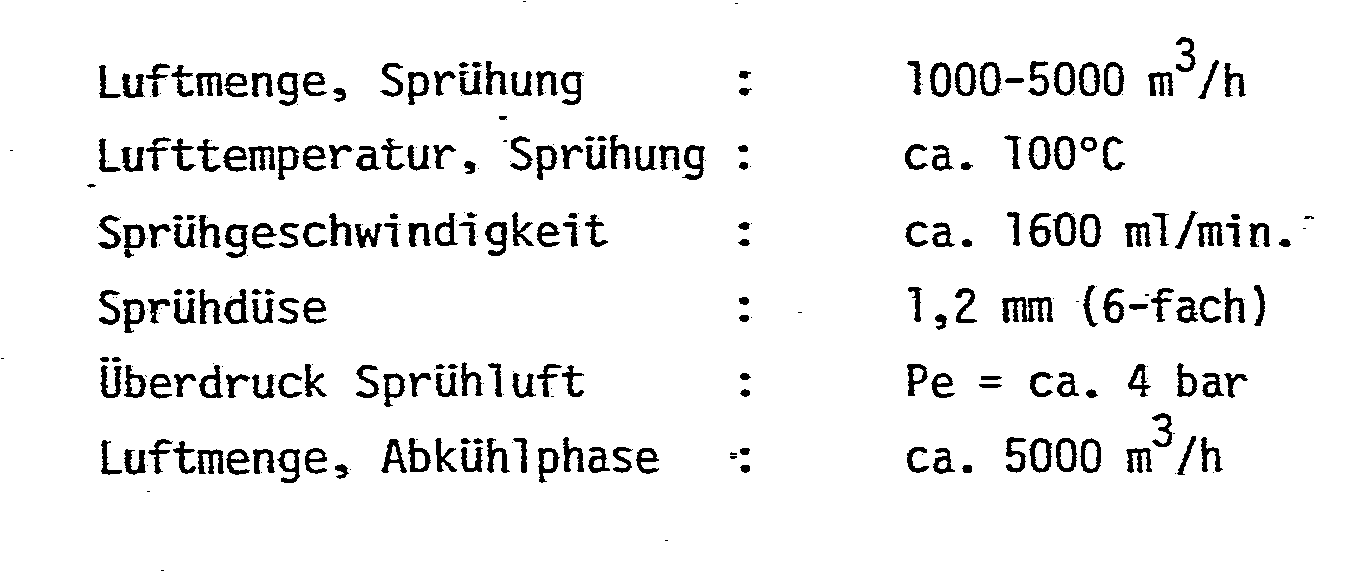
- Zu Beginn der Sprühung liegt der Futtermittelzusatz als feines, kompaktes Pulver vor, welches sich im Verlauf der Sprühphase zu einem leichten lockeren Granulat ausbildet. Die Granulatbildung und dadurch bedingte starke Volumenvergrößerung muß bei der Ansatzgröße berücksichtigt werden. Daher muß auch die Sprühung mit einer relativ kleinen Luftmenge begonnen werden und während der Sprühphase mit zunehmender Granulatbildung erhöht werden.
- Nach erfolgter Sprühung wird das Granulat in einem Siebgranuiator der Fa. Frewitt mit einem Siebeinsatz von 1.0 mm Maschenweite (rotierend, mittlere Geschwindigkeit) gesiebt und anschließend 100 Minuten in einem Drehspießmischer der Fa Lermer gemischt.
Claims (14)
Priority Applications (1)
| Application Number | Priority Date | Filing Date | Title |
|---|---|---|---|
| AT85107418T ATE40031T1 (de) | 1984-06-20 | 1985-06-15 | Zinkbacitracin enthaltender futtermittelzusatz. |
Applications Claiming Priority (2)
| Application Number | Priority Date | Filing Date | Title |
|---|---|---|---|
| DE19843422782 DE3422782A1 (de) | 1984-06-20 | 1984-06-20 | Zinkbacitracin enthaltender futtermittelzusatz |
| DE3422782 | 1984-06-20 |
Publications (3)
| Publication Number | Publication Date |
|---|---|
| EP0165577A2 true EP0165577A2 (de) | 1985-12-27 |
| EP0165577A3 EP0165577A3 (en) | 1987-01-14 |
| EP0165577B1 EP0165577B1 (de) | 1989-01-18 |
Family
ID=6238751
Family Applications (1)
| Application Number | Title | Priority Date | Filing Date |
|---|---|---|---|
| EP85107418A Expired EP0165577B1 (de) | 1984-06-20 | 1985-06-15 | Zinkbacitracin enthaltender Futtermittelzusatz |
Country Status (10)
| Country | Link |
|---|---|
| US (1) | US5531994A (de) |
| EP (1) | EP0165577B1 (de) |
| JP (1) | JPS6115653A (de) |
| AT (1) | ATE40031T1 (de) |
| AU (1) | AU577598B2 (de) |
| DE (2) | DE3422782A1 (de) |
| ES (1) | ES8700907A1 (de) |
| HU (1) | HU196910B (de) |
| IL (1) | IL75571A (de) |
| NZ (1) | NZ212481A (de) |
Cited By (6)
| Publication number | Priority date | Publication date | Assignee | Title |
|---|---|---|---|---|
| EP0302462A3 (en) * | 1987-08-05 | 1990-08-16 | Boehringer Ingelheim Vetmedica Gmbh | Stabilized food additive and process for its preparation |
| EP0363733A3 (de) * | 1988-10-14 | 1991-09-25 | DOX-AL ITALIA S.p.A. | Verfahren zur Herstellung von Mischungen, verwendbar in Nahrungsmitteln und Tierfutter, die gleichmässig verteilte wirksame Substanzen enthalten |
| EP0419121A3 (en) * | 1989-09-18 | 1991-12-04 | Smithkline Beecham Corporation | Stabilized antibiotic compositions for animal feeding |
| DE4217971C1 (de) * | 1992-05-30 | 1993-10-21 | Boehringer Ingelheim Vetmed | Verfahren und Wirbelbettapparatur zum Granulieren und/oder Umhüllen |
| FR2748393A1 (fr) * | 1996-05-10 | 1997-11-14 | Sogeval Lab | Procede de traitement de principes actifs pulverulents et melange notamment aliment pour animaux renfermant des principes actifs ainsi traites |
| WO2003045354A1 (en) * | 2001-11-28 | 2003-06-05 | Novartis Ag | Micropherules containing a pleuromutilin derivative |
Families Citing this family (8)
| Publication number | Priority date | Publication date | Assignee | Title |
|---|---|---|---|---|
| YU43426B (en) * | 1985-12-19 | 1989-06-30 | Krka | Process for preparating compound of zn-salt of bacitracine |
| US5720971A (en) * | 1995-07-05 | 1998-02-24 | Her Majesty The Queen In Right Of Canada, As Represented By The Department Of Agriculture And Agri-Food Canada | Enzyme additives for ruminant feeds |
| US6745131B2 (en) * | 1999-08-31 | 2004-06-01 | Adisseo France S.A.S. | Feedstuffs and methods for obtaining them |
| DK1987723T3 (da) * | 2003-11-03 | 2012-07-02 | Hills Pet Nutrition Inc | Overtrukket dyrefodersammensætning |
| CN101006829B (zh) * | 2007-01-26 | 2010-08-11 | 李旭东 | 高分子材料包裹的水产饲料添加剂 |
| SI2941965T1 (sl) * | 2014-05-05 | 2019-07-31 | Dox-Al Italia S.P.A. | Prevlečena živalska krma |
| WO2020038898A1 (en) * | 2018-08-20 | 2020-02-27 | Fermbiotics Holding ApS | Improved human food product |
| CN122181621A (zh) * | 2018-08-20 | 2026-06-12 | 发酵专家公司 | 动物饲料产品及其用途 |
Family Cites Families (13)
| Publication number | Priority date | Publication date | Assignee | Title |
|---|---|---|---|---|
| US3627885A (en) * | 1968-07-18 | 1971-12-14 | Rit Rech Ind Therapeut | Stabilized antibiotic compositions for animal feeding |
| US3829564A (en) * | 1970-07-17 | 1974-08-13 | Commw Scient Ind Res Org | Coated products for veterinary use |
| ZA72341B (en) * | 1971-04-09 | 1972-09-27 | Commercial Solvents Corp | Therapeutic composition containing zinc bacitracin and sulfamethazine |
| JPS557405B2 (de) * | 1972-01-24 | 1980-02-25 | ||
| JPS50129728A (de) * | 1974-04-05 | 1975-10-14 | ||
| GB1505921A (en) * | 1974-07-22 | 1978-04-05 | Goodrich Co B F | Production of chlorinated derivatives |
| JPS5095489A (de) * | 1974-08-29 | 1975-07-29 | ||
| US4164572A (en) * | 1976-10-06 | 1979-08-14 | A/S Apothekernes Laboratorium For Specialpraeparater | Zinc bacitracin composition for use as a feed supplement and method for making the same |
| US4096246A (en) * | 1976-10-06 | 1978-06-20 | A/S Apothekernes Laboratorium For Specialpraeparater | Zinc bacitracin composition for use as a feed supplement and method for making the same |
| US4181709A (en) * | 1977-09-02 | 1980-01-01 | Eastman Kodak Company | Rumen-stable pellets |
| DE2808803C3 (de) * | 1978-03-01 | 1981-10-22 | Institut mikrobiologii imeni Avgusta Kirchenštejna Akademii Nauk Latvijskoj SSR, Riga | Verfahren zum Schutze pulverförmiger Futterkonzentrate |
| JPS56109554A (en) * | 1980-02-01 | 1981-08-31 | Toray Ind Inc | Granular feed for cultivation of aquatic animal |
| JPS56118480A (en) * | 1980-02-26 | 1981-09-17 | Asahi Denka Kogyo Kk | Slow release composition |
-
1984
- 1984-06-20 DE DE19843422782 patent/DE3422782A1/de not_active Withdrawn
-
1985
- 1985-06-15 DE DE8585107418T patent/DE3567568D1/de not_active Expired
- 1985-06-15 AT AT85107418T patent/ATE40031T1/de not_active IP Right Cessation
- 1985-06-15 EP EP85107418A patent/EP0165577B1/de not_active Expired
- 1985-06-19 HU HU852416A patent/HU196910B/hu not_active IP Right Cessation
- 1985-06-19 IL IL75571A patent/IL75571A/xx not_active IP Right Cessation
- 1985-06-19 JP JP60132102A patent/JPS6115653A/ja active Pending
- 1985-06-19 NZ NZ212481A patent/NZ212481A/en unknown
- 1985-06-19 ES ES544360A patent/ES8700907A1/es not_active Expired
- 1985-06-20 AU AU43900/85A patent/AU577598B2/en not_active Ceased
-
1994
- 1994-05-12 US US08/241,514 patent/US5531994A/en not_active Expired - Fee Related
Cited By (9)
| Publication number | Priority date | Publication date | Assignee | Title |
|---|---|---|---|---|
| EP0302462A3 (en) * | 1987-08-05 | 1990-08-16 | Boehringer Ingelheim Vetmedica Gmbh | Stabilized food additive and process for its preparation |
| US5750135A (en) * | 1987-08-05 | 1998-05-12 | Boehringer Ingelheim Vetmedica Gmbh | Stabilized feed additive and process for the preparation thereof |
| EP0363733A3 (de) * | 1988-10-14 | 1991-09-25 | DOX-AL ITALIA S.p.A. | Verfahren zur Herstellung von Mischungen, verwendbar in Nahrungsmitteln und Tierfutter, die gleichmässig verteilte wirksame Substanzen enthalten |
| EP0419121A3 (en) * | 1989-09-18 | 1991-12-04 | Smithkline Beecham Corporation | Stabilized antibiotic compositions for animal feeding |
| DE4217971C1 (de) * | 1992-05-30 | 1993-10-21 | Boehringer Ingelheim Vetmed | Verfahren und Wirbelbettapparatur zum Granulieren und/oder Umhüllen |
| FR2748393A1 (fr) * | 1996-05-10 | 1997-11-14 | Sogeval Lab | Procede de traitement de principes actifs pulverulents et melange notamment aliment pour animaux renfermant des principes actifs ainsi traites |
| WO2003045354A1 (en) * | 2001-11-28 | 2003-06-05 | Novartis Ag | Micropherules containing a pleuromutilin derivative |
| CN100348185C (zh) * | 2001-11-28 | 2007-11-14 | 诺瓦提斯公司 | 含有截短侧耳素衍生物的微球 |
| US8236851B2 (en) | 2001-11-28 | 2012-08-07 | Novartis Ag | Microspherules containing a pleuromutilin derivative |
Also Published As
| Publication number | Publication date |
|---|---|
| AU577598B2 (en) | 1988-09-29 |
| ES8700907A1 (es) | 1986-11-16 |
| JPS6115653A (ja) | 1986-01-23 |
| AU4390085A (en) | 1986-01-02 |
| DE3422782A1 (de) | 1986-01-02 |
| ATE40031T1 (de) | 1989-02-15 |
| NZ212481A (en) | 1987-10-30 |
| HU196910B (en) | 1989-02-28 |
| EP0165577A3 (en) | 1987-01-14 |
| EP0165577B1 (de) | 1989-01-18 |
| US5531994A (en) | 1996-07-02 |
| DE3567568D1 (en) | 1989-02-23 |
| ES544360A0 (es) | 1986-11-16 |
| IL75571A0 (en) | 1985-10-31 |
| IL75571A (en) | 1989-02-28 |
| HUT41985A (en) | 1987-06-29 |
Similar Documents
| Publication | Publication Date | Title |
|---|---|---|
| EP0165577B1 (de) | Zinkbacitracin enthaltender Futtermittelzusatz | |
| DE69201952T2 (de) | Verwendung eines enzymhaltigen granulates und verfahren zur herstellung von einem pelletisierten futter. | |
| DE2541459C3 (de) | Verfahren zur Herstellung staubfreier arzneilicher Chinoxalin-1,4dioxid-Tierfuttermischungen | |
| DE2227502C3 (de) | Verfahren zur Herstellung von Calciumhypochlorit-Granulat | |
| EP0302462B1 (de) | Stabilisierter Futtermittelzusatz und Verfahren zu seiner Herstellung | |
| EP0573876B1 (de) | Verfahren zur Herstellung von Cholinchlorid enthaltenden Pulvern, diese Pulver und ihre Verwendung | |
| DE2838308C2 (de) | Verfahren zur Herstellung von Pillen für die orale Verabfolgung an Wiederkäuer | |
| DE3032618C2 (de) | ||
| CH683224A5 (de) | Fischfutterzusatz, Fischfutter und Herstellungsverfahren. | |
| DE69314298T2 (de) | Tylosin enthaltende Tierfutter-Trockenvormischung | |
| WO1998037772A1 (de) | Verfahren zur herstellung eines rieselfähigen tierfuttermittelsupplements auf methioninsalzbasis und das so erhältliche granulat | |
| EP1523244A1 (de) | Zubereitungen, enthaltend mindestens ein diformiat | |
| DE3500162A1 (de) | Pulvergemische mit hohem propylenglykolgehalt und verfahren zur herstellung derselben sowie ihre verwendung | |
| DE1767852C3 (de) | Verwendung von zwei synthetischen Calciumsilikaten zur Stabilisierung von Antibiotika als Beifuttermittel | |
| DE2745035A1 (de) | Als futtermittelzusatz verwendbares zinkbacitracinpraeparat und verfahren zu seiner herstellung | |
| DE1492152B1 (de) | Anthelmintische,veterinaermedizinische Zubereitung | |
| DE2808803C3 (de) | Verfahren zum Schutze pulverförmiger Futterkonzentrate | |
| DE3918524A1 (de) | Verfahren zur staubbindung in granulaten | |
| DE973974C (de) | Verfahren zur Herstellung von Abdruckmassen fuer zahnaerztliche Zwecke | |
| EP0039841A2 (de) | Verfahren zur Herstellung von staubarmen Präparationen | |
| DE4326804B4 (de) | Durch Beschichtung stabilisierte Natriumpercarbonate | |
| DE2412960A1 (de) | Verfahren zum herstellen von glykoside enthaltenden granulaten | |
| DD147819A1 (de) | Verfahren zur herstellung von pulverfoermigen anionenaustauschern fuer pharmazeutische zwecke | |
| DE1517333A1 (de) | Verfahren zur Behandlung von Tabak | |
| DD227040A1 (de) | Verfahren zur herstellung granulierter wuerzmittel |
Legal Events
| Date | Code | Title | Description |
|---|---|---|---|
| PUAI | Public reference made under article 153(3) epc to a published international application that has entered the european phase |
Free format text: ORIGINAL CODE: 0009012 |
|
| AK | Designated contracting states |
Designated state(s): AT BE CH DE FR GB IT LI LU NL SE |
|
| 17P | Request for examination filed |
Effective date: 19860828 |
|
| PUAL | Search report despatched |
Free format text: ORIGINAL CODE: 0009013 |
|
| AK | Designated contracting states |
Kind code of ref document: A3 Designated state(s): AT BE CH DE FR GB IT LI LU NL SE |
|
| 17Q | First examination report despatched |
Effective date: 19880415 |
|
| GRAA | (expected) grant |
Free format text: ORIGINAL CODE: 0009210 |
|
| AK | Designated contracting states |
Kind code of ref document: B1 Designated state(s): AT BE CH DE FR GB IT LI LU NL SE |
|
| REF | Corresponds to: |
Ref document number: 40031 Country of ref document: AT Date of ref document: 19890215 Kind code of ref document: T |
|
| REF | Corresponds to: |
Ref document number: 3567568 Country of ref document: DE Date of ref document: 19890223 |
|
| GBT | Gb: translation of ep patent filed (gb section 77(6)(a)/1977) | ||
| ITF | It: translation for a ep patent filed | ||
| ET | Fr: translation filed | ||
| PLBE | No opposition filed within time limit |
Free format text: ORIGINAL CODE: 0009261 |
|
| STAA | Information on the status of an ep patent application or granted ep patent |
Free format text: STATUS: NO OPPOSITION FILED WITHIN TIME LIMIT |
|
| 26N | No opposition filed | ||
| ITTA | It: last paid annual fee | ||
| EPTA | Lu: last paid annual fee | ||
| EAL | Se: european patent in force in sweden |
Ref document number: 85107418.7 |
|
| REG | Reference to a national code |
Ref country code: GB Ref legal event code: IF02 |
|
| PGFP | Annual fee paid to national office [announced via postgrant information from national office to epo] |
Ref country code: CH Payment date: 20030520 Year of fee payment: 19 |
|
| PGFP | Annual fee paid to national office [announced via postgrant information from national office to epo] |
Ref country code: NL Payment date: 20030530 Year of fee payment: 19 Ref country code: GB Payment date: 20030530 Year of fee payment: 19 |
|
| PGFP | Annual fee paid to national office [announced via postgrant information from national office to epo] |
Ref country code: DE Payment date: 20030603 Year of fee payment: 19 Ref country code: AT Payment date: 20030603 Year of fee payment: 19 |
|
| PGFP | Annual fee paid to national office [announced via postgrant information from national office to epo] |
Ref country code: SE Payment date: 20030604 Year of fee payment: 19 |
|
| PGFP | Annual fee paid to national office [announced via postgrant information from national office to epo] |
Ref country code: LU Payment date: 20030605 Year of fee payment: 19 |
|
| PGFP | Annual fee paid to national office [announced via postgrant information from national office to epo] |
Ref country code: FR Payment date: 20030611 Year of fee payment: 19 |
|
| PGFP | Annual fee paid to national office [announced via postgrant information from national office to epo] |
Ref country code: BE Payment date: 20030612 Year of fee payment: 19 |
|
| PG25 | Lapsed in a contracting state [announced via postgrant information from national office to epo] |
Ref country code: LU Free format text: LAPSE BECAUSE OF NON-PAYMENT OF DUE FEES Effective date: 20040615 Ref country code: GB Free format text: LAPSE BECAUSE OF NON-PAYMENT OF DUE FEES Effective date: 20040615 Ref country code: AT Free format text: LAPSE BECAUSE OF NON-PAYMENT OF DUE FEES Effective date: 20040615 |
|
| PG25 | Lapsed in a contracting state [announced via postgrant information from national office to epo] |
Ref country code: SE Free format text: LAPSE BECAUSE OF NON-PAYMENT OF DUE FEES Effective date: 20040616 |
|
| PG25 | Lapsed in a contracting state [announced via postgrant information from national office to epo] |
Ref country code: LI Free format text: LAPSE BECAUSE OF NON-PAYMENT OF DUE FEES Effective date: 20040630 Ref country code: CH Free format text: LAPSE BECAUSE OF NON-PAYMENT OF DUE FEES Effective date: 20040630 Ref country code: BE Free format text: LAPSE BECAUSE OF NON-PAYMENT OF DUE FEES Effective date: 20040630 |
|
| BERE | Be: lapsed |
Owner name: *BOEHRINGER INGELHEIM VETMEDICA G.M.B.H. Effective date: 20040630 |
|
| PG25 | Lapsed in a contracting state [announced via postgrant information from national office to epo] |
Ref country code: NL Free format text: LAPSE BECAUSE OF NON-PAYMENT OF DUE FEES Effective date: 20050101 Ref country code: DE Free format text: LAPSE BECAUSE OF NON-PAYMENT OF DUE FEES Effective date: 20050101 |
|
| EUG | Se: european patent has lapsed | ||
| GBPC | Gb: european patent ceased through non-payment of renewal fee |
Effective date: 20040615 |
|
| EUG | Se: european patent has lapsed | ||
| REG | Reference to a national code |
Ref country code: CH Ref legal event code: PL |
|
| PG25 | Lapsed in a contracting state [announced via postgrant information from national office to epo] |
Ref country code: FR Free format text: LAPSE BECAUSE OF NON-PAYMENT OF DUE FEES Effective date: 20050228 |
|
| NLV4 | Nl: lapsed or anulled due to non-payment of the annual fee |
Effective date: 20050101 |
|
| REG | Reference to a national code |
Ref country code: FR Ref legal event code: ST |