EP0166242B1 - Polyélectrolytes cationactifs solubles dans l'eau, leur préparation et leur utilisation - Google Patents
Polyélectrolytes cationactifs solubles dans l'eau, leur préparation et leur utilisation Download PDFInfo
- Publication number
- EP0166242B1 EP0166242B1 EP85106524A EP85106524A EP0166242B1 EP 0166242 B1 EP0166242 B1 EP 0166242B1 EP 85106524 A EP85106524 A EP 85106524A EP 85106524 A EP85106524 A EP 85106524A EP 0166242 B1 EP0166242 B1 EP 0166242B1
- Authority
- EP
- European Patent Office
- Prior art keywords
- formula
- polyelectrolyte
- reaction
- compounds
- general formula
- Prior art date
- Legal status (The legal status is an assumption and is not a legal conclusion. Google has not performed a legal analysis and makes no representation as to the accuracy of the status listed.)
- Expired - Lifetime
Links
- CUHMMDPUXJFCNB-UHFFFAOYSA-N CCC(C)(C)N(C)C Chemical compound CCC(C)(C)N(C)C CUHMMDPUXJFCNB-UHFFFAOYSA-N 0.000 description 1
Classifications
-
- C—CHEMISTRY; METALLURGY
- C07—ORGANIC CHEMISTRY
- C07D—HETEROCYCLIC COMPOUNDS
- C07D239/00—Heterocyclic compounds containing 1,3-diazine or hydrogenated 1,3-diazine rings
- C07D239/02—Heterocyclic compounds containing 1,3-diazine or hydrogenated 1,3-diazine rings not condensed with other rings
- C07D239/24—Heterocyclic compounds containing 1,3-diazine or hydrogenated 1,3-diazine rings not condensed with other rings having three or more double bonds between ring members or between ring members and non-ring members
- C07D239/26—Heterocyclic compounds containing 1,3-diazine or hydrogenated 1,3-diazine rings not condensed with other rings having three or more double bonds between ring members or between ring members and non-ring members with only hydrogen atoms, hydrocarbon or substituted hydrocarbon radicals, directly attached to ring carbon atoms
-
- C—CHEMISTRY; METALLURGY
- C07—ORGANIC CHEMISTRY
- C07D—HETEROCYCLIC COMPOUNDS
- C07D231/00—Heterocyclic compounds containing 1,2-diazole or hydrogenated 1,2-diazole rings
- C07D231/02—Heterocyclic compounds containing 1,2-diazole or hydrogenated 1,2-diazole rings not condensed with other rings
- C07D231/10—Heterocyclic compounds containing 1,2-diazole or hydrogenated 1,2-diazole rings not condensed with other rings having two or three double bonds between ring members or between ring members and non-ring members
- C07D231/12—Heterocyclic compounds containing 1,2-diazole or hydrogenated 1,2-diazole rings not condensed with other rings having two or three double bonds between ring members or between ring members and non-ring members with only hydrogen atoms, hydrocarbon or substituted hydrocarbon radicals, directly attached to ring carbon atoms
-
- C—CHEMISTRY; METALLURGY
- C07—ORGANIC CHEMISTRY
- C07D—HETEROCYCLIC COMPOUNDS
- C07D233/00—Heterocyclic compounds containing 1,3-diazole or hydrogenated 1,3-diazole rings, not condensed with other rings
- C07D233/54—Heterocyclic compounds containing 1,3-diazole or hydrogenated 1,3-diazole rings, not condensed with other rings having two double bonds between ring members or between ring members and non-ring members
- C07D233/56—Heterocyclic compounds containing 1,3-diazole or hydrogenated 1,3-diazole rings, not condensed with other rings having two double bonds between ring members or between ring members and non-ring members with only hydrogen atoms or radicals containing only hydrogen and carbon atoms, attached to ring carbon atoms
-
- C—CHEMISTRY; METALLURGY
- C07—ORGANIC CHEMISTRY
- C07D—HETEROCYCLIC COMPOUNDS
- C07D241/00—Heterocyclic compounds containing 1,4-diazine or hydrogenated 1,4-diazine rings
- C07D241/02—Heterocyclic compounds containing 1,4-diazine or hydrogenated 1,4-diazine rings not condensed with other rings
- C07D241/10—Heterocyclic compounds containing 1,4-diazine or hydrogenated 1,4-diazine rings not condensed with other rings having three double bonds between ring members or between ring members and non-ring members
- C07D241/12—Heterocyclic compounds containing 1,4-diazine or hydrogenated 1,4-diazine rings not condensed with other rings having three double bonds between ring members or between ring members and non-ring members with only hydrogen atoms, hydrocarbon or substituted hydrocarbon radicals, directly attached to ring carbon atoms
-
- C—CHEMISTRY; METALLURGY
- C07—ORGANIC CHEMISTRY
- C07D—HETEROCYCLIC COMPOUNDS
- C07D249/00—Heterocyclic compounds containing five-membered rings having three nitrogen atoms as the only ring hetero atoms
- C07D249/02—Heterocyclic compounds containing five-membered rings having three nitrogen atoms as the only ring hetero atoms not condensed with other rings
- C07D249/08—1,2,4-Triazoles; Hydrogenated 1,2,4-triazoles
-
- C—CHEMISTRY; METALLURGY
- C07—ORGANIC CHEMISTRY
- C07D—HETEROCYCLIC COMPOUNDS
- C07D295/00—Heterocyclic compounds containing polymethylene-imine rings with at least five ring members, 3-azabicyclo [3.2.2] nonane, piperazine, morpholine or thiomorpholine rings, having only hydrogen atoms directly attached to the ring carbon atoms
- C07D295/04—Heterocyclic compounds containing polymethylene-imine rings with at least five ring members, 3-azabicyclo [3.2.2] nonane, piperazine, morpholine or thiomorpholine rings, having only hydrogen atoms directly attached to the ring carbon atoms with substituted hydrocarbon radicals attached to ring nitrogen atoms
- C07D295/12—Heterocyclic compounds containing polymethylene-imine rings with at least five ring members, 3-azabicyclo [3.2.2] nonane, piperazine, morpholine or thiomorpholine rings, having only hydrogen atoms directly attached to the ring carbon atoms with substituted hydrocarbon radicals attached to ring nitrogen atoms substituted by singly or doubly bound nitrogen atoms
- C07D295/125—Heterocyclic compounds containing polymethylene-imine rings with at least five ring members, 3-azabicyclo [3.2.2] nonane, piperazine, morpholine or thiomorpholine rings, having only hydrogen atoms directly attached to the ring carbon atoms with substituted hydrocarbon radicals attached to ring nitrogen atoms substituted by singly or doubly bound nitrogen atoms with the ring nitrogen atoms and the substituent nitrogen atoms attached to the same carbon chain, which is not interrupted by carbocyclic rings
- C07D295/13—Heterocyclic compounds containing polymethylene-imine rings with at least five ring members, 3-azabicyclo [3.2.2] nonane, piperazine, morpholine or thiomorpholine rings, having only hydrogen atoms directly attached to the ring carbon atoms with substituted hydrocarbon radicals attached to ring nitrogen atoms substituted by singly or doubly bound nitrogen atoms with the ring nitrogen atoms and the substituent nitrogen atoms attached to the same carbon chain, which is not interrupted by carbocyclic rings to an acyclic saturated chain
-
- C—CHEMISTRY; METALLURGY
- C07—ORGANIC CHEMISTRY
- C07D—HETEROCYCLIC COMPOUNDS
- C07D405/00—Heterocyclic compounds containing both one or more hetero rings having oxygen atoms as the only ring hetero atoms, and one or more rings having nitrogen as the only ring hetero atom
- C07D405/02—Heterocyclic compounds containing both one or more hetero rings having oxygen atoms as the only ring hetero atoms, and one or more rings having nitrogen as the only ring hetero atom containing two hetero rings
- C07D405/06—Heterocyclic compounds containing both one or more hetero rings having oxygen atoms as the only ring hetero atoms, and one or more rings having nitrogen as the only ring hetero atom containing two hetero rings linked by a carbon chain containing only aliphatic carbon atoms
-
- D—TEXTILES; PAPER
- D06—TREATMENT OF TEXTILES OR THE LIKE; LAUNDERING; FLEXIBLE MATERIALS NOT OTHERWISE PROVIDED FOR
- D06P—DYEING OR PRINTING TEXTILES; DYEING LEATHER, FURS OR SOLID MACROMOLECULAR SUBSTANCES IN ANY FORM
- D06P1/00—General processes of dyeing or printing textiles, or general processes of dyeing leather, furs, or solid macromolecular substances in any form, classified according to the dyes, pigments, or auxiliary substances employed
- D06P1/44—General processes of dyeing or printing textiles, or general processes of dyeing leather, furs, or solid macromolecular substances in any form, classified according to the dyes, pigments, or auxiliary substances employed using insoluble pigments or auxiliary substances, e.g. binders
- D06P1/655—Compounds containing ammonium groups
- D06P1/66—Compounds containing ammonium groups containing quaternary ammonium groups
-
- D—TEXTILES; PAPER
- D06—TREATMENT OF TEXTILES OR THE LIKE; LAUNDERING; FLEXIBLE MATERIALS NOT OTHERWISE PROVIDED FOR
- D06P—DYEING OR PRINTING TEXTILES; DYEING LEATHER, FURS OR SOLID MACROMOLECULAR SUBSTANCES IN ANY FORM
- D06P5/00—Other features in dyeing or printing textiles, or dyeing leather, furs, or solid macromolecular substances in any form
- D06P5/02—After-treatment
- D06P5/04—After-treatment with organic compounds
- D06P5/06—After-treatment with organic compounds containing nitrogen
Definitions
- the invention relates to water-soluble cationic polyelectrolytes which can be used in textile finishing to increase the dyeability of cellulose fibers, to increase the color fastness and to complete the dyeing with reactive dyes.
- the washability of the dye must be reduced retrospectively for some dye groups, for example by forming a complex from the dye and a macromolecular compound with a charge of the same name as the dye molecule.
- Washing is especially important when dyeing and printing cellulosic materials with reactive dyes, and at the same time it is complicated.
- dyeing with such dyes it is known that only part of the dye reacts with the cellulose fibers. A relatively large proportion of the dye hydrolyzes and must be removed. The color or printing fastness is therefore dependent on the completeness of the washing out of the hydrolyzed dye.
- Another solution which already relates to the selection of the dye composition, consists in the use of dyes which can be washed out as well as possible in the hydrolyzed state. There are further possibilities in the choice of the washing process, both from a technological and an apparatus point of view.
- the object of the invention is to develop new, water-soluble, cation-active polyelectrolytes, in particular for the abovementioned uses, which do not have the disadvantages of conventional polyelectrolytes, are simple and economical to produce and can be used when washing out reactive dyes after dyeing or printing processes and also to increase color fastness let use and issue a process for their manufacture.
- the invention is based on the surprising finding that pronounced effects in removing the hydrolyzed portion of reactive dyes from cellulose fibers after dyeing or printing and in improving the color fastness in dyeings with other anion dyes, preferably with substantive dyes, by using a new group of cationic dyes Polyelectrolytes that can be obtained are obtainable by.
- 0.1 to 2 mol of the polyfunctional amines of the general formula II can be used per mole of the compound of the general formula II.
- Particularly advantageous properties have the reaction products obtainable by reacting the compounds (I) and (11) in a molar ratio of 1: 0.5 to 1: 1.
- polyfunctional amines of the general formula (II) are, for example, ethylenediamine, diethylenetriamine and triethylenetetramine.
- the compounds of the general formula (I) are already known (cf. GB-A-2 094 298).
- a salt of the corresponding heterocyclic compound is usually first generated with a strong acid, whereupon an aqueous solution of this salt is quaternized with epichlorohydrin in such a way that 1 mol of this salt accounts for 2 mol of epichlorohydrin.
- the actual process according to the invention follows, the polyfunctional amine of the general formula (II) or a corresponding aqueous solution thereof being added.
- the reaction is exothermic and takes place at a temperature of 10 to 100 ° C; it is preferably carried out at 40 to 60 ° C.
- the end product is used without further treatments.
- the concentration of the active substance in the mixtures is determined by the handling requirements during the treatment. It is advantageous to use aqueous solutions of the reaction products according to the invention with a concentration of 40 to 60% by mass. Solutions of higher concentration have too high a viscosity, which makes handling during treatment difficult.
- the compounds of the general formula (I) are obtained as aqueous solutions with an active substance content of 70 to 85% by mass, it is advantageous to comply with the abovementioned condition for the concentration of the compounds according to the invention in the end product, the polyfunctional amines for synthesis general formula (II) in the form of aqueous solutions with a concentration of 40 to 60% by mass.
- the resulting reaction products are at a content of active substance of 40 to 60% by mass of yellow-brown viscous liquids with a density of 1.3 to 1.5 g / ml, which are miscible with water in any ratio.
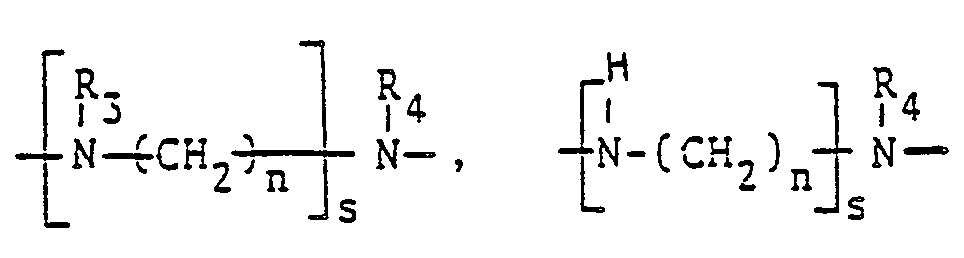
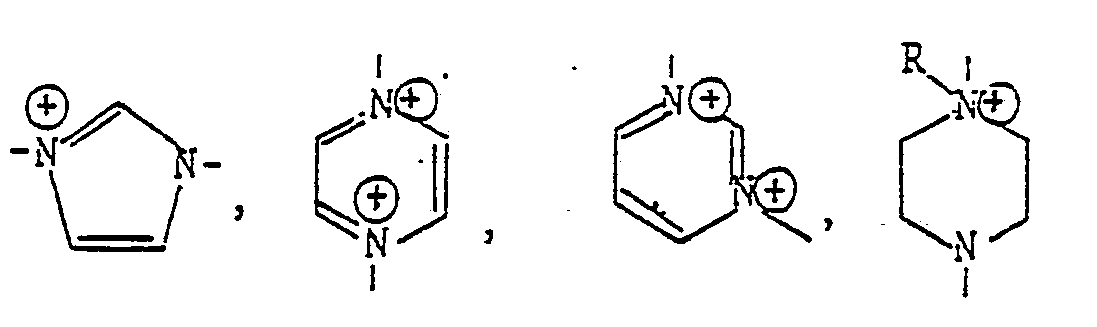
- Table 2 shows formulas of elementary structural units of the resulting compounds of the formula (III).
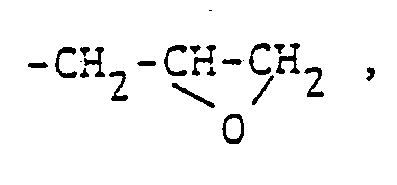
- the compounds of the formula (III) according to the invention can also have terminal epoxy groups.
- the compounds or reaction products according to the invention have a whole series of properties which can be used in finishing technology.
- alkaline media they can react with alcoholic OH groups of the cellulose macromolecules and thus cause them to crosslink. This markedly improves the dyeability with anion dyes.
- reaction products according to the invention Compared to the compounds of formula (I), the reaction products according to the invention have a markedly increased stabilizing effect on anion dyes and in particular substantive dyes. However, the effect of the compounds according to the invention in termination processes which follow after dyeing and printing with reactive dyes is quite surprising and unusual.
- Termination and washing processes using compounds of formula (I) are characterized by an intensive washing action, with no changes to the existing devices being necessary. Furthermore, the light fastness of the colorations and prints are not adversely affected in any way. The use of these cation-active polyelectrolytes leads to a considerable shortening of the washing process and thus to a saving in water, energy and labor costs.
- the washed-out dye can be prevented from bleeding out into the light background during washing.
- the polyelectrolytes according to the invention can be used not only technically and industrially, but also in the home when washing textile articles with less fastness to washing.
- the method according to the invention can also be used in the repair of textile goods in which there has been bleeding of the unfixed dye.
- the concentration of the cation-active polyelectrolytes in a water bath is 0.1 to 20 gII;
- the textile materials are washed in this bath at a temperature of 15 to 100 ° C for 10 s to 60 min.
- the washing effect increases with the bath temperature; the most suitable temperature range is from 80 to 100 ° C.
- the effect of the polyelectrolytes according to the invention when dyeing with substantive dyes is different in comparison with the reactive dyes.
- the polyelectrolytes act similarly to the known fixatives derived, for example, from dicyandiamide. So you increase the color fastness. In contrast to the known compounds, however, they do not reduce the light fastness, which is a further advantage.
- the cation-active polyelectrolytes are able to bind metal cations, so that fixed colorations can be treated with aqueous solutions of salts of a suitable metal.
- aqueous solutions of salts of a suitable metal This increases the wet fastness and also the light fastness.
- Water-soluble salts of Ca 2+ , Mg 2+ , Zn 2+ , C U 2+ , Fe 2+ , Co 2+ and Ni 2+ are advantageously suitable.
- the aqueous solutions for such treatments contain 0.1 to 20 gII of a divalent or trivalent cation.
- the salts can be used simultaneously with the cation-active polyelectrolyte or subsequently.
- polyelectrolytes according to the invention were produced by using 110 kg of hexamethylene diamine (50%), 70 kg of N, N'-dimethylethylene diamine (50%) and 116 kg of triethylene tetramine (50%) instead of 80 kg of diethylene triamine (50%).
- Mercerized cotton yarn with a color depth of 2% with Directorange C.I. 39 had been dyed was treated at a temperature of 30 ° C. in a liquor containing 1 g / l of the polyelectrolyte prepared according to Example 1 at a liquor ratio of 1 20 10 min. This was followed by centrifugation and drying. The coloration was good fastness to water, sweat and wash at 40 ° C.
- the cotton yarn according to Example 4 was treated in a liquor containing 5 g / l of the polyelectrolyte prepared according to Example 1 and 2 g / l sodium hydroxide at 50 ° C. and a liquor ratio of 1:20 for 30 minutes. After washing and neutralization, the yarn was dried. The coloration showed excellent water, sweat and wash fastness at 95 ° C. It was therefore a coloration with a higher level of authenticity than in the termination process according to Example 4.
- a knitted cotton fabric was pretreated on the dyeing reel by a conventional cooking process and bleaching. Thereafter, the following liquor was treated at a liquor ratio of 1:20:
- the treatment temperature was 55 ° C, the treatment time was 50 minutes.
- the knitted fabric was washed with reactive blue C.I. 4 colored. Compared to conventional dyeing, double dye yield was achieved.
- a fabric made of polyester and cellulose fibers (67/33%) was impregnated on the foulard with a liquor of the following composition:
- the fabric 10 After passing through the foulard and squeezing to 70%, the fabric 10 was deposited with constant rotation at room temperature. In the course of the deposition, the reactive dye was completely fixed and the cellulose fibers were crosslinked by the compound according to the invention, and thus the iron-resistant finish was improved.
- the yarn was washed with cold water for 5 minutes and then with water at 50 ° C. for a further 5 minutes. Then it was treated in an aqueous liquor which contained 2 g / l of the cationic polyelectrolyte 2 from Table 1 (temperature 90 ° C., duration 10 min). This was followed by 5 minutes of washing with 50 ° C warm water and brief rinsing with cold water. The wash fastness of this very deep dyeing was 4-5 / 4-5 / 4-5, while wash fastness of 4/3/4 was achieved with conventionally named dyeing.
- a knitted fabric made from a cotton-cellulose blend was washed in a hydrodynamic dyeing machine in the usual way with reactive red C.I. 2 (4.5%) colored.
- the knitted fabric was washed with water at 20 to 25 ° C. for 5 minutes and then with water at 60 ° C. for 5 minutes and then in a float with 2 g / l of the cationic polyelectrolyte 3 from Table 1 at 90 ° C. for 10 minutes treated.
- the wet fastness properties were significantly better than after conventional dyeing.
- the cotton fabric dyed and fixed according to Example 4 was treated for a further 20 min at 60 ° C. and a liquor ratio of 1: 5 in a liquor consisting of crystalline copper (II) sulfate (2.5 g / l) and glacial acetic acid (1, 0 ml / l) had been prepared.
Landscapes
- Chemical & Material Sciences (AREA)
- Organic Chemistry (AREA)
- Engineering & Computer Science (AREA)
- Textile Engineering (AREA)
- Coloring (AREA)
Claims (12)







Applications Claiming Priority (4)
| Application Number | Priority Date | Filing Date | Title |
|---|---|---|---|
| CS3987/84 | 1984-05-28 | ||
| CS843987A CS245170B1 (en) | 1984-05-28 | 1984-05-28 | Water-soluble cation active polyelectrolyte and method of its production |
| CS4316/84 | 1984-06-07 | ||
| CS431684A CS253213B3 (en) | 1984-06-07 | 1984-06-07 | Method of dyeing and/or printing finishing and washing on textile materials containing cellulose fibres |
Publications (2)
| Publication Number | Publication Date |
|---|---|
| EP0166242A1 EP0166242A1 (fr) | 1986-01-02 |
| EP0166242B1 true EP0166242B1 (fr) | 1990-01-03 |
Family
ID=25745926
Family Applications (1)
| Application Number | Title | Priority Date | Filing Date |
|---|---|---|---|
| EP85106524A Expired - Lifetime EP0166242B1 (fr) | 1984-05-28 | 1985-05-28 | Polyélectrolytes cationactifs solubles dans l'eau, leur préparation et leur utilisation |
Country Status (8)
| Country | Link |
|---|---|
| US (1) | US4758671A (fr) |
| EP (1) | EP0166242B1 (fr) |
| DE (1) | DE3575131D1 (fr) |
| ES (1) | ES8603971A1 (fr) |
| HU (1) | HUT39203A (fr) |
| PL (1) | PL143600B2 (fr) |
| RO (1) | RO92977A (fr) |
| YU (1) | YU88785A (fr) |
Families Citing this family (6)
| Publication number | Priority date | Publication date | Assignee | Title |
|---|---|---|---|---|
| CH672219B5 (fr) * | 1985-01-25 | 1990-05-15 | Ciba Geigy Ag | |
| US5470986A (en) * | 1994-06-27 | 1995-11-28 | E. I. Du Pont De Nemours And Company | Imidazolium hardeners for hydrophilic colloid |
| US5643498A (en) * | 1994-08-19 | 1997-07-01 | Rhone-Poulenc Inc. | Quaternary cationic surfactants having multiple hydrophobic and hydrophilic groups |
| US6531241B1 (en) | 1999-07-08 | 2003-03-11 | Covalent Associates, Inc. | Cyclic delocalized cations connected by spacer groups |
| CN105088803A (zh) * | 2015-08-26 | 2015-11-25 | 江苏恒源丝绸集团有限公司 | 丝绸抗菌防蛀整理方法 |
| US12486616B2 (en) * | 2020-01-28 | 2025-12-02 | Noble Biomaterials, Inc. | Methods for controlling color during a metallization process and resulting products |
Family Cites Families (5)
| Publication number | Priority date | Publication date | Assignee | Title |
|---|---|---|---|---|
| FR2509302A1 (fr) * | 1981-03-04 | 1983-01-14 | Vyzk Ustav Zuslechtovaci | Composes d'ammonium quaternaire, procede pour leur fabrication et utilisation de ces produits dans les apprets de finissage des tissus |
| US4366036A (en) * | 1981-09-08 | 1982-12-28 | Occidental Chemical Corporation | Additive and alkaline zinc electroplating bath and process using same |
| DE3205647A1 (de) * | 1982-02-17 | 1983-08-25 | Basf Ag, 6700 Ludwigshafen | Methinfarbstoffe |
| US4613609A (en) * | 1983-07-12 | 1986-09-23 | Schering A. G. | Antiarrhythmic imidazoliums |
| ZA86171B (en) * | 1985-01-16 | 1986-08-27 | Hoffmann La Roche | Polycyclic salts |
-
1985
- 1985-05-27 RO RO85118942A patent/RO92977A/fr unknown
- 1985-05-27 ES ES543527A patent/ES8603971A1/es not_active Expired
- 1985-05-27 PL PL1985253650A patent/PL143600B2/pl unknown
- 1985-05-28 EP EP85106524A patent/EP0166242B1/fr not_active Expired - Lifetime
- 1985-05-28 DE DE8585106524T patent/DE3575131D1/de not_active Expired - Fee Related
- 1985-05-28 YU YU00887/85A patent/YU88785A/xx unknown
- 1985-05-28 HU HU852043A patent/HUT39203A/hu unknown
-
1987
- 1987-01-14 US US07/003,111 patent/US4758671A/en not_active Expired - Fee Related
Also Published As
| Publication number | Publication date |
|---|---|
| PL253650A2 (en) | 1986-02-25 |
| ES543527A0 (es) | 1986-01-01 |
| HUT39203A (en) | 1986-08-28 |
| ES8603971A1 (es) | 1986-01-01 |
| RO92977A (fr) | 1987-11-30 |
| YU88785A (en) | 1988-10-31 |
| US4758671A (en) | 1988-07-19 |
| DE3575131D1 (de) | 1990-02-08 |
| PL143600B2 (en) | 1988-02-29 |
| EP0166242A1 (fr) | 1986-01-02 |
Similar Documents
| Publication | Publication Date | Title |
|---|---|---|
| EP0133933B1 (fr) | Procédé de préparation de teintures avec des colorants réactifs | |
| DE2504282C3 (de) | Verfahren zum kontinuierlichen Färben von Polyester- und Cellulosefasern | |
| DE3207845C2 (fr) | ||
| CH501769A (de) | Verfahren zum Färben von stickstoffhaltigen Textilfasern | |
| EP0232519B1 (fr) | Copolymère, procédé de sa préparation et son usage | |
| EP0166242A1 (fr) | Polyélectrolytes cationactifs solubles dans l'eau, leur préparation et leur utilisation | |
| EP0259251B1 (fr) | Composés cationiques obtenus par réaction de carbamides avec des épihalogènehydrines | |
| DE1906709C3 (de) | Verfahren zur Herstellung basischer Azofarbstoffe und ihre Verwendung | |
| EP0097125A2 (fr) | Procédé d'échange de sels inorganiques peu solubles de colorants ou d'azurants optiques cationiques en sels d'acides organiques facilement solubles | |
| DE4101822A1 (de) | Pigmentdruck auf faserstoffen | |
| EP0225282B1 (fr) | Procédé de post-traitement de matière fibreuse cellulosique teinte | |
| DE3417240A1 (de) | Verfahren zur nachbehandlung von gefaerbten textilen materialien aus natuerlichen oder synthetischen polyamiden | |
| DE3422822A1 (de) | Faerbeverfahren | |
| EP0163608B1 (fr) | Procédé de teinture de matières fibreuses en polyamides naturelles ou synthétiques avec des colorants à complexes métallifères 1:1 | |
| EP0093361B1 (fr) | Composés alcoxyalcoylés d'ammonium quaternaire, procédé de préparation et utilisation | |
| DE3621410C2 (fr) | ||
| EP0824156B1 (fr) | Polymères dérivés de l'urée, solubles dans l'eau, ayant des groupements ammonium quaternaire, et leur utilisation | |
| DE3505018C2 (fr) | ||
| DE2335674C3 (de) | Verfahren und Mittel zum Präparieren von Fasern | |
| DE3320629A1 (de) | Verfahren zum faerben von textilen materialien aus hydrophilen fasern | |
| DE2023179C (de) | Verfahren zum Farben und Bedrucken von Textilfasern | |
| DE874753C (de) | Verfahren zum Mattieren von Textilien | |
| DE1619391C3 (de) | Verfahren zur Verbesserung der Naßechtheitseigenschaften von mit Schwefelfarbstoffen erzeugten Färbungen und Drucken auf Cellulosetextilfasern | |
| DE1469766A1 (de) | Phthalocyaninfarbstoffe,Verfahren zu ihrer Herstellung und ihre Verwendung zum Faerben | |
| DE1568258B2 (de) | Verwendung von amphoteren Polyglykolverbindungen als Egalisiermittel |
Legal Events
| Date | Code | Title | Description |
|---|---|---|---|
| PUAI | Public reference made under article 153(3) epc to a published international application that has entered the european phase |
Free format text: ORIGINAL CODE: 0009012 |
|
| AK | Designated contracting states |
Designated state(s): BE CH DE FR GB IT LI |
|
| 17P | Request for examination filed |
Effective date: 19860207 |
|
| 17Q | First examination report despatched |
Effective date: 19870730 |
|
| RBV | Designated contracting states (corrected) |
Designated state(s): CH DE GB LI |
|
| GRAA | (expected) grant |
Free format text: ORIGINAL CODE: 0009210 |
|
| AK | Designated contracting states |
Kind code of ref document: B1 Designated state(s): CH DE GB LI |
|
| GBT | Gb: translation of ep patent filed (gb section 77(6)(a)/1977) | ||
| REF | Corresponds to: |
Ref document number: 3575131 Country of ref document: DE Date of ref document: 19900208 |
|
| PG25 | Lapsed in a contracting state [announced via postgrant information from national office to epo] |
Ref country code: GB Effective date: 19900528 |
|
| PG25 | Lapsed in a contracting state [announced via postgrant information from national office to epo] |
Ref country code: LI Effective date: 19900531 Ref country code: CH Effective date: 19900531 |
|
| PLBE | No opposition filed within time limit |
Free format text: ORIGINAL CODE: 0009261 |
|
| STAA | Information on the status of an ep patent application or granted ep patent |
Free format text: STATUS: NO OPPOSITION FILED WITHIN TIME LIMIT |
|
| 26N | No opposition filed | ||
| GBPC | Gb: european patent ceased through non-payment of renewal fee | ||
| REG | Reference to a national code |
Ref country code: CH Ref legal event code: PL |
|
| PG25 | Lapsed in a contracting state [announced via postgrant information from national office to epo] |
Ref country code: DE Effective date: 19910201 |