EP0166595A2 - Système de communication d'informations - Google Patents
Système de communication d'informations Download PDFInfo
- Publication number
- EP0166595A2 EP0166595A2 EP85304488A EP85304488A EP0166595A2 EP 0166595 A2 EP0166595 A2 EP 0166595A2 EP 85304488 A EP85304488 A EP 85304488A EP 85304488 A EP85304488 A EP 85304488A EP 0166595 A2 EP0166595 A2 EP 0166595A2
- Authority
- EP
- European Patent Office
- Prior art keywords
- signal
- information
- signals
- frequency
- digital
- Prior art date
- Legal status (The legal status is an assumption and is not a legal conclusion. Google has not performed a legal analysis and makes no representation as to the accuracy of the status listed.)
- Granted
Links
Images



Classifications
-
- H—ELECTRICITY
- H04—ELECTRIC COMMUNICATION TECHNIQUE
- H04J—MULTIPLEX COMMUNICATION
- H04J4/00—Combined time-division and frequency-division multiplex systems
- H04J4/005—Transmultiplexing
Definitions
- the present invention relates generally to an information communication system and, particularly, to an information communication system including a signal selecting apparatus for effectively servicing subscribers with desired pieces of information, such as image signals and multichannel audio signals, in response to the request of the subscribers.
- a terminal unit provided in the home is operated by the user to specify a desired combination of image and audio signals such as stereo sound.
- Various systems have been considered to realize this kind of system.
- One example of such a system has selector units for selecting the information signals to be sent to the subscriber located in a relay station known as a sub center.
- Such systems using sub centers are desirable,'since unauthorized reception can be readily prevented, maintenance is easy and the leving of fees simple.
- Information signals supplied from the sub center to the subscriber include vatious different kinds such as (1) signals supplied from the center to the sub center, (2) signals transmitted from a geostationary satellite to the sub center, and (3) signals supplied independently by the sub center, for example, package system media such as video discs.
- the largest proportion of the signals supplied to the subscriber are from a center to the sub center.
- image signals, multichannel sound signals (stereo signals included with the image signals, or separate audio signals) and digital signals, such as character data are sent from the center to the sub center
- optical fibers are most suitable. In order to improve the transmission efficiency of the different signals over the optical fiber, a frequency-division multiplexing scheme is used.
- Suitable signals in the frequency-division multiplexing scheme are selected via an analog matrix switch in response to the demands of the subscribers.
- image signals are sent in a baseband of several megahertz or less, while sound and data signals are sent spread over a higher frequency band.
- at least four kinds of signals in the entire communication frequency band are multiplexed, so there is a problem of image degradation due to different frequency signal components between neighbouring signal on the frequency axis leaking into the image signal.
- This mixing of different frequency signals is the cause of nonlinear distortion being generated at the wide band analog matrix switch and/or the electrical/optical converting section.
- a desired set of information signals are multiplexed and supplied to each subscriber to provide the information desired by the subscribers.
- a first multiplexer unit is provided for receiving digital data signals containing multichannel sound signals and generating a time-division multiplexed, or TDM, information signal by time-division multiplexing these digital signals.
- the TDM information signal is angle-modulated by the modulator unit.
- a second multiplexer unit is provided for receiving an image signal and the angle-modulated information signal. These signals are frequency-division multiplexed by the second multiplexer unit and an FDM information signal which is adapted to be supplied to a certain subscriber.
- the frequency band necessary for supplying an image signal and a multichannel sound signal can be narrowed and the leaking of image signals of different frequency components, which is the cause of nonlinear distortion, can be suppressed or prevented, thereby providing high quality information transmission.
- a method of selecting, in response to the request from a plurality of subscribers, the desired information signal from signals which are a prepared predetermined combination of information, is used in the sub center for feeding the signals to a plurality of subscribers.
- the prepared information signal may be various combinations of, for example, (1) a color image signal for movies, etc., (2) high fidelity stereo sound signals included in the movie signal. If required, still image data for characters may be supplementarily supplied.
- a matrix switch is provided in the sub center for carrying out the required signal selection operation.
- Fig. 1 shows a simplified circuit structure for selecting an image signal and attached audio signals in response to the request of each subscriber (if necessary digital data signals may be included) and converting the signals into optical signals.
- Wide-band analog matrix switch 10 has m signal input lines 12 and n signal output lines 14.
- matrix _switch 10 a transistor, such as a metal oxide semiconductor field effect transistor (MOSFET), is integrated on each intersection of the matrix wires extending in rows and columns. By changing the gate voltage of any one of the MOSFETs, it is possible to make the MOSFET conductive and, thereby, connect the desired input line with a particular output line.
- MOSFET metal oxide semiconductor field effect transistor
- matrix switch 10 is able to transmit the desired information signal to a particular output line 14 in response to a command from a subscriber from m varieties of information signals input to matrix switch 10 from input line 12. In other words, matrix switch 10 can partially change the electrical connection relationships such that a particular input line 12 and particular output line 14 are connected.
- Each signal output line 14 from matrix switch 10 is connected to the electrical/optical converter 20 via pulsed FM modulator 18.
- the information signal to be sent to a particular subscriber selected by matrix switch 10 is converted to an optical signal by converter 20, and supplied to optical fiber cable 22. Accordingly, the selected information signal is transmitted to the subscriber via optical fiber cable 22.
- each information signal supplied to input line 12 of matrix switch 10 is a frequency-division multiplex signal formed of (1) a color image signal, (2) a two-channel audio signal attached to the image signal (digital signal), and if necessary, (3) a supplementary character data signal (digital signal).
- the digital signals, audio and character data signals are quaternary phase-shift keying signals (QPSK) obtained by time-division multiplexing and quaternary modulating of pulse-coded audio and character data signals.
- QPSK quaternary phase-shift keying signals
- each information signal selected by way of matrix switch 10 is a specific signal (referred to as a "hybrid multiplex information signal” hereinafter) which is produced by (1) time-division multiplexing pulse-coded audio and data signals, (2) angle-modulating the digital signals obtained in this way, and (3) frequency-division multiplexing the angle-modulated signal with the image signal.
- Fig. 2 shows the overall structure of the circuit for producing the hybrid multiplex information signal of this embodiment.
- matrix switch 10 of Fig. 1 is used to select one hybrid multiplex information signal of one group of information signals selected by one subscriber. This basic concept can simply be expanded to accomodate the number of actual subscribers.
- analog image signal Sl is supplied to input terminal 30 and 2-channel audio signals S2, S3 (analog) are supplied to input terminals 32, 34, while digital data signal S4 is supplied to input terminal 36.
- Input terminal 30 is directly connected to frequency-division multiplexer 40 for frequency-division multiplexing.
- Audio input terminals 32, 34 and data input terminal 36 are connected to frequency-division multiplexer 40 via pulse code modulation (PCM) encoder 42 and modulator 44.
- PCM pulse code modulation
- Audio signals S2, S3 are PCM- modulated by PCM encoder 42 and converted to digital audio signals. These signals are digitally multiplexed with data signal S4 based on the TDM scheme.
- audio signals S2, S3 and data signal S4 are time- divisionally multiplexed by PCM encoder 42 to produce digital signal S5.
- Signal S5 is supplied to modulator 44 which also receives first carrier wave signal C1 from carrier wave generator 46.
- This first carrier wave signal Cl has a frequency of, for example, 5 MHz to 15 MHz.
- first carrier wave signal C1 is angle-modulated so that a primary time-division multiplexed signal S6 of audio signals S2, S3 and data signal S4 is supplied from modulator 44 to frequency division multiplexer 40.
- phase-shift keying (QPSK) of the phase-shift keyng (PSK) of the frequency modulation is preferably performed as angle modulation by modulator 44.
- QPSK quaternary phase-shift keying
- the spectrum distribution range of the required signal modulation is small and a narrow signal transmission band is possible.
- Image signal Sl and multiplex signal S6 are frequency-division multiplexed by multiplexer 40 to produce a secondary multiplexed signal S7.
- Multiplexer 40 frequency-division multiplexes image signal Sl and multiplex signal S6 so output signal S7 is a frequency-division multiplexed information signal.
- Fig. 3 is a frequency spectrum characteristic graph of this frequency-division multiplexed information signal S7.
- image signal component 50 is distributed over the baseband while signal component 52, which corresponds to signal S7, is distributed over a higher frequency band.
- the image signal, the stereo audio signal attached to the image signal, and the data signal are all included in the distribution of these two signal components 50, 50 on the frequency axis.
- output signal S7 from frequency division multiplexer 40 is supplied to second modulator 60, which also receives second carrier wave signal C2 from carrier wave generator 46.
- Second carrier wave signal C2 has a frequency of, for example, 10 MHz to 100 MHz.
- Modulator 60 modulates second carrier wave C2 based on signal S7, to thereby send a modulated information signal S8 having the final waveform for transmission to the subscriber to electrical/optical converter 62.
- the frequency spectrum of modulated signal S8 from modulator 60 is shown in Fig. 4.
- PFM pulse-frequency modulation
- pulse FM pulsed frequency modulation
- the linearity of the multiplexed information signal is of paramount importance and in the nonlinear electro/optical conversion processing, the deterioration in the linearity of the multiplexed signal, which is inevitably produced, must be kept to the minimum. If pulse-frequency modulation is performed before the electro/optical conversion, the hybrid multiplexed information signal S8 can maintain good linearity, and, therefore, the signal-to-noise ratio can be improved. Consequently, it is possible to increase the serviceable distance between the subscriber and the sub center.
- Modulated signal S8 from modulator 60 is converted to an optical pulse train optical signal S9 by converter 62 for transmision to optical fiber cable 22 (Fig. 1).
- the hybrid multiplex information signals obtained in this way are sent to the subscribers by way of matrix switch 10 under the control of controller 16 shown in Fig. 1.
- the information signals to be supplied to the subscriber are hybrid- multiplexed.
- the signals other than the image signal, the audio signals S2, S3 and data signal S4, are digitalized and time-division multiplexed.
- the resultant digitalized information signal is angle-modulated and then frequency-division multiplexed with image signal Sl. Accordingly, in the frequency-division multiplexing process, the signal components corresponding to audio signals S2, S3 and data signal S4 occupy a narrow frequency band approximately equal to that occupied by any one of signals S2, S3, S4 on the frequency axis, as is shown by reference numeral 52 in Fig. 3.
- the required frequency band width of the hybrid multiplexed information signal of this invention can be reduced by approximately two thirds compared to that of the prior art. Consequently, it is possible to reliably prevent the crosstalk generated between neighbouring signals on the frequency axis (i.e., the mixing of different frequency components with the image signal), which in turn makes it possible to reliably prevent the horizontal synchronous image signal from leaking and mixing with the audio signal because the audio signals are digitalized.
- analog matrix switch 10 which comprises MOSFETs.
- the reason for this is that by reducing the required frequency band of the hybrid multiplexed information signal, a desired hybrid multiplexed information signal can be selected in such a manner that all the signal components of this information signal are included in the desired frequency band of the MOSFETs of analog matrix switch 10 (no generation of nonlinear distortion). Consequently, it is possible to efficiently supply high quality image information, character data and stereo information having a high S/N ratio and improved dynamic range to the subscriber via optical fiber cable.
- a single digital information signal (time-division multiplexed) formed of the frequency-division multiplexed audio signals S2, S3 and data signal S4 is frequency-division multiplexed with the image signal Sl, so only one frequency-division multiplexed carrier wave is required.
- the level of this carrier wave can be set lower than the carrier wave level used in the prior art analog-type frequency modulation. Accordingly, it is possible to effectively suppress image deterioration due to the beat with the color subcarrier wave signal.
- the capability of the digital processing circuit is used to the full making it possible to integrate the circuit structure required for the hybrid multiplexing of this invention on wafer chips. This in turn results in a more compact system and contributes greatly to its simplification.
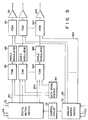
- Fig. 5 shows second embodiment of this invention in which each subscriber is able to specify any desired combination of color image information, such as movies, and 2-channel audio information, and, if necessary, character data. For example, the subscriber may at his own discretion select a music program entirely unrelated to the movie he is watching.
- Fig. 5 shows the simplified circuit structure required in the sub center for when a combination of different signals is selected in response to a request by the subscriber and converted to an optical signal.
- the sub center is provided with two kinds of matrix switch units, digital and analog matrix switches 70 and 72.
- the PCM 2-channel audio signal (digital signal) is supplied to input terminals 74 of switch 70.
- the analog information signal of the color image signal is supplied to the input terminals 76 of analog matrix switch 72.
- Digital and analog matrix switches 70 and 72 are controlled by control circuit 78 which operates in response to a signal select command from the subscriber.
- controller 78 changes the matrix connections inside matrix switch units 70 and 72 in response to the combination of image and audio information desired by the subscriber.
- the specified combination of information is output from matrix switch units 70 and 72 to the specified output lines 80 and 82 connected to the subscribers terminal.
- the matrix line connecting (wiring) pattern is changed such that the desired audio signals are output to the pair of output lines communicating with the subscriber (note: In this embodiment the output line of the matrix corresponding to the 2-channel audio signal is composed of 2 lines).
- analog matrix switch 72 the matrix line connecting (wiring) pattern is changed such that the desired character data signal is output to a particular output line 82 which communicates with the subscriber.
- TDMs time-division multiplexers
- FDMs frequency-division multiplexers
- the 2-channel digital audio signal e.g., a stereo audio signal
- the 2-channel digital audio signal desired by the subscriber is sent to TDM 86i from the pair of corresponding output lines 80i of digital matrix switch 70 under the control of controller 78.
- an independent digital information signal is sent to TDM 86i together with the command signal selected by the subscriber.
- These signals are time-division multiplexed to produce one TDM signal.
- This TDM signal is supplied to angle modulator 88i for digital angle modulation.
- angle modulation the QPSK technique described in detail for the first embodiment is similarly preferable.
- the resultant digital modulated signal is then sent to FDM 90i.
- the desired image signal output from analog matrix switch 72 is supplied to FDM 90i via exclusive output line 82i.
- FDM 90i frequency-division multiplexes the digital angle-modulated signal, which includes the stereo and character data signals, and the image signal to obtain the hybrid multiplexed information signal to be supplied to the subscriber.
- This signal is supplied to the subscriber via transmission path 92i, which also has the function of converting the signal to the format used by the signal transmitting means of that particular system.
- the signal transmission means is an optical fiber cable, for example, PFM, in which pulses of a constant width are repeatedly sent and the frequency varies in response to the information or pulsed FM (also called square-waveform FM) is used.
- a plurality of information for the image, sound and data, etc. can be freely combined at the sub center in response to the demands of individual subscribers of the information transmission system.
- signal transmission means such as an optical fiber cable
- frame information signals sent to the subscriber via signal transmission means are processed using the hybrid multiplexing technique of this invention so it is possible to supply high quality information (pictures, sound, or character messages).
- One frame is the signal transmitted corresponding to one subscriber line.
- the circuit structure shown in Fig. 5 it is possible to supply any combination of PCM digital audio signal or data signal and the desired image signal.
- the combination of digital audio or data signal is time-division multiplexed and supplied to the subscriber. It is essential that these digital signals be in accurate synchronization. The reason for this is that if they are not, the pulses will degrade during signal transmission, the inclusion of false pulses will surpass permissable limits, and correct information will not be transmitted to the subscriber.
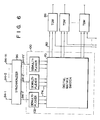
- the circuit structure for framing the digital signals that were time-division multiplexed before being frequency-division multiplexed with the image signal will be described with reference to Fig. 6.
- FIG. 6 the same circuit elements as in Fig. 5 have been given the same reference numerals and a description of which has been omitted.
- a plurality of frames 94-1, 94-2,..., 94-m are input to synchronizing circuit 96 where they are temporarily stored in the internal buffer memory (not shown) and synchronized. What is desirable at this time is to adjust the frames so that their phases match. For example, when the input frames are transferred from the center to the sub center, if a common clock signal is generated on the center side, it is possible to perform this frame synchronization at the center.
- synchronizing circuit 96 is provided on the sub center side in this embodiment.
- Signal 94' output from synchronizer 96 is supplied to signal selector unit 100.
- Signal selector unit 100 includes demultiplexers 102-1, 102-2,..., 102-m. Frame signals 94 synchronized by synchronizer 96 are supplied to corresponding demultiplexers 102.
- Each demultiplexer 102 divides the input frame signal into a plurality of digital information signals 74 (including, for example, multi channel audio signals) as was described in detail with reference to Fig. 5. These information signals 74 are supplied to digital matrix switch 70 as was described earlier. It is preferable that this synchronization of frames be performed at the sub center side so as to facilitate the time-division multiplexing that occurs later at the TDMs.
- Fig. 7 shows an information transmission system of the third embodiment of the present invention to which the special hybrid multiplexing, which is the core concept of the present invention, has been applied.
- the image information, 2-channel audio information, and, if necessary, data information are selected by exclusive switches in response to the demands of the subscribers.
- the multiple channel audio signal is PCM modulated.
- This PCM signal is time-division multiplexed with the digital data signal, angle modulated, and then frequency-division multiplexed with the image signal.
- the signal synchronization required for time-division multiplexing can be performed by the PCM encoder exclusively provided for each subscriber so a synchronization circuit at the sub center is unnecessary. Consequently, the structure and control of the signal selecting unit for distributing the desired information signals can be made simple.
- analog matrix switch 100 receives only image signals 102 and selects, under the control of control circuit 104, the signals desired by the subscribers, each of which is transmited to the corresponding subscriber transmission unit 106-1, ..., 106-i, ..., 106-n.
- Analog matrix switch 108 receives only audio signals 110, under the control of control circuit 104 selects the desired signals, and respectively transmits them to the corresponding subscriber transmission units 106-1, ..., 106-i, ..., 106-n.
- the audio signal is the audio information attached to an image signal or only a music program without an image, etc.
- the selected multichannel (for example 4) analog audio signal 112 output from selector 108 is supplied to PCM encoder 114-1 provided in transmission unit 106-1.
- digital data signal 116 is supplied to P CM encoder 114-1 via exclusive data input terminal 118-1.
- Digital data signal 116 may be a data signal that is common to all the subscribers of the information transmission system, or a data signal with an address, or a data signal selected based on the demands of the subscriber.
- PCM encoder 114-1 PCM-modulates analog audio signal 112 and time-division multiplexes digital signal 116 with this PCM encoded audio signal.
- the time-division multiplexed digital information signal output from PCM encoder 114-1 is supplied to modulator 118 and angle modulated.
- the signal output from modulator 118-1 is supplied to frequency-division multiplexer 120.
- image signal 122-1 also is supplied from image selecting matrix switch 100 to frequency-division multiplexer 120 where input image signal 122-1 and the angle-modulated digital information signal are frequency-division modulated.
- the FDM information signal, or hybrid multiplexed information signal, from multiplexer 120-1 is transmitted to E/O converter 124-i where it is converted to an optical signal for transmission over optical fiber cable 126-1.
- Optical fiber cable 126-1 is provided exclusively for the service of one subscriber.
- Wavelength division multiplexer 128 synthesizes a plurality of optical information signals 126-i, ..., 126-n. This makes it possible to increase the quantity of information provided for one subscriber.
- the image and audio signals are selected by exclusive selector units 100, 108 in response to the demands of the subscribers.
- the signal handled at the selection stage are all analog signals (namely, baseband signals), so there is no particular need to synchronize the audio signals before being transmitted to PCM encoder 114 of transmitter 106.
- the signal selection matrix switch units in the sub center can have non synchronous circuit arrangement. Accordingly, the signal processing control can be simplified, the structure can be simplified, and at the same time, it is possible to greatly increase the subscriber information selection range.
- a quaternary phase shift keying (QPSK) technique was employed in order to modulate the TDM signal in which the audio signal and the digital information signal, such as character data signal, are time-division multiplexed with each other.
- QPSK quaternary phase shift keying
- the hybrid multiplexing method of this invention is not limited to this and a phase shift keying (PSK) or a frequency-shift keying (FSK) may also be used.
- PSK phase shift keying
- FSK frequency-shift keying
- a carrier wave signal of 5 MHz to 15 MHz was used as the first carrier wave Cl.
- This frequency setting was determined so as to satisfy the following conditions: (1) the minimum frequency of the first carrier wave Cl is higher than the upper frequency limit of the image signal based on the NTSC system; and (2) the maximum frequency of the carrier wave Cl is set to be in a frequency band which is suitable for improving the S/N ratio.
- a 10 to 100 MHz carrier wave signal was used as the second carrier wave C2.
- This frequency setting means that the minimum frequency of the second carrier wave C2 is twice the minimum frequency of the first carrier wave Cl and was set so that the maximum frequency of second carrier wave C2 was in a region such that the S/N ratio was improved.
- the information transmission means is not restricted to optical fiber cables and may be radio wave transmission or any of various other ways for transmitting signals.
Landscapes
- Engineering & Computer Science (AREA)
- Computer Networks & Wireless Communication (AREA)
- Signal Processing (AREA)
- Optical Communication System (AREA)
- Time-Division Multiplex Systems (AREA)
Applications Claiming Priority (4)
| Application Number | Priority Date | Filing Date | Title |
|---|---|---|---|
| JP59129200A JP2815853B2 (ja) | 1984-06-25 | 1984-06-25 | 信号選択方式 |
| JP129200/84 | 1984-06-25 | ||
| JP129198/84 | 1984-06-25 | ||
| JP12919884A JPH0616612B2 (ja) | 1984-06-25 | 1984-06-25 | 光伝送方式 |
Publications (3)
| Publication Number | Publication Date |
|---|---|
| EP0166595A2 true EP0166595A2 (fr) | 1986-01-02 |
| EP0166595A3 EP0166595A3 (en) | 1988-10-05 |
| EP0166595B1 EP0166595B1 (fr) | 1992-04-08 |
Family
ID=26464670
Family Applications (1)
| Application Number | Title | Priority Date | Filing Date |
|---|---|---|---|
| EP85304488A Expired EP0166595B1 (fr) | 1984-06-25 | 1985-06-24 | Système de communication d'informations |
Country Status (4)
| Country | Link |
|---|---|
| US (1) | US4704715A (fr) |
| EP (1) | EP0166595B1 (fr) |
| CA (1) | CA1256606A (fr) |
| DE (1) | DE3585806D1 (fr) |
Cited By (2)
| Publication number | Priority date | Publication date | Assignee | Title |
|---|---|---|---|---|
| EP0518644B1 (fr) * | 1991-06-10 | 1997-03-05 | Hamamatsu Photonics K.K. | Système de multiplexage pour un signal vidéo |
| CN101150779A (zh) * | 2002-05-10 | 2008-03-26 | 三菱电机株式会社 | 通信系统、基站及移动站 |
Families Citing this family (38)
| Publication number | Priority date | Publication date | Assignee | Title |
|---|---|---|---|---|
| US4789980A (en) * | 1986-08-18 | 1988-12-06 | American Telephone & Telegraph Company, At&T Bell Laboratories | Switching techniques for FDM communication systems |
| US4852086A (en) * | 1986-10-31 | 1989-07-25 | Motorola, Inc. | SSB communication system with FM data capability |
| US4955083A (en) * | 1986-10-31 | 1990-09-04 | Motorola, Inc. | Dual mode radio transceiver for an SSB communication system |
| US4817192A (en) * | 1986-10-31 | 1989-03-28 | Motorola, Inc. | Dual-mode AFC circuit for an SSB radio transceiver |
| GB8713794D0 (en) * | 1987-06-12 | 1987-07-15 | British Telecomm | Optical multiplexing |
| JPH0752867B2 (ja) * | 1987-10-02 | 1995-06-05 | 株式会社ケンウッド | 多チヤンネルpcm音楽放送システム |
| JPH0267525A (ja) * | 1988-09-02 | 1990-03-07 | Hitachi Ltd | 光スイツチ装置及びスイツチ間伝送方法 |
| US5060303A (en) * | 1988-09-06 | 1991-10-22 | Wilmoth Thomas E | Optical data link system, and methods of constructing and utilizing same |
| US5144466A (en) * | 1988-10-04 | 1992-09-01 | Canon Kabushiki Kaisha | Optical fiber communication method and multimedia optical fiber network using the same |
| US4922536A (en) * | 1988-11-14 | 1990-05-01 | Massachusetts Institute Of Technology | Digital audio transmission for use in studio, stage or field applications |
| JP2777194B2 (ja) * | 1989-05-29 | 1998-07-16 | 株式会社東芝 | 光伝送方式 |
| US4999831A (en) * | 1989-10-19 | 1991-03-12 | United Telecommunications, Inc. | Synchronous quantized subcarrier multiplexer for digital transport of video, voice and data |
| US5283780A (en) * | 1990-10-18 | 1994-02-01 | Stanford Telecommunications, Inc. | Digital audio broadcasting system |
| JP3308525B2 (ja) * | 1990-11-30 | 2002-07-29 | 株式会社日立製作所 | ネットワーク |
| US5204855A (en) * | 1991-01-09 | 1993-04-20 | Rockwell International Corporation | Skywave adaptable network transceiver apparatus |
| US5204856A (en) * | 1991-01-09 | 1993-04-20 | Rockwell International Corporation | Skywave adaptable network transceiver apparatus using predictive frequencies for initial link-up |
| BE1004813A3 (nl) * | 1991-05-08 | 1993-02-02 | Bell Telephone Mfg | Optische zender/ontvangerinrichting. |
| US5274627A (en) * | 1991-07-10 | 1993-12-28 | International Telecommunications Satellite Organization | Non-regenerative multibeam satellite communications system with FDMA access and SSTDM connectivity |
| US5572347A (en) * | 1991-07-30 | 1996-11-05 | Alcatel Network Systems, Inc. | Switched video architecture for an optical fiber-to-the-curb telecommunications system |
| US5576874A (en) * | 1991-07-31 | 1996-11-19 | Alcatel Network Systems, Inc. | Optical distribution shelf for a remote terminal of an optical fiber telecommunications network |
| US5491839A (en) * | 1991-08-21 | 1996-02-13 | L. S. Research, Inc. | System for short range transmission of a plurality of signals simultaneously over the air using high frequency carriers |
| US5299264A (en) * | 1991-08-21 | 1994-03-29 | L. S. Research, Inc. | System for short-range transmission of signals over the air using a high frequency carrier |
| US5528283A (en) * | 1992-06-22 | 1996-06-18 | Alcatel Network Systems, Inc. | Switched video distribution apparatus |
| US5600365A (en) * | 1994-01-28 | 1997-02-04 | Sony Corporation | Multiple audio and video signal providing apparatus |
| US5648985A (en) * | 1994-11-30 | 1997-07-15 | Rockwell Semiconductor Systems, Inc. | Universal radio architecture for low-tier personal communication system |
| DE4444218A1 (de) * | 1994-12-13 | 1996-06-27 | Sel Alcatel Ag | Optische Sendeeinrichtung für ein optisches Nachrichtenübertragungssystem in Verbindung mit einem Funksystem |
| US5673323A (en) * | 1995-04-12 | 1997-09-30 | L. S. Research, Inc. | Analog spread spectrum wireless speaker system |
| DE19737482A1 (de) | 1997-08-28 | 1999-03-04 | Alsthom Cge Alcatel | Verfahren zur optischen Übertragung über ein Lichtwellenleiternetz, sowie optisches Übertragungsnetz |
| US6529303B1 (en) | 1998-03-05 | 2003-03-04 | Kestrel Solutions, Inc. | Optical communications networks utilizing frequency division multiplexing |
| US7154914B1 (en) * | 1998-03-05 | 2006-12-26 | Forster Energy Llc | Through-timing of data transmitted across an optical communications system utilizing frequency division multiplexing |
| US6452945B1 (en) * | 1998-03-05 | 2002-09-17 | Kestrel Solutions, Inc. | Electrical add-drop multiplexing for optical communications networks utilizing frequency division multiplexing |
| US6947500B1 (en) * | 1999-01-29 | 2005-09-20 | Northrop Grumman Corporation | Buffering and sequencing of soft decisions of multiple channels into a single shared biorthogonal decoder |
| US20020039211A1 (en) * | 1999-09-24 | 2002-04-04 | Tian Shen | Variable rate high-speed input and output in optical communication networks |
| US7228077B2 (en) * | 2000-05-12 | 2007-06-05 | Forster Energy Llc | Channel gain control for an optical communications system utilizing frequency division multiplexing |
| US20020110157A1 (en) * | 2001-02-14 | 2002-08-15 | Kestrel Solutions | Method and apparatus for providing a gigabit ethernet circuit pack |
| TWI234987B (en) * | 2004-02-19 | 2005-06-21 | Asia Optical Co Inc | Signal combination apparatus and communication system |
| JP2007336435A (ja) * | 2006-06-19 | 2007-12-27 | Matsushita Electric Ind Co Ltd | デジタル放送の送信装置及び受信装置 |
| KR102597802B1 (ko) * | 2021-06-11 | 2023-11-02 | 강원대학교산학협력단 | 시분할 다채널 아날로그 행렬 연산기, 이의 동작 방법, 및 이를 포함하는 장치 |
Family Cites Families (5)
| Publication number | Priority date | Publication date | Assignee | Title |
|---|---|---|---|---|
| US3655917A (en) * | 1970-05-01 | 1972-04-11 | Diecomp Inc | Frequency division multiplex system using the spectrum of a periodic synchronizing pulse for phase correction |
| US3894177A (en) * | 1973-03-23 | 1975-07-08 | Gen Dynamics Corp | Signal distribution system |
| FR2309080A1 (fr) * | 1975-04-21 | 1976-11-19 | Kokusai Denshin Denwa Co Ltd | Dispositif de multiplexage |
| DE2951512A1 (de) * | 1979-12-20 | 1981-07-02 | Siemens AG, 1000 Berlin und 8000 München | Breitband-vermittlungssystem |
| DE3044657A1 (de) * | 1980-11-27 | 1982-07-08 | Licentia Patent-Verwaltungs-Gmbh, 6000 Frankfurt | "dienstintegriertes digitales uebertragungssystem" |
-
1985
- 1985-06-24 EP EP85304488A patent/EP0166595B1/fr not_active Expired
- 1985-06-24 DE DE8585304488T patent/DE3585806D1/de not_active Expired - Lifetime
- 1985-06-24 CA CA000484994A patent/CA1256606A/fr not_active Expired
- 1985-06-25 US US06/748,449 patent/US4704715A/en not_active Expired - Lifetime
Non-Patent Citations (5)
| Title |
|---|
| 13TH INTERNATIONAL TV SYMPOSIUM, Montreux, 28th May - 2nd June 1983, pages 291-303; J.P. VAN DER FLUIT: "Optical transmission over long distances for CATV and CCTV" * |
| 1979 NATIONAL TELECOMMUNICATIONS CONFERENCE RECORD, Washington, D.C., 27th-29th November 1979, vol. 2, pages 37.5.1-37.5.5, IEEE, New York, US; S. TAKEUCHI et al.: "Development of basic components for optical video system" * |
| ELECTRONICS REVIEW, vol. 118, no. 21, 16th October 1975, pages 29-30; "Fiber-optic system carries voice, TV and data signals" * |
| PROCEEDINGS OF THE IEEE INTERNATIONAL CONFERENCE ON COMMUNICATIONS, Philadelphia, 13th-17th June 1982, vol. 2, pages 4D.4.1 - 4D.4.5, IEEE, New York, US; G.A. TOUGH et al.: "An integrated fiber optics distribution field trial in Elie, Manitoba" * |
| S. YONEZAWO: "MICROWAVE COMMUNICATION", 1970, pages 397-436, chapter 12: "PCM radio-relay system", Mainzen Co., Ltd, Tokyo, JP * |
Cited By (3)
| Publication number | Priority date | Publication date | Assignee | Title |
|---|---|---|---|---|
| EP0518644B1 (fr) * | 1991-06-10 | 1997-03-05 | Hamamatsu Photonics K.K. | Système de multiplexage pour un signal vidéo |
| CN101150779A (zh) * | 2002-05-10 | 2008-03-26 | 三菱电机株式会社 | 通信系统、基站及移动站 |
| CN101150779B (zh) * | 2002-05-10 | 2015-08-12 | 黑莓有限公司 | 通信系统、基站及移动站 |
Also Published As
| Publication number | Publication date |
|---|---|
| US4704715A (en) | 1987-11-03 |
| EP0166595A3 (en) | 1988-10-05 |
| CA1256606A (fr) | 1989-06-27 |
| DE3585806D1 (de) | 1992-05-14 |
| EP0166595B1 (fr) | 1992-04-08 |
Similar Documents
| Publication | Publication Date | Title |
|---|---|---|
| US4704715A (en) | Information communication system | |
| US5339315A (en) | Cable broadcasting system and the transmission center for on demand program services | |
| JP3133597B2 (ja) | 光伝送有線放送システム | |
| KR100889899B1 (ko) | 비트 레이트 혼재 광통신 방법, 광가입자 장치 및 광국측장치 | |
| FI82578C (fi) | Kabeltelevisionssystem foer selektiv saendning av i foervaeg bandade video- och ljudmeddelanden. | |
| JP3547750B2 (ja) | ビデオ・オン・デマンド用の受動光網 | |
| US5822102A (en) | Passive optical network employing upconverted 16-cap signals | |
| US5105292A (en) | Asynchronous optical communication system | |
| DK200300306A (da) | Et trådløst kommunikationssystem | |
| EP0690591A1 (fr) | Système de transmission optique bidirectionelle en réseau d'abonnés utilisant une seule longeur d'onde | |
| JPS59122161A (ja) | ブロ−ドバンドネツトワ−クシステム | |
| CA2171753A1 (fr) | Systeme de communication a large bande | |
| CA2114653A1 (fr) | Methode et appareil de transmission de signaux a large bande entre un poste central et des abonnes | |
| JPH0870291A (ja) | 時分割多方向多重通信方式 | |
| US6512755B1 (en) | Wireless telecommunications access system | |
| NL8501633A (nl) | Televisieoverdrachtssysteem. | |
| JPH11177491A (ja) | 波長分割多重システムにおける共通同報チャネル供給方法及びwdm送信機 | |
| US5500898A (en) | Scramble communication system multiplexing/demultiplexing scramble generation polynomial | |
| US5406553A (en) | Apparatus and method for converting a frequency division multiplex to a time division multiplex | |
| JPH09205452A (ja) | 光加入者線伝送方法 | |
| JPH104391A (ja) | マルチキャリア伝送方式 | |
| US5719874A (en) | Time-division-multiplexing method and apparatus | |
| JP3105763B2 (ja) | 多方向多重接続方式の無線通信システム | |
| JP2986508B2 (ja) | 時系列信号のマルチ接続方式 | |
| JPS61139129A (ja) | 信号分配方式 |
Legal Events
| Date | Code | Title | Description |
|---|---|---|---|
| PUAI | Public reference made under article 153(3) epc to a published international application that has entered the european phase |
Free format text: ORIGINAL CODE: 0009012 |
|
| 17P | Request for examination filed |
Effective date: 19850708 |
|
| AK | Designated contracting states |
Designated state(s): DE FR GB |
|
| PUAL | Search report despatched |
Free format text: ORIGINAL CODE: 0009013 |
|
| AK | Designated contracting states |
Kind code of ref document: A3 Designated state(s): DE FR GB |
|
| 17Q | First examination report despatched |
Effective date: 19901019 |
|
| GRAA | (expected) grant |
Free format text: ORIGINAL CODE: 0009210 |
|
| AK | Designated contracting states |
Kind code of ref document: B1 Designated state(s): DE FR GB |
|
| REF | Corresponds to: |
Ref document number: 3585806 Country of ref document: DE Date of ref document: 19920514 |
|
| ET | Fr: translation filed | ||
| PLBE | No opposition filed within time limit |
Free format text: ORIGINAL CODE: 0009261 |
|
| 26N | No opposition filed | ||
| REG | Reference to a national code |
Ref country code: GB Ref legal event code: 746 Effective date: 19981010 |
|
| REG | Reference to a national code |
Ref country code: FR Ref legal event code: D6 |
|
| REG | Reference to a national code |
Ref country code: GB Ref legal event code: IF02 |
|
| PGFP | Annual fee paid to national office [announced via postgrant information from national office to epo] |
Ref country code: FR Payment date: 20040608 Year of fee payment: 20 |
|
| PGFP | Annual fee paid to national office [announced via postgrant information from national office to epo] |
Ref country code: GB Payment date: 20040623 Year of fee payment: 20 |
|
| PGFP | Annual fee paid to national office [announced via postgrant information from national office to epo] |
Ref country code: DE Payment date: 20040701 Year of fee payment: 20 |
|
| PG25 | Lapsed in a contracting state [announced via postgrant information from national office to epo] |
Ref country code: GB Free format text: LAPSE BECAUSE OF EXPIRATION OF PROTECTION Effective date: 20050623 |
|
| REG | Reference to a national code |
Ref country code: GB Ref legal event code: PE20 |