EP0166962A1 - Neue Polyesterpolyole und ihre Verwendung als Polyol-Komponente in Zweikomponenten-Polyurethanlacken - Google Patents
Neue Polyesterpolyole und ihre Verwendung als Polyol-Komponente in Zweikomponenten-Polyurethanlacken Download PDFInfo
- Publication number
- EP0166962A1 EP0166962A1 EP85106549A EP85106549A EP0166962A1 EP 0166962 A1 EP0166962 A1 EP 0166962A1 EP 85106549 A EP85106549 A EP 85106549A EP 85106549 A EP85106549 A EP 85106549A EP 0166962 A1 EP0166962 A1 EP 0166962A1
- Authority
- EP
- European Patent Office
- Prior art keywords
- mol
- acid
- component
- dicarboxylic acid
- polyester
- Prior art date
- Legal status (The legal status is an assumption and is not a legal conclusion. Google has not performed a legal analysis and makes no representation as to the accuracy of the status listed.)
- Granted
Links
- 229920005862 polyol Polymers 0.000 title claims abstract description 37
- 150000003077 polyols Chemical class 0.000 title claims abstract description 37
- 229920005906 polyester polyol Polymers 0.000 title claims abstract description 25
- 239000004922 lacquer Substances 0.000 title claims description 56
- 239000004814 polyurethane Substances 0.000 title claims description 14
- 229920002635 polyurethane Polymers 0.000 title claims description 14
- QQVIHTHCMHWDBS-UHFFFAOYSA-N isophthalic acid Chemical compound OC(=O)C1=CC=CC(C(O)=O)=C1 QQVIHTHCMHWDBS-UHFFFAOYSA-N 0.000 claims abstract description 25
- 125000002887 hydroxy group Chemical group [H]O* 0.000 claims abstract description 22
- OFOBLEOULBTSOW-UHFFFAOYSA-N Malonic acid Chemical compound OC(=O)CC(O)=O OFOBLEOULBTSOW-UHFFFAOYSA-N 0.000 claims abstract description 17
- XXMIOPMDWAUFGU-UHFFFAOYSA-N hexane-1,6-diol Chemical compound OCCCCCCO XXMIOPMDWAUFGU-UHFFFAOYSA-N 0.000 claims abstract description 12
- XNGIFLGASWRNHJ-UHFFFAOYSA-N phthalic acid Chemical compound OC(=O)C1=CC=CC=C1C(O)=O XNGIFLGASWRNHJ-UHFFFAOYSA-N 0.000 claims abstract description 10
- KKEYFWRCBNTPAC-UHFFFAOYSA-N Terephthalic acid Chemical compound OC(=O)C1=CC=C(C(O)=O)C=C1 KKEYFWRCBNTPAC-UHFFFAOYSA-N 0.000 claims abstract description 6
- 239000007795 chemical reaction product Substances 0.000 claims abstract description 5
- 238000010137 moulding (plastic) Methods 0.000 claims abstract description 4
- LFQSCWFLJHTTHZ-UHFFFAOYSA-N Ethanol Chemical compound CCO LFQSCWFLJHTTHZ-UHFFFAOYSA-N 0.000 claims abstract description 3
- 229920001228 polyisocyanate Polymers 0.000 claims description 49
- 239000005056 polyisocyanate Substances 0.000 claims description 35
- 239000000203 mixture Substances 0.000 claims description 17
- 229920003023 plastic Polymers 0.000 claims description 17
- 239000004033 plastic Substances 0.000 claims description 17
- 238000000576 coating method Methods 0.000 claims description 16
- PEDCQBHIVMGVHV-UHFFFAOYSA-N Glycerine Chemical compound OCC(O)CO PEDCQBHIVMGVHV-UHFFFAOYSA-N 0.000 claims description 8
- 238000010276 construction Methods 0.000 claims description 8
- 239000000654 additive Substances 0.000 claims description 7
- 150000001875 compounds Chemical class 0.000 claims description 7
- 238000004519 manufacturing process Methods 0.000 claims description 7
- 229910052751 metal Inorganic materials 0.000 claims description 7
- 239000002184 metal Substances 0.000 claims description 7
- 239000000758 substrate Substances 0.000 claims description 7
- ZJCCRDAZUWHFQH-UHFFFAOYSA-N Trimethylolpropane Chemical compound CCC(CO)(CO)CO ZJCCRDAZUWHFQH-UHFFFAOYSA-N 0.000 claims description 6
- 239000011230 binding agent Substances 0.000 claims description 6
- 229920002457 flexible plastic Polymers 0.000 claims description 5
- LGRFSURHDFAFJT-UHFFFAOYSA-N Phthalic anhydride Natural products C1=CC=C2C(=O)OC(=O)C2=C1 LGRFSURHDFAFJT-UHFFFAOYSA-N 0.000 claims description 4
- WNLRTRBMVRJNCN-UHFFFAOYSA-N adipic acid Chemical compound OC(=O)CCCCC(O)=O WNLRTRBMVRJNCN-UHFFFAOYSA-N 0.000 claims description 4
- JHIWVOJDXOSYLW-UHFFFAOYSA-N butyl 2,2-difluorocyclopropane-1-carboxylate Chemical compound CCCCOC(=O)C1CC1(F)F JHIWVOJDXOSYLW-UHFFFAOYSA-N 0.000 claims description 4
- 238000005516 engineering process Methods 0.000 claims description 4
- 125000003178 carboxy group Chemical group [H]OC(*)=O 0.000 claims description 3
- IFDVQVHZEKPUSC-UHFFFAOYSA-N cyclohex-3-ene-1,2-dicarboxylic acid Chemical compound OC(=O)C1CCC=CC1C(O)=O IFDVQVHZEKPUSC-UHFFFAOYSA-N 0.000 claims description 3
- QSAWQNUELGIYBC-UHFFFAOYSA-N cyclohexane-1,2-dicarboxylic acid Chemical compound OC(=O)C1CCCCC1C(O)=O QSAWQNUELGIYBC-UHFFFAOYSA-N 0.000 claims description 3
- 150000002739 metals Chemical class 0.000 claims description 3
- MUTGBJKUEZFXGO-OLQVQODUSA-N (3as,7ar)-3a,4,5,6,7,7a-hexahydro-2-benzofuran-1,3-dione Chemical compound C1CCC[C@@H]2C(=O)OC(=O)[C@@H]21 MUTGBJKUEZFXGO-OLQVQODUSA-N 0.000 claims description 2
- KMOUUZVZFBCRAM-OLQVQODUSA-N (3as,7ar)-3a,4,7,7a-tetrahydro-2-benzofuran-1,3-dione Chemical compound C1C=CC[C@@H]2C(=O)OC(=O)[C@@H]21 KMOUUZVZFBCRAM-OLQVQODUSA-N 0.000 claims description 2
- 235000011037 adipic acid Nutrition 0.000 claims description 2
- 239000001361 adipic acid Substances 0.000 claims description 2
- WXZMFSXDPGVJKK-UHFFFAOYSA-N pentaerythritol Chemical compound OCC(CO)(CO)CO WXZMFSXDPGVJKK-UHFFFAOYSA-N 0.000 claims description 2
- UFDHBDMSHIXOKF-UHFFFAOYSA-N tetrahydrophthalic acid Natural products OC(=O)C1=C(C(O)=O)CCCC1 UFDHBDMSHIXOKF-UHFFFAOYSA-N 0.000 claims description 2
- 239000003973 paint Substances 0.000 abstract description 31
- 239000011527 polyurethane coating Substances 0.000 abstract description 4
- 150000008065 acid anhydrides Chemical class 0.000 abstract 1
- 150000001335 aliphatic alkanes Chemical class 0.000 abstract 1
- 125000004432 carbon atom Chemical group C* 0.000 abstract 1
- 150000003022 phthalic acids Chemical class 0.000 abstract 1
- 229920000728 polyester Polymers 0.000 description 44
- 239000002253 acid Substances 0.000 description 20
- ZWEHNKRNPOVVGH-UHFFFAOYSA-N 2-Butanone Chemical compound CCC(C)=O ZWEHNKRNPOVVGH-UHFFFAOYSA-N 0.000 description 12
- 238000012360 testing method Methods 0.000 description 11
- 150000001991 dicarboxylic acids Chemical class 0.000 description 9
- 239000002904 solvent Substances 0.000 description 9
- RRAMGCGOFNQTLD-UHFFFAOYSA-N hexamethylene diisocyanate Chemical compound O=C=NCCCCCCN=C=O RRAMGCGOFNQTLD-UHFFFAOYSA-N 0.000 description 8
- 238000001035 drying Methods 0.000 description 7
- XEKOWRVHYACXOJ-UHFFFAOYSA-N Ethyl acetate Chemical compound CCOC(C)=O XEKOWRVHYACXOJ-UHFFFAOYSA-N 0.000 description 6
- YXFVVABEGXRONW-UHFFFAOYSA-N Toluene Chemical compound CC1=CC=CC=C1 YXFVVABEGXRONW-UHFFFAOYSA-N 0.000 description 6
- 239000000049 pigment Substances 0.000 description 6
- 239000000243 solution Substances 0.000 description 6
- 239000011248 coating agent Substances 0.000 description 5
- ZFSLODLOARCGLH-UHFFFAOYSA-N isocyanuric acid Chemical group OC1=NC(O)=NC(O)=N1 ZFSLODLOARCGLH-UHFFFAOYSA-N 0.000 description 5
- 230000014759 maintenance of location Effects 0.000 description 5
- 229920000058 polyacrylate Polymers 0.000 description 5
- 239000007858 starting material Substances 0.000 description 5
- 239000013638 trimer Substances 0.000 description 5
- -1 aliphatic dicarboxylic acids Chemical class 0.000 description 4
- 239000003795 chemical substances by application Substances 0.000 description 4
- 150000002576 ketones Chemical class 0.000 description 4
- 238000000034 method Methods 0.000 description 4
- 239000000126 substance Substances 0.000 description 4
- 239000002966 varnish Substances 0.000 description 4
- DKPFZGUDAPQIHT-UHFFFAOYSA-N Butyl acetate Natural products CCCCOC(C)=O DKPFZGUDAPQIHT-UHFFFAOYSA-N 0.000 description 3
- SJRJJKPEHAURKC-UHFFFAOYSA-N N-Methylmorpholine Chemical compound CN1CCOCC1 SJRJJKPEHAURKC-UHFFFAOYSA-N 0.000 description 3
- CTQNGGLPUBDAKN-UHFFFAOYSA-N O-Xylene Chemical compound CC1=CC=CC=C1C CTQNGGLPUBDAKN-UHFFFAOYSA-N 0.000 description 3
- 125000001931 aliphatic group Chemical group 0.000 description 3
- OHJMTUPIZMNBFR-UHFFFAOYSA-N biuret Chemical group NC(=O)NC(N)=O OHJMTUPIZMNBFR-UHFFFAOYSA-N 0.000 description 3
- 150000001732 carboxylic acid derivatives Chemical class 0.000 description 3
- 239000003054 catalyst Substances 0.000 description 3
- 125000005442 diisocyanate group Chemical group 0.000 description 3
- 238000005886 esterification reaction Methods 0.000 description 3
- FUZZWVXGSFPDMH-UHFFFAOYSA-N hexanoic acid Chemical compound CCCCCC(O)=O FUZZWVXGSFPDMH-UHFFFAOYSA-N 0.000 description 3
- IQPQWNKOIGAROB-UHFFFAOYSA-N isocyanate group Chemical group [N-]=C=O IQPQWNKOIGAROB-UHFFFAOYSA-N 0.000 description 3
- NIMLQBUJDJZYEJ-UHFFFAOYSA-N isophorone diisocyanate Chemical compound CC1(C)CC(N=C=O)CC(C)(CN=C=O)C1 NIMLQBUJDJZYEJ-UHFFFAOYSA-N 0.000 description 3
- 238000005259 measurement Methods 0.000 description 3
- 238000010422 painting Methods 0.000 description 3
- 238000002360 preparation method Methods 0.000 description 3
- JOYRKODLDBILNP-UHFFFAOYSA-N urethane group Chemical group NC(=O)OCC JOYRKODLDBILNP-UHFFFAOYSA-N 0.000 description 3
- 239000008096 xylene Substances 0.000 description 3
- SVONRAPFKPVNKG-UHFFFAOYSA-N 2-ethoxyethyl acetate Chemical compound CCOCCOC(C)=O SVONRAPFKPVNKG-UHFFFAOYSA-N 0.000 description 2
- XLLIQLLCWZCATF-UHFFFAOYSA-N 2-methoxyethyl acetate Chemical compound COCCOC(C)=O XLLIQLLCWZCATF-UHFFFAOYSA-N 0.000 description 2
- CCTFMNIEFHGTDU-UHFFFAOYSA-N 3-methoxypropyl acetate Chemical compound COCCCOC(C)=O CCTFMNIEFHGTDU-UHFFFAOYSA-N 0.000 description 2
- 239000005058 Isophorone diisocyanate Substances 0.000 description 2
- 229910001209 Low-carbon steel Inorganic materials 0.000 description 2
- BAPJBEWLBFYGME-UHFFFAOYSA-N Methyl acrylate Chemical compound COC(=O)C=C BAPJBEWLBFYGME-UHFFFAOYSA-N 0.000 description 2
- ATUOYWHBWRKTHZ-UHFFFAOYSA-N Propane Chemical compound CCC ATUOYWHBWRKTHZ-UHFFFAOYSA-N 0.000 description 2
- PPBRXRYQALVLMV-UHFFFAOYSA-N Styrene Chemical compound C=CC1=CC=CC=C1 PPBRXRYQALVLMV-UHFFFAOYSA-N 0.000 description 2
- TZCXTZWJZNENPQ-UHFFFAOYSA-L barium sulfate Chemical compound [Ba+2].[O-]S([O-])(=O)=O TZCXTZWJZNENPQ-UHFFFAOYSA-L 0.000 description 2
- FPCJKVGGYOAWIZ-UHFFFAOYSA-N butan-1-ol;titanium Chemical compound [Ti].CCCCO.CCCCO.CCCCO.CCCCO FPCJKVGGYOAWIZ-UHFFFAOYSA-N 0.000 description 2
- 230000003197 catalytic effect Effects 0.000 description 2
- 230000008859 change Effects 0.000 description 2
- 150000002009 diols Chemical class 0.000 description 2
- 230000032050 esterification Effects 0.000 description 2
- 150000002148 esters Chemical class 0.000 description 2
- 239000000945 filler Substances 0.000 description 2
- 235000011187 glycerol Nutrition 0.000 description 2
- 239000004611 light stabiliser Substances 0.000 description 2
- 239000000463 material Substances 0.000 description 2
- 238000002156 mixing Methods 0.000 description 2
- 229920000570 polyether Polymers 0.000 description 2
- 238000012545 processing Methods 0.000 description 2
- 229920005989 resin Polymers 0.000 description 2
- 239000011347 resin Substances 0.000 description 2
- 229940116351 sebacate Drugs 0.000 description 2
- CXMXRPHRNRROMY-UHFFFAOYSA-L sebacate(2-) Chemical compound [O-]C(=O)CCCCCCCCC([O-])=O CXMXRPHRNRROMY-UHFFFAOYSA-L 0.000 description 2
- 239000007921 spray Substances 0.000 description 2
- RUELTTOHQODFPA-UHFFFAOYSA-N toluene 2,6-diisocyanate Chemical compound CC1=C(N=C=O)C=CC=C1N=C=O RUELTTOHQODFPA-UHFFFAOYSA-N 0.000 description 2
- QKOWXXDOHMJOMQ-UHFFFAOYSA-N 1,3,5-tris(6-isocyanatohexyl)biuret Chemical compound O=C=NCCCCCCNC(=O)N(CCCCCCN=C=O)C(=O)NCCCCCCN=C=O QKOWXXDOHMJOMQ-UHFFFAOYSA-N 0.000 description 1
- SMZOUWXMTYCWNB-UHFFFAOYSA-N 2-(2-methoxy-5-methylphenyl)ethanamine Chemical compound COC1=CC=C(C)C=C1CCN SMZOUWXMTYCWNB-UHFFFAOYSA-N 0.000 description 1
- NIXOWILDQLNWCW-UHFFFAOYSA-N 2-Propenoic acid Natural products OC(=O)C=C NIXOWILDQLNWCW-UHFFFAOYSA-N 0.000 description 1
- DOTYDHBOKPPXRB-UHFFFAOYSA-N 2-butyl-2-[(3,5-ditert-butyl-4-hydroxyphenyl)methyl]propanedioic acid Chemical compound CCCCC(C(O)=O)(C(O)=O)CC1=CC(C(C)(C)C)=C(O)C(C(C)(C)C)=C1 DOTYDHBOKPPXRB-UHFFFAOYSA-N 0.000 description 1
- 125000000954 2-hydroxyethyl group Chemical group [H]C([*])([H])C([H])([H])O[H] 0.000 description 1
- QOXOZONBQWIKDA-UHFFFAOYSA-N 3-hydroxypropyl Chemical group [CH2]CCO QOXOZONBQWIKDA-UHFFFAOYSA-N 0.000 description 1
- NIXOWILDQLNWCW-UHFFFAOYSA-M Acrylate Chemical compound [O-]C(=O)C=C NIXOWILDQLNWCW-UHFFFAOYSA-M 0.000 description 1
- NLHHRLWOUZZQLW-UHFFFAOYSA-N Acrylonitrile Chemical compound C=CC#N NLHHRLWOUZZQLW-UHFFFAOYSA-N 0.000 description 1
- 229920000877 Melamine resin Polymers 0.000 description 1
- NTIZESTWPVYFNL-UHFFFAOYSA-N Methyl isobutyl ketone Chemical compound CC(C)CC(C)=O NTIZESTWPVYFNL-UHFFFAOYSA-N 0.000 description 1
- UIHCLUNTQKBZGK-UHFFFAOYSA-N Methyl isobutyl ketone Natural products CCC(C)C(C)=O UIHCLUNTQKBZGK-UHFFFAOYSA-N 0.000 description 1
- VVQNEPGJFQJSBK-UHFFFAOYSA-N Methyl methacrylate Chemical compound COC(=O)C(C)=C VVQNEPGJFQJSBK-UHFFFAOYSA-N 0.000 description 1
- GYCMBHHDWRMZGG-UHFFFAOYSA-N Methylacrylonitrile Chemical compound CC(=C)C#N GYCMBHHDWRMZGG-UHFFFAOYSA-N 0.000 description 1
- 239000004721 Polyphenylene oxide Substances 0.000 description 1
- 229920005830 Polyurethane Foam Polymers 0.000 description 1
- 229910000831 Steel Inorganic materials 0.000 description 1
- YSMRWXYRXBRSND-UHFFFAOYSA-N TOTP Chemical compound CC1=CC=CC=C1OP(=O)(OC=1C(=CC=CC=1)C)OC1=CC=CC=C1C YSMRWXYRXBRSND-UHFFFAOYSA-N 0.000 description 1
- 239000004433 Thermoplastic polyurethane Substances 0.000 description 1
- GWEVSGVZZGPLCZ-UHFFFAOYSA-N Titan oxide Chemical compound O=[Ti]=O GWEVSGVZZGPLCZ-UHFFFAOYSA-N 0.000 description 1
- 239000007983 Tris buffer Substances 0.000 description 1
- 238000006887 Ullmann reaction Methods 0.000 description 1
- UKLDJPRMSDWDSL-UHFFFAOYSA-L [dibutyl(dodecanoyloxy)stannyl] dodecanoate Chemical compound CCCCCCCCCCCC(=O)O[Sn](CCCC)(CCCC)OC(=O)CCCCCCCCCCC UKLDJPRMSDWDSL-UHFFFAOYSA-L 0.000 description 1
- 150000007513 acids Chemical class 0.000 description 1
- 239000002318 adhesion promoter Substances 0.000 description 1
- 239000000853 adhesive Substances 0.000 description 1
- 230000001070 adhesive effect Effects 0.000 description 1
- 150000004996 alkyl benzenes Chemical class 0.000 description 1
- 150000001412 amines Chemical class 0.000 description 1
- 239000012752 auxiliary agent Substances 0.000 description 1
- 230000004888 barrier function Effects 0.000 description 1
- CDQSJQSWAWPGKG-UHFFFAOYSA-N butane-1,1-diol Chemical class CCCC(O)O CDQSJQSWAWPGKG-UHFFFAOYSA-N 0.000 description 1
- 239000006229 carbon black Substances 0.000 description 1
- 238000006243 chemical reaction Methods 0.000 description 1
- 238000004140 cleaning Methods 0.000 description 1
- 239000008199 coating composition Substances 0.000 description 1
- 229920001577 copolymer Polymers 0.000 description 1
- 238000005336 cracking Methods 0.000 description 1
- 238000004132 cross linking Methods 0.000 description 1
- 239000012975 dibutyltin dilaurate Substances 0.000 description 1
- 150000005690 diesters Chemical class 0.000 description 1
- 230000004069 differentiation Effects 0.000 description 1
- JXCHMDATRWUOAP-UHFFFAOYSA-N diisocyanatomethylbenzene Chemical compound O=C=NC(N=C=O)C1=CC=CC=C1 JXCHMDATRWUOAP-UHFFFAOYSA-N 0.000 description 1
- XXBDWLFCJWSEKW-UHFFFAOYSA-N dimethylbenzylamine Chemical compound CN(C)CC1=CC=CC=C1 XXBDWLFCJWSEKW-UHFFFAOYSA-N 0.000 description 1
- 230000000694 effects Effects 0.000 description 1
- 229920001971 elastomer Polymers 0.000 description 1
- 239000006260 foam Substances 0.000 description 1
- 238000005187 foaming Methods 0.000 description 1
- 238000010438 heat treatment Methods 0.000 description 1
- 229930195733 hydrocarbon Natural products 0.000 description 1
- 150000002430 hydrocarbons Chemical class 0.000 description 1
- 230000001771 impaired effect Effects 0.000 description 1
- 238000001746 injection moulding Methods 0.000 description 1
- 239000012948 isocyanate Substances 0.000 description 1
- 150000002513 isocyanates Chemical class 0.000 description 1
- VQPKAMAVKYTPLB-UHFFFAOYSA-N lead;octanoic acid Chemical compound [Pb].CCCCCCCC(O)=O VQPKAMAVKYTPLB-UHFFFAOYSA-N 0.000 description 1
- 239000002932 luster Substances 0.000 description 1
- 239000000155 melt Substances 0.000 description 1
- 230000004048 modification Effects 0.000 description 1
- 238000012986 modification Methods 0.000 description 1
- 239000002991 molded plastic Substances 0.000 description 1
- 239000002808 molecular sieve Substances 0.000 description 1
- 239000000178 monomer Substances 0.000 description 1
- 229920003052 natural elastomer Polymers 0.000 description 1
- 229920001194 natural rubber Polymers 0.000 description 1
- 150000002989 phenols Chemical class 0.000 description 1
- 239000004014 plasticizer Substances 0.000 description 1
- 229920000642 polymer Polymers 0.000 description 1
- 239000011496 polyurethane foam Substances 0.000 description 1
- 230000008569 process Effects 0.000 description 1
- 239000000047 product Substances 0.000 description 1
- 230000002035 prolonged effect Effects 0.000 description 1
- 239000001294 propane Substances 0.000 description 1
- 238000010107 reaction injection moulding Methods 0.000 description 1
- 230000008439 repair process Effects 0.000 description 1
- 239000005060 rubber Substances 0.000 description 1
- 238000004904 shortening Methods 0.000 description 1
- 150000004756 silanes Chemical class 0.000 description 1
- URGAHOPLAPQHLN-UHFFFAOYSA-N sodium aluminosilicate Chemical compound [Na+].[Al+3].[O-][Si]([O-])=O.[O-][Si]([O-])=O URGAHOPLAPQHLN-UHFFFAOYSA-N 0.000 description 1
- 239000007787 solid Substances 0.000 description 1
- 238000005507 spraying Methods 0.000 description 1
- 239000003381 stabilizer Substances 0.000 description 1
- 239000010959 steel Substances 0.000 description 1
- 238000003756 stirring Methods 0.000 description 1
- 239000004575 stone Substances 0.000 description 1
- 238000003860 storage Methods 0.000 description 1
- 230000035882 stress Effects 0.000 description 1
- 229920003051 synthetic elastomer Polymers 0.000 description 1
- 239000005061 synthetic rubber Substances 0.000 description 1
- 238000009864 tensile test Methods 0.000 description 1
- 230000008646 thermal stress Effects 0.000 description 1
- 229920001169 thermoplastic Polymers 0.000 description 1
- 229920002803 thermoplastic polyurethane Polymers 0.000 description 1
- 239000004416 thermosoftening plastic Substances 0.000 description 1
- 239000002562 thickening agent Substances 0.000 description 1
- OGIDPMRJRNCKJF-UHFFFAOYSA-N titanium oxide Inorganic materials [Ti]=O OGIDPMRJRNCKJF-UHFFFAOYSA-N 0.000 description 1
- DVKJHBMWWAPEIU-UHFFFAOYSA-N toluene 2,4-diisocyanate Chemical compound CC1=CC=C(N=C=O)C=C1N=C=O DVKJHBMWWAPEIU-UHFFFAOYSA-N 0.000 description 1
- 238000005809 transesterification reaction Methods 0.000 description 1
- 150000003623 transition metal compounds Chemical class 0.000 description 1
- XLYOFNOQVPJJNP-UHFFFAOYSA-N water Substances O XLYOFNOQVPJJNP-UHFFFAOYSA-N 0.000 description 1
- 239000002023 wood Substances 0.000 description 1
- 239000010457 zeolite Substances 0.000 description 1
Classifications
-
- C—CHEMISTRY; METALLURGY
- C08—ORGANIC MACROMOLECULAR COMPOUNDS; THEIR PREPARATION OR CHEMICAL WORKING-UP; COMPOSITIONS BASED THEREON
- C08G—MACROMOLECULAR COMPOUNDS OBTAINED OTHERWISE THAN BY REACTIONS ONLY INVOLVING UNSATURATED CARBON-TO-CARBON BONDS
- C08G18/00—Polymeric products of isocyanates or isothiocyanates
- C08G18/06—Polymeric products of isocyanates or isothiocyanates with compounds having active hydrogen
- C08G18/28—Polymeric products of isocyanates or isothiocyanates with compounds having active hydrogen characterised by the compounds used containing active hydrogen
- C08G18/40—High-molecular-weight compounds
- C08G18/42—Polycondensates having carboxylic or carbonic ester groups in the main chain
- C08G18/4205—Polycondensates having carboxylic or carbonic ester groups in the main chain containing cyclic groups
- C08G18/4208—Polycondensates having carboxylic or carbonic ester groups in the main chain containing cyclic groups containing aromatic groups
- C08G18/4211—Polycondensates having carboxylic or carbonic ester groups in the main chain containing cyclic groups containing aromatic groups derived from aromatic dicarboxylic acids and dialcohols
- C08G18/4219—Polycondensates having carboxylic or carbonic ester groups in the main chain containing cyclic groups containing aromatic groups derived from aromatic dicarboxylic acids and dialcohols from aromatic dicarboxylic acids and dialcohols in combination with polycarboxylic acids and/or polyhydroxy compounds which are at least trifunctional
-
- C—CHEMISTRY; METALLURGY
- C08—ORGANIC MACROMOLECULAR COMPOUNDS; THEIR PREPARATION OR CHEMICAL WORKING-UP; COMPOSITIONS BASED THEREON
- C08G—MACROMOLECULAR COMPOUNDS OBTAINED OTHERWISE THAN BY REACTIONS ONLY INVOLVING UNSATURATED CARBON-TO-CARBON BONDS
- C08G18/00—Polymeric products of isocyanates or isothiocyanates
- C08G18/06—Polymeric products of isocyanates or isothiocyanates with compounds having active hydrogen
- C08G18/28—Polymeric products of isocyanates or isothiocyanates with compounds having active hydrogen characterised by the compounds used containing active hydrogen
- C08G18/40—High-molecular-weight compounds
- C08G18/42—Polycondensates having carboxylic or carbonic ester groups in the main chain
- C08G18/4205—Polycondensates having carboxylic or carbonic ester groups in the main chain containing cyclic groups
-
- C—CHEMISTRY; METALLURGY
- C08—ORGANIC MACROMOLECULAR COMPOUNDS; THEIR PREPARATION OR CHEMICAL WORKING-UP; COMPOSITIONS BASED THEREON
- C08G—MACROMOLECULAR COMPOUNDS OBTAINED OTHERWISE THAN BY REACTIONS ONLY INVOLVING UNSATURATED CARBON-TO-CARBON BONDS
- C08G63/00—Macromolecular compounds obtained by reactions forming a carboxylic ester link in the main chain of the macromolecule
- C08G63/02—Polyesters derived from hydroxycarboxylic acids or from polycarboxylic acids and polyhydroxy compounds
- C08G63/12—Polyesters derived from hydroxycarboxylic acids or from polycarboxylic acids and polyhydroxy compounds derived from polycarboxylic acids and polyhydroxy compounds
- C08G63/16—Dicarboxylic acids and dihydroxy compounds
- C08G63/20—Polyesters having been prepared in the presence of compounds having one reactive group or more than two reactive groups
-
- Y—GENERAL TAGGING OF NEW TECHNOLOGICAL DEVELOPMENTS; GENERAL TAGGING OF CROSS-SECTIONAL TECHNOLOGIES SPANNING OVER SEVERAL SECTIONS OF THE IPC; TECHNICAL SUBJECTS COVERED BY FORMER USPC CROSS-REFERENCE ART COLLECTIONS [XRACs] AND DIGESTS
- Y10—TECHNICAL SUBJECTS COVERED BY FORMER USPC
- Y10T—TECHNICAL SUBJECTS COVERED BY FORMER US CLASSIFICATION
- Y10T428/00—Stock material or miscellaneous articles
- Y10T428/31504—Composite [nonstructural laminate]
- Y10T428/31551—Of polyamidoester [polyurethane, polyisocyanate, polycarbamate, etc.]
-
- Y—GENERAL TAGGING OF NEW TECHNOLOGICAL DEVELOPMENTS; GENERAL TAGGING OF CROSS-SECTIONAL TECHNOLOGIES SPANNING OVER SEVERAL SECTIONS OF THE IPC; TECHNICAL SUBJECTS COVERED BY FORMER USPC CROSS-REFERENCE ART COLLECTIONS [XRACs] AND DIGESTS
- Y10—TECHNICAL SUBJECTS COVERED BY FORMER USPC
- Y10T—TECHNICAL SUBJECTS COVERED BY FORMER US CLASSIFICATION
- Y10T428/00—Stock material or miscellaneous articles
- Y10T428/31504—Composite [nonstructural laminate]
- Y10T428/31551—Of polyamidoester [polyurethane, polyisocyanate, polycarbamate, etc.]
- Y10T428/31554—Next to second layer of polyamidoester
-
- Y—GENERAL TAGGING OF NEW TECHNOLOGICAL DEVELOPMENTS; GENERAL TAGGING OF CROSS-SECTIONAL TECHNOLOGIES SPANNING OVER SEVERAL SECTIONS OF THE IPC; TECHNICAL SUBJECTS COVERED BY FORMER USPC CROSS-REFERENCE ART COLLECTIONS [XRACs] AND DIGESTS
- Y10—TECHNICAL SUBJECTS COVERED BY FORMER USPC
- Y10T—TECHNICAL SUBJECTS COVERED BY FORMER US CLASSIFICATION
- Y10T428/00—Stock material or miscellaneous articles
- Y10T428/31504—Composite [nonstructural laminate]
- Y10T428/31551—Of polyamidoester [polyurethane, polyisocyanate, polycarbamate, etc.]
- Y10T428/31569—Next to natural rubber
Definitions
- the present invention relates to new polyester polyols based on selected starting materials and their use in combination with certain paint polyisocyanates as binders or binder components in two-component polyurethane coatings in the coating of molded plastic parts.
- Highly flexible plastics for this application include semi-hard elastomeric polyurethanes (e.g. (R) Bayflex types from BAYER AG, Leverkusen), which are made from two-component polyurethane former mixtures by reaction injection molding in closed molds, optionally with foaming, thermoplastic polyurethanes (e.g. ( R ) Desmopan types from BAYER AG or ( R ) Texin types from Mobay Chemical Corporation, Pittsburgh, USA), which are processed using the injection molding technique, as well as the difference most rubber types proved to be suitable.
- semi-hard elastomeric polyurethanes e.g. (R) Bayflex types from BAYER AG, Leverkusen
- thermoplastic polyurethanes e.g. ( R ) Desmopan types from BAYER AG or ( R ) Texin types from Mobay Chemical Corporation, Pittsburgh, USA
- Plastic parts based on these chemical materials which have been part of the state of the art in vehicle construction for some years, are relatively large and therefore essentially determine the appearance of the vehicle. For these reasons, the raw parts must be painted. In addition, the surface of the plastics is degraded when weathered and must therefore be protected against the effects of the weather.
- elastic paints are also required for less elastic plastic parts to prevent mechanical damage to the parts. For example, hard but tough thermoplastics have to be coated with highly elastic, extremely resistant lacquers to prevent the lacquer film from tearing in the event of mechanical damage or other external influences and the cracks continuing in the compact plastic. The paint - especially the top coat - of such parts is therefore made far more than the standard paint job.
- pack coating compositions described in the patent literature which contain, inter alia, a urethanized polyester polyol and, for example, a melamine-formaldehyde resin as crosslinking component and are particularly suitable for coating rubber-like, resilient substrates (such as foams Polyurethanes and natural and synthetic rubber) are not optimally suited for painting automotive parts to which the above requirements apply.
- a particular disadvantage is that the The lacquers must be cured at elevated temperatures, which leads to the plastic moldings, which often have only low heat resistance, being deformed during the stoving of the lacquers.
- polyester polyols according to the invention described in more detail below on the basis of selected starting materials as polyhydroxyl component or essential part of the polyhydroxyl component in two-component polyurethane lacquers, the object is achieved.
- the invention also relates to the use of these polyester polyols according to the invention, optionally in admixture with other organic polyhydroxyl compounds as binder components for two-component polyurethane lacquers, the lacquer polyisocyanates and, if appropriate, the auxiliaries and additives customary in polyurethane lacquer technology in the production of lacquer coatings on plastic moldings.
- the particularly good suitability of the polyester polyols according to the invention for the use according to the invention is due to the selection according to the invention of the starting materials on which the polyester polyols are based and their quantitative ratio.
- the polyester polyols according to the invention have hydroxyl numbers within the range from 80 to 250, preferably 120 to 200, Acid numbers of less than 12, preferably 1.0 to 10 and an average molecular weight of 800 to 4000, preferably 800 to 2000, which can be calculated from the stoichiometry of the starting materials used.
- the polyester polyols according to the invention are highly viscous, colorless to light yellow colored, clear resins which are used in lacquer solvents such as, for example, hydrocarbons such as toluene, xylene or higher alkylbenzenes, esters such as ethyl acetate, butyl acetate, methyl glycol acetate, ethyl glycol acetate, methoxypropyl acetate, ketones such as methyl ethyl ketone or methylis ketone clear or methyl ethyl ketone or methylis ketone or methyl ethyl ketone or methylis ketone are.
- lacquer solvents such as, for example, hydrocarbons such as toluene, xylene or higher alkylbenzenes, esters such as ethyl acetate, butyl acetate, methyl glycol acetate, ethyl glycol acetate, meth
- polyester polyols according to the invention have been prepared from the above-mentioned selected structural components a) and b).
- Particularly preferred polyester polyols according to the invention are the corresponding reaction products based on a) 1,6-hexanediol and trimethylolpropane and b) isophthalic acid, adipic acid and optionally phthalic acid or phthalic anhydride.
- polyesters according to the invention are prepared in a manner known per se using methods such as those described in "Ullmanns Enzyklopadie der Technische Chemie, Verlag Chemie Weinheim, 4th Edition (1980), Volume 19, pages 61 ff. Or by H. Wagner and HF Sarx "Lackschulharze", Carl Hanser Verlag, Kunststoff (1971), pages 86-152, are described in detail were a catalytic amount of a conventional esterification catalyst such as acids, bases or transition metal compounds such as titanium tetrabutylate at about 80-260 ° C, preferably 100-200 ° C. The esterification reaction is carried out until the desired values for the hydroxyl and acid number are reached.
- the molecular weight of the polyester polyols according to the invention can be calculated from the stoichiometry of the starting materials (taking into account the resulting hydroxyl and acid numbers).
- polyester polyols according to the invention are used according to the invention, they are optionally used in admixture with other organic polyhydroxyl compounds known from polyurethane coating technology as the polyhydroxyl component.
- these other polyhydroxyl compounds can be the usual polyester, polyether or polyacrylate polyols.
- the further known polyacrylate polyols of the prior art are preferably used as further organic polyhydroxyl compounds, if they are used at all in addition to the polyester polyols essential to the invention.
- Polyacrylate polyols suitable as blending components are copolymers of 2-hydroxyethyl and / or 2- or 3-hydroxypropyl (meth) acrylate with other olefinically unsaturated monomers such as methyl acrylate, methyl methacrylate, styrene, acrylic acid, acrylonitrile which are soluble in paint solvents of the type already mentioned by way of example. Methacrylonitrile and the like
- the hydroxyl group content of these polyacrylate polyols is generally between 1 and 5% by weight.
- polyester polyols according to the invention When used according to the invention, they can be used in admixture with up to 90, preferably up to 50 hydroxyl equivalent%, based on all polyhydroxyl compounds, of other polyols of the type mentioned by way of example. However, the polyester polyols according to the invention are particularly preferably used as the sole polyol component in the use according to the invention.
- Reaction partners for the polyol component when using the polyester polyols according to the invention are the customary "lacquer polyisocyanates", i.e. especially the known modification products of simple diisocyanates, e.g. urethane groups or in particular biuret groups or isocyanurate groups, such as e.g.
- the corresponding "lacquer polyisocyanates" with aliphatic and / or cycloaliphatic isocyanate groups are particularly preferably used.
- lacquer polyisocyanates containing urethane groups include in particular the reaction products of 2,4-and optionally 2,6-diisocyanatotoluene with below shot amounts of trimethylolpropane or its mixtures with simple diols such as the isomeric propane or butanediols.
- the preparation of such lacquer polyisocyanates containing urethane groups in virtually monomer-free form is described, for example, in DE-PS 1 090 196.
- biuret group-containing lacquer polyisocyanates which are particularly preferred for the use according to the invention include, in particular, those based on 1,6-diisocyanatohexane, the preparation of which is described, for example, in EP-B1-000 3505, DE-PS 1 101 394, US Pat. No. 3 358 010 or U.S. Patent 3,903,127.
- the likewise preferred polyisocyanates containing isocyanurate groups include, in particular, the isocyanate group-containing trimer or mixed trimer of the above-mentioned diisocyanates, such as, for example, the isocyanurate group-containing polyisocyanates based on diisocyanatotoluene according to GB-PS 1 060 430, GB-PS 1 506 373 or GB- PS 1 458 564, the mixed trimer of diisocyanatotoluenes with 1,6-diisocyanatohexane, which are accessible, for example, according to DE-PS 1 644 809 or DE-OS 3 144 672, and in particular the aliphatic or aliphatic-cycloaliphatic trimer or mixed trimer based on 1 , 6-diisocyanatohexane and / or isophorone diisocyanate, for example according to US Pat.
- Lacquer polyisocyanates used generally have an isocyanate content of 5 to 25% by weight and a residual content of monomeric diisocyanates used for their preparation of less than preferably less than 2% by weight.
- any mixtures of the paint polyisocyanates mentioned by way of example can also be used.
- the polyol component and the polyisocyanate component are present in amounts corresponding to an equivalent ratio of isocyanate groups to hydroxyl groups of 10: 1 to 1: 2, preferably 1.5: 1 to 1: 1.2 .
- the two-component binders obtained by mixing the two components have only a limited processing time of approximately 2 to 48 hours and are processed either as such (solvent-free clearcoats), but preferably with the usual auxiliaries and additives. These auxiliary agents and additives, which may be used, can either be added to the mixture or to the individual components before they are mixed.
- Auxiliaries and additives include, for example, solvents, such as Ethyl acetate, butyl acetate, methyl ethyl ketone, methyl isobutyl ketone, ethylene glycol monoethyl ether acetate, methoxypropylacetate, toluene, xylene, white spirit or any mixture of these solvents.
- solvents such as Ethyl acetate, butyl acetate, methyl ethyl ketone, methyl isobutyl ketone, ethylene glycol monoethyl ether acetate, methoxypropylacetate, toluene, xylene, white spirit or any mixture of these solvents.
- the solvents are used in an amount of up to 70, preferably up to 40,% by weight, based on the mixture as a whole.
- auxiliaries and additives that may be used are e.g. Plasticizers such as Tricresyl phosphate or phthalic diester, chlorinated paraffins, pigments and fillers, such as titanium oxide, barium sulfate, chalk, carbon black; Catalysts such as N, N-dimethylbenzylamine, N-methylmorpholine, lead octoate or dibutyltin dilaurate; Leveling agent; Thickeners, optionally stabilizers, such as substituted phenols, organofunctional silanes as adhesion promoters and light stabilizers.
- Plasticizers such as Tricresyl phosphate or phthalic diester, chlorinated paraffins, pigments and fillers, such as titanium oxide, barium sulfate, chalk, carbon black
- Catalysts such as N, N-dimethylbenzylamine, N-methylmorpholine, lead octoate or dibutyltin dilaurate
- Particularly preferred compounds are: bis (1,2,2,2,6,6-pentamethylpiperidyl-4) sebacate, bis (2,2,6,6-tetramethylpiperidyl-4) sebacate, n-butyl- ( 3,5-di-tert-butyl-4-hydroxybenzyl) malonic acid bis- (1,2,2,6,6-pentamethylpiperidyl-4) ester.
- the moisture adhering to the fillers and pigments can be removed by drying beforehand or by using water-absorbing substances, e.g. Molecular sieve zeolites are removed.
- the drying of the paint films resulting from the use according to the invention can be carried out at room temperature follow and does not require an increase in temperature in order to achieve the optimal properties mentioned at the beginning. Because of the relatively slow drying at room temperature, however, it is often advisable to raise the temperature to approximately 60 to 120 ° C., preferably 80 to 100 ° C., over a period of 20 to 40 minutes. A higher drying temperature and thus a shortening of the stoving process is possible, but there is a risk that the plastic parts coated with the paints will deform.
- the paints used according to the invention are particularly suitable for painting plastics, but also for metals and other substrates.
- the paints used according to the invention are particularly advantageously suitable for painting flexible plastic parts such as are used in automobile construction. Because of the equally good suitability of the lacquers used according to the invention for plastics and metals, they are also particularly suitable for lacquering structures such as exterior parts of automobiles which are produced in a modern mixed construction from plastic and metal parts.
- lacquers used according to the invention favor this "on line" lacquering, in particular of automotive exterior parts, since the lacquer films can be cured at low temperatures, so that the plastics do not exposed to excessive thermal stress, and since the resulting paint films have excellent weather resistance and elasticity, so that decorative coatings remain unchanged for a long period of time and withstand stresses from impact or impact.
- the excellent stone chip resistance of automotive top coats produced according to the invention should also be emphasized.
- the lacquer films obtained with the two-component lacquers used according to the invention optimally fulfill two opposing requirements, namely excellent low-temperature elasticity with high gloss retention.
- lacquers used in accordance with the invention can of course be made using all the usual methods of lacquer technology, such as Brush, spray or dip on the substrates to be coated.
- lacquers according to the invention are suitable both for the production of primers and for the production of intermediate layers as well as for the production of top layers on the substrates to be coated.
- the components are weighed in a reactor equipped with a stirrer, heating, automatic temperature control, column and receiver and heated to 100 to 150 ° C, resulting in an inhomogeneous but easily stirrable melt. After 1 to 2 hours, the temperature is gradually increased to 200 ° C. in the course of 4 to 8 hours while distilling off water. The melt becomes homogeneous and clear. Thereafter, a catalytic amount of a conventional transesterification catalyst (titanium tetrabutylate) is added and the esterification is continued under reduced pressure at 200 ° C. In the course of 6 to 8 hours, the pressure is reduced to 10 to 20 mbar and stirring is continued under these conditions until the desired acid number is reached.
- a conventional transesterification catalyst titanium tetrabutylate
- the polyester consists of 54 mol% polyols and 46 mol% dicarboxylic acids.
- the polyol component consists of 70.4 mol% of 1,6-hexanediol, the acid component of 50.4 mol% of isophthalic acid.
- the polyester consists of 56 mol% polyols and 44 mol% dicarboxylic acids.
- the polyol component consists of 79.4 mol% of 1,6-hexanediol, the acid component of 64.5 mol% of isophthalic acid.
- the polyester consists of 58 mol% polyols and 42 mol% dicarboxylic acids.
- the polyol component consists of 89% 1,6-hexanediol, the acid component 80% from isophthalic acid.
- the polyester consists of 55 mol% polyols and 45 mol% dicarboxylic acids.
- the polyol component consists of 80 mol% of 1,6-hexanediol, the acid component of 60 mol% of isophthalic acid.
- the polyester consists of 55.6 mol% polyols and 44.4 mol% dicarboxylic acids.
- the polyol component consists of 80 mol% of 1,6-hexanediol, the carboxylic acid component of 62.5 mol% of isophthalic acid.
- the polyester consists of 55.6 mol% polyols and 44.4 mol% dicarboxylic acids.
- the polyol component consists of 80 mol% of 1,6-hexanediol, the carboxylic acid component of 75 mol% of isophthalic acid.
- the polyester consists of 54.5 mol% polyols and 45.5 mol% dicarboxylic acids.
- the polyol component consists of 75 mol% of 1,6-hexanediol, the carboxylic acid component of 70 mol% of isophthalic acid.
- This polyester consists of 54.5 mol% polyols and 45.5 mol% dicarboxylic acids.
- This polyester consists of 54.5 mol% polyols and 45.5 mol% dicarboxylic acids.
- This polyester consists of 55.6 mol% polyols and 44.4 mol% dicarboxylic acid, but does not contain any aliphatic dicarboxylic acid.
- lacquer polyisocyanates are used:
- Lacquer polyisocyanate A Lacquer polyisocyanate A:
- Lacquer polyisocyanate B
- NCO content of the solution 21.7% by weight.
- Free 1,6-diisocyanatohexane content of the solution less than 0.5% by weight.
- This example describes the production of ready-to-use paints based on the polyester polyols according to Examples 1 to 12, their application and the testing of the resulting paint films.
- the polyols from Examples 1 to 12 were provided with various additives and rubbed with the pigment on a three-roll mixer.
- the run-down time (DIN 53 211, 4 mm nozzle) is approx. 18 seconds.
- the paints are now ready for spraying.
- the processing time when stored in closed containers is approx. 30 hours.
- the samples of the ready-to-spray varnishes are sprayed on mild steel plates 0.5 mm thick and 3.5 mm thick plastic plates made of semi-rigid integral polyurethane foam (Bayflex (R) type from BAYER AG) and cured at 80 ° C for 20 minutes.
- the resulting dry paint layers have a thickness of approx. 50 ⁇ m.
- the coated plates are first stored at room temperature for 8 days. Then the Impact resistance (ASTM-D 2794), König hardness (DIN 53 157), Gardner gloss at 60 ° (DIN 67 530) and cross-cut adhesive strength (DIN 53 151) tested. Almost all test subjects show excellent results in these tests. The course and appearance of the paint samples are also excellent and do not allow differentiation. Testing in a weatherometer also shows the high quality of the paint samples. The only exceptions are the paint samples L 10 and L 11, which lose gloss and adhesion after a short time. These samples also have insufficient hardness and solvent resistance. Since the corresponding paints are also not stable in storage and crystallize especially in the cold, they are not included in the further tests.
- Table 2 shows the astonishing gloss retention of the polyurethane lacquers according to the invention after 2 years of weathering. Only the comparison varnish L 8 is comparably good in the first part of the test period. However, this varnish has a completely inadequate elasticity (see Table 3).
- the weathered metal sheets coated with lacquers according to the invention are washed after checking the gloss retention and the lacquers are examined for adhesion and elasticity.
- the paints consistently show practically unchanged good adhesion and elastic deformability.
- samples with a length of 70 mm and a width of 8 mm are first sawed out of the coated plastic parts.
- the elasticity test is carried out with a tractor at different temperatures.
- the plastic samples are clamped in the clamps of this machine in such a way that the free clamping length equals the initial length equals 40 mm.
- the samples are marked at a distance of 40 mm.
- the machine's pulling speed is 50 mm / min.
- the tensile testing machine is switched off immediately and the distance between the markings is measured.
- the elongation to damage (in%) is calculated from the resulting change in length (Table 3). 5 measurements were carried out at each temperature and the mean value was given.
- the results show the particular advantages of the lacquer layers produced with the lacquers according to the invention, which in particular have a high maximum of elasticity in the particularly important temperature range from 0 to 20.degree.
- the elasticity of the lacquer layers produced according to the invention is many times higher than that produced from lacquers L 8 and L 9 not according to the invention.
- lacquer layers produced from lacquers L 1 and L 3 have a somewhat lower elasticity than the layers produced from the other lacquers according to the invention, they are still clearly superior to lacquer layer L 12 not produced according to the invention.
Landscapes
- Chemical & Material Sciences (AREA)
- Health & Medical Sciences (AREA)
- Chemical Kinetics & Catalysis (AREA)
- Medicinal Chemistry (AREA)
- Polymers & Plastics (AREA)
- Organic Chemistry (AREA)
- Polyurethanes Or Polyureas (AREA)
- Paints Or Removers (AREA)
Abstract
Description
- Die vorliegende Erfindung betrifft neue Polyesterpolyole auf Basis ausgewählter Ausgangsmaterialien und ihre Verwendung in Kombination mit bestimmten Lackpolyisocyanaten als Bindemittel bzw. Bindemittelkomponente in Zweikomponenten-Polyurethanlacken bei der Beschichtung von Kunststofformteilen.
- Es ist seit langem bekannt, wenig flexible Substrate, wie z.B. Metall oder Holz mit Zweikomponenten-Polyurethanlacken auf Basis von Hydroxylgruppen aufweisenden Polyestern, Polyethern oder Polyacrylaten und organischen Polyisocyanaten zu beschichten. Die resultierenden Lacküberzüge zeichnen sich insbesondere durch eine ausgezeichnete Härte, eine sehr gute Haftung und unübertroffene Wetterbeständigkeit aus. Die chemischen Grundlagen dieser Lacke und Überzüge werden u.a. in "Lackkunstharze" Hans Wagner/Hans Friederich Sarx, Carl Hanser Verlag, München, Seite 153 bis 173, 1971, beschrieben.
- Die Zweikomponenten-Polyurethanlacke des Standes der Technik, führen jedoch oft zu hochvernetzten Lacküberzügen, deren Elastizität den diesbezüglichen Anforderungen an Überzüge für flexible Substrate oft nicht genügt. Besonders im Automobilbau werden in zunehmendem Umfang flexible Kunststoffteile zur Erhöhung der Sicherheit eingesetzt. So müssen z.B. in einigen Ländern Kraftfahrzeuge mit Stoßstangen ausgerüstet sein, die einen Aufprall mit einer bestimmten Geschwindigkeit (z.B. 5 MPH) gegen eine feste Barriere ohne Beschädigung überstehen, wobei gleichzeitig Funktionsteile wie Scheinwerfer, Blinkleuchten, Türen und Hauben in ihrer Funktion nicht beeinträchtigt werden dürfen. Diese und andere, noch weiter gehende Forderungen haben in vielen Ländern dazu geführt, daß die bisherigen Stoßfänger aus Metall beim PKW-Bau nicht mehr verwendet werden und komplette Vorder- und Heckteile aus hochflexiblen Materialien hergestellt werden, die die Forderung nach schadfreier Rückstellbarkeit des Stoßfängers nach dem Aufprall erfüllen (Vermeidung von Schäden bei Bagatellunfällen).
- Als hochflexible Kunststoffe für diese Anwendung haben sich u.a. halbharte elastomere Polyurethane (z.B. (R)Bayflex-Typen der BAYER AG, Leverkusen), die aus Zweikomponenten-Polyurethanbildnergemischen nach der Reaktionsspritzgußtechnik in geschlossenen Formen, gegebenenfalls unter Aufschäumung hergestellt werden, thermoplastische Polyurethane (z.B. (R)Desmopan-Typen der BAYER AG oder (R)Texin-Typen der Mobay Chemical Corporation, Pittsburgh, USA), die nach der Spritzgußtechnik verarbeitet werden, als auch die unterschiedlichsten Kautschuktypen als geeignet erwiesen.
- Im Fahrzeugbau seit einigen Jahren zum Stand der Technik gehörende Kunststoffteile auf Basis dieser Chemiewerkstoffe sind relativ groß und bestimmen deshalb wesentlich das Aussehen des Fahrzeugs. Aus diesen Gründen ist eine Lackierung der rohen Teile erforderlich. Es kommt hinzu, daß die Oberfläche der Kunststoffe bei Bewitterung abgebaut werden und daher gegen Witterungseinflüsse geschützt werden müssen. Elastische Lackierungen sind jedoch auch für weniger elastische Kunststoffteile erforderlich, um mechanische Schädigung der Teile zu verhindern. So müssen beispielsweise harte aber zähe Thermoplaste mit hochelastischen, äußerst beständigen Lacken lackiert werden, um zu verhindern, daß der Lackfilm bei mechanischer Beschädigung oder durch andere äußere Einflüsse reißt und die Risse sich in dem kompakten Kunststoff fortsetzen. An die Lackierung - vor allem an die Decklackierung - solcher Teile werden daher weit über das Maß einer üblichen Lackierung hinausgehende Ansprüche gestellt.
- Es war daher die der Erfindung zugrundeliegende Aufgabe ein neues Zweikomponenten-Polyurethanlack-System zur Verfügung zu stellen, das diesen besonderen Anforderungen genügt und insbesondere für die Lackierung von elastischen Kunststoffteilen optimal geeignet ist. Das neue Lacksystem sollte insbesondere folgenden Anforderungen genügen:
- 1. Tieftemperatur-Elastizität: Auch bei -25°C darf der Film bei den genannten Aufprallgeschwindigkeiten nicht reißen. Die mechanischen Eigenschaften des Kunststoffs sollen durch die Lackierung möglichst wenig beeinträchtigt werden.
- 2. Gute Glanzhaltung: Der Lackfilm auf den Kunststoffteilen sollte möglichst haltbar sein. Er darf unter Witterungseinflüssen nicht schneller abbauen als derjenige auf der Karosserie.
- 3. Keine Nachversprödung bei Bewitterung: Auch nach längerer Bewitterung darf der Film nicht nachverspröden, d.h., die Tieftemperaturelastizität soll sich während der Bewitterung nicht verschlechtern.
- 4. Niedrige Trockentemperatur: Die Wärmestandfestigkeit solcher großer Kunststoffteile ist begrenzt. Die erforderlichen Trockentemperaturen und -zeiten sollten daher aus diesen, aber auch aus Gründen der Energieersparnis möglichst niedrig sein.
- 5. Reparaturfähigkeit: Die Trocknungsbedingungen eines solchen Systems sollten neben der Erstlackierung auch eine Reparaturlackierung bei 80°C oder Raumtemperatur ermöglichen.
- Es gelingt zwar auch unter Verwendung der bekannten Zweikomponenten-Systeme des Standes der Technik hochflexible Lacke herzustellen, die in Bezug auf Elastizität und Kälteflexibilität vollkommend ausreichend sind. Vor allem ist dies durch Verwendung von bestimmten Polyhydroxylpolyestern als wesentliche Polyolkomponente möglich, die vorwiegend aus aliphatischen Dicarbonsäuren und aliphatischen Diolen aufgebaut sind und allenfalls eine unwesentlich oberhalb 2 liegende Hydroxylfunktionalität aufweisen. Der Nachteil von Zweikomponenten-Polyurethanlacken auf Basis derartiger Polyesterdiole und der üblichen Lackpolyisocyanate besteht jedoch in dem Umstand, da8 die Lacküberzüge viel zu weich, d.h. von zu geringer Oberflächenhärte sind. Vor allem sind die Wetterresistenz, die Kreidungsbeständigkeit und damit die Glanzhaltung der aus derartigen Lacksystemen aufgebauten Überzüge völlig unzureichend.
- Auch die in der Patentliteratur (z.B. DE-OS 2 407 495) beschriebenen sogenannten Einpacküberzugsmassen, die u.a. ein urethanisiertes Polyesterpolyol und als vernetzende Komponente z.B. ein Melamin-Formaldehyd-Harz enthalten und sich besonders zum Überziehen von kautschukartigen, federnden Substraten eignen (wie Schaumstoffen aus Polyurethanen und natürlichen und synthetischem Kautschuk), sind zum Lackieren von Automobilteilen, für die die obengenannten Anforderungen gelten, nicht optimal geeignet. Von Nachteil ist insbesondere, daß die Aushärtung der Lacke bei erhöhten Temperaturen erfolgen muß, was dazu führt, daß die Kunststofformteile, die oft nur eine geringe Wärmefestigkeit aufweisen, während des Einbrennens der Lacke verformen.
- Wie jetzt überraschenderweise gefunden wurde, gelingt es durch die Verwendung der nachstehend näher beschriebenen erfindungsgemäßen Polyesterpolyole auf Basis ausgewählter Ausgangsmaterialien als Polyhydroxylkomponente bzw. wesentlichen Teil der Polyhydroxylkomponente in Zweikomponenten-Polyurethanlacken die gestellte Aufgabe zu lösen.
- Gegenstand der Erfindung sind Polyesterpolyole des Hydroxylzahlbereichs von 80 bis 250, die Umsetzungsprodukte von
- a) 54 bis 58 Mol-% einer Polyol-Komponente mit
- b) 46 bis 42 Mol-% einer Dicarbonsäure-Komponente
- a) die Polyolkomponente aus (i) 70 bis 90 Mol-% Hexandiol-1,6 und (ii) 10 bis 30 Mol-% mindestens eines höherwertigen Alkohols, ausgewählt aus der Gruppe bestehend aus Trimethylolpropan, Glycerin, Pentaerythrit und Gemischen dieser Polyole, besteht, und
- b) die Dicarbonsäurekomponente aus (iii) 50 bis 80 Mol-% Isophthalsäure, (iv) 30 bis 20 Mol-% mindestens einer Dicarbonsäure der Formel HOOC-(CH2)n-COOH (n = eine ganze Zahl von 2-8) und (v) 0 bis 20 Mol-% mindestens einer Dicarbonsäure oder mindestens eines Dicarbonsäureanhydrids, ausgewählt aus der Gruppe bestehend aus Terephthalsäure, Phthalsäure, Phthalsäureanhydrid, Tetrahydrophthalsäure, Tetrahydrophthalsäureanhydrid, Hexahydrophthalsäure und Hexahydrophthalsäureanhydrid, besteht,
- Gegenstand der Erfindung ist auch die Verwendung dieser erfindungsgemäßen Polyesterpolyole, gegebenenfalls in Abmischung mit anderen organischen Polyhydroxylverbindungen als Bindemittelkomponente für Zweikomponenten-Polyurethanlacke, die Lackpolyisocyanate, sowie gegebenenfalls die in der Polyurethanlacktechnologie üblichen Hilfs- und Zusatzmittel enthalten bei der Herstellung von Lacküberzügen auf Kunststofformteilen.
- Die besonders gute Eignung der erfindungsgemäßen Polyesterpolyole für die erfindungsgemäße Verwendung ist auf die erfindungsgemäße Auswahl der den Polyesterpolyolen zugrundeliegenden Ausgangsmaterialien und deren Mengenverhältnis zurückzuführen. Die erfindungsgemäßen Polyesterpolyole weisen Hydroxylzahlen innerhalb des Bereichs von 80 bis 250, vorzugsweise 120 bis 200, Säurezahlen von unter 12, vorzugsweise 1,0 bis 10 und ein mittleres, aus der Stöchiometrie der eingesetzten Ausgangsmaterialien berechenbares Molekulargewicht von 800 bis 4000, vorzugsweise 800 bis 2000 auf. Die erfindungsgemäßen Polyesterpolyole sind hochviskose, farblose bis hellgelb gefärbte, klare Harze, die in Lacklösungsmitteln wie beispielsweise Kohlenwasserstoffen wie Toluol, Xylol oder höheren Alkylbenzolen, Estern wie Ethylacetat, Butylacetat, Methylglykolacetat, Ethylglykolacetat, Methoxypropylacetat, Ketonen wie Methylethylketon oder Methylisobutylketon oder deren Gemischen klar löslich sind.
- Erfindungswesentlich ist außerdem, daß die erfindungsgemäßen Polyhydroxypolyesterpolyole aus den obengenannten ausgewählten Aufbaukomponenten a) und b) hergestellt worden sind. Besonders bevorzugte erfindungsgemäße Polyesterpolyole sind die entsprechenden Umsetzungsprodukte auf Basis von a) Hexandiol-1,6 und Trimethylolpropan und b) Isophthalsäure, Adipinsäure und gegebenenfalls Phthalsäure oder Phthalsäureanhydrid.
- Die Herstellung der erfindungsgemäßen Polyester erfolgt in an sich bekannter Weise nach Methoden wie sie beispielsweise in "Ullmanns Enzyklopädie der technischen Chemie, Verlag Chemie Weinheim, 4. Auflage (1980), Band 19, Seiten 61 ff. oder von H. Wagner und H.F. Sarx in "Lackkunstharze", Carl Hanser Verlag, München (1971), Seiten 86-152 ausführlich beschrieben sind. Die Veresterung erfolgt gegebenenfalls in Gegenwart einer katalytischen Menge eines üblichen Veresterungskatalysators wie z.B. Säuren, Basen oder Ubergangsmetallverbindungen wie z.B. Titantetrabutylat bei ca. 80-260°C, vorzugsweise 100-200°C. Die Veresterungsreaktion wird so lange durchgeführt, bis die angestrebten Werte für die Hydroxyl- und Säurezahl erreicht sind. Das Molekulargewicht der erfindungsgemäßen Polyesterpolyole kann aus der Stöchiometrie der Ausgangsmaterialien (unter Berücksichtigung der resultierenden Hydroxyl- und Säurezahlen) berechnet werden.
- Bei der erfindungsgemäßen Verwendung der erfindungsgemäßen Polyesterpolyole werden diese gegebenenfalls in Abmischung mit anderen, aus der Polyurethanlacktechnologie bekannten organischen Polyhydroxylverbindungen als Polyhydroxyl-Komponente eingesetzt. Bei diesen anderen Polyhydroxylverbindungen kann es sich um die üblichen Polyester-, Polyether- oder Polyacrylat-Polyole handeln. Vorzugsweise werden als weitere organische Polyhydroxylverbindungen, falls solche überhaupt neben den erfindungswesentlichen Polyesterpolyolen zum Einsatz gelangen, die an sich bekannten Polyacrylatpolyole des Standes der Technik eingesetzt.
- Als Abmischkomponente geeignete Polyacrylatpolyole sind in Lacklösungsmitteln der bereits beispielhaft genannten Art lösliche Copolymerisate von 2-Hydroxyethyl- und/oder 2- bzw. 3-Hydroxypropyl(meth)acrylat mit anderen olefinisch ungesättigten Monomeren wie z.B. Methylacrylat, Methylmethacrylat, Styrol, Acrylsäure, Acrylnitril, Methacrylnitril u.dgl. Der Hydroxylgruppengehalt dieser Polyacrylatpolyole liegt im allgemeinen zwischen 1 und 5 Gew.-%. Bei der erfindungsgemäßen Verwendung der erfindungsgemäßen Polyesterpolyole können diese in Abmischung mit bis zu 90, vorzugsweise bis zu 50 Hydroxyläquivalent-%, bezogen auf alle Polyhydroxylverbindungen, an anderen Polyolen der beispielhaft genannten Art zum Einsatz gelangen. Besonders bevorzugt werden jedoch die erfindungsgemäßen Polyesterpolyole als alleinige Polyol-Komponente bei der erfindungsgemäßen Verwendung eingesetzt.
- Reaktionspartner für die Polyol-Komponente bei der erfindunsgemäßen Verwendung der erfindungsgemäßen Polyesterpolyole sind die üblichen "Lackpolyisocyanate", d.h. vor allem die bekannten, Urethangruppen oder insbesondere Biuretgruppen bzw. Isocyanuratgruppen aufweisenden Modifizierungsprodukte von einfachen Diisocyanaten wie z.B. 1,6-Diisocyanatohexan, 1-Isocyanato-3,3,5-trimethyl-5-isocyanatomethyl-cyclohexan (Isophorondiisocyanat), 2,4-Diisocyanatotoluol und seine Gemische mit bis zu 35 Gew.-%, bezogen auf Gesamtgemisch, an 2,6-Diisocyanatotoluol oder deren Gemische. Besonders bevorzugt werden die entsprechenden "Lackpolyisocyanate" mit aliphatisch und/oder cycloaliphatisch gebundenen Isocyanatgruppen eingesetzt.
- Zu den Urethangruppen aufweisenden "Lackpolyisocyanaten" gehören insbesondere die Umsetzungsprodukte von 2,4-und gegebenenfalls 2,6-Diisocyanatotoluol mit unterschüssigen Mengen an Trimethylolpropan bzw. dessen Gemischen mit einfachen Diolen wie z.B. den isomeren Propan- oder Butandiolen. Die Herstellung derartiger, Urethangruppen aufweisender Lackpolyisocyanate in praktisch monomerenfreier Form ist beispielsweise in DE-PS 1 090 196 beschrieben.
- Zu den Biuretgruppen aufweisenden Lackpolyisocyanaten, die bei der erfindungsgemäßen Verwendung ganz besonders bevorzugt sind, gehören insbesondere jene auf Basis von 1,6-Diisocyanatohexan, deren Herstellung beispielsweise in EP-B1-000 3505, DE-PS 1 101 394, US-PS 3 358 010 oder US-PS 3 903 127 beschrieben ist.
- Zu den ebenfalls bevorzugten, Isocyanuratgruppen aufweisenden Polyisocyanaten gehören insbesondere die Isocyanatgruppen aufweisenden Trimerisate bzw. Mischtrimerisate der oben beispielhaft genannten Diisocyanate, wie z.B. die Isocyanuratgruppen aufweisenden Polyisocyanate auf Basis von Diisocyanatotoluol gemäß GB-PS 1 060 430, GB-PS 1 506 373 oder GB-PS 1 458 564, die Mischtrimerisate von Diisocyanatotoluolen mit 1,6-Diisocyanatohexan, die beispielsweise gemäß DE-PS 1 644 809 oder DE-OS 3 144 672 zugänglich sind, und insbesondere die aliphatischen bzw. aliphatischcycloaliphatischen Trimerisate bzw. Mischtrimerisate auf Basis von 1,6-Diisocyanatohexan und/oder Isophorondiisocyanat, die beispielsweise gemäß US-PS 4 324 879, US-PS 4 288 586, DE-OS 3 100 262, DE-OS 3 100 263, DE-OS 3 033 860 oder DE-OS 3 144 672 zugänglich sind. Die bei der erfindungsgemäßen Verwendung zum Einsatz gelangenden Lackpolyisocyanate weisen im allgemeinen einen Isocyanatgehalt von5 bis 25 Gew.-% und einen Restgehalt an, zu ihrer Herstellung eingesetzten, monomeren Diisocyanaten von unter vorzugsweise unter 2 Gew.-% auf. Selbstverständlich können auch beliebige Gemische der beispielhaft genannten Lackpolyisocyanate zum Einsatz gelangen.
- In den bei der erfindungsgemäßen Verwendung zum Einsatz gelangenden Zweikomponenten-Polyurethanlacken liegen die Polyolkomponente und die Polyisocyanatkomponente in, einem Äquivalentverhältnis von Isocyanatgruppen zu Hydroxylgruppen von 10:1 bis 1:2, vorzugsweise 1,5:1 bis 1:1,2 entsprechenden Mengen vor. Die durch Vermischen der beiden Komponenten erhaltenen Zweikomponenten-Bindemittel haben nur eine begrenzte Verarbeitungszeit von ca. 2 bis 48 Stunden und werden entweder als solche (lösungsmittelfreie Klarlacke), vorzugsweise jedoch unter Mitverwendung der üblichen Hilfs- und Zusatzmittel verarbeitet. Diese gegebenenfalls mitzuverwendenden Hilfs- und Zusatzmittel können entweder dem Gemisch oder den Einzelkomponenten vor deren Durchmischung hinzugefügt werden.
- Als Hilfs- und Zusatzmittel kommen beispielsweise Lösungsmittel in Betracht, wie z.B. Ethylacetat, Butylacetat, Methylethylketon, Methylisobutylketon, Ethylenglykolmonoethylether-acetat, Methoxypropylacetat, Toluol, Xylol, Testbenzin oder beliebige Gemische dieser Lösungsmittel.
- Die Lösungsmittel werden in einer Menge von bis zu 70, vorzugsweise bis zu 40 Gew.-%, bezogen auf Gesamtgemisch, mitverwendet.
- Weitere, gegebenenfalls mitzuverwendende Hilfs- und Zusatzmittel sind z.B. Weichmacher wie z.B. Trikresylphosphat oder Phthalsäurediester, Chlorparaffine, Pigmente und Füllstoffe, wie Titanoxid, Bariumsulfat, Kreide, Ruß; Katalysatoren wie z.B. N,N-Dimethylbenzylamin, N-Methylmorpholin, Bleioctoat oder Dibutylzinndilaurat; Verlaufmittel; Verdickungsmittel, gegebenenfalls Stabilisatoren, wie substituierte Phenole, organofunktionelle Silane als Haftvermittler und Lichtschutzmittel. Derartige Lichtschutzmittel sind beispielsweise sterisch gehinderte Amine, wie sie u.a. in DE-OS 2 417 353 (= US-PS 4 123 418 und US-PS 4 110 304) und DE-OS 2 456 864 (= US-PS 3 993 655 und US-PS 4 221 701) beschrieben sind. Besonders bevorzugte Verbindungen sind: Bis-(1,2,2,2,6,6-pentamethylpiperidyl-4)-sebacat, Bis-(2,2,6,6-tetramethylpiperidyl-4)-sebacat, n-Butyl-(3,5-di-tert.-butyl-4-hydroxybenzyl)-malonsäure-bis-(1,2,2,6,6-pentamethylpiperidyl-4)-ester.
- Die den Füllstoffen und Pigmenten anhaftende Feuchtigkeit kann durch vorhergehende Trocknung oder durch Mitverwendung von wasseraufnehmenden Stoffen, wie z.B. Molekularsieb-Zeolithen, entfernt werden.
- Die Trocknung der bei der erfindungsgemäßen Verwendung resultierenden Lackfilme kann bei Raumtemperatur erfolgen und bedarf keiner Temperaturerhöhung, um die eingangs erwähnten, optimalen Eigenschaften zu erreichen. Wegen der verhältnismäßig langsam verlaufenden Trocknung bei Raumtemperatur ist jedoch oftmals eine Temperaturerhöhung auf ca. 60 bis 120°C, vorzugsweise 80 bis 100°C während eines Zeitraums von 20 bis 40 Minuten empfehlenswert. Eine höhere Trocknungstemperatur und somit eine Verkürzung des Einbrennprozesses ist zwar möglich, jedoch besteht die Gefahr, daß sich die mit den Lacken beschichten Kunststoffteile verformen.
- Die erfindungsgemäß zum Einsatz gelangenden Lacke eignen sich vor allem für die Lackierung von Kunststoffen, jedoch auch für Metalle und andere Substrate. Besonders vorteilhaft eignen sich die erfindungsgemäß zum Einsatz gelangenden Lacke zum Lackieren von flexiblen Kunststoffteilen, wie sie beim Automobilbau Anwendung finden. Wegen der gleichermaßen guten Eignung der erfindungsgemäß zum Einsatz gelangenden Lacke für Kunststoffe und Metalle eignen sich diese insbesondere auch hervorragend zur Lackierung von Konstruktionen wie z.B. Außenteile von Automobilen, die in moderner Gemischtbauweise aus Kunststoff- und Metallteilen hergestellt werden. Die besonderen Vorteile der erfindungsgemäß zum Einsatz gelangenden Lacke begünstigen diese "on line"-Lackierung insbesondere von Automobilaußenteilen, da die Härtung der Lackfilme bereits bei niedrigen Temperaturen erfolgen kann, so daß die Kunststoffe keiner übermäßigen Temperaturbelastung ausgesetzt werden, und da die resultierenden Lackfilme eine ausgezeichnete Witterungsbeständigkeit und Elastizität aufweisen, so daß dekorative Lackierungen für eine lange Zeitdauer unverändert erhalten bleiben und Beanspruchungen durch Stoß oder Schlag schadlos überstehen. Hervorzuheben ist in diesem Zusammenhang insbesondere auch die ausgezeichnete Steinschlagfestigkeit von erfindungsgemäß hergestellten Automobil-Decklackierungen. Die mit den erfindungsgemäß zum Einsatz gelangenden Zweikomponenten-Lacken erhaltenen Lackfilme erfüllen in optimaler Weise zwei an sich gegensätzliche Forderungen nämlich eine ausgezeichnete Tieftemperatur-Elastizität bei gleichzeitig hoher Glanzhaltung.
- Die erfindungsgemäß zum Einsatz gelangenden Lacke können selbstverständlich nach allen üblichen Methoden der Lacktechnologie wie z.B. Streichen, Spritzen oder Tauchen auf die zu beschichtenden Substrate aufgetragen werden. Die erfindungsgemäßen Lacke eignen sich sowohl zur Herstellung von Grundierungen als auch zur Herstellung von Zwischenschichten als auch zur Herstellung von Deckschichten auf den zu lackierenden Substraten.
- Die nachfolgenden Beispiele dienen zur weiteren Erläuterung der Erfindung.
- Die Komponenten werden in einem Reaktor, der mir Rührer, Heizung, automatischer Temperatursteuerung, Kolonne und Vorlage ausgerüstet ist, eingewogen und auf 100 bis 150°C erhitzt, wobei eine inhomogene aber gut rührbare Schmelze entsteht. Nach 1 bis 2h erhöht man unter Abdestillieren von Wasser die Temperatur im Verlauf von 4 bis 8h allmählich auf 200°C. Die Schmelze wird hierbei homogen und klar. Danach fügt man eine katalytische Menge eines üblichen Umesterungskatalysators (Titantetrabutylat) zu und setzt die Veresterung unter vermindertem Druck bei 200°C fort. Im Verlauf von 6 bis 8 h senkt man den Druck auf 10 bis 20 mbar und rührt unter diesen Bedingungen weiter, bis die gewünschte Säurezahl erreicht ist.
- Man erhält farblose, bis schwach gelb gefärbte Weichharze, die in üblichen Lacklösemitteln klar löslich sind.
- Die Zusammensetzung und die Daten der einzelnen, auf diesem Wege hergestellten Polyester sind in den Beispielen 1 bis 12 angegeben.
-

- Hydroxylzahl: 149
- Säurezahl: 8
- Mittlere Funktionalität: ca. 4
- Mittleres Molgewicht: ca. 1530
- Der Polyester besteht aus 54 Mol-% Polyolen und 46 Mol-% Dicarbonsäuren. Die Polyolkomponente besteht zu 70,4 Mol-% aus Hexandiol-1,6, die Säurekomponente zu 50,4 Mol-% aus Isophthalsäure.
-


- Der Polyester besteht aus 56 Mol-% Polyolen und 44 Mol-% Dicarbonsäuren. Die Polyolkomponente besteht zu 79,4 Mol-% aus Hexandiol-1,6, die Säurekomponente zu 64,5 Mol-% aus Isophthalsäure.
-

-
- Hydroxylzahl: 187
- Säurezahl: 5
- Mittlere Funktionalität: ca. 2,8
- Mittleres Molgewicht: ca. 800
- Der Polyester besteht aus 58 Mol-% Polyolen und 42 Mol-% Dicarbonsäuren. Die Polyolkomponente besteht zu 89 % aus Hexandiol-1,6, die Säurekomponente zu 80 % aus Isophthalsäure.
-
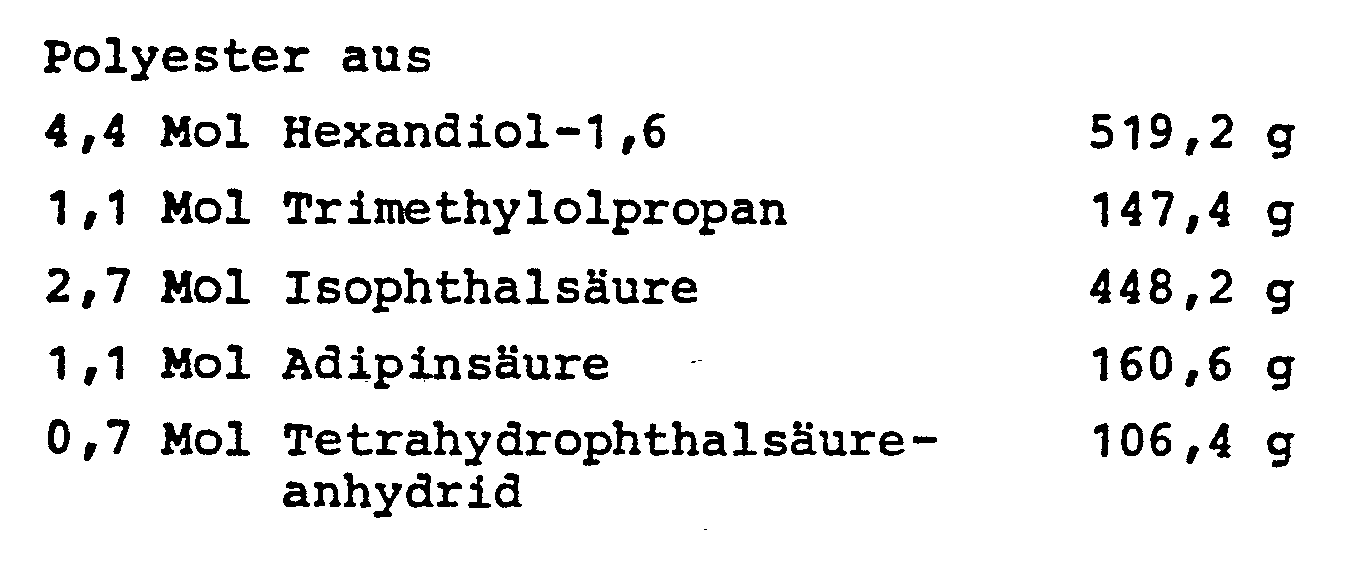
- Hydroxylzahl: 138
- Säurezahl: 4
- Mittlere Funktionalität: ca. 3,1
- Mittleres Molgewicht: ca. 1230
- Der Polyester besteht aus 55 Mol-% Polyolen und 45 Mol-% Dicarbonsäuren. Die Polyolkomponente besteht zu 80 Mol-% aus Hexandiol-1,6, die Säurekomponente zu 60 Mol-% aus Isophthalsäure.
-

-
- Hydroxylzahl: 143
- Säurezahl: 3
- Mittlere Funktionalität: ca. 3
- Mittleres Molgewicht: 1100
- Der Polyester besteht aus 55,6 Mol-% Polyolen und 44,4 Mol-% Dicarbonsäuren. Die Polyolkomponente besteht zu 80 Mol-% aus Hexandiol-1,6, die Carbonsäurekomponente zu 62,5 Mol-% aus Isophthalsäure.
-

- Hydroxylzahl: 148
- Säurezahl: 1,8
- Mittlere Funktionalität: 3
- Mittleres Molgewicht: 1170
- Der Polyester besteht aus 55,6 Mol-% Polyolen und 44,4 Mol-% Dicarbonsäuren. Die Polyolkomponente besteht zu 80 Mol-% aus Hexandiol-1,6, die Carbonsäurekomponente zu 75 Mol-% aus Isophthalsäure.
-

- Hydroxylzahl: 142
- Säurezahl: 2,6
- Mittlere Funktionalität: ca. 3,5
- Mittleres Molgewicht: ca. 1350
- Der Polyester besteht aus 54,5 Mol-% Polyolen und 45,5 Mol-% Dicarbonsäuren. Die Polyolkomponente besteht zu 75 Mol-% aus Hexandiol-1,6, die Carbonsäurekomponente zu 70 Mol-% aus Isophthalsäure.
-

- Hydroxylzahl: 260
- Säurezahl: 4
- Mittlere Funktionalität: 9-10
- Mittleres Molgewicht: 1900
-
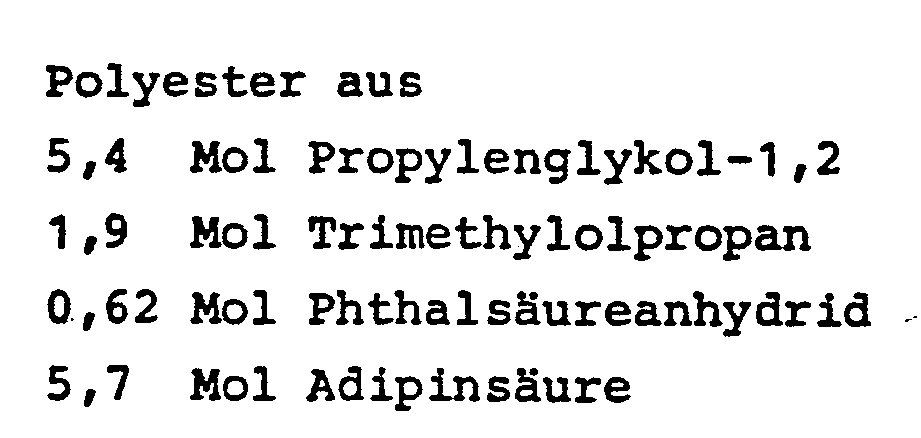
- Hydroxylzahl: 165 Säurezahl: 6
-

- Hydroxylzahl: 80
- Säurezahl: 2
- Mittlere Funktionalität: 2
- Mittleres Molgewicht: 1360
- Dieser Polyester besteht aus 54,5 Mol-% Polyolen und 45,5 Mol-% Dicarbonsäuren.
-

- Hydroxylzahl: 85
- Säurezahl: 1
- Mittlere Funktionalität: 2
- Mittleres Molgewicht: 1320
- Dieser Polyester besteht aus 54,5 Mol-% Polyolen und 45,5 Mol-% Dicarbonsäuren.
-

- Hydroxylzahl: 145
- Säurezahl: 3
- Mittlere Funktionalität: 3
- Mittleres Molgewicht: 1200
- Dieser Polyester besteht aus 55,6 Mol-% Polyolen und 44,4 Mol-% Dicarbonsäure, enthält jedoch keine aliphatische Dicarbonsäure.
- In dem nachfolgenden Verwendungsbeispiel 13 werden die folgenden Lackpolyisocyanate eingesetzt:
- Biuretpolyisocyanat auf Basis von 1,6-Diisocyanatohexan, bestehend aus einem Gemisch von N,N',N"-Tris-(isocyanato- hexyl)-biuret mit seinen höheren Homologen, 75 gew.-%ige Lösung in Ethylglykblacetat/Xylol (Volumenverhältnis = , 1:1), NCO-Gehalt der Lösung: 16,8 Gew.-%. Gehalt der Lösung an freiem 1,6-Diisocyanatohexan: unter 0,7 Gew.-%.
- Isocyanuratgruppen aufweisendes Polyisocyanat auf Basis von 1,6-Diisocyanatohexan, bestehend aus einem Gemisch aus N,N',N"-Tris-(isocyanatohexyl)-isocyanurat mit seinen höheren Homologen, 90 gew.-%ige Lösung in Butylacetat. NCO-Gehalt der Lösung: 21,7 Gew.-%. Gehalt der Lösung an freiem 1,6-Diisocyanatohexan: unter 0,5 Gew.-%.
- Dieses Beispiel beschreibt die Herstellung von gebrauchsfertigen Lacken auf Basis der Polyesterpolyole gemäß Beispielen 1 bis 12, deren Applikation und die Prüfung der resultierenden Lackfilme. Um die Beurteilung der einzelnen Lackmuster zu vereinfachen, wurden nur Weißlacke hergestellt. Dabei wurden die Polyole aus den Beispielen 1 bis 12 mit verschiedenen Zusätzen versehen und auf einen Dreiwalzenmischer mit dem Pigment angerieben.
- Die folgende Tabelle 1 gibt die Zusammensetzung der Polyol-Anreibungen wieder:

- Diese Pigmentpasten werden nun mit den Polyisocyanaten A bzw. B versetzt wobei ein NCO/OH-Verhältnis von ca. 1,2:1 eingehalten wird. Außerdem wird noch weiteres Lösungsmittel zugegeben, so daß die gebrauchsfertigen Lacke aus
- ca. 33 Gew.-% Bindemittel
- ca. 20 Gew.-% Pigment und
- ca. 47 Gew.-% Lösungsmittel
- bestehen.
- Die Auslaufzeit (DIN 53 211, 4 mm Düse) beträgt ca. 18 Sekunden. Damit sind die Lacke spritzfertig eingestellt. Die Verarbeitungszeit bei Aufbewahrung im geschlossenen Gebinde beträgt ca. 30 Stunden.
- Die Proben der spritzfertig eingestellten Lacke werden einerseits auf Flußstahlplatten von 0,5 mm Dicke und andererseits auf 3,5 mm dicke Kunststoffplatten aus halbhartem Polyurethanintegralschaumstoff (Bayflex(R)-Typ der BAYER AG) aufgespritzt und während 20 Minuten bei 80°C ausgehärtet. Die resultierenden, trockenen Lackschichten weisen eine Dicke von ca. 50 µm auf.
- Die einzelnen Lacke tragen die folgenden Bezeichnungen:
- L 1 Polyester aus Beispiel 1 + Polyisocyanat A
- L 2 Polyester aus Beispiel 2 + Polyisocyanat A
- L 3 Polyester aus Beispiel 3 + Polyisocyanat A
- L 4 Polyester aus Beispiel 4 + Polyisocyanat A
- L 5a Polyester aus Beispiel 5 + Polyisocyanat A
- L 5b Polyester aus Beispiel 5 + Polyisocyanat B
- L 6a Polyester aus Beispiel 6 + Polyisocyanat A
- L 6b Polyester aus Beispiel 6 + Polyisocyanat B
- L 7 Polyester aus Beispiel 7 + Polyisocyanat A
- L 8 Polyester aus Beispiel 8 + Polyisocyanat A
- L 9 Polyester aus Beispiel 9 + Polyisocyanat A
- L 10 Polyester aus Beispiel 10 + Polyisocyanat A
- L 11 Polyester aus Beispiel 11 + Polyisocyanat A
- L 12 Polyester aus Beispiel 12 + Polyisocyanat A
- Vor der Prüfung der lacktechnischen Eigenschaften der auf die Stahlplatten aufgetragenen Lackschichten werden die beschichteten Platten zunächst während 8 Tagen bei Raumtemperatur gelagert. Anschließend wird jeweils die Schlagfestigkeit (ASTM-D 2794), Härte nach König (DIN 53 157), Glanz nach Gardner bei 60° (DIN 67 530) und die Haftfestigkeit im Kreuzschnitt (DIN 53 151) geprüft. Fast alle Prüflinge zeigen bei diesen Prüfungen ausgezeichnete Ergebnisse. Auch Verlauf und Aussehen der Lackmuster sind ausgezeichnet und lassen eine Differenzierung nicht zu. Auch die Prüfung in einem Weatherometer zeigt die hohe Qualität der Lackmuster. Eine Ausnahme machen hierbei lediglich die Lackproben L 10 und L 11, die schon nach kurzer Zeit Glanz und Haftung verlieren. Diese Proben weisen auch eine unzureichende Härte und Lösungsmittelbeständigkeit auf. Da auch die entsprechenden Lacke nicht lagerbeständig sind und besonders in der Kälte auskristallisieren werden sie nicht in die weiteren Prüfungen einbezogen.
- Weitere entsprechend mit den Lacken L 1 bis L 9 und L 12 beschichtete Flußstahlplatten werden in Florida einem Bewitterungstest unterzogen. Hierbei werden die beschichteten Prüflinge in einem Winkel von 45° ausgelegt. Beurteilt wird die Veränderung des Glanzes in Abhängigkeit von der Zeit. Die Beurteilung des Glanzes erfolgt ohne Reinigung der Bleche nach Gartner bei 60°C im zeitlichen Abstand von 3 Monaten über einen Zeitraum von insgesamt 24 Monaten. Die entsprechenden Ergebnisse sind in der Tabelle 2 zusammengefaßt.
-

- Die Tabelle 2 zeigt die erstaunliche Glanzhaltung der erfindungsgemäßen Polyurethanlacke nach 2-jähriger Bewitterung. Nur der Vergleichslack L 8 ist im ersten Teil der Prüfzeit vergleichbar gut. Allerdings weist dieser Lack eine völlig unzureichende Elastizität auf (vgl. Tabelle 3).
- Die bewitterten, mit erfindungsgemäßen Lacken beschichteten Bleche werden nach Abprüfung der Glanzhaltung gewaschen und die Lacke in Bezug auf Haftung und Elastizität untersucht. Die Lacke zeigen dabei durchweg eine praktisch unveränderte gute Haftung und elastische Verformbarkeit.
- Zur Prüfung der Elastizität der Lackschichten werden zunächst Proben einer Länge von 70 mm und einer Breite von 8 mm aus den beschichteten Kunststoffteilen ausgesägt.
- Die Prüfung der Elastizität wird mit einer Zugmaschine bei verschiedenen Temperaturen durchgeführt. Die Kunststoffproben werden so in die Klemmen dieser Maschine eingespannt, daß die freie Einspannlänge gleich Ausgangslänge gleich 40 mm beträgt. Um Fehler zu eliminieren, die während der Dehnungsmessung durch das Fließen der Proben aus den Klemmen auftreten könnten, werden die Proben im Abstand von 40 mm markiert. Die Zuggeschwindigkeit der Maschine beträgt 50 mm/min.
- Bei sichtbarer Schädigung des Lackes (z.B. Rißbildung oder auch punktförmige Schädigung) wird die Zugprüfmaschine sofort abgeschaltet und der Abstand der Markierungen gemessen. Aus der resultierenden Längenänderung wird die Dehnung bis zur Schädigung (in %) berechnet (Tabelle 3). Bei jeder Temperatur wurden 5 Messungen durchgeführt und der Mittelwert angegeben.
-
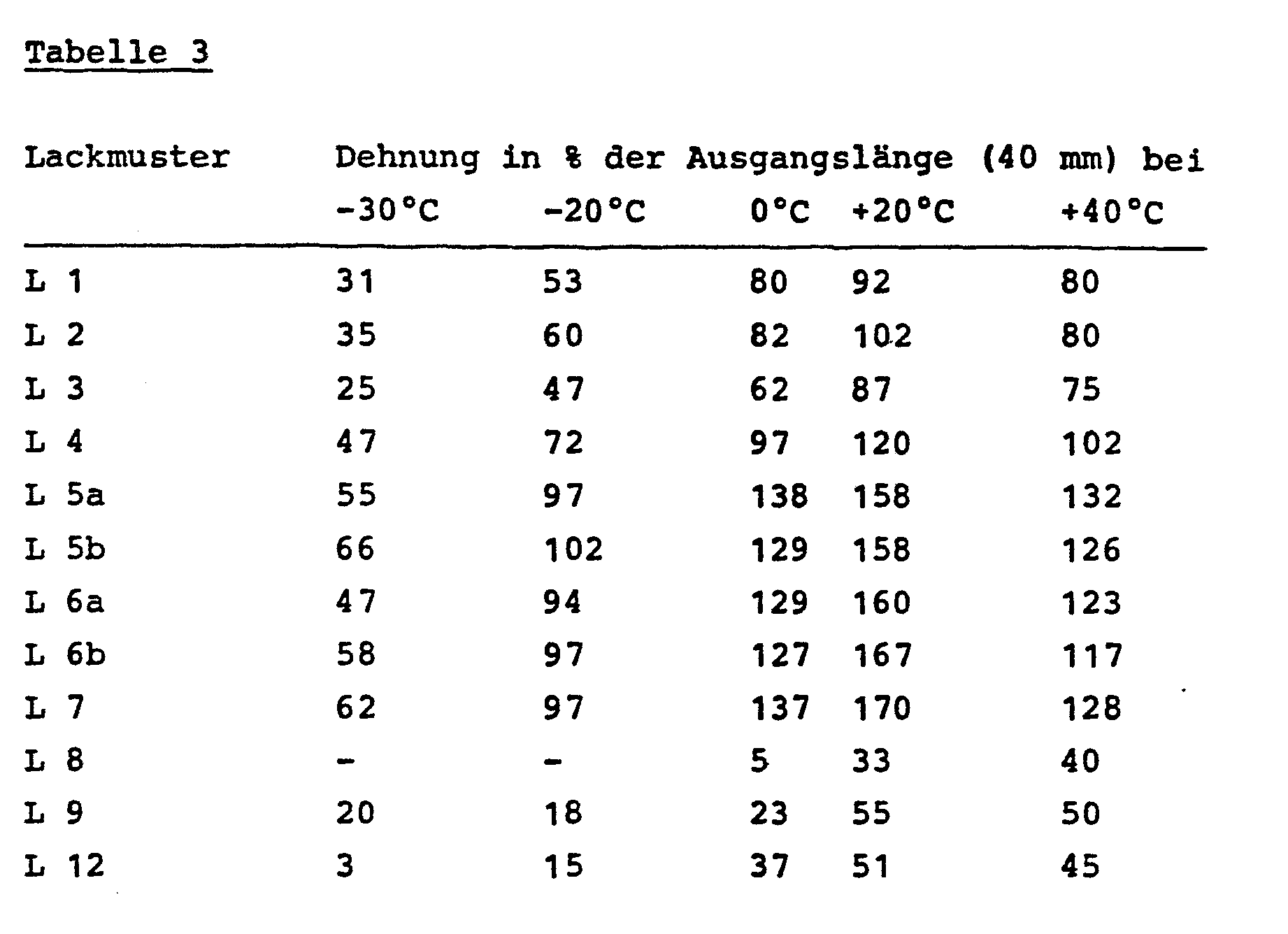
- Die Ergebnisse zeigen die besonderen Vorteile der mit den erfindungsgemäßen Lacken hergestellten Lackschichten, die insbesondere ein hohes Maximum an Elastizität in dem besonders wichtigen Temperaturbereich von 0 bis 20°C aufweisen. Die Elastizität der erfindungsgemäß hergestellten Lackschichten ist um ein vielfaches höher als die aus den nicht erfindungsgemäßen Lacken L 8 und L 9 hergestellten.
- Die aus den Lacken L 1 und L 3 hergestellten Lackschichten weisen zwar eine etwas geringere Elastizität als die aus den übrigen erfindungsgemäßen Lacken hergestellten Schichten auf, jedoch sind sie der nicht erfindungsgemäß hergestellten Lackschicht L 12 noch eindeutig überlegen.
darstellen, dadurch gekennzeichnet, daß
wobei sich die unter a) und b) gemachten Prozentangaben jeweils zu 100 ergänzen.
Claims (5)
darstellen, dadurch gekennzeichnet, daß
Applications Claiming Priority (2)
| Application Number | Priority Date | Filing Date | Title |
|---|---|---|---|
| DE19843421122 DE3421122A1 (de) | 1984-06-07 | 1984-06-07 | Neue polyesterpolyole und ihre verwendung als polyol-komponente in zweikomponenten-plyurethanlacken |
| DE3421122 | 1984-06-07 |
Publications (2)
| Publication Number | Publication Date |
|---|---|
| EP0166962A1 true EP0166962A1 (de) | 1986-01-08 |
| EP0166962B1 EP0166962B1 (de) | 1988-07-13 |
Family
ID=6237770
Family Applications (1)
| Application Number | Title | Priority Date | Filing Date |
|---|---|---|---|
| EP85106549A Expired EP0166962B1 (de) | 1984-06-07 | 1985-05-29 | Neue Polyesterpolyole und ihre Verwendung als Polyol-Komponente in Zweikomponenten-Polyurethanlacken |
Country Status (4)
| Country | Link |
|---|---|
| US (2) | US4656243A (de) |
| EP (1) | EP0166962B1 (de) |
| CA (1) | CA1252797A (de) |
| DE (2) | DE3421122A1 (de) |
Cited By (3)
| Publication number | Priority date | Publication date | Assignee | Title |
|---|---|---|---|---|
| EP0250052A1 (de) * | 1986-06-19 | 1987-12-23 | Akzo N.V. | Verfahren zum Beschichten eines synthetischen Substrats mit einem Grundiermittel und einem Deckanstrich und die Grundiermittel für dieses Verfahren |
| EP0318800A3 (en) * | 1987-12-03 | 1990-08-22 | Bayer Ag | Polyesterpolyols and their use as polyol component in two-component polyurethane lacquers |
| EP0590398A1 (de) * | 1992-09-24 | 1994-04-06 | Bayer Ag | Lösungsmittelfreie Zweikomponentenpolyurethanklebstoffsysteme |
Families Citing this family (12)
| Publication number | Priority date | Publication date | Assignee | Title |
|---|---|---|---|---|
| US4835205A (en) * | 1988-01-11 | 1989-05-30 | The Goodyear Tire & Rubber Company | Copolyester adhesive containing hyroxymethyl benzoic acid |
| JP2647696B2 (ja) * | 1988-08-23 | 1997-08-27 | 日産自動車株式会社 | プラスチック部品の表面改質方法 |
| DE4115588A1 (de) * | 1991-05-13 | 1992-11-19 | Herberts Gmbh | Verfahren zur grundierung von kunststoffsubstraten, ueberzugsmittel hierzu und dessen verwendung |
| US5169725A (en) * | 1991-08-29 | 1992-12-08 | Morton International, Inc. | Utilization of flexible coating on steel to impart superior scratch and chip resistance |
| DE4217363A1 (de) * | 1992-05-26 | 1993-12-02 | Bayer Ag | Neue Polyesterpolyole und ihre Verwendung als Polyolkomponente in Zweikomponenten-Polyurethanlacken |
| DE4337432A1 (de) | 1993-11-03 | 1995-05-04 | Bayer Ag | Verwendung von Polyesterpolyolen als Bindemittelkomponente in Zweikomponenten-Polyurethanlacken |
| US5820491A (en) * | 1996-02-07 | 1998-10-13 | Ppg Industries, Inc. | Abrasion resistant urethane topcoat |
| JPH10332902A (ja) * | 1997-05-27 | 1998-12-18 | Nippon Ee R C Kk | プラスチックレンズとその製造方法及びプライマー組成物 |
| DE10334723A1 (de) * | 2003-07-30 | 2005-02-24 | Bayer Materialscience Ag | Neue Bindemittelkombination für hochbeständige Kunststofflacke |
| DE102009005712A1 (de) * | 2009-01-22 | 2010-07-29 | Bayer Materialscience Ag | Polyurethanvergussmassen |
| US20140275320A1 (en) | 2013-03-14 | 2014-09-18 | Allnex IP S.à.r.I. | Methods for making elastomers, elastomer compositions and related elastomers |
| WO2020131185A2 (en) | 2018-09-26 | 2020-06-25 | Dvorchak Enterprises Llc | One component uv curable compositions and methods for making same |
Citations (3)
| Publication number | Priority date | Publication date | Assignee | Title |
|---|---|---|---|---|
| FR2230701A1 (de) * | 1973-05-22 | 1974-12-20 | Veba Chemie Ag | |
| EP0005033A2 (de) * | 1978-04-19 | 1979-10-31 | Ppg Industries, Inc. | Ungelierte Polyester und ihre Verwendung in Überzugsmitteln |
| EP0024379A1 (de) * | 1979-08-17 | 1981-03-04 | The Goodyear Tire & Rubber Company | Polyesterurethan und daraus hergestellter Behälter |
Family Cites Families (3)
| Publication number | Priority date | Publication date | Assignee | Title |
|---|---|---|---|---|
| US4400477A (en) * | 1982-02-17 | 1983-08-23 | Blanpied Robert H | Copolyester polyol resins, foamable blends comprising the same, and resultant polyisocyanurate foams |
| CA1215719A (fr) * | 1983-05-04 | 1986-12-23 | Georges N. Altounian | Polyols et procede de leur preparation, et polyurethanne en decoulant |
| US4540771A (en) * | 1984-10-01 | 1985-09-10 | Ppg Industries, Inc. | High solids polyester polyols and resinous polyols thereof |
-
1984
- 1984-06-07 DE DE19843421122 patent/DE3421122A1/de not_active Withdrawn
-
1985
- 1985-05-22 CA CA000482089A patent/CA1252797A/en not_active Expired
- 1985-05-24 US US06/737,603 patent/US4656243A/en not_active Expired - Fee Related
- 1985-05-29 EP EP85106549A patent/EP0166962B1/de not_active Expired
- 1985-05-29 DE DE8585106549T patent/DE3563750D1/de not_active Expired
-
1986
- 1986-10-28 US US06/923,986 patent/US4692384A/en not_active Expired - Fee Related
Patent Citations (3)
| Publication number | Priority date | Publication date | Assignee | Title |
|---|---|---|---|---|
| FR2230701A1 (de) * | 1973-05-22 | 1974-12-20 | Veba Chemie Ag | |
| EP0005033A2 (de) * | 1978-04-19 | 1979-10-31 | Ppg Industries, Inc. | Ungelierte Polyester und ihre Verwendung in Überzugsmitteln |
| EP0024379A1 (de) * | 1979-08-17 | 1981-03-04 | The Goodyear Tire & Rubber Company | Polyesterurethan und daraus hergestellter Behälter |
Cited By (3)
| Publication number | Priority date | Publication date | Assignee | Title |
|---|---|---|---|---|
| EP0250052A1 (de) * | 1986-06-19 | 1987-12-23 | Akzo N.V. | Verfahren zum Beschichten eines synthetischen Substrats mit einem Grundiermittel und einem Deckanstrich und die Grundiermittel für dieses Verfahren |
| EP0318800A3 (en) * | 1987-12-03 | 1990-08-22 | Bayer Ag | Polyesterpolyols and their use as polyol component in two-component polyurethane lacquers |
| EP0590398A1 (de) * | 1992-09-24 | 1994-04-06 | Bayer Ag | Lösungsmittelfreie Zweikomponentenpolyurethanklebstoffsysteme |
Also Published As
| Publication number | Publication date |
|---|---|
| DE3421122A1 (de) | 1985-12-12 |
| EP0166962B1 (de) | 1988-07-13 |
| US4692384A (en) | 1987-09-08 |
| DE3563750D1 (en) | 1988-08-18 |
| US4656243A (en) | 1987-04-07 |
| CA1252797A (en) | 1989-04-18 |
Similar Documents
| Publication | Publication Date | Title |
|---|---|---|
| EP0720996B1 (de) | Polyesterpolyole und ihre Verwendung in Zweikomponenten-Polyurethanlacken | |
| EP0053766B2 (de) | Verfahren zur Herstellung von Ueberzügen | |
| EP0166962B1 (de) | Neue Polyesterpolyole und ihre Verwendung als Polyol-Komponente in Zweikomponenten-Polyurethanlacken | |
| EP0610450B1 (de) | Lacke, ein verfahren zu ihrer herstellung und ihre verwendung | |
| EP0650992B1 (de) | Verwendung von Polyesterpolyolen als Bindemittelkomponente in Zweikomponenten-Polyurethanlacken | |
| EP0819710B1 (de) | Neue festkörperreiche 2K-PUR-Bindemittelkombinationen | |
| DE3328131C2 (de) | Pulverlacke auf der Basis teilblockierter IPDI-Isocyanurate und hydroxylgruppenhaltiger Polyester sowie ein Verfahren zur Herstellung matter Überzüge | |
| EP0883640B1 (de) | Neue polyesterpolyole und ihre verwendung als polyolkomponente in zweikomponenten-polyurethanlacken | |
| EP1137687A1 (de) | Beschichtungsmittel, verfahren zu seiner herstellung und seine verwendung als decklack oder klarlack, insbesondere zur beschichtung von kunststoffen | |
| EP0659795B1 (de) | Polyesterpolyole und ihre Verwendung in Zweikomponenten-Polyurethanlacken | |
| EP0571829B1 (de) | Ungesättigte Polyesterpolyole und ihre Verwendung in Zweikomponenten-Polyurethanlacken | |
| EP1123333A1 (de) | Beschichtungsmittel, verfahren zu seiner herstellung und seine verwendung als effekt-klarlack, insbesondere zur beschichtung von kunststoffen | |
| EP0318800B1 (de) | Neue Polyesterpolyole und ihre Verwendung als Polyol-Komponente in Zweikomponenten-Polyurethanlacken | |
| EP0494442B1 (de) | Beschichtungsmittel und seine Verwendung zur Herstellung von Beschichtungen | |
| EP0778298A2 (de) | Festkörperreiche Bindemittelkombination | |
| DE4022660A1 (de) | Bindemittelkombination, ihre verwendung in einbrennlacken und ein verfahren zur herstellung von ueberzuegen | |
| EP0705858B1 (de) | Neue Polyesterpolyole und ihre Verwendung als Polyolkomponente in Zweikomponenten-Polyurethanlacken | |
| DE3339580A1 (de) | Waessrige dispersionen vernetzer-haltiger lackbindemittel auf polyesterbasis | |
| EP0555705B1 (de) | Pulverlack, ein Verfahren zu seiner Herstellung und seine Verwendung | |
| EP1101780B1 (de) | Festkörperreiche Bindemittelkombinationen und deren Verwendung | |
| DE19537026C2 (de) | Neue Polyesterpolyole und ihre Verwendung als Polyolkomponente in Zweikomponenten-Polyurethanlacken | |
| EP0142700B1 (de) | Verwendung eines nicht wäBrigen Lacks zur Herstellung von Steinschlagschutzschichten im Kraftfahrzeugbau | |
| DE3739478A1 (de) | Verfahren zur herstellung von einkomponenten-pur-einbrennlacken | |
| DE4417355A1 (de) | Hitzehärtbare Beschichtungsmittel und ihre Verwendung | |
| DE3602890A1 (de) | Bindemittelkombinationen fuer die kunststofflackierung |
Legal Events
| Date | Code | Title | Description |
|---|---|---|---|
| PUAI | Public reference made under article 153(3) epc to a published international application that has entered the european phase |
Free format text: ORIGINAL CODE: 0009012 |
|
| 17P | Request for examination filed |
Effective date: 19850529 |
|
| AK | Designated contracting states |
Designated state(s): BE DE FR GB |
|
| 17Q | First examination report despatched |
Effective date: 19861112 |
|
| GRAA | (expected) grant |
Free format text: ORIGINAL CODE: 0009210 |
|
| AK | Designated contracting states |
Kind code of ref document: B1 Designated state(s): BE DE FR GB |
|
| GBT | Gb: translation of ep patent filed (gb section 77(6)(a)/1977) | ||
| REF | Corresponds to: |
Ref document number: 3563750 Country of ref document: DE Date of ref document: 19880818 |
|
| ET | Fr: translation filed | ||
| PGFP | Annual fee paid to national office [announced via postgrant information from national office to epo] |
Ref country code: DE Payment date: 19890424 Year of fee payment: 5 |
|
| PLBI | Opposition filed |
Free format text: ORIGINAL CODE: 0009260 |
|
| PGFP | Annual fee paid to national office [announced via postgrant information from national office to epo] |
Ref country code: BE Payment date: 19890517 Year of fee payment: 5 |
|
| PGFP | Annual fee paid to national office [announced via postgrant information from national office to epo] |
Ref country code: FR Payment date: 19890524 Year of fee payment: 5 |
|
| PGFP | Annual fee paid to national office [announced via postgrant information from national office to epo] |
Ref country code: GB Payment date: 19890531 Year of fee payment: 5 |
|
| 26 | Opposition filed |
Opponent name: AKZO N.V. Effective date: 19890405 Opponent name: BASF LACKE + FARBEN AKTIENGESELLSCHAFT, MUENSTER Effective date: 19890410 Opponent name: SYNTHOPOL CHEMIE DR. RER. POL. KOCH GMBH & CO. KG Effective date: 19890407 |
|
| RDAG | Patent revoked |
Free format text: ORIGINAL CODE: 0009271 |
|
| STAA | Information on the status of an ep patent application or granted ep patent |
Free format text: STATUS: PATENT REVOKED |
|
| 27W | Patent revoked |
Effective date: 19891005 |
|
| GBPR | Gb: patent revoked under art. 102 of the ep convention designating the uk as contracting state | ||
| BERE | Be: lapsed |
Owner name: BAYER A.G. Effective date: 19900531 |
|
| PLAB | Opposition data, opponent's data or that of the opponent's representative modified |
Free format text: ORIGINAL CODE: 0009299OPPO |