EP0167165A2 - Verfahren und Apparat für Grafikanzeige - Google Patents
Verfahren und Apparat für Grafikanzeige Download PDFInfo
- Publication number
- EP0167165A2 EP0167165A2 EP85108293A EP85108293A EP0167165A2 EP 0167165 A2 EP0167165 A2 EP 0167165A2 EP 85108293 A EP85108293 A EP 85108293A EP 85108293 A EP85108293 A EP 85108293A EP 0167165 A2 EP0167165 A2 EP 0167165A2
- Authority
- EP
- European Patent Office
- Prior art keywords
- pattern
- memory means
- addresses
- map memory
- display
- Prior art date
- Legal status (The legal status is an assumption and is not a legal conclusion. Google has not performed a legal analysis and makes no representation as to the accuracy of the status listed.)
- Granted
Links
Images


Classifications
-
- G—PHYSICS
- G06—COMPUTING OR CALCULATING; COUNTING
- G06K—GRAPHICAL DATA READING; PRESENTATION OF DATA; RECORD CARRIERS; HANDLING RECORD CARRIERS
- G06K15/00—Arrangements for producing a permanent visual presentation of the output data, e.g. computer output printers
-
- G—PHYSICS
- G06—COMPUTING OR CALCULATING; COUNTING
- G06K—GRAPHICAL DATA READING; PRESENTATION OF DATA; RECORD CARRIERS; HANDLING RECORD CARRIERS
- G06K2215/00—Arrangements for producing a permanent visual presentation of the output data
- G06K2215/0082—Architecture adapted for a particular function
- G06K2215/0094—Colour printing
Definitions
- the present invention relates to a graphics display method and apparatus and particularly to a method and apparatus for providing a wide range of color reproduction in minimum operating time.
- Graphics display terminals and the like are not limited to the presentation of multicolor cathode-ray-tube images, but can also produce multicolor hard copy utilizing apparatus such as an ink jet copier.
- the ink jet copier or printer has a limited number of ink jets which can be employed separately for depositing a single bit or pixel of information on paper, or which can be used together to produce a limited number combination of colors.
- four colors of ink are used: yellow, cyan, and magenta (subtractive primaries) and black. Red, green, and blue (additive primaries) are formed by superimposing two ink colors on the same dot or pixel.
- cyan over yellow results in green
- magenta over yellow results in red
- magenta over cyan produces blue.
- the four colors of ink can produce a total of seven solid colors, with the white of the paper supplying an eighth.
- Another method of producing the effect of relative color intensity utilizes "dither" patterns, including dots of one color interspersed with dots of another in a correct ratio to form the desired shade. For example, to achieve a mixture of two primaries such as red and yellow, dots of red may be interlaced with dots of yellow, wherein the interlaced arrangement comprises the dither pattern. If there are appreciable numbers of dots or pixels in an area being colored, and if the resulting hard copy is viewed at any distance, the eye combines the colors of the dither pattern to achieve the effect of the desired shade.
- the management of the color image including the "rasterizing" of data to supply the individual dots or pixels is usually under the control of a microprocessor.
- the processor would direct the production of each pixel at each particular location on a piece of paper, and the processor would look up the color information in a table in order to determine what color each pixel should be in order to write the overall dither pattern.
- This approach slows operation relative to the speed of operation of an ink jet copier apparatus. It would be more desirable for the processor to simply specify a color in advance for a particular area or object, and then merely address the area or object without necessitating the organization of the required dither pattern as well.
- a processor or the like provides the addresses (e.g, x and y coordinate addresses) for the object or graphics to 'be written, and thrs p addresses are used to access locations in a pixel bit map memory.
- This memory is later read out for providing the actual pixels or dots on a hard copy.
- the data written at each pixel memory location is derived from a pattern memory accessed at the same time as the pixel bit map memory, except, in the illustrated example, only the lower order bits are employed while the higher order bits in the address for the pattern memory remain constant for a particular pattern.
- the input information from the processor addresses successive locations in the pixel bit map memory, e.g.
- the lower order bits repeatedly cycle through a relatively small number of values. For instance, if only the two lowest order bits of the constantly changing addresses are considered, this part will cycle from zero to three repeatedly as the overall address substantially continuously changes in a given direction to "lay in" pixels in the pixel bit map memory.
- the data in the pattern memory that is repeatedly addressed and written into the bit map memory is arranged to be the dither pattern, in two dimensions, which will achieve a desired color shade.
- a plurality of dither patterns are stored, with one dither pattern being selected by the processor through the provision of high order address bits to the pattern memory before a given object or area is input to the pixel bit map memory.
- the processor itself is not required to constantly keep track of a dither pattern and decide the actual primary color for each pixel. Rather, th p processor need only specify the desired shade corresponding to a dither pattern, and then the processor specifies successive address locations for the desired object or area and the dither pattern will be automatically filled in.
- a graphics display may be considered as divided into a multiplicity of dots or "pixels" 10 which are presented in a plurality of rows or scans such as row 12 in Fig. 1.
- the number of pixels in each row is actually much greater than illustrated, and the rows, and pixels in a row, are much closer spaced so the eye of the observer cannot distinguish between one pixel and the next at any distance.
- the rows of pixels are provided in sequence with each pixel being "painted" . individually by an electron beam in the case of a cathode-ray-tube, or by a stream of ink, either of which is illustrated by line 14 in Fig. 1.
- the ink jet suitably employed for a hard copy device actually comprises four ink jet elements, one for each of the subtractive primaries, as hereinbefore mentioned, and black.
- the information for providing the Fig. 1 display is derived in a conventional manner from a pixel bit map memory as schematically illustrated in Fig. 2.
- This pixel bit map memory comprises a number of memory "planes" 16, elements of which store digits of words identifying the pixels. Assuminq a one-to-one correspondence between the memory organization and the display provided therefrom, the upper left hand bits 18 in the memory planes 16 will identify the upper left hand pixel 20 in the display in Fig. 1, and so on.
- the three binary bits (one for each plane) are capable of identifying eight colors, e.g. black, white, the subtractive primaries yellow, cyan and magenta, and the additive primaries red, green ⁇ and blue.
- the information from the memory is scanned by rows, and the read out of this information controls the ink jets or the like in order to form the display image.
- the image is a line drawing or an object having an area
- the region of display surrounding the lines or object will be read out as white pixels (absence of information)
- the line or object itself will be mapped in the memory in Fig. 2 with the individual pixel identifying a word specifying the color that is to be written at the corresponding point in the display of Fig. 1.
- the ink jets or the like are off-on devices and are only capable of producing a limited number of rolors (eight in this example), and cannot produce shades of different colors.
- a process know as "dithering" is utilized wherein adjacent pixels in a particular area, instead of having the same color, are instead "painted” in different colors so that to the observer a combination of the colors is perceived.
- the pixels are so close together that without very close examination the individual pixels are not detectable.
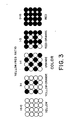
- five dither patterns are illustrated each employing a 4 x 4 pixel matrix. In this illustration the white dots stand for yellow pixels and the filled in dots stand for red pixels.
- the ratio of yellow dots to red dots in the pattern determines whether the mixture will appear as yellow (ratio of sixteen yellow dots to zero red dots), yellow-orange (ratio of three to one), orange (one to one), red-orange (one to three) or red (zero to sixteen).
- the dither patterns can be used to acheive similar ratio mixtures of any of the additive-subtractive primary pairs. It is seen the color shade is determined by the ratio of the number of pixels of one color imprinted to the ratio of the number of pixels of other color imprinted.
- the conventional approach to pixelating an area of the display would be for the processor to look up the different colors necessary to produce a different shade and the ratio the pixels for writing the pixels of an image in dither pattern fashion.
- the present invention utilizes a pattern memory which is accessed by the processor concurrently with the pixel bit map memory, the pattern from the pattern memory being read over and . over aqain into the pix p l hit map memory to provide the desired dither pattern.. ir. this manner the processor need only specify the addresses of the object or area to be written into the pixel bit map memory and the desired dither pattern, theretofore selected by the processor, is automatically read into the pixel bit map memory as the data at the addressed pixel locations.
- processor 22 which suitably comprises a- type 68000 microprocessor is connected to its main memory 24 by way of address bus 26 and data bus 28.
- address bus 26 and data bus 28 are connected to the raster memory portion, as hereinafter more fully described, and the ink jet printer apparatus 30.
- Appropriate buffer means or conventional I/O means, not shown, may be interposed between these various elements.
- the raster memory portion mainly comprises a pixel bit map memory 32 in wherein the individual pixels of a pixel map are stored in the manner schematically illustrated in Fig. 2.
- the pixel bit map memory 32 is read out, seriatum, via buffers 34 and 36 to the data bus for transmission, one horizontal line at a time, to ink jet printer 30 which thereupon imprints the pixel dots of the directed color in a manner understood by those skilled in the art.
- the information for printing is first read into the pixel bit map memory 32, with the addresses being supplied by processor 22 through address bus 26 and bit map address circuit 38 wherein the processor addresses are converted to correct x and y addresses for accessing the bit map memory.
- the data which is to be stored in bit map memory 32 at the prescribed pixrl locations is obtained from pattern memory 40, the pattern memory 40 storing a plurality of selectable dither patterns as hereinafter more fully described. These dither patterns are written in advance into pattern memory 40 from data bus 28 via raster memory data bus 42.
- Pattern memory 40 is addressed from the address bus 26 by way of pattern address circuit 44 which converts the bus address to appropriate x and y addresses for the pattern memory.
- pattern address circuit 44 converts the bus address to appropriate x and y addresses for the pattern memory.
- the circuit includes a character memory 40'which is addressed from the processor by way of address circuit 38.
- the processor can scan a character stored in character memory 48, e.g. over a 5 x 7 matrix, and where a "one" is encountered, an element of a selected dither pattern is written into memory 32.
- address bits from address bus 26 are provided to memory select decode circuit 50 which accordingly selects one of the memories 32, 40 or 48 for addressing.
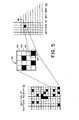
- pattern memory 40 for supplying dither patterns to bit map memory 32 will be further explained with the aid of Fig. 5.
- a plurality of dither patterns each comprising a 4 x 4 matrix of pixels, are stored in adjoining locations in the pattern memory.
- the separate dither patterns are separated by heavier lines, with six such dither patterns being shown in this particular case.
- These dither patterns will have been previously stored in pattern memory 40 to provide the desired selection of different shades.
- Some dither patterns may be all one color so as to identify one of the primaries as hereinbefore described.
- the 4 x 4 pixel pattern selected is again illustrated at 56 in Fig. 5.
- This selected dither pattern will be repeatedly "laid in” to bit map memory 32 according to the addresses received from address bus 26.
- an address from address bus 26 simultaneously addresses a pixel location 58 in pixel bit map memory 32, and a pixel location 60 in portion 56 of pattern memory 40.
- the data word representing a particular color from pattern memory 40 at location 60 will be read out of pattern memory 40 and onto raster memory data bus 42 via "merge" circuit 54.
- the data or word read from location 60 in pattern memory 40 is read into the bit map memory 32 at location 58.
- the processor is laying a vertical line into bit map memory 32 by means of a series of addresses identifying pixels "vertically" above one another in the pixel bit map. Then, the pixel data 60 from the pattern memory will first be written into pixel bit map memory 32 followed by pixel data 62, 64 and 66 in that order. If the processor continues to lay in a vertical line, the pixel from location 60 will again be accessed followed again by pixels at locations 62, 64 and 66 and so on. The repeated pattern will "draw" a vertical line in the bit map memory with every fourth pixel havinq one color while the three intervening pixels are of the other color, consequently "dithering" the line to provide a combination of the two colors.
- the processor is called upon to do nothing but identify the pixel dither pattern initially by storing higher order bits of a memory address in latch circuit 46, and then specifying the successive addresses for the object or line to be drawn into the bit map memory 32. This enables the system to operate much more rapidly than if the processor had to define the color of each individual pixel.
- the pattern memory 40 is read out onto raster memory data bus 42 for reading into bit map memory 32 by way of merge circuit 54, designated "f(x,y)" where x and y are the outputs of the pattern memory 40 and the previous information read from the same bit map memory location in bit map memory 32.
- merge circuit 54 suitably comprises a read only memory or other memory set up so that a particular combination of data words provide x and y addresses which select a "combined" color.
- a particular shade theretofore contained in bit map memory 32 can be overwritten by another color which can be combined therewith to change the shade.
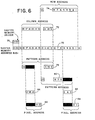
- Fig. 6 is illustrative of the addressing of the pattern memory and bit map memory for bringing about the entry of data from the pattern memory into the bit map memory.
- the address bus bits are illustrated at 70 in Fig. 6 with the corresponding bits for the column address and the row address of the bit map memory being shown at 72 and 74 thereabove.
- Bits 20 and 21 are used for memory decode and are applied to the decode circuit 50 in Fig. 4.
- the pattern address (first axis) is illustrated at 78 and may comprise bits 9, 10, 11, 15, 16, 17 and 18.
- the pattern address (second axis) may comprise bits 3 through 8 and 12.
- the pattern addresses select the particular pattern e.g. the particular 4 x 4 pattern matrix, representing a particular dither pattern, from a multiplicity of such patterns stored in the pattern memory 40. For instance, the pattern addresses select one of the six dither patterns indicated between the heavier lines at the left hand side of Fig. 5. Of course, a much larger number of patterns are stored and selectable by these pattern addresses.
- the pattern addresses are initially stored in pattern latch and select circuit 46 by the processor before the processor writes a particular object or area into the bit map memory.
- Illustrated at 82 and 84 are the pixel addresses, first axis and second axis, that are used to address particular pixels within the already selected pattern matrix. These bits correspond to similarly numbered bit in the column address and the row address utilized for addressing the bit map memory, i.e. comprising the lower order bits thereof which are coupled via bus portion 52 in Fig. 4. These lower order bits combine with the pattern address bits stored in latch 46 to provide the overall addressinq input to pattern memory 40.
- Bits 15-17, indicated at 86 in Fig. 6, and bits 3-5 -indicated at 88 in Fig. 6, may be utilized in a given instance as either part of the pattern address or as a part of the pixel address.
- the pixel patterns stored in the pattern memory have hereinbefore been described as 4 x 4 bit matrices, it is also possible to utilize a dither pattern matrix which is 8 x 8 or some larger size, therefore requiring more bits in the pixel address for the identification of each component.
- pattern latch and select circuit 46 stores a smaller number of bits to identify one of a smaller number of patterns, each of which includes more pixel bits and therefore requires a larger pixel address. It is readily apparent that the division of bits between pattern addresses and addresses for bits within the patterns is easily adjustable in accordance with the size of the patterns desired.
Landscapes
- Engineering & Computer Science (AREA)
- General Engineering & Computer Science (AREA)
- Physics & Mathematics (AREA)
- General Physics & Mathematics (AREA)
- Theoretical Computer Science (AREA)
- Facsimile Image Signal Circuits (AREA)
- Color Image Communication Systems (AREA)
- Controls And Circuits For Display Device (AREA)
- Image Processing (AREA)
Applications Claiming Priority (2)
| Application Number | Priority Date | Filing Date | Title |
|---|---|---|---|
| US628693 | 1984-07-06 | ||
| US06/628,693 US4730185A (en) | 1984-07-06 | 1984-07-06 | Graphics display method and apparatus for color dithering |
Publications (3)
| Publication Number | Publication Date |
|---|---|
| EP0167165A2 true EP0167165A2 (de) | 1986-01-08 |
| EP0167165A3 EP0167165A3 (en) | 1986-03-19 |
| EP0167165B1 EP0167165B1 (de) | 1990-10-24 |
Family
ID=24519928
Family Applications (1)
| Application Number | Title | Priority Date | Filing Date |
|---|---|---|---|
| EP85108293A Expired - Lifetime EP0167165B1 (de) | 1984-07-06 | 1985-07-04 | Verfahren und Apparat für Grafikanzeige |
Country Status (5)
| Country | Link |
|---|---|
| US (1) | US4730185A (de) |
| EP (1) | EP0167165B1 (de) |
| JP (1) | JPS6138992A (de) |
| CA (1) | CA1240425A (de) |
| DE (1) | DE3580201D1 (de) |
Cited By (6)
| Publication number | Priority date | Publication date | Assignee | Title |
|---|---|---|---|---|
| WO1988001767A1 (en) * | 1986-08-25 | 1988-03-10 | Digital Equipment Corporation | Horizontal line processor of data to be printed out sequentially |
| US4885703A (en) * | 1987-11-04 | 1989-12-05 | Schlumberger Systems, Inc. | 3-D graphics display system using triangle processor pipeline |
| US4888712A (en) * | 1987-11-04 | 1989-12-19 | Schlumberger Systems, Inc. | Guardband clipping method and apparatus for 3-D graphics display system |
| US4901064A (en) * | 1987-11-04 | 1990-02-13 | Schlumberger Technologies, Inc. | Normal vector shading for 3-D graphics display system |
| US4945500A (en) * | 1987-11-04 | 1990-07-31 | Schlumberger Technologies, Inc. | Triangle processor for 3-D graphics display system |
| EP0603833A3 (de) * | 1992-12-22 | 1997-11-12 | Konica Corporation | Farbbildverarbeitungsgerät zur Glättung eines Bildes |
Families Citing this family (28)
| Publication number | Priority date | Publication date | Assignee | Title |
|---|---|---|---|---|
| US5175807A (en) * | 1986-12-04 | 1992-12-29 | Quantel Limited | Video signal processing with added probabilistic dither |
| US4991122A (en) * | 1987-10-07 | 1991-02-05 | General Parametrics Corporation | Weighted mapping of color value information onto a display screen |
| JPH01231473A (ja) * | 1988-03-10 | 1989-09-14 | Brother Ind Ltd | 画像形成方法 |
| US5051820A (en) * | 1988-07-26 | 1991-09-24 | Brother Kogyo Kabushiki Kaisha | Color image recording apparatus capable of recording color gradation pattern |
| US5003496A (en) * | 1988-08-26 | 1991-03-26 | Eastman Kodak Company | Page memory control in a raster image processor |
| US4837613A (en) * | 1988-09-01 | 1989-06-06 | Adobe Systems, Inc. | Method of color selection for display and printing |
| US4956638A (en) * | 1988-09-16 | 1990-09-11 | International Business Machines Corporation | Display using ordered dither |
| US4920501A (en) * | 1988-10-19 | 1990-04-24 | Eastman Kodak Company | Digital halftoning with minimum visual modulation patterns |
| US4918622A (en) * | 1988-11-16 | 1990-04-17 | Eastman Kodak Company | Electronic graphic arts screener |
| US5148294A (en) * | 1989-01-27 | 1992-09-15 | Fuji Xerox Corporation, Ltd. | Image processing apparatus and method for painting a memory with plural colors |
| DE69033844T2 (de) * | 1989-04-28 | 2002-04-04 | Canon K.K., Tokio/Tokyo | Bildverarbeitungseinrichtung |
| US4953104A (en) * | 1989-05-18 | 1990-08-28 | Eastman Kodak Company | Page buffer for an electronic gray-scale color printer |
| US5179641A (en) * | 1989-06-23 | 1993-01-12 | Digital Equipment Corporation | Rendering shaded areas with boundary-localized pseudo-random noise |
| JP2595098B2 (ja) * | 1989-07-05 | 1997-03-26 | キヤノン株式会社 | 記録装置および記録ヘッド |
| US5146554A (en) * | 1989-09-29 | 1992-09-08 | Eastman Kodak Company | Page memory control in a raster image processor employed for digital halftoning |
| US5214517A (en) * | 1990-02-07 | 1993-05-25 | Eastman Kodak Company | Digital halftoning with correlated minimum visual modulation patterns |
| US5249164A (en) * | 1990-06-27 | 1993-09-28 | Koz Mark C | Digital color tv for personal computers |
| US5341228A (en) * | 1990-12-04 | 1994-08-23 | Research Corporation Technologies | Method and apparatus for halftone rendering of a gray scale image using a blue noise mask |
| US5191640A (en) * | 1990-12-26 | 1993-03-02 | Xerox Corporation | Method for optimal discrete rendering of images |
| US5714974A (en) * | 1992-02-14 | 1998-02-03 | Industrial Technology Research Laboratories | Dithering method and circuit using dithering matrix rotation |
| US5389948A (en) * | 1992-02-14 | 1995-02-14 | Industrial Technology Research Institute | Dithering circuit and method |
| US5598184A (en) * | 1992-03-27 | 1997-01-28 | Hewlett-Packard Company | Method and apparatus for improved color recovery in a computer graphics system |
| KR100258919B1 (ko) * | 1993-10-30 | 2000-06-15 | 윤종용 | 디더링행렬을 구현하는 디더링회로 및 그 방법 |
| US5734369A (en) * | 1995-04-14 | 1998-03-31 | Nvidia Corporation | Method and apparatus for dithering images in a digital display system |
| US6141024A (en) * | 1997-02-03 | 2000-10-31 | Ati Technologies, Inc | Generating color text |
| JP3922568B2 (ja) * | 2002-03-18 | 2007-05-30 | 株式会社リコー | 画像処理装置、描画処理方法及び該方法を実行するためのプログラム |
| US7411589B2 (en) * | 2004-04-30 | 2008-08-12 | Honeywell International Inc. | Liquid crystal color display system and method |
| US7542620B1 (en) * | 2004-08-16 | 2009-06-02 | Apple Inc. | Robust temporal dithering and filtering |
Family Cites Families (8)
| Publication number | Priority date | Publication date | Assignee | Title |
|---|---|---|---|---|
| US3977007A (en) * | 1975-06-02 | 1976-08-24 | Teletype Corporation | Gray tone generation |
| US4203154A (en) * | 1978-04-24 | 1980-05-13 | Xerox Corporation | Electronic image processing system |
| US4225861A (en) * | 1978-12-18 | 1980-09-30 | International Business Machines Corporation | Method and means for texture display in raster scanned color graphic |
| US4345313A (en) * | 1980-04-28 | 1982-08-17 | Xerox Corporation | Image processing method and apparatus having a digital airbrush for touch up |
| US4495522A (en) * | 1981-07-07 | 1985-01-22 | Konishiroku Photo Industry Co., Ltd. | Recording apparatus and method of picture image |
| US4463374A (en) * | 1981-11-20 | 1984-07-31 | Trilog, Inc. | Color plotter interface and control circuit |
| JPS58157255A (ja) * | 1982-03-13 | 1983-09-19 | Dainippon Screen Mfg Co Ltd | 画像走査記録方法 |
| US4532503A (en) * | 1982-11-08 | 1985-07-30 | International Business Machines Corporation | Sequence controlled pixel configuration |
-
1984
- 1984-07-06 US US06/628,693 patent/US4730185A/en not_active Expired - Lifetime
-
1985
- 1985-06-25 CA CA000485137A patent/CA1240425A/en not_active Expired
- 1985-07-04 DE DE8585108293T patent/DE3580201D1/de not_active Revoked
- 1985-07-04 EP EP85108293A patent/EP0167165B1/de not_active Expired - Lifetime
- 1985-07-05 JP JP14815085A patent/JPS6138992A/ja active Pending
Cited By (9)
| Publication number | Priority date | Publication date | Assignee | Title |
|---|---|---|---|---|
| WO1988001767A1 (en) * | 1986-08-25 | 1988-03-10 | Digital Equipment Corporation | Horizontal line processor of data to be printed out sequentially |
| US4825386A (en) * | 1986-08-25 | 1989-04-25 | Digital Equipment Corporation | Horizontal line processor of data to be printed dot sequentially |
| AU603830B2 (en) * | 1986-08-25 | 1990-11-29 | Digital Equipment Corporation | Printer character generator |
| US4885703A (en) * | 1987-11-04 | 1989-12-05 | Schlumberger Systems, Inc. | 3-D graphics display system using triangle processor pipeline |
| US4888712A (en) * | 1987-11-04 | 1989-12-19 | Schlumberger Systems, Inc. | Guardband clipping method and apparatus for 3-D graphics display system |
| US4901064A (en) * | 1987-11-04 | 1990-02-13 | Schlumberger Technologies, Inc. | Normal vector shading for 3-D graphics display system |
| US4945500A (en) * | 1987-11-04 | 1990-07-31 | Schlumberger Technologies, Inc. | Triangle processor for 3-D graphics display system |
| EP0603833A3 (de) * | 1992-12-22 | 1997-11-12 | Konica Corporation | Farbbildverarbeitungsgerät zur Glättung eines Bildes |
| US5774636A (en) * | 1992-12-22 | 1998-06-30 | Konica Corporation | Color image processing apparatus for smoothing compensation of an image |
Also Published As
| Publication number | Publication date |
|---|---|
| EP0167165A3 (en) | 1986-03-19 |
| JPS6138992A (ja) | 1986-02-25 |
| CA1240425A (en) | 1988-08-09 |
| EP0167165B1 (de) | 1990-10-24 |
| US4730185A (en) | 1988-03-08 |
| DE3580201D1 (de) | 1990-11-29 |
Similar Documents
| Publication | Publication Date | Title |
|---|---|---|
| US4730185A (en) | Graphics display method and apparatus for color dithering | |
| US4974171A (en) | Page buffer system for an electronic gray-scale color printer | |
| US4680596A (en) | Method and apparatus for controlling ink-jet color printing heads | |
| EP0425583B1 (de) | Steuerung eines seitenspeichers in einem rasterbildprozessor | |
| CA1104730A (en) | Character graphics colour display system | |
| US4139838A (en) | Color pattern and alphanumeric character generator for use with raster-scan display devices | |
| EP0139093B1 (de) | Rasteranzeigesystem mit mehreren Speichern | |
| GB2157927A (en) | Circuit for processing digital image data in a high resolution raster display | |
| CA1249677A (en) | Computer display system for producing color text and graphics | |
| JPH0323918B2 (de) | ||
| US4757309A (en) | Graphics display terminal and method of storing alphanumeric data therein | |
| JPH0683357B2 (ja) | 画像処理方法 | |
| US5140431A (en) | Digital electronic system for halftone printing | |
| EP0426809B1 (de) | Seitenpuffer für einen elektronischen grautonfarbdrucker | |
| US5146554A (en) | Page memory control in a raster image processor employed for digital halftoning | |
| US4894665A (en) | Method of generating an expanded color set of a low resolution color printer | |
| US5287195A (en) | Image display apparatus and method using halftone super cells | |
| US5309552A (en) | Programmable multi-format display controller | |
| EP0219989A2 (de) | Papierfarbkopiersystem | |
| US5553204A (en) | Image output apparatus for gradation image data | |
| JP2635309B2 (ja) | 画像処理装置 | |
| EP0413483A2 (de) | Anzeigesystem | |
| EP0170136A2 (de) | Verfahren und Vorrichtung zur Kontrolle von Farb-/Tintenstrahldruckköpfen | |
| EP0321315A2 (de) | Rasterdruck- oder Rasteranzeigegerät | |
| JPS597115B2 (ja) | アドレス作成方法 |
Legal Events
| Date | Code | Title | Description |
|---|---|---|---|
| PUAI | Public reference made under article 153(3) epc to a published international application that has entered the european phase |
Free format text: ORIGINAL CODE: 0009012 |
|
| AK | Designated contracting states |
Designated state(s): DE FR GB NL |
|
| PUAL | Search report despatched |
Free format text: ORIGINAL CODE: 0009013 |
|
| AK | Designated contracting states |
Kind code of ref document: A3 Designated state(s): DE FR GB NL |
|
| 17P | Request for examination filed |
Effective date: 19860513 |
|
| 17Q | First examination report despatched |
Effective date: 19880620 |
|
| GRAA | (expected) grant |
Free format text: ORIGINAL CODE: 0009210 |
|
| AK | Designated contracting states |
Kind code of ref document: B1 Designated state(s): DE FR GB NL |
|
| REF | Corresponds to: |
Ref document number: 3580201 Country of ref document: DE Date of ref document: 19901129 |
|
| ET | Fr: translation filed | ||
| PGFP | Annual fee paid to national office [announced via postgrant information from national office to epo] |
Ref country code: FR Payment date: 19910610 Year of fee payment: 7 |
|
| PGFP | Annual fee paid to national office [announced via postgrant information from national office to epo] |
Ref country code: GB Payment date: 19910612 Year of fee payment: 7 |
|
| PGFP | Annual fee paid to national office [announced via postgrant information from national office to epo] |
Ref country code: DE Payment date: 19910628 Year of fee payment: 7 |
|
| PLBI | Opposition filed |
Free format text: ORIGINAL CODE: 0009260 |
|
| PGFP | Annual fee paid to national office [announced via postgrant information from national office to epo] |
Ref country code: NL Payment date: 19910731 Year of fee payment: 7 |
|
| 26 | Opposition filed |
Opponent name: OCE-NEDERLAND B.V. Effective date: 19910722 |
|
| NLR1 | Nl: opposition has been filed with the epo |
Opponent name: OCE-NEDERLAND B.V. |
|
| RDAG | Patent revoked |
Free format text: ORIGINAL CODE: 0009271 |
|
| STAA | Information on the status of an ep patent application or granted ep patent |
Free format text: STATUS: PATENT REVOKED |
|
| 27W | Patent revoked |
Effective date: 19911028 |
|
| GBPR | Gb: patent revoked under art. 102 of the ep convention designating the uk as contracting state | ||
| NLR2 | Nl: decision of opposition |