EP0168030A2 - Bildsensor vom Kontakttyp und Verfahren zu seinem Betrieb - Google Patents
Bildsensor vom Kontakttyp und Verfahren zu seinem Betrieb Download PDFInfo
- Publication number
- EP0168030A2 EP0168030A2 EP85108514A EP85108514A EP0168030A2 EP 0168030 A2 EP0168030 A2 EP 0168030A2 EP 85108514 A EP85108514 A EP 85108514A EP 85108514 A EP85108514 A EP 85108514A EP 0168030 A2 EP0168030 A2 EP 0168030A2
- Authority
- EP
- European Patent Office
- Prior art keywords
- shift register
- charge
- transfer
- image sensor
- gate
- Prior art date
- Legal status (The legal status is an assumption and is not a legal conclusion. Google has not performed a legal analysis and makes no representation as to the accuracy of the status listed.)
- Granted
Links
- 238000000034 method Methods 0.000 title claims description 26
- 238000002347 injection Methods 0.000 claims description 22
- 239000007924 injection Substances 0.000 claims description 22
- 239000000758 substrate Substances 0.000 description 9
- 238000010586 diagram Methods 0.000 description 7
- 230000001629 suppression Effects 0.000 description 7
- 229910021417 amorphous silicon Inorganic materials 0.000 description 5
- 239000003990 capacitor Substances 0.000 description 5
- 239000011521 glass Substances 0.000 description 4
- 230000003287 optical effect Effects 0.000 description 4
- 230000035945 sensitivity Effects 0.000 description 3
- 238000004891 communication Methods 0.000 description 2
- 238000010276 construction Methods 0.000 description 2
- 238000009826 distribution Methods 0.000 description 2
- 230000002688 persistence Effects 0.000 description 2
- 238000006243 chemical reaction Methods 0.000 description 1
- 230000003247 decreasing effect Effects 0.000 description 1
- 230000003111 delayed effect Effects 0.000 description 1
- 238000005286 illumination Methods 0.000 description 1
- AMGQUBHHOARCQH-UHFFFAOYSA-N indium;oxotin Chemical compound [In].[Sn]=O AMGQUBHHOARCQH-UHFFFAOYSA-N 0.000 description 1
- 238000004519 manufacturing process Methods 0.000 description 1
- 229910052751 metal Inorganic materials 0.000 description 1
- 239000002184 metal Substances 0.000 description 1
- 230000003071 parasitic effect Effects 0.000 description 1
- 239000004065 semiconductor Substances 0.000 description 1
- 230000008054 signal transmission Effects 0.000 description 1
- 238000003860 storage Methods 0.000 description 1
- 230000001960 triggered effect Effects 0.000 description 1
Images



Classifications
-
- H—ELECTRICITY
- H04—ELECTRIC COMMUNICATION TECHNIQUE
- H04N—PICTORIAL COMMUNICATION, e.g. TELEVISION
- H04N1/00—Scanning, transmission or reproduction of documents or the like, e.g. facsimile transmission; Details thereof
- H04N1/40—Picture signal circuits
- H04N1/40056—Circuits for driving or energising particular reading heads or original illumination means
Definitions
- the present invention relates to a contact type image sensor which can be effectively used as a photoelectric conversion device in facsimile machines and others. More particularly, the present invention relates to a low noise contact type image sensor using a plurality of charge- transfer device (CTD) shift registers.
- CCD charge- transfer device
- the invention also relates to a method of driving such a image sensor.
- facsimile machines have been constructed with a small linear image sensor of the MOSIC type or the charge coupled device (CCD) type which has an active length extremely smaller than the width of a document to be read.
- CCD charge coupled device
- in order to form an image of the document in a reduced manner on the image sensor it has been required to locate between the image sensor and the document a reduction optical system having an optical path of a substantial length, so that the machine will inevitably be of a large size.
- full document width contact type linear image sensors have been developed. Since the contact type linear image sensor needs only a very short optical path between the image sensor and the document, and does not require any reduction optical system, the facsimile machine can be fabricated with a more compact size and at a lower cost than the conventional machine.
- the contact type image sensor itself is of a large size because it includes a photodetector array having the same active length as the width of the document to be read.
- a contact type image sensor for a A-4 size document has to have an active length of 216 mm.
- the image sensor is required to have 1728 or 3456 photodetector cells.
- This linear image sensor is in the form of a hybrid circuit fabricated on a glass substrate.
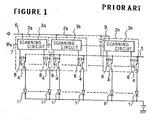
- the image sensor comprises a large number of photodetectors 1 made of, for example, amorphous silicon and formed on the glass substrate in a straight line.
- It further includes a plurality of driving integrated circuit chips 2a, 2b, ... and 2n all located on the same glass substrate.
- Each of the driving IC chips 2a, 2b, ... 2n includes a scanning pulse generating circuit 3a, 3b, ...
- gate switches 4 constituted of one MOSFET adapted to be turned on and off by the corresponding one stage of the scanning circuit.
- These gate switches 4 are also . connected at its one end to the respective photodetectors 1 in a one-to-one relation and at its other end to a common signal line 5.
- a clock line 6 is connected to an clock input of each scanning circuit, and each scanning circuit is connected at its output to an input of the next scanning circuit: Thus, in the condition that a clock.
- the image sensor operates in a storage mode.
- the first is a switching noise generated in the form of a spike by the leakage of the gate driving pulse through a gate-drain capacitance 8 of the MOSFET switch 4.
- the second noise is a clock noise generated through a parasitic capacitance 9 between the clock line 6 and the signal line 5.
- a light emitting diode As a light source for the contact type image sensor, a light emitting diode (LED) is widely used.
- the LED is, however, limitative in the intensity of the emitted light. Therefore, in the case of reading the photosignal at a scanning speed of 5 to 10 msec/line, which is generally required in the facsimile equipment, or at a higher speed, the photosignal obtained is too weak and therefore the signal-to-noise (S/N) ratio is not so high. As the result, noise suppression has been required in order to obtain a sufficient S/N ratio.
- Koike et al proposed one noise suppression method in "Improvements of S/N Ratio of M O S Image Sensor by Neighboring Bit Correlation Method", Transactions of Institute of Electronics and Communication Engineerings of Japan, Vol. J 60-C, pages 113 to 120 (1977).
- a pair of MOSFETs 21a and 21b is connected to each photodetector 22, and one of the MOSFETs 21a in each pair is connected to a noise line 23 while the other MOSFET 2lb is connected to a signal line 24.
- each scanning pulse output stage of the scanning circuit 25 is connected to the gate of the MOSFET 21b which is coupled to one photodetector 22i and also to the gate of the MOSFET 21a which is coupled to one photodetector 22i_ 1 just before the photodetector 22i in the scanning direction.
- each two adjacent MOSFET switches 21a and 21b respectively- connected to each pair of adjacent different photodetectors 22i- l and 22i are simultaneously turned on by a scanning pulse supplied from the scanning circuit 25, so that a signal including a noise is read out on the signal line 24 and only a noises appears on the noise line 23. Therefore, the noise component can be removed from the voltage on the signal line 24 by obtaining the difference in voltage between the lines 23 and 24. Thus, there can be suppressed noises having a fixed pattern, such as the aforementioned switching noise and clock noise.
- each photodetector 31 is connected through one MOSFET switch 32 to a signal line 33, and instead of the dummy MOSFE T 21a shown in Figure 2, a MOS capacitor 34 having the same capacitance as the MOSFET switch 32 is connected to each MOSFET switch and a noise line 35.
- One MOSFET switch 32 and the MOS capacitor 34 connected thereto are simultaneously switched on and off by a scanning circuit 36, so that a signal including a noise is outputted to the signal line 33 and a noise only on the noise line 34, similarly to the lines 23 and 24.
- the noises can therefore be removed from the signals by obtaining the difference of voltage between the lines 33 and 35.
- Ohba et al. proposed a third method for noise suppression in "Fixed Pattern Noise In an Area Sensor And FPN suppressing Circuit", Television Society Technical Report, Vol. 4. No. 13, pages 53 to 58 (1980).
- signal and noise are integrated during the driving period for each photodetector cell so that only a pair of positive and negative noises caused by one scanning pulse are cancelled each other.
- the gate switch 4 is constituted by a CMOS switch consisting of a pair of series-connected p-channel MOSFET and N-channel M OSFET. A pair of pulses reverse in phase to each other are applied to the respective MOSFETs of the CMOS gate switch, so that noises of opposite polarities to each other appear in the pair of MOSFETs, respectively, but are resultingly cancelled by each other.
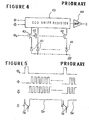
- the photosignal in each stage of the CCD shift register 43 is serially transferred stage by stage by alternately supplying clock pulses ⁇ and ⁇ as shown in Figure 5, so that a photosignal SP as shown in Figure 5 is outputted from the CCD shift register 43 to an output amplifier 44.
- CCD image sensors recently developed, moreover, it is able to drive the CCD shift register at a transfer clock pulse frequency of 10 MH Z or higher. If such a high speed CCD image sensor is applied to a contact type image sensor for A-4 size having 16 elements/mm resolution, namely, having 3456 photodetector cells, a reading speed of 0.4 msec/line or more can be expected. In addition, by alternately reading photodetector cells arranged in a line by use of a pair of CCD shift registers at a speed of 0.4 msec/line, a speed of 0.2 msec/line or more can be realized.
- the CCD image sensor can have an increased sensitivity, so that it can obtain an SIN ratio higher than the conventional MOSIC image sensor.
- each of the CC D shift registers is provided at its output with one floating gate amplifier, if all the floating gate amplifiers are directly connected together to a common output line of the image sensor, a short-circuit situation is caused.
- the CCD image sensor has a problem of a so-called "image lag". Namely, when the photosignal is small, specifically when the voltage across the photodetector 41 is not greater. than 0.3V, even if the transfer gate 42 is turned on, the electric charge will not be quickly and sufficiently be transferred from the photodetector to the CCD shift register.
- the voltage across the photodetector is determined by the amount of a photoelectric charge stored in the photodetector and the capacitance of the photodetector. Namely, the voltage across the photodetector is increased by increase of the amount of the photoelectric charge stored in the photodetector, but decreased by the capacitance of the photodetector.
- the capacitance of the photodetector becomes larger than that of each stage of the CCD shift register, the amount of the electric charge transferred from the photodetector to the CCD shift register becomes small.
- the capacitance of the photodetector such as a-Si type photodetector cell is generally larger than that of the CCD type image sensor. Therefore,- in the case that a-Si photodetectors are directly connected to the CCD shift register, the above mentioned image lag will occur, and therefore, a sufficient sensitivity cannot be obtained.
- Another object of the present invention is to provide a low noise contact type image sensor capable of being driven at a high speed.
- a further object of the present invention is to provide a contact type linear image sensor which is free from the feed-through noise as mentioned above.
- Still another object of the present invention is to provide a contact type image sensor which have high abilities to obtain a higher scanning speed and a higher resolution than a MOSIC circuit and which can discriminate half tone.
- a still further object of the present invention is to provide a contact type image sensor using CCD driving circuit free of the aforementioned image lag.
- a more further object of the present invention is to provide a method of driving such a sensor.
- a contact type image sensor which comprises a plurality of photodetectors; a plurality of driving circuits each of which includes one charge shift register having a plurality of stages, an output amplifier connected to the output of the charge shift register, a change-over switch means connected to the output of the output amplifier, and a plurality of transfer gate means connected between respective stages of the charge shift register and the corresponding ones of the photodetectors in a one-to-one relation; and a common output line connected to the outputs of the change-over switch means of all the driving circuits.
- each of the transfer gate means of all the driving circuits has a controlled input connected in common to one control terminal.
- each of the transfer gate means is a MOSFET having a gate connected in common to the one control terminal.
- the output amplifier of each driving circuit is a floating gate amplifier connected to the final stage of the associated charge shift register, and the change-over switch means of each driving circuit is a CMOS circuit.
- the charge shift registers are preferably formed by CTD shift registers such as CCD registers.
- the charge shift registers are CCD shift registers
- each of the driving circuits further includes an auxiliary transfer gate means connected between each of the transfer gate means and the corresponding photodetector, and means for injecting bias charge to all the stages of the CCD shift register.
- each of the transfer gate means has a controlled input connected in common to a first control terminal
- each of the auxiliary transfer gate means has a controlled input connected in common to a second control terminal.
- each of the charge injection means includes a diode means connected to a voltage source, and a injection gate means connected between the diode means and the first stage of the associated CCD shift register.
- a driving method for a contact type image sensor which includes a plurality of photodetectors; a plurality of driving circuits each of which includes one charge shift register having a plurality of stages, an output amplifier connected to the output of the charge shift register, a change-over switch means connected to the output of the output amplifier, and a plurality of transfer gate means connected between respective stages of the charge shift register and the corresponding ones of the photodetectors in a one-to-one relation; and a common output line connected to the output of the change-over switch means of all the driving circuits.
- This driving method includes the steps of simultaneously turning on the transfer gate means of all the driving circuits, so as to transfer an electric charge stored in each of the photodetectors to the corresponding stages of the charge shift registers; sequentially driving the charge shift registers one by one in the direction of arrangement of the photodetectors, by supplying transfer clock pulses only to a selected one of the charge shift registers and at the same time turning on only the change-over switch means associated to the selected charge-shift register during only the period of time in which the transfer pulses are applied; and repeatedly carrying out the above two steps.
- the driving method for the image sensor additionally includes the steps of injecting the bias charge to the CCD shift register; and simultaneously turning on the transfer gate means and the auxiliary transfer gate means twice in such a manner that, upon the first turning-on, the bias charges in the CCD shift register are transferred to the corresponding photodetectors, and upon the second turning-on, the photoelectric charges plus the bias charges are transferred from the respective photodetectors to the corresponding stages of the CCD shift register.
- each of the transfer gate means is a MOSFET whose gate is connected in common to a first control terminal
- each of the auxiliary transfer gate means is another MOSFET whose gate is connected in common to a second control terminal.
- the first turning-on is carried out by applying a first gate pulse to the gate of the first MOSFET and at the same time supplying the gate of the second MOSFET with a second gate pulse having a voltage higher than that of the first gate pulse
- the second turning-on is carried out by simultaneously supplying the gates of the first and second MOSFETs with gate pulses of the voltages which are substantially the same as each other but lower than that of the second gate pulse.
- the charge injection means includes a diode means connected to a voltage source, and a injection gate means connected between the diode means and the first stage of the associated CCD shift register.
- a first preferred embodiment of the contact type CCD image sensor in accordance with the present invention comprises M integrated circuit chips 60, each of which includes one CCD shift register 61. formed on a semiconductor substrate and having N cascade-connected stages.
- this shift register 61 is a two-phase driven buried-channel type CCD shift register having a high transfer efficiency.
- Each of the stages 1 ... N of each CCD shift register is connected at its input to one transfer gate 52 constituted of for example one MOSFET as shown in Figure 6.
- Each of the MOSFET transfer gates 62 is connected to one photodetector cell 63 through a bonding pads 64 and 65 bridged by a bonding wire 66.
- Each of the photodetector cells is, for example, composed of an amorphous silicon film held between an individual metal electrode formed on an insulating substrate (not shown) such as glass and a common transparent electrode, so that all the photodetector cells are arranged in the form of one straight line.
- the individual electrode is made of Au
- the common transparent electrode is made of ITO (Indium Tin Oxide).
- the transfer gates 62 correspond to the photodetector cell 63 in one-to-one relation, and therefore, by applying a transfer pulse G to all the transfer gates 62, the electric charge stored in each photodetector 63 are simultaneously transferred through the associated transfer gate 62 to the corresponding stage of the CCD shift registers 61.
- each of the CCD shift registers 61 is connected at its output to a floating gate amplifier 67 , whose output is connected to a common output line 68 through an output change-over switch 69 and a bonding wire 70.
- This switch 69 is constituted of for example a CMOS circuit which includes a pair of p-channel MOSFET and n-channel M OSF ET turned on by a pair of gate pulses ⁇ S and ⁇ S inverted in phase to each other.
- each CCD driving integrated circuit chip 60 comprises the N-stage CCD shift register 61, the N transfer gates 62, the floating gate amplifier 67 and the switch 69.
- the M chips 60 are assembled and attached on the substrate formed with the [N x M] photodetector cells 63.
- the gates of all the MOSFET transfer gates 62 in the M chips i.e. [M x N] transfer gates
- the transfer pulse ⁇ G is applied to all the transfer gates 62, so that the transfer gates are turned on at the same time in order to simultaneously transfer the photoelectric charges stored in all the photodetectors 63 to the corresponding stages of all the CCD shift registers 61.
- the transfer clock pulses ⁇ 1 and ⁇ 1 are applied to only the first CCD shift register 61 so as to transfer the charges in the respective stages of the first register 61 to the succeeding stages, stage by stage.
- the photoelectric charge in each stage is transferred one stage by one pair of clock pulses ⁇ 1 and ⁇ 1 , and therefore, N pairs of clock pulses ⁇ 1 and ⁇ 1 are applied to the CCD shift register 61, so that all the photoelectric charges temporarily stored in the first to Nth stages of the first CCD shift register 61 are sequentially outputted to the associated 67.
- the gate pulses ⁇ S1 and ⁇ S1 are applied to the output change-over-switch 69 of the first CC D shift register 60 so that the switch 69 is turned on.
- the gate pulse ⁇ S1 has a high level period corresponding to the period of time in which the N clock pulses ⁇ 1 are sequentially applied, and the gate pulse ⁇ S1 is reverse in phase to the gate pulse ⁇ S1 .
- no gate pulse is applied to the switches 69 of the second to Nth CCD shift registers 61, so that these switches are kept in an OFF state.
- the photoelectric charges in the respective stages of the first CCD shift register 61 are sequentially outputted through the switch 69 to the common output line 68, but, the photoelectric charges stored in all the registers 60 except the first one are not transferred and remain stored there in the period of time tSl - t S2 .
- the transfer clock pulses ⁇ 2 and ⁇ 2 are then applied to the second CCD shift register 61 and the output change-over switch 69 associated to the second CC D register is turned on by the gate pulses ⁇ S2 and ⁇ S2 .
- the transfer clock pulses nor the gate pulses are applied to the CCD shift registers 61 excluding the second one. Therefore, the photosignal stored in the second CCD register 61 are sequentially transferred and then outputted to the output line 68.
- each transfer gate 62 is turned on only once during a scanning time for each one line, but out of the period t S1 ⁇ t SM+1 of reading photosignals from the CCD shift registers. Therefore, the feed-through noises N f caused by triggering the transfer gates 62 will not be contained in the photosignals outputted through the output line 68. In this connection, another feed-through noises will be generated by the pulses ⁇ S1 ⁇ ⁇ SM and ⁇ S1 ⁇ ⁇ SM applied to the output change-over switches 69. But, this is negligible, because such feed-through noise will in general be not greater than 1 mV, and on the other hand, the photosignals are amplified by the floating gate amplifiers 63 to have a value of about 1 V for example.
- CMOS switch In place of CMOS switch, a MOS switch of P-channel or N-channel can be used as an output change-over switch 69.
- the CMOS switch has the advantage capable of cancelling the noises by a pair of positive and negative pulses, as mentioned hereinbefore.
- the photoelectric charge stored in each photodetector is intermittently transferred to the CCD shift register. Therefore, the charge given by a dark current is stored in the CCD shift register during a period of time from the moment the transfer of charge from that CCD shift register has been completed to the moment the next transfer of charge from the same CCD shift register is started. In this embodiment, however, such a dark charge does not become a substantial cause of noise to the photosignal.
- the photoelectric charge of about 0.2 pC is stored under illumination of 100 lx (wavelength 555 nm) and the photodetector aperture size of 0.05 x 0.06 mm 2 .
- the dark charge stored in the CCD shift register 6l is about 1 x 10- 4 pC at the scanning speed of 1 msec/line. Therefore, the noise caused by the dark charge is negligible since this dark charge is extremely smaller than the photoelectric charge.
- the second embodiment also comprises M photodetector reading-out IC chip 60 each of which includes a N stage CCD shift register 61 having an output connected through a floating gate amplifier 67 and a CMOS type change-over switch 69 to a common output line 68.
- M photodetector reading-out IC chip 60 each of which includes a N stage CCD shift register 61 having an output connected through a floating gate amplifier 67 and a CMOS type change-over switch 69 to a common output line 68.
- Each stage of the CC D shift register 61 is connected to the corresponding one photodetector 63 through one transfer gate 62, the bonding pad 64, the bonding wire 66 and the bonding pad 65.
- a an anxiliary transfer gate 81 is connected between each transfer gate 62 and the associated bonding pad 64.
- This auxiliary gate 81 is constituted of one MOSFET, similarly to the transfer gate 62.
- a diode 82 is connected through another transfer gate 83 to the first stage of each CCD shift register 61.
- This diode 82 is reversely biased to constitute a capacitor as shown in Figure 8, and a potential ⁇ IB is applied to a connection node between the diode 82 and the associated transfer gate 83. Therefore, by turning on the transfer.gate 83, a bias charge is injected from the diode capacitor 82 through the transfer gate 83 to the first stage of the CCD shift register 60.
- one N-stage CCD shift register 61 N pairs of transfer gates 62 and auxiliary gates 81, one floating gate amplifier 67, one switch 69, one diode 82 and one transfer gate 83 are manufactured on a single IC chip_60.
- the M chips 60 are assembled and attached on the substrate formed with the [N x M] photodetectors 63.
- the gates of all the transfer gates 62 i.e. [M x N] transfer gates
- are connected in common so that all the transfer gates are simultaneously turned on and off.
- the gates of auxiliary gates 81 are connected in common, so that all the M x N auxiliary gates are turned on and off at one time.
- the image sensor as mentioned above is operated as follows:
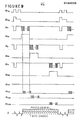
- the M x N transfer gates 62 and the M x N auxiliary gates 81 are simultaneously turned on twice in succession by the transfer gate pulse OTG and the auxiliary gate pulse ⁇ PG as shown in Figure 9.
- transfer gates 62 and the auxiliary gates 81 are simultaneously turned on, but the auxiliary gates 81 are applied with a gate voltage ⁇ PG higher than that ⁇ TG applied to the transfer gates 62 as shown in Figure 9, so that there is produced such an inclined potential distribution that the potential is the highest under the gate of the CCD shift register and is lowered step by step toward the transfer gate and the auxiliary gate and then becomes the lowest under the photodetector. Accordingly, the bias charge stored in each stage of the CCD shift register is transferred or injected to the associated photodetector, with the result that the photoelectric charge plus the bias charge is stored in the photodetector.
- the transfer gates 62 and the auxiliary gates 81 are applied with the same gate voltages ⁇ TG and ⁇ PG as shown in Figure 9, resulting in production of such a potential distribution that the potential is the highest under the photodetector and is lowered at the auxiliary gate and the transfer gate and then becomes the lowest under the gate of the CC D shift register.
- the photoelectric charge plus the bias charge in the respective photodetector is transferred to the corresponding stage of the CCD shift register.
- the transfer clock pulses ⁇ 1 as shown in Figure 9 and the inverted transfer clock pulses ⁇ 1 are applied to only the first CCD shift register 61 so as to transfer the charges in the respective stages of the same register 61 to the succeeding stages, stage by stage, and to finally output the photosignal from the output terminal to the amplifier 67.
- the gate pulse ⁇ S1 shown in Figure 9 and the inverted gate pulse ⁇ S1 are applied to the output change-over switch 69 of the first CCD shift register 61 so that the switch is turned on during the period of time in which the transfer clock pulses ⁇ 1 and 01 are applied.
- the photoelectric charges in the respective stages of the first CCD shift register 61 are sequentially outputted through the switch 69 to the common output line 68.
- injection gate pulses ⁇ IG1 as shown in Figure 9 are applied to the injection gate 83 connected to the input of the first CCD shift register 61.
- the charge stored in the capacitor 82 applied with a constant voltage ⁇ IB from the pulse generator 50 is intermittently injected to the first stage of the first CCD shift register 61.
- Such an injected charge will be transferred to the next stage in synchronism with the transfer of the photosignal through the CC D shift register.
- N injection gate pulses ⁇ IG1 are applied to the gate 83, but have to be delayed from the transfer clock pulses ⁇ 1 by one period of the transfer pulse ⁇ 1 , so that the injected bias charge will not be superimposed with the photoelectric charge being transferred through the CC D shift register.
- the new bias charge for the next scanning line are stored in each stage of the first CCD shift register 61.
- the photoelectric charges (plus the bias charges) stored in the CCD shift registers other than the first one will not be transferred and remain stored, similarly to the first embodiment.
- the transfer clock pulses ⁇ 2 and ⁇ 2 are then applied to the second CCD shift register 61 and the output change-over switch 64 associated to the second CCD shift register 61 is turned on by the gate pulses ⁇ S2 and ⁇ S2 .
- the injection gate pulses 0 IG2 are applied to the injection gate 83 connected to the input of the second CCD shift register 61.
- the photosignal stored in the respective stages of the second CCD shift register 61 are sequentially transferred through the second CCD shift register 61 and finally outputted through the amplifier 67 to the common output line 68, and at the same time, the new bias charge for the next scanning line are stored in the second CCD shift register 61.
- the photoelectric charges including the bias charges as shown in Figure 9 are outputted from an output O of the contact type image sensor. Since these bias charges are regarded as DC offset, it is easy to remove the bias charge component in a subsequent process of the signals. Only real photosignals can therefore be obtained.
- the photoelectric charges are added with the biasing charges, the voltage across the photodetector 63 becomes higher, with the result that the aforementioned "image lag" is overcame.
- This bias charge is' sufficient if it is of about 0.3 pC.
- the photoelectric charge stored in each photodetector cell is of about 0.2 pC as mentioned above, the total charge will be of about 0.5 pC. This total charge can be transferred without overflow in a shift register having cell size of 15 x 30 gzm 2 which is often used in CCD recently.
- the contact type CCD image sensor constructed and operated in accordance with the present invention can realize a high scanning speed at a very low noise, since the photoelectric charges in all the photodetectors are simultaneously transferred to a plurality of CCD shift registers which are inherently low in noise characteristics, and then, the photoelectric charges temporarily stored in the CCD shift registers are read out in such a manner that there is omitted the feed-through noise caused at the time of transferring the charge from the photodetectors to the CC D shift register.
- a S/N ratio of not less than 40 dB can be obtained at a scanning speed of 0.5 msec/line, and therefore, a half tone image can be sufficiently detected or discriminated.
- the image sensor has only one output line. Accordingly, the image sensor can be simply connected to an external circuit, and since only one signal line is required for connection to an external, the reliability in signal transmission to an external will be high.
- the image sensor is very improved in sensitivity by injecting the bias charge to the photodetectors before transferring the photoelectric charge from each photodetector to the CCD shift registers. Namely, since the amount of charge in the-photodetector is increased by such an injection of the bias charge, the voltage across the photodetector becomes high, and therefore, the difference in potential between the CCD shift register and the photodetector also becomes large.
- the contact type image sensor can have a very high S/N ratio without lowering the scanning speed.
Landscapes
- Engineering & Computer Science (AREA)
- Multimedia (AREA)
- Signal Processing (AREA)
- Facsimile Heads (AREA)
Applications Claiming Priority (4)
| Application Number | Priority Date | Filing Date | Title |
|---|---|---|---|
| JP59143020A JPS6121669A (ja) | 1984-07-10 | 1984-07-10 | 密着形センサとその駆動方法 |
| JP143020/84 | 1984-07-10 | ||
| JP59164445A JPH0666851B2 (ja) | 1984-08-06 | 1984-08-06 | 密着形イメージセンサ |
| JP164445/84 | 1984-08-06 |
Publications (3)
| Publication Number | Publication Date |
|---|---|
| EP0168030A2 true EP0168030A2 (de) | 1986-01-15 |
| EP0168030A3 EP0168030A3 (en) | 1987-08-05 |
| EP0168030B1 EP0168030B1 (de) | 1990-09-26 |
Family
ID=26474847
Family Applications (1)
| Application Number | Title | Priority Date | Filing Date |
|---|---|---|---|
| EP85108514A Expired EP0168030B1 (de) | 1984-07-10 | 1985-07-09 | Bildsensor vom Kontakttyp und Verfahren zu seinem Betrieb |
Country Status (3)
| Country | Link |
|---|---|
| US (1) | US4672453A (de) |
| EP (1) | EP0168030B1 (de) |
| DE (1) | DE3579854D1 (de) |
Cited By (1)
| Publication number | Priority date | Publication date | Assignee | Title |
|---|---|---|---|---|
| US5138467A (en) * | 1989-02-28 | 1992-08-11 | Canon Kabushiki Kaisha | Photoelectric conversion device |
Families Citing this family (28)
| Publication number | Priority date | Publication date | Assignee | Title |
|---|---|---|---|---|
| DE69027346T2 (de) * | 1989-02-10 | 1996-10-31 | Canon Kk | Sensorchip und dieser benutzendes photoelektrisches Umwandlungsgerät |
| JPH03119855A (ja) * | 1989-10-02 | 1991-05-22 | Nippon Steel Corp | 密着型イメージセンサ |
| US5103322A (en) * | 1990-05-14 | 1992-04-07 | Polaroid Corporation | Scanner with retractable roller feed |
| US5111263A (en) * | 1991-02-08 | 1992-05-05 | Eastman Kodak Company | Charge-coupled device (CCD) image sensor operable in either interlace or non-interlace mode |
| US5299013A (en) * | 1991-07-25 | 1994-03-29 | Dyna Image Corp. | Silicon butting contact image sensor with two-phase shift register |
| JP2910485B2 (ja) * | 1993-02-19 | 1999-06-23 | 富士ゼロックス株式会社 | 画像読取装置及び画像読取方法 |
| US5543838A (en) * | 1993-08-31 | 1996-08-06 | Xerox Corporation | Signal multiplexing system for an image sensor array |
| AU6899896A (en) * | 1995-08-21 | 1997-03-27 | Starcam Systems, Inc. | High-speed high-resolution multi-frame real-time digital camera |
| US5760833A (en) * | 1996-05-20 | 1998-06-02 | Torrey Science Corporation | Readout of pixel data from array of CCD image detectors |
| US6219468B1 (en) * | 1996-10-17 | 2001-04-17 | Minolta Co., Ltd. | Image detection system |
| US6786420B1 (en) * | 1997-07-15 | 2004-09-07 | Silverbrook Research Pty. Ltd. | Data distribution mechanism in the form of ink dots on cards |
| US6618117B2 (en) | 1997-07-12 | 2003-09-09 | Silverbrook Research Pty Ltd | Image sensing apparatus including a microcontroller |
| US6879341B1 (en) | 1997-07-15 | 2005-04-12 | Silverbrook Research Pty Ltd | Digital camera system containing a VLIW vector processor |
| US20040119829A1 (en) | 1997-07-15 | 2004-06-24 | Silverbrook Research Pty Ltd | Printhead assembly for a print on demand digital camera system |
| US6624848B1 (en) | 1997-07-15 | 2003-09-23 | Silverbrook Research Pty Ltd | Cascading image modification using multiple digital cameras incorporating image processing |
| US6690419B1 (en) | 1997-07-15 | 2004-02-10 | Silverbrook Research Pty Ltd | Utilising eye detection methods for image processing in a digital image camera |
| US7110024B1 (en) | 1997-07-15 | 2006-09-19 | Silverbrook Research Pty Ltd | Digital camera system having motion deblurring means |
| SG70128A1 (en) * | 1997-10-06 | 2000-01-25 | Canon Kk | Method of driving image sensor |
| AUPP702098A0 (en) | 1998-11-09 | 1998-12-03 | Silverbrook Research Pty Ltd | Image creation method and apparatus (ART73) |
| KR100430099B1 (ko) * | 1999-03-02 | 2004-05-03 | 엘지.필립스 엘시디 주식회사 | 쉬프트 레지스터 회로 |
| AUPQ056099A0 (en) | 1999-05-25 | 1999-06-17 | Silverbrook Research Pty Ltd | A method and apparatus (pprint01) |
| US7334791B2 (en) * | 2002-08-24 | 2008-02-26 | Blinky Bones, Inc. | Electronic die |
| US20050231621A1 (en) * | 2004-04-20 | 2005-10-20 | Su Wen H | Integrated image detecting apparatus |
| JP4120890B2 (ja) * | 2005-06-30 | 2008-07-16 | ブラザー工業株式会社 | 画像読取装置 |
| US20090228463A1 (en) * | 2008-03-10 | 2009-09-10 | Cramer Richard D | Method for Searching Compound Databases Using Topomeric Shape Descriptors and Pharmacophoric Features Identified by a Comparative Molecular Field Analysis (CoMFA) Utilizing Topomeric Alignment of Molecular Fragments |
| US10090349B2 (en) * | 2012-08-09 | 2018-10-02 | Taiwan Semiconductor Manufacturing Company, Ltd. | CMOS image sensor chips with stacked scheme and methods for forming the same |
| JP6516204B2 (ja) * | 2016-01-19 | 2019-05-22 | 京セラドキュメントソリューションズ株式会社 | 画像読取装置、画像読取方法、画像形成装置及び制御プログラム |
| CN116132830B (zh) * | 2023-01-06 | 2025-11-21 | 威海华菱光电股份有限公司 | 线阵图像传感器芯片和图像传感器 |
Family Cites Families (5)
| Publication number | Priority date | Publication date | Assignee | Title |
|---|---|---|---|---|
| JPS564946A (en) * | 1979-05-24 | 1981-01-19 | Nec Corp | Speed converter using charge transfer device |
| JPS5780864A (en) * | 1980-11-08 | 1982-05-20 | Hitachi Ltd | Driving circuit for ccd photosensor |
| JPS58125952A (ja) * | 1982-01-22 | 1983-07-27 | Fuji Xerox Co Ltd | 原稿読取装置 |
| JPS59160374A (ja) * | 1983-03-02 | 1984-09-11 | Canon Inc | 光電変換装置 |
| US4620231A (en) * | 1984-06-18 | 1986-10-28 | Rca Corporation | CCD imager with photodetector bias introduced via the CCD register |
-
1985
- 1985-07-09 DE DE8585108514T patent/DE3579854D1/de not_active Expired - Lifetime
- 1985-07-09 EP EP85108514A patent/EP0168030B1/de not_active Expired
- 1985-07-09 US US06/753,232 patent/US4672453A/en not_active Expired - Fee Related
Cited By (1)
| Publication number | Priority date | Publication date | Assignee | Title |
|---|---|---|---|---|
| US5138467A (en) * | 1989-02-28 | 1992-08-11 | Canon Kabushiki Kaisha | Photoelectric conversion device |
Also Published As
| Publication number | Publication date |
|---|---|
| EP0168030B1 (de) | 1990-09-26 |
| EP0168030A3 (en) | 1987-08-05 |
| DE3579854D1 (de) | 1990-10-31 |
| US4672453A (en) | 1987-06-09 |
Similar Documents
| Publication | Publication Date | Title |
|---|---|---|
| EP0168030B1 (de) | Bildsensor vom Kontakttyp und Verfahren zu seinem Betrieb | |
| US3946151A (en) | Semiconductor image sensor | |
| EP1178673B1 (de) | Festkörperbildaufnahmevorrichtung | |
| US8072528B2 (en) | Solid state imaging device and camera system | |
| US4952788A (en) | Method of photoelectric detection with reduction of remanence of a phototransistor, notably of the NIPIN type | |
| US4189749A (en) | Solid state image sensing device | |
| US4450484A (en) | Solid states image sensor array having circuit for suppressing image blooming and smear | |
| EP1178674B1 (de) | Festkörper-Bildaufnahmevorrichtung und Kamerasystem | |
| EP0653881A2 (de) | Festkörperbildaufnahmevorrichtung | |
| EP0489724B1 (de) | Anordnung und Verfahren zum photoelektrischen Umformen von Licht in elektrische Signale | |
| US6674471B1 (en) | Solid-state imaging device and method for driving the same | |
| EP0548987B1 (de) | Schaltung mit Source-Folger für Bildsensor | |
| US4551757A (en) | Method for driving solid-state image sensor | |
| US4366503A (en) | Solid state image pick-up device and its charge transfer method | |
| US6980243B2 (en) | Photoelectric conversion device providing advantageous readout of two-dimensional array of transistors | |
| EP0577391B1 (de) | Festkörperbildaufnahmevorrichtung | |
| US4413283A (en) | Solid-state imaging device | |
| US7394054B2 (en) | Photoelectric converter and a method of driving the same | |
| US4609825A (en) | Device for modulating the sensitivity of a line-transfer photosensitive device | |
| US4587562A (en) | Solid state image pick-up device | |
| EP0267591A2 (de) | Lichtelektrischer Wandler | |
| JPH0462225B2 (de) | ||
| JPS58221562A (ja) | 原稿読取装置 | |
| US4665325A (en) | Solid state image sensor with signal amplification | |
| JPH09168117A (ja) | 固体撮像素子 |
Legal Events
| Date | Code | Title | Description |
|---|---|---|---|
| PUAI | Public reference made under article 153(3) epc to a published international application that has entered the european phase |
Free format text: ORIGINAL CODE: 0009012 |
|
| 17P | Request for examination filed |
Effective date: 19850709 |
|
| AK | Designated contracting states |
Designated state(s): DE FR GB NL |
|
| PUAL | Search report despatched |
Free format text: ORIGINAL CODE: 0009013 |
|
| RHK1 | Main classification (correction) |
Ipc: H04N 1/04 |
|
| AK | Designated contracting states |
Kind code of ref document: A3 Designated state(s): DE FR GB NL |
|
| 17Q | First examination report despatched |
Effective date: 19891222 |
|
| GRAA | (expected) grant |
Free format text: ORIGINAL CODE: 0009210 |
|
| AK | Designated contracting states |
Kind code of ref document: B1 Designated state(s): DE FR GB NL |
|
| REF | Corresponds to: |
Ref document number: 3579854 Country of ref document: DE Date of ref document: 19901031 |
|
| ET | Fr: translation filed | ||
| PLBE | No opposition filed within time limit |
Free format text: ORIGINAL CODE: 0009261 |
|
| STAA | Information on the status of an ep patent application or granted ep patent |
Free format text: STATUS: NO OPPOSITION FILED WITHIN TIME LIMIT |
|
| 26N | No opposition filed | ||
| PGFP | Annual fee paid to national office [announced via postgrant information from national office to epo] |
Ref country code: GB Payment date: 19950703 Year of fee payment: 11 |
|
| PGFP | Annual fee paid to national office [announced via postgrant information from national office to epo] |
Ref country code: FR Payment date: 19950725 Year of fee payment: 11 |
|
| PGFP | Annual fee paid to national office [announced via postgrant information from national office to epo] |
Ref country code: NL Payment date: 19950728 Year of fee payment: 11 |
|
| PGFP | Annual fee paid to national office [announced via postgrant information from national office to epo] |
Ref country code: DE Payment date: 19950920 Year of fee payment: 11 |
|
| PG25 | Lapsed in a contracting state [announced via postgrant information from national office to epo] |
Ref country code: GB Effective date: 19960709 |
|
| PG25 | Lapsed in a contracting state [announced via postgrant information from national office to epo] |
Ref country code: NL Effective date: 19970201 |
|
| GBPC | Gb: european patent ceased through non-payment of renewal fee |
Effective date: 19960709 |
|
| PG25 | Lapsed in a contracting state [announced via postgrant information from national office to epo] |
Ref country code: FR Effective date: 19970328 |
|
| NLV4 | Nl: lapsed or anulled due to non-payment of the annual fee |
Effective date: 19970201 |
|
| PG25 | Lapsed in a contracting state [announced via postgrant information from national office to epo] |
Ref country code: DE Effective date: 19970402 |
|
| REG | Reference to a national code |
Ref country code: FR Ref legal event code: ST |