EP0168208A2 - Elektronischer Drucker - Google Patents
Elektronischer Drucker Download PDFInfo
- Publication number
- EP0168208A2 EP0168208A2 EP85304718A EP85304718A EP0168208A2 EP 0168208 A2 EP0168208 A2 EP 0168208A2 EP 85304718 A EP85304718 A EP 85304718A EP 85304718 A EP85304718 A EP 85304718A EP 0168208 A2 EP0168208 A2 EP 0168208A2
- Authority
- EP
- European Patent Office
- Prior art keywords
- data
- printing
- character
- hammer
- spacing
- Prior art date
- Legal status (The legal status is an assumption and is not a legal conclusion. Google has not performed a legal analysis and makes no representation as to the accuracy of the status listed.)
- Granted
Links
Images

Classifications
-
- B—PERFORMING OPERATIONS; TRANSPORTING
- B41—PRINTING; LINING MACHINES; TYPEWRITERS; STAMPS
- B41J—TYPEWRITERS; SELECTIVE PRINTING MECHANISMS, i.e. MECHANISMS PRINTING OTHERWISE THAN FROM A FORME; CORRECTION OF TYPOGRAPHICAL ERRORS
- B41J25/00—Actions or mechanisms not otherwise provided for
- B41J25/24—Case-shift mechanisms; Fount-change arrangements
-
- B—PERFORMING OPERATIONS; TRANSPORTING
- B41—PRINTING; LINING MACHINES; TYPEWRITERS; STAMPS
- B41J—TYPEWRITERS; SELECTIVE PRINTING MECHANISMS, i.e. MECHANISMS PRINTING OTHERWISE THAN FROM A FORME; CORRECTION OF TYPOGRAPHICAL ERRORS
- B41J1/00—Typewriters or selective printing mechanisms characterised by the mounting, arrangement or disposition of the types or dies
- B41J1/22—Typewriters or selective printing mechanisms characterised by the mounting, arrangement or disposition of the types or dies with types or dies mounted on carriers rotatable for selection
- B41J1/24—Typewriters or selective printing mechanisms characterised by the mounting, arrangement or disposition of the types or dies with types or dies mounted on carriers rotatable for selection the plane of the type or die face being perpendicular to the axis of rotation
- B41J1/28—Carriers stationary for impression, e.g. with the types or dies not moving relative to the carriers
- B41J1/30—Carriers stationary for impression, e.g. with the types or dies not moving relative to the carriers with the types or dies moving relative to the carriers or mounted on flexible carriers
-
- B—PERFORMING OPERATIONS; TRANSPORTING
- B41—PRINTING; LINING MACHINES; TYPEWRITERS; STAMPS
- B41J—TYPEWRITERS; SELECTIVE PRINTING MECHANISMS, i.e. MECHANISMS PRINTING OTHERWISE THAN FROM A FORME; CORRECTION OF TYPOGRAPHICAL ERRORS
- B41J19/00—Character- or line-spacing mechanisms
- B41J19/18—Character-spacing or back-spacing mechanisms; Carriage return or release devices therefor
- B41J19/20—Positive-feed character-spacing mechanisms
- B41J19/32—Differential or variable-spacing arrangements
-
- B—PERFORMING OPERATIONS; TRANSPORTING
- B41—PRINTING; LINING MACHINES; TYPEWRITERS; STAMPS
- B41J—TYPEWRITERS; SELECTIVE PRINTING MECHANISMS, i.e. MECHANISMS PRINTING OTHERWISE THAN FROM A FORME; CORRECTION OF TYPOGRAPHICAL ERRORS
- B41J9/00—Hammer-impression mechanisms
- B41J9/44—Control for hammer-impression mechanisms
- B41J9/48—Control for hammer-impression mechanisms for deciding or adjusting hammer-drive energy
Definitions
- the present invention relates to an electronic printer, e.g. an impact-type electronic printer using a rotary printing wheel.
- Conventional electronic printers are designed to realize a uniform printing depth by varying the hammer pressure for each printing type.
- a conventional electronic printer prints out characters and symbols cleanly with a uniform depth by continuously controlling the depth of the printed characters according to their size.
- the conventional electronic printer cannot produce completely clean print merely by controlling the depth of the printed characters and symbols.
- cleaner printing can only be realized by adequately varying the spacing so that the next character is set in its printing position with reference to the size of the printing type.
- the controller system should be provided with a variety of specific spacing data for adequately varying the space in accordance with the magnitude of the areas of the respective printing type. Therefore, it is necessary to independently draw out from the ROM printing-type position data, hammer pressure and spacing data in response to the input data that represents the printable character.
- no conventional electronic printer can smoothly extract such data from the ROM, because it involves the entire circuitry in complex operations.
- the present invention primarily aims at providing distinctly cleaner characters than can be printed with impact-type electronic printers using a rotary printing wheel.
- Another object of the present invention is to provide the impact-type electronic printer with a means for independently storing both hammer pressure data and spacing data to correctly match the respective printing types and such means for effectively and smoothly drawing out the printing-type position data, hammer pressure data, and the spacing data from the memory means (ROM).
- ROM memory means
- the main CPU then draws out the printing-type position data, the hammer pressure data, and the spacing data in response to-the input data to allow the printer to execute the printing operation using the designated printing types in accordance with these data drawn out of the ROM, thus realizing distinct, clean printed characters.
- the unique system embodied by the present invention makes it possible for the controller to easily read important data from ROM.
- the control system reflecting the present invention allows the ROM to effectively store the printing-type position data, hammer pressure data, and spacing data, the control system can, for example, read these data merely by executing the reading operation twice.
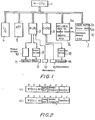
- Figure 1 is a simplified block diagram of the control circuit of the electronic printer embodied by the present invention, as typically applied to typewriters.
- Reference number 1 indicates the 8-bit main CPU of the typewriter reflecting the preferred embodiment of the present invention.
- Reference numbers 2 and 3 indicate the 8-bit subordinate CPUs. Of these, the wheel CPU (W-CPU) 2 controls the operations of both the rotary printing wheel 9 and the hammer 11, whereas the carriage CPU (C-CPU) 3 controls the operation of the carriage 14.
- Reference number 4 indicates the interface connected to' external data sources which deliver the ASCII code to this interface.
- Reference number 5 indicates the keyboard unit that receives the key-code character data.
- Reference number 6 indicates the ROM which is provided with table 6A and which converts the key codes into the ASCII code table 6B which stores the printing-type position data (WHEEL NO.) designating the physical positions of the respective printing types of the rotary printing wheel, hammer pressure data, and spacing data, while ROM 6 also contains other tables storing control programs.
- Reference number 7 indicates the RAM containing the input buffer 7, the miscellaneous buffer 7B, and the sentence memory area 7C.
- Reference number 8 indicates the printing-wheel driver connected to the W-CPU 2.
- Reference number 9 indicates the rotary printing wheel controlled by the wheel driver 8.
- Reference number 10 indicates the hammer driver connected to the W-CPU 2.
- Reference number 11 indicates the hammer controlled by the hammer driver 10.
- Reference number 12 indicates the photosensor (optical rotary encoder) that detects the position of the rotary printing wheel 9 and delivers the data related to the position of this wheel to the W-CPU 2.
- Reference number 13 indicates the carriage driver connected to the C-CPU 3 and reference number 14 indicates the carriage controlled by the carriage driver 13.
- Reference number 15 indicates the photosensor (optical rotary encoder) that detects the position of the carriage 14 and delivers data regarding the moving position of the carriage 14 to the C-CPU 3.
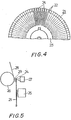
- the carriage 14 is provided with the rotary printing wheel 9 and the hammer 11 shown in Figure 5.
- the rotary printing wheel 9 bears 112 printing types.
- the printing-type position data is composed of 8 bits. Although 7-bit data composition is quite sufficient for selecting any of these 112 printing types, the 8th bit is made available for providing data related to composite symbols such as $ (dollar) and V (yen), and as a result, a maximum of 8 bits are made available.
- the hammer pressure data and the spacing data are respectively composed of 4 bits to allow the control system of the printer to apply a maximum of 16 kinds of hammer pressure and space adjustment.
- the electronic printer incorporating the preferred embodiment of the present invention enables the ROM 6 to constantly store together the 8-bit printing-type position data, the 4-bit hammer pressure data, and the 4-bit spacing data.
- the ROM 6 is provided with 2 stages, i.e., 2 address positions dealing with each printing type. As shown in Figure 2 (1), the first stage stores the upper 4-bit contents of the 80bit printing-type position data, the upper 2-bit contents of the 4-bit hammer pressure data, and the upper 2-bit contents of the 4-bit spacing data. On the other hand, the second stage stores 8-bit data comprised of the lower 4-bit contents of the 8-bit printing-type position data, the lower 2-bit contents of the 4-bit hammer pressure data, and the lower 2-bit contents of the 4-bit spacing data. In addition, the ROM 6 stores the data relating to the 112 printing types, for example the first and second stages would be provided with the n-th through (224+n)th addresses.
- At least one kind of the printing-type position data, hammer pressure data, and the spacing data described above may be divided into one-half when the divided data is stored in the ROM. Needless to say, these data may also be divided into any desired parts other than one-half.
- Rotary wheel electronic printers use a rotary printing wheel 21 in Figure 4 .
- the rotary printing wheel has a number of spokes 22, 22 --- almost all identical in shape.
- Each spoke 22, 22 --- radially extends from the center hub 23 and bears a printing type 24 at its tip, forming part of the external circumference of the rotary printing wheel.
- Printing types include upper case and lower case characters, numerals, and a variety of symbols.
- the rotary printing wheel 21 is driven by the rotating shaft of the drive motor 25 mounted on the carriage.
- the drive motor 25 controls the rotation of the rotary printing wheel 21 so that the desired printing type 24 can be set in the correct printing position where the platen 26 and the hammer 27 match each other exactly.
- the hammer 27 By causing the hammer 27 to hit the rear surface of the designated printing type 24 in the direction of the platen 26, the designated printing type 24 performs the printing and recording of the required data on the recording paper 28 in front of the platen 26 via an ink ribbon 29.
- the main CPU 1 identifies whether or not the input data belongs to the ASCII code.
- the input data transmitted from the external data sources via the interface 4 belongs to the ASCII code whereas the data input from the keyboard unit 5 belongs to the key code.
- the main CPU 1 converts the key-coded input data into the ASCII code by referring it to the conversion table 6A of ROM 6.
- all input data are standardized into the ASCII code.
- the ASCII-coded data from the interface 4 and such data converted into the ASCII code from the keyboard unit 5 are temporarily stored in the input buffer of the RAM 7.
- the main CPU 1 then reads data out from the ROM 6 by addressing the positions that match the input data stored in the ROM 6.
- the printing-type position data, hammer pressure data, and the spacing data respectively match the ASCII code and can be correctly received from the input buffer of the ROM 6.
- the first-stage data shown in Figure 2 (comprised of the 8-bit data containing the upper 4-bit contents of the printing-type position data, the upper 2-bit contents of the hammer pressure data, and the upper 2-bit contents of the spacing data) are read out of the ROM 6 and then temporarily stored in the buffer of the RAM 7.
- the second-stage data (comprised of the 8-bit data containing the lower 4-bit contents of the printing-type position data, the lower 2-bit contents of the hammer pressure data, and the lower 2-bit contents of the spacing data) are also read out of the ROM 6 and temporarily stored in the buffer of the RAM 7.
- both the upper and lower 4-bit contents of the printing-type position data stored in the RAM 7 are then integrated into the 8-bit printing-type position data for delivery to the W-CPU 2.
- both the upper and lower 2-bit contents of the hammer pressure data are integrated into the 4-bit data, which is then provided with control data before being delivered to the W-CPU 2.
- the upper and lower 2-bit contents of the spacing data are integrated into the 4-bit spacing data, which is also provided with control data before eventually being delivered to the W-CPU 3.
- the electronic printer system then proceeds to the printing operation.
- the main CPU 1 executes a specific operation in reference to the spacing data received from the C-CPU 3 and then generates the spacing data for providing the optimum spaces in advance of and behind the designated printing type.
- the ain CPU 1 controls the operation of the carriage driver 13 in response to the advance spacing data before activating the carriage 14 to move its position.
- the main CPU 1 controls the operation of the printing wheel driver 8 in response to the printing-type position data fed from the W-CPU 2 in order that the rotary printing wheel 9 can precisely rotate itself up to the designated position where the designated printing type matching the input data executes the printing operation.
- the W-CPU 2 controls the operation of the hammer driver 10 to drive the hammer 11 at the moment when the printing type of the rotary printing wheel 9 matching the input data stops at the printing position so that the printing can be executed at the optimum pressure as determined by the hammer pressure data.
- the C-CPU 3 controls the operation of the carriage driver 13 in accordance with the post-print spacing data. This causes the carriage 14 to move its position.
Landscapes
- Record Information Processing For Printing (AREA)
- Accessory Devices And Overall Control Thereof (AREA)
- Character Spaces And Line Spaces In Printers (AREA)
Applications Claiming Priority (2)
| Application Number | Priority Date | Filing Date | Title |
|---|---|---|---|
| JP137584/84 | 1984-07-02 | ||
| JP59137584A JPS6116879A (ja) | 1984-07-02 | 1984-07-02 | 電子式プリンタ |
Publications (3)
| Publication Number | Publication Date |
|---|---|
| EP0168208A2 true EP0168208A2 (de) | 1986-01-15 |
| EP0168208A3 EP0168208A3 (en) | 1986-07-02 |
| EP0168208B1 EP0168208B1 (de) | 1990-09-19 |
Family
ID=15202128
Family Applications (1)
| Application Number | Title | Priority Date | Filing Date |
|---|---|---|---|
| EP85304718A Expired EP0168208B1 (de) | 1984-07-02 | 1985-07-02 | Elektronischer Drucker |
Country Status (5)
| Country | Link |
|---|---|
| US (1) | US4687356A (de) |
| EP (1) | EP0168208B1 (de) |
| JP (1) | JPS6116879A (de) |
| CA (1) | CA1258198A (de) |
| DE (1) | DE3579762D1 (de) |
Families Citing this family (6)
| Publication number | Priority date | Publication date | Assignee | Title |
|---|---|---|---|---|
| DE3527432A1 (de) * | 1985-07-31 | 1987-02-26 | Triumph Adler Ag | Verfahren zum abdrucken von zeichen bei schreib- oder aehnlichen bueromaschinen |
| US4818130A (en) * | 1986-11-19 | 1989-04-04 | Brother Kogyo Kabushiki Kaisha | Character erasable printing apparatus including selective erasing of variable length underline |
| US5148187A (en) * | 1987-11-05 | 1992-09-15 | Sony Corporation | Printing apparatus with mechanism precisely defining printing start position |
| US6141028A (en) * | 1992-05-22 | 2000-10-31 | Seiko Epson Corporation | Printer and control method therefor |
| EP0570909B1 (de) * | 1992-05-22 | 1997-08-20 | Seiko Epson Corporation | Drucker und Verfahren zur Steuerung desselben |
| US5995774A (en) * | 1998-09-11 | 1999-11-30 | Lexmark International, Inc. | Method and apparatus for storing data in a non-volatile memory circuit mounted on a printer's process cartridge |
Family Cites Families (16)
| Publication number | Priority date | Publication date | Assignee | Title |
|---|---|---|---|---|
| US3858509A (en) * | 1972-07-10 | 1975-01-07 | Xerox Corp | Control logic for print wheel and hammer of high speed printing apparatus |
| CA1039217A (en) * | 1974-07-01 | 1978-09-26 | Willy J. Grundherr | Rotary wheel printing system |
| CH582067A5 (de) * | 1974-10-16 | 1976-11-30 | Hermes Precisa International | |
| JPS5193632A (de) * | 1975-02-14 | 1976-08-17 | ||
| US4074798A (en) * | 1976-09-01 | 1978-02-21 | Xerox Corporation | Encoded print wheel system |
| GB1604577A (en) * | 1977-09-14 | 1981-12-09 | Exxon Research Engineering Co | Coded printing element and apparatus for use thereof |
| US4189246A (en) * | 1977-12-22 | 1980-02-19 | International Business Machines Corporation | Variable print-hammer control for on-the-fly-printing |
| US4217055A (en) * | 1978-05-30 | 1980-08-12 | Qume Corporation | Daisy wheel printer which accommodates different print wheel fonts |
| DE2850378A1 (de) * | 1978-11-21 | 1980-05-29 | Olympia Werke Ag | Einrichtung zur eingabe von funktionssteuerbefehlen an einer schreib- oder aehnlichen daten schreibenden bueromaschine |
| IT1117610B (it) * | 1979-02-09 | 1986-02-17 | Olivetti & Co Spa | Macchina per scrivere elettronica con dispositivo di posizionamento dell'organo di scrittura |
| US4264220A (en) * | 1979-12-12 | 1981-04-28 | International Business Machines Corporation | Printwheel homing apparatus |
| CA1162317A (en) * | 1980-04-28 | 1984-02-14 | Gordon Sohl | Read only memory coded print wheel cartridge |
| US4314769A (en) * | 1980-06-02 | 1982-02-09 | International Business Machines Corporation | Acoustical tone generator |
| JPS5824470A (ja) * | 1981-08-07 | 1983-02-14 | Ricoh Co Ltd | インパクトプリンタの制御装置 |
| JPS5865683A (ja) * | 1981-10-15 | 1983-04-19 | Canon Inc | 印字装置 |
| US4541746A (en) * | 1983-10-14 | 1985-09-17 | International Business Machines Corporation | Initializing apparatus for daisy wheel printer |
-
1984
- 1984-07-02 JP JP59137584A patent/JPS6116879A/ja active Pending
-
1985
- 1985-06-26 US US06/748,985 patent/US4687356A/en not_active Expired - Lifetime
- 1985-06-27 CA CA000485741A patent/CA1258198A/en not_active Expired
- 1985-07-02 DE DE8585304718T patent/DE3579762D1/de not_active Expired - Lifetime
- 1985-07-02 EP EP85304718A patent/EP0168208B1/de not_active Expired
Also Published As
| Publication number | Publication date |
|---|---|
| US4687356A (en) | 1987-08-18 |
| CA1258198A (en) | 1989-08-08 |
| EP0168208A3 (en) | 1986-07-02 |
| DE3579762D1 (de) | 1990-10-25 |
| EP0168208B1 (de) | 1990-09-19 |
| JPS6116879A (ja) | 1986-01-24 |
Similar Documents
| Publication | Publication Date | Title |
|---|---|---|
| US4026403A (en) | Automatic printer with plurality of replaceable printing members | |
| US4074798A (en) | Encoded print wheel system | |
| US4323315A (en) | Electronic typewriter with display device | |
| US3168182A (en) | Type wheel shifting and impacting means in high speed printers | |
| US4595303A (en) | Printing apparatus with two print heads | |
| EP0063939B1 (de) | Schreibanordnung | |
| JPS6144074B2 (de) | ||
| US4687356A (en) | Electronic printer with interleaved storage of print wheel position, hammer intensity, and carriage position data in read only memory | |
| US4684269A (en) | Apparatus for printing with character fonts and dot-matrix printing in the same line | |
| JPS5824470A (ja) | インパクトプリンタの制御装置 | |
| CA1066949A (en) | Impact line printer having graphics plotting capability | |
| US4635081A (en) | Apparatus and method for generating dot-matrix characters in graphic patterns | |
| US4585362A (en) | One-touch character correction and replacement system | |
| US4684270A (en) | Print element, printer and method of printing | |
| US4644477A (en) | Printing apparatus | |
| US4773774A (en) | Printer with erasing ribbon control function | |
| JPS6232062A (ja) | タイプライタ又は類似の事務機における文字の印字方法 | |
| JPS61233557A (ja) | 複合プリンタ | |
| JPS604794B2 (ja) | シリアルインパクト型プリンタ | |
| US4789949A (en) | Printer throughput | |
| JPS6353042A (ja) | 記録装置 | |
| KR940005148B1 (ko) | 휠교환식 메모리 타자기의 인자방법 | |
| KR890000463B1 (ko) | 데이지휠식 항영겸용 전동타자기 | |
| JPS6116632B2 (de) | ||
| JPH0356671B2 (de) |
Legal Events
| Date | Code | Title | Description |
|---|---|---|---|
| PUAI | Public reference made under article 153(3) epc to a published international application that has entered the european phase |
Free format text: ORIGINAL CODE: 0009012 |
|
| AK | Designated contracting states |
Designated state(s): DE GB IT |
|
| PUAL | Search report despatched |
Free format text: ORIGINAL CODE: 0009013 |
|
| RHK1 | Main classification (correction) |
Ipc: B41J 1/30 |
|
| AK | Designated contracting states |
Kind code of ref document: A3 Designated state(s): DE GB IT |
|
| 17P | Request for examination filed |
Effective date: 19861215 |
|
| 17Q | First examination report despatched |
Effective date: 19880323 |
|
| ITF | It: translation for a ep patent filed | ||
| GRAA | (expected) grant |
Free format text: ORIGINAL CODE: 0009210 |
|
| AK | Designated contracting states |
Kind code of ref document: B1 Designated state(s): DE GB IT |
|
| REF | Corresponds to: |
Ref document number: 3579762 Country of ref document: DE Date of ref document: 19901025 |
|
| PLBE | No opposition filed within time limit |
Free format text: ORIGINAL CODE: 0009261 |
|
| STAA | Information on the status of an ep patent application or granted ep patent |
Free format text: STATUS: NO OPPOSITION FILED WITHIN TIME LIMIT |
|
| ITTA | It: last paid annual fee | ||
| 26N | No opposition filed | ||
| REG | Reference to a national code |
Ref country code: GB Ref legal event code: IF02 |
|
| PGFP | Annual fee paid to national office [announced via postgrant information from national office to epo] |
Ref country code: GB Payment date: 20040630 Year of fee payment: 20 |
|
| PGFP | Annual fee paid to national office [announced via postgrant information from national office to epo] |
Ref country code: DE Payment date: 20040715 Year of fee payment: 20 |
|
| PG25 | Lapsed in a contracting state [announced via postgrant information from national office to epo] |
Ref country code: GB Free format text: LAPSE BECAUSE OF EXPIRATION OF PROTECTION Effective date: 20050701 |
|
| REG | Reference to a national code |
Ref country code: GB Ref legal event code: PE20 |