EP0168367A2 - Dispositif protecteur pour plantes et méthode et dispositif pour sa fabrication - Google Patents
Dispositif protecteur pour plantes et méthode et dispositif pour sa fabrication Download PDFInfo
- Publication number
- EP0168367A2 EP0168367A2 EP85850221A EP85850221A EP0168367A2 EP 0168367 A2 EP0168367 A2 EP 0168367A2 EP 85850221 A EP85850221 A EP 85850221A EP 85850221 A EP85850221 A EP 85850221A EP 0168367 A2 EP0168367 A2 EP 0168367A2
- Authority
- EP
- European Patent Office
- Prior art keywords
- thread
- guard
- plant
- knitting
- net structure
- Prior art date
- Legal status (The legal status is an assumption and is not a legal conclusion. Google has not performed a legal analysis and makes no representation as to the accuracy of the status listed.)
- Granted
Links
Images

Classifications
-
- D—TEXTILES; PAPER
- D04—BRAIDING; LACE-MAKING; KNITTING; TRIMMINGS; NON-WOVEN FABRICS
- D04B—KNITTING
- D04B1/00—Weft knitting processes for the production of fabrics or articles not dependent on the use of particular machines; Fabrics or articles defined by such processes
- D04B1/22—Weft knitting processes for the production of fabrics or articles not dependent on the use of particular machines; Fabrics or articles defined by such processes specially adapted for knitting goods of particular configuration
-
- A—HUMAN NECESSITIES
- A01—AGRICULTURE; FORESTRY; ANIMAL HUSBANDRY; HUNTING; TRAPPING; FISHING
- A01G—HORTICULTURE; CULTIVATION OF VEGETABLES, FLOWERS, RICE, FRUIT, VINES, HOPS OR SEAWEED; FORESTRY; WATERING
- A01G13/00—Protection of plants
- A01G13/10—Devices for affording protection against animals, birds or other pests
-
- D—TEXTILES; PAPER
- D04—BRAIDING; LACE-MAKING; KNITTING; TRIMMINGS; NON-WOVEN FABRICS
- D04B—KNITTING
- D04B9/00—Circular knitting machines with independently-movable needles
- D04B9/42—Circular knitting machines with independently-movable needles specially adapted for producing goods of particular configuration
Definitions
- the present invention r Lates to a plant guard which is intended to protect a plant against attack by pests and which comprises a knitted hose-shaped net which is intended to form a casing around the plant; hang threads attached to one end of the net and forming the bottom thereof; and a net-closure thread provided at the other end of the net for gathering together the upper part of the guard.
- the invention also relates to a method and a machine for producing such plant guards.
- the guards are applied to respective plants manually, by inserting the plants into a tube onto which a number of guards have been mounted. When a plant is drawn out of the tube, the plant engages bottom threads located on the lowermost guard and extending transversely of the outlet orifice of the tube, therewith to entrain the guard with the plant. The upper part of the guard is then gathered around the plant with the aid of a tie, which is tied manually around the plant, whereafter the plant is ready for planting.
- one object of the present invention is to provide a plant guard in the form of a hose-like net structure such that successive nets can be placed over a succession of plants in a progressive planting operation in a simple and rapid fashion.
- other objects are to provide a method and a machine for producing such plant guards in an economic and operationally reliable manner.
- the plant guard 10 comprises a knitted hose-shaped net structure which is intended to form a casing around the root-parts of a plant and the stem and lateral growths thereof.
- the net structure includes a main part 11 which is knitted with a polyamide thread or like synthetic thread which is highly resistant to ultraviolet radiation, and a lower part which is knitted with a cotton thread.
- the root part of the plant will be encased in the lower net part 12, while most of the main net part 11 will be located above the soil.
- the net is terminated with a bottom part 13 comprising knitted elastomeric thread.
- a plurality of hang-threads 14 are caused to extend diametrically across the bottom end 15 of the guard, therewith to form tmbottom thereof.
- a closure tie 17 At the opposite end 16 oi the guard and knitted integrally with the main net part 11 is a closure tie 17.
- the properties of the closure tie should be such as to enable it to pass readily through threading eyelets when the tie is stretched, but to render it self-locking when tension is released.
- a crimped polyamide thread for example 1/78 denier nylon, has been found to be suitable for this purpose.
- the closure tie or thread is knitted so as to form at least one, preferably two extended loops 18.
- the elastomeric threads in the bottom part 13 of an adjacent plant guard 23 are intended to pass through these loops.
- the upper end 16 of the guard is terminated with a number of knitted rows of covered elastomeric thread, so as to provide an effective lock against unravelling of the stitches in the net-closure part.
- the plant guards are suitably mounted for delivery on a storage and applicator tube 19, a tube of 50 cm in length being capable of carrying and storing one hundred plant guards 20.
- a plant is introduced into an upper inlet orifice 21 and allowed to fall down through the tube, until caught by the cruciform constituted by the hang threads 14. The plant is then pulled down, out of the tube, so as to entrain therewith the lowermost plant guard 10, which is thus drawn out around the plant, as illustrated in Fig. 3.
- the closure thread 17 comprises a material which is stronger in tension than the thread used in the bottom end 15 of the guard, and hence the loops 18 will tear-off the elastomeric threads extending therethrough at the bottom end of the guard.
- the tightened upper end of the guard becomes self-locking, since the crimped polyamide thread is self-contracting when the load on the loops is removed, and since the threads knitted in the final row 24 comprise a covered elastomeric thread which is self-locking in itself, the last row cannot be further unravelled, despite the fact that one thread has been drawn out.
- the next guard 23 in line has been drawn down to an extent such that its hang-threads 14 now cross the exit orifice 22, thereby enabling the next plant to be fitted with a corresponding plant guard with no time lost, and so on. It has been found in practice that a plant guard according to the invention can be applied to a plant in just 20-30 % of the planting time required by the earlier known plant guard with which the closure thread is tightened manually.
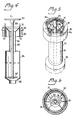
- a knitting machine for producing a plant guard according to the invention is illustrated in Figs. 4-6.
- the machine is a modified circular knitting machine of the kind used, for example, for knitting stockings.
- the machine comprises conventionally a knitting cylinder 30 provided with knitting needles 31 and sinker means 32.
- a dial plate 33 is arranged to sever the knitting thread when changing to a new type of thread.
- the knitting cylinder 30 and the dial plate 33 rotate about an external tube 34 in a conventional manner.
- the plant guards are manufactured in a continuous sequence, the guards being mutually connected together by means of respective loops 18.
- a guide tube 35 is arranged centrally in the outer tube 34, and extends through the knitting cylinder 30 up to the dial plate 33.
- the guide tube 35 is suspended from the dial plate with the aid of a coupling 39 so arranged that the guide tube rotates at the same speed as the dial plate, and therewith the knitting cylinder.
- the guide tube opens into a collecting housing 36 which is placed under a given sub-pressure, so as to successively draw down by suction the knitted plant guards located around said guide tube.
- the plant guards move down against a rubber plate and subsequent to manufacturing a given number of guards, for example one hundred guards, the knitting machine is stopped and a removable bottom 38 removed from the collecting housing together with the rubber plate 37, so as to enable the guards to be drawn from the guide tube and collected on the storage and applicator tube 19.
- the diameter of the tube 19 is greater than that of the guide tube, and hence the guards are suitably transferred with the aid of a conical transfer device (not shown), to simplify handling of the plant guards.
- Knitting of each individual guard commences with the bottom part 13, there being first knitted an inlay incorporating about three rows of thread in the bottom part of the guard.
- This thread suitably comprises a covered elastomeric thread, for example a thread retailed under the designation LYCRA. Knitting then continues with a conventional stocking stitch for about three rows, the inlay being stitched in so as to be incorporated in a further row.
- the hang-threads 14 are then stitched, this being effected by lifting solely two mutually opposite knitting needles 31a to take thread,while holding all remaining needles in a lowered position. From two to four rows are suitably knitted in this way. These needles are then drawn down while two other needles displaced through 90° with respect to the previously mentioned needles are lifted to take thread for a corresponding number of rows, so as to form a cruciform bottom part. Knitting is suitably effected in at least two stitching systems around the guide tube 35, so that the tube is located in the centre of the cruciform, as shown in Figs. 5 and 6. This facilitates guiding of the plant guards along the tube 35 and the transfer of said guards to the storage and applicator tube 19. Knitting is then continued with a conventional stocking stitch for at least three rows with the same elastomeric thread.
- the bottom part 13 of the net is now completed and knitting continues with the lower part 12 of the guard.
- This part of the guard is preferbly knitted in a thread which will dissolve relatively quickly in the ground, so that the root system of the plant is able to develop unhindered.
- the thread used is suitably an untreated and unbleached cotton thread having a thickness Ne of 50/1--60/1.
- the cotton thread is knitted in conventional stocking stitch for from ten to fifteen rows, i.e. two to three centimetres.
- the main part 11 of the guard is then knitted, suitably using a highly durable yarn, particularly a yarn which can withstand ultraviolet radiation, so that the yarn remains intact for at least the first four years.
- the yarn or thread is not excessively coarse or the stitches excessively tight so as to unnecessarily prevent photosynthesis.
- a smooth polyamide thread for example a 1/50 denier nylon. Knitting is suitably effected in the so-called micromesh knitting mode, which provides a suitable loop form and an elastic net.
- the length of the main part of the guard is adapted to the size of the plants to be planted and consequently is normally from 15-40 cm.
- the closure thread is stitched together therewith.
- the yarn used for the closure thread shall possess properties which enable it to pass readily through knitting eyes when stretched and which render the thread self-locking ;ahen tension is removed.
- Crimped polyamide thread has been found a suitable yarn in this respect.
- the tensile strength of the thread shall greatly exceed that of the thread in the bottom part 30 of the guard, so that the loops 18 are not torn apart during planting work.
- An example of suitable thread in this respect is 1/78 denier nylon.
- closure thread is knitted with solely one system and commences with stocking stitch for one row, whereafter two knitting needles are drawn down in the knitting cylinder and take therewith two loops, to remain in this position until the next knitting sequence is ready.
- a further two, three rows of closure thread are drawn through the loops in the first knitted row, whereafter the last row 24 is suitably knitted with a covered elastomeric thread, for example a thread of the same kind used in the bottom part of the guard.
- a single knitting system is also used in this respect, because the loops 18 would otherwise be dropped, since the second knitting system is used to couple said loops, This assumes that the machine only has two knitting systems.
- Stitching is terminated subsequent to knitting three to six rows, although the downwardly drawn needles are held in their lowered positions.
- Manufacture of the next plant guard then begins in the same manner, with an introductory stage, whereafter all needles are lifted, including the two downwardly drawn needles, and knitting commences, the knitting thread extending through the two loops 18.
- Figs. 5 and 6 illustrate the manufacturing stage in which the hang-threads in the next following guard are newly produced. Stitching then continues in the aforedescribed manner.
Landscapes
- Engineering & Computer Science (AREA)
- Textile Engineering (AREA)
- Life Sciences & Earth Sciences (AREA)
- Environmental Sciences (AREA)
- Zoology (AREA)
- Health & Medical Sciences (AREA)
- General Health & Medical Sciences (AREA)
- Toxicology (AREA)
- Birds (AREA)
- Catching Or Destruction (AREA)
- Knitting Of Fabric (AREA)
- Protection Of Plants (AREA)
- External Artificial Organs (AREA)
- Organic Low-Molecular-Weight Compounds And Preparation Thereof (AREA)
- Cultivation Of Plants (AREA)
- Breeding Of Plants And Reproduction By Means Of Culturing (AREA)
- Saccharide Compounds (AREA)
- Executing Machine-Instructions (AREA)
- Beans For Foods Or Fodder (AREA)
Priority Applications (1)
| Application Number | Priority Date | Filing Date | Title |
|---|---|---|---|
| AT85850221T ATE58044T1 (de) | 1984-07-05 | 1985-06-27 | Pflanzenschutzvorrichtung sowie verfahren und vorrichtung zu seiner herstellung. |
Applications Claiming Priority (2)
| Application Number | Priority Date | Filing Date | Title |
|---|---|---|---|
| SE8403576A SE448930B (sv) | 1984-07-05 | 1984-07-05 | Plantskydd bestaende av ett stickat slangformigt net for skydd av plantor mot angrepp av skadedjur samt forfarande for tillverkning av plantskyddet |
| SE8403576 | 1984-07-05 |
Publications (3)
| Publication Number | Publication Date |
|---|---|
| EP0168367A2 true EP0168367A2 (fr) | 1986-01-15 |
| EP0168367A3 EP0168367A3 (en) | 1987-04-08 |
| EP0168367B1 EP0168367B1 (fr) | 1990-11-07 |
Family
ID=20356456
Family Applications (1)
| Application Number | Title | Priority Date | Filing Date |
|---|---|---|---|
| EP85850221A Expired - Lifetime EP0168367B1 (fr) | 1984-07-05 | 1985-06-27 | Dispositif protecteur pour plantes et méthode et dispositif pour sa fabrication |
Country Status (11)
| Country | Link |
|---|---|
| US (1) | US4750292A (fr) |
| EP (1) | EP0168367B1 (fr) |
| AT (1) | ATE58044T1 (fr) |
| AU (1) | AU571337B2 (fr) |
| CA (1) | CA1265929A (fr) |
| DE (1) | DE3580408D1 (fr) |
| DK (1) | DK298585A (fr) |
| FI (1) | FI76911C (fr) |
| NO (1) | NO852708L (fr) |
| NZ (1) | NZ212570A (fr) |
| SE (1) | SE448930B (fr) |
Cited By (3)
| Publication number | Priority date | Publication date | Assignee | Title |
|---|---|---|---|---|
| GB2168582A (en) * | 1984-12-20 | 1986-06-25 | Rolinx Ltd | A shelter for trees |
| GB2230929A (en) * | 1989-05-05 | 1990-11-07 | John Athelstan Jones | Protective sleeve for plants |
| EP0856249A3 (fr) * | 1997-01-31 | 1999-10-20 | Albin Heeb | Dispositif pour empêcher des dégâts à l'écorce des feuillus et conifères |
Families Citing this family (18)
| Publication number | Priority date | Publication date | Assignee | Title |
|---|---|---|---|---|
| USD311796S (en) | 1987-04-24 | 1990-10-30 | Collins Christopher G | Reclosable debris bag for pool cleaners |
| CA1283515C (fr) * | 1989-09-29 | 1991-04-30 | Greg Ogilvie | Sachet pour pain de savon |
| US5241783A (en) * | 1990-08-30 | 1993-09-07 | Krueger Scott D | Apparatus and process for growing plants |
| US6058651A (en) * | 1995-06-02 | 2000-05-09 | Perez; Jose L. | Hanging plant apparatus |
| US5830119A (en) * | 1996-04-25 | 1998-11-03 | Chen; Yu-Lin | Bag with closure tie and method of making |
| US6018906A (en) * | 1997-01-31 | 2000-02-01 | Pia; Richard E. | Mushroom bed structure |
| US20030159342A1 (en) * | 2002-02-22 | 2003-08-28 | Fermin Ruiz | Controlled ripening protective cover for agricultural products |
| US6643978B2 (en) | 2002-02-26 | 2003-11-11 | Timothy Key Price | Collapsible water reservoir pot |
| EP1634492B1 (fr) * | 2003-05-23 | 2007-12-12 | Manuel Foix Robert | Dispositif de protection d'articles divers contre les oiseaux, les insectes et la poussiere |
| ES2220221A1 (es) * | 2003-05-23 | 2004-12-01 | Manuel Foix Robert | Un dispositivo protector de articulos diversos contra pajaros, insectos y polvo. |
| US20050172550A1 (en) * | 2004-01-02 | 2005-08-11 | Environmental Quality Resources, L.L.C. | Tree shelter |
| US20050172548A1 (en) * | 2004-02-09 | 2005-08-11 | Bement Ronald A. | Frost protection for plants |
| US20060032133A1 (en) * | 2004-07-28 | 2006-02-16 | Tuoriniemi Veijo M | Protective elastic sleeve |
| CA2524743C (fr) * | 2005-10-27 | 2012-04-10 | Patrick King | Couvre-sac a dechets |
| US9398746B1 (en) | 2012-02-07 | 2016-07-26 | Daniel Scott Schweitzer | Protection device that segregates burrowing animals from plants |
| AU2015217665B2 (en) * | 2014-02-11 | 2018-09-27 | Nine Ip Limited | Netting materials |
| US10231384B2 (en) * | 2016-04-05 | 2019-03-19 | Anna Lynette Edwards | Apparatus to suspend bouquets in a vehicle |
| DE102020108122B3 (de) * | 2020-03-24 | 2021-06-17 | Alfred Buck | Rohrartiges Rundgestrick und Verfahren hierzu |
Family Cites Families (28)
| Publication number | Priority date | Publication date | Assignee | Title |
|---|---|---|---|---|
| US1807819A (en) * | 1931-06-02 | Device for loading explosives in wells | ||
| US735217A (en) * | 1900-12-06 | 1903-08-04 | Julius De Long | Pneumatic apparatus for producing mats or bats of fibrous material. |
| FR633293A (fr) * | 1926-09-04 | 1928-01-26 | Pot à plantes | |
| US1926053A (en) * | 1931-04-10 | 1933-09-12 | Orville B Morgan | Plant protector |
| US1894506A (en) * | 1931-06-17 | 1933-01-17 | Wilson Clarence Ellsworth | Wrapping for plants |
| US1988886A (en) * | 1933-03-20 | 1935-01-22 | Clarence E Wilson | Protective covering for plants |
| AT209796B (de) * | 1957-05-20 | 1960-06-25 | Anton Johann Riediger | Verpackungsbeutel |
| US2989828A (en) * | 1958-09-04 | 1961-06-27 | Flex O Glass Inc | Plastic plant package |
| US3380220A (en) * | 1963-09-03 | 1968-04-30 | Dow Chemical Co | Plastic bag tree packaging |
| US3184890A (en) * | 1963-10-03 | 1965-05-25 | Leo S Mckey | Planting pot |
| US3322176A (en) * | 1964-08-21 | 1967-05-30 | Geller Helen | Expandable shopping bag |
| DE1804926A1 (de) * | 1968-10-24 | 1970-05-27 | Klaus Sontag | Schutzvorrichtung fuer Pflanzen |
| US3709263A (en) * | 1970-09-08 | 1973-01-09 | Thiokol Chemical Corp | Woven fabric for nursery plant root balls |
| US3662490A (en) * | 1970-09-25 | 1972-05-16 | Robert S Childs | Method and apparatus for packaging trees for transplanting |
| US4006561A (en) * | 1971-02-05 | 1977-02-08 | Pflanz-Frisch Transportsack Gmbh | Plant package and method of preparing the same |
| US3788003A (en) * | 1971-07-19 | 1974-01-29 | Res Council Alberta | Seedling container |
| US4016678A (en) * | 1974-01-24 | 1977-04-12 | Conwed Corporation | Seedling transplant containers |
| CH598746A5 (fr) * | 1975-11-04 | 1978-05-12 | Breveteam Sa | |
| NL7600654A (nl) * | 1976-01-22 | 1977-07-26 | Maasbach Pieter Cornelis | Werkwijze voor het behandelen van gewas en daar- bij toe te passen middelen. |
| NL162874C (nl) * | 1977-04-07 | 1982-10-18 | Amtac Bv | Inrichting voor het verpakken van een kluit van een boom, struik of plant. |
| US4091925A (en) * | 1977-08-15 | 1978-05-30 | Standun, Inc. | Snag resistant vented flower sleeve |
| IT1163730B (it) * | 1979-10-23 | 1987-04-08 | Verde Srl Centro | Confezione per la protezione e la conservazione prolungata di piante vive e fiori recisi |
| US4333265A (en) * | 1980-03-13 | 1982-06-08 | Arnold Richard L | Air drop planting system and improved planting device for same |
| EP0039115B1 (fr) * | 1980-04-25 | 1984-04-18 | Koninklijke Emballage Industrie Van Leer B.V. | Emballage contenant des plantes en pot |
| US4357884A (en) * | 1980-08-25 | 1982-11-09 | Henry J. Rast, Jr. | Plant protection system |
| NL8005568A (nl) * | 1980-10-08 | 1982-05-03 | Hemmer Krebs B V | Werkwijze en inrichting voor het met een elastische kous omhullen van de kluit van een plant, struik of boom. |
| NL8203460A (nl) * | 1982-09-06 | 1984-04-02 | Herman Eduard Marie Van Bannin | Systeem voor het verpakken van bloemen, planten, heesters, jonge bomen en andere sierteelt-produkten en vanuit gelijke methode/werkwijze het verpakken van wortelkluiten van voornoemde produkten. |
| SE449153B (sv) * | 1983-01-21 | 1987-04-13 | Bo Lofqvist | System for skydd av plantor mot insektsangrepp samt plantskydd avsett att inga i systemet |
-
1984
- 1984-07-05 SE SE8403576A patent/SE448930B/sv not_active IP Right Cessation
-
1985
- 1985-06-27 DE DE8585850221T patent/DE3580408D1/de not_active Expired - Fee Related
- 1985-06-27 AT AT85850221T patent/ATE58044T1/de not_active IP Right Cessation
- 1985-06-27 CA CA000485739A patent/CA1265929A/fr not_active Expired - Fee Related
- 1985-06-27 EP EP85850221A patent/EP0168367B1/fr not_active Expired - Lifetime
- 1985-06-27 NZ NZ212570A patent/NZ212570A/en unknown
- 1985-06-27 AU AU44232/85A patent/AU571337B2/en not_active Ceased
- 1985-06-28 FI FI852582A patent/FI76911C/fi not_active IP Right Cessation
- 1985-07-01 DK DK298585A patent/DK298585A/da not_active Application Discontinuation
- 1985-07-04 NO NO852708A patent/NO852708L/no unknown
-
1987
- 1987-04-10 US US07/037,124 patent/US4750292A/en not_active Expired - Fee Related
Cited By (3)
| Publication number | Priority date | Publication date | Assignee | Title |
|---|---|---|---|---|
| GB2168582A (en) * | 1984-12-20 | 1986-06-25 | Rolinx Ltd | A shelter for trees |
| GB2230929A (en) * | 1989-05-05 | 1990-11-07 | John Athelstan Jones | Protective sleeve for plants |
| EP0856249A3 (fr) * | 1997-01-31 | 1999-10-20 | Albin Heeb | Dispositif pour empêcher des dégâts à l'écorce des feuillus et conifères |
Also Published As
| Publication number | Publication date |
|---|---|
| AU4423285A (en) | 1986-01-09 |
| DE3580408D1 (de) | 1990-12-13 |
| SE8403576L (sv) | 1986-01-06 |
| DK298585A (da) | 1986-01-06 |
| NZ212570A (en) | 1987-10-30 |
| SE8403576D0 (sv) | 1984-07-05 |
| FI76911B (fi) | 1988-09-30 |
| DK298585D0 (da) | 1985-07-01 |
| CA1265929A (fr) | 1990-02-20 |
| US4750292A (en) | 1988-06-14 |
| NO852708L (no) | 1986-01-06 |
| AU571337B2 (en) | 1988-04-14 |
| FI852582A0 (fi) | 1985-06-28 |
| EP0168367B1 (fr) | 1990-11-07 |
| ATE58044T1 (de) | 1990-11-15 |
| SE448930B (sv) | 1987-03-30 |
| FI852582L (fi) | 1986-01-06 |
| EP0168367A3 (en) | 1987-04-08 |
| FI76911C (fi) | 1989-01-10 |
Similar Documents
| Publication | Publication Date | Title |
|---|---|---|
| EP0168367B1 (fr) | Dispositif protecteur pour plantes et méthode et dispositif pour sa fabrication | |
| DE2450062C3 (de) | Monofilter Aufleitfaden aus Kunststoff für Hopfenreben und Haken für seine Befestigung am Spanndraht | |
| US20060032133A1 (en) | Protective elastic sleeve | |
| US7892377B2 (en) | Dimensionally stable horticultural netting | |
| KR102115591B1 (ko) | 해조류 종묘 양식로프 | |
| JP5144580B2 (ja) | 幼齢木の食害防止用プロテクター | |
| WO2007059345A2 (fr) | Filet horticole avec commande des dimensions | |
| JP3342247B2 (ja) | 長芋用のネット | |
| CN222442534U (zh) | 一种农业种植防病害地布 | |
| JPH0623596Y2 (ja) | 伸縮性ロ−プ | |
| JPH0529012Y2 (fr) | ||
| JPH0624459B2 (ja) | 釣糸の製造方法 | |
| CN112081061A (zh) | 一种落叶收集降解网及其制作方法 | |
| US2256254A (en) | Method for the culture of pineapple plants bearing a ratoon crop | |
| JPS6030930Y2 (ja) | 防護用網地 | |
| KR100330173B1 (ko) | 덩굴풀 식물용 넝쿨 관리기 | |
| KR200253337Y1 (ko) | 낚시용 뜰채 | |
| JPH0135162Y2 (fr) | ||
| AT404214B (de) | Vorrichtung zur verhinderung von schälschäden an laub- und nadelbäumen | |
| KR960004029Y1 (ko) | 작물지지망 | |
| JP2524246Y2 (ja) | 釣り用サビキ仕掛け | |
| JPS5840859Y2 (ja) | 漁業用刺し網 | |
| JP2590532Y2 (ja) | モグラ捕獲具 | |
| JP2025130600A (ja) | 樹木保護用資材 | |
| JPS59900Y2 (ja) | 伸縮性筒状ほう帯 |
Legal Events
| Date | Code | Title | Description |
|---|---|---|---|
| PUAI | Public reference made under article 153(3) epc to a published international application that has entered the european phase |
Free format text: ORIGINAL CODE: 0009012 |
|
| AK | Designated contracting states |
Designated state(s): AT BE CH DE FR GB IT LI LU NL SE |
|
| PUAL | Search report despatched |
Free format text: ORIGINAL CODE: 0009013 |
|
| AK | Designated contracting states |
Kind code of ref document: A3 Designated state(s): AT BE CH DE FR GB IT LI LU NL SE |
|
| 17P | Request for examination filed |
Effective date: 19870904 |
|
| 17Q | First examination report despatched |
Effective date: 19881208 |
|
| GRAA | (expected) grant |
Free format text: ORIGINAL CODE: 0009210 |
|
| RAP1 | Party data changed (applicant data changed or rights of an application transferred) |
Owner name: MIBEK AKTIEBOLAG |
|
| AK | Designated contracting states |
Kind code of ref document: B1 Designated state(s): AT BE CH DE FR GB IT LI LU NL SE |
|
| PG25 | Lapsed in a contracting state [announced via postgrant information from national office to epo] |
Ref country code: IT Free format text: LAPSE BECAUSE OF FAILURE TO SUBMIT A TRANSLATION OF THE DESCRIPTION OR TO PAY THE FEE WITHIN THE PRESCRIBED TIME-LIMIT;WARNING: LAPSES OF ITALIAN PATENTS WITH EFFECTIVE DATE BEFORE 2007 MAY HAVE OCCURRED AT ANY TIME BEFORE 2007. THE CORRECT EFFECTIVE DATE MAY BE DIFFERENT FROM THE ONE RECORDED. Effective date: 19901107 Ref country code: SE Effective date: 19901107 Ref country code: AT Effective date: 19901107 Ref country code: NL Effective date: 19901107 Ref country code: BE Effective date: 19901107 Ref country code: CH Effective date: 19901107 Ref country code: LI Effective date: 19901107 |
|
| REF | Corresponds to: |
Ref document number: 58044 Country of ref document: AT Date of ref document: 19901115 Kind code of ref document: T |
|
| REF | Corresponds to: |
Ref document number: 3580408 Country of ref document: DE Date of ref document: 19901213 |
|
| ET | Fr: translation filed | ||
| REG | Reference to a national code |
Ref country code: CH Ref legal event code: PL |
|
| NLV1 | Nl: lapsed or annulled due to failure to fulfill the requirements of art. 29p and 29m of the patents act | ||
| PGFP | Annual fee paid to national office [announced via postgrant information from national office to epo] |
Ref country code: DE Payment date: 19910620 Year of fee payment: 7 |
|
| PGFP | Annual fee paid to national office [announced via postgrant information from national office to epo] |
Ref country code: FR Payment date: 19910628 Year of fee payment: 7 |
|
| PG25 | Lapsed in a contracting state [announced via postgrant information from national office to epo] |
Ref country code: LU Free format text: LAPSE BECAUSE OF NON-PAYMENT OF DUE FEES Effective date: 19910630 |
|
| PLBE | No opposition filed within time limit |
Free format text: ORIGINAL CODE: 0009261 |
|
| STAA | Information on the status of an ep patent application or granted ep patent |
Free format text: STATUS: NO OPPOSITION FILED WITHIN TIME LIMIT |
|
| PGFP | Annual fee paid to national office [announced via postgrant information from national office to epo] |
Ref country code: GB Payment date: 19910920 Year of fee payment: 7 |
|
| 26N | No opposition filed | ||
| PG25 | Lapsed in a contracting state [announced via postgrant information from national office to epo] |
Ref country code: GB Effective date: 19920627 |
|
| GBPC | Gb: european patent ceased through non-payment of renewal fee |
Effective date: 19920627 |
|
| PG25 | Lapsed in a contracting state [announced via postgrant information from national office to epo] |
Ref country code: FR Effective date: 19930226 |
|
| PG25 | Lapsed in a contracting state [announced via postgrant information from national office to epo] |
Ref country code: DE Effective date: 19930302 |
|
| REG | Reference to a national code |
Ref country code: FR Ref legal event code: ST |