EP0168523B1 - Kompletthülle für ein Floppy-Disk - Google Patents
Kompletthülle für ein Floppy-Disk Download PDFInfo
- Publication number
- EP0168523B1 EP0168523B1 EP84113817A EP84113817A EP0168523B1 EP 0168523 B1 EP0168523 B1 EP 0168523B1 EP 84113817 A EP84113817 A EP 84113817A EP 84113817 A EP84113817 A EP 84113817A EP 0168523 B1 EP0168523 B1 EP 0168523B1
- Authority
- EP
- European Patent Office
- Prior art keywords
- jacket
- fibres
- jacket according
- liner
- floppy disk
- Prior art date
- Legal status (The legal status is an assumption and is not a legal conclusion. Google has not performed a legal analysis and makes no representation as to the accuracy of the status listed.)
- Expired
Links
- 239000000835 fiber Substances 0.000 claims description 19
- 239000004745 nonwoven fabric Substances 0.000 claims description 8
- 229920000728 polyester Polymers 0.000 claims description 7
- 239000000203 mixture Substances 0.000 claims description 6
- 239000004952 Polyamide Substances 0.000 claims description 2
- 239000004020 conductor Substances 0.000 claims description 2
- 229920002647 polyamide Polymers 0.000 claims description 2
- 229920000098 polyolefin Polymers 0.000 claims description 2
- 239000000463 material Substances 0.000 abstract description 19
- 238000002372 labelling Methods 0.000 description 5
- 238000003860 storage Methods 0.000 description 5
- 238000005299 abrasion Methods 0.000 description 4
- 238000004519 manufacturing process Methods 0.000 description 3
- 238000000034 method Methods 0.000 description 3
- 230000035699 permeability Effects 0.000 description 3
- 238000005452 bending Methods 0.000 description 2
- 238000009960 carding Methods 0.000 description 2
- 239000000969 carrier Substances 0.000 description 2
- 238000009833 condensation Methods 0.000 description 2
- 230000005494 condensation Effects 0.000 description 2
- 230000002349 favourable effect Effects 0.000 description 2
- 230000000717 retained effect Effects 0.000 description 2
- 229920001634 Copolyester Polymers 0.000 description 1
- 239000004743 Polypropylene Substances 0.000 description 1
- 229920000297 Rayon Polymers 0.000 description 1
- 229910000831 Steel Inorganic materials 0.000 description 1
- 230000015572 biosynthetic process Effects 0.000 description 1
- 239000011248 coating agent Substances 0.000 description 1
- 238000000576 coating method Methods 0.000 description 1
- 238000004040 coloring Methods 0.000 description 1
- 238000007596 consolidation process Methods 0.000 description 1
- 238000001816 cooling Methods 0.000 description 1
- 239000000428 dust Substances 0.000 description 1
- 239000002657 fibrous material Substances 0.000 description 1
- 239000011521 glass Substances 0.000 description 1
- 230000007257 malfunction Effects 0.000 description 1
- 238000002844 melting Methods 0.000 description 1
- 230000008018 melting Effects 0.000 description 1
- 239000003960 organic solvent Substances 0.000 description 1
- 239000002245 particle Substances 0.000 description 1
- 239000004033 plastic Substances 0.000 description 1
- 229920003023 plastic Polymers 0.000 description 1
- -1 polypropylene Polymers 0.000 description 1
- 229920001155 polypropylene Polymers 0.000 description 1
- 229920000915 polyvinyl chloride Polymers 0.000 description 1
- 230000001681 protective effect Effects 0.000 description 1
- 238000007711 solidification Methods 0.000 description 1
- 230000008023 solidification Effects 0.000 description 1
- 239000004071 soot Substances 0.000 description 1
- 230000003068 static effect Effects 0.000 description 1
- 239000010959 steel Substances 0.000 description 1
- 239000004753 textile Substances 0.000 description 1
- 238000003466 welding Methods 0.000 description 1
Images

Classifications
-
- G—PHYSICS
- G11—INFORMATION STORAGE
- G11B—INFORMATION STORAGE BASED ON RELATIVE MOVEMENT BETWEEN RECORD CARRIER AND TRANSDUCER
- G11B23/00—Record carriers not specific to the method of recording or reproducing; Accessories, e.g. containers, specially adapted for co-operation with the recording or reproducing apparatus ; Intermediate mediums; Apparatus or processes specially adapted for their manufacture
- G11B23/02—Containers; Storing means both adapted to cooperate with the recording or reproducing means
- G11B23/03—Containers for flat record carriers
-
- G—PHYSICS
- G11—INFORMATION STORAGE
- G11B—INFORMATION STORAGE BASED ON RELATIVE MOVEMENT BETWEEN RECORD CARRIER AND TRANSDUCER
- G11B23/00—Record carriers not specific to the method of recording or reproducing; Accessories, e.g. containers, specially adapted for co-operation with the recording or reproducing apparatus ; Intermediate mediums; Apparatus or processes specially adapted for their manufacture
- G11B23/02—Containers; Storing means both adapted to cooperate with the recording or reproducing means
- G11B23/03—Containers for flat record carriers
- G11B23/033—Containers for flat record carriers for flexible discs
- G11B23/0332—Containers for flat record carriers for flexible discs for single discs, e.g. envelopes
Definitions
- the invention relates to a complete casing (hereinafter also called jacket) for a floppy disk.
- Such data carriers consist of a flexible disk coated with magnetizable material, which is located in a casing and rotates during use.
- the jacket usually consists of a PVC film (cover) facing the outside, which is lined on the inside with a non-woven material (liner).
- the purpose of the PVC film is to ensure the necessary stability and flexibility for the sleeve during use and storage of the disk. It is also intended to protect the data carrier from external mechanical damage.
- the main task of the liner is to gently and smoothly pick up dust particles accumulating on the data carrier during operation and to ensure a low, uniform torque of the magnetic disk in the sleeve. It also prevents the magnetizable coating from coming into direct contact with the PVC material and thus causing scratches on the pane.
- Floppy disk sleeves with a PVC cover have a temperature resistance of 10 ° C to approx. 70 ° C; these values are dictated by the thermal behavior of the PVC film. Difficulties with regard to the temperature resistance of floppy disk cases (storage and transport in motor vehicles, sunlit workplaces behind glass, storage on cooling surfaces of office machines) made it necessary to search for new jacket materials that would push the PVC cover to the limit of its thermal strength can replace.
- DE-B-23 25 715 describes a protective cover for an information carrier, in particular for an image plate, the cover consisting of paper or a plastic (not specified in more detail) and the liner consisting of a nonwoven layer.
- a cover is temperature-resistant within wide limits when using paper as cover material.
- the problem of labeling / printing is also solved.
- the outside of the casing cannot have the mechanical properties required for protecting the disk, such as tensile and scratch resistance.
- the liner is laminated onto the paper, its already poor moisture permeability is reduced even further, so that in this respect the product again has almost the disadvantageous properties of a PVC film. This fact is not so important if the jacket, as described in the above-mentioned design specification, only serves for the storage and handling of the information carrier and that it is outside during operation. the case is located.
- GB-A-20 96 194 describes an outer cover made of non-woven material for records. This also suggests their application for floppy disks.
- this "sleeve" is electrically conductive and primarily has the task of protecting the record against static charge only during storage and handling, ie outside of the recording / playback device. The requirements here are completely different due to the different task, since the "sleeve" is not in the playback unit during operation. The findings of the above British publication are therefore not transferable to jackets for floppy disks.
- the invention has for its object to develop a complete jacket (jacket) for floppy disks, which avoids the use of a PVC film, is easy to manufacture and has a temperature resistance of over 80 ° C.
- the outside of the envelope (cover) should be fine-pored and of high porosity in order to ensure an improved moisture exchange. Furthermore, this outside should be inscribable and printable with common materials and processes.
- the favorable properties of the PVC film according to the prior art, such as stability, flexibility, abrasion resistance, weldability and thickness, should largely be retained.
- the tried and tested liner material nonwoven has to serve as the inner lining as before.
- the nonwoven preferably consists of polyester, polyamide, polyolefin, PVC fibers, also as heterofil fibers, or fiber mixtures.
- Printing the nonwoven on its cover side is, for example, ordinary Textile printing process possible. Furthermore, due to its light color and its porosity, this surface is ideally suited for labeling with ink, ballpoint or felt pens. To make it easier to print or label, to increase stiffness, for coloring or as an anti-static treatment, the outside can be provided with the usual finishes for nonwovens. Due to its high porosity, the entire casing has a high moisture permeability over its entire thickness. Condensation is reliably avoided. The temperature resistance of the casing is fully guaranteed under all realistic operating conditions due to the fiber material used. Last but not least, high stiffness values - they are supported in the example by numerical data - characterize the jacket according to the invention.
- the casing can be constructed in one layer, preferably in multiple layers: in this embodiment, the number and sequence of the individual layers can be set in a targeted manner depending on the desired abrasion and rigidity values.
- the jacket according to the invention is preferably spot-welded in its multilayer design, on the one hand to ensure good moisture permeability and high flexibility, and on the other hand to ensure firm cohesion of the individual layers.
- FIGS. 1 to 3 is intended to illustrate the structure and properties of a preferred, multilayer embodiment of the jacket according to the present invention, without in any way restricting the scope thereof as defined in the claims.
- a fiber mixture of 100% thermally activatable binding fibers preferably heterofil fibers based on polyester / copolyester with a titer of 3.3 dtex and a melting point of 225 ° C.
- the solidification takes place in a hot air oven 7 with subsequent calibration in a press unit 8 to form a fine-pored nonwoven.
- the nonwoven fabric thus obtained has a weight of 200 g / m 2 and forms the abrasion-resistant outside 5 a (cover) of the jacket.
- a fiber mixture of 100% polyester homofil fibers with a titer of 1.7 dtex is placed inline on this nonwoven fabric 5 a via a carding machine 4 on a conveyor belt 9 to form a nonwoven fabric 10.
- the nonwoven has a weight of 30 g / m 2 .
- the consolidation and connection takes place here according to the spot-welding technique in a calender 11 with a smooth steel roller 13 and an engraved roller 12.
- the applied fleece is formed in such a way that it corresponds to a liner material and the inside 10 of the jacket forms.
- the finished material with a weight of 230 g / m 2 is rolled up with the reel 14. It has a structure according to FIG. 2.
- a complete sleeve 16 according to the invention can be punched out of this sheet material (FIG. 3), which is folded together and provided with a floppy disk 15.
- the jacket 16 manufactured in the manner described with a weight of 230 g / m 2 shows the same stiffness properties as a corresponding cover material based on a PVC film (approx. 300 g / m 2 ) with a nonwoven liner (approx 35 g / m2), which is usually used for this.
- the nonwoven fabric cover according to the invention can also be varied in stiffness by changing the fiber composition without increasing the weight per square meter.
- a fiber blend of 70% polyester heterofil fibers (3.3 dtex) and 30% polyester homofil fibers (1.7 dtex) corresponding values were achieved in the stiffness test compared to a stiffer PVC film with a weight of 350 g per square meter (table 2):
Landscapes
- Packaging For Recording Disks (AREA)
- Laminated Bodies (AREA)
- Magnetic Record Carriers (AREA)
- Holding Or Fastening Of Disk On Rotational Shaft (AREA)
- Nonwoven Fabrics (AREA)
- Polishing Bodies And Polishing Tools (AREA)
- Supplying Of Containers To The Packaging Station (AREA)
- Electrochromic Elements, Electrophoresis, Or Variable Reflection Or Absorption Elements (AREA)
Description
- Die Erfindung betrifft eine Kompletthülle (im folgenden auch Jacket genannt) für ein Floppy-Disk. Derartige Datenträger bestehen aus einer mit magnetisierbarem Material beschichteten, flexiblen Scheibe, welche sich in einer Hülle befindet und während des Gebrauchs eine Drehbewegung vollführt. Das Jacket besteht in der Regel aus einer der Außenseite zugewandten PVC-Folie (cover), welche innen mit einem Vliesstoff (liner) ausgekleidet ist.
- Die PVC-Folie hat die Aufgabe, für die Hülle die notwendige Standigkeit und Flexibilität während Gebrauch und Lagerung der Diskette zu gewährleisten. Ferner soll sie den Datenträger vor mechanischer Beschädigung von außen schützen. Hauptaufgabe des Liners ist es, während des Betriebes auf dem Datenträger anfallende Staubpartikel sanft gleitend aufzunehmen und ein niedriges, gleichmäßiges Drehmoment der Magnetscheibe in der Hülle sicherzustellen. Ferner wird dadurch vermieden, daß die magnetisierbare Beschichtung direkt mit dem PVC-Material in Berührung kommt und so Kratzer auf der Scheibe entstehen.
- Floppy-Disk-Hüllen mit einem PVC-Cover haben eine Temperaturbeständigkeit von 10°C bis ca. 70 °C; diese Werte werden von dem thermischen Verhalten der PVC-Folie diktiert. Schwierigkeiten bezüglich der Temperaturbeständigkeit von Floppy-Disk-Hüllen (Lagerung und Transport in Kraftfahrzeugen, sonnenbeschienene Arbeitsplätze hinter Glas, Ablage auf Kühlflächen von Büromaschinen) machten die Suche nach neuen Jacket-Materialien erforderlich, welche das an die Grenze seiner thermischen Belastbarkeit gelangte PVC-Cover ersetzen können.
- Ferner kann das Fehlen der Porosität in der PVC-Folie unter extremen Temperaturbedingungen bei Anwesenheit von Feuchtigkeit zu unerwünschter Kondenswasserbildung auf der Floppy-Disk führen. Da eine Perforation der Folie bisher nur unzulänglich Abhilfe brachte, mußte auch aus diesem Grunde nach geeigneten Ersatzmaterialien gesucht werden.
- Oft ist es wünschenswert, das Cover der Floppy-Disk-Hülle, z. B. zu Werbe- oder Kennzeichnungszwecken, bedruckbar bzw. beschriftbar auszugestalten. Von organischen Lösungsmitteln freie Schreibgeräte (gewöhnliche Faserschreiber, Kugelschreiber und Bleistifte) sind zum Beschriften von PVC-Folie jedoch nicht geeignet. Eine Kennzeichnungsmöglichkeit ohne Verwendung von Aufklebern würde zu einer erheblichen Verbesaerung bezüglich der Handhabung von Disketten führen. Auch aus diesem Grunde ist ein Ersatz des PVC-Covers wünschenswert.
- In jedem Falle aollen jedoch die günstigen Eigenschaften des Liners (Vlieastoff) erhalten bleiben.
- Die DE-B-23 25 715 beschreibt eine Schutzhülle für einen Informationsträger, insbesondere für eine Bildplatte, wobei das Cover aus Papier oder einem nicht näher bezeichneten Kunststoff und der Liner aus einer Faservliesschicht besteht. Eine solche Hülle ist bei Verwendung von Papier als Cover-Material in weiten Grenzen temperaturbeständig. Ebenso ist das Problem der Beschriftbarkeit/ Bedruckbarkeit gelöst. Die Hüllenaußenseite kann jedoch nicht die für den Schutz der Diskette erforderlichen mechanischen Eigenschaften, wie Zug-und Ritzfestigkeit, aufweisen. Außerdem wird beim Aufkaschieren des Liners auf das Papier dessen ohnehin schlechte Feuchtigkeitsdurchlässigkeit noch weiter erniedrigt, so daß das Produkt in dieser Beziehung wieder nahezu die nachteiligen Eigenschaften einer PVC-Folie erhält. Dieser Umstand ist nicht so sehr von Bedeutung, wenn das Jacket, wie in der erwähnten Auslegeschrift beschrieben, allein der Lagerung und Handhabung des Informationsträgers dient und dieser sich während des Betriebes außerhalb. der Hülle befindet.
- Für ein auch während Aufnahme und Wiedergabe in seiner Hülle verbleibendes Floppy-Disk ist ein solches Material jedoch unter diesen Umständen ungeeignet.
- GB-A-20 96 194 beschreibt eine Außenhülle aus Vliesstoff für Schallplatten. Hierin wird auch deren Anwendungsmöglichkeit für Floppy-Disks vorgeschlagen. Dieses "sleeve" ist jedoch elektrisch leitend und hat in erster Linie die Aufgabe, die Schallplatte lediglich bei Lagerung und Handhabung, also außerhalb dea Aufnahme-/Wiedergabe-Gerätes, umhüllend zu schützen gegen statische Aufladung. Die gestellten Anforderungen sind hier also aufgrund der andersartigen Aufgabenstellung völlig andere, da das "sleeve" sich während des Betriebes nicht in der Abspieleinheit befindet. Auf Jackets für Floppy-Disks sind die Erkenntnisse der obigen britischen Druckschrift daher nicht übertragbaf.
- Der Erfindung liegt die Aufgabe zugrunde, eine Kompletthülle (jacket) für Floppy-Disks zu entwickeln, welche die Anwendung einer PVC-Folie vermeidet, einfach zu fertigen ist und eine Temperaturbeständigkeit von über 80°C aufweist. Dabei soll die Hüllenaußenseite (cover) feinporig und von hoher Porosität sein, um einen verbesserten Feuchtigkeitsaustausch zu gewährleisten. Ferner soll diese Außenseite mit gebräuchlichen Materialien und Verfahren beschriftbar und bedruckbar sein. Die günstigen Eigenschaften der PVC-Folie nach dem Stand der Technik, wie Standigkeit, Flexibilität, Abriebfestigkeit, Verschweißbarkeit und Dicke, sollen weitgehend erhalten bleiben. Das bewährte Liner-Material Vliesstoff hat dabei wie bisher als Innenauskleidung zu dienen.
- Alle diese Aufgaben werden in einfacher Weise gelöst durch eine Kompletthülle (jacket), welche zur Gänze aus ein- oder mehrschichtigem Vliesstoff besteht. Wesentlich ist ferner, daß der Vliesstoff eine glatte und abriebfeste, poröse Außenseite, welche die Aufgaben eines Covers übernimmt, und eine weiche, faserige Innenseite aufweist, welche den bisherigen Liner ersetzt. Cover und Liner sind somit aus demselben Material. Der Vliesstoff besteht vorzugsweise aus Polyester-, Polyamid-, Polyolefin-, PVC-Fasern, auch als Heterofil-Fasern, oder Fasernmischungen.
- Ein Bedrucken des Vliesstoffes auf seiner Cover-Seite ist beispielsweise mit gewöhnlichen Textildruckverfahren möglich. Ferner ist diese Fläche sowohl aufgrund ihrer hellen Farbe als auch ihrer Porosität für die Beschriftung mit Tinte, Kugel- oder Filzschreiber hervorragend geeignet. Zur Erleichterung der Bedruck- oder Beschriftbarkeit, zur Erhöhung der Steifigkeit, zur Einfärbung oder als Antistatikausrüstung kann die Außenseite mit den bei Vliesstoffen üblichen Finishs versehen sein. Die Kompletthülle besitzt aufgrund ihrer hohen Porosität über ihre Gesamtdicke eine hohe Feuchtigkeitsdurchlässigkeit. Schwitzwasserbildung wird somit zuverlässig vermieden. Die Temperaturbeständigkeit der Hülle ist unter allen realistischen Einsatzbedingungen aufgrund des eingesetzten Fasermaterials voll gewährleistet. Nicht zuletzt zeichnen hohe Steifigkeitswerte - sie werden im Beispiel durch Zahlenangaben belegt - das erfindungsgemäße Jacket aus.
- Die Hülle kann gemäß der Erfindung ein-, vorzugsweise mehrschichtig aufgebaut sein: Anzahl und Aufeinanderfolge der einzelnen Schichten können bei dieser Ausführungsform je nach den gewünschten Abrieb- und Steifigkeitswerten gezielt eingestellt werden.
- Vorzugsweise ist das erfindungsgemäße Jacket in seiner mehrschichtigen Ausführung punktverschweißt, um einerseits gute Feuchtigkeitsdurchlässigkeit und hohe Flexibilität, andererseits festen Zusammenhalt der einzelnen Schichten zu gewährleisten.
- Zur Vermeidung von Störungen elektrostatischer Art, wie sie häufig beim Betrieb magnetischer Datenträger auftreten, ist es üblich, Cover und/oder Liner von Floppy-Disk-Hüllen mit elektrisch leitfähigen Materialien zu versehen. Dies gelingt bei der erfindungsgemäßen Ausführungsform besonders elegant dann, wenn ein Teil der Fasern in dem verwendeten Vliesstoff elektrisch leitfähig ist. Mit der Verwendung solcher Fasern ist es möglich, eine Kompletthülle in einer besonders bevorzugten Ausführungsform herzustellen, deren elektrischer Oberflächenwiderstand ROT (gemessen nach DIN 54 345, BI. 1) und Durchgangswiderstand RD (gemessen nach DIN 53 482), unabhängig von der Feuchtigkeit und auch bei Temperaturen über 100°C, einen Wert von 109Q, zweckmäßigerweise sogar 10652, nicht überschreitet. Besonders geeignete Fasern dieser Art sind in der deutschen DE-A-33 26 597 beschrieben. Es handelt sich dabei um Polypropylen-, Polyester- und/oder ViskoseFasern, welche 20 bis 40 Gew.-%, bezogen auf das Gesamtgewicht dieser Fasern, eingesponnenen Ruß in fein verteilter Form enthalten.
- Somit entfällt die nachträgliche Ausrüstung des Vliesstoffes mit einem Antistatikum.
- Als beispielhafte Ausführung sind in den Abbildungen eine erfindungsgemäße Floppy-Disk-Hülle sowie deren Herstellung dargelegt. Dabei zeigen:.
- Fig. 1 ein einstufiges Herstellungsverfahren für ein mehrschichtiges Jacket,
- Fig. 2 das Jacket-Material im Querschnitt,
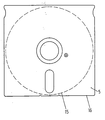
- Fig. 3 die fertige Kompletthülle mit dem Floppy-Disk.
- Das folgende Beispiel mit den Figuren 1 bis 3 soll Aufbau und Eigenschaften einer bevorzugten, mehrschichtigen Ausführungsform des Jackets gemäß der vorliegenden Erfindung verdeutlichen, ohne deren in den Ansprüchen festgelegten Umfang in irgendeiner Weise einzuschränken.
- Eine Fasermischung aus 100 % thermisch aktivierbaren Bindefasern, vorzugsweise Heterofil-Fasern auf Basis Polyester/Co-Polyester mit einem Titer von 3,3 dtex und einem Schmelzpunkt von 225°C, wird über eine Krempelanlage 1, 2, 3 auf einem Transportband 6 zu einem Faservlies 5 gelegt. (Figur 1). Die Verfestigung erfolgt in einem Heißluftofen 7 mit anschließender Kalibrierung in einem Preßwerk 8 zur Ausbildung eines feinporigen Vliesstoffes. Der so erhaltene Vliesstoff hat ein Gewicht von 200 g/m2 und bildet die abriebfeste Außenseite 5 a (cover) des Jackets. Auf diesen Vliesstoff 5 a wird inline eine Fasermischung aus 100 % Polyester-Homofil-Fasern mit einem Titer von 1,7 dtex über eine Krempelmaschine 4 auf einem Transportband 9 zu einem Vlies 10 gelegt. Das Faservlies hat ein Gewicht von 30 g/m2. Die Verfestigung und Verbindung erfolgt hier nach der Punkt-Schweiß-Technik in einem Kalander 11 mit einer glatten Stahlwalze 13 und einer gravierten Walze 12. Das aufgebrachte Vlies wird dadurch so ausgebildet, daß es einem Liner-Material entspricht in und die Innenseite 10 des Jackets bildet. Das Fertigmaterial mit einem Gewicht von 230 g/m2 wird mit der Aufrollung 14 aufgerollt. Es besitzt einen Aufbau gemäß Figur 2. Aus diesem Bahnenmaterial kann eine erfindungsgemäße Kompletthülle 16 ausgestanzt werden (Figur 3), welche zusammengefaltet und mit einem Floppy-Disk 15 versehen wird.
- Das in der beschriebenen Weise hergestellte Jacket 16 mit einem Gewicht von 230 g/m2 zeigt in den Steifigkeitseigenschaften die gleichen Werte wie ein entsprechendes Hüllenmaterial auf Basis einer PVC-Folie (ca. 300 g/m2) mit einem Vliesstoff-Liner (ca. 35 g/m2), welches üblicherweise hierfür Verwendung findet.
- Um die Steifigkeit in Meßwerten auszudrücken, wurden beide Proben mit dem Steifigkeitsprüfer 58963 der Firma Frank, Birkenau, unter folgenden Bedingungen gemessen (Tabelle 1):
- Probengröße: 30 x 70 mm
- Biegewinkel: 30 °
- Biegeabstand: 10 mm
- Meßbereich: 5 N

- Häufig wurden auch etwas steifere PVC-Folien für das Cover von Floppy-Disk-Hüllen eingesetzt. Die erfindungsgemäße Vliesstoff-Hülle kann durch Änderung der Faserzusammensetzung auch in der Steifigkeit variiert werden, ohne das Quadratmeter-Gewicht zu erhöhen. Mit einer Fasermischung aus 70 % Polyester-Heterofilfasern (3,3 dtex) und 30 % Polyester-Homofilfasern (1,7 dtex) wurden entsprechende Werte bei der Steifigkeitsprüfung gegenüber einer steiferen PVC-Folie mit einem Quadratmeter-Gewicht von 350 g erreicht (Tabelle 2):

-

Claims (6)
Priority Applications (1)
| Application Number | Priority Date | Filing Date | Title |
|---|---|---|---|
| AT84113817T ATE33081T1 (de) | 1984-07-14 | 1984-11-15 | Kompletthuelle fuer ein floppy-disk. |
Applications Claiming Priority (2)
| Application Number | Priority Date | Filing Date | Title |
|---|---|---|---|
| DE3425990 | 1984-07-14 | ||
| DE3425990A DE3425990C2 (de) | 1984-07-14 | 1984-07-14 | Hülle für ein während des Gebrauchs darin rotierendes Floppy-Disk |
Publications (2)
| Publication Number | Publication Date |
|---|---|
| EP0168523A1 EP0168523A1 (de) | 1986-01-22 |
| EP0168523B1 true EP0168523B1 (de) | 1988-03-16 |
Family
ID=6240646
Family Applications (1)
| Application Number | Title | Priority Date | Filing Date |
|---|---|---|---|
| EP84113817A Expired EP0168523B1 (de) | 1984-07-14 | 1984-11-15 | Kompletthülle für ein Floppy-Disk |
Country Status (11)
| Country | Link |
|---|---|
| US (1) | US4724501A (de) |
| EP (1) | EP0168523B1 (de) |
| JP (1) | JPS6139989A (de) |
| KR (1) | KR900006312B1 (de) |
| AT (1) | ATE33081T1 (de) |
| BR (1) | BR8500647A (de) |
| CA (1) | CA1259131A (de) |
| DE (2) | DE3425990C2 (de) |
| ES (1) | ES283209Y (de) |
| HK (1) | HK6991A (de) |
| ZA (1) | ZA851558B (de) |
Families Citing this family (19)
| Publication number | Priority date | Publication date | Assignee | Title |
|---|---|---|---|---|
| JPS61181852A (ja) * | 1985-02-06 | 1986-08-14 | Shin Etsu Chem Co Ltd | フロツピ−デイスクジヤケツト用塩化ビニル系樹脂組成物 |
| DE8703847U1 (de) * | 1987-03-14 | 1987-04-23 | Hoechst Ag, 6230 Frankfurt | Verpackungshülle für scheibenförmige magnetische Informationsträger |
| US4845583A (en) * | 1987-05-07 | 1989-07-04 | Bonar Fabrics Corporation | Record diskette or disk jackets lined with powder bonded nonwoven fabrics |
| US4837652A (en) * | 1987-06-11 | 1989-06-06 | Kerby Thomas D | Method and apparatus for indexing and labeling electronic disks |
| JPH01181168U (de) * | 1988-06-11 | 1989-12-27 | ||
| US5161770A (en) * | 1990-12-19 | 1992-11-10 | Integral Peripherals, Inc. | Shock absorbent mounting arrangement for disk drive or other component |
| US5149048A (en) * | 1990-12-19 | 1992-09-22 | Integral Peripherals | Shock absorbent mounting arrangement for disk drive or other component |
| EP0563230B1 (de) * | 1990-12-19 | 2000-02-16 | Mobile Storage Technology Inc. | Miniatur-festplattenantrieb für tragbaren computer |
| JP2966116B2 (ja) * | 1991-01-18 | 1999-10-25 | 三菱レイヨン株式会社 | フロッピーディスクジャケット用ライナー |
| US5154290A (en) * | 1991-07-12 | 1992-10-13 | Walter Chieng | Cassette jacket for a 3.5 diskette |
| DE9110661U1 (de) * | 1991-08-29 | 1991-10-17 | BASF Magnetics GmbH, 6800 Mannheim | Schutzhülle für einen scheibenförmigen Aufzeichnungsträger, insbesondere für einen flexiblen Datenaufzeichnungsträger |
| US5379171A (en) * | 1991-09-25 | 1995-01-03 | Integral Peripherals | Microminiature hard disk drive |
| US6310747B1 (en) | 1991-09-25 | 2001-10-30 | Mobile Storage Technology, Inc. | Method for reducing external signal interference with signals in a computer disk storage system |
| US5506740A (en) * | 1994-05-06 | 1996-04-09 | International Paper Company | Paperboard micro computer diskette |
| US5485338A (en) * | 1994-05-06 | 1996-01-16 | International Paper Company | Paperboard micro computer diskette |
| US5596458A (en) * | 1994-12-19 | 1997-01-21 | Integral Peripherals, Inc. | Variable zone layout for information storage disk drive |
| US6091559A (en) * | 1994-12-19 | 2000-07-18 | Mobile Storage Technology Inc. | Variable zone layout and track pitch parameter considerations for information storage disk drive |
| US6054146A (en) * | 1997-12-23 | 2000-04-25 | Hbh Enterprises | Wax-based fish food compositions, articles and related methods |
| US7342741B1 (en) | 2000-02-10 | 2008-03-11 | Esgw Holdings Limited | Disk drive with variable track density |
Family Cites Families (10)
| Publication number | Priority date | Publication date | Assignee | Title |
|---|---|---|---|---|
| DE2325715C3 (de) * | 1973-05-21 | 1980-08-28 | Ted Bildplatten Ag Aeg-Telefunken- Teldec, Zug (Schweiz) | Schutzhülle für einen Informationsträger, insbesondere für eine Bildplatte |
| US4000232A (en) * | 1975-09-23 | 1976-12-28 | Mobil Oil Corporation | Method of pelletizing plastic material |
| DE2800237A1 (de) * | 1978-01-04 | 1979-07-12 | Wilfried Schlick | Schallplatten-oberflaechenschoner |
| JPS5794966A (en) * | 1980-12-02 | 1982-06-12 | Hitachi Maxell Ltd | Storage bag for magnetic disk cartridge |
| GB2096194A (en) * | 1981-04-03 | 1982-10-13 | Lantor Uk Ltd | Non-woven electrically conductive sheet material |
| US4413298A (en) * | 1981-05-05 | 1983-11-01 | Minnesota Mining And Manufacturing Company | Diskette jacket |
| JPS581864A (ja) * | 1981-06-25 | 1983-01-07 | Achilles Corp | フロツピ−デスクのジヤケツト用シ−ト |
| US4414597A (en) * | 1981-09-14 | 1983-11-08 | Chicopee | Floppy disc liner |
| DE3215378C2 (de) * | 1982-04-24 | 1985-06-13 | Ludwig Fr. Noltemeyer GmbH, 3300 Braunschweig | Umhüllung für eine Schallplatte |
| US4568994A (en) * | 1983-10-07 | 1986-02-04 | Memron, Inc. | Warp resistant-dimensionally stable jacket for magnetic recording disk |
-
1984
- 1984-07-14 DE DE3425990A patent/DE3425990C2/de not_active Expired
- 1984-11-15 EP EP84113817A patent/EP0168523B1/de not_active Expired
- 1984-11-15 AT AT84113817T patent/ATE33081T1/de not_active IP Right Cessation
- 1984-11-15 DE DE8484113817T patent/DE3469970D1/de not_active Expired
- 1984-12-06 ES ES1984283209U patent/ES283209Y/es not_active Expired
-
1985
- 1985-02-12 BR BR8500647A patent/BR8500647A/pt not_active IP Right Cessation
- 1985-02-28 ZA ZA851558A patent/ZA851558B/xx unknown
- 1985-03-16 KR KR1019850001710A patent/KR900006312B1/ko not_active Expired
- 1985-03-25 US US06/715,470 patent/US4724501A/en not_active Expired - Fee Related
- 1985-06-18 CA CA000484372A patent/CA1259131A/en not_active Expired
- 1985-07-12 JP JP15261885A patent/JPS6139989A/ja active Granted
-
1991
- 1991-01-24 HK HK69/91A patent/HK6991A/xx unknown
Also Published As
| Publication number | Publication date |
|---|---|
| JPH0413792B2 (de) | 1992-03-10 |
| KR900006312B1 (ko) | 1990-08-28 |
| BR8500647A (pt) | 1986-04-15 |
| DE3469970D1 (en) | 1988-04-21 |
| ES283209U (es) | 1985-05-16 |
| US4724501A (en) | 1988-02-09 |
| DE3425990C2 (de) | 1987-05-07 |
| ES283209Y (es) | 1986-01-01 |
| JPS6139989A (ja) | 1986-02-26 |
| CA1259131A (en) | 1989-09-05 |
| HK6991A (en) | 1991-02-01 |
| EP0168523A1 (de) | 1986-01-22 |
| ATE33081T1 (de) | 1988-04-15 |
| ZA851558B (en) | 1985-10-30 |
| KR860001424A (ko) | 1986-02-26 |
| DE3425990A1 (de) | 1986-01-16 |
Similar Documents
| Publication | Publication Date | Title |
|---|---|---|
| DE3425990C2 (de) | Hülle für ein während des Gebrauchs darin rotierendes Floppy-Disk | |
| DE3208865C2 (de) | ||
| DE2641943C2 (de) | Vorrichtung zur Reinigung eines mit flexiblen Magnetplatten zu verwendenden Magnetkopfes | |
| DE3137293C2 (de) | Magnetischer Aufzeichnungsträger | |
| DE3429818A1 (de) | Thermoplastische kunststoffolie, verfahren zu ihrer herstellung und verwendung derselben | |
| DE2722582C2 (de) | ||
| DE2329532B2 (de) | Mehrschichtiges flexibles Isolierband oder -blatt | |
| DE3208703C2 (de) | ||
| DE3123803C2 (de) | ||
| DE2522780A1 (de) | Magnetisches aufzeichnungsmedium | |
| DE69319492T2 (de) | Bildempfangsschicht und Farbstoffschicht für thermische Übertragung | |
| EP0129850A2 (de) | Auf einer Umfangsfläche eines Körpers, insbesondere einer Trockenbatterie aufschrumpfbares mehrschichtiges Haftetikett | |
| DE69729893T2 (de) | Druckblätter | |
| DE2556919A1 (de) | Reinigungsbogen und reinigungsmantel zur reinigung eines magnetkopfes fuer flexible scheiben sowie verfahren zur reinigung eines magnetkopfes | |
| EP0133441B1 (de) | Schutzhülle für einen Informationsträger | |
| DE3327278A1 (de) | Magnetisches aufzeichnungsmaterial mit einer magnetschicht auf einer seite eines traegers und einer nichtmagnetischen tio-schicht auf der anderen seite | |
| DE2532640C3 (de) | Photographisches Schichtträger | |
| DE602005002278T2 (de) | Magnetisches Aufzeichnungsband | |
| DE69322014T2 (de) | Kassette und Behälter für Kassette | |
| DE69419586T2 (de) | Verbundfolie für Tintenstrahl- und für magnetische Aufzeichnungsverfahren | |
| DE1278513B (de) | Magnetisches Aufzeichnungsmaterial | |
| DE3328720C2 (de) | Magnetaufzeichnungsmaterial mit hoher Aufzeichnungsdichte | |
| DE69418100T2 (de) | Gleitblatt für eine Plattenkassette | |
| DE2423819C2 (de) | Anordnung zur Herstellung eines magnetischen Aufzeichnungsträgers sowie deren Verwendung zur Herstellung einer Magnetkarte | |
| JPH0679978A (ja) | 熱転写記録用インクリボン |
Legal Events
| Date | Code | Title | Description |
|---|---|---|---|
| PUAI | Public reference made under article 153(3) epc to a published international application that has entered the european phase |
Free format text: ORIGINAL CODE: 0009012 |
|
| 17P | Request for examination filed |
Effective date: 19850412 |
|
| AK | Designated contracting states |
Designated state(s): AT BE CH DE FR GB IT LI LU NL SE |
|
| 17Q | First examination report despatched |
Effective date: 19870812 |
|
| ITF | It: translation for a ep patent filed | ||
| GRAA | (expected) grant |
Free format text: ORIGINAL CODE: 0009210 |
|
| AK | Designated contracting states |
Kind code of ref document: B1 Designated state(s): AT BE CH DE FR GB IT LI LU NL SE |
|
| REF | Corresponds to: |
Ref document number: 33081 Country of ref document: AT Date of ref document: 19880415 Kind code of ref document: T |
|
| GBT | Gb: translation of ep patent filed (gb section 77(6)(a)/1977) | ||
| REF | Corresponds to: |
Ref document number: 3469970 Country of ref document: DE Date of ref document: 19880421 |
|
| ET | Fr: translation filed | ||
| PLBE | No opposition filed within time limit |
Free format text: ORIGINAL CODE: 0009261 |
|
| STAA | Information on the status of an ep patent application or granted ep patent |
Free format text: STATUS: NO OPPOSITION FILED WITHIN TIME LIMIT |
|
| 26N | No opposition filed | ||
| REG | Reference to a national code |
Ref country code: GB Ref legal event code: 732 |
|
| ITTA | It: last paid annual fee | ||
| EPTA | Lu: last paid annual fee | ||
| PGFP | Annual fee paid to national office [announced via postgrant information from national office to epo] |
Ref country code: CH Payment date: 19941020 Year of fee payment: 11 |
|
| PGFP | Annual fee paid to national office [announced via postgrant information from national office to epo] |
Ref country code: SE Payment date: 19941024 Year of fee payment: 11 |
|
| PGFP | Annual fee paid to national office [announced via postgrant information from national office to epo] |
Ref country code: DE Payment date: 19941025 Year of fee payment: 11 |
|
| PGFP | Annual fee paid to national office [announced via postgrant information from national office to epo] |
Ref country code: LU Payment date: 19941101 Year of fee payment: 11 Ref country code: GB Payment date: 19941101 Year of fee payment: 11 |
|
| PGFP | Annual fee paid to national office [announced via postgrant information from national office to epo] |
Ref country code: AT Payment date: 19941110 Year of fee payment: 11 |
|
| PGFP | Annual fee paid to national office [announced via postgrant information from national office to epo] |
Ref country code: FR Payment date: 19941117 Year of fee payment: 11 |
|
| PGFP | Annual fee paid to national office [announced via postgrant information from national office to epo] |
Ref country code: NL Payment date: 19941130 Year of fee payment: 11 |
|
| PGFP | Annual fee paid to national office [announced via postgrant information from national office to epo] |
Ref country code: BE Payment date: 19941212 Year of fee payment: 11 |
|
| EAL | Se: european patent in force in sweden |
Ref document number: 84113817.5 |
|
| PG25 | Lapsed in a contracting state [announced via postgrant information from national office to epo] |
Ref country code: DE Effective date: 19950707 |
|
| PG25 | Lapsed in a contracting state [announced via postgrant information from national office to epo] |
Ref country code: LU Free format text: LAPSE BECAUSE OF NON-PAYMENT OF DUE FEES Effective date: 19951115 Ref country code: GB Effective date: 19951115 Ref country code: AT Effective date: 19951115 |
|
| PG25 | Lapsed in a contracting state [announced via postgrant information from national office to epo] |
Ref country code: SE Effective date: 19951116 |
|
| PG25 | Lapsed in a contracting state [announced via postgrant information from national office to epo] |
Ref country code: LI Effective date: 19951130 Ref country code: CH Effective date: 19951130 Ref country code: BE Effective date: 19951130 |
|
| BERE | Be: lapsed |
Owner name: FIRMA CARL FREUDENBERG Effective date: 19951130 |
|
| PG25 | Lapsed in a contracting state [announced via postgrant information from national office to epo] |
Ref country code: NL Effective date: 19960601 |
|
| GBPC | Gb: european patent ceased through non-payment of renewal fee |
Effective date: 19951115 |
|
| REG | Reference to a national code |
Ref country code: CH Ref legal event code: PL |
|
| PG25 | Lapsed in a contracting state [announced via postgrant information from national office to epo] |
Ref country code: FR Effective date: 19960731 |
|
| NLV4 | Nl: lapsed or anulled due to non-payment of the annual fee |
Effective date: 19960601 |
|
| EUG | Se: european patent has lapsed |
Ref document number: 84113817.5 |
|
| REG | Reference to a national code |
Ref country code: FR Ref legal event code: ST |