EP0169000A2 - Four à micro-ondes et procédé pour cuire de la nourriture - Google Patents
Four à micro-ondes et procédé pour cuire de la nourriture Download PDFInfo
- Publication number
- EP0169000A2 EP0169000A2 EP85304652A EP85304652A EP0169000A2 EP 0169000 A2 EP0169000 A2 EP 0169000A2 EP 85304652 A EP85304652 A EP 85304652A EP 85304652 A EP85304652 A EP 85304652A EP 0169000 A2 EP0169000 A2 EP 0169000A2
- Authority
- EP
- European Patent Office
- Prior art keywords
- time
- oven
- temperature
- hot air
- microwave
- Prior art date
- Legal status (The legal status is an assumption and is not a legal conclusion. Google has not performed a legal analysis and makes no representation as to the accuracy of the status listed.)
- Granted
Links
Images


Classifications
-
- H—ELECTRICITY
- H05—ELECTRIC TECHNIQUES NOT OTHERWISE PROVIDED FOR
- H05B—ELECTRIC HEATING; ELECTRIC LIGHT SOURCES NOT OTHERWISE PROVIDED FOR; CIRCUIT ARRANGEMENTS FOR ELECTRIC LIGHT SOURCES, IN GENERAL
- H05B6/00—Heating by electric, magnetic or electromagnetic fields
- H05B6/64—Heating using microwaves
- H05B6/6435—Aspects relating to the user interface of the microwave heating apparatus
-
- H—ELECTRICITY
- H05—ELECTRIC TECHNIQUES NOT OTHERWISE PROVIDED FOR
- H05B—ELECTRIC HEATING; ELECTRIC LIGHT SOURCES NOT OTHERWISE PROVIDED FOR; CIRCUIT ARRANGEMENTS FOR ELECTRIC LIGHT SOURCES, IN GENERAL
- H05B6/00—Heating by electric, magnetic or electromagnetic fields
- H05B6/64—Heating using microwaves
- H05B6/6408—Supports or covers specially adapted for use in microwave heating apparatus
- H05B6/6411—Supports or covers specially adapted for use in microwave heating apparatus the supports being rotated
-
- H—ELECTRICITY
- H05—ELECTRIC TECHNIQUES NOT OTHERWISE PROVIDED FOR
- H05B—ELECTRIC HEATING; ELECTRIC LIGHT SOURCES NOT OTHERWISE PROVIDED FOR; CIRCUIT ARRANGEMENTS FOR ELECTRIC LIGHT SOURCES, IN GENERAL
- H05B6/00—Heating by electric, magnetic or electromagnetic fields
- H05B6/64—Heating using microwaves
- H05B6/6447—Method of operation or details of the microwave heating apparatus related to the use of detectors or sensors
- H05B6/645—Method of operation or details of the microwave heating apparatus related to the use of detectors or sensors using temperature sensors
-
- H—ELECTRICITY
- H05—ELECTRIC TECHNIQUES NOT OTHERWISE PROVIDED FOR
- H05B—ELECTRIC HEATING; ELECTRIC LIGHT SOURCES NOT OTHERWISE PROVIDED FOR; CIRCUIT ARRANGEMENTS FOR ELECTRIC LIGHT SOURCES, IN GENERAL
- H05B6/00—Heating by electric, magnetic or electromagnetic fields
- H05B6/64—Heating using microwaves
- H05B6/647—Aspects related to microwave heating combined with other heating techniques
- H05B6/6473—Aspects related to microwave heating combined with other heating techniques combined with convection heating
-
- H—ELECTRICITY
- H05—ELECTRIC TECHNIQUES NOT OTHERWISE PROVIDED FOR
- H05B—ELECTRIC HEATING; ELECTRIC LIGHT SOURCES NOT OTHERWISE PROVIDED FOR; CIRCUIT ARRANGEMENTS FOR ELECTRIC LIGHT SOURCES, IN GENERAL
- H05B6/00—Heating by electric, magnetic or electromagnetic fields
- H05B6/64—Heating using microwaves
- H05B6/647—Aspects related to microwave heating combined with other heating techniques
- H05B6/6482—Aspects related to microwave heating combined with other heating techniques combined with radiant heating, e.g. infrared heating
Definitions
- This invention relates to microwave ovens and to methods of cooking food.
- the applicants copending European Patent Application No. 0122710 discloses a microwave oven having a microwave generator for supplying microwave power to the cavity, a fan for forcing a flow of recirculated hot air through the cavity and means which sense the cavity temperature. If the cavity temperature reaches a predetermined level within a predetermined time the microwave generator and the supply of forced hot air are switched off to finish the cooking process.
- the present invention is a development or refinement of the disclosure of the aforementioned European Patent Application.
- a microwave oven comprises a microwave generator for supplying microwave power to a cavity of the oven, thermal heating means for supplying a forced flow of hot air to the cavity simultaneously with the microwave power, means for monitoring the variation in hot air temperature with time, means for sensing said variation after a predetermined time interval short in comparison with the time taken to cook food items in the oven, and processing means responsive to the sensing means for predicting the time at which the hot air temperature will reach a particular threshold, and means for discontinuing the supply of power to the microwave generator and the thermal heating means after the predicted time has elapsed.
- the means for monitoring the variation in hot air temperature with time monitor the slope of the temperature time curve, and the predetermined time interval after which the sensing means sense this variation may be between 3 and 8 minutes, conveniently about 4 or 6 minutes, from the commencement of cooking with the oven in a cold condition.
- the processing means are able to predict the time at which the cavity temperature will reach a particular threshold, whereupon the oven will switch off and cooking ceases.
- the oven may have means for altering the particular threshold temperature so that the user has the choice of selecting a well baked food item or a lightly baked food item (well done or rare in the terminology of cooking meats). Thus if the user selects well baked this increases the particular threshold temperature, and this will increase the predicted time, and therefore the cooking time. Conversely, selecting lightly baked reduces the threshold temperature, shortening the predicted time, and therefore the cooking time.
- the processing means predict that the predicted time is longer than a predetermined time (such as 30 minutes) the oven may, when the threshold temperature is reached, continue to operate but with changed rates of power delivered by the microwave generator and the thermal heating means. For example, when the threshold temperature is reached the microwave power may be doubled and the power to the thermal heating means halved, as disclosed in the applicants aforementioned European Patent Application.
- a predetermined time such as 30 minutes
- the slope of the hot air temperature/time curve after a short interval of time like 4 or 6 minutes is characteristic of the foodstuff being cooked in the oven. Further, it has been found that all foods can be placed in a particular one of plurality of categories by reference to the slope of the temperature time curve after a time period like 4 or 6 minutes.
- a relatively steep temperature time curve is characteristic of baked food items, i.e. pastries, cakes, pies and flans.
- a somewhat less steep curve is characteristic of heavier food items like joints of meat, particularly beef.
- a relatively flat temperature/time curve is characteristic of frozen convenience foods.
- This important result means that sensing the gradient of the temperature time curve after a short predetermined time interval of operation of the oven enables the oven to identify the food item as belonging to one of these three major categories of foodstuffs. Once the oven has identified the category of foodstuff which is being cooked, the oven can automatically select the appropriate magnitude and duration of microwave power and convection (or forced air) power.
- a method of cooking food in a microwave oven having a cavity supplied with microwave power simultaneously with thermal power provided by a forced flow of hot air through the cavity comprises monitoring the variation in hot air temperature with time, sensing said variation after a predetermined time interval short in comparison with the time taken to cook food items in the oven, using electronic processing means responsive to said sensing means for predicting the time at which the hot air temperature will reach a particular threshold and switching off the microwave power and the thermal power after the predicted time has elapsed.
- the forced flow of hot air is preferably blown through the oven cavity by a fan which blows the air over an electrical resistance heating element.
- a triac 14 controlled by a first timer governs the supply of power to a cavity lamp 16 and a blower 18 for the magnetron.
- the blower 18 blows a flow of cooling air over the magnetron to cool the latter.
- a further triac 20 which is controlled by a convection timer and through which current must pass before reaching a triac 22 and a parallel network comprising a convection motor 24, a relay 26 for operating a flap or damper, a diode 28 in parallel with a triac 30, and an electrical resistance heating element 32.
- the convection motor 24 drives a fan for blowing air over the element 32, this forced flow of hot air being recirculated through the oven cavity so as to produce thermal power for browning the food to supplement the microwave power.
- a triac 34 forms a microwave on/off switch, and inductive coils 36 transmit power through one or more capacitors 38, 40 and 42 to the magnatron 44.
- the oven has the usual door latch switch 46, monitor switch 48, cook/start switch 50 and turntable motor 52. A portion of the oven cavity is shown schematically at 54.
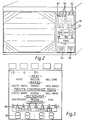
- the oven has a control panel 56 with displays and touch sensitive pads, as shown in Figure 2.
- the panel 56 has three touch pads 58 for setting into a display 60 the date in day, month and year format. Two pads 62 enable the time of day in hours and minutes to be set and to appear in the display 60.
- the panel 56 also has a "Select" pad 66 between respective "Down” and “Up” pads 68, 70; a "Cook” pad 72; a "Door Open” pad 74 and a "Reset Off” pad 76.
- Figure 3 shows the display in greater detail, the date appearing at the top of the display 60 and the time in an alpha-numeric display 78 at the base of the display 60.
- the display also bears the legends illustrated in Figure 3, together with a temperature scale.80 and a "Cooking Complete" sign which can be illuminated.
- the oven In use the oven is plugged in and the date and time of day set by the pads 58 and 62.
- the "Select" pad 66 is touched once and the display 60 illuminates the legend "Meat Medium”. This turns on the triac 14 which in turn energises the magnetron blower 18 and the cavity lamp 16. At the same time triacs 22, 30 and 34 are gated on.
- the display 60 shows the legend "Baked Normal".
- the user can select baked foods to be lightly baked or well baked by pressing the "Down” or “Up” pad 68 or 70, respectively upon which the display will show “Lightly Baked” or "Well Baked”.
- the number of times which the "Select Pad” 66 is touched will determine which of the five modes (meat, baked, frozen convenience foods, microwave and convection) the oven will operate in.
- the hot air temperature rises as indicated in Figure 4b.
- the temperature of the hot air is sensed by a thermistor positioned to be exposed to the hot air flow immediately the latter has passed over the electrical resistance heating element 32.
- This sensed temperature is representative of the oven cavity temperature. It has been found that all food items, except for meat, are cooked by the time the hot air temperature reaches a particular threshold Tl, typically 250°C. For such food items, this temperature Tl is reached within a predetermined time from a cold start. Rather than detect when this temperature Tl is reached, which can be inaccurate because the curve is flattening off, the described oven senses the gradient of the time curve after a predetermined time interval. This is done in the following manner.
- the hot air temperature is sensed by the thermistor forming the temperature sensing means.
- the gradient of the temperature/time curve is computed by a microprocessor of the oven. This is shown in 4b where the detected gradient Gl is such that the microprocessor can predict that the hot air temperature will reach the predetermined threshold Tl after a total cooking time of about 27 minutes. Accordingly, when the microprocessor has computed the remaining cooking time this time appears on the display 78, counting down to zero whereupon the cooker switches off and the cooking complete sign is displayed.
- the microprocessor computes the time taken to reach a lower threshold temperature, shown as Tl- in Figure 4b. When this time has elapsed (which will naturally be a shorter time than 27 minutes) the cooker will switch off. If the "Up" pad 70 has been touched, because the user wants food well done, the micro- processor computes the time taken to reach a higher threshold temperature, shown as T1+ in Figure 4b. When this time has elapsed, which will be greater than 27 minutes, the cooker will switch off as before. Hence, the detection of the temperature/time gradient at a time of 4 minutes after the commencement of cooking determines the cooking time.
- the microwave oven door is opened the illuminated time will disappear to signify that the cooking process has been interrupted.
- the micro-processor control circuit will resense the temperature/time gradient and recompute the balance of the cooking time required. This time will then be displayed, with the time counting down to zero as before.
- the timer 170 runs to the predetermined time of 30 minutes, this being the time span within which all normal baked food items are cooked. As has been mentioned, meat items take longer than the predetermined time of 30 minutes. Operation after the predetermined time of 30 minutes is governed by further timers 172, 174, 176 of the timing means.
- Figure 4c is a plot of hot air temperature against time for a larger food item taking more than 30 minutes to cook.
- temperature Tl is not reached before time 170 ceases at 30 minutes.
- Temperature Tl will be reached some time after 30 minutes and this is sensed by the gradient G2 detected at 4 minutes.
- gradient G2 predicts that the temperature will be reached some time after 30 minutes and this ensures that, when temperature Tl is reached, the micro-processor switches the microwave power level from low to high ( Figure 4d) and the thermal power from high level to low level ( Figure 4e).
- the micro-processor records that the maximum temperature Tl has been reached.
- the hot air temperature is monitored between 30 and 40 minutes, and at 40 minutes the timer 172 ceases.
- the oven switches off, providing the temperature T1 has previously been reached. If the hot air temperature at 40 minutes is above the first sub-level, or temperature T1 has not been reached, cooking continues. The hot air temperature is monitored between 40 and 50 minutes, and at 50 minutes the timer 174 ceases. If the hot air temperature during this 10 minute interval falls to a second sub-level (typically 190°C) the oven switches off, providing the temperature Tl has previously been reached. If the hot air temperature at 50 minutes is above the second sub-level, cooking continues until a third sub-level temperature e.g. 170°C is reached or the timer 176 ceases at 60 minutes.
- a first sub-level typically 210°C
- the predetermined temperature Tl will be increased or decreased if the "Up” or “Down” pad has been touched during the precooking selection procedure.
- the detected gradient of the temperature/time curve after the predetermined time interval e.g. 4 minutes
- the predetermined time interval e.g. 4 minutes
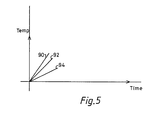
- Figure 5 illustrates three typical gradients 90, 92 and 94 which apply to baked food items, meats, and frozen food items, respectively.
- detection of the gradient enables the micro-processor to place th food item in one of the 3 pre-programmed categories so that once the gradient has been detected the oven will know the nature of the food item being cooked and will thereby select the approriate magnitudes and durations of microwave power and recirculated hot air power.
- the sensing means may sense an alternative characteristic of the curve, such as the integrated area below the curve, to predict when the threshold temperature will be reached.
- the oven should always commence from the same starting conditions, ie a cold start, which effectively means a hot air temperature below 80 * C. If the oven is warm from a previous cooking operation, when the "cook" pad 72 is touched, air from the magnetron blower 18 is directed into the oven cavity, as a result of the relay 26 allowing the flap or damper to move to an open position. When the flap or damper is in the open position, a vent in the oven side wall is uncovered to cause the cooking air flowing past the magnetron to enter the cavity.
- the relay 26 When the temperature sensing means detect that the hot air temperature has dropped to a particular value (e.g. less than 80°C) the relay 26 is energised to cause the flap or damper to close, and cooking commences with the simultaneous application of microwave power and forced hot air.
- a particular value e.g. less than 80°C
- the relay 26 is energised to cause the flap or damper to close, and cooking commences with the simultaneous application of microwave power and forced hot air.
- compensation for the warm cavity could be provided by commencing with microwave power alone and introducing forced hot air after a time delay.
Landscapes
- Physics & Mathematics (AREA)
- Electromagnetism (AREA)
- Engineering & Computer Science (AREA)
- Human Computer Interaction (AREA)
- Electric Ovens (AREA)
Applications Claiming Priority (2)
| Application Number | Priority Date | Filing Date | Title |
|---|---|---|---|
| GB848417644A GB8417644D0 (en) | 1984-07-11 | 1984-07-11 | Microwave ovens |
| GB8417644 | 1984-07-11 |
Publications (3)
| Publication Number | Publication Date |
|---|---|
| EP0169000A2 true EP0169000A2 (fr) | 1986-01-22 |
| EP0169000A3 EP0169000A3 (en) | 1987-12-09 |
| EP0169000B1 EP0169000B1 (fr) | 1989-05-24 |
Family
ID=10563716
Family Applications (1)
| Application Number | Title | Priority Date | Filing Date |
|---|---|---|---|
| EP85304652A Expired EP0169000B1 (fr) | 1984-07-11 | 1985-06-28 | Four à micro-ondes et procédé pour cuire de la nourriture |
Country Status (7)
| Country | Link |
|---|---|
| US (1) | US4647746A (fr) |
| EP (1) | EP0169000B1 (fr) |
| JP (1) | JPH0781713B2 (fr) |
| AU (1) | AU571711B2 (fr) |
| CA (1) | CA1236174A (fr) |
| DE (1) | DE3570513D1 (fr) |
| GB (1) | GB8417644D0 (fr) |
Cited By (7)
| Publication number | Priority date | Publication date | Assignee | Title |
|---|---|---|---|---|
| EP0239290A3 (en) * | 1986-03-26 | 1988-05-11 | Microwave Ovens Limited | Microwave ovens and methods of cooking food |
| EP0327262A1 (fr) * | 1988-02-05 | 1989-08-09 | Microwave Ovens Limited | Fours à micro-ondes et procédé pour y décongeler des aliments |
| GB2203320B (en) * | 1987-04-08 | 1991-05-08 | Creda Ltd | Cooking ovens |
| WO1995034191A1 (fr) * | 1994-06-07 | 1995-12-14 | Microwave Ovens Limited | Four a micro-ondes |
| EP0730391A3 (fr) * | 1995-02-28 | 1997-03-26 | Samsung Electronics Co Ltd | Méthode et dispositif de contrÔle de la température pour four à micro-ondes |
| EP0928125A3 (fr) * | 1997-12-31 | 2000-03-01 | Lg Electronics Inc. | Méthode et appareil pour compenser la température dans un four à micro-ondes |
| EP2136604A1 (fr) * | 2008-06-20 | 2009-12-23 | Topinox Sarl | Procédé de réglage de la puissance des micro-ondes dans un appareil de cuisson à micro-ondes en fonction de la température mesurée au coeur et appareil de cuisson |
Families Citing this family (21)
| Publication number | Priority date | Publication date | Assignee | Title |
|---|---|---|---|---|
| GB8613553D0 (en) * | 1986-06-04 | 1986-07-09 | Microwave Ovens Ltd | Microwave ovens |
| KR900008978B1 (ko) * | 1987-01-22 | 1990-12-15 | 마쯔시다덴기산교 가부시기가이샤 | 가열조리장치 |
| US5189274A (en) * | 1989-06-13 | 1993-02-23 | Matsushita Electric Industrial Co., Ltd. | Heating method for microwave oven having heat element |
| US5191183A (en) * | 1991-02-21 | 1993-03-02 | Ontario Hydro | Apparatus for processing ceramics using microwave oven with resistance heating unit |
| US5254823A (en) * | 1991-09-17 | 1993-10-19 | Turbochef Inc. | Quick-cooking oven |
| GB9209350D0 (en) * | 1992-04-30 | 1992-06-17 | Microwave Ovens Ltd | Microwave ovens and methods of cooking food |
| GB2280829B (en) * | 1993-06-08 | 1997-10-29 | London Inst Higher Education C | Cooking apparatus |
| CA2224447A1 (fr) * | 1995-06-15 | 1997-01-03 | Aktiebolaget Electrolux | Four culinaire |
| JPH10223366A (ja) * | 1996-12-03 | 1998-08-21 | Matsushita Electric Ind Co Ltd | 加熱装置 |
| US7092988B1 (en) | 1997-05-27 | 2006-08-15 | Jeffrey Bogatin | Rapid cooking oven with broadband communication capability to increase ease of use |
| KR100265646B1 (ko) * | 1997-11-06 | 2000-10-02 | 윤종용 | 벽걸이형 전자렌지 및 그 출력제어방법 |
| US8224892B2 (en) | 2000-04-28 | 2012-07-17 | Turbochef Technologies, Inc. | Rapid cooking oven with broadband communication capability to increase ease of use |
| US7012220B2 (en) * | 2003-04-10 | 2006-03-14 | Maytag Corp. | Alpha-numeric data entry and display for electronic oven control system |
| US9265097B2 (en) | 2010-07-01 | 2016-02-16 | Goji Limited | Processing objects by radio frequency (RF) energy |
| US9992824B2 (en) | 2010-10-29 | 2018-06-05 | Goji Limited | Time estimation for energy application in an RF energy transfer device |
| JP6003327B2 (ja) * | 2012-07-19 | 2016-10-05 | 富士通株式会社 | 伝送装置および温度制御方法 |
| US20140216271A1 (en) * | 2013-02-01 | 2014-08-07 | Euro-Pro Operating Llc | Rotisserie System |
| JP6560158B2 (ja) * | 2016-05-30 | 2019-08-14 | 株式会社松井製作所 | 金型温度調節装置及び金型温度調節方法 |
| US11412584B2 (en) | 2017-12-08 | 2022-08-09 | Alkar-Rapidpak, Inc. | Ovens with metallic belts and microwave launch box assemblies for processing food products |
| US12563647B2 (en) | 2021-04-26 | 2026-02-24 | Alkar-Rapidpak, Inc. | Food processing machines with microwave heating systems and microwave suppression systems |
| DE102023133430A1 (de) * | 2023-11-29 | 2025-06-05 | Rational Aktiengesellschaft | Verfahren zum Einstellen einer Mikrowellenleistung |
Family Cites Families (13)
| Publication number | Priority date | Publication date | Assignee | Title |
|---|---|---|---|---|
| JPS51101244A (en) * | 1975-03-04 | 1976-09-07 | Matsushita Electric Industrial Co Ltd | Kanetsusochi |
| JPS55151779A (en) * | 1979-05-15 | 1980-11-26 | Matsushita Electric Industrial Co Ltd | Heater with program timer |
| JPS56935A (en) * | 1979-06-15 | 1981-01-08 | Matsushita Electric Ind Co Ltd | High-frequency heating device |
| JPS5613692A (en) * | 1979-07-11 | 1981-02-10 | Matsushita Electric Industrial Co Ltd | High frequency heater |
| EP0024798B1 (fr) * | 1979-07-20 | 1984-02-15 | Matsushita Electric Industrial Co., Ltd. | Procédé de contrôle du chauffage d'aliments et appareil à cet effet |
| US4317977A (en) * | 1979-09-06 | 1982-03-02 | Litton Systems, Inc. | Power controlled microwave oven |
| US4390768A (en) * | 1980-09-24 | 1983-06-28 | Raytheon Company | Cook-by-weight microwave oven |
| CA1190604A (fr) * | 1981-07-21 | 1985-07-16 | Takeshi Tanabe | Combinaison de four a micro-ondes et gril avec automatisme regulateur de duree et de degre de cuisson |
| CA1200289A (fr) * | 1981-07-28 | 1986-02-04 | Takeshi Tanabe | Cuisiniere a four micro-ondes et gril |
| CA1192618A (fr) * | 1981-09-03 | 1985-08-27 | Sharp Kabushiki Kaisha | Four a micro-ondes a cuisson automatique et dispositif rechauffeur |
| JPS5875629A (ja) * | 1981-10-30 | 1983-05-07 | Matsushita Electric Ind Co Ltd | センサを備えた自動加熱装置 |
| JPS58220385A (ja) * | 1982-06-16 | 1983-12-21 | 三洋電機株式会社 | 電子制御式調理器 |
| GB8307123D0 (en) * | 1983-03-15 | 1983-04-20 | Microwave Ovens Ltd | Microwave ovens |
-
1984
- 1984-07-11 GB GB848417644A patent/GB8417644D0/en active Pending
-
1985
- 1985-06-28 DE DE8585304652T patent/DE3570513D1/de not_active Expired
- 1985-06-28 EP EP85304652A patent/EP0169000B1/fr not_active Expired
- 1985-07-02 AU AU44505/85A patent/AU571711B2/en not_active Ceased
- 1985-07-08 US US06/752,592 patent/US4647746A/en not_active Expired - Fee Related
- 1985-07-10 JP JP60153326A patent/JPH0781713B2/ja not_active Expired - Lifetime
- 1985-07-10 CA CA000486560A patent/CA1236174A/fr not_active Expired
Cited By (8)
| Publication number | Priority date | Publication date | Assignee | Title |
|---|---|---|---|---|
| EP0239290A3 (en) * | 1986-03-26 | 1988-05-11 | Microwave Ovens Limited | Microwave ovens and methods of cooking food |
| GB2203320B (en) * | 1987-04-08 | 1991-05-08 | Creda Ltd | Cooking ovens |
| EP0327262A1 (fr) * | 1988-02-05 | 1989-08-09 | Microwave Ovens Limited | Fours à micro-ondes et procédé pour y décongeler des aliments |
| WO1995034191A1 (fr) * | 1994-06-07 | 1995-12-14 | Microwave Ovens Limited | Four a micro-ondes |
| EP0730391A3 (fr) * | 1995-02-28 | 1997-03-26 | Samsung Electronics Co Ltd | Méthode et dispositif de contrÔle de la température pour four à micro-ondes |
| US5814794A (en) * | 1995-02-28 | 1998-09-29 | Samsung Electronics Co., Ltd. | Temperature control apparatus of microwave oven and method thereof |
| EP0928125A3 (fr) * | 1997-12-31 | 2000-03-01 | Lg Electronics Inc. | Méthode et appareil pour compenser la température dans un four à micro-ondes |
| EP2136604A1 (fr) * | 2008-06-20 | 2009-12-23 | Topinox Sarl | Procédé de réglage de la puissance des micro-ondes dans un appareil de cuisson à micro-ondes en fonction de la température mesurée au coeur et appareil de cuisson |
Also Published As
| Publication number | Publication date |
|---|---|
| CA1236174A (fr) | 1988-05-03 |
| US4647746A (en) | 1987-03-03 |
| JPH0781713B2 (ja) | 1995-09-06 |
| AU4450585A (en) | 1986-01-16 |
| JPS6141827A (ja) | 1986-02-28 |
| EP0169000A3 (en) | 1987-12-09 |
| GB8417644D0 (en) | 1984-08-15 |
| AU571711B2 (en) | 1988-04-21 |
| EP0169000B1 (fr) | 1989-05-24 |
| DE3570513D1 (en) | 1989-06-29 |
Similar Documents
| Publication | Publication Date | Title |
|---|---|---|
| EP0169000B1 (fr) | Four à micro-ondes et procédé pour cuire de la nourriture | |
| EP0327262B1 (fr) | Fours à micro-ondes et procédé pour y décongeler des aliments | |
| US5039535A (en) | Method of cooking food products | |
| EP0358344B1 (fr) | Fours à micro-ondes | |
| EP0289000B1 (fr) | Appareil de chauffage automatique | |
| CA2024961C (fr) | Dispositif de commande et de reglage d'appareils de cuisson, et methode connexe | |
| CA1249036A (fr) | Fours a micro-ondes, et methodes de cuisson d'aliments | |
| EP0281263B1 (fr) | Fourneau à micro-ondes et procédé pour cuire des aliments | |
| EP0166997B1 (fr) | Four à micro-ondes avec mode de décongélation à basse puissance et mode de cuisson à grande puissance | |
| EP0122710B1 (fr) | Four à micro-onde et procédé pour cuire de la nourriture | |
| US5968402A (en) | Safety system for microwave oven with electric heater | |
| JP2534862B2 (ja) | 電子レンジおよび食物を料理する方法 | |
| EP0066637B1 (fr) | Procédé pour brunir des aliments dans un four à micro-ondes | |
| US4771152A (en) | Microwave ovens and methods for cooking primarily baked goods and frozen foods | |
| US5302793A (en) | Microwave ovens with air inlet and air outlet temperature sensors | |
| CA1301258C (fr) | Appareil de chauffage automatique | |
| EP0083663A1 (fr) | Dispositif de cuisson a micro-ondes | |
| JPH0317425A (ja) | 加熱調理器 | |
| KR0131952B1 (ko) | 전자렌지의 트레이 오삽입 검출장치 및 검출방법 | |
| JPS63277021A (ja) | オ−ブント−スタ− | |
| JPH0315922Y2 (fr) | ||
| KR0128553B1 (ko) | 전자렌지의 소비전력 표시방법 | |
| JPH0448118A (ja) | 加熱調理器 | |
| JPH07231854A (ja) | 加熱調理器 | |
| JPS61211622A (ja) | マイクロ波オ−ブンと調理法 |
Legal Events
| Date | Code | Title | Description |
|---|---|---|---|
| PUAI | Public reference made under article 153(3) epc to a published international application that has entered the european phase |
Free format text: ORIGINAL CODE: 0009012 |
|
| AK | Designated contracting states |
Designated state(s): BE DE FR GB IT SE |
|
| PUAL | Search report despatched |
Free format text: ORIGINAL CODE: 0009013 |
|
| AK | Designated contracting states |
Kind code of ref document: A3 Designated state(s): BE DE FR GB IT SE |
|
| 17P | Request for examination filed |
Effective date: 19871221 |
|
| 17Q | First examination report despatched |
Effective date: 19880915 |
|
| ITF | It: translation for a ep patent filed | ||
| GRAA | (expected) grant |
Free format text: ORIGINAL CODE: 0009210 |
|
| AK | Designated contracting states |
Kind code of ref document: B1 Designated state(s): BE DE FR GB IT SE |
|
| REF | Corresponds to: |
Ref document number: 3570513 Country of ref document: DE Date of ref document: 19890629 |
|
| ET | Fr: translation filed | ||
| REG | Reference to a national code |
Ref country code: GB Ref legal event code: 732 |
|
| PLBE | No opposition filed within time limit |
Free format text: ORIGINAL CODE: 0009261 |
|
| STAA | Information on the status of an ep patent application or granted ep patent |
Free format text: STATUS: NO OPPOSITION FILED WITHIN TIME LIMIT |
|
| 26N | No opposition filed | ||
| PGFP | Annual fee paid to national office [announced via postgrant information from national office to epo] |
Ref country code: BE Payment date: 19900601 Year of fee payment: 6 |
|
| PG25 | Lapsed in a contracting state [announced via postgrant information from national office to epo] |
Ref country code: BE Effective date: 19910630 |
|
| BERE | Be: lapsed |
Owner name: MICROWAVE OVENS LTD Effective date: 19910630 |
|
| ITTA | It: last paid annual fee | ||
| EAL | Se: european patent in force in sweden |
Ref document number: 85304652.2 |
|
| REG | Reference to a national code |
Ref country code: GB Ref legal event code: IF02 |
|
| PGFP | Annual fee paid to national office [announced via postgrant information from national office to epo] |
Ref country code: FR Payment date: 20020417 Year of fee payment: 18 |
|
| PGFP | Annual fee paid to national office [announced via postgrant information from national office to epo] |
Ref country code: DE Payment date: 20020702 Year of fee payment: 18 |
|
| PGFP | Annual fee paid to national office [announced via postgrant information from national office to epo] |
Ref country code: GB Payment date: 20030410 Year of fee payment: 19 |
|
| PGFP | Annual fee paid to national office [announced via postgrant information from national office to epo] |
Ref country code: SE Payment date: 20030617 Year of fee payment: 19 |
|
| PG25 | Lapsed in a contracting state [announced via postgrant information from national office to epo] |
Ref country code: DE Free format text: LAPSE BECAUSE OF NON-PAYMENT OF DUE FEES Effective date: 20040101 |
|
| PG25 | Lapsed in a contracting state [announced via postgrant information from national office to epo] |
Ref country code: FR Free format text: LAPSE BECAUSE OF NON-PAYMENT OF DUE FEES Effective date: 20040227 |
|
| REG | Reference to a national code |
Ref country code: FR Ref legal event code: ST |
|
| PG25 | Lapsed in a contracting state [announced via postgrant information from national office to epo] |
Ref country code: GB Free format text: LAPSE BECAUSE OF NON-PAYMENT OF DUE FEES Effective date: 20040628 |
|
| PG25 | Lapsed in a contracting state [announced via postgrant information from national office to epo] |
Ref country code: SE Free format text: LAPSE BECAUSE OF NON-PAYMENT OF DUE FEES Effective date: 20040629 |
|
| EUG | Se: european patent has lapsed | ||
| EUG | Se: european patent has lapsed | ||
| GBPC | Gb: european patent ceased through non-payment of renewal fee |
Effective date: 20040628 |