EP0169057A2 - Verfahren und Anordnung zur Entdeckung von Schmuggelsubstanz - Google Patents
Verfahren und Anordnung zur Entdeckung von Schmuggelsubstanz Download PDFInfo
- Publication number
- EP0169057A2 EP0169057A2 EP85305067A EP85305067A EP0169057A2 EP 0169057 A2 EP0169057 A2 EP 0169057A2 EP 85305067 A EP85305067 A EP 85305067A EP 85305067 A EP85305067 A EP 85305067A EP 0169057 A2 EP0169057 A2 EP 0169057A2
- Authority
- EP
- European Patent Office
- Prior art keywords
- container
- particulates
- air
- substance
- contraband
- Prior art date
- Legal status (The legal status is an assumption and is not a legal conclusion. Google has not performed a legal analysis and makes no representation as to the accuracy of the status listed.)
- Granted
Links
- 239000000126 substance Substances 0.000 title claims abstract description 46
- 238000000034 method Methods 0.000 title claims abstract description 44
- 238000005070 sampling Methods 0.000 claims description 32
- 239000007789 gas Substances 0.000 claims description 16
- 238000010438 heat treatment Methods 0.000 claims description 13
- 238000013019 agitation Methods 0.000 claims description 12
- 239000002360 explosive Substances 0.000 claims description 11
- ZPUCINDJVBIVPJ-LJISPDSOSA-N cocaine Chemical compound O([C@H]1C[C@@H]2CC[C@@H](N2C)[C@H]1C(=O)OC)C(=O)C1=CC=CC=C1 ZPUCINDJVBIVPJ-LJISPDSOSA-N 0.000 claims description 10
- 150000002500 ions Chemical class 0.000 claims description 10
- 239000012159 carrier gas Substances 0.000 claims description 7
- GVGLGOZIDCSQPN-PVHGPHFFSA-N Heroin Chemical compound O([C@H]1[C@H](C=C[C@H]23)OC(C)=O)C4=C5[C@@]12CCN(C)[C@@H]3CC5=CC=C4OC(C)=O GVGLGOZIDCSQPN-PVHGPHFFSA-N 0.000 claims description 6
- 229960002069 diamorphine Drugs 0.000 claims description 6
- 229960003920 cocaine Drugs 0.000 claims description 5
- 238000004458 analytical method Methods 0.000 claims description 3
- 230000001419 dependent effect Effects 0.000 claims description 2
- 239000004033 plastic Substances 0.000 claims description 2
- SPSSULHKWOKEEL-UHFFFAOYSA-N 2,4,6-trinitrotoluene Chemical group CC1=C([N+]([O-])=O)C=C([N+]([O-])=O)C=C1[N+]([O-])=O SPSSULHKWOKEEL-UHFFFAOYSA-N 0.000 claims 1
- SNIOPGDIGTZGOP-UHFFFAOYSA-N Nitroglycerin Chemical group [O-][N+](=O)OCC(O[N+]([O-])=O)CO[N+]([O-])=O SNIOPGDIGTZGOP-UHFFFAOYSA-N 0.000 claims 1
- 239000000006 Nitroglycerin Substances 0.000 claims 1
- TZRXHJWUDPFEEY-UHFFFAOYSA-N Pentaerythritol Tetranitrate Chemical group [O-][N+](=O)OCC(CO[N+]([O-])=O)(CO[N+]([O-])=O)CO[N+]([O-])=O TZRXHJWUDPFEEY-UHFFFAOYSA-N 0.000 claims 1
- 239000000026 Pentaerythritol tetranitrate Substances 0.000 claims 1
- CYQFCXCEBYINGO-UHFFFAOYSA-N THC Natural products C1=C(C)CCC2C(C)(C)OC3=CC(CCCCC)=CC(O)=C3C21 CYQFCXCEBYINGO-UHFFFAOYSA-N 0.000 claims 1
- FZJYQGFGNHGSFX-PVQKIFDLSA-N [(4r,4ar,7s,7ar,12bs)-9-acetyloxy-3-methyl-1,2,3,4,4a,7,7a,13-octahydro-4,12-methanobenzofuro[3,2-e]isoquinoline-3-ium-7-yl] acetate;chloride Chemical group [Cl-].O([C@H]1[C@H](C=C[C@H]23)OC(C)=O)C4=C5[C@@]12CC[NH+](C)[C@@H]3CC5=CC=C4OC(C)=O FZJYQGFGNHGSFX-PVQKIFDLSA-N 0.000 claims 1
- 238000007664 blowing Methods 0.000 claims 1
- 229960003771 cocaine hydrochloride Drugs 0.000 claims 1
- PIQVDUKEQYOJNR-VZXSFKIWSA-N cocaine hydrochloride Chemical compound [Cl-].O([C@H]1C[C@@H]2CC[C@@H]([NH+]2C)[C@H]1C(=O)OC)C(=O)C1=CC=CC=C1 PIQVDUKEQYOJNR-VZXSFKIWSA-N 0.000 claims 1
- CYQFCXCEBYINGO-IAGOWNOFSA-N delta1-THC Chemical compound C1=C(C)CC[C@H]2C(C)(C)OC3=CC(CCCCC)=CC(O)=C3[C@@H]21 CYQFCXCEBYINGO-IAGOWNOFSA-N 0.000 claims 1
- 229960004242 dronabinol Drugs 0.000 claims 1
- 229960003711 glyceryl trinitrate Drugs 0.000 claims 1
- 229940008043 heroin hydrochloride Drugs 0.000 claims 1
- 240000004308 marijuana Species 0.000 claims 1
- 229960002532 methamphetamine hydrochloride Drugs 0.000 claims 1
- TWXDDNPPQUTEOV-FVGYRXGTSA-N methamphetamine hydrochloride Chemical compound Cl.CN[C@@H](C)CC1=CC=CC=C1 TWXDDNPPQUTEOV-FVGYRXGTSA-N 0.000 claims 1
- 229960004321 pentaerithrityl tetranitrate Drugs 0.000 claims 1
- 230000000063 preceeding effect Effects 0.000 claims 1
- 230000003746 surface roughness Effects 0.000 claims 1
- 230000032258 transport Effects 0.000 claims 1
- 239000000015 trinitrotoluene Substances 0.000 claims 1
- 239000002245 particle Substances 0.000 description 18
- 239000000428 dust Substances 0.000 description 13
- 239000003921 oil Substances 0.000 description 11
- 238000004806 packaging method and process Methods 0.000 description 11
- 229940079593 drug Drugs 0.000 description 7
- 239000003814 drug Substances 0.000 description 7
- 230000000694 effects Effects 0.000 description 6
- LFQSCWFLJHTTHZ-UHFFFAOYSA-N Ethanol Chemical compound CCO LFQSCWFLJHTTHZ-UHFFFAOYSA-N 0.000 description 5
- 230000015556 catabolic process Effects 0.000 description 5
- 238000001514 detection method Methods 0.000 description 5
- CSCPPACGZOOCGX-UHFFFAOYSA-N Acetone Chemical compound CC(C)=O CSCPPACGZOOCGX-UHFFFAOYSA-N 0.000 description 4
- 238000007689 inspection Methods 0.000 description 4
- 239000002904 solvent Substances 0.000 description 4
- QTBSBXVTEAMEQO-UHFFFAOYSA-N Acetic acid Chemical compound CC(O)=O QTBSBXVTEAMEQO-UHFFFAOYSA-N 0.000 description 3
- 150000001875 compounds Chemical class 0.000 description 3
- 238000009826 distribution Methods 0.000 description 3
- 230000003446 memory effect Effects 0.000 description 3
- XKRFYHLGVUSROY-UHFFFAOYSA-N Argon Chemical compound [Ar] XKRFYHLGVUSROY-UHFFFAOYSA-N 0.000 description 2
- 241000218236 Cannabis Species 0.000 description 2
- 239000006096 absorbing agent Substances 0.000 description 2
- 239000004480 active ingredient Substances 0.000 description 2
- RYYVLZVUVIJVGH-UHFFFAOYSA-N caffeine Chemical compound CN1C(=O)N(C)C(=O)C2=C1N=CN2C RYYVLZVUVIJVGH-UHFFFAOYSA-N 0.000 description 2
- 239000003795 chemical substances by application Substances 0.000 description 2
- 239000012141 concentrate Substances 0.000 description 2
- 238000011109 contamination Methods 0.000 description 2
- 230000008602 contraction Effects 0.000 description 2
- 238000005520 cutting process Methods 0.000 description 2
- JHIVVAPYMSGYDF-UHFFFAOYSA-N cyclohexanone Chemical compound O=C1CCCCC1 JHIVVAPYMSGYDF-UHFFFAOYSA-N 0.000 description 2
- 238000003795 desorption Methods 0.000 description 2
- 238000003384 imaging method Methods 0.000 description 2
- 239000007788 liquid Substances 0.000 description 2
- 238000004519 manufacturing process Methods 0.000 description 2
- QPJVMBTYPHYUOC-UHFFFAOYSA-N methyl benzoate Chemical compound COC(=O)C1=CC=CC=C1 QPJVMBTYPHYUOC-UHFFFAOYSA-N 0.000 description 2
- 150000003839 salts Chemical class 0.000 description 2
- 230000005526 G1 to G0 transition Effects 0.000 description 1
- VEXZGXHMUGYJMC-UHFFFAOYSA-N Hydrochloric acid Chemical compound Cl VEXZGXHMUGYJMC-UHFFFAOYSA-N 0.000 description 1
- LPHGQDQBBGAPDZ-UHFFFAOYSA-N Isocaffeine Natural products CN1C(=O)N(C)C(=O)C2=C1N(C)C=N2 LPHGQDQBBGAPDZ-UHFFFAOYSA-N 0.000 description 1
- NNJVILVZKWQKPM-UHFFFAOYSA-N Lidocaine Chemical compound CCN(CC)CC(=O)NC1=C(C)C=CC=C1C NNJVILVZKWQKPM-UHFFFAOYSA-N 0.000 description 1
- 239000004809 Teflon Substances 0.000 description 1
- 229920006362 Teflon® Polymers 0.000 description 1
- 238000005299 abrasion Methods 0.000 description 1
- 238000010521 absorption reaction Methods 0.000 description 1
- 230000001133 acceleration Effects 0.000 description 1
- 229910052786 argon Inorganic materials 0.000 description 1
- 229960001948 caffeine Drugs 0.000 description 1
- VJEONQKOZGKCAK-UHFFFAOYSA-N caffeine Natural products CN1C(=O)N(C)C(=O)C2=C1C=CN2C VJEONQKOZGKCAK-UHFFFAOYSA-N 0.000 description 1
- 239000011111 cardboard Substances 0.000 description 1
- 239000003153 chemical reaction reagent Substances 0.000 description 1
- 239000011248 coating agent Substances 0.000 description 1
- 238000000576 coating method Methods 0.000 description 1
- 239000012612 commercial material Substances 0.000 description 1
- 238000010924 continuous production Methods 0.000 description 1
- 238000001816 cooling Methods 0.000 description 1
- 230000005684 electric field Effects 0.000 description 1
- 239000004744 fabric Substances 0.000 description 1
- 239000006260 foam Substances 0.000 description 1
- 230000006870 function Effects 0.000 description 1
- 238000004817 gas chromatography Methods 0.000 description 1
- 239000011521 glass Substances 0.000 description 1
- 230000005484 gravity Effects 0.000 description 1
- 230000006698 induction Effects 0.000 description 1
- 238000009434 installation Methods 0.000 description 1
- 229960004194 lidocaine Drugs 0.000 description 1
- 239000000463 material Substances 0.000 description 1
- 239000002184 metal Substances 0.000 description 1
- 229940095102 methyl benzoate Drugs 0.000 description 1
- 239000000203 mixture Substances 0.000 description 1
- 230000009149 molecular binding Effects 0.000 description 1
- 229920000620 organic polymer Polymers 0.000 description 1
- 229920001558 organosilicon polymer Polymers 0.000 description 1
- 239000000123 paper Substances 0.000 description 1
- 230000001141 propulsive effect Effects 0.000 description 1
- 230000005855 radiation Effects 0.000 description 1
- 239000011435 rock Substances 0.000 description 1
- 239000004576 sand Substances 0.000 description 1
- 238000000926 separation method Methods 0.000 description 1
- 229930004725 sesquiterpene Natural products 0.000 description 1
- 150000004354 sesquiterpene derivatives Chemical class 0.000 description 1
- 229920005573 silicon-containing polymer Polymers 0.000 description 1
- 239000000779 smoke Substances 0.000 description 1
- 239000004071 soot Substances 0.000 description 1
- 238000003756 stirring Methods 0.000 description 1
- 150000003467 sulfuric acid derivatives Chemical class 0.000 description 1
- 239000013076 target substance Substances 0.000 description 1
- BFKJFAAPBSQJPD-UHFFFAOYSA-N tetrafluoroethene Chemical compound FC(F)=C(F)F BFKJFAAPBSQJPD-UHFFFAOYSA-N 0.000 description 1
- 239000003039 volatile agent Substances 0.000 description 1
Images


Classifications
-
- G—PHYSICS
- G01—MEASURING; TESTING
- G01V—GEOPHYSICS; GRAVITATIONAL MEASUREMENTS; DETECTING MASSES OR OBJECTS; TAGS
- G01V9/00—Prospecting or detecting by methods not provided for in groups G01V1/00 - G01V8/00
- G01V9/007—Prospecting or detecting by methods not provided for in groups G01V1/00 - G01V8/00 by detecting gases or particles representative of underground layers at or near the surface
-
- G—PHYSICS
- G01—MEASURING; TESTING
- G01N—INVESTIGATING OR ANALYSING MATERIALS BY DETERMINING THEIR CHEMICAL OR PHYSICAL PROPERTIES
- G01N1/00—Sampling; Preparing specimens for investigation
- G01N1/02—Devices for withdrawing samples
- G01N2001/022—Devices for withdrawing samples sampling for security purposes, e.g. contraband, warfare agents
-
- G—PHYSICS
- G01—MEASURING; TESTING
- G01N—INVESTIGATING OR ANALYSING MATERIALS BY DETERMINING THEIR CHEMICAL OR PHYSICAL PROPERTIES
- G01N1/00—Sampling; Preparing specimens for investigation
- G01N1/28—Preparing specimens for investigation including physical details of (bio-)chemical methods covered elsewhere, e.g. G01N33/50, C12Q
- G01N1/2813—Producing thin layers of samples on a substrate, e.g. smearing, spinning-on
- G01N2001/2833—Collecting samples on a sticky, tacky, adhesive surface
Definitions
- This invention relates to method and apparatus for detecting contraband such as drugs, alcohol, firearms and explosives in containers.
- cargo containers can be quite large (from 10 feet to 50 feet in length or more).
- cargo containers When such containers are unloaded from ships, rail cars or aircraft, at ports of entry into a country, they should in theory be inspected by customs authorities.
- volume of such container traffic is high, and because each container may be loaded with sealed boxes, drums and the like, it is impossible in practice to inspect the contents of each container. In fact, because of the high volume of such traffic, there may be only a few minutes available to inspect each container.
- x-ray examination of such containers has been proposed.
- Such x-ray examination is capable of detecting certain types of contraband, such as firearms, but it is not capable of detecting other kinds of contraband, such as drugs, alcohol and explosives if such substances are appropriately packaged.
- the inventors have discovered that many contraband substances which are to be detected, such as drugs and explosives, and which may have extremely low vapor pressures, emit (even when packaged) particulates which then are present in the cargo container in which such contraband is being transported.
- the particulates are emitted in various ways. When the contraband is not wrapped the particulates may be emitted through simple mechanical abrasion.
- the contraband When the contraband is packaged, particulates may be emitted through pin holes in the packaging in which the contraband is wrapped, or they may be present on the packaging because the person who wrapped the contraband touched the packaging after touching the contraband. Alternatively, they may be present on the packaging because of a dusty environment in the location where the contraband was wrapped.
- particulates emitted from the contraband escape into the cargo container in which the contraband is transported. Some of such particulates remain airborne within the container and some settle on surfaces in the container. Such surfaces may include the surfaces of the container itself or packages in the container. The particulates may also settle on or agglomerate with dust (i.e. other particulates) located in the container. In addition vapors emitted from the contraband are absorbed over a period of time by non-contraband particulates in the container, providing a concentration effect.
- the invention provides a method of detecting a contraband substance in a container, said method comprising the steps of:
- the invention provides apparatus for detecting a substance in a container, said apparatus comprising:
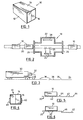
- Fig. 1 shows a typical cargo container 10 having sides 12, a top 14 and doors 16 located at one end thereof.
- the cargo container 10 may be a standard forty foot container of the kind transported by ship and then by truck or rail from the port at which the ship loads or unloads, or it may be an air cargo container, or it may simply be a large use.
- Such containers may be used to carry contraband such as drugs, alcohol, firearms or explosives. Because of the high volume of traffic in such containers, it is not practical to unload and inspect the contents of each container.
- the containers are transported on a conveyor 20, which may be a belt conveyor or a roller conveyor, through a thick-walled concrete building 22.
- an x-ray source 24 transmits high energy x-rays 26 through the container 10 to an imaging device 28.
- the imaging device transmits to a screen (not shown), the image produced by the x-rays, so that the operator may view the image and detect the presence of certain kinds of contraband.
- Thick radiation proof doors 29 seal the x-ray source during the x-ray process to prevent escape of dangerous x-rays.
- the high energy x-ray facility 18 can detect the presence of certain objects, such as firearms, even through relatively thick metal walls. However, it is not capable of detecting contraband such as explosives and drugs when these are appropriately packaged.
- the applicant's invention is particularly suited to be used in combination with the x-ray facilities shown, particularly trailer of the kind pulled by truck tractors for highway when the conveyor 20 is adapted to agitate the container 10 as will be described.
- Restricted drugs such as heroin and cocaine are usually transported in the form of their salts, typically hydrochloride or sulphate salts. These salts have an extremely low vapor pressure, which may be as low as 10-7 torr. Cannabis and many explosives have a similarly low vapor pressure. If the vapor from small quantities of such contraband substances were to be detected in a container, it would be necessary to sample the air in the container at least for several hours, if not more, and then to concentrate that air to obtain a sufficiently large quantity of the contraband vapor for detection.
- contraband substances emit more volatile breakdown or related products.
- explosives may emit cyclohexanone, which is a solvent used during the manufacturing process.
- Heroin may emit vapors of acetone (a solvent used therein) and acetic acid (a breakdown product of heroin) or of caffeine, which is a "cutting” agent used in heroin.
- Cocaine may emit vapors of acetone (a solvent) or methylbenzoate (a breakdown product) or of lidocaine (a "cutting” agent used in cocaine).
- Cannabis may emit pinene or sesquiterpenes, which are volatile non-active ingredients thereof. Table I at the end of this description lists these chemical or contraband signatures and shows their relative volatilities.
- contraband substances except of course for liquids
- emit particulates This is partly because virtually all packaging contains microscopic pinholes through which the particulates may pass, and partly because of contamination of the substance on the packaging itself.
- the contamination on the packaging may result from various factors, e.g. the person who wrapped the contraband may have touched the contraband and then the packaging, or airborne contraband particles at the wrapping location may have settled on the packaging, or non-contraband dust particles at the wrapping location which may have absorbed and concentrated vapors from the contraband may have settled on the packaging.
- the contraband substance while in the container may emit vapors, both of its active ingredient and of other characteristic products associated with it, although often at very low pressures. These vapors usually diffuse through the packaging in which the contraband is located.
- the dust particles may for example be fibrous (e.g. lint from paper, cardboard, cloth, and the like), silicacious (e.g. sand and rock dust).and carbonaceous (e.g. soot, skin particles and the like). Many of these dust particles act as good natural absorbers of the vapor emitted by the contraband. In addition many natural dust particles are relatively sticky and may tend to agglomerate with particulates of the contraband itself.
- the particles of interest may range in use from 10-7 meters to 2 X 10- 6 meters (smoke particles) and from 2 X 10⁻⁶ meters to 10- 3 meters (airborne dust particles) and even larger for such particles as lint.
- the time between when a cargo container is loaded and when it must be inspected is usually at least a day or several days and can be much more. This allows considerable time for the dust particles in the container to absorb and in effect to concentrate vapors from contraband in the container. It also allows considerable time for particulates of the contraband to be emitted and to float within or settle on surfaces within the cargo container.
- the resultant vibration may increase the number of natural particles available to act as absorbers and also increases the number of contraband particles emitted.
- the vibration also causes more even distribution of all these particles within the container.
- Temperature changes within the container caused by heating and cooling as the ambient environment changes, also increase the distribution and mobility of particles within the container.
- particulates in the container are collected and analyzed for the presence of contraband.
- the particulates are collected by sampling the air within the container.
- the container is agitated immediately or at least shortly prior to sampling the air therein.
- the agitation may be performed in several ways. If the container 10 is the trailer 30 (Fig. 3) of a tractor-trailer combination 32 which has been driven to the sampling location 34, then frequently no additional agitation will be required since considerable agitation occurs during the driving process. However, if necessary, a bumpy road surface or "speed bumps" 36 may be provided in the portion of the road 38 over which the trailer must be driven as it travels to the inspection location.
- a vibrating device 40 may be placed against the sides or top of the container 10 to vibrate the container.
- the vibrating device 40 may be an ordinary direct mechanical vibrator or may be a sonic or ultrasonic transducer, to agitate the contents of the container. If desired two such vibrating devices 40 may be used, one placed against each side of container 10 and preferably near the bottom of the container, to maximize the vibration accelerations applied to the cargo and other surfaces within the container.
- the rollers 42 (Fig. 5) of the conveyor may be staggered as shown in exaggerated form at 44 or may be made of different diameters, to bump the container immediately prior to its movement into the air sampling location 34. Sufficient propulsive force (either by gravity or by powered rollers) is provided to ensure continued movement of the container 10.
- the conveyor 20 may contain a small drop indicated at 46 in Fig. 6 so that the container actually falls several inches to stir up the dust within the container.
- a sampling line 48 As shown in Fig. 7.
- a hole 50 is bored in the roof of the container and the sampling line 48 inserted therethrough.
- the sampling line 48 will include a collar 52 and a foam seal 54 beneath the collar 52.
- the collar and seal are pressed against the outside of the container roof 14 adjacent the hole 50, to seal the hole around the sampling line 48 against movement of air therethrough.
- a plug (not shown) is fitted into the hole 50 to seal it.
- the plug may contain a valve so that when the container is next inspected, the sampling line 48 can simply be connected to the valve.
- a blast of highpressure air may be injected through the sampling line 48 from a source 56 of compressed air, directed through a valve 58, in order to agitate dust within the container.
- a separate high pressure air line may be inserted into the hole 50 to agitate dust, such line can then be removed and replaced by the sampling line.
- this is not preferred because of the potential for particle loss during the disconnect-connect cycle.
- the hole 50 is bored and the sampling line 48 is inserted into the container 10 at a location remote from the doors 16. Doors are a prime source of air leakage into the container.
- the sampling line 48 is placed as far as possible from the doors, and air is sucked into the sampling line, a flow of air is set up through the container from the doors to the sampling line, carrying dust in the container with such flow.
- the container is an open-backed or tarpaulin covered truck body
- high pressure air from a compressed air source may be injected into one end of the container at the same time as an air sample is being withdrawn from the other end of the container, in order to set up a better air flow containing particulates.
- the container is a closed cargo container, its doors may nevertheless have sufficient gaps at their seals so that an air hose can be pressed against or through such gaps, or through the rubber seals around the gaps, to inject air during the sampling process.
- the sampling line may contain tentacles 60 as shown in Fig. 8.
- the tentacles 60 tend to fan out when the sampling line is inserted through the hole 50.
- the tentacles 60 will normally be relatively short and may include an expansion mechanism (not shown) so that they are directed in different directions as they move below the roof of the container. There is usually a space of at least six to twelve inches between the roof of a container and the top of the cargo therein to allow space for such tentacles.
- the sampling line 48 typically extends to a sample collector 62 as shown in Fig. 9. Air is drawn from line 48 into an inlet 64 of the collector and through collector outlet 66 to atmosphere by an air pump 68.
- the line 48 will often be of a substantial length.
- molecules of a medium molecular weight compound can lose 50% or more of their number in a line 48 of between 5 and 10 meters in length. These molecules tend to diffuse rapidly to the walls of the line 48 where they are held by molecular binding forces. This loss not only reduces the signal to be analyzed but also causes undesirable memory effects since molecules which are absorbed or trapped on the walls of line 48 may be released at inopportune times. (To reduce but not eliminate this problem, the walls of line 48 may be heated.)
- the inventors have however discovered that particulates will travel much further along a line, even an unheated line, with much lower losses than molecules.
- the particulate losses in a 10 meter line are minor and even a 100 meter long line 48 can be used if needed.
- the particulate losses are lower because the particulates diffuse much more slowly than do molecules to the walls of the line 48.
- Those particulates which do reach the walls of the line 48 are more likely than molecules to be dragged off the walls because of the greater projection of the particulates into the shear layer adjacent the wall.
- This enables the collector system to be described to be at a greater distance from the container where necessary. Since it is often difficult to bring sophisticated equipment close to the container being inspected, this aids the establishment of a practical inspection system. At the same time undesirable memory effects in the line 48 are avoided.
- the diameter of line 48 is increased immediately outside the hole 50, e.g. to between four inches and eight inches. Air is sucked through the line 48 at the maximum possible flow rate, both to obtain the largest possible quantity of particulates, and to reduce the likelihood that particulates will settle in the line 48.
- the line 48 should be smooth walled, without sharp bends or sudden sharp expansions or contractions, all of which tend to trap particles.
- no bend should be sharper than about five times the internal diameter of the line 48.
- the bends should be ten internal line diameters or more.
- the increase in internal diameter preferably should not be at a rate greater than about a 7 degree half angle cone. With more abrupt expansions, the flow in the line is more likely to separate from the line wall and form a turbulent region with backflow, which can cause settling and undesired memory effects. Contractions in the internal diameter of the line do not normally cause flow separation and can be more abrupt but should be smoothly contoured and moderately gradual.
- the roughness of the internal surface of the wall of line 48 should preferably not be greater than about 1% of the internal line diameter.
- the line 48 may be made from the plastic known under the trade mark TEFLON and may be heated if trace vapors are also to be conducted through the line.
- the collector 62 performs the function of collecting, i.e. trapping particulates located in the air stream entering the collector. This can be accomplished in various ways.
- the collector 62 may be a conventional cyclone. Alternatively, it may be a rolled coil 70 of wire mesh as shown in Fig. 10.
- the air stream 71 in the line 48 enters the center of the coil 70 and travels radially therethrough as indicated by arrows 72 (much like an automobile air filter).
- the wire mesh coil 70 is coated with an appropriate sticky substance such as a light oil. Particulates in the air stream are collected on the sticky wire surfaces of the collector during the air sampling process.
- Other forms of collector may also be used.
- the collector 62 (which can preferably be quickly plugged into and unplugged from line 48) is removed from line 48 and connected to an analyzer 74 (Fig. 11) to be described.
- a source 76 of heated inert carrier gas is plugged into the collector inlet 64.
- the collector 62 itself can be heated by a heater, for example an induction heater 78. This process rapidly releases vapors absorbed by the trapped particulates and vaporizes those particulates which are particulates of the contraband substance itself.
- the vapors are carried in a short period of time (e.g. 30 seconds) into the analyzer 74 for analysis.
- the heating is controlled so as not to destroy the oil coating on the mesh coil 70.
- the oil referred to above should be an oil of low volatility when heated and one which does not oxidize when heated. If appropriate oils are used, the compounds of interest may dissolve from the particulates into the oil, which acts as a solvent, and are then evaporated from the oil into the heated carrier gas stream. Stationary phase oils or gums used in conventional gas chromatography columns have been found suitable. These oils are generally organo-silicone polymers or other non-volatile organic polymers. For example an organosilicon polymer oil sold under the designation OV-275 by several suppliers, including Alltech Associates of Deer- field, Illinois, U.S.A. has been found particularly suitable for explosives. A similar oil sold under the designation OV-17 by the same suppliers has been found particularly suitable for cocaine and heroin.
- a large concentration effect is achieved. For example, if 100 cubic litres of air per second are collected from the container for 30 to 60 seconds, then 3000 to 6000 litres of air are collected. If the carrier gas flow from the collector 62 to the analyzer 74 is 0.1 litres per second for 10 seconds (1 litre), then a very large concentration effect is achieved, dependent of course in part on the efficiency with which particulates are collected. A further concentration effect is achieved because of the collection both of particulates ambient in the container which have had a long time to absorb contraband volatiles, and of particulates of the contraband itself which have had a long time to migrate about the container.
- a hand held collector may be used in place of or in addition to the collector 62 and sampling line 48.
- the hand held collector may be for example of the kind shown at 80 in Fig. 12.
- Collector 80 includes a removable glass tube 82 having a spiral wound wire collector coil 84 therein having two contacts 86, 88. Air is sucked into tube 82 by a fan 90 driven by a motor 92, and exits through holes 94 in casing 96.
- the motor 92 is driven by batteries (not shown) and is turned on by a trigger switch 98.
- the collector 80 can be brought to a container or trailer which is to be inspected more closely.
- tube 82 with the coil 84 therein is removed and plugged into the analyzer 74 like the collector 62.
- a source of electrical current may be connected to contacts 86, 88 to heat the wire coil 84 like a filament, to drive off vapors absorbed by particulates, or vaporize particulates, trapped in the coil.
- the analyzer 70 may be a mass analyzer such as that sold under the trade mark TAGA by Sciex Division of MDS Health Group Limited of Thornhill, Ontario, Canada, as shown in Fig. 13.
- the heated carrier gas from source 76 will be directed past a chemical reagent gas source 100 and a mixture of both gases will travel through the collector 62 into the inlet section 102 of the analyzer 70 for ionization.
- the inlet section 102 will include an ionizing source such as a corona discharge needle 104 which provides a corona discharge to ionize trace substances of interest.
- the resultant ions are then pulled by an electric field through an orifice 106 into a gas curtain chamber 108 and then through another orifice 110 into a vacuum chamber 112 where they enter a mass spectrometer 114.
- the gas curtain section 108 described in U.S. patent 4,023,398 issued on May 13, 1977 to J.B. French et al, provides an inert curtain gas (such as argon) which effuses from orifice 106 into chamber 102, i.e. countercurrent to the flow of ions into the orifice 106.
- the curtain gas thus prevents particulates from entering and clogging the orifices 106, 110 and allows only the ions to travel into the vaccuum chamber 112.
- the curtain gas enters the vacuum chamber 112 and may be cryopumped or pumped by an ordinary vacuum pump to establish a vacuum in chamber 112.
- the gas curtain is particularly useful in the present invention since the gas flow into the analyzer tends to be particulate laden (which is the opposite of what is normally desired) because of particulates carried out of the collector and into the analyzer. Such particles would rapidly clog an unprotected orifice.
- the method of the invention may also be used with substances such as alcohol which do not emit particulates. Where there are very small quantities of vapor present, the absorption of such vapor by particulates in the container over a period of days provides a concentration effect which increases the reliability of detection when the method of the invention is used. However the invention is primarily applicable to the detection of contraband substances which emit particulates.
- the above approximate optimum temperatures are those at which the vapors have been found best to be released from the collected particulates. If a significantly lower temperature is used, some of the adsorbed vapors will not be desorbed in the heating process or the particulates (if of the target substance itself) will not vaporize. If a significantly higher temperature is used, the particulates or the desorbed vapors or both may break down into other substances, which is highly undesirable. However there is a tolerance of approximately + or -15°C in the approximately optimum desorption temperatures given.
- the collector 62 In order that the particulates with their adsorbed vapors may be properly collected, it is desirable that the collector 62 not be unduly warm during the collection process (i.e. before the collected particulates are heated). Preferably the temperature of the particulates collected at the collector 62 should not exceed about 40°C before the collector is heated to desorb vapors from the particulates, and desirably such temperature is below about 30°C.
- container as used herein is meant to include any kind of container in which contraband may be transported, including without limitation cargo containers, trailers, trucks, autos, aircraft, luggage, trunks, boxes, letters and other mail.
- cargo containers including without limitation cargo containers, trailers, trucks, autos, aircraft, luggage, trunks, boxes, letters and other mail.
- air may be sampled from the luggage container simply by compressing the luggage container.
Landscapes
- Engineering & Computer Science (AREA)
- Remote Sensing (AREA)
- Physics & Mathematics (AREA)
- Life Sciences & Earth Sciences (AREA)
- General Life Sciences & Earth Sciences (AREA)
- General Physics & Mathematics (AREA)
- Geophysics (AREA)
- Sampling And Sample Adjustment (AREA)
- Geophysics And Detection Of Objects (AREA)
Applications Claiming Priority (4)
| Application Number | Priority Date | Filing Date | Title |
|---|---|---|---|
| CA459090 | 1984-07-17 | ||
| CA000459090A CA1224940A (en) | 1984-07-17 | 1984-07-17 | Method of detecting a contraband substance |
| US741052 | 1985-06-04 | ||
| US06/741,052 US4718268A (en) | 1985-06-04 | 1985-06-04 | Method and apparatus for detecting a contraband substance |
Publications (3)
| Publication Number | Publication Date |
|---|---|
| EP0169057A2 true EP0169057A2 (de) | 1986-01-22 |
| EP0169057A3 EP0169057A3 (en) | 1988-02-03 |
| EP0169057B1 EP0169057B1 (de) | 1991-05-08 |
Family
ID=25670449
Family Applications (1)
| Application Number | Title | Priority Date | Filing Date |
|---|---|---|---|
| EP19850305067 Expired EP0169057B1 (de) | 1984-07-17 | 1985-07-16 | Verfahren und Anordnung zur Entdeckung von Schmuggelsubstanz |
Country Status (4)
| Country | Link |
|---|---|
| EP (1) | EP0169057B1 (de) |
| JP (1) | JPH0617902B2 (de) |
| DE (1) | DE3582758D1 (de) |
| GB (1) | GB2162944B (de) |
Cited By (17)
| Publication number | Priority date | Publication date | Assignee | Title |
|---|---|---|---|---|
| EP0245082A3 (de) * | 1986-05-06 | 1989-05-17 | British Aerospace Public Limited Company | Probeentnahmesonden |
| EP0236047A3 (de) * | 1986-02-27 | 1989-07-12 | MDS Health Group Limited | Verfahren und Vorrichtung zur Spurenprobensammlung |
| EP0369661A3 (de) * | 1988-11-18 | 1991-04-10 | Thermedics, Inc. | Betretbare Kammer und Untersuchungsanordnung mit Gasprobenentnahme |
| EP0458622A3 (en) * | 1990-05-22 | 1992-01-22 | Barringer Technologies Inc. | Method and apparatus for collection and analysis of desquamated skin particulates or other tissue |
| GB2263578A (en) * | 1992-01-27 | 1993-07-28 | Bruker Franzen Analytik Gmbh | Mass spectrometers |
| WO1999038015A1 (en) * | 1998-01-05 | 1999-07-29 | Erik Andersen | A method for use in the detection of narcotics in closed containers, preferably freight containers, and a system for performing the method |
| WO2003058208A1 (en) * | 2001-12-31 | 2003-07-17 | Lockheed Martin Corporation | Closed loop system for air sampling of contained mail products |
| WO2003058207A3 (en) * | 2001-12-31 | 2003-08-21 | Lockheed Corp | Device and method for contamination detection within sealed containers |
| WO2003081214A3 (en) * | 2001-10-26 | 2004-01-22 | Lockheed Corp | System and method for detecting hazardous materials inside containers |
| WO2003076904A3 (en) * | 2001-10-29 | 2004-01-29 | Lockheed Corp | Hazardous material detection system and method for use with mail and other objects |
| WO2004018704A3 (en) * | 2002-05-20 | 2004-06-10 | Northrop Grumman Corp | Point source biological agent detection system |
| FR2853729A1 (fr) * | 2003-04-08 | 2004-10-15 | Icts France | Procede et appareil de detection de matiere a detecter contenant au moins un composant dispersible dans l'air sous forme de particules solides |
| US7019655B2 (en) | 2001-10-23 | 2006-03-28 | Technology Solutions International, Inc. | System and methods for detecting harmful agents within contents of mail |
| WO2006085999A1 (en) * | 2004-07-22 | 2006-08-17 | Marshall Wilson | Detecting concealed security threats |
| US7201037B2 (en) | 2001-12-10 | 2007-04-10 | Lockheed Martin Corporation | Mail tub with air ports |
| CN103998914A (zh) * | 2011-09-06 | 2014-08-20 | Atonarp株式会社 | 气体采集装置以及检查装置 |
| WO2016048216A1 (en) * | 2014-09-24 | 2016-03-31 | Tellusecure Ab | Package screening device |
Families Citing this family (3)
| Publication number | Priority date | Publication date | Assignee | Title |
|---|---|---|---|---|
| JPH02159538A (ja) * | 1988-12-13 | 1990-06-19 | Mitsubishi Heavy Ind Ltd | 内容物検知装置 |
| CZ342196A3 (cs) * | 1996-11-21 | 1998-01-14 | Energetic Materials Consulting S.R.O. | Systém klimatizace samostatných dopravních jednotek |
| WO2021201183A1 (ja) * | 2020-03-31 | 2021-10-07 | ダイキン工業株式会社 | 検知ユニット、収容容器、検知装置 |
Family Cites Families (8)
| Publication number | Priority date | Publication date | Assignee | Title |
|---|---|---|---|---|
| US3768302A (en) * | 1970-12-08 | 1973-10-30 | Barringer Research Ltd | Method and apparatus for sensing substances by analysis of adsorbed matter associated with atmospheric particulates |
| GB1454602A (en) * | 1974-05-02 | 1976-11-03 | Jenkins A | Apparatus for checking the contents of closed containers |
| GB1489928A (en) * | 1974-08-29 | 1977-10-26 | Pye Electronic Prod Ltd | Method and apparatus for sampling the atmosphere in non-hermetically-sealed containers |
| DE2649912A1 (de) * | 1975-11-28 | 1977-06-08 | Macourt | Trennung und analyse von teilchenueberzuegen |
| US4045997A (en) * | 1976-03-11 | 1977-09-06 | Marsland Engineering Limited | Air curtain device |
| US4202200A (en) * | 1976-07-01 | 1980-05-13 | Pye (Electronic Products) Limited | Apparatus for detecting explosive substances |
| US4478096A (en) * | 1983-06-29 | 1984-10-23 | The United States Of America As Represented By The Secretary Of Agriculture | Shielded sniffing device |
| US4580440A (en) * | 1984-07-17 | 1986-04-08 | British Aerospace Public Company Limited, Bracknell Division | Method of detecting a contraband substance |
-
1985
- 1985-07-16 EP EP19850305067 patent/EP0169057B1/de not_active Expired
- 1985-07-16 GB GB08517937A patent/GB2162944B/en not_active Expired
- 1985-07-16 DE DE8585305067T patent/DE3582758D1/de not_active Expired - Lifetime
- 1985-07-17 JP JP60157971A patent/JPH0617902B2/ja not_active Expired - Lifetime
Cited By (27)
| Publication number | Priority date | Publication date | Assignee | Title |
|---|---|---|---|---|
| EP0236047A3 (de) * | 1986-02-27 | 1989-07-12 | MDS Health Group Limited | Verfahren und Vorrichtung zur Spurenprobensammlung |
| EP0245082A3 (de) * | 1986-05-06 | 1989-05-17 | British Aerospace Public Limited Company | Probeentnahmesonden |
| EP0369661A3 (de) * | 1988-11-18 | 1991-04-10 | Thermedics, Inc. | Betretbare Kammer und Untersuchungsanordnung mit Gasprobenentnahme |
| EP0458622A3 (en) * | 1990-05-22 | 1992-01-22 | Barringer Technologies Inc. | Method and apparatus for collection and analysis of desquamated skin particulates or other tissue |
| GB2263578A (en) * | 1992-01-27 | 1993-07-28 | Bruker Franzen Analytik Gmbh | Mass spectrometers |
| US5373156A (en) * | 1992-01-27 | 1994-12-13 | Bruker-Franzen Analytik Gmbh | Method and device for the mass-spectrometric examination of fast organic ions |
| WO1999038015A1 (en) * | 1998-01-05 | 1999-07-29 | Erik Andersen | A method for use in the detection of narcotics in closed containers, preferably freight containers, and a system for performing the method |
| US7190276B2 (en) | 2001-10-23 | 2007-03-13 | Technology Solutions International Inc. | System and methods for detecting harmful agents within contents of mail |
| US7019655B2 (en) | 2001-10-23 | 2006-03-28 | Technology Solutions International, Inc. | System and methods for detecting harmful agents within contents of mail |
| WO2003081214A3 (en) * | 2001-10-26 | 2004-01-22 | Lockheed Corp | System and method for detecting hazardous materials inside containers |
| US6823714B2 (en) | 2001-10-26 | 2004-11-30 | Lockheed Martin Corporation | System and method for detecting hazardous materials inside containers |
| WO2003076904A3 (en) * | 2001-10-29 | 2004-01-29 | Lockheed Corp | Hazardous material detection system and method for use with mail and other objects |
| US6948653B2 (en) | 2001-10-29 | 2005-09-27 | Lockheed Martin Corporation | Hazardous material detection system for use with mail and other objects |
| US7201037B2 (en) | 2001-12-10 | 2007-04-10 | Lockheed Martin Corporation | Mail tub with air ports |
| WO2003058207A3 (en) * | 2001-12-31 | 2003-08-21 | Lockheed Corp | Device and method for contamination detection within sealed containers |
| WO2003058208A1 (en) * | 2001-12-31 | 2003-07-17 | Lockheed Martin Corporation | Closed loop system for air sampling of contained mail products |
| WO2004018704A3 (en) * | 2002-05-20 | 2004-06-10 | Northrop Grumman Corp | Point source biological agent detection system |
| US7405073B2 (en) | 2002-05-20 | 2008-07-29 | Northrop Grumman Corporation | Point source biological agent detection system |
| AU2003285852B2 (en) * | 2002-05-20 | 2006-12-14 | Northrop Grumman Corporation | Point source biological agent detection system |
| FR2853729A1 (fr) * | 2003-04-08 | 2004-10-15 | Icts France | Procede et appareil de detection de matiere a detecter contenant au moins un composant dispersible dans l'air sous forme de particules solides |
| US7846742B2 (en) | 2003-04-08 | 2010-12-07 | Icts Europe Holdings B.V. | Method for detecting substance to be detected containing at least one component that is dispersible in air in the form of solid particles |
| WO2006085999A1 (en) * | 2004-07-22 | 2006-08-17 | Marshall Wilson | Detecting concealed security threats |
| CN103998914A (zh) * | 2011-09-06 | 2014-08-20 | Atonarp株式会社 | 气体采集装置以及检查装置 |
| EP2755015A4 (de) * | 2011-09-06 | 2015-04-29 | Atonarp Inc | Gasprobenahmevorrichtung und inspektionsvorrichtung |
| CN103998914B (zh) * | 2011-09-06 | 2016-04-06 | Atonarp株式会社 | 气体采集装置以及检查装置 |
| US9625358B2 (en) | 2011-09-06 | 2017-04-18 | Atonarp Inc. | Gas sampling apparatus and monitoring apparatus |
| WO2016048216A1 (en) * | 2014-09-24 | 2016-03-31 | Tellusecure Ab | Package screening device |
Also Published As
| Publication number | Publication date |
|---|---|
| GB2162944A (en) | 1986-02-12 |
| DE3582758D1 (de) | 1991-06-13 |
| EP0169057B1 (de) | 1991-05-08 |
| GB8517937D0 (en) | 1985-08-21 |
| JPH0617902B2 (ja) | 1994-03-09 |
| JPS61105483A (ja) | 1986-05-23 |
| EP0169057A3 (en) | 1988-02-03 |
| GB2162944B (en) | 1988-03-16 |
Similar Documents
| Publication | Publication Date | Title |
|---|---|---|
| US4580440A (en) | Method of detecting a contraband substance | |
| US4718268A (en) | Method and apparatus for detecting a contraband substance | |
| EP0169057B1 (de) | Verfahren und Anordnung zur Entdeckung von Schmuggelsubstanz | |
| US5942699A (en) | Method and apparatus for sampling contaminants | |
| EP0447158A2 (de) | Detektor für versteckte Sprengstoffe und narkotische Substanzen | |
| US6823714B2 (en) | System and method for detecting hazardous materials inside containers | |
| EP0934519B1 (de) | Dampfspurennachweis | |
| US6834533B2 (en) | System and method for detecting bio-hazardous particulates in mail handling systems | |
| US5742050A (en) | Method and apparatus for sample introduction into a mass spectrometer for improving a sample analysis | |
| US7989760B2 (en) | Extraction detection system and method | |
| JP3800422B2 (ja) | 特定薬物の探知方法及び探知装置 | |
| JP3097046B2 (ja) | ハンドヘルド棒 | |
| US20110186436A1 (en) | Particle Interrogation Devices and Methods | |
| US7833802B2 (en) | Stroboscopic liberation and methods of use | |
| EP2446242B1 (de) | Nichtinvasives verfahren und system zum abtasten des inhalts eines behälters auf das vorhandensein gefährlicher substanzen | |
| US20040202574A1 (en) | Method and apparatus for detecting substance to be detected containing at least one component that is dispersible in air in the form of solid particles | |
| US20070266771A1 (en) | Method of an Apparatus for Detecting the Presence of Signature Volatile Compounds From Materials in a Confined Environment | |
| Krieger et al. | Measurement of polychlorinated biphenyls and polycyclic aromatic hydrocarbons in air with a diffusion denuder | |
| US7357044B2 (en) | Sample collection device and method of using said device | |
| US4338029A (en) | Mineral exploration | |
| Chauhan et al. | Trace analysis of cocaine and heroin in different customs scenarios using a custom-built ion mobility spectrometer | |
| JPH04218747A (ja) | コンテナ内荷物の検査方法および装置 |
Legal Events
| Date | Code | Title | Description |
|---|---|---|---|
| PUAI | Public reference made under article 153(3) epc to a published international application that has entered the european phase |
Free format text: ORIGINAL CODE: 0009012 |
|
| AK | Designated contracting states |
Designated state(s): BE DE FR GB NL |
|
| PUAL | Search report despatched |
Free format text: ORIGINAL CODE: 0009013 |
|
| AK | Designated contracting states |
Kind code of ref document: A3 Designated state(s): BE DE FR GB NL |
|
| 17P | Request for examination filed |
Effective date: 19880723 |
|
| 17Q | First examination report despatched |
Effective date: 19890830 |
|
| GRAA | (expected) grant |
Free format text: ORIGINAL CODE: 0009210 |
|
| AK | Designated contracting states |
Kind code of ref document: B1 Designated state(s): BE DE FR GB NL |
|
| REF | Corresponds to: |
Ref document number: 3582758 Country of ref document: DE Date of ref document: 19910613 |
|
| ET | Fr: translation filed | ||
| RAP4 | Party data changed (patent owner data changed or rights of a patent transferred) |
Owner name: BRITISH AEROSPACE PUBLIC LIMITED COMPANY |
|
| PLBI | Opposition filed |
Free format text: ORIGINAL CODE: 0009260 |
|
| 26 | Opposition filed |
Opponent name: THERMEDETEC, INC. Effective date: 19920123 |
|
| NLR1 | Nl: opposition has been filed with the epo |
Opponent name: THERMEDETEC, INC. |
|
| RAP4 | Party data changed (patent owner data changed or rights of a patent transferred) |
Owner name: BRITISH AEROSPACE PUBLIC LIMITED COMPANY |
|
| PLBN | Opposition rejected |
Free format text: ORIGINAL CODE: 0009273 |
|
| STAA | Information on the status of an ep patent application or granted ep patent |
Free format text: STATUS: OPPOSITION REJECTED |
|
| 27O | Opposition rejected |
Effective date: 19931120 |
|
| NLR2 | Nl: decision of opposition | ||
| REG | Reference to a national code |
Ref country code: GB Ref legal event code: 732E |
|
| NLS | Nl: assignments of ep-patents |
Owner name: MDS HEALTH GROUP LIMITED |
|
| REG | Reference to a national code |
Ref country code: FR Ref legal event code: TP |
|
| PGFP | Annual fee paid to national office [announced via postgrant information from national office to epo] |
Ref country code: GB Payment date: 19970704 Year of fee payment: 13 |
|
| PGFP | Annual fee paid to national office [announced via postgrant information from national office to epo] |
Ref country code: FR Payment date: 19970717 Year of fee payment: 13 |
|
| PGFP | Annual fee paid to national office [announced via postgrant information from national office to epo] |
Ref country code: NL Payment date: 19970721 Year of fee payment: 13 |
|
| PGFP | Annual fee paid to national office [announced via postgrant information from national office to epo] |
Ref country code: DE Payment date: 19970724 Year of fee payment: 13 |
|
| PGFP | Annual fee paid to national office [announced via postgrant information from national office to epo] |
Ref country code: BE Payment date: 19970730 Year of fee payment: 13 |
|
| PG25 | Lapsed in a contracting state [announced via postgrant information from national office to epo] |
Ref country code: GB Free format text: LAPSE BECAUSE OF NON-PAYMENT OF DUE FEES Effective date: 19980716 |
|
| PG25 | Lapsed in a contracting state [announced via postgrant information from national office to epo] |
Ref country code: BE Free format text: LAPSE BECAUSE OF NON-PAYMENT OF DUE FEES Effective date: 19980731 |
|
| BERE | Be: lapsed |
Owner name: MDS HEALTH GROUP LTD Effective date: 19980731 |
|
| PG25 | Lapsed in a contracting state [announced via postgrant information from national office to epo] |
Ref country code: NL Free format text: LAPSE BECAUSE OF NON-PAYMENT OF DUE FEES Effective date: 19990201 |
|
| GBPC | Gb: european patent ceased through non-payment of renewal fee |
Effective date: 19980716 |
|
| PG25 | Lapsed in a contracting state [announced via postgrant information from national office to epo] |
Ref country code: FR Free format text: LAPSE BECAUSE OF NON-PAYMENT OF DUE FEES Effective date: 19990331 |
|
| NLV4 | Nl: lapsed or anulled due to non-payment of the annual fee |
Effective date: 19990201 |
|
| PG25 | Lapsed in a contracting state [announced via postgrant information from national office to epo] |
Ref country code: DE Free format text: LAPSE BECAUSE OF NON-PAYMENT OF DUE FEES Effective date: 19990501 |
|
| REG | Reference to a national code |
Ref country code: FR Ref legal event code: ST |