EP0169145A2 - Appareil pour trier des enveloppes - Google Patents
Appareil pour trier des enveloppes Download PDFInfo
- Publication number
- EP0169145A2 EP0169145A2 EP85401460A EP85401460A EP0169145A2 EP 0169145 A2 EP0169145 A2 EP 0169145A2 EP 85401460 A EP85401460 A EP 85401460A EP 85401460 A EP85401460 A EP 85401460A EP 0169145 A2 EP0169145 A2 EP 0169145A2
- Authority
- EP
- European Patent Office
- Prior art keywords
- envelopes
- envelope
- series
- staging area
- desired characteristic
- Prior art date
- Legal status (The legal status is an assumption and is not a legal conclusion. Google has not performed a legal analysis and makes no representation as to the accuracy of the status listed.)
- Withdrawn
Links
Images


Classifications
-
- B—PERFORMING OPERATIONS; TRANSPORTING
- B07—SEPARATING SOLIDS FROM SOLIDS; SORTING
- B07C—POSTAL SORTING; SORTING INDIVIDUAL ARTICLES, OR BULK MATERIAL FIT TO BE SORTED PIECE-MEAL, e.g. BY PICKING
- B07C1/00—Measures preceding sorting according to destination
-
- B—PERFORMING OPERATIONS; TRANSPORTING
- B43—WRITING OR DRAWING IMPLEMENTS; BUREAU ACCESSORIES
- B43M—BUREAU ACCESSORIES NOT OTHERWISE PROVIDED FOR
- B43M7/00—Devices for opening envelopes
- B43M7/02—Devices for both opening envelopes and removing contents
Definitions
- the present invention relates generally to the bulk processing of envelopes, and in particular, to the sorting of envelopes in accordance with specified parameters.
- envelopes it is at times important to sort envelopes in accordance with their thickness, based upon an assumed relation between the thickness of the envelope and the nature of the documents which it contains.
- a sorting apparatus which sequentially delivers envelopes to a staging area for transfer past means for sensing specified characteristics of each envelope and/or its contents, and which incorporates a deflector mechanism which is capable of selectively delivering envelopes to any of a plurality of receiving areas in accordance with signals received from the sensing means.
- the deflector mechanism is capable of directing an envelope received in the apparatus and analyzed by the sensing means to different areas for subsequent collection and transfer to an appropriate mail extraction device, or to other operations as desired.
- the deflector mechanism of the sorting apparatus provides a means for sorting mail in accordance with specified characteristics so that an envelope exhibiting the specified characteristic is deflected from the mail extraction device prior to opening, and so that all other envelopes are capable of proceeding from the sorting operation directly to the mail extraction operation.
- the area into which envelopes of a specified characteristic are deflected may be secured, if desired, so that the diverted envelopes may be safely retained for subsequent access only by authorized personnel.
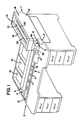
- Figure 1 illustrates an envelope sorting apparatus 1 in operational association with a mail extraction desk 2.
- the sorting apparatus 1 has been shown in use in combination with a "Rapid Extraction Desk" of the type manufactured by the Opex Corporation of Cherry Hill, New Jersey.
- a "Rapid Extraction Desk" of the type manufactured by the Opex Corporation of Cherry Hill, New Jersey.
- Such a combination of operational elements has been selected to facilitate description of the sorting apparatus 1 of the present invention, however, it is to be understood that the sorting apparatus 1 of the present invention is also capable of use in connection with any of a variety of mail extraction devices which are currently available.
- a sorting apparatus 1 in accordance with the present invention need not be directly associated with a mail extraction device, but may alternatively be used as a stand alone unit.
- the sorting apparatus 1 is positioned in alignment with and over the initial staging area 3 of the mail extraction desk 2. Accordingly, envelopes will be sequentially delivered to the initial staging area 3 in accordance with opertion of the sorting apparatus 1, enabling a pre-sorting of envelopes delivered to the mail extraction desk 2 as will be described below.
- an envelope to be processed is first severed along a lateral edge by an edge cutting device 4, whereupon the envelope is drawn along a linear path which traverses the mail extraction desk 2 by means of an appropriate .conveyor 5.
- Conveyor 5 first delivers a staged envelope past a second edge cutting device 6, which severs the top edge of the envelope to prepare the envelope for delivery to an-extraction staging area 7.
- suction cups 8 appropriately engage the staged envelope, spreading apart the sides of the envelope to reveal the contents. The contents are then capable of being removed from the envelope and sorted as desired, making use of the trays 9 and bins 10 associated with the mail extraction desk 2.
- the sorting apparatus 1 is positioned on the mail extraction desk 2 so that the discharge 13 of the sorting apparatus 1 is in communication with the initial staging area 3 of the mail extraction desk 2.
- a series of envelopes 14-to be sorted, opened and emptied are then placed in the sorting apparatus 1, as distinguished from the mail extraction desk, for sorting prior to opening and extraction.
- a plurality of envelopes l4 are capable of being placed within the bin 15 which forms upper portions of the sorting apparatus 1, and that such envelopes 14 are preferably positioned in the bin 15 in a staggered or shingled fashion as illustrated, resting upon a pusher 16.
- Pusher 16 operates in combination with edge stop 17 to retain the series of envelopes 14 in desired orientation.
- the bin 15 of the sorting apparatus 1 is capable of receiving envelopes of different sizes and shapes. Accordingly, as will become apparent from the description which follows, the series of envelopes 14 may be non-uniform in configuration provided the mail extraction desk used is capable of processing non-uniform envelopes. Otherwise, it will be necessary to make sure that the envelopes 14 are of uniform configuration to accommodate the limitations of the mail extraction desk.
- the mail sorting apparatus 1 generally comprises a housing 18 defined by a pair of sides 19 which, in combination with the base 20 of the apparatus and a table 21 for receiving the series of envelopes 14 as previously described, combine to develop an enclosure 22 for receiving segregated envelopes as will be described more fully below.
- the enclosure 22 is secured against unauthorized entry by means of a rear door 23 which is provided with a locking mechanism 24 (see Figure 5).
- a door 23 may be provided which does not incorporate a lock, or in the alternative, the rear or sides of the apparatus may be left open.
- the table 21 which forms upper portions of the enclosure 22 acts in combination with the sides 19 of the sorting apparatus 1 to define the bin 15 which is used to receive the series of envelopes 14-as previously described.
- the table 21 further incorporates a pair of driven chains 25 which, in association with pusher 16, serve to urge the series of envelopes 14 toward the front of the sorting apparatus 1 so as to urge a first envelope 2 0 ' in the series 14 against the stop 17 provided at the end of the table 21, thus readying.the envelope 26 for subsequent operations as follows.
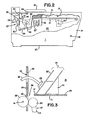
- Pick-up mechanism 27 generally comprises an arm 28, one end of which is provided with a suction cup 29, and the other end of which is pivoted for rotation about a pivot pin 30 responsive to a connecting rod 31 which is operatively connected to a drive mechanism 32.
- the arm 28 of the pick-up mechanism 27 also serves as a means for applying vacuum to the suction cup 29, via an appropriate vacuum hose.
- the drive mechanism 32 is vacuum actuated so that the source of vacuum which operates the drive mechanism 32 is also. available to apply a vacuum at suction cup 29, thereby facilitating operations.
- suction cup 29 is capable of being extended through an aperture 33 in a facing plate 34 which forms part of the front of the sorting apparatus 1, to address the series of envelopes 14. Accordingly, upon appropriate signaling, operation of the drive mechanism 32 is used to pivot the arm 28 about the pivot pin 3U to advance the suction cup 29 through the aperture 33 and into engagement with the first envelope 26 in the series of envelopes 14 provided. Such movement is capable of adjustment by means of the threaded connector 35 of the connecting rod 31.
- the arm 28 is then retracted so as to withdraw the suction cup 29 through the aperture 33, placing the envelope 26 in contact with the facing plate 34, as illustrated in phantom in Figure 3. In this manner, the envelope 26 is placed in proper positioning for sorting as follows.
- Sensing means 37 generally comprises a series of drive wheels 38 in operational association with a roller/follower 39.
- a plurality of drive wheels 38 extend through a series of apertures 40 in the facing plate 34 and are commonly connected by a drive shaft 41 which is journalled for rotation in fixed relation to the facing plate 34, and which is capable of selective rotation by motor 42. via drive belt 43.
- a series of five drive wheels 38 have been provided at spaced intervals along the drive shaft 41, preferably regularly spaced intervals, to sense the thickness of the envelope 26 at-various locations along its length, and to accommodate envelopes of different lengths. It is to be understood that a greater or lesser number of drive wheels 38 may be used, as desired.
- Roller/follower 39 is preferably continuous and cylindrical, extenting fully across the facing plate 34 and between a pair of follower arms 44. Roller/follower 39 is preferably journaled for rotation between follower arms 44 so that passage of an envelope 26 between the driven wheels 38 and the roller/follower 39 will cause deflection of the follower arms 44 in accordance with the thickness of the envelope 26, and its contents.
- follower arms 44 are pivotally associated with the sorting apparatus, at 43, so that deflection of the roller/follower 39 will cause the follower arms 44 to rotate against a spring and about the pivot 43, in turn rotating a lever 46 which is connected to either of the follower arms 44 and which is operatively associated with a microswitch 47 positioned so as to follow movement of the lever 46.
- an envelope 26 passing between the driven wheels 38 and the roller/follower 39 of the sorting apparatus 1 will cause deflection of the lever 46 in accordance with the thickness of the envelope 26 and its content.
- Such deflection is capable of developing a change in state of the microswitch 47, adjustment of this threshold parameter being achieved by adjusting the location of the microswitch 47 with respect to the lever 46, as desired.
- the envelope 26 will proceed downwardly in Figure 5, passing the sensing means 37 and a guide member 48, eventually contacting a deflector 49 which is positioned beneath the guide member 48 and which is capable of guiding the envelope 26 into the position 50 which is illustrated in phantom in Figure 5.
- the position 50 corresponds to the initial staging area 3 of the mail extraction desk 2, readying the envelope 26 for subequent processing by the mail extraction desk 2 as previously described.
- envelopes having.a thickness which is less than a prescribed threshold value will be passed through the sorting apparatus 1, for subsequent processing at the mail extraction desk 2.
- the deflector 49 is pivoted for rotation about its base 51 in accordance with operation of a connecting rod 52 which connects upper portions 53 of the deflector 49 with the end 54 of a lever mechanism 55.
- Lever mechanism 55 is rotatable about a pivot 56 responsive to interaction between a follower 57 associated with the lever mechanism 55, and a cam 58.
- Cam 58 is rotatable in the direction of the arrow 59 by means of a motor 60, and is provided with a pair of detents 61 which are diametrically opposed to.one another so as to appropriatly time the cam 58.
- a second microswitch 62 is positioned opposite to the follower 57 of the lever mechanism 55 so that the arm 63 of the microswitch 62 will enter one of the detents 61 of the cam 58 as the follower 57 enters the other detent 61.
- Microswitch 62 is used.to discontinue rotation of the cam 58 after a period of time which is sufficient to assure passage of the envelope 26 from between the series of driven wheels 38 and the roller/follower 39, whereupon the deflector 49 is reset and the sorting apparatus 1 is ready to process another envelope.
- the envelope 26 passing between the driven wheels 38 and the roller/follower 39 of the sensing means 37 is caused to enter the enclosure 22 of the mail sorting apparatus 1, rather than passing on to the initial staging area 3 of the mail extraction desk 2.
- envelopes 26 segregated from the series of envelopes 14 being sorted be received in the enclosure 22 in an organized fashion.
- a table 64 is located within the enclosure 22 near the base 20, which table 64 is provided with a driven chain mechanism 65 similar to the driven chain mechanism 25 associated with the table 2l.
- the driven chain mechanism 65 proceeds from the front of the sorting apparatus 1 to its rear.
- a stacker 66 is positioned over the driven chain mechanism 65 so that an envelope 26 passing between the guide member 48 and the facing plate 34 will be received on the angled face 67 of the stacker 66, being assisted in this positioning be a stop 68 formed at the end of the table 64.
- the sorting apparatus 1 be provided with a counter which records the number of envelopes which have been deflected from their normal path of travel and into the enclosure 22. Such a counter may, for example, be operated responsive to microswitch 47. Further, it is preferred that appropriate means be provided for detecting when the stacker 66 has reached the end of its travel, signifying a need to remove contents from the enclosure 22.
- This may be accomplished responsive to a selected number of envelope passings, as detected by means of the counter in association with microswitch 47, or by providing a microswitch or a photocell arrangement at the end of the table 64 which is opposite to the stop 68, to signify the limit in travel of the stacker 66.
- Either sensing scheme may be used to activate a warning light or buzzer to signify the need to empty the enclosure 22 of its contents, if desired.
- sorting apparatus 1 serves well to satisfy each of the objectives previously set forth. It will also be understood that the sorting apparatus 1 previously described is capable of variation without departing from the spirit and scope of the present invention.
- the sorting apparatus 1 of the present invention is also capable of use in combination with any of a number of mail extraction desks apart from the .embodiment illustrated, such as that illustrated in U.S. Patent No. 4,139,977, for example, or in the alternative, as a stand alone unit which is not associated with a mail extraction desk 2 of any kind.
- the sorting apparatus 1 is provided with a photocell 69 ( Figure 5) which is capable of being illuminated by a lamp 70 if the staging area 3 of the mail extraction desk 2 does not contain an envelope.
- This condition is used to activate the drive mechanism 32 which operates the pick-up mechanism 27, initiating the processing of an envelope 26 to be sorted. Otherwise, operation of the pick-up mechanism 27 is inhibited. This or other modifications may be required when interfacing the sorting apparatus 1 with different types of mail extraction equipment.
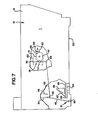
- appropriate means may be provided to receive envelopes delivered to the position 50 illustrated in Figure 5, such as a simple bin or bag for receiving envelopes, or preferably, a stacking mechanism similar to that illustrated in Figure 7 which is capable of receiving the envelopes in an oriented, shingled fashion.
- the enclosure 22 of a sorting apparatus 1 used either in combination with a mail extraction desk, or as a stand alone unit may be provided with a locking door 23 to provide a secured enclosure 22, or in the alternative, may be provided with either an access door or a simple opening, depending upon whether the envelopes collected in the enclosure 22 are to be accessable to anyone, or only to specif ied operators.
- the parameter sensed in analyzing the series of envelopes 14 is the thickness of the envelopes and their contents. This may be used to isolate relatively thin envelopes from relatively thick envelopes, or vice versa. Such a capability finds application in connection with the segregation of envelopes which are relatively thin, and which are therefore expected to contain only a single invoice and a single payment, for expedited handling. Such a capability also finds application in connection with the segregation of relatively thick envelopes, . which are expected to contain a processed or returned credit card, and which should therefore only be accessable to designated authorized personnel.
- the sorting apparatus of the present invention is not limited to the sensing of envelope thickness by means of a microswitch as previously described.
- sensing of the thickness of the envelope may be accomplished by other implements, such as a linear variable differential transformer, for example.
- sort envelopes by sensing the capacitance of the envelope, or the opacity of the envelope, providing alternative means for determining the content of an envelope and for determining which envelopes are to be separated from the ordinary course of processing.
- the sorting apparatus 1 of the present invention has been described in connection with certain specific applications, it will be understood that the sorting apparatus of the present invention will find applicability in a variety of different applications.
- the sorting apparatus may be used to test envelopes to determine the number of documents in a return mailer, to signify which of two or more different courses of action are to be taken. Return mailers containing coins, tokens or similar items may be separated from the series of envelopes under test, is desired.
- envelopes containing paper clips and staples may be separated out, since such implements may not be compatible with the sorting process, or the mail extraction process.
- metal detection sensors may be used to accomplish the sorting function, as distinguished from the thickness sensing means 37 previously described.
Landscapes
- Sorting Of Articles (AREA)
Applications Claiming Priority (2)
| Application Number | Priority Date | Filing Date | Title |
|---|---|---|---|
| US63095584A | 1984-07-16 | 1984-07-16 | |
| US630955 | 1984-07-16 |
Publications (2)
| Publication Number | Publication Date |
|---|---|
| EP0169145A2 true EP0169145A2 (fr) | 1986-01-22 |
| EP0169145A3 EP0169145A3 (fr) | 1986-07-30 |
Family
ID=24529245
Family Applications (1)
| Application Number | Title | Priority Date | Filing Date |
|---|---|---|---|
| EP85401460A Withdrawn EP0169145A3 (fr) | 1984-07-16 | 1985-07-16 | Appareil pour trier des enveloppes |
Country Status (4)
| Country | Link |
|---|---|
| EP (1) | EP0169145A3 (fr) |
| AU (1) | AU4506185A (fr) |
| ES (1) | ES8703302A1 (fr) |
| ZA (1) | ZA855343B (fr) |
Cited By (8)
| Publication number | Priority date | Publication date | Assignee | Title |
|---|---|---|---|---|
| WO1988001543A1 (fr) * | 1986-09-05 | 1988-03-10 | Opex Corporation | Appareil de traitement automatique de grands volumes de courrier et similaire |
| EP0225288A3 (fr) * | 1985-11-27 | 1988-03-30 | Opex Corporation | Dispositif de surveillance de l'épaisseur d'un objet |
| WO1994004378A1 (fr) * | 1992-08-19 | 1994-03-03 | The Technology Partnership Plc | Appareil et procede de verification du contenu d'une enveloppe |
| US5310062A (en) * | 1986-09-05 | 1994-05-10 | Opex Corporation | Apparatus for automated mail extraction and remittance processing |
| EP0605065A1 (fr) * | 1992-12-31 | 1994-07-06 | Hadewe B.V. | Méthode et appareil pour vérifier si des documents ont été séparés d'une enveloppe ouverte |
| US5397003A (en) * | 1986-09-05 | 1995-03-14 | Opex Corporation | Method and apparatus for determining the orientation of a document |
| US5460273A (en) * | 1986-09-05 | 1995-10-24 | Opex Corporation | Apparatus for the automated processing of bulk mail having varied characteristics |
| US5842693A (en) * | 1986-09-05 | 1998-12-01 | Opex Corporation | Automated mail extraction and remittance processing |
Family Cites Families (2)
| Publication number | Priority date | Publication date | Assignee | Title |
|---|---|---|---|---|
| US3712468A (en) * | 1971-02-24 | 1973-01-23 | W Wenner | Device which scans and detects for contents in a package |
| US4272943A (en) * | 1977-05-31 | 1981-06-16 | Mail-Ex Corporation | Envelope processing machine and method |
-
1985
- 1985-07-16 ZA ZA855343A patent/ZA855343B/xx unknown
- 1985-07-16 ES ES545626A patent/ES8703302A1/es not_active Expired
- 1985-07-16 AU AU45061/85A patent/AU4506185A/en not_active Abandoned
- 1985-07-16 EP EP85401460A patent/EP0169145A3/fr not_active Withdrawn
Cited By (15)
| Publication number | Priority date | Publication date | Assignee | Title |
|---|---|---|---|---|
| EP0225288A3 (fr) * | 1985-11-27 | 1988-03-30 | Opex Corporation | Dispositif de surveillance de l'épaisseur d'un objet |
| US5460273A (en) * | 1986-09-05 | 1995-10-24 | Opex Corporation | Apparatus for the automated processing of bulk mail having varied characteristics |
| US5540338A (en) * | 1986-09-05 | 1996-07-30 | Opex Corporation | Method and apparatus for determining the orientation of a document |
| US5842693A (en) * | 1986-09-05 | 1998-12-01 | Opex Corporation | Automated mail extraction and remittance processing |
| US5310062A (en) * | 1986-09-05 | 1994-05-10 | Opex Corporation | Apparatus for automated mail extraction and remittance processing |
| US4863037A (en) * | 1986-09-05 | 1989-09-05 | Opex Corporation | Apparatus for the automated processing of bulk mail and the like |
| US5397003A (en) * | 1986-09-05 | 1995-03-14 | Opex Corporation | Method and apparatus for determining the orientation of a document |
| US5439118A (en) * | 1986-09-05 | 1995-08-08 | Opex Corporation | Apparatus for extracting documents from envelopes |
| US5441159A (en) * | 1986-09-05 | 1995-08-15 | Opex Corporation | Apparatus for handling documents for delivery to remittance processing equipment |
| WO1988001543A1 (fr) * | 1986-09-05 | 1988-03-10 | Opex Corporation | Appareil de traitement automatique de grands volumes de courrier et similaire |
| US5518121A (en) * | 1986-09-05 | 1996-05-21 | Opex Corporation | Method for automated mail extraction and remittance processing |
| US5727692A (en) * | 1992-08-19 | 1998-03-17 | Stielow Gmbh & Co. | Apparatus and method for checking an envelope for contents |
| WO1994004378A1 (fr) * | 1992-08-19 | 1994-03-03 | The Technology Partnership Plc | Appareil et procede de verification du contenu d'une enveloppe |
| US5655668A (en) * | 1992-12-27 | 1997-08-12 | Hadewe B.V. | Method and apparatus for verifying whether documents have been separated from an opened envelope |
| EP0605065A1 (fr) * | 1992-12-31 | 1994-07-06 | Hadewe B.V. | Méthode et appareil pour vérifier si des documents ont été séparés d'une enveloppe ouverte |
Also Published As
| Publication number | Publication date |
|---|---|
| AU4506185A (en) | 1986-01-23 |
| ES8703302A1 (es) | 1987-03-01 |
| EP0169145A3 (fr) | 1986-07-30 |
| ES545626A0 (es) | 1987-03-01 |
| ZA855343B (en) | 1986-02-26 |
Similar Documents
| Publication | Publication Date | Title |
|---|---|---|
| US5460273A (en) | Apparatus for the automated processing of bulk mail having varied characteristics | |
| EP0279857B1 (fr) | Appareil de traitement automatique de grands volumes de courrier et similaire | |
| EP0571308B1 (fr) | Appareil et procédé pour l'extraction automatique du courrier et encaissement automatique | |
| US5464099A (en) | Method for the automated processing of documents and bulk mail | |
| US3976198A (en) | Method and apparatus for sorting currency | |
| JPH0236977B2 (fr) | ||
| US5924840A (en) | Method of extracting contents from envelopes | |
| US4934892A (en) | Envelope processing apparatus | |
| EP0926634A2 (fr) | Dispositif pour le traitement de pièces de monnaie et machine pour le dépot de pièces de monnaie avec un tel dispositif | |
| US6547078B1 (en) | Automated mail extraction and remittance processing | |
| EP0169145A2 (fr) | Appareil pour trier des enveloppes | |
| US5538140A (en) | Buffered stacker with drop floor assembly | |
| US6086472A (en) | Throw-into-type coin discriminator | |
| CA1236341A (fr) | Mecanisme de transport sur pour dispositifs de depot bancaire | |
| JPS6145278B2 (fr) | ||
| US5348128A (en) | Apparatus for the collection, identification and reclamation of recyclable waste | |
| JPS62209695A (ja) | 窓口用還流式硬貨入出金機 | |
| AU2017101000A4 (en) | A banknote dispenser and banknote sensor arrangement for use with banknotes comprising a transparent portion | |
| KR100514631B1 (ko) | 계수 분권기능을 갖는 현금처리기 | |
| JPH035969Y2 (fr) | ||
| JPS58106673A (ja) | 紙幣放出装置 | |
| JPS61127533A (ja) | 紙葉類自動取扱い装置 | |
| SE528122C2 (sv) | Mynthanteringsapparat med avskiljningsstationer | |
| JPH037596B2 (fr) | ||
| JPS58114186A (ja) | 自動取引装置 |
Legal Events
| Date | Code | Title | Description |
|---|---|---|---|
| PUAI | Public reference made under article 153(3) epc to a published international application that has entered the european phase |
Free format text: ORIGINAL CODE: 0009012 |
|
| AK | Designated contracting states |
Designated state(s): AT BE CH DE FR GB IT LI LU NL SE |
|
| PUAL | Search report despatched |
Free format text: ORIGINAL CODE: 0009013 |
|
| AK | Designated contracting states |
Kind code of ref document: A3 Designated state(s): AT BE CH DE FR GB IT LI LU NL SE |
|
| 17P | Request for examination filed |
Effective date: 19870116 |
|
| 17Q | First examination report despatched |
Effective date: 19880324 |
|
| STAA | Information on the status of an ep patent application or granted ep patent |
Free format text: STATUS: THE APPLICATION IS DEEMED TO BE WITHDRAWN |
|
| 18D | Application deemed to be withdrawn |
Effective date: 19880804 |
|
| RIN1 | Information on inventor provided before grant (corrected) |
Inventor name: STEVENS, ALBERT F. Inventor name: HALEY, PAUL E. |