EP0169521A2 - Cyclohexenonderivate, Verfahren zur ihrer Herstellung und ihre Verwendung zur Bekämpfung unerwünschten Pflanzenwuchses - Google Patents
Cyclohexenonderivate, Verfahren zur ihrer Herstellung und ihre Verwendung zur Bekämpfung unerwünschten Pflanzenwuchses Download PDFInfo
- Publication number
- EP0169521A2 EP0169521A2 EP85109120A EP85109120A EP0169521A2 EP 0169521 A2 EP0169521 A2 EP 0169521A2 EP 85109120 A EP85109120 A EP 85109120A EP 85109120 A EP85109120 A EP 85109120A EP 0169521 A2 EP0169521 A2 EP 0169521A2
- Authority
- EP
- European Patent Office
- Prior art keywords
- alkyl
- formula
- carbon atoms
- alkoxy
- hydrogen
- Prior art date
- Legal status (The legal status is an assumption and is not a legal conclusion. Google has not performed a legal analysis and makes no representation as to the accuracy of the status listed.)
- Granted
Links
- FWFSEYBSWVRWGL-UHFFFAOYSA-N cyclohex-2-enone Chemical class O=C1CCCC=C1 FWFSEYBSWVRWGL-UHFFFAOYSA-N 0.000 title claims abstract description 30
- 238000002360 preparation method Methods 0.000 title claims abstract description 11
- 230000012010 growth Effects 0.000 title description 5
- -1 N-Phenylcarbamoyl Chemical group 0.000 claims abstract description 116
- 125000000217 alkyl group Chemical group 0.000 claims abstract description 91
- 150000001875 compounds Chemical class 0.000 claims abstract description 52
- 150000002367 halogens Chemical class 0.000 claims abstract description 36
- 239000001257 hydrogen Substances 0.000 claims abstract description 35
- 229910052739 hydrogen Inorganic materials 0.000 claims abstract description 35
- 125000003545 alkoxy group Chemical group 0.000 claims abstract description 34
- 229910052736 halogen Inorganic materials 0.000 claims abstract description 32
- 125000000449 nitro group Chemical class [O-][N+](*)=O 0.000 claims abstract description 32
- UFHFLCQGNIYNRP-UHFFFAOYSA-N Hydrogen Chemical compound [H][H] UFHFLCQGNIYNRP-UHFFFAOYSA-N 0.000 claims abstract description 22
- 150000002431 hydrogen Chemical class 0.000 claims abstract description 21
- 125000004390 alkyl sulfonyl group Chemical group 0.000 claims abstract description 20
- 125000003236 benzoyl group Chemical group [H]C1=C([H])C([H])=C(C([H])=C1[H])C(*)=O 0.000 claims abstract description 14
- 238000000034 method Methods 0.000 claims abstract description 14
- 125000002496 methyl group Chemical group [H]C([H])([H])* 0.000 claims abstract description 13
- 229910052757 nitrogen Inorganic materials 0.000 claims abstract description 13
- 125000005137 alkenylsulfonyl group Chemical group 0.000 claims abstract description 12
- 125000003302 alkenyloxy group Chemical group 0.000 claims abstract description 11
- 125000004414 alkyl thio group Chemical group 0.000 claims abstract description 11
- 125000001584 benzyloxycarbonyl group Chemical group C(=O)(OCC1=CC=CC=C1)* 0.000 claims abstract description 11
- 125000002485 formyl group Chemical group [H]C(*)=O 0.000 claims abstract description 11
- 125000006678 phenoxycarbonyl group Chemical group 0.000 claims abstract description 11
- UYWQUFXKFGHYNT-UHFFFAOYSA-N phenylmethyl ester of formic acid Natural products O=COCC1=CC=CC=C1 UYWQUFXKFGHYNT-UHFFFAOYSA-N 0.000 claims abstract description 11
- 125000005118 N-alkylcarbamoyl group Chemical group 0.000 claims abstract description 10
- 125000004453 alkoxycarbonyl group Chemical group 0.000 claims abstract description 10
- 125000004644 alkyl sulfinyl group Chemical group 0.000 claims abstract description 10
- 125000004691 alkyl thio carbonyl group Chemical group 0.000 claims abstract description 10
- 125000006254 cycloalkyl carbonyl group Chemical group 0.000 claims abstract description 10
- 125000001160 methoxycarbonyl group Chemical group [H]C([H])([H])OC(*)=O 0.000 claims abstract description 10
- 125000002924 primary amino group Chemical group [H]N([H])* 0.000 claims abstract description 10
- 125000002887 hydroxy group Chemical group [H]O* 0.000 claims abstract description 9
- 125000001494 2-propynyl group Chemical group [H]C#CC([H])([H])* 0.000 claims abstract description 8
- 125000003754 ethoxycarbonyl group Chemical group C(=O)(OCC)* 0.000 claims abstract description 8
- 125000000262 haloalkenyl group Chemical group 0.000 claims abstract description 8
- 125000004441 haloalkylsulfonyl group Chemical group 0.000 claims abstract description 8
- 125000003342 alkenyl group Chemical group 0.000 claims abstract description 7
- 125000005133 alkynyloxy group Chemical group 0.000 claims abstract description 7
- 125000004093 cyano group Chemical group *C#N 0.000 claims abstract description 7
- 125000004432 carbon atom Chemical group C* 0.000 claims description 75
- XLYOFNOQVPJJNP-UHFFFAOYSA-N water Substances O XLYOFNOQVPJJNP-UHFFFAOYSA-N 0.000 claims description 24
- UUEVFMOUBSLVJW-UHFFFAOYSA-N oxo-[[1-[2-[2-[2-[4-(oxoazaniumylmethylidene)pyridin-1-yl]ethoxy]ethoxy]ethyl]pyridin-4-ylidene]methyl]azanium;dibromide Chemical compound [Br-].[Br-].C1=CC(=C[NH+]=O)C=CN1CCOCCOCCN1C=CC(=C[NH+]=O)C=C1 UUEVFMOUBSLVJW-UHFFFAOYSA-N 0.000 claims description 11
- 150000003839 salts Chemical class 0.000 claims description 11
- 230000002363 herbicidal effect Effects 0.000 claims description 8
- 125000001997 phenyl group Chemical group [H]C1=C([H])C([H])=C(*)C([H])=C1[H] 0.000 claims description 7
- ZAMOUSCENKQFHK-UHFFFAOYSA-N Chlorine atom Chemical compound [Cl] ZAMOUSCENKQFHK-UHFFFAOYSA-N 0.000 claims description 6
- PXGOKWXKJXAPGV-UHFFFAOYSA-N Fluorine Chemical compound FF PXGOKWXKJXAPGV-UHFFFAOYSA-N 0.000 claims description 6
- 239000000460 chlorine Substances 0.000 claims description 6
- 229910052801 chlorine Inorganic materials 0.000 claims description 6
- 239000004009 herbicide Substances 0.000 claims description 6
- 239000007864 aqueous solution Substances 0.000 claims description 5
- 239000003054 catalyst Substances 0.000 claims description 5
- 229910052731 fluorine Inorganic materials 0.000 claims description 5
- 239000011737 fluorine Substances 0.000 claims description 5
- 125000001188 haloalkyl group Chemical group 0.000 claims description 5
- 125000002777 acetyl group Chemical group [H]C([H])([H])C(*)=O 0.000 claims description 4
- 239000002253 acid Substances 0.000 claims description 4
- 150000003868 ammonium compounds Chemical class 0.000 claims description 3
- 125000000753 cycloalkyl group Chemical group 0.000 claims description 3
- 238000005984 hydrogenation reaction Methods 0.000 claims description 3
- 239000003701 inert diluent Substances 0.000 claims description 3
- 239000012442 inert solvent Substances 0.000 claims description 3
- 239000012948 isocyanate Substances 0.000 claims description 3
- 150000002513 isocyanates Chemical class 0.000 claims description 3
- 230000008635 plant growth Effects 0.000 claims description 3
- 150000001450 anions Chemical class 0.000 claims description 2
- 150000002443 hydroxylamines Chemical class 0.000 claims description 2
- 239000000654 additive Substances 0.000 claims 1
- 239000011230 binding agent Substances 0.000 claims 1
- 238000002955 isolation Methods 0.000 claims 1
- 125000002252 acyl group Chemical group 0.000 abstract description 6
- YMWUJEATGCHHMB-UHFFFAOYSA-N Dichloromethane Chemical compound ClCCl YMWUJEATGCHHMB-UHFFFAOYSA-N 0.000 description 36
- 239000000203 mixture Substances 0.000 description 28
- 239000004480 active ingredient Substances 0.000 description 23
- XEKOWRVHYACXOJ-UHFFFAOYSA-N Ethyl acetate Chemical compound CCOC(C)=O XEKOWRVHYACXOJ-UHFFFAOYSA-N 0.000 description 21
- OKKJLVBELUTLKV-UHFFFAOYSA-N Methanol Chemical compound OC OKKJLVBELUTLKV-UHFFFAOYSA-N 0.000 description 21
- 241000196324 Embryophyta Species 0.000 description 20
- WYURNTSHIVDZCO-UHFFFAOYSA-N Tetrahydrofuran Chemical compound C1CCOC1 WYURNTSHIVDZCO-UHFFFAOYSA-N 0.000 description 20
- RTZKZFJDLAIYFH-UHFFFAOYSA-N Diethyl ether Chemical compound CCOCC RTZKZFJDLAIYFH-UHFFFAOYSA-N 0.000 description 18
- 238000006243 chemical reaction Methods 0.000 description 17
- JUJWROOIHBZHMG-UHFFFAOYSA-N Pyridine Chemical compound C1=CC=NC=C1 JUJWROOIHBZHMG-UHFFFAOYSA-N 0.000 description 16
- 239000003921 oil Substances 0.000 description 16
- 239000000243 solution Substances 0.000 description 16
- 229910052783 alkali metal Inorganic materials 0.000 description 14
- 239000006185 dispersion Substances 0.000 description 13
- IAYPIBMASNFSPL-UHFFFAOYSA-N Ethylene oxide Chemical compound C1CO1 IAYPIBMASNFSPL-UHFFFAOYSA-N 0.000 description 12
- UIIMBOGNXHQVGW-UHFFFAOYSA-M Sodium bicarbonate Chemical compound [Na+].OC([O-])=O UIIMBOGNXHQVGW-UHFFFAOYSA-M 0.000 description 12
- YXFVVABEGXRONW-UHFFFAOYSA-N Toluene Chemical compound CC1=CC=CC=C1 YXFVVABEGXRONW-UHFFFAOYSA-N 0.000 description 12
- 239000003513 alkali Substances 0.000 description 12
- 235000014113 dietary fatty acids Nutrition 0.000 description 12
- 239000000194 fatty acid Substances 0.000 description 12
- 229930195729 fatty acid Natural products 0.000 description 12
- ZMXDDKWLCZADIW-UHFFFAOYSA-N N,N-Dimethylformamide Chemical compound CN(C)C=O ZMXDDKWLCZADIW-UHFFFAOYSA-N 0.000 description 11
- 241000209504 Poaceae Species 0.000 description 11
- VYPSYNLAJGMNEJ-UHFFFAOYSA-N Silicium dioxide Chemical compound O=[Si]=O VYPSYNLAJGMNEJ-UHFFFAOYSA-N 0.000 description 11
- 150000004665 fatty acids Chemical class 0.000 description 11
- CSCPPACGZOOCGX-UHFFFAOYSA-N Acetone Chemical compound CC(C)=O CSCPPACGZOOCGX-UHFFFAOYSA-N 0.000 description 10
- 239000002904 solvent Substances 0.000 description 10
- YLQBMQCUIZJEEH-UHFFFAOYSA-N tetrahydrofuran Natural products C=1C=COC=1 YLQBMQCUIZJEEH-UHFFFAOYSA-N 0.000 description 10
- WEVYAHXRMPXWCK-UHFFFAOYSA-N Acetonitrile Chemical compound CC#N WEVYAHXRMPXWCK-UHFFFAOYSA-N 0.000 description 9
- HEDRZPFGACZZDS-UHFFFAOYSA-N Chloroform Chemical compound ClC(Cl)Cl HEDRZPFGACZZDS-UHFFFAOYSA-N 0.000 description 9
- LFQSCWFLJHTTHZ-UHFFFAOYSA-N Ethanol Chemical compound CCO LFQSCWFLJHTTHZ-UHFFFAOYSA-N 0.000 description 9
- VEXZGXHMUGYJMC-UHFFFAOYSA-N Hydrochloric acid Chemical compound Cl VEXZGXHMUGYJMC-UHFFFAOYSA-N 0.000 description 8
- UMJSCPRVCHMLSP-UHFFFAOYSA-N pyridine Natural products COC1=CC=CN=C1 UMJSCPRVCHMLSP-UHFFFAOYSA-N 0.000 description 8
- 238000011282 treatment Methods 0.000 description 8
- 235000010469 Glycine max Nutrition 0.000 description 7
- 229910052784 alkaline earth metal Inorganic materials 0.000 description 7
- 239000000741 silica gel Substances 0.000 description 7
- 229910002027 silica gel Inorganic materials 0.000 description 7
- KFZMGEQAYNKOFK-UHFFFAOYSA-N Isopropanol Chemical compound CC(C)O KFZMGEQAYNKOFK-UHFFFAOYSA-N 0.000 description 6
- KDLHZDBZIXYQEI-UHFFFAOYSA-N Palladium Chemical compound [Pd] KDLHZDBZIXYQEI-UHFFFAOYSA-N 0.000 description 6
- ZMANZCXQSJIPKH-UHFFFAOYSA-N Triethylamine Chemical compound CCN(CC)CC ZMANZCXQSJIPKH-UHFFFAOYSA-N 0.000 description 6
- MVPPADPHJFYWMZ-UHFFFAOYSA-N chlorobenzene Chemical compound ClC1=CC=CC=C1 MVPPADPHJFYWMZ-UHFFFAOYSA-N 0.000 description 6
- 125000001495 ethyl group Chemical group [H]C([H])([H])C([H])([H])* 0.000 description 6
- VLKZOEOYAKHREP-UHFFFAOYSA-N n-Hexane Chemical compound CCCCCC VLKZOEOYAKHREP-UHFFFAOYSA-N 0.000 description 6
- 229910000030 sodium bicarbonate Inorganic materials 0.000 description 6
- 235000017557 sodium bicarbonate Nutrition 0.000 description 6
- CTQNGGLPUBDAKN-UHFFFAOYSA-N O-Xylene Chemical compound CC1=CC=CC=C1C CTQNGGLPUBDAKN-UHFFFAOYSA-N 0.000 description 5
- 240000007594 Oryza sativa Species 0.000 description 5
- 235000007164 Oryza sativa Nutrition 0.000 description 5
- 150000001448 anilines Chemical class 0.000 description 5
- JHIVVAPYMSGYDF-UHFFFAOYSA-N cyclohexanone Chemical compound O=C1CCCCC1 JHIVVAPYMSGYDF-UHFFFAOYSA-N 0.000 description 5
- 125000001449 isopropyl group Chemical group [H]C([H])([H])C([H])(*)C([H])([H])[H] 0.000 description 5
- 125000004108 n-butyl group Chemical group [H]C([H])([H])C([H])([H])C([H])([H])C([H])([H])* 0.000 description 5
- 159000000000 sodium salts Chemical class 0.000 description 5
- 239000007787 solid Substances 0.000 description 5
- 125000000999 tert-butyl group Chemical group [H]C([H])([H])C(*)(C([H])([H])[H])C([H])([H])[H] 0.000 description 5
- SCYULBFZEHDVBN-UHFFFAOYSA-N 1,1-Dichloroethane Chemical compound CC(Cl)Cl SCYULBFZEHDVBN-UHFFFAOYSA-N 0.000 description 4
- RYHBNJHYFVUHQT-UHFFFAOYSA-N 1,4-Dioxane Chemical compound C1COCCO1 RYHBNJHYFVUHQT-UHFFFAOYSA-N 0.000 description 4
- WBIQQQGBSDOWNP-UHFFFAOYSA-N 2-dodecylbenzenesulfonic acid Chemical compound CCCCCCCCCCCCC1=CC=CC=C1S(O)(=O)=O WBIQQQGBSDOWNP-UHFFFAOYSA-N 0.000 description 4
- XDTMQSROBMDMFD-UHFFFAOYSA-N Cyclohexane Chemical compound C1CCCCC1 XDTMQSROBMDMFD-UHFFFAOYSA-N 0.000 description 4
- IAZDPXIOMUYVGZ-UHFFFAOYSA-N Dimethylsulphoxide Chemical compound CS(C)=O IAZDPXIOMUYVGZ-UHFFFAOYSA-N 0.000 description 4
- ZHNUHDYFZUAESO-UHFFFAOYSA-N Formamide Chemical compound NC=O ZHNUHDYFZUAESO-UHFFFAOYSA-N 0.000 description 4
- DGAQECJNVWCQMB-PUAWFVPOSA-M Ilexoside XXIX Chemical compound C[C@@H]1CC[C@@]2(CC[C@@]3(C(=CC[C@H]4[C@]3(CC[C@@H]5[C@@]4(CC[C@@H](C5(C)C)OS(=O)(=O)[O-])C)C)[C@@H]2[C@]1(C)O)C)C(=O)O[C@H]6[C@@H]([C@H]([C@@H]([C@H](O6)CO)O)O)O.[Na+] DGAQECJNVWCQMB-PUAWFVPOSA-M 0.000 description 4
- OFBQJSOFQDEBGM-UHFFFAOYSA-N Pentane Chemical compound CCCCC OFBQJSOFQDEBGM-UHFFFAOYSA-N 0.000 description 4
- PMZURENOXWZQFD-UHFFFAOYSA-L Sodium Sulfate Chemical compound [Na+].[Na+].[O-]S([O-])(=O)=O PMZURENOXWZQFD-UHFFFAOYSA-L 0.000 description 4
- 229910052936 alkali metal sulfate Inorganic materials 0.000 description 4
- 239000004359 castor oil Substances 0.000 description 4
- 235000019438 castor oil Nutrition 0.000 description 4
- 244000038559 crop plants Species 0.000 description 4
- HPXRVTGHNJAIIH-UHFFFAOYSA-N cyclohexanol Chemical compound OC1CCCCC1 HPXRVTGHNJAIIH-UHFFFAOYSA-N 0.000 description 4
- 230000000694 effects Effects 0.000 description 4
- 239000000839 emulsion Substances 0.000 description 4
- 150000002148 esters Chemical class 0.000 description 4
- 150000002170 ethers Chemical class 0.000 description 4
- ZEMPKEQAKRGZGQ-XOQCFJPHSA-N glycerol triricinoleate Natural products CCCCCC[C@@H](O)CC=CCCCCCCCC(=O)OC[C@@H](COC(=O)CCCCCCCC=CC[C@@H](O)CCCCCC)OC(=O)CCCCCCCC=CC[C@H](O)CCCCCC ZEMPKEQAKRGZGQ-XOQCFJPHSA-N 0.000 description 4
- ZXEKIIBDNHEJCQ-UHFFFAOYSA-N isobutanol Chemical compound CC(C)CO ZXEKIIBDNHEJCQ-UHFFFAOYSA-N 0.000 description 4
- 125000000959 isobutyl group Chemical group [H]C([H])([H])C([H])(C([H])([H])[H])C([H])([H])* 0.000 description 4
- 125000004123 n-propyl group Chemical group [H]C([H])([H])C([H])([H])C([H])([H])* 0.000 description 4
- LQNUZADURLCDLV-UHFFFAOYSA-N nitrobenzene Chemical compound [O-][N+](=O)C1=CC=CC=C1 LQNUZADURLCDLV-UHFFFAOYSA-N 0.000 description 4
- 239000012074 organic phase Substances 0.000 description 4
- 235000009566 rice Nutrition 0.000 description 4
- 125000002914 sec-butyl group Chemical group [H]C([H])([H])C([H])([H])C([H])(*)C([H])([H])[H] 0.000 description 4
- 229910052938 sodium sulfate Inorganic materials 0.000 description 4
- 235000011152 sodium sulphate Nutrition 0.000 description 4
- 241000894007 species Species 0.000 description 4
- 238000003756 stirring Methods 0.000 description 4
- NFAOATPOYUWEHM-UHFFFAOYSA-N 2-(6-methylheptyl)phenol Chemical class CC(C)CCCCCC1=CC=CC=C1O NFAOATPOYUWEHM-UHFFFAOYSA-N 0.000 description 3
- ZWEHNKRNPOVVGH-UHFFFAOYSA-N 2-Butanone Chemical compound CCC(C)=O ZWEHNKRNPOVVGH-UHFFFAOYSA-N 0.000 description 3
- 239000005995 Aluminium silicate Substances 0.000 description 3
- QGZKDVFQNNGYKY-UHFFFAOYSA-O Ammonium Chemical compound [NH4+] QGZKDVFQNNGYKY-UHFFFAOYSA-O 0.000 description 3
- 244000075850 Avena orientalis Species 0.000 description 3
- 235000007319 Avena orientalis Nutrition 0.000 description 3
- UHOVQNZJYSORNB-UHFFFAOYSA-N Benzene Chemical compound C1=CC=CC=C1 UHOVQNZJYSORNB-UHFFFAOYSA-N 0.000 description 3
- 235000006463 Brassica alba Nutrition 0.000 description 3
- 244000140786 Brassica hirta Species 0.000 description 3
- WKBOTKDWSSQWDR-UHFFFAOYSA-N Bromine atom Chemical compound [Br] WKBOTKDWSSQWDR-UHFFFAOYSA-N 0.000 description 3
- OYPRJOBELJOOCE-UHFFFAOYSA-N Calcium Chemical compound [Ca] OYPRJOBELJOOCE-UHFFFAOYSA-N 0.000 description 3
- 244000068988 Glycine max Species 0.000 description 3
- FYYHWMGAXLPEAU-UHFFFAOYSA-N Magnesium Chemical compound [Mg] FYYHWMGAXLPEAU-UHFFFAOYSA-N 0.000 description 3
- ZLMJMSJWJFRBEC-UHFFFAOYSA-N Potassium Chemical compound [K] ZLMJMSJWJFRBEC-UHFFFAOYSA-N 0.000 description 3
- KWYUFKZDYYNOTN-UHFFFAOYSA-M Potassium hydroxide Chemical compound [OH-].[K+] KWYUFKZDYYNOTN-UHFFFAOYSA-M 0.000 description 3
- 244000062793 Sorghum vulgare Species 0.000 description 3
- 241000209140 Triticum Species 0.000 description 3
- 235000021307 Triticum Nutrition 0.000 description 3
- 150000001298 alcohols Chemical class 0.000 description 3
- 235000012211 aluminium silicate Nutrition 0.000 description 3
- 150000001408 amides Chemical class 0.000 description 3
- 239000002585 base Substances 0.000 description 3
- JFDZBHWFFUWGJE-UHFFFAOYSA-N benzonitrile Chemical compound N#CC1=CC=CC=C1 JFDZBHWFFUWGJE-UHFFFAOYSA-N 0.000 description 3
- 238000009835 boiling Methods 0.000 description 3
- GDTBXPJZTBHREO-UHFFFAOYSA-N bromine Substances BrBr GDTBXPJZTBHREO-UHFFFAOYSA-N 0.000 description 3
- 229910052794 bromium Inorganic materials 0.000 description 3
- 239000011575 calcium Substances 0.000 description 3
- 239000000969 carrier Substances 0.000 description 3
- 150000001805 chlorine compounds Chemical class 0.000 description 3
- 239000012141 concentrate Substances 0.000 description 3
- 230000006378 damage Effects 0.000 description 3
- 239000008187 granular material Substances 0.000 description 3
- 239000005457 ice water Substances 0.000 description 3
- RAXXELZNTBOGNW-UHFFFAOYSA-N imidazole Natural products C1=CNC=N1 RAXXELZNTBOGNW-UHFFFAOYSA-N 0.000 description 3
- NLYAJNPCOHFWQQ-UHFFFAOYSA-N kaolin Chemical compound O.O.O=[Al]O[Si](=O)O[Si](=O)O[Al]=O NLYAJNPCOHFWQQ-UHFFFAOYSA-N 0.000 description 3
- 229910052749 magnesium Inorganic materials 0.000 description 3
- 239000011777 magnesium Substances 0.000 description 3
- 235000019713 millet Nutrition 0.000 description 3
- 239000002480 mineral oil Substances 0.000 description 3
- 235000010446 mineral oil Nutrition 0.000 description 3
- 150000002790 naphthalenes Chemical class 0.000 description 3
- 150000002825 nitriles Chemical class 0.000 description 3
- 229920003023 plastic Polymers 0.000 description 3
- 229920000151 polyglycol Polymers 0.000 description 3
- 239000010695 polyglycol Substances 0.000 description 3
- 239000011591 potassium Substances 0.000 description 3
- 229910052700 potassium Inorganic materials 0.000 description 3
- 239000000843 powder Substances 0.000 description 3
- 239000000047 product Substances 0.000 description 3
- 150000003254 radicals Chemical class 0.000 description 3
- 239000011541 reaction mixture Substances 0.000 description 3
- 229910052708 sodium Inorganic materials 0.000 description 3
- 239000008096 xylene Substances 0.000 description 3
- RFFLAFLAYFXFSW-UHFFFAOYSA-N 1,2-dichlorobenzene Chemical compound ClC1=CC=CC=C1Cl RFFLAFLAYFXFSW-UHFFFAOYSA-N 0.000 description 2
- ZPQOPVIELGIULI-UHFFFAOYSA-N 1,3-dichlorobenzene Chemical compound ClC1=CC=CC(Cl)=C1 ZPQOPVIELGIULI-UHFFFAOYSA-N 0.000 description 2
- OCJBOOLMMGQPQU-UHFFFAOYSA-N 1,4-dichlorobenzene Chemical compound ClC1=CC=C(Cl)C=C1 OCJBOOLMMGQPQU-UHFFFAOYSA-N 0.000 description 2
- KBLAMUYRMZPYLS-UHFFFAOYSA-N 2,3-bis(2-methylpropyl)naphthalene-1-sulfonic acid Chemical compound C1=CC=C2C(S(O)(=O)=O)=C(CC(C)C)C(CC(C)C)=CC2=C1 KBLAMUYRMZPYLS-UHFFFAOYSA-N 0.000 description 2
- FOGYNLXERPKEGN-UHFFFAOYSA-N 3-(2-hydroxy-3-methoxyphenyl)-2-[2-methoxy-4-(3-sulfopropyl)phenoxy]propane-1-sulfonic acid Chemical class COC1=CC=CC(CC(CS(O)(=O)=O)OC=2C(=CC(CCCS(O)(=O)=O)=CC=2)OC)=C1O FOGYNLXERPKEGN-UHFFFAOYSA-N 0.000 description 2
- VHYFNPMBLIVWCW-UHFFFAOYSA-N 4-Dimethylaminopyridine Chemical compound CN(C)C1=CC=NC=C1 VHYFNPMBLIVWCW-UHFFFAOYSA-N 0.000 description 2
- JGDWCAGFRVFJKT-UHFFFAOYSA-N 5-(2-fluoro-5-nitrophenyl)cyclohexane-1,3-dione Chemical compound [O-][N+](=O)C1=CC=C(F)C(C2CC(=O)CC(=O)C2)=C1 JGDWCAGFRVFJKT-UHFFFAOYSA-N 0.000 description 2
- PZEBLWPPCXJQJL-UHFFFAOYSA-N 5-(3-amino-4-methoxyphenyl)-2-(N-ethoxy-C-propylcarbonimidoyl)-3-hydroxycyclohex-2-en-1-one Chemical compound C1C(=O)C(C(=NOCC)CCC)=C(O)CC1C1=CC=C(OC)C(N)=C1 PZEBLWPPCXJQJL-UHFFFAOYSA-N 0.000 description 2
- QTBSBXVTEAMEQO-UHFFFAOYSA-N Acetic acid Chemical compound CC(O)=O QTBSBXVTEAMEQO-UHFFFAOYSA-N 0.000 description 2
- OOIDBFRSHASBME-UHFFFAOYSA-N C1C(=O)C(C(=O)CCC)=C(O)CC1C1=CC([N+]([O-])=O)=CC=C1F Chemical compound C1C(=O)C(C(=O)CCC)=C(O)CC1C1=CC([N+]([O-])=O)=CC=C1F OOIDBFRSHASBME-UHFFFAOYSA-N 0.000 description 2
- LLCQUBQIUJUILL-UHFFFAOYSA-N C1C(=O)C(C(=O)CCC)=C(O)CC1C1=CC=C(OC)C(NC(C)=O)=C1 Chemical compound C1C(=O)C(C(=O)CCC)=C(O)CC1C1=CC=C(OC)C(NC(C)=O)=C1 LLCQUBQIUJUILL-UHFFFAOYSA-N 0.000 description 2
- 239000004215 Carbon black (E152) Substances 0.000 description 2
- RYGMFSIKBFXOCR-UHFFFAOYSA-N Copper Chemical compound [Cu] RYGMFSIKBFXOCR-UHFFFAOYSA-N 0.000 description 2
- ZAFNJMIOTHYJRJ-UHFFFAOYSA-N Diisopropyl ether Chemical compound CC(C)OC(C)C ZAFNJMIOTHYJRJ-UHFFFAOYSA-N 0.000 description 2
- CSNNHWWHGAXBCP-UHFFFAOYSA-L Magnesium sulfate Chemical compound [Mg+2].[O-][S+2]([O-])([O-])[O-] CSNNHWWHGAXBCP-UHFFFAOYSA-L 0.000 description 2
- RJUFJBKOKNCXHH-UHFFFAOYSA-N Methyl propionate Chemical compound CCC(=O)OC RJUFJBKOKNCXHH-UHFFFAOYSA-N 0.000 description 2
- JLTDJTHDQAWBAV-UHFFFAOYSA-N N,N-dimethylaniline Chemical compound CN(C)C1=CC=CC=C1 JLTDJTHDQAWBAV-UHFFFAOYSA-N 0.000 description 2
- LRHPLDYGYMQRHN-UHFFFAOYSA-N N-Butanol Chemical compound CCCCO LRHPLDYGYMQRHN-UHFFFAOYSA-N 0.000 description 2
- SECXISVLQFMRJM-UHFFFAOYSA-N N-Methylpyrrolidone Chemical compound CN1CCCC1=O SECXISVLQFMRJM-UHFFFAOYSA-N 0.000 description 2
- UFWIBTONFRDIAS-UHFFFAOYSA-N Naphthalene Chemical compound C1=CC=CC2=CC=CC=C21 UFWIBTONFRDIAS-UHFFFAOYSA-N 0.000 description 2
- PXHVJJICTQNCMI-UHFFFAOYSA-N Nickel Chemical compound [Ni] PXHVJJICTQNCMI-UHFFFAOYSA-N 0.000 description 2
- GRYLNZFGIOXLOG-UHFFFAOYSA-N Nitric acid Chemical compound O[N+]([O-])=O GRYLNZFGIOXLOG-UHFFFAOYSA-N 0.000 description 2
- IGFHQQFPSIBGKE-UHFFFAOYSA-N Nonylphenol Natural products CCCCCCCCCC1=CC=C(O)C=C1 IGFHQQFPSIBGKE-UHFFFAOYSA-N 0.000 description 2
- ISWSIDIOOBJBQZ-UHFFFAOYSA-N Phenol Chemical compound OC1=CC=CC=C1 ISWSIDIOOBJBQZ-UHFFFAOYSA-N 0.000 description 2
- 240000005498 Setaria italica Species 0.000 description 2
- 235000007226 Setaria italica Nutrition 0.000 description 2
- LSNNMFCWUKXFEE-UHFFFAOYSA-N Sulfurous acid Chemical compound OS(O)=O LSNNMFCWUKXFEE-UHFFFAOYSA-N 0.000 description 2
- HCHKCACWOHOZIP-UHFFFAOYSA-N Zinc Chemical compound [Zn] HCHKCACWOHOZIP-UHFFFAOYSA-N 0.000 description 2
- ISKQADXMHQSTHK-UHFFFAOYSA-N [4-(aminomethyl)phenyl]methanamine Chemical compound NCC1=CC=C(CN)C=C1 ISKQADXMHQSTHK-UHFFFAOYSA-N 0.000 description 2
- 150000001242 acetic acid derivatives Chemical class 0.000 description 2
- WETWJCDKMRHUPV-UHFFFAOYSA-N acetyl chloride Chemical compound CC(Cl)=O WETWJCDKMRHUPV-UHFFFAOYSA-N 0.000 description 2
- 239000012346 acetyl chloride Substances 0.000 description 2
- 239000013543 active substance Substances 0.000 description 2
- 239000000853 adhesive Substances 0.000 description 2
- 230000001070 adhesive effect Effects 0.000 description 2
- 150000001340 alkali metals Chemical class 0.000 description 2
- 150000001342 alkaline earth metals Chemical class 0.000 description 2
- 150000001412 amines Chemical class 0.000 description 2
- 159000000009 barium salts Chemical class 0.000 description 2
- 125000001797 benzyl group Chemical group [H]C1=C([H])C([H])=C(C([H])=C1[H])C([H])([H])* 0.000 description 2
- CODNYICXDISAEA-UHFFFAOYSA-N bromine monochloride Chemical compound BrCl CODNYICXDISAEA-UHFFFAOYSA-N 0.000 description 2
- 229910052791 calcium Inorganic materials 0.000 description 2
- 159000000007 calcium salts Chemical class 0.000 description 2
- 235000013877 carbamide Nutrition 0.000 description 2
- 239000003153 chemical reaction reagent Substances 0.000 description 2
- 239000003795 chemical substances by application Substances 0.000 description 2
- 150000008280 chlorinated hydrocarbons Chemical class 0.000 description 2
- 229910052802 copper Inorganic materials 0.000 description 2
- 239000010949 copper Substances 0.000 description 2
- 239000013078 crystal Substances 0.000 description 2
- 239000002270 dispersing agent Substances 0.000 description 2
- 238000009826 distribution Methods 0.000 description 2
- 229940060296 dodecylbenzenesulfonic acid Drugs 0.000 description 2
- 239000003995 emulsifying agent Substances 0.000 description 2
- 241001233957 eudicotyledons Species 0.000 description 2
- 238000002474 experimental method Methods 0.000 description 2
- 150000002191 fatty alcohols Chemical class 0.000 description 2
- 235000013312 flour Nutrition 0.000 description 2
- 238000009472 formulation Methods 0.000 description 2
- 150000008282 halocarbons Chemical class 0.000 description 2
- 229930195733 hydrocarbon Natural products 0.000 description 2
- 150000002430 hydrocarbons Chemical class 0.000 description 2
- 229910052500 inorganic mineral Inorganic materials 0.000 description 2
- 239000000543 intermediate Substances 0.000 description 2
- PNDPGZBMCMUPRI-UHFFFAOYSA-N iodine Chemical compound II PNDPGZBMCMUPRI-UHFFFAOYSA-N 0.000 description 2
- HJOVHMDZYOCNQW-UHFFFAOYSA-N isophorone Chemical compound CC1=CC(=O)CC(C)(C)C1 HJOVHMDZYOCNQW-UHFFFAOYSA-N 0.000 description 2
- 150000002576 ketones Chemical class 0.000 description 2
- WPBNNNQJVZRUHP-UHFFFAOYSA-L manganese(2+);methyl n-[[2-(methoxycarbonylcarbamothioylamino)phenyl]carbamothioyl]carbamate;n-[2-(sulfidocarbothioylamino)ethyl]carbamodithioate Chemical compound [Mn+2].[S-]C(=S)NCCNC([S-])=S.COC(=O)NC(=S)NC1=CC=CC=C1NC(=S)NC(=O)OC WPBNNNQJVZRUHP-UHFFFAOYSA-L 0.000 description 2
- 238000002844 melting Methods 0.000 description 2
- 230000008018 melting Effects 0.000 description 2
- WSFSSNUMVMOOMR-NJFSPNSNSA-N methanone Chemical compound O=[14CH2] WSFSSNUMVMOOMR-NJFSPNSNSA-N 0.000 description 2
- 229940017219 methyl propionate Drugs 0.000 description 2
- 125000004170 methylsulfonyl group Chemical group [H]C([H])([H])S(*)(=O)=O 0.000 description 2
- 239000011707 mineral Substances 0.000 description 2
- 235000010755 mineral Nutrition 0.000 description 2
- 238000002156 mixing Methods 0.000 description 2
- PSZYNBSKGUBXEH-UHFFFAOYSA-N naphthalene-1-sulfonic acid Chemical class C1=CC=C2C(S(=O)(=O)O)=CC=CC2=C1 PSZYNBSKGUBXEH-UHFFFAOYSA-N 0.000 description 2
- 229910017604 nitric acid Inorganic materials 0.000 description 2
- LYGJENNIWJXYER-UHFFFAOYSA-N nitromethane Chemical compound C[N+]([O-])=O LYGJENNIWJXYER-UHFFFAOYSA-N 0.000 description 2
- SNQQPOLDUKLAAF-UHFFFAOYSA-N nonylphenol Chemical compound CCCCCCCCCC1=CC=CC=C1O SNQQPOLDUKLAAF-UHFFFAOYSA-N 0.000 description 2
- 239000003960 organic solvent Substances 0.000 description 2
- XYFCBTPGUUZFHI-UHFFFAOYSA-O phosphonium Chemical compound [PH4+] XYFCBTPGUUZFHI-UHFFFAOYSA-O 0.000 description 2
- 239000004033 plastic Substances 0.000 description 2
- BASFCYQUMIYNBI-UHFFFAOYSA-N platinum Chemical compound [Pt] BASFCYQUMIYNBI-UHFFFAOYSA-N 0.000 description 2
- SCVFZCLFOSHCOH-UHFFFAOYSA-M potassium acetate Chemical compound [K+].CC([O-])=O SCVFZCLFOSHCOH-UHFFFAOYSA-M 0.000 description 2
- BWHMMNNQKKPAPP-UHFFFAOYSA-L potassium carbonate Chemical compound [K+].[K+].[O-]C([O-])=O BWHMMNNQKKPAPP-UHFFFAOYSA-L 0.000 description 2
- 239000011734 sodium Substances 0.000 description 2
- HEMHJVSKTPXQMS-UHFFFAOYSA-M sodium hydroxide Inorganic materials [OH-].[Na+] HEMHJVSKTPXQMS-UHFFFAOYSA-M 0.000 description 2
- 238000001228 spectrum Methods 0.000 description 2
- 239000007921 spray Substances 0.000 description 2
- 239000000126 substance Substances 0.000 description 2
- QAHVHSLSRLSVGS-UHFFFAOYSA-N sulfamoyl chloride Chemical compound NS(Cl)(=O)=O QAHVHSLSRLSVGS-UHFFFAOYSA-N 0.000 description 2
- RWSOTUBLDIXVET-UHFFFAOYSA-O sulfonium Chemical compound [SH3+] RWSOTUBLDIXVET-UHFFFAOYSA-O 0.000 description 2
- QAOWNCQODCNURD-UHFFFAOYSA-N sulfuric acid Substances OS(O)(=O)=O QAOWNCQODCNURD-UHFFFAOYSA-N 0.000 description 2
- YBBRCQOCSYXUOC-UHFFFAOYSA-N sulfuryl dichloride Chemical compound ClS(Cl)(=O)=O YBBRCQOCSYXUOC-UHFFFAOYSA-N 0.000 description 2
- 239000000725 suspension Substances 0.000 description 2
- 150000003512 tertiary amines Chemical class 0.000 description 2
- VZGDMQKNWNREIO-UHFFFAOYSA-N tetrachloromethane Chemical compound ClC(Cl)(Cl)Cl VZGDMQKNWNREIO-UHFFFAOYSA-N 0.000 description 2
- 150000003672 ureas Chemical class 0.000 description 2
- 239000000080 wetting agent Substances 0.000 description 2
- 239000011701 zinc Substances 0.000 description 2
- 229910052725 zinc Inorganic materials 0.000 description 2
- WHOZNOZYMBRCBL-OUKQBFOZSA-N (2E)-2-Tetradecenal Chemical class CCCCCCCCCCC\C=C\C=O WHOZNOZYMBRCBL-OUKQBFOZSA-N 0.000 description 1
- FTTATHOUSOIFOQ-UHFFFAOYSA-N 1,2,3,4,6,7,8,8a-octahydropyrrolo[1,2-a]pyrazine Chemical compound C1NCCN2CCCC21 FTTATHOUSOIFOQ-UHFFFAOYSA-N 0.000 description 1
- GIWQSPITLQVMSG-UHFFFAOYSA-N 1,2-dimethylimidazole Chemical compound CC1=NC=CN1C GIWQSPITLQVMSG-UHFFFAOYSA-N 0.000 description 1
- FKKAGFLIPSSCHT-UHFFFAOYSA-N 1-dodecoxydodecane;sulfuric acid Chemical compound OS(O)(=O)=O.CCCCCCCCCCCCOCCCCCCCCCCCC FKKAGFLIPSSCHT-UHFFFAOYSA-N 0.000 description 1
- XUJLWPFSUCHPQL-UHFFFAOYSA-N 11-methyldodecan-1-ol Chemical compound CC(C)CCCCCCCCCCO XUJLWPFSUCHPQL-UHFFFAOYSA-N 0.000 description 1
- 238000005160 1H NMR spectroscopy Methods 0.000 description 1
- QFUSCYRJMXLNRB-UHFFFAOYSA-N 2,6-dinitroaniline Chemical class NC1=C([N+]([O-])=O)C=CC=C1[N+]([O-])=O QFUSCYRJMXLNRB-UHFFFAOYSA-N 0.000 description 1
- PAWQVTBBRAZDMG-UHFFFAOYSA-N 2-(3-bromo-2-fluorophenyl)acetic acid Chemical compound OC(=O)CC1=CC=CC(Br)=C1F PAWQVTBBRAZDMG-UHFFFAOYSA-N 0.000 description 1
- UVHKPJUNMABGFV-UHFFFAOYSA-N 2-(N-ethoxy-C-propylcarbonimidoyl)-5-(2-fluoro-5-nitrophenyl)-3-hydroxycyclohex-2-en-1-one Chemical compound C(C)ON=C(CCC)C=1C(CC(CC=1O)C1=C(C=CC(=C1)[N+](=O)[O-])F)=O UVHKPJUNMABGFV-UHFFFAOYSA-N 0.000 description 1
- XNWFRZJHXBZDAG-UHFFFAOYSA-N 2-METHOXYETHANOL Chemical compound COCCO XNWFRZJHXBZDAG-UHFFFAOYSA-N 0.000 description 1
- AERGOUXUABLKMM-UHFFFAOYSA-N 2-acetyl-3-hydroxy-5-(2-methoxy-5-nitrophenyl)cyclohex-2-en-1-one Chemical compound COC1=CC=C([N+]([O-])=O)C=C1C1CC(=O)C(C(C)=O)=C(O)C1 AERGOUXUABLKMM-UHFFFAOYSA-N 0.000 description 1
- QLPDZVLGVWENJG-UHFFFAOYSA-N 2-acetyl-3-hydroxy-5-(2-methoxyphenyl)cyclohex-2-en-1-one Chemical compound COC1=CC=CC=C1C1CC(=O)C(C(C)=O)=C(O)C1 QLPDZVLGVWENJG-UHFFFAOYSA-N 0.000 description 1
- DOQAYVHUXLDJMG-UHFFFAOYSA-N 2-butanoyl-2-(4-methoxy-3-nitrophenyl)cyclohexane-1,3-dione Chemical compound C=1C=C(OC)C([N+]([O-])=O)=CC=1C1(C(=O)CCC)C(=O)CCCC1=O DOQAYVHUXLDJMG-UHFFFAOYSA-N 0.000 description 1
- 125000003541 2-chlorobenzoyl group Chemical group ClC1=C(C(=O)*)C=CC=C1 0.000 description 1
- ZNQVEEAIQZEUHB-UHFFFAOYSA-N 2-ethoxyethanol Chemical compound CCOCCO ZNQVEEAIQZEUHB-UHFFFAOYSA-N 0.000 description 1
- 125000003903 2-propenyl group Chemical group [H]C([*])([H])C([H])=C([H])[H] 0.000 description 1
- REEXLQXWNOSJKO-UHFFFAOYSA-N 2h-1$l^{4},2,3-benzothiadiazine 1-oxide Chemical class C1=CC=C2S(=O)NN=CC2=C1 REEXLQXWNOSJKO-UHFFFAOYSA-N 0.000 description 1
- IXVJKFCFNGQJTG-UHFFFAOYSA-N 3-oxopropanoyl 3-oxopropanoate Chemical compound O=CCC(=O)OC(=O)CC=O IXVJKFCFNGQJTG-UHFFFAOYSA-N 0.000 description 1
- 125000001999 4-Methoxybenzoyl group Chemical group [H]C1=C([H])C(=C([H])C([H])=C1OC([H])([H])[H])C(*)=O 0.000 description 1
- XAZNOOMRYLFDQO-UHFFFAOYSA-N 4h-3,1-benzoxazine Chemical class C1=CC=C2COC=NC2=C1 XAZNOOMRYLFDQO-UHFFFAOYSA-N 0.000 description 1
- RMEWCTHODLROAM-UHFFFAOYSA-N 5-(2-fluorophenyl)cyclohexane-1,3-dione Chemical compound FC1=CC=CC=C1C1CC(=O)CC(=O)C1 RMEWCTHODLROAM-UHFFFAOYSA-N 0.000 description 1
- VDVVUEICFUGBKJ-UHFFFAOYSA-N 5-(5-amino-2-fluorophenyl)-2-(N-ethoxy-C-propylcarbonimidoyl)-3-hydroxycyclohex-2-en-1-one Chemical compound NC=1C=CC(=C(C=1)C1CC(=C(C(C1)=O)C(CCC)=NOCC)O)F VDVVUEICFUGBKJ-UHFFFAOYSA-N 0.000 description 1
- 241001621841 Alopecurus myosuroides Species 0.000 description 1
- 240000001592 Amaranthus caudatus Species 0.000 description 1
- 235000009328 Amaranthus caudatus Nutrition 0.000 description 1
- 239000004254 Ammonium phosphate Substances 0.000 description 1
- 235000007320 Avena fatua Nutrition 0.000 description 1
- 241000209764 Avena fatua Species 0.000 description 1
- 241000894006 Bacteria Species 0.000 description 1
- 235000011371 Brassica hirta Nutrition 0.000 description 1
- OKTJSMMVPCPJKN-UHFFFAOYSA-N Carbon Chemical compound [C] OKTJSMMVPCPJKN-UHFFFAOYSA-N 0.000 description 1
- VEXZGXHMUGYJMC-UHFFFAOYSA-M Chloride anion Chemical compound [Cl-] VEXZGXHMUGYJMC-UHFFFAOYSA-M 0.000 description 1
- 235000008733 Citrus aurantifolia Nutrition 0.000 description 1
- FBPFZTCFMRRESA-FSIIMWSLSA-N D-Glucitol Natural products OC[C@H](O)[C@H](O)[C@@H](O)[C@H](O)CO FBPFZTCFMRRESA-FSIIMWSLSA-N 0.000 description 1
- 244000058871 Echinochloa crus-galli Species 0.000 description 1
- 241000233866 Fungi Species 0.000 description 1
- 241000287828 Gallus gallus Species 0.000 description 1
- 241001295925 Gegenes Species 0.000 description 1
- AVXURJPOCDRRFD-UHFFFAOYSA-N Hydroxylamine Chemical compound ON AVXURJPOCDRRFD-UHFFFAOYSA-N 0.000 description 1
- 239000005909 Kieselgur Substances 0.000 description 1
- 235000019738 Limestone Nutrition 0.000 description 1
- 244000100545 Lolium multiflorum Species 0.000 description 1
- 208000002720 Malnutrition Diseases 0.000 description 1
- 240000004658 Medicago sativa Species 0.000 description 1
- 235000017587 Medicago sativa ssp. sativa Nutrition 0.000 description 1
- 239000012359 Methanesulfonyl chloride Substances 0.000 description 1
- UYDWFJMARVQRBC-UHFFFAOYSA-N N-[3-[4-(N-ethoxy-C-methylcarbonimidoyl)-3-hydroxy-5-oxocyclohex-3-en-1-yl]-2-methoxyphenyl]acetamide Chemical compound C(C)(=O)NC=1C(=C(C=CC=1)C1CC(=C(C(C1)=O)C(C)=NOCC)O)OC UYDWFJMARVQRBC-UHFFFAOYSA-N 0.000 description 1
- VKXVQSACZYREHN-UHFFFAOYSA-N N-[3-[4-(N-ethoxy-C-methylcarbonimidoyl)-3-hydroxy-5-oxocyclohex-3-en-1-yl]-4-methoxyphenyl]acetamide Chemical compound C1C(=O)C(C(C)=NOCC)=C(O)CC1C1=CC(NC(C)=O)=CC=C1OC VKXVQSACZYREHN-UHFFFAOYSA-N 0.000 description 1
- PAYRUJLWNCNPSJ-UHFFFAOYSA-N N-phenyl amine Natural products NC1=CC=CC=C1 PAYRUJLWNCNPSJ-UHFFFAOYSA-N 0.000 description 1
- 235000011999 Panicum crusgalli Nutrition 0.000 description 1
- 239000005662 Paraffin oil Substances 0.000 description 1
- 229920003171 Poly (ethylene oxide) Polymers 0.000 description 1
- 239000004721 Polyphenylene oxide Substances 0.000 description 1
- UIIMBOGNXHQVGW-DEQYMQKBSA-M Sodium bicarbonate-14C Chemical compound [Na+].O[14C]([O-])=O UIIMBOGNXHQVGW-DEQYMQKBSA-M 0.000 description 1
- 235000015503 Sorghum bicolor subsp. drummondii Nutrition 0.000 description 1
- 240000002439 Sorghum halepense Species 0.000 description 1
- 244000064817 Sorghum halepense var. sudanense Species 0.000 description 1
- 235000011941 Tilia x europaea Nutrition 0.000 description 1
- 206010044278 Trace element deficiency Diseases 0.000 description 1
- 229920001807 Urea-formaldehyde Polymers 0.000 description 1
- 241000607479 Yersinia pestis Species 0.000 description 1
- 240000008042 Zea mays Species 0.000 description 1
- 235000005824 Zea mays ssp. parviglumis Nutrition 0.000 description 1
- 235000002017 Zea mays subsp mays Nutrition 0.000 description 1
- WNQQFQRHFNVNSP-UHFFFAOYSA-N [Ca].[Fe] Chemical compound [Ca].[Fe] WNQQFQRHFNVNSP-UHFFFAOYSA-N 0.000 description 1
- DHKHKXVYLBGOIT-UHFFFAOYSA-N acetaldehyde Diethyl Acetal Natural products CCOC(C)OCC DHKHKXVYLBGOIT-UHFFFAOYSA-N 0.000 description 1
- 229960000583 acetic acid Drugs 0.000 description 1
- 230000010933 acylation Effects 0.000 description 1
- 238000005917 acylation reaction Methods 0.000 description 1
- 150000001335 aliphatic alkanes Chemical class 0.000 description 1
- 229910000288 alkali metal carbonate Inorganic materials 0.000 description 1
- 150000008041 alkali metal carbonates Chemical class 0.000 description 1
- 150000008044 alkali metal hydroxides Chemical class 0.000 description 1
- 229910001860 alkaline earth metal hydroxide Inorganic materials 0.000 description 1
- 229910000287 alkaline earth metal oxide Inorganic materials 0.000 description 1
- 125000005210 alkyl ammonium group Chemical group 0.000 description 1
- 125000002877 alkyl aryl group Chemical group 0.000 description 1
- 150000008055 alkyl aryl sulfonates Chemical class 0.000 description 1
- 150000005215 alkyl ethers Chemical class 0.000 description 1
- 150000008051 alkyl sulfates Chemical class 0.000 description 1
- 229940045714 alkyl sulfonate alkylating agent Drugs 0.000 description 1
- 150000008052 alkyl sulfonates Chemical class 0.000 description 1
- 125000005336 allyloxy group Chemical group 0.000 description 1
- 229910000148 ammonium phosphate Inorganic materials 0.000 description 1
- 235000019289 ammonium phosphates Nutrition 0.000 description 1
- 150000003863 ammonium salts Chemical class 0.000 description 1
- BFNBIHQBYMNNAN-UHFFFAOYSA-N ammonium sulfate Chemical compound N.N.OS(O)(=O)=O BFNBIHQBYMNNAN-UHFFFAOYSA-N 0.000 description 1
- 229910052921 ammonium sulfate Inorganic materials 0.000 description 1
- 235000011130 ammonium sulphate Nutrition 0.000 description 1
- 150000004945 aromatic hydrocarbons Chemical class 0.000 description 1
- KWGKTCJZQGSZAI-UHFFFAOYSA-N benzonitrile butanenitrile Chemical compound C(CCC)#N.C(C1=CC=CC=C1)#N KWGKTCJZQGSZAI-UHFFFAOYSA-N 0.000 description 1
- KVNRLNFWIYMESJ-UHFFFAOYSA-N butyronitrile Chemical compound CCCC#N KVNRLNFWIYMESJ-UHFFFAOYSA-N 0.000 description 1
- DVECBJCOGJRVPX-UHFFFAOYSA-N butyryl chloride Chemical compound CCCC(Cl)=O DVECBJCOGJRVPX-UHFFFAOYSA-N 0.000 description 1
- 125000004063 butyryl group Chemical group O=C([*])C([H])([H])C([H])([H])C([H])([H])[H] 0.000 description 1
- OSGAYBCDTDRGGQ-UHFFFAOYSA-L calcium sulfate Inorganic materials [Ca+2].[O-]S([O-])(=O)=O OSGAYBCDTDRGGQ-UHFFFAOYSA-L 0.000 description 1
- 229910052799 carbon Inorganic materials 0.000 description 1
- BVKZGUZCCUSVTD-UHFFFAOYSA-N carbonic acid Chemical class OC(O)=O BVKZGUZCCUSVTD-UHFFFAOYSA-N 0.000 description 1
- 150000004649 carbonic acid derivatives Chemical class 0.000 description 1
- 150000007942 carboxylates Chemical class 0.000 description 1
- 150000001244 carboxylic acid anhydrides Chemical class 0.000 description 1
- 238000009903 catalytic hydrogenation reaction Methods 0.000 description 1
- 235000013339 cereals Nutrition 0.000 description 1
- 239000007795 chemical reaction product Substances 0.000 description 1
- NEHMKBQYUWJMIP-NJFSPNSNSA-N chloro(114C)methane Chemical compound [14CH3]Cl NEHMKBQYUWJMIP-NJFSPNSNSA-N 0.000 description 1
- KMJJJTCKNZYTEY-UHFFFAOYSA-N chloro-diethoxy-sulfanylidene-$l^{5}-phosphane Chemical compound CCOP(Cl)(=S)OCC KMJJJTCKNZYTEY-UHFFFAOYSA-N 0.000 description 1
- 125000002668 chloroacetyl group Chemical group ClCC(=O)* 0.000 description 1
- AOGYCOYQMAVAFD-UHFFFAOYSA-N chlorocarbonic acid Chemical class OC(Cl)=O AOGYCOYQMAVAFD-UHFFFAOYSA-N 0.000 description 1
- 239000004927 clay Substances 0.000 description 1
- 239000011248 coating agent Substances 0.000 description 1
- 238000000576 coating method Methods 0.000 description 1
- 239000007859 condensation product Substances 0.000 description 1
- 238000001816 cooling Methods 0.000 description 1
- 235000005822 corn Nutrition 0.000 description 1
- 150000001907 coumarones Chemical class 0.000 description 1
- 150000004292 cyclic ethers Chemical class 0.000 description 1
- HJSLFCCWAKVHIW-UHFFFAOYSA-N cyclohexane-1,3-dione Chemical class O=C1CCCC(=O)C1 HJSLFCCWAKVHIW-UHFFFAOYSA-N 0.000 description 1
- 125000006639 cyclohexyl carbonyl group Chemical group 0.000 description 1
- 125000006638 cyclopentyl carbonyl group Chemical group 0.000 description 1
- 125000006255 cyclopropyl carbonyl group Chemical group [H]C1([H])C([H])([H])C1([H])C(*)=O 0.000 description 1
- 125000005131 dialkylammonium group Chemical group 0.000 description 1
- MNNHAPBLZZVQHP-UHFFFAOYSA-N diammonium hydrogen phosphate Chemical compound [NH4+].[NH4+].OP([O-])([O-])=O MNNHAPBLZZVQHP-UHFFFAOYSA-N 0.000 description 1
- 150000004891 diazines Chemical class 0.000 description 1
- 125000004989 dicarbonyl group Chemical group 0.000 description 1
- PKKGKUDPKRTKLJ-UHFFFAOYSA-L dichloro(dimethyl)stannane Chemical compound C[Sn](C)(Cl)Cl PKKGKUDPKRTKLJ-UHFFFAOYSA-L 0.000 description 1
- 238000010790 dilution Methods 0.000 description 1
- 239000012895 dilution Substances 0.000 description 1
- USIUVYZYUHIAEV-UHFFFAOYSA-N diphenyl ether Chemical class C=1C=CC=CC=1OC1=CC=CC=C1 USIUVYZYUHIAEV-UHFFFAOYSA-N 0.000 description 1
- LQZZUXJYWNFBMV-UHFFFAOYSA-N dodecan-1-ol Chemical compound CCCCCCCCCCCCO LQZZUXJYWNFBMV-UHFFFAOYSA-N 0.000 description 1
- 239000010459 dolomite Substances 0.000 description 1
- 229910000514 dolomite Inorganic materials 0.000 description 1
- 239000000428 dust Substances 0.000 description 1
- 238000010410 dusting Methods 0.000 description 1
- 238000007345 electrophilic aromatic substitution reaction Methods 0.000 description 1
- LYCAIKOWRPUZTN-UHFFFAOYSA-N ethylene glycol Natural products OCCO LYCAIKOWRPUZTN-UHFFFAOYSA-N 0.000 description 1
- 125000006125 ethylsulfonyl group Chemical group 0.000 description 1
- 238000000605 extraction Methods 0.000 description 1
- 239000003337 fertilizer Substances 0.000 description 1
- 239000000499 gel Substances 0.000 description 1
- 230000035784 germination Effects 0.000 description 1
- 239000012362 glacial acetic acid Substances 0.000 description 1
- 238000000227 grinding Methods 0.000 description 1
- 150000003977 halocarboxylic acids Chemical class 0.000 description 1
- 125000005843 halogen group Chemical group 0.000 description 1
- 239000003864 humus Substances 0.000 description 1
- XIQUJVRFXPBMHS-UHFFFAOYSA-N hydron;o-prop-2-enylhydroxylamine;chloride Chemical compound Cl.NOCC=C XIQUJVRFXPBMHS-UHFFFAOYSA-N 0.000 description 1
- 150000004679 hydroxides Chemical class 0.000 description 1
- WGCNASOHLSPBMP-UHFFFAOYSA-N hydroxyacetaldehyde Natural products OCC=O WGCNASOHLSPBMP-UHFFFAOYSA-N 0.000 description 1
- 238000005470 impregnation Methods 0.000 description 1
- 229910052740 iodine Inorganic materials 0.000 description 1
- 159000000014 iron salts Chemical class 0.000 description 1
- 229920005610 lignin Polymers 0.000 description 1
- 239000004571 lime Substances 0.000 description 1
- 239000006028 limestone Substances 0.000 description 1
- 239000000395 magnesium oxide Substances 0.000 description 1
- CPLXHLVBOLITMK-UHFFFAOYSA-N magnesium oxide Inorganic materials [Mg]=O CPLXHLVBOLITMK-UHFFFAOYSA-N 0.000 description 1
- 229910052943 magnesium sulfate Inorganic materials 0.000 description 1
- 235000019341 magnesium sulphate Nutrition 0.000 description 1
- AXZKOIWUVFPNLO-UHFFFAOYSA-N magnesium;oxygen(2-) Chemical compound [O-2].[Mg+2] AXZKOIWUVFPNLO-UHFFFAOYSA-N 0.000 description 1
- 238000004519 manufacturing process Methods 0.000 description 1
- 239000000463 material Substances 0.000 description 1
- 229910052751 metal Inorganic materials 0.000 description 1
- 239000002184 metal Substances 0.000 description 1
- 229910001510 metal chloride Inorganic materials 0.000 description 1
- QARBMVPHQWIHKH-UHFFFAOYSA-N methanesulfonyl chloride Chemical compound CS(Cl)(=O)=O QARBMVPHQWIHKH-UHFFFAOYSA-N 0.000 description 1
- 229920000609 methyl cellulose Polymers 0.000 description 1
- HAMGRBXTJNITHG-UHFFFAOYSA-N methyl isocyanate Chemical compound CN=C=O HAMGRBXTJNITHG-UHFFFAOYSA-N 0.000 description 1
- 239000001923 methylcellulose Substances 0.000 description 1
- 235000010981 methylcellulose Nutrition 0.000 description 1
- UJJUEJRWNWVHCM-UHFFFAOYSA-N n-methylsulfamoyl chloride Chemical compound CNS(Cl)(=O)=O UJJUEJRWNWVHCM-UHFFFAOYSA-N 0.000 description 1
- 229910052759 nickel Inorganic materials 0.000 description 1
- 150000002828 nitro derivatives Chemical class 0.000 description 1
- 239000012454 non-polar solvent Substances 0.000 description 1
- 231100001184 nonphytotoxic Toxicity 0.000 description 1
- 235000016709 nutrition Nutrition 0.000 description 1
- TVMXDCGIABBOFY-UHFFFAOYSA-N octane Chemical compound CCCCCCCC TVMXDCGIABBOFY-UHFFFAOYSA-N 0.000 description 1
- ZQPPMHVWECSIRJ-KTKRTIGZSA-N oleic acid group Chemical group C(CCCCCCC\C=C/CCCCCCCC)(=O)O ZQPPMHVWECSIRJ-KTKRTIGZSA-N 0.000 description 1
- 150000007530 organic bases Chemical class 0.000 description 1
- 229910052763 palladium Inorganic materials 0.000 description 1
- 239000006072 paste Substances 0.000 description 1
- 239000003415 peat Substances 0.000 description 1
- 239000012071 phase Substances 0.000 description 1
- 229940044654 phenolsulfonic acid Drugs 0.000 description 1
- PWXJULSLLONQHY-UHFFFAOYSA-N phenylcarbamic acid Chemical class OC(=O)NC1=CC=CC=C1 PWXJULSLLONQHY-UHFFFAOYSA-N 0.000 description 1
- 150000004714 phosphonium salts Chemical class 0.000 description 1
- 230000003032 phytopathogenic effect Effects 0.000 description 1
- 229910052697 platinum Inorganic materials 0.000 description 1
- 239000002798 polar solvent Substances 0.000 description 1
- 229920000570 polyether Polymers 0.000 description 1
- 235000011056 potassium acetate Nutrition 0.000 description 1
- 229910000027 potassium carbonate Inorganic materials 0.000 description 1
- BDERNNFJNOPAEC-UHFFFAOYSA-N propan-1-ol Chemical compound CCCO BDERNNFJNOPAEC-UHFFFAOYSA-N 0.000 description 1
- 125000001501 propionyl group Chemical group O=C([*])C([H])([H])C([H])([H])[H] 0.000 description 1
- 125000001436 propyl group Chemical group [H]C([*])([H])C([H])([H])C([H])([H])[H] 0.000 description 1
- 239000011814 protection agent Substances 0.000 description 1
- 150000003222 pyridines Chemical class 0.000 description 1
- LOAUVZALPPNFOQ-UHFFFAOYSA-N quinaldic acid Chemical class C1=CC=CC2=NC(C(=O)O)=CC=C21 LOAUVZALPPNFOQ-UHFFFAOYSA-N 0.000 description 1
- 239000012266 salt solution Substances 0.000 description 1
- 239000004576 sand Substances 0.000 description 1
- 150000004760 silicates Chemical class 0.000 description 1
- 239000000377 silicon dioxide Substances 0.000 description 1
- 239000001632 sodium acetate Substances 0.000 description 1
- 235000017281 sodium acetate Nutrition 0.000 description 1
- 239000002689 soil Substances 0.000 description 1
- 239000000600 sorbitol Substances 0.000 description 1
- 238000004611 spectroscopical analysis Methods 0.000 description 1
- 238000005507 spraying Methods 0.000 description 1
- 239000007858 starting material Substances 0.000 description 1
- 239000000758 substrate Substances 0.000 description 1
- 125000005537 sulfoxonium group Chemical group 0.000 description 1
- 230000002195 synergetic effect Effects 0.000 description 1
- 239000000454 talc Substances 0.000 description 1
- 229910052623 talc Inorganic materials 0.000 description 1
- 125000004213 tert-butoxy group Chemical group [H]C([H])([H])C(O*)(C([H])([H])[H])C([H])([H])[H] 0.000 description 1
- 150000005621 tetraalkylammonium salts Chemical class 0.000 description 1
- CZDYPVPMEAXLPK-UHFFFAOYSA-N tetramethylsilane Chemical compound C[Si](C)(C)C CZDYPVPMEAXLPK-UHFFFAOYSA-N 0.000 description 1
- 150000003606 tin compounds Chemical class 0.000 description 1
- 125000005208 trialkylammonium group Chemical group 0.000 description 1
- 150000003918 triazines Chemical class 0.000 description 1
- IMFACGCPASFAPR-UHFFFAOYSA-N tributylamine Chemical compound CCCCN(CCCC)CCCC IMFACGCPASFAPR-UHFFFAOYSA-N 0.000 description 1
- 125000001889 triflyl group Chemical group FC(F)(F)S(*)(=O)=O 0.000 description 1
- RIOQSEWOXXDEQQ-UHFFFAOYSA-N triphenylphosphine Chemical class C1=CC=CC=C1P(C=1C=CC=CC=1)C1=CC=CC=C1 RIOQSEWOXXDEQQ-UHFFFAOYSA-N 0.000 description 1
- 125000003774 valeryl group Chemical group O=C([*])C([H])([H])C([H])([H])C([H])([H])C([H])([H])[H] 0.000 description 1
- 235000013311 vegetables Nutrition 0.000 description 1
- 239000002699 waste material Substances 0.000 description 1
- 239000002023 wood Substances 0.000 description 1
Classifications
-
- C—CHEMISTRY; METALLURGY
- C07—ORGANIC CHEMISTRY
- C07C—ACYCLIC OR CARBOCYCLIC COMPOUNDS
- C07C251/00—Compounds containing nitrogen atoms doubly-bound to a carbon skeleton
- C07C251/32—Oximes
- C07C251/34—Oximes with oxygen atoms of oxyimino groups bound to hydrogen atoms or to carbon atoms of unsubstituted hydrocarbon radicals
-
- C—CHEMISTRY; METALLURGY
- C07—ORGANIC CHEMISTRY
- C07F—ACYCLIC, CARBOCYCLIC OR HETEROCYCLIC COMPOUNDS CONTAINING ELEMENTS OTHER THAN CARBON, HYDROGEN, HALOGEN, OXYGEN, NITROGEN, SULFUR, SELENIUM OR TELLURIUM
- C07F9/00—Compounds containing elements of Groups 5 or 15 of the Periodic Table
- C07F9/02—Phosphorus compounds
- C07F9/06—Phosphorus compounds without P—C bonds
- C07F9/22—Amides of acids of phosphorus
- C07F9/24—Esteramides
- C07F9/2454—Esteramides the amide moiety containing a substituent or a structure which is considered as characteristic
- C07F9/247—Esteramides the amide moiety containing a substituent or a structure which is considered as characteristic of aromatic amines (N-C aromatic linkage)
Definitions
- the invention relates to cyclohexenone derivatives, processes for their preparation, herbicides which contain these compounds as active ingredients, and a process for controlling unwanted vegetation.
- R 1 represents hydrogen, methoxycarbonyl, ethoxycarbonyl, methyl or cyano, with hydrogen being preferred.
- R 2 in formula I represents unbranched or branched alkyl radicals having 1 to 4 carbon atoms, ie methyl, ethyl, n-propyl, i-propyl, n-butyl, sec-butyl, i-butyl, tert-butyl. Alkyl radicals with 2 or 3 carbon atoms are preferred.
- Residues for R 3 in formula I are propargyl, alkyl with 1 to 4 carbon atoms, alkenyl with 3 or 4 carbon atoms or haloalkenyl with 3 or 4 carbon atoms, which can contain up to three halogen substituents, preferably chloroalkenyl, for example methyl , Ethyl, n-propyl, i-propyl, n-butyl, sec-butyl, i-butyl, tert-butyl, allyl, l-chloroprop-l-en-3-yl, 2-chloroprop-l-ene -3-yl, 1,3-dichloroprop-1-en-3-yl, 1,1,2-trichloroprop-l-en-3-yl.
- chloroalkenyl for example methyl , Ethyl, n-propyl, i-propyl, n-butyl, sec-butyl, i-butyl
- Residues for R 4 in formula I are hydrogen or alkyl having 1 to 4 carbon atoms, ie methyl, ethyl, propyl, isopropyl, n-butyl, sec-butyl, i-butyl, tert-butyl, with hydrogen being preferred.
- R 5 in formula I represents hydrogen, alkyl, aliphatic acyl with 2 to 8 C atoms, formyl, cycloalkylcarbonyl with 4 to 7 C atoms, Me t h oxyalkylcarbonyl with 3 to 7 carbon atoms, optionally substituted by nitro, halogen, alkyl or alkoxy, benzoyl, alkoxycarbonyl, benzyloxycarbonyl, phenoxycarbonyl, alkylthiocarbonyl, N, N-dialkylcarbamoyl, N-alkylcarbamoyl, N-cycloalkylcarbamoyl with 5 to 8 C- Atoms in the cycloalkyl radical, N -alkoxy-N-alkylcarbamoyl, optionally substituted by nitro, halogen, alkyl, alkoxy or haloalkyl N-phenylcarbamoyl, alkylsulfonyl, al
- R 6 in formula I is in the ortho or para position and means halogen, hydroxy, alkyl, alkoxy, alkenyloxy, alkynyloxy, alkylthio, alkylsulfinyl or alkylsulfonyl, each having up to 4 carbon atoms nitro, amino, halogen, in particular fluorine or chlorine is preferred.
- alkyl groups for R 5 and R 6 and the alkyl and alkoxy groups in the radicals given for R 5 and R 6 can be unbranched or branched and, unless stated otherwise, have 1 to 4 carbon atoms, ie for alkyl or alkoxy come methyl, ethyl, n-propyl, i-propyl, n-butyl, sec-butyl i-butyl, tert-butyl, methoxy, ethoxy, n-propoxy, i-propoxy, n-butoxy, i-butoxy, sec- Butoxy and tert-butoxy into consideration.
- R 5 are hydrogen, methyl, ethyl, acetyl, propionyl, butyryl, valeryl, formyl, cyclopropylcarbonyl, cyclopentylcarbonyl, cyclohexylcarbonyl, methoxyacetyl, 2-methoxypropionyl, 3-methoxypropionyl, benzoyl, 3-nitrobenzoyl, 2-chlorobenzoyl, 4-methylbenzoyl , 4-methoxybenzoyl, methoxycarbonyl, ethoxycarbonyl, benzyloxycarbonyl, phenoxycarbonyl, methylthiocarbonyl, ethylthiocarbonyl, isopropylthiocarbonyl, N, N-dimethylcarbamoyl, N-methylcarbamoyl, N-cyclohexylcarbamoyl, N-methoxy-N-methylcarbamoyamamoyl , N
- R 6 are methyl, ethyl, n-propyl, n-butyl, i-propyl, sec-butyl, i-butyl, tert-butyl, fluorine, chlorine, bromine, iodine, hydroxy, methoxy, ethoxy, n-propoxy , i-propoxy, n-butoxy, i-butoxy, sec-butoxy, tert-butoxy, allyloxy, prop-2-ynyloxy, methylthio, ethylthio, methylsulfinyl, ethylsulfinyl, methylsulfonyl, ethylsulfonyl, nitro, amino.
- Suitable salts of the compounds of the formula I are agriculturally useful salts, for example the alkali metal salts, in particular the potassium or sodium salts, alkaline earth metal salts, in particular calcium, magnesium or barium salts and also manganese, copper, zinc or iron salts and ammonium and phosphonium salts, for example alkylammonium, dialkylammonium, trialkyl or tetraalkylammonium salts, benzyltrialkylammmonium salts, triphenylphosphonium salts, trialkylsulfonium salts or trialkylsulfoxonium salts.
- the alkali metal salts in particular the potassium or sodium salts
- alkaline earth metal salts in particular calcium, magnesium or barium salts and also manganese, copper, zinc or iron salts and ammonium and phosphonium salts
- alkylammonium, dialkylammonium, trialkyl or tetraalkylammonium salts benzy
- the herbicidally active cyclohexenone derivatives of the formula I can by reacting tricarbonyl compounds of the formula II with ammonium compounds R 3 0-NH 3 y , in which R 3 has the abovementioned meanings and Y represents an anion, are obtained.
- the reaction is advantageously carried out in a heterogeneous phase in an inert diluent at a temperature between 0 and 80 ° C. or between 0 ° C. and the boiling point of the reaction mixture in the presence of a base.
- bases are, for example, carbonates, hydrogen carbonates, acetates, alcoholates, hydroxides or oxides of alkali or alkaline earth metals, in particular of sodium, potassium, magnesium, calcium.
- Organic bases such as pyridine or tertiary amines can also be used.
- the reaction proceeds particularly well in a pH range from 2 to 9, in particular from 4.5 to 5.5.
- the pH range is expediently adjusted by adding acetates, for example alkali metal acetates, in particular sodium or potassium acetate or a mixture from both salts.
- Alkali metal acetates are added, for example, in amounts of 0.5 to 2 mol, based on the ammonium compound of the formula R 3 O-NH 3 Y.
- solvents examples include dimethyl sulfoxide, alcohols, such as methanol, ethanol, isopropanol, benzene, optionally chlorinated hydrocarbons, such as chloroform, dichloroethane, hexane, cyclohexane, esters, such as ethyl acetate, ethers, such as dioxane, tetrahydrofuran.
- alcohols such as methanol, ethanol, isopropanol
- benzene optionally chlorinated hydrocarbons, such as chloroform, dichloroethane, hexane, cyclohexane, esters, such as ethyl acetate, ethers, such as dioxane, tetrahydrofuran.
- chlorinated hydrocarbons such as chloroform, dichloroethane, hexane, cyclohexane
- esters such as ethyl acetate
- reaction product can then be isolated by concentrating the mixture, adding water and extraction with a non-polar solvent such as methylene chloride and distilling off the solvent under reduced pressure.
- a non-polar solvent such as methylene chloride
- the compounds of the formula I can also by reacting the tricarbonyl compounds of the formula II with hydroxylamines of the formula R 3 ON H " , in which R 3 has the abovementioned meanings, in inert diluents, in particular at a temperature between O O C and the boiling point of the reaction mixture between 15 and 70 ° C.
- the hydroxylamine can optionally be used as an aqueous solution.
- Suitable solvents for this reaction are, for example, alcohols, such as methanol, ethanol, isopropanol, cyclohexanol, optionally chlorinated hydrocarbons, such as hexane, cyclohexane, methylene chloride, toluene, dichloroethane, esters, such as ethyl acetate, nitriles, such as acetonitrile, cyclic ethers, such as tetrahydrofuran.
- alcohols such as methanol, ethanol, isopropanol
- cyclohexanol optionally chlorinated hydrocarbons, such as hexane, cyclohexane, methylene chloride, toluene, dichloroethane, esters, such as ethyl acetate, nitriles, such as acetonitrile, cyclic ethers, such as tetrahydrofuran.
- the alkali metal salts of the compounds of formula I can be obtained by treating these compounds with sodium or potassium hydroxide in aqueous solution or in an organic solvent such as methanol, ethanol, acetone. Sodium and potassium alcoholates can also serve as bases.
- the other metal salts e.g. B. the manganese, copper, zinc, iron calcium, magnesium and barium salts can be prepared from the sodium salts by reaction with the corresponding metal chlorides in aqueous solution.
- Ammonium, phosphonium, sulfonium and sulfoxonium salts can be prepared by reacting compounds of the formula I with ammonium, phosphonium, sulfonium or sulfoxonium hydroxides, optionally in aqueous solution.
- the new tricarbonyl compounds of formula II can from cyclohexane - 1,3-diones of the formula in which R 1 , R 4 , R5 and R 6 have the meaning given above, are prepared by methods known from the literature (Tetrahedron Letters, 29, 2491 (19 75 )).
- the new tricarbonyl compounds of the formula II serve as valuable intermediates for the preparation of the herbicidally active compounds of the formula I.
- the reaction is optionally carried out in an inert organic solvent.
- organic solvent are suitable for.
- hydrocarbons such as ligroin, gasoline, toluene, pentane, cyclohexane, halogenated hydrocarbons, such as methylene chloride, chloroform, dichloroethane, chlorobenzene, o-, m- or p-dichlorobenzene, nitrocarbons, such as nitrobenzene, nitromethane, nitriles, such as acetonitrile, butyronitrile Benzonitrile, ethers, such as diethyl ether, tetrahydrofuran, dioxane, esters, such as ethyl acetate, methyl propionate, ketones, such as acetone, methyl ethyl ketone, or amides, such as N , N-dimethylformamide or formamide. Mixtures of these solvents can also be used.
- the reaction is expediently carried out in the presence of a customary acid acceptor.
- Alkali metal hydroxides, alkali metal carbonates, alkali metal hydrogen carbonates, alkaline earth metal hydroxides, alkaline earth metal carbonates, alkaline earth metal hydrogen carbonates, alkaline earth metal oxides or amines for example sodium bicarbonate, potassium carbonate, triethylamine, tributylamine, pyridine, N, N-dimethylaniline, N, cyclo-dimethylamine, are suitable.
- the amount of acid acceptor is 1 to 4 moles, based on 1 mole of aniline derivative used.
- the reaction temperature is between -20 and + 150 ° C, preferably between 20 and 80 ° C.
- the electrophilic reagents R 5 Y and the compounds of the formulas Ia or II used as starting compounds are preferably used in an equimolar ratio.
- the reaction is optionally carried out in the presence of a catalyst which is customary for isocyanate reactions, for example a tertiary amine, such as triethylamine, 1,4-diazabicyclo [2.2.2.]
- a catalyst which is customary for isocyanate reactions
- a tertiary amine such as triethylamine, 1,4-diazabicyclo [2.2.2.]
- Octane nitrogen-containing heterocycles, such as pyridine, 1,2-dimethylimidazole, or organic tin compounds , such as dibutyltin diacetate, dimethyltin dichloride
- a solvent which is inert under the reaction conditions for example a hydrocarbon such as ligroin, gasoline, toluene, pentane, cyclohexane, a halogenated hydrocarbon such as methyl chloride, chloroform, dichloroethane, chlorobenzene, o-, m- or
- the amount of catalyst is 0.1 to 5 mol%, based on the aniline derivative used.
- the amount of solvent varies between 100 and 10,000% by weight.
- the reaction temperature can vary between -20 and + 150 ° C, preferably between 0 and 100 ° C.
- the catalytic hydrogenation of the nitro compounds of the formula V leads to the corresponding amino compounds of the formula Ib:
- an inert solvent such as. B. tetrahydrofuran, dioxane, C 1 to C 4 alcohols, ethylene glycol monomethyl ether, ethylene glycol monoethyl ether, N, N-dimethylformamide, pyridine, ethyl acetate, acetone, water or mixtures of these solvents, under a pressure between 1 to 5 bar, preferably normal pressure, with addition a conventional hydrogenation catalyst such as palladium, platinum, nickel at temperatures between 0 to 80 ° C, preferably room temperature.
- a conventional hydrogenation catalyst such as palladium, platinum, nickel at temperatures between 0 to 80 ° C, preferably room temperature.
- the cyclohexenone derivatives of the formula I and their salts can be, for example, in the form of directly sprayable solutions, powders, suspensions, also high-strength aqueous, oily or other suspensions or dispersions, emulsions, oil dispersions, pastes, dusts, sprays or granules by spraying, atomizing, dusting, Scattering or pouring can be applied.
- the application forms depend entirely on the purposes; in any case, they should ensure the finest possible distribution of the active compounds according to the invention.
- Mineral oil fractions of medium naphthalenes, aromatic hydrocarbons (toluene, xylene), methanol, ethanel, propanol, butanol, chloroform, carbon tetrachloride, cyclohexanol, cyclohexanone, chlorobenzene, isophorone, strongly polar solvents are used to produce directly sprayable solutions, emulsions, solids or oil dispersions.
- Aqueous application forms can be prepared from emulsion concentrates, pastes or wettable powders (sprayers, oil dispersions) by adding water.
- emulsions, pastes or oil dispersions the substances can be used as such or in an oil or solvent dissolved, homogenized in water by means of wetting agents, adhesives, dispersants or emulsifiers.
- concentrates consisting of an active substance, wetting agents, adhesives, dispersants or emulsifiers and possibly solvents or oil can also be prepared which are suitable for dilution with water.
- Powders, materials for broadcasting and dusts can be prepared by mixing or grinding the active substances together with a solid carrier.
- Granules e.g. Coating, impregnation and homogeneous granules can be produced by binding the active ingredients to solid carriers.
- Solid carriers are mineral soils such as silica gel, silicas, silica gels, silicates, talc, kaolin, attaclay, limestone, lime, chalk, bolus, loess, clay, dolomite, diatomaceous earth, calcium and magnesium sulfate, magnesium oxide, ground plastics, fertilizers such as ammonium sulfate, Ammonium phosphate, ammonium nitrate, ureas and vegetable products such as cereal flour, tree bark, wood and nutshell flour, cellulose powder and other solid carriers.
- the formulations contain between 0.1 and 95 percent by weight, preferably between 0.5 and 90 percent by weight, of active ingredient.
- the application can be done pre- or post-emergence. If the active ingredients are less compatible with certain crop plants when applied post-emergence, application techniques can also be used in which the herbicidal compositions are sprayed with the aid of sprayers in such a way that the leaves of the sensitive crop plants are not hit, if possible, while the active ingredients are applied to the leaves underneath growing unwanted plants or the uncovered floor area (post-directed, lay-by).
- the application rates of active ingredient are 0.025 to 3 kg / ha, preferably 0.06 to 0.5 kg / ha.
- Plastic flower pots with a content of 300 cm 3 and loamy sand with about 1.5% humus serve as cultivated plants.
- the seeds of the test plants are sown flat according to species.
- the active ingredients are applied to the earth's surface immediately afterwards. They are suspended or emulsified in water as a distribution agent and sprayed using finely distributing nozzles. The application rates are 3.0 kg / ha.
- the vessels are lightly sprinkled to get germination and growth going. Then cover the containers with transparent plastic covers until the plants have grown. This cover causes the test plants to germinate evenly, unless this is affected by the active ingredients.
- test plants are first grown and treated up to a height of 3 to 15 cm, depending on the growth habit them afterwards.
- the soy plants are grown in a substrate enriched with peat.
- post-emergence treatment either plants that have been sown directly and grown in the same containers are selected, or they are first grown separately as seedlings and transplanted into the test containers a few days before the treatment.
- the application rate for post-emergence treatment is 0.06 to 0.5 kg of active ingredient / ha. There is no cover during post-emergence treatment.
- the pots were placed in a greenhouse, where for thermophilic species warmer regions (20 to 35 ° C) and species from moderate K limate 10 preferably up to 25 ° C.
- the trial period spans 2 to 4 weeks. During this time, the plants are cared for and their reaction to the individual treatments is evaluated. It is rated on a scale from 0 to 100. 100 means no emergence of the plants or complete destruction of at least the aerial parts.
- the plants used in the greenhouse experiments consist of the following types:
- Alopecurus myosuroides field foxtail
- Avena fatua airport oats
- Avena sativa oats
- Echinochloa crus-galli chicken millet
- Glycine max silica
- Lolium multiflorum Italian raygras
- Oryza sativa rice
- Setaria italica Setaria italica
- Sinapis alba white mustard
- Sorghum halepense Sud grass, wild black millet.
- the compounds No. 56 and 114 and No. 109 and 111 with 0.5 or 0.06 kg of active ingredient / ha show a strong herbicidal activity against selected grasses, while soybeans as dicotyledonous crops are not damaged.
- Compound No. 7 is suitable, for example, for controlling millet in rice.
- Compounds Nos. 16 and 91 are also suitable, for example, for combating a broad spectrum of undesirable grass-like plants, soy as crop not being harmed.
- a high level of activity against unwanted plants from the Gramineae family shows e.g. Compound No. 103. However, it does not cause damage in wheat.
- the compounds No. 117, 126 and 127 selected by way of example can be used to control undesirable grassy plants well. Alfalfa as a crop is not damaged.
- the compounds according to the invention can be used in a large number of crop plants.
- the following crops can be considered:
- the cyclohexenone derivatives of the formula I and their salts can be mixed with numerous representatives of other herbicidal or growth-regulating active compound groups and applied together.
- diazines, 4H-3,1-benzoxazine derivatives, benzothiadiazinones, 2,6-dinitroanilines, N-phenylcarbamates, thiol carbamates, halocarboxylic acids, triazines, amides, ureas, diphenyl ethers, triazinones, uracils, benzofuran derivatives, quinoline-carboxylic acid derivatives are used as mixing partners Consider.
Landscapes
- Chemical & Material Sciences (AREA)
- Organic Chemistry (AREA)
- Health & Medical Sciences (AREA)
- Life Sciences & Earth Sciences (AREA)
- Biochemistry (AREA)
- General Health & Medical Sciences (AREA)
- Molecular Biology (AREA)
- Organic Low-Molecular-Weight Compounds And Preparation Thereof (AREA)
- Agricultural Chemicals And Associated Chemicals (AREA)
Abstract

- R' Wasserstoff, Methoxycarbonyl, Ethoxycarbonyl, Methyl oder Cyano,
- R2 Alkyl,
- R3 Alkyl, Alkenyl, Halogenalkenyl oder Propargyl,
- R4 Wasserstoff oder Alkyl,
- R5 Waserstoff, Alkyl, Acyl, Formyl, Cycloalkylcarbonyl, Methoxyalkylcarbonyl, gegebenenfalls substituiertes Benzoyl, Alkoxycarbonyl, Benzyloxycarbonyl, Phenoxycarbonyl. Alkylthiocarbonyl, N,N-Dialkylcarbamoyl, N-Alkylcarbamoyl, N-Cycloalkylcarbamoyl, N-Alkoxy-N-Alkyl-carbamoyl, gegebenenfalls substituiertes N-Phenylcarbamoyl, Alkylsulfonyl, Alkenylsulfonyl, Halogenalkylsulfonyl, N-Alkylsulfamoyl, N,N-Dialkylsulfamoyl, N-Acyl-N-alkylsulfamoyl N-Alkyl-N-methoxycarbonylsulfamoyl, Dialkoxyphosphoryl, Dialkoxythiophosphoryl, 2-Halogenalkanoyl, Acyloxyacetyl oder AIkoxyoxalyl und Alkyl, Halogen, Hydroxy, Alkoxy, Alkenyloxy, Alkinyloxy, Alkylthio, Alkylsulfinyl, Alkylsulfonyl, Nitro oder Amino bedeuten, und Salze dieser Verbindungen, Verfahren zu ihrer Herstellung und ihre Verwendung zur Bekämpfung unerwünschten Pflanzenwuchses.
Description
- Die Erfindung betrifft Cyclohexenonderivate, Verfahren zu ihrer Herstellung, Herbizide, die diese Verbindungen als Wirkstoffe enthalten,sowie ein Verfahren zur Bekämpfung von unerwünschtem Pflanzenwuchs.
- Es ist bekannt, Cyclohexenonderivate zur Bekämpfung von unerwünschten Gräsern in breitblättrigen Kulturen zu verwenden (DE-A-2 439 104). Außerdem ist aus DE-A-3 248 554 bekannt, daß Cyclohexen-1-on-derivate, die in 5-Stellung einen para-substituierten Phenylring tragen, grasartige Unkräuter in Mais und Weizen bekämpfen.
- Es wurde gefunden, daß Cyclohexenonderivate der Formel 1

- R1 Wasserstoff, Methoxycarbonyl, Ethoxycarbonyl, Methyl oder Cyano,
- R2 Alkyl mit 1 bis 4 C-Atomen,
- R3 Alkyl mit 1 bis 4 C-Atomen, Alkenyl mit 3 oder 4 C-Atomen, Halogenalkenyl mit 3 oder 4 C-Atomen und 1 bis 3 Halogensubstituenten oder Propargyl,
- R4 Wasserstoff oder Alkyl mit 1 bis 4 C-Atomen,
- R5 Wassertoff, Alkyl, aliphatisches Acyl mit 2 bis 8 C-Atomen, Formyl, Cycloalkylcarbonyl mit 4 bis 7 C-Atomen, Methoxyalkylcarbonyl, gegebenenfalls durch Nitro, Halogen, Alkyl oder Alkoxy substituiertes Benzoyl, Alkoxycarbonyl, Benzyloxycarbonyl, Phenoxycarbonyl, Alkylthiocarbonyl, N,N-Dialkylcarbamoyl, N-Alkylcarbamoyl, N-Cycloalkylcarbamoyl mit 5 bis 8 C-Atomen im Cycloalkylrest, N-Alkoxy-N-Alkyl- carbamoyl, gegebenenfalls durch Nitro, Halogen, Alkyl, Alkoxy oder Haloalkyl substituiertes N-Phenylcarbamoyl, Alkylsulfonyl, Alkenylsulfonyl, Halogenalkylsulfonyl, N-Alkylsulfamoyl, N,N-Dialkylsulfamoyl, N-Acyl-N-alkylsulfamoyl mit 2 bis 5 C-Atomen im Acylrest, N-Alkyl-N--methoxycarbonylsulfamoyl, Dialkoxyphosphoryl, Dialkoxythiophosphoryl, 2-Halogenalkanoyl, Acyloxyacetyl oder Alkoxyoxalyl,
- R6 Alkyl, Halogen, Hydroxy, Alkoxy, Alkenyloxy, Alkinyloxy, Alkylthio, Alkylsulfinyl, Alkylsulfonyl, Nitro oder Amino bedeutet, und Salze dieser Verbindungen eine gute herbizide Wirkung, vorzugsweise gegen
- Arten aus der Familie der Gräser (Gramineen), besitzen. Sie sind verträglich und somit selektiv in breitblättrigen Kulturen sowie in mono- kotylen Gewächsen, welche nicht zu den Gramineen zählen. Ferner sind Verbindungen darunter, welche sich auch in Gramineenkulturen, wie Weizen und Reis, selektiv verhalten und gleichzeitig unerwünschte Gräser bekämpfen.
- Die Cyclohexenonderivate der Formel I können in mehreren Formen auftreten, die alle vom Patentanspruch umfaßt werden:
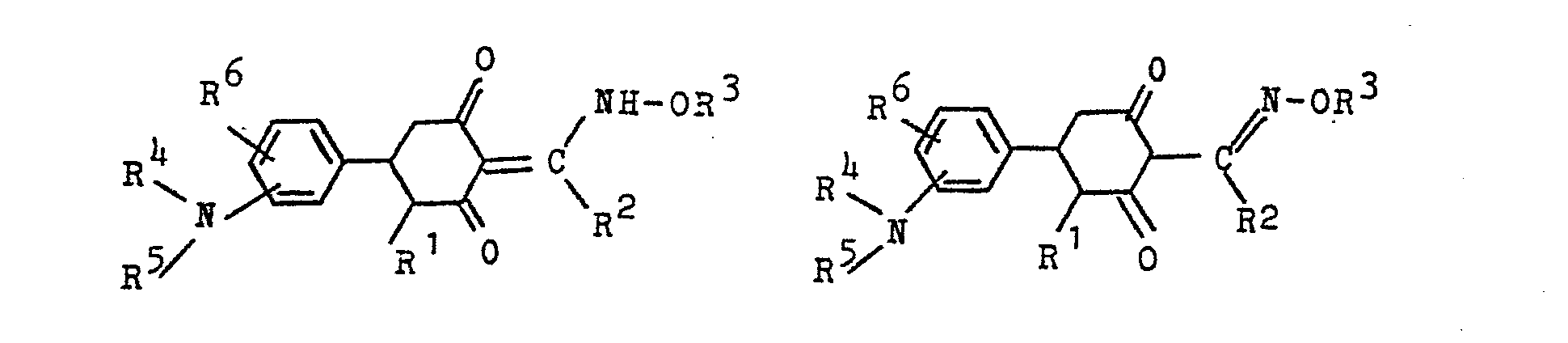

- R 2 in Formel I steht für unverzweigte oder verzweigte Alkylreste mit 1 bis 4 C-Atomen, d. h. für Methyl, Ethyl, n-Propyl, i-Propyl, n-Butyl, sec-Butyl, i-Butyl, tert-Butyl. Alkylreste mit 2 oder 3 C-Atomen sind bevorzugt.
- Reste für R3 in Formel I sind Propargyl, Alkyl mit 1 bis 4 C-Atomen, Alkenyl mit 3 oder 4 C-Atomen oder Halogenalkenyl mit 3 oder 4 C-Atomen, das bis zu drei Halogensubstituenten enthalten kann, vorzugsweise Chloralkenyl, beispielsweise Methyl, Ethyl, n-Propyl, i-Propyl, n-Butyl, sec-Butyl, i-Butyl, tert-Butyl, Allyl, l-Chlorprop-l-en-3-yl, 2-Chlor- prop-l-en-3-yl, 1,3-Dichlorprop-1-en-3-yl, 1,1,2-Trichlorprop-l-en-3-yl.
- Reste für R4 in Formel I sind Wasserstoff oder Alkyl mit 1 bis 4 C-Atomen, d.h. Methyl, Ethyl, Propyl, Isopropyl, n-Butyl, sec-Butyl, i-Butyl, tert-Butyl, wobei Wasserstoff bevorzugt ist.
- R5 in Formel I steht für Wasserstoff, Alkyl, aliphatisches Acyl mit 2 bis 8 C-Atomen, Formyl, Cycloalkylcarbonyl mit 4 bis 7 C-Atomen, Methoxyalkylcarbonyl mit 3 bis 7 C-Atomen, gegebenenfalls durch Nitro, Halogen, Alkyl oder Alkoxy substituiertes Benzoyl, Alkoxycarbonyl, Benzyloxycarbonyl, Phenoxycarbonyl, Alkylthiocarbonyl, N,N-Dialkylcarbamoyl, N-Alkylcarbamoyl, N-Cycloalkylcarbamoyl mit 5 bis 8 C-Atomen im Cycloalkylrest, N-Alkoxy-N-Alkylcarbamoyl, gegebenenfalls durch Nitro, Halogen, Alkyl, Alkoxy oder Haloalkyl substituiertes N-Phenylcarbamoyl, Alkylsulfonyl, Alkenylsulfonyl mit 2 bis 4 C-Atomen, Halogenalkylsulfonyl, Halogenalkenylsulfonyl mit 2 bis 4 C-Atomen, N-Alkylsulfamoyl, N,N-Di- alkylsulfamoyl, N-Acyl-N-alkylsulfamoyl mit 2 bis 5 C-Atomen im Acylrest, N-Alkyl-N-methoxycarbonylsulfamoyl, Dialkoxyphosphoryl, Dialkoxythiophosphoryl, 2-Halogenalkanoyl mit 2 bis 5 C-Atomen, Acyloxyacetyl mit 2 bis 4 C-Atomen im Acylrest, Alkoxyoxalyl, wobei Wasserstoff, aliphatisches Acyl mit 2 bis 8 C-Atomen und gegebenenfalls durch Nitro, Halogen, Alkyl oder Alkoxy substituiertes Benzoyl bevorzugt ist. Besonders bevorzugt sind Wasserstoff, Acetyl und Benzoyl.
- R6 in Formel I steht in ortho- meta- oder para-Position und bedeutet Halogen, Hydroxy, Alkyl, Alkoxy, Alkenyloxy, Alkinyloxy, Alkylthio, Alkylsulfinyl oder Alkylsulfonyl, jeweils mit bis zu 4 Kohlenstoffatomen Nitro, Amino, wobei Halogen, insbesondere Fluor oder Chlor bevorzugt ist.
- Die Alkylgruppen für R5 und R6 sowie die Alkyl- und Alkoxygruppen in den für R5 und R6 angegebenen Resten können unverzweigt oder verzweigt sein und haben, soweit nichts anderes angegeben ist, 1 bis 4 C-Atome, d. h. für Alkyl oder Alkoxy kommen Methyl, Ethyl, n-Propyl, i-Propyl, n-Butyl, sec-Butyl i-Butyl, tert-Butyl, Methoxy, Ethoxy, n-Propoxy, i-Propoxy, n-Butoxy, i-Butoxy, sec-Butoxy und tert-Butoxy in Betracht.
- Beispiele für R5 sind Wasserstoff, Methyl, Ethyl, Acetyl, Propionyl, Butyryl, Valeryl, Formyl, Cyclopropylcarbonyl, Cyclopentylcarbonyl, Cyclohexylcarbonyl, Methoxyacetyl, 2-Methoxypropionyl, 3-Methoxypropionyl, Benzoyl, 3-Nitrobenzoyl, 2-Chlorbenzoyl, 4-Methylbenzoyl, 4-Methoxybenzoyl, Methoxycarbonyl, Ethoxycarbonyl, Benzyloxycarbonyl, Phenoxycarbonyl, Methylthiocarbonyl, Ethylthiocarbonyl, Isopropylthiocarbonyl, N,N-Dimethylcarbamoyl, N-Methylcarbamoyl, N-Cyclohexylcarbamoyl, N-Methoxy-N-Methylcarbamoyl, N-(4-Nitrophenyl)-carbamoyl, N-(2-Chlorphenyl)--carbamoyl, N-(3-Methylphenyl)-carbamoyl, N-(3-Methoxyphenyl)-carbamoyl, N-Methylsulfamoyl, N,N-Dimethylsulfamoyl, N,N-Diethylsulfamoyl, N-Acetyl--N-methylsulfamoyl, N-Butyryl-N-ethylsulfamoyl, N-Methoxycarbonyl-N--methylsulfamoyl, N-Isopropyl-N-methoxycarbonylsulfamoyl, Methylsulfonyl, Chlormethylsulfonyl, Trifluormethylsulfonyl, Prop-2-en-ylsulfonyl, 2,3,3-Trichlorprop-2-en-ylsulfonyl, Diethoxyphosphoryl, Diethoxythiophosphoryl, Chloracetyl, 2-Brompropionyl, Acetoxyacetyl, Ethoxyoxalyl,
- Beispiele für R6 sind Methyl, Ethyl, n-Propyl, n-Butyl, i-Propyl, sec-Butyl, i-Butyl, tert-Butyl, Fluor, Chlor, Brom, Jod, Hydroxy, Methoxy, Ethoxy, n-Propoxy, i-Propoxy, n-Butoxy, i-Butoxy, sec-Butoxy, tert-Butoxy, Allyloxy, Prop-2-inyloxy, Methylthio, Ethylthio, Methylsulfinyl, Ethylsulfinyl, Methylsulfonyl, Ethylsulfonyl, Nitro, Amino.
- Als Salze der Verbindungen der Formel I kommen landwirtschaftlich brauchbare Salze, beispielsweise die Alkalimetallsalze, insbesondere die Kalium- oder Natriumsalze, Erdalkalimetallsalze, insbesondere Calcium-, Magnesium- oder Bariumsalze sowie Mangan-, Kupfer-, Zink- oder Eisensalze und Ammonium- und Phosphoniumsalze, beispielsweise Alkylammonium-, Dialkylammonium-, Trialkyl- oder Tetraalkylammoniumsalze, Benzyltrialkylammmoniumsalze, Triphenylphosphoniumsalze, Trialkylsulfoniumsalze oder Trialkylsulfoxoniumsalze in Betracht.
- Die herbizid wirksamen Cyclohexenonderivate der Formel I können durch Umsetzung von Tricarbonylverbindungen der Formel II
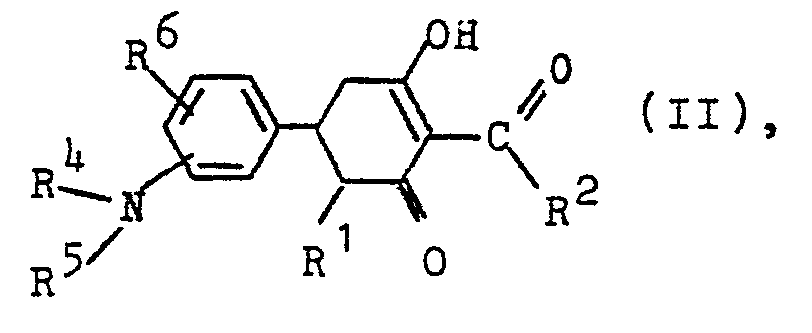
- Man führt die Reaktion zweckmäßigerweise in heterogener Phase in einem inerten Verdünnungsmittel bei einer Temperatur zwischen 0 und 80°C oder zwischen 0°C und dem Siedepunkt des Reaktionsgemisches in Gegenwart einer Base durch. Geeignete Basen sind beispielsweise Carbonate, Hydrogencarbonate, Acetate, Alkoholate, Hydroxide oder Oxide von Alkali- oder Erdalkalimetallen, insbesondere von Natrium, Kalium, Magnesium, Calcium. Außerdem können auch organische Basen, wie Pyridin oder tertiäre Amine, Verwendung finden.
- Die Umsetzung verläuft besonders gut in einem pH-Bereich von 2 bis 9, insbesondere von 4,5 bis 5,5. Die Einstellung des pH-Bereiches erfolgt zweckmäßigerweise durch Zusatz von Acetaten, beispielsweise Alkalimetallacetaten, insbesondere von Natrium- oder Kaliumacetat oder einer Mischung aus beiden Salzen. Alkalimetallacetate werden beispielsweise in Mengen von 0,5 bis 2 Mol, bezogen auf die Ammoniumerbindung der Formel R3O-NH3Y, zugesetzt.
- Als Lösungsmittel sind beispielsweise Dimethylsulfoxid, Alkohole, wie Methanol, Ethanol, Isopropanol, Benzol, gegebenenfalls chlorierte Kohlenwasserstoffe, wie Chloroform, Dichlorethan, Hexan, Cyclohexan, Ester, wie Essigsäureethylester, Ether, wie Dioxan, Tetrahydrofuran, geeignet.
- Die Umsetzung ist nach wenigen Stunden beendet, das Reaktionsprodukt kann dann durch Einengen der Mischung, Zugabe von Wasser und Extraktion mit einem unpolaren Lösungsmittel, wie Methylenchlorid und Abdestillieren des Lösungsmittels unter vermindertem Druck isoliert werden.
- Die Verbindungen der Formel I können außerdem durch Umsetzen der Tricarbonylverbindungen der Formel II mit Hydroxylaminen der Formel R3O-NH", in der R3 die obengenannten Bedeutungen hat, in inerten Verdünnungsmitteln bei einer Temperatur zwischen OOC und dem Siedepunkt des Reaktionsgemisches, insbesondere zwischen 15 und 70°C, erhalten werden. Gegebenenfalls kann das Hydroxylamin als wäßrige Lösung eingesetzt werden.
- Geeignete Lösungsmittel für diese Umsetzung sind beispielsweise Alkohole, wie Methanol, Ethanol, Isopropanol, Cyclohexanol, gegebenenfalls chlorierte Kohlenwasserstoffe, wie Hexan, Cyclohexan, Methylenchlorid, Toluol, Dichlorethan, Ester, wie Essigsäureethylester, Nitrile, wie Acetonitril, cyclische Ether, wie Tetrahydrofuran.
- Die Alkalimetallsalze der Verbindungen der Formel I können durch Behandeln dieser Verbindungen mit Natrium- oder Kaliumhydroxid in wäßriger Lösung oder in einem organischen Lösungsmittel, wie Methanol, Ethanol, Aceton, erhalten werden. Auch Natrium- und Kaliumalkoholate können als Basen dienen.
- Die anderen Metallsalze, z. B. die Mangan-, Kupfer-, Zink-, Eisen-Calcium-, Magnesium- und Bariumsalze können aus den Natriumsalzen durch Reaktion mit den entsprechenden Metallchloriden in wäßriger Lösung hergestellt werden. Ammonium-, Phosphonium-, Sulfonium- und Sulfoxoniumsalze können durch Umsetzung von Verbindungen der Formel I mit Ammonium-, Phosphonium-, Sulfonium- oder Sulfoxoniumhydroxiden, gegebenenfalls in wäßriger Lösung, hergestellt werden.
- Die neuen Tricarbonylverbindungen der Formel II können aus Cyclohexan--1,3-dionen der Formel

- Es ist auch möglich, die neuen Verbindungen der Formel II über die Zwischenstufe der Enolester, die bei der Acylierung von Verbindungen der Formel VII eventuell als Isomerengemische anfallen und in Gegenwart von Imidazol- oder Pyridinderivaten umgelagert werden (JP-A-63 052/1979), herzustellen.
- Wie aus dem vorausgehenden ersichtlich, dienen die neuen Tricarbonylverbindungen der Formel II als wertvolle Zwischenprodukte für die Herstellung der herbizid wirksamen Verbindungen der Formel I.
- Zu den Verbindungen der Formel VII gelangt man wiederum nach literaturbekannten Verfahren, wie dies auch aus folgendem Schema hervorgeht:

- Die Cyclohexenonderivate der Formel Ia


- R2 Alkyl mit 1 bis 4 C-Atomen,
- R3 Alkyl mit 1 bis 4 C-Atomen, Alkenylmit 3 oder 4 C-Atomen, Halogenalkenyl mit 3 oder 4 C-Atomen und 1 bis 3 Halogensubstituenten oder Propargyl,
- R5 aliphatisches Acyl mit 2 bis 8 C-Atomen, Formyl, Cycloalkylcarbonyl mit 4 bis 7 C-Atomen, Methoxyalkylcarbonyl, gegebenenfalls durch Nitro, Halogen, Alkyl oder Alkoxy substituiertes Benzoyl, Alkoxycarbonyl, Benzyloxycarbonyl, Phenoxycarbonyl, Alkylthiocarbonyl, N,N-Dialkylcarbamoyl, N-Alkoxy-N-Alkylcarbamoyl, Alkylsulfonyl, Alkenylsulfonyl, Halogenalkylsulfonyl, N-Alkylsulfamoyl, N,N-Dialkylsulfamoyl, N-Acyl-N-alkylsulfamoyl mit 2 bis 5 C-Atomen im Acylrest, N-Alkyl-N-methoxycarbonylsulfamoyl, Dialkoxyphosphoryl, Dialkoxythiophosphoryl, 2-Halogenalkanoyl, Acyloxyacetyl oder Alkoxyoxalyl und
- R6 Alkyl, Halogen, Hydroxy, Alkoxy, Alkenyloxy, Alkinyloxy, Alkylthio, Alkylsulfinyl, Alkylsulfonyl, Nitro oder Amino bedeuten,
- können durch Umsetzung einer Verbindung der Formel Ia bzw. II, in der R5 Wasserstoff bedeutet, mit elektrophilen Reagentien der Formel R5y (III), in denen R5 die oben angegebenen Bedeutungen hat und Y eine Austrittsgruppe, wie Chlor, Brom oder Carboxylat ist, erhalten werden.
- Die Umsetzung wird gegebenenfalls in einem inerten organischen Lösungsmittel durchgeführt. Geeignet sind z. B. Kohlenwasserstoffe, wie Ligroin, Benzin, Toluol, Pentan, Cyclohexan, Halogenkohlenwasserstoffe, wie Methylenchlorid, Chloroform, Dichlorethan, Chlorbenzol, o-, m- oder p-Dichlorbenzol, Nitrokohlenwasserstoffe, wie Nitrobenzol, Nitromethan, Nitrile, wie Acetonitril, Butyronitril, Benzonitril, Ether, wie Diethylether, Tetrahydrofuran, Dioxan, Ester, wie Essigsäureethylester, Propionsäuremethylester, Ketone, wie Aceton, Methylethylketon, oder Amide, wie N,N-Dimethylformamid oder Formamid. Auch Gemische dieser Lösungsmittel können verwendet werden. Die Menge an Lösungsmittel, bezogen auf eingesetztes Anilinderivat beträgt 100 bis 5 000 Gew.-X.
- Zweckmäßigerweise wird die Umsetzung in Gegenwart eines üblichen Säureakzeptors durchgeführt. In Betracht kommen Alkalihydroxide, Alkalicarbonate, Alkalihydrogencarbonate, Erdalkalihydroxide, Erdalkalicarbonate, Erdalkalihydrogencarbonate, Erdalkalioxide oder Amine, beispielsweise Natriumhydrogencarbonat, Kaliumcarbonat, Triethylamin, Tributylamin, Pyridin, N,N-Dimethylanilin, N,N-Dimethyl-N-cyclohexylamin, Chinolin. Die Menge an Säureakzeptor beträgt 1 bis 4 Mol, bezogen auf 1 Mol eingesetztes Anilinderivat.
- Die Reaktionstemperatur liegt zwischen -20 und +150°C, vorzugsweise zwischen 20 und 80°C. Die elektrophilen Reagentien R5Y und die als Ausgangsverbindungen verwendeten Verbindungen der Formeln Ia bzw. II werden bevorzugt in äquimolarem Verhältnis eingesetzt.
- Beispiele für Verbindungen der Formel R5Y sind Carbonsäurehalogenide, Carbonsäureanhydride, Chlorameisensäureester, Alkylthiocarbonylchloride, N,N-Dialkylcarbamoylchloride, N-Alkoxy-N-alkylcarbamoylchloride, N-A1- kylsulfamoylchloride, N-Acyl-N-alkylsulfamoylchloride, wie Carbonsäurehalogenide der Formel

- R8 für Alkyl mit 1 bis 7 C-Atomen, Cycloalkyl mit 3 bis 5 C-Atomen, Methoxyalkyl mit 2 bis 4 C-Atomen oder gegebenenfalls durch Nitro, Halogen, Alkyl mit 1 bis 4 C-Atomen oder Alkoxy mit 1 bis 3 C-Atomen substituiertes Phenyl steht,
- Formylacetanhydrid der Formel

- Chlorameisensäureester der Formel

- R 9 für Alkyl mit 1 bis 4 C-Atomen, Benzyl oder Phenyl steht, Alkylthiocarbonylchloride der Formel
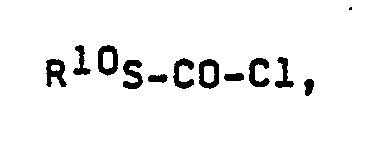
- R10 für Alkyl mit 1 bis 4 C-Atomen steht,
- N,N-Dialkylaminocarbamoylchloride der Formel

- R11 und R12 für Alkylreste aus 1 bis 4 C-Atomen stehen,
- N-Alkoxy-N-Alkylcarbamoylchloride der Formel

- R 13 für Alkyl mit 1 bis 4 C-Atomen und R14 für Alkoxy mit 1 bis 4 C-Atomen stehen,
- Sulfonylchloride der Formel

- R 15 für Alkyl mit 1 bis 4 C-Atomen, Alkenylsulfonyl mit 3 oder 4 C-Atomen, Halogenalkylsulfonyl mit bis zu 3 Halogenatomen steht, Sulfamoylchloride der Formel

- R16 für Alkyl mit 1 bis 4 C-Atomen und R17 für Wasserstoff, Alkyl mit 1 bis 4 C-Atomen, Acyl mit 2 bis 5 C-Atomen oder Methoxycarbonyl stehen, Dialkoxyphosphoryl- und Dialkoxythiophosphorylchloride der Formel

- X für 0 oder 5, und R18, R19 für Alkyl mit 1 bis 4 C-Atomen stehen,
- 2-Halogenalkanoylchloride der Formel
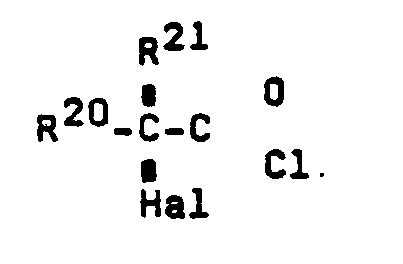
- R20, R21 für H oder Alkyl mit 1 bis 4 C-Atomen und Hal für Fluor, Chlor, Brom oder Jod stehen,
- Acyloxyacetylchloride der Formel

- R 22 für Alkyl mit 1 bis 4 C-Atomen steht,
- Alkoxyoxalylchloride der Formel

- R 23 für Alkyl mit 1 bis 4 C-Atomen steht.
- Außerdem erhält man die Cyclohexenonderivate der Formel Ic


- R l und R 4 Wasserstoff,
- R2 Alkyl mit 1 bis 4 C-Atomen,
- R5 N-Alkylcarbamoyl, N-Cycloalkylcarbamoyl mit 5 bis 8 C-Atomen im Cycloalkylrest oder gegebenenfalls durch Nitro, Halogen, Alkyl oder Alkoxy substituiertes N-Phenylcarbamoyl,
- R6 Alkyl, Halogen, Hydroxy, Alkoxy, Alkenyloxy, Alkinyloxy, Alkylthio, Alkylsulfinyl, Alkylsulfonyl, Nitro oder Amino bedeuten, durch Umsetzung der entsprechenden Aminoderivate mit Isocyanaten der Formel

- R7 diejenigen Reste bedeutet, die nach erfolgter Umsetzung zu entsprechenden Resten R5 in Formeln I und II führen.
- Die Umsetzung wird gegebenenfalls in Gegenwart eines für Isocyanatreaktionen gebräuchlichen Katalysators, z.B. eines tertiären Amins, wie Triethylamin, 1,4-Diazabicyclo-[2.2.2.]-octan, stickstoffhaltigen Heterocyclen, wie Pyridin, 1,2-Dimethylimidazol, oder organischer Zinnverbindungen, wie Dibutylzinndiacetat, Dimethylzinndichlorid und gegebenenfalls in Gegenwart eines unter den Reaktionsbedingungen inerten Lösungsmittels, z.B. eines Kohlenwasserstoffs, wie Ligroin, Benzin, Toluol, Pentan, Cyclohexan, eines Halogenkohlenwasserstoffs, wie Methylchlorid, Chloroform, Dichlorethan, Chlorbenzol, o-, m- oder p-Dichlorbenzol, eines Nitrokohlenwasserstoffs, wie Nitrobenzol, Nitromethan, eines Nitrils, wie Acetonitril, Butyronitril, Benzonitril, eines Ethers, wie Diethylether, Tetrahydrofuran, Dioxan, eines Esters, wie Essigsäureethylester, Propionsäuremethylester, eines Ketons, wie Aceton, Methylethylketon oder eines Amids, wie N,N-Dimethylformamid oder Formamid, durchgeführt (Houben-Weyl, Methoden der organischen Chemie, Bd. VIII, S. 132, Georg Thieme-Verlag, Stuttgart, 4. Auflage, 1952).
- Die Menge an Katalysator beträgt 0,1 bis 5 Mol.%, bezogen auf eingesetztes Anilinderivat. Die Lösungsmittelnenge schwankt zwischen 100 und 10 000 Gew.-%. Die Reaktionstemperatur kann zwischen -20 und +150°C, vorzugsweise zwischen 0 und 100°C, variieren.
- Die katalytische Hydrierung der Nitro-verbindungen der Formel V führt zu den entsprechenden Aminoverbindungen der Formel Ib:

- Die zur Herstellung der Verbindungen V erforderlichen Derivate der Formel VI können nach verschiedenen Methoden erhalten werden:

- Dabei hängt der Ort des Eintritts der Nitrogruppe auf "Dicarbonyl- oder Tricarbonyl-Stufe" nach den Regeln elektrophiler Aromatensubstitution in entscheidender Weise von R6 ab, z.B.:


- Die folgenden Beispiele erläutern die Herstellung der Cyclohexenonderivate der Formel I:
- 5,3 g 2-Butyryl-(3-nitro-4-methoxyphenyl)-cyclohexan-1,3-dion werden in 300 ml Tetrahydrofuran in Anwesenheit von 3 g Pd/Kohle (10 %) drucklos bei 25°C hydriert. Nach Aufnahme von 0,9 1 Wasserstoff wird über Natriumsulfat getrocknet, filtriert, mit 1,3 g Natriumhydrogencarbonat versetzt und mit 1,2 g Acetylchlorid zur Reaktion gebracht. Nach 16stündigem Rühren wird filtriert und eingeengt. Das verbleibende Öl wird mit Diethylether zur Kristallisation gebracht und abgesaugt. Man erhält 3 g (55 % Ausbeute) 5-(3-Acetylamino-4-methoxy-phenyl)-2-butyryl-3-hydroxy-cyclohex--2-en-l-on vom Fp. 102 - 106°C.
- 3 g 5-(3-Acetylamino-4-methoxy-phenyl)-2-butyryl-3-hydroxy-cyclohex-2--en-1-on werden zusammen mit 0,95 g 0-Allylhydroxylaminhydrochlorid und 0,8 g Natriumhydrogencarbonat in 40 ml Methanol 16 Stunden gerührt. Nach dem Einengen wird mit Methylenchlorid versetzt, mit Wasser ausgewaschen, getrocknet und eingeengt. Der verbleibende Rückstand wird mit Diisopropylether verrührt und abgesaugt. Man erhält 2,0 g (57 % Ausbeute) 5-(3-Acetylamino-4-methoxy-phenyl)-2-(1-allyloxyiminobutyl)-3-hydroxy--cyclohex-2-en-l-on vom Fp. 136 - 137°C (Verbindung Nr. 11).
- 4 g 2-(1-Ethoxyiminobutyl)-3-hydroxy-5-(3-amino-4-methoxy-phenyl)-cyclo- hex-2-en-1-on werden in 50 ml Pyridin bei 25°C mit 1,3 g Methansulfonylchlorid versetzt und 16 Stunden gerührt. Die Reaktionslösung wird auf Eis gegeben und mit Salzsäure auf pH 1 gebracht. Man extrahiert mit Methylenchlorid, trocknet die organische Phase, engt ein und erhält 3,6 g (74 % Ausbeute) an 2-(1-Ethoxyiminobutyl)-3-hydroxy-5-(4-methoxy-3-methyl- sulfonamidophenyl)-cyclohex-2-en-1-on vom Fp. 108 - 116°C (Zers.) (Verbindung Nr. 64).
- 4 g 5-(3-Amino-4-methoxyphenyl)-2-(1-ethoxyiminobutyl)-3-hydroxy-cyclo- hex-2-en-l-on werden in 50 ml Pyridin bei 25°C mit 2,2 g Diethoxythiophosphorylchlorid 16 Stunden gerührt. Die Reaktionslösung wird auf Eis gegeben und mit Salzsäure auf pH 1 gebracht. Man extrahiert mit Methylenchlorid, filtriert über Kieselgel, engt ein und erhält 4 g (69 % Ausbeute) eines Öls, bestehend aus 5-(3-Diethoxythiophosphorylamido-4-methoxy-phenyl)-2-(1-ethoxyiminobutyl)-3-hydroxy-cyclohex-2-en-1-on. (Verbindung Nr. 76).
- 4 g 5-(3-Amino-A-methoxyphenyl)-2-(1-ethoxyiminobutyl)-3-hydroxy-cyclo- hex-2-en-1-on werden in 50 ml Pyridin bei 25°C mit 1,5 g Methylaminosulfonylchlorid 16 Stunden gerührt. Die Reaktionslösung wird auf Eis gegeben und mit Salzsäure auf pH 1 gebracht. Man extrahiert mit Methylenchlorid, trocknet die organische Phase, engt ein und erhält 2,2 g (43 % Ausbeute) 2-(1-Ethoxyiminobutyl)-3-hydroxy-5-(4-methoxy-3-N-methyl-sulfa- moylamido)-cyclohex-2-en-1-on vom Fp. 56 - 58°C (Verbindung Nr. 75).
- 31 g 2-Acetyl-3-hydroxy-5-(2-methoxyphenyl)-cyclohex-2-en-1-on werden in 140 ml Eisessig gelöst und bei 25°C unter Kühlung mit 140 ml konzentrierter Schwefelsäure versetzt, nach dem schnellen Zutropfen von 7,7 g 98 %iger Salpetersäure wird 30 Min. gerührt und dann in eine Eis/ Methylenchlorid-Mischung eingegossen, die organische Phase wird abgetrennt, mit Wasser gewaschen und Ober Natriumsulfat getrocknet. Das nach dem Einengen erhaltene dunkle Öl wird in Methylenchlorid über Kieselgel filtriert und eingeengt. Man erhält 27,5 g (76 % Ausbeute) gelbliche Kristalle, die zu 20 % aus 2-Acetyl-3-hydroxy-5-(2-methoxy-3-nitrophenyl). -cyclohex-2-en-l-on (A) und zu 80 % aus 2-Acetyl-3-hydroxy-5-(2-methoxy-5 -nitrophenyl)-cyclohex-2-en-1-on (B) bestehen, Mischschmelzpunkt 145 - 151°C.

- 15 g des obigen Produktgemisches bestehend aus A und B (1 : 4) werden zusammen mit 4,2 g Natriumhydrogencarbonat und 4,6 g 0-Ethylhydroxylammoniumchlorid in Methanol 16 Stunden gerührt, eingeengt, in Methylenchlorid aufgenommen, mit Wasser ausgeschüttelt, getrocknet und eingeengt. Der Rückstand wird in Diisopropylether verrieben und abgesaugt. Man erhält 15,5 g (91 % Ausbeute) eines wiederum 1 : 4 Gemisches der entsprechenden 0-Ethyloximether C und D. Mischschmelzpunkt 132 - 142°C.
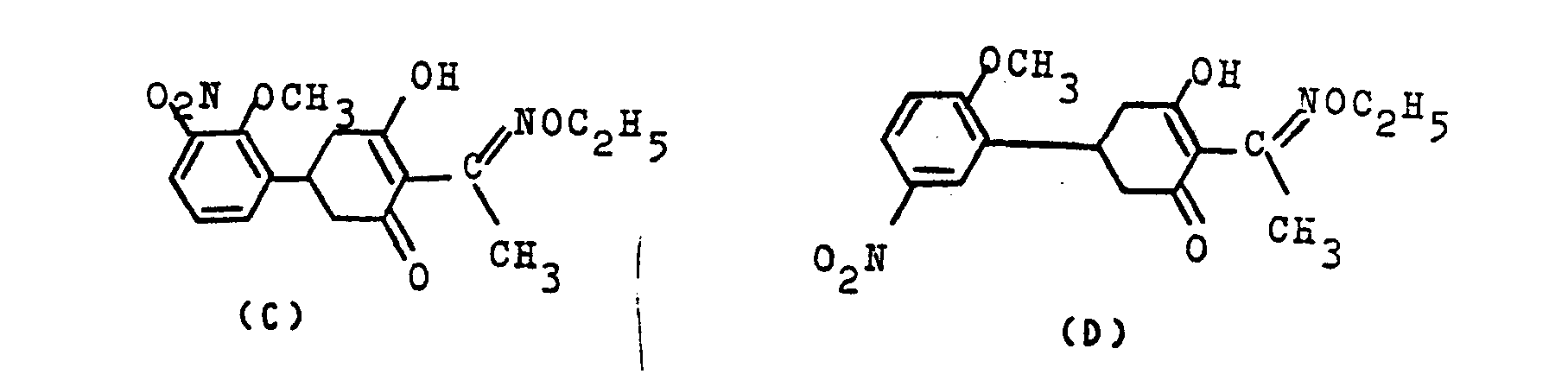
- 10,3 g des Produktgemisches C : D = 1 : 4 werden in 500 ml Tetrahydrofuran in Gegenwart von 3 g Palladium auf Kohle (10 %) bei 25°C drucklos hydriert. Nach Aufnahme von 3 1 Wasserstoff wird die Mischung über Natriumsulfat getrocknet, filtriert und eingeengt. Man erhält in quantitativer Ausbeute 9,5 g eines öligen 1 : 4 Gemisches der entsprechenden Aniline E und F.

- 9 g dieses Anilingemisches werden in 50 ml Tetrahydrofuran gelöst, mit 2,4 g Natriumhydrogencarbonat versetzt und unter Rühren mit 2,2 g Acetylchlorid zur Reaktion gebracht. Nach 16stündigem Rühren wird abfiltriert, eingeengt und das verbleibende Öl mit Essigester über Kieselgel chromatographiert. Man erhält 0,9 g (9 % Ausbeute) an isomerenreinem 5-(3-Acetamido-2-methoxyphenyl)-2-(1-ethoxyiminoethyl)-3-hydroxy-cyclohex-2-en-1-on,

- und 3,6 g (35 % Ausbeute) an isomerenreinem 5-(5-Acetamido-2-methoxyphenyl)-2-(1-ethoxyiminoethyl)-3-hydroxy-cyclohex-2-en-1-on.
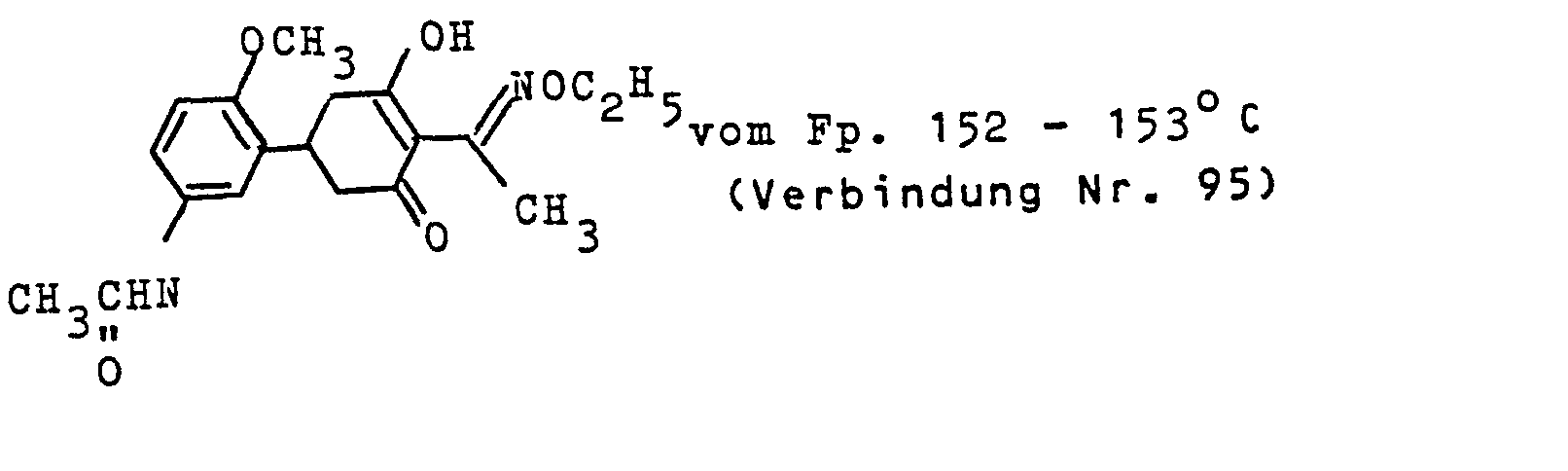
- 60 g 5(2-Fluorphenyl)-cyclohexan-1,3-dion werden bei -20°C in 500 ml konzentrierter Schwefelsäure gelöst und mit 18,3 g 98 %iger Salpetersäure bei -20°C innerhalb von 60 Minuten nitriert. Das Reaktionsgemisch wird in 5 1 Eiswasser eingerührt. Die ausgefallenen Kristalle werden abgesaugt und getrocknet. Man erhält 60,5 g (83 % Ausbeute) an 5-(2-Fluor--5-nitrophenyl)-cyclohexan-1,3-dion vom Fp. 171 - 173°C.
- 54 g 5-(2-Fluor-5-nitrophenyl)-cyclohexan-1,3-dion werden in 500 ml Methylenchlorid gelöst, mit 18,7 g Pyridin versetzt und bei RT innerhalb von 1 Stunde mit 25,2 g Buttersäurechlorid 0-acyliert. Nach 16stündigem Rühren wird mit Eiswasser, 5 %iger Natriumhydrogencarbonatlösung und nochmals mit Eiswasser ausgeschüttelt, über Natriumsulfat getrocknet und eingeengt. Das verbleibende Öl wird in etwa 300 ml Essigester aufgenommen und zusammen mit 3 g 4-Dimethylaminopyridin 5 Tage stehengelassen. Die organische Phase wird 2mal mit 5 %iger Salzsäure ausgeschüttelt, getrocknet und eingeengt. Der verbleibende Rückstand wird aus Isopropanol umkristallisiert. Man erhält 33 g (48 % Ausbeute) an 2-Butyryl-5--(2-fluor-5-nitrophenyl)-3-hydroxy-cyclohex-2-en-1-on vom Fp. 132°C.
- 25 g 2-Butyryl-5-(2-fluor-5-nitrophenyl)-3-hydroxy-cyclohex-2-en-l-on, 7,4 g Natriumhydrogencarbonat und 8,6 g 0-Ethylhydroxylammoniumchlorid werden 16 Stunden in 100 ml Methanol gerührt, eingeengt, in Methylenchlorid aufgenommen, mit Wasser gewaschen, getrocknet und wieder eingeengt. Man erhält 24 g (84 % Ausbeute) 2-(1-Ethoxyiminobutyl)-5-(2-fluor--5-nitrophenyl)-3-hydroxy-cyclohex-2-en-l-on als viskoses Öl.
- 23 g dieses Öls werden in 500 ml Tetrahydrofuran in Anwesenheit von 5 g Palladium auf Kohle (10 %) bei 25°C drucklos hydriert. Nach Aufnahme von 4,5 1 Wasserstoff wird getrocknet, abfiltriert und eingeengt. Man erhält 19,6 g (93 % Ausbeute) 5-(5-Amino-2-fluorphenyl)-2-(1-ethoxy- iminobutyl)-3-hydroxy-cyclohex-2-en-l-on als viskoses Öl.
- 5,5 g hiervon werden in 50 ml Tetrahydrofuran zusammen mit 1 g Methylisocyanat und 1 Tropfen Dibutylzinndiacetat 4 Tage bei Raumtemperatur stehengelassen. Nach Einengen wird der Rückstand mit Ether ausgerührt und getrocknet. Man erhält 4,4 g (69 % Ausbeute) 2-(1-Ethoxyiminobutyl)--5-[2-fluor-5-(3-methylureido)-phenyl]-3-hydroxy-cyclohex-2-en-1-an vom Fp. 120 - 122°C (Verbindung Nr. 116).
- Entsprechend werden folgende Cyclohexenonderivate der Formel I erhalten:


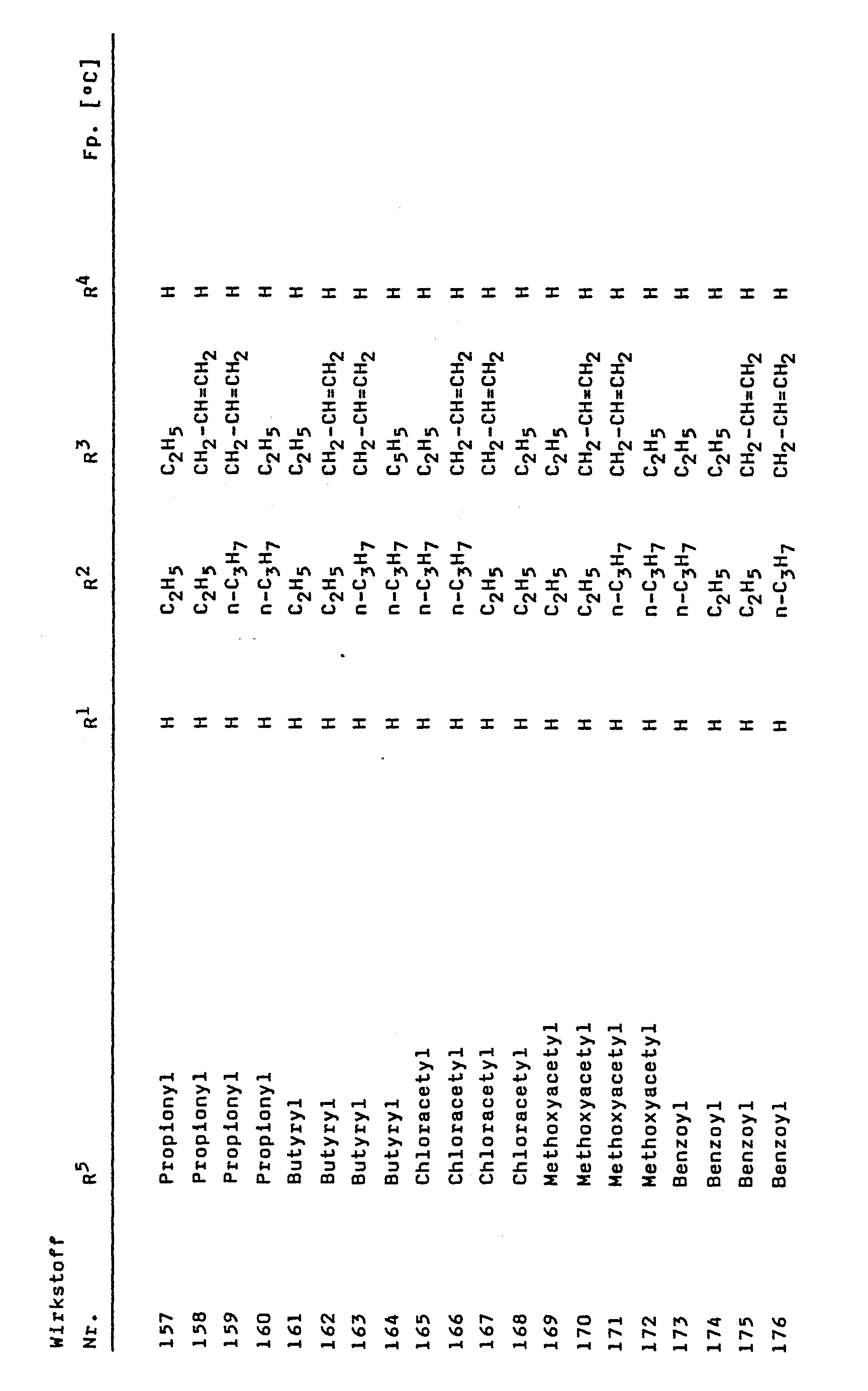

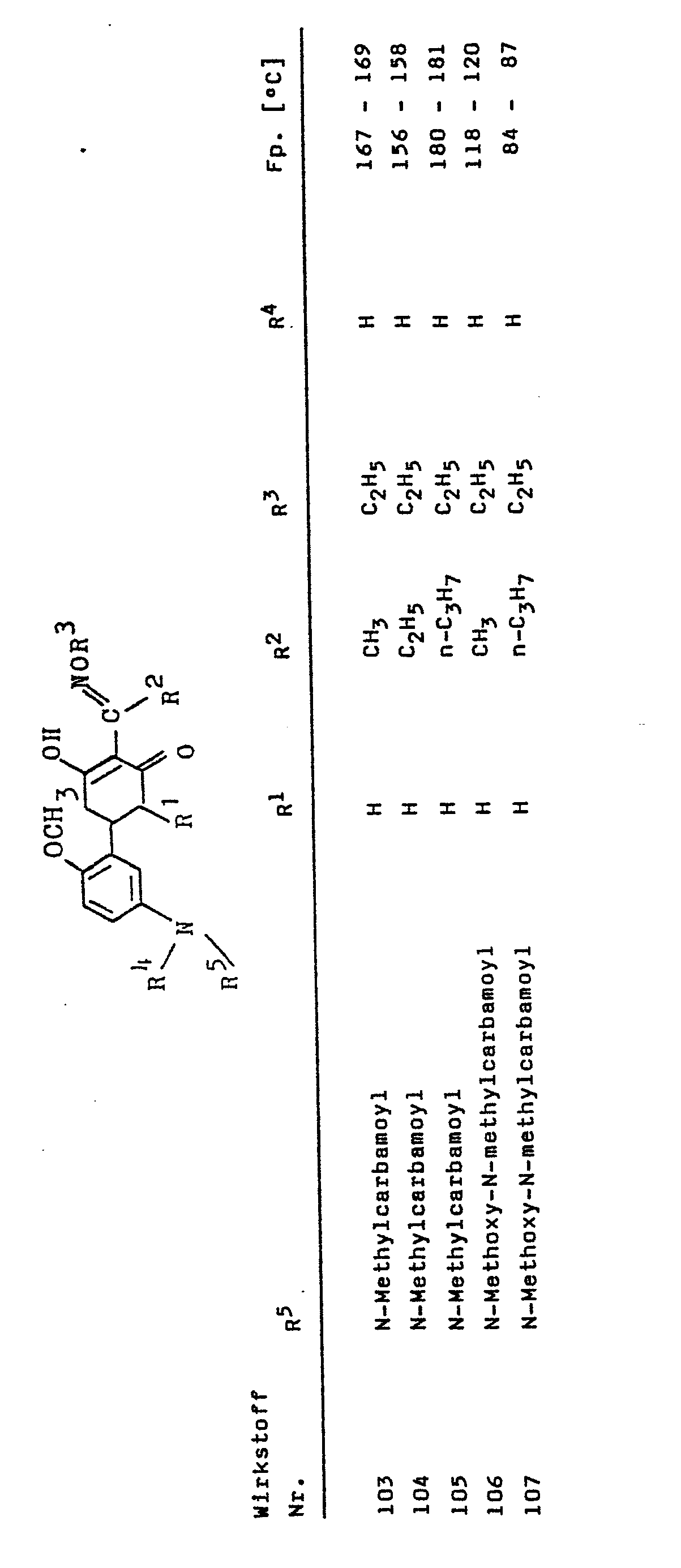


- Die Cyclohexenonderivate der Formel I lassen sich durch charakteristische 1H-NMR spektroskopische Daten (chemische Verschiebung in δ-Werten (ppm) in CDC13, bezogen auf Tetramethylsilan als internen Standard; s = Singulett, d = Dublett, q = Quartett, m = Multiplett) kennzeichnen:
- Verbindung Nr. Charakteristische Signale
- 76 1,0 (t, 3H); 3,9 (s, 3H); 4,0 - 4,4 (m, 6H)
- 77 1,0 (t, 3H); 3,85 (s, 3H); 4,0 - 4,3 (m, 6H)
- 91 2,2 (s, 3H); 2,45 (s, 3H); 3,75 (s, 3H); 6,95 (d, 1H); 7,15 (t, 1H); 8,20 (d, 1H)
- 95 2,2 (s, 3H); 2,4 (s, 3H); 3,8 (s, 3H); 6,8 (d, 1H); 7,45 (d, 1H)
- 108 0,95 (t, 3H); 4,1 (q, 2H); 6,55 (d, 1H); 6,75 (s, 1H); 7,10 (d, 1H)
- 113 1,3 (t, 3H); 6,4 - 6,6 (m), 6,85 (t)
- 136 3,6 (s); 3,8 (s); 6,5-6,8 (m)
- 177 2,95 (t); 6,8 (d); 7,25 (m); 7,45 (m), 8,35 (s)
- 195 2,15 (s); 3,4 (s); 8,1 (s); 6,9-7,1 (m); 7,85 (d)
- 218 0,95 (t); 1,3 (t); 4,05-4,2 (q)
- 240 2,95 (t); 3,35 (m);, 3,8 (s); 4,15 (q)
- 249 0,95 (t); 4,1 (q); 4,75 (q); 6,7 (s); 7,4 (d)
- 308 2,97 (t); 4,12 (q); 7,86 (d).
- Die Cyclohexenonderivate der Formel I und ihre Salze können beispielsweise in Form von direkt versprühbaren Lösungen, Pulvern, Suspensionen, auch hochprozentigen wäßrigen, öligen oder sonstigen Suspensionen oder Dispersionen, Emulsionen, Öldispersionen, Pasten, Stäubemitteln, Streumitteln oder Granulaten durch Versprühen, Vernebeln, Verstäuben, Verstreuen oder Gießen angewendet werden. Die Anwendungformen richten sich ganz nach den Verwendungszwecken; sie sollten in jedem Fall möglichst die feinste Verteilung der erfindungsgemäßen Wirkstoffe gewährleisten.
- Zur Herstellung von direkt versprühbaren Lösungen, Emulsionen, Festen oder öldispersionen kommen Mineralölfraktionen von mittleren Naphthalinen, aromatische Kohlenwasserstoffe (Toluol, Xylol), Methanol, Ethanel, Propanol, Butanol, Chloroform, Tetrachlorkohlenstoff, Cyclohexanol, Cyclohexanon, Chlorbenzol, Isophoron, stark polare Lösungsmittel, wie N,N-Dimethylformamid, Dimethylsulfoxid, N-Methylpyrrolidon oder Wasser in Betracit.
- Wäßrige Anwendungsformen können aus Emulsionskonzentraten, Pasten oder netzbaren Pulvern (Spritzpulyern, Öldispersionen) durch Zusatz on Wasser bereitet werden. Zur Herstellung von Emulsionen, Pasten oder Öldispersianen können die Substanzen als solche oder in einem Öl oder Lösungsmittel gelöst, mittels Netz-, Haft-, Dispergier- oder Emulgiermittel in Wasser homogenisiert werden. Es können aber auch aus wirksamer Substanz Netz-, Haft-, Dispergier- oder Emulgiermittel und eventuell Lösungsmittel oder Ö1 bestehende Konzentrate hergestellt werden, die zur Verdünnung mit Wasser geeignet sind.
- Als oberflächenaktive Stoffe kommen Alkali-, Erdalkali-, Ammoniumsalze von Ligninsulfonsäure, Naphthalinsulfonsäure, Phenolsulfonsäure, Alkylarylsulfonate, Alkylsulfate, Alkylsulfonate, Alkali- und Erdalkalisalze der Dibutylnaphthalinsulfonsäure, Laurylethersulfat, Fettalkoholsulfate, fettsaure Alkali- und Erdalkalisalze, Salze sulfatierter Hexadecanole, Heptadecanole, Octadecanole, Salze von sulfatiertem Fettalkoholglykolether, Kondensationsprodukte von sulfoniertem Naphthalin und Naphthalinderivaten mit Formaldehyd, Kondensationsprodukte des Naphthalins bzw. der Naphthalinsulfonsäuren mit Phenol und Formaldehyd, Polyoxyethylenoctylphenolether, ethoxyliertes Isooctylphenol, Octylphenol, Nonylphenon, Alkylphenolpolyglykolether, Tributylphenylpolyglykolether, Alkylarylpolyetheralkohole, Isotridecylalkohol, Fettalkoholethylenoxid-Kondensate, ethoxyliertes Rizinusöl, Polyoxyethylenalkylether, ethoxyliertes Polyoxypropylen, Laurylalkoholpolyglykoletheracetal, Sorbitester, Lignin, Sulfitablaugen und Methylcellulose in Betracht.
- Pulver-, Streu- und Stäubemittel können durch Mischen oder gemeinsames Vermahlen der wirksamen Substanzen mit einem festen Trägerstoff hergestellt werden.
- Granulate, z.B. Umhüllungs-, Imprägnierungs- und Homogengranulate, können durch Bindung der Wirkstoffe an festen Trägerstoffen hergestellt werden. Feste Trägerstoffe sind Mineralerden wie Silicagel, Kieselsäuren, Kieselgele, Silikate, Talkum, Kaolin, Attaclay, Kalkstein, Kalk, Kreide, Bolus, Löß, Ton, Dolomit, Diatomeenerde, Calcium- und Magnesiumsulfat, Magnesiumoxid, gemahlene Kunststoffe, Düngemittel, wie Ammoniumsulfat, Ammoniumphosphat, Ammoniumnitrat, Harnstoffe und pflanzliche Produkte, wie Getreidemehl, Baumrinden-, Holz- und Nußschalenmehl, Cellulosepulver und andere feste Trägerstoffe.
- Die Formulierungen enthalten zwischen 0,1 und 95 Gewichtsprozent, vorzugsweise zwischen 0,5 und 90 Gewichtsprozent, Wirkstoff.
- Beispiele für Formulierungen sind:
- I. Man vermischt 90 Gewichtsteile der Verbindung Nr. 1 mit 10 Gewichtsteilen N-Methyl-alpha-pyrrolidon und erhält eine Lösung, die zur Anwendung in Form kleinster Tropfen geeignet ist.
- 11. 20 Gewichtsteile der Verbindung Nr. 7 werden in einer Mischung gelöst, die aus 80 Gewichtsteilen Xylol, 10 Gewichtsteilen des Anlagerungsproduktes von 8 bis 10 Mol Ethylenoxid an 1 Mol ölsäure-N-monoethanolamid, 5 Gewichtsteilen Calciumsalz der Dodecylbenzolsulfonsäure und 5 Gewichtsteilen des Anlagerungsproduktes von 40 Mol Ethylenoxid an 1 Mol Ricinusöl besteht. Durch Ausgießen und feines Verteilen der Lösung in 100 000 Gewichtsteilen Wasser erhält man eine wäßrige Dispersion, die 0,02 Gewichtsprozent des Wirkstoffs enthält.
- III. 20 Gewichtsteile der Verbindung Nr. 109 werden in einer Mischung gelöst, die aus 40 Gewichtsteilen Cyclohexanon, 30 Gewichtsteilen Isobutanol, 20 Gewichtsteilen des Anlagerungsproduktes von 7 Mol Ethylenoxid an 1 Mol Isooctylphenol und 10 Gewichtsteile des Anlagerungsproduktes von 40 Mol Ethylenoxid an 1 Mol Ricinusöl besteht. Durch Eingießen und feines Verteilen der Lösung in 100 000 Gewichtsteilen Wasser erhält man eine wäßrige Dispersion, die 0,02 Gewichtsprozent des Wirkstoffs enthält.
- IV. 20 Gewichtsteile des Wirkstoffs Nr. 111 werden in einer Mischung gelöst, die aus 25 Gewichtsteilen Cyclohexanol, 65 Gewichtsteilen einer Mineralölfraktion vom Siedepunkt 210 bis 280°C und 10 Gewichtsteilen des Anlagerungsproduktes von 40 Mol Ethylenoxid an 1 Mol Ricinusöl besteht. Durch Eingießen und feines Verteilen der Lösung in 100 000 Gewichtsteilen Wasser erhält man eine wäßrige Dispersion, die 0,02 Gewichtsprozent des Wirkstoffs enthält.
- V. 20 Gewichtsteile des Wirkstoffs Nr. 7 werden mit 3 Gewichtsteilen des Natriumsalzes der Diisobutylnaphthalin-alpha-sulfonsäure, 17 Gewichtsteilen des Natriumsalzes einer Ligninsulfonsäure aus einer Sulfit-Ablauge und 60 Gewichtsteilen pulverförmigem Kieselsäuregel gut vermischt und in einer Hammermühle vermahlen. Durch feines Verteilen der Mischung in 20 000 Gewichtsteilen Wasser erhält man eine Spritzbrühe, die 0,1 Gewichtsprozent des Wirkstoffs enthält.
- VI. 3 Gewichtsteile des Wirkstoffs Nr. 33 werden mit 97 Gewichtsteilen feinteiligem Kaolin vermischt. Man erhält auf diese Weise ein Stäubemittel, das 3 Gewichtsprozent des Wirkstoffs enthält.
- VII. 30 Gewichtsteile des Wirkstoffs Nr. 56 werden mit einer Mischung aus 92 Gewichtsteilen pulverförmigem Kieselsäuregel und 8 Gewichtsteilen Paraffinöl, das auf die Oberfläche dieses Kieselgels gesprüht wurde, innig vermischt. Man erhält auf diese Weise eine Aufbereitung des Wirkstoffs mit guter Haftfähigkeit.
- VIII. 20 Teile des Wirkstoffs Nr. 111 werden mit 2 Teilen Calciumsalz der Dodecylbenzolsulfonsäure, 8 Teilen Fettalkohol-polyglykolether, 2 Teilen Natriumsalz eines Phenol-Harnstoff-Formaldehyd--Kondensates und 68 Teilen eines paraffinischen Mineralöls innig vermischt. Man erhält eine stabile ölige Dispersion.
- IX. 10 Gewichtsteile des Wirkstoffs Nr. 289 werden mit 90 Gewichtsteilen einer Mischung aus 93 Gewichtsteilen Xylol und 7 Gewichtsteilen des Anlagerungsproduktes von 8 Mol Ethylenoxid an 1 Mol Nonylphenol gemischt. Man erhält auf diese Weise eine Lösung, die 10 Gewichtsprozent des Wirkstoffs enthält.
- Die Applikation kann im Vorauflauf- oder im Nachauflaufverfahren erfolgen. Sind die Wirkstoffe bei Nachauflaufanwendung für gewisse Kulturpflanzen weniger verträglich, so können auch Aufbringungstechniken angewandt werden, bei welchen die herbiziden Mittel mit Hilfe der Spritzgeräte so gespritzt werden, daß die Blätter der empfindlichen Kulturpflanzen nach Möglichkeit nicht getroffen werden, während die Wirkstoffe auf die Blätter darunter wachsender unerwünschter Pflanzen oder die unbedeckte Bodenfläche gelangen (post-directed, lay-by).
- Die Aufwandmengen an Wirkstoff betragen je nach Jahreszeit, Zielpflanzen und Wachstumsstadium 0,025 bis 3 kg/ha, vorzugsweise 0,06 bis 0,5 kg/ha.
- Die Wirkung der Cyclohexenonderivate der Formel I auf das Pflanzenwachstum läßt sich durch Gewächshausversuche zeigen:
- Als Kulturpflanzen dienen Plastikblumentöpfe mit 300 cm3 Inhalt und lehmigem Sand mit etwa 1,5 % Humus als Substrat. Die Samen der Testpflanzen werden nach Arten getrennt flach eingesät. Bei Vorauflaufbehandlung werden die Wirkstoffe unmittelbar danach auf die Erdoberfläche aufgebracht. Sie werden hierbei in Wasser als Verteilungsmittel suspendiert oder emulgiert und mittels fein verteilender Düsen gespritzt. Die Aufwandmengen betragen 3,0 kg/ha.
- Nach dem Aufbringen der Mittel werden die Gefäße leicht beregnet, um Keimung und Wachstum in Gang zu bringen. Danach deckt man die Gefäße mit durchsichtigen Plastikhauben ab, bis die Pflanzen angewachsen sind. Diese Abdeckung bewirkt ein gleichmäßiges Keimen der Testpflanzen, sofern dies nicht durch die Wirkstoffe beeinträchtigt wird.
- Zum Zwecke der Nachauflaufbehandlung zieht man die Testpflanzen je nach Wuchsform erst bis zu einer Wuchshöhe von 3 bis 15 cm an und behandelte sie danach. Die Sojapflanzen werden in einem mit Torfmull (peat) angereicherten Substrat angezogen. Zur Nachauflaufbehandlung werden entweder direkt gesäte und in den gleichen Gefäßen aufgewachsene Pflanzen ausgewählt, oder sie werden erst als Keimpflanzen getrennt angezogen und einige Tage vor der Behandlung in die Versuchsgefäße verpflanzt. Die Aufwandmenge für die Nachauflaufbehandlung beträgt 0,06 bis 0,5 kg Wirkstoff/ha. Eine Abdeckung unterbleibt bei der Nachauflaufbehandlung.
- Die Versuchsgefäße werden im Gewächshaus aufgestellt, wobei für wärmeliebende Arten wärmere Bereiche (20 bis 35°C) und für solche gemäßigter Klimate 10 bis 25°C bevorzugt werden. Die Versuchsperiode erstreckt sich über 2 bis 4 Wochen. Während dieser Zeit werden die Pflanzen gepflegt und ihre Reaktion auf die einzelnen Behandlungen wird ausgewertet. Bewertet wird nach einer Skala von 0 bis 100. Dabei bedeutet 100 kein Aufgang der Pflanzen bzw. völlige Zerstörung zumindest der oberirdischen Teile.
- Die in den Gewächshausversuchen verwendeten Pflanzen setzen sich aus folgenden Arten zusammen:
- Alopecurus myosuroides (Ackerfuchsschwanz), Avena fatua (Flughafer), Avena sativa (Hafer), Echinochloa crus-galli (Hühnerhirse), Glycine max (Sojabohnen), Lolium multiflorum (Ital. Raygras), Oryza sativa (Reis), Setaria italica (Kolbenhirse), Sinapis alba (Weißer Senf), Sorghum halepense (Sudangras, Wilde Mohrenhirse).
- Bei Vorauflaufanwendung erweisen sich beispielsweise die Verbindungen Nr. 1, 7, 33, 56 als herbizid wirksam gegen Pflanzen aus der Familie der Gräser, während Sinapis alba als ein Vertreter dikotyler Pflanzen völlig ungeschädigt bleibt.
- Bei Nachauflaufbehandlung zeigen beispielsweise die Verbindungen Nr. 56 und 114 sowie Nr. 109 und 111 mit 0,5 bzw. 0,06 kg Wirkstoff/ha eine starke herbizide Aktivität gegen beispielhaft ausgwählte Gräser während Sojabohnen als dikotyle Kulturpflanzen nicht geschädigt werden. Verbindung Nr. 7 eignet sich beispielsweise zur Bekämpfung von Hühnerhirse in Reis.
- Schon mit geringen Aufwandmengen können z.B. mit Verbindung 109 oder 111 unerwünschte Gräser bekämpft werden, Soja als dikotyle Beispielkultur bleibt unbeeinflußt.
- Bei guter Verträglichkeit für Soja lassen sich mit den beispielhaft ausgewählten Verbindungen Nr. 60, 64 und 75 unerwünschte grasartige Pflanzen in dieser Kultur gut bekämpfen.
- Ebenso eignen sich beispielsweise die Verbindungen Nr. 16 und 91 zur Bekämpfung eines breiten Spektrums von unerwünschten grasartigen Pflanzen, wobei Soja als Kulturpflanze keinen Schaden erleidet.
- Ein hohes Wirkniveau gegen unerwünschte Pflanzen aus der Familie der Gramineen zeigt z.B. Verbindung Nr. 103. Sie verursacht jedoch keine Schäden in Weizen.
- Mit den beispielshaft ausgewählten Verbindungen Nr. 117, 126 und 127 lassen sich unerwünschte grasartige Pflanzen gut bekämpfen. Luzerne als Kulturpflanze erfährt dabei keine Schädigung.
- Zur Bekämpfung wichtiger Ungräser in Reis eignet sich z.B. Verbindung Nr. 289. Sie verursacht dabei nur geringe Schäden an der Kulturpflanze.
- In Anbetracht des erfaßbaren Wirkungsspektrums zur Unkrautbekämpfung, der Verträglichkeit für Kulturpflanzen oder der unerwünschten Beeinflussung des Wachstums derselben sowie angesichts der Vielfalt der Applikationsmethoden können die erfindungsgemäßen Verbindungen in einer großen Zahl von Kulturpflanzen eingesetzt werden. In Betracht kommen beispielsweise folgende Kulturen:


- Zur Verbreiterung des Wirkungsspektrums und zur Erzielung synergistischer Effekte können die Cyclohexenonderivate der Formel I und ihre Salze mit zahlreichen Vertretern anderer herbizider oder wachstumsregulierender Wirkstoffgruppen gemischt und gemeinsam ausgebracht werden. Beispielsweise kommen als Mischungspartner Diazine, 4H-3,1-Benzoxazinderivate, Benzothiadiazinone, 2,6-Dinitroaniline, N-Phenylcarbamate, Thiolcarbamate, Halogencarbonsäuren, Triazine, Amide, Harnstoffe, Diphenylether, Triazinone, Uracile, Benzofuranderivate, Chinolincarbonsäurederivate und andere herbizide Wirkstoffe in Betracht.
- Außerdem kann es von Nutzen sein, die Verbindungen der Formel I allein oder in Kombination mit anderen Herbiziden, auch noch mit weiteren Pflanzenschutzmitteln gemischt gemeinsam auszubringen, beispielsweise mit Mitteln zur Bekämpfung von Schädlingen oder phytopathogenen Pilzen bzw. Bakterien. Von Interesse ist ferner die Mischbarkeit mit Mineralsalzlösungen, welche zur Bekämpfung von Ernährungs- und Spurenelementmängeln eingesetzt werden. Es können auch nicht-phytotoxische Öle und Ölkonzentrate zugesetzt werden.
Claims (13)


umsetzt.


bedeuten.
Applications Claiming Priority (4)
| Application Number | Priority Date | Filing Date | Title |
|---|---|---|---|
| DE3427695 | 1984-07-27 | ||
| DE3427695 | 1984-07-27 | ||
| DE3433767 | 1984-09-14 | ||
| DE19843433767 DE3433767A1 (de) | 1984-07-27 | 1984-09-14 | Cyclohexenonderivate, verfahren zu ihrer herstellung und ihre verwendung zur bekaempfung unerwuenschten pflanzenwuchses |
Publications (3)
| Publication Number | Publication Date |
|---|---|
| EP0169521A2 true EP0169521A2 (de) | 1986-01-29 |
| EP0169521A3 EP0169521A3 (en) | 1987-04-15 |
| EP0169521B1 EP0169521B1 (de) | 1990-05-16 |
Family
ID=25823326
Family Applications (1)
| Application Number | Title | Priority Date | Filing Date |
|---|---|---|---|
| EP85109120A Expired - Lifetime EP0169521B1 (de) | 1984-07-27 | 1985-07-22 | Cyclohexenonderivate, Verfahren zur ihrer Herstellung und ihre Verwendung zur Bekämpfung unerwünschten Pflanzenwuchses |
Country Status (8)
| Country | Link |
|---|---|
| US (1) | US4692553A (de) |
| EP (1) | EP0169521B1 (de) |
| JP (1) | JP2768667B2 (de) |
| KR (1) | KR940002978B1 (de) |
| BR (1) | BR8503559A (de) |
| CA (1) | CA1265526A (de) |
| DE (2) | DE3433767A1 (de) |
| ES (1) | ES8609224A1 (de) |
Cited By (2)
| Publication number | Priority date | Publication date | Assignee | Title |
|---|---|---|---|---|
| EP0241787A1 (de) * | 1986-04-05 | 1987-10-21 | BASF Aktiengesellschaft | 2,5-Substituierte-Dihydroresorcinenoletherderivate |
| EP0252629A1 (de) * | 1986-07-01 | 1988-01-13 | Ici Australia Limited | Herbizide Cyclohexan-1,3-dion-Derivate |
Families Citing this family (4)
| Publication number | Priority date | Publication date | Assignee | Title |
|---|---|---|---|---|
| US4888043A (en) * | 1985-07-12 | 1989-12-19 | Ici Australia Limited | Herbicidal amino-mesityl cyclohexane-1,3-dione compounds |
| US4994106A (en) * | 1989-03-09 | 1991-02-19 | Basf Aktiengesellschaft | Cyclohexenone compounds, their preparation and their use for controlling undesirable plant growth |
| DE4014983A1 (de) * | 1990-05-09 | 1991-11-14 | Basf Ag | Cyclohexenonoximether, verfahren und zwischenprodukte zu ihrer herstellung und ihre verwendung als herbizide |
| US5399542A (en) * | 1993-12-20 | 1995-03-21 | Dowelanco | Substituted benzoxazinone cyclohexanediones and their herbicidal uses |
Family Cites Families (11)
| Publication number | Priority date | Publication date | Assignee | Title |
|---|---|---|---|---|
| US3950420A (en) * | 1973-08-15 | 1976-04-13 | Nippon Soda Company, Ltd. | Cyclohexane derivatives |
| JPS58146553A (ja) * | 1982-02-24 | 1983-09-01 | Nippon Soda Co Ltd | 5−フエニルシクロヘキセノン誘導体、その製造方法及び選択的除草剤 |
| GB2116544B (en) * | 1981-12-29 | 1985-06-19 | Nippon Soda Co | Cyclohexanone derivatives |
| JPS58116450A (ja) * | 1981-12-29 | 1983-07-11 | Nippon Soda Co Ltd | 5−フエニルシクロヘキセノン誘導体、その製造方法及び選択的除草剤 |
| JPS58206555A (ja) * | 1982-05-26 | 1983-12-01 | Nippon Soda Co Ltd | シクロヘキセノン誘導体、その製造方法及び選択的除草剤 |
| FR2518990B1 (fr) * | 1981-12-29 | 1986-04-18 | Nippon Soda Co | Derives de cyclohexenone, compositions herbicides les contenant et procede pour leur preparation |
| PH20618A (en) * | 1982-01-29 | 1987-03-06 | Ici Australia Ltd | Herbicidal 5-(substituted phenyl)-cyclohexan-1,3-dione derivatives |
| EP0089332B1 (de) * | 1982-03-17 | 1985-01-23 | Monsanto Company | Verfahren zur Herstellung von Orthomethylanilinen aus Orthoaminobenzylsulfoxiden |
| AU566671B2 (en) * | 1983-07-18 | 1987-10-29 | Ici Australia Limited | Cyclohexene-1,3-dione derivatives |
| DE3336354A1 (de) * | 1983-10-06 | 1985-04-25 | Basf Ag, 6700 Ludwigshafen | Cyclohexenonderivate, verfahren zu ihrer herstellung und ihre verwendung zur bekaempfung unerwuenschten pflanzenwuchses |
| JPH0631091B2 (ja) * | 1986-06-13 | 1994-04-27 | 東洋製罐株式会社 | 切断端縁の保護可能な易開封性缶蓋 |
-
1984
- 1984-09-14 DE DE19843433767 patent/DE3433767A1/de not_active Withdrawn
-
1985
- 1985-07-22 EP EP85109120A patent/EP0169521B1/de not_active Expired - Lifetime
- 1985-07-22 DE DE8585109120T patent/DE3577695D1/de not_active Expired - Lifetime
- 1985-07-25 CA CA000487498A patent/CA1265526A/en not_active Expired - Lifetime
- 1985-07-26 JP JP60164248A patent/JP2768667B2/ja not_active Expired - Lifetime
- 1985-07-26 ES ES545599A patent/ES8609224A1/es not_active Expired
- 1985-07-26 BR BR8503559A patent/BR8503559A/pt unknown
- 1985-07-26 US US06/759,257 patent/US4692553A/en not_active Expired - Lifetime
- 1985-07-27 KR KR1019850005404A patent/KR940002978B1/ko not_active Expired - Fee Related
Cited By (3)
| Publication number | Priority date | Publication date | Assignee | Title |
|---|---|---|---|---|
| EP0241787A1 (de) * | 1986-04-05 | 1987-10-21 | BASF Aktiengesellschaft | 2,5-Substituierte-Dihydroresorcinenoletherderivate |
| EP0252629A1 (de) * | 1986-07-01 | 1988-01-13 | Ici Australia Limited | Herbizide Cyclohexan-1,3-dion-Derivate |
| US4886911A (en) * | 1986-07-01 | 1989-12-12 | Ici Australia Limited | Herbicidal cyclohexane-1,3-dione derivatives |
Also Published As
| Publication number | Publication date |
|---|---|
| ES545599A0 (es) | 1986-07-16 |
| CA1265526A (en) | 1990-02-06 |
| KR940002978B1 (ko) | 1994-04-09 |
| DE3433767A1 (de) | 1986-01-30 |
| EP0169521A3 (en) | 1987-04-15 |
| JPS6143155A (ja) | 1986-03-01 |
| US4692553A (en) | 1987-09-08 |
| JP2768667B2 (ja) | 1998-06-25 |
| DE3577695D1 (de) | 1990-06-21 |
| BR8503559A (pt) | 1986-04-22 |
| KR860001060A (ko) | 1986-02-22 |
| EP0169521B1 (de) | 1990-05-16 |
| ES8609224A1 (es) | 1986-07-16 |
Similar Documents
| Publication | Publication Date | Title |
|---|---|---|
| EP0136702B1 (de) | Cyclohexenol-Derivate, Verfahren zu ihrer Herstellung und ihre Verwendung zur Bekämpfung unerwünschten Pflanzenwuchses | |
| EP0759907B1 (de) | Substituierte 3-phenylpyrazole als herbizide | |
| EP0136647B1 (de) | Cyclohexenonderivate, Verfahren zu ihrer Herstellung sowie ihre Verwendung zur Bekämpfung unerwünschten Pflanzenwuchses | |
| DE3609181A1 (de) | Cyclohexenonderivate, verfahren zu ihrer herstellung und ihre verwendung zur bekaempfung unerwuenschten pflanzenwachstums | |
| EP0142741A2 (de) | Cyclohexan-1,3-dionderivate, Verfahren zu ihrer Herstellung und ihre Verwendung zur Bekämpfung unerwünschten Pflanzenwuchses | |
| EP0103143B1 (de) | Cyclohexan-1,3-dion-derivate, Verfahren zu ihrer Herstellung und ihre Verwendung zur Bekämpfung unerwünschten Pflanzenwuchses | |
| DE69424174T2 (de) | Substituierte 1-amino-3-phenyluracile mit herbizider wirkung | |
| EP0107156B1 (de) | Cyclohexan-1,3-dionderivate, Verfahren zu ihrer Herstellung und ihre Verwendung zur Bekämpfung unerwünschten Pflanzenwuchses | |
| EP0169521B1 (de) | Cyclohexenonderivate, Verfahren zur ihrer Herstellung und ihre Verwendung zur Bekämpfung unerwünschten Pflanzenwuchses | |
| EP0137174B1 (de) | Cyclohexan-1,3-dionderivate, Verfahren zu ihrer Herstellung und ihre Verwendung zur Bekämpfung unerwünschten Pflanzenwuchses | |
| DE3901074A1 (de) | Thiophen-2-carbonsaeurederivate, verfahren zu ihrer herstellung und ihre verwendung zur bekaempfung unerwuenschten pflanzenwuchses | |
| EP0131875B1 (de) | Cyclohexan-1,3-dionderivate, Verfahren zu ihrer Herstellung und ihre Verwendung zur Bekämpfung unerwünschten Pflanzenwuches | |
| EP0136703B1 (de) | Cyclohexenonderivate, Verfahren zu ihrer Herstellung und ihre Verwendung zur Bekämpfung unerwünschten Pflanzenwuchses | |
| DE3045805A1 (de) | Diphenylether, verfahren zu ihrer herstellung und ihre verwendung als herbizide | |
| EP0157184B1 (de) | Cyclohexenone, Verfahren zu ihrer Herstellung sowie ihre Verwendung zur Bekämpfung unerwünschten Pflanzenwuchses | |
| EP0228598B1 (de) | Cyclohexenonderivate, Verfahren zu ihrer Herstellung und ihre Verwendung als herbizide und das Pflanzenwachstum regulierende Mittel | |
| EP0088299A1 (de) | Cyclohexan-1,3-dionderivate, Verfahren zu ihrer Herstellung und ihre Verwendung zur Bekämpfung unerwünschten Pfanzenwuchses | |
| EP0120448A1 (de) | Cyclohexan-1,3-dion-derivate, Verfahren zu ihrer Herstellung und ihre Verwendung zur Bekämpfung unerwünschten Pflanzenwuchses | |
| EP0081206A2 (de) | Anilinderivate, Verfahren zu ihrer Herstellung und ihre Verwendung zur Bekämpfung unerwünschten Pflanzenwuchses | |
| EP0162224B1 (de) | Cyclohexenonderivate und ihre Verwendung zur Bekämpfung unerwünschten Pflanzenwuchses | |
| EP0107123B1 (de) | Anilinderivate, Verfahren zu ihrer Herstellung und ihre Verwendung zur Bekämpfung unerwünschten Pflanzenwuchses | |
| EP0144052A2 (de) | Chinolinoxyphenylharnstoffe, Verfahren zu ihrer Herstellung und ihre Verwendung zur Bekämpfung unerwünschten Pflanzenwuchhses | |
| EP0728753B1 (de) | 5-Tetrahydropyranon-Cyclohexenonoximether und deren Verwendung als Herbizide | |
| EP0091639B1 (de) | Anilinderivate, Verfahren zu ihrer Herstellung und ihre Verwendung zur Bekämpfung unerwünschten Pflanzenwuchses | |
| EP0084671B1 (de) | Anilinderivate, Verfahren zu ihrer Herstellung und ihre Verwendung zur Bekämpfung unerwünschten Pflanzenwuchses sowie Zwischenprodukte für ihre Herstellung |
Legal Events
| Date | Code | Title | Description |
|---|---|---|---|
| PUAI | Public reference made under article 153(3) epc to a published international application that has entered the european phase |
Free format text: ORIGINAL CODE: 0009012 |
|
| AK | Designated contracting states |
Designated state(s): BE CH DE FR GB IT LI NL |
|
| PUAL | Search report despatched |
Free format text: ORIGINAL CODE: 0009013 |
|
| AK | Designated contracting states |
Kind code of ref document: A3 Designated state(s): BE CH DE FR GB IT LI NL |
|
| 17P | Request for examination filed |
Effective date: 19870226 |
|
| 17Q | First examination report despatched |
Effective date: 19871221 |
|
| GRAA | (expected) grant |
Free format text: ORIGINAL CODE: 0009210 |
|
| AK | Designated contracting states |
Kind code of ref document: B1 Designated state(s): BE CH DE FR GB IT LI NL |
|
| ITF | It: translation for a ep patent filed | ||
| REF | Corresponds to: |
Ref document number: 3577695 Country of ref document: DE Date of ref document: 19900621 |
|
| GBT | Gb: translation of ep patent filed (gb section 77(6)(a)/1977) | ||
| ET | Fr: translation filed | ||
| PLBE | No opposition filed within time limit |
Free format text: ORIGINAL CODE: 0009261 |
|
| STAA | Information on the status of an ep patent application or granted ep patent |
Free format text: STATUS: NO OPPOSITION FILED WITHIN TIME LIMIT |
|
| 26N | No opposition filed | ||
| ITTA | It: last paid annual fee | ||
| PGFP | Annual fee paid to national office [announced via postgrant information from national office to epo] |
Ref country code: NL Payment date: 19910731 Year of fee payment: 7 Ref country code: BE Payment date: 19910731 Year of fee payment: 7 |
|
| PG25 | Lapsed in a contracting state [announced via postgrant information from national office to epo] |
Ref country code: BE Effective date: 19920731 |
|
| BERE | Be: lapsed |
Owner name: BASF A.G. Effective date: 19920731 |
|
| PG25 | Lapsed in a contracting state [announced via postgrant information from national office to epo] |
Ref country code: NL Effective date: 19930201 |
|
| NLV4 | Nl: lapsed or anulled due to non-payment of the annual fee | ||
| PGFP | Annual fee paid to national office [announced via postgrant information from national office to epo] |
Ref country code: FR Payment date: 19990618 Year of fee payment: 15 |
|
| PGFP | Annual fee paid to national office [announced via postgrant information from national office to epo] |
Ref country code: CH Payment date: 19990701 Year of fee payment: 15 |
|
| PGFP | Annual fee paid to national office [announced via postgrant information from national office to epo] |
Ref country code: GB Payment date: 19990714 Year of fee payment: 15 |
|
| PGFP | Annual fee paid to national office [announced via postgrant information from national office to epo] |
Ref country code: DE Payment date: 19990716 Year of fee payment: 15 |
|
| PG25 | Lapsed in a contracting state [announced via postgrant information from national office to epo] |
Ref country code: DE Free format text: LAPSE BECAUSE OF THE APPLICANT RENOUNCES Effective date: 20000714 |
|
| PG25 | Lapsed in a contracting state [announced via postgrant information from national office to epo] |
Ref country code: GB Free format text: LAPSE BECAUSE OF NON-PAYMENT OF DUE FEES Effective date: 20000722 |
|
| PG25 | Lapsed in a contracting state [announced via postgrant information from national office to epo] |
Ref country code: LI Free format text: LAPSE BECAUSE OF NON-PAYMENT OF DUE FEES Effective date: 20000731 Ref country code: CH Free format text: LAPSE BECAUSE OF NON-PAYMENT OF DUE FEES Effective date: 20000731 |
|
| GBPC | Gb: european patent ceased through non-payment of renewal fee |
Effective date: 20000722 |
|
| REG | Reference to a national code |
Ref country code: CH Ref legal event code: PL |
|
| PG25 | Lapsed in a contracting state [announced via postgrant information from national office to epo] |
Ref country code: FR Free format text: LAPSE BECAUSE OF NON-PAYMENT OF DUE FEES Effective date: 20010330 |
|
| REG | Reference to a national code |
Ref country code: FR Ref legal event code: ST |