EP0170865B1 - Verfahren zur Herstellung von unter Feuchtigkeitsausschluss lagerstabilen Kunstharzmassen und deren Verwendung - Google Patents
Verfahren zur Herstellung von unter Feuchtigkeitsausschluss lagerstabilen Kunstharzmassen und deren Verwendung Download PDFInfo
- Publication number
- EP0170865B1 EP0170865B1 EP85108007A EP85108007A EP0170865B1 EP 0170865 B1 EP0170865 B1 EP 0170865B1 EP 85108007 A EP85108007 A EP 85108007A EP 85108007 A EP85108007 A EP 85108007A EP 0170865 B1 EP0170865 B1 EP 0170865B1
- Authority
- EP
- European Patent Office
- Prior art keywords
- process according
- diisocyanate
- reaction products
- polyether urethanes
- nco
- Prior art date
- Legal status (The legal status is an assumption and is not a legal conclusion. Google has not performed a legal analysis and makes no representation as to the accuracy of the status listed.)
- Expired
Links
- 238000000034 method Methods 0.000 title claims description 13
- 229920003002 synthetic resin Polymers 0.000 title claims description 8
- 239000000057 synthetic resin Substances 0.000 title claims description 8
- 238000002360 preparation method Methods 0.000 title description 6
- 230000002035 prolonged effect Effects 0.000 title 1
- 239000004721 Polyphenylene oxide Substances 0.000 claims abstract description 18
- 239000000203 mixture Substances 0.000 claims abstract description 18
- 229920000570 polyether Polymers 0.000 claims abstract description 18
- 238000007789 sealing Methods 0.000 claims abstract description 10
- 150000003673 urethanes Chemical class 0.000 claims abstract description 10
- 239000000853 adhesive Substances 0.000 claims abstract description 7
- 230000001070 adhesive effect Effects 0.000 claims abstract description 7
- 239000011248 coating agent Substances 0.000 claims abstract description 6
- 238000000576 coating method Methods 0.000 claims abstract description 6
- 230000007717 exclusion Effects 0.000 claims abstract description 3
- 239000012948 isocyanate Substances 0.000 claims description 17
- 150000002513 isocyanates Chemical class 0.000 claims description 17
- 239000007795 chemical reaction product Substances 0.000 claims description 16
- -1 aromatic hydrocarbon radical Chemical class 0.000 claims description 12
- 229920005862 polyol Polymers 0.000 claims description 11
- 150000003077 polyols Chemical class 0.000 claims description 11
- 150000004756 silanes Chemical class 0.000 claims description 11
- 125000004432 carbon atom Chemical group C* 0.000 claims description 8
- DVKJHBMWWAPEIU-UHFFFAOYSA-N toluene 2,4-diisocyanate Chemical compound CC1=CC=C(N=C=O)C=C1N=C=O DVKJHBMWWAPEIU-UHFFFAOYSA-N 0.000 claims description 8
- 150000001875 compounds Chemical class 0.000 claims description 7
- 150000001298 alcohols Chemical class 0.000 claims description 6
- IQPQWNKOIGAROB-UHFFFAOYSA-N isocyanate group Chemical group [N-]=C=O IQPQWNKOIGAROB-UHFFFAOYSA-N 0.000 claims description 6
- 125000002496 methyl group Chemical group [H]C([H])([H])* 0.000 claims description 6
- 125000001931 aliphatic group Chemical group 0.000 claims description 4
- 125000001495 ethyl group Chemical group [H]C([H])([H])C([H])([H])* 0.000 claims description 4
- 229920001451 polypropylene glycol Polymers 0.000 claims description 4
- 239000005058 Isophorone diisocyanate Substances 0.000 claims description 3
- 239000000654 additive Substances 0.000 claims description 3
- RRAMGCGOFNQTLD-UHFFFAOYSA-N hexamethylene diisocyanate Chemical compound O=C=NCCCCCCN=C=O RRAMGCGOFNQTLD-UHFFFAOYSA-N 0.000 claims description 3
- NIMLQBUJDJZYEJ-UHFFFAOYSA-N isophorone diisocyanate Chemical compound CC1(C)CC(N=C=O)CC(C)(CN=C=O)C1 NIMLQBUJDJZYEJ-UHFFFAOYSA-N 0.000 claims description 3
- CIUQDSCDWFSTQR-UHFFFAOYSA-N [C]1=CC=CC=C1 Chemical compound [C]1=CC=CC=C1 CIUQDSCDWFSTQR-UHFFFAOYSA-N 0.000 claims description 2
- 150000005840 aryl radicals Chemical class 0.000 claims description 2
- 238000004519 manufacturing process Methods 0.000 claims description 2
- 125000000547 substituted alkyl group Chemical group 0.000 claims description 2
- VZXPHDGHQXLXJC-UHFFFAOYSA-N 1,6-diisocyanato-5,6-dimethylheptane Chemical compound O=C=NC(C)(C)C(C)CCCCN=C=O VZXPHDGHQXLXJC-UHFFFAOYSA-N 0.000 claims 1
- 239000005057 Hexamethylene diisocyanate Substances 0.000 claims 1
- 239000000546 pharmaceutical excipient Substances 0.000 claims 1
- 125000002924 primary amino group Chemical group [H]N([H])* 0.000 abstract description 2
- 125000003545 alkoxy group Chemical group 0.000 abstract 1
- RTZKZFJDLAIYFH-UHFFFAOYSA-N ether Substances CCOCC RTZKZFJDLAIYFH-UHFFFAOYSA-N 0.000 abstract 1
- 125000003396 thiol group Chemical group [H]S* 0.000 abstract 1
- 239000000047 product Substances 0.000 description 14
- 238000006243 chemical reaction Methods 0.000 description 8
- 239000003054 catalyst Substances 0.000 description 7
- 238000006068 polycondensation reaction Methods 0.000 description 7
- 239000005056 polyisocyanate Substances 0.000 description 7
- 229920001228 polyisocyanate Polymers 0.000 description 7
- NBIIXXVUZAFLBC-UHFFFAOYSA-N Phosphoric acid Chemical compound OP(O)(O)=O NBIIXXVUZAFLBC-UHFFFAOYSA-N 0.000 description 6
- MTHSVFCYNBDYFN-UHFFFAOYSA-N diethylene glycol Chemical compound OCCOCCO MTHSVFCYNBDYFN-UHFFFAOYSA-N 0.000 description 6
- 238000006116 polymerization reaction Methods 0.000 description 6
- 239000002904 solvent Substances 0.000 description 6
- 239000004970 Chain extender Substances 0.000 description 5
- BLRPTPMANUNPDV-UHFFFAOYSA-N Silane Chemical compound [SiH4] BLRPTPMANUNPDV-UHFFFAOYSA-N 0.000 description 5
- 150000001412 amines Chemical class 0.000 description 5
- 239000011541 reaction mixture Substances 0.000 description 5
- 229910000077 silane Inorganic materials 0.000 description 5
- SBASXUCJHJRPEV-UHFFFAOYSA-N 2-(2-methoxyethoxy)ethanol Chemical compound COCCOCCO SBASXUCJHJRPEV-UHFFFAOYSA-N 0.000 description 4
- WYURNTSHIVDZCO-UHFFFAOYSA-N Tetrahydrofuran Chemical compound C1CCOC1 WYURNTSHIVDZCO-UHFFFAOYSA-N 0.000 description 4
- ZJCCRDAZUWHFQH-UHFFFAOYSA-N Trimethylolpropane Chemical compound CCC(CO)(CO)CO ZJCCRDAZUWHFQH-UHFFFAOYSA-N 0.000 description 4
- UKLDJPRMSDWDSL-UHFFFAOYSA-L [dibutyl(dodecanoyloxy)stannyl] dodecanoate Chemical compound CCCCCCCCCCCC(=O)O[Sn](CCCC)(CCCC)OC(=O)CCCCCCCCCCC UKLDJPRMSDWDSL-UHFFFAOYSA-L 0.000 description 4
- 230000002745 absorbent Effects 0.000 description 4
- 239000002250 absorbent Substances 0.000 description 4
- 230000002378 acidificating effect Effects 0.000 description 4
- 230000015572 biosynthetic process Effects 0.000 description 4
- 239000012975 dibutyltin dilaurate Substances 0.000 description 4
- 238000004821 distillation Methods 0.000 description 4
- LQZZUXJYWNFBMV-UHFFFAOYSA-N dodecan-1-ol Chemical compound CCCCCCCCCCCCO LQZZUXJYWNFBMV-UHFFFAOYSA-N 0.000 description 4
- NAQMVNRVTILPCV-UHFFFAOYSA-N hexane-1,6-diamine Chemical compound NCCCCCCN NAQMVNRVTILPCV-UHFFFAOYSA-N 0.000 description 4
- 229910052751 metal Inorganic materials 0.000 description 4
- 239000002184 metal Substances 0.000 description 4
- JOXIMZWYDAKGHI-UHFFFAOYSA-N toluene-4-sulfonic acid Chemical compound CC1=CC=C(S(O)(=O)=O)C=C1 JOXIMZWYDAKGHI-UHFFFAOYSA-N 0.000 description 4
- ZWEHNKRNPOVVGH-UHFFFAOYSA-N 2-Butanone Chemical compound CCC(C)=O ZWEHNKRNPOVVGH-UHFFFAOYSA-N 0.000 description 3
- XEKOWRVHYACXOJ-UHFFFAOYSA-N Ethyl acetate Chemical compound CCOC(C)=O XEKOWRVHYACXOJ-UHFFFAOYSA-N 0.000 description 3
- IAYPIBMASNFSPL-UHFFFAOYSA-N Ethylene oxide Chemical compound C1CO1 IAYPIBMASNFSPL-UHFFFAOYSA-N 0.000 description 3
- WSFSSNUMVMOOMR-UHFFFAOYSA-N Formaldehyde Chemical compound O=C WSFSSNUMVMOOMR-UHFFFAOYSA-N 0.000 description 3
- PEDCQBHIVMGVHV-UHFFFAOYSA-N Glycerine Chemical compound OCC(O)CO PEDCQBHIVMGVHV-UHFFFAOYSA-N 0.000 description 3
- OKKJLVBELUTLKV-UHFFFAOYSA-N Methanol Chemical compound OC OKKJLVBELUTLKV-UHFFFAOYSA-N 0.000 description 3
- GOOHAUXETOMSMM-UHFFFAOYSA-N Propylene oxide Chemical compound CC1CO1 GOOHAUXETOMSMM-UHFFFAOYSA-N 0.000 description 3
- VYPSYNLAJGMNEJ-UHFFFAOYSA-N Silicium dioxide Chemical compound O=[Si]=O VYPSYNLAJGMNEJ-UHFFFAOYSA-N 0.000 description 3
- YXFVVABEGXRONW-UHFFFAOYSA-N Toluene Chemical compound CC1=CC=CC=C1 YXFVVABEGXRONW-UHFFFAOYSA-N 0.000 description 3
- 229910000147 aluminium phosphate Inorganic materials 0.000 description 3
- XXMIOPMDWAUFGU-UHFFFAOYSA-N hexane-1,6-diol Chemical compound OCCCCCCO XXMIOPMDWAUFGU-UHFFFAOYSA-N 0.000 description 3
- 238000010992 reflux Methods 0.000 description 3
- 238000005809 transesterification reaction Methods 0.000 description 3
- 229940008841 1,6-hexamethylene diisocyanate Drugs 0.000 description 2
- KZMGYPLQYOPHEL-UHFFFAOYSA-N Boron trifluoride etherate Chemical compound FB(F)F.CCOCC KZMGYPLQYOPHEL-UHFFFAOYSA-N 0.000 description 2
- VTYYLEPIZMXCLO-UHFFFAOYSA-L Calcium carbonate Chemical compound [Ca+2].[O-]C([O-])=O VTYYLEPIZMXCLO-UHFFFAOYSA-L 0.000 description 2
- RWSOTUBLDIXVET-UHFFFAOYSA-N Dihydrogen sulfide Chemical class S RWSOTUBLDIXVET-UHFFFAOYSA-N 0.000 description 2
- JOYRKODLDBILNP-UHFFFAOYSA-N Ethyl urethane Chemical compound CCOC(N)=O JOYRKODLDBILNP-UHFFFAOYSA-N 0.000 description 2
- BAVYZALUXZFZLV-UHFFFAOYSA-N Methylamine Chemical compound NC BAVYZALUXZFZLV-UHFFFAOYSA-N 0.000 description 2
- LRHPLDYGYMQRHN-UHFFFAOYSA-N N-Butanol Chemical compound CCCCO LRHPLDYGYMQRHN-UHFFFAOYSA-N 0.000 description 2
- ISKQADXMHQSTHK-UHFFFAOYSA-N [4-(aminomethyl)phenyl]methanamine Chemical compound NCC1=CC=C(CN)C=C1 ISKQADXMHQSTHK-UHFFFAOYSA-N 0.000 description 2
- 239000013466 adhesive and sealant Substances 0.000 description 2
- HQABUPZFAYXKJW-UHFFFAOYSA-N butan-1-amine Chemical compound CCCCN HQABUPZFAYXKJW-UHFFFAOYSA-N 0.000 description 2
- 238000010276 construction Methods 0.000 description 2
- 238000007334 copolymerization reaction Methods 0.000 description 2
- 238000004132 cross linking Methods 0.000 description 2
- MWKFXSUHUHTGQN-UHFFFAOYSA-N decan-1-ol Chemical compound CCCCCCCCCCO MWKFXSUHUHTGQN-UHFFFAOYSA-N 0.000 description 2
- 150000002009 diols Chemical class 0.000 description 2
- 238000006266 etherification reaction Methods 0.000 description 2
- 239000000945 filler Substances 0.000 description 2
- ZSIAUFGUXNUGDI-UHFFFAOYSA-N hexan-1-ol Chemical compound CCCCCCO ZSIAUFGUXNUGDI-UHFFFAOYSA-N 0.000 description 2
- 125000002887 hydroxy group Chemical group [H]O* 0.000 description 2
- GLDOVTGHNKAZLK-UHFFFAOYSA-N octadecan-1-ol Chemical compound CCCCCCCCCCCCCCCCCCO GLDOVTGHNKAZLK-UHFFFAOYSA-N 0.000 description 2
- 239000000565 sealant Substances 0.000 description 2
- 239000000758 substrate Substances 0.000 description 2
- TXDNPSYEJHXKMK-UHFFFAOYSA-N sulfanylsilane Chemical class S[SiH3] TXDNPSYEJHXKMK-UHFFFAOYSA-N 0.000 description 2
- 239000011269 tar Substances 0.000 description 2
- ZIBGPFATKBEMQZ-UHFFFAOYSA-N triethylene glycol Chemical compound OCCOCCOCCO ZIBGPFATKBEMQZ-UHFFFAOYSA-N 0.000 description 2
- 238000005829 trimerization reaction Methods 0.000 description 2
- ZWVMLYRJXORSEP-UHFFFAOYSA-N 1,2,6-Hexanetriol Chemical compound OCCCCC(O)CO ZWVMLYRJXORSEP-UHFFFAOYSA-N 0.000 description 1
- VZWWZEJXAIOUFX-UHFFFAOYSA-N 1,3-bis(3-isocyanato-4-methylphenyl)urea Chemical compound C1=C(N=C=O)C(C)=CC=C1NC(=O)NC1=CC=C(C)C(N=C=O)=C1 VZWWZEJXAIOUFX-UHFFFAOYSA-N 0.000 description 1
- RTTZISZSHSCFRH-UHFFFAOYSA-N 1,3-bis(isocyanatomethyl)benzene Chemical compound O=C=NCC1=CC=CC(CN=C=O)=C1 RTTZISZSHSCFRH-UHFFFAOYSA-N 0.000 description 1
- QGLRLXLDMZCFBP-UHFFFAOYSA-N 1,6-diisocyanato-2,4,4-trimethylhexane Chemical compound O=C=NCC(C)CC(C)(C)CCN=C=O QGLRLXLDMZCFBP-UHFFFAOYSA-N 0.000 description 1
- DMYOHQBLOZMDLP-UHFFFAOYSA-N 1-[2-(2-hydroxy-3-piperidin-1-ylpropoxy)phenyl]-3-phenylpropan-1-one Chemical compound C1CCCCN1CC(O)COC1=CC=CC=C1C(=O)CCC1=CC=CC=C1 DMYOHQBLOZMDLP-UHFFFAOYSA-N 0.000 description 1
- RNFJDJUURJAICM-UHFFFAOYSA-N 2,2,4,4,6,6-hexaphenoxy-1,3,5-triaza-2$l^{5},4$l^{5},6$l^{5}-triphosphacyclohexa-1,3,5-triene Chemical compound N=1P(OC=2C=CC=CC=2)(OC=2C=CC=CC=2)=NP(OC=2C=CC=CC=2)(OC=2C=CC=CC=2)=NP=1(OC=1C=CC=CC=1)OC1=CC=CC=C1 RNFJDJUURJAICM-UHFFFAOYSA-N 0.000 description 1
- QPYKYDBKQYZEKG-UHFFFAOYSA-N 2,2-dimethylpropane-1,1-diol Chemical compound CC(C)(C)C(O)O QPYKYDBKQYZEKG-UHFFFAOYSA-N 0.000 description 1
- VZDIRINETBAVAV-UHFFFAOYSA-N 2,4-diisocyanato-1-methylcyclohexane Chemical compound CC1CCC(N=C=O)CC1N=C=O VZDIRINETBAVAV-UHFFFAOYSA-N 0.000 description 1
- AHYFYQKMYMKPKD-UHFFFAOYSA-N 3-ethoxysilylpropan-1-amine Chemical compound CCO[SiH2]CCCN AHYFYQKMYMKPKD-UHFFFAOYSA-N 0.000 description 1
- UPMLOUAZCHDJJD-UHFFFAOYSA-N 4,4'-Diphenylmethane Diisocyanate Chemical compound C1=CC(N=C=O)=CC=C1CC1=CC=C(N=C=O)C=C1 UPMLOUAZCHDJJD-UHFFFAOYSA-N 0.000 description 1
- CKPKHTKLLYPGFM-UHFFFAOYSA-N 6,6-dimethylheptane-1,1-diol Chemical class CC(CCCCC(O)O)(C)C CKPKHTKLLYPGFM-UHFFFAOYSA-N 0.000 description 1
- 229910002012 Aerosil® Inorganic materials 0.000 description 1
- DKPFZGUDAPQIHT-UHFFFAOYSA-N Butyl acetate Natural products CCCCOC(C)=O DKPFZGUDAPQIHT-UHFFFAOYSA-N 0.000 description 1
- UXVMQQNJUSDDNG-UHFFFAOYSA-L Calcium chloride Chemical compound [Cl-].[Cl-].[Ca+2] UXVMQQNJUSDDNG-UHFFFAOYSA-L 0.000 description 1
- OKTJSMMVPCPJKN-UHFFFAOYSA-N Carbon Chemical compound [C] OKTJSMMVPCPJKN-UHFFFAOYSA-N 0.000 description 1
- 239000009261 D 400 Substances 0.000 description 1
- FBPFZTCFMRRESA-FSIIMWSLSA-N D-Glucitol Natural products OC[C@H](O)[C@H](O)[C@@H](O)[C@H](O)CO FBPFZTCFMRRESA-FSIIMWSLSA-N 0.000 description 1
- FBPFZTCFMRRESA-JGWLITMVSA-N D-glucitol Chemical compound OC[C@H](O)[C@@H](O)[C@H](O)[C@H](O)CO FBPFZTCFMRRESA-JGWLITMVSA-N 0.000 description 1
- MHZGKXUYDGKKIU-UHFFFAOYSA-N Decylamine Chemical compound CCCCCCCCCCN MHZGKXUYDGKKIU-UHFFFAOYSA-N 0.000 description 1
- PIICEJLVQHRZGT-UHFFFAOYSA-N Ethylenediamine Chemical compound NCCN PIICEJLVQHRZGT-UHFFFAOYSA-N 0.000 description 1
- 239000004606 Fillers/Extenders Substances 0.000 description 1
- 238000004566 IR spectroscopy Methods 0.000 description 1
- NTIZESTWPVYFNL-UHFFFAOYSA-N Methyl isobutyl ketone Chemical compound CC(C)CC(C)=O NTIZESTWPVYFNL-UHFFFAOYSA-N 0.000 description 1
- UIHCLUNTQKBZGK-UHFFFAOYSA-N Methyl isobutyl ketone Natural products CCC(C)C(C)=O UIHCLUNTQKBZGK-UHFFFAOYSA-N 0.000 description 1
- 229920001730 Moisture cure polyurethane Polymers 0.000 description 1
- CTQNGGLPUBDAKN-UHFFFAOYSA-N O-Xylene Chemical compound CC1=CC=CC=C1C CTQNGGLPUBDAKN-UHFFFAOYSA-N 0.000 description 1
- REYJJPSVUYRZGE-UHFFFAOYSA-N Octadecylamine Chemical compound CCCCCCCCCCCCCCCCCCN REYJJPSVUYRZGE-UHFFFAOYSA-N 0.000 description 1
- 239000004952 Polyamide Substances 0.000 description 1
- AWMVMTVKBNGEAK-UHFFFAOYSA-N Styrene oxide Chemical compound C1OC1C1=CC=CC=C1 AWMVMTVKBNGEAK-UHFFFAOYSA-N 0.000 description 1
- 229920001079 Thiokol (polymer) Polymers 0.000 description 1
- 239000002318 adhesion promoter Substances 0.000 description 1
- 125000005370 alkoxysilyl group Chemical group 0.000 description 1
- 125000002947 alkylene group Chemical group 0.000 description 1
- 238000010539 anionic addition polymerization reaction Methods 0.000 description 1
- 239000003963 antioxidant agent Substances 0.000 description 1
- 125000003118 aryl group Chemical group 0.000 description 1
- HIFVAOIJYDXIJG-UHFFFAOYSA-N benzylbenzene;isocyanic acid Chemical class N=C=O.N=C=O.C=1C=CC=CC=1CC1=CC=CC=C1 HIFVAOIJYDXIJG-UHFFFAOYSA-N 0.000 description 1
- 238000012661 block copolymerization Methods 0.000 description 1
- 238000009835 boiling Methods 0.000 description 1
- CDQSJQSWAWPGKG-UHFFFAOYSA-N butane-1,1-diol Chemical compound CCCC(O)O CDQSJQSWAWPGKG-UHFFFAOYSA-N 0.000 description 1
- 229910000019 calcium carbonate Inorganic materials 0.000 description 1
- 239000001110 calcium chloride Substances 0.000 description 1
- 229910001628 calcium chloride Inorganic materials 0.000 description 1
- VPKDCDLSJZCGKE-UHFFFAOYSA-N carbodiimide group Chemical group N=C=N VPKDCDLSJZCGKE-UHFFFAOYSA-N 0.000 description 1
- 238000010538 cationic polymerization reaction Methods 0.000 description 1
- 238000001816 cooling Methods 0.000 description 1
- 239000012043 crude product Substances 0.000 description 1
- 150000004292 cyclic ethers Chemical class 0.000 description 1
- 230000001419 dependent effect Effects 0.000 description 1
- JQZRVMZHTADUSY-UHFFFAOYSA-L di(octanoyloxy)tin Chemical compound [Sn+2].CCCCCCCC([O-])=O.CCCCCCCC([O-])=O JQZRVMZHTADUSY-UHFFFAOYSA-L 0.000 description 1
- 150000004985 diamines Chemical class 0.000 description 1
- 235000014113 dietary fatty acids Nutrition 0.000 description 1
- 125000005442 diisocyanate group Chemical group 0.000 description 1
- 239000000539 dimer Substances 0.000 description 1
- 125000006840 diphenylmethane group Chemical group 0.000 description 1
- JRBPAEWTRLWTQC-UHFFFAOYSA-N dodecylamine Chemical compound CCCCCCCCCCCCN JRBPAEWTRLWTQC-UHFFFAOYSA-N 0.000 description 1
- 239000000428 dust Substances 0.000 description 1
- 239000000975 dye Substances 0.000 description 1
- 230000000694 effects Effects 0.000 description 1
- 150000002148 esters Chemical class 0.000 description 1
- 239000000194 fatty acid Substances 0.000 description 1
- 229930195729 fatty acid Natural products 0.000 description 1
- 239000003063 flame retardant Substances 0.000 description 1
- 125000000524 functional group Chemical group 0.000 description 1
- 238000004817 gas chromatography Methods 0.000 description 1
- ACCCMOQWYVYDOT-UHFFFAOYSA-N hexane-1,1-diol Chemical compound CCCCCC(O)O ACCCMOQWYVYDOT-UHFFFAOYSA-N 0.000 description 1
- FUZZWVXGSFPDMH-UHFFFAOYSA-M hexanoate Chemical compound CCCCCC([O-])=O FUZZWVXGSFPDMH-UHFFFAOYSA-M 0.000 description 1
- 229930195733 hydrocarbon Natural products 0.000 description 1
- 150000002430 hydrocarbons Chemical class 0.000 description 1
- 238000002329 infrared spectrum Methods 0.000 description 1
- 150000002484 inorganic compounds Chemical class 0.000 description 1
- 229910010272 inorganic material Inorganic materials 0.000 description 1
- 150000002576 ketones Chemical class 0.000 description 1
- 239000007788 liquid Substances 0.000 description 1
- 238000004949 mass spectrometry Methods 0.000 description 1
- 239000000463 material Substances 0.000 description 1
- VNWKTOKETHGBQD-UHFFFAOYSA-N methane Chemical group C VNWKTOKETHGBQD-UHFFFAOYSA-N 0.000 description 1
- 238000002156 mixing Methods 0.000 description 1
- ZETYUTMSJWMKNQ-UHFFFAOYSA-N n,n',n'-trimethylhexane-1,6-diamine Chemical compound CNCCCCCCN(C)C ZETYUTMSJWMKNQ-UHFFFAOYSA-N 0.000 description 1
- GOQYKNQRPGWPLP-UHFFFAOYSA-N n-heptadecyl alcohol Natural products CCCCCCCCCCCCCCCCCO GOQYKNQRPGWPLP-UHFFFAOYSA-N 0.000 description 1
- 150000002894 organic compounds Chemical class 0.000 description 1
- 125000001181 organosilyl group Chemical group [SiH3]* 0.000 description 1
- 239000002245 particle Substances 0.000 description 1
- WXZMFSXDPGVJKK-UHFFFAOYSA-N pentaerythritol Chemical compound OCC(CO)(CO)CO WXZMFSXDPGVJKK-UHFFFAOYSA-N 0.000 description 1
- 125000001997 phenyl group Chemical group [H]C1=C([H])C([H])=C(*)C([H])=C1[H] 0.000 description 1
- OJMIONKXNSYLSR-UHFFFAOYSA-N phosphorous acid Chemical class OP(O)O OJMIONKXNSYLSR-UHFFFAOYSA-N 0.000 description 1
- 239000000049 pigment Substances 0.000 description 1
- 239000011295 pitch Substances 0.000 description 1
- 239000004033 plastic Substances 0.000 description 1
- 229920003023 plastic Polymers 0.000 description 1
- 239000004014 plasticizer Substances 0.000 description 1
- 229920002647 polyamide Polymers 0.000 description 1
- 229920000098 polyolefin Polymers 0.000 description 1
- 229920006324 polyoxymethylene Polymers 0.000 description 1
- 229920001296 polysiloxane Polymers 0.000 description 1
- 229920006295 polythiol Polymers 0.000 description 1
- 239000004588 polyurethane sealant Substances 0.000 description 1
- 229920000915 polyvinyl chloride Polymers 0.000 description 1
- 239000000843 powder Substances 0.000 description 1
- 239000011435 rock Substances 0.000 description 1
- 239000004576 sand Substances 0.000 description 1
- 239000005394 sealing glass Substances 0.000 description 1
- 239000000377 silicon dioxide Substances 0.000 description 1
- 239000004590 silicone sealant Substances 0.000 description 1
- 238000000638 solvent extraction Methods 0.000 description 1
- 239000000600 sorbitol Substances 0.000 description 1
- 238000003756 stirring Methods 0.000 description 1
- 238000003860 storage Methods 0.000 description 1
- 239000000126 substance Substances 0.000 description 1
- ISIJQEHRDSCQIU-UHFFFAOYSA-N tert-butyl 2,7-diazaspiro[4.5]decane-7-carboxylate Chemical compound C1N(C(=O)OC(C)(C)C)CCCC11CNCC1 ISIJQEHRDSCQIU-UHFFFAOYSA-N 0.000 description 1
- YLQBMQCUIZJEEH-UHFFFAOYSA-N tetrahydrofuran Natural products C=1C=COC=1 YLQBMQCUIZJEEH-UHFFFAOYSA-N 0.000 description 1
- 239000002562 thickening agent Substances 0.000 description 1
- YODZTKMDCQEPHD-UHFFFAOYSA-N thiodiglycol Chemical compound OCCSCCO YODZTKMDCQEPHD-UHFFFAOYSA-N 0.000 description 1
- 229950006389 thiodiglycol Drugs 0.000 description 1
- 239000013008 thixotropic agent Substances 0.000 description 1
- QXJQHYBHAIHNGG-UHFFFAOYSA-N trimethylolethane Chemical compound OCC(C)(CO)CO QXJQHYBHAIHNGG-UHFFFAOYSA-N 0.000 description 1
- 239000008096 xylene Substances 0.000 description 1
- DGVVWUTYPXICAM-UHFFFAOYSA-N β‐Mercaptoethanol Chemical compound OCCS DGVVWUTYPXICAM-UHFFFAOYSA-N 0.000 description 1
Classifications
-
- C—CHEMISTRY; METALLURGY
- C08—ORGANIC MACROMOLECULAR COMPOUNDS; THEIR PREPARATION OR CHEMICAL WORKING-UP; COMPOSITIONS BASED THEREON
- C08G—MACROMOLECULAR COMPOUNDS OBTAINED OTHERWISE THAN BY REACTIONS ONLY INVOLVING UNSATURATED CARBON-TO-CARBON BONDS
- C08G18/00—Polymeric products of isocyanates or isothiocyanates
- C08G18/06—Polymeric products of isocyanates or isothiocyanates with compounds having active hydrogen
- C08G18/08—Processes
- C08G18/10—Prepolymer processes involving reaction of isocyanates or isothiocyanates with compounds having active hydrogen in a first reaction step
-
- Y—GENERAL TAGGING OF NEW TECHNOLOGICAL DEVELOPMENTS; GENERAL TAGGING OF CROSS-SECTIONAL TECHNOLOGIES SPANNING OVER SEVERAL SECTIONS OF THE IPC; TECHNICAL SUBJECTS COVERED BY FORMER USPC CROSS-REFERENCE ART COLLECTIONS [XRACs] AND DIGESTS
- Y10—TECHNICAL SUBJECTS COVERED BY FORMER USPC
- Y10S—TECHNICAL SUBJECTS COVERED BY FORMER USPC CROSS-REFERENCE ART COLLECTIONS [XRACs] AND DIGESTS
- Y10S528/00—Synthetic resins or natural rubbers -- part of the class 520 series
- Y10S528/901—Room temperature curable silicon-containing polymer
Definitions
- Elastic synthetic resin masses such as B.
- Adhesives and sealants for absorbent and non-absorbent substrates or surfaces have become increasingly important in recent years, particularly in the construction industry. While Thiokol sealants were mainly used in earlier years, more silicone and polyurethane sealants have been used more recently.
- Elastic coating, sealing and adhesive compounds are used as joint sealing compounds for sealing prefabricated elements and exposed concrete surfaces and, in addition to the actual sealing function, must compensate for the considerable temperature-dependent movements. This causes tensile and tensile forces, which can put considerable stress on the adhesive surface. They are also used as adhesives and sealants in the automotive industry, where they are used particularly advantageously for sealing glass against metal, for example for fastening windshields, and for other applications in which metal must be bonded to metal.
- DE-OS 2738979 discloses a process for the preparation of crosslinkable polyurethane prepolymers with terminal alkoxysilyl groups. When exposed to moisture, these prepolymers cure at room temperature to elastic products with good mechanical properties and good adhesion.
- the object of the present invention was therefore to overcome these disadvantages of the prior art and to develop synthetic resin compositions which cure in the presence of atmospheric moisture and which, in addition to good adhesion and good mechanical properties, have an increased curing rate.
- reaction products made from certain isocyanate prepolymers and amino or mercaptosilanes are used as synthetic resin compositions.
- silane compounds to be used according to the invention can be obtained by transesterification reactions, as described e.g. are described in DE-A 1 545080, can be obtained from the corresponding alkoxysilanes.
- the ratio between the silanes to be used according to the invention and the prepolymeric isocyanates, based on reactive X and NCO groups, can be varied in the range from 1: 2 to 1 :.
- the choice of the proportions depends on the molecular weight of the prepolymeric isocyanate and / or on the number of functional groups in the silane, the desired degree of crosslinking of the end product and its mechanical properties.
- prepolymer silanes If the reaction products from the polyether urethane and the alkoxysilane (hereinafter referred to as “prepolymer silanes”) still have free NCO groups, these can be reacted with monofunctional amines, mercaptans or alcohols. Liquid alcohols having 4-18, in particular 10-18, carbon atoms are preferably used. Butylamine, decylamine, dodecylamine, stearylamine, butanol, hexanol, decanol, dodecanol, stearyl alcohol, nonylphenyl or mixtures thereof are particularly preferred.
- a chain extension of the prepolymeric silanes can be carried out by reacting the free NCO group with di- or polyfunctional alcohols, mercaptans and amines.
- Preferred chain extenders are butanediol, hexanediol, diethylene glycol, trimethylhexanediols, hexamethylenediamine, trimethylhexamethylenediamine or mixtures thereof.
- the degree of crosslinking of the cured end product can be controlled in the desired manner by selecting suitable silane / NCO ratios, molecular weights of the polyether urethanes containing NCO groups, chain terminators or chain extenders.
- the prepolymeric silanes can still contain free NCO groups, e.g. B. up to 0.7% by weight. According to the invention, however, products are preferred in which free isocyanate can no longer be detected by IR spectroscopy.
- the polyether urethanes to be used according to the invention are reaction products of polyether polyols with excess isocyanates with molecular weights in the range from 10000-30000, preferably from 2000-25000.
- the polyols used are usually polyether polyols which are obtained by anionic polymerization, copolymerization and block copolymerization of alkylene oxides, such as ethylene oxide, propylene oxide and butylene oxide, with bis- or polyfunctional alcohols, such as butanediol- (1,4), 1,1,1-trimethylolethane, 1 , 1,1-trimethylolpropane, hexanetriol (1,2,6), glycerol, pentaerythritol and sorbitol, or with amines such as methylamine, ethylenediamine and 1,6-hexamethylenediamine, as starting components or by cationic polymerization and copolymerization of cyclic ethers, such as Tetrahydrofuran, ethylene oxide and propylene oxide, with acidic catalysts, such as boron trifluoride etherate and by polycondensation of water-releasable polyols such as hexan
- polythioether polyether polyols preferably the polycondensation products of thiodiglycol come with themselves and with diols and / or polyols, such as.
- Preferred polyacetals are the polycondensation products of formaldehyde and diols and / or polyols, such as diethylene glycol, triethylene glycol, butanediol- (1,4), hexanediol- (1,6), thioglycol and 1,1,1-trimethylolpropane, with acidic catalysts, such as phosphoric acid and p-toluenesulfonic acid.
- formaldehyde and diols and / or polyols such as diethylene glycol, triethylene glycol, butanediol- (1,4), hexanediol- (1,6), thioglycol and 1,1,1-trimethylolpropane
- acidic catalysts such as phosphoric acid and p-toluenesulfonic acid.
- the polyether polyols have molecular weights of approx. 300-20000. According to the invention, preference is given to polypropylene glycols with molecular weights of approximately 500-6000.
- the stated hydroxyl group-containing polymerization and polycondensation products are converted in a known manner with di- and / or polyisocyanates (preferably aliphatic, cycloaliphatic, cycloaliphatic-aliphatic or aromatic diisocyanates) into so-called isocyanate prepolymers containing isocyanate groups. If one accepts a certain additional chain extension reaction via urethane groups or if this is even desired, the hydroxyl-containing polymerization or polycondensation products are used in an NCO / OH ratio of approx. 1.1 to 2.5: 1 with the di- or polyisocyanates around.
- di- and / or polyisocyanates preferably aliphatic, cycloaliphatic, cycloaliphatic-aliphatic or aromatic diisocyanates
- a chain extension reaction is not desired, then a substantially larger excess of di- or polyisocyanate is used, preferably corresponding to an NCO / OH ratio of 3 to 5, the procedure is otherwise the same as for the low NCO / OH ratios and removed finally the excess di- or polyisocyanate, e.g. B. in the case of distillable di- or polyisocyanates by thin-layer distillation or, in the case of non-distillable isocyanates, by solvent extraction.
- Suitable di- or polyisocyanates are e.g. called: tolylene diisocyanate (2,4) and its technical mixtures with toluene diisocyanate (2,6), toluene diisocyanate (2,6), diphenylmethane diisocyanate (4,4 '), 1,6-hexamethylene diisocyanate, dimer fatty acid diisocyanate, naphthylene diisocyanate ( 1,5), m-xylylene diisocyanate, 1-methyl-2,4-diisocyanato-cyclohexane, isophorone diisocyanate, 2,4,4-trimethyl-1,6-diisocyanatohexane, dimeric tolylene diisocyanate (2,4),
- N, N'-di- (4-methyl-3-isocyanatophenyl) urea, N, N'-N ° -tri- (6-isocyanato-hexyl) -biuret, triphenyimethane triisocyanate- (4,4 ', 4 ") the reaction product of 3 moles of tolylene diisocyanate (2,4) and 1 mole of 1,1,1-trimethylolpropane, tri and polymerization products of tolylene diisocyanate (2,4), mixed trimerization and mixed polymerization products of tolylene diisocyanate (2,4) and 1,6-hexamethylene diisocyanate, mixtures of isomeric diphenylmethane diisocyanates, more than two polyisocyanates each containing benzene rings linked via methane groups, and diisocyanates with a diphenylmethane structure, the isocyanate groups of which are partially converted into carbodiimide groups.
- the polymerization and polycondensation products containing isocyanate groups can be prepared in bulk or in solvents which are inert to isocyanates.
- any solvents used are removed by distillation, preferably by thin-layer distillation.
- Suitable solvents are e.g. B. esters such as ethyl acetate, butyl acetate, methyl ethyl ketone, methyl isobutyl ketone, aromatics such as toluene, xylene and higher aromatic mixtures and mixtures of the solvents mentioned.
- the polymerization or polycondensation products having isocyanate groups and prepared by known processes from the components mentioned can then be reacted in a known reaction with the reactive groups of the silanes.
- fillers conventional fillers, pigments, dyes, plasticizers, thickeners, antioxidants, adhesion promoters, thixotropic agents, solvents and extenders such as tars, tar pitches, asphalts or plastics such as polyolefins which are not reactive with isocyanate can also be used to produce the coating, sealing and adhesive compositions , Vinyl plastics, polyamides can be used.
- Sand, rock powder, calcium carbonate and in particular silicas are preferred as fillers and hydrocarbons or ketones which are optionally substituted as solvents.
- organic or inorganic compounds such as. B. dibutyltin diacetate, tetrabutyldioleatodistannoxane can be added in small amounts as catalysts.
- the synthetic resin compositions according to the invention are preferably used as elastic coating, adhesive and sealing compositions for absorbent and non-absorbent substrates or surfaces, in particular in the construction and automotive sectors.
- silane compounds were prepared according to Example A 1:
- prepolymeric silanes were prepared in accordance with Example C 1, stages II and III also being able to be dispensed with individually or together and an exchange of components may include one of the changes in the reaction conditions listed.
- reaction mixture of mercapto compound and isocyanate When using mercaptosilane in 1, the reaction mixture of mercapto compound and isocyanate must be heated to 75-80 ° C with the use of 0.1% DBTL, based on the reaction mixture.
- reaction mixture must be heated to 75-80 ° C. using a catalyst. The same applies to 111.
- the skin formation time is the point in time when the surface is covered by a continuous skin for the first time.
- the rate of hardening is determined on the basis of the thickness of the skin formed.
- the following sealing compounds were produced in accordance with Example D 1 and tested for hardening behavior in a normal climate (23 ° C. 50% relative humidity).
Landscapes
- Chemical & Material Sciences (AREA)
- Health & Medical Sciences (AREA)
- Chemical Kinetics & Catalysis (AREA)
- Medicinal Chemistry (AREA)
- Polymers & Plastics (AREA)
- Organic Chemistry (AREA)
- Polyurethanes Or Polyureas (AREA)
- Glass Compositions (AREA)
- Solid-Sorbent Or Filter-Aiding Compositions (AREA)
- Drying Of Gases (AREA)
- Compositions Of Macromolecular Compounds (AREA)
- Diaphragms For Electromechanical Transducers (AREA)
- Sealing Material Composition (AREA)
- Adhesives Or Adhesive Processes (AREA)
- Processes Of Treating Macromolecular Substances (AREA)
- Paints Or Removers (AREA)
- Silicon Polymers (AREA)
- Prostheses (AREA)
Description
- Elastische Kunstharzmassen wie z. B. Klebe-und Dichtungsmassen für saugende und nichtsaugende Untergründe bzw. Oberflächen haben in den letzten Jahren insbesondere im Bauwesen .zunehmend an Bedeutung erlangt. Während in früheren Jahren überwiegend Thiokol-Dichtungsmassen eingesetzt wurden, finden in jüngerer Zeit mehr Silikon- und Polyurethandichtungsmassen Verwendung.
- Elastische Beschichtungs-, Dichtungs- und Klebemassen werden als Fugendichtungsmassen zur Abdichtung von Fertigbau-Elementen und Sichtbeton-Flächen eingesetzt und müssen neben der eigentlichen Abdichtungsfunktion die erheblichen temperaturabhängigen Bewegungen ausgleichen. Dabei treten Zug-Dehnungskräfte auf, welche die Adhäsionsfläche erheblich belasten können. Weiterhin finden sie Verwendung als Klebe- und Dichtungsmassen in der Automobilindustrie, wo sie besonders vorteilhaft zum Abdichten von Glas gegen Metall, wie beispielsweise zur Befestigung von Windschutzscheiben, und für andere Anwendungszwecke, bei denen Metall auf Metall verklebt werden muss, eingesetzt werden.
- Bei diesen Anwendungen werden hohe Anforderungen sowohl an das Adhäsionsvermögen als auch an die Aushärtungsgeschwindigkeit gestellt.
- Aus der DE-OS 2738979 ist ein Verfahren zur Herstellung von vernetzbaren Polyurethanpräpolymeren mit endständigen Alkoxysilylgruppen bekannt. Unter Einwirkung von Feuchtigkeit härten diese Präpolymeren bei Raumtemperatur zu elastischen Produkten mit guten mechanischen Eigenschaften guter Haftung aus.
- Diese Produkte weisen jedoch den Nachteil auf, dass ihre Aushärtungsgeschwindigkeit, insbesondere in den in der Praxis überwiegend vorkommenden Schichtdicken von 2" mm, noch nicht den Anforderungen entspricht.
- Infolge der langsamen Hautbildung bleiben die Oberflächen lange klebrig, so dass sich Staubund Schmutzteilchen auf ihnen ablagern können, wodurch sowohl ihre mechanischen Eigenschaften als auch das äussere Erscheinungsbild beeinträchtigt werden. Darüberhinaus ist die oft erforderliche Belastbarkeit der Beschichtung, Abdichtung oder Verklebung nicht in praxisgerechten Zeiten gegeben.
- Aufgabe der vorliegenden Erfindung war es daher, diese Nachteile des Standes der Technik zu überwinden und in Gegenwart von Luftfeuchtigkeit aushärtende Kunstharzmassen zu entwikkeln, welche neben guter Haftung und guten mechanischen Eigenschaften eine vergrösserte Aushärtungsgeschwindigkeit aufweisen.
- Diese Aufgabe wurde dadurch gelöst, dass als Kunstharzmassen Umsetzungsprodukte aus bestimmten lsocyanatpräpolymeren und Amino- bzw. Merkaptosilanen verwendet werden.
- Gegenstand der vorliegenden Erfindung ist ein Verfahren zur Herstellung von unter Feuchtigkeitsausschluss lagerstabilen Kunstharzmassen auf Basis von NCO-Gruppen enthaltenden Präpolymeren und Alkoxysilanen, welches dadurch gekennzeichnet ist, dass man NCO-Gruppen enthaltende Polyetherurethane, welche Umsetzungsprodukte sind von Polyetherpolyolen mit überschüssigen Isocyanaten mit Molgewichten im Bereich von 1000 - 30000 und welche mindestens zwei Isocyanatgruppen pro Molekül enthalten, mit mindestens einer Alkoxysilanverbindung der allgemeinen Formel

- mitX =-SH,-NHR2
- R =-CH3, -C2H5, -OR1; bevorzugt -OR1
- R' = -CH2-CH2-O-mR3
- R2 = H oder -C2H4-NH2 oder ein gegebenenfalls substituierter aliphatischer und/oder cycloaliphatischer oder aromatischer Kohlenwasserstoffrest mit 1 - 10 C-Atomen; insbesondere H,
- -CH3 oder -C2H5
- R3 = gegebenenfalls substituierter Alkyl- oder Arylrest mit 1 - 10 C-Atomen; insbesondere ein Methyl-, Ethyl- oder Phenylrest
- R4 = Alkylrest mit 1-4 C-Atomen oder bevorzugt R'
- n = 1-6, vorzugsweise 2 oder 3
- m = 1-30, vorzugsweise 1-15, insbesondere 1-3 umsetzt, wobei das Verhältnis zwischen den reaktiven X- und NCO-Gruppen im Bereich von 1 :2 bis 1 : 1 liegt und gegebenenfalls übliche Kettenverlängerer, Kettenabbrecher übliche inerte Zusatzstoffe, Hilfsstoffe und Beschleuniger zusetzt.
- Die erfindungsgemäss zu verwendenden Silanverbindungen können durch Umesterungsreaktionen, wie sie z.B. in der DE-A 1 545080 beschrieben sind, aus den entsprechenden Alkoxysilanen erhalten werden.
- Das Verhältnis zwischen den erfindungsgemäss zu verwendenden Silanen und den präpolymeren Isocyanaten kann, bezogen auf reaktive X-und NCO- Gruppen, im Bereich von 1 :2 bis 1 : variiert werden. Die Wahl der Mengenverhältnisse richtet sich nach dem Molekulargewicht des präpolymeren Isocyanats und/oder nach der Anzahl der funktionellen Gruppen im Silan, dem gewünschten Vernetzungsgrad des Endproduktes sowie dessen mechanischen Eigenschaften.
- Wenn die Umsetzungsprodukte aus dem Polyetherurethan und dem Alkoxysilan (im folgenden «präpolymere-Silane» genannt) noch freie NCO-Gruppen aufweisen, können diese mit monofunktionellen Aminen, Merkaptanen oder Alkohlen umgesetzt werden. Vorzugsweise werden flüssige Alkohole mit 4-18, insbesondere 10-18, C-Atomen verwendet. Besonders bevorzugt sind Butylamin, Decylamin, Dodecylamin, Stearylamin, Butanol, Hexanol, Dekanol, Dodekanol, Stearylalkohol, Nonylphenyl oder deren Mischungen.
- Falls gewünscht, kann eine Kettenverlängerung der präpolymeren Silane durch Umsetzung der freien NCO-Gruppe mit di- oder polyfunktionellen Alkoholen, Merkaptanen und Aminen durchgeführt werden. Bevorzugte Kettenverlängerungsmittel sind Butandiol, Hexandiol, Di- äthylenglykol, Trimethylhexandiole, Hexamethylendiamin, Trimethylhexamethylendiamin oder deren Mischungen.
- Durch Auswahl von geeigneten Silan/NCO-Verhältnissen, Molgewichten der NCO-Gruppen enthaltenden Polyetherurethane, Kettenabbrechern bzw. Kettenverlängerungsmitteln kann der Vernetzungsgrad des gehärteten Endproduktes in gewünschter Weise gesteuert werden.
- Die präpolymeren Silane können noch freie NCO-Gruppen enthalten z. B. bis 0,7 Gew.%. Erfindungsgemäss werden jedoch Produkte bevorzugt, in denen IR-spektroskopisch kein freies Isocyanat mehr nachweisbar ist.
- Bei den erfindungsgemäss zu verwendenden Polyetherurethanen handelt es sich um Umsetzungsprodukte von Polyetherpolyolen mit überschüssigen Isocyanaten mit Molgewichten im Bereich von 10000-30000, vorzugsweise von 2000-25000.
- Als Polyole finden üblicherweise Polyätherpolyole Verwendung, die durch anionische Polymerisation, Copolymerisation und Blockcopolymerisation von Alkylenoxiden, wie Äthylenoxid, Propylenoxid und Butylenoxid, mit bis- oder polyfunktionellen Alkoholen, wie Butandiol-(1,4), 1,1,1-Trimethyloläthan, 1,1,1-Trimethylolpropan, Hexantriol-(1,2,6), Glycerin, Pentaerythrit und Sorbit, oder mit Aminen, wie Methylamin, Äthylendiamin und 1,6-Hexamethylendiamin, als Startkomponenten oder durch kationische Polymerisation und Copolymerisation cyclischer Äther, wie Tetrahydrofuran, Äthylenoxid und Propylenoxid, mit sauren Katalysatoren, wie Bortrifluoridätherat und durch Polykondensation von unter Wasserabspaltung polykondensierbaren Glykolen, wie Hexandiol-(1,6) in Gegenwart saurer Verätherungskatalysatoren, wie p-Toluolsulfonsäure, erhalten werden, sowie, z.B. im Hinblick auf eine Flammschutzwirkung, Oxalkylierungsprodukte der Phosphorsäure und phosphoriger Säuren, z. B. mit Äthylenoxid, Propylenoxid, Butylenoxid und Styroloxid. Als Polythioätherpolyetherpolyole kommen vorzugsweise die Polykondensationsprodukte des Thiodiglykols mit sich und mit Diolen und/oder Polyolen, wie z. B. Hexandiol-(1,6), Triäthylenglykol, 2,2-Dimethylpropandiol-(1,3) und 1,1,1-Trimethylolpropan, in Gegenwart saurer Verätherungskatalysatoren, wie Phosphorsäure und phosphorige Säure, in Betracht. Als Polyacetale seien vorzugsweise die Polykondensationsprodukte aus Formaldehyd und Diolen und/oder Polyolen, wie Diäthylenglykol, Triäthylenglykol, Butandiol-(1,4), Hexandiol-(1,6), Thioglykol und 1,1,1-Trimethylolpropan, mit sauren Katalysatoren, wie Phosphorsäure und p-Toluolsulfonsäure, genannt.
- Die Polyetherpolyole weisen Molgewichte von ca. 300-20000 auf. Erfindungsgemäss bevorzugt werden Polypropylenglykole mit Molgewichten von ca. 500-6000.
- Die genannten Hydroxylgruppen enthaltenden Polymerisations- und Polykondensationsprodukte werden in bekannter Weise mit Di- und /oder Polyisocyanaten (vorzugsweise aliphatischen, cycloaliphatischen, cycloaliphatisch-aliphatischen oder aromatischen Diisocyanaten) in Isocyanatgruppen enthaltende sogenannte Isocyanatpräpolymere übergeführt. Nimmt man eine bestimmte zusätzliche Kettenverlängerungsreaktion über Urethangruppen in Kauf oder ist diese sogar erwünscht, so setzt man die hydroxylgruppenhaltigen Polymerisations- oder Polykondensationsprodukte in einem NCO/OH-Verhältnis von ca. 1,1 bis 2,5:1 mit den Di- oder Polyisocyanaten um. Ist eine Kettenverlängerungsreaktion nicht erwünscht, so verwendet man einen wesentlich grösseren Überschuss an Di- bzw. Polyisocyanat, vorzugsweise einem NCO/OH-Verhältnis von 3 bis 5 entsprechend, verfährt im übrigen in derselben Weise wie bei den niedrigen NCO/OH-Verhältnissen und entfernt schliesslich das überschüssige Di- bzw. Polyisocyanat, z. B. im Falle destillierbarer Di- bzw. Polyisocyanate durch Dünnschichtdestillation oder, bei nicht destillierbaren Isocyanaten, durch Lösungsmittelextraktion.
- Als geeignete Di- oder Polyisocyanate seien z.B. genannt: Toluylendiisocyanat-(2,4) sowie dessen technische Gemische mit Toluylendiisocyanat-(2,6), Toluylendiisocyanat-(2,6), Diphenylmethandiisocyanat-(4,4'), 1,6-Hexamethylendiisocyanat, Dimerfettsäurediisocyanat, Naphthylendiisocyanat-(1,5), m-Xylylendiisocyanat, 1-Methyl-2,4-diisocyanato-cyclohexan, Isophorondiisocyanat, 2,4,4-Trimethyl-1,6-diisocyanatohexan, dimeres Toluylendiisocyanat-(2,4),
- N,N'-Di-(4-methyl-3-isocyanatophenyl)-harnstoff, N,N'-N°-Tri-(6-isocyanato-hexyl)-biuret, Triphenyimethantriisocyanat-(4,4',4"), das Umsetzungsprodukt aus 3 Mol Toluylendiisocyanat-(2,4) und 1 Mol 1,1,1-Trimethylolpropan, Tri- und Polymerisationsprodukte von Toluylendiisocyanat-(2,4), Mischtrimerisations- und Mischpolymerisationsprodukte von Toluylendiisocyanat-(2,4) und 1,6-Hexamethylendiisocyanat, Gemische isomerer Diphenylmethandiisocyanate, mehr als zwei jeweils über Methangruppen verknüpfte Benzolkerne enthaltene Polyisocyanate und Diisocyanate mit Diphenylmethanstruktur, deren Isocyanatgruppen teilweise in Carbodiimidgruppen überführt sind.
- Die Herstellung der Isocyanatgruppen aufweisenden Polymerisations- und Polykondensationsprodukte kann in Substanz oder in gegenüber Isocyanaten inerten Lösungsmitteln durchgeführt werden. Nach beendeter Umsetzung werden gegebenenfalls verwendete Lösungsmittel durch Destillation, vorzugsweise durch Dünnschichtdestillation, entfernt. Es ist jedoch gegebenenfalls vorteilhaft, direkt die Lösungen der Isocyanatprepolymeren weiter zu verwenden.
- Als Katalysatoren, die in Mengen von 0,001 bis 2% verwendet werden können, kommen z. B. Diazabicyclooctan, Dibutylzinndilaurat und Zinn(II)-octoat in Frage.
- Geeignete Lösungsmittel sind z. B. Ester, wie Äthylacetat, Butylacetat, Methyläthylketon, Methylisobutylketon, Aromaten wie Toluol, Xylol und höhere Aromatengemische sowie Gemische der genannten Lösungsmittel.
- Die nach bekannten Verfahren aus den genannten Komponenten hergestellten Isocyanatgruppen aufweisenden Polymerisations- oder Polykondensationsprodukte können anschliessend in bekannter Reaktion mit den reaktiven Gruppen der Silane umgesetzt werden.
- Zur Herstellung der Beschichtungs-, Dichtungs- und Klebemassen können weiterhin auf diesem Gebiet übliche inerte Füllstoffe, Pigmente, Farbstoffe, Weichmacher, Verdickungsmittel, Antioxidantien, Haftvermittler, Thixotropierungsmittel, Lösungsmittel und Streckmittel wie mit Isocyanat nicht reaktive Teere, Teerpeche, Asphalte oder Kunststoffe wie Polyolefine, Vinylkunststoffe, Polyamide mitverwendet werden. Als Füllstoffe werden Sande, Gesteinsmehl, Calciumcarbonat und insbesondere Kieselsäuren und als Lösungsmittel gegebenenfalls substituierte Kohlenwasserstoffe oder Ketone bevorzugt.
- Zur Beschleunigung der Härtung können organische oder anorganische Verbindungen wie z. B. Dibutylzinndiacetat, Tetrabutyldioleatodistannoxan in geringen Mengen als Katalysatoren zugegeben werden.
- Die erfindungsgemässen Kunstharzmassen werden vorzugsweise als elastische Beschichtungs-, Klebe- und Dichtungsmassen für saugende und nichtsaugende Untergründe bzw. Oberflächen insbesondere auf dem Bau- und Automobilsektor eingesetzt.
- A Herstellung der erfindungsgemäss mitverwendeten Silanverbindungen
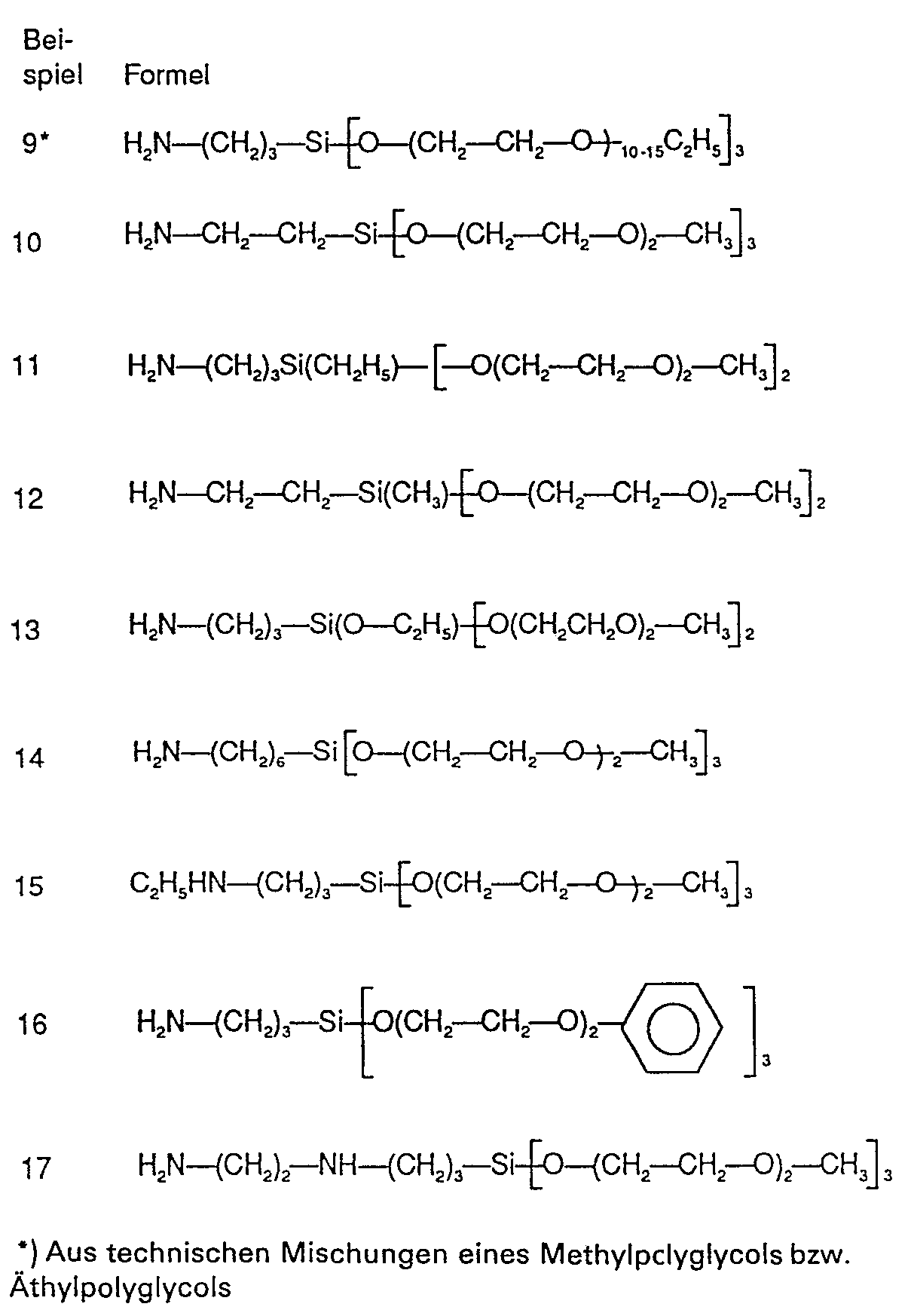
- Umesterung von y-Aminopropyltrimethoxysilan mit Diäthylenglykolmonomethyläther.
- In einer Standapparatur, die mit Innenthermometer, Rückflusskühler mit Calciumchlorid-Rohr und Rührer versehen ist, wurden 412 g (2,3 Mol)y-Aminopropyltrimethoxysilan vorgelegt und 1242 g (10,35 Mol = 50% Überschuss) Diäthylenglykolmonomethyläther zugemischt. Der Reaktionsansatz wurde zwei Stunden am Rückfluss erhitzt, wobei die Siedetemperatur bei etwa 110°C lag.
- Nach dem Abkühlen des Reaktionsansatzes wurde der Rückflusskühler durch eine Destillationsbrücke ersetzt. Zunächst wurde bei Normaldruck der bei der Reaktion freigesetzte Methylalkohol und anschliessend, nach erneutem Abkühlen, im Vakuum von etwa 10 mbar nicht umgesetzter Diäthylenglykolmonomethyläther bis zu einer Innentemperatur von 130 °C abdestilliert.
- Es wurden 979 g eines Rohproduktes erhalten, das noch etwa 13 Gew.-% Diäthylenglykolmonomethyläther enthielt. Das Umesterungsprodukt besteht zu etwa 75% aus dem Tris-2-(2-Methoxy- äthoxy-)äthoxy-silyl-3-aminopropan der Formel H2N-CHz-CH2-CH2-Si-(0(-CH2-CH2-0)2-CH3)3, die durch Gaschromatographie und Massenspektrometrie bestätigt wurde. Daneben wurden überwiegend die korrespondierenden Mono- und Di-(2-(2-methoxy-äthoxy))-silyl-Verbindungen erhalten
- Gemäss Beispiel A 1 wurden die folgenden Silanverbindungen hergestellt:

-
- 1000 g eines linearen Polypropylenglykols der OH-Zahl 56,1 werden mit
- 222,3g Isophorondiisocyanat versetzt. Nach Zugabe von
- 1,2 g Dibutylzinndilaurat wird die Mischung unter kräftigem Rühren auf 75 °C erwärmt und für 2,5 Stunden bei dieser Temperatur gehalten. Das Reaktionsprodukt hat einen Isocyanatgehalt von 3,4%.
- Gemäss Beispiel B 1 wurden die folgenden präpolymeren Isocyanate hergestellt:


- C Herstellung der präpolymeren Silane
-
- 1000 g des unter B1 hergestellten präpolymeren Isocyanats werden
- 153,5 des Silans A 1 zugetropft, wobei die Temperatur zwischen 55-80°C gehalten wird. Der NCO-Gehalt des Reaktionsproduktes beträgt 1,7%. II Zu
- 1000 g des obigen Reaktionsproduktes werden
- 43,6 g eines Polyoxipropylendiamins mit einem Molgewicht von 400 und einer Aminzahl von 280,5 (Jeffamin® D 400, Warenzeichen der Fa. Jefferson Chemical, Houston, USA) als Kettenverlängerer zugetropft bei einer Reaktionstemperatur von 55-80°C. Der NCO-Gehalt des Produktes beträgt danach 0,75%. III Zu
- 1000 g des Reaktionsprodukts II werden
- 34,7 g Dodekanol OH/Z 288 und 0,1% DBTL gegeben und die Mischung auf 75-80°C erwärmt. Die Reaktion wird solange fortgeführt, bis im IR-Spektrum kein freies NCO mehr nachzuweisen ist.
- Gemäss Beispiel C 1 wurden die folgenden präpolymeren Silane hergestellt, wobei die Stufen II und III auch einzeln oder zusammen entfallen können und wobei ein Austausch von Komponenten eine der aufgeführten Änderungen der Reaktionsbedingungen beinhalten kann.
- Bei Einsatz von Merkaptosilan in 1 muss die Reaktionsmischung aus Merkaptoverbindung und Isocyanat unter Mitverwendung von 0,1% DBTL, bezogen auf Reaktionsmischung, auf 75-80°C erwärmt werden.
- Werden als Kettenverlängerungsmittel in II anstelle der Amine Merkaptoverbindungen oder Alkohole verwendet, muss die Reaktionsmischung unter Mitverwendung eines Katalysators auf 75-80°C erwärmt werden. Analoges gilt für 111.

- D Herstellung einer Dichtungs- bzw. Klebemasse
-
- 350 g des gemäss Beispiel C 5 hergestellten präpolymeren Silans wurden mit
- 39 g einer hydrophobierten Kieselsäure (Aerosil® R 974, Warenzeichen der Fa. Degussa, Frankfurt) 15 min unter Vakuum (20 mbar) in einem Planetenkneter gemischt. Danach erfolgte eine Zugabe von
- 0,4g Dibutylzinndiacetat und ein weiteres Mischen von 10 Minuten unter einem Vakuum von 20 mbar.
- Zur Überprüfung der Hautbildungszeit und Durchhärtungsgeschwindigkeit wurde eine runde Metallform mit einem Durchmesser von 55 mm und einer Tiefe von 9 mm mit der Masse ausgespritzt und bei Normklima gehärtet.
- Die Hautbildungszeit ist der Zeitpunkt, an dem die Oberfläche erstmals von einer durchgehenden Haut überzogen ist.
- Die Durchhärtungsgeschwindigkeit wird anhand der Dicke der gebildeten Haut ermittelt.
- Es wurde eine Hautbildungszeit von1½ h und eine Durchhärtungsgeschwindigkeit von 4 mm/Tag festgestellt.
- Gemäss Beispiel D 1 wurden die folgenden Dichtungsmassen hergestellt und bei Normalklima (23°C 50% relative Feuchte) auf Härtungsverhalten überprüft.

Claims (15)

umsetzt, wobei das Verhältnis zwischen deren reaktiven X- und NCO-Gruppen im Bereich von 1 :2 bis 1 : 1 liegt, und gegebenenfalls übliche Kettenverlängerer, Kettenabbrecher, übliche inerte Zusatzstoffe, Hilfsstoffe und Beschleuniger zusetzt.
bedeuten.
Priority Applications (1)
| Application Number | Priority Date | Filing Date | Title |
|---|---|---|---|
| AT85108007T ATE44962T1 (de) | 1984-07-21 | 1985-06-28 | Verfahren zur herstellung von unter feuchtigkeitsausschluss lagerstabilen kunstharzmassen und deren verwendung. |
Applications Claiming Priority (2)
| Application Number | Priority Date | Filing Date | Title |
|---|---|---|---|
| DE3426987 | 1984-07-21 | ||
| DE19843426987 DE3426987A1 (de) | 1984-07-21 | 1984-07-21 | Verfahren zur herstellung von unter feuchtigkeitsausschluss lagerstabilen kunstharzmassen und deren verwendung |
Publications (2)
| Publication Number | Publication Date |
|---|---|
| EP0170865A1 EP0170865A1 (de) | 1986-02-12 |
| EP0170865B1 true EP0170865B1 (de) | 1989-07-26 |
Family
ID=6241256
Family Applications (1)
| Application Number | Title | Priority Date | Filing Date |
|---|---|---|---|
| EP85108007A Expired EP0170865B1 (de) | 1984-07-21 | 1985-06-28 | Verfahren zur Herstellung von unter Feuchtigkeitsausschluss lagerstabilen Kunstharzmassen und deren Verwendung |
Country Status (10)
| Country | Link |
|---|---|
| US (1) | US4798878A (de) |
| EP (1) | EP0170865B1 (de) |
| JP (1) | JPS6157616A (de) |
| AT (1) | ATE44962T1 (de) |
| AU (1) | AU586979B2 (de) |
| CA (1) | CA1254340A (de) |
| DE (2) | DE3426987A1 (de) |
| DK (1) | DK300785A (de) |
| ES (1) | ES8604277A1 (de) |
| NO (1) | NO852888L (de) |
Cited By (2)
| Publication number | Priority date | Publication date | Assignee | Title |
|---|---|---|---|---|
| US6596401B1 (en) | 1998-11-10 | 2003-07-22 | C. R. Bard Inc. | Silane copolymer compositions containing active agents |
| EP1738737A1 (de) | 2005-07-01 | 2007-01-03 | Kettenbach GmbH & CO. KG | Zu formstabilen Formkörpern aushärtendes kondensationsvernetzendes Dentalmaterial |
Families Citing this family (49)
| Publication number | Priority date | Publication date | Assignee | Title |
|---|---|---|---|---|
| DE3629237A1 (de) * | 1986-08-28 | 1988-03-03 | Henkel Kgaa | Alkoxysilanterminierte, feuchtigkeitshaertende polyurethane sowie ihre verwendung fuer klebe- und dichtungsmassen |
| DE3636974A1 (de) * | 1986-10-30 | 1988-05-05 | Bayer Ag | Poly-(ether-urethan-harnstoff)polyadditionsprodukte, ihre herstellung, abmischung enthaltend diese sowie ihre verwendung als abformmassen |
| JPH0674315B2 (ja) * | 1986-12-10 | 1994-09-21 | 東レチオコール株式会社 | 一液硬化型組成物 |
| JPS63245485A (ja) * | 1987-03-31 | 1988-10-12 | Sanyo Chem Ind Ltd | 陶管シ−ル用プライマ− |
| DE3742661A1 (de) * | 1987-12-16 | 1989-07-13 | Hawera Probst Kg Hartmetall | Gesteinsbohrer |
| JPH024891A (ja) * | 1988-06-21 | 1990-01-09 | Mitsubishi Rayon Co Ltd | 歯科用接着剤組成物 |
| DE4029504A1 (de) * | 1990-09-18 | 1992-03-19 | Henkel Kgaa | Dichtungs- und klebemassen mit speziellen weichmachern |
| DE4029505A1 (de) * | 1990-09-18 | 1992-03-19 | Henkel Kgaa | Feuchtigkeitshaertende, alkoxysilanterminierte polyurethane |
| US5525654A (en) * | 1990-09-18 | 1996-06-11 | Henkel Kommanditgesellschaft Auf Aktien | Polyurethane-based sealing and adhesive compositions containing special diurethane plasticizers |
| GB9210653D0 (en) * | 1992-05-19 | 1992-07-01 | Ici Plc | Silane functional oligomer |
| US5443903A (en) * | 1993-02-25 | 1995-08-22 | Minnesota Mining And Manufacturing Company | Hot melt stick |
| DE4307024A1 (de) * | 1993-03-05 | 1994-09-08 | Muehlbauer Ernst Kg | Kunststoffe mit einem Gehalt an Silan-, Ether-, Urethan- und Harnstoffgruppen |
| HUP9802301A2 (hu) * | 1995-09-26 | 1999-03-29 | Ameron International Corporation | Polisziloxán-poliuretán kompozíciók |
| US5539045A (en) * | 1995-10-27 | 1996-07-23 | Morton International, Inc. | Aliphatic silylated polyurethane mixtures having reduced viscosites |
| US5840800A (en) | 1995-11-02 | 1998-11-24 | Dow Corning Corporation | Crosslinked emulsions of pre-formed silicon modified organic polymers |
| DE19908562A1 (de) | 1998-03-25 | 1999-10-07 | Henkel Kgaa | Polyurethan und polyurethanhaltige Zubereitung |
| US6329488B1 (en) | 1998-11-10 | 2001-12-11 | C. R. Bard, Inc. | Silane copolymer coatings |
| GB9902856D0 (en) | 1999-02-10 | 1999-03-31 | Dow Corning | Organosiloxane compositions |
| US6197912B1 (en) | 1999-08-20 | 2001-03-06 | Ck Witco Corporation | Silane endcapped moisture curable compositions |
| DE10013628A1 (de) | 2000-03-18 | 2001-09-20 | Degussa | Stabile 1:1-Monoaddukte aus sekundären Aminoalkylalkoxysilanen und Diisocyanaten sowie ein Verfahren zu ihrer Herstellung |
| US6498210B1 (en) | 2000-07-13 | 2002-12-24 | Adco Products, Inc. | Silylated polyurethanes for adhesives and sealants with improved mechanical properties |
| ES2252606T3 (es) | 2001-08-06 | 2006-05-16 | Degussa Ag | Compuestos de organosilicio. |
| US6803412B2 (en) * | 2003-03-13 | 2004-10-12 | H.B. Fuller Licensing & Financing Inc. | Moisture curable hot melt sealants for glass constructions |
| DE10327624B3 (de) * | 2003-06-20 | 2004-12-30 | Degussa Ag | Organosiliciumverbindungen, Verfahren zu ihrer Herstellung, sowie ihre Verwendung |
| DE502005006995D1 (de) | 2004-02-13 | 2009-05-14 | Kettenbach Gmbh & Co Kg | Dentalmaterial auf basis von alkoxysilylfunktionellen polyethern |
| US7482420B2 (en) | 2004-03-24 | 2009-01-27 | Construction Research & Technology Gmbh | Silane-terminated polyurethanes with high strength and high elongation |
| DE102004030737A1 (de) * | 2004-06-25 | 2006-01-12 | Degussa Ag | Verfahren und Vorrichtung zur Extraktion von Stoffen aus silanmodifizierten Füllstoffen |
| US7888425B2 (en) * | 2004-07-16 | 2011-02-15 | Reichhold, Inc. | Low volatile organic compound stable solvent-based polyurethane compositions for coatings |
| DE102004045358B4 (de) | 2004-09-17 | 2009-11-26 | Kettenbach Gmbh & Co. Kg | Kondensationsvernetzendes Zweikomponenten-Dentalabformmaterial auf Basis von alkoxysilyl- und hydroxylsilylfunktionellen Polyethern |
| DE102004045214B4 (de) | 2004-09-17 | 2010-01-28 | Kettenbach Gmbh & Co. Kg | Zweikomponenten-Dentalabformmaterial auf Basis von hydroxylfunktionellen Polyethern und Alkoxysilanen und/oder Kieselsäureestern |
| DE102004055450A1 (de) * | 2004-11-17 | 2006-05-18 | Degussa Ag | Feuchtigkeitshärtendes Bindemittel |
| DE102005057801A1 (de) | 2005-01-20 | 2006-08-03 | Degussa Ag | Mercaptosilane |
| DE102005020535B3 (de) | 2005-05-03 | 2006-06-08 | Degussa Ag | Verfahren zur Herstellung von Mercaptoorganyl(alkoxysilanen) |
| DE102005038791A1 (de) | 2005-08-17 | 2007-02-22 | Degussa Ag | Organosiliciumverbindungen, ihre Herstellung und ihre Verwendung |
| DE102005060122A1 (de) * | 2005-12-16 | 2007-06-21 | Degussa Gmbh | Verfahren zur Herstellung von (Mercaptoorganyl)alkylpolyethersilanen |
| US7569653B2 (en) * | 2006-02-01 | 2009-08-04 | Momentive Performance Materials Inc. | Sealant composition having reduced permeability to gas |
| US20070178256A1 (en) * | 2006-02-01 | 2007-08-02 | Landon Shayne J | Insulated glass unit with sealant composition having reduced permeability to gas |
| US8580361B2 (en) * | 2006-02-01 | 2013-11-12 | Momentive Performance Materials Inc. | Insulated glass unit with sealant composition having reduced permeability to gas |
| US7541076B2 (en) * | 2006-02-01 | 2009-06-02 | Momentive Performance Materials Inc. | Insulated glass unit with sealant composition having reduced permeability to gas |
| US20070179236A1 (en) * | 2006-02-01 | 2007-08-02 | Landon Shayne J | Sealant composition having reduced permeability to gas |
| DE102006027235A1 (de) | 2006-06-09 | 2008-01-17 | Evonik Degussa Gmbh | Kautschukmischungen |
| DE102006048041A1 (de) | 2006-10-09 | 2008-04-10 | Henkel Kgaa | Zusammensetzungen aus teilweise silylterminierten Polymeren |
| DE102006055739A1 (de) * | 2006-11-25 | 2008-05-29 | Bayer Materialscience Ag | Abformmassen |
| DE102007037556A1 (de) | 2007-08-09 | 2009-02-12 | Evonik Degussa Gmbh | Verfahren zur Herstellung von alkylpolyethersubstituierten Mercaptosilanen |
| DE102009057597A1 (de) * | 2009-12-09 | 2011-06-16 | Bayer Materialscience Ag | Polyrethan-Prepolymere |
| BR112012033373B1 (pt) * | 2010-06-30 | 2021-04-20 | Dow Global Technologies Llc | composição, método para produzir uma composição de polímero terminado por silano reticulável, artigo e composição de polímero terminado por silano reticulável |
| DE102012223422A1 (de) | 2012-12-17 | 2014-06-18 | Henkel Ag & Co. Kgaa | Niedermodulige silanterminierte PU-Präpolymere |
| JP6255770B2 (ja) * | 2013-07-26 | 2018-01-10 | セメダイン株式会社 | 釉薬付タイル用ウレタン目地材 |
| EP3715397A1 (de) * | 2019-03-26 | 2020-09-30 | PolyU GmbH | Zusammensetzung und verfahren zur herstellung feuchtigkeitsvernetzender polymere und deren verwendung |
Family Cites Families (5)
| Publication number | Priority date | Publication date | Assignee | Title |
|---|---|---|---|---|
| DE1745526B2 (de) * | 1967-03-16 | 1980-04-10 | Union Carbide Corp., New York, N.Y. (V.St.A.) | Verfahren zur Herstellung vulkanisierbarer, unter wasserfreien Bedingungen beständiger Polymerisate |
| DE3220866A1 (de) * | 1982-06-03 | 1983-12-08 | Dynamit Nobel Ag, 5210 Troisdorf | Vernetzbare harzmischungen |
| DE3220865C2 (de) * | 1982-06-03 | 1984-08-02 | Dynamit Nobel Ag, 5210 Troisdorf | Haftkleber auf der Basis von hydroxylgruppenhaltigen Polymermischungen |
| JPS6055022A (ja) * | 1983-09-07 | 1985-03-29 | Sunstar Giken Kk | ポリウレタン樹脂組成物 |
| US4590224A (en) * | 1984-08-20 | 1986-05-20 | The Dow Chemical Company | Siloxane-containing polyisocyanurate |
-
1984
- 1984-07-21 DE DE19843426987 patent/DE3426987A1/de not_active Withdrawn
-
1985
- 1985-06-25 ES ES544540A patent/ES8604277A1/es not_active Expired
- 1985-06-28 DE DE8585108007T patent/DE3571819D1/de not_active Expired
- 1985-06-28 EP EP85108007A patent/EP0170865B1/de not_active Expired
- 1985-06-28 AT AT85108007T patent/ATE44962T1/de not_active IP Right Cessation
- 1985-07-02 DK DK300785A patent/DK300785A/da not_active Application Discontinuation
- 1985-07-17 CA CA000486943A patent/CA1254340A/en not_active Expired
- 1985-07-18 AU AU45222/85A patent/AU586979B2/en not_active Ceased
- 1985-07-18 JP JP60157119A patent/JPS6157616A/ja active Pending
- 1985-07-19 NO NO852888A patent/NO852888L/no unknown
- 1985-07-19 US US06/756,626 patent/US4798878A/en not_active Expired - Fee Related
Cited By (2)
| Publication number | Priority date | Publication date | Assignee | Title |
|---|---|---|---|---|
| US6596401B1 (en) | 1998-11-10 | 2003-07-22 | C. R. Bard Inc. | Silane copolymer compositions containing active agents |
| EP1738737A1 (de) | 2005-07-01 | 2007-01-03 | Kettenbach GmbH & CO. KG | Zu formstabilen Formkörpern aushärtendes kondensationsvernetzendes Dentalmaterial |
Also Published As
| Publication number | Publication date |
|---|---|
| DK300785D0 (da) | 1985-07-02 |
| ES8604277A1 (es) | 1986-02-01 |
| DK300785A (da) | 1986-01-22 |
| DE3571819D1 (en) | 1989-08-31 |
| US4798878A (en) | 1989-01-17 |
| CA1254340A (en) | 1989-05-16 |
| AU586979B2 (en) | 1989-08-03 |
| ES544540A0 (es) | 1986-02-01 |
| DE3426987A1 (de) | 1986-01-30 |
| ATE44962T1 (de) | 1989-08-15 |
| EP0170865A1 (de) | 1986-02-12 |
| AU4522285A (en) | 1986-01-23 |
| JPS6157616A (ja) | 1986-03-24 |
| NO852888L (no) | 1986-01-22 |
Similar Documents
| Publication | Publication Date | Title |
|---|---|---|
| EP0170865A1 (de) | Verfahren zur Herstellung von unter Feuchtigkeitsausschluss lagerstabilen Kunstharzmassen und deren Verwendung | |
| EP0086271B1 (de) | Elastische Kunstharzmassen mit verbesserter Haftwirkung | |
| EP0549626B1 (de) | Feuchtigkeitshärtende, alkoxysilanterminierte polyurethane | |
| CA1163039A (en) | Polyurethane sealant system | |
| EP1456274B1 (de) | Verwendung eines Isocyanatofunktionellen Silans als haftvermittelnden Zusatz in Polyurethan-Schmelzklebstoffen | |
| EP0261409B1 (de) | Verfarhen zur herstellung von Alkoxysilanterminierten, feuchtigkeitsärtenden Polyurethanen sowie ihre Verwendung für Klebe- und Dichtungsmassen | |
| DE602004002551T2 (de) | Zweikomponenten silylierte Polyurethan-Klebstoffe,-Dichtstoffe und Beschichtungszusammensetzungen | |
| EP1619215B1 (de) | Niedrigviskose Polyurethan-Prepolymere auf Basis von 2,4'-MDI | |
| EP0164520B1 (de) | Polyurethanzubereitungen mit inkorporiertem Haftvermittler | |
| EP1877459B2 (de) | Feuchtigkeitshärtende zusammensetzung mit erhöhter dehnbarkeit | |
| DE68911047T2 (de) | Aus Mischungen von Polypropylenoxid-Polyolen und von auf organischen Silicon-Blockcopolymeren basierenden Polyol-Zwischenprodukten hergestellte Polyurethane. | |
| WO2003018658A1 (de) | Einkomponentige alkoxysilanterminierte polymere enthaltende schnell härtende abmischungen | |
| EP0268559B1 (de) | Haftvermittler | |
| WO2007025668A1 (de) | Niedrigviskose alkoxysilangruppenaufweisende prepolymere, ein verfahren zu ihrer herstellung sowie ihre verwendung | |
| EP0406160B1 (de) | Haftvermittler | |
| DE4029504A1 (de) | Dichtungs- und klebemassen mit speziellen weichmachern | |
| DE3876828T2 (de) | Eine katalytisch schnell aushaertende polyurethan-dichtungszusammensetzung. | |
| EP1717240A1 (de) | Organoalkoxysilane zur Verwendung in feuchtigkeitshärtenden Zusammensetzungen | |
| EP0200861B1 (de) | Verfahren zur Herstellung von Mercaptogruppen aufweisenden Oligourethanen, die nach diesem Verfahren erhältlichen Oligourethane und ihre Verwendung | |
| EP0066167B1 (de) | Verfahren zur Herstellung von Mercaptogruppen aufweisenden Oligourethanen, sowie ihre Verwendung als Bindemittel für oxidativ härtbare Beschichtungs- und Dichtungsmassen bzw. als Zusatzmittel für Epoxidharze | |
| DE19727029B4 (de) | Einkomponentige Reaktivsystem-Zusammensetzung, Verfahren zu ihrer Herstellung und ihre Verwendung | |
| EP2016109B1 (de) | Feuchtigkeitshärtende kleb- und dichtstoffe | |
| EP0812866B1 (de) | Lagerstabile, feuchtigkeitshärtende Klebstoffmasse | |
| DE1914365C3 (de) | Verwendung von Isocyanatgruppen aufweisenden Polyurethanen als Fugenvergußmassen | |
| DE10108038C1 (de) | Isocyanatfreie schäumbare Mischungen |
Legal Events
| Date | Code | Title | Description |
|---|---|---|---|
| PUAI | Public reference made under article 153(3) epc to a published international application that has entered the european phase |
Free format text: ORIGINAL CODE: 0009012 |
|
| AK | Designated contracting states |
Designated state(s): AT BE CH DE FR GB IT LI LU NL SE |
|
| 17P | Request for examination filed |
Effective date: 19860710 |
|
| 17Q | First examination report despatched |
Effective date: 19871110 |
|
| GRAA | (expected) grant |
Free format text: ORIGINAL CODE: 0009210 |
|
| AK | Designated contracting states |
Kind code of ref document: B1 Designated state(s): AT BE CH DE FR GB IT LI LU NL SE |
|
| REF | Corresponds to: |
Ref document number: 44962 Country of ref document: AT Date of ref document: 19890815 Kind code of ref document: T |
|
| REF | Corresponds to: |
Ref document number: 3571819 Country of ref document: DE Date of ref document: 19890831 |
|
| ITF | It: translation for a ep patent filed | ||
| ET | Fr: translation filed | ||
| GBT | Gb: translation of ep patent filed (gb section 77(6)(a)/1977) | ||
| PGFP | Annual fee paid to national office [announced via postgrant information from national office to epo] |
Ref country code: FR Payment date: 19900510 Year of fee payment: 6 Ref country code: AT Payment date: 19900510 Year of fee payment: 6 |
|
| PGFP | Annual fee paid to national office [announced via postgrant information from national office to epo] |
Ref country code: GB Payment date: 19900515 Year of fee payment: 6 |
|
| PGFP | Annual fee paid to national office [announced via postgrant information from national office to epo] |
Ref country code: SE Payment date: 19900516 Year of fee payment: 6 |
|
| PGFP | Annual fee paid to national office [announced via postgrant information from national office to epo] |
Ref country code: BE Payment date: 19900518 Year of fee payment: 6 |
|
| PGFP | Annual fee paid to national office [announced via postgrant information from national office to epo] |
Ref country code: CH Payment date: 19900522 Year of fee payment: 6 |
|
| PGFP | Annual fee paid to national office [announced via postgrant information from national office to epo] |
Ref country code: LU Payment date: 19900523 Year of fee payment: 6 |
|
| PGFP | Annual fee paid to national office [announced via postgrant information from national office to epo] |
Ref country code: DE Payment date: 19900525 Year of fee payment: 6 |
|
| PLBE | No opposition filed within time limit |
Free format text: ORIGINAL CODE: 0009261 |
|
| STAA | Information on the status of an ep patent application or granted ep patent |
Free format text: STATUS: NO OPPOSITION FILED WITHIN TIME LIMIT |
|
| ITTA | It: last paid annual fee | ||
| PG25 | Lapsed in a contracting state [announced via postgrant information from national office to epo] |
Ref country code: LU Free format text: LAPSE BECAUSE OF NON-PAYMENT OF DUE FEES Effective date: 19900630 |
|
| PGFP | Annual fee paid to national office [announced via postgrant information from national office to epo] |
Ref country code: NL Payment date: 19900630 Year of fee payment: 6 |
|
| 26N | No opposition filed | ||
| PG25 | Lapsed in a contracting state [announced via postgrant information from national office to epo] |
Ref country code: GB Effective date: 19910628 Ref country code: AT Effective date: 19910628 |
|
| PG25 | Lapsed in a contracting state [announced via postgrant information from national office to epo] |
Ref country code: SE Effective date: 19910629 |
|
| PG25 | Lapsed in a contracting state [announced via postgrant information from national office to epo] |
Ref country code: LI Effective date: 19910630 Ref country code: CH Effective date: 19910630 Ref country code: BE Effective date: 19910630 |
|
| BERE | Be: lapsed |
Owner name: SCHERING A.G. BERLIN UND BERGKAMEN Effective date: 19910630 |
|
| PG25 | Lapsed in a contracting state [announced via postgrant information from national office to epo] |
Ref country code: NL Effective date: 19920101 |
|
| NLV4 | Nl: lapsed or anulled due to non-payment of the annual fee | ||
| GBPC | Gb: european patent ceased through non-payment of renewal fee | ||
| PG25 | Lapsed in a contracting state [announced via postgrant information from national office to epo] |
Ref country code: FR Effective date: 19920228 |
|
| REG | Reference to a national code |
Ref country code: CH Ref legal event code: PL |
|
| PG25 | Lapsed in a contracting state [announced via postgrant information from national office to epo] |
Ref country code: DE Effective date: 19920401 |
|
| REG | Reference to a national code |
Ref country code: FR Ref legal event code: ST |
|
| EUG | Se: european patent has lapsed |
Ref document number: 85108007.7 Effective date: 19920109 |