EP0171134A2 - Wahlweise abnehmbarer prothetischer Nagel - Google Patents
Wahlweise abnehmbarer prothetischer Nagel Download PDFInfo
- Publication number
- EP0171134A2 EP0171134A2 EP85302518A EP85302518A EP0171134A2 EP 0171134 A2 EP0171134 A2 EP 0171134A2 EP 85302518 A EP85302518 A EP 85302518A EP 85302518 A EP85302518 A EP 85302518A EP 0171134 A2 EP0171134 A2 EP 0171134A2
- Authority
- EP
- European Patent Office
- Prior art keywords
- legs
- nail
- digit
- prosthetic
- portions
- Prior art date
- Legal status (The legal status is an assumption and is not a legal conclusion. Google has not performed a legal analysis and makes no representation as to the accuracy of the status listed.)
- Withdrawn
Links
Images
Classifications
-
- A—HUMAN NECESSITIES
- A61—MEDICAL OR VETERINARY SCIENCE; HYGIENE
- A61F—FILTERS IMPLANTABLE INTO BLOOD VESSELS; PROSTHESES; DEVICES PROVIDING PATENCY TO, OR PREVENTING COLLAPSING OF, TUBULAR STRUCTURES OF THE BODY, e.g. STENTS; ORTHOPAEDIC, NURSING OR CONTRACEPTIVE DEVICES; FOMENTATION; TREATMENT OR PROTECTION OF EYES OR EARS; BANDAGES, DRESSINGS OR ABSORBENT PADS; FIRST-AID KITS
- A61F2/00—Filters implantable into blood vessels; Prostheses, i.e. artificial substitutes or replacements for parts of the body; Appliances for connecting them with the body; Devices providing patency to, or preventing collapsing of, tubular structures of the body, e.g. stents
- A61F2/02—Prostheses implantable into the body
-
- A—HUMAN NECESSITIES
- A45—HAND OR TRAVELLING ARTICLES
- A45D—HAIRDRESSING OR SHAVING EQUIPMENT; EQUIPMENT FOR COSMETICS OR COSMETIC TREATMENTS, e.g. FOR MANICURING OR PEDICURING
- A45D31/00—Artificial nails
-
- A—HUMAN NECESSITIES
- A61—MEDICAL OR VETERINARY SCIENCE; HYGIENE
- A61F—FILTERS IMPLANTABLE INTO BLOOD VESSELS; PROSTHESES; DEVICES PROVIDING PATENCY TO, OR PREVENTING COLLAPSING OF, TUBULAR STRUCTURES OF THE BODY, e.g. STENTS; ORTHOPAEDIC, NURSING OR CONTRACEPTIVE DEVICES; FOMENTATION; TREATMENT OR PROTECTION OF EYES OR EARS; BANDAGES, DRESSINGS OR ABSORBENT PADS; FIRST-AID KITS
- A61F2/00—Filters implantable into blood vessels; Prostheses, i.e. artificial substitutes or replacements for parts of the body; Appliances for connecting them with the body; Devices providing patency to, or preventing collapsing of, tubular structures of the body, e.g. stents
- A61F2/50—Prostheses not implantable in the body
-
- A—HUMAN NECESSITIES
- A61—MEDICAL OR VETERINARY SCIENCE; HYGIENE
- A61F—FILTERS IMPLANTABLE INTO BLOOD VESSELS; PROSTHESES; DEVICES PROVIDING PATENCY TO, OR PREVENTING COLLAPSING OF, TUBULAR STRUCTURES OF THE BODY, e.g. STENTS; ORTHOPAEDIC, NURSING OR CONTRACEPTIVE DEVICES; FOMENTATION; TREATMENT OR PROTECTION OF EYES OR EARS; BANDAGES, DRESSINGS OR ABSORBENT PADS; FIRST-AID KITS
- A61F5/00—Orthopaedic methods or devices for non-surgical treatment of bones or joints; Nursing devices ; Anti-rape devices
- A61F5/01—Orthopaedic devices, e.g. long-term immobilising or pressure directing devices for treating broken or deformed bones such as splints, casts or braces
- A61F5/11—Devices for correcting deformities of the nails
Definitions
- the invention relates generally to prosthetic nails for humans; more particularly, it relates to a prosthetic nail which is adapted to be surgically fitted to a finger or a toe so as to entirely replace a damaged or diseased nail.
- the digits of a foot are also vulnerable to many kinds of injuries. Lawn mowers in particular seem to contribute to many cutting injuries; and the dropping of heavy objects on the leading edge of a foot naturally contributes to many crushing injuries to the toes.
- Such cosmetic nails are merely glued on 'top of an existing fingernail or toenail in order to create what is described as a more pleasing appearance.
- plastic appendages depend upon a natural nail for this connection to the finger or toe, and they have no structural features which would render them independently operable as prosthetic nails.
- the present invention is concerned with the type of prosthetic nail which has a nail plate comprising a sheet having front and rear ends and a longitudinal axis extending therebetween, the plate being adapted to be placed on top of the distal end of a digit so that the longitudinal axis extends in the same general direction as the distal phalangeal bone of the digit, and being slightly curved as viewed in a transverse plane so as to approach the generally cylindrical cross-sectional shape of a typical digit, said plate having a thin edge at its rear end that is adapted to be at least partially buried within the eponychial fold of the digit.
- Still another object is to provide a prosthetic nail which is selectively replaceable when either desired or required by the wearer, to satisfy either cosmetic preferences or structural needs, all without the necessity for repeated surgical involvement.
- the prosthetic nail of the invention is characterised by a bifurcated anchor member extending downwardly from near the front end of the nail plate, and having two legs with proximal and distal portions, the distal portions of the legs having a rest condition at which they are spaced apart appreciably further than are their proximal portions and being susceptible of being temporarily brought together so that the distal portions are essentially as close as are the proximal portions, the two legs lying in a transverse plane where they are exposed to being externally gripped from the front of the nail plate, whereby the nail plate is held in place on a digit when the leg distal portions are in their rest condition and when they are in contact with a pocket of tissue on the forward end of a person's digit, and whereby said leg distal portions may be temporarily brought together so that the anchor member may be lifted vertically away from the person's nail bed without damaging the pocket of tissue.
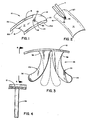
- a prosthetic nail 10 in accordance with this invention includes a nail plate 12 consisting of a sheet of material which is compatible with the human body and having a front end 14 and a rear end 16.
- a preferred material for the sheet is a thin (e.g., about 0.015 to 0.020 in.) piece of polypropylene; more specifically, an unmodified homopolymer of the type sold by Hercules Incorporated of Willmington, Delaware under the trademark "Profax 6523" is believed to be particularly appropriate.
- a thin sheet of this polypropylene will have an essentially translucent character so that the blood vessels near the end of a person's digit will be sufficiently perceptible as to provide an essentially variegated pinkish colour--almost matching a person's natural fingernails.
- the tensile strength of such a material typically 4300--5500 PSI) will be quite adequate for handling the loads to which the prosthetic nail 10 will likely be subjected.
- the plate 12 is sized so that it may be placed on top of the distal end of a digit in such a way that the longitudinal axis of the plate extends in the same general direction as the distal phalangeal bone of the digit.
- the length of the plate 12 is about 2.4 cm as manufactured, and the width is about 1.5 cm.
- the material from which the preferred plate is manufactured is sufficiently soft as to be readily susceptible to being cut with ordinary scissors, so that the plate may be configured for matching the size of other, natural nails--in order that the articial nail will not be so noticeable.
- the plate 12 is slightly curved so as to approach the generally cylindrical cross-sectional shape of a typical digit.
- the right edge 18 and the left edge.20 of the plate 12 may be formed by terminating the plate's width in the general plane of the plate; in such a case, it would be easy for anyone with scissors to cut small portions off the sides of the plate in order to make it fit the associated digit.
- An advantage of such an embodiment is that the plate 12 can be supplied in a relatively wide condition--and trimmed by one or more millimeters along each side as appropriate to meet a particular medical requirement.
- the right and left edges lie in a plane that is spaced a slight distance away from the plane of the plate.
- These edges 18A, 20A would then be connected to the main body of the plate 12 by short, elongated portions or skirts.
- skirts 22, 24 can be medically beneficial in that they provide a downwardly extending structure which can bear against the sides of the nail bed and help proclude the entrance of dirt or other contaminants through the sides of the prosthetic nail.
- These depending skirts 22, 24 are also useful in providing lateral stability for a prosthetic nail, so that the nail has less tendency to shift with respect to a digit when the nail is subjected to transverse loading.
- skirts 22, 24 there is no way to adjust the nail size to make it more narrow after it has been fabricated; hence, a much greater inventory of nail sizes must be maintained by a surgeon so that he will have at his disposal a nail that is reasonably assured of constituting an acceptable "fit" on a particular patient.
- a bifurcated anchor member 26 Extending downwardly from near the front end of the nail plate 12 is a bifurcated anchor member 26.
- Said anchor member has two legs 28, 30, each of which has proximal and distal portions.
- the leg distal portions 32, 34 have a rest condition at which they are spaced apart appreciably further than are their promixal portions.
- the distal portions 32, 34 are susceptible of being temporarily forced together, so that the distal portions can be made to be essentially as close as their proximal portions 36, 38.
- the two legs 28, 30 lie in a generally transverse plane where they are exposed to being externally gripped from the front of the nail plate-by tweezers or the like.
- FIG 2 an illustation of one embodiment of the prosthetic nail--having no depending skirts along the sides--is shown with exemplary tweezers T; the tweezers are shown in a configuration as if they were being manually squeezed, such that they are applying a compressive force against the outside surfaces of the legs 28, 30.
- the resilience of the plastic material from which the legs are formed causes the distal ends 32, 34 to be brought toward one another.
- the distance between the outer surfaces of the distal portions 32, 34 can be essentially the same as the distance betwen outer surfaces of the proximal portions 36, 38. Under these conditions, it would be feasible to lift the anchor member 26 vertically away from a person's nail bend without unduly distorting or damaging a pocket of tissue in said nail bed.
- the two legs 28, 30 are shown with solid lines in their rest condition, and shown with broken lines in their (temporary) compressed condition.
- This figure probably best illustrates the two conditions or modes wherein the inherent resilience of the leg material is used to provide the desired engagement between a prosthetic nail 10 and the person's nail bed. While relying on leg resilience to cause the distal end of a leg to rest below some tissue in order to achieve selective engagement, it is true that another way of achieving such an engagement would be to have hinged legs which possess minimal, if any, inherent resilience.
- the bifurcated anchor member 26 includes legs that extend downwardly from the plate for about 4 mm; that is, the most remote part of a leg is preferably less than 5 mm from the bottom of the plate 12.
- the length of the depending legs 28, 30 to 5 mm or less, there will be less chance of physical contact between any bone structure and a depending leg. Any accidental blow to the top of the plate 12 will therefore tend to be cushioned by soft tissue on the digit, thereby making the prosthetic nail less sensitive to normal manual activity involving contact with a digit's surroundings.
- the side-to-side spread of the distal ends 32, 34 is preferably about 6 mm when the legs 28, 30 are in their rest mode; when temporarily forced together, the distal portions are preferably about 3 mm apart (from outisde surface to outside surface). Hence, the outside surface of the distal portions 32, 34 are spaced appreciably further than are their proximal portions--when the legs 28, 30 are at rest. The increased 3 mm of distal width when the legs 28, 30 are relaxed is sufficient to provide significant resistance against upward movement of a plate 12 away from the tissue in a digit.
- While 3 mm may not seem like much in an absolute sense, it is believed to be enough to hold a prosthetic nail 10 on a digit even when that nail is being used in a functional way, e.g., to scratch some skin that is itching, etc.
- the tissue on a person's digit will grow around the two depending legs 28, 30 by an amount to permit pinching action between two fingernails, so that a needle or the like could be grasped and lifted.
- the distal end of a leg have ample radii-even to the point of being essentially round.
- the reason for preferring a cross-sectional area which is wider than it is deep (or thick) is to insure that the legs will have a larger area amount of inertia about the axis about which the leg flexes when it is squeezed with tweezers or the like. That is, it is easier to bend the legs 28, 30 in a direction that is parallel to the longitudinal axis of the plate 12 than it is to bend the legs transversely.
- the anchor member 26 will typically be cast or otherwise prepared as a distinct element--and then combined with a generally planar plate 12 by ultrasonic welding or a particularly effective glue, etc.
- the nail may also be cast as an integral unit, using a flexible mould or a rigid mould with movable cores.
- the prosthetic nail 10 will typically be sterilized and packaged with a pair of tweezers T or any other appropriate installation tool. A surgeon will then open the sterilized package at a later time and insert the prosthetic nail into a space that has been surgically prepared to receive the nail. By temporarily forcing the two legs together, the distal end of those legs may be caused to engage (and eventually lie under) a small amount of tissue. At any desired time, the prosthetic nail 10 can be removed from the digit by reversing the installation procedure, i.e., forcing the legs together and then lifting the plate away from the nail bed.
Landscapes
- Health & Medical Sciences (AREA)
- Animal Behavior & Ethology (AREA)
- Veterinary Medicine (AREA)
- Engineering & Computer Science (AREA)
- Biomedical Technology (AREA)
- Heart & Thoracic Surgery (AREA)
- Vascular Medicine (AREA)
- Public Health (AREA)
- General Health & Medical Sciences (AREA)
- Life Sciences & Earth Sciences (AREA)
- Cardiology (AREA)
- Oral & Maxillofacial Surgery (AREA)
- Transplantation (AREA)
- Orthopedic Medicine & Surgery (AREA)
- Nursing (AREA)
- Prostheses (AREA)
Applications Claiming Priority (2)
| Application Number | Priority Date | Filing Date | Title |
|---|---|---|---|
| US06/599,981 US4559055A (en) | 1984-04-13 | 1984-04-13 | Selectively removable prosthetic nail |
| US599981 | 1984-04-13 |
Publications (2)
| Publication Number | Publication Date |
|---|---|
| EP0171134A2 true EP0171134A2 (de) | 1986-02-12 |
| EP0171134A3 EP0171134A3 (de) | 1987-03-25 |
Family
ID=24401900
Family Applications (1)
| Application Number | Title | Priority Date | Filing Date |
|---|---|---|---|
| EP85302518A Withdrawn EP0171134A3 (de) | 1984-04-13 | 1985-04-10 | Wahlweise abnehmbarer prothetischer Nagel |
Country Status (3)
| Country | Link |
|---|---|
| US (1) | US4559055A (de) |
| EP (1) | EP0171134A3 (de) |
| JP (1) | JPS60236641A (de) |
Cited By (1)
| Publication number | Priority date | Publication date | Assignee | Title |
|---|---|---|---|---|
| EP0160500B1 (de) * | 1984-04-30 | 1991-07-24 | E. Olayinka Ogunro | Provisorischer Überzug zum Begünstigen einer kosmetisch gefälligen Heilung des Nagelbettgewebes |
Families Citing this family (20)
| Publication number | Priority date | Publication date | Assignee | Title |
|---|---|---|---|---|
| US4819623A (en) * | 1984-04-30 | 1989-04-11 | Ogunro E Olayinka | Device to foster cosmetically pleasing healing of nail bed tissue |
| US4756950A (en) * | 1985-03-23 | 1988-07-12 | Mitsubishi Paper Mills, Ltd. | Gradation recording heat-transfer sheet |
| GB2227175B (en) * | 1988-12-09 | 1992-07-22 | David Sydney Grantham | Prosthetic device for relieving prostatic problems |
| US5060678A (en) * | 1990-05-10 | 1991-10-29 | Bauman Mark L | Artificial nail and implantation techniques |
| GB9100197D0 (en) * | 1991-01-05 | 1991-02-20 | Aylott David H | Artificial nail tip |
| US5226433A (en) * | 1991-06-05 | 1993-07-13 | Garcia Carree Juan J | Device for the treatment of ingrowing nails |
| US5450864A (en) * | 1994-02-28 | 1995-09-19 | Creative Nail Design System Incorporated | Artificial nail tips |
| USD365175S (en) | 1994-02-28 | 1995-12-12 | Cosmar Corporation | Artificial nail tip |
| US6177034B1 (en) | 1998-04-03 | 2001-01-23 | A-Pear Biometric Replications Inc. | Methods for making prosthetic surfaces |
| JP3852007B2 (ja) * | 2003-04-21 | 2006-11-29 | j−sen株式会社 | クリップ用爪型カバーとプラスチック製クリップとを組み合わせたクリップセット |
| KR200335618Y1 (ko) * | 2003-07-02 | 2003-12-11 | 이창기업 주식회사 | 인조 손톱 부착장치 |
| US7222628B2 (en) * | 2004-04-03 | 2007-05-29 | King Larue Ezelle | Artificial nail apparatus |
| WO2007053849A2 (en) * | 2005-11-01 | 2007-05-10 | Robert Brodkin | Method and apparatus for attachment of artificial nail |
| US20090078277A1 (en) * | 2006-05-08 | 2009-03-26 | Fumiko Uemura | Nail Shaper for Ingrown Nail and False Nail |
| ES2326247B1 (es) * | 2007-02-09 | 2010-07-15 | Ana Maestro Perdices | Protesis ungueal. |
| KR100913168B1 (ko) * | 2009-03-27 | 2009-08-19 | 장성용 | 인조손톱 부착세트 및 그의 제조방법 |
| KR101239735B1 (ko) * | 2010-11-26 | 2013-03-06 | 장성용 | 입체형 장식물이 부착된 인조네일 및 인조네일 제조방법 |
| WO2017132024A1 (en) * | 2016-01-29 | 2017-08-03 | Miki Roberto Augusto | Nail plate growth guide surgical implantation kit |
| US11484106B2 (en) | 2019-11-19 | 2022-11-01 | Drew Christie | Implant for removable prosthetic nail |
| US20230067516A1 (en) * | 2021-09-01 | 2023-03-02 | Alyssa Lauren Surowiec | Detachable Artificial Nail System |
Family Cites Families (2)
| Publication number | Priority date | Publication date | Assignee | Title |
|---|---|---|---|---|
| GB661624A (en) * | 1948-07-07 | 1951-11-21 | Boris Bogoslowsky | Nail coating article and method |
| US4445234A (en) * | 1982-07-19 | 1984-05-01 | Ogunro E Olayinka | Prosthetic nail for surgical attachment to a finger or toe |
-
1984
- 1984-04-13 US US06/599,981 patent/US4559055A/en not_active Expired - Fee Related
-
1985
- 1985-04-10 EP EP85302518A patent/EP0171134A3/de not_active Withdrawn
- 1985-04-12 JP JP60078228A patent/JPS60236641A/ja active Pending
Cited By (1)
| Publication number | Priority date | Publication date | Assignee | Title |
|---|---|---|---|---|
| EP0160500B1 (de) * | 1984-04-30 | 1991-07-24 | E. Olayinka Ogunro | Provisorischer Überzug zum Begünstigen einer kosmetisch gefälligen Heilung des Nagelbettgewebes |
Also Published As
| Publication number | Publication date |
|---|---|
| EP0171134A3 (de) | 1987-03-25 |
| JPS60236641A (ja) | 1985-11-25 |
| US4559055A (en) | 1985-12-17 |
Similar Documents
| Publication | Publication Date | Title |
|---|---|---|
| US4559055A (en) | Selectively removable prosthetic nail | |
| EP0099635B1 (de) | Künstlicher Nagel | |
| US4955897A (en) | Tissue forceps | |
| US4552532A (en) | Osteocorrective dentoalveolar implant system | |
| US4990148A (en) | Thin footplate rongeur | |
| US5026385A (en) | Double-bladed scalpel | |
| JPS6140418B2 (de) | ||
| EP1190690A3 (de) | Obere Schicht für absorbierenden Artikel | |
| IE893270L (en) | Ophthalmic staple and instruments for implementing use | |
| ES2161229T3 (es) | Microesferas bioterapeuticas revestidas con celulas. | |
| EP1199037A3 (de) | Klammer zur Befestigung von Hernia-Netz | |
| EP0919198A3 (de) | Fixationselement zur Osteosynthese | |
| KR102596246B1 (ko) | 손발톱 교정밴드 | |
| US20080078085A1 (en) | Nail-treatment device | |
| US5881461A (en) | Nail cutter/clipper for treating ingrown nails and hang nails and/or preventing ingrown nails | |
| EP0231400A1 (de) | Osteokorrektives dentoalveolares Implantatsystem | |
| US4819623A (en) | Device to foster cosmetically pleasing healing of nail bed tissue | |
| USD503800S1 (en) | Surgical blade | |
| EP0373771A3 (de) | Neue pharmazeutische Anwendungen von Cystatinen | |
| KR100485247B1 (ko) | 내생발톱 성형용 인조 평발톱 | |
| US5803092A (en) | Cuticle pusher having a clamshell head | |
| KR200277199Y1 (ko) | 내생발톱 성형용 인조 평발톱 | |
| EP0160500B1 (de) | Provisorischer Überzug zum Begünstigen einer kosmetisch gefälligen Heilung des Nagelbettgewebes | |
| CN211131542U (zh) | 一种植骨用碎骨剪 | |
| SU1599000A1 (ru) | Протез сухожилий сгибателей пальцев кисти |
Legal Events
| Date | Code | Title | Description |
|---|---|---|---|
| PUAI | Public reference made under article 153(3) epc to a published international application that has entered the european phase |
Free format text: ORIGINAL CODE: 0009012 |
|
| AK | Designated contracting states |
Designated state(s): AT BE CH DE FR GB IT LI NL SE |
|
| PUAL | Search report despatched |
Free format text: ORIGINAL CODE: 0009013 |
|
| AK | Designated contracting states |
Kind code of ref document: A3 Designated state(s): AT BE CH DE FR GB IT LI NL SE |
|
| STAA | Information on the status of an ep patent application or granted ep patent |
Free format text: STATUS: THE APPLICATION IS DEEMED TO BE WITHDRAWN |
|
| 18D | Application deemed to be withdrawn |
Effective date: 19870926 |