EP0171208A1 - Tôles d'acier laminées à froid et procédé pour leur fabrication - Google Patents
Tôles d'acier laminées à froid et procédé pour leur fabrication Download PDFInfo
- Publication number
- EP0171208A1 EP0171208A1 EP85304993A EP85304993A EP0171208A1 EP 0171208 A1 EP0171208 A1 EP 0171208A1 EP 85304993 A EP85304993 A EP 85304993A EP 85304993 A EP85304993 A EP 85304993A EP 0171208 A1 EP0171208 A1 EP 0171208A1
- Authority
- EP
- European Patent Office
- Prior art keywords
- weight
- cold
- steel sheet
- rolled
- steel
- Prior art date
- Legal status (The legal status is an assumption and is not a legal conclusion. Google has not performed a legal analysis and makes no representation as to the accuracy of the status listed.)
- Granted
Links
Images



Classifications
-
- C—CHEMISTRY; METALLURGY
- C21—METALLURGY OF IRON
- C21D—MODIFYING THE PHYSICAL STRUCTURE OF FERROUS METALS; GENERAL DEVICES FOR HEAT TREATMENT OF FERROUS OR NON-FERROUS METALS OR ALLOYS; MAKING METAL MALLEABLE, e.g. BY DECARBURISATION OR TEMPERING
- C21D8/00—Modifying the physical properties of ferrous metals or ferrous alloys by deformation combined with, or followed by, heat treatment
- C21D8/02—Modifying the physical properties of ferrous metals or ferrous alloys by deformation combined with, or followed by, heat treatment during manufacturing of plates or strips
- C21D8/04—Modifying the physical properties of ferrous metals or ferrous alloys by deformation combined with, or followed by, heat treatment during manufacturing of plates or strips to produce plates or strips for drawing, e.g. for deep-drawing
- C21D8/0447—Modifying the physical properties of ferrous metals or ferrous alloys by deformation combined with, or followed by, heat treatment during manufacturing of plates or strips to produce plates or strips for drawing, e.g. for deep-drawing characterised by the heat treatment
- C21D8/0473—Final recrystallisation annealing
-
- C—CHEMISTRY; METALLURGY
- C22—METALLURGY; FERROUS OR NON-FERROUS ALLOYS; TREATMENT OF ALLOYS OR NON-FERROUS METALS
- C22C—ALLOYS
- C22C38/00—Ferrous alloys, e.g. steel alloys
- C22C38/14—Ferrous alloys, e.g. steel alloys containing titanium or zirconium
-
- C—CHEMISTRY; METALLURGY
- C21—METALLURGY OF IRON
- C21D—MODIFYING THE PHYSICAL STRUCTURE OF FERROUS METALS; GENERAL DEVICES FOR HEAT TREATMENT OF FERROUS OR NON-FERROUS METALS OR ALLOYS; MAKING METAL MALLEABLE, e.g. BY DECARBURISATION OR TEMPERING
- C21D8/00—Modifying the physical properties of ferrous metals or ferrous alloys by deformation combined with, or followed by, heat treatment
- C21D8/02—Modifying the physical properties of ferrous metals or ferrous alloys by deformation combined with, or followed by, heat treatment during manufacturing of plates or strips
- C21D8/04—Modifying the physical properties of ferrous metals or ferrous alloys by deformation combined with, or followed by, heat treatment during manufacturing of plates or strips to produce plates or strips for drawing, e.g. for deep-drawing
- C21D8/0421—Modifying the physical properties of ferrous metals or ferrous alloys by deformation combined with, or followed by, heat treatment during manufacturing of plates or strips to produce plates or strips for drawing, e.g. for deep-drawing characterised by the working steps
- C21D8/0426—Hot rolling
Definitions
- This invention relates to cold-rolled steel sheets for deep drawing having an improved bake hardenability and a method of manufacturing the same.
- the steel sheet is demanded to be soft and have a good workability in the press forming and exhibit a property of increasing the yield strength or a so-called bake hardenability in the subsequent paint baking.
- the cold-rolled steel sheet having the bake hardenability and the method of manufacturing the same there are descriptions on Ti-containing steel in Japanese Patent laid open No. 53-114,717, Nb-containing steel in Japanese Patent laid open No. 57-70,258, and Ti and Nb-containing steel in Japanese Patent laid open No. 59-31,827.
- the bake hardenability is imparted without deterioration of other properties by controlling the amounts of Ti, Nb added or the cooling rate in the annealing to make the amount of solute carbon in steel proper.
- the properties of the steel sheet are considerably influenced by delicate change of the addition amount. That is, when the addition amount of Ti, Nb is outside the predetermined range, the properties exerting on formabilities such as elongation, r-value and the like are degraded or the bake hardenability is not obtained satisfactorily. Therefore, the exact control of the addition amount is considered'to be significant in the production step.
- Japanese Patent laid open No. 58-110,659 mentions that S is limited to a range of 0.001-0.020% by weight and N is limited to not more than 0.0035%
- Japanese Patent laid open No. 58-42,752 mentions that N is limited to not more than 0.0025%.
- the former is only to prevent the occurrence of surface defects by reducing the amounts of Ti and B, and the latter is only to improve the secondary workability and r-value.
- the inventors have made studies with respect to the relation between the amount of S, N and the properties in Ti-containing extremely low carbon steel and found that a high bake hardenability is obtained by limiting the amount of each of S and N and the total amount of S and N to specified ranges and restricting the addition amount of Ti to the specified range in consideration of the S, N amounts, and as a result the invention has been accomplished.
- a cold-rolled steel sheet for deep drawing having an improved bake hardenability and comprising 0.0005 to 0.015% by weight of C, not more than 1.0% by weight of Si, not more than 1.0% by weight of Mn, not more than 0.15% by weight of P, 0.005 to 0.100% by weight of Al, not more than 0.003% by weight of S and not more than 0.004% by weight of N provided that the value of S+N is not more than 0.005% by weight, Ti corresponding to Ti(wt%) represented by the following equation (1) when an effective Ti content expressed by Ti A in the equation (1) satisfies the following inequality (2), and the balance being substantially Fe with inevitable impurities.
- the effective Ti content (Ti ) is 1 to less than 4 times of the C content (wt%).
- the steel sheet may further include at least one of not more than 0.05% by weight of Nb and not more than 0.0050% by weight of B.
- a method of manufacturing a cold-rolled steel sheet for deep drawing having an improved bake hardenability which comprises the steps of:
- the cast slab is heated at a heating temperature of not less than 1,150°C before the hot rolling step.
- a slab of vacuum molten steel comprising 0.0015% of C, 0.1% of Mn, 0.04% of AQ and variable amounts of N, S and Ti was hot rolled to a thickness of 3.5 mm and then cold rolled to a thickness of 0.8 mm in a laboratory. Then, the cold-rolled sheet was subjected to a heat treatment under such a heat cycle that the sheet was soaked at 800°C for 40 seconds, which was temper rolled at a reduction of about 0.8%.
- the influence of the (S+N) amount on bake hardenability (hereinafter abbreviated as BH), r-value and total elongation (hereinafter abbreviated as El) was examined to obtain results as shown in Figs. 1 and 2.
- BH was evaluated by measuring the increasing amount of yield point when applying a preliminary strain of 2% and subjecting to an aging treatment corresponding to a baking of 170°C and 20 minutes as shown in Fig. 3.
- Each of the El value and r-value was an average of the measured values with respect to three test pieces sampled at three angles of 0°, 45° and 90° with respect to the rolling direction as calculated according to the following equations:
- Fig. 1 shows the data under the condition of 4 ⁇ Ti*/C ⁇ 20, while Fig. 2 particularly shows the data under the condition of 1 ⁇ Ti*/C ⁇ 4.
- the C content is advantageous as low as possible for improving the properties of steel. When it exceeds 0.015%, even if the amount of Ti added as mentioned later is increased, the good drawability can not be obtained. On the other hand, if the C content is less than 0.0005%, BH aiming at the invention can not be obtained. Thus, the C content is restricted to a range of 0.0005 to 0.015%.
- Si and Mn effectively contributes to increase the strength of steel sheet without the degradation of deep drawability.
- Si and Mn are more than 1.0%, respectively, the elongation and drawability of steel sheet are considerably degraded. Therefore, Si and Mn are restricted to not more than 1.0%, respectively.
- P is effective for increasing the strength of steel sheet without the degradation of deep drawability likewise the case of Si and Mn. However, if P is more than 0.15%, the elongation and drawability of steel sheet are considerably degraded. Therefore, P is restricted to not more than 0.15%.
- Al is added in an amount of not less than 0.005% for deoxidation or the like.
- the addition of more than 0.100% of Al adversely affects the surface properties of steel sheet.
- Al is restricted to a range of 0.005 - 0.100%.
- S and N in steel are most important ingredients according to the invention. As apparent from the aforementioned experimental results, S ⁇ 0.003%, N ⁇ 0.004% and S+N ⁇ 0.005% are required to advantageously provide the improved bake hardenability.
- Ti is added for fixing S, N and C.
- the bake hardenability of at least 2 kgf/mm 2 aiming at the invention can be obtained with the high r-value. If Ti* is less than 1 times of C content (or atomic ratio of Ti*/C is less than 0.25), solute C excessively remains in steel, which is apt to cause yield elongation.
- the excess addition of Ti causes the degradation of the surface properties of steel sheet and becomes disadvantageous in view of the cost, so that the upper limit of Ti is restricted to 20 times of C content.
- Nb and B may be added to enhance r-value and El without damaging the bake hardenability aimed at the invention.
- Nb is more than 0.05% and B is more than 0.0050%
- the addition effect is saturated and the cost becomes disadvantageous, so that the upper limits of Nb and B are restricted to not more than 0.05% and not more than 0.0050%, respectively.
- not more than 1.0% of each of Cr, Cu, V and Zr and not more than 0.05% of each of Sb and Ca may be added, if necessary, because they do not degrade BH and deep drawability.
- the cold-rolled steel sheet having the above composition is produced by forming a steel tapped from a converter or an electric furnace into a slab by an ingot making-slabbing process or a continuous casting process, hot rolling and cold rolling the slab and continuously annealing the cold-rolled sheet while holding over a temperature region above recrystallization temperature within 300 seconds.
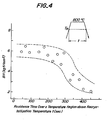
- a slab of vacuum molten steel comprising 0.0020% of C, 0.1% of Mn, 0.04% of AQ, 0.026% of Ti, 0.0022% of S and 0.0019% of N (i.e. Ti*/C ⁇ 8.1) was hot rolled to a thickness of 3.5 mm and then cold rolled to a thickness of 0.8 mm in a laboratory.
- the recrystallization temperature of the cold-rolled sheet was 660°C.
- Fig. 4 is shown a relation between BH and residence time, t (sec) over a temperature region above recrystallization temperature (T R ) when the above cold-rolled sheet is subjected to continuous annealing under such conditions that the heating and cooling rates are 10°C/sec, respectively and the soaking time is varied.
- the high BH value can stably be obtained when the residence time over the temperature region above the recrystallization temperature is within 300 seconds. This is considered due to the fact that the long-term annealing becomes disadvantageous for the securing of solute C because the precipitation of TiC progresses during the annealing. In the continuous annealing inclusive of heating and cooling, therefore, the residence time over the temperature region above the recrystallization temperature must be shortened and is within 300 seconds, preferably 100 seconds.
- the r-value is considerably enhanced when the slab reheating temperature is not less than 1,150°C. This is considered due to the fact that when the slab is reheated at higher temperature, the distribution and morphology of the composite precipitate of TiS and TiC in the hot-rolled sheet change to advantageously develop the recrystallization texture of ⁇ 111 ⁇ in the cold rolling and annealing.
- the cold-rolled steel sheets according to the invention are excellent in the phosphate treating property, hot dipping property and secondary workability and may be used as an original steel sheet for surface treatment such as electric zinc coating or the like.
- Each of steel materials having a chemical composition as shown in Table 1 was melted in a converter, subjected to a degassing treatment under vacuum, and then cast by a continuous casting apparatus to form a slab.
- This slab was hot rolled and cold rolled in usual manner to form a cold-rolled steel sheet having a thickness of 0.8 mm, which was subjected to a continuous annealing (soaking conditions: 800°C, 30 seconds) and a temper rolling (reduction: 0.5-1%).
- the mechanical properties of the thus obtained products are shown in Table 2. The mechanical properties were all measured by using JIS No. 5 test pieces.
- YEk, BH and aging index AI are test results with respect to the test piece sampled in parallel with the rolling direction.
- Each of steel materials (Nos. 14-17) having a chemical composition as shown in Table 3 was melted in a converter, subjected to a degassing treatment under vacuum and continuously cast to form a slab.
- the slab thus obtained was hot rolled and then cold rolled in usual manner to form a cold-rolled steel sheet having a thickness of 0.8 mm, which was subjected to a continuous annealing (soaking conditions: 800°C, 30 seconds) and a temper rolling (reduction: 0.5-1%).
- All of Steel Nos. 14-24 according to the invention were 2 ⁇ AI ⁇ 5 kgf/mm 2 .
- Each of steel materials (Nos. 28-30) having a chemical composition as shown in Table 5 was melted in a converter, subjected to a degassing treatment under vacuum and continuously cast to form a slab.
- the thus obtained slab was heated at 1,100-1,220°C, hot rolled, and then cold rolled to form a cold-rolled steel sheet having a thickness of 0.8 mm, which was subjected to a continuous annealing.
- the high BH value was obtained with no problems in the mechanical properties when the residence time over the temperature region above the recrystallization temperature was within 300 seconds.
- AI was not less than 2 kgf/mm 2 .
- the recrystallization temperature was 650°C, 720°C and 760°C in the cases of Steel No. 28, Steel No. 29 and Steel No. 30, respectively.
- the thus obtained slab was heated and soaked at 1,090-1,330°C for 3-4 hours and then hot rolled.
- the hot rolling finish temperature and the coiling temperature were 910-880°C and 510-600°C, respectively.
- the hot-rolled steel sheet was cold rolled to form a cold-rolled steel sheet having a thickness of 0.8 mm, which was then subjected to a continuous annealing.
- the residence time over the temperature region above the recrystallization temperature was set in a range of.75-92 seconds, and the attained maximum temperature was 790-820°C.
- the proper bake hardenability can be obtained together with the deep drawability in the cold-rolled sheet of extremely low carbon aluminum killed steel by restricting S, N and S+N amounts in steel to particular ranges and satisfying 1 ⁇ Ti*/C ⁇ 20 as the Ti amount.
- the proper bake hardenability is advantageously ensured by the continuous annealing under the specified recrystallization annealing conditions.
Landscapes
- Chemical & Material Sciences (AREA)
- Engineering & Computer Science (AREA)
- Mechanical Engineering (AREA)
- Materials Engineering (AREA)
- Metallurgy (AREA)
- Organic Chemistry (AREA)
- Physics & Mathematics (AREA)
- Thermal Sciences (AREA)
- Crystallography & Structural Chemistry (AREA)
- Heat Treatment Of Sheet Steel (AREA)
Applications Claiming Priority (6)
| Application Number | Priority Date | Filing Date | Title |
|---|---|---|---|
| JP146990/84 | 1984-07-17 | ||
| JP14699084A JPS6126757A (ja) | 1984-07-17 | 1984-07-17 | 焼付硬化性を有する深絞り用冷延鋼板 |
| JP122807/85 | 1985-06-07 | ||
| JP60122807A JPS61281852A (ja) | 1985-06-07 | 1985-06-07 | 焼付硬化性に富む遅時効性深絞り用冷延鋼板 |
| JP60144437A JPS627822A (ja) | 1985-07-03 | 1985-07-03 | 焼付硬化性を有する深絞り用冷延鋼板の製造方法 |
| JP144437/85 | 1985-07-03 |
Publications (3)
| Publication Number | Publication Date |
|---|---|
| EP0171208A1 true EP0171208A1 (fr) | 1986-02-12 |
| EP0171208B1 EP0171208B1 (fr) | 1989-02-08 |
| EP0171208B2 EP0171208B2 (fr) | 1993-04-21 |
Family
ID=27314524
Family Applications (1)
| Application Number | Title | Priority Date | Filing Date |
|---|---|---|---|
| EP85304993A Expired - Lifetime EP0171208B2 (fr) | 1984-07-17 | 1985-07-12 | Tôles d'acier laminées à froid et procédé pour leur fabrication |
Country Status (6)
| Country | Link |
|---|---|
| US (2) | US4750952A (fr) |
| EP (1) | EP0171208B2 (fr) |
| KR (1) | KR910002872B1 (fr) |
| AU (1) | AU560865B2 (fr) |
| CA (1) | CA1259827A (fr) |
| DE (1) | DE3568192D1 (fr) |
Cited By (9)
| Publication number | Priority date | Publication date | Assignee | Title |
|---|---|---|---|---|
| EP0262874A3 (fr) * | 1986-09-27 | 1989-01-25 | Nippon Kokan Kabushiki Kaisha | Tôles d'acier laminées à froid et leur procédé de fabrication |
| EP0308751A1 (fr) * | 1987-09-14 | 1989-03-29 | Kawasaki Steel Corporation | Feuille d'acier laminé à chaud ayant une résistance élevée à un accroissement de la fragilité suite à un travail secondaire ou à une soudure et adaptée à un emboutissage profond et méthode pour la fabriquer |
| WO1989007158A1 (fr) * | 1988-01-29 | 1989-08-10 | Stahlwerke Peine-Salzgitter Ag | Tole ou feuillard lamines a froid et procede pour leur fabrication |
| EP0228756B1 (fr) * | 1984-07-17 | 1990-05-16 | Kawasaki Steel Corporation | Tôles en acier à très basse teneur en carbone |
| EP0417699A3 (en) * | 1989-09-11 | 1992-03-18 | Kawasaki Steel Corporation | Cold-rolled steel sheet for deep drawing and method of producing the same |
| EP0528407A1 (fr) * | 1991-08-19 | 1993-02-24 | Kawasaki Steel Corporation | Tôles d'acier laminées à froid ayant une tenacité élevée et une bonne aptitude à l'emboutissage profond |
| EP0484960A3 (en) * | 1990-11-09 | 1993-03-03 | Nippon Steel Corporation | Cold-rolled steel strip having excellent combined press formability and method of producing same |
| DE4214946A1 (de) * | 1992-04-13 | 1993-11-11 | Toyo Kohan Co Ltd | Durchlaufgeglühtes Stahlblech und Verfahen zu seiner Herstellung |
| EP0578221A1 (fr) * | 1992-07-08 | 1994-01-12 | Nkk Corporation | Rôle d'acier, résistant à la formation de soufflures et procédé pour sa fabrication |
Families Citing this family (13)
| Publication number | Priority date | Publication date | Assignee | Title |
|---|---|---|---|---|
| AU611883B2 (en) * | 1987-02-02 | 1991-06-27 | John Lysaght (Australia) Limited | Steel suited to cintinuous casting and annealing |
| US5053194A (en) * | 1988-12-19 | 1991-10-01 | Kawasaki Steel Corporation | Formable thin steel sheets |
| CA2037316C (fr) * | 1990-03-02 | 1997-10-28 | Shunichi Hashimoto | Toles d'acier a emboutes laminees a froid ou galvanisees par immersion a chaud |
| ES2125856T5 (es) † | 1990-08-17 | 2004-09-16 | Jfe Steel Corporation | Lamina de acero de alta resistencia para formado en prensa y metodo de produccion de la misma. |
| US5556485A (en) * | 1994-11-07 | 1996-09-17 | Bethlehem Steel Corporation | Bake hardenable vanadium containing steel and method of making thereof |
| US5656102A (en) * | 1996-02-27 | 1997-08-12 | Bethlehem Steel Corporation | Bake hardenable vanadium containing steel and method thereof |
| US5853903A (en) * | 1996-05-07 | 1998-12-29 | Nkk Corporation | Steel sheet for excellent panel appearance and dent resistance after panel-forming |
| JP4177478B2 (ja) * | 1998-04-27 | 2008-11-05 | Jfeスチール株式会社 | 成形性、パネル形状性、耐デント性に優れた冷延鋼板、溶融亜鉛めっき鋼板及びそれらの製造方法 |
| US6110296A (en) * | 1998-04-28 | 2000-08-29 | Usx Corporation | Thin strip casting of carbon steels |
| US6143100A (en) * | 1998-09-29 | 2000-11-07 | National Steel Corporation | Bake-hardenable cold rolled steel sheet and method of producing same |
| ITFI20020227A1 (it) * | 2002-11-20 | 2004-05-21 | Perini Fabio Spa | Macchina ribobinatrice con un dispositivo incollatore per incollare il lembo finale del rotolo formato e relativo metodo di avvolgimento |
| ATE382571T1 (de) * | 2002-12-03 | 2008-01-15 | Perini Fabio Spa | Aufwickler zur herstellung von bahnmaterialrollen |
| KR20180093307A (ko) * | 2017-02-13 | 2018-08-22 | 주식회사 레고켐 바이오사이언스 | 4, 5-디아미노 치환 피리미딘 유도체의 제조방법 및 이를 제조하기 위한 신규한 화합물 |
Citations (4)
| Publication number | Priority date | Publication date | Assignee | Title |
|---|---|---|---|---|
| DE2155620A1 (de) * | 1970-12-19 | 1972-07-06 | Nippon Kokan Kk | Vakuumentgaster Stahl, der zu Platten für das Sondertiefziehen heiß verwalzt ist, und Verfahren zu dessen Herstellung |
| FR2299408A1 (fr) * | 1975-01-28 | 1976-08-27 | Nippon Steel Corp | Procede de production de toles d'acier pour l'emaillage et nouveaux produits ainsi obtenus |
| EP0067878A1 (fr) * | 1980-11-26 | 1982-12-29 | Kawasaki Steel Corporation | Procede de fabrication d'une plaque d'acier fine pour l'etirage avec curabilite par cuisson au four |
| WO1984001585A1 (fr) * | 1982-10-08 | 1984-04-26 | Kawasaki Steel Co | Procede de fabrication d'acier lamine a froid pour l'emboutissage profond |
Family Cites Families (6)
| Publication number | Priority date | Publication date | Assignee | Title |
|---|---|---|---|---|
| JPS5669358A (en) * | 1979-10-18 | 1981-06-10 | Kobe Steel Ltd | Ultra low carbon cold rolled steel sheet with superior press formability |
| JPS57104627A (en) * | 1980-12-19 | 1982-06-29 | Nippon Kokan Kk <Nkk> | Manufacture of cold rolled soft steel plate with superior press formability by continuous annealing |
| EP0071175B1 (fr) * | 1981-07-24 | 1986-03-12 | Byk Gulden Lomberg Chemische Fabrik GmbH | Acides phénylalkyloxiranecarboxyliques, procédé pour leur préparation, leur utilisation et médicaments les renfermant |
| JPS591637A (ja) * | 1982-06-28 | 1984-01-07 | Kawasaki Steel Corp | 二次加工における耐ぜい性割れ性に優れる深紋り用冷延鋼板の製造法 |
| US4504326A (en) * | 1982-10-08 | 1985-03-12 | Nippon Steel Corporation | Method for the production of cold rolled steel sheet having super deep drawability |
| JPS5989727A (ja) * | 1982-11-12 | 1984-05-24 | Kawasaki Steel Corp | プレス成形性の優れた超深絞り用冷延鋼板の製造方法 |
-
1985
- 1985-07-11 CA CA000486656A patent/CA1259827A/fr not_active Expired
- 1985-07-12 DE DE8585304993T patent/DE3568192D1/de not_active Expired
- 1985-07-12 AU AU44885/85A patent/AU560865B2/en not_active Expired
- 1985-07-12 EP EP85304993A patent/EP0171208B2/fr not_active Expired - Lifetime
- 1985-07-15 US US06/755,500 patent/US4750952A/en not_active Expired - Lifetime
- 1985-07-16 KR KR1019850005098A patent/KR910002872B1/ko not_active Expired
-
1987
- 1987-11-27 US US07/125,921 patent/US4818299A/en not_active Expired - Lifetime
Patent Citations (5)
| Publication number | Priority date | Publication date | Assignee | Title |
|---|---|---|---|---|
| DE2155620A1 (de) * | 1970-12-19 | 1972-07-06 | Nippon Kokan Kk | Vakuumentgaster Stahl, der zu Platten für das Sondertiefziehen heiß verwalzt ist, und Verfahren zu dessen Herstellung |
| FR2299408A1 (fr) * | 1975-01-28 | 1976-08-27 | Nippon Steel Corp | Procede de production de toles d'acier pour l'emaillage et nouveaux produits ainsi obtenus |
| EP0067878A1 (fr) * | 1980-11-26 | 1982-12-29 | Kawasaki Steel Corporation | Procede de fabrication d'une plaque d'acier fine pour l'etirage avec curabilite par cuisson au four |
| WO1984001585A1 (fr) * | 1982-10-08 | 1984-04-26 | Kawasaki Steel Co | Procede de fabrication d'acier lamine a froid pour l'emboutissage profond |
| EP0120976A1 (fr) * | 1982-10-08 | 1984-10-10 | Kawasaki Steel Corporation | Procede de fabrication d'acier lamine a froid pour l'emboutissage profond |
Non-Patent Citations (2)
| Title |
|---|
| PATENTS ABSTRACTS OF JAPAN, vol. 8, no. 118 (C-226) [1555], 31st May 1984; & JP - A - 59 31 827 (SHIN NIPPON SEITETSU K.K.) 21-02-1984 * |
| PATENTS ABSTRACTS OF JAPAN, vol. 8, no. 118 (C-226) [1555], 31st May 1984; & JP - A - 59 31 828 (KAWASAKI SEITETSU K.K.) 21-02-1984 * |
Cited By (12)
| Publication number | Priority date | Publication date | Assignee | Title |
|---|---|---|---|---|
| EP0228756B1 (fr) * | 1984-07-17 | 1990-05-16 | Kawasaki Steel Corporation | Tôles en acier à très basse teneur en carbone |
| EP0262874A3 (fr) * | 1986-09-27 | 1989-01-25 | Nippon Kokan Kabushiki Kaisha | Tôles d'acier laminées à froid et leur procédé de fabrication |
| EP0308751A1 (fr) * | 1987-09-14 | 1989-03-29 | Kawasaki Steel Corporation | Feuille d'acier laminé à chaud ayant une résistance élevée à un accroissement de la fragilité suite à un travail secondaire ou à une soudure et adaptée à un emboutissage profond et méthode pour la fabriquer |
| US4931106A (en) * | 1987-09-14 | 1990-06-05 | Kawasaki Steel Corporation | Hot rolled steel sheet having high resistances against secondary-work embrittlement and brazing embrittlement and adapted for ultra-deep drawing and a method for producing the same |
| WO1989007158A1 (fr) * | 1988-01-29 | 1989-08-10 | Stahlwerke Peine-Salzgitter Ag | Tole ou feuillard lamines a froid et procede pour leur fabrication |
| GR1000537B (el) * | 1988-01-29 | 1992-08-25 | Salzgitter Peine Stahlwerke | Φυλλο η λωρις ψυχρας εξελασεως και μεθοδος παραγωγης αυτων. |
| EP0417699A3 (en) * | 1989-09-11 | 1992-03-18 | Kawasaki Steel Corporation | Cold-rolled steel sheet for deep drawing and method of producing the same |
| EP0484960A3 (en) * | 1990-11-09 | 1993-03-03 | Nippon Steel Corporation | Cold-rolled steel strip having excellent combined press formability and method of producing same |
| EP0528407A1 (fr) * | 1991-08-19 | 1993-02-24 | Kawasaki Steel Corporation | Tôles d'acier laminées à froid ayant une tenacité élevée et une bonne aptitude à l'emboutissage profond |
| DE4214946A1 (de) * | 1992-04-13 | 1993-11-11 | Toyo Kohan Co Ltd | Durchlaufgeglühtes Stahlblech und Verfahen zu seiner Herstellung |
| EP0578221A1 (fr) * | 1992-07-08 | 1994-01-12 | Nkk Corporation | Rôle d'acier, résistant à la formation de soufflures et procédé pour sa fabrication |
| US5356493A (en) * | 1992-07-08 | 1994-10-18 | Nkk Corporation | Blister-resistant steel sheet and method for producing thereof |
Also Published As
| Publication number | Publication date |
|---|---|
| US4750952A (en) | 1988-06-14 |
| KR910002872B1 (ko) | 1991-05-06 |
| EP0171208B1 (fr) | 1989-02-08 |
| AU560865B2 (en) | 1987-04-16 |
| AU4488585A (en) | 1986-01-23 |
| US4818299A (en) | 1989-04-04 |
| DE3568192D1 (en) | 1989-03-16 |
| CA1259827A (fr) | 1989-09-26 |
| KR860001208A (ko) | 1986-02-24 |
| EP0171208B2 (fr) | 1993-04-21 |
Similar Documents
| Publication | Publication Date | Title |
|---|---|---|
| EP0171208A1 (fr) | Tôles d'acier laminées à froid et procédé pour leur fabrication | |
| EP0152665B1 (fr) | Tôles en acier laminées à froid présentant une structure dual-phase et une grande aptitude à l'emboutissage profond et procédé de fabrication | |
| EP0101740B1 (fr) | Procede de fabrication d'acier lamine a froid presentant d'excellentes caracteristiques de moulage par pressage | |
| EP0608430B1 (fr) | Tole laminee a froid representant une trempabilite pour peinture au four et des caracteristiques de vieillissement et une aptitude au moulage autrement qu'a froid excellentes, et tole zinguee laminee a froid et procede de fabrication | |
| US4394186A (en) | Method for producing a dual-phase steel sheet having excellent formability, high artificial-aging hardenability after forming, high strength, low yield ratio, and high ductility | |
| US4857117A (en) | Method of manufacturing a cold-rolled steel sheet having a good deep drawability | |
| EP1616971A1 (fr) | Feuille d'acier lamine a froid a resistance elevee et procede de production de celle-ci | |
| EP0475096B2 (fr) | Feuillard en acier à haute résistance, pour mise en forme par matriçage et procédé pour sa fabrication | |
| US4517031A (en) | Method of manufacturing cold rolled steel sheets for extra deep drawing with an excellent press formability | |
| EP0444967B1 (fr) | Tôles d'acier laminées à froid ou tôles d'acier laminées à froid galvanisées par immersion pour emboutissage profond | |
| EP0612857A1 (fr) | Tole d'acier laminee a froid a phase unique de ferrite ou tole d'acier plaquee au zinc par fusion pour emboutissage profond a froid inalterable par vieillissement et procede de fabrication | |
| EP0406619A1 (fr) | Procédé pour la fabrication de tôles d'acier laminées à froid, galvanisées non vieillissantes et ayant une bonne aptitude au formage, dans une ligne de galvanisation continue | |
| EP0064552B1 (fr) | Plaque en acier mince pour l'etirage possedant d'excellentes proprietes de durcissement au four et procede de fabrication | |
| CA1332520C (fr) | Toles d'acier laminees a froid et methode de production | |
| US6143100A (en) | Bake-hardenable cold rolled steel sheet and method of producing same | |
| JP3719025B2 (ja) | 耐疲労特性に優れた深絞り用冷延薄鋼板 | |
| JPH0542486B2 (fr) | ||
| JPH04346625A (ja) | 耐時効性、プレス成形性の優れた焼付硬化型冷延鋼板の製造方法 | |
| JP2620444B2 (ja) | 加工性に優れた高強度熱延鋼板およびその製造方法 | |
| JP3740875B2 (ja) | 耐衝撃特性に優れた深絞り用冷延薄鋼板 | |
| JP3049147B2 (ja) | 化成処理性及び深絞り性に優れた高張力冷延鋼板の製造方法 | |
| JPS61130423A (ja) | 深絞り性のすぐれた冷延鋼板の製造方法 | |
| JPH07242948A (ja) | 焼付け硬化性に優れた深絞り用冷延鋼板の製造方法 | |
| JPH0776410B2 (ja) | 焼付硬化性に優れた非時効性深絞り用高強度冷延鋼板およびその製造方法 | |
| JPH042729A (ja) | 焼付硬化性を有する深絞り用高強度冷延鋼板の製造方法 |
Legal Events
| Date | Code | Title | Description |
|---|---|---|---|
| PUAI | Public reference made under article 153(3) epc to a published international application that has entered the european phase |
Free format text: ORIGINAL CODE: 0009012 |
|
| AK | Designated contracting states |
Designated state(s): DE FR GB IT SE |
|
| 17P | Request for examination filed |
Effective date: 19860630 |
|
| 17Q | First examination report despatched |
Effective date: 19870729 |
|
| GRAA | (expected) grant |
Free format text: ORIGINAL CODE: 0009210 |
|
| AK | Designated contracting states |
Kind code of ref document: B1 Designated state(s): DE FR GB IT SE |
|
| ITF | It: translation for a ep patent filed | ||
| REF | Corresponds to: |
Ref document number: 3568192 Country of ref document: DE Date of ref document: 19890316 |
|
| ET | Fr: translation filed | ||
| PLBI | Opposition filed |
Free format text: ORIGINAL CODE: 0009260 |
|
| 26 | Opposition filed |
Opponent name: SSAB TUNNPLAT AB Effective date: 19891107 |
|
| ITTA | It: last paid annual fee | ||
| PUAH | Patent maintained in amended form |
Free format text: ORIGINAL CODE: 0009272 |
|
| STAA | Information on the status of an ep patent application or granted ep patent |
Free format text: STATUS: PATENT MAINTAINED AS AMENDED |
|
| 27A | Patent maintained in amended form |
Effective date: 19930421 |
|
| AK | Designated contracting states |
Kind code of ref document: B2 Designated state(s): DE FR GB IT SE |
|
| ITF | It: translation for a ep patent filed | ||
| ET3 | Fr: translation filed ** decision concerning opposition | ||
| EAL | Se: european patent in force in sweden |
Ref document number: 85304993.0 |
|
| REG | Reference to a national code |
Ref country code: GB Ref legal event code: IF02 |
|
| PGFP | Annual fee paid to national office [announced via postgrant information from national office to epo] |
Ref country code: SE Payment date: 20040706 Year of fee payment: 20 |
|
| PGFP | Annual fee paid to national office [announced via postgrant information from national office to epo] |
Ref country code: GB Payment date: 20040707 Year of fee payment: 20 |
|
| PGFP | Annual fee paid to national office [announced via postgrant information from national office to epo] |
Ref country code: FR Payment date: 20040708 Year of fee payment: 20 |
|
| PGFP | Annual fee paid to national office [announced via postgrant information from national office to epo] |
Ref country code: DE Payment date: 20040722 Year of fee payment: 20 |
|
| PG25 | Lapsed in a contracting state [announced via postgrant information from national office to epo] |
Ref country code: GB Free format text: LAPSE BECAUSE OF EXPIRATION OF PROTECTION Effective date: 20050711 |
|
| REG | Reference to a national code |
Ref country code: GB Ref legal event code: PE20 |
|
| EUG | Se: european patent has lapsed |