EP0067878A1 - Procede de fabrication d'une plaque d'acier fine pour l'etirage avec curabilite par cuisson au four - Google Patents
Procede de fabrication d'une plaque d'acier fine pour l'etirage avec curabilite par cuisson au four Download PDFInfo
- Publication number
- EP0067878A1 EP0067878A1 EP81903083A EP81903083A EP0067878A1 EP 0067878 A1 EP0067878 A1 EP 0067878A1 EP 81903083 A EP81903083 A EP 81903083A EP 81903083 A EP81903083 A EP 81903083A EP 0067878 A1 EP0067878 A1 EP 0067878A1
- Authority
- EP
- European Patent Office
- Prior art keywords
- weight
- steel
- effective
- sheet
- steel sheet
- Prior art date
- Legal status (The legal status is an assumption and is not a legal conclusion. Google has not performed a legal analysis and makes no representation as to the accuracy of the status listed.)
- Granted
Links
Images

Classifications
-
- C—CHEMISTRY; METALLURGY
- C22—METALLURGY; FERROUS OR NON-FERROUS ALLOYS; TREATMENT OF ALLOYS OR NON-FERROUS METALS
- C22C—ALLOYS
- C22C38/00—Ferrous alloys, e.g. steel alloys
- C22C38/14—Ferrous alloys, e.g. steel alloys containing titanium or zirconium
-
- C—CHEMISTRY; METALLURGY
- C21—METALLURGY OF IRON
- C21D—MODIFYING THE PHYSICAL STRUCTURE OF FERROUS METALS; GENERAL DEVICES FOR HEAT TREATMENT OF FERROUS OR NON-FERROUS METALS OR ALLOYS; MAKING METAL MALLEABLE, e.g. BY DECARBURISATION OR TEMPERING
- C21D9/00—Heat treatment, e.g. annealing, hardening, quenching or tempering, adapted for particular articles; Furnaces therefor
- C21D9/46—Heat treatment, e.g. annealing, hardening, quenching or tempering, adapted for particular articles; Furnaces therefor for sheet metals
- C21D9/48—Heat treatment, e.g. annealing, hardening, quenching or tempering, adapted for particular articles; Furnaces therefor for sheet metals deep-drawing sheets
Definitions
- Cold rolled steel sheets or zinc-plated steel sheets produced from the cold rolled steel sheet are used as an exterior automotive plate in a large amount. These steel sheets are subjected to a drawing treatment, such as a press molding, and then to a.bake coating at the use, and these steel sheets for drawing can satisfy advantageously the demand for dent resistance by improving the yield strength due to the heating during the bake coating, that is, by improving so-called baking hardenability.
- the baking hardenability is evaluated by the BH value of the total increased value of yield strength of a steel sheet in the case where the steel sheet is prestrained under a tension of 2% and then subjected to a heat treatment of 170°C for 20 minutes.
- the baking hardenability of a steel sheet must be improved without deteriorating the drawability represented by the Lankford value r.
- the present invention belongs to a technical field relating to a method of producing a thin steel sheet adapted for drawing and having high r value and BH value from a cold rolled steel sheet, particularly from a high tensile strength cold rolled steel sheet; or from a metal-or alloy-plated steel sheet produced from these cold rolled steel sheets and having a plated film at least on one surface, said metal- or alloy-plated steel sheet being hot dip plated steel sheet, particularly zinc hot dip plated steel sheet, whose plated zinc film may be formed into alloy, aluminum plated steel sheet, lead-tin plated (terne plated) steel sheet and the like.
- Rimmed steel has been used for a long period of time due to its excellent surface property for obtaining beautiful finishing of coating.
- the rimmed steel has an ageing property at room temperature due to the presence of nitrogen solid solved therein, and when the rimmed steel is press molded just after the cold rolling, the yield strength is increased due to the strain ageing by nitrogen without generation of stretcher-strain at the bake coating.
- Aluminum killed thin steel sheet is excellent in the deep drawing property, but is generally poor in the baking hardenability. due to the presence of nitrogen fixed by aluminum.
- Ferrite-martensite dual phase steel sheet has a satisfactorily high baking hardenability, but has generally a low r value of about 1.0, and is poor in the drawability. Therefore, the use field of ferrite-martensite dual phase steel sheet is limited.
- a steel sheet having a high r value and a low yield point which is produced by adding Ti, Nb and the like to extra low carbon steel to fix C and N, and by adding P, Mn and the like thereto to form a solid solution and to strengthen the steel, is used in the automotive parts more widely than the above described rephos steel.
- the steel has a low yield strength and a high tensile strength, and therefore when plastic strain is applied to the steel, the steel has a remarkably high hardenability in the working.
- Japanese Patent Laid-Open Application No. 114,717/78 discloses Ti addition
- Japanese Patent Application Publication No. 30,528/76 discloses Zr addition
- Japanese Patent Laid-Open Application No. 130,819/74 discloses Nb addition.
- Ti, Zr and the like are contained in a steel in an amount a little smaller than the amount of C+N in order that C and N in the steel are not completely fixed but solid solved C and N are left in the steel in an amount not to cause deterioration of deep drawing property while directing to the prevention of ageing at room temperature, and further the steel is cooled at a cooling rate, which does not cause carbide and nitride of iron precipitated in the relatively low temperature region in the cooling step after the annealing.
- an Nb-containing steel which contains, in % by weight, 0.004% of C, 0.03% of Al and 0.062% of Nb, is hot rolled, and then continuously annealed at a uniform temperature of 800°C, whereby a steel sheet having an age hardening value of 17.8 kg/mm 2 is obtained (by treatment of prestraining under 3% tension and then artificial ageing treatment at 200°C for 30 minutes).
- the r value is only about 1.71, and further the amount of Nb is excessively large as compared with the amount of C, and the steel sheet is low in the elongation and is not satisfactory in the ductility.
- the inventors have found that, when a proper amount of Ti is added to a low carbon steel, which contains Mn and Si and further contains P, S and N as an incidental impurity, depending upon the contents of [C], [S] and [N] in the steel, the harmful action of S and N, which stiffens a cold rolled steel sheet of the above described low carbon steel, can be effectively suppressed; that (32[S]+48 14 [N])% by weight of Ti is consumed in the formation of TiS and TiN, and only the remaining Ti serves to fix [C]; and that, when the remaining Ti is called as [effective Ti] and a Ti-containing low carbon cold rolled steel sheet containing [effective Ti] in an amount smaller than (4 times amount of [C] content plus 0.05% by weight) but larger than (4 times amount of [C] content minus 0.015% by weight) is heat treated within a continuous annealing temperature range selected depending upon the value of ([effective Ti]% by weight - 4[C]% by weight), and the heat treated sheet
- the feature of the present invention lies in a method of producing a thin steel sheet having baking hardenability and adapted for drawing, comprising subjecting a cold rolled thin steel sheet, which has a composition containing 0.001-0.010% by weight of C, not more than 1.0% by weight of Mn, not more than 1.2% by weight of Si, not more than 0.1% by weight of P, not more than 0.02% by weight of S and not more than 0.01% by weight of N, and further containing [effective Ti] in an amount larger than (4 times amount of [C] content minus 0.015% by weight) but smaller than (4 times amount of [C] content plus 0.05% by weight), said [effective Ti] being remaining Ti after by weight of Ti is subtracted from the total amount of Ti depending upon the [S] and [N] contents in the steel, to a continuous annealing under a condition that the sheet is heated at a temperature, which lies within the range of from 850 to 950°C and further lies within the range of from 850°C+(70/0.05) ⁇
- the inventors have considered that the amount of solid solved C contained in the steel at the recrystallization is not so large enough to check the development of aggregation texture ⁇ 111 ⁇ , but after the recrystallization, TiC is dissolved in the steel to increase the amount of solid solved C and to give a baking hardenability to the steel, and at the same time C segregated at the grain boundary disturbs the grain boundary segregation of P to prevent the stiffening of the grain boundary.
- C is an element necessary for giving baking hardenability to steel.
- the use of a larger amount of C deteriorates the r value of steel. Therefore, the lower limit of the amount of C is limited to 0.001% by weight, and the upper limit thereof is limited to 0.01% by weight.
- Si and Mn are added to steel in order to give a sufficiently high strength to the steel in order that the steel is used as a high tensile strength cold rolled steel sheet.
- the addition of a larger amount of Si and Mn to steel lowers the elongation and r value of the steel and further deteriorates its chemical treatment property and the like. Therefore, the upper limit of Si is limited to 1.2% by weight, and that of Mn is limited to 1.0% by weight.
- P improves the strength of steel similarly to Mn and Si. Moreover, P is an element having the lowest influence upon the lowering of the r value of steel within the range of C and Ti contents defined in the present invention. However, the addition of more than 0.1% by weight of P to steel lowers the elongation of the steel, and further deteriorates its spot weldability. Therefore, the upper limit of P is limited to 0.1% by weight.
- S and N are harmful elements which stiffen steel sheet.
- the influence of S and N can be eliminated by the use of Ti.
- Ti when the content of S and/or N in steel is excessively high, Ti must be used in a large amount, and the resulting steel sheet is expensive.
- a large amount of TiN and TiS is precipitated in the steel to lower its elongation. Therefore, it is necessary that N is contained in the steel of the present invention in an amount of not more than 0.01% by weight, and S is contained in the steel in an amount of not more than 0.02% by weight.
- Ti is the most important addition element in the present invention. That is, when Ti is used in an amount defined in the present invention and a recrystallization annealing is carried out under a condition defined in the present invention, a steel sheet having high r value and ductility and further having non-ageing property at room temperature and baking hardenability can be produced.
- the lower limit of the amount of [effective Ti] is defined by the formula, [effective Ti](% by weight) > [4[C](% by weight) - 0.015), due to the reason that, when the amount of [effective Ti] is not larger than ⁇ 4[C](% by weight) - 0.015)% by weight, the steel age-deteriorates at room temperature. While, when a steel contains [effective Ti] in an amount defined by the formula, [effective Ti](% by weight) > ⁇ 4[C](% by weight) + 0.05), a sufficiently high baking hardenability cannot be obtained by an annealing temperature within the range capable of obtaining a high r value. Therefore, the uppr limit of the amount of effective Ti is defined by the formula, [effective Ti] ⁇ ⁇ 4[C](% by weight) + 0.05).
- the annealing temperature must be within the range of from 850 to 950°C.
- the annealing temperature range for obtaining a steel sheet having non-ageing property at room temperature and having baking hardenability varies depending upon the Ti content. That is, in the case of ⁇ [effective Ti](% by weight) - 4[C](% by weight) ⁇ ⁇ 0, when the steel is heated to a temperature higher than 950°C+(100/0.015) ⁇ [effective Ti](% by weight) - 4[C](% by weight) ⁇ , the annealed sheet age-deteriorates at room temperature.
- the annealing temperature is limited to a temperature, which is within the range of from 850 to 950°C and within the range of from 850°C+(70/0.05) ⁇ [effective Ti](% by weight) - 4[C](% by weight) ⁇ to 950°C+(100/0.015)([effective Ti](% by weight) - 4[C](% by weight) ⁇ .
- a cooling rate of at least 10°C per second is necessary, and a cooling rate of at least 25°C per second is preferable. Even when a high speed cooling is carried out at a rate of not less than 100°C per second, the baking hardenability is no longer improved. However, a high speed cooling, such as mist cooling or water cooling, may be carried out. In the cooling, it is neither necessary to start the rapid cooling just after the annealing, nor necessary to cool rapidly the sheet to room temperature. When the sheet is rapidly cooled at the above described cooling rate within the temperature range of 850-500°C, the baking hardenability can be secured.
- a steel having a composition shown in the following Table 1 was melted under vacuum, and the molten steel was made into a cold rolled steel sheet having a thickness of 0.6 mm through hot rolling and cold rolling.
- the cold rolled steel sheet was annealed for 2 minutes at various temperatures within the range of 830-980°C, cooled at a rate of 30°C/sec, and then subjected to a skin pass rolling at a reduction rate of 0.6%.
- the resulting thin steel sheet was examined with respect to its ageing property, baking hardenability and r value.
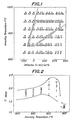
- Fig. 1 shows the range of the amount of [effective Ti] and the range of the heating temperature which can produce non-ageing thin steel sheets having a baking hardenability of at least 4 kg/mm 2 .
- the black circle represents thin steel sheets which exhibited the yield elongation in the tensile test after the steel sheets were maintained at 30°C for 30 days; while the white circle represents thin steel sheets which were free from the yield elongation in the tensile test.
- Fig. 1 represent the difference between the yield stress of a thin steel sheet after the following heat treatment and the deforming stress thereof before the heat treatment. That is, a pre- strain of 2% is given to a thin steel sheet by a tensile deformation, the prestrained sheet is subjected to a heat treatment at 170°C for 20 minutes, and a tensile test of the heat treated steel sheet is again carried out.
- the ageing property at room temperature and the baking hardenability of steel sheet were examined in the same manner as described.above.
- a steel containing Ti in an amount defined by the following formula, ⁇ [effective Ti](% by weight) - 4[C](% by weight)) ⁇ -0.015 cannot be made into a non-ageing steel at room temperature even when the steel is annealed at any temperature.
- a steel containing Ti in an amount defined by the following formula, ⁇ [effective Ti](% by weight) - 4[C](% by weight)) > 0.05 must be annealed at a temperature not lower than 950°C in order to obtain a baking hardenability of at least 4 kg/mm 2 .
- Fig. 2 illustrates the variation of r value due to the variation of annealing temperature of these steel sheets.
- substantially all the annealed steels, except a part of the steels have an r value higher than 1.8 at the annealing temperature of 830-950°C.
- the annealing temperature is 980°C
- the r value of the annealed sheets is very low and is about 1.2-1.3. Therefore, the annealing temperature must be not higher than 950°C in order to obtain a high r value.
- Fig. 3 illustrates the change of r value due to the change of [C] content at various annealing temperatures, which has been measured by using steel Nos. 2, 5, 8 and 12 among the above described steels.
- any annealing temperatures as the [C] content in steel is higher, the r value thereof decreases.
- the [C] content in steel must be lower than 0.01% by weight in order to obtain stably steels having an r value of higher than 1.8.
- a steel having a composition shown in the following Table 2 was melted by vacuum melting, the molten steel was made into a cold rolled steel sheet having a thickness of 0.6 mm through hot rolling and cold rolling, and the cold rolled steel sheet was annealed at 890°C for 2 minutes and then cooled at a rate of 30°C/sec.
- the above cooled steel sheet was subjected to a skin pass rolling at a reduction rate of 0.6%, and then subjected to a tensile test.
- the skin pass rolled sheet was further measured with respect to its r value and baking hardenability.
- the sheet was further molded into a cylindrical cup, and the cup was subjected to a drop hammer test to examine the stiffening property in the secondary working. The obtained results are shown in the following Table 3.
- No. 16 steel sheet containing about 0.12% by weight of P has a tendency that the steel sheet stiffens in the secondary working. While, it is known that steel sheet containing more than 0.10% by weight of P is poor in the spot weldability. Therefore, it is necessary that the steel of the present invention has a P content of 0.04-0.1% by weight. When a solid solution strengthening effect due to P is insufficient and a steel having a necessary strength cannot be obtained, the addition of Si or Mn to the steel is effective. However, No. 19 or No. 22 steel sheet containing 1.17% by weight of Mn or 1.5% by weight of Si, respectively, has an r value of not higher than 1.8. That is, an Si content of higher than 1.2% by weight or Mn content of higher than 1.0% by weight in a steel cannot give a high r value to the steel.
- a steel slab having a composition shown in the following Table 4 was hot rolled at a finishing temperature of 880°C to produce a hot rolled sheet having a thickness of 2.6 mm, and the hot rolled sheet was coiled at a temperature of 580°C, pickled to remove scale and then cold rolled to produce a cold rolled sheet having a thickness of 0.7 mm.
- the cold rolled sheet was annealed under a condition that the sheet was heated at 900°C for 2 minutes and then cooled at a cooling rate of 20°C/sec, and the annealed sheet was subjected to a skin pass rolling at a reduction rate of 0.6% to produce a thin steel sheet.
- the properties of the resulting thin steel sheets were examined. The obtained results are shown in the following Table 5.
- Steel sheets A, C, D, E and F produced according to the present invention have a high r value of at least 1.8 and a high baking hardenability of at least 4 kg/mm 2 , and are non-ageing at room temperature.
- the resulting thin steel sheet for drawing which has excellent press moldability and further has high dent resistance after bake coating.
- Cold rolled steel sheet having such baking hardenability and adapted for drawing can be used in various automotive parts, and particularly can decrease the thickness of steel sheet for automobile. Therefore, the steel sheet of the present invention is very contributable for the production of light weight car body, and is very valuable in industry.
Landscapes
- Chemical & Material Sciences (AREA)
- Engineering & Computer Science (AREA)
- Mechanical Engineering (AREA)
- Materials Engineering (AREA)
- Metallurgy (AREA)
- Organic Chemistry (AREA)
- Physics & Mathematics (AREA)
- Thermal Sciences (AREA)
- Crystallography & Structural Chemistry (AREA)
- Heat Treatment Of Sheet Steel (AREA)
Abstract
Applications Claiming Priority (2)
| Application Number | Priority Date | Filing Date | Title |
|---|---|---|---|
| JP55165315A JPS6046166B2 (ja) | 1980-11-26 | 1980-11-26 | 焼付硬化性を有する良加工性冷延鋼板の製造方法 |
| JP165315/80 | 1980-11-26 |
Publications (3)
| Publication Number | Publication Date |
|---|---|
| EP0067878A1 true EP0067878A1 (fr) | 1982-12-29 |
| EP0067878A4 EP0067878A4 (fr) | 1984-01-09 |
| EP0067878B1 EP0067878B1 (fr) | 1987-03-25 |
Family
ID=15809990
Family Applications (1)
| Application Number | Title | Priority Date | Filing Date |
|---|---|---|---|
| EP81903083A Expired EP0067878B1 (fr) | 1980-11-26 | 1981-11-21 | Procede de fabrication d'une plaque d'acier fine pour l'etirage avec curabilite par cuisson au four |
Country Status (4)
| Country | Link |
|---|---|
| US (1) | US4589931A (fr) |
| EP (1) | EP0067878B1 (fr) |
| JP (1) | JPS6046166B2 (fr) |
| WO (1) | WO1982001893A1 (fr) |
Cited By (1)
| Publication number | Priority date | Publication date | Assignee | Title |
|---|---|---|---|---|
| EP0171208A1 (fr) * | 1984-07-17 | 1986-02-12 | Kawasaki Steel Corporation | Tôles d'acier laminées à froid et procédé pour leur fabrication |
Families Citing this family (15)
| Publication number | Priority date | Publication date | Assignee | Title |
|---|---|---|---|---|
| JPS5967322A (ja) * | 1982-10-08 | 1984-04-17 | Kawasaki Steel Corp | 深絞り用冷延鋼板の製造方法 |
| US4504326A (en) * | 1982-10-08 | 1985-03-12 | Nippon Steel Corporation | Method for the production of cold rolled steel sheet having super deep drawability |
| JPS59177327A (ja) * | 1983-03-25 | 1984-10-08 | Sumitomo Metal Ind Ltd | プレス加工用冷延鋼板の製造法 |
| DE3672864D1 (de) * | 1985-03-06 | 1990-08-30 | Kawasaki Steel Co | Verfahren zur herstellung von gewalzten verformbaren duennen stahlblechen. |
| JPS6383230A (ja) * | 1986-09-27 | 1988-04-13 | Nkk Corp | 焼付硬化性およびプレス成形性の優れた高強度冷延鋼板の製造方法 |
| JP4177478B2 (ja) * | 1998-04-27 | 2008-11-05 | Jfeスチール株式会社 | 成形性、パネル形状性、耐デント性に優れた冷延鋼板、溶融亜鉛めっき鋼板及びそれらの製造方法 |
| JP4177477B2 (ja) * | 1998-04-27 | 2008-11-05 | Jfeスチール株式会社 | 耐常温時効性とパネル特性に優れた冷延鋼板及び溶融亜鉛めっき鋼板の製造方法 |
| US6143100A (en) * | 1998-09-29 | 2000-11-07 | National Steel Corporation | Bake-hardenable cold rolled steel sheet and method of producing same |
| JP4585138B2 (ja) * | 2001-04-17 | 2010-11-24 | 新日本製鐵株式会社 | 遅時効性と焼付硬化性に優れた薄鋼板 |
| JP5127444B2 (ja) * | 2004-03-25 | 2013-01-23 | ポスコ | 高強度焼付硬化型冷間圧延鋼板、溶融めっき鋼板及びその製造方法 |
| US7968210B2 (en) * | 2005-02-10 | 2011-06-28 | Nippon Steel Corporation | Aluminum type plated steel sheet and heat shrink band using the same |
| EP2492363B1 (fr) | 2005-09-23 | 2013-11-27 | Posco | Tôle d'acier laminée à froid durcissant au four de résistance supérieure et procédé de fabrication de la tôle d'acier laminée à froid |
| KR101105040B1 (ko) * | 2008-06-23 | 2012-01-16 | 주식회사 포스코 | 표면특성 및 내2차 가공취성이 우수한 소부경화강 및 그 제조방법 |
| KR102381829B1 (ko) | 2020-09-24 | 2022-04-01 | 주식회사 포스코 | 소부경화성 및 상온 내시효성이 우수한 냉연강판, 도금강판 및 이들의 제조방법 |
| KR102468037B1 (ko) | 2020-11-05 | 2022-11-17 | 주식회사 포스코 | 소부 경화성 및 내시효성이 우수한 냉연강판, 도금강판 및 이들의 제조방법 |
Family Cites Families (8)
| Publication number | Priority date | Publication date | Assignee | Title |
|---|---|---|---|---|
| GB1176863A (en) * | 1966-02-17 | 1970-01-07 | Yawata Iron & Steel Co | Process for the production of Cold-Rolled Steel Sheets having Excellent Press Workability |
| US3857740A (en) * | 1972-07-11 | 1974-12-31 | Nippon Steel Corp | Precipitation hardening high strength cold rolled steel sheet and method for producing same |
| JPS5231992B2 (fr) * | 1973-07-16 | 1977-08-18 | ||
| JPS5722974B2 (fr) * | 1975-01-28 | 1982-05-15 | ||
| JPS54104417A (en) * | 1978-02-06 | 1979-08-16 | Kobe Steel Ltd | Cold rolled steel sheet with superior surface properties and deep drawability |
| JPS54107420A (en) * | 1978-02-09 | 1979-08-23 | Nippon Kokan Kk <Nkk> | Manufacture of cold rolled steel plate with baking hardenability |
| JPS54107419A (en) * | 1978-02-09 | 1979-08-23 | Nippon Kokan Kk <Nkk> | Manufacture of cold rolled killed steel plate with baking hardenability |
| JPS6044376B2 (ja) * | 1978-10-21 | 1985-10-03 | 新日本製鐵株式会社 | 非時効性で、かつ深絞り加工性の優れた連続熱処理による冷延鋼板の製造方法 |
-
1980
- 1980-11-26 JP JP55165315A patent/JPS6046166B2/ja not_active Expired
-
1981
- 1981-11-21 EP EP81903083A patent/EP0067878B1/fr not_active Expired
- 1981-11-21 WO PCT/JP1981/000353 patent/WO1982001893A1/fr not_active Ceased
- 1981-11-21 US US06/709,982 patent/US4589931A/en not_active Expired - Lifetime
Cited By (2)
| Publication number | Priority date | Publication date | Assignee | Title |
|---|---|---|---|---|
| EP0171208A1 (fr) * | 1984-07-17 | 1986-02-12 | Kawasaki Steel Corporation | Tôles d'acier laminées à froid et procédé pour leur fabrication |
| US4750952A (en) * | 1984-07-17 | 1988-06-14 | Kawasaki Steel Corporation | Cold-rolled steel sheets |
Also Published As
| Publication number | Publication date |
|---|---|
| EP0067878B1 (fr) | 1987-03-25 |
| JPS5789437A (en) | 1982-06-03 |
| WO1982001893A1 (fr) | 1982-06-10 |
| US4589931A (en) | 1986-05-20 |
| EP0067878A4 (fr) | 1984-01-09 |
| JPS6046166B2 (ja) | 1985-10-15 |
Similar Documents
| Publication | Publication Date | Title |
|---|---|---|
| US7959747B2 (en) | Method of making cold rolled dual phase steel sheet | |
| US7879160B2 (en) | Cold rolled dual-phase steel sheet | |
| EP0608430B1 (fr) | Tole laminee a froid representant une trempabilite pour peinture au four et des caracteristiques de vieillissement et une aptitude au moulage autrement qu'a froid excellentes, et tole zinguee laminee a froid et procede de fabrication | |
| EP0067878B1 (fr) | Procede de fabrication d'une plaque d'acier fine pour l'etirage avec curabilite par cuisson au four | |
| EP0171208B2 (fr) | Tôles d'acier laminées à froid et procédé pour leur fabrication | |
| US4394186A (en) | Method for producing a dual-phase steel sheet having excellent formability, high artificial-aging hardenability after forming, high strength, low yield ratio, and high ductility | |
| US4908073A (en) | Method of producing a cold rolled steel sheet having a good ageing resistance and small anisotropy and adapted for deep drawing | |
| EP0203809A2 (fr) | Procédé pour la production de tôles d'acier laminées à froid présentant une bonne aptitude à l'emboutissage profond | |
| EP0064552B1 (fr) | Plaque en acier mince pour l'etirage possedant d'excellentes proprietes de durcissement au four et procede de fabrication | |
| JP3601721B2 (ja) | 焼付硬化可能なバナジウム含有鋼 | |
| US7699947B2 (en) | Ultrahigh strength hot-rolled steel and method of producing bands | |
| CN100439544C (zh) | 高强度冷轧钢板及其制造方法 | |
| JPH0578784A (ja) | 成形性の良好な高強度冷延鋼板 | |
| JP3719025B2 (ja) | 耐疲労特性に優れた深絞り用冷延薄鋼板 | |
| KR100308003B1 (ko) | 고강도합금화용융아연도금강판 | |
| JPH06145893A (ja) | 延性と耐遅れ破壊特性に優れた高強度溶融亜鉛めっき鋼板およびその製造方法 | |
| JP3740875B2 (ja) | 耐衝撃特性に優れた深絞り用冷延薄鋼板 | |
| JP3718987B2 (ja) | 耐時効性に優れた塗装焼付硬化型冷延鋼板およびその製造方法 | |
| JPH05171353A (ja) | 焼付け硬化性に優れた深絞り用薄鋼板およびその製造方法 | |
| JPH0578783A (ja) | 成形性の良好な高強度冷延鋼板 | |
| JPH05263189A (ja) | 成形性の良好な高強度冷延鋼板と溶融亜鉛メッキ高強度冷延鋼板およびそれらの製造方法 | |
| JP3111462B2 (ja) | 高強度焼付硬化性鋼板の製造方法 | |
| JP4218598B2 (ja) | めっき特性に優れる高張力合金化溶融亜鉛めっき鋼板 | |
| JP4556362B2 (ja) | 成形後強度上昇熱処理能と深絞り性に優れた高張力冷延鋼板およびその製造方法 | |
| JP2515139B2 (ja) | 超深絞り用合金化溶融亜鉛めっき鋼板の製造方法 |
Legal Events
| Date | Code | Title | Description |
|---|---|---|---|
| PUAI | Public reference made under article 153(3) epc to a published international application that has entered the european phase |
Free format text: ORIGINAL CODE: 0009012 |
|
| 17P | Request for examination filed |
Effective date: 19820805 |
|
| AK | Designated contracting states |
Designated state(s): DE FR SE |
|
| GRAA | (expected) grant |
Free format text: ORIGINAL CODE: 0009210 |
|
| AK | Designated contracting states |
Kind code of ref document: B1 Designated state(s): DE FR SE |
|
| REF | Corresponds to: |
Ref document number: 3176032 Country of ref document: DE Date of ref document: 19870430 |
|
| ET | Fr: translation filed | ||
| PLBE | No opposition filed within time limit |
Free format text: ORIGINAL CODE: 0009261 |
|
| STAA | Information on the status of an ep patent application or granted ep patent |
Free format text: STATUS: NO OPPOSITION FILED WITHIN TIME LIMIT |
|
| 26N | No opposition filed | ||
| EAL | Se: european patent in force in sweden |
Ref document number: 81903083.4 |
|
| PGFP | Annual fee paid to national office [announced via postgrant information from national office to epo] |
Ref country code: SE Payment date: 20001106 Year of fee payment: 20 |
|
| PGFP | Annual fee paid to national office [announced via postgrant information from national office to epo] |
Ref country code: FR Payment date: 20001110 Year of fee payment: 20 |
|
| PGFP | Annual fee paid to national office [announced via postgrant information from national office to epo] |
Ref country code: DE Payment date: 20001113 Year of fee payment: 20 |
|
| PG25 | Lapsed in a contracting state [announced via postgrant information from national office to epo] |
Ref country code: SE Free format text: THE PATENT HAS BEEN ANNULLED BY A DECISION OF A NATIONAL AUTHORITY Effective date: 20011129 |