EP0172094A1 - Betriebssystem für mehrere benachbarte Radargeräte - Google Patents
Betriebssystem für mehrere benachbarte Radargeräte Download PDFInfo
- Publication number
- EP0172094A1 EP0172094A1 EP85401544A EP85401544A EP0172094A1 EP 0172094 A1 EP0172094 A1 EP 0172094A1 EP 85401544 A EP85401544 A EP 85401544A EP 85401544 A EP85401544 A EP 85401544A EP 0172094 A1 EP0172094 A1 EP 0172094A1
- Authority
- EP
- European Patent Office
- Prior art keywords
- radars
- phase
- radar
- operating system
- phase shift
- Prior art date
- Legal status (The legal status is an assumption and is not a legal conclusion. Google has not performed a legal analysis and makes no representation as to the accuracy of the status listed.)
- Granted
Links
- 230000010363 phase shift Effects 0.000 claims description 49
- 238000005259 measurement Methods 0.000 claims description 29
- 230000008878 coupling Effects 0.000 claims description 3
- 238000010168 coupling process Methods 0.000 claims description 3
- 238000005859 coupling reaction Methods 0.000 claims description 3
- 230000005540 biological transmission Effects 0.000 abstract description 26
- 102100031437 Cell cycle checkpoint protein RAD1 Human genes 0.000 abstract description 2
- 102100033934 DNA repair protein RAD51 homolog 2 Human genes 0.000 abstract description 2
- 101001130384 Homo sapiens Cell cycle checkpoint protein RAD1 Proteins 0.000 abstract description 2
- 101001132307 Homo sapiens DNA repair protein RAD51 homolog 2 Proteins 0.000 abstract description 2
- 239000013256 coordination polymer Substances 0.000 description 19
- 238000012937 correction Methods 0.000 description 5
- 230000000875 corresponding effect Effects 0.000 description 5
- 241000287107 Passer Species 0.000 description 4
- 101100412102 Haemophilus influenzae (strain ATCC 51907 / DSM 11121 / KW20 / Rd) rec2 gene Proteins 0.000 description 3
- 101100356020 Haemophilus influenzae (strain ATCC 51907 / DSM 11121 / KW20 / Rd) recA gene Proteins 0.000 description 3
- 101100042680 Mus musculus Slc7a1 gene Proteins 0.000 description 3
- 238000000034 method Methods 0.000 description 3
- 230000010355 oscillation Effects 0.000 description 3
- 239000007787 solid Substances 0.000 description 3
- 238000012546 transfer Methods 0.000 description 3
- 101000986989 Naja kaouthia Acidic phospholipase A2 CM-II Proteins 0.000 description 2
- 230000008859 change Effects 0.000 description 2
- 238000005286 illumination Methods 0.000 description 2
- 210000000056 organ Anatomy 0.000 description 2
- 230000005855 radiation Effects 0.000 description 2
- 238000012360 testing method Methods 0.000 description 2
- 101100322245 Caenorhabditis elegans des-2 gene Proteins 0.000 description 1
- 241001080024 Telles Species 0.000 description 1
- 240000008042 Zea mays Species 0.000 description 1
- 230000001427 coherent effect Effects 0.000 description 1
- 238000010276 construction Methods 0.000 description 1
- 230000002596 correlated effect Effects 0.000 description 1
- 230000001419 dependent effect Effects 0.000 description 1
- 238000013461 design Methods 0.000 description 1
- 238000001514 detection method Methods 0.000 description 1
- 230000000694 effects Effects 0.000 description 1
- 238000001914 filtration Methods 0.000 description 1
- 230000006872 improvement Effects 0.000 description 1
- 230000010354 integration Effects 0.000 description 1
- 238000012986 modification Methods 0.000 description 1
- 230000004048 modification Effects 0.000 description 1
- 238000012545 processing Methods 0.000 description 1
- 230000035945 sensitivity Effects 0.000 description 1
Images

Classifications
-
- G—PHYSICS
- G01—MEASURING; TESTING
- G01S—RADIO DIRECTION-FINDING; RADIO NAVIGATION; DETERMINING DISTANCE OR VELOCITY BY USE OF RADIO WAVES; LOCATING OR PRESENCE-DETECTING BY USE OF THE REFLECTION OR RERADIATION OF RADIO WAVES; ANALOGOUS ARRANGEMENTS USING OTHER WAVES
- G01S13/00—Systems using the reflection or reradiation of radio waves, e.g. radar systems; Analogous systems using reflection or reradiation of waves whose nature or wavelength is irrelevant or unspecified
- G01S13/87—Combinations of radar systems, e.g. primary radar and secondary radar
Definitions
- This patent application relates to a particular operating system of very long range radar transceivers.
- the invention can be extended to other technical sectors for which it is sought to optimize the operation of multiple transceivers by obtaining certain phase relationships both between the transmission signals and those of reception.
- the invention therefore relates to an operating system of several neighboring radars, characterized in that it comprises a set of n radars transmitting, at the same frequency with any phases, parallel beams combined over a long distance, said radars being arranged so that inside the area common to the beams, there are directions in which the emitted fields are substantially in phase.
- phase of the emission signal, of the reception signals and of a test signal; this, in a reference plane P i defined for each radar i; this reference plane is preferably placed in the vicinity of the antenna side duplexer, in a similar manner for each radar.
- the phase reference can be different for each speed camera, but it is imperatively the same frequency for all radars, this frequency being the common emission frequency; the deviations from one reference to another can therefore only be a constant phase shift (which should be taken into account in the calculation of the phase correction ⁇ as will be seen later).
- the reference is in fact a fictitious sinusoid S i at the transmission frequency f e which would result from the beat between a local oscillation in microwave fH and a local oscillation in intermediate frequency f I ;
- this sinusoid S i is fictitious because according to the methods well known to those skilled in the art, a phase measurement is preferably made at the output of an amplifier at intermediate frequency after a frequency change using the aforementioned local oscillation at the frequency f H.
- K ij which depends in particular on the completion of the frequency change and of the amplifier at intermediate frequency.
- the influence of this constant disappears when measuring phase differences, at the output of the devices which are symmetrical, the phase difference measured at intermediate frequency corresponds exactly to the phase difference of the signals themselves.
- Two neighboring shiny fringes have asymptotic directions defined by half-angle cones at the vertex ⁇ 1 and ⁇ 2 such that: is
- a 0.0 or 0.1 phase combination may correspond to a dark fringe but in this case the other combination corresponds to a bright fringe.
- the combinations 0.0 and 0.1 both correspond to intermediate values for the intensity of the fringes.
- phase relationships between the radar transmitters in order to shift the system of interference fringes between the radars.
- the purpose of this is to make the shiny fringes scan in steps the directions of the space located inside the beam common to the radars.
- This phase modification is made either from pulse to pulse or from burst to burst when the radars perform a signal processing which uses coherence techniques (coherent integration, Doppler filtering, etc.).
- the simplest case is that where there are only 2 radars; we can then modify the phase relationship between the 2 transmitters only once, going from ⁇ to ⁇ + ⁇ ; this allows the network of bright fringes and the network of dark fringes to be permuted; in this way, a coarse scan of the directions of space located inside the beam common to the two radars is created. If we want to improve the smoothness of the scan, we will go from ⁇ to then to But this will require 3 successive transmissions (or 3 bursts).
- the first column on the left corresponds to radar n ° 1; the second column corresponds to radar 2; the third column on radar 3.
- the number 0 placed in the 2nd column indicates that the phase relationship between the first 2 radars is kept constant, its (any) value is called ⁇ 12 ; the number 1 placed in the 2nd column indicates that the previous value goes from ⁇ 12 to ⁇ 12 + ⁇ .
- the third column indicates the phase difference between radar no. 3 and radar 1; the number 0 indicates that the phase difference between the 2 radars is kept constant at its initial value (any) ⁇ 13 ; the number 1 indicates that the phase shift goes from the value ⁇ 13 to ⁇ 13 + ⁇ .
- phase variations of ⁇ radians from one emission to another for certain radars, we carry out, for example, a sequence of 2 p-1 transmissions (or bursts), the phase variations being shown diagrammatically by the following 2 p- 1 binary numbers:
- the presence of a 0 indicates that the phase of the i-th radar is kept constant (equal to ⁇ l, any i ), the presence of a 1 indicates that ⁇ Li is replaced by the presence of a 2 indicates that ⁇ l, i is replaced by
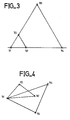
- three radars R1, R2, R3 are provided which, instead of being aligned, are placed at the vertices of a triangle.
- this triangle can be equilateral.
- the search and tracking volume is then preferably centered on the normal to the plane of the triangle which passes through the orthocenter of the triangle.
- the interference system between R 1 and R 2 is a hyperbolic network of revolution around the line R 1 R 2
- the interference system between R 1 and R 3 is a hyperboloid network of revolution around the line R 1 R 3 .
- the arrangement in the preceding triangle is combined with aligned arrangements.
- five radars R1 to R5 are arranged at the vertices of two equilateral triangles having in common an angle at the vertex, the angle RI for example.
- the radars Rl, R3, R5 are therefore aligned as well as the radars Rl, R2 and R4.
- the reception sets are supposed to have two by two equal transmission times and equal phase shifts between their inputs and their corresponding outputs as defined for the comparison of radars two by two.
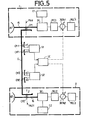
- each radar also has, in the reception chain, a phase shifter (DEPH 1, DEPH 2) receiving the preamplified signal from the amplifier (REC1, REC2) and transmitting it to the amplifier (REC'l , REC'2) after introduction of a controllable phase shift.
- a phase shifter DEPH 1, DEPH 2
- the two radars are coupled by two directional couplers (CP 1, CP 2) to a single G waveguide.
- a first phase shift measurement system Sl with two inputs el and e'1 coupled to the waveguide G by two directional couplers CM1 and CM'l suitably oriented.
- a second phase shift measurement system S2 has two inputs e2 and e'2 coupled, by directional couplers (CM2 and CM'2) suitably oriented, to the waveguide G.
- CM2 and CM'2 directional couplers
- the electrical length of the fly connecting the directional couplers CP1 and CM1 is equal to that of the fly connecting the directional couplers CP2 and CM2.
- the CMI-CM'1 link is identical to the CM2-CM'2 link.
- the electrical length of the channel connecting the directional coupler CP1 to the output of the receiver REC'1 is equal to that of the channel connecting the coupler CP2 to the output of the receiver REC'2 and this when the two phase shifters DEPH 1 and DEPH 2 are in the zero phase shift position.
- phase measurement systems S1, S2 make it possible to measure the phase differences of the signals on transmission from the two radars 1 and 2.
- the results of these measurements are transmitted to a difference and control circuit UC.
- These circuits make it possible to obtain the value of the phase difference ⁇ 2- ⁇ 1 of the signals on transmission. More precisely, they make it possible to obtain the value 2 ( ⁇ 2 - ⁇ 1 ).
- the circuits UC control the phase shifters DEPH 1 and DEPH 2. A differential phase shift is thus introduced as will be described below.
- the emission signal from each of the radars is sent to the other via a single guide G where the two emission signals propagate in opposite directions.
- These transmission signals are taken from radars 1 and 2 by the respective directional couplers CP 1 and CP 2 placed on the common channel for the transmission and reception of each radar.
- CP 1 and CP 2 a reference plane PR 11 and PR 21 respectively, these two reference planes being situated similarly inside the couplers. These two plans define the entrance to the reception channels of each speed camera.
- the system SI measures the phase shift Ml between the signal of the local emission of the radar 1 and the signal of the emission of the radar 2 received via the guide G.
- the measurement system S2 measures the phase shift M2 between the signal from the local radar 2 emission and the signal from the radar 1 emission received via the guide G.
- the two measurement systems S1 and S2 take the signals subjected to the measurements via the respective couplers CM 1, CM'1 and CM 2, CM'2.
- the coupler CM 1 supplies the local signal from radar 1 to the input el of the measurement system Sl.
- the coupler CM'1 supplies the signal from radar 2 to input e'1 of the measurement system Sl transmitted by the guide G
- the coupler CM2 supplies to the input e2 of the system S2, the local signal of emission of the radar 2 and the coupler CM'2 supplies to the input e'2, the signal d of radar 1 transmitted by guide G.
- the two sets of couplers CP 1, CM 1, CM'l on the one hand and CP 2, CM 2 and CM'2 on the other hand are identical as well as their internal connections. All directional couplers are fitted with a suitable load in the fourth channel in accordance with good practice.
- ⁇ 1 and ⁇ 2 represent, to the same constant constant, the emission phases respectively in the reference planes PR 1 and PR 2.
- ⁇ representing the phase shift due to the waveguide G.
- the radar whose emission is in phase advance will receive a signal in phase delay. To phase the 2 signals received by radars 1 and 2, it is therefore necessary to give a phase advance to the receiver corresponding to the transmission in phase advance.
- FIG. 5 represents the phase shifters DEPH 1 and DEPH 2 inserted between two receivers REC 1, REC '1 for one of the phase shifters and REC 2, REC' 2 for the other phase shifter.
- these pairs of receivers REC 1 - REC '1 and REC 2 - REC' 2 each form a single organ, a phase shifter (DEPH 1, DEPH 2) being placed inside each organ.
- phase shifters make it possible to compensate for the transmission phase shift, measured as described above, by a phase shift at reception.
- a difference calculation and control circuit UC makes it possible as a function of the measurement results M1 and M2 carried out by the measurement systems 51 and S2 to effect the difference M1 and M2 and to control the phase shifters DEPH 1 and DEPH 2 accordingly.
- the phase shift measurement system according to the invention may include a number n of radars.
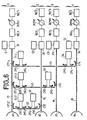
- FIG. 6 represents a system with four radars.
- the measurement of the phase shifts on transmission is made by separate comparisons which all take radar 1 as a reference and use guides G2, G3, G4 respectively to propagate the signals to be compared in both directions.
- the coupling of G2, G3, G4 is made respectively to radar 1 by the couplers CP 1.2, CP 1.3 and CP 1.4.
- the respective couplings to radars 2, 3 and 4 are made by the couplers CP 2, CP 3 and CP 4.
- the homologous paths of a pair of radars are provided with equal lengths.
- each waveguide G2, G3, G4 are coupled two phase-shift measurement systems similar to the systems S1 and S2 of FIG. 5.
- phase shift measurement system S 1.3 by couplers CM 1.3 and CM '1.3 and, on the other hand, a phase shift measurement system S3 by CM 3 and CM '3 couplers.
- the two phase-shift measurement systems associated with the same waveguide supply their measurement results to a difference and control circuit not shown in FIG. 6 and make it possible to control the phase shifters of the radars associated with this waveguide.
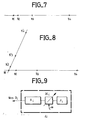
- Figure 9 shows how to introduce the phase shifts ⁇ or and 4 ⁇ 3 in the transmitters E2, E3, ... etc with respect to the transmitter El.
- the transmitters are generally terminated by a power amplifier tube A; so that it is preferable to introduce the above phase shifts at low level at the input of the power amplifier by a controlled phase shift DE. at the output of the pilot Pi.
- the frequency reference of the pilots Pl, P2, Pi ... can be unique therefore common; but it is also possible that each Pi pilot has its own frequency reference (for example example, an atomic clock) such that its great stability avoids any frequency sliding during the duration of the transmissions or bursts which must be made at the same frequency i.e. during the 2 P-1 or 3 P-1 successive transmissions or gusts which ensure the scanning in steps of the space inside the beam common to the radars.
Landscapes
- Engineering & Computer Science (AREA)
- Radar, Positioning & Navigation (AREA)
- Remote Sensing (AREA)
- Computer Networks & Wireless Communication (AREA)
- Physics & Mathematics (AREA)
- General Physics & Mathematics (AREA)
- Radar Systems Or Details Thereof (AREA)
Applications Claiming Priority (2)
| Application Number | Priority Date | Filing Date | Title |
|---|---|---|---|
| FR8412134 | 1984-07-31 | ||
| FR8412134A FR2568686B1 (fr) | 1984-07-31 | 1984-07-31 | Systeme d'exploitation de plusieurs radars voisins |
Publications (2)
| Publication Number | Publication Date |
|---|---|
| EP0172094A1 true EP0172094A1 (de) | 1986-02-19 |
| EP0172094B1 EP0172094B1 (de) | 1989-07-12 |
Family
ID=9306669
Family Applications (1)
| Application Number | Title | Priority Date | Filing Date |
|---|---|---|---|
| EP85401544A Expired EP0172094B1 (de) | 1984-07-31 | 1985-07-26 | Betriebssystem für mehrere benachbarte Radargeräte |
Country Status (3)
| Country | Link |
|---|---|
| EP (1) | EP0172094B1 (de) |
| DE (1) | DE3571507D1 (de) |
| FR (1) | FR2568686B1 (de) |
Cited By (2)
| Publication number | Priority date | Publication date | Assignee | Title |
|---|---|---|---|---|
| WO2000040999A1 (de) * | 1999-01-07 | 2000-07-13 | Siemens Aktiengesellschaft | Verfahren zur erfassung von zielobjekten und zur bestimmung deren richtung für ein radargerät in kraftfahrzeugen |
| GB2357918A (en) * | 1999-09-30 | 2001-07-04 | Alenia Marconi Systems Ltd | HF Radar Tx/Rx assembly |
Citations (1)
| Publication number | Priority date | Publication date | Assignee | Title |
|---|---|---|---|---|
| US3454944A (en) * | 1968-03-13 | 1969-07-08 | United Aircraft Corp | Wide-angle interferometer radar |
-
1984
- 1984-07-31 FR FR8412134A patent/FR2568686B1/fr not_active Expired
-
1985
- 1985-07-26 EP EP85401544A patent/EP0172094B1/de not_active Expired
- 1985-07-26 DE DE8585401544T patent/DE3571507D1/de not_active Expired
Patent Citations (1)
| Publication number | Priority date | Publication date | Assignee | Title |
|---|---|---|---|---|
| US3454944A (en) * | 1968-03-13 | 1969-07-08 | United Aircraft Corp | Wide-angle interferometer radar |
Non-Patent Citations (3)
| Title |
|---|
| IEEE TRANS. ON AEROSPACE AND ELECTRONICS SYSTEMS, vol. AES-15, no. 4, juillet 1979, pages 555-563, New York, US; A. FARINA et al.: "Multiradar tracking system using radial velocity measurements" * |
| IEEE TRANSACTIONS ON ANTENNAS AND PROPAGATION, vol. AP-24, no. 5, septembre 1976, pages 707-720, New York, US; L.J. GRIFFITHS: "Time-domain adaptive beamforming of HF backscatter radar signals" * |
| INTERNATIONAL CONFERENCE RADAR-82, 18-20 octobre 1982, pages 169-173, The Institution of Electrical Engineers, Londres, GB; W.G. BATH: "Association of multisite radar data in the presence of large navigation and sensor alignment errors" * |
Cited By (4)
| Publication number | Priority date | Publication date | Assignee | Title |
|---|---|---|---|---|
| WO2000040999A1 (de) * | 1999-01-07 | 2000-07-13 | Siemens Aktiengesellschaft | Verfahren zur erfassung von zielobjekten und zur bestimmung deren richtung für ein radargerät in kraftfahrzeugen |
| US6762711B1 (en) | 1999-01-07 | 2004-07-13 | Siemens Aktiengesellschaft | Method for detecting target objects and for determining their direction and the like for a radar device |
| GB2357918A (en) * | 1999-09-30 | 2001-07-04 | Alenia Marconi Systems Ltd | HF Radar Tx/Rx assembly |
| US6618002B1 (en) | 1999-09-30 | 2003-09-09 | Alenia Marconi Systems Limited | HF radar |
Also Published As
| Publication number | Publication date |
|---|---|
| FR2568686B1 (fr) | 1986-12-05 |
| DE3571507D1 (en) | 1989-08-17 |
| EP0172094B1 (de) | 1989-07-12 |
| FR2568686A1 (fr) | 1986-02-07 |
Similar Documents
| Publication | Publication Date | Title |
|---|---|---|
| EP2312335B1 (de) | Radar mit großer Winkelpräzision, insbesondere für die Funktion der Erkennung und Vermeidung von Hindernissen | |
| EP3819670A1 (de) | Verarbeitungsverfahren für kohärenten mimo-radar, der ddma-wellenformen verarbeitet | |
| EP0143497B1 (de) | Mit stetigen frequenzmodulierten Wellen arbeitendes Monopulsradargerät mit Achsenstabilisierung | |
| EP0097073A1 (de) | Verfahren und Vorrichtung zur Verringerung des Störsignalpegels, empfangen über die Nebenzipfel einer Radarantenne | |
| FR2859538A1 (fr) | Systeme de radar a ondes de surface | |
| EP0600799A1 (de) | Aktive Antenne mit variabler Polarisations-Synthese | |
| EP0415818A1 (de) | Steuerung der Ausrichtung für Antennensystem mit elektronisch gesteuerter Auslenkung und Strahlformung durch Berechnung | |
| FR2988858A1 (fr) | Dispositif de detection electromagnetique actif et passif a faible probabilite d'interception | |
| FR2498336A1 (fr) | Dispositif de transmission d'ondes electromagnetiques en polarisation lineaire | |
| FR2648570A1 (fr) | Dispositif et procede pour mesurer l'azimut et le site d'un objet | |
| FR2948774A1 (fr) | Radar de detection de cibles aeriennes equipant un aeronef notamment pour l'evitement d'obstacles en vol | |
| EP0013221A1 (de) | Abtastantenne für Radar, insbesondere für Verfolgungsradar | |
| EP0172094B1 (de) | Betriebssystem für mehrere benachbarte Radargeräte | |
| WO2010136461A1 (fr) | Télémètre absolu hyperfréquence de haute précision à dispositif de réflexion multi-etat | |
| FR2978560A1 (fr) | Dispositif de detection d'une cible resistant au fouillis, procede de detection | |
| EP1181573A1 (de) | Verfahren und vorrichtung zur elektromagnetischen lenkung , insbesondere zur zielvervolgung | |
| FR3089726A1 (fr) | Procédé de confusion de la signature électronique émise par un radar, et dispositif d’émission/réception adapté pour sa mise en œuvre | |
| EP2822198B1 (de) | Verfahren und Vorrichtung zur Messung der Gruppenlaufzeit einer Antenne | |
| EP0613019B1 (de) | Abweichungsantenne für Monopulsradar | |
| EP1233282B1 (de) | Vorrichtung mit verteilten Sende- und Empfangsantennen, insbesondere für Radar mit synthetischer Emission und Strahlbildung | |
| EP0624804A1 (de) | Zielverfolgungssystem zur Schätzung des Ausrichtungsfehlers einer HF-Antenne | |
| BE1032131B1 (fr) | Un système radar de surveillance des déformations à ouverture réelle basé sur PMCW-MIMO | |
| EP1522871B1 (de) | Radar mit synthetischen Peilkanälen | |
| EP4560943A1 (de) | Verbesserte gruppenantenne zur sende- und/oder empfangskalibrierung; sende- und/oder empfangskalibrierungsanordnungen | |
| FR3134458A1 (fr) | Système de positionnement à segments de câble rayonnant |
Legal Events
| Date | Code | Title | Description |
|---|---|---|---|
| PUAI | Public reference made under article 153(3) epc to a published international application that has entered the european phase |
Free format text: ORIGINAL CODE: 0009012 |
|
| AK | Designated contracting states |
Designated state(s): DE GB IT NL |
|
| 17P | Request for examination filed |
Effective date: 19860630 |
|
| 17Q | First examination report despatched |
Effective date: 19880210 |
|
| RAP3 | Party data changed (applicant data changed or rights of an application transferred) |
Owner name: THOMSON-CSF |
|
| GRAA | (expected) grant |
Free format text: ORIGINAL CODE: 0009210 |
|
| AK | Designated contracting states |
Kind code of ref document: B1 Designated state(s): DE GB IT NL |
|
| ITTA | It: last paid annual fee | ||
| PGFP | Annual fee paid to national office [announced via postgrant information from national office to epo] |
Ref country code: NL Payment date: 19890731 Year of fee payment: 5 Ref country code: GB Payment date: 19890731 Year of fee payment: 5 |
|
| ITF | It: translation for a ep patent filed | ||
| REF | Corresponds to: |
Ref document number: 3571507 Country of ref document: DE Date of ref document: 19890817 |
|
| PGFP | Annual fee paid to national office [announced via postgrant information from national office to epo] |
Ref country code: DE Payment date: 19890823 Year of fee payment: 5 |
|
| GBT | Gb: translation of ep patent filed (gb section 77(6)(a)/1977) | ||
| PLBE | No opposition filed within time limit |
Free format text: ORIGINAL CODE: 0009261 |
|
| STAA | Information on the status of an ep patent application or granted ep patent |
Free format text: STATUS: NO OPPOSITION FILED WITHIN TIME LIMIT |
|
| 26N | No opposition filed | ||
| PG25 | Lapsed in a contracting state [announced via postgrant information from national office to epo] |
Ref country code: GB Effective date: 19900726 |
|
| PG25 | Lapsed in a contracting state [announced via postgrant information from national office to epo] |
Ref country code: NL Effective date: 19910201 |
|
| NLV4 | Nl: lapsed or anulled due to non-payment of the annual fee | ||
| GBPC | Gb: european patent ceased through non-payment of renewal fee | ||
| PG25 | Lapsed in a contracting state [announced via postgrant information from national office to epo] |
Ref country code: DE Effective date: 19910403 |