EP0173396A2 - Insert à chaussures variable ajustable - Google Patents
Insert à chaussures variable ajustable Download PDFInfo
- Publication number
- EP0173396A2 EP0173396A2 EP85201320A EP85201320A EP0173396A2 EP 0173396 A2 EP0173396 A2 EP 0173396A2 EP 85201320 A EP85201320 A EP 85201320A EP 85201320 A EP85201320 A EP 85201320A EP 0173396 A2 EP0173396 A2 EP 0173396A2
- Authority
- EP
- European Patent Office
- Prior art keywords
- foot
- cap
- area
- zone
- modifying
- Prior art date
- Legal status (The legal status is an assumption and is not a legal conclusion. Google has not performed a legal analysis and makes no representation as to the accuracy of the status listed.)
- Withdrawn
Links
Images


Classifications
-
- A—HUMAN NECESSITIES
- A43—FOOTWEAR
- A43B—CHARACTERISTIC FEATURES OF FOOTWEAR; PARTS OF FOOTWEAR
- A43B7/00—Footwear with health or hygienic arrangements
- A43B7/14—Footwear with health or hygienic arrangements with foot-supporting parts
- A43B7/1405—Footwear with health or hygienic arrangements with foot-supporting parts with pads or holes on one or more locations, or having an anatomical or curved form
- A43B7/1415—Footwear with health or hygienic arrangements with foot-supporting parts with pads or holes on one or more locations, or having an anatomical or curved form characterised by the location under the foot
- A43B7/142—Footwear with health or hygienic arrangements with foot-supporting parts with pads or holes on one or more locations, or having an anatomical or curved form characterised by the location under the foot situated under the medial arch, i.e. under the navicular or cuneiform bones
-
- A—HUMAN NECESSITIES
- A43—FOOTWEAR
- A43B—CHARACTERISTIC FEATURES OF FOOTWEAR; PARTS OF FOOTWEAR
- A43B7/00—Footwear with health or hygienic arrangements
- A43B7/14—Footwear with health or hygienic arrangements with foot-supporting parts
- A43B7/1405—Footwear with health or hygienic arrangements with foot-supporting parts with pads or holes on one or more locations, or having an anatomical or curved form
- A43B7/1415—Footwear with health or hygienic arrangements with foot-supporting parts with pads or holes on one or more locations, or having an anatomical or curved form characterised by the location under the foot
- A43B7/143—Footwear with health or hygienic arrangements with foot-supporting parts with pads or holes on one or more locations, or having an anatomical or curved form characterised by the location under the foot situated under the lateral arch, i.e. the cuboid bone
-
- A—HUMAN NECESSITIES
- A43—FOOTWEAR
- A43B—CHARACTERISTIC FEATURES OF FOOTWEAR; PARTS OF FOOTWEAR
- A43B7/00—Footwear with health or hygienic arrangements
- A43B7/14—Footwear with health or hygienic arrangements with foot-supporting parts
- A43B7/1405—Footwear with health or hygienic arrangements with foot-supporting parts with pads or holes on one or more locations, or having an anatomical or curved form
- A43B7/1415—Footwear with health or hygienic arrangements with foot-supporting parts with pads or holes on one or more locations, or having an anatomical or curved form characterised by the location under the foot
- A43B7/144—Footwear with health or hygienic arrangements with foot-supporting parts with pads or holes on one or more locations, or having an anatomical or curved form characterised by the location under the foot situated under the heel, i.e. the calcaneus bone
-
- A—HUMAN NECESSITIES
- A43—FOOTWEAR
- A43B—CHARACTERISTIC FEATURES OF FOOTWEAR; PARTS OF FOOTWEAR
- A43B7/00—Footwear with health or hygienic arrangements
- A43B7/14—Footwear with health or hygienic arrangements with foot-supporting parts
- A43B7/1405—Footwear with health or hygienic arrangements with foot-supporting parts with pads or holes on one or more locations, or having an anatomical or curved form
- A43B7/1415—Footwear with health or hygienic arrangements with foot-supporting parts with pads or holes on one or more locations, or having an anatomical or curved form characterised by the location under the foot
- A43B7/1445—Footwear with health or hygienic arrangements with foot-supporting parts with pads or holes on one or more locations, or having an anatomical or curved form characterised by the location under the foot situated under the midfoot, i.e. the second, third or fourth metatarsal
-
- A—HUMAN NECESSITIES
- A43—FOOTWEAR
- A43B—CHARACTERISTIC FEATURES OF FOOTWEAR; PARTS OF FOOTWEAR
- A43B7/00—Footwear with health or hygienic arrangements
- A43B7/14—Footwear with health or hygienic arrangements with foot-supporting parts
- A43B7/22—Footwear with health or hygienic arrangements with foot-supporting parts with fixed flat-foot insertions, metatarsal supports, ankle flaps or the like
Definitions
- This invention relates generally to orthotic appliances for feet and constitutes further development since my pending applications Serial No. 324,820, filed November 25, 1981 and Serial No. 431,291, filed September 30, 1982 both of which are incorporated in their entirety herewith by reference.
- the gait When one is moving substantially in a linear direction, the gait consists of three distinct phases.
- the heel strike phase occurs during which the foot is essentially a "mobile adaptor" ready to conform to the topographical contours encountered.
- Some of the impact forces are dissipated through the ankle and leg bones to the upper torso, while other impact forces are translated along the length of the foot. The proper dissipation and translation of these forces during heel strike phase produce a natural shock absorption mechanism.
- the transition or mid-gait phase transforms the mobile adaptor into a "rigid lever" whereby the mid-tarsal joint becomes locked preparing the foot for translation of the accumulated forces in a stable manner throughout the foot during the remainder of said cycle and the impact forces are dissipated through the ankle and leg bones to the upper torso.
- the "toe roll” phase finishes the gait cycle and constitutes the final propulsive and translatory phase of gait. After the toe leaves the ground, the swing phase of the next step begins in which the other foot is involved in the heel strike phase.
- the critical phase is the mid-gait or transition phase where the foot is transformed from a "mobile adaptor" to a "rigid lever".
- the optimum configuration for the ankle and tarsal joint at this point is to have the sub-tailor joint in a neutral position as the mid-tarsal joint becomes locked and the foot becomes a "rigid lever". This allows the impact load to be properly dissipated and translated. While podiatrists have long been aware of the need to maintain the foot's proper orientation relative to the leg to provide a "rigid lever" and accordingly have prescribed orthoses for that purpose, the general populace rarely avails themselves of these services until after a certain amount of discomfort and/or damage has been done.
- the patent to Riggs teaches the use of an insole type appliance having a compound contour like the Ritchey invention configured in such a manner as to provide foot relief based on Rigg's perception of a universal foot disorder.
- the Zente patent teaches the use of a liquid filled orthopedic apparatus comprised of a plurality of discrete internal liquid filled ampules which are strategically placed between upper an lower laminae and sealed in place to provide separate support for various parts of the foot.
- an instrumentality which includes an initial blank having an upper surface that generally follows the contour of the planter surface of a person's foot, and includes a bottom surface having a zone of disparate resiliency relative to area adjacent the zone so that during the gait cycle, the insert is deformed in a controlled manner so that the appliance by its controlled deformation encourages the foot associated with the appliance to be oriented in such a manner that the gait phase from a mobile adaptor to a rigid lever occurs such that the foot is disposed in a neutral position.
- the tarsal joint and its relationship to the sub-tailor joint is relatively neutral as the mid-tarsal joint becomes locked so that the transmission of forces along the bone structure from the foot, through the ankle and up the leg occur in a most efficient manner and unwanted torsions and stress have been avoided, which can cause strain along the ankle, knee, hip, small of the back, etc.
- the insert according to the instant invention provides a zone of disparate resiliency which accommodates a person's foot during the normal gait cycle wherein the foot experiences natural elongation along the longitudinal extent thereof, the zone of disparate resiliency deforming in a predetermined fashion so as to accommodate the distortion of the foot while concomitantly urging the foot in the preferred neutral position during the critical phase from heel strike to mid-gait.
- an appropriate recess is provided on a bottom surface of the insert which is supplemented with a pad whose durometric value and therefore resiliency can be altered to accommodate different conditions.
- a further instrumentality is provided which is of general horseshoe configuration and formed from a cork resin composite which when heated expands substantially beyond its original dimension and is capable when heated, to deform in a controlled manner with suitable pressure applied thereon.
- a further instrumentality is provided which provides a cap on the bottom of the insert adapted to retain the resilient pad, horseshoe cork resin and full length blank and bind them all together, the cap formed from a relatively rigid material, the total appliance becoming an integral piece when the cork resin is allowed to cure.
- the cap being formed from a rigid material, allows further controlled deformation by structuring into the cap preferred areas of yielding deformation, so as to further encourage phenomena such as heel cupping and insert deformation to allow accommodation of the foot during elongation and during the transition from the heel strike to the mid-gait to the toe roll phases.
- a further object of this invention contemplates providing a device as characterized above which encourages a proper orientation of the foot and its associated bones relative to the leg in such a manner that the weight distribution is substantially uniform along the longitudinal axis of the foot based upon the individual foot component's weight bearing ability.
- a further object of this invention is to provide a device which assists in orienting the sub-tailor joint so as to be more aligned towards a neutral position and the mid-tarsal joint in a more functional position, that is locked.
- reference numeral 10 is directed to the orthotic appliance according to the present invention.
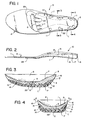
- the insert 10 is defined by a four component system that includes a full length blank B defining a topmost portion, and a cap C defining a lowermost portion, the cap C extends from the metatarsal head area 8 rearwardly to a heel area 6, a resilient pad 29 and a horseshoe-shaped cork resin insert 12.
- the full length upper blank B has a top surface 1 formed from an abrasion resistant padded material such as synthetic fabric, nylon, dacron, felt, cloth or the like and a resilient underlying substrate 2 formed from rubber or its equivalent which padded material and rubber substrate are interconnected by means of adhesion or fusion.
- the lowermost portion of the full length blank defines a bottom layer 3 formed from a foamed material such as Freelen-, Plastizote*, or any other opened or closed cell foam characterized as being relatively resilient, having sufficient memory to return to its original state when unstressed, and capable of moderate shock absorption properties and loads.
- the cap C is formed from a material which is comparatively rigid when contrasted with the upper full length blank B, and may be formed from polyethylene, polypropylene (with or without diluents such as talc), epoxy and fiberglass, graphite fibers combined with a resin, polyurethene fibers bound in a resin, or kelvar fibers with resin; all of the above preferred constituents of the cap being characterized as having a predetermined and programmable resistance to deformation and torsion in such a manner that when distorted, fibers associated therewith (or plastics as poured) react to deformation in a desired manner to be defined hereinafter.
- an intermediate member 12 disposed between the cap and the blank.
- This member 12 is preferably formed from a cork resin mixture characterized in its ability to expand two to three times its original volume when heated and as shown in the drawings is of substantially U-shaped configuration partially defining and further enhancing the elongate longitudinal recess 9 disposed on and provided on the bottom face of the blank B.
- the cork resin layer 12 has a contour complemental to a portion of the bottom surface of the full length blank B so that there is natural registry therebetween.
- a bottom portion of the blank is provided with a peripheral marginal wall 14 that extends from the heel area forward and tapers to a relatively smooth transition adjacent the metatarsal head area of the foot, and has a complex contour adapted to receive the similarly formed cork resin intermediate layer thereat.
- the cork layer resin 12 has a central void, so as to define its U-shaped configuration, and also to allow the disposition therein of a resilient pad 29 having a rear portion complemental to the configuration of the U-shaped cork resin intermediate layer so that there is minimal overlap.
- the resilient pad 29 has a somewhat bulbous heel area which narrows along a medial extent thereof and flares forwardly and outwardly to the metatarsal head area, the resilient pad 29 terminating adjacent and just behind the toes of the user so that the metatarsal head of the person wearing the device is provided with an underlying pad.
- a complementally formed recess 9 is provided on a bottom face of the blank B so that there is ready and facile registry between the resilient pad 29 and the recess 9.
- the marginal wall 14 of the blank is sufficiently sculpted as is the horseshoe-shaped cork resin intermediate piece 12 that the cap C can have its upwardly extending edge 17 of peripheral wall 4 engage the peripheral shelf 15 disposed around the blank B.
- an upper rim 16 of the blank B is provided above the shelf 15, and is suitably contoured such that when all elements are assembled, a smooth transition exists between the lateral wall of the cap and the blank, since the shelf 15 is dimensioned to accommodate not only the thickness defined by edge 17 of the cap wall 4, but also the cork.
- the top surface of the cork resin layer 12 has a contour complemental to the registering bottom surface of the full length blank so that there is natural nesting therebetween.
- a characteristic of the cork resin composition is that upon heating and expansion, it will deform under pressure (as by one's foot in a controlled wearing situation) to fill any associated void, and therefore the cap C formed of the material set forth as above will define the finished bottom configuration of the cork resin layer 12 with the cork resin adapted to be received within the associated apertures of the cap as will now be defined.
- a plurality of apertures 11 are provided on the medial and lateral segments of the cap, and as shown in Figure 5 are disposed on the horizontal planar surface 5 of the cap.
- the apertures 11 along with smaller apertures 32 are adapted to be filled with the cork resin so that the cap is inextricably bound to the cork.
- the cork is of such a nature that it will react and bind to the Plastizote-, or Freelen- bottom surface of the blank so that the device is provided with a unitary structure. Since some of the cork will also expand sufficiently to engage a portion of the resilient pad 29, the pad 29 will also become an intrinsic part of the composite thus formed.
- the apertures 32 or 11 can initially be provided with resilient plugs of sorbathane or the like prior to heating of the cork resin layer, and the associated plugs P will thus be bonded to the orthotic insert.
- the full length blank B is provided along the medial, lateral and heel aspect with a side wall 14 adapted to be dimensioned in accordance with the width and heighth of the corresponding walls 4 of the cap so that when upon assembly, a flush peripheral wall is provided.
- the side wall 14 defines (along with the shelf 15 and an upper rim 16 offset from the wall 14) a periphery so that the thickness of the cap 17 is substantially the same as the shelf dimension 15 for nesting engagement. Since some migration of the cork resin will occur between the inner face of wall 4 of the cap and the side wall 14 of the blank B, a bonding has been effected there as well.
- the cork resin layer is provided with peripheral edges that have a feathered taper, so that cork migration into adjacent areas of the blank and the cap can readily occur.
- an orthotic appliance which has an improved characteristic of resiliency and resistance to uncontrolled deformation, and by virtue of its lamination between not only the blank but also the cap, strength derived from the cap will allow distortion of the insert during the normal gait cycle without delamination or deterioration of the components. Since the cork resin lends itself to ready deformation when heated, multiple orthopedic adjustments are possible by use of the cork resin layer.
- the cap C also includes a metatarsal head area 8 provided with a plurality of longitudinally extending slots 33, each slot terminating in an aperture 34.
- the resilient pad 29 extends beyond the length of the metatarsal head area and in fact extends closer to the toes, forward the cap.
- the leading edge of the cap is appropriately cushioned and supplemented with additional resilience by means of the resilient pad 29. In this manner, relieving pressure on certain metatarsal head areas can be evidenced for the benefit of people experiencing metatarsal discomfort, commonly geriatric patients.
- One preferred technique would be to remove a portion of the cap that extends between adjacent slots 33 so that area of the foot is at a different horizontal level when receiving pressure from the support the cap provides on the foot, providing a relieved area. Additionally, it is contemplated that providing the apertures 34 with resilient fingers F or the like for elevating certain areas to the exclusion of others can provide an additional benefit. Thus, a topographical disparity can be provided along the metatarsal head area for the associated benefits and the concomitant pressure release.
- the cap has a main surface 5 which includes the apertures 11, which peripherally run along a medial, lateral and calcaneal aspect of the cap surface.
- a plurality of smaller dimensioned apertures 32 are similarly provided adapted to receive either resilient fingers, cork resin, or the equivalent for similar associated purposes and benefits.
- the marginal wall 4 includes a curved top edge 17 that includes a rear wall 6 of substantially uniform heighth, but as the wall extends forwardly, each side is provided with one downwardly extending undulation each respectively offset from the other in a plane transverse to the longitudinal axis, and thereafter an upwardly curved segment ultimately tapering downwardly to the flat area of the cap proximate to the metatarsal head area.
- a complemental contour on the peripheral wall 14 of the full length blank is also defined so that an interlocking is provided by the nesting arrangement of the shelf 15 and the top edge 17 and the undulations serve not only to assure registry of the blank and its cap, but also to encourage deformation of the two relative to foot pressure in a predetermined manner.
- the medial marginal side wall has greater length than the lateral wall and corresponds to and underlies the blank's arch support so that the upwardly extending portion forward of the undulation on the medial side thereof underlies and causes additional beneficial support of the arch member, a consideration not necessary on the lateral aspect of the foot on its associated opposite side.
- the horseshoe-shaped cork resin layer 12 has an inner void complementally formed to receive therewithin the resilient pad 29, and therefore the inner void area near the bight portion of the horseshoe-shaped cork resin layer 12 has a bulbous rear opening immediately adjacent the calcaneal area of the foot, an inwardly directed tapered or necked down area slightly forward the calcaneal area and an outwardly flared and opening legs that increases to the area where the metatarsal head extends transversely across the foot.
- the leading edges of the horseshoe-shaped cork resin layer comes to a point, and the area of the cork resin layer immediately forward the calcaneal area is thickened and has greater width so that the cork resin layer can be caused to expand along the medial and lateral aspect of the foot to provide additional support along the arch area on the medial aspect, and on an opposed lateral aspect as well.
- the wall 14 of the blank B has a contour complemental to that of the cork resin layer.
- the resilient pad 29 and the blank can occur with no discernable dimension problems, and in fact, when the cork resin layer is heated, voids associated with peculiarities of the insert as it relates to a person's foot can all be accommodated by the expansion of the cork/resin into those recesses, which can also include the apertures 11 and 32 of the cap.
- the resilient pad 29 can be affixed to the bottom surface of the blank B by adhesion, fusion or the like and is additionally retained therein by overflow of the cork resin along the peripheral border between the recess 9 of the blank and the resilient pad 29. As shown in Figure 5, the top peripheral edge of the blank 31 is feathered so that this edge provides no impediment to the user when donning the inserts, or in their utilization during flexure of the foot.
- Figures 7 and 8 show respectively top and bottom perspectives of a further type of cap C 1 which manifests certain differences over the cap shown in the other drawing figures, but the like reference numerals will be repeated here.
- the cap includes a bottom surface 55 having a leading edge 8 adapted to terminate adjacent the metatarsal area of a person's foot, and similar slits 33 are provided extending longitudinally along the cap C 1 terminating in enlarged apertures 34. Slightly rearward of the rounded apertures which communicate with the slits 33, further apertures 34 1 are provided for the insertion thereof of resilient fingers as was shown in Figure 5.
- the top surface 55 1 of the cap C 1 has a contour complemental to the configuration of the plantar surface of a person's foot, and the bottom surface of the cap includes an arcuate heel area 56 and two pairs of radially extending skeg type devices which provide beneficial pronation of a person's foot by virtue of the skeg's upwardly extending nature, so that the removal of one or more skegs from one side or the other of the cap can provide angulation.
- the skegs being of wedge-like configuration having a tapered point adjacent the calcaneal central heel area and a widened area outboard therefrom serve to enhance heel cupping, and a fairly rigid cap is required to use the skegs in heel posting.
- the bottom face of the cap C 1 has a central recess 58 bordered by first and second strips 59 terminating in a V-shaped recess 60 and includes a first section 61 at a leading edge thereof having a linear forward edge, and a second edge 62 declinated rearwardly along the medial aspect of a person's foot.
- a transition 63 is provided between the leading edges 61 and 62 and angled so that the transition between the two edges 61 and 62 is somewhat uniform. Trailing edges of the upwardly extending portions 64 and 65 allow the central area 58 to serve as a zone of disparate resiliency by providing a relatively weakened area thereat so as to encourage additional heel cupping.
- the top surface 1 of the blank B reflects the contour of a person's foot with a high degree of fidelity, and includes an arch support area of raised dimension, a depressed heel cup area and a heel supporting rim or lip which surrounds the heel for the beneficial heel cupping when the resilient pad 29 and its associated recess 9 have been deformed. More particularly, deformation of the insert causes associated exaggerated cupping along the heel area of the insert so that the insert deflects in a direction of the arrows A as shown in Figure 4. This deformation is also present further up along the foot, and is in the same direction of the arrows.
Landscapes
- Health & Medical Sciences (AREA)
- Epidemiology (AREA)
- General Health & Medical Sciences (AREA)
- Public Health (AREA)
- Footwear And Its Accessory, Manufacturing Method And Apparatuses (AREA)
- Orthopedics, Nursing, And Contraception (AREA)
- Rehabilitation Tools (AREA)
Applications Claiming Priority (2)
| Application Number | Priority Date | Filing Date | Title |
|---|---|---|---|
| US64382384A | 1984-08-24 | 1984-08-24 | |
| US643823 | 1984-08-24 |
Publications (2)
| Publication Number | Publication Date |
|---|---|
| EP0173396A2 true EP0173396A2 (fr) | 1986-03-05 |
| EP0173396A3 EP0173396A3 (fr) | 1989-03-22 |
Family
ID=24582368
Family Applications (1)
| Application Number | Title | Priority Date | Filing Date |
|---|---|---|---|
| EP85201320A Withdrawn EP0173396A3 (fr) | 1984-08-24 | 1985-08-15 | Insert à chaussures variable ajustable |
Country Status (4)
| Country | Link |
|---|---|
| EP (1) | EP0173396A3 (fr) |
| JP (1) | JPS61168301A (fr) |
| AU (1) | AU581674B2 (fr) |
| CA (1) | CA1249929A (fr) |
Cited By (11)
| Publication number | Priority date | Publication date | Assignee | Title |
|---|---|---|---|---|
| EP0516679A4 (fr) * | 1990-01-29 | 1992-09-29 | Michael Kendall | Insert pour chaussure orthopedique. |
| WO1998031248A1 (fr) * | 1997-01-21 | 1998-07-23 | Bio-Kinetic Technologies, Incorporated | Garniture interieure de chaussures orthopediques et procede de fabrication associe |
| RU2177762C1 (ru) * | 2000-05-23 | 2002-01-10 | Измалков Сергей Николаевич | Способ лечения деформаций стоп и травм нижних конечностей и устройство для его осуществления |
| WO2006133894A3 (fr) * | 2005-06-13 | 2007-03-08 | Mario Schiavon | Support plantaire ajuste |
| WO2008036397A3 (fr) * | 2006-09-21 | 2008-06-19 | Schering Plough Healthcare | Orthèse rembourrée |
| WO2012174482A1 (fr) * | 2011-06-15 | 2012-12-20 | Propet Robert | Semelle intérieure personnalisable |
| US9038482B2 (en) | 2006-09-21 | 2015-05-26 | Msd Consumer Care, Inc. | Footcare product dispensing kiosk |
| EP2437629A4 (fr) * | 2009-06-02 | 2017-04-05 | Forme Limited | Chaussure de confort et procédé |
| US11134863B2 (en) | 2015-10-05 | 2021-10-05 | Scholl's Wellness Company Llc | Generating orthotic product recommendations |
| EP3970549A4 (fr) * | 2019-10-30 | 2023-02-08 | Winning One Co., Ltd. | Semelle intérieure de chaussure |
| US11854058B2 (en) | 2017-10-13 | 2023-12-26 | Scholl's Wellness Company Llc | Footcare product dispensing kiosk |
Families Citing this family (19)
| Publication number | Priority date | Publication date | Assignee | Title |
|---|---|---|---|---|
| EP0643931B1 (fr) * | 1993-02-05 | 1997-05-02 | Mizuno Corporation | Chaussures de gymnastique |
| JPH08112107A (ja) * | 1994-10-13 | 1996-05-07 | Yutaka Mito | 靴中敷 |
| AUPO464497A0 (en) * | 1997-01-17 | 1997-02-13 | Cheong, Wilson | A fully adjustable arch support with a self-modification component and volume adjustability |
| JP3894643B2 (ja) * | 1998-01-19 | 2007-03-22 | オリンパス株式会社 | 成形型における球型の固定方法及び成形型 |
| FR2777429B1 (fr) * | 1998-04-21 | 2000-05-26 | Salomon Sa | Chaussure a semelage avec structure deformable |
| JP4368038B2 (ja) * | 1999-04-28 | 2009-11-18 | アディダス インターナショナル ベー ヴェー | 靴 |
| JP2004057790A (ja) * | 2002-07-31 | 2004-02-26 | Asahi Golf Yohin Kk | インソール |
| DK176311B1 (da) * | 2004-11-08 | 2007-07-23 | Ecco Sko As | Sko og fremgangsmåde til fremstilling af sko |
| US7484319B2 (en) * | 2005-08-12 | 2009-02-03 | Spenco Medical Corporation | Shoe insole |
| NZ567850A (en) * | 2005-11-02 | 2010-11-26 | Spenco Medical Corp | Shoe insole for woman's foot with cradle structure formed by lateral portions on either side of central base, and cushioning pad above base |
| JP5366869B2 (ja) * | 2009-04-28 | 2013-12-11 | 株式会社村井 | 上履き用インソール |
| JP5190574B2 (ja) * | 2010-10-22 | 2013-04-24 | 泰弘 西田 | 履物用インソール |
| JP6048831B2 (ja) * | 2013-11-01 | 2016-12-21 | ウィニングワン株式会社 | 靴の中敷き |
| JP2016131585A (ja) * | 2015-01-15 | 2016-07-25 | 靖 辻 | 手足症候群の予防及び/又は治療に用いるための足裏支持体 |
| JP6609222B2 (ja) * | 2015-07-15 | 2019-11-20 | 株式会社村井 | インソール及び靴 |
| JP6838871B2 (ja) * | 2016-06-30 | 2021-03-03 | 株式会社アルペン | インソール |
| JP7142345B2 (ja) * | 2018-07-24 | 2022-09-27 | 株式会社村井 | 軽登山用のインソール |
| JP6501237B1 (ja) * | 2018-09-13 | 2019-04-17 | 株式会社Boutlet | インソール |
| JP6821137B2 (ja) * | 2018-12-17 | 2021-01-27 | 有限会社山形義肢研究所 | 短下肢装具 |
Family Cites Families (6)
| Publication number | Priority date | Publication date | Assignee | Title |
|---|---|---|---|---|
| US2021729A (en) * | 1932-09-26 | 1935-11-19 | Carl O Johnson | Exuding metatarsal pad and heel cup |
| FR1207258A (fr) * | 1958-11-05 | 1960-02-16 | Perfectionnement aux semelles premières de chaussures | |
| GB1063039A (en) * | 1964-05-27 | 1967-03-22 | Scholl Meg Co Ltd | Improvements in and relating to foot corrective devices |
| US3416245A (en) * | 1967-07-27 | 1968-12-17 | Frank Noone Shoe Co Inc | Contoured insole |
| US4435910A (en) * | 1982-03-12 | 1984-03-13 | Michel Marc | Shoe insole |
| US4510700A (en) * | 1982-09-30 | 1985-04-16 | Brown Dennis N | Variably adjustable shoe inserts |
-
1985
- 1985-08-02 AU AU45719/85A patent/AU581674B2/en not_active Ceased
- 1985-08-15 EP EP85201320A patent/EP0173396A3/fr not_active Withdrawn
- 1985-08-23 CA CA000489329A patent/CA1249929A/fr not_active Expired
- 1985-08-23 JP JP60185664A patent/JPS61168301A/ja active Pending
Cited By (17)
| Publication number | Priority date | Publication date | Assignee | Title |
|---|---|---|---|---|
| EP0516679A4 (fr) * | 1990-01-29 | 1992-09-29 | Michael Kendall | Insert pour chaussure orthopedique. |
| WO1998031248A1 (fr) * | 1997-01-21 | 1998-07-23 | Bio-Kinetic Technologies, Incorporated | Garniture interieure de chaussures orthopediques et procede de fabrication associe |
| RU2177762C1 (ru) * | 2000-05-23 | 2002-01-10 | Измалков Сергей Николаевич | Способ лечения деформаций стоп и травм нижних конечностей и устройство для его осуществления |
| WO2006133894A3 (fr) * | 2005-06-13 | 2007-03-08 | Mario Schiavon | Support plantaire ajuste |
| US9576311B2 (en) | 2006-09-21 | 2017-02-21 | Bayer Healthcare Llc | Footcare product dispensing kiosk |
| US7958653B2 (en) | 2006-09-21 | 2011-06-14 | Schering-Plough Healthcare Products, Inc. | Cushioned orthotic |
| US20110277354A1 (en) * | 2006-09-21 | 2011-11-17 | Msd Consumer Care, Inc. | Cushioned orthotic |
| CN101541199B (zh) * | 2006-09-21 | 2012-03-07 | Msd消费保健品公司 | 缓冲矫正器 |
| US8800169B2 (en) | 2006-09-21 | 2014-08-12 | Msd Consumer Care, Inc. | Cushioned orthotic |
| US9038482B2 (en) | 2006-09-21 | 2015-05-26 | Msd Consumer Care, Inc. | Footcare product dispensing kiosk |
| WO2008036397A3 (fr) * | 2006-09-21 | 2008-06-19 | Schering Plough Healthcare | Orthèse rembourrée |
| EP2437629A4 (fr) * | 2009-06-02 | 2017-04-05 | Forme Limited | Chaussure de confort et procédé |
| WO2012174482A1 (fr) * | 2011-06-15 | 2012-12-20 | Propet Robert | Semelle intérieure personnalisable |
| US8800168B1 (en) | 2011-06-15 | 2014-08-12 | Robert Propét | Customizable insole |
| US11134863B2 (en) | 2015-10-05 | 2021-10-05 | Scholl's Wellness Company Llc | Generating orthotic product recommendations |
| US11854058B2 (en) | 2017-10-13 | 2023-12-26 | Scholl's Wellness Company Llc | Footcare product dispensing kiosk |
| EP3970549A4 (fr) * | 2019-10-30 | 2023-02-08 | Winning One Co., Ltd. | Semelle intérieure de chaussure |
Also Published As
| Publication number | Publication date |
|---|---|
| AU4571985A (en) | 1986-02-27 |
| JPS61168301A (ja) | 1986-07-30 |
| AU581674B2 (en) | 1989-03-02 |
| CA1249929A (fr) | 1989-02-14 |
| EP0173396A3 (fr) | 1989-03-22 |
Similar Documents
| Publication | Publication Date | Title |
|---|---|---|
| US4510700A (en) | Variably adjustable shoe inserts | |
| USRE33648E (en) | Variably adjustable shoe inserts | |
| CA1249929A (fr) | Semelle orthopedique a rigidite reglable et variable | |
| US5184409A (en) | Orthotic insert and method of making of the same | |
| US4597196A (en) | Orthotic insert and method or making of the same | |
| US7900380B2 (en) | User moldable adjustable insert | |
| US6131311A (en) | Insole insert for footwear | |
| US20040194344A1 (en) | User-customizable insoles for footwear and method of customizing insoles | |
| US6510626B1 (en) | Custom orthotic foot support assembly | |
| US4702255A (en) | Orthopedic apparatus | |
| US5394626A (en) | Orthotic and method of making of the same | |
| US5170572A (en) | Tripod support insole | |
| EP0500632B1 (fr) | Methode pour former des dispositifs orthotiques | |
| US4979318A (en) | Pronatary insert for high-heeled shoes | |
| US6026599A (en) | Pseudo-planar insole insert | |
| US4868945A (en) | Biomechanically adapted custom footwear | |
| WO1988010076A1 (fr) | Support orthopedique de chaussure de ski | |
| EP0516679A4 (fr) | Insert pour chaussure orthopedique. | |
| US2033758A (en) | Foot appliance | |
| US20200281307A1 (en) | Functional orthotic support structure for footwear | |
| US20120042546A1 (en) | Orthotic Device and Method of Manufacture | |
| WO1999053785A1 (fr) | Semelle interieure a elasticite modifiee par perforations | |
| AU655159B2 (en) | Improvements in or relating to orthotic devices | |
| WO1989010708A1 (fr) | Insert de pronation pour chaussures a talons hauts |
Legal Events
| Date | Code | Title | Description |
|---|---|---|---|
| PUAI | Public reference made under article 153(3) epc to a published international application that has entered the european phase |
Free format text: ORIGINAL CODE: 0009012 |
|
| AK | Designated contracting states |
Kind code of ref document: A2 Designated state(s): AT BE CH DE FR GB IT LI LU NL SE |
|
| PUAL | Search report despatched |
Free format text: ORIGINAL CODE: 0009013 |
|
| AK | Designated contracting states |
Kind code of ref document: A3 Designated state(s): AT BE CH DE FR GB IT LI LU NL SE |
|
| 17P | Request for examination filed |
Effective date: 19890301 |
|
| RAP3 | Party data changed (applicant data changed or rights of an application transferred) |
Owner name: NORTHWEST PODIATRIC LABORATORY, INC. |
|
| 17Q | First examination report despatched |
Effective date: 19901015 |
|
| STAA | Information on the status of an ep patent application or granted ep patent |
Free format text: STATUS: THE APPLICATION IS DEEMED TO BE WITHDRAWN |
|
| 18D | Application deemed to be withdrawn |
Effective date: 19910226 |
|
| RIN1 | Information on inventor provided before grant (corrected) |
Inventor name: BROWN, DENNIS N. |