EP0173473B1 - Production de polymères et copolymères de polyacétylène - Google Patents
Production de polymères et copolymères de polyacétylène Download PDFInfo
- Publication number
- EP0173473B1 EP0173473B1 EP85305492A EP85305492A EP0173473B1 EP 0173473 B1 EP0173473 B1 EP 0173473B1 EP 85305492 A EP85305492 A EP 85305492A EP 85305492 A EP85305492 A EP 85305492A EP 0173473 B1 EP0173473 B1 EP 0173473B1
- Authority
- EP
- European Patent Office
- Prior art keywords
- polymer
- bis
- trifluoromethyl
- copolymer
- acetylene
- Prior art date
- Legal status (The legal status is an assumption and is not a legal conclusion. Google has not performed a legal analysis and makes no representation as to the accuracy of the status listed.)
- Expired
Links
Images
Classifications
-
- H—ELECTRICITY
- H01—ELECTRIC ELEMENTS
- H01B—CABLES; CONDUCTORS; INSULATORS; SELECTION OF MATERIALS FOR THEIR CONDUCTIVE, INSULATING OR DIELECTRIC PROPERTIES
- H01B1/00—Conductors or conductive bodies characterised by the conductive materials; Selection of materials as conductors
- H01B1/06—Conductors or conductive bodies characterised by the conductive materials; Selection of materials as conductors mainly consisting of other non-metallic substances
- H01B1/12—Conductors or conductive bodies characterised by the conductive materials; Selection of materials as conductors mainly consisting of other non-metallic substances organic substances
- H01B1/124—Intrinsically conductive polymers
- H01B1/125—Intrinsically conductive polymers comprising aliphatic main chains, e.g. polyactylenes
-
- C—CHEMISTRY; METALLURGY
- C08—ORGANIC MACROMOLECULAR COMPOUNDS; THEIR PREPARATION OR CHEMICAL WORKING-UP; COMPOSITIONS BASED THEREON
- C08G—MACROMOLECULAR COMPOUNDS OBTAINED OTHERWISE THAN BY REACTIONS ONLY INVOLVING UNSATURATED CARBON-TO-CARBON BONDS
- C08G61/00—Macromolecular compounds obtained by reactions forming a carbon-to-carbon link in the main chain of the macromolecule
- C08G61/02—Macromolecular compounds containing only carbon atoms in the main chain of the macromolecule, e.g. polyxylylenes
- C08G61/04—Macromolecular compounds containing only carbon atoms in the main chain of the macromolecule, e.g. polyxylylenes only aliphatic carbon atoms
- C08G61/06—Macromolecular compounds containing only carbon atoms in the main chain of the macromolecule, e.g. polyxylylenes only aliphatic carbon atoms prepared by ring-opening of carbocyclic compounds
- C08G61/08—Macromolecular compounds containing only carbon atoms in the main chain of the macromolecule, e.g. polyxylylenes only aliphatic carbon atoms prepared by ring-opening of carbocyclic compounds of carbocyclic compounds containing one or more carbon-to-carbon double bonds in the ring
Definitions
- the present invention relates to novel polymers and copolymers, their production and the production of poly(acetylene). More specifically, the present invention relates to polymers containing 3,6- bis(trifluoromethyl)pentacyclo[6.2.0.0 2,4 .0 3,6 .0 5,7 ] dec-9-ene and to a copolymer of 7,8-bis(trifluoromethyl)-tricyclo [4.2.2.0 2,5 ]deca-3,7,9-triene and 3,6-bis-(trifluoromethyl)pentacyclo[6.2.0.0 2,4 .0 3,6 .0 5,7 ]dec-9-ene and to a method of producing poly(acetylene) therefrom.
- Poly(acetylene) is known to have highly desirable electrical conducting properties. Such polymers are usually produced by direct polymerisation of acetylene gas in the presence of a catalyst, eg as described by Ito et al. (J. Polymer, Sci. Polymer Chem. Ed., 12, pp 11, 1974).
- the polymers thus produced have a relatively low density of about 0.4 g/cc and have a morphology which is an open, irregular, fibrillar structure with random orientation of the fibrils.
- the conductivity of such polymers has hitherto been improved by appropriate chemical doping.
- the morphology of polymers produced hitherto offers an advantage with respect to the speed of chemical reactions such as doping.
- the poly(acetylene) is also highly susceptible to oxidative degradation. Moreover, the open and irregular morphology of the polymer and the random orientation of the fibrils makes the doping of specific areas of the film with well-defined edges, which is the basis of the semi-conductor industry, virtually impossible. Such polymers are also infusible and insoluble in conventional solvents thereby making it difficult to fabricate isotropic and anisotropic articles therefrom. Thus, there is a continuing need in industry for a poly(acetylene) which can be easily and conveniently fabricated into articles of a desired shape, and which can be fabricated to possess a degree of chain alignment. This chain alignment increases the anisotropy of electrical properties.
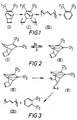
- Edwards and Feast (Polymer, vol. 21, June 1980, pp 595) have described a method of producing poly-(acetylene) (III) by first polymerising the precursor 7,8-bis(trifluoromethyl)tricyclo[4.2.2.0 2,5 ]deca-3,7,9- triene (I) using a catalyst in toluene and the precursor polymer (II) so formed is spontaneously decomposed to a black product and 1,2-bis(trifluoromethyl)benzene.
- the monomer (IV) may be isolated, purified, characterized and polymerised. Moreover, the polymer so formed has a negigible transformation rate at ambient conditions and may be converted by a series of reactions into poly(acetylene) (111). It is believed that this reaction occurs according to the attached Figure 3.
- the poly(acetylene) prepared from either the polymer or copolymer generally exhibit an improved morphology as compared to the poly(acetylene) prepared by direct polymerisation techniques.
- a metathesis polymer comprised of multiple units of 3,6-bis(trifluoromethyl)pentacyclo[6.2.0.0 2,4 .0 3,6 .0 5,7 ]-dec-9-ene.
- the polymer can also contain multiple units of 7,8-bis(tri-fluoromethyl)tricyclo[4.2.2.0 2,5 ]deca-3,7,9-triene (I) and thus be a copolymer of formula (VI).
- Also provided herein is a process for preparing the above polymer or copolymer comprising bringing a solution containing at least 3,6-bis(trifluoromethyl)pentacyclo[6.2.0.0 2,4 .0 3,6 .0 5,7 ]-dec-9-ene (IV) and optionally 7,8-bis(tri-fluoromethyl)tricyclo[4.2.2.0 2,5 ]deca-3,7,9-triene (I) into contact with a methathesis catalyst at a temperature from -50°C to 70°C in an atmosphere substantially inert under the reaction conditions employed.
- a process for producing a coherent poly-(acetylene) (III) comprising solvent casting a solution of the polymer comprised of 3,6-bis(trifluoromethyl)-pentacyclo[6.2.0 .0 2,4 .0 3,6 .0 5,7 ]-dec-9-ene (IV) and heating at a temperature of between 50° and 120°C under reduced pressure over a duration of between 0.1 and 100 hours in an inert atmosphere.
- the solution is cast into a film and transformed into a coherent film of poly(acetylene) (III).
- the polymer produced essentially from the monomer 3,6-bis(trifluoromethyl)pentacyclo[6.2.0.0 2,4 .0 3,6 .0 5,7 ]-dec-9-ene (IV) is substantially stable at ambient temperatures. Thus, is does not undergo any significant degree of decomposition at room temperature e.g. up to about 30°C. For example, for 10% of polymer (V) to be converted to poly(acetylene) it takes about 1.5 years at room temperature. The copolymer is also stable at room temperature. However, the stability is dependent upon the concentration of the monomer (IV) present in the copolymer composition.
- the monomer 3,6-bis(trifluoromethyl)pentacyclo[6.2.0.0 2,4 .0 3,6 .0 6,7 ]-dec-9-ene (IV) is characterised by the following physical and spectral data.
- the polymer consisting essentially of repeating units of 3,6-bis(trifluoromethyl)pentacyclo-[6.2.0.0 2,4 .0 3,6 .0 5,7 ]- dec-9-ene (IV) is represented by the general formula (V) where n is a number from 50 to 50,000, preferably 1000 to 30,000.
- V the polymer
- VI copolymer
- the polymer (copolymer) of this invention can contain other monomer units in addition to the monomer (IV) (and the monomer (II)) without departing from the scope of the present invention.
- the polymer (V) has the following structure and physical and spectral characteristics:
- the polymer (V) is white and soluble in certain organic solvents. Solutions of the polymer can be used to cast fibres or films.
- the NMR data on the polymer (V) is as follows:
- the polymer (V) is prepared by contacting a solution of 3,6-bis(trifluoromethyl)pentacyclo-[6.2.0.0 2,4 .0 3,6 .0 5,7 ]-dec-9-ene (IV) with a metathesis catalyst at a temperature suitably from -50°C to 70°C, preferably from -30°C to 20°C in an atmosphere substantially inert under the reaction conditions.
- the monomer (IV) can be dissolved in a wide range of organic solvent which will evaporate under the conditions employed.
- suitable solvents include ethers, esters, ketones, and aromatics hydrocarbons.
- Preferred solvents are acetone, methylethyl ketone, ethyl acetate and chlorobenzene.
- the monomer (IV) is dissolved to a concentration from 100 to 1000 g/I.
- the copolymer (VI) of the present invention is a metathesis copolymner of 3,6-bis(trifluoromethyl)-pentacyclo[6.2.0.0 2,4 .0 3,6 .0 5,7 ]-dec-9-ene (IV) and 7,8-bis(trifluoromethyl)tricyclo[4.2.2.0 2,5 ]dec-3,7,9-triene (I).
- the copolymer can be subjected to elevated temperatures and reduced pressures to produce poly-(acetylene) (III).
- the copolymer of the present invention can be represented by the following general formula: wherein a and b represent the number of repeating monomer units in n with a proviso that a and b are each less than about 100 and such that a/b is between 0.01 and 100 and n is a number from 50 to 50,000, preferably from 1000 to 30,000.
- the copolymer can be prepared containing varying compositions e.g. varying ratios of the monomers which will effect its temperature of conversion and other physical characteristics.
- each copolymer will have specific physical characteristics depending on the ratio of the monomer (IV) to the monomer of formula (I).
- the copolymers herein can be tailored during preparation to provide the characteristics desired (e.g. stability) for the conversion to the final poly(acetylene) (III) product.
- a solution of 7,8-bis(trifluoromethyl)tricyclo[4.2.2.02,5]deca-3,7,9-triene (I) can be photoisomerised for a sufficient period to convert the monomer (I) to the desired amount of its isomer 3,6-bis(trifluoromethyl)pentacyclo-[6.2.0.0 2,4 .0 3,6 .0 5,7 ]-dec-9-ene (IV).
- the mixture of (I) and (IV) would then be polymerised at temperatures from about -50°C to about 70°C, preferably 0° to 10°C, in an atmosphere substantially inert under the reaction conditions such as nitrogen.
- the ratio of monomer (I) to monomer (IV) can vary widely.
- the ratio of monomer (I) to monomer (IV) will be between about 0.1 and about 100.0, most preferably between 0.1 and 10.
- the total concentration of monomer in the solution can vary from 100 to 1000 g/I.
- the metathesis polymerisation catalyst may be any one of those known to those skilled in the art provided that such catalyst does not adversely affect the structure of the monomers except to open the cyclobutene ring so as to enable polymerisation to occur.
- metathesis polymerisation catalysts are molybdenum pentachloride-tetraalkyl tin system and a tungsten hexachloride-tetraalkyl tin system.
- the molybdenum catalyst gave a polymer having a weight average molecular weight of 100,000 whereas the tungsten catalyst gave a polymer of weight average molecular weight 550,000.
- Metathesis polymerisations are well known to those skilled in the art.
- tetramethyltin may be dissolved in a solution of molybdenum pentachloride in chlorobenzene or other suitable solvent under a blanket of inert gas and the resultant catalyst solution may be introduced into a solution of the monomers employed which may also be in chlorobenzene.
- the reaction is conducted at about 0°C under an inert atmosphere such as nitrogen for a few hours until the reaction mixture becomes viscous.
- the polymerisation may thereafter be terminated by the addition of a chain stopping agent such as methanol.
- the polymer (V) or copolymer (VI) so formed may then be separated from the monomers and then, if necessary, reprecipitated by dissolving in a suitable organic solvent such as acetone followed by addition to methanol.
- a suitable organic solvent such as acetone followed by addition to methanol.
- the precipitated polymer may then be dried under reduced pressure.
- polymer (V) or copolymer (VI) so produced may then be converted to poly(acetylene) (III) by a decomposition route similar to that described in our prior published EP 802329-A.
- polymer (V) and copolymer (VI) exhibit a significant reduction in the rate of conversion at room temperature when compared with the polymer (II). Further, the rate of conversion is significantly faster at elevated temperatures.
- the polymer (V) or copolymer (VI) may be shaped into any desired shape prior to conversion to poly-(acetylene) (III). For instance it may be shaped into fibres, rods, plates or films and then converted so as to generate a poly(acetylene) (III) product having the same shape as that of the original polymer (V) or copolymer (VI). Conventional techniques known to those skilled in the art can be employed for formed the desired shapes from the solution of polymer (V) or copolymer (VI).
- Poly(acetylene) (III) can be prepared by solvent casting a solution of a polymer of the general formula (V) or copolymer of the general formula (VI) and transforming the pre-cast polymer (V) or copolymer (VI) into the poly(acetylene) (III) and by-product 1,2-bis(trifluoromethyl)benzene at a temperature between about 50° and about 120°C, preferably between 70 and 100°C, under reduced pressure over a duration of between 0.1 and 100 hours in an atmosphere inert to the precursor polymer (V) or copolymer (VI) and to the poly(acetylene) (III).
- polymer (V) or copolymer (VI) may be cast into a thin film from a solution thereof and the film, when subjected to elevated temperature and reduced pressure, results in a poly-(acetylene) film.
- the polymer (V) or copolymer (VI) is preferably dissolved in an organic solvent to a concentration which, for a given depth of solution, gives the desired thickness of the required shape. This concentration is typically up to about 100 gll.
- the polymer (V) or copolymer (VI) is suitably cast from organic solvents such as acetone, chloroform, ethyl acetate or ethyl methyl ketone.
- the solvent casting process it is most desirable to minimise moisture and/or oxygen content of the system in order to produce a coherent film or other shape having the desirable properties of conductance. It is most preferable to carry out the casting in an atmosphere inert with respect to the polymer (V) or copolymer (VI) and the eventual polyacetylene (III) formed.
- the inert atmosphere is suitably provided by nitrogen or argon gas.
- the casting temperature may be adjusted as necessary to control the rate of deposition of the polymer (V) or copolymer (VI) from the solvent.
- the temperature at which and the duration for which the polymer (V) or copolymer (VI) is heated to produce the poly(acetylene) will depend upon the rate of transformation desired and, in the case of copolymer (VI), on the concentration of the monomer (IV) in the copolymer.
- the polymer (V) or copolymer (VI) is heated at a temperature from 50 to 120°C, preferably between 70 and 100°C, under vacuum or in the presence of an inert atmospphere, e.g. nitrogen, to transform the polymer (V) or copolymer (VI) into coherent poly(acetylene) (III).
- the heating procedure may be carried out for a period between 0.1 and 100 hours to form the poly(acetylene) (III).
- rate of heating may vary, the rate of heating is suitably between 1 and 10°C per minute with the lower the temperature, the longer the duration of heating. For some uses partial transformation may be adequate and hence variations outside the preferred ranges may be acceptable.
- the poly(acetylene) (III) formed from either the polymer (V) or copolymer (VI) has a substantially higher density than the poly(acetylene) polymers produced by direct polymerisation of acetylene.
- the density of the poly(acetylene) (III) produced according to the present invention is approximately 1.1 g/cc whereas that of the poly(acetylene) produced by direct polymerisation of acetylene according to the prior art methods is only about 0.4 to 0.5 g/cc.
- the calculated crystalline density of poly(acetylene) is 1.2 g/cc.
- the morphology of the poly(acetylene) (III) produced according to the present invention from the polymer (V) or copolymer (VI) is a thin, coherent solid film with no significant quantity of voids.
- the conductivity of the pristine poly(acetylene) (II) produced according to the present invention from either the polymer (V) or copolymer (VI) is generally in the range of between about 10-a and about 10-' per ohm per cm.
- the electrical properties of the poly(acetylene) produced according to the present invention may be altered as desired by addition of suitable dopants known in the art.
- dopants include the halogens, fluorides of arsenic, protonic acids and alkali metals in appropriate forms.
- the dopants are suitably added by diffusion from a gas or liquid phase, electrochemical diffusion or by ion implantation techniques.
- the morphology of the poly(acetylene) produced herein is particularly suitable for selective area doping, with a resolution which is better than 1000 A. in comparison the fibrils in directly polymerised poly(acetylene) gives a resolution figure which rises to around 100 microns which is approximately 1000 times larger.
- the conductivity of these films can be substantially improved.
- the conductivity of the coherent film may be improved to a value of greater than 1 per ohm per cm.
- the product was found (by 1H nmr) to be a clean mixture of 85% (IV) and 15% of the starting material.
- the product was redissolved in a small quantity of pentane; the light yellow crystals which precipitated from this solution upon standing at 248K were trap-to-trap sublimed (293K to 77K) to give pure (by 1 H nmr).
- Tetramethyltin (15 micron 1,0.11 mmol) was added under N 2 to 1.5 ml of a 0.01 g/ml solution of MoCl s in chlorobenzene (0.05 mmol). The mixture was left to stand for 15 mins and then syringed under N 2 , into a stirred solution of (IV) (1.45 g, 5.4 mmol) in chlorobenzene (6 ml) cooled to just above 0°C. The contents of the flask gradually became viscous over a period of 2 hours 20 minutes at which time the polymerisation was terminated by addition of MeOH (20 ml).
- the white polymeric product which precipitated was filtered, redissolved in acetone (20 ml) reprecipitated into CH 3 0H (250 ml) and dried (12 hours 10- 3 mm Hg) in vacuo at room temperature to yield 0.5 g (33%) of (V), the polymer from (IV).
- the molecular weight of the polymer (V) was measured by gel permeation chromatography. The weight average molecular weight was estimated to be from 950,000 to 1,200,000. The average number of repeating units n in polymer (V) was estimated to be about 4000.
- Tetramethyltin (30 micro 1, 0.22 mmoles) was added to a solution of tungsten hexachloride (0.11 mmoles) in chlorobenzene. The mixture was stirred for 25 mins and then syringed under nitrogen into a stirred solution of monomer (IV) (11 mmoles) in chlorobenzene (9 mls) and held at 10°C. The polymerisation was initiated rapidly and polymer began to precipitate from solution after 45 mins. At this point more chlorobenzene (3 mols) was added and the polymerisation continued for another 15 mins.
- the polymer was totally precipitated by the addition of methanol (30 ml), filtered, washed again with methanol and reprecipitated from acetone solution into methanol to give 2.75 g (90%) of a white product after drying in vacuo. The product remained unchanged after standing at room temperature for 24 hours. A film of this material, cast from acetone solution, was smoothly converted to polyacetylene at 70°C and 10- 3 mm Hg.
- a thin film of (V) was cast from acetone solution into a film.
- the film so formed was converted smoothly to a shiny black film, poly(acetylene) (III), over a period of 3 hours at 75°C under dynamic vacuum (10- 3 mm Hg).
- a film of (V) maintained at ambient temperature, had yellowed slightly over a period of two weeks. Material kept in a refrigerator had shown absolutely no visible sign of deterioration after a similar period.
- the conversion of polymer (V) to poly(acetylene) (III) was also followed by differential scanning calorimetry (DSC). 2 mg of (V) were placed in an aluminium pan of a Perkin Elmer DSC2 and the sample was heated at 10°C per minute.
Landscapes
- Chemical & Material Sciences (AREA)
- Physics & Mathematics (AREA)
- Spectroscopy & Molecular Physics (AREA)
- Health & Medical Sciences (AREA)
- Chemical Kinetics & Catalysis (AREA)
- Medicinal Chemistry (AREA)
- Polymers & Plastics (AREA)
- Organic Chemistry (AREA)
- Polyoxymethylene Polymers And Polymers With Carbon-To-Carbon Bonds (AREA)
Claims (10)


Priority Applications (1)
| Application Number | Priority Date | Filing Date | Title |
|---|---|---|---|
| AT85305492T ATE46179T1 (de) | 1984-08-04 | 1985-08-01 | Herstellung von polymeren und copolymeren des polyacetylens. |
Applications Claiming Priority (6)
| Application Number | Priority Date | Filing Date | Title |
|---|---|---|---|
| GB848419949A GB8419949D0 (en) | 1984-08-04 | 1984-08-04 | Polymers |
| GB8419949 | 1984-08-04 | ||
| GB848421643A GB8421643D0 (en) | 1984-08-25 | 1984-08-25 | Polymers and copolymers |
| GB8421643 | 1984-08-25 | ||
| GB848422743A GB8422743D0 (en) | 1984-09-08 | 1984-09-08 | Copolymers and production of polyacetylene |
| GB8422743 | 1984-09-08 |
Publications (3)
| Publication Number | Publication Date |
|---|---|
| EP0173473A2 EP0173473A2 (fr) | 1986-03-05 |
| EP0173473A3 EP0173473A3 (en) | 1987-07-15 |
| EP0173473B1 true EP0173473B1 (fr) | 1989-09-06 |
Family
ID=27262435
Family Applications (1)
| Application Number | Title | Priority Date | Filing Date |
|---|---|---|---|
| EP85305492A Expired EP0173473B1 (fr) | 1984-08-04 | 1985-08-01 | Production de polymères et copolymères de polyacétylène |
Country Status (4)
| Country | Link |
|---|---|
| US (2) | US4626580A (fr) |
| EP (1) | EP0173473B1 (fr) |
| CA (1) | CA1245398A (fr) |
| DE (1) | DE3572830D1 (fr) |
Families Citing this family (3)
| Publication number | Priority date | Publication date | Assignee | Title |
|---|---|---|---|---|
| US5026783A (en) * | 1988-10-24 | 1991-06-25 | California Institute Of Technology | High energy polymers formed by ring opening metathesis polymerization |
| US5512635A (en) * | 1993-05-27 | 1996-04-30 | Amoco Corporation | Process for preparing linear monofunctional and telechelic difunctional polymers and compositions obtained thereby |
| US6997057B2 (en) * | 2001-08-10 | 2006-02-14 | Seti Media Inc. | Sound pollution surveillance system and method |
Family Cites Families (1)
| Publication number | Priority date | Publication date | Assignee | Title |
|---|---|---|---|---|
| US4496702A (en) * | 1981-11-20 | 1985-01-29 | The British Petroleum Company P.L.C. | Polyacetylene production |
-
1985
- 1985-07-30 US US06/760,486 patent/US4626580A/en not_active Expired - Fee Related
- 1985-08-01 DE DE8585305492T patent/DE3572830D1/de not_active Expired
- 1985-08-01 EP EP85305492A patent/EP0173473B1/fr not_active Expired
- 1985-08-02 CA CA000488035A patent/CA1245398A/fr not_active Expired
-
1986
- 1986-01-07 US US06/816,713 patent/US4673731A/en not_active Expired - Fee Related
Also Published As
| Publication number | Publication date |
|---|---|
| CA1245398A (fr) | 1988-11-22 |
| EP0173473A3 (en) | 1987-07-15 |
| US4626580A (en) | 1986-12-02 |
| DE3572830D1 (en) | 1989-10-12 |
| US4673731A (en) | 1987-06-16 |
| EP0173473A2 (fr) | 1986-03-05 |
Similar Documents
| Publication | Publication Date | Title |
|---|---|---|
| Hong et al. | Synthesis of electrically conductive polypyrroles at the air-water interface of a Langmuir-Blodgett film balance | |
| Edwards et al. | New routes to conjugated polymers: 1. A two step route to polyacetylene | |
| US4766198A (en) | Process for making thiophene and furfurane polymers | |
| Scherman et al. | Direct synthesis of soluble, end-functionalized polyenes and polyacetylene block copolymers | |
| Masuda et al. | Synthesis and characterization of poly [[o-(trimethylsilyl) phenyl] acetylene] | |
| Tokito et al. | Polyarylenevinylene films prepared from precursor polymers soluble in organic solvents | |
| Cho et al. | Cyclopolymerization of dipropargylgermaniums by transition-metal catalysts | |
| US5026783A (en) | High energy polymers formed by ring opening metathesis polymerization | |
| US4507462A (en) | Low molecular weight aromatic polymers with biphenylene end groups | |
| EP0173473B1 (fr) | Production de polymères et copolymères de polyacétylène | |
| US4578443A (en) | Polyacetylene production | |
| US4727135A (en) | Synthesis of polyquinoline by the catalytical dehydrogenative polymerization of tetrahydroquinoline | |
| US3265640A (en) | Crosslinked polymers from alpha, alpha-dichloro-p-xylene and polysubstituted benzenes | |
| US5110885A (en) | Method for polymerizing acyclic dienes | |
| EP0124979B1 (fr) | Fabrication de polyacéthylène | |
| US5290895A (en) | Polymerized dienes prepared by step propagation, condensation type polymerization of acyclic dienes | |
| Klavetter et al. | Condensed phase route to polyacetylene | |
| Munardi et al. | Polymerization of acetylene with Ti (OC4H9) 4/butyllithium as catalyst system and silicone oil as reaction medium | |
| Okada et al. | Chemical synthesis of polysaccharides. 4. 4-Deoxy-(1→ 6)-β-DL-ribo-hexopyranan, the first example of a (1→ 6)-β-linked polysaccharide synthesized by the ring-opening polymerization method | |
| JPS6195009A (ja) | 複分解ポリマ−、その製造方法およびそれを使用したポリアセチレンの製造方法 | |
| Sugimoto et al. | Synthesis and properties of poly (phenylacetylene) s having dialkylamino groups | |
| Gal et al. | Synthesis and properties of poly (dipropargyl sulfoxide) | |
| CA1218799A (fr) | Production de polyacetylene | |
| Shirakawa | Synthesis of polyacetylene | |
| US4503205A (en) | Method of making soluble polyacetylenic and polyaromatic polymers |
Legal Events
| Date | Code | Title | Description |
|---|---|---|---|
| PUAI | Public reference made under article 153(3) epc to a published international application that has entered the european phase |
Free format text: ORIGINAL CODE: 0009012 |
|
| AK | Designated contracting states |
Kind code of ref document: A2 Designated state(s): AT BE CH DE FR GB IT LI NL SE |
|
| PUAL | Search report despatched |
Free format text: ORIGINAL CODE: 0009013 |
|
| AK | Designated contracting states |
Kind code of ref document: A3 Designated state(s): AT BE CH DE FR GB IT LI NL SE |
|
| 17P | Request for examination filed |
Effective date: 19870703 |
|
| 17Q | First examination report despatched |
Effective date: 19881024 |
|
| GRAA | (expected) grant |
Free format text: ORIGINAL CODE: 0009210 |
|
| AK | Designated contracting states |
Kind code of ref document: B1 Designated state(s): AT BE CH DE FR GB IT LI NL SE |
|
| REF | Corresponds to: |
Ref document number: 46179 Country of ref document: AT Date of ref document: 19890915 Kind code of ref document: T |
|
| ET | Fr: translation filed | ||
| ITF | It: translation for a ep patent filed | ||
| REF | Corresponds to: |
Ref document number: 3572830 Country of ref document: DE Date of ref document: 19891012 |
|
| PGFP | Annual fee paid to national office [announced via postgrant information from national office to epo] |
Ref country code: DE Payment date: 19900612 Year of fee payment: 6 |
|
| PGFP | Annual fee paid to national office [announced via postgrant information from national office to epo] |
Ref country code: FR Payment date: 19900613 Year of fee payment: 6 |
|
| PGFP | Annual fee paid to national office [announced via postgrant information from national office to epo] |
Ref country code: SE Payment date: 19900618 Year of fee payment: 6 |
|
| PLBE | No opposition filed within time limit |
Free format text: ORIGINAL CODE: 0009261 |
|
| STAA | Information on the status of an ep patent application or granted ep patent |
Free format text: STATUS: NO OPPOSITION FILED WITHIN TIME LIMIT |
|
| PGFP | Annual fee paid to national office [announced via postgrant information from national office to epo] |
Ref country code: GB Payment date: 19900719 Year of fee payment: 6 |
|
| 26N | No opposition filed | ||
| ITTA | It: last paid annual fee | ||
| PGFP | Annual fee paid to national office [announced via postgrant information from national office to epo] |
Ref country code: NL Payment date: 19900831 Year of fee payment: 6 Ref country code: CH Payment date: 19900831 Year of fee payment: 6 Ref country code: AT Payment date: 19900831 Year of fee payment: 6 |
|
| PGFP | Annual fee paid to national office [announced via postgrant information from national office to epo] |
Ref country code: BE Payment date: 19900911 Year of fee payment: 6 |
|
| PG25 | Lapsed in a contracting state [announced via postgrant information from national office to epo] |
Ref country code: GB Effective date: 19910801 Ref country code: AT Effective date: 19910801 |
|
| PG25 | Lapsed in a contracting state [announced via postgrant information from national office to epo] |
Ref country code: SE Effective date: 19910802 |
|
| PG25 | Lapsed in a contracting state [announced via postgrant information from national office to epo] |
Ref country code: LI Effective date: 19910831 Ref country code: CH Effective date: 19910831 Ref country code: BE Effective date: 19910831 |
|
| BERE | Be: lapsed |
Owner name: THE BRITISH PETROLEUM CY P.L.C. Effective date: 19910831 |
|
| PG25 | Lapsed in a contracting state [announced via postgrant information from national office to epo] |
Ref country code: NL Effective date: 19920301 |
|
| GBPC | Gb: european patent ceased through non-payment of renewal fee | ||
| NLV4 | Nl: lapsed or anulled due to non-payment of the annual fee | ||
| PG25 | Lapsed in a contracting state [announced via postgrant information from national office to epo] |
Ref country code: FR Effective date: 19920430 |
|
| REG | Reference to a national code |
Ref country code: CH Ref legal event code: PL |
|
| PG25 | Lapsed in a contracting state [announced via postgrant information from national office to epo] |
Ref country code: DE Effective date: 19920501 |
|
| REG | Reference to a national code |
Ref country code: FR Ref legal event code: ST |
|
| EUG | Se: european patent has lapsed |
Ref document number: 85305492.2 Effective date: 19920306 |