EP0173630A2 - Reinigung von Natriumaluminatlösungen des Bayerverfahrens durch Beseitigung von Natriumoxalat - Google Patents
Reinigung von Natriumaluminatlösungen des Bayerverfahrens durch Beseitigung von Natriumoxalat Download PDFInfo
- Publication number
- EP0173630A2 EP0173630A2 EP85420118A EP85420118A EP0173630A2 EP 0173630 A2 EP0173630 A2 EP 0173630A2 EP 85420118 A EP85420118 A EP 85420118A EP 85420118 A EP85420118 A EP 85420118A EP 0173630 A2 EP0173630 A2 EP 0173630A2
- Authority
- EP
- European Patent Office
- Prior art keywords
- oxalate
- liquor
- sodium
- bayer
- fraction
- Prior art date
- Legal status (The legal status is an assumption and is not a legal conclusion. Google has not performed a legal analysis and makes no representation as to the accuracy of the status listed.)
- Granted
Links
Images
Classifications
-
- C—CHEMISTRY; METALLURGY
- C01—INORGANIC CHEMISTRY
- C01F—COMPOUNDS OF THE METALS BERYLLIUM, MAGNESIUM, ALUMINIUM, CALCIUM, STRONTIUM, BARIUM, RADIUM, THORIUM, OR OF THE RARE-EARTH METALS
- C01F7/00—Compounds of aluminium
- C01F7/02—Aluminium oxide; Aluminium hydroxide; Aluminates
- C01F7/46—Purification of aluminium oxide, aluminium hydroxide or aluminates
- C01F7/47—Purification of aluminium oxide, aluminium hydroxide or aluminates of aluminates, e.g. removal of compounds of Si, Fe, Ga or of organic compounds from Bayer process liquors
- C01F7/473—Removal of organic compounds, e.g. sodium oxalate
Definitions
- the invention relates to a process for purifying alkaline solutions preferably originating from the decomposition of sodium aluminate from the Bayer cycle by precipitation of sodium oxalate, by means of the introduction of an appropriate agent causing destabilization of the state of supersaturation in which the oxalate is naturally found.
- the Bayer process constitutes the essential technique for producing alumina intended to be transformed into aluminum by igneous electrolysis.
- the bauxite ore is heat treated with an aqueous solution of sodium hydroxide, at an appropriate concentration, thus causing the solubilization of the alumina and obtaining a supersaturated solution of aluminate of sodium.
- the supersaturated solution of sodium aluminate is seeded with particles of aluminum trihydroxide in order to cause the precipitation of aluminum trihydroxide.
- the alumina-depleted sodium aluminate liquor is recycled to the attack stage after being concentrated and recharged with sodium hydroxide to restore the concentration suitable for attacking the ore.
- the supersaturated sodium aluminate solution resulting from the attack takes up organic matter in the form of sodium salts, including the oxalate. is one of the most troublesome components.
- the critical threshold of supersaturation beyond which the sodium oxalate spontaneously precipitates varies with the nature of the liquor. It is all the higher that the liquor contains slightly degraded oragnic matter.
- This precipitation phenomenon of sodium oxalate affects the physicochemical qualities of the precipitated aluminum trihydroxide and leads, for example, to large variations in the particle size of the alumina produced or to an increased brittleness of the grains of alumina which can represent major drawbacks for the use of this alumina in the production of aluminum by electrolysis.
- a first process well known to those skilled in the art consists in treating with lime the washing liquor of the aluminum trihydroxide produced in the Bayer cycle, in order to precipitate the oxalate present in the form of the calcium salt and of eliminate it from the manufacturing cycle while the washing liquor depleted in oxalate is recycled.
- a variant of this process further consists in washing part of the aluminum trihydroxide primer and treating the washing liquor of said primer with lime.
- a process described in patents USP 3 899 571 and European patent 0 013 407 consists in treating a Bayer liquor which is supersaturated with respect to the equilibrium solubility of sodium oxalate (such as liquors depleted in sodium aluminate from decomposition, reconcentrated or not) by introduction of a recycled sodium oxalate primer to cause precipitation of the sodium oxalate in solution and lead to the concentration of the solubility equilibrium of the anhydrous sodium oxalate.
- sodium oxalate such as liquors depleted in sodium aluminate from decomposition, reconcentrated or not
- the purified liquor is then reintroduced into the Bayer cycle while a fraction of the solid phase of sodium oxalate is used for the preparation of the primer crystal suspension, the other fraction being eliminated from the cycle.
- the sodium oxalate crystals constituting the primer quickly become inactive by poisoning their surface with the organic matter present. More than that, the organic materials present require, for the sodium oxalate crystals, a delicate washing operation. Because, in the case where the washing proves to be insufficient, there appears a drop in activity of the primer and therefore a decrease in the precipitation yield of sodium oxalate. And, in the case where the washing is too thorough, a granulometric refinement of the primer is manifested, which leads to difficult liquid-solid separations and therefore to decreases in purification yield.
- Another method for limiting the quantity of sodium oxalate in Bayer liquors described in French patent FR-A-2 317 226 and US 4 038 039 consists in concentrating by evaporation a part of the liquor coming from the decomposition of l sodium aluminate, in order to make it supersaturated with sodium oxalate and then to break this supersaturation by spraying the concentrated and cooled liquor, into fine droplets on a packing of steel turn, the destabilization of the supersaturation being caused by the shock mechanical droplets on the lining and rapid evaporation of the liquid phase, consequence of the high ratio between the surface of the droplets and their volume.
- Another method, finally, for limiting the amount of sodium oxalate in Bayer liquors described in US Patents 4,275,043 and 4,275,042 consists in causing the precipitation of sodium oxalate by selective adsorption on activated carbon or by a cationic sequestrant, organic matter responsible for the stability of the supersaturation of sodium oxalate. Then, after a solid-liquid separation, the liquor depleted in sodium oxalate is reintroduced into the Bayer cycle, while the precipitated oxalate is extracted from the circuit at the same time as the activated carbon, the latter being able to be subsequently regenerated by a treatment. thermal.
- the process as described does not offer all the efficiency that one might expect to such an extent that it is advisable to complete its action by the introduction of a sodium oxalate primer. .
- the process according to the invention which consists in treating all or part of a liquor from the Bayer cycle, preferably after decomposition of the sodium aluminate, before or after its concentration, with an agent for destabilizing the state of supersaturation of sodium oxalate in solution, is characterized in that the destabilizing agent causing the precipitation of sodium oxalate is chosen from the group comprising calcium oxalate and barium oxalate and that in the case of liquors loaded with degraded organic matter, generally resulting from the high temperature attack of bauxites rich in humic matter, a synthetic anionic polyelectrolyte of high molecular weight is introduced beforehand into said liquors at any point in the Bayer cycle.
- the destabilizing agent consisting of calcium or barium oxalate
- the sodium aluminate solution preferably originating from decomposition, before or after its concentration.
- Calcium or barium oxalate unstable under these conditions, release the oxalate ion. This results in an increase in the concentration of sodium oxalate such that the critical threshold of supersaturation in the solution is exceeded and that the sodium oxalate precipitates spontaneously, partly carrying with it organic matter responsible for its state of initial supersaturation. .
- Part of the precipitated oxalate is recycled to the purification stage according to a special procedure, because, due to the organic materials present, the precipitated oxalate cannot be recycled as it is. Indeed, the dissolution in whole or in part of the precipitated oxalate containing the organic matter would result in an increase in the critical threshold of supersaturation of oxalate in the liquor to be purified.
- the purified liquor after separation of the solid phase is reintroduced into the Bayer circuit.
- Its residual sodium oxalate content corresponds to the solubility limit of sodium oxalate under the conditions of the experiment, called apparent solubility.
- the difference between the critical supersaturation threshold and the apparent solubility of sodium oxalate in the sodium aluminate solution therefore reflects the importance of the purification efficiency.
- This anionic polyelectrolyte is chosen from the group comprising polyacrylic acids, polyacrylamides, sodium polystyrenes sulfonates, copolymers of sodium polyacrylate and polyacrylamide. Widely used as flocculants, these synthetic organic compounds are also known for their stabilizing properties.
- sodium oxalate in Bayer liquor (communication from Gordon Lever ICSOBA already cited) in the same way as the humic substances contained in bauxites.
- these humic materials are rapidly degraded in the high attack temperature cycle, so that their stabilizing action on the supersaturation of sodium oxalate in liquors derived from such treatments, is very low.
- the Applicant has observed increases of 500 to 800% in the purification efficiency, measured by the difference between the critical threshold of supersaturation and the limit of apparent solubility; this purification efficiency being preserved without further addition of stabilizer over several tens of attack cycles, this whatever the concentration of caustic Na 20 and the temperature of the attack liquor in the ranges usually practiced in the Bayer cycle ( Na 20 caustic 100 to 250 g / liter temperature 100 to 290 ° C).
- This purification treatment of Bayer liquors preferably originating from the decomposition of sodium aluminate is carried out before or after the concentration step at the temperature of the liquor itself, or after cooling.
- the temperature at which the purification treatment is carried out is chosen in the range 20 * to 80 ° C and preferably in the range 50 ° to 70 ° C.
- the amount of agent for destabilizing the state of supersaturation of sodium oxalate, introduced into the Bayer liquor to be treated to cause precipitation of sodium oxalate, expressed in the anhydrous form of calcium oxalate or barium, is generally understood, in the case where the agent is calcium oxalate, between 0.5 and 15 g / l and preferably between 1.0 and 5.0 g / l and in the case where the agent is barium oxalate, generally between 0.5 and 25 g / l and preferably between 1 and 10 g / l.
- the solid phase thus separated is, for at least one fraction, subjected to at least partial dissolution in water when the destabilizing agent is oxalate of calcium and in an alkaline solution when the destabilizing agent is barium oxalate. This redissolution takes place
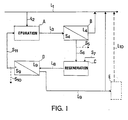
- the invention will be better understood thanks to the numerical description of a general treatment scheme according to the invention.
- the Bayer L1 liquor preferably coming from the decomposition zone of the sodium aluminate solution, depleted in alumina and supersaturated in sodium oxalate, and returning to the attack of the bauxite ore, is subjected to the levy of an L2 fraction, before or after concentration, intended to be subjected to the treatment according to the invention.
- the fraction L2 thus removed is introduced into the purification zone (A) as well as the solid fraction S11 constituted in part by calcium oxalate or barium oxalate recycled.
- the purification treatment in zone (A) is carried out with stirring and in the aforementioned temperature range.
- the suspension obtained L3 is subjected to a solid-liquid separation in (B).
- the L4 purified liquor from this operation is recycled in the Bayer Ll liquor circuit.
- the solid phase S4 is constituted for a fraction by sodium oxalate precipitated in the purification zone (A) and for the other fraction by tricalcium aluminate hexahydrate in the case of the use of the oxalate of calcium or barium carbonate in the case of the use of barium oxalate as a destabilizing agent.
- the solid phase S4 is partly extracted from the cycle according to S5 thus constituting the output of the oxalate eliminated from the Bayer cycle, while the remaining part S6 is introduced into the zone (C) where it is treated with lime, itself introduced according to S7 in the form of milk.
- the sodium oxalate constituting a part of S6 is therefore transformed into calcium oxalate.
- the suspension L8 resulting from this treatment is subjected to a solid-liquid separation in (D), the liquid phase L9 being recycled in the Bayer L1 circuit, while the solid phase S9 constituting the agent for destabilizing the at a temperature at most equal to the boiling point and preferably between 70 "and 90 ° C.
- the destabilizing agent is calcium oxalate
- the latter is obtained by reacting the precipitated sodium oxalate with a lime milk, prepared in water.
- the volume of milk used in this stage is generally between 50 and 500 liters and preferably between 100 and 200 liters per tonne of alumina produced.
- the destabilizing agent is barium oxalate
- the latter is obtained by reacting on the precipitated sodium oxalate, barium aluminate in the presence of a washing liquor taken from the Bayer cycle, and Na 2 O concentration generally between 20 and 80 g / l.
- the volume of liquor used in this step is generally between 50 and 500 liters and preferably between 100 and 200 liters per tonne of alumina produced.
- the quantities of Ca0 or Al 2 O 4 Ba, chosen from the above-mentioned concentration ranges, used for the preparation of the destabilizing agent are such that they ensure both the formation of said agent and the precipitation of the carbonate present. in the liquor impregnating the precipitated sodium oxalate cake, as well as the carbonate present in the washing liquor sampled in the Bayer cycle, when the destabilizing agent is barium oxalate.
- the suspension of calcium oxalate or barium oxalate thus obtained is then subjected to a solid-liquid separation.
- the solid phase of calcium or barium oxalate constitutes all or part of the agent for destabilizing the state of supersaturation of sodium oxalate present in the liquor of the Bayer cycle to be purified into oxalate, said liquor having been removed after decomposition of sodium aluminate.
- the liquid phase containing the organic materials is reintroduced into the Bayer cycle when the destabilizing agent is calcium oxalate, or else is purified from the barium ions by a means known to those skilled in the art, such as for example according to FR 2 328 660, before being reintroduced into the Bayer cycle, when the destabilizing agent is barium oxalate.
- supersaturation with sodium oxalate of the liquor L2 is introduced according to Sll into the purification zone (A).
- the solid phase S4 is introduced in its entirety, according to S6 into zone (C) where it is treated with barium aluminate introduced according to S7 with a diluted liquor in Na20.
- the sodium oxalate constituting a part of S6 is transformed into barium oxalate.
- the suspension L8, resulting from the treatment is subjected to a solid-liquid separation in (D).
- the liquid phase L9 containing the stabilizing organic materials is then led into the zone (E) where it undergoes a purification of the barium ions according to any process known to those skilled in the art.
- a fraction of the solid phase S9 is extracted according to S10 and constitutes the exit of the oxalate eliminated from the Bayer cycle.
- This fraction S10 is calcined with an addition of alumina according to the method described in French patent FR 2 328 660 with the aim of regenerating barium aluminate and eliminating the oxalate in the form of carbon dioxide CO 2.
- the other fraction of the solid phase S9, constituting the agent for destabilizing the supersaturation of sodium oxalate in the liquor L2 is introduced according to S11, into the purification zone (A) of the said liquor.
- the L2 liquor taken from the Bayer L1 cycle had the following composition: 1000 mL of this liquor L2 were placed in a reactor (A) and kept at a constant temperature of 60 ° C. 3.2 g calcium oxalate S11, destabilizing agent of the supersaturation of sodium oxalate were added with the above liquor. The whole was kept under stirring for 4 hours.
- the suspension L3 was subjected to a solid-liquid separation of the phases in (B).
- phase S4 constituting the filter cake which contains the tricalcium aluminate hexahydrate formed during the decomposition reaction of the calcium oxalate in the treated liquor, as well as the precipitated sodium oxalate was separated into two fractions S5 and S6 .
- the S6 fraction was taken up and treated in the regeneration zone (C) with 150 milliliters of a lime milk containing 17 g / 1 of CaO.
- the medium thus formed was stirred at 80 ° C for 2 hours in order to convert the sodium oxalate fraction S6 calcium oxalate.
- the liquor L9 purified in oxalate was then able to be recycled in L1 and the solid phase S9 was recycled in the purification zone (A).
- the amount of sodium oxalate purified in zone (A) and separated from the liquid phase L4 in (B) was then 0.29 g / l.
- the fraction S6 was dissolved in water and the aqueous sodium oxalate solution thus obtained was recycled to the purification zone (A) for a new treatment of industrial liquor L2.
- the amount of purified oxalic carbon was only 0.11 g / l, while according to the invention, the amount of purified oxalic carbon in zone (A) varied in the range from 0.28 to 0.31 g / l.
- This industrial liquor L2 had the following composition: 10.7 g calcium oxalate were added to 1000 mL of this liquor, the whole being stirred at 60 ° C for 6 hours.
- the suspension obtained was filtered and the liquid phase L4 then titrated 0.38 g / l of oxalic carbon, i.e., compared to the initial composition, elimination by precipitation of 0.04 g / l of oxalic carbon.
- the purification efficiency was increased by 500, 600 and 800% respectively compared to the control test.
- An industrial liquor L2 of the same origin and of identical composition as that of Example 3, 20 mg / 1 of the same polyelectrolyte (brand Floerger-type AN 934 SH) was added. The liquor was then brought to a temperature of 245 ° C for 8, 24, 48 and 72 hours. At the end of each residence time, its critical oversaturation threshold for sodium oxalate was determined and a purification test was carried out according to the protocol described in Example Ib.
- the L3 suspension from (A) was filtered.
- the L4 filtrate had a content of 0.39 g / l of oxalic carbon.
- the S4 cake was taken up in the regeneration zone (C) in 70 ml of a dilute aqueous liquor, originating from the Bayer cycle, and containing 40 g / 1 of caustic Na 2 O.
- the solid fraction S10 of the cake S9 corresponded to the quantity of purified sodium oxalate, representing approximately 34% of the total mass of the solid leaving the treatment cycle.
- the other solid fraction S11 was recycled to the purification (A) constituting the agent for destabilizing the supersaturation to oxalate in the purification of a new quantity (1000 milliliters) of liquor L2.
- the liquor sampled L2 had the following composition:
- the filtrate L4 had an oxalic carbon content of 0.51 g / 1.
- the temperature of the reactor (A) was adjusted to 60 ° C. by circulation of a heat transfer fluid in a double jacket.
- the average residence time of the liquor was approximately 6 hours.
- the suspension from (A) was conveyed by pump to the filter (B) which was thus supplied with a suspension containing 15-20 g / l of dry matter.
- the L4 liquor leaving the filter (B) contained:
- the overhanging suspension L8 was subjected in (D) to a solid-liquid separation.
- the solid fraction S9 constituted the destabilizing agent (calcium oxalate) recycled to the purification step (A) with S11.
Landscapes
- Chemical & Material Sciences (AREA)
- Organic Chemistry (AREA)
- Health & Medical Sciences (AREA)
- General Health & Medical Sciences (AREA)
- Life Sciences & Earth Sciences (AREA)
- Geology (AREA)
- Inorganic Chemistry (AREA)
- Compounds Of Alkaline-Earth Elements, Aluminum Or Rare-Earth Metals (AREA)
- Detergent Compositions (AREA)
- Solid-Sorbent Or Filter-Aiding Compositions (AREA)
Applications Claiming Priority (4)
| Application Number | Priority Date | Filing Date | Title |
|---|---|---|---|
| FR8410187A FR2566382B1 (fr) | 1984-06-25 | 1984-06-25 | Purification des solutions d'aluminate de sodium du cycle bayer par elimination d'oxalate de sodium |
| FR8410187 | 1984-06-25 | ||
| FR858506283A FR2580618B2 (fr) | 1985-04-18 | 1985-04-18 | Amelioration du procede de purification des solutions d'aluminate de sodium du cycle bayer par elimination d'oxalate de sodium |
| FR8506283 | 1985-04-18 |
Publications (3)
| Publication Number | Publication Date |
|---|---|
| EP0173630A2 true EP0173630A2 (de) | 1986-03-05 |
| EP0173630A3 EP0173630A3 (en) | 1986-03-19 |
| EP0173630B1 EP0173630B1 (de) | 1988-05-18 |
Family
ID=26224040
Family Applications (1)
| Application Number | Title | Priority Date | Filing Date |
|---|---|---|---|
| EP85420118A Expired EP0173630B1 (de) | 1984-06-25 | 1985-06-24 | Reinigung von Natriumaluminatlösungen des Bayerverfahrens durch Beseitigung von Natriumoxalat |
Country Status (18)
| Country | Link |
|---|---|
| US (1) | US4597952A (de) |
| EP (1) | EP0173630B1 (de) |
| AU (1) | AU573350B2 (de) |
| BR (1) | BR8503020A (de) |
| CA (1) | CA1285373C (de) |
| DE (1) | DE3562764D1 (de) |
| ES (1) | ES8604472A1 (de) |
| GB (1) | GB2160853B (de) |
| GR (1) | GR851483B (de) |
| HU (1) | HU198653B (de) |
| IE (1) | IE58433B1 (de) |
| IN (1) | IN164323B (de) |
| MX (1) | MX166543B (de) |
| NO (1) | NO167020C (de) |
| NZ (1) | NZ212512A (de) |
| OA (1) | OA08044A (de) |
| TR (1) | TR25314A (de) |
| YU (1) | YU43876B (de) |
Cited By (2)
| Publication number | Priority date | Publication date | Assignee | Title |
|---|---|---|---|---|
| FR2581054A1 (fr) * | 1985-04-24 | 1986-10-31 | Nalco Chemical Co | Procede pour reduire le pourcentage de cristaux de trihydrate d'alumine de diametre inferieur a 200 microns obtenus a partir des liqueurs du procede bayer et procede d'extraction des cristaux d'oxalate de sodium a partir de ces memes liqueurs epuisees |
| FR2686872A1 (fr) * | 1992-02-05 | 1993-08-06 | Pechiney Aluminium | Procede d'elimination de l'oxalate de sodium des solutions d'aluminate de sodium du cycle bayer. |
Families Citing this family (17)
| Publication number | Priority date | Publication date | Assignee | Title |
|---|---|---|---|---|
| US4999170A (en) * | 1988-06-03 | 1991-03-12 | Vereinigte Aluminum-Werke Aktiendesellschaft | Method for removing sodium oxalate from caustic aluminate liquors |
| US5137722A (en) * | 1991-01-16 | 1992-08-11 | Allegheny-Singer Research Institute | Extract and pharmaceutical composition for treatment of calcium oxalate stone disease |
| US5279827A (en) * | 1991-01-16 | 1994-01-18 | Allegheny-Singer Research Institute | Extract and pharmaceutical composition for treatment of calcium oxalate stone disease and viral infections |
| US5385586A (en) * | 1993-03-24 | 1995-01-31 | Nalco Chemical Company | Liquor oxalate stabilizers |
| US5728180A (en) * | 1996-06-25 | 1998-03-17 | Aluminum Company Of America | Adsorbent combinations for enhanced removal of sodium oxalate from bayer process spent liquor |
| AP1701A (en) * | 1998-09-25 | 2007-01-02 | Worsley Alumina Pty Ltd | Improved bayer causticisation. |
| AU2001272227B2 (en) * | 2000-07-20 | 2004-03-04 | South32 Worsley Alumina Pty Ltd | Improved process for filter aid production in alumina refineries |
| AUPQ889100A0 (en) * | 2000-07-20 | 2000-08-10 | Worsley Alumina Pty Ltd | Improved process for filter aid production in alumina refineries |
| AUPR437001A0 (en) * | 2001-04-11 | 2001-05-17 | Worsley Alumina Pty Ltd | Process for the removal of anionic impurities from caustic aluminate solutions |
| DE10119685A1 (de) * | 2001-04-20 | 2002-10-24 | Stockhausen Chem Fab Gmbh | Entfernung nicht-wasserlöslicher Substanzen aus Metallaufschlüssen |
| RU2302995C1 (ru) * | 2005-11-07 | 2007-07-20 | Государственное образовательное учреждение высшего профессионального образования "Санкт-Петербургский государственный горный институт им. Г.В. Плеханова (технический университет)" | Способ очистки алюминатных растворов от примесей |
| RU2313490C1 (ru) * | 2006-05-11 | 2007-12-27 | Государственное образовательное учреждение высшего профессионального образования "Санкт-Петербургский государственный горный институт имени Г.В. Плеханова (технический университет)" | Способ переработки бокситов |
| CN112299461B (zh) * | 2020-11-08 | 2023-03-24 | 湖南诺兰蒂尔环保科技有限公司 | 一种铝酸钠溶液中草酸盐排除装置及工艺 |
| AU2022220705A1 (en) | 2021-02-12 | 2023-08-17 | Ecolab Usa Inc. | Purification of bauxite ores using boronic acid-functional compounds |
| CN114735736B (zh) * | 2022-03-28 | 2024-05-03 | 广西田东锦鑫化工有限公司 | 氧化铝生产中去除铝酸钠溶液中多种有机化合物的方法 |
| CN116621204A (zh) * | 2023-05-25 | 2023-08-22 | 山东大学 | 一种铝酸钠溶液提纯净化的方法与应用 |
| CN120864539B (zh) * | 2025-07-03 | 2026-08-11 | 中铝山东有限公司 | 一种基于草酸盐滤饼制备高白氢氧化铝的方法 |
Family Cites Families (7)
| Publication number | Priority date | Publication date | Assignee | Title |
|---|---|---|---|---|
| US3372985A (en) * | 1963-02-20 | 1968-03-12 | Kaiser Aluminium Chem Corp | Process for removing impurities from the precipitation system of the bayer process |
| JPS53400B2 (de) * | 1972-12-06 | 1978-01-07 | ||
| FR2328660A1 (fr) * | 1975-10-21 | 1977-05-20 | Pechiney Aluminium | Perfectionnement a l'epuration de solutions en circulation dans le cycle bayer |
| US4263261A (en) * | 1978-12-21 | 1981-04-21 | Sumitomo Aluminium Smelting Company, Limited | Method for the removal of impurities from sodium aluminate solution |
| US4275043A (en) * | 1979-01-31 | 1981-06-23 | Alcan Research And Development Limited | Removal of oxalate from bayer process liquor |
| US4275042A (en) * | 1980-01-22 | 1981-06-23 | Alcan Research And Development Limited | Removal of oxalate from Bayer process liquor |
| US4478795A (en) * | 1982-10-18 | 1984-10-23 | Diamond Shamrock Chemicals Company | Aluminum trihydroxide deliquoring with anionic polymers |
-
1985
- 1985-06-17 CA CA000484177A patent/CA1285373C/fr not_active Expired - Lifetime
- 1985-06-18 GR GR851483A patent/GR851483B/el unknown
- 1985-06-21 NZ NZ212512A patent/NZ212512A/xx unknown
- 1985-06-24 IE IE156085A patent/IE58433B1/en not_active IP Right Cessation
- 1985-06-24 ES ES544480A patent/ES8604472A1/es not_active Expired
- 1985-06-24 DE DE8585420118T patent/DE3562764D1/de not_active Expired
- 1985-06-24 BR BR8503020A patent/BR8503020A/pt not_active IP Right Cessation
- 1985-06-24 NO NO852537A patent/NO167020C/no unknown
- 1985-06-24 YU YU1049/85A patent/YU43876B/xx unknown
- 1985-06-24 AU AU43982/85A patent/AU573350B2/en not_active Ceased
- 1985-06-24 US US06/747,955 patent/US4597952A/en not_active Expired - Fee Related
- 1985-06-24 GB GB08515911A patent/GB2160853B/en not_active Expired
- 1985-06-24 EP EP85420118A patent/EP0173630B1/de not_active Expired
- 1985-06-25 MX MX205772A patent/MX166543B/es unknown
- 1985-06-25 HU HU852488A patent/HU198653B/hu not_active IP Right Cessation
- 1985-06-25 OA OA58618A patent/OA08044A/xx unknown
- 1985-06-25 TR TR85/30011A patent/TR25314A/xx unknown
- 1985-06-26 IN IN481/CAL/85A patent/IN164323B/en unknown
Cited By (3)
| Publication number | Priority date | Publication date | Assignee | Title |
|---|---|---|---|---|
| FR2581054A1 (fr) * | 1985-04-24 | 1986-10-31 | Nalco Chemical Co | Procede pour reduire le pourcentage de cristaux de trihydrate d'alumine de diametre inferieur a 200 microns obtenus a partir des liqueurs du procede bayer et procede d'extraction des cristaux d'oxalate de sodium a partir de ces memes liqueurs epuisees |
| FR2686872A1 (fr) * | 1992-02-05 | 1993-08-06 | Pechiney Aluminium | Procede d'elimination de l'oxalate de sodium des solutions d'aluminate de sodium du cycle bayer. |
| EP0555163A1 (de) * | 1992-02-05 | 1993-08-11 | Aluminium Pechiney | Verfahren zur Entfernung von Natriumoxalat aus Natriumaluminatlösungen von dem Bayerzyklus |
Also Published As
| Publication number | Publication date |
|---|---|
| HUT38284A (en) | 1986-05-28 |
| NO852537L (no) | 1985-12-27 |
| NO167020C (no) | 1991-09-25 |
| GB8515911D0 (en) | 1985-07-24 |
| EP0173630A3 (en) | 1986-03-19 |
| NZ212512A (en) | 1989-03-29 |
| NO167020B (no) | 1991-06-17 |
| AU573350B2 (en) | 1988-06-02 |
| IN164323B (de) | 1989-02-18 |
| ES544480A0 (es) | 1986-02-01 |
| US4597952A (en) | 1986-07-01 |
| GB2160853A (en) | 1986-01-02 |
| IE58433B1 (en) | 1993-09-22 |
| GB2160853B (en) | 1987-11-04 |
| CA1285373C (fr) | 1991-07-02 |
| AU4398285A (en) | 1986-01-02 |
| YU43876B (en) | 1989-12-31 |
| HU198653B (en) | 1989-11-28 |
| EP0173630B1 (de) | 1988-05-18 |
| DE3562764D1 (en) | 1988-06-23 |
| MX166543B (es) | 1993-01-15 |
| BR8503020A (pt) | 1986-03-11 |
| YU104985A (en) | 1987-10-31 |
| IE851560L (en) | 1985-12-25 |
| TR25314A (tr) | 1992-12-22 |
| OA08044A (fr) | 1987-01-31 |
| GR851483B (de) | 1985-11-25 |
| ES8604472A1 (es) | 1986-02-01 |
Similar Documents
| Publication | Publication Date | Title |
|---|---|---|
| EP0173630B1 (de) | Reinigung von Natriumaluminatlösungen des Bayerverfahrens durch Beseitigung von Natriumoxalat | |
| EP0555163B1 (de) | Verfahren zur Entfernung von Natriumoxalat aus Natriumaluminatlösungen von dem Bayerzyklus | |
| EP0006070B1 (de) | Verfahren zur Gewinnung von reinem Aluminiumoxyd mittels Salzsäure-Lixiviation von Aluminium enthaltenden Mineralien und Extraktion der Verunreinigungen mittels einer Behandlung mit Schwefelsäure | |
| CA1087860A (fr) | Epuration de solutions en circulation dans le cycle bayer | |
| RU2134658C1 (ru) | Безводный хлористый магний | |
| CA2199059C (fr) | Procede d'epuration des solutions d'aluminate de sodium contenant de l'oxalate de sodium | |
| EP0231715B1 (de) | Nach Bedarf gesteuertes Verfahren mit hoher Produktivität zur Herstellung von sehr reinem Aluminiumtrihydroxid mit mittlerem Durchmesser von weniger als 4 Mikron | |
| EP0748294B1 (de) | Verfahren zur entfernung von eisen aus natriumaluminatlaugen, die aus dem alkalischen angriff von aluminium-metahydroxid enthaltendem bauxit stammen | |
| EP0891298B1 (de) | Verfahren zur rückgewinnung von natrium das in industriellen alkaliabfällen enthalten ist | |
| EP0005679A1 (de) | Kontinuierliches Verfahren zur Gewinnung von reinem Aluminiumoxyd aus einer von der Chlor-Schwefelsäure-Lixiviation von Aluminium enthaltenden Mineralien stammenden sauren Lösung und zur Reinigung der von dem Aluminiumoxyd getrennten Lösung | |
| FR2551429A2 (fr) | Procede de production d'un trihydroxyde d'aluminium de granulometrie grosse et reguliere | |
| CA2190295C (fr) | Procede de traitement de bauxite a trihydrate d'alumine a basse teneur en silice reactive | |
| EP0230686B1 (de) | Verfahren zur Herstellung einer wässrigen Natriumchloridlösung und Verfahren zur Erzeugung von Natriumbikarbonat | |
| FR2587021A1 (fr) | Procede de recuperation de l'aluminate de sodium contenu dans les boues rouges | |
| FR2580618A2 (fr) | Amelioration du procede de purification des solutions d'aluminate de sodium du cycle bayer par elimination d'oxalate de sodium | |
| FR2566382A1 (fr) | Purification des solutions d'aluminate de sodium du cycle bayer par elimination d'oxalate de sodium | |
| CA2350686A1 (fr) | Procede d'epuration des liqueurs d'aluminate de sodium contenant de l'oxalate de sodium | |
| FR2725440A1 (fr) | Procede de production d'alumine | |
| SU990657A1 (ru) | Способ получени фторида цези из хлорида цези | |
| EP1198415A1 (de) | Verfahren zur reinigung von natriumoxalat enthaltende natriumaluminatlösungen mit verwertung von rückständen | |
| FR2458513A1 (fr) | Procede pour l'elimination des fluorures des effluents les contenant | |
| EP0089163A2 (de) | Verfahren zur Herabsetzung der Calziumkonzentration von wässerigen Lösungen | |
| CH654558A5 (fr) | Procede pour la production d'oxyfluorure de niobium. | |
| FR2479792A2 (fr) | Procede de purification de solutions contenant des carbonate et sulfate alcalins, eventuellement de l'hydroxyde alcalin ainsi que l'un au moins des metaux, vanadium, uranium et molybdene | |
| LU85684A1 (fr) | Procede pour la production de bicarbonate de metal alcalin et carbonate de sodium obtenu a partir de ce procede |
Legal Events
| Date | Code | Title | Description |
|---|---|---|---|
| PUAI | Public reference made under article 153(3) epc to a published international application that has entered the european phase |
Free format text: ORIGINAL CODE: 0009012 |
|
| PUAL | Search report despatched |
Free format text: ORIGINAL CODE: 0009013 |
|
| AK | Designated contracting states |
Kind code of ref document: A2 Designated state(s): CH DE FR GB IT LI NL |
|
| AK | Designated contracting states |
Kind code of ref document: A3 Designated state(s): CH DE FR GB IT LI NL |
|
| 17P | Request for examination filed |
Effective date: 19860417 |
|
| 17Q | First examination report despatched |
Effective date: 19870313 |
|
| GRAA | (expected) grant |
Free format text: ORIGINAL CODE: 0009210 |
|
| AK | Designated contracting states |
Kind code of ref document: B1 Designated state(s): CH DE FR GB IT LI NL |
|
| ITF | It: translation for a ep patent filed | ||
| REF | Corresponds to: |
Ref document number: 3562764 Country of ref document: DE Date of ref document: 19880623 |
|
| GBV | Gb: ep patent (uk) treated as always having been void in accordance with gb section 77(7)/1977 [no translation filed] | ||
| PG25 | Lapsed in a contracting state [announced via postgrant information from national office to epo] |
Ref country code: GB Free format text: LAPSE BECAUSE OF NON-PAYMENT OF DUE FEES Effective date: 19881124 |
|
| PLBE | No opposition filed within time limit |
Free format text: ORIGINAL CODE: 0009261 |
|
| STAA | Information on the status of an ep patent application or granted ep patent |
Free format text: STATUS: NO OPPOSITION FILED WITHIN TIME LIMIT |
|
| 26N | No opposition filed | ||
| ITTA | It: last paid annual fee | ||
| PGFP | Annual fee paid to national office [announced via postgrant information from national office to epo] |
Ref country code: CH Payment date: 19930512 Year of fee payment: 9 |
|
| PGFP | Annual fee paid to national office [announced via postgrant information from national office to epo] |
Ref country code: DE Payment date: 19930513 Year of fee payment: 9 |
|
| PGFP | Annual fee paid to national office [announced via postgrant information from national office to epo] |
Ref country code: FR Payment date: 19930615 Year of fee payment: 9 |
|
| PGFP | Annual fee paid to national office [announced via postgrant information from national office to epo] |
Ref country code: NL Payment date: 19930630 Year of fee payment: 9 |
|
| PG25 | Lapsed in a contracting state [announced via postgrant information from national office to epo] |
Ref country code: LI Effective date: 19940630 Ref country code: CH Effective date: 19940630 |
|
| PG25 | Lapsed in a contracting state [announced via postgrant information from national office to epo] |
Ref country code: NL Effective date: 19950101 |
|
| NLV4 | Nl: lapsed or anulled due to non-payment of the annual fee | ||
| PG25 | Lapsed in a contracting state [announced via postgrant information from national office to epo] |
Ref country code: FR Effective date: 19950228 |
|
| REG | Reference to a national code |
Ref country code: CH Ref legal event code: PL |
|
| PG25 | Lapsed in a contracting state [announced via postgrant information from national office to epo] |
Ref country code: DE Effective date: 19950301 |
|
| REG | Reference to a national code |
Ref country code: FR Ref legal event code: ST |