EP0173636B1 - Procédé pour recouvrir des structures de maçonnerie - Google Patents
Procédé pour recouvrir des structures de maçonnerie Download PDFInfo
- Publication number
- EP0173636B1 EP0173636B1 EP19850630130 EP85630130A EP0173636B1 EP 0173636 B1 EP0173636 B1 EP 0173636B1 EP 19850630130 EP19850630130 EP 19850630130 EP 85630130 A EP85630130 A EP 85630130A EP 0173636 B1 EP0173636 B1 EP 0173636B1
- Authority
- EP
- European Patent Office
- Prior art keywords
- beads
- crack
- specified
- absorbing layer
- resin binder
- Prior art date
- Legal status (The legal status is an assumption and is not a legal conclusion. Google has not performed a legal analysis and makes no representation as to the accuracy of the status listed.)
- Expired - Lifetime
Links
- 238000000576 coating method Methods 0.000 title claims description 26
- 239000011248 coating agent Substances 0.000 title claims description 22
- 238000000034 method Methods 0.000 title claims description 14
- 230000008569 process Effects 0.000 title claims description 14
- 229920005989 resin Polymers 0.000 claims description 37
- 239000011347 resin Substances 0.000 claims description 37
- 239000011230 binding agent Substances 0.000 claims description 35
- 239000010410 layer Substances 0.000 claims description 34
- 239000011324 bead Substances 0.000 claims description 26
- 239000011247 coating layer Substances 0.000 claims description 15
- 239000004014 plasticizer Substances 0.000 claims description 11
- 239000000178 monomer Substances 0.000 claims description 10
- 239000011521 glass Substances 0.000 claims description 6
- 125000003118 aryl group Chemical class 0.000 claims description 5
- 230000001413 cellular effect Effects 0.000 claims description 5
- 229920001577 copolymer Polymers 0.000 claims description 5
- NIXOWILDQLNWCW-UHFFFAOYSA-M Acrylate Chemical compound [O-]C(=O)C=C NIXOWILDQLNWCW-UHFFFAOYSA-M 0.000 claims description 4
- 239000004794 expanded polystyrene Substances 0.000 claims description 3
- 230000009471 action Effects 0.000 claims description 2
- 230000001419 dependent effect Effects 0.000 claims description 2
- 239000012188 paraffin wax Substances 0.000 claims description 2
- 238000005096 rolling process Methods 0.000 claims description 2
- 229920006026 co-polymeric resin Polymers 0.000 claims 1
- 238000005336 cracking Methods 0.000 description 6
- 239000002904 solvent Substances 0.000 description 6
- 239000002562 thickening agent Substances 0.000 description 6
- 239000000203 mixture Substances 0.000 description 4
- ZWEHNKRNPOVVGH-UHFFFAOYSA-N 2-Butanone Chemical compound CCC(C)=O ZWEHNKRNPOVVGH-UHFFFAOYSA-N 0.000 description 3
- CSCPPACGZOOCGX-UHFFFAOYSA-N Acetone Chemical compound CC(C)=O CSCPPACGZOOCGX-UHFFFAOYSA-N 0.000 description 3
- UHOVQNZJYSORNB-UHFFFAOYSA-N Benzene Chemical compound C1=CC=CC=C1 UHOVQNZJYSORNB-UHFFFAOYSA-N 0.000 description 3
- YMWUJEATGCHHMB-UHFFFAOYSA-N Dichloromethane Chemical compound ClCCl YMWUJEATGCHHMB-UHFFFAOYSA-N 0.000 description 3
- XEKOWRVHYACXOJ-UHFFFAOYSA-N Ethyl acetate Chemical compound CCOC(C)=O XEKOWRVHYACXOJ-UHFFFAOYSA-N 0.000 description 3
- YXFVVABEGXRONW-UHFFFAOYSA-N Toluene Chemical compound CC1=CC=CC=C1 YXFVVABEGXRONW-UHFFFAOYSA-N 0.000 description 3
- 239000010425 asbestos Substances 0.000 description 3
- 229910052500 inorganic mineral Inorganic materials 0.000 description 3
- 239000011707 mineral Substances 0.000 description 3
- 229910052895 riebeckite Inorganic materials 0.000 description 3
- 239000007787 solid Substances 0.000 description 3
- RXGUIWHIADMCFC-UHFFFAOYSA-N 2-Methylpropyl 2-methylpropionate Chemical compound CC(C)COC(=O)C(C)C RXGUIWHIADMCFC-UHFFFAOYSA-N 0.000 description 2
- FFWSICBKRCICMR-UHFFFAOYSA-N 5-methyl-2-hexanone Chemical compound CC(C)CCC(C)=O FFWSICBKRCICMR-UHFFFAOYSA-N 0.000 description 2
- NIQCNGHVCWTJSM-UHFFFAOYSA-N Dimethyl phthalate Chemical compound COC(=O)C1=CC=CC=C1C(=O)OC NIQCNGHVCWTJSM-UHFFFAOYSA-N 0.000 description 2
- YNQLUTRBYVCPMQ-UHFFFAOYSA-N Ethylbenzene Chemical compound CCC1=CC=CC=C1 YNQLUTRBYVCPMQ-UHFFFAOYSA-N 0.000 description 2
- 150000001252 acrylic acid derivatives Chemical class 0.000 description 2
- 239000011449 brick Substances 0.000 description 2
- 230000015556 catabolic process Effects 0.000 description 2
- MVPPADPHJFYWMZ-UHFFFAOYSA-N chlorobenzene Chemical compound ClC1=CC=CC=C1 MVPPADPHJFYWMZ-UHFFFAOYSA-N 0.000 description 2
- 238000010276 construction Methods 0.000 description 2
- JHIVVAPYMSGYDF-UHFFFAOYSA-N cyclohexanone Chemical compound O=C1CCCCC1 JHIVVAPYMSGYDF-UHFFFAOYSA-N 0.000 description 2
- 238000006731 degradation reaction Methods 0.000 description 2
- DOIRQSBPFJWKBE-UHFFFAOYSA-N dibutyl phthalate Chemical compound CCCCOC(=O)C1=CC=CC=C1C(=O)OCCCC DOIRQSBPFJWKBE-UHFFFAOYSA-N 0.000 description 2
- 239000006185 dispersion Substances 0.000 description 2
- 238000009413 insulation Methods 0.000 description 2
- 239000000463 material Substances 0.000 description 2
- 239000003973 paint Substances 0.000 description 2
- 235000015096 spirit Nutrition 0.000 description 2
- 239000004575 stone Substances 0.000 description 2
- VZGDMQKNWNREIO-UHFFFAOYSA-N tetrachloromethane Chemical compound ClC(Cl)(Cl)Cl VZGDMQKNWNREIO-UHFFFAOYSA-N 0.000 description 2
- UOCLXMDMGBRAIB-UHFFFAOYSA-N 1,1,1-trichloroethane Chemical compound CC(Cl)(Cl)Cl UOCLXMDMGBRAIB-UHFFFAOYSA-N 0.000 description 1
- QMMJWQMCMRUYTG-UHFFFAOYSA-N 1,2,4,5-tetrachloro-3-(trifluoromethyl)benzene Chemical compound FC(F)(F)C1=C(Cl)C(Cl)=CC(Cl)=C1Cl QMMJWQMCMRUYTG-UHFFFAOYSA-N 0.000 description 1
- WSLDOOZREJYCGB-UHFFFAOYSA-N 1,2-Dichloroethane Chemical compound ClCCCl WSLDOOZREJYCGB-UHFFFAOYSA-N 0.000 description 1
- LTMRRSWNXVJMBA-UHFFFAOYSA-L 2,2-diethylpropanedioate Chemical compound CCC(CC)(C([O-])=O)C([O-])=O LTMRRSWNXVJMBA-UHFFFAOYSA-L 0.000 description 1
- GOXQRTZXKQZDDN-UHFFFAOYSA-N 2-Ethylhexyl acrylate Chemical compound CCCCC(CC)COC(=O)C=C GOXQRTZXKQZDDN-UHFFFAOYSA-N 0.000 description 1
- PTTPXKJBFFKCEK-UHFFFAOYSA-N 2-Methyl-4-heptanone Chemical compound CC(C)CC(=O)CC(C)C PTTPXKJBFFKCEK-UHFFFAOYSA-N 0.000 description 1
- RUMACXVDVNRZJZ-UHFFFAOYSA-N 2-methylpropyl 2-methylprop-2-enoate Chemical compound CC(C)COC(=O)C(C)=C RUMACXVDVNRZJZ-UHFFFAOYSA-N 0.000 description 1
- DKPFZGUDAPQIHT-UHFFFAOYSA-N Butyl acetate Natural products CCCCOC(C)=O DKPFZGUDAPQIHT-UHFFFAOYSA-N 0.000 description 1
- MQIUGAXCHLFZKX-UHFFFAOYSA-N Di-n-octyl phthalate Natural products CCCCCCCCOC(=O)C1=CC=CC=C1C(=O)OCCCCCCCC MQIUGAXCHLFZKX-UHFFFAOYSA-N 0.000 description 1
- PYGXAGIECVVIOZ-UHFFFAOYSA-N Dibutyl decanedioate Chemical compound CCCCOC(=O)CCCCCCCCC(=O)OCCCC PYGXAGIECVVIOZ-UHFFFAOYSA-N 0.000 description 1
- KBEBGUQPQBELIU-CMDGGOBGSA-N Ethyl cinnamate Chemical compound CCOC(=O)\C=C\C1=CC=CC=C1 KBEBGUQPQBELIU-CMDGGOBGSA-N 0.000 description 1
- 239000004354 Hydroxyethyl cellulose Substances 0.000 description 1
- 229920000663 Hydroxyethyl cellulose Polymers 0.000 description 1
- NTIZESTWPVYFNL-UHFFFAOYSA-N Methyl isobutyl ketone Chemical compound CC(C)CC(C)=O NTIZESTWPVYFNL-UHFFFAOYSA-N 0.000 description 1
- UIHCLUNTQKBZGK-UHFFFAOYSA-N Methyl isobutyl ketone Natural products CCC(C)C(C)=O UIHCLUNTQKBZGK-UHFFFAOYSA-N 0.000 description 1
- VVQNEPGJFQJSBK-UHFFFAOYSA-N Methyl methacrylate Chemical compound COC(=O)C(C)=C VVQNEPGJFQJSBK-UHFFFAOYSA-N 0.000 description 1
- CTQNGGLPUBDAKN-UHFFFAOYSA-N O-Xylene Chemical compound CC1=CC=CC=C1C CTQNGGLPUBDAKN-UHFFFAOYSA-N 0.000 description 1
- 240000005428 Pistacia lentiscus Species 0.000 description 1
- YSMRWXYRXBRSND-UHFFFAOYSA-N TOTP Chemical compound CC1=CC=CC=C1OP(=O)(OC=1C(=CC=CC=1)C)OC1=CC=CC=C1C YSMRWXYRXBRSND-UHFFFAOYSA-N 0.000 description 1
- 230000001133 acceleration Effects 0.000 description 1
- 230000001070 adhesive effect Effects 0.000 description 1
- WNLRTRBMVRJNCN-UHFFFAOYSA-L adipate(2-) Chemical compound [O-]C(=O)CCCCC([O-])=O WNLRTRBMVRJNCN-UHFFFAOYSA-L 0.000 description 1
- 125000001931 aliphatic group Chemical group 0.000 description 1
- 239000003849 aromatic solvent Substances 0.000 description 1
- 230000003796 beauty Effects 0.000 description 1
- 230000008901 benefit Effects 0.000 description 1
- 230000015572 biosynthetic process Effects 0.000 description 1
- BJQHLKABXJIVAM-UHFFFAOYSA-N bis(2-ethylhexyl) phthalate Chemical compound CCCCC(CC)COC(=O)C1=CC=CC=C1C(=O)OCC(CC)CCCC BJQHLKABXJIVAM-UHFFFAOYSA-N 0.000 description 1
- ZFMQKOWCDKKBIF-UHFFFAOYSA-N bis(3,5-difluorophenyl)phosphane Chemical compound FC1=CC(F)=CC(PC=2C=C(F)C=C(F)C=2)=C1 ZFMQKOWCDKKBIF-UHFFFAOYSA-N 0.000 description 1
- 239000004359 castor oil Substances 0.000 description 1
- 235000019438 castor oil Nutrition 0.000 description 1
- 239000004568 cement Substances 0.000 description 1
- 230000001055 chewing effect Effects 0.000 description 1
- KBEBGUQPQBELIU-UHFFFAOYSA-N cinnamic acid ethyl ester Natural products CCOC(=O)C=CC1=CC=CC=C1 KBEBGUQPQBELIU-UHFFFAOYSA-N 0.000 description 1
- 239000004927 clay Substances 0.000 description 1
- 238000005034 decoration Methods 0.000 description 1
- JBSLOWBPDRZSMB-FPLPWBNLSA-N dibutyl (z)-but-2-enedioate Chemical compound CCCCOC(=O)\C=C/C(=O)OCCCC JBSLOWBPDRZSMB-FPLPWBNLSA-N 0.000 description 1
- FBSAITBEAPNWJG-UHFFFAOYSA-N dimethyl phthalate Natural products CC(=O)OC1=CC=CC=C1OC(C)=O FBSAITBEAPNWJG-UHFFFAOYSA-N 0.000 description 1
- 229960001826 dimethylphthalate Drugs 0.000 description 1
- 238000001035 drying Methods 0.000 description 1
- QYDYPVFESGNLHU-UHFFFAOYSA-N elaidic acid methyl ester Natural products CCCCCCCCC=CCCCCCCCC(=O)OC QYDYPVFESGNLHU-UHFFFAOYSA-N 0.000 description 1
- 239000003995 emulsifying agent Substances 0.000 description 1
- 238000002474 experimental method Methods 0.000 description 1
- 230000008014 freezing Effects 0.000 description 1
- 238000007710 freezing Methods 0.000 description 1
- ZEMPKEQAKRGZGQ-XOQCFJPHSA-N glycerol triricinoleate Natural products CCCCCC[C@@H](O)CC=CCCCCCCCC(=O)OC[C@@H](COC(=O)CCCCCCCC=CC[C@@H](O)CCCCCC)OC(=O)CCCCCCCC=CC[C@H](O)CCCCCC ZEMPKEQAKRGZGQ-XOQCFJPHSA-N 0.000 description 1
- FUZZWVXGSFPDMH-UHFFFAOYSA-N hexanoic acid Chemical compound CCCCCC(O)=O FUZZWVXGSFPDMH-UHFFFAOYSA-N 0.000 description 1
- 229940071826 hydroxyethyl cellulose Drugs 0.000 description 1
- 235000019447 hydroxyethyl cellulose Nutrition 0.000 description 1
- QYDYPVFESGNLHU-KHPPLWFESA-N methyl oleate Chemical compound CCCCCCCC\C=C/CCCCCCCC(=O)OC QYDYPVFESGNLHU-KHPPLWFESA-N 0.000 description 1
- 229940073769 methyl oleate Drugs 0.000 description 1
- 238000012986 modification Methods 0.000 description 1
- 230000004048 modification Effects 0.000 description 1
- YKYONYBAUNKHLG-UHFFFAOYSA-N n-Propyl acetate Natural products CCCOC(C)=O YKYONYBAUNKHLG-UHFFFAOYSA-N 0.000 description 1
- 229940090181 propyl acetate Drugs 0.000 description 1
- 230000009467 reduction Effects 0.000 description 1
- 239000000565 sealant Substances 0.000 description 1
- 239000000758 substrate Substances 0.000 description 1
- STCOOQWBFONSKY-UHFFFAOYSA-N tributyl phosphate Chemical compound CCCCOP(=O)(OCCCC)OCCCC STCOOQWBFONSKY-UHFFFAOYSA-N 0.000 description 1
- WVLBCYQITXONBZ-UHFFFAOYSA-N trimethyl phosphate Chemical compound COP(=O)(OC)OC WVLBCYQITXONBZ-UHFFFAOYSA-N 0.000 description 1
- NQPDZGIKBAWPEJ-UHFFFAOYSA-N valeric acid Chemical compound CCCCC(O)=O NQPDZGIKBAWPEJ-UHFFFAOYSA-N 0.000 description 1
- XLYOFNOQVPJJNP-UHFFFAOYSA-N water Substances O XLYOFNOQVPJJNP-UHFFFAOYSA-N 0.000 description 1
- 239000012463 white pigment Substances 0.000 description 1
- 239000008096 xylene Substances 0.000 description 1
Images
Classifications
-
- E—FIXED CONSTRUCTIONS
- E04—BUILDING
- E04G—SCAFFOLDING; FORMS; SHUTTERING; BUILDING IMPLEMENTS OR AIDS, OR THEIR USE; HANDLING BUILDING MATERIALS ON THE SITE; REPAIRING, BREAKING-UP OR OTHER WORK ON EXISTING BUILDINGS
- E04G23/00—Working measures on existing buildings
- E04G23/02—Repairing, e.g. filling cracks; Restoring; Altering; Enlarging
-
- C—CHEMISTRY; METALLURGY
- C04—CEMENTS; CONCRETE; ARTIFICIAL STONE; CERAMICS; REFRACTORIES
- C04B—LIME, MAGNESIA; SLAG; CEMENTS; COMPOSITIONS THEREOF, e.g. MORTARS, CONCRETE OR LIKE BUILDING MATERIALS; ARTIFICIAL STONE; CERAMICS; REFRACTORIES; TREATMENT OF NATURAL STONE
- C04B26/00—Compositions of mortars, concrete or artificial stone, containing only organic binders, e.g. polymer or resin concrete
- C04B26/02—Macromolecular compounds
-
- C—CHEMISTRY; METALLURGY
- C04—CEMENTS; CONCRETE; ARTIFICIAL STONE; CERAMICS; REFRACTORIES
- C04B—LIME, MAGNESIA; SLAG; CEMENTS; COMPOSITIONS THEREOF, e.g. MORTARS, CONCRETE OR LIKE BUILDING MATERIALS; ARTIFICIAL STONE; CERAMICS; REFRACTORIES; TREATMENT OF NATURAL STONE
- C04B41/00—After-treatment of mortars, concrete, artificial stone or ceramics; Treatment of natural stone
- C04B41/45—Coating or impregnating, e.g. injection in masonry, partial coating of green or fired ceramics, organic coating compositions for adhering together two concrete elements
- C04B41/4582—Porous coatings, e.g. coating containing porous fillers
-
- C—CHEMISTRY; METALLURGY
- C04—CEMENTS; CONCRETE; ARTIFICIAL STONE; CERAMICS; REFRACTORIES
- C04B—LIME, MAGNESIA; SLAG; CEMENTS; COMPOSITIONS THEREOF, e.g. MORTARS, CONCRETE OR LIKE BUILDING MATERIALS; ARTIFICIAL STONE; CERAMICS; REFRACTORIES; TREATMENT OF NATURAL STONE
- C04B41/00—After-treatment of mortars, concrete, artificial stone or ceramics; Treatment of natural stone
- C04B41/45—Coating or impregnating, e.g. injection in masonry, partial coating of green or fired ceramics, organic coating compositions for adhering together two concrete elements
- C04B41/52—Multiple coating or impregnating multiple coating or impregnating with the same composition or with compositions only differing in the concentration of the constituents, is classified as single coating or impregnation
-
- Y—GENERAL TAGGING OF NEW TECHNOLOGICAL DEVELOPMENTS; GENERAL TAGGING OF CROSS-SECTIONAL TECHNOLOGIES SPANNING OVER SEVERAL SECTIONS OF THE IPC; TECHNICAL SUBJECTS COVERED BY FORMER USPC CROSS-REFERENCE ART COLLECTIONS [XRACs] AND DIGESTS
- Y10—TECHNICAL SUBJECTS COVERED BY FORMER USPC
- Y10T—TECHNICAL SUBJECTS COVERED BY FORMER US CLASSIFICATION
- Y10T428/00—Stock material or miscellaneous articles
- Y10T428/20—Patched hole or depression
-
- Y—GENERAL TAGGING OF NEW TECHNOLOGICAL DEVELOPMENTS; GENERAL TAGGING OF CROSS-SECTIONAL TECHNOLOGIES SPANNING OVER SEVERAL SECTIONS OF THE IPC; TECHNICAL SUBJECTS COVERED BY FORMER USPC CROSS-REFERENCE ART COLLECTIONS [XRACs] AND DIGESTS
- Y10—TECHNICAL SUBJECTS COVERED BY FORMER USPC
- Y10T—TECHNICAL SUBJECTS COVERED BY FORMER US CLASSIFICATION
- Y10T428/00—Stock material or miscellaneous articles
- Y10T428/249921—Web or sheet containing structurally defined element or component
- Y10T428/249953—Composite having voids in a component [e.g., porous, cellular, etc.]
- Y10T428/249971—Preformed hollow element-containing
- Y10T428/249972—Resin or rubber element
-
- Y—GENERAL TAGGING OF NEW TECHNOLOGICAL DEVELOPMENTS; GENERAL TAGGING OF CROSS-SECTIONAL TECHNOLOGIES SPANNING OVER SEVERAL SECTIONS OF THE IPC; TECHNICAL SUBJECTS COVERED BY FORMER USPC CROSS-REFERENCE ART COLLECTIONS [XRACs] AND DIGESTS
- Y10—TECHNICAL SUBJECTS COVERED BY FORMER USPC
- Y10T—TECHNICAL SUBJECTS COVERED BY FORMER US CLASSIFICATION
- Y10T428/00—Stock material or miscellaneous articles
- Y10T428/249921—Web or sheet containing structurally defined element or component
- Y10T428/249953—Composite having voids in a component [e.g., porous, cellular, etc.]
- Y10T428/249971—Preformed hollow element-containing
- Y10T428/249974—Metal- or silicon-containing element
-
- Y—GENERAL TAGGING OF NEW TECHNOLOGICAL DEVELOPMENTS; GENERAL TAGGING OF CROSS-SECTIONAL TECHNOLOGIES SPANNING OVER SEVERAL SECTIONS OF THE IPC; TECHNICAL SUBJECTS COVERED BY FORMER USPC CROSS-REFERENCE ART COLLECTIONS [XRACs] AND DIGESTS
- Y10—TECHNICAL SUBJECTS COVERED BY FORMER USPC
- Y10T—TECHNICAL SUBJECTS COVERED BY FORMER US CLASSIFICATION
- Y10T428/00—Stock material or miscellaneous articles
- Y10T428/25—Web or sheet containing structurally defined element or component and including a second component containing structurally defined particles
- Y10T428/252—Glass or ceramic [i.e., fired or glazed clay, cement, etc.] [porcelain, quartz, etc.]
-
- Y—GENERAL TAGGING OF NEW TECHNOLOGICAL DEVELOPMENTS; GENERAL TAGGING OF CROSS-SECTIONAL TECHNOLOGIES SPANNING OVER SEVERAL SECTIONS OF THE IPC; TECHNICAL SUBJECTS COVERED BY FORMER USPC CROSS-REFERENCE ART COLLECTIONS [XRACs] AND DIGESTS
- Y10—TECHNICAL SUBJECTS COVERED BY FORMER USPC
- Y10T—TECHNICAL SUBJECTS COVERED BY FORMER US CLASSIFICATION
- Y10T428/00—Stock material or miscellaneous articles
- Y10T428/25—Web or sheet containing structurally defined element or component and including a second component containing structurally defined particles
- Y10T428/254—Polymeric or resinous material
Definitions
- the cracking of masonry structures is a very well known phenomenon. Concrete walls, concrete block walls, stone walls and brick walls are all very susceptible to cracking. This cracking is sometimes due to distortion caused by movements in the foundation of the masonry structure. In other cases, crack formation is caused by vibrations in the masonry structure and/or drying out subsequent to the construction of the structure. Such cracking can occur after various time periods including shortly after the masonry structure is constructed to periods many years after the construction of the structure. Unfortunately, such cracks are generally transmitted through layers of paint which coat such masonry structures.
- Masonry structures are painted with exterior coatings of varying thicknesses both to provide the masonry structure with a degree of protection and as a decoration.
- the propagation of cracks through the coating destroys both the coatings aesthetic beauty and the protection that it provides to the masonry structure.
- Cracks which are transmitted through such an exterior coating layer are both unsightly and provide a point at which moisture can penetrate into the masonry structure. For example, wind can drive rain into such cracks with the moisture being further transmitted into the structure by capillary forces into the interior of the structure causing dampness, degradation of the material, and a reduction of the thermal insulation efficiency of the masonry structure.
- an acceleration in the degradation of the exterior takes place due to moisture and its expansion during freezing which acts between the coating and substrate as well as opening the crack in the masonry structure even wider.
- French patent application No. 2,307,092 discloses a coating for masonry structures which contains expanded glass beads so as to improve the thermal insulating capacity of buildings.
- the process invention relates to a process for coating masonry structures.
- This coating is comprised of a crack absorbing layer which is applied directly onto the masonry structure with a final conventional coating layer being applied to it.
- the crack absorbing layer does not allow for cracks which develop in the masonry structure to be transmitted to the final (outside) coating layer.
- the final coating layer is essentially a conventional coating which is applied to the crack absorbing layer and forms the outer surface of the crack resistant coating.
- This invention more specifically describes a process for coating a masonry structure as defined in the claims.
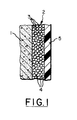
- Fig, 1 is a cross-sectional view of a masonry structure which has been coated with the crack resistant coating of this invention.
- the masonry structure 1 is coated with a crack resistant coating which is comprised of two layers. These layers are a crack absorbing layer 2 which is applied directly onto the masonry structure 1 so as to be adjacent and contiguous to it and a conventional coating layer 5 which is applied to the crack absorbing layer 2 so as to be adjacent and contiguous to it.
- the crack absorbing layer 2 is comprised of beads 3 which are essentially spherical and which are bound by a resin binder 4.
- the crack absorbing layer is applied to the masonry structure as a composition which is comprised of the beads which are homogeneously mixed throughout a resin binder solution having a viscosity of from 0.5 to 10 poise at 10,000 seconds ⁇ 1 and a Brookfield viscosity of at least 600 poise at 10 rpm (revolutions per minute).
- This composition has a consistency that allows it to be troweled onto a vertical masonry structure, such as a wall. It is important for this composition to have a consistency that is thick enough to keep it from running after application to a vertical masonry structure. It is preferred for the resin binder solution to have a viscosity ranging from 2 to 6 poise at 10,000 seconds ⁇ 1 and a Brookfield viscosity of about 750 poise at 10 rpm.
- the resin binder It is important for the resin binder to exhibit sufficient flexibility to allow a degree of rolling action between the beads in order to absorb cracks which form in the masonry structure. It is also important for the resin binder to exhibit sufficient adhesive properties so as to hold the beads together as well as holding the crack absorbing layer to the masonry structure.
- Copolymers of vinyl-substituted aromatic monomers and acrylates are used as resin binders in the practice of this invention.
- the most common acrylates used in these copolymers are 2-ethylhexylacrylate, isobutyl methylacrylate, and methyl methacrylate.
- the monomer ratio of vinyl-substituted aromatic monomers to acrylate monomers in these copolymers can vary greatly. However, in most cases, such copolymers which are used as resin binders will contain from 15 weight percent to 60 weight percent acrylate monomer and from 40 weight percent to 85 weight percent vinyl-substituted aromatic monomer.
- Such resins are commercially available from a variety of sources and include PlioliteTM AC-4 and PlioliteTM AC-80 which are sold by The Goodyear Tire & Rubber Company.
- plasticizers in the binder resin in order to attain the properties which are desired.
- Numerous plasticizers can be used for this purpose.
- Some commonly used plasticizers include halogenated paraffins (particularly chlorinated paraffins), butyl stearate, dibutyl maleate, dibutyl phthalate, dibutyl sebacate, diethyl malonate, dimethyl phthalate, dioctyl adipate, dioctyl phthalate, ethyl cinnamate, methyl oleate, tricresyl phosphate, trimethyl phosphate, tributyl phosphate and trioctyl adipate.
- Persons skilled in the art will be able to select the type and amount of plasticizers needed in order to attain the requisite combination of properties needed in the binder resin.
- the resin binder is dissolved in a suitable solvent in order for the beads to be mixed throughout it for application to the masonry structure.
- a suitable solvent for the particular binder resin being used.
- Some solvents which are commonly used for this purpose include white mineral spirits (containing pure aliphatic or aromatic solvents or blends of both), methylene chloride, ethylene chloride, trichloroethane, chlorobenzene, acetone, methyl ethyl ketone, methyl isobutyl ketone, methyl isoamyl ketone, diisobutyl ketone, ethyl acetate, propyl acetate, butyl acetate, isobutyl isobutyrate, benzene, toluene, xylene, ethyl benzene, cyclohexanone, and carbon tetrachloride.
- Water can also be used in conjunction with an appropriate emulsifier as a medium in which the binder resin can be dispersed.
- an aqueous resin binder dispersion can be used as a medium through which the beads can be homogeneously mixed for application to the masonry structure.
- the resin binder solution or aqueous resin binder dispersion may further contain a thickener in order to attain a viscosity which is in the required range.
- thickeners can be either organic or mineral.
- hydrogenated castor oil, clay, or hydroxy ethyl cellulose can be used as the thickener.
- Certain resin binders will not require the employment of any external thickeners. For instance, in cases where PlioliteTM AC-4 is used as the resin binder no external thickeners are required in order to attain the necessary Brookfield viscosity for the resin binder solution.
- the beads which are mixed throughout the resin binder solution can be solid or cellular and can have a diameter ranging from about 1 mm (millimeter) to about 6 mm. It will generally be preferred for these beads to have a diameter ranging from 2 mm to 4 mm.
- suitable beads include solid glass beads, cellular (blown) glass beads, and expanded polystyrene beads.
- a particular advantage offered by cellular glass beads and expanded polystyrene beads is their ability to improve thermal insulation.
- the final coating layer is essentially a conventional paint or coating which is applied to the crack absorbing layer.
- the conventional coating layer is adjacent and contiguous to the crack absorbing layer.
- the crack absorbing layer will protect the final coating layer (conventional coating layer) from cracks which form in the masonry structure.
- the crack absorbing layer absorbs cracks rather than transmitting them to the outer coating which in this case is the conventional coating layer.
- the crack absorbing layer can protect the final coating layer from cracks as large as 5 mm in width which form in the masonry structure.
- the degree of protection provided by the crack absorbing layer from cracking in the masonry structure is somewhat dependent upon its thickness. Thicker crack absorbing layers naturally provide a higher degree of protection for the final coating layer than do thinner crack absorbing layers. Normally the crack absorbing layer will have a thickness ranging from about 0.3 to about 3 centimeters. More commonly, the crack absorbing layer will have a thickness ranging from 1 to 2 centimeters.
- the resin binder used was PlioliteTM AC-4 which is sold by The Goodyear Tire & Rubber Company.
- the solvent used for making the resin binder solution was white mineral spirits which contained about 50% to 60% aromatics.
- the resin binder solution also contained a chlorinated paraffin plasticizer.
- the total solids content of the resin binder solution was 20% with it containing 15% binder resin and 5% plasticizer.
- the beads used in the crack absorbing layer were ExpanverTM cellular glass beads having an average diameter of about 0.4 cm.
- the crack absorbing layer was then coated with a conventional decorative thick coating which contained a white pigment.
- the coating was then allowed to dry or "set-up".
- the two pieces of coated asbestos sheeting were then pulled apart to a distance of 5 mm.
- the crack absorbing layer was stretched to absorb a 5 mm crack.
- the outside coating did not crack.
- This experiment shows that this crack resistant coating will not crack even when the masonry structure it is coating develops a 5 mm crack.
- the crack absorbing layer absorbed the 5 mm crack, and it was not transmitted through the final coating layer.
Landscapes
- Engineering & Computer Science (AREA)
- Chemical & Material Sciences (AREA)
- Ceramic Engineering (AREA)
- Architecture (AREA)
- Structural Engineering (AREA)
- Materials Engineering (AREA)
- Organic Chemistry (AREA)
- Chemical Kinetics & Catalysis (AREA)
- Electrochemistry (AREA)
- Mechanical Engineering (AREA)
- Civil Engineering (AREA)
- Paints Or Removers (AREA)
- Laminated Bodies (AREA)
- Finishing Walls (AREA)
- Panels For Use In Building Construction (AREA)
Claims (10)
- Procédé destiné à recouvrir une structure de maçonnerie à l'aide d'un enduit résistant aux fissures, caractérisé par le fait (1) d'appliquer une couche absorbant les fissures sur la structure de maçonnerie, dans lequel on applique la couche absorbant les fissures sous la forme d'une solution de liant résinique ayant une viscosité de 0,05 à 1 Pa.s (0,5 à 10 poises) à 10.000 secondes⁻¹ et une viscosité de Brookfield d'au moins 60 Pa.s (600 poises) à 10 tours/minute, et dans lequel la solution de liant résinique contient une résine copolymère qui comprend de 15 pour cent en poids à 60 pour cent en poids de monomères d'acrylate et de 40 pour cent en poids à 85 pour cent en poids de monomères aromatiques substitués par un groupe vinyle ; dans lequel la solution de liant résinique contient des perles qui sont essentiellement de structure sphérique, et (2) appliquer une couche d'enduit sur la couche absorbant les fissures, dans lequel la couche absorbant les fissures manifeste une flexibilité suffisante pour permettre aux perles de mettre en oeuvre un certain degré de roulement, permettant ainsi d'absorber les fissures qui se forment dans la structure de maçonnerie.
- Procédé selon la revendication 1, caractérisé en ce que le liant résinique contient, en outre, un plastifiant.
- Procédé selon la revendication 1 ou 2, caractérisé en ce que les perles ont un diamètre de 1 mm à 6 mm.
- Procédé selon la revendication 2 ou 3, lorsqu'il dépend de la revendication 2, caractérisé en ce que le plastifiant est une paraffine chlorée.
- Procédé selon la revendication 1, caractérisé en ce que les perles sont des perles de verre cellulaire.
- Procédé selon la revendication 1, caractérisé en ce que les perles sont des perles de polystyrène expansé.
- Procédé selon la revendication 1, caractérisé en ce que la couche absorbant les fissures a une épaisseur de 0,3 à 3 cm.
- Procédé selon la revendication 1, caractérisé en ce que la couche absorbant les fissures a une épaisseur entre 1 et 2 cm et en ce que les perles ont un diamètre entre 2 mm et 4 mm.
- Procédé selon la revendication 1, caractérisé en ce que la solution de liant résinique a une viscosité allant de 2 à 6 poises à 10.000 sec.⁻¹ et une viscosité de Brookfield d'environ 750 poises à 10 tours/minute.
- Procédé selon la revendication 1, caractérisé en ce que le liant résinique est un copolymère d'un ou de plusieurs monomères aromatiques substitués par un groupe vinyle et d'un ou de plusieurs monomères d'acrylate.
Priority Applications (1)
| Application Number | Priority Date | Filing Date | Title |
|---|---|---|---|
| AT85630130T ATE72812T1 (de) | 1984-08-31 | 1985-08-21 | Verfahren zur verhuellung von mauerwerkstrukturen. |
Applications Claiming Priority (2)
| Application Number | Priority Date | Filing Date | Title |
|---|---|---|---|
| US645989 | 1984-08-31 | ||
| US06/645,989 US4562109A (en) | 1984-08-31 | 1984-08-31 | Crack resistant coating for masonry structures and process for applying same |
Publications (3)
| Publication Number | Publication Date |
|---|---|
| EP0173636A2 EP0173636A2 (fr) | 1986-03-05 |
| EP0173636A3 EP0173636A3 (en) | 1987-08-26 |
| EP0173636B1 true EP0173636B1 (fr) | 1992-02-26 |
Family
ID=24591284
Family Applications (1)
| Application Number | Title | Priority Date | Filing Date |
|---|---|---|---|
| EP19850630130 Expired - Lifetime EP0173636B1 (fr) | 1984-08-31 | 1985-08-21 | Procédé pour recouvrir des structures de maçonnerie |
Country Status (17)
| Country | Link |
|---|---|
| US (3) | US4562109A (fr) |
| EP (1) | EP0173636B1 (fr) |
| JP (1) | JPS6172695A (fr) |
| KR (1) | KR930002373B1 (fr) |
| AR (1) | AR244376A1 (fr) |
| AT (1) | ATE72812T1 (fr) |
| AU (1) | AU567860B2 (fr) |
| BR (1) | BR8503955A (fr) |
| CA (1) | CA1254335A (fr) |
| DE (1) | DE3585421D1 (fr) |
| DK (1) | DK165318C (fr) |
| FI (1) | FI82944C (fr) |
| IL (1) | IL76125A (fr) |
| NO (1) | NO853425L (fr) |
| PT (1) | PT80982B (fr) |
| TR (1) | TR23283A (fr) |
| ZA (1) | ZA856294B (fr) |
Families Citing this family (27)
| Publication number | Priority date | Publication date | Assignee | Title |
|---|---|---|---|---|
| US4882219A (en) * | 1984-08-31 | 1989-11-21 | The Goodyear Tire & Rubber Company | Crack resistant coating for masonry structures |
| US4562109A (en) * | 1984-08-31 | 1985-12-31 | The Goodyear Tire & Rubber Company | Crack resistant coating for masonry structures and process for applying same |
| JPS6344066A (ja) * | 1986-08-07 | 1988-02-25 | 株式会社 ラザ− | 合成樹脂製の塗り材料のための下地材 |
| US4786531A (en) * | 1987-12-07 | 1988-11-22 | Hodson James V | Deep penetrating water resistant sealer composition, its preparation and use |
| WO1989009196A1 (fr) * | 1988-03-30 | 1989-10-05 | Hans Dietrich Sulzer | Liant pour granules poreux hydrophiles |
| US5116647A (en) * | 1988-09-12 | 1992-05-26 | W. R. Grace & Co.-Conn. | Methods for water proofing wet structures formed from water-penetrable construction materials |
| US5330795A (en) * | 1991-02-01 | 1994-07-19 | H. B. Fuller Licensing & Financing | Emulsion based coatings and a method using an emulsion based coating to seal asbestos containing soils |
| DE4121457C2 (de) * | 1991-06-28 | 1997-02-13 | Dyckerhoff Ag | Anordnung und Verfahren zum Dämmen und Dichten von Fugen aufweisenden Bauwerksfassaden |
| US5416142A (en) * | 1991-12-17 | 1995-05-16 | Oatey Company | Method of bonding and bonding compositions |
| CA2083676A1 (fr) * | 1991-12-17 | 1993-06-18 | Paul E. Naton | Compositions contenant des microspheres creuses |
| CA2085940A1 (fr) * | 1992-11-30 | 1994-05-31 | John H. Gaveske | Procede d'hydrofugation de materiaux de construction rigides |
| US5736197A (en) * | 1992-11-30 | 1998-04-07 | Poly-Wall International, Inc. | Method of waterproofing rigid structural materials |
| DE4323476A1 (de) * | 1993-07-14 | 1995-01-19 | Steag Kernenergie Gmbh | Stoßdämpfende Anordnung und Verfahren zu ihrer Herstellung |
| US5576065A (en) * | 1995-02-03 | 1996-11-19 | Poly Wall International, Inc. | Multilayered system for waterproofing rigid structural materials |
| US5600930A (en) * | 1995-04-10 | 1997-02-11 | Drucker; Ernest R. | Construction system using lightweight fire-resistant panels |
| US5556668A (en) * | 1995-07-13 | 1996-09-17 | Victory Concept Industries, Ltd. | Rubberized paint coating process |
| US5576062A (en) * | 1995-07-25 | 1996-11-19 | Polywall International, Inc. | Chemically resistant coating for concrete and masonry structures |
| IT1293153B1 (it) * | 1997-02-04 | 1999-02-12 | Dario Toncelli | Procedimento per il risanamento di lastre fessurate. |
| US6025032A (en) * | 1998-03-03 | 2000-02-15 | Poly Wall International, Inc. | Method and composition for waterproofing |
| AU4809000A (en) | 1999-05-04 | 2000-11-17 | Protective Coatings Technology, Inc. | Method and composition for waterproofing |
| US20040059036A1 (en) * | 2002-09-23 | 2004-03-25 | Gaveske John H. | Method and composition for waterproofing |
| US6689236B1 (en) * | 2003-03-20 | 2004-02-10 | Autoliv Asp, Inc. | Binder matrix for gas generants and related compositions and methods |
| WO2007053119A1 (fr) * | 2005-11-04 | 2007-05-10 | National University Of Singapore | Procede d'application de milieu de revetement et panneau preforme |
| WO2009012581A1 (fr) * | 2007-07-23 | 2009-01-29 | Arne Wallin | Carreau de sol composite pré-moulé modulaire et système de plancher |
| CN104136694A (zh) | 2012-01-16 | 2014-11-05 | 塞维索制造股份公司 | 多功能结构及其制造方法 |
| NL2014985B1 (nl) | 2014-06-20 | 2016-12-06 | Ceves-Vergeer B V | Droog mortelmengsel met korrels van geëxpandeerd glas. |
| CN107963911A (zh) * | 2017-12-14 | 2018-04-27 | 吴海 | 一种高反射隔热保温的混凝土加气砖及其制备方法 |
Family Cites Families (33)
| Publication number | Priority date | Publication date | Assignee | Title |
|---|---|---|---|---|
| CA563840A (fr) * | 1958-09-23 | H. Russell Alexander | Methode de production d'unites enduites de construction de maconnerie | |
| CA817472A (en) * | 1969-07-08 | T. Metters Norman | Method of filling cracks | |
| US2367536A (en) * | 1940-09-24 | 1945-01-16 | Congoleum Nairn Inc | Covering structure |
| US2824502A (en) * | 1954-09-15 | 1958-02-25 | Prismo Safety Corp | Highway marking composition containing glass beads and process for making and using same |
| US2897732A (en) * | 1955-12-22 | 1959-08-04 | Baltimore Paint & Color Works | Highway marker comprising unsaturated alkyd resin and glass beads and method of making same |
| US3036928A (en) * | 1959-12-18 | 1962-05-29 | Cataphote Corp | Retroreflective composition and method of applying same |
| US3230184A (en) * | 1962-03-06 | 1966-01-18 | Standard Oil Co | Glass microsphere and fiber filled polyester resin composition |
| US3418896A (en) * | 1967-02-03 | 1968-12-31 | Prismo Safety Corp | Reflective markers and reflective elements therefor |
| US3553002A (en) * | 1967-07-31 | 1971-01-05 | Nasa | Thermal protection ablation spray system |
| US3652486A (en) * | 1968-11-13 | 1972-03-28 | Ren Plastics Inc | Carvable epoxy resin compositions |
| SU430129A1 (ru) * | 1970-10-22 | 1974-05-30 | В. В. Барановский, О. А. Ситникова , В. И. Смирнова | ЭЛЕКТРОИЗОЛЯЦИОННЫЙ СОСТАВ <|д ттт |
| US3873475A (en) * | 1971-09-01 | 1975-03-25 | Minnesota Mining & Mfg | Composition for filling, patching and the like |
| US4108806A (en) * | 1971-12-06 | 1978-08-22 | The Dow Chemical Company | Thermoplastic expandable microsphere process and product |
| US4248752A (en) * | 1972-06-23 | 1981-02-03 | The Carborundum Company | Refractory moldable composition |
| JPS49108808A (fr) * | 1973-02-17 | 1974-10-16 | ||
| DE2536319C3 (de) * | 1975-08-14 | 1981-11-19 | Rudolf 8019 Moosach Hinterwaldner | Härtbare Masse und Verfahren zu deren Härtung |
| US4082427A (en) * | 1974-07-02 | 1978-04-04 | Fukuoka Tokushu Garasu Kabushiki Kaisha | High refractive index glass compositions |
| FR2307092A1 (fr) * | 1975-04-07 | 1976-11-05 | Bonnal Et Cie Renaulac | Perfectionnement apporte aux enduits de facade, en vue d'ameliorer l'isolation thermique des batiments |
| SE423229B (sv) * | 1975-11-14 | 1982-04-26 | Bfg Glassgroup | Material- komposition omfattande cellulera kroppar fordelade i ett bindemedel eller i ett herdbart eller herdat material |
| US4053448A (en) * | 1976-06-21 | 1977-10-11 | Arthur William Holle | Polyester based patching composition |
| IT1089605B (it) * | 1976-10-18 | 1985-06-18 | Italiana Petroli | Materiali e strutture per isolamenti termici ed acustici e procedimenti per la loro preparazione |
| US4168113A (en) * | 1977-07-05 | 1979-09-18 | American Optical Corporation | Glass lens with ion-exchanged antireflection coating and process for manufacture thereof |
| DE2731175C3 (de) * | 1977-07-09 | 1980-12-11 | Hoechst Ag, 6000 Frankfurt | Pigmentzubereitungen |
| DE2938874A1 (de) * | 1979-09-26 | 1981-04-09 | Bayer Ag, 5090 Leverkusen | Flammwidrige schaeumbare formmassen |
| DE2939141C2 (de) * | 1979-09-27 | 1982-07-08 | Basf Farben + Fasern Ag, 2000 Hamburg | Verwendung von Beschichtungsmassen |
| JPS56106237A (en) * | 1980-01-29 | 1981-08-24 | Matsushita Electric Ind Co Ltd | Transmissive screen and its manufacture |
| US4403048A (en) * | 1980-08-08 | 1983-09-06 | T C Manufacturing Company | Corrosion-resistant coating composition containing hollow microballoons |
| DK158210C (da) * | 1980-09-25 | 1990-09-03 | Grace W R & Co | Anvendelse af en latex af en gummiagtig polymer til forsegling af et beholderlukke |
| GB2084601B (en) * | 1980-09-25 | 1984-09-05 | Grace W R & Co | Sealing compositions |
| US4447491A (en) * | 1981-06-17 | 1984-05-08 | Imperial Chemical Industries Plc | Network of bonded expanded polystyrene beads having chemically delaminated vermiculite impregnant |
| US4388424A (en) * | 1981-11-05 | 1983-06-14 | Scm Corporation | Caulk containing microballoons |
| AU555809B2 (en) * | 1983-12-09 | 1986-10-09 | Onoda Corp. | Method for repairing and restoring deteriorated cement- containing inorganic material |
| US4562109A (en) * | 1984-08-31 | 1985-12-31 | The Goodyear Tire & Rubber Company | Crack resistant coating for masonry structures and process for applying same |
-
1984
- 1984-08-31 US US06/645,989 patent/US4562109A/en not_active Expired - Lifetime
-
1985
- 1985-06-17 CA CA000484132A patent/CA1254335A/fr not_active Expired
- 1985-08-09 AR AR30132985A patent/AR244376A1/es active
- 1985-08-16 TR TR3580285A patent/TR23283A/xx unknown
- 1985-08-18 IL IL7612585A patent/IL76125A/xx not_active IP Right Cessation
- 1985-08-19 ZA ZA856294A patent/ZA856294B/xx unknown
- 1985-08-19 FI FI853175A patent/FI82944C/fi not_active IP Right Cessation
- 1985-08-19 BR BR8503955A patent/BR8503955A/pt not_active IP Right Cessation
- 1985-08-19 PT PT8098285A patent/PT80982B/pt not_active IP Right Cessation
- 1985-08-21 DE DE8585630130T patent/DE3585421D1/de not_active Expired - Fee Related
- 1985-08-21 EP EP19850630130 patent/EP0173636B1/fr not_active Expired - Lifetime
- 1985-08-21 AT AT85630130T patent/ATE72812T1/de not_active IP Right Cessation
- 1985-08-30 DK DK397685A patent/DK165318C/da not_active IP Right Cessation
- 1985-08-30 JP JP60191793A patent/JPS6172695A/ja active Granted
- 1985-08-30 AU AU46920/85A patent/AU567860B2/en not_active Ceased
- 1985-08-30 KR KR1019850006318A patent/KR930002373B1/ko not_active Expired - Fee Related
- 1985-08-30 NO NO853425A patent/NO853425L/no unknown
- 1985-09-03 US US06/771,746 patent/US4634724A/en not_active Expired - Lifetime
-
1986
- 1986-12-22 US US06/944,082 patent/US4804693A/en not_active Expired - Lifetime
Also Published As
| Publication number | Publication date |
|---|---|
| US4634724A (en) | 1987-01-06 |
| DK165318C (da) | 1993-04-05 |
| JPH0364475B2 (fr) | 1991-10-07 |
| FI82944C (fi) | 1991-05-10 |
| IL76125A0 (en) | 1985-12-31 |
| PT80982A (en) | 1985-08-30 |
| FI82944B (fi) | 1991-01-31 |
| DK165318B (da) | 1992-11-09 |
| AU567860B2 (en) | 1987-12-03 |
| IL76125A (en) | 1991-06-10 |
| DK397685D0 (da) | 1985-08-30 |
| CA1254335A (fr) | 1989-05-16 |
| AR244376A1 (es) | 1993-10-29 |
| FI853175A0 (fi) | 1985-08-19 |
| AU4692085A (en) | 1986-03-06 |
| ZA856294B (en) | 1986-03-26 |
| NO853425L (no) | 1986-03-03 |
| JPS6172695A (ja) | 1986-04-14 |
| FI853175L (fi) | 1986-03-01 |
| TR23283A (tr) | 1989-08-28 |
| DK397685A (da) | 1986-03-01 |
| KR930002373B1 (ko) | 1993-03-29 |
| PT80982B (pt) | 1987-09-30 |
| EP0173636A3 (en) | 1987-08-26 |
| BR8503955A (pt) | 1986-06-03 |
| EP0173636A2 (fr) | 1986-03-05 |
| US4804693A (en) | 1989-02-14 |
| US4562109A (en) | 1985-12-31 |
| KR860001922A (ko) | 1986-03-24 |
| ATE72812T1 (de) | 1992-03-15 |
| DE3585421D1 (de) | 1992-04-02 |
Similar Documents
| Publication | Publication Date | Title |
|---|---|---|
| EP0173636B1 (fr) | Procédé pour recouvrir des structures de maçonnerie | |
| US4745032A (en) | Roofing and similar materials | |
| US6749920B1 (en) | High solids, low shrinkage coating | |
| US5681639A (en) | Waterproof lightweight grain-tone decorative panel | |
| US5786095A (en) | Inorganic based intumescent system | |
| US5736197A (en) | Method of waterproofing rigid structural materials | |
| US3492196A (en) | Built-up insulated structure and method | |
| US5482737A (en) | Method of waterproofing rigid structural materials | |
| EP0410065B1 (fr) | Système de sous-couche/membrane d'imperméabilisation | |
| DE19750769C2 (de) | Verfahren zum Überdecken von Asbestzementoberflächen | |
| US20100143731A1 (en) | Waterproofing coating containing light weight fillers | |
| US4735027A (en) | Coating for wallboards | |
| US4882219A (en) | Crack resistant coating for masonry structures | |
| KR930021687A (ko) | 벽이나 마루 표면을 위한 입체 표면 구조 라이닝과 구조풀을 만드는 방법 | |
| IE64217B1 (en) | A heat and sound insulating product it use and a method of manufacturing such a product | |
| JPH02311382A (ja) | 無機質板 | |
| GB2106922A (en) | Mixture of vinylidene chloride copolymer and ceramic material and method of use thereof | |
| WO1998004639A1 (fr) | Composition intumescente pour couche d'appret sur un panneau de fribragglo-ciment | |
| UA128966C2 (uk) | Ізоляційний матеріал та спосіб його виробництва | |
| US5308891A (en) | Cement based heat insulator, method of making same and structure having same | |
| JPS6047235B2 (ja) | 木質セメント板への仕上塗装材用下地剤 | |
| KR20240069357A (ko) | 건축물의 단열 방수 시공 방법 | |
| RU2159785C1 (ru) | Защитно-декоративная композиция | |
| JPH0512035Y2 (fr) | ||
| HU200208B (en) | Method for water- and vapourtight insulating coatings |
Legal Events
| Date | Code | Title | Description |
|---|---|---|---|
| PUAI | Public reference made under article 153(3) epc to a published international application that has entered the european phase |
Free format text: ORIGINAL CODE: 0009012 |
|
| 17P | Request for examination filed |
Effective date: 19850903 |
|
| AK | Designated contracting states |
Kind code of ref document: A2 Designated state(s): AT BE CH DE FR GB IT LI LU NL SE |
|
| PUAL | Search report despatched |
Free format text: ORIGINAL CODE: 0009013 |
|
| AK | Designated contracting states |
Kind code of ref document: A3 Designated state(s): AT BE CH DE FR GB IT LI LU NL SE |
|
| 17Q | First examination report despatched |
Effective date: 19890612 |
|
| GRAA | (expected) grant |
Free format text: ORIGINAL CODE: 0009210 |
|
| AK | Designated contracting states |
Kind code of ref document: B1 Designated state(s): AT BE CH DE FR GB IT LI LU NL SE |
|
| REF | Corresponds to: |
Ref document number: 72812 Country of ref document: AT Date of ref document: 19920315 Kind code of ref document: T |
|
| REF | Corresponds to: |
Ref document number: 3585421 Country of ref document: DE Date of ref document: 19920402 |
|
| ET | Fr: translation filed | ||
| ITF | It: translation for a ep patent filed | ||
| PLBE | No opposition filed within time limit |
Free format text: ORIGINAL CODE: 0009261 |
|
| STAA | Information on the status of an ep patent application or granted ep patent |
Free format text: STATUS: NO OPPOSITION FILED WITHIN TIME LIMIT |
|
| 26N | No opposition filed | ||
| ITTA | It: last paid annual fee | ||
| EPTA | Lu: last paid annual fee | ||
| EAL | Se: european patent in force in sweden |
Ref document number: 85630130.4 |
|
| PGFP | Annual fee paid to national office [announced via postgrant information from national office to epo] |
Ref country code: NL Payment date: 19950707 Year of fee payment: 11 |
|
| PGFP | Annual fee paid to national office [announced via postgrant information from national office to epo] |
Ref country code: GB Payment date: 19950711 Year of fee payment: 11 |
|
| PGFP | Annual fee paid to national office [announced via postgrant information from national office to epo] |
Ref country code: SE Payment date: 19950719 Year of fee payment: 11 |
|
| PGFP | Annual fee paid to national office [announced via postgrant information from national office to epo] |
Ref country code: AT Payment date: 19950724 Year of fee payment: 11 |
|
| PGFP | Annual fee paid to national office [announced via postgrant information from national office to epo] |
Ref country code: LU Payment date: 19950801 Year of fee payment: 11 |
|
| PGFP | Annual fee paid to national office [announced via postgrant information from national office to epo] |
Ref country code: FR Payment date: 19950814 Year of fee payment: 11 |
|
| PGFP | Annual fee paid to national office [announced via postgrant information from national office to epo] |
Ref country code: DE Payment date: 19950828 Year of fee payment: 11 |
|
| PGFP | Annual fee paid to national office [announced via postgrant information from national office to epo] |
Ref country code: BE Payment date: 19950905 Year of fee payment: 11 |
|
| PGFP | Annual fee paid to national office [announced via postgrant information from national office to epo] |
Ref country code: CH Payment date: 19951024 Year of fee payment: 11 |
|
| PG25 | Lapsed in a contracting state [announced via postgrant information from national office to epo] |
Ref country code: LU Free format text: LAPSE BECAUSE OF NON-PAYMENT OF DUE FEES Effective date: 19960821 Ref country code: GB Effective date: 19960821 Ref country code: AT Effective date: 19960821 |
|
| PG25 | Lapsed in a contracting state [announced via postgrant information from national office to epo] |
Ref country code: SE Effective date: 19960822 |
|
| PG25 | Lapsed in a contracting state [announced via postgrant information from national office to epo] |
Ref country code: LI Effective date: 19960831 Ref country code: CH Effective date: 19960831 Ref country code: BE Effective date: 19960831 |
|
| BERE | Be: lapsed |
Owner name: THE GOODYEAR TIRE & RUBBER CY Effective date: 19960831 |
|
| PG25 | Lapsed in a contracting state [announced via postgrant information from national office to epo] |
Ref country code: NL Effective date: 19970301 |
|
| REG | Reference to a national code |
Ref country code: CH Ref legal event code: PL |
|
| GBPC | Gb: european patent ceased through non-payment of renewal fee |
Effective date: 19960821 |
|
| PG25 | Lapsed in a contracting state [announced via postgrant information from national office to epo] |
Ref country code: FR Effective date: 19970430 |
|
| NLV4 | Nl: lapsed or anulled due to non-payment of the annual fee |
Effective date: 19970301 |
|
| PG25 | Lapsed in a contracting state [announced via postgrant information from national office to epo] |
Ref country code: DE Effective date: 19970501 |
|
| EUG | Se: european patent has lapsed |
Ref document number: 85630130.4 |
|
| REG | Reference to a national code |
Ref country code: FR Ref legal event code: ST |