EP0175214A2 - Alliage magnétique permanent et méthode pour sa fabrication - Google Patents
Alliage magnétique permanent et méthode pour sa fabrication Download PDFInfo
- Publication number
- EP0175214A2 EP0175214A2 EP85111177A EP85111177A EP0175214A2 EP 0175214 A2 EP0175214 A2 EP 0175214A2 EP 85111177 A EP85111177 A EP 85111177A EP 85111177 A EP85111177 A EP 85111177A EP 0175214 A2 EP0175214 A2 EP 0175214A2
- Authority
- EP
- European Patent Office
- Prior art keywords
- weight
- alloy
- coercive force
- further including
- alloy according
- Prior art date
- Legal status (The legal status is an assumption and is not a legal conclusion. Google has not performed a legal analysis and makes no representation as to the accuracy of the status listed.)
- Granted
Links
- 229910001004 magnetic alloy Inorganic materials 0.000 title claims abstract description 20
- 238000004519 manufacturing process Methods 0.000 title claims description 10
- 229910045601 alloy Inorganic materials 0.000 claims abstract description 55
- 239000000956 alloy Substances 0.000 claims abstract description 55
- QVGXLLKOCUKJST-UHFFFAOYSA-N atomic oxygen Chemical compound [O] QVGXLLKOCUKJST-UHFFFAOYSA-N 0.000 claims abstract description 38
- 229910052760 oxygen Inorganic materials 0.000 claims abstract description 38
- 239000001301 oxygen Substances 0.000 claims abstract description 38
- XEEYBQQBJWHFJM-UHFFFAOYSA-N Iron Chemical compound [Fe] XEEYBQQBJWHFJM-UHFFFAOYSA-N 0.000 claims abstract description 23
- 229910052742 iron Inorganic materials 0.000 claims abstract description 9
- 229910052761 rare earth metal Inorganic materials 0.000 claims abstract description 9
- 229910052796 boron Inorganic materials 0.000 claims abstract description 6
- ZOXJGFHDIHLPTG-UHFFFAOYSA-N Boron Chemical compound [B] ZOXJGFHDIHLPTG-UHFFFAOYSA-N 0.000 claims abstract description 5
- 229910052727 yttrium Inorganic materials 0.000 claims abstract description 5
- VWQVUPCCIRVNHF-UHFFFAOYSA-N yttrium atom Chemical compound [Y] VWQVUPCCIRVNHF-UHFFFAOYSA-N 0.000 claims abstract description 5
- 239000010936 titanium Substances 0.000 claims description 14
- 229910052719 titanium Inorganic materials 0.000 claims description 10
- 229910052782 aluminium Inorganic materials 0.000 claims description 9
- 239000000843 powder Substances 0.000 claims description 9
- 238000010298 pulverizing process Methods 0.000 claims description 8
- RTAQQCXQSZGOHL-UHFFFAOYSA-N Titanium Chemical compound [Ti] RTAQQCXQSZGOHL-UHFFFAOYSA-N 0.000 claims description 6
- XAGFODPZIPBFFR-UHFFFAOYSA-N aluminium Chemical compound [Al] XAGFODPZIPBFFR-UHFFFAOYSA-N 0.000 claims description 6
- 229910017052 cobalt Inorganic materials 0.000 claims description 6
- 239000010941 cobalt Substances 0.000 claims description 6
- GUTLYIVDDKVIGB-UHFFFAOYSA-N cobalt atom Chemical compound [Co] GUTLYIVDDKVIGB-UHFFFAOYSA-N 0.000 claims description 6
- 238000000034 method Methods 0.000 claims description 6
- 239000002245 particle Substances 0.000 claims description 6
- 238000005245 sintering Methods 0.000 claims description 5
- 239000011651 chromium Substances 0.000 claims description 4
- 229910052735 hafnium Inorganic materials 0.000 claims description 4
- 239000010955 niobium Substances 0.000 claims description 4
- 229910052804 chromium Inorganic materials 0.000 claims description 3
- 229910052750 molybdenum Inorganic materials 0.000 claims description 3
- 229910052758 niobium Inorganic materials 0.000 claims description 3
- 229910052715 tantalum Inorganic materials 0.000 claims description 3
- 229910052721 tungsten Inorganic materials 0.000 claims description 3
- 229910052726 zirconium Inorganic materials 0.000 claims description 3
- VYZAMTAEIAYCRO-UHFFFAOYSA-N Chromium Chemical compound [Cr] VYZAMTAEIAYCRO-UHFFFAOYSA-N 0.000 claims description 2
- ZOKXTWBITQBERF-UHFFFAOYSA-N Molybdenum Chemical compound [Mo] ZOKXTWBITQBERF-UHFFFAOYSA-N 0.000 claims description 2
- 238000005266 casting Methods 0.000 claims description 2
- VBJZVLUMGGDVMO-UHFFFAOYSA-N hafnium atom Chemical compound [Hf] VBJZVLUMGGDVMO-UHFFFAOYSA-N 0.000 claims description 2
- 239000011733 molybdenum Substances 0.000 claims description 2
- GUCVJGMIXFAOAE-UHFFFAOYSA-N niobium atom Chemical compound [Nb] GUCVJGMIXFAOAE-UHFFFAOYSA-N 0.000 claims description 2
- GUVRBAGPIYLISA-UHFFFAOYSA-N tantalum atom Chemical compound [Ta] GUVRBAGPIYLISA-UHFFFAOYSA-N 0.000 claims description 2
- WFKWXMTUELFFGS-UHFFFAOYSA-N tungsten Chemical compound [W] WFKWXMTUELFFGS-UHFFFAOYSA-N 0.000 claims description 2
- 239000010937 tungsten Substances 0.000 claims description 2
- 229910052720 vanadium Inorganic materials 0.000 claims description 2
- LEONUFNNVUYDNQ-UHFFFAOYSA-N vanadium atom Chemical compound [V] LEONUFNNVUYDNQ-UHFFFAOYSA-N 0.000 claims description 2
- 239000002994 raw material Substances 0.000 claims 3
- QCWXUUIWCKQGHC-UHFFFAOYSA-N Zirconium Chemical compound [Zr] QCWXUUIWCKQGHC-UHFFFAOYSA-N 0.000 claims 1
- WPBNNNQJVZRUHP-UHFFFAOYSA-L manganese(2+);methyl n-[[2-(methoxycarbonylcarbamothioylamino)phenyl]carbamothioyl]carbamate;n-[2-(sulfidocarbothioylamino)ethyl]carbamodithioate Chemical compound [Mn+2].[S-]C(=S)NCCNC([S-])=S.COC(=O)NC(=S)NC1=CC=CC=C1NC(=S)NC(=O)OC WPBNNNQJVZRUHP-UHFFFAOYSA-L 0.000 claims 1
- 239000000155 melt Substances 0.000 claims 1
- 238000002844 melting Methods 0.000 claims 1
- 230000008018 melting Effects 0.000 claims 1
- 230000004907 flux Effects 0.000 abstract description 27
- 239000000203 mixture Substances 0.000 abstract description 12
- 230000003247 decreasing effect Effects 0.000 description 16
- 239000007789 gas Substances 0.000 description 6
- 230000008569 process Effects 0.000 description 5
- 230000007423 decrease Effects 0.000 description 4
- 229910052779 Neodymium Inorganic materials 0.000 description 3
- 229910052777 Praseodymium Inorganic materials 0.000 description 3
- 230000032683 aging Effects 0.000 description 3
- 230000007547 defect Effects 0.000 description 3
- 239000011572 manganese Substances 0.000 description 3
- 230000000052 comparative effect Effects 0.000 description 2
- 230000001771 impaired effect Effects 0.000 description 2
- 230000005381 magnetic domain Effects 0.000 description 2
- 229910052748 manganese Inorganic materials 0.000 description 2
- 238000006467 substitution reaction Methods 0.000 description 2
- 229910052684 Cerium Inorganic materials 0.000 description 1
- RYGMFSIKBFXOCR-UHFFFAOYSA-N Copper Chemical compound [Cu] RYGMFSIKBFXOCR-UHFFFAOYSA-N 0.000 description 1
- 229910000640 Fe alloy Inorganic materials 0.000 description 1
- PWHULOQIROXLJO-UHFFFAOYSA-N Manganese Chemical compound [Mn] PWHULOQIROXLJO-UHFFFAOYSA-N 0.000 description 1
- 229910052772 Samarium Inorganic materials 0.000 description 1
- 230000015572 biosynthetic process Effects 0.000 description 1
- 229910052799 carbon Inorganic materials 0.000 description 1
- 230000015556 catabolic process Effects 0.000 description 1
- 230000008859 change Effects 0.000 description 1
- 239000000470 constituent Substances 0.000 description 1
- 229910052802 copper Inorganic materials 0.000 description 1
- 239000010949 copper Substances 0.000 description 1
- 230000007797 corrosion Effects 0.000 description 1
- 238000005260 corrosion Methods 0.000 description 1
- 230000000694 effects Effects 0.000 description 1
- 238000002474 experimental method Methods 0.000 description 1
- 239000010419 fine particle Substances 0.000 description 1
- 229910052732 germanium Inorganic materials 0.000 description 1
- 239000011261 inert gas Substances 0.000 description 1
- 239000000463 material Substances 0.000 description 1
- 230000007246 mechanism Effects 0.000 description 1
- QEFYFXOXNSNQGX-UHFFFAOYSA-N neodymium atom Chemical compound [Nd] QEFYFXOXNSNQGX-UHFFFAOYSA-N 0.000 description 1
- 229910001172 neodymium magnet Inorganic materials 0.000 description 1
- 229910052757 nitrogen Inorganic materials 0.000 description 1
- 229910052698 phosphorus Inorganic materials 0.000 description 1
- PUDIUYLPXJFUGB-UHFFFAOYSA-N praseodymium atom Chemical compound [Pr] PUDIUYLPXJFUGB-UHFFFAOYSA-N 0.000 description 1
- 238000002360 preparation method Methods 0.000 description 1
- 150000002910 rare earth metals Chemical class 0.000 description 1
- 238000005204 segregation Methods 0.000 description 1
- VSZWPYCFIRKVQL-UHFFFAOYSA-N selanylidenegallium;selenium Chemical compound [Se].[Se]=[Ga].[Se]=[Ga] VSZWPYCFIRKVQL-UHFFFAOYSA-N 0.000 description 1
- 229910052710 silicon Inorganic materials 0.000 description 1
- 239000010935 stainless steel Substances 0.000 description 1
- 229910001220 stainless steel Inorganic materials 0.000 description 1
- 229910052723 transition metal Inorganic materials 0.000 description 1
- 150000003624 transition metals Chemical class 0.000 description 1
- XLYOFNOQVPJJNP-UHFFFAOYSA-N water Substances O XLYOFNOQVPJJNP-UHFFFAOYSA-N 0.000 description 1
Images


Classifications
-
- H—ELECTRICITY
- H01—ELECTRIC ELEMENTS
- H01F—MAGNETS; INDUCTANCES; TRANSFORMERS; SELECTION OF MATERIALS FOR THEIR MAGNETIC PROPERTIES
- H01F1/00—Magnets or magnetic bodies characterised by the magnetic materials therefor; Selection of materials for their magnetic properties
- H01F1/01—Magnets or magnetic bodies characterised by the magnetic materials therefor; Selection of materials for their magnetic properties of inorganic materials
- H01F1/03—Magnets or magnetic bodies characterised by the magnetic materials therefor; Selection of materials for their magnetic properties of inorganic materials characterised by their coercivity
- H01F1/032—Magnets or magnetic bodies characterised by the magnetic materials therefor; Selection of materials for their magnetic properties of inorganic materials characterised by their coercivity of hard-magnetic materials
- H01F1/04—Magnets or magnetic bodies characterised by the magnetic materials therefor; Selection of materials for their magnetic properties of inorganic materials characterised by their coercivity of hard-magnetic materials metals or alloys
-
- H—ELECTRICITY
- H01—ELECTRIC ELEMENTS
- H01F—MAGNETS; INDUCTANCES; TRANSFORMERS; SELECTION OF MATERIALS FOR THEIR MAGNETIC PROPERTIES
- H01F1/00—Magnets or magnetic bodies characterised by the magnetic materials therefor; Selection of materials for their magnetic properties
- H01F1/01—Magnets or magnetic bodies characterised by the magnetic materials therefor; Selection of materials for their magnetic properties of inorganic materials
- H01F1/03—Magnets or magnetic bodies characterised by the magnetic materials therefor; Selection of materials for their magnetic properties of inorganic materials characterised by their coercivity
- H01F1/032—Magnets or magnetic bodies characterised by the magnetic materials therefor; Selection of materials for their magnetic properties of inorganic materials characterised by their coercivity of hard-magnetic materials
- H01F1/04—Magnets or magnetic bodies characterised by the magnetic materials therefor; Selection of materials for their magnetic properties of inorganic materials characterised by their coercivity of hard-magnetic materials metals or alloys
- H01F1/047—Alloys characterised by their composition
- H01F1/053—Alloys characterised by their composition containing rare earth metals
- H01F1/055—Alloys characterised by their composition containing rare earth metals and magnetic transition metals, e.g. SmCo5
- H01F1/057—Alloys characterised by their composition containing rare earth metals and magnetic transition metals, e.g. SmCo5 and IIIa elements, e.g. Nd2Fe14B
-
- H—ELECTRICITY
- H01—ELECTRIC ELEMENTS
- H01F—MAGNETS; INDUCTANCES; TRANSFORMERS; SELECTION OF MATERIALS FOR THEIR MAGNETIC PROPERTIES
- H01F1/00—Magnets or magnetic bodies characterised by the magnetic materials therefor; Selection of materials for their magnetic properties
- H01F1/01—Magnets or magnetic bodies characterised by the magnetic materials therefor; Selection of materials for their magnetic properties of inorganic materials
- H01F1/03—Magnets or magnetic bodies characterised by the magnetic materials therefor; Selection of materials for their magnetic properties of inorganic materials characterised by their coercivity
- H01F1/032—Magnets or magnetic bodies characterised by the magnetic materials therefor; Selection of materials for their magnetic properties of inorganic materials characterised by their coercivity of hard-magnetic materials
- H01F1/04—Magnets or magnetic bodies characterised by the magnetic materials therefor; Selection of materials for their magnetic properties of inorganic materials characterised by their coercivity of hard-magnetic materials metals or alloys
- H01F1/047—Alloys characterised by their composition
- H01F1/053—Alloys characterised by their composition containing rare earth metals
- H01F1/055—Alloys characterised by their composition containing rare earth metals and magnetic transition metals, e.g. SmCo5
- H01F1/057—Alloys characterised by their composition containing rare earth metals and magnetic transition metals, e.g. SmCo5 and IIIa elements, e.g. Nd2Fe14B
- H01F1/0571—Alloys characterised by their composition containing rare earth metals and magnetic transition metals, e.g. SmCo5 and IIIa elements, e.g. Nd2Fe14B in the form of particles, e.g. rapid quenched powders or ribbon flakes
- H01F1/0575—Alloys characterised by their composition containing rare earth metals and magnetic transition metals, e.g. SmCo5 and IIIa elements, e.g. Nd2Fe14B in the form of particles, e.g. rapid quenched powders or ribbon flakes pressed, sintered or bonded together
- H01F1/0577—Alloys characterised by their composition containing rare earth metals and magnetic transition metals, e.g. SmCo5 and IIIa elements, e.g. Nd2Fe14B in the form of particles, e.g. rapid quenched powders or ribbon flakes pressed, sintered or bonded together sintered
Definitions
- the present invention relates to a permanent magnetic alloy containing a rare-earth element and iron and to a method of manufacturing the same.
- a Co-containing alloy such as RC05 or R 2 (CoCuFeM) 17 (where R is a rare-earth element such as Sm or Ce and M is a transition metal such as Ti, Zr or Hf) is known as a material for a conventional rare-earth permanent magnet.
- R is a rare-earth element such as Sm or Ce and M is a transition metal such as Ti, Zr or Hf
- BH maximum energy product
- Co is relatively expensive.
- This permanent magnetic alloy is an Nd-Fe-B alloy which has a low manufacturing cost and a maximum energy product frequently exceeding 30 MGOe.
- the alloy has magnetic characteristics which vary within a wide range, in particular, a coercive force varying from 300 Oe to 10 KOe. For this reason, the alloy cannot provide stable magnetic characteristics.
- Such a drawback prevents advantageous industrial application of the alloy so that an iron alloy stable predetermined magnetic characteristics with excellent reproducibility has been desired.
- a permanent magnetic alloy according to the present invention essentially consists of 10 to 40% by weight of R, 0.1 to 8% by weight of boron, 50 to 300 ppm by weight of oxygen and the balance of iron where R is at least one component selected from yttrium and the rare-earth elements.
- the contents of R, B and 0 are set to fall within prescribed ranges.
- the present inventors conducted studies and experiments to determine the influence of oxygen concentration on magnetic characteristics. According to the results obtained, when the oxygen concentration of an alloy exceeds 300 pp m, the coercive force I H c is significantly decreased. As a result, the maximum energy product (BH) max is decreased. When the oxygen concentration is lower than 50 ppm, the pulverization time during manufacture of a permanent magnet is long and the residual magnetic flux density Br is decreased.
- An alloy having a prescribed composition according to the present invention has high coercive force I H C and residual magnetic flux density Br, and other excellent magnetic characteristics and can be manufactured easily at low cost.
- a permanent magnetic alloy according to the present invention contains 10 to 40% of R where R is at least one component selected from yttrium and rare-earth elements.
- the prescribed content of 10 to 40% described above is a total amount of R components.
- the coercive force I H C tends to decrease at high temperatures.
- the content of R is less than 10.%, the coercive force I H C of the resultant alloy is low and satisfactory magnetic characteristics as a permanent magnet cannot be obtained.
- the content of R exceeds 40%, the residual magnetic flux density Br decreases.
- the maximum energy product (BH) max is a value related to a product of the coercive force I H C and the residual magnetic flux density Br. Therefore, when either the coercive force I H C or residual magnetic flux density Br is low, the maximum energy product (BH) max is low. For these reasons, the content of R is selected to be 10 to 40% by weight.
- Nd and Pr are particularly effective in increasing the maximum energy product (BH) max
- BH maximum energy product
- selected Rs preferably include at least one of Nd and Pr.
- the content of Nd and/or Pr based on the total content of Rs is preferably 70% or more.
- B Boron
- the characteristic feature of the present invention resides in the oxygen concentration being set to fall within the range of 50 to 300 ppm.
- the present inventors have, for the first time, demonstrated the important influence of oxygen concentration on the coercive force I H C and residual magnetic flux density Br.
- Fig. 1 is a graph showing the coercive force I H C and the residual magnetic flux density Br as a function of oxygen concentration in the alloy.
- the oxygen concentration exceeds 300 ppm, the coercive force I H C is significantly decreased.
- the maximum energy product (BH) max as a maximum value of the product of the coercive force I H C and the residual magnetic flux density Br is also decreased.
- the oxygen concentration of the alloy is set to fall within the range of 50 to 300 ppm by weight.
- Influence mechanism of oxygen concentration on the magnetic characteristics of an alloy is postulated as follows.
- oxygen in the molten alloy is partially bonded with atoms of R or Fe (which is a main constituent) to form an oxide, and is segregated in grain boundaries of the alloy with the remaining oxygen.
- R or Fe which is a main constituent
- an R-Fe-B magnet is a fine particle magnet and the coercive force of such a magnet is mainly determined by a reverse magnetic domain generating magnetic field
- the alloy has defects such as an oxide and segregation, the defects become reverse magnetic domain formation sources and decrease coercive force. Therefore, when the oxygen concentration is too high, the coercive force is decreased.
- grain boundary breakdown does not occur very frequently and the pulverization performance is lowered.
- Thus if the oxygen concentration is too low, it is difficult to pulverize the alloy.
- the alloy of the present invention consists of the above-mentioned components and the balance of iron. Iron serves to increase the residual magnetic flux density.
- B can be partially substituted by C, N, Si, P, Ge or the like.
- the substitution amount can be up to 50% of the B content.
- the alloy according to the present invention basically consists of R, Fe, B and 0.
- the alloy of the present invention can additionally contain cobalt (Co), chromium (Cr), aluminum (Al), titanium (Ti), zirconium (Zr), hafnium (Hf), niobium (Nb), tantalum (Ta), vanadium (V), manganese (Mn), molybdenum (Mo), and tungsten (W).
- Co serves to increase the Curie temperature of the alloy and improve stability of magnetic characteristics against temperature change.
- Cr and Al serve to significantly improve corrosion resistance of the alloy.
- Ti, Zr, Hf, Nb, Ta, V, Mn, Mo and W serve to increase the coercive force.
- the alloy preferably contains 0.2 to 5% by weight of at least one of Ti and Al.
- Co also serves to improve thermal stability of the alloy and is preferably added in the amount of 20% by weight or less. Although addition of Co in a small amount can provide an effect of improving thermal stability, Co is preferably added in the amount of 5% by weight or more.
- a method of manufacturing a permanent magnet using a permanent magnetic alloy having such a composition will be described.
- an alloy of the above composition is prepared.
- An ingot obtained by casting the molten alloy is pulverized using a pulverizing means such as a ball mill or a jet mill.
- the alloy is pulverized to obtain an average particle size of 2 to 10 ⁇ m.
- the average particle size exceeds 10 ⁇ m, the magnetic flux density is lowered.
- the powder obtained in this manner is compressed in a predetermined shape.
- a magnetic field of about 15 KOe is applied to obtain a predetermined magnetic orientation.
- the powder compact is sintered at 1,000 to 1,200°C for 0.5 to 5 hours to obtain a sintered body.
- the compact is heated in an inert gas atmosphere such as Ar gas or in a vacuum (not more than 10 -3 Torr).
- the resultant sintered body is heated at 400 to 1,100°C for 1 to 10 hours to perform aging, thereby improving the magnetic characteristics of the alloy.
- the aging temperature differs in accordance with the composition adopted, it is preferably 550 to 1,000°C if the alloy contains Al and/or Ti.
- a permanent magnetic alloy prepared in this manner has a high coercive force I H C and residual magnetic flux density Br and therefore has a high maximum energy product (BH) max .
- the permanent magnetic alloy of the present invention has excellent magnetic characteristics.
- the present invention will be described by way of its examples below.
- the respective components were mixed in accordance with the compositions shown in Table 1 below.
- Two kilograms of each composition were melted in a water cooled copper boat in an arc furnace.
- the furnace interior was kept in an Ar gas atmosphere, and the oxygen concentration in the furnace was strictly controlled so as to adjust the oxygen concentration in the alloy.
- the permanent magnetic alloy prepared in this manner was coarsely pulverized in an Ar gas atmosphere and then finely pulverized by a stainless steel ball mill to an average particle size of 3 to 5 ⁇ m.
- the resultant fine powder was packed in a predetermined press mold and compressed at a pressure of 2 ton/cm 2 while applying a magnetic field of 20,000 Oe.
- the obtained compact was sintered in an Ar gas atmosphere at 1,080°C for 1 hour. Then, the sintered body was cooled to room temperature and was aged in a vacuum at 550°C for 1 hour. The sintered body was then rapidly cooled to room temperture.
- Table 2 shows the magnetic characteristics (the residual magnetic flux density Br, the coercive force IHC , and the maximum energy product (BH) max ) ) of the permanent magnets prepared in this manner.
- the alloys in the Examples of the present invention all have high residual magnetic flux density Br and coercive force I H C and high maximum energy product (BH) max as compared to those of alloys of Comparative Examples.
- the alloys of the Examples of the present invention have superior magnetic characteristics represented by the maximum energy product and ease in manufacture represented by pulverization time.
- Fig. 2 shows the residual magnetic flux density Br, the coercive force I H C , and the maximum energy product (BH) max as a function of oxygen concentration in the permanent magnetic alloys.
- the magnetic characteristics of the permanent magnet largely depend on the oxygen concentration in the alloy.
- the oxygen concentration is less than 0.005% by weight, orientation performance in a magnetic field is impaired.
- the residual magnetic flux density Br is also decreased.
- the oxygen concentration exceeds 0.03% by weight, the coercive force is significantly decreased. Therefore, in a composition wherein the oxygen concentration is less than 0.005% by weight or more than 0.03% by weight, a high maximum energy product (BH) max cannot be obtained.
- a permanent magnetic alloy was prepared having a composition of 33.2% by weight of Nd, 1.3% by weight of B, 14.6% by weight of Co, 0.8% by weight of Al, 0.03% by weight of oxygen and the balance of iron.
- the resultant permanent magnetic alloy was pulverized, compressed and sintered in a similar manner.
- the sintered alloy was aged at 600°C for 1 hour and was thereafter rapidly cooled.
- the alloy had a coercive force I H C of 11 KOe, a maximum energy product (BH) max of 35 MGOe and a Br temperature coefficient of -0.07%/°C.
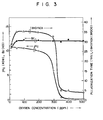
- Respective components were mixed in the amounts of 33% by weight of Nd, 1.3% by weight of B, 1.5% by weight of Ti, and the balance of Fe to prepare alloys having different oxygen concentrations.
- Each compact of the powder was prepared in a similar manner to that described above.
- the resultant compact was sintered in an Ar gas atmosphere at 1,080°C for 1 hour and was rapidly cooled to room temperature. Thereafter, aging was performed in a vacuum at 800°C for 1 hour and the sintered body was again rapidly cooled to room temperature.
- Fig. 3 shows the residual magnetic flux density Br, the coercive force I H C , and the maximum energy product (BH) max as a function of oxygen concentration in the permanent magnetic alloy.
- the magnetic characteristics of the permanent magnet largely depend on the oxygen concentration in the alloy.
- the oxygen concentration is less than 0.005% by weight, since the orientation performance of the magnet in a magnetic field is degraded, the residual magnetic flux density Br is decreased.
- the oxygen concentration exceeds 0.03% by weight, the coercive force is considerably decreased. Therefore, with a composition wherein the oxygen concentration is below 0.005% by weight or exceeds 0.03% by weight, the coercive force is much impaired. With such a composition, a high maximum energy product (BH) max cannot be obtained.
- a permanent magnetic alloy was prepared which had a composition consisting of 33% by weight of Nd, 1.1% by weight of B, 14.0% by weight of Co, 2.3% by weight of Ti, 0.03% by weight of 0 and the balance of Fe.
- the resultant permanent magnetic alloy was pulverized, compressed and sintered in a similar manner to that described above.
- the sample after sintering was aged at 800°C and was rapidly cooled.
- the maximum energy product of the sintered body was found to be 38 MGOe.
- the sintered body had a Br temperature coefficient of -0.07%/°C.
Landscapes
- Engineering & Computer Science (AREA)
- Power Engineering (AREA)
- Chemical & Material Sciences (AREA)
- Crystallography & Structural Chemistry (AREA)
- Inorganic Chemistry (AREA)
- Hard Magnetic Materials (AREA)
Applications Claiming Priority (6)
| Application Number | Priority Date | Filing Date | Title |
|---|---|---|---|
| JP59191810A JPS6169945A (ja) | 1984-09-14 | 1984-09-14 | 永久磁石合金及び永久磁石の製造方法 |
| JP191810/84 | 1984-09-14 | ||
| JP66848/85 | 1985-03-30 | ||
| JP60066849A JPS61227150A (ja) | 1985-03-30 | 1985-03-30 | 永久磁石合金及び永久磁石の製造方法 |
| JP66849/85 | 1985-03-30 | ||
| JP60066848A JPS61227151A (ja) | 1985-03-30 | 1985-03-30 | 永久磁石合金及び永久磁石の製造方法 |
Publications (4)
| Publication Number | Publication Date |
|---|---|
| EP0175214A2 true EP0175214A2 (fr) | 1986-03-26 |
| EP0175214A3 EP0175214A3 (en) | 1987-05-13 |
| EP0175214B1 EP0175214B1 (fr) | 1990-05-09 |
| EP0175214B2 EP0175214B2 (fr) | 1993-12-29 |
Family
ID=27299280
Family Applications (1)
| Application Number | Title | Priority Date | Filing Date |
|---|---|---|---|
| EP85111177A Expired - Lifetime EP0175214B2 (fr) | 1984-09-14 | 1985-09-04 | Alliage magnétique permanent et méthode pour sa fabrication |
Country Status (4)
| Country | Link |
|---|---|
| US (3) | US4664724A (fr) |
| EP (1) | EP0175214B2 (fr) |
| KR (1) | KR900001477B1 (fr) |
| DE (1) | DE3577618D1 (fr) |
Cited By (4)
| Publication number | Priority date | Publication date | Assignee | Title |
|---|---|---|---|---|
| US4827235A (en) * | 1986-07-18 | 1989-05-02 | Kabushiki Kaisha Toshiba | Magnetic field generator useful for a magnetic resonance imaging instrument |
| EP0289680A3 (en) * | 1987-04-30 | 1990-06-06 | Seiko Epson Corporation | Permanent magnet and method of producing the same |
| US5017247A (en) * | 1988-12-26 | 1991-05-21 | Aichi Steel Works, Limited | Rare earth magnet alloy |
| US5538565A (en) * | 1985-08-13 | 1996-07-23 | Seiko Epson Corporation | Rare earth cast alloy permanent magnets and methods of preparation |
Families Citing this family (31)
| Publication number | Priority date | Publication date | Assignee | Title |
|---|---|---|---|---|
| EP0248981B1 (fr) * | 1986-06-12 | 1993-07-07 | Kabushiki Kaisha Toshiba | Aimant permanent et alliage magnétique permanent |
| JPS6324030A (ja) * | 1986-06-26 | 1988-02-01 | Res Dev Corp Of Japan | 異方性希土類磁石材料およびその製造方法 |
| DE3750367T2 (de) * | 1987-04-30 | 1994-12-08 | Seiko Epson Corp | Dauermagnet und sein Herstellungsverfahren. |
| US5186761A (en) * | 1987-04-30 | 1993-02-16 | Seiko Epson Corporation | Magnetic alloy and method of production |
| US5460662A (en) * | 1987-04-30 | 1995-10-24 | Seiko Epson Corporation | Permanent magnet and method of production |
| US4806155A (en) * | 1987-07-15 | 1989-02-21 | Crucible Materials Corporation | Method for producing dysprosium-iron-boron alloy powder |
| US5002351A (en) * | 1988-07-05 | 1991-03-26 | Preformed Line Products Company | Fusion splicer for optical fibers |
| US4920009A (en) * | 1988-08-05 | 1990-04-24 | General Motors Corporation | Method for producing laminated bodies comprising an RE-FE-B type magnetic layer and a metal backing layer |
| US5240513A (en) * | 1990-10-09 | 1993-08-31 | Iowa State University Research Foundation, Inc. | Method of making bonded or sintered permanent magnets |
| US5228620A (en) * | 1990-10-09 | 1993-07-20 | Iowa State University Research Foundtion, Inc. | Atomizing nozzle and process |
| US5242508A (en) * | 1990-10-09 | 1993-09-07 | Iowa State University Research Foundation, Inc. | Method of making permanent magnets |
| US5125574A (en) * | 1990-10-09 | 1992-06-30 | Iowa State University Research Foundation | Atomizing nozzle and process |
| JPH04337604A (ja) * | 1991-05-14 | 1992-11-25 | Seiko Instr Inc | 希土類鉄系永久磁石 |
| FR2686730B1 (fr) * | 1992-01-23 | 1994-11-04 | Aimants Ugimag Sa | Methode de reglage de l'induction remanente d'un aimant fritte et produit ainsi obtenu. |
| US5454998A (en) * | 1994-02-04 | 1995-10-03 | Ybm Technologies, Inc. | Method for producing permanent magnet |
| JP3779404B2 (ja) * | 1996-12-05 | 2006-05-31 | 株式会社東芝 | 永久磁石材料、ボンド磁石およびモータ |
| US6332933B1 (en) | 1997-10-22 | 2001-12-25 | Santoku Corporation | Iron-rare earth-boron-refractory metal magnetic nanocomposites |
| TW493185B (en) | 1998-07-13 | 2002-07-01 | Santoku Inc | High performance iron-rare earth-boron-refractory-cobalt nanocomposites |
| US6669788B1 (en) * | 1999-02-12 | 2003-12-30 | General Electric Company | Permanent magnetic materials of the Fe-B-R tpe, containing Ce and Nd and/or Pr, and process for manufacture |
| US6261515B1 (en) | 1999-03-01 | 2001-07-17 | Guangzhi Ren | Method for producing rare earth magnet having high magnetic properties |
| WO2001091139A1 (fr) | 2000-05-24 | 2001-11-29 | Sumitomo Special Metals Co., Ltd. | Aimant permanent a plusieurs phases ferromagnetiques et procede de production |
| US6648984B2 (en) | 2000-09-28 | 2003-11-18 | Sumitomo Special Metals Co., Ltd. | Rare earth magnet and method for manufacturing the same |
| US7217328B2 (en) * | 2000-11-13 | 2007-05-15 | Neomax Co., Ltd. | Compound for rare-earth bonded magnet and bonded magnet using the compound |
| WO2002093591A2 (fr) * | 2001-05-15 | 2002-11-21 | Sumitomo Special Metals Co., Ltd. | Aimant nanocomposite d'un alliage des terres rares a base de fer et son procede de production |
| JP4055709B2 (ja) * | 2001-07-31 | 2008-03-05 | 日立金属株式会社 | アトマイズ法によるナノコンポジット磁石の製造方法 |
| KR100535945B1 (ko) * | 2001-11-22 | 2005-12-12 | 가부시키가이샤 네오맥스 | 나노컴포지트 자석 |
| WO2004046409A2 (fr) * | 2002-11-18 | 2004-06-03 | Iowa State University Research Foundation, Inc. | Alliage a aimant permanent a performance amelioree a temperature elevee |
| US20050062572A1 (en) * | 2003-09-22 | 2005-03-24 | General Electric Company | Permanent magnet alloy for medical imaging system and method of making |
| US7485193B2 (en) * | 2004-06-22 | 2009-02-03 | Shin-Etsu Chemical Co., Ltd | R-FE-B based rare earth permanent magnet material |
| US8821650B2 (en) * | 2009-08-04 | 2014-09-02 | The Boeing Company | Mechanical improvement of rare earth permanent magnets |
| CN103177867B (zh) * | 2013-03-27 | 2015-06-17 | 山西恒立诚磁业有限公司 | 烧结钕铁硼永磁体的制备方法及装置 |
Family Cites Families (4)
| Publication number | Priority date | Publication date | Assignee | Title |
|---|---|---|---|---|
| CA1316375C (fr) * | 1982-08-21 | 1993-04-20 | Masato Sagawa | Materiaux magnetiques et aimants permanents |
| DE3379084D1 (en) | 1982-09-27 | 1989-03-02 | Sumitomo Spec Metals | Permanently magnetizable alloys, magnetic materials and permanent magnets comprising febr or (fe,co)br (r=vave earth) |
| US4601875A (en) * | 1983-05-25 | 1986-07-22 | Sumitomo Special Metals Co., Ltd. | Process for producing magnetic materials |
| US4588439A (en) * | 1985-05-20 | 1986-05-13 | Crucible Materials Corporation | Oxygen containing permanent magnet alloy |
-
1985
- 1985-09-04 DE DE8585111177T patent/DE3577618D1/de not_active Expired - Lifetime
- 1985-09-04 EP EP85111177A patent/EP0175214B2/fr not_active Expired - Lifetime
- 1985-09-06 KR KR1019850006536A patent/KR900001477B1/ko not_active Expired
- 1985-09-09 US US06/773,547 patent/US4664724A/en not_active Expired - Lifetime
-
1987
- 1987-02-06 US US07/011,609 patent/US4793874A/en not_active Expired - Lifetime
-
1988
- 1988-09-27 US US07/249,945 patent/US4878964A/en not_active Expired - Lifetime
Cited By (7)
| Publication number | Priority date | Publication date | Assignee | Title |
|---|---|---|---|---|
| US5538565A (en) * | 1985-08-13 | 1996-07-23 | Seiko Epson Corporation | Rare earth cast alloy permanent magnets and methods of preparation |
| US5560784A (en) * | 1985-08-13 | 1996-10-01 | Seiko Epson Corporation | Rare earth cast alloy permanent magnets and methods of preparation |
| US5565043A (en) * | 1985-08-13 | 1996-10-15 | Seiko Epson Corporation | Rare earth cast alloy permanent magnets and methods of preparation |
| US5597425A (en) * | 1985-08-13 | 1997-01-28 | Seiko Epson Corporation | Rare earth cast alloy permanent magnets and methods of preparation |
| US4827235A (en) * | 1986-07-18 | 1989-05-02 | Kabushiki Kaisha Toshiba | Magnetic field generator useful for a magnetic resonance imaging instrument |
| EP0289680A3 (en) * | 1987-04-30 | 1990-06-06 | Seiko Epson Corporation | Permanent magnet and method of producing the same |
| US5017247A (en) * | 1988-12-26 | 1991-05-21 | Aichi Steel Works, Limited | Rare earth magnet alloy |
Also Published As
| Publication number | Publication date |
|---|---|
| US4878964A (en) | 1989-11-07 |
| KR900001477B1 (ko) | 1990-03-12 |
| US4664724A (en) | 1987-05-12 |
| EP0175214A3 (en) | 1987-05-13 |
| US4793874A (en) | 1988-12-27 |
| EP0175214B2 (fr) | 1993-12-29 |
| EP0175214B1 (fr) | 1990-05-09 |
| KR860002840A (ko) | 1986-04-30 |
| DE3577618D1 (de) | 1990-06-13 |
Similar Documents
| Publication | Publication Date | Title |
|---|---|---|
| EP0175214B2 (fr) | Alliage magnétique permanent et méthode pour sa fabrication | |
| US5071493A (en) | Rare earth-iron-boron-based permanent magnet | |
| US5034146A (en) | Rare earth-based permanent magnet | |
| CA1315571C (fr) | Materiaux magnetiques et aimants permanents | |
| JP3997413B2 (ja) | R−Fe−B系焼結磁石及びその製造方法 | |
| EP0248981B1 (fr) | Aimant permanent et alliage magnétique permanent | |
| US4859254A (en) | Permanent magnet | |
| EP0237416B1 (fr) | Aimant permanent à base de terres rares | |
| US5230751A (en) | Permanent magnet with good thermal stability | |
| EP0476606B1 (fr) | Poudres à aimantation permanente | |
| EP0362805B1 (fr) | Aimant permanent et procédé de fabrication | |
| EP0386286B1 (fr) | Aimant permanent à base de métal de terre rare et de fer | |
| US4497672A (en) | Method for the preparation of a rare earth-cobalt based permanent magnet | |
| EP0517355A1 (fr) | Alliage magnétique permanent résistant à la corrosion et procédé pour la fabrication d'un aimant permanent à partir de cet alliage | |
| JP3126199B2 (ja) | 希土類永久磁石の製造方法 | |
| EP0510578A2 (fr) | Alliage à base de terre rare pour aimant permanent | |
| JP3298220B2 (ja) | 希土類―Fe―Nb―Ga―Al―B系焼結磁石 | |
| JP2577373B2 (ja) | 焼結型永久磁石 | |
| JPH06104108A (ja) | Nd−Fe−Co−B型焼結磁石 | |
| JP2886384B2 (ja) | R−Fe−B系永久磁石用原料粉末の製造方法 | |
| JPH06260316A (ja) | Nd−Fe−B型焼結磁石 | |
| JPS6247454A (ja) | 永久磁石合金 | |
| JPS61227151A (ja) | 永久磁石合金及び永久磁石の製造方法 | |
| JPH0897022A (ja) | 希土類磁石の製造方法 | |
| JPH0524226B2 (fr) |
Legal Events
| Date | Code | Title | Description |
|---|---|---|---|
| PUAI | Public reference made under article 153(3) epc to a published international application that has entered the european phase |
Free format text: ORIGINAL CODE: 0009012 |
|
| 17P | Request for examination filed |
Effective date: 19851001 |
|
| AK | Designated contracting states |
Kind code of ref document: A2 Designated state(s): CH DE FR LI |
|
| PUAL | Search report despatched |
Free format text: ORIGINAL CODE: 0009013 |
|
| AK | Designated contracting states |
Kind code of ref document: A3 Designated state(s): CH DE FR LI |
|
| 17Q | First examination report despatched |
Effective date: 19890317 |
|
| GRAA | (expected) grant |
Free format text: ORIGINAL CODE: 0009210 |
|
| AK | Designated contracting states |
Kind code of ref document: B1 Designated state(s): CH DE FR LI |
|
| REF | Corresponds to: |
Ref document number: 3577618 Country of ref document: DE Date of ref document: 19900613 |
|
| ET | Fr: translation filed | ||
| PLBI | Opposition filed |
Free format text: ORIGINAL CODE: 0009260 |
|
| 26 | Opposition filed |
Opponent name: VACUUMSCHMELZE GMBH, HANAU Effective date: 19910201 |
|
| PUAH | Patent maintained in amended form |
Free format text: ORIGINAL CODE: 0009272 |
|
| STAA | Information on the status of an ep patent application or granted ep patent |
Free format text: STATUS: PATENT MAINTAINED AS AMENDED |
|
| 27A | Patent maintained in amended form |
Effective date: 19931229 |
|
| AK | Designated contracting states |
Kind code of ref document: B2 Designated state(s): CH DE FR LI |
|
| REG | Reference to a national code |
Ref country code: CH Ref legal event code: AEN |
|
| ET3 | Fr: translation filed ** decision concerning opposition | ||
| REG | Reference to a national code |
Ref country code: FR Ref legal event code: D6 |
|
| PGFP | Annual fee paid to national office [announced via postgrant information from national office to epo] |
Ref country code: DE Payment date: 20040902 Year of fee payment: 20 |
|
| PGFP | Annual fee paid to national office [announced via postgrant information from national office to epo] |
Ref country code: FR Payment date: 20040908 Year of fee payment: 20 |
|
| PGFP | Annual fee paid to national office [announced via postgrant information from national office to epo] |
Ref country code: CH Payment date: 20040915 Year of fee payment: 20 |
|
| REG | Reference to a national code |
Ref country code: CH Ref legal event code: PL |