EP0175254A2 - Objet allongé raide mais pouvant être fléchi - Google Patents
Objet allongé raide mais pouvant être fléchi Download PDFInfo
- Publication number
- EP0175254A2 EP0175254A2 EP85111365A EP85111365A EP0175254A2 EP 0175254 A2 EP0175254 A2 EP 0175254A2 EP 85111365 A EP85111365 A EP 85111365A EP 85111365 A EP85111365 A EP 85111365A EP 0175254 A2 EP0175254 A2 EP 0175254A2
- Authority
- EP
- European Patent Office
- Prior art keywords
- sheets
- major axis
- article
- plane
- delineator
- Prior art date
- Legal status (The legal status is an assumption and is not a legal conclusion. Google has not performed a legal analysis and makes no representation as to the accuracy of the status listed.)
- Granted
Links
Images
Classifications
-
- E—FIXED CONSTRUCTIONS
- E01—CONSTRUCTION OF ROADS, RAILWAYS, OR BRIDGES
- E01F—ADDITIONAL WORK, SUCH AS EQUIPPING ROADS OR THE CONSTRUCTION OF PLATFORMS, HELICOPTER LANDING STAGES, SIGNS, SNOW FENCES, OR THE LIKE
- E01F13/00—Arrangements for obstructing or restricting traffic, e.g. gates, barricades ; Preventing passage of vehicles of selected category or dimensions
- E01F13/04—Arrangements for obstructing or restricting traffic, e.g. gates, barricades ; Preventing passage of vehicles of selected category or dimensions movable to allow or prevent passage
- E01F13/06—Arrangements for obstructing or restricting traffic, e.g. gates, barricades ; Preventing passage of vehicles of selected category or dimensions movable to allow or prevent passage by swinging into open position about a vertical or horizontal axis parallel to the road direction, i.e. swinging gates
-
- E—FIXED CONSTRUCTIONS
- E01—CONSTRUCTION OF ROADS, RAILWAYS, OR BRIDGES
- E01F—ADDITIONAL WORK, SUCH AS EQUIPPING ROADS OR THE CONSTRUCTION OF PLATFORMS, HELICOPTER LANDING STAGES, SIGNS, SNOW FENCES, OR THE LIKE
- E01F9/00—Arrangement of road signs or traffic signals; Arrangements for enforcing caution
- E01F9/60—Upright bodies, e.g. marker posts or bollards; Supports for road signs
- E01F9/623—Upright bodies, e.g. marker posts or bollards; Supports for road signs characterised by form or by structural features, e.g. for enabling displacement or deflection
- E01F9/627—Upright bodies, e.g. marker posts or bollards; Supports for road signs characterised by form or by structural features, e.g. for enabling displacement or deflection self-righting after deflection or displacement
- E01F9/629—Traffic guidance, warning or control posts, bollards, pillars or like upstanding bodies or structures
-
- E—FIXED CONSTRUCTIONS
- E01—CONSTRUCTION OF ROADS, RAILWAYS, OR BRIDGES
- E01F—ADDITIONAL WORK, SUCH AS EQUIPPING ROADS OR THE CONSTRUCTION OF PLATFORMS, HELICOPTER LANDING STAGES, SIGNS, SNOW FENCES, OR THE LIKE
- E01F9/00—Arrangement of road signs or traffic signals; Arrangements for enforcing caution
- E01F9/60—Upright bodies, e.g. marker posts or bollards; Supports for road signs
- E01F9/623—Upright bodies, e.g. marker posts or bollards; Supports for road signs characterised by form or by structural features, e.g. for enabling displacement or deflection
- E01F9/631—Upright bodies, e.g. marker posts or bollards; Supports for road signs characterised by form or by structural features, e.g. for enabling displacement or deflection specially adapted for breaking, disengaging, collapsing or permanently deforming when deflected or displaced, e.g. by vehicle impact
-
- F—MECHANICAL ENGINEERING; LIGHTING; HEATING; WEAPONS; BLASTING
- F16—ENGINEERING ELEMENTS AND UNITS; GENERAL MEASURES FOR PRODUCING AND MAINTAINING EFFECTIVE FUNCTIONING OF MACHINES OR INSTALLATIONS; THERMAL INSULATION IN GENERAL
- F16F—SPRINGS; SHOCK-ABSORBERS; MEANS FOR DAMPING VIBRATION
- F16F1/00—Springs
- F16F1/36—Springs made of rubber or other material having high internal friction, e.g. thermoplastic elastomers
- F16F1/42—Springs made of rubber or other material having high internal friction, e.g. thermoplastic elastomers characterised by the mode of stressing
- F16F1/422—Springs made of rubber or other material having high internal friction, e.g. thermoplastic elastomers characterised by the mode of stressing the stressing resulting in flexion of the spring
-
- F—MECHANICAL ENGINEERING; LIGHTING; HEATING; WEAPONS; BLASTING
- F16—ENGINEERING ELEMENTS AND UNITS; GENERAL MEASURES FOR PRODUCING AND MAINTAINING EFFECTIVE FUNCTIONING OF MACHINES OR INSTALLATIONS; THERMAL INSULATION IN GENERAL
- F16F—SPRINGS; SHOCK-ABSORBERS; MEANS FOR DAMPING VIBRATION
- F16F2236/00—Mode of stressing of basic spring or damper elements or devices incorporating such elements
- F16F2236/02—Mode of stressing of basic spring or damper elements or devices incorporating such elements the stressing resulting in flexion of the spring
Definitions
- the present invention is concerned with an elongated article which must display substantial resistance to distortion yet can be repeatedly deformed by bending across its major axis in the plane of its minor axis.
- Typical of such articles are highway marker posts and gate arms.
- a number of applications require an elongated article having the contradictory properties of resisting deformation by bending or twisting and yet of being able to withstand repeated flexing along its major axis.
- markers and barriers for traffic control which must be able to withstand being struck by this traffic.
- Such applications include highway delineator posts like those described in U.S. Patent Nos. 4,245,922, 4,084,914, 4,298,292 and 4,343,567, gate arms for parking lots, and legs for highway barriers.
- U.S. Patent No. 4,084,914 A channel member similar to that illustrated in U.S. Patent No. 4,245,922 is stiffened against bending or twisting in the wind by bolting a second channel to it.
- the two channels face each other rather than resting one in the other.
- the two channel members are preferably constructed of polycarbonate, a rigid thermoplastic material which can undergo substantial elastic deformation. The article requires assembly with bolts or other fasteners and it is not clear that it could withstand repeated 90° deflections without suffering permanent damage.
- the present invention concerns an elongated article which displays substantial resistance to bending or twisting but which can also be repeatedly deflected through 90° across its major axis in the plane of its minor axis without suffering permanent damage.
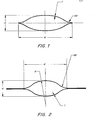
- This article comprises two joined elongated sheets of a rigid thermoplastic material which can undergo significant elastic deformation. Each sheet is formed in the shape at an arc and the arcs are joined along their longitudinal edges to form a lens-like structure in the cross section perpendicular to the major axis of the elongated article with the critical proviso that a reverse radius occurs in each longitudinal edge of each sheet immediately before its joins the longitudinal edge of the other sheet.
- this reverse radius i.e., an arc whose interior faces away from the juncture of the two sheets, is sufficient to allow at least a 90° bend in the elongated article along its major axis without significant plastic deformation occurring.
- the present invention also concerns a highway delineator which is able to withstand impact with traffic and is self erecting after deflections of 90° or more.
- the delineator comprises the elongated article described hereinabove with means for securing it to the ground adjacent to the roadway to be marked. These anchoring means may be integral with the elongated article or may be mechanically secured to it.
- the delineator should be of sufficient length that it can be adequately secured and yet project above the ground enough to be readily visible to those using the highway.
- the length, width and rigidity of the delineator should be balanced so that it is not easily deflected by anticipated wind loads, so that it can withstand several impacts by a vehicle without sustaining fracture, and so that it readily rights itself after deflection.
- a taller delineator may require a greater sheet thickness because of the greater stress on the extreme end of the delineator during deflection, especially by a fast moving vehicle. It is important to minimize the coefficient of static friction between the opposing two faces of the lens shape of the elongated shape if impact with vehicles moving at a high rate of speed are to be survived.
- the elongated article of the present invention may be prepared from any thermoplastic material which can undergo substantial elastic deformation and which also displays substantial resistance to deformation.
- thermoplastic material which can undergo substantial elastic deformation and which also displays substantial resistance to deformation.
- the material should be capable of storing sufficient elastic energy to lift the portion of the article intended to be deflected to the horizontal back to its initial vertical position.
- a material should be selected which can right the delineator after deflection by being run over by a vehicle. The precise amount of elastic strain capacity and elastic deformation resistance needed will depend on the particular design utilized and the application in which the article is used.
- thermoplastic aromatic polycarbonate resins Particular suitable materials are the thermoplastic aromatic polycarbonate resins.
- the high molecular weight resins which are based upon 2,2-bis-(4-hydroxyphenyl) propane or bisphenol A and have melt flow rates between 1 and 24, preferably between 1 and 12 grams/10 minutes per ASTM D-1238 are especially suitable.
- Such suitable resins include both homopolymers and copolymers of bisphenol A and include branched resins such as are described in U.S. Patent Nos. 3,544,514 and 4,185,009. These resins typically can sustain a strain before substantial plastic deformation occurs of about 8% and have a tensile modulus of about 3.3x10 5 psi. These materials are available in transparent form so that various indicia can readily be inserted into the hollow lens portion.
- thermoplastic engineering resins may also be suitable.
- the polyamide resins based on aliphatic dicarboxylic acids and aliphatic amines or on caprolactam are among these materials.
- nylon 6 and nylon 66 resins are also of interest.
- thermoplastic polyesters such as the polyalkylene terephthalates described in U.S. Patent 3,516957, blends of these resins with polycarbonate such as described in U.S. Patent 3,218,372 and impact modified versions of these resins such as described in U.S. Patent No. 4,297,233.
- the particular end use to which the elongated article is put may dictate further material requirements. For instance if the article is to be used as a highway delineator it will need good resistance to sudden impact over a wide temperature range and outdoor weathering. A typical test for such an application is being struck by a vehicle travelling at about 50 miles per hour. In some cases it is desired that a delineator survive ten such impacts and still retain its utility. To survive such a test it is advantageous to select a material having a fairly low coefficient of static friction or to modify the interior faces of the lens portion to display such a low coefficient by, for example, spraying them with an appropriate lubricant. The concept is to reduce the amount of stress transmitted when the two walls of the lens portion slide over each other when the article is deflected through 90°.
- thermoplastic aromatic polycarbonates which have been modified to display low blocking behavior as thin films.
- Such resins are disclosed in U.S. Patent Nos. 4,405,731 and 4,454,261 incorporated herein by reference. These materials typically have coefficients of static friction as determined by ASTM D-1894-78 of less than 10, preferably less than 5 and most preferably less than 1 for thin cast films. In this evaluation procedure the coefficient of static friction is determined between the free surfaces of two cast one mil films of the material being evaluated.
- suitable materials include other synthetic thermoplastic resin compositions which have both the necessary mechanical properties and a low coefficient of static friction between surfaces of the material.
- the lubricants which can be applied to the inner surfaces of the lens portion of the article include those dry lubricants which are typically used to enhance release in injection molding thermoplastic resins.
- a particularly suitable class of such lubricants are the silicone sprays exemplified by Muller Stephenson's MS 122 Release Agent Dry Lubricant.
- the two walls defining the lens portion of the elongated article may be joined along their lateral edges in any manner which substantially uniformly transfers stress from one to the other upon flexing or deflection of the article across its major axis in the plane of its minor axis.
- the wall on the outside of the bend typically exerts a tensile stress on the wall on the inside of the bend seeking to stretch it to an equal length and it is desirable that this tensile stress be transmitted as uniformly as possible.
- the article may be formed from two sheets, which have each been formed to contain an appropriate arc which is centrally located in the sheet, which extends across a portion of the width of the sheet and which has its apogee or top extending parallel to the major axis of the sheet.
- the sheets may be given this configuration by a variety of techniques including thermoforming and profile extrusion.
- the lateral edges of the sheets are then joined to form a longitudinally extending lens portion between them.
- solvent cementing, adhesive bonding, and welding including hot tool welding, hot gas welding, heat sealing, and ultrasonic welding. Solvent cementing has been found to be an especially good technique, particularly with polycarbonate.
- Another technique of particular interest is to simultaneously profile extrude both sheets separately but simultaneously and then bond the longitudinal edges of the two sheets by pressing them together before the articles cool below a formable temperature.
- the elongated article is created as a unitary shape.
- the lens portion is then created without the formation and joining of two separate pieces.
- the lens portion is created at the same time as the flat sheet portion.
- a particularly preferred technique is to profile extrude the elongated article. This tends to assure that a uniform bond is formed between each of the side portions in which the lens portion terminates.
- the critical features of the elongated article are that it displays stiffness similar to a cylindrical tube but yet is still able to sustain deflections of at least about 90° across its major axis in the plane of its minor axis without suffering substantial plastic deformation. It is believed that the lens portion provides the stiffness while the reverse radius provides the ability to sustain the deflection. Particularly interesting articles are obtained when the ratio between the width and the height of the lens portion is between about 2 and 4, preferably between about 2.5 and 3.5.
- This stiffness may be further enhanced by extending the area of juncture of the two walls of the lens portion perpendicular to the major axis of the article and in the plane of juncture, i.e., in such a manner that the lens portion and the juncture portions, or wings, may by dissected by a common plane. These wings need only be sufficient to prevent the article from coming apart along this common plane on deflection through 90°.
- the area of juncture required will depend on the manner of creating the joint and the material out of which the article is created.
- a preferred design for applications in which stiffness is important involves employing wings whose extension perpendicular to the major axis is between about 0.25 and 0.75 times the width (W) of the lens portion.
- a suitable reverse radius can readily be determined by experimentation. Without any reverse radius the elongated article will fail on repeated 90° flexing due to the plastic deformation which occurs in the areas of juncture. Generally a kinking of material, the extent of which will depend on the particular material of construction, will be observed at the two points where the two sides of the lens portion join. This phenomenon can be eliminated by providing a sufficient reverse radius, i.e., an arc with its interior directed away from the lens portion, in each lateral edge of both walls of the lens portion immediately adjacent to the point at which it is joined with the lateral edge of the other wall.
- the radius of this arc is preferably between about 10 and 30 times the thickness of a wall of the lens portion with a ratio between about 15 and 25 being particularly preferred.
- the highway delineator may comprise the elongated article alone or it may also include additional means for securing this article to the ground.
- the article should include some integral means for secure attachment to the ground.
- a preferred embodiment of this concept involves providing an article with wings and providing each wing with portions which each diverge from the plane of the wings by an acute angle. The vertex of each angle should generally point toward the end of the article which is to be inserted into the ground. These barbs can be readily obtained by cutting into each wing at several locations along lines pointing to this end and deflecting the portion of the wing immediately before this incision above or below the plane of the wing by an acute angle.
- the delineator may also comprise an appropriate base which can be securely fixed in the ground and which is mechanically attached to the elongated article.
Landscapes
- Engineering & Computer Science (AREA)
- Architecture (AREA)
- Civil Engineering (AREA)
- Structural Engineering (AREA)
- General Engineering & Computer Science (AREA)
- Health & Medical Sciences (AREA)
- Child & Adolescent Psychology (AREA)
- Mechanical Engineering (AREA)
- Laminated Bodies (AREA)
- Compositions Of Macromolecular Compounds (AREA)
Applications Claiming Priority (2)
| Application Number | Priority Date | Filing Date | Title |
|---|---|---|---|
| US652788 | 1984-09-20 | ||
| US06/652,788 US4621940A (en) | 1984-09-20 | 1984-09-20 | Stiff but bendable elongated plastic article |
Publications (3)
| Publication Number | Publication Date |
|---|---|
| EP0175254A2 true EP0175254A2 (fr) | 1986-03-26 |
| EP0175254A3 EP0175254A3 (en) | 1986-07-23 |
| EP0175254B1 EP0175254B1 (fr) | 1989-02-15 |
Family
ID=24618168
Family Applications (1)
| Application Number | Title | Priority Date | Filing Date |
|---|---|---|---|
| EP85111365A Expired EP0175254B1 (fr) | 1984-09-20 | 1985-09-09 | Objet allongé raide mais pouvant être fléchi |
Country Status (5)
| Country | Link |
|---|---|
| US (1) | US4621940A (fr) |
| EP (1) | EP0175254B1 (fr) |
| JP (1) | JPS6174835A (fr) |
| CA (1) | CA1293654C (fr) |
| DE (1) | DE3568291D1 (fr) |
Families Citing this family (9)
| Publication number | Priority date | Publication date | Assignee | Title |
|---|---|---|---|---|
| EP0307758B1 (fr) * | 1987-09-17 | 1992-12-16 | Miles Inc. | Boîtier de luminaire |
| US5205236A (en) * | 1991-07-26 | 1993-04-27 | Flexstake, Inc. | Stiffener core for a highway marker |
| US5238322A (en) * | 1991-11-25 | 1993-08-24 | Stirtz Ronald H | Break-resistant road marker |
| US5620277A (en) * | 1994-12-01 | 1997-04-15 | Cole, Sr.; Novice J. | Marking and anchoring apparatus |
| FR2859739B1 (fr) * | 2003-09-11 | 2005-11-11 | Pascal Lucchina | Bras mobile notamment a usage routier ou autoroutier |
| US7090429B1 (en) | 2005-08-05 | 2006-08-15 | Humphrey William D | Highway delineation unit and method of installing same |
| US20080092796A1 (en) * | 2006-10-23 | 2008-04-24 | Laivins Kenneth T | Disposable flag |
| US10531698B2 (en) | 2016-05-06 | 2020-01-14 | Hummingbird Sports, Llc | Soft athletic helmet and rear closure mechanism |
| US10959478B2 (en) | 2017-09-22 | 2021-03-30 | Hummingbird Sports, Llc | Eye protection orientation system |
Family Cites Families (30)
| Publication number | Priority date | Publication date | Assignee | Title |
|---|---|---|---|---|
| US32045A (en) * | 1861-04-16 | Improved low-water alarm for steam-boilers | ||
| BE537732A (fr) * | ||||
| US1939968A (en) * | 1930-08-09 | 1933-12-19 | Jr John Frei | Flexible post |
| FR1124813A (fr) * | 1955-05-18 | 1956-10-18 | Piquet pour clôtures, panneaux publicitaires ou analogues | |
| US3295556A (en) * | 1963-08-26 | 1967-01-03 | Laurence W Gertsma | Foldable conduit |
| US3312034A (en) * | 1964-03-06 | 1967-04-04 | Pollak Steel Company | Sign support post |
| GB1113505A (en) * | 1965-11-12 | 1968-05-15 | William Randolph Wood | Traffic guidance device for roads |
| US3380428A (en) * | 1965-12-20 | 1968-04-30 | Kenneth A. Abrams | Traffic guide post |
| DE1926703A1 (de) * | 1969-05-24 | 1970-11-26 | Guenther Gubela | Strassenmarkierungsbake fuer Verkehrszwecke |
| US3838661A (en) * | 1972-07-10 | 1974-10-01 | R Medley | Post |
| US4004545A (en) * | 1975-03-20 | 1977-01-25 | G.L.P. Company | Boundary marker |
| USB570382I5 (fr) * | 1975-04-22 | 1976-04-13 | ||
| DE2546427C2 (de) * | 1975-10-16 | 1977-11-24 | Döring, Erich, 8052 Moosburg | Elastischer Leitpfosten für Straßen |
| US4078867A (en) * | 1975-12-24 | 1978-03-14 | Grandview Industries, Limited | Traffic marker post |
| US4061435A (en) * | 1976-08-19 | 1977-12-06 | Schmanski Donald W | Roadway delineator |
| US4126403A (en) * | 1976-10-04 | 1978-11-21 | Franklin Steel Company | Post construction |
| US4106879A (en) * | 1976-11-08 | 1978-08-15 | Gubela Strassenausrustungs-Gmbh | Knockover roadway marker post |
| US4032248A (en) * | 1976-11-18 | 1977-06-28 | Parduhn Alfred D | Articulated highway delineator post |
| US4084914A (en) * | 1977-01-28 | 1978-04-18 | Humphrey William D | Self-erecting highway guide post |
| US4105350A (en) * | 1977-02-17 | 1978-08-08 | Donnell John Francis O | Safety flexure for articulated channel-shaped roadway posts |
| US4123183A (en) * | 1977-08-29 | 1978-10-31 | Ryan John E | Guidepost for roadways and the like |
| USRE32045E (en) | 1978-08-30 | 1985-12-10 | Roadway/traffic delineator | |
| US4290712A (en) * | 1979-04-02 | 1981-09-22 | Hayes Norman J | Plastic post apparatus and methods |
| US4245922A (en) * | 1979-04-02 | 1981-01-20 | Auriemma Robert S | Traffic delineator post |
| US4297050A (en) * | 1979-08-15 | 1981-10-27 | Gmelch John C | Highway guide post |
| US4298292A (en) * | 1979-12-10 | 1981-11-03 | Franklin Steel Company | Traffic delineator |
| LU82466A1 (fr) * | 1980-02-08 | 1980-10-08 | Tlb Plastics Corp | Poteau indicateur pour le balisage des routes |
| US4343567A (en) * | 1980-02-27 | 1982-08-10 | Robert D. Cunningham | Self-erecting roadway marking post |
| US4299256A (en) * | 1980-10-06 | 1981-11-10 | Baxter Travenol Laboratories, Inc. | Coextruded silicone-containing tubing having long term frictional lubrication properties |
| SE8206927L (sv) * | 1982-12-03 | 1984-06-04 | Accurat Teknik Ab | Forfarande och anordning for montering av stolpe eller stolpfundament |
-
1984
- 1984-09-20 US US06/652,788 patent/US4621940A/en not_active Expired - Fee Related
-
1985
- 1985-04-11 CA CA000478893A patent/CA1293654C/fr not_active Expired - Lifetime
- 1985-09-09 EP EP85111365A patent/EP0175254B1/fr not_active Expired
- 1985-09-09 DE DE8585111365T patent/DE3568291D1/de not_active Expired
- 1985-09-19 JP JP60205465A patent/JPS6174835A/ja active Pending
Also Published As
| Publication number | Publication date |
|---|---|
| EP0175254A3 (en) | 1986-07-23 |
| DE3568291D1 (en) | 1989-03-23 |
| US4621940A (en) | 1986-11-11 |
| EP0175254B1 (fr) | 1989-02-15 |
| CA1293654C (fr) | 1991-12-31 |
| JPS6174835A (ja) | 1986-04-17 |
Similar Documents
| Publication | Publication Date | Title |
|---|---|---|
| US4621940A (en) | Stiff but bendable elongated plastic article | |
| US4084914A (en) | Self-erecting highway guide post | |
| US3975083A (en) | Wide angle retroreflector assembly and method of making same | |
| US4511281A (en) | Road-surface mountable delineator support member | |
| CA1036312A (fr) | Indicateur de limite | |
| US4078867A (en) | Traffic marker post | |
| US4123183A (en) | Guidepost for roadways and the like | |
| US7510346B2 (en) | Signpost formed of recycled material | |
| US6113307A (en) | Highway delineator | |
| US5066163A (en) | Resilient sign and guidepost | |
| CA2053023A1 (fr) | Dispositif a bandes rugueuses souples | |
| US4297050A (en) | Highway guide post | |
| US5273371A (en) | Signalling post | |
| US4749538A (en) | Extrusion process for a stiff but bendable elongated plastic article | |
| JPS58502011A (ja) | 路傍表示柱、交通標識柱またはランプ柱のような柱およびその製造方法 | |
| US20130108362A1 (en) | Transversely slotted delineator | |
| US4986694A (en) | Marker for concrete barriers | |
| US20050023079A1 (en) | Soundproofing restraining system | |
| US5002423A (en) | Connector for barrier module | |
| US5662430A (en) | Universal ground marker | |
| AU8145982A (en) | Flexible street sign blank | |
| US12117062B2 (en) | Mono-structure | |
| NL8003090A (nl) | Geleidingspaal. | |
| US5238322A (en) | Break-resistant road marker | |
| JP2019085809A (ja) | 道路標識柱用緩衝材 |
Legal Events
| Date | Code | Title | Description |
|---|---|---|---|
| PUAI | Public reference made under article 153(3) epc to a published international application that has entered the european phase |
Free format text: ORIGINAL CODE: 0009012 |
|
| 17P | Request for examination filed |
Effective date: 19850909 |
|
| AK | Designated contracting states |
Kind code of ref document: A2 Designated state(s): DE FR GB IT |
|
| PUAL | Search report despatched |
Free format text: ORIGINAL CODE: 0009013 |
|
| RAP1 | Party data changed (applicant data changed or rights of an application transferred) |
Owner name: MOBAY CORPORATION |
|
| AK | Designated contracting states |
Kind code of ref document: A3 Designated state(s): DE FR GB IT |
|
| 17Q | First examination report despatched |
Effective date: 19871102 |
|
| GRAA | (expected) grant |
Free format text: ORIGINAL CODE: 0009210 |
|
| ITF | It: translation for a ep patent filed | ||
| AK | Designated contracting states |
Kind code of ref document: B1 Designated state(s): DE FR GB IT |
|
| REF | Corresponds to: |
Ref document number: 3568291 Country of ref document: DE Date of ref document: 19890323 |
|
| ET | Fr: translation filed | ||
| PGFP | Annual fee paid to national office [announced via postgrant information from national office to epo] |
Ref country code: DE Payment date: 19890816 Year of fee payment: 5 |
|
| PGFP | Annual fee paid to national office [announced via postgrant information from national office to epo] |
Ref country code: GB Payment date: 19890831 Year of fee payment: 5 |
|
| PGFP | Annual fee paid to national office [announced via postgrant information from national office to epo] |
Ref country code: FR Payment date: 19890912 Year of fee payment: 5 |
|
| ITTA | It: last paid annual fee | ||
| PLBE | No opposition filed within time limit |
Free format text: ORIGINAL CODE: 0009261 |
|
| STAA | Information on the status of an ep patent application or granted ep patent |
Free format text: STATUS: NO OPPOSITION FILED WITHIN TIME LIMIT |
|
| 26N | No opposition filed | ||
| PG25 | Lapsed in a contracting state [announced via postgrant information from national office to epo] |
Ref country code: GB Effective date: 19900909 |
|
| GBPC | Gb: european patent ceased through non-payment of renewal fee | ||
| PG25 | Lapsed in a contracting state [announced via postgrant information from national office to epo] |
Ref country code: FR Effective date: 19910530 |
|
| PG25 | Lapsed in a contracting state [announced via postgrant information from national office to epo] |
Ref country code: DE Effective date: 19910601 |
|
| REG | Reference to a national code |
Ref country code: FR Ref legal event code: ST |