EP0175406B1 - Verfahren zur Vernichtung von Abfall durch ein thermisches Verfahren - Google Patents
Verfahren zur Vernichtung von Abfall durch ein thermisches Verfahren Download PDFInfo
- Publication number
- EP0175406B1 EP0175406B1 EP85201362A EP85201362A EP0175406B1 EP 0175406 B1 EP0175406 B1 EP 0175406B1 EP 85201362 A EP85201362 A EP 85201362A EP 85201362 A EP85201362 A EP 85201362A EP 0175406 B1 EP0175406 B1 EP 0175406B1
- Authority
- EP
- European Patent Office
- Prior art keywords
- hydrogen
- waste
- donor
- sec
- temperature
- Prior art date
- Legal status (The legal status is an assumption and is not a legal conclusion. Google has not performed a legal analysis and makes no representation as to the accuracy of the status listed.)
- Expired
Links
- 239000002699 waste material Substances 0.000 title claims abstract description 51
- 238000000034 method Methods 0.000 title claims abstract description 38
- 230000006378 damage Effects 0.000 title claims abstract description 5
- 239000001257 hydrogen Substances 0.000 claims abstract description 61
- 229910052739 hydrogen Inorganic materials 0.000 claims abstract description 61
- UFHFLCQGNIYNRP-UHFFFAOYSA-N Hydrogen Chemical compound [H][H] UFHFLCQGNIYNRP-UHFFFAOYSA-N 0.000 claims abstract description 34
- 150000002431 hydrogen Chemical class 0.000 claims abstract description 28
- 238000007327 hydrogenolysis reaction Methods 0.000 claims abstract description 27
- 150000001875 compounds Chemical class 0.000 claims abstract description 23
- 229930195733 hydrocarbon Natural products 0.000 claims abstract description 21
- 150000002430 hydrocarbons Chemical class 0.000 claims abstract description 21
- 238000010791 quenching Methods 0.000 claims abstract description 18
- 239000000852 hydrogen donor Substances 0.000 claims abstract description 17
- 238000006243 chemical reaction Methods 0.000 claims abstract description 15
- 230000000171 quenching effect Effects 0.000 claims abstract description 14
- QVGXLLKOCUKJST-UHFFFAOYSA-N atomic oxygen Chemical compound [O] QVGXLLKOCUKJST-UHFFFAOYSA-N 0.000 claims abstract description 13
- 239000001301 oxygen Substances 0.000 claims abstract description 13
- 229910052760 oxygen Inorganic materials 0.000 claims abstract description 13
- NINIDFKCEFEMDL-UHFFFAOYSA-N Sulfur Chemical compound [S] NINIDFKCEFEMDL-UHFFFAOYSA-N 0.000 claims abstract description 11
- 239000004215 Carbon black (E152) Substances 0.000 claims abstract description 9
- QJGQUHMNIGDVPM-UHFFFAOYSA-N nitrogen(.) Chemical compound [N] QJGQUHMNIGDVPM-UHFFFAOYSA-N 0.000 claims abstract description 8
- UHOVQNZJYSORNB-UHFFFAOYSA-N Benzene Chemical compound C1=CC=CC=C1 UHOVQNZJYSORNB-UHFFFAOYSA-N 0.000 claims description 32
- 239000004071 soot Substances 0.000 claims description 20
- OKKJLVBELUTLKV-UHFFFAOYSA-N Methanol Chemical compound OC OKKJLVBELUTLKV-UHFFFAOYSA-N 0.000 claims description 18
- XLYOFNOQVPJJNP-UHFFFAOYSA-N water Substances O XLYOFNOQVPJJNP-UHFFFAOYSA-N 0.000 claims description 16
- 239000000386 donor Substances 0.000 claims description 15
- 238000012856 packing Methods 0.000 claims description 13
- IMNFDUFMRHMDMM-UHFFFAOYSA-N N-Heptane Chemical compound CCCCCCC IMNFDUFMRHMDMM-UHFFFAOYSA-N 0.000 claims description 12
- 239000007789 gas Substances 0.000 claims description 12
- QGZKDVFQNNGYKY-UHFFFAOYSA-N Ammonia Chemical compound N QGZKDVFQNNGYKY-UHFFFAOYSA-N 0.000 claims description 9
- 239000002250 absorbent Substances 0.000 claims description 9
- 230000002745 absorbent Effects 0.000 claims description 9
- 239000008187 granular material Substances 0.000 claims description 6
- LELOWRISYMNNSU-UHFFFAOYSA-N hydrogen cyanide Chemical compound N#C LELOWRISYMNNSU-UHFFFAOYSA-N 0.000 claims description 5
- 239000003795 chemical substances by application Substances 0.000 claims description 4
- 239000006185 dispersion Substances 0.000 claims description 4
- 230000000694 effects Effects 0.000 claims description 4
- 238000010438 heat treatment Methods 0.000 claims description 4
- 238000000926 separation method Methods 0.000 claims description 4
- 230000003467 diminishing effect Effects 0.000 claims description 3
- 125000005842 heteroatom Chemical group 0.000 claims description 3
- 229910021529 ammonia Inorganic materials 0.000 claims description 2
- 238000009835 boiling Methods 0.000 claims description 2
- 230000007935 neutral effect Effects 0.000 claims description 2
- 150000002927 oxygen compounds Chemical class 0.000 claims description 2
- 230000035484 reaction time Effects 0.000 claims description 2
- 238000005979 thermal decomposition reaction Methods 0.000 claims description 2
- 230000000063 preceeding effect Effects 0.000 claims 2
- RWSOTUBLDIXVET-UHFFFAOYSA-N Dihydrogen sulfide Chemical compound S RWSOTUBLDIXVET-UHFFFAOYSA-N 0.000 claims 1
- 229910000037 hydrogen sulfide Inorganic materials 0.000 claims 1
- 125000005843 halogen group Chemical group 0.000 abstract description 2
- IJGRMHOSHXDMSA-UHFFFAOYSA-N Atomic nitrogen Chemical compound N#N IJGRMHOSHXDMSA-UHFFFAOYSA-N 0.000 description 14
- VYPSYNLAJGMNEJ-UHFFFAOYSA-N Silicium dioxide Chemical compound O=[Si]=O VYPSYNLAJGMNEJ-UHFFFAOYSA-N 0.000 description 10
- 238000002485 combustion reaction Methods 0.000 description 10
- 238000009434 installation Methods 0.000 description 10
- 230000015572 biosynthetic process Effects 0.000 description 9
- 239000000463 material Substances 0.000 description 9
- 238000010521 absorption reaction Methods 0.000 description 8
- MVPPADPHJFYWMZ-UHFFFAOYSA-N chlorobenzene Chemical compound ClC1=CC=CC=C1 MVPPADPHJFYWMZ-UHFFFAOYSA-N 0.000 description 8
- 239000011261 inert gas Substances 0.000 description 8
- 229910052757 nitrogen Inorganic materials 0.000 description 7
- 239000012071 phase Substances 0.000 description 7
- 239000004576 sand Substances 0.000 description 7
- PNEYBMLMFCGWSK-UHFFFAOYSA-N Alumina Chemical compound [O-2].[O-2].[O-2].[Al+3].[Al+3] PNEYBMLMFCGWSK-UHFFFAOYSA-N 0.000 description 6
- HEMHJVSKTPXQMS-UHFFFAOYSA-M Sodium hydroxide Chemical compound [OH-].[Na+] HEMHJVSKTPXQMS-UHFFFAOYSA-M 0.000 description 6
- 239000003570 air Substances 0.000 description 6
- 239000000567 combustion gas Substances 0.000 description 6
- 239000000203 mixture Substances 0.000 description 6
- 238000002474 experimental method Methods 0.000 description 5
- 230000002349 favourable effect Effects 0.000 description 5
- 229910000069 nitrogen hydride Inorganic materials 0.000 description 5
- ATUOYWHBWRKTHZ-UHFFFAOYSA-N Propane Chemical compound CCC ATUOYWHBWRKTHZ-UHFFFAOYSA-N 0.000 description 4
- 229910052799 carbon Inorganic materials 0.000 description 4
- 238000000354 decomposition reaction Methods 0.000 description 4
- 239000007788 liquid Substances 0.000 description 4
- 231100000331 toxic Toxicity 0.000 description 4
- 230000002588 toxic effect Effects 0.000 description 4
- OKTJSMMVPCPJKN-UHFFFAOYSA-N Carbon Chemical compound [C] OKTJSMMVPCPJKN-UHFFFAOYSA-N 0.000 description 3
- VEXZGXHMUGYJMC-UHFFFAOYSA-N Hydrochloric acid Chemical compound Cl VEXZGXHMUGYJMC-UHFFFAOYSA-N 0.000 description 3
- 239000005864 Sulphur Substances 0.000 description 3
- 239000002826 coolant Substances 0.000 description 3
- 239000000110 cooling liquid Substances 0.000 description 3
- 238000010586 diagram Methods 0.000 description 3
- 150000002013 dioxins Chemical class 0.000 description 3
- 239000010808 liquid waste Substances 0.000 description 3
- 229910052751 metal Inorganic materials 0.000 description 3
- 239000002184 metal Substances 0.000 description 3
- 150000003071 polychlorinated biphenyls Chemical class 0.000 description 3
- 229920000915 polyvinyl chloride Polymers 0.000 description 3
- 239000004800 polyvinyl chloride Substances 0.000 description 3
- 239000002904 solvent Substances 0.000 description 3
- OCJBOOLMMGQPQU-UHFFFAOYSA-N 1,4-dichlorobenzene Chemical compound ClC1=CC=C(Cl)C=C1 OCJBOOLMMGQPQU-UHFFFAOYSA-N 0.000 description 2
- 239000006227 byproduct Substances 0.000 description 2
- 238000005336 cracking Methods 0.000 description 2
- TXCDCPKCNAJMEE-UHFFFAOYSA-N dibenzofuran Chemical class C1=CC=C2C3=CC=CC=C3OC2=C1 TXCDCPKCNAJMEE-UHFFFAOYSA-N 0.000 description 2
- 229940117389 dichlorobenzene Drugs 0.000 description 2
- 230000003292 diminished effect Effects 0.000 description 2
- 239000000446 fuel Substances 0.000 description 2
- 239000007791 liquid phase Substances 0.000 description 2
- 239000000575 pesticide Substances 0.000 description 2
- 230000000704 physical effect Effects 0.000 description 2
- 239000001294 propane Substances 0.000 description 2
- 238000004064 recycling Methods 0.000 description 2
- 238000005201 scrubbing Methods 0.000 description 2
- 235000011121 sodium hydroxide Nutrition 0.000 description 2
- 238000003860 storage Methods 0.000 description 2
- 231100000167 toxic agent Toxicity 0.000 description 2
- OHDYZVVLNPXKDX-UHFFFAOYSA-N 2,3-dichlorobenzonitrile Chemical compound ClC1=CC=CC(C#N)=C1Cl OHDYZVVLNPXKDX-UHFFFAOYSA-N 0.000 description 1
- HFZWRUODUSTPEG-UHFFFAOYSA-N 2,4-dichlorophenol Chemical compound OC1=CC=C(Cl)C=C1Cl HFZWRUODUSTPEG-UHFFFAOYSA-N 0.000 description 1
- UXVMQQNJUSDDNG-UHFFFAOYSA-L Calcium chloride Chemical compound [Cl-].[Cl-].[Ca+2] UXVMQQNJUSDDNG-UHFFFAOYSA-L 0.000 description 1
- YZCKVEUIGOORGS-IGMARMGPSA-N Protium Chemical compound [1H] YZCKVEUIGOORGS-IGMARMGPSA-N 0.000 description 1
- XUIMIQQOPSSXEZ-UHFFFAOYSA-N Silicon Chemical compound [Si] XUIMIQQOPSSXEZ-UHFFFAOYSA-N 0.000 description 1
- QAOWNCQODCNURD-UHFFFAOYSA-N Sulfuric acid Chemical compound OS(O)(=O)=O QAOWNCQODCNURD-UHFFFAOYSA-N 0.000 description 1
- 125000003545 alkoxy group Chemical group 0.000 description 1
- 125000004104 aryloxy group Chemical group 0.000 description 1
- 230000033228 biological regulation Effects 0.000 description 1
- 239000001110 calcium chloride Substances 0.000 description 1
- 229910001628 calcium chloride Inorganic materials 0.000 description 1
- 239000003575 carbonaceous material Substances 0.000 description 1
- BIWJNBZANLAXMG-YQELWRJZSA-N chloordaan Chemical compound ClC1=C(Cl)[C@@]2(Cl)C3CC(Cl)C(Cl)C3[C@]1(Cl)C2(Cl)Cl BIWJNBZANLAXMG-YQELWRJZSA-N 0.000 description 1
- 239000000571 coke Substances 0.000 description 1
- 238000006482 condensation reaction Methods 0.000 description 1
- 230000007797 corrosion Effects 0.000 description 1
- 238000005260 corrosion Methods 0.000 description 1
- 230000007423 decrease Effects 0.000 description 1
- 230000008021 deposition Effects 0.000 description 1
- DFBKLUNHFCTMDC-PICURKEMSA-N dieldrin Chemical compound C([C@H]1[C@H]2[C@@]3(Cl)C(Cl)=C([C@]([C@H]22)(Cl)C3(Cl)Cl)Cl)[C@H]2[C@@H]2[C@H]1O2 DFBKLUNHFCTMDC-PICURKEMSA-N 0.000 description 1
- 229950006824 dieldrin Drugs 0.000 description 1
- NGPMUTDCEIKKFM-UHFFFAOYSA-N dieldrin Natural products CC1=C(Cl)C2(Cl)C3C4CC(C5OC45)C3C1(Cl)C2(Cl)Cl NGPMUTDCEIKKFM-UHFFFAOYSA-N 0.000 description 1
- 238000001035 drying Methods 0.000 description 1
- 230000002708 enhancing effect Effects 0.000 description 1
- 125000000524 functional group Chemical group 0.000 description 1
- 239000007792 gaseous phase Substances 0.000 description 1
- 239000010795 gaseous waste Substances 0.000 description 1
- 238000000227 grinding Methods 0.000 description 1
- 229910052736 halogen Inorganic materials 0.000 description 1
- 150000002367 halogens Chemical class 0.000 description 1
- IXCSERBJSXMMFS-UHFFFAOYSA-N hydrogen chloride Substances Cl.Cl IXCSERBJSXMMFS-UHFFFAOYSA-N 0.000 description 1
- 229910000041 hydrogen chloride Inorganic materials 0.000 description 1
- 125000002887 hydroxy group Chemical group [H]O* 0.000 description 1
- 238000011065 in-situ storage Methods 0.000 description 1
- 230000005764 inhibitory process Effects 0.000 description 1
- 150000002739 metals Chemical class 0.000 description 1
- 238000002156 mixing Methods 0.000 description 1
- 229910017464 nitrogen compound Inorganic materials 0.000 description 1
- 150000002830 nitrogen compounds Chemical class 0.000 description 1
- 239000003921 oil Substances 0.000 description 1
- 150000002894 organic compounds Chemical class 0.000 description 1
- 239000010815 organic waste Substances 0.000 description 1
- 230000001590 oxidative effect Effects 0.000 description 1
- TWNQGVIAIRXVLR-UHFFFAOYSA-N oxo(oxoalumanyloxy)alumane Chemical compound O=[Al]O[Al]=O TWNQGVIAIRXVLR-UHFFFAOYSA-N 0.000 description 1
- 239000002245 particle Substances 0.000 description 1
- 125000001997 phenyl group Chemical group [H]C1=C([H])C([H])=C(*)C([H])=C1[H] 0.000 description 1
- 231100000614 poison Toxicity 0.000 description 1
- 230000007096 poisonous effect Effects 0.000 description 1
- 229920000642 polymer Polymers 0.000 description 1
- 239000000843 powder Substances 0.000 description 1
- 238000002360 preparation method Methods 0.000 description 1
- 239000000047 product Substances 0.000 description 1
- 238000000197 pyrolysis Methods 0.000 description 1
- 230000000717 retained effect Effects 0.000 description 1
- 150000003839 salts Chemical class 0.000 description 1
- 239000000377 silicon dioxide Substances 0.000 description 1
- 235000012239 silicon dioxide Nutrition 0.000 description 1
- 239000007787 solid Substances 0.000 description 1
- 239000002910 solid waste Substances 0.000 description 1
- 239000007921 spray Substances 0.000 description 1
- 238000005507 spraying Methods 0.000 description 1
- 229910001220 stainless steel Inorganic materials 0.000 description 1
- 239000010935 stainless steel Substances 0.000 description 1
- JLYXXMFPNIAWKQ-UHFFFAOYSA-N γ Benzene hexachloride Chemical compound ClC1C(Cl)C(Cl)C(Cl)C(Cl)C1Cl JLYXXMFPNIAWKQ-UHFFFAOYSA-N 0.000 description 1
Images


Classifications
-
- A—HUMAN NECESSITIES
- A62—LIFE-SAVING; FIRE-FIGHTING
- A62D—CHEMICAL MEANS FOR EXTINGUISHING FIRES OR FOR COMBATING OR PROTECTING AGAINST HARMFUL CHEMICAL AGENTS; CHEMICAL MATERIALS FOR USE IN BREATHING APPARATUS
- A62D3/00—Processes for making harmful chemical substances harmless or less harmful, by effecting a chemical change in the substances
- A62D3/30—Processes for making harmful chemical substances harmless or less harmful, by effecting a chemical change in the substances by reacting with chemical agents
- A62D3/37—Processes for making harmful chemical substances harmless or less harmful, by effecting a chemical change in the substances by reacting with chemical agents by reduction, e.g. hydrogenation
-
- C—CHEMISTRY; METALLURGY
- C10—PETROLEUM, GAS OR COKE INDUSTRIES; TECHNICAL GASES CONTAINING CARBON MONOXIDE; FUELS; LUBRICANTS; PEAT
- C10G—CRACKING HYDROCARBON OILS; PRODUCTION OF LIQUID HYDROCARBON MIXTURES, e.g. BY DESTRUCTIVE HYDROGENATION, OLIGOMERISATION, POLYMERISATION; RECOVERY OF HYDROCARBON OILS FROM OIL-SHALE, OIL-SAND, OR GASES; REFINING MIXTURES MAINLY CONSISTING OF HYDROCARBONS; REFORMING OF NAPHTHA; MINERAL WAXES
- C10G1/00—Production of liquid hydrocarbon mixtures from oil-shale, oil-sand, or non-melting solid carbonaceous or similar materials, e.g. wood, coal
- C10G1/06—Production of liquid hydrocarbon mixtures from oil-shale, oil-sand, or non-melting solid carbonaceous or similar materials, e.g. wood, coal by destructive hydrogenation
-
- A—HUMAN NECESSITIES
- A62—LIFE-SAVING; FIRE-FIGHTING
- A62D—CHEMICAL MEANS FOR EXTINGUISHING FIRES OR FOR COMBATING OR PROTECTING AGAINST HARMFUL CHEMICAL AGENTS; CHEMICAL MATERIALS FOR USE IN BREATHING APPARATUS
- A62D2101/00—Harmful chemical substances made harmless, or less harmful, by effecting chemical change
- A62D2101/04—Pesticides, e.g. insecticides, herbicides, fungicides or nematocides
-
- A—HUMAN NECESSITIES
- A62—LIFE-SAVING; FIRE-FIGHTING
- A62D—CHEMICAL MEANS FOR EXTINGUISHING FIRES OR FOR COMBATING OR PROTECTING AGAINST HARMFUL CHEMICAL AGENTS; CHEMICAL MATERIALS FOR USE IN BREATHING APPARATUS
- A62D2101/00—Harmful chemical substances made harmless, or less harmful, by effecting chemical change
- A62D2101/20—Organic substances
- A62D2101/22—Organic substances containing halogen
-
- A—HUMAN NECESSITIES
- A62—LIFE-SAVING; FIRE-FIGHTING
- A62D—CHEMICAL MEANS FOR EXTINGUISHING FIRES OR FOR COMBATING OR PROTECTING AGAINST HARMFUL CHEMICAL AGENTS; CHEMICAL MATERIALS FOR USE IN BREATHING APPARATUS
- A62D2101/00—Harmful chemical substances made harmless, or less harmful, by effecting chemical change
- A62D2101/20—Organic substances
- A62D2101/26—Organic substances containing nitrogen or phosphorus
-
- A—HUMAN NECESSITIES
- A62—LIFE-SAVING; FIRE-FIGHTING
- A62D—CHEMICAL MEANS FOR EXTINGUISHING FIRES OR FOR COMBATING OR PROTECTING AGAINST HARMFUL CHEMICAL AGENTS; CHEMICAL MATERIALS FOR USE IN BREATHING APPARATUS
- A62D2101/00—Harmful chemical substances made harmless, or less harmful, by effecting chemical change
- A62D2101/20—Organic substances
- A62D2101/28—Organic substances containing oxygen, sulfur, selenium or tellurium, i.e. chalcogen
-
- A—HUMAN NECESSITIES
- A62—LIFE-SAVING; FIRE-FIGHTING
- A62D—CHEMICAL MEANS FOR EXTINGUISHING FIRES OR FOR COMBATING OR PROTECTING AGAINST HARMFUL CHEMICAL AGENTS; CHEMICAL MATERIALS FOR USE IN BREATHING APPARATUS
- A62D2203/00—Aspects of processes for making harmful chemical substances harmless, or less harmful, by effecting chemical change in the substances
- A62D2203/10—Apparatus specially adapted for treating harmful chemical agents; Details thereof
Definitions
- the invention concerns a process for the destruction of waste, comprising biologically difficult to degrade polyhalogenated compounds and which further may contain other hetero atoms, by thermal decomposition.
- waste materials cannot be deposited in this way because they are poisonous, and impose health risk, or because they are offered in too large quantities and are difficult biologically degradable.
- this kind of waste are: pesticides, like aldrin, dieldrin, chlordane, hexachlorcyclohexane and transformer oils polychlorinated biphenyls which are toxic; residues of the preparation of pesticides and polychlorinated biphenyls, which contain besides traces of pesticids and of polychlorinated biphenyls also toxic oxygen containing compounds (dioxins); polyvinylchloride waste which is offered in large quantites and since it is not biologically degradable forms a big problem.
- pesticides like aldrin, dieldrin, chlordane, hexachlorcyclohexane and transformer oils
- polychlorinated biphenyls which are toxic
- residues of the preparation of pesticides and polychlorinated biphenyls which contain besides traces of
- waste materials like biologically difficult to degrade halogen, nitrogen, sulphur and/or oxygen containing compounds can be destructed under less rigorous conditions by thermal hydrogenolysis.
- the waste materials, together with an excess hydrogen or a hydrogen donor e.g. methanol are heated during 1-10 seconds to a temperature between 700 and 1200°C under which conditions functional groups in the waste material (halogen atoms, hydroxyl groups, alkoxy groups, aryloxy groups, sulphur containing groups, nitrogen containing groups, etc.) are splitted off and the organic structures and the hydrocarbons formed are partly converted to smaller hydrocarbons and eventually carbon.
- the hydrogenolysis is not influenced by the presence of metals or metal salts (no inhibition) and so is universally applicable. Together with hydrogen (donor) an inert gas (nitrogen, oxygen free or oxygen poor combustion gases etc.) may be applied.
- an inert gas nitrogen, oxygen free or oxygen poor combustion gases etc.
- the hydrocarbons and hydrogen-containing phase remains, which can be used or flared without problems.
- the invention concerns generally a process for the destruction of waste, wherein the waste materials are subjected to hydrogenolysis.
- the invention concerns a process comprising heating of the waste materials together with an excess of hydrogen or a hydrogen donor compound which in situ forms hydrogen during 1-10 seconds at a temperature between 700-1200°C, quenching the gaseous effluent of the reaction and separation of the effluent in a hydrocarbon and hydrogen containing phase and a hydrogen halogenide-, nitrogen-, sulphur-, and/or oxygen-compounds containing phase.
- the hydrogenolysis temperature has to be at least 700°C since otherwise the conversion reaction of some types of organic compounds is too slow and incomplete. At temperatures above 1200°C cracking reactions are dominating and carbon formation can present problems.
- the waste materials are heated to the aimed temperature in a fast and uniform way. This is reached efficiently by contacting the waste materials and hydrogen or a hydrogen donor with a preheated mass of contact bodies, or by spraying the waste materials by means of a hot neutral or reducing gas.
- contact bodies these can suitably form a "packed column", which in particular for application on a small scale is an excellent possibility.
- a fluidized bed is a good alternative.
- the contact bodies used in a packed column can be E.G. Raschig rings, berl saddles, lessing rings,, pall rings from fireproof material e.g. silicon dioxide, aluminium oxide or silicium carbide, or from resistant metal like stainless steel.
- fireproof material e.g. silicon dioxide, aluminium oxide or silicium carbide, or from resistant metal like stainless steel.
- the contact bodies applied in a fluidised bed are more particularly from an inert granular material, compatible with the reaction temperature.
- Sand forms a cheap material very suitable for this purpose, but also aluminium oxide (Korund) and similar hard granular materials that are compatible with high temperatures are useful.
- the particle size of the sand or any other granular material applied in the fluidized bed is within the normal range from 50 11m till 1 mm, more in particular between 50 and 300 pm since in this range the reaction temperature is best controlled and the fluidized bed works most favourable.
- the hydrogen or hydrogen donor applied in this procedure according to the invention has to be in excess with respect to the organic waste materials that are hydrogenolysed. This means that more than 1 mol equivalent hydrogen per mol equivalent bonds to be broken has to be applied.
- 1.2 to 10 mol equivalents hydrogen or hydrogen donor more preferred 1.5 to 7 mol equivalents hydrogen or hydrogen donor per mol equivalent bonds to be broken in the waste materials, and more in particular 2 to 4 mol equivalents hydrogen (donor) per mol equivalent bonds to be broken.
- the waste material and/or the hydrogen (donor) is preferentially preheated before being fed in the reactor.
- the preheating temperature is at least 200°C and preferentially between 350-500°C.
- the preheating of the waste materials and/or the hydrogen (donor) can be performed in the usual way e.g. by leading the liquid or gaseous waste material through a heat exchanger and in the case of solid waste materials, e.g. polymers like polyvinylchloride, by powdering and dispersion the powder in a suitable solvent and leading this dispersion through a heat exchanger.
- solid waste materials e.g. polymers like polyvinylchloride
- Waste materials giving rise to coke formation in the case of preheating may be atomised with the hydrogen (donor) and enter the hydrogenolysis reaction in this form without problems.
- the procedure according to the invention gives good results when hydrogen is used for the hydrogenolysis reaction. Since, however, hydrogen is expensive a hydrogendonor is preferred, which means a compound that splits off hydrogen under reaction conditions and has no or hardly any disadvantageous influence on the course of the reaction.
- a suitable hydrogen donor is e.g. methanol.
- the effluent of the hydrogenolysis reaction is quenched, inter alia to prevent cracking reactions, giving soot formation and excessive fouling of the reactor.
- Water meets this requirement in every respect and can be perfectly used; the use of water as quenching medium implies, however, special precautions, stnce water is also a solvent for the reaction byproducts like HCI, H 2 S, NH 3 , HCN, etc. and the water vapour formed may give corrosion problems.
- a cold hydrocarbon with a boiling point between 60 and 100°C is used as quenching medium.
- HCI etc. is hardly soluble in such hydrocarbons and HCI etc. is hardly corrosive in a hydrocarbon vapour environment.
- More particularly benzene is a very suitable quenching agent, with favourable physical properties for this purpose.
- Another suitable quenching medium is heptane which also has favourable physical properties and with respect to benzene has the advantage that it is not toxic.
- the gaseous effluent of the hydrogenolysis reaction after quenching is separated in a liquid hydrocarbon containing phase and a gaseous phase containing hydrogen, light hydrocarbons, hydrogen halogenides, H 2 S, NH 3 , HCN containing compounds and similar compounds.
- the gaseous effluent is subsequently separated in a hydrogen and light hydrocarbons containing phase and a hydrogen halogenides nitrogen-, and sulphur-compounds containing phase.
- the gaseous effluent is contacted preferably with an absorbent for the last mentioned compounds to effect this separation.
- Water is preferably used as an absorbent since it is cheap and easily available and it is a suitable solvent for the aimed compounds.
- the hydrogen and light hydrocarbons containing phase can be recycled to the reactor or, if two reactors in series are used, this stream together with the liquid hydrocarbons containing stream can be fed to the second reactor.
- soot As mentioned before a small degree of soot formation also occurs during hydrogenolysis. This soot is deposited on the contacting bodies in the reactor. To prevent disturbance of the process by soot formation the soot content has to be controlled.
- the soot deposition on the granular contact bodies can be kept within an acceptable range, by diminishing or interrupting the waste feed in such a way that the soot can react with hydrogen.
- Figure 1 gives a schematic diagram of the installation for performing the procedure according to the invention in which a packed column is used.
- Fig. 1 The installation of Fig. 1 comprises: a vertical reactor vessel filled with, e.g. raschig-rings, acting as packed column 1.
- a cooling liquid e.g. water, benzene or heptane
- a discharge line 9 serves for transport of the vapour mixture of effluent and cooling liquid to condensor 10, where the temperature is lowered further.
- Condensor 10 has a discharge line 11 for the liquid phase and a discharge line 12 for the gaseous components.
- the gaseous components enter the absorption column 13 by this line 12 where the gaseous components are contacted with an absorbent, e.g. water to remove the hydrogen halogenides, nitrogen- and/or sulphur components formed during the hydrogenolysis reaction, the absorbent is added via line 14.
- the remaining gaseous components (mainly hydrogen, light hydrocarbons and co) are discharged by line 15 at the top of the absorption column.
- the absorbent with absorbed hydrogen halogenides, nitrogen- and/or sulphur compounds is discharged by line 16 to vessel 17 (e.g. hydrochloric acid, ammonia etc.).
- the hydrogen (donor) can also be used to spray the liquid waste material into the reactor.
- waste material in the solid state has to be processed, e.g. polyvinylchloride waste
- it is first milled and then suspended in the hydrogendonor stream and fed to the column.
- the waste material and the hydrogen (donor) is heated quickly to about 1000-1200°C, which temperature decreases slowly as the column is used longer.
- Feeding the waste material and the hydrogen (donor) is interrupted as soon as the temperature at the top of the reactor falls below 950-1100°C.
- hot combustion gases are fed again to column 1 to increase the temperature, in which case also carbon containing material deposited on the packing (soot, tar) is expelled and/or burned.
- the effluent leaving the packed column is fed to quench cooler 7 by line 6, where the temperature is lowered to circa 150°C, by mixing with the cooling agent (water, benzene, or heptane) fed via line 8.
- the cooling agent water, benzene, or heptane
- the vapour mixture leaves the column by line 9 to condensor 10 where the temperature is lowered to condense the mixture. If the cooling agent is water the temperature is lowered to about 100°C at which temperature also the hydrogen halogenide (HCI), nitrogen compounds (NH 3 ) and possibly sulphur compounds (H 2 S) are absorbed.
- HCI hydrogen halogenide
- NH 3 nitrogen compounds
- H 2 S possibly sulphur compounds
- the temperature is lowered to about 70°C at which temperature benzene and heptane condensate.
- the liquid phase formed is removed via line 11.
- the remaining gas/ vapour mixture leaves the condensor via line 12 and enters the absorption column 13 where it is countercurrently contacted with the absorbent e.g. water in which if desired absorption enhancing compounds (e.g. NaOH for the absorption of H z S; H 2 SO 4 for the absorption of NH 3 ) may be added.
- the absorption column 13 may be of the tray type or filled with a packing with a packing to obtain a good contact between the gas/vapour mixture and the absorbent.
- the absorbate goes via line 16 to storage vessel 17.
- the remaining gases/vapours (hydrogen, light hydrocarbons, CO, inert gas) leave by line 15 after which they can be processed (recycling hydrogen and hydrocarbons as fuel).
- the waste material (in the vapour state or as fine granulate) together with the hydrogendonor are fed in a fluidized bed reactor 31 via line 32, in which sand acts as the inert fluidized medium and in which a temperature suitable for the hydrogenolysis is maintained between 900 and 1050°C.
- the gas leaving the fluidized bed together with entrained sand enters cyclone 34 via line 33 where the sand is separated from the effluent.
- the sand returns to reactor 31 by line 35 and effluent gas without sand is quenched in the system comprising the quench cooler 7, condensor 10, absorption column 13 and connecting lines and supply lines, functioning in the same way as described before in connection with Figure 1.
- soot and/or tar is deposited on the sand granulate.
- the waste feed is stopped while the feed of hydrogen (donor) continues, or (in the case of hydrogen) the waste feed is diminished, until the soot and/or tar disposition has been removed and the activity of the column is restored to the original level. Subsequently the feeding of waste is brought to the original level and the process is started again.
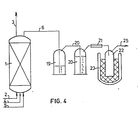
- FIG. 4 An installation is used as depicted in Fig. 4.
- the gas/vapour effluent from the packed column passes for analysis of the effluent through a quench system consisting of a scrubbing bottle 18, in which the effluent bubbles through 5-10 cm water, a second scrubbing vessel where the effluent bubbles through 15-25 cm water, a drying tube 21, e.g. filled with calcium chloride, in which water vapour from the cooled effluent is removed, and subsequently a storage vessel 22 which is placed in a dewar vessel 23, filled with liquid nitrogen, in which all vapour components are condensed and retained.
- a quench system consisting of a scrubbing bottle 18, in which the effluent bubbles through 5-10 cm water, a second scrubbing vessel where the effluent bubbles through 15-25 cm water, a drying tube 21, e.g. filled with calcium chloride, in which water vapour from the cooled effluent is removed, and subsequently a storage vessel 22 which is placed in a dewar vessel 23, filled with liquid nitrogen,
- the packed column has a heignt of 1.5 m and a diameter of 7.5 cm and is filled for 1.25 m with raschig rings of 3.2 mm diameter and 3.2 mm height (the volume taken by the raschig rings is 5.5 L; porosity of the packing 0.7; contact area 5.5 dm 2 ).
- the column is flushed during a short time with hot inert gas e.g. nitrogen to remove traces of oxygen. Subsequently a mixture of the model compound and hydrogen (temperature 250°C) is led through the column.
- hot inert gas e.g. nitrogen to remove traces of oxygen.
- Example II The procedure of Example II, Experiment 1 was repeated, but using methanol as hydrogen donor.
- the amount of dichlorobenzene added to the reactor was 3.8 mol/s and the amount of methanol was 5 mol/s. Under these circumstances also a decomposition grade exceeding 99.9% has been found.
Landscapes
- Chemical & Material Sciences (AREA)
- General Chemical & Material Sciences (AREA)
- Oil, Petroleum & Natural Gas (AREA)
- Engineering & Computer Science (AREA)
- Chemical Kinetics & Catalysis (AREA)
- Life Sciences & Earth Sciences (AREA)
- Organic Chemistry (AREA)
- Emergency Management (AREA)
- Health & Medical Sciences (AREA)
- Toxicology (AREA)
- Wood Science & Technology (AREA)
- General Health & Medical Sciences (AREA)
- Business, Economics & Management (AREA)
- Treating Waste Gases (AREA)
- Organic Low-Molecular-Weight Compounds And Preparation Thereof (AREA)
- Processing And Handling Of Plastics And Other Materials For Molding In General (AREA)
- Electrical Discharge Machining, Electrochemical Machining, And Combined Machining (AREA)
- Yarns And Mechanical Finishing Of Yarns Or Ropes (AREA)
- Exhaust Gas Treatment By Means Of Catalyst (AREA)
Claims (21)
Priority Applications (1)
| Application Number | Priority Date | Filing Date | Title |
|---|---|---|---|
| AT85201362T ATE40564T1 (de) | 1984-08-30 | 1985-08-29 | Verfahren zur vernichtung von abfall durch ein thermisches verfahren. |
Applications Claiming Priority (2)
| Application Number | Priority Date | Filing Date | Title |
|---|---|---|---|
| NL8402641 | 1984-08-30 | ||
| NL8402641A NL8402641A (nl) | 1984-08-30 | 1984-08-30 | Werkwijze voor het vernietigen van organische afvalstoffen door thermische omzetting. |
Publications (2)
| Publication Number | Publication Date |
|---|---|
| EP0175406A1 EP0175406A1 (de) | 1986-03-26 |
| EP0175406B1 true EP0175406B1 (de) | 1989-02-01 |
Family
ID=19844390
Family Applications (1)
| Application Number | Title | Priority Date | Filing Date |
|---|---|---|---|
| EP85201362A Expired EP0175406B1 (de) | 1984-08-30 | 1985-08-29 | Verfahren zur Vernichtung von Abfall durch ein thermisches Verfahren |
Country Status (5)
| Country | Link |
|---|---|
| US (1) | US4851600A (de) |
| EP (1) | EP0175406B1 (de) |
| AT (1) | ATE40564T1 (de) |
| DE (1) | DE3568057D1 (de) |
| NL (1) | NL8402641A (de) |
Families Citing this family (11)
| Publication number | Priority date | Publication date | Assignee | Title |
|---|---|---|---|---|
| DE3616785A1 (de) * | 1986-05-17 | 1987-11-19 | Union Rheinische Braunkohlen | Verfahren zur aufarbeitung von kohlenstoff enthaltenden abfaellen und biomassen |
| CA1294111C (en) * | 1986-08-08 | 1992-01-14 | Douglas J. Hallett | Process for the destruction of organic waste material |
| AU5207990A (en) * | 1989-04-10 | 1990-10-18 | 655901 Ontario Inc. | Process for the destruction of organic waste material |
| CA2103664C (en) * | 1991-02-06 | 1997-08-19 | Rolf Ryham | Method of recovering energy and chemicals from black liquor |
| DE4300860A1 (de) * | 1993-01-15 | 1994-07-21 | Rwe Entsorgung Ag | Verfahren zur Entfernung von Chlor aus synthetischen, organischen Abfällen |
| US5547653A (en) * | 1994-10-24 | 1996-08-20 | E. I. Du Pont De Nemours And Company | Carbonization of halocarbons |
| US5817288A (en) * | 1994-11-14 | 1998-10-06 | Uop Llc | Process for treating a non-distillable halogenated organic feed stream |
| US5567324A (en) * | 1995-06-07 | 1996-10-22 | Envirogen, Inc. | Method of biodegrading hydrophobic organic compounds |
| NL1006379C2 (nl) * | 1997-06-23 | 1999-02-08 | Gibros Pec Bv | Werkwijze voor het afkoelen van verontreinigd gas. |
| DE102004038220B4 (de) * | 2004-08-05 | 2009-07-23 | Proton Technology Gmbh I.Gr. | Thermische Biomassenverölung |
| US20150360965A1 (en) * | 2012-12-18 | 2015-12-17 | Invista Technologies S.A.R.L. | Apparatus and method for decreasing humidity during an andrussow process |
Family Cites Families (23)
| Publication number | Priority date | Publication date | Assignee | Title |
|---|---|---|---|---|
| US470911A (en) * | 1892-03-15 | Jesse a | ||
| US2774800A (en) * | 1954-08-23 | 1956-12-18 | Exxon Research Engineering Co | Method for hydrolyzing sulfonic acids |
| US2929682A (en) * | 1957-03-28 | 1960-03-22 | Phillips Petroleum Co | Process for the production of hydrogen halide from a friedel-crafts metal halide sludge |
| US3595931A (en) * | 1968-05-28 | 1971-07-27 | Gulf Research Development Co | Hydrogenolysis of aromatic halides |
| US3855347A (en) * | 1972-09-15 | 1974-12-17 | Badger Co | Process for hydrogenating halogenated hydrocarbons |
| US3969427A (en) * | 1974-11-19 | 1976-07-13 | Mobil Oil Corporation | Conversion of alcohols and/or ethers to hydrocarbons |
| GB1504086A (en) * | 1976-05-14 | 1978-03-15 | Cities Service Co | Hydrogenation of carbonaceous materials to produce liquid |
| DE2721290A1 (de) * | 1977-05-09 | 1978-11-23 | Ernst Kirchgaessner | Verfahren zum gewinnen von fluessigen kohlenwasserstoffen aus abwaessern und/oder klaerschlaemmen |
| US4301137A (en) * | 1977-12-21 | 1981-11-17 | Occidental Research Corporation | Removal of chlorine from pyrolysis vapors |
| DE2930032A1 (de) * | 1979-07-24 | 1981-01-29 | Orth Dieter | Verfahren zur herstellung von festen, fluessigen und gasfoermigen kohlenwasserstoffen durch katalytische hydrierung von kohlenwasserstoffhaltiger biomasse |
| US4351978A (en) * | 1980-07-21 | 1982-09-28 | Osaka Prefectural Government | Method for the disposal of polychlorinated biphenyls |
| US4293404A (en) * | 1980-07-21 | 1981-10-06 | Mobil Oil Corporation | Dehydroxylation and/or demercaptolation of heavy petroleum oils |
| US4324644A (en) * | 1980-08-26 | 1982-04-13 | Occidental Research Corporation | Pyrolysis process for stabilizing volatile hydrocarbons utilizing a beneficially reactive gas |
| US4308411A (en) * | 1980-08-28 | 1981-12-29 | Occidental Research Corporation | Process for converting oxygenated hydrocarbons into hydrocarbons |
| US4396786A (en) * | 1980-10-27 | 1983-08-02 | Johnson Matthey Public Limited Company | Method for producing fuel oil from cellulosic materials |
| US4338186A (en) * | 1980-11-17 | 1982-07-06 | Suntech, Inc. | Shale oil process |
| GB2089831B (en) * | 1980-12-18 | 1984-10-31 | Univ Salford Ind Centre | Conversion of municipal waste to fuel |
| US4364745A (en) * | 1981-06-26 | 1982-12-21 | Standard Oil Company (Indiana) | Plant hydrocarbon recovery process |
| US4526675A (en) * | 1983-05-26 | 1985-07-02 | Standard Oil Company (Indiana) | Hydrocarbon conversion method |
| US4493761A (en) * | 1983-12-05 | 1985-01-15 | Standard Oil Company (Indiana) | Catalytic hydroliquefaction using a Cr-Mo-Group VIII catalyst |
| DE3412536A1 (de) * | 1984-04-04 | 1985-10-31 | Fried. Krupp Gmbh, 4300 Essen | Verfahren zur herstellung von kohlenwasserstoffen aus klaerschlamm |
| US4587007A (en) * | 1984-09-10 | 1986-05-06 | Mobil Oil Corporation | Process for visbreaking resids in the presence of hydrogen-donor materials and organic sulfur compounds |
| US4623448A (en) * | 1985-03-12 | 1986-11-18 | Moreco Energy, Inc. | Removing halogenated polyphenyl materials from used oil products |
-
1984
- 1984-08-30 NL NL8402641A patent/NL8402641A/nl not_active Application Discontinuation
-
1985
- 1985-08-28 US US06/770,392 patent/US4851600A/en not_active Expired - Fee Related
- 1985-08-29 AT AT85201362T patent/ATE40564T1/de not_active IP Right Cessation
- 1985-08-29 DE DE8585201362T patent/DE3568057D1/de not_active Expired
- 1985-08-29 EP EP85201362A patent/EP0175406B1/de not_active Expired
Also Published As
| Publication number | Publication date |
|---|---|
| DE3568057D1 (en) | 1989-03-09 |
| US4851600A (en) | 1989-07-25 |
| EP0175406A1 (de) | 1986-03-26 |
| ATE40564T1 (de) | 1989-02-15 |
| NL8402641A (nl) | 1986-03-17 |
Similar Documents
| Publication | Publication Date | Title |
|---|---|---|
| KR100843502B1 (ko) | 보다 저품질의 할로겐화 물질로부터 하나 이상의 유용한 생성물을 제조하는 방법 및 이를 위한 장치 | |
| US4654203A (en) | Process for the chemical thermodecomposition of higher halogenated hydrocarbons | |
| EP0469701B1 (de) | Verfahren für die gleichzeitige Behandlung von zwei gefährlichen Chargen. | |
| US4810365A (en) | Hydrogenation of mineral oils contaminated with chlorinated hydrocarbons | |
| US4950309A (en) | Process for the conversion of toxic organic substances to useful products | |
| JP2975208B2 (ja) | 重合体クラッキング | |
| CA2130019C (en) | Process for the preparation of synthesis gas | |
| EP0175406B1 (de) | Verfahren zur Vernichtung von Abfall durch ein thermisches Verfahren | |
| RU1836408C (ru) | Способ получени жидких продуктов из углеродсодержащих материалов | |
| US5904879A (en) | Partial oxidation of waste plastic material | |
| EP0390985B1 (de) | Behandlung eines temperaturempfindlichen Kohlenwasserstoffeinsatzes | |
| KR100311754B1 (ko) | 폐플라스틱 재료 부분 산화방법 | |
| EP0360406B1 (de) | Behandlung eines temperaturempfindlichen Kohlenwasserstoffstromes, der eine nicht destillierbare Komponente enthält | |
| US5050511A (en) | Process for the destruction of organic waste material | |
| US4983782A (en) | Process for treating wastes and the like by low temperature carbonization and further processing of the low temperature carbonization oil | |
| EP0306164A1 (de) | Verfahren zum Hydrieren von temperaturempfindlichen Abfall-Kohlenwasserstoffmaterialien | |
| US5004533A (en) | Process for treating an organic stream containing a non-distillable component to produce an organic vapor and a solid | |
| CA2295907C (en) | Method for eliminating halogenated and non halogenated waste | |
| EP0392727B1 (de) | Verfahren zur Vernichtung von organischem Abfallstoff | |
| JPH03103271A (ja) | 空気遮断下でハロゲン化炭化水素を化学的熱分解する方法 | |
| JP2000327831A (ja) | プラスチック廃棄物のモノマーリサイクル法 | |
| US5176816A (en) | Process to produce a hydrogenated distillable hydrocarbonaceous product | |
| Wey et al. | Operating parameters of autothermal pyrolosis of plastic waste in a fluidized bed | |
| US5817288A (en) | Process for treating a non-distillable halogenated organic feed stream | |
| CS268406B1 (cs) | Způsob katalytické hydrogenolýzy chlorovaných bifenylů |
Legal Events
| Date | Code | Title | Description |
|---|---|---|---|
| PUAI | Public reference made under article 153(3) epc to a published international application that has entered the european phase |
Free format text: ORIGINAL CODE: 0009012 |
|
| AK | Designated contracting states |
Kind code of ref document: A1 Designated state(s): AT BE CH DE FR GB IT LI LU NL SE |
|
| 17P | Request for examination filed |
Effective date: 19860916 |
|
| 17Q | First examination report despatched |
Effective date: 19870910 |
|
| ITF | It: translation for a ep patent filed | ||
| GRAA | (expected) grant |
Free format text: ORIGINAL CODE: 0009210 |
|
| AK | Designated contracting states |
Kind code of ref document: B1 Designated state(s): AT BE CH DE FR GB IT LI LU NL SE |
|
| REF | Corresponds to: |
Ref document number: 40564 Country of ref document: AT Date of ref document: 19890215 Kind code of ref document: T |
|
| REF | Corresponds to: |
Ref document number: 3568057 Country of ref document: DE Date of ref document: 19890309 |
|
| ET | Fr: translation filed | ||
| PLBE | No opposition filed within time limit |
Free format text: ORIGINAL CODE: 0009261 |
|
| STAA | Information on the status of an ep patent application or granted ep patent |
Free format text: STATUS: NO OPPOSITION FILED WITHIN TIME LIMIT |
|
| 26N | No opposition filed | ||
| ITTA | It: last paid annual fee | ||
| EPTA | Lu: last paid annual fee | ||
| EAL | Se: european patent in force in sweden |
Ref document number: 85201362.2 |
|
| PGFP | Annual fee paid to national office [announced via postgrant information from national office to epo] |
Ref country code: SE Payment date: 19980727 Year of fee payment: 14 |
|
| PGFP | Annual fee paid to national office [announced via postgrant information from national office to epo] |
Ref country code: LU Payment date: 19980729 Year of fee payment: 14 |
|
| PGFP | Annual fee paid to national office [announced via postgrant information from national office to epo] |
Ref country code: FR Payment date: 19980730 Year of fee payment: 14 |
|
| PGFP | Annual fee paid to national office [announced via postgrant information from national office to epo] |
Ref country code: GB Payment date: 19980820 Year of fee payment: 14 |
|
| PGFP | Annual fee paid to national office [announced via postgrant information from national office to epo] |
Ref country code: AT Payment date: 19980821 Year of fee payment: 14 |
|
| PGFP | Annual fee paid to national office [announced via postgrant information from national office to epo] |
Ref country code: CH Payment date: 19980825 Year of fee payment: 14 |
|
| PGFP | Annual fee paid to national office [announced via postgrant information from national office to epo] |
Ref country code: BE Payment date: 19980828 Year of fee payment: 14 |
|
| PGFP | Annual fee paid to national office [announced via postgrant information from national office to epo] |
Ref country code: NL Payment date: 19980831 Year of fee payment: 14 |
|
| PGFP | Annual fee paid to national office [announced via postgrant information from national office to epo] |
Ref country code: DE Payment date: 19980925 Year of fee payment: 14 |
|
| PG25 | Lapsed in a contracting state [announced via postgrant information from national office to epo] |
Ref country code: LU Free format text: LAPSE BECAUSE OF NON-PAYMENT OF DUE FEES Effective date: 19990829 Ref country code: GB Free format text: LAPSE BECAUSE OF NON-PAYMENT OF DUE FEES Effective date: 19990829 Ref country code: AT Free format text: LAPSE BECAUSE OF NON-PAYMENT OF DUE FEES Effective date: 19990829 |
|
| PG25 | Lapsed in a contracting state [announced via postgrant information from national office to epo] |
Ref country code: SE Free format text: THE PATENT HAS BEEN ANNULLED BY A DECISION OF A NATIONAL AUTHORITY Effective date: 19990830 |
|
| PG25 | Lapsed in a contracting state [announced via postgrant information from national office to epo] |
Ref country code: LI Free format text: LAPSE BECAUSE OF NON-PAYMENT OF DUE FEES Effective date: 19990831 Ref country code: CH Free format text: LAPSE BECAUSE OF NON-PAYMENT OF DUE FEES Effective date: 19990831 Ref country code: BE Free format text: LAPSE BECAUSE OF NON-PAYMENT OF DUE FEES Effective date: 19990831 |
|
| BERE | Be: lapsed |
Owner name: RIJKSUNIVERSITEIT LEIDEN Effective date: 19990831 |
|
| PG25 | Lapsed in a contracting state [announced via postgrant information from national office to epo] |
Ref country code: NL Free format text: LAPSE BECAUSE OF NON-PAYMENT OF DUE FEES Effective date: 20000301 |
|
| REG | Reference to a national code |
Ref country code: CH Ref legal event code: PL |
|
| GBPC | Gb: european patent ceased through non-payment of renewal fee |
Effective date: 19990829 |
|
| PG25 | Lapsed in a contracting state [announced via postgrant information from national office to epo] |
Ref country code: FR Free format text: LAPSE BECAUSE OF NON-PAYMENT OF DUE FEES Effective date: 20000428 |
|
| EUG | Se: european patent has lapsed |
Ref document number: 85201362.2 |
|
| NLV4 | Nl: lapsed or anulled due to non-payment of the annual fee |
Effective date: 20000301 |
|
| PG25 | Lapsed in a contracting state [announced via postgrant information from national office to epo] |
Ref country code: DE Free format text: LAPSE BECAUSE OF NON-PAYMENT OF DUE FEES Effective date: 20000601 |
|
| REG | Reference to a national code |
Ref country code: FR Ref legal event code: ST |