EP0469701B1 - Verfahren für die gleichzeitige Behandlung von zwei gefährlichen Chargen. - Google Patents
Verfahren für die gleichzeitige Behandlung von zwei gefährlichen Chargen. Download PDFInfo
- Publication number
- EP0469701B1 EP0469701B1 EP91304305A EP91304305A EP0469701B1 EP 0469701 B1 EP0469701 B1 EP 0469701B1 EP 91304305 A EP91304305 A EP 91304305A EP 91304305 A EP91304305 A EP 91304305A EP 0469701 B1 EP0469701 B1 EP 0469701B1
- Authority
- EP
- European Patent Office
- Prior art keywords
- hydrogen
- stream
- hydrogenation
- hydrocarbonaceous
- zone
- Prior art date
- Legal status (The legal status is an assumption and is not a legal conclusion. Google has not performed a legal analysis and makes no representation as to the accuracy of the status listed.)
- Expired - Lifetime
Links
- 238000000034 method Methods 0.000 title claims description 30
- 231100001261 hazardous Toxicity 0.000 title 1
- 238000005984 hydrogenation reaction Methods 0.000 claims description 90
- 239000001257 hydrogen Substances 0.000 claims description 83
- 229910052739 hydrogen Inorganic materials 0.000 claims description 83
- UFHFLCQGNIYNRP-UHFFFAOYSA-N Hydrogen Chemical compound [H][H] UFHFLCQGNIYNRP-UHFFFAOYSA-N 0.000 claims description 82
- 150000001875 compounds Chemical class 0.000 claims description 35
- 239000007788 liquid Substances 0.000 claims description 34
- 238000005201 scrubbing Methods 0.000 claims description 27
- 239000003054 catalyst Substances 0.000 claims description 21
- 150000002896 organic halogen compounds Chemical class 0.000 claims description 18
- 238000000926 separation method Methods 0.000 claims description 17
- 239000003921 oil Substances 0.000 claims description 12
- 239000012530 fluid Substances 0.000 claims description 11
- 238000004519 manufacturing process Methods 0.000 claims description 10
- 150000003071 polychlorinated biphenyls Chemical class 0.000 claims description 10
- 238000005194 fractionation Methods 0.000 claims description 8
- 239000000203 mixture Substances 0.000 claims description 8
- 239000002904 solvent Substances 0.000 claims description 8
- 239000010687 lubricating oil Substances 0.000 claims description 7
- 239000002699 waste material Substances 0.000 claims description 7
- 239000013618 particulate matter Substances 0.000 claims description 6
- 150000004820 halides Chemical class 0.000 claims description 5
- 238000010438 heat treatment Methods 0.000 claims description 5
- 229910001502 inorganic halide Inorganic materials 0.000 claims description 5
- VZGDMQKNWNREIO-UHFFFAOYSA-N tetrachloromethane Chemical compound ClC(Cl)(Cl)Cl VZGDMQKNWNREIO-UHFFFAOYSA-N 0.000 claims description 4
- 239000010730 cutting oil Substances 0.000 claims description 3
- 150000002431 hydrogen Chemical class 0.000 claims description 3
- 239000002440 industrial waste Substances 0.000 claims description 3
- 230000008016 vaporization Effects 0.000 claims description 3
- UOCLXMDMGBRAIB-UHFFFAOYSA-N 1,1,1-trichloroethane Chemical compound CC(Cl)(Cl)Cl UOCLXMDMGBRAIB-UHFFFAOYSA-N 0.000 claims description 2
- WSLDOOZREJYCGB-UHFFFAOYSA-N 1,2-Dichloroethane Chemical compound ClCCCl WSLDOOZREJYCGB-UHFFFAOYSA-N 0.000 claims description 2
- PAAZPARNPHGIKF-UHFFFAOYSA-N 1,2-dibromoethane Chemical compound BrCCBr PAAZPARNPHGIKF-UHFFFAOYSA-N 0.000 claims description 2
- OSDWBNJEKMUWAV-UHFFFAOYSA-N Allyl chloride Chemical compound ClCC=C OSDWBNJEKMUWAV-UHFFFAOYSA-N 0.000 claims description 2
- BRLQWZUYTZBJKN-UHFFFAOYSA-N Epichlorohydrin Chemical compound ClCC1CO1 BRLQWZUYTZBJKN-UHFFFAOYSA-N 0.000 claims description 2
- CYTYCFOTNPOANT-UHFFFAOYSA-N Perchloroethylene Chemical group ClC(Cl)=C(Cl)Cl CYTYCFOTNPOANT-UHFFFAOYSA-N 0.000 claims description 2
- XSTXAVWGXDQKEL-UHFFFAOYSA-N Trichloroethylene Chemical group ClC=C(Cl)Cl XSTXAVWGXDQKEL-UHFFFAOYSA-N 0.000 claims description 2
- 150000001298 alcohols Chemical class 0.000 claims description 2
- 239000003245 coal Substances 0.000 claims description 2
- 150000002170 ethers Chemical class 0.000 claims description 2
- 150000002902 organometallic compounds Chemical class 0.000 claims description 2
- 125000001997 phenyl group Chemical class [H]C1=C([H])C([H])=C(*)C([H])=C1[H] 0.000 claims description 2
- 238000000746 purification Methods 0.000 claims description 2
- 238000004064 recycling Methods 0.000 claims description 2
- 239000011269 tar Substances 0.000 claims description 2
- UBOXGVDOUJQMTN-UHFFFAOYSA-N trichloroethylene Natural products ClCC(Cl)Cl UBOXGVDOUJQMTN-UHFFFAOYSA-N 0.000 claims description 2
- 239000000243 solution Substances 0.000 description 25
- 239000000047 product Substances 0.000 description 23
- 229930195733 hydrocarbon Natural products 0.000 description 17
- 150000002430 hydrocarbons Chemical class 0.000 description 17
- 238000006243 chemical reaction Methods 0.000 description 14
- 238000009903 catalytic hydrogenation reaction Methods 0.000 description 10
- KWYUFKZDYYNOTN-UHFFFAOYSA-M Potassium hydroxide Chemical compound [OH-].[K+] KWYUFKZDYYNOTN-UHFFFAOYSA-M 0.000 description 9
- HEMHJVSKTPXQMS-UHFFFAOYSA-M Sodium hydroxide Chemical compound [OH-].[Na+] HEMHJVSKTPXQMS-UHFFFAOYSA-M 0.000 description 9
- 239000004215 Carbon black (E152) Substances 0.000 description 8
- 239000007789 gas Substances 0.000 description 8
- -1 halide compounds Chemical class 0.000 description 8
- 229910052751 metal Inorganic materials 0.000 description 8
- 239000002184 metal Substances 0.000 description 8
- 230000003197 catalytic effect Effects 0.000 description 7
- 239000007791 liquid phase Substances 0.000 description 7
- IJGRMHOSHXDMSA-UHFFFAOYSA-N Atomic nitrogen Chemical compound N#N IJGRMHOSHXDMSA-UHFFFAOYSA-N 0.000 description 6
- PXHVJJICTQNCMI-UHFFFAOYSA-N Nickel Chemical compound [Ni] PXHVJJICTQNCMI-UHFFFAOYSA-N 0.000 description 6
- 239000002131 composite material Substances 0.000 description 6
- 238000002156 mixing Methods 0.000 description 6
- NINIDFKCEFEMDL-UHFFFAOYSA-N Sulfur Chemical compound [S] NINIDFKCEFEMDL-UHFFFAOYSA-N 0.000 description 5
- 238000006477 desulfuration reaction Methods 0.000 description 5
- 230000023556 desulfurization Effects 0.000 description 5
- 150000002739 metals Chemical class 0.000 description 5
- 229910052717 sulfur Inorganic materials 0.000 description 5
- 239000011593 sulfur Substances 0.000 description 5
- 208000033830 Hot Flashes Diseases 0.000 description 4
- 206010060800 Hot flush Diseases 0.000 description 4
- VEXZGXHMUGYJMC-UHFFFAOYSA-N Hydrochloric acid Chemical compound Cl VEXZGXHMUGYJMC-UHFFFAOYSA-N 0.000 description 4
- CPELXLSAUQHCOX-UHFFFAOYSA-N Hydrogen bromide Chemical compound Br CPELXLSAUQHCOX-UHFFFAOYSA-N 0.000 description 4
- XEEYBQQBJWHFJM-UHFFFAOYSA-N Iron Chemical compound [Fe] XEEYBQQBJWHFJM-UHFFFAOYSA-N 0.000 description 4
- ATUOYWHBWRKTHZ-UHFFFAOYSA-N Propane Chemical compound CCC ATUOYWHBWRKTHZ-UHFFFAOYSA-N 0.000 description 4
- 239000007792 gaseous phase Substances 0.000 description 4
- 229910000041 hydrogen chloride Inorganic materials 0.000 description 4
- IXCSERBJSXMMFS-UHFFFAOYSA-N hydrogen chloride Substances Cl.Cl IXCSERBJSXMMFS-UHFFFAOYSA-N 0.000 description 4
- VNWKTOKETHGBQD-UHFFFAOYSA-N methane Chemical compound C VNWKTOKETHGBQD-UHFFFAOYSA-N 0.000 description 4
- KDLHZDBZIXYQEI-UHFFFAOYSA-N Palladium Chemical compound [Pd] KDLHZDBZIXYQEI-UHFFFAOYSA-N 0.000 description 3
- 230000015572 biosynthetic process Effects 0.000 description 3
- 238000009835 boiling Methods 0.000 description 3
- 239000000571 coke Substances 0.000 description 3
- 238000005695 dehalogenation reaction Methods 0.000 description 3
- VLKZOEOYAKHREP-UHFFFAOYSA-N n-Hexane Chemical compound CCCCCC VLKZOEOYAKHREP-UHFFFAOYSA-N 0.000 description 3
- 229910052759 nickel Inorganic materials 0.000 description 3
- 229910052757 nitrogen Inorganic materials 0.000 description 3
- QGZKDVFQNNGYKY-UHFFFAOYSA-N Ammonia Chemical compound N QGZKDVFQNNGYKY-UHFFFAOYSA-N 0.000 description 2
- VYZAMTAEIAYCRO-UHFFFAOYSA-N Chromium Chemical compound [Cr] VYZAMTAEIAYCRO-UHFFFAOYSA-N 0.000 description 2
- RYGMFSIKBFXOCR-UHFFFAOYSA-N Copper Chemical compound [Cu] RYGMFSIKBFXOCR-UHFFFAOYSA-N 0.000 description 2
- RWSOTUBLDIXVET-UHFFFAOYSA-N Dihydrogen sulfide Chemical compound S RWSOTUBLDIXVET-UHFFFAOYSA-N 0.000 description 2
- OTMSDBZUPAUEDD-UHFFFAOYSA-N Ethane Chemical compound CC OTMSDBZUPAUEDD-UHFFFAOYSA-N 0.000 description 2
- KRHYYFGTRYWZRS-UHFFFAOYSA-N Fluorane Chemical compound F KRHYYFGTRYWZRS-UHFFFAOYSA-N 0.000 description 2
- DGAQECJNVWCQMB-PUAWFVPOSA-M Ilexoside XXIX Chemical compound C[C@@H]1CC[C@@]2(CC[C@@]3(C(=CC[C@H]4[C@]3(CC[C@@H]5[C@@]4(CC[C@@H](C5(C)C)OS(=O)(=O)[O-])C)C)[C@@H]2[C@]1(C)O)C)C(=O)O[C@H]6[C@@H]([C@H]([C@@H]([C@H](O6)CO)O)O)O.[Na+] DGAQECJNVWCQMB-PUAWFVPOSA-M 0.000 description 2
- ZOKXTWBITQBERF-UHFFFAOYSA-N Molybdenum Chemical compound [Mo] ZOKXTWBITQBERF-UHFFFAOYSA-N 0.000 description 2
- VYPSYNLAJGMNEJ-UHFFFAOYSA-N Silicium dioxide Chemical compound O=[Si]=O VYPSYNLAJGMNEJ-UHFFFAOYSA-N 0.000 description 2
- CDBYLPFSWZWCQE-UHFFFAOYSA-L Sodium Carbonate Chemical compound [Na+].[Na+].[O-]C([O-])=O CDBYLPFSWZWCQE-UHFFFAOYSA-L 0.000 description 2
- HCHKCACWOHOZIP-UHFFFAOYSA-N Zinc Chemical compound [Zn] HCHKCACWOHOZIP-UHFFFAOYSA-N 0.000 description 2
- 239000002253 acid Substances 0.000 description 2
- 150000001336 alkenes Chemical class 0.000 description 2
- PNEYBMLMFCGWSK-UHFFFAOYSA-N aluminium oxide Inorganic materials [O-2].[O-2].[O-2].[Al+3].[Al+3] PNEYBMLMFCGWSK-UHFFFAOYSA-N 0.000 description 2
- 239000007864 aqueous solution Substances 0.000 description 2
- 239000010426 asphalt Substances 0.000 description 2
- QVGXLLKOCUKJST-UHFFFAOYSA-N atomic oxygen Chemical compound [O] QVGXLLKOCUKJST-UHFFFAOYSA-N 0.000 description 2
- 150000007514 bases Chemical class 0.000 description 2
- 239000006227 byproduct Substances 0.000 description 2
- 229910052793 cadmium Inorganic materials 0.000 description 2
- BDOSMKKIYDKNTQ-UHFFFAOYSA-N cadmium atom Chemical compound [Cd] BDOSMKKIYDKNTQ-UHFFFAOYSA-N 0.000 description 2
- AXCZMVOFGPJBDE-UHFFFAOYSA-L calcium dihydroxide Chemical compound [OH-].[OH-].[Ca+2] AXCZMVOFGPJBDE-UHFFFAOYSA-L 0.000 description 2
- 239000000920 calcium hydroxide Substances 0.000 description 2
- 229910001861 calcium hydroxide Inorganic materials 0.000 description 2
- 239000012876 carrier material Substances 0.000 description 2
- 230000015556 catabolic process Effects 0.000 description 2
- 238000004517 catalytic hydrocracking Methods 0.000 description 2
- 229910052804 chromium Inorganic materials 0.000 description 2
- 239000011651 chromium Substances 0.000 description 2
- 229910017052 cobalt Inorganic materials 0.000 description 2
- 239000010941 cobalt Substances 0.000 description 2
- GUTLYIVDDKVIGB-UHFFFAOYSA-N cobalt atom Chemical compound [Co] GUTLYIVDDKVIGB-UHFFFAOYSA-N 0.000 description 2
- 229910052802 copper Inorganic materials 0.000 description 2
- 239000010949 copper Substances 0.000 description 2
- 238000006731 degradation reaction Methods 0.000 description 2
- 230000001419 dependent effect Effects 0.000 description 2
- 238000010586 diagram Methods 0.000 description 2
- 230000000694 effects Effects 0.000 description 2
- 239000002737 fuel gas Substances 0.000 description 2
- 229910052736 halogen Inorganic materials 0.000 description 2
- 150000002367 halogens Chemical class 0.000 description 2
- 229910000042 hydrogen bromide Inorganic materials 0.000 description 2
- 229910000040 hydrogen fluoride Inorganic materials 0.000 description 2
- 229910000039 hydrogen halide Inorganic materials 0.000 description 2
- 239000012433 hydrogen halide Substances 0.000 description 2
- 229910000037 hydrogen sulfide Inorganic materials 0.000 description 2
- 229910052742 iron Inorganic materials 0.000 description 2
- 239000000463 material Substances 0.000 description 2
- QSHDDOUJBYECFT-UHFFFAOYSA-N mercury Chemical compound [Hg] QSHDDOUJBYECFT-UHFFFAOYSA-N 0.000 description 2
- 229910052753 mercury Inorganic materials 0.000 description 2
- 229910052750 molybdenum Inorganic materials 0.000 description 2
- 239000011733 molybdenum Substances 0.000 description 2
- JRZJOMJEPLMPRA-UHFFFAOYSA-N olefin Natural products CCCCCCCC=C JRZJOMJEPLMPRA-UHFFFAOYSA-N 0.000 description 2
- 239000001301 oxygen Substances 0.000 description 2
- 229910052760 oxygen Inorganic materials 0.000 description 2
- 230000000737 periodic effect Effects 0.000 description 2
- BASFCYQUMIYNBI-UHFFFAOYSA-N platinum Chemical compound [Pt] BASFCYQUMIYNBI-UHFFFAOYSA-N 0.000 description 2
- BWHMMNNQKKPAPP-UHFFFAOYSA-L potassium carbonate Chemical compound [K+].[K+].[O-]C([O-])=O BWHMMNNQKKPAPP-UHFFFAOYSA-L 0.000 description 2
- 239000001294 propane Substances 0.000 description 2
- 238000011084 recovery Methods 0.000 description 2
- 229910052708 sodium Inorganic materials 0.000 description 2
- 239000011734 sodium Substances 0.000 description 2
- 239000007787 solid Substances 0.000 description 2
- 239000000126 substance Substances 0.000 description 2
- XLYOFNOQVPJJNP-UHFFFAOYSA-N water Substances O XLYOFNOQVPJJNP-UHFFFAOYSA-N 0.000 description 2
- 229910001868 water Inorganic materials 0.000 description 2
- 229910052725 zinc Inorganic materials 0.000 description 2
- 239000011701 zinc Substances 0.000 description 2
- WKBOTKDWSSQWDR-UHFFFAOYSA-N Bromine atom Chemical compound [Br] WKBOTKDWSSQWDR-UHFFFAOYSA-N 0.000 description 1
- VEXZGXHMUGYJMC-UHFFFAOYSA-M Chloride anion Chemical compound [Cl-] VEXZGXHMUGYJMC-UHFFFAOYSA-M 0.000 description 1
- ZAMOUSCENKQFHK-UHFFFAOYSA-N Chlorine atom Chemical compound [Cl] ZAMOUSCENKQFHK-UHFFFAOYSA-N 0.000 description 1
- PXGOKWXKJXAPGV-UHFFFAOYSA-N Fluorine Chemical compound FF PXGOKWXKJXAPGV-UHFFFAOYSA-N 0.000 description 1
- WHXSMMKQMYFTQS-UHFFFAOYSA-N Lithium Chemical compound [Li] WHXSMMKQMYFTQS-UHFFFAOYSA-N 0.000 description 1
- FYYHWMGAXLPEAU-UHFFFAOYSA-N Magnesium Chemical compound [Mg] FYYHWMGAXLPEAU-UHFFFAOYSA-N 0.000 description 1
- ZLMJMSJWJFRBEC-UHFFFAOYSA-N Potassium Chemical compound [K] ZLMJMSJWJFRBEC-UHFFFAOYSA-N 0.000 description 1
- KJTLSVCANCCWHF-UHFFFAOYSA-N Ruthenium Chemical compound [Ru] KJTLSVCANCCWHF-UHFFFAOYSA-N 0.000 description 1
- BQCADISMDOOEFD-UHFFFAOYSA-N Silver Chemical compound [Ag] BQCADISMDOOEFD-UHFFFAOYSA-N 0.000 description 1
- UCKMPCXJQFINFW-UHFFFAOYSA-N Sulphide Chemical compound [S-2] UCKMPCXJQFINFW-UHFFFAOYSA-N 0.000 description 1
- 239000003463 adsorbent Substances 0.000 description 1
- 229910052782 aluminium Inorganic materials 0.000 description 1
- XAGFODPZIPBFFR-UHFFFAOYSA-N aluminium Chemical compound [Al] XAGFODPZIPBFFR-UHFFFAOYSA-N 0.000 description 1
- 229910021529 ammonia Inorganic materials 0.000 description 1
- 229910052785 arsenic Inorganic materials 0.000 description 1
- RQNWIZPPADIBDY-UHFFFAOYSA-N arsenic atom Chemical compound [As] RQNWIZPPADIBDY-UHFFFAOYSA-N 0.000 description 1
- 238000010420 art technique Methods 0.000 description 1
- 229910052788 barium Inorganic materials 0.000 description 1
- DSAJWYNOEDNPEQ-UHFFFAOYSA-N barium atom Chemical compound [Ba] DSAJWYNOEDNPEQ-UHFFFAOYSA-N 0.000 description 1
- GDTBXPJZTBHREO-UHFFFAOYSA-N bromine Substances BrBr GDTBXPJZTBHREO-UHFFFAOYSA-N 0.000 description 1
- 229910052794 bromium Inorganic materials 0.000 description 1
- 239000001273 butane Substances 0.000 description 1
- 229910052792 caesium Inorganic materials 0.000 description 1
- TVFDJXOCXUVLDH-UHFFFAOYSA-N caesium atom Chemical compound [Cs] TVFDJXOCXUVLDH-UHFFFAOYSA-N 0.000 description 1
- 239000004568 cement Substances 0.000 description 1
- 238000005119 centrifugation Methods 0.000 description 1
- 239000007795 chemical reaction product Substances 0.000 description 1
- 239000000460 chlorine Substances 0.000 description 1
- 229910052801 chlorine Inorganic materials 0.000 description 1
- 238000009833 condensation Methods 0.000 description 1
- 230000005494 condensation Effects 0.000 description 1
- 230000003750 conditioning effect Effects 0.000 description 1
- 239000000356 contaminant Substances 0.000 description 1
- 238000007796 conventional method Methods 0.000 description 1
- 230000006378 damage Effects 0.000 description 1
- 238000000354 decomposition reaction Methods 0.000 description 1
- 239000003085 diluting agent Substances 0.000 description 1
- 238000004090 dissolution Methods 0.000 description 1
- 238000005516 engineering process Methods 0.000 description 1
- 230000007613 environmental effect Effects 0.000 description 1
- 238000001914 filtration Methods 0.000 description 1
- 229910052731 fluorine Inorganic materials 0.000 description 1
- 239000011737 fluorine Substances 0.000 description 1
- 229910052730 francium Inorganic materials 0.000 description 1
- KLMCZVJOEAUDNE-UHFFFAOYSA-N francium atom Chemical compound [Fr] KLMCZVJOEAUDNE-UHFFFAOYSA-N 0.000 description 1
- PCHJSUWPFVWCPO-UHFFFAOYSA-N gold Chemical compound [Au] PCHJSUWPFVWCPO-UHFFFAOYSA-N 0.000 description 1
- 229910052737 gold Inorganic materials 0.000 description 1
- 239000010931 gold Substances 0.000 description 1
- 150000002366 halogen compounds Chemical class 0.000 description 1
- BHEPBYXIRTUNPN-UHFFFAOYSA-N hydridophosphorus(.) (triplet) Chemical compound [PH] BHEPBYXIRTUNPN-UHFFFAOYSA-N 0.000 description 1
- 229910052809 inorganic oxide Inorganic materials 0.000 description 1
- 229910052741 iridium Inorganic materials 0.000 description 1
- GKOZUEZYRPOHIO-UHFFFAOYSA-N iridium atom Chemical compound [Ir] GKOZUEZYRPOHIO-UHFFFAOYSA-N 0.000 description 1
- 239000012633 leachable Substances 0.000 description 1
- 229910052744 lithium Inorganic materials 0.000 description 1
- 239000011777 magnesium Substances 0.000 description 1
- 229910052749 magnesium Inorganic materials 0.000 description 1
- 239000010705 motor oil Substances 0.000 description 1
- IJDNQMDRQITEOD-UHFFFAOYSA-N n-butane Chemical compound CCCC IJDNQMDRQITEOD-UHFFFAOYSA-N 0.000 description 1
- OFBQJSOFQDEBGM-UHFFFAOYSA-N n-pentane Natural products CCCCC OFBQJSOFQDEBGM-UHFFFAOYSA-N 0.000 description 1
- 229910017464 nitrogen compound Inorganic materials 0.000 description 1
- 150000002830 nitrogen compounds Chemical class 0.000 description 1
- 229910000510 noble metal Inorganic materials 0.000 description 1
- 150000002894 organic compounds Chemical class 0.000 description 1
- 239000010815 organic waste Substances 0.000 description 1
- 229910052762 osmium Inorganic materials 0.000 description 1
- SYQBFIAQOQZEGI-UHFFFAOYSA-N osmium atom Chemical compound [Os] SYQBFIAQOQZEGI-UHFFFAOYSA-N 0.000 description 1
- 229910052763 palladium Inorganic materials 0.000 description 1
- 229910052697 platinum Inorganic materials 0.000 description 1
- 229920000642 polymer Polymers 0.000 description 1
- 229910052700 potassium Inorganic materials 0.000 description 1
- 239000011591 potassium Substances 0.000 description 1
- 229910000027 potassium carbonate Inorganic materials 0.000 description 1
- 239000000376 reactant Substances 0.000 description 1
- 229910052703 rhodium Inorganic materials 0.000 description 1
- 239000010948 rhodium Substances 0.000 description 1
- MHOVAHRLVXNVSD-UHFFFAOYSA-N rhodium atom Chemical compound [Rh] MHOVAHRLVXNVSD-UHFFFAOYSA-N 0.000 description 1
- 229910052701 rubidium Inorganic materials 0.000 description 1
- IGLNJRXAVVLDKE-UHFFFAOYSA-N rubidium atom Chemical compound [Rb] IGLNJRXAVVLDKE-UHFFFAOYSA-N 0.000 description 1
- 229910052707 ruthenium Inorganic materials 0.000 description 1
- 229920006395 saturated elastomer Polymers 0.000 description 1
- 238000004904 shortening Methods 0.000 description 1
- 239000000377 silicon dioxide Substances 0.000 description 1
- 229910052709 silver Inorganic materials 0.000 description 1
- 239000004332 silver Substances 0.000 description 1
- 229910000029 sodium carbonate Inorganic materials 0.000 description 1
- 238000001179 sorption measurement Methods 0.000 description 1
- 239000013589 supplement Substances 0.000 description 1
- 231100000331 toxic Toxicity 0.000 description 1
- 230000002588 toxic effect Effects 0.000 description 1
- WFKWXMTUELFFGS-UHFFFAOYSA-N tungsten Chemical compound [W] WFKWXMTUELFFGS-UHFFFAOYSA-N 0.000 description 1
- 229910052721 tungsten Inorganic materials 0.000 description 1
- 239000010937 tungsten Substances 0.000 description 1
- 229910052720 vanadium Inorganic materials 0.000 description 1
- GPPXJZIENCGNKB-UHFFFAOYSA-N vanadium Chemical compound [V]#[V] GPPXJZIENCGNKB-UHFFFAOYSA-N 0.000 description 1
- 238000009834 vaporization Methods 0.000 description 1
Images
Classifications
-
- C—CHEMISTRY; METALLURGY
- C10—PETROLEUM, GAS OR COKE INDUSTRIES; TECHNICAL GASES CONTAINING CARBON MONOXIDE; FUELS; LUBRICANTS; PEAT
- C10G—CRACKING HYDROCARBON OILS; PRODUCTION OF LIQUID HYDROCARBON MIXTURES, e.g. BY DESTRUCTIVE HYDROGENATION, OLIGOMERISATION, POLYMERISATION; RECOVERY OF HYDROCARBON OILS FROM OIL-SHALE, OIL-SAND, OR GASES; REFINING MIXTURES MAINLY CONSISTING OF HYDROCARBONS; REFORMING OF NAPHTHA; MINERAL WAXES
- C10G9/00—Thermal non-catalytic cracking, in the absence of hydrogen, of hydrocarbon oils
-
- A—HUMAN NECESSITIES
- A62—LIFE-SAVING; FIRE-FIGHTING
- A62D—CHEMICAL MEANS FOR EXTINGUISHING FIRES OR FOR COMBATING OR PROTECTING AGAINST HARMFUL CHEMICAL AGENTS; CHEMICAL MATERIALS FOR USE IN BREATHING APPARATUS
- A62D3/00—Processes for making harmful chemical substances harmless or less harmful, by effecting a chemical change in the substances
- A62D3/30—Processes for making harmful chemical substances harmless or less harmful, by effecting a chemical change in the substances by reacting with chemical agents
- A62D3/37—Processes for making harmful chemical substances harmless or less harmful, by effecting a chemical change in the substances by reacting with chemical agents by reduction, e.g. hydrogenation
-
- C—CHEMISTRY; METALLURGY
- C10—PETROLEUM, GAS OR COKE INDUSTRIES; TECHNICAL GASES CONTAINING CARBON MONOXIDE; FUELS; LUBRICANTS; PEAT
- C10G—CRACKING HYDROCARBON OILS; PRODUCTION OF LIQUID HYDROCARBON MIXTURES, e.g. BY DESTRUCTIVE HYDROGENATION, OLIGOMERISATION, POLYMERISATION; RECOVERY OF HYDROCARBON OILS FROM OIL-SHALE, OIL-SAND, OR GASES; REFINING MIXTURES MAINLY CONSISTING OF HYDROCARBONS; REFORMING OF NAPHTHA; MINERAL WAXES
- C10G45/00—Refining of hydrocarbon oils using hydrogen or hydrogen-generating compounds
- C10G45/02—Refining of hydrocarbon oils using hydrogen or hydrogen-generating compounds to eliminate hetero atoms without changing the skeleton of the hydrocarbon involved and without cracking into lower boiling hydrocarbons; Hydrofinishing
-
- A—HUMAN NECESSITIES
- A62—LIFE-SAVING; FIRE-FIGHTING
- A62D—CHEMICAL MEANS FOR EXTINGUISHING FIRES OR FOR COMBATING OR PROTECTING AGAINST HARMFUL CHEMICAL AGENTS; CHEMICAL MATERIALS FOR USE IN BREATHING APPARATUS
- A62D2101/00—Harmful chemical substances made harmless, or less harmful, by effecting chemical change
- A62D2101/20—Organic substances
- A62D2101/22—Organic substances containing halogen
-
- A—HUMAN NECESSITIES
- A62—LIFE-SAVING; FIRE-FIGHTING
- A62D—CHEMICAL MEANS FOR EXTINGUISHING FIRES OR FOR COMBATING OR PROTECTING AGAINST HARMFUL CHEMICAL AGENTS; CHEMICAL MATERIALS FOR USE IN BREATHING APPARATUS
- A62D2101/00—Harmful chemical substances made harmless, or less harmful, by effecting chemical change
- A62D2101/20—Organic substances
- A62D2101/24—Organic substances containing heavy metals
-
- A—HUMAN NECESSITIES
- A62—LIFE-SAVING; FIRE-FIGHTING
- A62D—CHEMICAL MEANS FOR EXTINGUISHING FIRES OR FOR COMBATING OR PROTECTING AGAINST HARMFUL CHEMICAL AGENTS; CHEMICAL MATERIALS FOR USE IN BREATHING APPARATUS
- A62D2203/00—Aspects of processes for making harmful chemical substances harmless, or less harmful, by effecting chemical change in the substances
- A62D2203/02—Combined processes involving two or more distinct steps covered by groups A62D3/10 - A62D3/40
Definitions
- the field of art to which this invention pertains is the production of hydrogenated distillable hydrocarbonaceous compounds from a hydrocarbonaceous feed having a non-distillable component and a feed comprising halogenated organic compounds. More specifically, the invention relates to a novel process for the simultaneous hydrogenation of a first feedstock comprising hydrocarbonaceous compounds and having a non-distillable component, and a second feedstock comprising halogenated organic compounds.
- the invention provides an improved process for the production of hydrogenated, distillable hydrocarbonaceous product from a first feed comprising hydrocarbonaceous compounds and having a non-distillable component, and a second feed comprising halogenated organic compounds by contacting the first feed with a hot hydrogen-rich gaseous stream derived at least in part from processing of the second feed to increase the temperature of this feed stream and to vaporize at least a portion of the distillable hydrocarbonaceous compounds thereby producing a distillable hydrocarbonaceous product which is immediately hydrogenated in an integrated first hydrogenation zone.
- the second feed is then contacted with hydrogen derived from the first zone in a second hydrogenation zone at hydrogenation conditions to produce a hydrogenated hydrocarbonaceous product and at least one water-soluble inorganic halide compound.
- Important elements of the process are the integrated hydrogenation reaction zones which reduce capital and utility costs, and the recycle of the hydrogen-rich gas stream recovered from the second hydrogenation zone to the first feed processing steps.
- This recycle gas stream may contain small quantities of unconverted volatile organic halide compounds and the first hydrogenation zone serves to ensure complete destruction of these compounds.
- the consecutive passage of this recycle gas stream through both a thermal zone for heating the gas stream followed by a catalytic hydrogenation zone will convert greater than 99% of the organic halide compounds to hydrogen halide.
- One embodiment of the invention may be characterized as a process for the simultaneous hydrogenation of a first feedstock comprising hydrocarbonaceous compounds and having a non-distillable component, and a second feedstock comprising halogenated organic compounds which process comprises: (a) contacting the first feedstock with a first hydrogen-rich gaseous stream having a temperature greater than the first feedstock in a flash zone at flash conditions selected to increase the temperature of the first feedstock and to vaporize at least a portion thereof to provide a hydrocarbonaceous vapor stream comprising hydrogen, and a heavy product comprising the non-distillable component; (b) contacting the hydrocarbonaceous vapor stream comprising hydrogen with a hydrogenation catalyst in a first hydrogenation reaction zone at hydrogenation conditions to increase the hydrogen content of the hydrocarbonaceous compounds contained in the hydrocarbonaceous vapor stream; (c) condensing at least a portion of the resulting effluent from the first hydrogenation reaction zone to produce a second hydrogen-rich gaseous stream and a first liquid hydrogenated
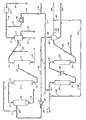
- the drawing is a simplified process flow diagram of a preferred embodiment of the present invention.
- the present invention provides an improved integrated process for the simultaneous hydrogenation of a first feedstock comprising hydrocarbonaceous compounds and having a non-distillable component, and a second feedstock comprising halogenated organic compounds.
- hydrocarbonaceous streams having a non-distillable component are candidates for the first feedstock.
- hydrocarbonaceous streams which are suitable for treatment by a process of the present invention are dielectric fluids, hydraulic fluids, heat transfer fluids, used lubricating oil, used cutting oils, used solvents, still bottoms from solvent recycle operations, coal tars, atmospheric residuum, oils contaminated with polychlorinated biphenyls (PCB), and other hydrocarbonaceous industrial waste.
- Many of these hydrocarbonaceous streams may contain non-distillable components which include, for example, organometallic compounds, inorganic metallic compounds, finely divided particulate matter and non-distillable hydrocarbonaceous compounds.
- the present invention is particularly advantageous when the non-distillable components comprise sub-micron particulate matter and the conventional techniques of filtration or centrifugation tend to be highly ineffective.
- a non-distillable component including finely divided particulate matter in a hydrocarbonaceous feed to a hydrogenation zone greatly increases the difficulty of hydrogenation.
- a non-distillable component tends (1) to foul the hot heat exchange surfaces which are used to heat the feed to hydrogenation conditions, (2) to form coke or in some other manner deactivate the hydrogenation catalyst thereby shortening its active life and (3) to otherwise hinder a smooth and facile hydrogenation operation.
- Particulate matter in a feed stream tends to deposit within the hydrogenation zone and to plug a fixed hydrogenation catalyst bed thereby abbreviating the time on stream.
- the resulting distillable hydrocarbonaceous stream is introduced into a hydrogenation zone.
- metallic compounds such as those that contain metals such as zinc, copper, iron, barium, phosphorous, magnesium, aluminum, lead, mercury, cadmium, cobalt, arsenic, vanadium, chromium, and nickel, these compounds will be isolated in the relatively small volume of recovered non-distillable product which may then be treated for metals recovery or otherwise disposed of as desired.
- the resulting recovered distillable hydrocarbonaceous stream is hydrogenated to remove or convert such components as desired.
- the hydrogenation of the resulting distillable hydrocarbonaceous stream is preferably conducted immediately without intermediate separation or condensation.
- a hydrocarbonaceous stream containing a non-distillable component is contacted with a hot hydrogen-rich gaseous stream having a temperature greater than the hydrocarbonaceous stream in a flash zone at flash conditions thereby increasing the temperature of the hydrocarbonaceous stream and vaporizing at least a portion thereof to provide a hydrocarbonaceous vapor stream comprising hydrogen and a heavy non-distillable product.
- the hot hydrogen-rich gaseous stream preferably comprises more than about 70 mol.% hydrogen and preferably more than about 90 mol.% hydrogen.
- the hot hydrogen-rich gaseous stream is comprised of a recycle hydrogen gas stream which contains trace quantities of halogenated organic compounds.
- the hot hydrogen-rich gaseous stream is multi-functional and serves as (1) a heat source used to directly heat the hydrocarbonaceous feed stream to preclude the coke formation that could otherwise occur when using an indirect heating apparatus such as a heater or heat-exchanger, (2) a diluent to reduce the partial pressure of the hydrocarbonaceous compounds during vaporization in the flash zone, (3) a reactant to minimize the possible formation of hydrocarbonaceous polymers at elevated temperatures, (4) a stripping medium, and (5) at least a portion of the hydrogen required in the hydrogenation reaction zone.
- the hot hydrogen-rich gaseous stream is composed of a recycle hydrogen gas stream which contains halogenated organic compounds
- the subsequent thermal and catalytic zones through which this stream passes is a valuable technique to ensure essentially complete conversion of halogenated organic compounds in the present process.
- the first feedstock is preferably maintained at a temperature less than 482°F (250°C) before being introduced into the flash zone in order to prevent or minimize the thermal degradation.
- the hot hydrogen-rich gaseous stream is introduced into the flash zone at a temperature greater than the hydrocarbonaceous feed stream and preferably at a temperature from 200°F (93°C) to 1200°F (649°C).
- the flash zone is preferably maintained at flash conditions which include a temperature from 150°F (65°C) to 860°F (460°C), a pressure from atmospheric to 2000 psig (103 to 13893 kPa), a hydrogen circulation rate of 1000 SCFB (168 normal m3/m3) to 60,000 SCFB (10,110 normal m3/m3) based on the hydrocarbonaceous feed stream to the flash zone and an average residence time of the hydrogen-containing, hydrocarbonaceous vapor stream in the flash zone from about 0.1 seconds to about 50 seconds.
- a more preferred average residence time of the hydrogen-containing hydrocarbonaceous vapor stream in the flash zone is from about 1 second to about 10 seconds.
- the resulting heavy non-distillable portion of the first feedstock is removed from the bottom of the flash zone as required to yield a heavy non-distillable product.
- the heavy non-distillable product may contain a relatively small amount of distillable components, but since essentially all of the non-distillable components contained in the first feedstock are recovered in this product stream, the term "heavy non-distillable product" is nevertheless used for the convenient description of this product stream.
- the heavy non-distillable product preferably contains a distillable component of less than 10 weight percent and more preferably less than 5 wt.%.
- an additional liquid may be utilized to flush the heavy non-distillables from the flash zone.
- an additional liquid may, for example, be a high boiling range vacuum gas oil having a boiling range from 700°F (371°C) to 1000°F (538°C) or a vacuum tower bottom stream boiling at a temperature greater than 1000°F (538°C).
- the non-distillable fraction is flushed with vacuum resid (bitumen)
- the properties of the resid are enhanced for use as an asphalt cement and thus provides a useful outlet for the bottoms.
- toxic metals are stabilized and made non-leachable.
- the selection of a flush liquid depends upon the composition of the hydrocarbonaceous feed stream and the prevailing flash conditions in the flash separator, and the volume of the flush liquid is preferably limited to that required for removal of the heavy non-distillable component.
- the resulting hydrogen-containing hydrocarbonaceous vapor stream is removed from the flash zone and is introduced into a first catalytic hydrogenation zone containing hydrogenation catalyst and maintained at hydrogenation conditions.
- the catalytic hydrogenation zone may contain a fixed, ebullated or fluidized catalyst bed.
- This reaction zone is preferably maintained under an imposed pressure from atmospheric to 2000 psig (103 to 13893 kPa) and more preferably under a pressure from 100 psig to 1800 psig (739 to 12514 kPa).
- a maximum catalyst bed temperature in the range of 122°F (50°C) to 850°F (454°C) selected to perform the desired hydrogenation conversion to reduce or eliminate the undesirable characteristics or components of the hydrocarbonaceous vapor stream.
- the desired hydrogenation conversion includes, for example, dehalogenation, desulfurization, denitrification, olefin saturation, oxygenate conversion and hydrocracking.
- Further preferred operating conditions include liquid hourly space velocities (LHSV) in the range from 0.05 hr. ⁇ 1 to 20 hr. ⁇ 1 and hydrogen circulation rates from 200 standard cubic feet per barrel (SCFB) (33.71 normal m3/m3) to 70,000 SCFB (11,796 normal m3/m3), preferably from 300 SCFB (50.6 normal m3/m3) to about 20,000 SCFB (3371 normal m3/m3).
- the temperature of the hydrogen-containing hydrocarbonaceous vapor stream which is removed from the flash zone is not deemed to be exactly the temperature selected to operate the catalytic hydrogenation zone
- the temperature of the vapor stream may be adjusted either upward or downward in order to achieve the desired temperature in the catalytic hydrogenation zone. Such a temperature adjustment may be accomplished, for example, by the addition of either cold or hot hydrogen.
- the preferred catalytic composite disposed within the first hydrogenation zone can be characterized as containing a metallic component having hydrogenation activity, which component is combined with a suitable refractory inorganic oxide carrier material of either synthetic or natural origin.
- Preferred carrier materials are alumina, silica and mixtures thereof.
- Suitable metallic components having hydrogenation activity are those selected from the group comprising the metals of Groups VI-B and VIII of the Periodic Table, as set forth in the Periodic Table of the Elements , E.H. Sargent and Company, 1964.
- the catalytic composites may comprise one or more metallic components from the group of molybdenum, tungsten, chromium, iron, cobalt, nickel, platinum, palladium, iridium, osmium, rhodium, ruthenium, and mixtures thereof.
- concentration of the catalytically active metallic component, or components is primarily dependent upon a particular metal as well as the physical and/or chemical characteristics of the particular hydrocarbon feedstock.
- the metallic components of Group VI-B are generally present in the catalytic composite in an amount within the range of from 1 to 20 wt.%, the iron-group metals in an amount within the range of 0.2 to 10 wt.%, whereas the noble metals of Group VIII are preferably present in an amount within the range of from 0.1 to 5 wt.%, calculated on an elemental basis.
- any catalyst employed commercially for hydrogenating middle distillate hydrocarbonaceous compounds to remove nitrogen and sulfur may function effectively in the hydrogenation zone of the present invention.
- hydrogenation catalytic composites may comprise one or more of the following components: cesium, francium, lithium, potassium, rubidium, sodium, copper, gold, silver, cadmium, mercury and zinc.
- the effluent from the first hydrogenation zone is preferably partially condensed in a hot separator and then contacted with an aqueous scrubbing solution and the admixture is admitted to a separation zone in order to separate a spent aqueous stream, a hydrogenated hydrocarbonaceous liquid phase and a hydrogen-rich gaseous phase.
- the contact of the hydrocarbonaceous effluent from the hydrogenation zone with the aqueous scrubbing solution may be performed in any convenient manner and is preferably conducted by co-current, in-line mixing which may be promoted by inherent turbulence, mixing orifices or any other suitable mixing means.
- the aqueous scrubbing solution is preferably introduced in an amount from 1 to 100 volume percent based on the hydrocarbonaceous effluent from the hydrogenation zone.
- the aqueous scrubbing solution is selected depending on the characteristics of the hydrocarbonaceous vapor stream introduced into the hydrogenation zone.
- the aqueous scrubbing solution preferably contains a basic compound such as calcium hydroxide, potassium hydroxide, potassium carbonate, sodium carbonate or sodium hydroxide in order to neutralize the acid such as hydrogen chloride, hydrogen bromide and hydrogen fluoride, for example, which is formed during the hydrogenation of the halogen compounds.
- water may be a suitable aqueous scrubbing solution to dissolve the resulting hydrogen sulfide and ammonia.
- the resulting hydrogenated hydrocarbonaceous liquid phase is preferably recovered from the hydrogen-rich gaseous phase in a separation zone which is maintained at essentially the same pressure as the first hydrogenation reaction zone and as a consequence contains dissolved hydrogen and low molecular weight normally gaseous hydrocarbons if present.
- the hydrogenated hydrocarbonaceous liquid phase comprising the hereinabove mentioned gases be stabilized in a convenient manner, such as, for example, by stripping or flashing to remove the normally gaseous components to provide a stable hydrogenated distillable hydrocarbonaceous product.
- halogenated organic compounds both unsaturated and saturated, are candidates for the second feedstock.
- organic streams comprising halogenated organic compounds are dielectric fluids, hydraulic fluids, heat transfer fluids, used lubricating oil, used cutting oils, used solvents, halogenated hydrocarbonaceous by-products, oils contaminated with polychlorinated biphenyls (PCB), halogenated wastes, petrochemical by-products and other halogenated hydrocarbonaceous industrial waste.
- the halogenated organic feed streams may also contain organic compounds which include sulfur, oxygen, nitrogen or metal components which may be hydrogenated to remove or convert such components as desired.
- the halogenated organic compounds may also contain hydrogen and are therefore then referred to as hydrocarbonaceous compounds.
- Preferred second feedstocks comprise fractionation column bottoms in the production of allyl chloride, fractionation column bottoms in the production of ethylene dichloride, fractionation column bottoms in the production of trichloroethylene and perchloroethylene, used dielectric fluid containing polychlorinated biphenyls (PCB) and chlorinated benzene, used chlorinated solvents, and mixtures thereof.
- PCB polychlorinated biphenyls
- chlorinated benzene used chlorinated solvents, and mixtures thereof.
- second feedstocks comprise fractionation bottoms from the purification column in epichlorohydrin production, carbon tetrachloride, 1,1,1-trichloroethane, chlorinated alcohols, chlorinated ethers, chlorofluorocarbons, ethylene dibromide and admixtures thereof.
- the second feedstock preferably contain a halogen selected from the group consisting of chlorine, fluorine and bromine.
- the second feedstock is introduced in admixture with a hydrogen-rich gaseous stream into a second catalytic hydrogenation zone containing hydrogenation catalyst and maintained at hydrogenation conditions.
- This second catalytic hydrogenation zone may contain a fixed, ebullated or fluidized catalyst bed.
- the operating conditions selected for this catalytic hydrogenation zone are selected primarily to dehalogenate the halogenated organic compounds which are introduced thereto.
- This catalytic hydrogenation zone is preferably maintained under an imposed pressure from atmospheric to 2000 psig (103 to 13893 kPa) and more preferably under a pressure from 100 psig to 1800 psig (793 to 12514 kPa).
- such reaction is conducted with a maximum catalyst bed temperature in the range of 122 to 850°F (50 to 454°C) selected to perform the desired hydrogenation and dehalogenation conversion to reduce or eliminate the concentration of halogenated organic compounds contained in the second feedstock and to perform the desired hydrogenation conversion includes, for example, dehalogenation, desulfurization, denitrification, olefin saturation, oxygenate conversion and hydrocracking.
- LHSV in the range from 0.05 hr. ⁇ 1 to 20 hr. ⁇ 1 and hydrogen circulation rates from 200 standard cubic feet per barrel (SCFB) (33.71 normal m3/m3) to 100,000 SCFB (16851 normal m3/m3), preferably from 200 SCFB (33.71 normal m3/m3) to 50,000 SCFB (8427 normal m3/m3).
- SCFB standard cubic feet per barrel
- SCFB standard cubic feet per barrel
- SCFB standard cubic feet per barrel
- At least a portion of the hydrogen-rich gaseous stream which is introduced into the second hydrogenation zone is provided via a recycle stream which is recovered from the first hydrogenation zone.
- the temperature of the second feedstock is not deemed to be exactly the temperature selected to operate the second catalytic hydrogenation zone, the temperature may be adjusted either upward or downward by either indirect heat exchange or by the addition of either cool or hot hydrogen.
- the hydrogen-rich gaseous stream which is ultimately recovered from the effluent of the second hydrogenation zone in one embodiment of the present invention is recycled to the hot flash zone as described hereinabove.
- Either of the hydrogenation zones utilized in the present invention may contain one or more catalyst beds or stages.
- the preferred catalytic composites disposed within the second hydrogenation zone can be selected from the preferred catalytic composites which are preferably used in the first hydrogenation zone.
- the hydrocarbonaceous effluent from the second hydrogenation zone is preferably contacted with an aqueous scrubbing solution and the admixture is admitted to a separation zone in order to separate a halide-rich aqueous stream, a hydrogenated hydrocarbonaceous liquid phase and a hydrogen-rich gaseous phase which contains trace quantities of halogenated organic compounds.
- the contact of the effluent from the second hydrogenation zone with the aqueous scrubbing solution may be performed in any convenient manner and is preferably conducted by co-current, in-line mixing which may be promoted by inherent turbulence, mixing orifices or any other suitable mixing means.
- the aqueous scrubbing solution is preferably introduced in an amount from about 1 to about 100 vol.% of the total feedstock charged to the hydrogenation zone based on the quantity of hydrogen halide compounds present in the effluent from the hydrogenation zone.
- the aqueous scrubbing solution is selected depending on the characteristics of the organic feed stream introduced into the second hydrogenation zone.
- at least some halogenated organic compounds are introduced as feedstock and therefore the aqueous scrubbing solution in one embodiment preferably contains a basic compound such as calcium hydroxide, potassium hydroxide or sodium hydroxide in order to neutralize the acid such as hydrogen chloride, hydrogen bromide and hydrogen fluoride, for example, which is formed during the hydrogenation of the halogenated organic compounds.
- the halide component is recovered by dissolution in water or a lean aqueous solution of the halide compound.
- This embodiment permits the subsequent recovery and use of a desirable and valuable halide compound.
- the final selection of the aqueous scrubbing solution is dependent upon the particular halide compounds which are present and the desired end product.
- the resulting hydrogenated hydrocarbonaceous liquid phase is recovered and at least a portion of the hydrogen-rich gaseous phase is heated and recycled to the flash zone and subsequently to the first hydrogenation zone.
- the separation zone that follows the second hydrogenation zone is preferably maintained at essentially the same pressure as the second hydrogenation zone and as a consequence the liquid phase contains dissolved hydrogen and low molecular weight normally gaseous hydrocarbons. It is preferred that the liquid phase be stabilized in a convenient manner, such as, for example, by stripping or flashing to remove the normally gaseous components to provide a stable hydrogenated distillable hydrocarbonaceous product.
- a significant portion of the hydrogenated hydrocarbonaceous product may comprise methane, ethane, propane, butane, hexane and admixtures thereof and an adsorbent/stripper arrangement may conveniently be used to recover methane and ethane.
- a first feedstock is introduced into the process via conduit 1 and is contacted with a hot gaseous hydrogen-rich recycle stream which is provided via conduit 26 and hereinafter described.
- the mixture of the first feedstock and the hydrogen-rich recycle stream are introduced via conduit 26' and intimately contacted in flash separator 2.
- a hydrocarbonaceous vapor stream comprising hydrogen is removed from hot hydrogen flash separator 2 via conduit 4 and introduced into first hydrogenation reaction zone 5 without intermediate separation thereof.
- a heavy non-distillable stream is removed from the bottom of flash separator 2 via conduit 3 and recovered.
- a hydrogenated hydrocarbonaceous vapor stream is removed from the first hydrogenation reaction zone 5 via conduit 6 and is introduced into hot separator 7.
- a liquid hydrocarbonaceous stream containing high molecular weight hydrocarbons is removed from hot separator 7 via conduit 8.
- a gaseous stream containing hydrogen and hydrocarbons having lower molecular weights is removed from hot separator 7 via conduit 9 and are contacted with an aqueous scrubbing solution which is introduced via conduit 10.
- the resulting admixture of the gaseous effluent from hot separator 7 and the aqueous scrubbing solution is passed via conduit 9 into vapor-liquid separator 11.
- a hydrogen-rich gaseous stream is removed from vapor-liquid separator 11 via conduit 14 and at least a portion of this stream is introduced via conduit 14 into guard bed 15.
- a fuel gas stream is removed from guard bed 15 via conduit 16 and recovered.
- At least a portion of the gaseous stream flowing in conduit 14 is diverted via conduit 17 and introduced into compressor 18 and the resulting compressed gas is transported from compressor 18 via conduit 17. Since hydrogen is lost in the process by means of a portion of the hydrogen being dissolved in the exiting liquid hydrocarbon streams and the hydrogen being consumed during the hydrogenation reactions, it is necessary to supplement the hydrogen-rich gaseous stream with make-up hydrogen from some suitable external source, and make-up hydrogen is introduced via conduit 19.
- a hydrocarbon stream containing lower molecular weight compounds is removed from vapor-liquid separator 11 via conduit 13 and recovered.
- the second feedstock is introduced into the process via conduit 31 and is contacted with the hydrogen-rich gaseous recycle stream which is provided via conduit 17, and the resulting mixture introduced into the first stage of second hydrogenation zone, zone 20, via conduit 31.
- a hydrocarbon recycle stream is provided via conduit 30 and is hereinafter described is also introduced into zone 20 via conduit 30 and conduit 31.
- a resulting hydrogenated stream is removed from zone 20 via conduit 21, further heated in heat exchanger 32 and introduced into the second stage of the second hydrogenation reaction zone, zone 22.
- the resulting hydrogenated hydrocarbonaceous stream is removed from zone 22 via conduit 23 and is contacted with an aqueous halide-lean scrubbing solution which is introduced via conduit 24.
- the resulting admixture of the hydrogenated hydrocarbonaceous effluent and the aqueous scrubbing solution is passed via conduit 23 and introduced into vapor-liquid separator 25.
- a hydrogen-rich gaseous stream which may contain small quantities of organic halide compounds is removed from vapor-liquid separator 25 via conduit 26 and passed through heat exchanger 27 to raise the temperature of the flowing stream.
- the resulting heated flowing stream is continued to be transported via conduit 26 and is subsequently introduced into hot flash separator 2 as described hereinabove.
- a halide-rich aqueous scrubbing solution is removed from vapor-liquid separator 25 via conduit 28 and recovered.
- a liquid hydrogenated hydrocarbonaceous stream comprising hydrogen in solution is removed from vapor-liquid separator 25 via conduit 29 and at least a portion of this stream is removed from the process and recovered. Another portion of the liquid hydrogenated hydrocarbonaceous stream which is removed from vapor-liquid separator 25 via conduit 29 is recycled via conduit 30 and conduit 31 to zone 20 as described hereinabove.
- the vapor-liquid separator 25 may be necessarily operated at a pressure in the range from 300 psig to 1000 psig (2172 to 6998 kPa).
- the first feedstock is a waste lube oil having the characteristics presented in Table 1 and contaminated with 20 ppm by weight of polychlorinated biphenyl (PCB) is charged at a rate of 100 mass units per hour to a hot hydrogen flash separation zone.
- the hot hydrogen is introduced into the hot hydrogen flash separation zone at a rate of 31 mass units per hour.
- the waste lube oil is preheated to a temperature of ⁇ 482°F ( ⁇ 250°C) before introduction into the hot hydrogen flash separation zone which temperature precluded any significant detectable thermal degradation.
- the waste lube oil is intimately contacted in the hot flash separation zone with a hot hydrogen-rich gaseous stream having a temperature upon introduction into the hot hydrogen flash separation zone of >748°F (>398°C).
- the hot hydrogen flash separation zone is operated at conditions which included a temperature of 788°F (420°C), a pressure of 810 psig (5688 kPa), a hydrogen circulation rate of 18,000 SCFB (3034 normal m3/m3) and an average residence time of the vapor stream of 5 seconds.
- a hydrocarbonaceous vapor stream comprising hydrogen is recovered from hot hydrogen flash separation zone, and is directly introduced without separation into a first hydrogenation zone containing a hydrogenation catalyst comprising alumina, nickel and molybdenum. Properties of C7+ fraction entering the reaction zone are presented in Table 2.
- the hydrogenation reaction is conducted with a catalyst peak temperature of 662°F (350°C), a pressure of 800 psig (5619kPa), a LHSV of 0.5 hr. ⁇ 1 based on hydrocarbon feed and a hydrogen to oil ratio of 20,000 SCFB (3370 normal m3/m3).
- the hydrogenated effluent from the first hydrogenation zone including small quantities of hydrogen chloride is passed into a hot flash zone to produce a liquid hydrocarbonaceous stream and a gaseous stream containing hydrogen, hydrogen chloride, hydrogen sulfide and lower molecular weight hydrocarbons.
- the resulting gaseous stream is thereafter contacted with an aqueous scrubbing solution containing sodium hydroxide, cooled to about 100°F (38°C), and sent to a vapor-liquid separator wherein a gaseous hydrogen-rich stream is separated from the normally liquid hydrocarbonaceous products and spent aqueous scrubbing solution containing sodium, sulfide and chloride ions.
- the resulting gaseous hydrogen-rich stream is bifurcated to provide a first stream which is passed through an adsorption zone to remove any trace quantities of organic halide compounds and to provide a fuel gas stream, and a second stream which is compressed and admixed with a fresh supply of hydrogen in an amount sufficient to maintain the specified second hydrogenation zone conditions.
- a non-distillable liquid stream is recovered from the bottom of the flash separation zone in an amount of 12 mass units per hour and having the characteristics presented in Table 3.
- a halogenated organic second feedstock having the characteristics presented in Table 4 in an amount of 100 mass units per hour is admixed with the second hydrogen stream and the resulting admixture is charged to a second hydrogenation zone containing a palladium on alumina catalyst and operating at hydrogenation conditions which include a maximum temperature of 572°F (300°C), a pressure of 850 psig (5964 kPa) and a hydrogen to feed ratio of about 60,000 SCFB (10,110 normal m3/m3).
- a recycle hydrocarbon stream containing hydrocarbons recovered from the effluent from the second hydrogenation zone in an amount of 100 mass units per hour is also introduced into the second hydrogenation zone.
- the resulting effluent from the second hydrogenation zone was neutralized with an aqueous solution containing potassium hydroxide and was found to contain 38 mass units of hydrocarbonaceous products having the characteristics presented in Table 5.
Landscapes
- Chemical & Material Sciences (AREA)
- Oil, Petroleum & Natural Gas (AREA)
- Chemical Kinetics & Catalysis (AREA)
- General Chemical & Material Sciences (AREA)
- Engineering & Computer Science (AREA)
- Organic Chemistry (AREA)
- General Health & Medical Sciences (AREA)
- Business, Economics & Management (AREA)
- Emergency Management (AREA)
- Toxicology (AREA)
- Health & Medical Sciences (AREA)
- Physics & Mathematics (AREA)
- Thermal Sciences (AREA)
- Production Of Liquid Hydrocarbon Mixture For Refining Petroleum (AREA)
- Organic Low-Molecular-Weight Compounds And Preparation Thereof (AREA)
- Fire-Extinguishing Compositions (AREA)
- Catalysts (AREA)
- Lubricants (AREA)
- General Preparation And Processing Of Foods (AREA)
- Low-Molecular Organic Synthesis Reactions Using Catalysts (AREA)
Claims (5)
- Verfahren zur gleichzeitigen Hydrierung eines ersten Beschickungsmaterials (1), das kohlenwasserstoffhaltige Verbindungen umfaßt und eine nichtdestillierbare Komponente hat, und eines zweiten halogenierte organische Verbindungen umfassenden Beschikkungsmaterials (31), bei dem mana) das erste Beschickungsmaterial (1) mit einem ersten wasserstoffreichen gasförmigen Strom (26) mit einer größeren Temperatur als das erste Beschikkungsmaterial in einer Schnellverdampfungszone (2) bei Schnellverdampfungsbedingungen in Berührung bringt und dabei die Temperatur des ersten Beschikkungsmaterials erhöht und wenigstens einen Teil desselben verdampft und so einen kohlenwasserstoffhaltigen, Wasserstoff umfassenden Dampfstrom (4) und ein die nichtidestillierbare Komponente umfassendes schweres Produkt (3) bekommt,b) den Wasserstoff umfassenden kohlenwasserstoffhaltigen Dampfstrom (4) mit einem Hydrierkatalysator in einer ersten Hydrierreaktionszone (5) bei Hydrierbedingungen behandelt, die wirksam sind, seinen Wasserstoffgehalt zu erhöhen,c) wenigstens einen Teil des resultierenden Ausflusses (6) aus der ersten Hydrierreaktionszone (5) kondensiert, um einen zweiten wasserstoffreichen gasförmigen Strom (9) und einen ersten flüssigen hydrierten Strom (8), der hydrierte destillierbare kohlenwasserstoffhaltige Verbindungen umfaßt, zu erzeugen,d) das zweite Beschickungsmaterial (31) und wenigstens einen Teil des zweiten wassertoffreichen gasförmigen Stromes (17) mit einem Hydrierkatalysator in einer zweiten Hydrierreaktionszone (20 und 22) bei Hydrierbedingungen umsetzt, die so ausgewählt sind, daß ein Ausfluß (23) erzeugt wird, der kohlenwasserstoffhaltige Verbindungen und wenigstens eine wasserlösliche anorganische Halogenidverbindung enthält,e) den resultierenden Ausfluß (23) aus der zweiten Hydrierzone (20 und 22) mit einer halogenidarmen wäßrigen Waschlösung (24) in Berührung bringt,f) ein resultierendes Gemisch des Ausflusses (23) und der halogenidarmen wäßrigen Waschlösung (24) in eine Trennzone (25) einführt, um einen dritten wasserstoffreichen gasförmigen Strom (26), einen zweiten kohlenwasserstoffhaltige Verbindungen umfassenden flüssigen hydrierten Strom (29) und eine halogenidreiche wäßrige Waschlösung (28), die wenigstens einen Teil der wasserlöslichen anorganischen Halogenidverbindung enthält, zu bekommen,g) wenigstens einen Teil des dritten wasserstoffreichen gasförmigen Stromes (26), der in Stufe (f) gewonnen wurde, zu der Stufe (a) als wenigstens einen Teil des ersten wasserstoffreichen gasförmigen Stromes zurückführt und erhitzt, undh) den ersten flüssigen hydrierten Strom (8) aus der Stufe (c) und den zweiten flüssigen hydrierten Strom (29) aus der Stufe (f) gewinnt.
- Verfahren nach Anspruch 1, bei dem das erste Beschickungsmaterial (1) dielektrische Fließmittel, hydraulische Fließmittel, Wärmeübertragungsfließmittel, verbrauchts Schmieröl, verbrauchte Schneidöle, verbrauchte Lösungsmittel, Destillationsbodenprodukte aus Lösungsmittelrückführung, Kohleteere, atmosphärischen Rückstand, PCB-verunreinigte Öle, habgenierte Abfälle oder anderen kohlenwasserstoffhaltigen Industrieabfall umfaßt und worin die nichtidestillierbare Komponente metallorganische Verbindungen, anorganische Metallverbindungen, feinverteiltes feinteiliges Material und nichtdestillierbare kohlenwasserstoffhaltige Verbindungen umfaßt.
- Verfahren nach Anspruch 1 oder 2, bei dem das erste Beschickungsmaterial (1) in die Schnellverdampfungszone mit einer Temperatur geringer als 250 °C eingeführt wird und die Temperatur des ersten wasserstoffreichen Stromes (26) 93 bis 649 °C ist.
- Verfahren nach Anspruch 1, 2 oder 3, bei dem wenigstens ein Teil (9) des resultierenden Ausflusses (6) aus der ersten Hydrierzone (5) in Berührung mit einer wäßrigen Waschlösung (10) gebracht wird.
- Verfahren nach Anspruch 1, bei dem das zweite Beschickungsmaterial (31 ) eine Komponente umfaßt, die aus der Gruppe der Fraktionierkolonnenbodenprodukte bei der Herstellung von Allylchlorid, der Fraktionierkolonnenbodenprodukte bei der Herstellung von Ethylendichlorid, der Fraktionierkolonnenbodenprodukte bei der Herstellung von Trichlorethylen und Perchlorethylen, von verbrauchtem dielektrischem Fließmittel, das polychloriertes Biphenyl (PCB) und chloriertes Benzol enthält von verbrauchten chlorierten Lösungsmitteln, Fraktionierbodenprodukten aus den Reinigungskolonnen bei der Epichlorhydrinherstellung, Tetrachlorkohlenstoff, 1,1,1-Trichlorethan, chlorierten Alkoholen, chlorierten Ethern, Chlorfluorkohlenstoffen, Ethylendibromid und Gemischen hiervon ausgewählt ist.
Applications Claiming Priority (2)
| Application Number | Priority Date | Filing Date | Title |
|---|---|---|---|
| US559820 | 1990-07-30 | ||
| US07/559,820 US5013424A (en) | 1990-07-30 | 1990-07-30 | Process for the simultaneous hydrogenation of a first feedstock comprising hydrocarbonaceous compounds and having a non-distillable component and a second feedstock comprising halogenated organic compounds |
Publications (3)
| Publication Number | Publication Date |
|---|---|
| EP0469701A2 EP0469701A2 (de) | 1992-02-05 |
| EP0469701A3 EP0469701A3 (en) | 1992-05-06 |
| EP0469701B1 true EP0469701B1 (de) | 1993-08-25 |
Family
ID=24235162
Family Applications (1)
| Application Number | Title | Priority Date | Filing Date |
|---|---|---|---|
| EP91304305A Expired - Lifetime EP0469701B1 (de) | 1990-07-30 | 1991-05-14 | Verfahren für die gleichzeitige Behandlung von zwei gefährlichen Chargen. |
Country Status (9)
| Country | Link |
|---|---|
| US (1) | US5013424A (de) |
| EP (1) | EP0469701B1 (de) |
| JP (1) | JPH0673550B2 (de) |
| KR (1) | KR940005548B1 (de) |
| AU (1) | AU631323B2 (de) |
| CA (1) | CA2042233C (de) |
| DE (1) | DE69100303T2 (de) |
| ES (1) | ES2043434T3 (de) |
| NO (1) | NO912938L (de) |
Families Citing this family (54)
| Publication number | Priority date | Publication date | Assignee | Title |
|---|---|---|---|---|
| US5068484A (en) * | 1989-11-02 | 1991-11-26 | Uop | Process for the hydroconversion of a feedstock comprising organic compounds having a tendency to readily form polymer compounds |
| US5316663A (en) * | 1992-01-13 | 1994-05-31 | Uop | Process for the treatment of halogenated hydrocarbons |
| JP3293207B2 (ja) | 1992-11-12 | 2002-06-17 | 栗田工業株式会社 | 揮発性有機ハロゲン化合物含有ガスの処理方法 |
| JP3239502B2 (ja) | 1992-12-22 | 2001-12-17 | 栗田工業株式会社 | 揮発性有機ハロゲン化合物含有水の処理方法 |
| CA2091740A1 (en) * | 1992-03-25 | 1993-09-26 | Kanji Miyabe | A method of treatment of a fluid containing volatile organic halogenated compounds |
| JP3293181B2 (ja) | 1992-07-14 | 2002-06-17 | 栗田工業株式会社 | 揮発性有機ハロゲン化合物含有ガスの気相分解処理方法 |
| JP3324139B2 (ja) | 1992-04-23 | 2002-09-17 | 栗田工業株式会社 | 揮発性有機ハロゲン化合物含有ガスの気相還元分解処理方法 |
| US5490941A (en) * | 1992-03-25 | 1996-02-13 | Kurita Water Industries, Ltd. | Method of treatment of a fluid containing volatile organic halogenated compounds |
| US5314614A (en) * | 1992-06-17 | 1994-05-24 | Uop | Process for hydrotreating an organic feedstock containing olefinic compounds and a halogen component |
| US5453557A (en) * | 1992-10-01 | 1995-09-26 | The Dow Chemical Company | Processes for converting chlorinated byproducts and waste products to useful materials |
| US5430214A (en) * | 1992-10-01 | 1995-07-04 | The Dow Chemical Company | Hydrodehalogenation process and catalyst for use therein |
| US5600041A (en) * | 1992-11-25 | 1997-02-04 | Uop | Process for the selective removal of organic nitrates from a halogenated organic stream containing trace quantities of organic nitrates |
| EP0855377A1 (de) | 1992-11-25 | 1998-07-29 | Uop | Verfahren zur selektiven Entfernung des organischen Nitratgehaltes in einem halogenierten organischen Strom |
| US5744669A (en) * | 1992-11-25 | 1998-04-28 | Uop | Process for the conversion of a halogenated organic stream containing trace quantities of organic nitrates |
| US5552037A (en) * | 1993-06-25 | 1996-09-03 | Uop | Process for the treatment of two halogenated hydrocarbon streams |
| JP3326910B2 (ja) | 1993-09-16 | 2002-09-24 | 栗田工業株式会社 | 揮発性有機ハロゲン化合物の処理方法 |
| GB2282815A (en) * | 1993-10-15 | 1995-04-19 | Merck & Co Inc | HIV peptide sulfides cyclised via a thioether linkage |
| EP0714875A1 (de) * | 1994-11-28 | 1996-06-05 | The Dow Chemical Company | Hydrogenation von halogenierten Verbindungen |
| US5659108A (en) * | 1995-07-07 | 1997-08-19 | The Dow Chemical Company | Process for the complete saturation of halogenated hydrocarbon streams containing unsaturated compounds |
| EP0993498B1 (de) | 1997-06-24 | 2004-08-11 | Process Dynamics, Inc. | Wasserstoffbehandlung in zwei phasen |
| US7569136B2 (en) * | 1997-06-24 | 2009-08-04 | Ackerson Michael D | Control system method and apparatus for two phase hydroprocessing |
| US7291257B2 (en) * | 1997-06-24 | 2007-11-06 | Process Dynamics, Inc. | Two phase hydroprocessing |
| US6607689B1 (en) * | 2000-08-29 | 2003-08-19 | Micron Technology, Inc. | Layer thickness control for stereolithography utilizing variable liquid elevation and laser focal length |
| RU2187537C1 (ru) * | 2001-05-29 | 2002-08-20 | Открытое акционерное общество "Рязанский нефтеперерабатывающий завод" | Установка гидроочистки нефтяного сырья |
| US7838708B2 (en) | 2001-06-20 | 2010-11-23 | Grt, Inc. | Hydrocarbon conversion process improvements |
| US6823996B2 (en) * | 2002-04-26 | 2004-11-30 | Donaldson Company, Inc. | Spin-on filter including improved seal arrangement and methods |
| JP2007525477A (ja) | 2003-07-15 | 2007-09-06 | ジーアールティー インコーポレイテッド | 炭化水素の合成 |
| US20050171393A1 (en) | 2003-07-15 | 2005-08-04 | Lorkovic Ivan M. | Hydrocarbon synthesis |
| US7674941B2 (en) | 2004-04-16 | 2010-03-09 | Marathon Gtf Technology, Ltd. | Processes for converting gaseous alkanes to liquid hydrocarbons |
| US7244867B2 (en) | 2004-04-16 | 2007-07-17 | Marathon Oil Company | Process for converting gaseous alkanes to liquid hydrocarbons |
| US8642822B2 (en) | 2004-04-16 | 2014-02-04 | Marathon Gtf Technology, Ltd. | Processes for converting gaseous alkanes to liquid hydrocarbons using microchannel reactor |
| US8173851B2 (en) | 2004-04-16 | 2012-05-08 | Marathon Gtf Technology, Ltd. | Processes for converting gaseous alkanes to liquid hydrocarbons |
| US20060100469A1 (en) | 2004-04-16 | 2006-05-11 | Waycuilis John J | Process for converting gaseous alkanes to olefins and liquid hydrocarbons |
| US20080275284A1 (en) | 2004-04-16 | 2008-11-06 | Marathon Oil Company | Process for converting gaseous alkanes to liquid hydrocarbons |
| KR100749898B1 (ko) * | 2004-10-25 | 2007-08-21 | 한국전력공사 | 촉매를 이용한 폴리클로리네이티드 바이페닐의 제거방법 |
| SG187456A1 (en) | 2006-02-03 | 2013-02-28 | Grt Inc | Separation of light gases from halogens |
| AP2673A (en) | 2006-02-03 | 2013-05-23 | Grt Inc | Continuous process for converting natural gas to liquid hydrocarbons |
| MX2009012581A (es) | 2007-05-24 | 2010-03-15 | Grt Inc | Reactor de zonas que incorpora captura y liberacion de haluro de hidrogeno reversible. |
| US8282810B2 (en) | 2008-06-13 | 2012-10-09 | Marathon Gtf Technology, Ltd. | Bromine-based method and system for converting gaseous alkanes to liquid hydrocarbons using electrolysis for bromine recovery |
| US8038869B2 (en) * | 2008-06-30 | 2011-10-18 | Uop Llc | Integrated process for upgrading a vapor feed |
| US8273929B2 (en) | 2008-07-18 | 2012-09-25 | Grt, Inc. | Continuous process for converting natural gas to liquid hydrocarbons |
| US8198495B2 (en) | 2010-03-02 | 2012-06-12 | Marathon Gtf Technology, Ltd. | Processes and systems for the staged synthesis of alkyl bromides |
| US8367884B2 (en) | 2010-03-02 | 2013-02-05 | Marathon Gtf Technology, Ltd. | Processes and systems for the staged synthesis of alkyl bromides |
| US12421459B2 (en) | 2011-01-19 | 2025-09-23 | Duke Technologies, Llc | Process for hydroprocessing of non-petroleum feedstocks with hydrogen production |
| US9096804B2 (en) | 2011-01-19 | 2015-08-04 | P.D. Technology Development, Llc | Process for hydroprocessing of non-petroleum feedstocks |
| US8815050B2 (en) | 2011-03-22 | 2014-08-26 | Marathon Gtf Technology, Ltd. | Processes and systems for drying liquid bromine |
| US8436220B2 (en) | 2011-06-10 | 2013-05-07 | Marathon Gtf Technology, Ltd. | Processes and systems for demethanization of brominated hydrocarbons |
| US8829256B2 (en) | 2011-06-30 | 2014-09-09 | Gtc Technology Us, Llc | Processes and systems for fractionation of brominated hydrocarbons in the conversion of natural gas to liquid hydrocarbons |
| US8802908B2 (en) | 2011-10-21 | 2014-08-12 | Marathon Gtf Technology, Ltd. | Processes and systems for separate, parallel methane and higher alkanes' bromination |
| US9193641B2 (en) | 2011-12-16 | 2015-11-24 | Gtc Technology Us, Llc | Processes and systems for conversion of alkyl bromides to higher molecular weight hydrocarbons in circulating catalyst reactor-regenerator systems |
| WO2015050635A1 (en) * | 2013-10-03 | 2015-04-09 | Exxonmobil Chemical Patents Inc. | Hydrocarbon raffinate stream processing |
| TR201816563T4 (tr) * | 2014-03-17 | 2018-11-21 | Hydrodec Dev Corporation Pty Ltd | Kullanilmiş yağlarin rafi̇nasyonu. |
| CN113966381A (zh) * | 2019-06-20 | 2022-01-21 | 托普索公司 | 预热加氢处理反应器进料流的方法 |
| CN115803311B (zh) * | 2020-09-27 | 2026-03-06 | 英力士美国化学公司 | 回收氧化副产物的方法 |
Family Cites Families (6)
| Publication number | Priority date | Publication date | Assignee | Title |
|---|---|---|---|---|
| US4923590A (en) * | 1987-08-13 | 1990-05-08 | Uop | Process for treating a temperature-sensitive hydrocarbonaceous stream containing a non-distillable component to produce a hydrogenated distillable hydrocarbonaceous product |
| EP0306164B1 (de) * | 1987-08-13 | 1992-10-14 | Uop | Verfahren zum Hydrieren von temperaturempfindlichen Abfall-Kohlenwasserstoffmaterialien |
| US4882037A (en) * | 1988-08-15 | 1989-11-21 | Uop | Process for treating a temperature-sensitive hydrocarbonaceous stream containing a non-distillable component to produce a selected hydrogenated distillable light hydrocarbonaceous product |
| US4899001A (en) * | 1988-11-21 | 1990-02-06 | Uop | Process for the simultaneous hydroconversion of a first feedstock comprising unsaturated, halogenated organic compounds and a second feedstock comprising saturated, halogenated organic compounds |
| US4929781A (en) * | 1988-11-30 | 1990-05-29 | Uop | Process for the simultaneous hydroconversion of a first feedstock comprising unsaturated, halogenated organic compounds and a second feedstock comprising saturated, halogenated organic compounds |
| US4895995A (en) * | 1988-12-02 | 1990-01-23 | Uop | Process for the simultaneous hydroconversion of a first feedstock comprising unsaturated, halogenated organic compounds and a second feedstock comprising saturated, halogenated organic compounds |
-
1990
- 1990-07-30 US US07/559,820 patent/US5013424A/en not_active Expired - Lifetime
-
1991
- 1991-05-09 CA CA002042233A patent/CA2042233C/en not_active Expired - Fee Related
- 1991-05-14 EP EP91304305A patent/EP0469701B1/de not_active Expired - Lifetime
- 1991-05-14 DE DE91304305T patent/DE69100303T2/de not_active Expired - Fee Related
- 1991-05-14 ES ES91304305T patent/ES2043434T3/es not_active Expired - Lifetime
- 1991-07-03 AU AU80119/91A patent/AU631323B2/en not_active Ceased
- 1991-07-10 JP JP3194971A patent/JPH0673550B2/ja not_active Expired - Fee Related
- 1991-07-29 NO NO91912938A patent/NO912938L/no unknown
- 1991-07-29 KR KR1019910013029A patent/KR940005548B1/ko not_active Expired - Fee Related
Also Published As
| Publication number | Publication date |
|---|---|
| JPH04261675A (ja) | 1992-09-17 |
| NO912938L (no) | 1992-01-31 |
| DE69100303T2 (de) | 1994-02-24 |
| ES2043434T3 (es) | 1993-12-16 |
| US5013424A (en) | 1991-05-07 |
| AU631323B2 (en) | 1992-11-19 |
| NO912938D0 (no) | 1991-07-29 |
| JPH0673550B2 (ja) | 1994-09-21 |
| KR940005548B1 (ko) | 1994-06-20 |
| DE69100303D1 (de) | 1993-09-30 |
| EP0469701A3 (en) | 1992-05-06 |
| AU8011991A (en) | 1992-02-06 |
| EP0469701A2 (de) | 1992-02-05 |
| CA2042233A1 (en) | 1992-01-31 |
| KR930002482A (ko) | 1993-02-23 |
| CA2042233C (en) | 2001-05-08 |
Similar Documents
| Publication | Publication Date | Title |
|---|---|---|
| EP0469701B1 (de) | Verfahren für die gleichzeitige Behandlung von zwei gefährlichen Chargen. | |
| EP0432323B1 (de) | Gleichzeitige Hydrodehalogenierung von zwei halogenierte organische Verbindungen enthaltenden Strömen | |
| CA2005781C (en) | Simultaneous hydrodehalogenation of two streams containing halogenated organic compounds | |
| US4899001A (en) | Process for the simultaneous hydroconversion of a first feedstock comprising unsaturated, halogenated organic compounds and a second feedstock comprising saturated, halogenated organic compounds | |
| EP0390985B1 (de) | Behandlung eines temperaturempfindlichen Kohlenwasserstoffeinsatzes | |
| US5302282A (en) | Integrated process for the production of high quality lube oil blending stock | |
| US5244565A (en) | Integrated process for the production of distillate hydrocarbon | |
| EP0541871B1 (de) | Hydrierende Konversion eines Abfalleinsatzstoffes aus hochreaktiven organischen Verbindungen | |
| EP0360406B1 (de) | Behandlung eines temperaturempfindlichen Kohlenwasserstoffstromes, der eine nicht destillierbare Komponente enthält | |
| AU666815B2 (en) | Suppression of carbonaceous deposits in a process for hydrotreating an organic feedstock containing unstable olefinic compounds | |
| US4923590A (en) | Process for treating a temperature-sensitive hydrocarbonaceous stream containing a non-distillable component to produce a hydrogenated distillable hydrocarbonaceous product | |
| US4840721A (en) | Process for treating a temperature-sensitive hydrocarbonaceous stream containing a non-distillable component to produce a hydrogenated distillable hydrocarbonaceous product | |
| EP0306164B1 (de) | Verfahren zum Hydrieren von temperaturempfindlichen Abfall-Kohlenwasserstoffmaterialien | |
| US5004533A (en) | Process for treating an organic stream containing a non-distillable component to produce an organic vapor and a solid | |
| US5384037A (en) | Integrated process for the production of distillate hydrocarbon | |
| KR940009044B1 (ko) | 고반응성 유기 화합물로 이루어진 공급 원료의 수소화 전환방법 | |
| US5176816A (en) | Process to produce a hydrogenated distillable hydrocarbonaceous product | |
| EP0643123A2 (de) | Verfahren zur Behandlung von halogenierten Kohlenwasserstoffen | |
| JP2569273B2 (ja) | 触媒への炭化物析出を抑制するハイドロトリーティング方法 | |
| EP0642810A2 (de) | Verfahren zur Wasserstoffbehandlung von organischen Einsätzen, die olefinische Verbindungen und einen Halogenteil enthalten |
Legal Events
| Date | Code | Title | Description |
|---|---|---|---|
| PUAI | Public reference made under article 153(3) epc to a published international application that has entered the european phase |
Free format text: ORIGINAL CODE: 0009012 |
|
| AK | Designated contracting states |
Kind code of ref document: A2 Designated state(s): BE DE ES FR GB IT NL SE |
|
| PUAL | Search report despatched |
Free format text: ORIGINAL CODE: 0009013 |
|
| AK | Designated contracting states |
Kind code of ref document: A3 Designated state(s): BE DE ES FR GB IT NL SE |
|
| 17P | Request for examination filed |
Effective date: 19921007 |
|
| 17Q | First examination report despatched |
Effective date: 19930126 |
|
| GRAA | (expected) grant |
Free format text: ORIGINAL CODE: 0009210 |
|
| AK | Designated contracting states |
Kind code of ref document: B1 Designated state(s): BE DE ES FR GB IT NL SE |
|
| REF | Corresponds to: |
Ref document number: 69100303 Country of ref document: DE Date of ref document: 19930930 |
|
| ET | Fr: translation filed | ||
| ITF | It: translation for a ep patent filed | ||
| REG | Reference to a national code |
Ref country code: ES Ref legal event code: FG2A Ref document number: 2043434 Country of ref document: ES Kind code of ref document: T3 |
|
| PLBE | No opposition filed within time limit |
Free format text: ORIGINAL CODE: 0009261 |
|
| STAA | Information on the status of an ep patent application or granted ep patent |
Free format text: STATUS: NO OPPOSITION FILED WITHIN TIME LIMIT |
|
| 26N | No opposition filed | ||
| EAL | Se: european patent in force in sweden |
Ref document number: 91304305.5 |
|
| REG | Reference to a national code |
Ref country code: GB Ref legal event code: IF02 |
|
| PGFP | Annual fee paid to national office [announced via postgrant information from national office to epo] |
Ref country code: NL Payment date: 20030423 Year of fee payment: 13 |
|
| PGFP | Annual fee paid to national office [announced via postgrant information from national office to epo] |
Ref country code: DE Payment date: 20030626 Year of fee payment: 13 |
|
| PG25 | Lapsed in a contracting state [announced via postgrant information from national office to epo] |
Ref country code: NL Free format text: LAPSE BECAUSE OF NON-PAYMENT OF DUE FEES Effective date: 20041201 Ref country code: DE Free format text: LAPSE BECAUSE OF NON-PAYMENT OF DUE FEES Effective date: 20041201 |
|
| NLV4 | Nl: lapsed or anulled due to non-payment of the annual fee |
Effective date: 20041201 |
|
| PGFP | Annual fee paid to national office [announced via postgrant information from national office to epo] |
Ref country code: GB Payment date: 20050511 Year of fee payment: 15 |
|
| PG25 | Lapsed in a contracting state [announced via postgrant information from national office to epo] |
Ref country code: IT Free format text: LAPSE BECAUSE OF NON-PAYMENT OF DUE FEES Effective date: 20050514 |
|
| PGFP | Annual fee paid to national office [announced via postgrant information from national office to epo] |
Ref country code: FR Payment date: 20050517 Year of fee payment: 15 |
|
| PGFP | Annual fee paid to national office [announced via postgrant information from national office to epo] |
Ref country code: SE Payment date: 20050519 Year of fee payment: 15 |
|
| PGFP | Annual fee paid to national office [announced via postgrant information from national office to epo] |
Ref country code: ES Payment date: 20050609 Year of fee payment: 15 |
|
| PGFP | Annual fee paid to national office [announced via postgrant information from national office to epo] |
Ref country code: BE Payment date: 20050624 Year of fee payment: 15 |
|
| PG25 | Lapsed in a contracting state [announced via postgrant information from national office to epo] |
Ref country code: GB Free format text: LAPSE BECAUSE OF NON-PAYMENT OF DUE FEES Effective date: 20060514 |
|
| PG25 | Lapsed in a contracting state [announced via postgrant information from national office to epo] |
Ref country code: SE Free format text: LAPSE BECAUSE OF NON-PAYMENT OF DUE FEES Effective date: 20060515 |
|
| PG25 | Lapsed in a contracting state [announced via postgrant information from national office to epo] |
Ref country code: ES Free format text: LAPSE BECAUSE OF NON-PAYMENT OF DUE FEES Effective date: 20060516 |
|
| PG25 | Lapsed in a contracting state [announced via postgrant information from national office to epo] |
Ref country code: BE Free format text: LAPSE BECAUSE OF NON-PAYMENT OF DUE FEES Effective date: 20060531 |
|
| EUG | Se: european patent has lapsed | ||
| GBPC | Gb: european patent ceased through non-payment of renewal fee |
Effective date: 20060514 |
|
| REG | Reference to a national code |
Ref country code: FR Ref legal event code: ST Effective date: 20070131 |
|
| REG | Reference to a national code |
Ref country code: ES Ref legal event code: FD2A Effective date: 20060516 |
|
| BERE | Be: lapsed |
Owner name: *UOP Effective date: 20060531 |
|
| PG25 | Lapsed in a contracting state [announced via postgrant information from national office to epo] |
Ref country code: FR Free format text: LAPSE BECAUSE OF NON-PAYMENT OF DUE FEES Effective date: 20060531 |