EP0176036A2 - Verfahren zur Herstellung kohlenstoffhaltiger Körper - Google Patents
Verfahren zur Herstellung kohlenstoffhaltiger Körper Download PDFInfo
- Publication number
- EP0176036A2 EP0176036A2 EP85111844A EP85111844A EP0176036A2 EP 0176036 A2 EP0176036 A2 EP 0176036A2 EP 85111844 A EP85111844 A EP 85111844A EP 85111844 A EP85111844 A EP 85111844A EP 0176036 A2 EP0176036 A2 EP 0176036A2
- Authority
- EP
- European Patent Office
- Prior art keywords
- bodies
- carbonaceous
- carbonaceous bodies
- per hour
- powder filler
- Prior art date
- Legal status (The legal status is an assumption and is not a legal conclusion. Google has not performed a legal analysis and makes no representation as to the accuracy of the status listed.)
- Granted
Links
Images

Classifications
-
- C—CHEMISTRY; METALLURGY
- C25—ELECTROLYTIC OR ELECTROPHORETIC PROCESSES; APPARATUS THEREFOR
- C25C—PROCESSES FOR THE ELECTROLYTIC PRODUCTION, RECOVERY OR REFINING OF METALS; APPARATUS THEREFOR
- C25C3/00—Electrolytic production, recovery or refining of metals by electrolysis of melts
- C25C3/06—Electrolytic production, recovery or refining of metals by electrolysis of melts of aluminium
- C25C3/08—Cell construction, e.g. bottoms, walls, cathodes
- C25C3/12—Anodes
- C25C3/125—Anodes based on carbon
-
- C—CHEMISTRY; METALLURGY
- C04—CEMENTS; CONCRETE; ARTIFICIAL STONE; CERAMICS; REFRACTORIES
- C04B—LIME, MAGNESIA; SLAG; CEMENTS; COMPOSITIONS THEREOF, e.g. MORTARS, CONCRETE OR LIKE BUILDING MATERIALS; ARTIFICIAL STONE; CERAMICS; REFRACTORIES; TREATMENT OF NATURAL STONE
- C04B35/00—Shaped ceramic products characterised by their composition; Ceramics compositions; Processing powders of inorganic compounds preparatory to the manufacturing of ceramic products
- C04B35/515—Shaped ceramic products characterised by their composition; Ceramics compositions; Processing powders of inorganic compounds preparatory to the manufacturing of ceramic products based on non-oxide ceramics
- C04B35/52—Shaped ceramic products characterised by their composition; Ceramics compositions; Processing powders of inorganic compounds preparatory to the manufacturing of ceramic products based on non-oxide ceramics based on carbon, e.g. graphite
- C04B35/528—Shaped ceramic products characterised by their composition; Ceramics compositions; Processing powders of inorganic compounds preparatory to the manufacturing of ceramic products based on non-oxide ceramics based on carbon, e.g. graphite obtained from carbonaceous particles with or without other non-organic components
- C04B35/532—Shaped ceramic products characterised by their composition; Ceramics compositions; Processing powders of inorganic compounds preparatory to the manufacturing of ceramic products based on non-oxide ceramics based on carbon, e.g. graphite obtained from carbonaceous particles with or without other non-organic components containing a carbonisable binder
-
- Y—GENERAL TAGGING OF NEW TECHNOLOGICAL DEVELOPMENTS; GENERAL TAGGING OF CROSS-SECTIONAL TECHNOLOGIES SPANNING OVER SEVERAL SECTIONS OF THE IPC; TECHNICAL SUBJECTS COVERED BY FORMER USPC CROSS-REFERENCE ART COLLECTIONS [XRACs] AND DIGESTS
- Y02—TECHNOLOGIES OR APPLICATIONS FOR MITIGATION OR ADAPTATION AGAINST CLIMATE CHANGE
- Y02P—CLIMATE CHANGE MITIGATION TECHNOLOGIES IN THE PRODUCTION OR PROCESSING OF GOODS
- Y02P10/00—Technologies related to metal processing
- Y02P10/25—Process efficiency
Definitions
- the invention relates to a method of producing carbonaceous bodies, in particular electrodes, such as anodes of parallelepipedal, cubic, or cylindrical shape for producing aluminum or steel, by calcining raw shaped bodies containing pyrolyzable substances, in an oxidizing medium within a tunnel type furnace wherein the distillation products, e.g. volatile organics issuing in the temperature range of 200° to 600°C and gaseous decomposition products or particulates are completely burned off.
- the distillation products e.g. volatile organics issuing in the temperature range of 200° to 600°C and gaseous decomposition products or particulates are completely burned off.
- Carbonaceous bodies are produced, in general, from a mass of petroleum coke, anthracite, carbon black, graphite, or the like, which are added with a binder, such as, for example, tar and/or pitch. As shaped bodies of such types are being fired, the binder is coked, thus yielding desired mechanical and electrical characteristics.
- a binder such as, for example, tar and/or pitch.
- Anodes for the production of aluminum are mainly calcined, nowadays, in annular open chamber furnaces where they are stacked in layers comprising 6 to 8 anodes.
- tunnel type furnaces as disclosed for example in published patents DE-OS 3042708 and EP-OS 0103130, afford the following advantages: improved reproducibility of the calcining conditions, improved hygiene of the work area, and possibility for thermal recovery.
- Tunnel type furnaces for anodes for the production of aluminum are comprised, in principle, of four zones: a pre-heating zone (temperatures of the carbonaceous bodies up to about 200°C), a combustion zone (temperatures of the carbonaceous bodies up to about 600°C), a firing zone (temperature of the carbonaceous bodies of about 1000-1200°C), and a cooling zone.
- a number of trucks loaded with raw carbonaceous bodies are pushed into such furnaces at a speed generally in the range of 0.5 to 3 meters per hour.
- the shaped bodies are preferably contained in muffles placed on the trucks and, preferably, embedded in a powder filler containing carbon for protection against oxidation and deformation.
- the trucks are pushed through the furnace in conformity with a set temperature pattern, also called firing curve.
- the temperature pattern or respectively, the heating rate resulting therefrom, is a decisive process parameter for the production of high quality fired electrodes.
- the second critical phase is met in the approximate range of 350°C to 550°C.
- the binder is coked, while releasing at the same time volatile organics; in the instance of pitch being used, inter alia also polycyclic aromatics which may be harmful to humans. Also in this case, a weakened mechanical structure of the carbonaceous body exists which can not always withstand expansion and contraction.
- the inventors have set for themselves the task of providing a method of manufacturing carbonaceous bodies which can yield crack-free shaped bodies at decreased costs and with high reproducibility, and involves no purification of the burned gases.
- This task is accomplished by a method for the production of carbonaceous bodies, in particular electrodes of parallelepipedic, cubic, or cylindrical shape for the electrolysis of aluminum by calcining raw shaped bodies containing pyrolyzable substances in a tunnel type furnace, characterized in that, at least until the binder within the carbonaceous bodies is fully softened, a weight subdivided homogeneously in conformity with the binder is caused to act on carbonaceous body covering surface(s).
- the temperature gradient reaches preferably a maximum of 10°C per hour, in particular of about 4° to 6°C per hour, while the subsequent heating to about 600°C corresponds preferably to a maximum of 50°C per hour, in particular of about 20° to 30°C per hour.
- covering surface of carbonaceous bodies laid in a single layer, or covering surface of the uppermost carbonaceous body in a multiple layer arrangement may be also loaded with a heavy weight, this is avoided for economical reasons.
- a lower limit of 70 kgw/m 2 has proved adequate.
- a single layer of raw shaped bodies is placed on the trucks. This is specially advantageous because the exchange of heat during the heating and cooling steps alike, takes place at a fast rate.
- the weights may be at least in part removed at a temperature above 200°C, the decisive phenomena to the formation of cracks occurring below this temperature level.
- Typical tunnel type furnaces may be designed such that the weights can be removed after the heating zone (up to about 200°C).
- the weights may also be removed, without problems, even at a later stage, or may be left there until the calcining process is completed.
- tunnel type furnaces are advantageously designed to afford separate implementation of the pre-heating furnace.
- the plate weights can be removed long after the trucks loaded with the carbonaceous bodies have left the pre-heating tunnel.
- Variations including pre-heating furnaces which utilize the flue gases of a calcining furnace placed at a downstream location afford, in particular, energy savings.
- the plate weights used in accordance with this invention are expediently formed from a refractory -ceramic material resistant to corrosion, and have a thickness, for example, of 2-15 centimeters, preferably of about 10 cm. In an industrial application, particularly satisfactory have proved to be materials containing silicon oxide and/or aluminum oxide, as well as silicon carbide or compounds thereof. Expediently, the plate weights have the same horizontal surface area as the carbonaceous bodies being calcined. As is usual with prior methods, the raw carbonaceous bodies may be covered with a powder filler effective to prevent oxidation, generally containing carbon, e.g. metallurgic coke, petroleum coke, or anthracite. This covering is, in turn, covered with the plate weights. The determining load is calculated from the weights of the plates and the covering.
- the plate weights may also be placed directly onto the raw carbonaceous body and be then covered with the powder filler.
- preferably thin cover plates having a small weight are placed on the covering to restrict combustion of the powder filler.
- the load on the carbonaceous bodies would be given by the combined weights of the plate weights, covering, and cover plates.
- the carbonaceous bodies to be calcined are or not packed in a box. If a box is used, the powder filler may be placed into an interspace formed by porous ceramic plates, and the raw carbonaceous bodies may be placed into the box such that they are held away from the powder filler. The plate weights would be placed directly onto the carbonaceous bodies. A cavity would be left between the shaped bodies and the box, laterally and/or at the top.
- a protection layer containing Al 2 O 3 and/or Si0 2 over the raw shaped bodies there is applied a protection layer containing Al 2 O 3 and/or Si0 2 .
- this "paint" comprises, for example, borates and/or phosphates and/or alkaline salts.
- the layer is pervious, up to about 600°C, to the volatile organic distillation products issuing from the binder and to the decomposition, gaseous or particulate, products, but not to the oxidizing medium.
- the protection layer is vitrified and becomes impervious in both directions. Where a protective layer is employed, both a box and the powder filler may be omitted.
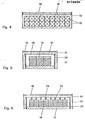
- Figure 1 of the drawings shows a box 10 filled with powder filler 16, wherein the anodes 12 are immersed. Over the powder filler 16, there is arranged a horizontal layer of plate weights 14.
- the weight load on the covering surface of the carbonaceous bodies 12 varies from 100 to 400 kgw/m 2 , where 30-200 kgw/m 2 are formed from the powder filler overlying the carbon bodies, and 70-200 kgw/m 2 from the plate weights.
- the plate weights 14 are shown laid directly on the carbonaceous bodies 12.
- the powder filler 16 which surrounds the bodies 12 is poured onto the plate weights 14 and covered, in turn, with lightweight ceramic covering plates 18, which prevent entrainment and/or combustion of the powder filler 16.
- the weight load on the covering surfaces of the carbonaceous bodies 12 is 70-280 kgw/m 2 and has the following composition:
- the carbonaceous bodies 12 are not introduced into a box but laid onto powder filler spread over a bottom plate 20 having a laterally raised edge 22.
- the carbonaceous bodies 12 are, in turn, covered with a relatively deep layer of the powder filler 16.
- the side edge 22 stops the powder filler 16 from falling out of the truck, while permitting of some flowing thereof.
- the powder filler in protected, in turn, by thin covering plates 18.
- the weight load of 160-400 kgw/m 2 on the covering surface of the carbon bodies 12 is constituted by the following two components:
- FIGS 5 and 6 differently from the embodiments illustrated thus far, show examples where the carbonaceous bodies 12 are not in direct contact, at least not laterally, with the powder filler 16.
- a box 10 there are arranged porous supporting walls 24 of a ceramic material which are filled with powder filler 16.
- plate weights 14 On the bodies 12 are placed plate weights 14.
- a ceramic cover 26 At a distance from the plate weights, a ceramic cover 26 carries the powder filler 16, which is protected, in turn, by covering plates 18.
- Figure 6 there is shown a box 10 of a larger size which is constructed as shown in Figure 5.
- a box 10 of a larger size which is constructed as shown in Figure 5.
- a further embodiment consists of lowering the floor-26 until it is brought to bear directly on the outer sides of the plates 14.
- the supports 28 may be omitted, as may the plates 26 from the middle.
Landscapes
- Chemical & Material Sciences (AREA)
- Engineering & Computer Science (AREA)
- Organic Chemistry (AREA)
- Ceramic Engineering (AREA)
- Materials Engineering (AREA)
- Electrochemistry (AREA)
- Structural Engineering (AREA)
- Chemical Kinetics & Catalysis (AREA)
- Manufacturing & Machinery (AREA)
- Metallurgy (AREA)
- Carbon And Carbon Compounds (AREA)
- Electrolytic Production Of Metals (AREA)
- Electrodes For Compound Or Non-Metal Manufacture (AREA)
- Ceramic Products (AREA)
- Non-Alcoholic Beverages (AREA)
- Compositions Of Oxide Ceramics (AREA)
Priority Applications (1)
| Application Number | Priority Date | Filing Date | Title |
|---|---|---|---|
| AT85111844T ATE50412T1 (de) | 1984-09-28 | 1985-09-19 | Verfahren zur herstellung kohlenstoffhaltiger koerper. |
Applications Claiming Priority (2)
| Application Number | Priority Date | Filing Date | Title |
|---|---|---|---|
| IT22915/84A IT1178518B (it) | 1984-09-28 | 1984-09-28 | Procedimento per la produzione di corpi carboniosi |
| IT2291584 | 1984-09-28 |
Publications (3)
| Publication Number | Publication Date |
|---|---|
| EP0176036A2 true EP0176036A2 (de) | 1986-04-02 |
| EP0176036A3 EP0176036A3 (en) | 1987-01-21 |
| EP0176036B1 EP0176036B1 (de) | 1990-02-14 |
Family
ID=11201859
Family Applications (1)
| Application Number | Title | Priority Date | Filing Date |
|---|---|---|---|
| EP85111844A Expired - Lifetime EP0176036B1 (de) | 1984-09-28 | 1985-09-19 | Verfahren zur Herstellung kohlenstoffhaltiger Körper |
Country Status (9)
| Country | Link |
|---|---|
| EP (1) | EP0176036B1 (de) |
| AT (1) | ATE50412T1 (de) |
| AU (1) | AU583300B2 (de) |
| CA (1) | CA1250710A (de) |
| DE (1) | DE3576049D1 (de) |
| ES (1) | ES8605050A1 (de) |
| IT (1) | IT1178518B (de) |
| NO (1) | NO169766C (de) |
| ZA (1) | ZA857445B (de) |
Families Citing this family (2)
| Publication number | Priority date | Publication date | Assignee | Title |
|---|---|---|---|---|
| IT1178521B (it) * | 1984-09-28 | 1987-09-09 | Alusuisse Italia Spa | Procedimento di calcinazione di corpi carboniosi, in particolare elettrodi, in forni continui od intermittenti e struttura di contenimento per effettuare il procedimento |
| IT1178519B (it) * | 1984-09-28 | 1987-09-09 | Alusuisse Italia Spa | Procedimento per la produzione di corpi carboniosi |
Family Cites Families (8)
| Publication number | Priority date | Publication date | Assignee | Title |
|---|---|---|---|---|
| FR1573937A (de) * | 1968-02-19 | 1969-07-11 | ||
| DE2630396A1 (de) * | 1976-07-06 | 1978-01-12 | Reynolds Metals Co | Verfahren zum brennen von kohlebloecken |
| DE2731760A1 (de) * | 1977-07-14 | 1979-02-01 | Kloeckner Humboldt Deutz Ag | Verfahren und vorrichtung zur herstellung gebrannter kohleanoden, insbesondere zur verwendung fuer die aluminium- schmelzflusselektrolyse |
| DE3042708C2 (de) * | 1980-11-10 | 1986-07-17 | Rudolf 2106 Bendestorf Riedel | Tunnelofen mit zwei parallelen Kanälen |
| IT1205267B (it) * | 1982-08-18 | 1989-03-15 | Alusuisse Italia Spa | Procedimento per la produzione di blocchi carboniosi in forno a tunnel ed apparecchiatura per l'esecuzione del procedimento |
| IT1172847B (it) * | 1983-12-29 | 1987-06-18 | Sirma | Procedimento di cottura di anodi in forni a tunnel e carrello per effettuare il procedimento |
| FR2570646B1 (fr) * | 1984-09-26 | 1987-10-30 | Pradom Ltd | Procede de preparation de materiaux composites a elements de renforcement orientes et produits obtenus |
| IT1178520B (it) * | 1984-09-28 | 1987-09-09 | Alusuisse Italia Spa | Procedimento e forno a tunnel per la calcinazione di corpi carboniosi, in particolare di elettrodi |
-
1984
- 1984-09-28 IT IT22915/84A patent/IT1178518B/it active
-
1985
- 1985-09-19 DE DE8585111844T patent/DE3576049D1/de not_active Expired - Lifetime
- 1985-09-19 AT AT85111844T patent/ATE50412T1/de not_active IP Right Cessation
- 1985-09-19 EP EP85111844A patent/EP0176036B1/de not_active Expired - Lifetime
- 1985-09-25 CA CA000491538A patent/CA1250710A/en not_active Expired
- 1985-09-26 ZA ZA857445A patent/ZA857445B/xx unknown
- 1985-09-26 ES ES547332A patent/ES8605050A1/es not_active Expired
- 1985-09-26 AU AU47931/85A patent/AU583300B2/en not_active Ceased
- 1985-09-27 NO NO853834A patent/NO169766C/no unknown
Also Published As
| Publication number | Publication date |
|---|---|
| EP0176036B1 (de) | 1990-02-14 |
| NO169766B (no) | 1992-04-27 |
| NO853834L (no) | 1986-04-01 |
| NO169766C (no) | 1992-08-05 |
| AU583300B2 (en) | 1989-04-27 |
| ES8605050A1 (es) | 1986-03-16 |
| ATE50412T1 (de) | 1990-02-15 |
| DE3576049D1 (de) | 1990-03-22 |
| AU4793185A (en) | 1986-04-10 |
| ZA857445B (en) | 1986-06-25 |
| IT8422915A0 (it) | 1984-09-28 |
| ES547332A0 (es) | 1986-03-16 |
| IT1178518B (it) | 1987-09-09 |
| EP0176036A3 (en) | 1987-01-21 |
| CA1250710A (en) | 1989-03-07 |
Similar Documents
| Publication | Publication Date | Title |
|---|---|---|
| RU2496745C2 (ru) | Спеченный огнеупорный материал на основе карбида кремния с нитридом кремния в качестве связующего вещества | |
| US4597564A (en) | Rotary hearth | |
| US4738753A (en) | Method of producing carbonaceous bodies | |
| EP0176036B1 (de) | Verfahren zur Herstellung kohlenstoffhaltiger Körper | |
| US4342178A (en) | Carbon anode furnace cover construction | |
| CN108680024A (zh) | 一种焦炉蓄热室全粘土格子砖的复合砌筑结构 | |
| CN212512534U (zh) | 一种石油焦煅烧炉耐热烟道 | |
| JPS6038582A (ja) | 炉の天井の支持構造体 | |
| US4146444A (en) | Method for preheating a molten salt electrolysis cell | |
| US4130391A (en) | Tank block | |
| EP0176876B1 (de) | Verfahren zum Kalzinieren von Kohlenstoffkörpern, insbesondere Elektroden, entweder in kontinuierlichen oder diskontinuierlichen Brennöfen und eine umhüllende Anordnung für dessen Durchführung | |
| US1605885A (en) | Glass furnace | |
| US2393658A (en) | Coke-oven wall construction | |
| JPH0139693Y2 (de) | ||
| SU1483227A1 (ru) | Вагонетка туннельной печи | |
| SU894301A2 (ru) | Печь дл графитации углеграфитовых материалов и изделий | |
| SU1493854A1 (ru) | Под рудовосстановительной печи | |
| JPS6219799B2 (de) | ||
| SU960118A1 (ru) | Теплоизол ционна шихта дл обжига углеродсодержащих заготовок | |
| SU1689733A1 (ru) | Камера обжиговой печи | |
| SU1242698A1 (ru) | Печна вагонетка | |
| RU1819341C (ru) | Печна вагонетка | |
| SU1203349A1 (ru) | Вагонетка туннельной печи | |
| Bhatia | Overview of refractories | |
| JPS6241197Y2 (de) |
Legal Events
| Date | Code | Title | Description |
|---|---|---|---|
| PUAI | Public reference made under article 153(3) epc to a published international application that has entered the european phase |
Free format text: ORIGINAL CODE: 0009012 |
|
| AK | Designated contracting states |
Kind code of ref document: A2 Designated state(s): AT CH DE FR GB IT LI NL SE |
|
| PUAL | Search report despatched |
Free format text: ORIGINAL CODE: 0009013 |
|
| AK | Designated contracting states |
Kind code of ref document: A3 Designated state(s): AT CH DE FR GB IT LI NL SE |
|
| 17P | Request for examination filed |
Effective date: 19870701 |
|
| 17Q | First examination report despatched |
Effective date: 19880609 |
|
| GRAA | (expected) grant |
Free format text: ORIGINAL CODE: 0009210 |
|
| AK | Designated contracting states |
Kind code of ref document: B1 Designated state(s): AT CH DE FR GB IT LI NL SE |
|
| REF | Corresponds to: |
Ref document number: 50412 Country of ref document: AT Date of ref document: 19900215 Kind code of ref document: T |
|
| REF | Corresponds to: |
Ref document number: 3576049 Country of ref document: DE Date of ref document: 19900322 |
|
| ET | Fr: translation filed | ||
| ITF | It: translation for a ep patent filed | ||
| PLBE | No opposition filed within time limit |
Free format text: ORIGINAL CODE: 0009261 |
|
| STAA | Information on the status of an ep patent application or granted ep patent |
Free format text: STATUS: NO OPPOSITION FILED WITHIN TIME LIMIT |
|
| 26N | No opposition filed | ||
| PGFP | Annual fee paid to national office [announced via postgrant information from national office to epo] |
Ref country code: SE Payment date: 19910809 Year of fee payment: 7 |
|
| PGFP | Annual fee paid to national office [announced via postgrant information from national office to epo] |
Ref country code: FR Payment date: 19910816 Year of fee payment: 7 |
|
| PGFP | Annual fee paid to national office [announced via postgrant information from national office to epo] |
Ref country code: DE Payment date: 19910823 Year of fee payment: 7 |
|
| PGFP | Annual fee paid to national office [announced via postgrant information from national office to epo] |
Ref country code: AT Payment date: 19910905 Year of fee payment: 7 |
|
| PGFP | Annual fee paid to national office [announced via postgrant information from national office to epo] |
Ref country code: GB Payment date: 19910909 Year of fee payment: 7 |
|
| PGFP | Annual fee paid to national office [announced via postgrant information from national office to epo] |
Ref country code: CH Payment date: 19910925 Year of fee payment: 7 |
|
| ITTA | It: last paid annual fee | ||
| PGFP | Annual fee paid to national office [announced via postgrant information from national office to epo] |
Ref country code: NL Payment date: 19910930 Year of fee payment: 7 |
|
| PG25 | Lapsed in a contracting state [announced via postgrant information from national office to epo] |
Ref country code: GB Effective date: 19920919 Ref country code: AT Effective date: 19920919 |
|
| PG25 | Lapsed in a contracting state [announced via postgrant information from national office to epo] |
Ref country code: SE Effective date: 19920920 |
|
| PG25 | Lapsed in a contracting state [announced via postgrant information from national office to epo] |
Ref country code: LI Effective date: 19920930 Ref country code: CH Effective date: 19920930 |
|
| PG25 | Lapsed in a contracting state [announced via postgrant information from national office to epo] |
Ref country code: NL Effective date: 19930401 |
|
| NLV4 | Nl: lapsed or anulled due to non-payment of the annual fee | ||
| GBPC | Gb: european patent ceased through non-payment of renewal fee |
Effective date: 19920919 |
|
| PG25 | Lapsed in a contracting state [announced via postgrant information from national office to epo] |
Ref country code: FR Effective date: 19930528 |
|
| REG | Reference to a national code |
Ref country code: CH Ref legal event code: PL |
|
| PG25 | Lapsed in a contracting state [announced via postgrant information from national office to epo] |
Ref country code: DE Effective date: 19930602 |
|
| REG | Reference to a national code |
Ref country code: FR Ref legal event code: ST |
|
| EUG | Se: european patent has lapsed |
Ref document number: 85111844.8 Effective date: 19930406 |