EP0176757A2 - Herstellung einer kationisch wasserlöslichen Polymers und Produkt - Google Patents
Herstellung einer kationisch wasserlöslichen Polymers und Produkt Download PDFInfo
- Publication number
- EP0176757A2 EP0176757A2 EP85110721A EP85110721A EP0176757A2 EP 0176757 A2 EP0176757 A2 EP 0176757A2 EP 85110721 A EP85110721 A EP 85110721A EP 85110721 A EP85110721 A EP 85110721A EP 0176757 A2 EP0176757 A2 EP 0176757A2
- Authority
- EP
- European Patent Office
- Prior art keywords
- acid
- cationic
- monomer
- polymer
- water soluble
- Prior art date
- Legal status (The legal status is an assumption and is not a legal conclusion. Google has not performed a legal analysis and makes no representation as to the accuracy of the status listed.)
- Granted
Links
- XLYOFNOQVPJJNP-UHFFFAOYSA-N water Substances O XLYOFNOQVPJJNP-UHFFFAOYSA-N 0.000 title claims description 15
- 238000002360 preparation method Methods 0.000 title abstract description 7
- 229920006317 cationic polymer Polymers 0.000 title description 4
- 125000002091 cationic group Chemical group 0.000 claims abstract description 35
- 238000009826 distribution Methods 0.000 claims abstract description 13
- OFOBLEOULBTSOW-UHFFFAOYSA-N Malonic acid Chemical compound OC(=O)CC(O)=O OFOBLEOULBTSOW-UHFFFAOYSA-N 0.000 claims abstract description 7
- 239000000178 monomer Substances 0.000 claims description 37
- 238000000034 method Methods 0.000 claims description 29
- 239000002253 acid Substances 0.000 claims description 22
- 239000000203 mixture Substances 0.000 claims description 15
- 230000008569 process Effects 0.000 claims description 13
- WNLRTRBMVRJNCN-UHFFFAOYSA-N adipic acid Chemical compound OC(=O)CCCCC(O)=O WNLRTRBMVRJNCN-UHFFFAOYSA-N 0.000 claims description 12
- 238000006116 polymerization reaction Methods 0.000 claims description 12
- KDYFGRWQOYBRFD-UHFFFAOYSA-N succinic acid Chemical compound OC(=O)CCC(O)=O KDYFGRWQOYBRFD-UHFFFAOYSA-N 0.000 claims description 8
- 235000011037 adipic acid Nutrition 0.000 claims description 7
- 239000001361 adipic acid Substances 0.000 claims description 6
- 239000001384 succinic acid Substances 0.000 claims description 4
- 125000003277 amino group Chemical group 0.000 claims description 3
- 230000000379 polymerizing effect Effects 0.000 claims description 3
- 229920002401 polyacrylamide Polymers 0.000 claims description 2
- 150000007942 carboxylates Chemical group 0.000 claims 1
- 238000007720 emulsion polymerization reaction Methods 0.000 claims 1
- 229920003169 water-soluble polymer Polymers 0.000 abstract description 5
- 239000007787 solid Substances 0.000 abstract description 4
- 150000001991 dicarboxylic acids Chemical class 0.000 abstract description 2
- 238000005189 flocculation Methods 0.000 abstract description 2
- 230000016615 flocculation Effects 0.000 abstract description 2
- 239000002351 wastewater Substances 0.000 abstract 1
- 229920000642 polymer Polymers 0.000 description 32
- 238000006243 chemical reaction Methods 0.000 description 28
- 239000000047 product Substances 0.000 description 16
- 239000003921 oil Substances 0.000 description 15
- 239000010802 sludge Substances 0.000 description 15
- 239000008346 aqueous phase Substances 0.000 description 12
- 239000000839 emulsion Substances 0.000 description 9
- 239000000243 solution Substances 0.000 description 9
- HRPVXLWXLXDGHG-UHFFFAOYSA-N Acrylamide Chemical compound NC(=O)C=C HRPVXLWXLXDGHG-UHFFFAOYSA-N 0.000 description 8
- 150000007513 acids Chemical class 0.000 description 8
- 230000008901 benefit Effects 0.000 description 8
- 239000003999 initiator Substances 0.000 description 7
- 238000004519 manufacturing process Methods 0.000 description 7
- 239000000463 material Substances 0.000 description 7
- 238000002156 mixing Methods 0.000 description 7
- 229920001577 copolymer Chemical group 0.000 description 6
- 150000003839 salts Chemical class 0.000 description 6
- 230000000694 effects Effects 0.000 description 5
- 239000002245 particle Substances 0.000 description 5
- IJGRMHOSHXDMSA-UHFFFAOYSA-N Atomic nitrogen Chemical compound N#N IJGRMHOSHXDMSA-UHFFFAOYSA-N 0.000 description 4
- 238000007334 copolymerization reaction Methods 0.000 description 4
- 239000003995 emulsifying agent Substances 0.000 description 4
- 239000000706 filtrate Substances 0.000 description 4
- 239000000499 gel Substances 0.000 description 4
- 230000003301 hydrolyzing effect Effects 0.000 description 4
- 239000004094 surface-active agent Substances 0.000 description 4
- QLAJNZSPVITUCQ-UHFFFAOYSA-N 1,3,2-dioxathietane 2,2-dioxide Chemical compound O=S1(=O)OCO1 QLAJNZSPVITUCQ-UHFFFAOYSA-N 0.000 description 3
- 150000001412 amines Chemical group 0.000 description 3
- 230000002349 favourable effect Effects 0.000 description 3
- 229910052500 inorganic mineral Inorganic materials 0.000 description 3
- 230000014759 maintenance of location Effects 0.000 description 3
- FQPSGWSUVKBHSU-UHFFFAOYSA-N methacrylamide Chemical compound CC(=C)C(N)=O FQPSGWSUVKBHSU-UHFFFAOYSA-N 0.000 description 3
- 239000011707 mineral Substances 0.000 description 3
- 239000012071 phase Substances 0.000 description 3
- 150000003254 radicals Chemical class 0.000 description 3
- 239000002994 raw material Substances 0.000 description 3
- 230000009257 reactivity Effects 0.000 description 3
- 235000011044 succinic acid Nutrition 0.000 description 3
- 238000012360 testing method Methods 0.000 description 3
- SMZOUWXMTYCWNB-UHFFFAOYSA-N 2-(2-methoxy-5-methylphenyl)ethanamine Chemical compound COC1=CC=C(C)C=C1CCN SMZOUWXMTYCWNB-UHFFFAOYSA-N 0.000 description 2
- NIXOWILDQLNWCW-UHFFFAOYSA-N 2-Propenoic acid Natural products OC(=O)C=C NIXOWILDQLNWCW-UHFFFAOYSA-N 0.000 description 2
- PUAQLLVFLMYYJJ-UHFFFAOYSA-N 2-aminopropiophenone Chemical compound CC(N)C(=O)C1=CC=CC=C1 PUAQLLVFLMYYJJ-UHFFFAOYSA-N 0.000 description 2
- 239000004908 Emulsion polymer Substances 0.000 description 2
- VEXZGXHMUGYJMC-UHFFFAOYSA-N Hydrochloric acid Chemical compound Cl VEXZGXHMUGYJMC-UHFFFAOYSA-N 0.000 description 2
- HVUMOYIDDBPOLL-XWVZOOPGSA-N Sorbitan monostearate Chemical compound CCCCCCCCCCCCCCCCCC(=O)OC[C@@H](O)[C@H]1OC[C@H](O)[C@H]1O HVUMOYIDDBPOLL-XWVZOOPGSA-N 0.000 description 2
- QAOWNCQODCNURD-UHFFFAOYSA-N Sulfuric acid Chemical compound OS(O)(=O)=O QAOWNCQODCNURD-UHFFFAOYSA-N 0.000 description 2
- AZDRQVAHHNSJOQ-UHFFFAOYSA-N alumane Chemical class [AlH3] AZDRQVAHHNSJOQ-UHFFFAOYSA-N 0.000 description 2
- ROOXNKNUYICQNP-UHFFFAOYSA-N ammonium persulfate Chemical compound [NH4+].[NH4+].[O-]S(=O)(=O)OOS([O-])(=O)=O ROOXNKNUYICQNP-UHFFFAOYSA-N 0.000 description 2
- 238000004458 analytical method Methods 0.000 description 2
- QVGXLLKOCUKJST-UHFFFAOYSA-N atomic oxygen Chemical compound [O] QVGXLLKOCUKJST-UHFFFAOYSA-N 0.000 description 2
- 150000001735 carboxylic acids Chemical class 0.000 description 2
- BHDFTVNXJDZMQK-UHFFFAOYSA-N chloromethane;2-(dimethylamino)ethyl 2-methylprop-2-enoate Chemical compound ClC.CN(C)CCOC(=O)C(C)=C BHDFTVNXJDZMQK-UHFFFAOYSA-N 0.000 description 2
- 239000003599 detergent Substances 0.000 description 2
- -1 dimethylamino ethyl methyl Chemical group 0.000 description 2
- 230000008034 disappearance Effects 0.000 description 2
- 238000001914 filtration Methods 0.000 description 2
- 239000008394 flocculating agent Substances 0.000 description 2
- 238000005188 flotation Methods 0.000 description 2
- 238000000265 homogenisation Methods 0.000 description 2
- 239000004615 ingredient Substances 0.000 description 2
- 230000005865 ionizing radiation Effects 0.000 description 2
- 229910052757 nitrogen Inorganic materials 0.000 description 2
- 239000001301 oxygen Substances 0.000 description 2
- 229910052760 oxygen Inorganic materials 0.000 description 2
- 238000012545 processing Methods 0.000 description 2
- 230000005855 radiation Effects 0.000 description 2
- 239000001587 sorbitan monostearate Substances 0.000 description 2
- 235000011076 sorbitan monostearate Nutrition 0.000 description 2
- 229940035048 sorbitan monostearate Drugs 0.000 description 2
- 239000000758 substrate Substances 0.000 description 2
- 239000007762 w/o emulsion Substances 0.000 description 2
- ZORQXIQZAOLNGE-UHFFFAOYSA-N 1,1-difluorocyclohexane Chemical compound FC1(F)CCCCC1 ZORQXIQZAOLNGE-UHFFFAOYSA-N 0.000 description 1
- JKNCOURZONDCGV-UHFFFAOYSA-N 2-(dimethylamino)ethyl 2-methylprop-2-enoate Chemical compound CN(C)CCOC(=O)C(C)=C JKNCOURZONDCGV-UHFFFAOYSA-N 0.000 description 1
- WYGWHHGCAGTUCH-UHFFFAOYSA-N 2-[(2-cyano-4-methylpentan-2-yl)diazenyl]-2,4-dimethylpentanenitrile Chemical compound CC(C)CC(C)(C#N)N=NC(C)(C#N)CC(C)C WYGWHHGCAGTUCH-UHFFFAOYSA-N 0.000 description 1
- NLHHRLWOUZZQLW-UHFFFAOYSA-N Acrylonitrile Chemical compound C=CC#N NLHHRLWOUZZQLW-UHFFFAOYSA-N 0.000 description 1
- RYGMFSIKBFXOCR-UHFFFAOYSA-N Copper Chemical compound [Cu] RYGMFSIKBFXOCR-UHFFFAOYSA-N 0.000 description 1
- 238000004566 IR spectroscopy Methods 0.000 description 1
- CERQOIWHTDAKMF-UHFFFAOYSA-N Methacrylic acid Chemical compound CC(=C)C(O)=O CERQOIWHTDAKMF-UHFFFAOYSA-N 0.000 description 1
- CTQNGGLPUBDAKN-UHFFFAOYSA-N O-Xylene Chemical compound CC1=CC=CC=C1C CTQNGGLPUBDAKN-UHFFFAOYSA-N 0.000 description 1
- OAICVXFJPJFONN-UHFFFAOYSA-N Phosphorus Chemical compound [P] OAICVXFJPJFONN-UHFFFAOYSA-N 0.000 description 1
- BAPJBEWLBFYGME-UHFFFAOYSA-N acrylic acid methyl ester Natural products COC(=O)C=C BAPJBEWLBFYGME-UHFFFAOYSA-N 0.000 description 1
- 239000012190 activator Substances 0.000 description 1
- 239000000654 additive Substances 0.000 description 1
- 230000000996 additive effect Effects 0.000 description 1
- 150000001279 adipic acids Chemical class 0.000 description 1
- 238000013019 agitation Methods 0.000 description 1
- 229910001870 ammonium persulfate Inorganic materials 0.000 description 1
- 125000000129 anionic group Chemical group 0.000 description 1
- 239000007864 aqueous solution Substances 0.000 description 1
- 125000003118 aryl group Chemical group 0.000 description 1
- 230000015572 biosynthetic process Effects 0.000 description 1
- 230000003139 buffering effect Effects 0.000 description 1
- 150000001732 carboxylic acid derivatives Chemical class 0.000 description 1
- 230000015556 catabolic process Effects 0.000 description 1
- 229920003118 cationic copolymer Polymers 0.000 description 1
- 239000013522 chelant Substances 0.000 description 1
- XBXVSHIOXPRBOH-UHFFFAOYSA-N chloromethane;2-(dimethylamino)ethyl 2-methylprop-2-enoate;prop-2-enamide Chemical compound ClC.NC(=O)C=C.CN(C)CCOC(=O)C(C)=C XBXVSHIOXPRBOH-UHFFFAOYSA-N 0.000 description 1
- 238000004140 cleaning Methods 0.000 description 1
- 239000000084 colloidal system Substances 0.000 description 1
- 230000000052 comparative effect Effects 0.000 description 1
- 150000001875 compounds Chemical class 0.000 description 1
- 238000011109 contamination Methods 0.000 description 1
- 229910052802 copper Inorganic materials 0.000 description 1
- 239000010949 copper Substances 0.000 description 1
- 238000004132 cross linking Methods 0.000 description 1
- 230000003247 decreasing effect Effects 0.000 description 1
- 238000006731 degradation reaction Methods 0.000 description 1
- 239000008367 deionised water Substances 0.000 description 1
- 229910021641 deionized water Inorganic materials 0.000 description 1
- 238000011161 development Methods 0.000 description 1
- 238000004090 dissolution Methods 0.000 description 1
- 238000004070 electrodeposition Methods 0.000 description 1
- 230000008030 elimination Effects 0.000 description 1
- 238000003379 elimination reaction Methods 0.000 description 1
- 239000004744 fabric Substances 0.000 description 1
- 238000009472 formulation Methods 0.000 description 1
- 125000000524 functional group Chemical group 0.000 description 1
- 238000004128 high performance liquid chromatography Methods 0.000 description 1
- 238000007654 immersion Methods 0.000 description 1
- 239000011261 inert gas Substances 0.000 description 1
- 239000003350 kerosene Substances 0.000 description 1
- 239000002480 mineral oil Substances 0.000 description 1
- 238000005065 mining Methods 0.000 description 1
- 238000012986 modification Methods 0.000 description 1
- 230000004048 modification Effects 0.000 description 1
- 238000012544 monitoring process Methods 0.000 description 1
- WFKDPJRCBCBQNT-UHFFFAOYSA-N n,2-dimethylprop-2-enamide Chemical compound CNC(=O)C(C)=C WFKDPJRCBCBQNT-UHFFFAOYSA-N 0.000 description 1
- YPHQUSNPXDGUHL-UHFFFAOYSA-N n-methylprop-2-enamide Chemical compound CNC(=O)C=C YPHQUSNPXDGUHL-UHFFFAOYSA-N 0.000 description 1
- 230000003472 neutralizing effect Effects 0.000 description 1
- 229920000847 nonoxynol Polymers 0.000 description 1
- SNQQPOLDUKLAAF-UHFFFAOYSA-N nonylphenol Chemical class CCCCCCCCCC1=CC=CC=C1O SNQQPOLDUKLAAF-UHFFFAOYSA-N 0.000 description 1
- 230000020477 pH reduction Effects 0.000 description 1
- LQPLDXQVILYOOL-UHFFFAOYSA-I pentasodium;2-[bis[2-[bis(carboxylatomethyl)amino]ethyl]amino]acetate Chemical compound [Na+].[Na+].[Na+].[Na+].[Na+].[O-]C(=O)CN(CC([O-])=O)CCN(CC(=O)[O-])CCN(CC([O-])=O)CC([O-])=O LQPLDXQVILYOOL-UHFFFAOYSA-I 0.000 description 1
- 229910052698 phosphorus Inorganic materials 0.000 description 1
- 239000011574 phosphorus Substances 0.000 description 1
- 239000000049 pigment Substances 0.000 description 1
- 230000001376 precipitating effect Effects 0.000 description 1
- 238000001556 precipitation Methods 0.000 description 1
- 238000005086 pumping Methods 0.000 description 1
- 238000010926 purge Methods 0.000 description 1
- 238000003908 quality control method Methods 0.000 description 1
- 238000011084 recovery Methods 0.000 description 1
- 239000010865 sewage Substances 0.000 description 1
- 239000002002 slurry Substances 0.000 description 1
- 239000002904 solvent Substances 0.000 description 1
- 239000001593 sorbitan monooleate Substances 0.000 description 1
- 235000011069 sorbitan monooleate Nutrition 0.000 description 1
- 229940035049 sorbitan monooleate Drugs 0.000 description 1
- 239000000126 substance Substances 0.000 description 1
- 150000003444 succinic acids Chemical class 0.000 description 1
- 239000006228 supernatant Substances 0.000 description 1
- 239000008399 tap water Substances 0.000 description 1
- 235000020679 tap water Nutrition 0.000 description 1
- 229920001897 terpolymer Polymers 0.000 description 1
- 150000003512 tertiary amines Chemical class 0.000 description 1
- 239000002562 thickening agent Substances 0.000 description 1
- 238000004448 titration Methods 0.000 description 1
- 238000012546 transfer Methods 0.000 description 1
- UZNHKBFIBYXPDV-UHFFFAOYSA-N trimethyl-[3-(2-methylprop-2-enoylamino)propyl]azanium;chloride Chemical compound [Cl-].CC(=C)C(=O)NCCC[N+](C)(C)C UZNHKBFIBYXPDV-UHFFFAOYSA-N 0.000 description 1
- 238000001132 ultrasonic dispersion Methods 0.000 description 1
- 239000002699 waste material Substances 0.000 description 1
- 238000004065 wastewater treatment Methods 0.000 description 1
- 239000008096 xylene Substances 0.000 description 1
Images
Classifications
-
- C—CHEMISTRY; METALLURGY
- C08—ORGANIC MACROMOLECULAR COMPOUNDS; THEIR PREPARATION OR CHEMICAL WORKING-UP; COMPOSITIONS BASED THEREON
- C08F—MACROMOLECULAR COMPOUNDS OBTAINED BY REACTIONS ONLY INVOLVING CARBON-TO-CARBON UNSATURATED BONDS
- C08F220/00—Copolymers of compounds having one or more unsaturated aliphatic radicals, each having only one carbon-to-carbon double bond, and only one being terminated by only one carboxyl radical or a salt, anhydride ester, amide, imide or nitrile thereof
- C08F220/02—Monocarboxylic acids having less than ten carbon atoms; Derivatives thereof
- C08F220/52—Amides or imides
- C08F220/54—Amides, e.g. N,N-dimethylacrylamide or N-isopropylacrylamide
- C08F220/56—Acrylamide; Methacrylamide
-
- C—CHEMISTRY; METALLURGY
- C02—TREATMENT OF WATER, WASTE WATER, SEWAGE, OR SLUDGE
- C02F—TREATMENT OF WATER, WASTE WATER, SEWAGE, OR SLUDGE
- C02F1/00—Treatment of water, waste water, or sewage
- C02F1/52—Treatment of water, waste water, or sewage by flocculation or precipitation of suspended impurities
- C02F1/54—Treatment of water, waste water, or sewage by flocculation or precipitation of suspended impurities using organic material
Definitions
- This invention relates to the use of acids in conjunction with and to improve the performance and stability of cationic water soluble water treatment polymers having a quaternary amine functionality, and copolymers thereof, with ethylenically unsaturated monomers.
- These polymers may be prepared by reaction in the presence of free radical initiators or ionizing radiation.
- dicarboxylic acid is used to improve the performance and stability of cationic water treatment polymers.
- the procedure can be used in both solution and emulsion (water/oil) reactions.
- the performance of water treatment polymers of this kind relates to the dewatering capability of the polymer based on a SFR (specific filter resistance) test of total drainage of the supernatant through the sludge in comparison to dose.
- Stability relates to the performance of the polymer and retention of cationic charge.
- the performance of cationic polymer can be related to a number of different variables including: (1) molecular weight, (2) charge, (3) charge distribution.
- the method of this invention involves the effect on the charge distribution in the polymer during the course of the reaction through the use of a dicarboxylic acid, and buffering capability in the reaction mass to maintain the desired charge in the polymer after the completion of the reaction.
- cationic polymers are useful as drainage aids, flotation aids, retention aids, process water flocculants, and in the manufacture of paper and paper products, waste effluent treatment, oil recovery operations, and mining operations.
- the major difficulty in preparing these cationic products relates to the differences in reactivity between the acrylamide (the major backbone in these polymer formulations) and the cationic co-monomers.
- the cationic co-monomer was added in increments over the course of the reaction to prevent the homopolymerization of the cationic monomer substrate and force the reaction between the monomers present.
- a second problem is the lack of hydrolytic stability of quaternary cationic monomers and the resulting polymers; a means for suppressing this hydrolytic degradation would therefore be desirable.
- Cationic water soluble polymers have been found to be relatively difficult to produce and apply because of the poor hydrolytic stability of the product polymer and in the case of most cationic monomers, difficulties occur in the polymerization because the relative reactivities of the cationic monomers are much higher than the usual comonomers.
- the high reactivity of the cationic monomers leads to production of an initial fraction during the copolymerization of material that is excessively high in cationic.content and a later fraction almost devoid of cationic content. Materials polymerized in this fashion do not exhibit the same application activity as materials produced with an even distribution of charge during the polymerization.
- Gershberg discloses the addition of sulfuric acid to adjust the pH of an aqueous phase reaction containing various monomers including cationic monomers described in this invention.
- the pH range considered optimum for the invention described by Gershberg is clearly outside that considered optimum for the present invention and the use of strong acids does not give the desirable results of the weaker acids disclosed as suitable in the present invention.
- Phalanges, et al. discloses polymerization by radiation in the range of pH 2 to 5 for the purpose of preventing certain aluminum salts from precipitating out of solution. These aluminum salts are in solution for the purpose of preventing crosslinking of the polymer which will occur as the conversion of the monomer nears completion. Phalanges does not disclose the advantages of any particular type of acid, nor the benefits of using acids other than those preventing the precipitation of salts present in the system of that patentee.
- Sekmakas, et al. discloses the use of acids in the preparation of tertiary amine copolymers for use in electrocoating by neutralizing the amine functionality with various acids to a pH in the general range of 5 to 7. This pH range is outside the range of interest in the present invention.
- the functional group involved in S ekmakas, et al. is a tertiary amine
- the chemical nature of the compounds is completely at variance with the subject of this invention.
- Sekmakas discusses this possibility and rejects it as not feasible because of the large amount of acid required to neutralize the amine salt functionality.
- an acid additive is utilized to control the polymerization to produce a more uniform comonomer rate of reaction.
- novel polymeric compositions having exceptionally well distributed and active cationic charge are prepared. These materials are highly useful in flocculation, sludge dewatering as retention and flotation aids and other water treating applications.
- These water soluble polymers contain segments of acrylamide or methacrylamide, acrylic acid or methacrylic acid, salts thereof, dimethylamino ethyl methyl acrylate quaternary salts, and other ethylenically unsaturated comonomers containing quaternary amine functional groups.
- Typical quaternary amine cationic monomers include: l-trimethylammonium-2-hydroxypropylmethacrylate methosulfate, trimethylammonium-2-hydroxypropylacrylate methosulfate, 1-trimethylammonium-2-2-hydroxypropylacrylate methosulfate, 3-methacrylamidopropyltrimethyl- ammonium chloride, dimethylaminoethylmethacrylate methylchloride quat, and the like.
- the repeating monomer units of the polymer will include anywhere from 1-70 mole % of the cationic monomer with the remainder being a nonionic substrate such as: acrylamide, methacrylamide, N-methyl acrylamide, N-methylmethacrylamide and the like.
- the acid employed in the copolymerization may be a mineral acid, an organic carboxylic acid as a dicarboxylic acid. Dicarboxylic acids, particularly adipic and succinic acids are preferred.
- An object of the invention is the provision of a process for the development of cationic water soluble polymers having excellent charge distribution and cationic charge stability. Polymers manufactured by this process have many advantages over these currently available. The primary advantage is improved charge distribution over current systems. Another object of this invention is not to necessarily neutralize an amine salt functionality but to provide a pH where the monomers described are hydrolytically stable and where the copolymerization kinetics are most favorable. Other advantages include increased activity and shelf life of the resulting products, increased performance in high p H applications, and production of the material in various forms including solutions, solution gels and emulsions.
- the invention permits the preparation of novel water treatment polymers containing at least a small proportion of cationic functionality provided by the comonomer.
- These new flocculant compositions are obtained by polymerizing ethylenically unsaturated monomers containing quaternary amine functionalities with essentially nonionic monomers to obtain a polymer containing an improved charge distribution in the presence of acid.
- This invention can be applied to polymerizations conducted in aqueous solutions, solution gels and emulsion products.
- the polymerization can be initiated by free radical initiators such as ammonium persulfate, 2,2' azobis(2,4 dimethyl valeronitrile) and by UV light, gamma radiation and other ionizing radiation.
- free radical initiators such as ammonium persulfate, 2,2' azobis(2,4 dimethyl valeronitrile) and by UV light, gamma radiation and other ionizing radiation.
- One particularly desirable implementation of the subject invention is the production of cationic polymers in emulsion form.
- the inverse emulsion products of this invention consist of a continuous oil phase composition in which microscopic droplets of a dispersed aqueous phase containing the water soluble polymer are present. Also present in the system are various surfactants which help stabilize the emulsion and aid in the release of the polymer at the point of end use.
- Products of this type are commonly manufactured by a process consisting of the steps of raw material preparation, homogenization, reaction and product finishing.
- Raw material preparation is accomplished by mixing the components of the aqueous and oil phases together in two separate vessels and often adjusting the pH of the aqueous phase.
- Illustrative water-in-oil emulsifying agents that can be used are sorbitan monooleate, sorbitan monostearate, and ethoxylated derivatives of the former.
- Oils can be of the general classes of mineral oils, deodorized kerosene or solvents such as xylene.
- a preferred class of oils are deodorized kerosenes with an aromatic content below 10%.
- the invention also contemplates copolymers and terpolymers obtained by polymerization of mixtures of these monomers as well as water soluble mixtures of such monomers with various other polymerizable monomers in relative proportions that yield water soluble copolymers.
- Various copolymers may include acrylamide, methacrylamide, acrylonitrile, acrylic acid and salts thereof, dimethylamino ethyl methacrylate and quaternary salts thereof and other ethylenically unsaturated monomers.
- a cationic copolymer was produced using the following ingredients:
- the aqueous phase was then added to the reactor containing the oil-surfactant blend with mixing. This forms a crude emulsion. A homogenizer was then used to decrease the particle size to below 5 microns before polymerization.
- the ratio of disappearance of QM to acrylamide is shown in the fourth column.
- the ratio should be as constant as possible over the course of the reaction to insure good charge distribution.
- Example 2 The procedure of Example 1 was followed except that hydrochloric acid was added to adjust the pH of the aqueous phase to pH 3.5. The results are summarized in the following Table II.
- Example 1 The procedure of Example 1 was followed except that succinic acid was used to bring the pH of the aqueous phase to 4.7.
- the results are summarized in the following Table III.
- Example 1 The procedure of Example 1 was followed except that succinic acid was used to bring the pH of the aqueous phase 3.5.
- the results are summarized in the following Table IV.
- Example 1 The procedure of Example 1 was followed except that adipic acid was used to bring the pH of the aqueous phase 3.5.
- the results are summarized in the following Table V.
- a cationic copolmer was produced using the following ingredients using the procedure of Example 1:
- Example 6 The procedure of Example 6 was followed with the exception that 8 grams of adipic acid were used.
- Example 6 The procedure of Example 6 was followed with the exception that 12 grams of adipic acid were used.
- Example 6 The procedure of Example 6 was followed with the exception that 16 grams of adipic acid were used.
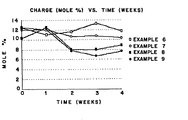
- the general conclusion here is that the cationic charge is relatively stable until a high level of dicarboxylic acid is added. This level corresponds roughly to decreasing the pH below 3.
- the specific filter resistance test compares the comparative dewatering capabilities of different polymers on an individual sludge.
- the method consists of adding polymer to the sludge to be dewatered, filtering the flocculated sludge and monitoring the quantity of filtrate drained over time.
- the SFR (specific filter resistance) is calculated by an equation comparing the filtrate drained over time and a number of parameters:
- Varying the dosages of the polymer a series of points with different SFR's can be found for the polymer of interest on a sludge, showing the dewatering ability of that polymer. By using a different polymer on the same sludge, a comparison between the two polymers can be observed. A polymer working at lower SFR's use a lower dose is, according to this well accepted test, the more effective product. Further background information can be found in Weber, J. Physiochemical Processes for Water Quality Control, pp. 566-567 Wiley-Interscience Publishers, New York, 1972.
- the products of Examples 1 through 5 were evaluated using the following technique: Aliquots of 500 milliliters of tap water were placed in 800 milliliter flasks and 2.5 grams each of the products of Examples 1 through 5 were added to each of the flasks under the conditions of vigorous mixing. The mixing was continued for one-half hour after the addition of the polymer.
- Quantities of the resulting solution were added to 100 milliliter aliquots of anaerobic digested sludge obtained from the Syracuse Metropolitan Waste Water Treatment Plant. Doses used were in the range of 20 to 140 parts per million of polymer.
- the resulting polymer-sludge mix was agitated by pouring the mixture back and fourth from one mixing cup to the next twelve times.
- the resulting flocculated sludge was then filtered in a 55 milliliter Buchner funnel with a disk of filter cloth serving to retain the sludge solids. Filtration rates were then measured and the specific filter resistances calculated according to the previous discussion. Results are set forth in Table VII below.
Landscapes
- Chemical & Material Sciences (AREA)
- Organic Chemistry (AREA)
- Life Sciences & Earth Sciences (AREA)
- Medicinal Chemistry (AREA)
- Polymers & Plastics (AREA)
- Chemical Kinetics & Catalysis (AREA)
- Health & Medical Sciences (AREA)
- Hydrology & Water Resources (AREA)
- Engineering & Computer Science (AREA)
- Environmental & Geological Engineering (AREA)
- Water Supply & Treatment (AREA)
- Addition Polymer Or Copolymer, Post-Treatments, Or Chemical Modifications (AREA)
- Separation Of Suspended Particles By Flocculating Agents (AREA)
Applications Claiming Priority (4)
| Application Number | Priority Date | Filing Date | Title |
|---|---|---|---|
| US65325384A | 1984-09-24 | 1984-09-24 | |
| US653253 | 1984-09-24 | ||
| US761089 | 1985-08-02 | ||
| US06/761,089 US4668747A (en) | 1984-09-24 | 1985-08-02 | Preparation of water soluble cationic acrylamide polymer and product using weak acid to adjust pH |
Publications (3)
| Publication Number | Publication Date |
|---|---|
| EP0176757A2 true EP0176757A2 (de) | 1986-04-09 |
| EP0176757A3 EP0176757A3 (en) | 1986-07-30 |
| EP0176757B1 EP0176757B1 (de) | 1990-11-07 |
Family
ID=27096480
Family Applications (1)
| Application Number | Title | Priority Date | Filing Date |
|---|---|---|---|
| EP85110721A Expired EP0176757B1 (de) | 1984-09-24 | 1985-08-26 | Herstellung einer kationisch wasserlöslichen Polymers und Produkt |
Country Status (4)
| Country | Link |
|---|---|
| US (1) | US4668747A (de) |
| EP (1) | EP0176757B1 (de) |
| CA (1) | CA1261099A (de) |
| DE (1) | DE3580440D1 (de) |
Cited By (4)
| Publication number | Priority date | Publication date | Assignee | Title |
|---|---|---|---|---|
| WO1992007881A1 (en) * | 1990-11-05 | 1992-05-14 | Marathon Oil Company | A method for inhibiting hydrolysis of polyacrylamide |
| US8152962B2 (en) | 2004-12-03 | 2012-04-10 | Basf Aktiengesellschaft | Method for producing paper with a high substance weight |
| US8394237B2 (en) | 2008-09-02 | 2013-03-12 | BASF SE Ludwigshafen | Method for manufacturing paper, cardboard and paperboard using endo-beta-1,4-glucanases as dewatering means |
| CN103242480A (zh) * | 2013-04-15 | 2013-08-14 | 北京恒聚化工集团有限责任公司 | 一种阳离子聚丙烯酰胺乳液的制备方法及制得的乳液 |
Families Citing this family (8)
| Publication number | Priority date | Publication date | Assignee | Title |
|---|---|---|---|---|
| US4809937A (en) * | 1987-09-23 | 1989-03-07 | Big Jon, Inc. | Cable penetration plug |
| US4983698A (en) * | 1987-12-23 | 1991-01-08 | Exxon Chemical Patents Inc. | Cationic polymers |
| IT1237794B (it) * | 1989-12-21 | 1993-06-17 | Eniricerche Spa | Copolimeri acrilammidici contenenti unita' (met) acrilammido benzendicarbossiliche |
| US5008319A (en) * | 1990-02-01 | 1991-04-16 | Polypure, Inc. | Homogeneous mixtures of solid organic acids and solid cationic ester-based polymer flocculants |
| US5365775A (en) * | 1993-09-27 | 1994-11-22 | Penniman John G | Process for automatic measurement of specific filtration resistance and electrostatic charge of a fibrous dispersion |
| JPH10212323A (ja) * | 1997-01-31 | 1998-08-11 | Soken Chem & Eng Co Ltd | 親水性アクリル共重合体、親水性アクリル樹脂粒子およびインクジェット用記録媒体 |
| GB0220714D0 (en) * | 2002-09-05 | 2002-10-16 | Ciba Spec Chem Water Treat Ltd | Dewatering of suspensions |
| CN109714968A (zh) | 2016-07-28 | 2019-05-03 | 艾克森实验室有限公司 | 基于聚合物的抗微生物组合物及其使用方法 |
Family Cites Families (4)
| Publication number | Priority date | Publication date | Assignee | Title |
|---|---|---|---|---|
| US3344100A (en) * | 1965-07-28 | 1967-09-26 | Goodrich Co B F | Emulsion polymerization using water insoluble metal salts of fatty acids |
| US3929751A (en) * | 1971-04-14 | 1975-12-30 | American Cyanamid Co | High molecular weight acrylamide polymer production by high solids solution polymerization |
| US4024040A (en) * | 1974-02-26 | 1977-05-17 | Hercules Incorporated | Polymerization of unsaturated monomers with radiation in the presence of salts |
| US4195147A (en) * | 1979-02-22 | 1980-03-25 | Desoto, Inc. | Preparation of cationic amine-functional copolymers |
-
1985
- 1985-08-02 US US06/761,089 patent/US4668747A/en not_active Expired - Fee Related
- 1985-08-26 DE DE8585110721T patent/DE3580440D1/de not_active Revoked
- 1985-08-26 EP EP85110721A patent/EP0176757B1/de not_active Expired
- 1985-08-29 CA CA000489688A patent/CA1261099A/en not_active Expired
Cited By (7)
| Publication number | Priority date | Publication date | Assignee | Title |
|---|---|---|---|---|
| WO1992007881A1 (en) * | 1990-11-05 | 1992-05-14 | Marathon Oil Company | A method for inhibiting hydrolysis of polyacrylamide |
| GB2262529A (en) * | 1990-11-05 | 1993-06-23 | Marathon Oil Co | A method for inhibiting hydrolysis of polyacrylamide |
| GB2262529B (en) * | 1990-11-05 | 1994-04-06 | Marathon Oil Co | A method for inhibiting hydrolysis of polyacrylamide |
| US8152962B2 (en) | 2004-12-03 | 2012-04-10 | Basf Aktiengesellschaft | Method for producing paper with a high substance weight |
| US8394237B2 (en) | 2008-09-02 | 2013-03-12 | BASF SE Ludwigshafen | Method for manufacturing paper, cardboard and paperboard using endo-beta-1,4-glucanases as dewatering means |
| CN103242480A (zh) * | 2013-04-15 | 2013-08-14 | 北京恒聚化工集团有限责任公司 | 一种阳离子聚丙烯酰胺乳液的制备方法及制得的乳液 |
| CN103242480B (zh) * | 2013-04-15 | 2015-06-24 | 北京恒聚化工集团有限责任公司 | 一种阳离子聚丙烯酰胺乳液的制备方法及制得的乳液 |
Also Published As
| Publication number | Publication date |
|---|---|
| US4668747A (en) | 1987-05-26 |
| DE3580440D1 (de) | 1990-12-13 |
| EP0176757A3 (en) | 1986-07-30 |
| CA1261099A (en) | 1989-09-26 |
| EP0176757B1 (de) | 1990-11-07 |
Similar Documents
| Publication | Publication Date | Title |
|---|---|---|
| EP0469196B1 (de) | Interpolymere Flockungsmittel | |
| US5707533A (en) | Process for the preparation of aqueous dispersion polymers | |
| EP1274652B1 (de) | Verfahren zur klärung von wasser unter nutzung von niedrigmolekularen kationischen dispersionspolymeren | |
| US4783513A (en) | Novel water soluble cationic acrylamide polymers having relatively uniform cationic quaternary amine functional unit distribution | |
| EP0176757B1 (de) | Herstellung einer kationisch wasserlöslichen Polymers und Produkt | |
| JPH05192513A (ja) | カチオン性高分子凝集剤 | |
| US5132023A (en) | Emulsified mannich acrylamide polymers | |
| EP0637599B1 (de) | Behandlungsverfahren für ölige Abwässer | |
| US5597490A (en) | DADMAC/vinyl trialkoxysilane copolymers for treatment of food processing wastes | |
| US5132383A (en) | Copolymers of 3-methacryloyloxy-2-hydroxypropyl trimethylammonium chloride monomer and vinyl monomer | |
| US5019275A (en) | Method of flocculation with cationic terpolymer flocculants | |
| CA2005681A1 (en) | Cationic microemulsified polymers | |
| US6569968B1 (en) | Polymer of a water-soluble radical-polymerizable monomer, process for producing the polymer and flocculant comprising the polymer | |
| JPH11510526A (ja) | 高い標準粘度の第四級化マンニッヒ型ミクロエマルジョン | |
| EP1228100B1 (de) | Polymerisatzusammensetzung und ein verfahren zu dessen herstellung | |
| CA1295081C (en) | Cationic monomer delayed addition process | |
| DE3312424C2 (de) | ||
| KR20000069506A (ko) | 수용성 중합체 분산액의 제조방법 | |
| JP2921295B2 (ja) | アリルアミン−フマル酸共重合体を含む水処理剤 | |
| US5068297A (en) | Hydrophobic cationic terpolymers from acrylamide, unsaturated quaternary salt and vinyl acetate | |
| JPS61123616A (ja) | 水溶性のカチオン性ポリマ−の製造法 | |
| JPH04293600A (ja) | 汚泥脱水方法 | |
| USRE36780E (en) | Mannich acrylamide polymers | |
| WO1999019262A1 (en) | Chain extended cationic polymer synthesis | |
| CA1260634A (en) | Dewatering agents |
Legal Events
| Date | Code | Title | Description |
|---|---|---|---|
| PUAI | Public reference made under article 153(3) epc to a published international application that has entered the european phase |
Free format text: ORIGINAL CODE: 0009012 |
|
| AK | Designated contracting states |
Kind code of ref document: A2 Designated state(s): DE FR GB NL |
|
| PUAL | Search report despatched |
Free format text: ORIGINAL CODE: 0009013 |
|
| AK | Designated contracting states |
Kind code of ref document: A3 Designated state(s): DE FR GB NL |
|
| 17P | Request for examination filed |
Effective date: 19870116 |
|
| 17Q | First examination report despatched |
Effective date: 19880527 |
|
| RAP1 | Party data changed (applicant data changed or rights of an application transferred) |
Owner name: POLYPURE INC. |
|
| GRAA | (expected) grant |
Free format text: ORIGINAL CODE: 0009210 |
|
| AK | Designated contracting states |
Kind code of ref document: B1 Designated state(s): DE FR GB NL |
|
| PG25 | Lapsed in a contracting state [announced via postgrant information from national office to epo] |
Ref country code: NL Effective date: 19901107 |
|
| REF | Corresponds to: |
Ref document number: 3580440 Country of ref document: DE Date of ref document: 19901213 |
|
| ET | Fr: translation filed | ||
| NLV1 | Nl: lapsed or annulled due to failure to fulfill the requirements of art. 29p and 29m of the patents act | ||
| PLBI | Opposition filed |
Free format text: ORIGINAL CODE: 0009260 |
|
| PGFP | Annual fee paid to national office [announced via postgrant information from national office to epo] |
Ref country code: GB Payment date: 19910805 Year of fee payment: 7 |
|
| PLBI | Opposition filed |
Free format text: ORIGINAL CODE: 0009260 |
|
| PGFP | Annual fee paid to national office [announced via postgrant information from national office to epo] |
Ref country code: FR Payment date: 19910808 Year of fee payment: 7 |
|
| PLBI | Opposition filed |
Free format text: ORIGINAL CODE: 0009260 |
|
| 26 | Opposition filed |
Opponent name: ROEHM GMBH Effective date: 19910723 |
|
| 26 | Opposition filed |
Opponent name: ALLIED COLLOIDS LIMITED Effective date: 19910806 Opponent name: BASF AKTIENGESELLSCHAFT, LUDWIGSHAFEN Effective date: 19910802 Opponent name: ROEHM GMBH Effective date: 19910723 |
|
| PGFP | Annual fee paid to national office [announced via postgrant information from national office to epo] |
Ref country code: DE Payment date: 19910930 Year of fee payment: 7 |
|
| 26 | Opposition filed |
Opponent name: AMERICAN CYANAMID COMPANY Effective date: 19910807 Opponent name: ALLIED COLLOIDS LIMITED Effective date: 19910806 Opponent name: BASF AKTIENGESELLSCHAFT, LUDWIGSHAFEN Effective date: 19910802 Opponent name: ROEHM GMBH Effective date: 19910723 |
|
| RDAG | Patent revoked |
Free format text: ORIGINAL CODE: 0009271 |
|
| STAA | Information on the status of an ep patent application or granted ep patent |
Free format text: STATUS: PATENT REVOKED |
|
| 27W | Patent revoked |
Effective date: 19920413 |
|
| GBPR | Gb: patent revoked under art. 102 of the ep convention designating the uk as contracting state | ||
| PLAB | Opposition data, opponent's data or that of the opponent's representative modified |
Free format text: ORIGINAL CODE: 0009299OPPO |