EP0177110A1 - Procédé pour accélérer l'amorphisation de composés intermétalliques par une réaction chimique utilisant les défauts de leur réseau - Google Patents
Procédé pour accélérer l'amorphisation de composés intermétalliques par une réaction chimique utilisant les défauts de leur réseau Download PDFInfo
- Publication number
- EP0177110A1 EP0177110A1 EP85301795A EP85301795A EP0177110A1 EP 0177110 A1 EP0177110 A1 EP 0177110A1 EP 85301795 A EP85301795 A EP 85301795A EP 85301795 A EP85301795 A EP 85301795A EP 0177110 A1 EP0177110 A1 EP 0177110A1
- Authority
- EP
- European Patent Office
- Prior art keywords
- lattice defects
- hydrogen
- amorphous
- intermetallic compounds
- amorphization
- Prior art date
- Legal status (The legal status is an assumption and is not a legal conclusion. Google has not performed a legal analysis and makes no representation as to the accuracy of the status listed.)
- Granted
Links
Images
Classifications
-
- B—PERFORMING OPERATIONS; TRANSPORTING
- B22—CASTING; POWDER METALLURGY
- B22F—WORKING METALLIC POWDER; MANUFACTURE OF ARTICLES FROM METALLIC POWDER; MAKING METALLIC POWDER; APPARATUS OR DEVICES SPECIALLY ADAPTED FOR METALLIC POWDER
- B22F9/00—Making metallic powder or suspensions thereof
- B22F9/002—Making metallic powder or suspensions thereof amorphous or microcrystalline
- B22F9/004—Making metallic powder or suspensions thereof amorphous or microcrystalline by diffusion, e.g. solid state reaction
-
- C—CHEMISTRY; METALLURGY
- C22—METALLURGY; FERROUS OR NON-FERROUS ALLOYS; TREATMENT OF ALLOYS OR NON-FERROUS METALS
- C22C—ALLOYS
- C22C45/00—Amorphous alloys
-
- Y—GENERAL TAGGING OF NEW TECHNOLOGICAL DEVELOPMENTS; GENERAL TAGGING OF CROSS-SECTIONAL TECHNOLOGIES SPANNING OVER SEVERAL SECTIONS OF THE IPC; TECHNICAL SUBJECTS COVERED BY FORMER USPC CROSS-REFERENCE ART COLLECTIONS [XRACs] AND DIGESTS
- Y10—TECHNICAL SUBJECTS COVERED BY FORMER USPC
- Y10S—TECHNICAL SUBJECTS COVERED BY FORMER USPC CROSS-REFERENCE ART COLLECTIONS [XRACs] AND DIGESTS
- Y10S420/00—Alloys or metallic compositions
- Y10S420/90—Hydrogen storage
Definitions
- the present invention relates to a process for accelerating amorphization of metal material in material engineering. More particularly, the present invention relates to a process for accelerating amorphization of intermetallic compounds by a chemical reaction using lattice defects.
- Amorphous metals have become of note as new materials rich in functional properties in wide fields of engineering because of their excellent physical and chemical properties.
- amorphous metals For production of these amorphous metals, two methods have been established: rapid cooling of liquid metal and vapor deposition of metal. Of these methods, the method of rapid cooling of liquid metal has become current recently and is able to produce an amorphous metal. Further, by the method of vapor deposition of metal, the metal vapor which is produced by heating and dissolving the metal in vacuo is applied onto a substrate maintained at the temperature of liquid helium or liquid nitrogen to produce the amorphous metal.
- the method of rapid cooling of liquid metal has the following problems:
- the method of vapor deposition is unable to produce a product thicker than that produced by the method of rapid cooling of liquid, so that the product produced has a very high cost.
- a process for accelerating amorphization of intermetallic compounds of a Zr-Al alloy by a chemical reation using lattice defects comprising the steps of: artificially arranging the lattice defects at given positions and in given forms in the crystals of the intermetallic compounds, and then forming amorphous regions at the lattice defects by hydrogen absorption under a hydrogen gas atmosphere.
- intermetallic compounds preferably are made by adding a metal element to another single metal which usually forms a tightly bonded hydride. After lattice defects are introduced into the intermetallic compounds, the compounds are subjected to a chemical reaction by adding hydrogen and amorphized. In this case, since hydrogen is preferentially and rapidly absorbed and diffused in the material along the lattice defects, various lattice defects are previously introduced into the materials under given conditions so that amorphous phases having any desired form or volume are formed in the materials. This method can also be used to prepare amorphous materials having greater thicknesses than obtainable by other methods.
- the present invention is a process for amorphization of intermetallic compounds by absorbing hydrogen and by a chemical reaction.
- lattice defects such as dislocation, crystal boundaries, homogeneous interface, etc.
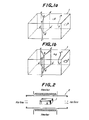
- lattice defects such as crystal boundaries (a-b-b'-a', b-c-c'-b' and b-d-d'-b'), a dislocation line (e-f), a microdefect (g) and a dislocation loop (h) are artifically arranged.
- techniques such as cold or hot working, heat treatment, irradiation with particle beam, or the like may be used.
- the crystals 1 are then treated by heating at a given temperature in a hydrogen-containing gas (pure H 2 gas, H 2 gas plus an inert gas, etc.) in, for example, an electric furnace 2 as shown in Figure 2.
- a hydrogen-containing gas pure H 2 gas, H 2 gas plus an inert gas, etc.
- the heating temperature and the heating time are variable depending on the kinds and properties of the Zr-Al alloys and lattice defects which are previously formed.
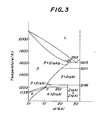
- Zr 3 Al alloy is heat-treated at 350 to 650 0 K, 900 sec and 1 atm, and Zr 2 Al alloy at 400 to 700°K, 1,800 sec and 1 atm.
- the crystals preferentially absorb hydrogen near the lattice defects which are previously formed, and amorphous phases are obtained.
- Figure 1(b) shows the amorphous phases formed in the above lattice defects in the form of films (a-b-b'-a', b-c-c'-b' and b-d-d'-b'), a string (e-f), a globe (g) and a ring (h), respectively.
- the amorphous region taking the form of a film or a curved surface may be formed by a cell wall or a sub-boundary which arranges dislocation lines as a group.
- the thicknesses of the amorphous regions shown in Figure l(b) are freely controlled by controlling the hydrogen pressure of the surrounding gas, the temperature of hydrogen absorption and the time of hydrogen absorption.
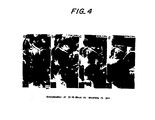
- FIG. 4(a) shows a photograph of the structures of the obtained sample. Extended fine structures are already observed at places enclosed with circles.
- This sample was heat-treated at heating temperatures and heating times of 773°K for 0.9 ks ( Figure 4(b)), 823 0 K for 0.9 ks ( Figure 4(c)) and 873°K for 0.6 ks ( Figure 4(d)), successively, in the electric furnace having a surrounding gas at 0.1 MPa of Ar plus 10% H 2 so as to absorb hydrogen.
- the sample was cooled to the room temperature and observed within the same range of the electron microscope.
- Figure 4(b) shows that filmy structures having striking contrasts were produced at the places where the above-mentioned fine structures are formed, and that, at the same time, hydrogen was gradually absorbed along the defects in the form of crystal boundaries, films, or lines which seemed to be dislocation lines formed by the heat treatment.
- Figures 4(c) and (d) show that the whole sample of Zr 3 Al (except the part noted at A) changed to the amorphous phases with accelerating the hydrogen absorption. However, in the case of Zr 2Al crystals (noted at A), amorphization proceeds at an extremely thin edge (in the lower part of Figure 4(c)) of the sample, and does not yet proceed at the somewhat thicker part (in the right centre part) of the sample.
- Figure 4(d) shows that amorphization of Zr 2 Al also proceeded completely.
- Zr-Al alloys were treated in order to arrange the lattice defects previously in the same way described in the above Example 1.
- the obtained samples were heat-treated at heating temperatures of 470°K to 873 0 K and for heating times of 0.9 ks to 1.8 ks in a surrounding gas which contained H 2 , at 1 atm.
- the samples were then cooled and observed within the same range of the electron microscope, repeatedly. The amorphization was recognized by the observation of the sample changes due to the hydrogen absorption.
- the present invention utilizes the phenomenon in which the amorphous phases formed by hydrogen absorption are preferentially produced along the lattice defects in the form of lines and curved surfaces in the crystals by controlling appropriately the conditions of hydrogen absorption. According to this process, the amorphous region having a given form at a given position in the crystals is obtained by controlling the arrangement of these lattice defects. Further, since the hydrogen diffusion occurs easily and rapidly along the lattice defects, amorphous materials having sufficient thickness (1 cm or more) can be prepared by sufficient absorption of hydrogen.
- the dislocations which are one kind of lattice defect acting as nuclei for amorphization, are able to form loops of several nm diameter or to arrange at intervals of several nm or more.
- amorphous balls of several nm diameter can be formed or amorphous columns of several nm diameter can be distributed at intervals of several nm or more.
- finely ground amorphous powder can be obtained by grinding the amorphous materials, and finely ground alloy powder from which hydrogen is released can be obtained by heating the amorphous materials at higher temperature than the temperature of crystallization. Since the amorphous material has a constant temperature of crystallization, it is repeatedly usable as the material of hydrogen absorption from which hydrogen is released at a constant temperature.
Landscapes
- Chemical & Material Sciences (AREA)
- Chemical Kinetics & Catalysis (AREA)
- Crystallography & Structural Chemistry (AREA)
- Engineering & Computer Science (AREA)
- Materials Engineering (AREA)
- Mechanical Engineering (AREA)
- Metallurgy (AREA)
- Organic Chemistry (AREA)
- Powder Metallurgy (AREA)
Applications Claiming Priority (2)
| Application Number | Priority Date | Filing Date | Title |
|---|---|---|---|
| JP191644/84 | 1984-09-14 | ||
| JP59191644A JPS6169932A (ja) | 1984-09-14 | 1984-09-14 | 格子欠陥を用いた化学反応による金属間化合物のアモルフアス化促進方法 |
Publications (2)
| Publication Number | Publication Date |
|---|---|
| EP0177110A1 true EP0177110A1 (fr) | 1986-04-09 |
| EP0177110B1 EP0177110B1 (fr) | 1988-11-17 |
Family
ID=16278082
Family Applications (1)
| Application Number | Title | Priority Date | Filing Date |
|---|---|---|---|
| EP85301795A Expired EP0177110B1 (fr) | 1984-09-14 | 1985-03-14 | Procédé pour accélérer l'amorphisation de composés intermétalliques par une réaction chimique utilisant les défauts de leur réseau |
Country Status (4)
| Country | Link |
|---|---|
| US (1) | US4637927A (fr) |
| EP (1) | EP0177110B1 (fr) |
| JP (1) | JPS6169932A (fr) |
| DE (1) | DE3566273D1 (fr) |
Cited By (2)
| Publication number | Priority date | Publication date | Assignee | Title |
|---|---|---|---|---|
| FR2580298A1 (fr) * | 1985-04-15 | 1986-10-17 | Solomat Sa | Procede de fabrication de materiaux a caracteristiques morphologiques determinees, notamment des materiaux amorphes et en particulier des verres metalliques a l'etat amorphe |
| EP0250811A3 (fr) * | 1986-05-29 | 1988-10-05 | Cendres Et Metaux S.A. | Procédé de fabrication d'articles en alliages au moins partiellement amorphes |
Families Citing this family (3)
| Publication number | Priority date | Publication date | Assignee | Title |
|---|---|---|---|---|
| AU620155B2 (en) * | 1988-10-15 | 1992-02-13 | Koji Hashimoto | Amorphous aluminum alloys |
| JPH04362105A (ja) * | 1991-06-06 | 1992-12-15 | Nisshin Steel Co Ltd | 金属間化合物微粉末の製造方法 |
| CN113044886A (zh) * | 2021-03-15 | 2021-06-29 | 西北工业大学 | 一种含晶格缺陷超细MnO2纳米线的制备方法及应用 |
Citations (1)
| Publication number | Priority date | Publication date | Assignee | Title |
|---|---|---|---|---|
| WO1984002926A1 (fr) * | 1983-01-31 | 1984-08-02 | California Inst Of Techn | Formation de materiaux amorphes |
Family Cites Families (2)
| Publication number | Priority date | Publication date | Assignee | Title |
|---|---|---|---|---|
| US4231816A (en) * | 1977-12-30 | 1980-11-04 | International Business Machines Corporation | Amorphous metallic and nitrogen containing alloy films |
| JPS6021367A (ja) * | 1983-07-16 | 1985-02-02 | Univ Osaka | 金属結晶のアモルフアス化方法 |
-
1984
- 1984-09-14 JP JP59191644A patent/JPS6169932A/ja active Granted
-
1985
- 1985-03-12 US US06/711,441 patent/US4637927A/en not_active Expired - Lifetime
- 1985-03-14 DE DE8585301795T patent/DE3566273D1/de not_active Expired
- 1985-03-14 EP EP85301795A patent/EP0177110B1/fr not_active Expired
Patent Citations (1)
| Publication number | Priority date | Publication date | Assignee | Title |
|---|---|---|---|---|
| WO1984002926A1 (fr) * | 1983-01-31 | 1984-08-02 | California Inst Of Techn | Formation de materiaux amorphes |
Non-Patent Citations (2)
| Title |
|---|
| CHEMICAL ABSTRACTS, vol. 100, 1984, page 254, no. 125315w, Columbus, Ohio, US; K. SAMWER et al.: "Glass formation by a solid-state reaction of crystalline zirconium-X phases with hydrogen and structure of glassy hydrides", & J. NON-CRYST. SOLIDS 1984, 61-62(1), 631-6 * |
| CHEMICAL ABSTRACTS, vol. 91, no. 16, 15th October 1979, page 593, no. 132249b, Columbus, Ohio, US; L.M. HOWE et al.: "The irradiation-induced transformation from the ordered - disordered - amorphous states in zirconium aluminum", & PROC. MICROSC. SOC. CAN. 1979, 6, 82-3 * |
Cited By (2)
| Publication number | Priority date | Publication date | Assignee | Title |
|---|---|---|---|---|
| FR2580298A1 (fr) * | 1985-04-15 | 1986-10-17 | Solomat Sa | Procede de fabrication de materiaux a caracteristiques morphologiques determinees, notamment des materiaux amorphes et en particulier des verres metalliques a l'etat amorphe |
| EP0250811A3 (fr) * | 1986-05-29 | 1988-10-05 | Cendres Et Metaux S.A. | Procédé de fabrication d'articles en alliages au moins partiellement amorphes |
Also Published As
| Publication number | Publication date |
|---|---|
| DE3566273D1 (en) | 1988-12-22 |
| JPS6169932A (ja) | 1986-04-10 |
| EP0177110B1 (fr) | 1988-11-17 |
| US4637927A (en) | 1987-01-20 |
| JPH0250969B2 (fr) | 1990-11-06 |
Similar Documents
| Publication | Publication Date | Title |
|---|---|---|
| Konno et al. | Crystallization of silicon in aluminium/amorphous-silicon multilayers | |
| Van Rossum et al. | Amorphization of Hf-Ni films by solid-state reaction | |
| Parthasarathi et al. | The annealing of vacancy defects in β-NiAl I. Vacancy loop growth in as-grown single crystals annealed in ultra-high vacuum | |
| JPH04505505A (ja) | 材料の改良 | |
| EP0178034B1 (fr) | Procédé de préparation de phases amorphes de composés intermétalliques au moyen d'une réaction chimique | |
| US4637927A (en) | Process for accelerating of amorphization of intermetallic compounds by a chemical reaction using lattice defects | |
| Sakurai et al. | Nitrogen effect in mechanical alloying of immiscible Cu‐V: Extended x‐ray absorption fine structure study | |
| Cadien et al. | Phase transformations in ion‐mixed metastable (GaSb) 1− x (Ge2) x semiconducting alloys | |
| US4797166A (en) | Method for producing an at least partly amorphous alloy piece | |
| US3634143A (en) | Preparation of iii{14 v alloys for infrared detectors | |
| Van Rossum et al. | Amorphization of Thin Multilayer Films by Ion Mixing and Solid State Reaction | |
| Askenazy et al. | Deformation-induced amorphization of CuTi2 microcrystals in an amorphous matrix | |
| US4557765A (en) | Method for amorphization of a metal crystal | |
| US3759750A (en) | Superconductive alloy and method for its production | |
| Abe et al. | Metastable Phases in Mg–Sn Alloys Obtained by Splat Cooling | |
| Marfaing et al. | Structural changes in AuxSi1-x alloy films under laser irradiation | |
| Aleksandrov | Laser epitaxy of materials for electronics | |
| Aziz et al. | Precipitation of Icosahedral Al–Mn during pulsed laser melting | |
| Bowden | Properties and Processing of Niobium Aluminides | |
| Tino et al. | Behaviors of Eutectic Crystals below Their Eutectic Points (II) | |
| Sharma et al. | The preparation of InSb films | |
| Hamlyn-Harris et al. | Amorphization of nickel and Ni P alloys by ion implantation | |
| Kanazawa et al. | Formation and growth of vacancy clusters in quenched dilute Al-Si alloys studied by positron annihilation | |
| Shikhmanter et al. | The crystallization of amorphous Dy-Cu thin films | |
| Kamenetzky et al. | Deformation-induced amorphization of crystalline particles in a Cu-Ti metallic glass |
Legal Events
| Date | Code | Title | Description |
|---|---|---|---|
| PUAI | Public reference made under article 153(3) epc to a published international application that has entered the european phase |
Free format text: ORIGINAL CODE: 0009012 |
|
| AK | Designated contracting states |
Kind code of ref document: A1 Designated state(s): DE FR GB SE |
|
| 17P | Request for examination filed |
Effective date: 19860730 |
|
| 17Q | First examination report despatched |
Effective date: 19870729 |
|
| GRAA | (expected) grant |
Free format text: ORIGINAL CODE: 0009210 |
|
| AK | Designated contracting states |
Kind code of ref document: B1 Designated state(s): DE FR GB SE |
|
| REF | Corresponds to: |
Ref document number: 3566273 Country of ref document: DE Date of ref document: 19881222 |
|
| ET | Fr: translation filed | ||
| PLBE | No opposition filed within time limit |
Free format text: ORIGINAL CODE: 0009261 |
|
| STAA | Information on the status of an ep patent application or granted ep patent |
Free format text: STATUS: NO OPPOSITION FILED WITHIN TIME LIMIT |
|
| 26N | No opposition filed | ||
| EAL | Se: european patent in force in sweden |
Ref document number: 85301795.2 |
|
| PGFP | Annual fee paid to national office [announced via postgrant information from national office to epo] |
Ref country code: GB Payment date: 20000313 Year of fee payment: 16 |
|
| PGFP | Annual fee paid to national office [announced via postgrant information from national office to epo] |
Ref country code: SE Payment date: 20000324 Year of fee payment: 16 |
|
| PGFP | Annual fee paid to national office [announced via postgrant information from national office to epo] |
Ref country code: FR Payment date: 20000329 Year of fee payment: 16 |
|
| PGFP | Annual fee paid to national office [announced via postgrant information from national office to epo] |
Ref country code: DE Payment date: 20000425 Year of fee payment: 16 |
|
| PG25 | Lapsed in a contracting state [announced via postgrant information from national office to epo] |
Ref country code: GB Free format text: LAPSE BECAUSE OF NON-PAYMENT OF DUE FEES Effective date: 20010314 |
|
| PG25 | Lapsed in a contracting state [announced via postgrant information from national office to epo] |
Ref country code: SE Free format text: LAPSE BECAUSE OF NON-PAYMENT OF DUE FEES Effective date: 20010315 |
|
| EUG | Se: european patent has lapsed |
Ref document number: 85301795.2 |
|
| GBPC | Gb: european patent ceased through non-payment of renewal fee |
Effective date: 20010314 |
|
| PG25 | Lapsed in a contracting state [announced via postgrant information from national office to epo] |
Ref country code: FR Free format text: LAPSE BECAUSE OF NON-PAYMENT OF DUE FEES Effective date: 20011130 |
|
| REG | Reference to a national code |
Ref country code: FR Ref legal event code: ST |
|
| PG25 | Lapsed in a contracting state [announced via postgrant information from national office to epo] |
Ref country code: DE Free format text: LAPSE BECAUSE OF NON-PAYMENT OF DUE FEES Effective date: 20020101 |