EP0179045A2 - Installation pour l'élimination des déchets - Google Patents
Installation pour l'élimination des déchets Download PDFInfo
- Publication number
- EP0179045A2 EP0179045A2 EP85890243A EP85890243A EP0179045A2 EP 0179045 A2 EP0179045 A2 EP 0179045A2 EP 85890243 A EP85890243 A EP 85890243A EP 85890243 A EP85890243 A EP 85890243A EP 0179045 A2 EP0179045 A2 EP 0179045A2
- Authority
- EP
- European Patent Office
- Prior art keywords
- treatment
- sludge
- waste
- fermentation
- wastewater
- Prior art date
- Legal status (The legal status is an assumption and is not a legal conclusion. Google has not performed a legal analysis and makes no representation as to the accuracy of the status listed.)
- Withdrawn
Links
Images
Classifications
-
- B—PERFORMING OPERATIONS; TRANSPORTING
- B09—DISPOSAL OF SOLID WASTE; RECLAMATION OF CONTAMINATED SOIL
- B09B—DISPOSAL OF SOLID WASTE NOT OTHERWISE PROVIDED FOR
- B09B3/00—Destroying solid waste or transforming solid waste into something useful or harmless
- B09B3/30—Destroying solid waste or transforming solid waste into something useful or harmless involving mechanical treatment
- B09B3/35—Shredding, crushing or cutting
-
- B—PERFORMING OPERATIONS; TRANSPORTING
- B03—SEPARATION OF SOLID MATERIALS USING LIQUIDS OR USING PNEUMATIC TABLES OR JIGS; MAGNETIC OR ELECTROSTATIC SEPARATION OF SOLID MATERIALS FROM SOLID MATERIALS OR FLUIDS; SEPARATION BY HIGH-VOLTAGE ELECTRIC FIELDS
- B03B—SEPARATING SOLID MATERIALS USING LIQUIDS OR USING PNEUMATIC TABLES OR JIGS
- B03B9/00—General arrangement of separating plant, e.g. flow sheets
- B03B9/06—General arrangement of separating plant, e.g. flow sheets specially adapted for refuse
-
- B—PERFORMING OPERATIONS; TRANSPORTING
- B09—DISPOSAL OF SOLID WASTE; RECLAMATION OF CONTAMINATED SOIL
- B09B—DISPOSAL OF SOLID WASTE NOT OTHERWISE PROVIDED FOR
- B09B3/00—Destroying solid waste or transforming solid waste into something useful or harmless
- B09B3/60—Biochemical treatment, e.g. by using enzymes
- B09B3/65—Anaerobic treatment
-
- B—PERFORMING OPERATIONS; TRANSPORTING
- B09—DISPOSAL OF SOLID WASTE; RECLAMATION OF CONTAMINATED SOIL
- B09B—DISPOSAL OF SOLID WASTE NOT OTHERWISE PROVIDED FOR
- B09B3/00—Destroying solid waste or transforming solid waste into something useful or harmless
- B09B3/70—Chemical treatment, e.g. pH adjustment or oxidation
-
- C—CHEMISTRY; METALLURGY
- C02—TREATMENT OF WATER, WASTE WATER, SEWAGE, OR SLUDGE
- C02F—TREATMENT OF WATER, WASTE WATER, SEWAGE, OR SLUDGE
- C02F11/00—Treatment of sludge; Devices therefor
- C02F11/004—Sludge detoxification
-
- C—CHEMISTRY; METALLURGY
- C02—TREATMENT OF WATER, WASTE WATER, SEWAGE, OR SLUDGE
- C02F—TREATMENT OF WATER, WASTE WATER, SEWAGE, OR SLUDGE
- C02F9/00—Multistage treatment of water, waste water or sewage
-
- C—CHEMISTRY; METALLURGY
- C05—FERTILISERS; MANUFACTURE THEREOF
- C05F—ORGANIC FERTILISERS NOT COVERED BY SUBCLASSES C05B, C05C, e.g. FERTILISERS FROM WASTE OR REFUSE
- C05F9/00—Fertilisers from household or town refuse
- C05F9/02—Apparatus for the manufacture
-
- C—CHEMISTRY; METALLURGY
- C02—TREATMENT OF WATER, WASTE WATER, SEWAGE, OR SLUDGE
- C02F—TREATMENT OF WATER, WASTE WATER, SEWAGE, OR SLUDGE
- C02F11/00—Treatment of sludge; Devices therefor
- C02F11/02—Biological treatment
- C02F11/04—Anaerobic treatment; Production of methane by such processes
-
- C—CHEMISTRY; METALLURGY
- C02—TREATMENT OF WATER, WASTE WATER, SEWAGE, OR SLUDGE
- C02F—TREATMENT OF WATER, WASTE WATER, SEWAGE, OR SLUDGE
- C02F11/00—Treatment of sludge; Devices therefor
- C02F11/12—Treatment of sludge; Devices therefor by de-watering, drying or thickening
-
- C—CHEMISTRY; METALLURGY
- C02—TREATMENT OF WATER, WASTE WATER, SEWAGE, OR SLUDGE
- C02F—TREATMENT OF WATER, WASTE WATER, SEWAGE, OR SLUDGE
- C02F11/00—Treatment of sludge; Devices therefor
- C02F11/12—Treatment of sludge; Devices therefor by de-watering, drying or thickening
- C02F11/13—Treatment of sludge; Devices therefor by de-watering, drying or thickening by heating
-
- C—CHEMISTRY; METALLURGY
- C02—TREATMENT OF WATER, WASTE WATER, SEWAGE, OR SLUDGE
- C02F—TREATMENT OF WATER, WASTE WATER, SEWAGE, OR SLUDGE
- C02F3/00—Biological treatment of water, waste water, or sewage
-
- Y—GENERAL TAGGING OF NEW TECHNOLOGICAL DEVELOPMENTS; GENERAL TAGGING OF CROSS-SECTIONAL TECHNOLOGIES SPANNING OVER SEVERAL SECTIONS OF THE IPC; TECHNICAL SUBJECTS COVERED BY FORMER USPC CROSS-REFERENCE ART COLLECTIONS [XRACs] AND DIGESTS
- Y02—TECHNOLOGIES OR APPLICATIONS FOR MITIGATION OR ADAPTATION AGAINST CLIMATE CHANGE
- Y02A—TECHNOLOGIES FOR ADAPTATION TO CLIMATE CHANGE
- Y02A40/00—Adaptation technologies in agriculture, forestry, livestock or agroalimentary production
- Y02A40/10—Adaptation technologies in agriculture, forestry, livestock or agroalimentary production in agriculture
- Y02A40/20—Fertilizers of biological origin, e.g. guano or fertilizers made from animal corpses
-
- Y—GENERAL TAGGING OF NEW TECHNOLOGICAL DEVELOPMENTS; GENERAL TAGGING OF CROSS-SECTIONAL TECHNOLOGIES SPANNING OVER SEVERAL SECTIONS OF THE IPC; TECHNICAL SUBJECTS COVERED BY FORMER USPC CROSS-REFERENCE ART COLLECTIONS [XRACs] AND DIGESTS
- Y02—TECHNOLOGIES OR APPLICATIONS FOR MITIGATION OR ADAPTATION AGAINST CLIMATE CHANGE
- Y02W—CLIMATE CHANGE MITIGATION TECHNOLOGIES RELATED TO WASTEWATER TREATMENT OR WASTE MANAGEMENT
- Y02W30/00—Technologies for solid waste management
- Y02W30/50—Reuse, recycling or recovery technologies
- Y02W30/52—Mechanical processing of waste for the recovery of materials, e.g. crushing, shredding, separation or disassembly
Definitions
- the invention relates to a device for the disposal of waste such as e.g. municipal and commercial solid waste, waste water and sludge with a mechanical treatment of solid waste, in particular waste shredding and / or waste sorting and a device for sludge treatment.
- a number of devices of the type mentioned at the outset have already become known, the common disadvantage of which is that they are designed for a certain essentially largely constant amount of waste of a certain essentially largely constant composition.
- Wastewater treatment plants have become known, for example, with which largely purified water can be produced, but special landfills are still generally required with regard to solid residues.
- the known plants can never process and dispose of them so far that they are actually residue-free, i.e. can work for highly toxic concentrates without the need for special landfills.
- Another disadvantage of the known devices is that, for reasons of economy, they have been limited to an average amount of waste to be disposed of.
- DE-AS 1916672 a device for the treatment of waste has become known, in which an aqueous suspension is produced and in this suspension an at least partial comminution is carried out by impact.
- DE-OS 2132537 shows and describes a method for the treatment of solid waste, in which a pulverizer and then an alluvial separation are carried out.
- US-PS 4113185 a device has become known where a mechanical treatment is followed by a sludge treatment.
- At least one device for fermentation, for enzymatic hydrolysis and / or for extraction is additionally provided, the presence of a hydrometallurgical plant gains another essential aspect.
- proteins are usually broken down and the hydrogen sulfide obtained on this occasion can be disposed of particularly easily if the raw materials made available to the fermentation still contain heavy metals.
- sulfidic slurries are formed, which can be fed directly to the hydrometallurgical workup.
- Organic acids can also be made available for hydrometallurgical processing from the fermentation.
- the rotting operation can advantageously be connected to a fertilizer preparation, wherein this fertilizer preparation can also be supplied with dry sludge from the sludge treatment.
- a device for gasification and / or conversion of biogenic waste and / or dry sludge is connected upstream of the energy utilization device, the energy utilization device being designed both for the combustion of gases and of solids
- the sludge treatment is preferably designed so that it includes mechanical dewatering and thermal treatment, in particular using steam.
- hydrolysates for a downstream fermentation, dry sludge for energy utilization, the rotting operation or the fertilizer preparation and finally for an enzymatic hydrolysis or extraction as well as substrates prepared for a fermentation can be produced, which subsequently are available to a suitable intermediate consumer within the device according to the invention can be put.
- wastewater sludge accumulating in the wastewater treatment and the solids accumulating in the wastewater treatment can be fed to the mechanical treatment
- wastewater treatment wastewater from the rotting operation wastewater from the hydrometallurgical operation
- the enzymatic hydrolysis, extraction and fermentation filtrates, condensates and Splash water from sludge treatment, gas wash water from combustion and gasification, and cleaning water
- the rotting condensates obtained in the rotting operation in particular substances volatile in H 2 O vapor and organic acids, and also hydrolysates from the sludge treatment, can be fed to the fermentation here.
- the fermentation residues can easily be returned to the sludge treatment and the fermentation gases can be fed directly to energy production.
- the dewatered or dried sludge can be fed to the rotting operation of the fertilizer preparation for energy generation or gasification, the large number of alternative ways ensuring the optimal utilization of the individual system parts in a particularly simple manner.
- the sulfidic sludge and / or organic acids formed in the fermentation can be fed to the hydrometallurgical plant from mechanical processing.
- the biogenic or combustible components from the mechanical processing can be used for energy utilization and / or gasification and / or enzymatic hydrolysis or extraction.
- All substances finally removed from the process allow immediate environmentally friendly recycling and the facility is advantageously designed so that from the facility ash from gasification and energy utilization neutralized sludge, ferrous scrap and metals from the hydrometallurgical plant, biotechnological Products from fermentation, hard materials from mechanical processing, fertilizers, soil conditioners or peat substitutes from fertilizer processing and cleaned wastewater from wastewater treatment can be removed and all other products within the system until at least one of the products mentioned is obtained from one part of the system to another the plant are feasible.
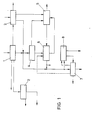
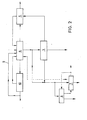
- FIG. 2 an analogous process diagram in an analogous representation for the treatment of sewage sludge
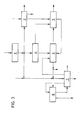
- FIG. 3 an analogous process diagram in analogous representation for the processing of emter residues shown
- Fermentation or digestion can be carried out in the fermentation, with ethanol, methane or the like depending on the process. can be manufactured.
- the condensates of the rotting operation 3 can also be fed to this fermentation 5, wherein dried sludge can be introduced into the rotting operation 3 and fine-grained fractions can be applied.
- the hydrolysis residues of the enzymatic hydrolysis then pass into a mechanical and thermal sludge treatment 6, which can also be used to supply biomass in the form of fermentation residues.
- the hydrolysates and condensates of this mechanical and thermal sludge treatment can in turn be returned to the fermentation 5.
- Some of the dried hydrolysis residues or biomass can be fed to the rotting operation, or can be recycled again to the enzymatic hydrolysis 4.
- part of these combustible components can be subjected to combustion 7, which provides the energy required to provide steam for the mechanical and thermal sludge treatment.
- a part of this BRAM can also be fed to a gasification 8, whereupon the gas obtained is then fed to the combustion 7. Ash can be discharged from both gasification and combustion and the energy gained can be made available to other parts of the plant.
- sewage sludge and crushed screenings are processed and first fed to a mechanical and thermal sludge treatment 6.
- the condensates and hydrolyzates of this mechanical and thermal sludge treatment are in turn made available to a fermentation 5 and, as already described in FIG. 1, ethanol or methane or the like, depending on the procedure. can be manufactured.
- condensates can in turn be fed in from a downstream rotting operation 3, the dry sludge being made available to this rotting operation 3 for mechanical and thermal sludge treatment.
- the biomass and fermentation residues of the fermentation 5 can in turn be returned to the mechanical and thermal sludge treatment 6.
- the fine compost is discharged from the rotting operation and, as in the embodiment according to FIG. 1, a secondary fuel fraction is fed to a combustion 7 or gasification 8 together with part of the dry sludge. Ash can again be discharged from these two stages and the gas from the gasification can be used for combustion be subjected.
- the training according to FIG. 3 involves the processing of residue from the emter in the context of a plant according to the invention.
- the crop residues for example maize straw, are first fed to the mechanical processing 1, whereupon the crushed crop residues are partially made available to a rotting operation 3 after hard materials such as sand have been separated off. Another part is fed to a combustion 7 or a gasification 8 together with the secondary fuel fraction from the rotting operation. However, part of this fuel fraction is made available for an enzymatic hydrolysis 4, the hydrolysates obtained in turn being fed to a fermentation 5.
- the condensates from the rotting operation are also added to this fermentation 5 and subsequently also condensate or hydrolyzates from a subsequent mechanical and thermal sludge treatment 6 are introduced.
- the biomass or fermentation pressure residues remaining in the fermentation can in turn, as in the method according to FIG. 1, be returned to the mechanical and thermal sludge treatment 6.
- a dewatered and dried solid fraction is applied, which results in a dry sludge and as such can at least partially be given to the rotting operation 3.
- Any combination of these plant parts can be used for the simultaneous processing of domestic waste, sewage sludge and / or crop residues, in particular a hydrometallurgical processing can also be connected in the manner described at the outset, as is indicated in the exemplary embodiment according to FIG. 1 after the wet processing .
Landscapes
- Engineering & Computer Science (AREA)
- Environmental & Geological Engineering (AREA)
- Chemical & Material Sciences (AREA)
- General Chemical & Material Sciences (AREA)
- Life Sciences & Earth Sciences (AREA)
- Chemical Kinetics & Catalysis (AREA)
- Biochemistry (AREA)
- Organic Chemistry (AREA)
- Water Supply & Treatment (AREA)
- Hydrology & Water Resources (AREA)
- Health & Medical Sciences (AREA)
- General Health & Medical Sciences (AREA)
- Toxicology (AREA)
- Manufacturing & Machinery (AREA)
- Processing Of Solid Wastes (AREA)
- Paper (AREA)
Applications Claiming Priority (2)
| Application Number | Priority Date | Filing Date | Title |
|---|---|---|---|
| AT315684A AT385686B (de) | 1984-10-04 | 1984-10-04 | Einrichtung zur entsorgung von abfaellen |
| AT3156/84 | 1984-10-04 |
Publications (2)
| Publication Number | Publication Date |
|---|---|
| EP0179045A2 true EP0179045A2 (fr) | 1986-04-23 |
| EP0179045A3 EP0179045A3 (fr) | 1988-03-16 |
Family
ID=3546192
Family Applications (1)
| Application Number | Title | Priority Date | Filing Date |
|---|---|---|---|
| EP19850890243 Withdrawn EP0179045A3 (fr) | 1984-10-04 | 1985-10-02 | Installation pour l'élimination des déchets |
Country Status (3)
| Country | Link |
|---|---|
| EP (1) | EP0179045A3 (fr) |
| AT (1) | AT385686B (fr) |
| NO (1) | NO853944L (fr) |
Cited By (8)
| Publication number | Priority date | Publication date | Assignee | Title |
|---|---|---|---|---|
| GB2181724A (en) * | 1985-09-25 | 1987-04-29 | Feld & Hahn Gmbh | Disposal of seepage water from rubbish dumps |
| EP0343535A3 (en) * | 1988-05-25 | 1990-09-05 | Outokumpu Oy | Method for treating waste materials |
| DE4433302A1 (de) * | 1994-09-19 | 1996-03-21 | Vsg Verfahrenstechnik Fuer Sch | Verfahren zur Abfallbehandlung |
| WO1996026021A1 (fr) * | 1995-02-22 | 1996-08-29 | Bernhard Kammermeier | Procede et unite de traitement permettant d'eliminer des substrats biologiquement contamines |
| EP0767011A1 (fr) * | 1995-10-06 | 1997-04-09 | Frank Alex Erich Rindelaub | Installation pour le traitement intermédiare de déchets de façon mécanique et biologique |
| US6337203B1 (en) | 1997-12-31 | 2002-01-08 | Groupe Conporec, Inc. | Odor-free composting method and installation |
| EP1557403A1 (fr) | 2004-01-26 | 2005-07-27 | Yes-Sun Holdings Limited | Système et procédé pour l'élimination sans compostage des déchets |
| WO2008117096A3 (fr) * | 2007-03-28 | 2008-12-11 | Foevarosi Csatornazasi Muevek | Procédé et appareil destinés à traiter des déchets contenant des substances organiques |
Family Cites Families (11)
| Publication number | Priority date | Publication date | Assignee | Title |
|---|---|---|---|---|
| DE1162302B (de) * | 1962-03-17 | 1964-02-06 | Paul Treckmann & Co | Verfahren und Vorrichtung zum Aufbereiten und Vorbehandeln von Muell fuer die Umwandlung desselben in Duengemittel |
| DE1224672B (de) * | 1965-08-12 | 1966-09-15 | Silvano Matteini Dr Ing | Verfahren und Anlage zur Beseitigung staedtischer Abfaelle |
| GB1353067A (en) * | 1970-07-08 | 1974-05-15 | Occidental Petroleum Corp | Process for recovery of valuable materials from solid wastes |
| US3736111A (en) * | 1971-05-17 | 1973-05-29 | Hercules Inc | Process and apparatus for the complete reclamation of valuable products from solid waste |
| DE2227004C3 (de) * | 1972-06-02 | 1981-06-19 | Texaco Development Corp., 10650 White Plains, N.Y. | Verfahren zur Erzeugung von Kohlenmonoxid und Wasserstoff aus festen Brennstoffen |
| GB1571886A (en) * | 1976-01-28 | 1980-07-23 | Lawson V | Process for handling waste material |
| DE2642451A1 (de) * | 1976-09-21 | 1978-03-23 | Kneer Franz X | Verfahren zum verwerten von abfallstoffen insbesondere von muell und klaerschlamm |
| US4113185A (en) * | 1977-06-08 | 1978-09-12 | Black Clawson Fibreclaim, Inc. | Process for producing fuel from solid waste |
| AU524220B2 (en) * | 1978-05-05 | 1982-09-09 | John Lester Lang | Preparation of fuel aswell as animal and plant nutrients from waste materials |
| DE3015290A1 (de) * | 1980-04-21 | 1981-10-29 | Werner & Pfleiderer, 7000 Stuttgart | Verfahren und anlage zum veraschen von klaerschlamm |
| AT378176B (de) * | 1981-10-20 | 1985-06-25 | Rieger Walter Ing | Verfahren zur aufarbeitung von einen heizwert aufweisenden schlammfoermigen abwasserrueckstaenden sowie anlage zur durchfuehrung des verfahrens |
-
1984
- 1984-10-04 AT AT315684A patent/AT385686B/de not_active IP Right Cessation
-
1985
- 1985-10-02 EP EP19850890243 patent/EP0179045A3/fr not_active Withdrawn
- 1985-10-04 NO NO853944A patent/NO853944L/no unknown
Cited By (10)
| Publication number | Priority date | Publication date | Assignee | Title |
|---|---|---|---|---|
| GB2181724A (en) * | 1985-09-25 | 1987-04-29 | Feld & Hahn Gmbh | Disposal of seepage water from rubbish dumps |
| EP0343535A3 (en) * | 1988-05-25 | 1990-09-05 | Outokumpu Oy | Method for treating waste materials |
| DE4433302A1 (de) * | 1994-09-19 | 1996-03-21 | Vsg Verfahrenstechnik Fuer Sch | Verfahren zur Abfallbehandlung |
| WO1996026021A1 (fr) * | 1995-02-22 | 1996-08-29 | Bernhard Kammermeier | Procede et unite de traitement permettant d'eliminer des substrats biologiquement contamines |
| EP0767011A1 (fr) * | 1995-10-06 | 1997-04-09 | Frank Alex Erich Rindelaub | Installation pour le traitement intermédiare de déchets de façon mécanique et biologique |
| US6337203B1 (en) | 1997-12-31 | 2002-01-08 | Groupe Conporec, Inc. | Odor-free composting method and installation |
| EP1557403A1 (fr) | 2004-01-26 | 2005-07-27 | Yes-Sun Holdings Limited | Système et procédé pour l'élimination sans compostage des déchets |
| WO2008117096A3 (fr) * | 2007-03-28 | 2008-12-11 | Foevarosi Csatornazasi Muevek | Procédé et appareil destinés à traiter des déchets contenant des substances organiques |
| US8100354B2 (en) | 2007-03-28 | 2012-01-24 | Veolia Bioenergy Europe Kft. | Apparatus for processing utility waste with biodegradable organic material content |
| EA016173B1 (ru) * | 2007-03-28 | 2012-02-28 | Веолиа Байоэнерджи Юроп Кфт. | Устройство для переработки утилизируемых отходов, содержащих органические вещества |
Also Published As
| Publication number | Publication date |
|---|---|
| ATA315684A (de) | 1987-10-15 |
| AT385686B (de) | 1988-05-10 |
| EP0179045A3 (fr) | 1988-03-16 |
| NO853944L (no) | 1986-04-07 |
Similar Documents
| Publication | Publication Date | Title |
|---|---|---|
| EP0262144B1 (fr) | Procede de recuperation de sous-produits gazeux a partir d'ordures | |
| DE112011101025B4 (de) | Verfahren zur kombinierten Aufbereitung von Haushaltsabfall und Abwasser | |
| EP0229927B1 (fr) | Procédé de séparation et de traitement de la partie organique d'ordures ménagères | |
| EP0423606B1 (fr) | Procédé de traitement des ordures ménagères, des déchets industriels et des analogues en obtenant des matériaux cellulosiques | |
| EP1687093B1 (fr) | Procede et dispositif de traitement par voie humide et mecanique d'un melange de substances, en particulier de dechets de tous types | |
| EP0185648A2 (fr) | Procédé pour le traitement de la boue provenant d'une installation pour la purification biologique d'eau usée | |
| DE2260787A1 (de) | Verfahren zur muellverbrennung und waermeausbeute in dampfkesseln | |
| EP1275443A2 (fr) | Procédé de traitement physique et chimique, et de séparation de déchets industriels et/ou ménagers | |
| DE19909328B4 (de) | Abfallverwertungsverfahren | |
| EP0767011A1 (fr) | Installation pour le traitement intermédiare de déchets de façon mécanique et biologique | |
| EP1274656A1 (fr) | Procede de conditionnement de substances solides biogenes | |
| EP1874476B1 (fr) | Procede et dispositif pour l'elimination des dechets | |
| EP0799811B1 (fr) | Procédé de traitement de déchets ménagers | |
| NO853944L (no) | Anordning for behandling av avfall. | |
| EP1289665B1 (fr) | Procede pour le traitement de dechets | |
| DE2642451A1 (de) | Verfahren zum verwerten von abfallstoffen insbesondere von muell und klaerschlamm | |
| DE102010017635A1 (de) | Recyclingsystem und Verfahren zum Betreiben eines Recyclingsystems | |
| DE2814795A1 (de) | Klaeranlage | |
| WO2000027954A1 (fr) | Procede d'utilisation de dechets | |
| DE10210467B4 (de) | Verfahren zur Behandlung von kommunalen Restabfällen | |
| CH685981A5 (de) | Anlage zur mechanisch-biologischen Zwischenbehandlung von Mull. | |
| DE202021102347U1 (de) | Konditioniertes Klärschlammprodukt, Produktionseinrichtung und Klärschlammsystem | |
| DE4127297A1 (de) | Verfahren zum aufbereiten von deponiekoerpermaterial, insbesondere altlasten | |
| DE4233672A1 (de) | Verfahren zur umweltfreundlichen Entsorgung von Klärschlamm und Entsorgungsanlage | |
| DE19619159A1 (de) | Verfahren zur Behandlung von Hausmüll oder hausmüllähnlichen Stoffen |
Legal Events
| Date | Code | Title | Description |
|---|---|---|---|
| PUAI | Public reference made under article 153(3) epc to a published international application that has entered the european phase |
Free format text: ORIGINAL CODE: 0009012 |
|
| AK | Designated contracting states |
Kind code of ref document: A2 Designated state(s): BE CH DE FR GB IT LI LU NL SE |
|
| PUAL | Search report despatched |
Free format text: ORIGINAL CODE: 0009013 |
|
| AK | Designated contracting states |
Kind code of ref document: A3 Designated state(s): BE CH DE FR GB IT LI LU NL SE |
|
| 18D | Application deemed to be withdrawn |
Effective date: 19880917 |
|
| RIN1 | Information on inventor provided before grant (corrected) |
Inventor name: LUGSCHEIDER, WALTER, DIPL.-ING. DR. Inventor name: HANKE, REINHART, DIPL.-ING. Inventor name: STEINMUELLER, HORST, DIPL.-ING. Inventor name: FLOEDL, GERALD, DIPL.-ING. DR. |