EP1874476B1 - Procede et dispositif pour l'elimination des dechets - Google Patents
Procede et dispositif pour l'elimination des dechets Download PDFInfo
- Publication number
- EP1874476B1 EP1874476B1 EP20060742233 EP06742233A EP1874476B1 EP 1874476 B1 EP1874476 B1 EP 1874476B1 EP 20060742233 EP20060742233 EP 20060742233 EP 06742233 A EP06742233 A EP 06742233A EP 1874476 B1 EP1874476 B1 EP 1874476B1
- Authority
- EP
- European Patent Office
- Prior art keywords
- waste
- pellets
- stage
- plastic
- sewage sludge
- Prior art date
- Legal status (The legal status is an assumption and is not a legal conclusion. Google has not performed a legal analysis and makes no representation as to the accuracy of the status listed.)
- Expired - Lifetime
Links
Images

Classifications
-
- B—PERFORMING OPERATIONS; TRANSPORTING
- B03—SEPARATION OF SOLID MATERIALS USING LIQUIDS OR USING PNEUMATIC TABLES OR JIGS; MAGNETIC OR ELECTROSTATIC SEPARATION OF SOLID MATERIALS FROM SOLID MATERIALS OR FLUIDS; SEPARATION BY HIGH-VOLTAGE ELECTRIC FIELDS
- B03B—SEPARATING SOLID MATERIALS USING LIQUIDS OR USING PNEUMATIC TABLES OR JIGS
- B03B9/00—General arrangement of separating plant, e.g. flow sheets
- B03B9/06—General arrangement of separating plant, e.g. flow sheets specially adapted for refuse
-
- B—PERFORMING OPERATIONS; TRANSPORTING
- B29—WORKING OF PLASTICS; WORKING OF SUBSTANCES IN A PLASTIC STATE IN GENERAL
- B29B—PREPARATION OR PRETREATMENT OF THE MATERIAL TO BE SHAPED; MAKING GRANULES OR PREFORMS; RECOVERY OF PLASTICS OR OTHER CONSTITUENTS OF WASTE MATERIAL CONTAINING PLASTICS
- B29B17/00—Recovery of plastics or other constituents of waste material containing plastics
- B29B17/02—Separating plastics from other materials
-
- B—PERFORMING OPERATIONS; TRANSPORTING
- B29—WORKING OF PLASTICS; WORKING OF SUBSTANCES IN A PLASTIC STATE IN GENERAL
- B29B—PREPARATION OR PRETREATMENT OF THE MATERIAL TO BE SHAPED; MAKING GRANULES OR PREFORMS; RECOVERY OF PLASTICS OR OTHER CONSTITUENTS OF WASTE MATERIAL CONTAINING PLASTICS
- B29B17/00—Recovery of plastics or other constituents of waste material containing plastics
- B29B17/04—Disintegrating plastics, e.g. by milling
-
- C—CHEMISTRY; METALLURGY
- C10—PETROLEUM, GAS OR COKE INDUSTRIES; TECHNICAL GASES CONTAINING CARBON MONOXIDE; FUELS; LUBRICANTS; PEAT
- C10L—FUELS NOT OTHERWISE PROVIDED FOR; NATURAL GAS; SYNTHETIC NATURAL GAS OBTAINED BY PROCESSES NOT COVERED BY SUBCLASSES C10G OR C10K; LIQUIFIED PETROLEUM GAS; USE OF ADDITIVES TO FUELS OR FIRES; FIRE-LIGHTERS
- C10L5/00—Solid fuels
- C10L5/02—Solid fuels such as briquettes consisting mainly of carbonaceous materials of mineral or non-mineral origin
- C10L5/34—Other details of the shaped fuels, e.g. briquettes
- C10L5/36—Shape
- C10L5/363—Pellets or granulates
-
- C—CHEMISTRY; METALLURGY
- C10—PETROLEUM, GAS OR COKE INDUSTRIES; TECHNICAL GASES CONTAINING CARBON MONOXIDE; FUELS; LUBRICANTS; PEAT
- C10L—FUELS NOT OTHERWISE PROVIDED FOR; NATURAL GAS; SYNTHETIC NATURAL GAS OBTAINED BY PROCESSES NOT COVERED BY SUBCLASSES C10G OR C10K; LIQUIFIED PETROLEUM GAS; USE OF ADDITIVES TO FUELS OR FIRES; FIRE-LIGHTERS
- C10L5/00—Solid fuels
- C10L5/40—Solid fuels essentially based on materials of non-mineral origin
- C10L5/46—Solid fuels essentially based on materials of non-mineral origin on sewage, house, or town refuse
-
- B—PERFORMING OPERATIONS; TRANSPORTING
- B29—WORKING OF PLASTICS; WORKING OF SUBSTANCES IN A PLASTIC STATE IN GENERAL
- B29B—PREPARATION OR PRETREATMENT OF THE MATERIAL TO BE SHAPED; MAKING GRANULES OR PREFORMS; RECOVERY OF PLASTICS OR OTHER CONSTITUENTS OF WASTE MATERIAL CONTAINING PLASTICS
- B29B17/00—Recovery of plastics or other constituents of waste material containing plastics
- B29B17/02—Separating plastics from other materials
- B29B2017/0213—Specific separating techniques
- B29B2017/0217—Mechanical separating techniques; devices therefor
- B29B2017/0237—Mechanical separating techniques; devices therefor using density difference
- B29B2017/0244—Mechanical separating techniques; devices therefor using density difference in liquids
-
- B—PERFORMING OPERATIONS; TRANSPORTING
- B29—WORKING OF PLASTICS; WORKING OF SUBSTANCES IN A PLASTIC STATE IN GENERAL
- B29B—PREPARATION OR PRETREATMENT OF THE MATERIAL TO BE SHAPED; MAKING GRANULES OR PREFORMS; RECOVERY OF PLASTICS OR OTHER CONSTITUENTS OF WASTE MATERIAL CONTAINING PLASTICS
- B29B17/00—Recovery of plastics or other constituents of waste material containing plastics
- B29B17/02—Separating plastics from other materials
- B29B2017/0213—Specific separating techniques
- B29B2017/0268—Separation of metals
-
- B—PERFORMING OPERATIONS; TRANSPORTING
- B29—WORKING OF PLASTICS; WORKING OF SUBSTANCES IN A PLASTIC STATE IN GENERAL
- B29B—PREPARATION OR PRETREATMENT OF THE MATERIAL TO BE SHAPED; MAKING GRANULES OR PREFORMS; RECOVERY OF PLASTICS OR OTHER CONSTITUENTS OF WASTE MATERIAL CONTAINING PLASTICS
- B29B17/00—Recovery of plastics or other constituents of waste material containing plastics
- B29B17/02—Separating plastics from other materials
- B29B2017/0213—Specific separating techniques
- B29B2017/0268—Separation of metals
- B29B2017/0272—Magnetic separation
-
- B—PERFORMING OPERATIONS; TRANSPORTING
- B29—WORKING OF PLASTICS; WORKING OF SUBSTANCES IN A PLASTIC STATE IN GENERAL
- B29B—PREPARATION OR PRETREATMENT OF THE MATERIAL TO BE SHAPED; MAKING GRANULES OR PREFORMS; RECOVERY OF PLASTICS OR OTHER CONSTITUENTS OF WASTE MATERIAL CONTAINING PLASTICS
- B29B17/00—Recovery of plastics or other constituents of waste material containing plastics
- B29B17/04—Disintegrating plastics, e.g. by milling
- B29B2017/0424—Specific disintegrating techniques; devices therefor
- B29B2017/0496—Pyrolysing the materials
-
- B—PERFORMING OPERATIONS; TRANSPORTING
- B29—WORKING OF PLASTICS; WORKING OF SUBSTANCES IN A PLASTIC STATE IN GENERAL
- B29K—INDEXING SCHEME ASSOCIATED WITH SUBCLASSES B29B, B29C OR B29D, RELATING TO MOULDING MATERIALS OR TO MATERIALS FOR MOULDS, REINFORCEMENTS, FILLERS OR PREFORMED PARTS, e.g. INSERTS
- B29K2067/00—Use of polyesters or derivatives thereof, as moulding material
-
- B—PERFORMING OPERATIONS; TRANSPORTING
- B29—WORKING OF PLASTICS; WORKING OF SUBSTANCES IN A PLASTIC STATE IN GENERAL
- B29K—INDEXING SCHEME ASSOCIATED WITH SUBCLASSES B29B, B29C OR B29D, RELATING TO MOULDING MATERIALS OR TO MATERIALS FOR MOULDS, REINFORCEMENTS, FILLERS OR PREFORMED PARTS, e.g. INSERTS
- B29K2705/00—Use of metals, their alloys or their compounds, for preformed parts, e.g. for inserts
-
- B—PERFORMING OPERATIONS; TRANSPORTING
- B29—WORKING OF PLASTICS; WORKING OF SUBSTANCES IN A PLASTIC STATE IN GENERAL
- B29K—INDEXING SCHEME ASSOCIATED WITH SUBCLASSES B29B, B29C OR B29D, RELATING TO MOULDING MATERIALS OR TO MATERIALS FOR MOULDS, REINFORCEMENTS, FILLERS OR PREFORMED PARTS, e.g. INSERTS
- B29K2705/00—Use of metals, their alloys or their compounds, for preformed parts, e.g. for inserts
- B29K2705/08—Transition metals
- B29K2705/12—Iron
-
- Y—GENERAL TAGGING OF NEW TECHNOLOGICAL DEVELOPMENTS; GENERAL TAGGING OF CROSS-SECTIONAL TECHNOLOGIES SPANNING OVER SEVERAL SECTIONS OF THE IPC; TECHNICAL SUBJECTS COVERED BY FORMER USPC CROSS-REFERENCE ART COLLECTIONS [XRACs] AND DIGESTS
- Y02—TECHNOLOGIES OR APPLICATIONS FOR MITIGATION OR ADAPTATION AGAINST CLIMATE CHANGE
- Y02E—REDUCTION OF GREENHOUSE GAS [GHG] EMISSIONS, RELATED TO ENERGY GENERATION, TRANSMISSION OR DISTRIBUTION
- Y02E50/00—Technologies for the production of fuel of non-fossil origin
- Y02E50/10—Biofuels, e.g. bio-diesel
-
- Y—GENERAL TAGGING OF NEW TECHNOLOGICAL DEVELOPMENTS; GENERAL TAGGING OF CROSS-SECTIONAL TECHNOLOGIES SPANNING OVER SEVERAL SECTIONS OF THE IPC; TECHNICAL SUBJECTS COVERED BY FORMER USPC CROSS-REFERENCE ART COLLECTIONS [XRACs] AND DIGESTS
- Y02—TECHNOLOGIES OR APPLICATIONS FOR MITIGATION OR ADAPTATION AGAINST CLIMATE CHANGE
- Y02E—REDUCTION OF GREENHOUSE GAS [GHG] EMISSIONS, RELATED TO ENERGY GENERATION, TRANSMISSION OR DISTRIBUTION
- Y02E50/00—Technologies for the production of fuel of non-fossil origin
- Y02E50/30—Fuel from waste, e.g. synthetic alcohol or diesel
-
- Y—GENERAL TAGGING OF NEW TECHNOLOGICAL DEVELOPMENTS; GENERAL TAGGING OF CROSS-SECTIONAL TECHNOLOGIES SPANNING OVER SEVERAL SECTIONS OF THE IPC; TECHNICAL SUBJECTS COVERED BY FORMER USPC CROSS-REFERENCE ART COLLECTIONS [XRACs] AND DIGESTS
- Y02—TECHNOLOGIES OR APPLICATIONS FOR MITIGATION OR ADAPTATION AGAINST CLIMATE CHANGE
- Y02W—CLIMATE CHANGE MITIGATION TECHNOLOGIES RELATED TO WASTEWATER TREATMENT OR WASTE MANAGEMENT
- Y02W30/00—Technologies for solid waste management
- Y02W30/50—Reuse, recycling or recovery technologies
- Y02W30/52—Mechanical processing of waste for the recovery of materials, e.g. crushing, shredding, separation or disassembly
-
- Y—GENERAL TAGGING OF NEW TECHNOLOGICAL DEVELOPMENTS; GENERAL TAGGING OF CROSS-SECTIONAL TECHNOLOGIES SPANNING OVER SEVERAL SECTIONS OF THE IPC; TECHNICAL SUBJECTS COVERED BY FORMER USPC CROSS-REFERENCE ART COLLECTIONS [XRACs] AND DIGESTS
- Y02—TECHNOLOGIES OR APPLICATIONS FOR MITIGATION OR ADAPTATION AGAINST CLIMATE CHANGE
- Y02W—CLIMATE CHANGE MITIGATION TECHNOLOGIES RELATED TO WASTEWATER TREATMENT OR WASTE MANAGEMENT
- Y02W30/00—Technologies for solid waste management
- Y02W30/50—Reuse, recycling or recovery technologies
- Y02W30/62—Plastics recycling; Rubber recycling
Definitions
- waste was later valued for a long time as starting materials. Waste as an undesirable raw material is the first time in the high industrialization in the late 19th century, the speech. Among the waste is expected by-products, which are often annoying factories. From the twentieth century onwards, the notion of waste also includes, in addition to industrial residues, the residues attributable to increasing urbanization, such as sewage and refuse. Their removal took place at the beginning by means of relatively simple methods. They simply stored garbage on remote, otherwise useless places (Meyer's Conversation Lexicon of 1924). The current definition in the dictionary, on the other hand, reads: "Remains left over from the preparation or production of something that can not be used any further and thrown away".
- a first partial flow, or the total flow of the respective suction channel and / or immediately before the outgoing secondary shredding unit a second partial stream or the total flow of the light fraction is branched off in this method before the suction unit in one of the suction channels.
- the first part or total stream of the reuse becomes immediate, or after comminution, fed in a further crushing unit of the re-use and supplied to the second partial or total flow of the second post-shredding unit.
- the fraction passing from the second post-shredding unit is then further fed to a briquette or pellet press and processed into briquettes and / or pellets. This method does not take into account the extraction of energy from the waste and its use in the treatment process.
- the method consists of selectively removing light iron material with an overband magnet and heavier iron material with a drum magnet. The remaining material is separated by air classification into a lighter fraction and a heavier fraction.
- the lighter fraction which in particular comprises plastic films, aluminum foils and paper, is comminuted and fed to an aspirator.
- the aspirator is equipped with two sieves and one air sifter allowing the separation of the material into a plastic fraction, aluminum fraction and a fraction containing heavy metal particles.
- From the EP 1 188 491 A1 is a method for sorting out a plastic mixture from a waste mixture and a Abfallortierstrom known.
- the technical problem is solved to sort out a plastic mixture consisting essentially of plastic objects with small amounts of impurities.
- a waste fraction having at least plastic objects and beverage cartons is first sorted out of a waste mixture.
- beverage cartons are sorted out of the waste fraction, and from the waste fraction reduced around the beverage cartons, the plastic mixture is separated off as a heavy fraction with the aid of a ballistic separator.
- the technical problem is also solved by additionally or separately from the beverage cartons containing metal objects of the waste fraction are removed before they are fed to the Ballistkseparator. Again, only a partial problem of waste disposal is addressed. There is no indication of an extraction of energy.
- the invention is therefore based on the object to accomplish the waste disposal as comprehensively as possible and taking into account energetic processes.
- An essential aspect of the method according to the invention is that the waste produced is dried in a specific process step, wherein the energy required for the drying process is supplied by the waste heat of a turbine, which itself serves to generate energy.
- the device according to the invention therefore provides for the removal of these ash parts.
- the invention will be described in more detail below.
- a discharge device downstream of the sensor or discriminator device in the transport direction of the strip is activated, which transfers the identified constituent into a ballistic trajectory ending in the region of a receiving shaft by means of compressed air.
- Those components of the waste mixture to which no desired property has been assigned do not experience such a discharge and remain on the conveyor belt, from where they usually tip into a receiving shaft for receiving a specific sorting fraction.
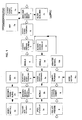
- process step (2b) the sorting by magnets and the shipment in a receiving shaft for non-ferrous metals (2c) and another for iron (2c) is shown. Furthermore, in process step (3), the sifting and separation of plastics is carried out in a water basin.
- the separation and division into the plastic PET (polyethylene terephthalate) and other plastics is symbolized by the process step (3a).
- a mill is designated, which grinds the respective plastics into granules and then in the receiving shaft (3c) for PET granules or the receiving shaft (3e) for granules of other plastics spends.
- the liberated from the described components waste passes through the further mill (4) and enters a drying stage (5), which receives its main heat energy by the waste heat of the stage (10b).
- a drying stage (5) which receives its main heat energy by the waste heat of the stage (10b).
- the device (6) according to the invention for the separation of these ash and dust components is known in FIG. 2 shown.
- a steam turbine (10) is operated, which generates electricity and waste heat (10b) via a generator (10a), with which in turn the drying stage (5) is operated.
- the mixing stage (7) it is ensured that the calorific value of the pellets used for boiler firing remains constant within a certain range. This is achieved by appropriate control of the three components PET granules, granules from other plastic fractions and sewage sludge.
- Sewage sludge accumulates in a sewage treatment plant at various points of the wastewater treatment. Due to its high nutrient content, it is suitable as a soil conditioner and is used, among other things, as such in agriculture. Because of the high content of heavy metals in the sewage sludge, the application on soils must be strictly controlled. Although the heavy metal pollution of sewage, and thus of sewage sludge, has declined sharply, natural heavy metal pollution will always be found. The amount of heavy metals has decreased mainly due to the introduction of unleaded gasoline, as well as the use of gas stations and car washes. The waste water accumulated during the car wash can be pre-cleaned there by oil separators.
- the sewage and thus the sewage sludge contain residues of medicines, diagnostics and disinfectants, as they can not be degraded by biological purification processes.
- this is to be used as fuel.
- Each fuel consists in principle of the substance groups water, combustible (mainly organic substances) and ash (inorganic substances). Due to its high water content of more than 90% by weight, sewage sludge is not immediately suitable as a fuel, ie it must be heavily dewatered or dried prior to a thermal treatment or use.
- PET polyethylene terephthalate
- the liquid feedstock ethylene glycol and terephthalate compounds are derived from petroleum which has been partially reacted with oxygen. To produce PET, these starting compounds are combined to form long chain molecules. In chemical terms, this means that ethylene glycol and the terephthalate compounds are polycondensed together.
- the first short-chain starting molecules which consist exclusively of the elements carbon, oxygen and hydrogen, are attached to each other by so-called ester bonds.
- the plastic also owes its name to this process: "poly” (many) and "ester” (for the type of binding).
- PET is in principle "an old acquaintance", because the basic material was already developed in 1941 as polyester in the USA.
- the PET granulate is subjected to an additional refining step which, among other things, further improves the mechanical properties of the plastic.
- FIG. 2 is shown in detail the process step (6) for the separation of ash and dust fractions of the dried in the drying step (5) waste.
- (11) is the suction hose connected to an unillustrated air exhaust device
- (12) is the exhaust drum.
- the suction drum (12) consists of a cylindrical hole-like body of revolution, which is mounted at an adjustable height transversely of the direction of travel of the dried waste conveying conveyor belt (14).
- the ash - laden waste is approaching in the FIG. 2 on the right side and is here denoted by (16).
- Parallel to the longitudinal axis of the suction drum (12) is on one side of a stripping device (13) and on the other side a rotary brush (18), which serves to clean the suction drum arranged.
- the direction of rotation of the suction drum (12) is opposite to the running direction of the conveyor belt (14).
- the direction of rotation of the rotary brush (18) is in turn opposite to the direction of rotation of the suction drum (12).
- Under the stripping device (13) runs in the same direction, the discharge conveyor (15).
- a dust protection housing (17) is mounted, which ensures that most of the ash is discharged through the suction hose (11).
- the invention provides that the suction flow is pulsed.
Landscapes
- Chemical & Material Sciences (AREA)
- Engineering & Computer Science (AREA)
- Environmental & Geological Engineering (AREA)
- Oil, Petroleum & Natural Gas (AREA)
- Organic Chemistry (AREA)
- Mechanical Engineering (AREA)
- Life Sciences & Earth Sciences (AREA)
- General Life Sciences & Earth Sciences (AREA)
- Geochemistry & Mineralogy (AREA)
- Geology (AREA)
- Processing Of Solid Wastes (AREA)
Claims (18)
- Procédé pour l'élimination des déchets avec les étapes de procédé suivantes consistant à :a) séparer les composants métalliques,b) séparer les minéraux + les restes et les composants synthétiques, ainsi que les séparer comme granulat,c) sécher les déchets résiduels,d) libérer les déchets résiduels séchés des cendres,e) mélanger les déchets exempts de cendre avec du granulat synthétique et des boues de curage dans une proportion réglable,f) presser le produit mélangé pour former des pellets,g) brûler les pellets pour obtenir de l'énergie.
- Procédé selon la revendication 1, caractérisé en ce que l'énergie obtenue est utilisée pour le séchage des déchets.
- Procédé selon la revendication 1, caractérisé en ce que l'énergie obtenue est utilisée pour la mise à feu d'une chaudière à vapeur et le fonctionnement d'une turbine à vapeur.
- Procédé selon la revendication 1, caractérisé en ce que l'énergie obtenue est utilisée pour la mise à feu d'une chaudière à vapeur et le fonctionnement d'une turbine à vapeur, la turbine à vapeur faisant fonctionner une génératrice et la chaleur perdue étant utilisée pour le séchage des déchets.
- Procédé selon l'une quelconque des revendications 1 à 4, caractérisé en ce que les composants synthétiques présents sous la forme de granulat sont séparés en composants qui se composent de PET et en composants qui se composent d'autres matières synthétiques.
- Procédé selon l'une quelconque des revendications 1 à 5, caractérisé en ce que le rapport de mélange des composants des déchets exempts de cendre, des composants synthétiques et des boues de curage sert au réglage de la puissance calorifique des pellets.
- Procédé selon la revendication 6, caractérisé en ce que la puissance calorifique des pellets est maintenue constante.
- Procédé selon l'une quelconque des revendications 1 à 6, caractérisé en ce que les boues de curage servent en outre au réglage de la teneur en humidité et de la solidarisation des pellets.
- Procédé selon l'une quelconque des revendications 1 à 8, caractérisé en ce qu'il s'agit pour les déchets, d'ordures ménagères et de déchets industriels semblables aux ordures ménagères.
- Dispositif pour l'élimination de déchets avec les caractéristiques suivantes dans l'ordre de déroulement :a) un dispositif de déchiquetage grossier des ordures ménagères (1), un bassin (2, 2a, 2b, 2c) pour la séparation des composants métalliques,b) un bassin (3) pour la séparation des composants synthétiques et des minéraux + des restes, criblagec) des broyeurs (3b, 3d) pour la transformation des composants synthétiques en granulat,d) un broyeur (4) pour le broyage des déchets résiduels,e) une étape de séchage (5) pour le séchage des déchets broyés, résiduels,f) une étape de séparation (6) pour la libération des déchets séchés des cendres,g) une étape de mélange (7) pour le mélange des déchets exempts de cendre avec le granulat synthétique et les boues de curage dans une proportion réglable,h) une presse (8) pour la formation du produit mélangé en pellets,i) une étape de combustion (9) des pellets pour obtenir de l'énergie.
- Dispositif pour l'élimination des déchets selon la revendication 10, caractérisé en ce que l'étape de combustion (9) fournit l'énergie pour l'étape de séchage (5).
- Dispositif pour l'élimination des déchets selon la revendication 10, caractérisé en ce que l'étape de combustion (9) fournit l'énergie pour le fonctionnement d'une chaudière à vapeur et d'une turbine à vapeur.
- Dispositif pour l'élimination des déchets selon la revendication 10,
caractérisé en ce que l'étape de combustion (9) fournit l'énergie pour le fonctionnement d'une chaudière à vapeur et d'une turbine à vapeur, la chaleur perdue fournissant l'énergie pour l'étape de séchage (5). - Dispositif selon l'une quelconque des revendications 10 à 14, caractérisé en ce que les broyeurs (3b, 3d) fournissent du granulat de PET et du granulat des composants de matière synthétique résiduelle.
- Dispositif selon l'une quelconque des revendications 10 à 14, caractérisé en ce que l'étape de séparation (6) postérieure à l'étape de séchage (5) travaille avec un courant d'air qui est utilisé par impulsions.
- Dispositif selon l'une quelconque des revendications 10 à 15, caractérisé en ce que l'étape de mélange (7) règle le rapport de mélange des composants des déchets exempts de cendre, des composants synthétiques et des boues de curage de sorte que la puissance calorifique des pellets reste constante.
- Dispositif selon l'une quelconque des revendications 10 à 16, caractérisé en ce que l'étape de mélange (7) règle le rapport de mélange des composants des déchets exempts de cendre, des composants synthétiques et des boues de curage de sorte que les boues de curage servent au réglage de la teneur en humidité et de la solidarisation des pellets.
- Dispositif selon l'une quelconque des revendications 10 à 17, caractérisé en ce qu'il sert à l'élimination des ordures ménagères et déchets industriels semblables aux ordures ménagères.
Applications Claiming Priority (2)
| Application Number | Priority Date | Filing Date | Title |
|---|---|---|---|
| DE200510017334 DE102005017334A1 (de) | 2005-04-14 | 2005-04-14 | Verfahren und Vorrichtung zur Entsorgung von Abfall |
| PCT/DE2006/000632 WO2006108393A1 (fr) | 2005-04-14 | 2006-04-10 | Procede et dispositif pour l'elimination des dechets |
Publications (2)
| Publication Number | Publication Date |
|---|---|
| EP1874476A1 EP1874476A1 (fr) | 2008-01-09 |
| EP1874476B1 true EP1874476B1 (fr) | 2009-07-15 |
Family
ID=36717173
Family Applications (1)
| Application Number | Title | Priority Date | Filing Date |
|---|---|---|---|
| EP20060742233 Expired - Lifetime EP1874476B1 (fr) | 2005-04-14 | 2006-04-10 | Procede et dispositif pour l'elimination des dechets |
Country Status (6)
| Country | Link |
|---|---|
| US (1) | US20090211250A1 (fr) |
| EP (1) | EP1874476B1 (fr) |
| CA (1) | CA2616077A1 (fr) |
| DE (3) | DE102005017334A1 (fr) |
| HR (1) | HRP20090554T1 (fr) |
| WO (1) | WO2006108393A1 (fr) |
Families Citing this family (4)
| Publication number | Priority date | Publication date | Assignee | Title |
|---|---|---|---|---|
| CA2736293C (fr) | 2009-03-14 | 2015-10-20 | Alexander Koslow | Procede de recyclage pour dechets electroniques destine a recuperer des matieres revalorisables en evitant de liberer des substances nocives |
| DE102009014717B4 (de) | 2009-03-27 | 2019-02-28 | Mueg Mitteldeutsche Umwelt- Und Entsorgung Gmbh | Verfahren und Vorrichtung zur Verarbeitung von staubförmigen und flüssig/pastösen Abfallstoffen sowie zur Herstellung eines Mischbrennstoffes |
| WO2021163099A1 (fr) * | 2020-02-10 | 2021-08-19 | Eastman Chemical Company | Appareil et procédés de manipulation de solides plastiques particulaires |
| DE102021114871A1 (de) * | 2021-06-09 | 2022-12-15 | Der Grüne Punkt - Duales System Deutschland GmbH | Verfahren zum Recycling von post-consumer Verpackungsabfällen |
Family Cites Families (11)
| Publication number | Priority date | Publication date | Assignee | Title |
|---|---|---|---|---|
| DE2548760C2 (de) * | 1975-10-31 | 1977-12-29 | Goergen, Fritz-Aurel, Dr., Cologny (Schweiz) | Verfahren zur Aufbereitung und Verbrennung von Abfällen |
| NL8000978A (nl) * | 1980-02-16 | 1981-09-16 | Stamicarbon | Inrichting voor het scheiden van delen van verschillend soortelijk gewicht volgens de drijfen bezinkmethode. |
| DE3614325A1 (de) * | 1986-04-28 | 1987-10-29 | Organ Faser Technology Co | Verfahren und vorrichtung zur aufbereitung von haushalts-, gewerbe- und anderen dgl. abfaellen |
| US4938864A (en) * | 1988-08-23 | 1990-07-03 | Mare Creek Industries, Inc. | Method for processing fine coal |
| SE466387B (sv) * | 1989-06-05 | 1992-02-10 | Rejector Ab | Saett och anordning foer att behandla avfall |
| US4957049A (en) * | 1990-02-22 | 1990-09-18 | Electrodyne Research Corp. | Organic waste fuel combustion system integrated with a gas turbine combined cycle |
| US5063862A (en) * | 1990-06-01 | 1991-11-12 | Flexible Environmental Systems, Inc. | Solid waste reclamation and processing method |
| DE4130416C1 (fr) * | 1991-09-10 | 1992-12-10 | Thermoselect Ag, Vaduz, Li | |
| US5431702A (en) * | 1993-03-25 | 1995-07-11 | Dynecology, Inc. | Waste conversion process and products |
| US7252691B2 (en) * | 2001-03-06 | 2007-08-07 | John Philipson | Conversion of municipal solid waste to high fuel value |
| CN1649673A (zh) * | 2002-05-04 | 2005-08-03 | 克里斯托弗·穆特 | 用于处理材料或复合材料和混合物的方法和装置 |
-
2005
- 2005-04-14 DE DE200510017334 patent/DE102005017334A1/de not_active Withdrawn
-
2006
- 2006-04-10 CA CA 2616077 patent/CA2616077A1/fr not_active Abandoned
- 2006-04-10 WO PCT/DE2006/000632 patent/WO2006108393A1/fr not_active Ceased
- 2006-04-10 DE DE200650004237 patent/DE502006004237D1/de not_active Expired - Lifetime
- 2006-04-10 HR HR20090554T patent/HRP20090554T1/hr unknown
- 2006-04-10 EP EP20060742233 patent/EP1874476B1/fr not_active Expired - Lifetime
- 2006-04-10 US US11/911,553 patent/US20090211250A1/en not_active Abandoned
- 2006-04-10 DE DE200611001570 patent/DE112006001570A5/de not_active Withdrawn
Also Published As
| Publication number | Publication date |
|---|---|
| WO2006108393A1 (fr) | 2006-10-19 |
| DE102005017334A1 (de) | 2006-10-19 |
| DE112006001570A5 (de) | 2008-04-03 |
| CA2616077A1 (fr) | 2006-10-19 |
| DE502006004237D1 (de) | 2009-08-27 |
| HRP20090554T1 (hr) | 2009-12-31 |
| EP1874476A1 (fr) | 2008-01-09 |
| US20090211250A1 (en) | 2009-08-27 |
Similar Documents
| Publication | Publication Date | Title |
|---|---|---|
| EP0423606B1 (fr) | Procédé de traitement des ordures ménagères, des déchets industriels et des analogues en obtenant des matériaux cellulosiques | |
| DE112011101025B4 (de) | Verfahren zur kombinierten Aufbereitung von Haushaltsabfall und Abwasser | |
| DE69617458T2 (de) | Vorrichtung und verfahren zum recycling und umwandeln von abfall | |
| EP0082815B2 (fr) | Procédé pour séparer au moins une fraction des ordures municipales et dispositif pour la mise en oeuvre du procédé | |
| DE3105597C2 (de) | Abfallaufbereitung | |
| EP1687093B1 (fr) | Procede et dispositif de traitement par voie humide et mecanique d'un melange de substances, en particulier de dechets de tous types | |
| EP0543133B1 (fr) | Procédé et appareillage pour le traitement de la boue d'épuration épaissie | |
| DE3226798A1 (de) | Verfahren zur beseitigung und verwertung von abfallstoffen | |
| EP0185648A2 (fr) | Procédé pour le traitement de la boue provenant d'une installation pour la purification biologique d'eau usée | |
| EP0937504B1 (fr) | Procédé et dispositif pour la valorisation des déchets ménagers | |
| DE4126838C2 (de) | Verfahren zur Müllentsorgung | |
| DE19909328B4 (de) | Abfallverwertungsverfahren | |
| EP0767011A1 (fr) | Installation pour le traitement intermédiare de déchets de façon mécanique et biologique | |
| EP1874476B1 (fr) | Procede et dispositif pour l'elimination des dechets | |
| DE3037714A1 (de) | Anlage zur muellaufbereitung und rueckgewinnung | |
| DE19649901C2 (de) | Verfahren zur Trennung eines Gemisches von Restabfällen | |
| EP0179045A2 (fr) | Installation pour l'élimination des déchets | |
| EP1289665B1 (fr) | Procede pour le traitement de dechets | |
| DE69514255T2 (de) | Verfahren und vorrichtung zur herstellung von einem brennstoff durch kontinuierlicher pyrolyse von zerkleinerten oder pastösen abfallsoffen | |
| DE19621751C1 (de) | Abfallentsorgungsanlage | |
| DE10142290B4 (de) | Verfahren und Vorrichtung zur Behandlung von Restabfall aus Hausmüll und hausmüllähnlichen Abfällen | |
| DE102016117741B4 (de) | Verfahren und Anlage zur Aufbereitung von Asche aus Müllverbrennungsanlagen | |
| EP1652585B1 (fr) | Procédé et installation de traitement de déchets résiduels urbains ou industriels | |
| CH685981A5 (de) | Anlage zur mechanisch-biologischen Zwischenbehandlung von Mull. | |
| DE10210467B4 (de) | Verfahren zur Behandlung von kommunalen Restabfällen |
Legal Events
| Date | Code | Title | Description |
|---|---|---|---|
| PUAI | Public reference made under article 153(3) epc to a published international application that has entered the european phase |
Free format text: ORIGINAL CODE: 0009012 |
|
| 17P | Request for examination filed |
Effective date: 20071113 |
|
| AK | Designated contracting states |
Kind code of ref document: A1 Designated state(s): AT BE BG CH CY CZ DE DK EE ES FI FR GB GR HU IE IS IT LI LT LU LV MC NL PL PT RO SE SI SK TR |
|
| AX | Request for extension of the european patent |
Extension state: BA HR MK YU |
|
| 17Q | First examination report despatched |
Effective date: 20080401 |
|
| RAX | Requested extension states of the european patent have changed |
Extension state: YU Payment date: 20071113 Extension state: MK Payment date: 20071113 Extension state: HR Payment date: 20071113 Extension state: BA Payment date: 20071113 |
|
| GRAP | Despatch of communication of intention to grant a patent |
Free format text: ORIGINAL CODE: EPIDOSNIGR1 |
|
| GRAS | Grant fee paid |
Free format text: ORIGINAL CODE: EPIDOSNIGR3 |
|
| GRAA | (expected) grant |
Free format text: ORIGINAL CODE: 0009210 |
|
| AK | Designated contracting states |
Kind code of ref document: B1 Designated state(s): AT BE BG CH CY CZ DE DK EE ES FI FR GB GR HU IE IS IT LI LT LU LV MC NL PL PT RO SE SI SK TR |
|
| AX | Request for extension of the european patent |
Extension state: BA HR MK YU |
|
| REG | Reference to a national code |
Ref country code: CH Ref legal event code: EP Ref country code: GB Ref legal event code: FG4D Free format text: NOT ENGLISH |
|
| REG | Reference to a national code |
Ref country code: IE Ref legal event code: FG4D |
|
| REF | Corresponds to: |
Ref document number: 502006004237 Country of ref document: DE Date of ref document: 20090827 Kind code of ref document: P |
|
| REG | Reference to a national code |
Ref country code: HR Ref legal event code: TUEP Ref document number: P20090554 Country of ref document: HR Ref country code: RO Ref legal event code: EPE |
|
| REG | Reference to a national code |
Ref country code: HR Ref legal event code: T1PR Ref document number: P20090554 Country of ref document: HR |
|
| NLV1 | Nl: lapsed or annulled due to failure to fulfill the requirements of art. 29p and 29m of the patents act | ||
| PG25 | Lapsed in a contracting state [announced via postgrant information from national office to epo] |
Ref country code: FI Free format text: LAPSE BECAUSE OF FAILURE TO SUBMIT A TRANSLATION OF THE DESCRIPTION OR TO PAY THE FEE WITHIN THE PRESCRIBED TIME-LIMIT Effective date: 20090715 Ref country code: LT Free format text: LAPSE BECAUSE OF FAILURE TO SUBMIT A TRANSLATION OF THE DESCRIPTION OR TO PAY THE FEE WITHIN THE PRESCRIBED TIME-LIMIT Effective date: 20090715 Ref country code: IS Free format text: LAPSE BECAUSE OF FAILURE TO SUBMIT A TRANSLATION OF THE DESCRIPTION OR TO PAY THE FEE WITHIN THE PRESCRIBED TIME-LIMIT Effective date: 20091115 Ref country code: ES Free format text: LAPSE BECAUSE OF FAILURE TO SUBMIT A TRANSLATION OF THE DESCRIPTION OR TO PAY THE FEE WITHIN THE PRESCRIBED TIME-LIMIT Effective date: 20091026 Ref country code: SE Free format text: LAPSE BECAUSE OF FAILURE TO SUBMIT A TRANSLATION OF THE DESCRIPTION OR TO PAY THE FEE WITHIN THE PRESCRIBED TIME-LIMIT Effective date: 20090715 |
|
| REG | Reference to a national code |
Ref country code: IE Ref legal event code: FD4D |
|
| PG25 | Lapsed in a contracting state [announced via postgrant information from national office to epo] |
Ref country code: PL Free format text: LAPSE BECAUSE OF FAILURE TO SUBMIT A TRANSLATION OF THE DESCRIPTION OR TO PAY THE FEE WITHIN THE PRESCRIBED TIME-LIMIT Effective date: 20090715 Ref country code: NL Free format text: LAPSE BECAUSE OF FAILURE TO SUBMIT A TRANSLATION OF THE DESCRIPTION OR TO PAY THE FEE WITHIN THE PRESCRIBED TIME-LIMIT Effective date: 20090715 Ref country code: LV Free format text: LAPSE BECAUSE OF FAILURE TO SUBMIT A TRANSLATION OF THE DESCRIPTION OR TO PAY THE FEE WITHIN THE PRESCRIBED TIME-LIMIT Effective date: 20090715 Ref country code: SI Free format text: LAPSE BECAUSE OF FAILURE TO SUBMIT A TRANSLATION OF THE DESCRIPTION OR TO PAY THE FEE WITHIN THE PRESCRIBED TIME-LIMIT Effective date: 20090715 |
|
| PG25 | Lapsed in a contracting state [announced via postgrant information from national office to epo] |
Ref country code: BG Free format text: LAPSE BECAUSE OF FAILURE TO SUBMIT A TRANSLATION OF THE DESCRIPTION OR TO PAY THE FEE WITHIN THE PRESCRIBED TIME-LIMIT Effective date: 20091015 Ref country code: PT Free format text: LAPSE BECAUSE OF FAILURE TO SUBMIT A TRANSLATION OF THE DESCRIPTION OR TO PAY THE FEE WITHIN THE PRESCRIBED TIME-LIMIT Effective date: 20091115 |
|
| PG25 | Lapsed in a contracting state [announced via postgrant information from national office to epo] |
Ref country code: IE Free format text: LAPSE BECAUSE OF FAILURE TO SUBMIT A TRANSLATION OF THE DESCRIPTION OR TO PAY THE FEE WITHIN THE PRESCRIBED TIME-LIMIT Effective date: 20090715 Ref country code: CZ Free format text: LAPSE BECAUSE OF FAILURE TO SUBMIT A TRANSLATION OF THE DESCRIPTION OR TO PAY THE FEE WITHIN THE PRESCRIBED TIME-LIMIT Effective date: 20090715 Ref country code: EE Free format text: LAPSE BECAUSE OF FAILURE TO SUBMIT A TRANSLATION OF THE DESCRIPTION OR TO PAY THE FEE WITHIN THE PRESCRIBED TIME-LIMIT Effective date: 20090715 Ref country code: DK Free format text: LAPSE BECAUSE OF FAILURE TO SUBMIT A TRANSLATION OF THE DESCRIPTION OR TO PAY THE FEE WITHIN THE PRESCRIBED TIME-LIMIT Effective date: 20090715 |
|
| PLBE | No opposition filed within time limit |
Free format text: ORIGINAL CODE: 0009261 |
|
| STAA | Information on the status of an ep patent application or granted ep patent |
Free format text: STATUS: NO OPPOSITION FILED WITHIN TIME LIMIT |
|
| PG25 | Lapsed in a contracting state [announced via postgrant information from national office to epo] |
Ref country code: SK Free format text: LAPSE BECAUSE OF FAILURE TO SUBMIT A TRANSLATION OF THE DESCRIPTION OR TO PAY THE FEE WITHIN THE PRESCRIBED TIME-LIMIT Effective date: 20090715 |
|
| 26N | No opposition filed |
Effective date: 20100416 |
|
| PG25 | Lapsed in a contracting state [announced via postgrant information from national office to epo] |
Ref country code: GR Free format text: LAPSE BECAUSE OF FAILURE TO SUBMIT A TRANSLATION OF THE DESCRIPTION OR TO PAY THE FEE WITHIN THE PRESCRIBED TIME-LIMIT Effective date: 20091016 |
|
| BERE | Be: lapsed |
Owner name: ORAWETZ, UTA Effective date: 20100430 |
|
| PG25 | Lapsed in a contracting state [announced via postgrant information from national office to epo] |
Ref country code: MC Free format text: LAPSE BECAUSE OF NON-PAYMENT OF DUE FEES Effective date: 20100430 |
|
| REG | Reference to a national code |
Ref country code: CH Ref legal event code: PL |
|
| PG25 | Lapsed in a contracting state [announced via postgrant information from national office to epo] |
Ref country code: LI Free format text: LAPSE BECAUSE OF NON-PAYMENT OF DUE FEES Effective date: 20100430 Ref country code: CH Free format text: LAPSE BECAUSE OF NON-PAYMENT OF DUE FEES Effective date: 20100430 |
|
| PG25 | Lapsed in a contracting state [announced via postgrant information from national office to epo] |
Ref country code: IT Free format text: LAPSE BECAUSE OF FAILURE TO SUBMIT A TRANSLATION OF THE DESCRIPTION OR TO PAY THE FEE WITHIN THE PRESCRIBED TIME-LIMIT Effective date: 20090715 Ref country code: BE Free format text: LAPSE BECAUSE OF NON-PAYMENT OF DUE FEES Effective date: 20100430 |
|
| PGFP | Annual fee paid to national office [announced via postgrant information from national office to epo] |
Ref country code: FR Payment date: 20110427 Year of fee payment: 6 |
|
| PGFP | Annual fee paid to national office [announced via postgrant information from national office to epo] |
Ref country code: GB Payment date: 20110419 Year of fee payment: 6 |
|
| PG25 | Lapsed in a contracting state [announced via postgrant information from national office to epo] |
Ref country code: CY Free format text: LAPSE BECAUSE OF FAILURE TO SUBMIT A TRANSLATION OF THE DESCRIPTION OR TO PAY THE FEE WITHIN THE PRESCRIBED TIME-LIMIT Effective date: 20090715 |
|
| PG25 | Lapsed in a contracting state [announced via postgrant information from national office to epo] |
Ref country code: LU Free format text: LAPSE BECAUSE OF NON-PAYMENT OF DUE FEES Effective date: 20100410 Ref country code: HU Free format text: LAPSE BECAUSE OF FAILURE TO SUBMIT A TRANSLATION OF THE DESCRIPTION OR TO PAY THE FEE WITHIN THE PRESCRIBED TIME-LIMIT Effective date: 20100116 |
|
| PG25 | Lapsed in a contracting state [announced via postgrant information from national office to epo] |
Ref country code: TR Free format text: LAPSE BECAUSE OF FAILURE TO SUBMIT A TRANSLATION OF THE DESCRIPTION OR TO PAY THE FEE WITHIN THE PRESCRIBED TIME-LIMIT Effective date: 20090715 |
|
| REG | Reference to a national code |
Ref country code: AT Ref legal event code: MM01 Ref document number: 436308 Country of ref document: AT Kind code of ref document: T Effective date: 20110410 |
|
| GBPC | Gb: european patent ceased through non-payment of renewal fee |
Effective date: 20120410 |
|
| REG | Reference to a national code |
Ref country code: FR Ref legal event code: ST Effective date: 20121228 |
|
| PG25 | Lapsed in a contracting state [announced via postgrant information from national office to epo] |
Ref country code: AT Free format text: LAPSE BECAUSE OF NON-PAYMENT OF DUE FEES Effective date: 20110410 Ref country code: GB Free format text: LAPSE BECAUSE OF NON-PAYMENT OF DUE FEES Effective date: 20120410 |
|
| PG25 | Lapsed in a contracting state [announced via postgrant information from national office to epo] |
Ref country code: FR Free format text: LAPSE BECAUSE OF NON-PAYMENT OF DUE FEES Effective date: 20120430 |
|
| REG | Reference to a national code |
Ref country code: HR Ref legal event code: ODRP Ref document number: P20090554 Country of ref document: HR Payment date: 20180403 Year of fee payment: 13 |
|
| PGFP | Annual fee paid to national office [announced via postgrant information from national office to epo] |
Ref country code: RO Payment date: 20180402 Year of fee payment: 13 |
|
| REG | Reference to a national code |
Ref country code: HR Ref legal event code: PBON Ref document number: P20090554 Country of ref document: HR Effective date: 20190410 |
|
| PG25 | Lapsed in a contracting state [announced via postgrant information from national office to epo] |
Ref country code: RO Free format text: LAPSE BECAUSE OF NON-PAYMENT OF DUE FEES Effective date: 20190410 |
|
| REG | Reference to a national code |
Ref country code: DE Ref legal event code: R082 Ref document number: 502006004237 Country of ref document: DE Representative=s name: MUELLER, THOMAS, DIPL.-ING., DE |
|
| PGFP | Annual fee paid to national office [announced via postgrant information from national office to epo] |
Ref country code: DE Payment date: 20240418 Year of fee payment: 19 |
|
| REG | Reference to a national code |
Ref country code: DE Ref legal event code: R119 Ref document number: 502006004237 Country of ref document: DE |
|
| PG25 | Lapsed in a contracting state [announced via postgrant information from national office to epo] |
Ref country code: DE Free format text: LAPSE BECAUSE OF NON-PAYMENT OF DUE FEES Effective date: 20251104 |