EP0179268A2 - Procédé pour la fabrication de matériaux calorifuges - Google Patents
Procédé pour la fabrication de matériaux calorifuges Download PDFInfo
- Publication number
- EP0179268A2 EP0179268A2 EP85111714A EP85111714A EP0179268A2 EP 0179268 A2 EP0179268 A2 EP 0179268A2 EP 85111714 A EP85111714 A EP 85111714A EP 85111714 A EP85111714 A EP 85111714A EP 0179268 A2 EP0179268 A2 EP 0179268A2
- Authority
- EP
- European Patent Office
- Prior art keywords
- thermal insulation
- calcium silicate
- storage phase
- water glass
- temperature
- Prior art date
- Legal status (The legal status is an assumption and is not a legal conclusion. Google has not performed a legal analysis and makes no representation as to the accuracy of the status listed.)
- Granted
Links
Images
Classifications
-
- C—CHEMISTRY; METALLURGY
- C04—CEMENTS; CONCRETE; ARTIFICIAL STONE; CERAMICS; REFRACTORIES
- C04B—LIME, MAGNESIA; SLAG; CEMENTS; COMPOSITIONS THEREOF, e.g. MORTARS, CONCRETE OR LIKE BUILDING MATERIALS; ARTIFICIAL STONE; CERAMICS; REFRACTORIES; TREATMENT OF NATURAL STONE
- C04B28/00—Compositions of mortars, concrete or artificial stone, containing inorganic binders or the reaction product of an inorganic and an organic binder, e.g. polycarboxylate cements
- C04B28/18—Compositions of mortars, concrete or artificial stone, containing inorganic binders or the reaction product of an inorganic and an organic binder, e.g. polycarboxylate cements containing mixtures of the silica-lime type
-
- Y—GENERAL TAGGING OF NEW TECHNOLOGICAL DEVELOPMENTS; GENERAL TAGGING OF CROSS-SECTIONAL TECHNOLOGIES SPANNING OVER SEVERAL SECTIONS OF THE IPC; TECHNICAL SUBJECTS COVERED BY FORMER USPC CROSS-REFERENCE ART COLLECTIONS [XRACs] AND DIGESTS
- Y02—TECHNOLOGIES OR APPLICATIONS FOR MITIGATION OR ADAPTATION AGAINST CLIMATE CHANGE
- Y02W—CLIMATE CHANGE MITIGATION TECHNOLOGIES RELATED TO WASTEWATER TREATMENT OR WASTE MANAGEMENT
- Y02W30/00—Technologies for solid waste management
- Y02W30/50—Reuse, recycling or recovery technologies
- Y02W30/91—Use of waste materials as fillers for mortars or concrete
Definitions
- the invention relates to a method for producing thermal insulation bodies according to the preamble of patent claim 1.
- thermal insulation bodies are mainly needed in the field of furnace, plant and pipeline construction, e.g. in the form of plates, blocks and molded parts, which can be form-fittingly adapted to the furnace to be lined, the pipe to be clad and the like, so as to ensure all-round, uninterrupted thermal insulation.
- DE-PS 10 12 857 describes the production of a calcium silicate mass using lime and silicon dioxide and water-containing calcium hydrosilicates as suspending agents, with a temperature of 66 to 79 ° C. by metering in to carry out a pre-reaction (water binding to achieve a low bulk density) hot water is required.
- DE-PS 28 32 125 describes a process for the production of fire-resistant lightweight building boards with the exclusion of any external heat application. These lightweight panels meet the requirements in their intended area of application, namely building construction, where these lightweight panels serve as non-load-bearing wall elements and must meet the safety regulations for a fire. From this patent it is known to form the reaction product from essentially Ca0, Si0 2 and water after a storage phase, to dewater it, to subject it to hydrothermal curing and then to dry it nen.
- the shape required according to the invention is likely Stability, in particular a linear shrinkage of at most 2% cannot be guaranteed, since at temperatures that lead to burning and sintering, a calcium silicate of undefined structure is formed which contains high water. Such heat protection agents are therefore not suitable for the application according to the invention.
- Insulating materials produced in this way have a density of between 150 and 300 kg / m 3 , depending on the volume proportions of plastics and other inorganic fillers they contain, and they should remain dimensionally stable even with prolonged continuous heat loads, but the actual permanent heat loads and the actual linear shrinkage will made no statement.
- the area of application of these insulation materials in construction and refrigeration as well as composite elements clearly indicates that they were not considered for use at permanent temperatures above 800 ° C. At such high temperatures, it is obviously only important for the insulating material known from this publication that it retains a protective function which is adequate in terms of fire technology. This known method is also because of the required use of expanded plastic particles with regard to the raw material to be used and the working method is very complex.
- thermal insulation bodies manufactured according to the generic method are known, the maximum operating temperature of which on the hot side is limited to 900 ° C if they can be used directly as front material (exposed use). At most, operating temperatures of 950 ° C can be reached, namely when they are used as backing for ramming compounds, refractory concrete and light stone lining. Such thermal insulation bodies should have a linear shrinkage of at most 2% after 24 hours of continuous temperature exposure at the respective classification temperature. The maximum operating temperature of these molded articles is 950 ° C, since at the classification temperature of 1000 ° C the linear shrinkage is already clearly above 2%. When the classification temperature is exceeded, the structure of the shaped bodies collapses immediately. Such thermal insulation bodies are therefore not suitable for thermal insulation purposes in a temperature range reaching up to 1100 ° C.
- the object of the invention is to provide an inexpensive production method for thermal insulation bodies of the type mentioned at the outset, which have a bulk density of 150 to 350 kg / m 3 and whose linear shrinkage after a 24-hour temperature load of 1000 ° C. at most 2% is.
- linear shrinkage means only the length shrinkage and not the thickness shrinkage.
- such thermal insulation bodies should be provided with toxicologically harmless reinforcing materials, with asbestos being eliminated as the reinforcing material.
- the weight fraction of amorphous Si0 2 is preferably from 12 to 18% and K 2 0 or Na 2 0 is preferably 0.4 to 0.6%.
- a temperature of preferably 46 to 50 ° C. is reached.
- the invention is therefore based on the basic idea, in a manufacturing process of the type mentioned, in which the reaction product is shaped after a storage phase, dewatered, subjected to a hydrothermal hardening and then dried, in which the Ca0 component from quicklime, hydrated lime or the like is also used. and the Si0 2 component consists partly of crystalline Si0 2 and amorphous Si0 2 , to provide the amorphous Si0 2 part from water glass and silica and to supply the reaction mixture for the storage phase to the extent that its temperature at the beginning of the storage phase is between about 40 to 55 ° C is.
- Thermal insulation bodies produced in this way have a bulk density of between 150 and 350 kg / m 3 and a linear shrinkage after 24 hours of exposure to temperature at 1000 ° C of at most 2%. They are particularly inexpensive to manufacture with regard to the starting materials and especially for use in furnaces. , Plant and pipeline construction in the form of plates, blocks or molded parts, particularly suitable for long-term temperature loads above 950 ° C, for exposed use as well as with curtain-shaped ceramic fibers or behind a chamotte facade.
- the starting conditions according to the invention are required so that a calcium silicate with a crystal structure of predominantly xonotlite (C 6 S 6 H) is obtained by the hydrothermal hardening in the temperature range from about 190 to 210 ° C.
- a CaO component this has above all * of claim 1
- amorphous Si0 2 components for the water glass portion are sodium or potassium water glass, preferably sodium water glass is used; Precipitated or pyrogenic silica, preferably precipitated silica, are particularly suitable for the silica component. Combinations of soda water glass and precipitated silica have proven to be the best.
- This composition of the amorphous, reactive Si0 2 component forms, in conjunction with quicklime and water, high-water calcium silicate hydrate phases (CSH). These hydrated calcium silicate phases are necessary to achieve low bulk densities in a molded, hydrothermally hardened and then dried calcium silicate body.
- the water glass component may only be present in the starting mixture to a limited extent in order to achieve the desired high application limit temperatures.
- sodium water glass is added, considerable amounts of Na 2 0 remain in the calcium silicate moldings, which during the hydrothermal hardening changes into calcium sodium silicate - pectolite, Ca 2 NaH (Si 3 0 9 ). If the proportions in calcium silicate moldings are too high, this leads to an undesirable reduction in the maximum application temperature.
- the proportion of silica in the starting mixture should also not be too high, since this would be uneconomical with regard to the costs for the starting materials.
- the weight fraction of amorphous SiO 2 is between about 6 and 21% by weight, based on the calcium silicate of the thermal insulation body , and furthermore the K 2 0 or Na 2 0 content introduced into the thermal insulation body through the water glass within the limits is set between about 0.1 and 0.7% by weight; the latter values are preferably between 0.4 and 0.6%.
- the percentages of the individual components based on the weight of the end product must be converted in a manner known per se into the corresponding proportions of these components in the starting mixture; this is done primarily taking into account the amount of water added.
- the limit value of Na 2 0 resulting from sodium silicate is preferably 0.9 to 1.3%, based on the non-dewatered reaction product. After removing about 55% of the original mixed water by pressing, these values are then only 0.4 to 0.6%, based on the calcium silicate of the thermal insulation body. These values are achieved, for example, with a commercially available sodium water glass which has the lowest possible Na 2 0 content, for example with the composition: 5.6% Na 2 0, 21.9% Si0 2 and 72.5% water.
- the weight fraction of amorphous SiO 2 resulting from water glass, based on the calcium silicate of the heat insulation body is 1.0 to 6.0%, preferably 4.0 to 5.5%. Accordingly, the weight fraction of amorphous SiO 2 resulting from precipitated silica, based on the calcium silicate of the heat insulation body, is 5 to 15%, preferably 8.0 to 12.5%.
- the mixed water is preheated to approximately 32 to 47 ° C., preferably 38 to 42 ° C.
- This last-mentioned temperature is maintained as long as possible by using a thermally insulated storage container, but without any further external heat application, the storage period being, according to another development of the invention, at least 10 hours.
- other toxicologically harmless substances can in principle be used for this, but mostly more complex than cellulose material and worse with regard to the improvements in properties that can be achieved.
- Cellulose fibers are slurried in the required amount of water with the help of a powerful disso stirrer for 15 minutes, followed by the addition of quartz powder and silica, the mixing time being a further 3 minutes.
- the mixture is heated to a temperature of 32 to 47 ° C., preferably 38 to 42 ° C., using a suitable heat source.
- Water glass is added during the lime mixing period, which creates a thickening that does not exceed a pumpable consistency.
- the calcium silicate sludge is emptied into a suitable thermally insulated reaction container and transferred to a sieve press known per se at the earliest after a rest period (storage phase) of 10 hours.
- the calcium silicate mass is dewatered by the subsequent pressing process, 55% of the original mixed water is removed and at the same time a stable calcium silicate body is formed.
- this shaped body is exposed to a saturated steam temperature of 205 ° C for 10 hours.
- the calcium silicate bodies are dried at a temperature of 105 ° C. to constant weight.
- Example 1 was repeated with the difference that the type I silica content was raised from 8 to 10%. Furthermore, the amount of soda water glass was reduced so that the proportion of Na 2 0 in the unshaped calcium silicate mass is now 1.1% instead of 1.3%, or 0.5% in the dewatered and shaped calcium silicate body instead of 0.6% % is.
- Example 2 was repeated with the difference that the type I silica content was raised to 11%.
- Example 3 was repeated with the difference that one of the precipitates, which was less qualitatively effective in terms of water-binding capacity, fell Type II silica was used with a share of 13%.
- the percentages in the examples relating to the composition of the starting mixture (recipe) or of the end product mean percentages by weight, based on the solids content of the starting mixture or the calcium silicate of the thermal insulation body.
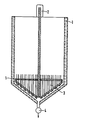
- the storage container consists of an outer wall with thermal insulation layer 1, its drive with gear 2 for a discharge agitator with gate 3 and a gate valve with pump 4.
- the storage container is filled in batches from a mixer with warm calcium silicate sludge. After a storage time of 10 hours, the agitator 3 is switched on briefly in order to convert the strongly thickened calcium silicate impact into a flowable and pumpable consistency; at the same time, a certain amount is pumped out to a screen press by means of pump 4.
Landscapes
- Chemical & Material Sciences (AREA)
- Engineering & Computer Science (AREA)
- Ceramic Engineering (AREA)
- Structural Engineering (AREA)
- Inorganic Chemistry (AREA)
- Materials Engineering (AREA)
- Chemical Kinetics & Catalysis (AREA)
- Organic Chemistry (AREA)
- Curing Cements, Concrete, And Artificial Stone (AREA)
- Solid-Sorbent Or Filter-Aiding Compositions (AREA)
- Silicates, Zeolites, And Molecular Sieves (AREA)
- Thermal Insulation (AREA)
- Glass Compositions (AREA)
- Insulated Conductors (AREA)
- Working-Up Tar And Pitch (AREA)
Priority Applications (1)
| Application Number | Priority Date | Filing Date | Title |
|---|---|---|---|
| AT85111714T ATE54436T1 (de) | 1984-10-12 | 1985-09-17 | Verfahren zum herstellen von waermedaemmkoerpern. |
Applications Claiming Priority (2)
| Application Number | Priority Date | Filing Date | Title |
|---|---|---|---|
| DE3437415 | 1984-10-12 | ||
| DE3437415A DE3437415C1 (de) | 1984-10-12 | 1984-10-12 | Verfahren zum Herstellen von Waermedaemmkoerpern |
Publications (3)
| Publication Number | Publication Date |
|---|---|
| EP0179268A2 true EP0179268A2 (fr) | 1986-04-30 |
| EP0179268A3 EP0179268A3 (en) | 1987-10-21 |
| EP0179268B1 EP0179268B1 (fr) | 1990-07-11 |
Family
ID=6247704
Family Applications (1)
| Application Number | Title | Priority Date | Filing Date |
|---|---|---|---|
| EP19850111714 Expired - Lifetime EP0179268B1 (fr) | 1984-10-12 | 1985-09-17 | Procédé pour la fabrication de matériaux calorifuges |
Country Status (3)
| Country | Link |
|---|---|
| EP (1) | EP0179268B1 (fr) |
| AT (1) | ATE54436T1 (fr) |
| DE (1) | DE3437415C1 (fr) |
Cited By (1)
| Publication number | Priority date | Publication date | Assignee | Title |
|---|---|---|---|---|
| EP0982275A3 (fr) * | 1998-08-28 | 2001-08-29 | Lias-Franken Leichtbaustoffe GmbH & Co. KG | Utilisation de matériau silicio-calcaire comme matériau résistant à la temperature |
Families Citing this family (1)
| Publication number | Priority date | Publication date | Assignee | Title |
|---|---|---|---|---|
| DE3641823A1 (de) * | 1986-12-06 | 1988-06-16 | Csp Chemie Entwicklungsgesells | Verfahren und vorrichtung zur herstellung plattenfoermiger bauelemente aus caliciumsilikat |
Family Cites Families (7)
| Publication number | Priority date | Publication date | Assignee | Title |
|---|---|---|---|---|
| DE481611C (de) * | 1925-05-06 | 1929-08-26 | Hans Scheidemandel Dr | Verfahren zur Herstellung von Waermeschutzmitteln |
| DE621341C (de) * | 1934-05-08 | 1935-11-05 | Karl Ivar Anders Eklund | Verfahren zur Herstellung hydrosilikatgebundener Formkoerper |
| GB456562A (en) * | 1936-03-17 | 1936-11-11 | Janos Albert | Process for the manufacture of highly porous silica-lime stones |
| US2904444A (en) * | 1957-11-26 | 1959-09-15 | Fibreboard Paper Products Corp | Method of making calcareous-silicious insulating material |
| FI37267A (fi) * | 1964-09-09 | 1967-10-10 | Outokumpu Oy | Säätölaitteisto kiintomateriaalin poistamiseksi leijukerrosuunien reaktiotilasta |
| FR1534997A (fr) * | 1967-07-13 | 1968-08-02 | Osaka Packing | Procédé de fabrication d'une pâte aqueuse à base de silicate de calicum hydratéet produits en résultant |
| DE2832125C2 (de) * | 1978-07-21 | 1983-03-03 | Mars Inc., 22102 McLean, Va. | Verfahren zur Herstellung von feuerbeständigen maßgenauen Leichtbauplatten |
-
1984
- 1984-10-12 DE DE3437415A patent/DE3437415C1/de not_active Expired
-
1985
- 1985-09-17 EP EP19850111714 patent/EP0179268B1/fr not_active Expired - Lifetime
- 1985-09-17 AT AT85111714T patent/ATE54436T1/de not_active IP Right Cessation
Cited By (1)
| Publication number | Priority date | Publication date | Assignee | Title |
|---|---|---|---|---|
| EP0982275A3 (fr) * | 1998-08-28 | 2001-08-29 | Lias-Franken Leichtbaustoffe GmbH & Co. KG | Utilisation de matériau silicio-calcaire comme matériau résistant à la temperature |
Also Published As
| Publication number | Publication date |
|---|---|
| ATE54436T1 (de) | 1990-07-15 |
| DE3437415C1 (de) | 1986-04-10 |
| EP0179268A3 (en) | 1987-10-21 |
| EP0179268B1 (fr) | 1990-07-11 |
Similar Documents
| Publication | Publication Date | Title |
|---|---|---|
| DE3414967C2 (de) | Verfahren zum Herstellen eines Leichtkeramikmaterials für Bauzwecke und Verwendung dieses Materials | |
| EP0182793B1 (fr) | Corps en ceramique a porosite elevee utilisee a des fins d'adsorption ou d'absorption, notamment pour litieres pour animaux, procede pour sa fabrication et son utilisation | |
| DE2631090C3 (de) | Bindemittelgenüsch | |
| DE2805523A1 (de) | Verfahren zur herstellung von gipsbauteilen | |
| DE2461781C2 (de) | Verfahren zur Herstellung eines asbestfreien, feuerfesten Formkörpers | |
| DE2949390C2 (de) | Härtbare Zusammensetzung zur Bildung von Ettringit (TSH), Zement, Gips, sowie bis zu 40 Gew.-% Fasermaterial enthaltenden Produkten | |
| EP0179268B1 (fr) | Procédé pour la fabrication de matériaux calorifuges | |
| DE2627823A1 (de) | Verfahren zur herstellung von kalk-siliciumdioxid-isolierungen aus perlit | |
| DE102007062492B4 (de) | Verfahren zur Herstellung eines zementgebundenen Formsteins und hergestellter Formstein | |
| DE2601683C3 (de) | Kalk-Kieselsäure-Gemisch sowie Verfahren zur Herstellung von dampfgehärteten Baustoffen daraus | |
| DE2339139A1 (de) | Keramische isoliersteine | |
| DE3221463A1 (de) | Verfahren zur herstellung eines leichtbaustoffes | |
| DE642466C (de) | Verfahren zur Herstellung eines Bindemittels | |
| CH642037A5 (en) | Refractory ceramic insulation bricks and a process for their production | |
| DE3315357C2 (de) | Verfahren zur Herstellung von leichten Isolier- und Bauelementen aus amorpher Kieselsäure, welche bei der Ferrosiliciumerzeugung anfällt | |
| DE3304033A1 (de) | Leichtbaustoff sowie verfahren zu seiner herstellung | |
| EP0176649A1 (fr) | Procédé pour la fabrication à sec des panneaux de construction en plâtre | |
| AT235189B (de) | Verfahren zur Herstellung von mikroporösen Leichtbeton-Bausteinen | |
| DD231338A1 (de) | Verfahren zur herstellung feuerfester waermedaemmender formkoerper und gemenge | |
| DE2130540C3 (de) | Verfahren zur Herstellung eines Zusatzmittels für Kalk- oder Zementmörtel | |
| AT149677B (de) | Verfahren zur Herstellung poröser Kunststeinmassen. | |
| EP0247238A2 (fr) | Matériau de construction léger et son procédé de fabrication | |
| DE4418310A1 (de) | Verfahren zur Herstellung von Porenbetonkörpern | |
| DE3331613A1 (de) | Gesinterter, poroeser, keramischer formkoerper | |
| EP0147814A2 (fr) | Perlite expansée |
Legal Events
| Date | Code | Title | Description |
|---|---|---|---|
| PUAI | Public reference made under article 153(3) epc to a published international application that has entered the european phase |
Free format text: ORIGINAL CODE: 0009012 |
|
| AK | Designated contracting states |
Kind code of ref document: A2 Designated state(s): AT BE CH DE FR GB IT LI LU NL SE |
|
| RBV | Designated contracting states (corrected) |
Designated state(s): AT BE CH FR GB IT LI NL SE |
|
| PUAL | Search report despatched |
Free format text: ORIGINAL CODE: 0009013 |
|
| AK | Designated contracting states |
Kind code of ref document: A3 Designated state(s): AT BE CH FR GB IT LI NL SE |
|
| 17P | Request for examination filed |
Effective date: 19871026 |
|
| 17Q | First examination report despatched |
Effective date: 19881229 |
|
| GRAA | (expected) grant |
Free format text: ORIGINAL CODE: 0009210 |
|
| AK | Designated contracting states |
Kind code of ref document: B1 Designated state(s): AT BE CH FR GB IT LI NL SE |
|
| PG25 | Lapsed in a contracting state [announced via postgrant information from national office to epo] |
Ref country code: SE Effective date: 19900711 Ref country code: IT Free format text: LAPSE BECAUSE OF FAILURE TO SUBMIT A TRANSLATION OF THE DESCRIPTION OR TO PAY THE FEE WITHIN THE PRESCRIBED TIME-LIMIT;WARNING: LAPSES OF ITALIAN PATENTS WITH EFFECTIVE DATE BEFORE 2007 MAY HAVE OCCURRED AT ANY TIME BEFORE 2007. THE CORRECT EFFECTIVE DATE MAY BE DIFFERENT FROM THE ONE RECORDED. Effective date: 19900711 Ref country code: FR Effective date: 19900711 Ref country code: BE Effective date: 19900711 |
|
| REF | Corresponds to: |
Ref document number: 54436 Country of ref document: AT Date of ref document: 19900715 Kind code of ref document: T |
|
| PGFP | Annual fee paid to national office [announced via postgrant information from national office to epo] |
Ref country code: GB Payment date: 19900823 Year of fee payment: 6 |
|
| GBT | Gb: translation of ep patent filed (gb section 77(6)(a)/1977) | ||
| PG25 | Lapsed in a contracting state [announced via postgrant information from national office to epo] |
Ref country code: AT Effective date: 19900917 |
|
| PG25 | Lapsed in a contracting state [announced via postgrant information from national office to epo] |
Ref country code: LI Effective date: 19900930 Ref country code: CH Effective date: 19900930 |
|
| PGFP | Annual fee paid to national office [announced via postgrant information from national office to epo] |
Ref country code: NL Payment date: 19900930 Year of fee payment: 6 |
|
| EN | Fr: translation not filed | ||
| PLBE | No opposition filed within time limit |
Free format text: ORIGINAL CODE: 0009261 |
|
| STAA | Information on the status of an ep patent application or granted ep patent |
Free format text: STATUS: NO OPPOSITION FILED WITHIN TIME LIMIT |
|
| REG | Reference to a national code |
Ref country code: CH Ref legal event code: PL |
|
| 26N | No opposition filed | ||
| PG25 | Lapsed in a contracting state [announced via postgrant information from national office to epo] |
Ref country code: GB Effective date: 19910917 |
|
| PG25 | Lapsed in a contracting state [announced via postgrant information from national office to epo] |
Ref country code: NL Effective date: 19920401 |
|
| GBPC | Gb: european patent ceased through non-payment of renewal fee | ||
| NLV4 | Nl: lapsed or anulled due to non-payment of the annual fee |